SMT. C.H.M College
DEPARTMENT OF BIOLOGY
Dr. Neelam Parab
Mr. Sunil Sharma
Mr. Rahul Badve
Mr. Sachin Sangare
Cell Structure
& Organisation
 The branch of biology which deals with
the study of structure, function,
molecular organisation, growth,
reproduction & genetics is called
Cytology/Cell Biology
 Simple microscope 50--100 times
 Compound microscope -- 1000 times &
more
 Electron microscope – 500000 times
 Cells have no specific/typical shape
(rectangular, circular, conical,
columnar)
Introduction
The Great Team
The term “Cell” was
introduced by Robert
Hooke
Anton van
Leeuwenhoek reported
other types of cells
J. E. Purkinje coined
the term Protoplasm.
Robert Brown
discovered & named
Nucleus
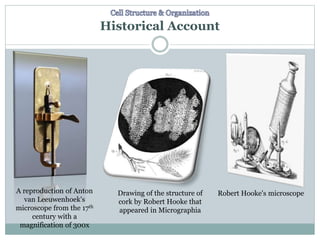
Historical Account
Historical Account
Robert Hooke's microscope
A reproduction of Anton
van Leeuwenhoek's
microscope from the 17th
century with a
magnification of 300x
Drawing of the structure of
cork by Robert Hooke that
appeared in Micrographia
Dimensions
Largest cell – Ostrich egg 15 cms.
Dimensions
Cell Theory/Cell Doctrine
 All organisms are made up of cells
 Cell is the basic structural &
functional unit of life
 Cells have genetic information & is passed from generation
to generation.
 Cells are similar in their chemical composition & metabolic
activity.
 All cells arise from pre-existing cells
 Cells are duplicating, self-contained units.
Exceptions to Cell Theory
 Viruses do not have cellular organisation
 Bacteria & BGA are prokaryotes, they do not show true
cellular structures
 Capacity of living nucleated cell, to differentiate into any
other type of cell & thus form a complete new organism.
TOTIPOTENCY
PROKARYOTIC CELL
NO Well Defined Nucleus
{NO WDN}
No Memb Bound cell Organelles
{NO MBO}
Pro – primitive Karyon – nucleus
Bacteria & Blue green algae constitute this group
There are four forms of bacteria
Spirilla– twisted
Cocci – spherical/ovoid
Vibrio – comma shaped
Bacilli – rodshaped
Prokaryotic Cell
Bacteria
Prokaryotic Cell
Blue green algae
(Cyanobacteria) are
photosynthetic prokaryotes.
They may be filamentous or
non filamentous
They fix atm. N2,
symbiotically or non
symbiotically
Blue green algae/Cyanobacteria
Prokaryotic Cell -- Components
Cell Envelope
Cytoplasm
Mesosomes
Chromatophores
Nucleoid/Genome Ribosomes
Inclusion bodies
Plasmids
Cell Envelope
It consists of three layers namely ;
GLYCOCALYX
Glycocalyx Cell wall
Plasma membrane
Outermost, made up of
macromolecules, help in
adhesion
Some have loose sheath
Slime, few have thick &
tough capsule.
Both the layers are made up
of polysaccharides & may
contain proteins
Glycocalyx
CELLWALL
Present below glycocalyx,
provides definite shape &
support.
Cellwalls of different bacteria show different types of
reactions with Gram’s Stain
 Made up of Peptidoglycans (Gram +ve) / Murein (Gram -ve)/ in
Eubacteria & Psuedo-peptidoglycan in Archaebacteria.
Cell Envelope
PLASMA MEMBRANE
Innermost covering made up
of Proteins & Lipids
Serves as barrier & helps in intercellular communication.
Bacterial plasma membrane is the site for photosynthesis,
respiration etc.
Membrane also holds receptor molecules to detect & respond
to chemicals.
Cell Envelope
No membrane bound nucleus, only long double stranded
circular DNA molecule
Highly coiled with the help of non histone proteins
Connected to plasma membrane through mesosome.
Nucleoid/Genome
Plasmids
Extra chromosomal, autonomously, self-replicating mini-
chromosomes
Render antibiotic resistance, fertility.
Used as an important tool in
Genetic engineering
Cytoplasm
Semi fluid ground substance or matrix.
Contains variety of inorganic & organic compounds.
Does not show cytoplasm streaming, lacks organelles.
Following membranous structures are seen
Mesosomes Chromatophores Inclusion bodies
Invaginations of plasma
membrane.
Forms vesicles, tubules,
lamellae.
 Involved in formation of
cell wall, DNA replication.
 Also involved in distribution of chromosomes to cells.
Exact function is still
unknown
Mesosomes
Usually seen in photosynthetic bacteria & BGA
They contain different
pigments such as;
Bacteriophaeophytin
Carotenoids
Bacteriochlorophylls
Chromatophores
Dense particles in the cytoplasm, made up of RNA & Proteins
Each 70s ribosome is made
up of two subunits 50s & 30s
Helps in protein synthesis
Termed as 70s ribosomes
S stands for Svedberg unit
(sedimentation in centrifuge
depending on speed & size of
particle).
Ribosomes
Storage granules lie freely in cytoplasm
They are of two types such as
Cyanophycean granules, Starch granules, Glycogen granules
Inorganic Inclusions
Organic Inclusions
Phosphates & Sulphur granules
Inclusion Bodies
EUKARYOTIC
CELL
Cell Wall
Protective, semi-transparent,
thick, strong, rigid
Made up of polysaccharides such as
Cellulose Pectin
Lignin Hemicellulose
Cutin
Suberin
Provides shape, helps in transport of material
Shows three layers namely
Primary cell wall – capable of
growth, seen in meristematic tissue,
mesophyll, pith.
Middle lamella – cementing substance
pectin, calcium and magnesium (ripening
is due to solubilization of pectin)
Secondary cell wall – thickens the wall, presence of pits, plasmodesmata
(cytoplasmic bridges)
Plasma Membrane/Cell membrane
Semi-permeable or selectively permeable
70 to 80 Ao in thickness,
structure explained by Singer
& Nicholson in Fluid Mosaic
Model
Different Proteins are
present in viscous fluid
matrix of phospholipid bi
layer so (trilaminar)
Each phospholipid bilayer
consists of Head & Tails
Head is hydrophillic & tail is hydrophobic
Lipid bilayer is 45 A o thick, tails at rightangles to the surface
Hydrophobic ends face each other, external surface has hydrophillic ends
Quasifluid nature of lipids renders fluidity and thus lateral movement of
proteins takes place
Plasma Membrane contd….
Proteins are globular, of 2 types
Extrinsic & Intrinsic
Extrinsic/Peripheral are
loosely held, intrinsic are
tightly bound also called as
Integral proteins.
 Some run across the entire
thickness & are called as
tunnel proteins
Tunnel proteins serve as a
passage for polar molecules
Transport of molecules across takes place passively, actively and osmosis
as well
Functions of Plasma Membrane
Imparts shape, protects
Regulates semi-permeability, reabsorption, excretion
& secretion.
Contributes in the formation of cell organelles
Many membranes serves as enzymes
Serves as a receptor of stimuli.
In amoeba it carries out locomotion, phagocytosis &
pinocytosis
Cytoplasm
Jelly like colloidal ground substance also called matrix
Outer ectoplasm, inner endoplasm
Shows streaming movements called CYCLOSIS
 Composed of sugars, amino acids, t-RNA, Nucleotides, minerals, vitamins,
proteins & enzymes.
 Also contains many organelles like nucleus, mitochondria.
 Source of raw materials and seat of metabolic activities
 As organelles like mitochondria and chloroplast have distinct functions
hence all other organelles are together termed as endomembrane
system.
CELL
ORGANELLES
Mitochondria
Endoplasmic Reticulum
Golgi apparatus
Plastids
Lysosomes
Sphaerosomes
Perioxisomes
Glyoxysomes
Ribosomes
Centrioles
Vacuoles
Mitochondria
Covered by lipo-proteinaceous double
membrane.
Polymorphic -- Rod shaped, filamentous,
small spherical, granular
0.2 to 2 micrometers, average number 50
to 50,000
Mitos – thread, Chondros -- granule
Also called as power house of cell as it
generated ATP
Inner membrane folded, selectively permeable
Outer membrane is smooth, permeable, 60 AO
Folds are called cristae, contain Oxysomes/F1 particles
Cavity is filled with dense homogenous, proteinaceous fluid called matrix
Matrix shows DNA, RNA, Proteins, Lipids, Ribosomes
Mitochondria contd….
ULTRASTRUCTURE
Head piece (100 AO),
Oxysomes show Head piece, stalk piece & Base piece
Stalk piece (32 AO)
Base piece(45 AO)
Mitochondria contd….
Electron Carrier molecules or Coenzymes are
present on the rest of the membrane.
They are the molecules of ATPase for
terminal step.
1 to 10 lacs of oxysomes are seen in a
mitochondrion
ULTRASTRUCTURE
Cytochromes
Electron carriers are as follows
Dehydrogenases Flavoproteins
Glucose (6C)
Pyruvic acid (3C)
NADH2 & FADH2
CO2 & H2O
Glycolysis
Cytoplasm
Kreb’s Cycle
Matrix
ETS
F1 particle
Steps in Respiration
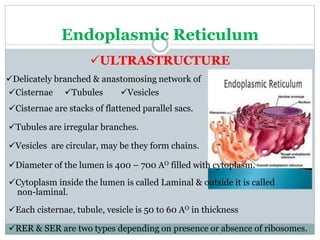
Endoplasmic Reticulum
Tubules are irregular branches.
Cisternae are stacks of flattened parallel sacs.
Delicately branched & anastomosing network of
ULTRASTRUCTURE
Cisternae
Vesicles are circular, may be they form chains.
Tubules Vesicles
Each cisternae, tubule, vesicle is 50 to 60 AO in thickness
Diameter of the lumen is 400 – 700 AO filled with cytoplasm.
RER & SER are two types depending on presence or absence of ribosomes.
Cytoplasm inside the lumen is called Laminal & outside it is called
non-laminal.
Endoplasmic Reticulum contd…
Connected at one end with nuclear membrane
& the other with plasma membrane
Functions
Provide mechanical support to cytoplasm.
Helps in maintaining position of other organelles
Glycogen & lipids are synthesized & stored in ER.
SER plays role in detoxification of liver.
It also plays a role in synthesis & secretion of lipds.
Provides precursors to Golgi Complex.
RER – Protein Synthesis, associated Ribosomes are called protein factories
It also plays a role in synthesis steroid hormones by gonad & Adrenal cortex
Golgi Complex
Described by Camillo Golgi (nervous tissue)
ULTRASTRUCTURE
Aggregation of few to hundreds of
membrane bound bodiesMembranes are
smooth.
Membrane limited flattened saccules
or cisternae
Vesicles -- Large vacuoles filled with
amorphous substance
Made up of cisternae/lamellae, vesicles.
Lamellae/Cisternae are closely stacked, Commonly 2 to 8 in number
Around 50 lamellae are seen in liver cells
Plastids
Found in Algae, Plant cells & certain Protists
Semiautonomous having DNA, & double membrane
Leucoplasts
Chromoplasts
They are of three main types
Chloroplasts
No pigments
colourless,
Store food material
Amyloplast – starch
Elaioplast – oils
Aleuroplast – proteins
Coloured contains
pigments other than
chlorophyll Yellow, Orange,
Red in colour, found in flower
& fruits Green coloured
because of
chlorophyll
Chloroplast
ULTRASTRUCTURE
Polymorphic, covered by double
membrane peri-stromium, made up
of lipoproteins.
Outer and inner membrane encloses
peri-plastidil space.
Internally filled with homogenous
proteinaceous matrix -- stroma
Shows network of lamellae, namely;
grana & stroma lamellae
(Intergranal lamellae/fret channels)
Grana made up of thyllakoids, containing quantasomes, pigments for
photosynthesis.
Thyllakoids are membrane bound flattened sac like structures.
Plastidome – DNA molecule which makes chloroplast semiautonomous.
Lysosomes
Lysosomes are single lipo-proteinacious membrane
bound bodies
Lyso=digestive Soma=body
Elliptical or highly irregular in shape contain hydrolytic
enzymes hence called Suicidal Bags
Present in animal cells (except
mammalian RBC’s)
Avg. diameter – 0.25 to 0.8
micrometer, polymorphic
Lysosomes originate from “GERL”(Golgi associated ER)
Enzymes seen in a lysosome are
Acid Phophotases
Sulphatases
Proteases
Nucleases
Lipases
Glycosidases
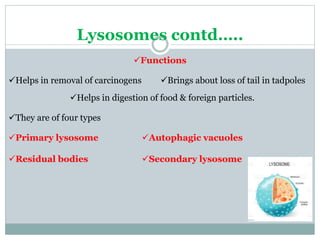
Lysosomes contd…..
They are of four types
Primary lysosome
Secondary lysosome
Residual bodies
Autophagic vacuoles
Brings about loss of tail in tadpoles
Helps in digestion of food & foreign particles.
Helps in removal of carcinogens
Functions
Lysosomes contd…..
Small granules, homogenous contents
Inactive storage form or ready reserves of enzymes.
Formed by fusion of primary lysosome with endocytosis vacuoles
Larger bodies, heterogenous contents
Primary lysosome
Secondary lysosome/Heterophagic granules
Primary lysosome may fuse to an unwanted organelle to form a large sac
called as autophagic vacuole or auto-phagosome
Secondary lysosomes containing indigestible matter are called as residual
bodies.
Residual bodies
Lysosomes contd…..
Cells with diminished physiological activity require internal re-modelling
(intracellular digestion).
Excess organelles are eliminated by autophagy
In Dead cells the enzymes are released & thus the cells are digested.
In Sperms the enzyme Hyaluronidase dissolves the protective coat of
ovum.
Sphaerosomes – Storage & Synthesis of fats
Few other organelles
Perioxisomes – contains enzymes for synthesis of peroxides
Glyoxysomes – micro-bodies for oxidation of fatty acids
(germinating seeds)
Granular organelles not bound by
membrane
Ribosomes
Sites of Protein synthesis
Found attached to ER, also in
cytoplasm, mitochondrial matrix &
chloroplast.
150-250 AO in diameter, contain
RNA & proteins.
80S Ribosomes occur in groups and
are called as polysomes or
polyribosomes.
In groups they may be arranged
linearly or in rosette shaped cluster.
Membrane (semi permeable - tonoplast) bound fluid (cell sap) filled spaces are
called vacuoles.
Vacuoles
Alkaloids
They may contain Amino acids
Minerals  Esters
Tanins
 Waste products
Water soluble pigments - Anthocyanin
Prominently found in plants (2 -3 permanent
are seen), in animal cells few & smaller.
A single large vacuole occupying 90% of
cells volume called as central vacuole can
be seen.
Cell sap of vacuole is a store house of various ions & hence hypertonic
Some seeds store organic material like proteins in small vacuoles.
Maintains turgidity, excretion & osmoregulation
They store excretory products or compounds harmful or unpalatable to
herbivores.
Non membranous cylindrical or
rod-shaped micro-tubular structures
in animal cells
Centrioles
Nine clusters of 3 microtubules
arranged in circular pattern.
Help in spindle formation & basal
bodies of flagella.
Dense area of cytoplasm
containing radiating microtubules.
Centrosomes contain a pair of
cylindrical structures called as
centrioles.
Diameter – 1500 to 2500 AO
length – 1600 AO to 8 microns.
Cilia & Flagella
Fine hair like protoplasmic
outgrowths on free surface of cell.
Generate a current for transport of
materials & locomotion.
Cilia are small and many whereas
flagella is single and long.
They consist of basal body, basal
plate and shaft.
Basal body is placed in cytoplasm and derived from centriole.
It has nine peripheral triplets of fibrils (arranged like centriole)
Central tubule is covered by central sheath.
Shaft consists of sheath and axoneme, axoneme posesses 11 fibrils 9
peripheral doublets and two single central fibrils.
Sheath is connected to one of the tubule by radial spoke, central tubules
are connected to each other by bridges.
Peripheral doublets are connected through linkers/inter-doublet bridge.
Non living materials in vacuoles, cytoplasm or cellwall
Cell inclusions
They may be organic/inorganic in chemical composition.
Discovered by Robert Brown
Nucleus
Usually cells have single nucleus, in certain cases bi nucleated
(paramoecium), & multinucleated (fungi).
Prokaryotic cell shows only chromosome and is called as
nucleoid/Genome
Such cells are called Syncytial (animals) & Coenocytes (plants)
Position
Nucleus is placed centrally usually, variations are seen
Glandular cells – basal Adipose cells – peripheral
Nucleus contd…
Shape & Size
Depends on the shape of the cell
Columnar cells – Ovoid /elongated
Cuboidal cells -- Spherical
Squamous epithelial cells – disc shaped
WBC’s – bi/multilobed
Vorticella – “c” shaped
 Depends on volume of cell, amount of DNA & Proteins & metabolic
phase of cell
Nucleus contd…
It also consists nuclear pores, annuli, central granule & fibrous lamina.
Ideally a well defined nucleus shows following parts
Nuclear membrane Nucleoplasm Nucleolus
Nuclear pores Chromatin network
Nuclear membrane
Made up of two membranes, outer & inner with peri-nuclear space
 7-8 nm in thickness, outer communicates with ER & inner contains
dense material called fibrous lamina.
Nucleus contd…
Perinuclear Space
10-70 nm filled with fluid similar to ER.
Annuli
Nuclear pores are enclosed by electron dense rings/cylinders called as
annuli.
Nuclear pore + Annulus = Pore complex
Annuli work as diaphragm while pore complex works for selective
permeability
Central Granule
Not a constant feature
Nucleus contd…
Fibrous lamina
Honey comb pattern made up of acid protein
Functions of nuclear envelope
Separation of nuclear material from cytoplasm
Exchange of necessary materials
Attachment of organelles like ER
Synthesizes proteins
Source membrane for other membranes
Video......VideosXIIProtein Synthesis.mpg
Nucleus contd…
Transparent, semisolid, granular, acidophillic matrix called as nuclear
sap/nucleoplasm/karyolymph
Contains nucleic acids, proteins, enzymes & minerals.
Nucleoplasm
Nucleolus
Spherical acidophillic body
Active cells have large nucleolus,
Cells without synthetic activity may lack nucleolus
Dense homogenous body without limiting membrane
Coiled filament called nucleolonema in matrix
Amorphous matrix, chromatin, fibrils & granules
Nucleus contd…
Thread like coiled & much elongated structures
Stained by Feulgen stain heterochromatin & Euchromatin
Chromatin material
 Heterochromatin – dark, metabolically & genetically inert
Euchromatin – light, genetically active
Made up of nuleosomes, forms chromosomes
Nuclear
membrane
Nucleoplasm
Nucleolus
Chromatin
network
Nuclear pore
Eukaryotic Nucleus
well defined
Video

Chapter_5_Cell_structure_and_Organisation.pptx

  • 1.
    SMT. C.H.M College DEPARTMENTOF BIOLOGY Dr. Neelam Parab Mr. Sunil Sharma Mr. Rahul Badve Mr. Sachin Sangare
  • 2.
  • 3.
     The branchof biology which deals with the study of structure, function, molecular organisation, growth, reproduction & genetics is called Cytology/Cell Biology  Simple microscope 50--100 times  Compound microscope -- 1000 times & more  Electron microscope – 500000 times  Cells have no specific/typical shape (rectangular, circular, conical, columnar) Introduction
  • 4.
    The Great Team Theterm “Cell” was introduced by Robert Hooke Anton van Leeuwenhoek reported other types of cells J. E. Purkinje coined the term Protoplasm. Robert Brown discovered & named Nucleus Historical Account
  • 5.
    Historical Account Robert Hooke'smicroscope A reproduction of Anton van Leeuwenhoek's microscope from the 17th century with a magnification of 300x Drawing of the structure of cork by Robert Hooke that appeared in Micrographia
  • 6.
  • 7.
    Largest cell –Ostrich egg 15 cms. Dimensions
  • 8.
    Cell Theory/Cell Doctrine All organisms are made up of cells  Cell is the basic structural & functional unit of life  Cells have genetic information & is passed from generation to generation.  Cells are similar in their chemical composition & metabolic activity.  All cells arise from pre-existing cells  Cells are duplicating, self-contained units.
  • 9.
    Exceptions to CellTheory  Viruses do not have cellular organisation  Bacteria & BGA are prokaryotes, they do not show true cellular structures  Capacity of living nucleated cell, to differentiate into any other type of cell & thus form a complete new organism. TOTIPOTENCY
  • 10.
    PROKARYOTIC CELL NO WellDefined Nucleus {NO WDN} No Memb Bound cell Organelles {NO MBO}
  • 11.
    Pro – primitiveKaryon – nucleus Bacteria & Blue green algae constitute this group There are four forms of bacteria Spirilla– twisted Cocci – spherical/ovoid Vibrio – comma shaped Bacilli – rodshaped Prokaryotic Cell Bacteria
  • 12.
    Prokaryotic Cell Blue greenalgae (Cyanobacteria) are photosynthetic prokaryotes. They may be filamentous or non filamentous They fix atm. N2, symbiotically or non symbiotically Blue green algae/Cyanobacteria
  • 13.
    Prokaryotic Cell --Components Cell Envelope Cytoplasm Mesosomes Chromatophores Nucleoid/Genome Ribosomes Inclusion bodies Plasmids
  • 14.
    Cell Envelope It consistsof three layers namely ; GLYCOCALYX Glycocalyx Cell wall Plasma membrane Outermost, made up of macromolecules, help in adhesion Some have loose sheath Slime, few have thick & tough capsule. Both the layers are made up of polysaccharides & may contain proteins Glycocalyx
  • 15.
    CELLWALL Present below glycocalyx, providesdefinite shape & support. Cellwalls of different bacteria show different types of reactions with Gram’s Stain  Made up of Peptidoglycans (Gram +ve) / Murein (Gram -ve)/ in Eubacteria & Psuedo-peptidoglycan in Archaebacteria. Cell Envelope
  • 16.
    PLASMA MEMBRANE Innermost coveringmade up of Proteins & Lipids Serves as barrier & helps in intercellular communication. Bacterial plasma membrane is the site for photosynthesis, respiration etc. Membrane also holds receptor molecules to detect & respond to chemicals. Cell Envelope
  • 17.
    No membrane boundnucleus, only long double stranded circular DNA molecule Highly coiled with the help of non histone proteins Connected to plasma membrane through mesosome. Nucleoid/Genome
  • 18.
    Plasmids Extra chromosomal, autonomously,self-replicating mini- chromosomes Render antibiotic resistance, fertility. Used as an important tool in Genetic engineering
  • 19.
    Cytoplasm Semi fluid groundsubstance or matrix. Contains variety of inorganic & organic compounds. Does not show cytoplasm streaming, lacks organelles. Following membranous structures are seen Mesosomes Chromatophores Inclusion bodies
  • 20.
    Invaginations of plasma membrane. Formsvesicles, tubules, lamellae.  Involved in formation of cell wall, DNA replication.  Also involved in distribution of chromosomes to cells. Exact function is still unknown Mesosomes
  • 21.
    Usually seen inphotosynthetic bacteria & BGA They contain different pigments such as; Bacteriophaeophytin Carotenoids Bacteriochlorophylls Chromatophores
  • 22.
    Dense particles inthe cytoplasm, made up of RNA & Proteins Each 70s ribosome is made up of two subunits 50s & 30s Helps in protein synthesis Termed as 70s ribosomes S stands for Svedberg unit (sedimentation in centrifuge depending on speed & size of particle). Ribosomes
  • 23.
    Storage granules liefreely in cytoplasm They are of two types such as Cyanophycean granules, Starch granules, Glycogen granules Inorganic Inclusions Organic Inclusions Phosphates & Sulphur granules Inclusion Bodies
  • 25.
  • 26.
    Cell Wall Protective, semi-transparent, thick,strong, rigid Made up of polysaccharides such as Cellulose Pectin Lignin Hemicellulose Cutin Suberin Provides shape, helps in transport of material Shows three layers namely Primary cell wall – capable of growth, seen in meristematic tissue, mesophyll, pith. Middle lamella – cementing substance pectin, calcium and magnesium (ripening is due to solubilization of pectin) Secondary cell wall – thickens the wall, presence of pits, plasmodesmata (cytoplasmic bridges)
  • 27.
    Plasma Membrane/Cell membrane Semi-permeableor selectively permeable 70 to 80 Ao in thickness, structure explained by Singer & Nicholson in Fluid Mosaic Model Different Proteins are present in viscous fluid matrix of phospholipid bi layer so (trilaminar) Each phospholipid bilayer consists of Head & Tails Head is hydrophillic & tail is hydrophobic Lipid bilayer is 45 A o thick, tails at rightangles to the surface Hydrophobic ends face each other, external surface has hydrophillic ends Quasifluid nature of lipids renders fluidity and thus lateral movement of proteins takes place
  • 28.
    Plasma Membrane contd…. Proteinsare globular, of 2 types Extrinsic & Intrinsic Extrinsic/Peripheral are loosely held, intrinsic are tightly bound also called as Integral proteins.  Some run across the entire thickness & are called as tunnel proteins Tunnel proteins serve as a passage for polar molecules Transport of molecules across takes place passively, actively and osmosis as well
  • 29.
    Functions of PlasmaMembrane Imparts shape, protects Regulates semi-permeability, reabsorption, excretion & secretion. Contributes in the formation of cell organelles Many membranes serves as enzymes Serves as a receptor of stimuli. In amoeba it carries out locomotion, phagocytosis & pinocytosis
  • 30.
    Cytoplasm Jelly like colloidalground substance also called matrix Outer ectoplasm, inner endoplasm Shows streaming movements called CYCLOSIS  Composed of sugars, amino acids, t-RNA, Nucleotides, minerals, vitamins, proteins & enzymes.  Also contains many organelles like nucleus, mitochondria.  Source of raw materials and seat of metabolic activities  As organelles like mitochondria and chloroplast have distinct functions hence all other organelles are together termed as endomembrane system.
  • 31.
  • 32.
    Mitochondria Covered by lipo-proteinaceousdouble membrane. Polymorphic -- Rod shaped, filamentous, small spherical, granular 0.2 to 2 micrometers, average number 50 to 50,000 Mitos – thread, Chondros -- granule Also called as power house of cell as it generated ATP Inner membrane folded, selectively permeable Outer membrane is smooth, permeable, 60 AO Folds are called cristae, contain Oxysomes/F1 particles Cavity is filled with dense homogenous, proteinaceous fluid called matrix Matrix shows DNA, RNA, Proteins, Lipids, Ribosomes
  • 33.
    Mitochondria contd…. ULTRASTRUCTURE Head piece(100 AO), Oxysomes show Head piece, stalk piece & Base piece Stalk piece (32 AO) Base piece(45 AO)
  • 34.
    Mitochondria contd…. Electron Carriermolecules or Coenzymes are present on the rest of the membrane. They are the molecules of ATPase for terminal step. 1 to 10 lacs of oxysomes are seen in a mitochondrion ULTRASTRUCTURE Cytochromes Electron carriers are as follows Dehydrogenases Flavoproteins
  • 35.
    Glucose (6C) Pyruvic acid(3C) NADH2 & FADH2 CO2 & H2O Glycolysis Cytoplasm Kreb’s Cycle Matrix ETS F1 particle Steps in Respiration
  • 37.
    Endoplasmic Reticulum Tubules areirregular branches. Cisternae are stacks of flattened parallel sacs. Delicately branched & anastomosing network of ULTRASTRUCTURE Cisternae Vesicles are circular, may be they form chains. Tubules Vesicles Each cisternae, tubule, vesicle is 50 to 60 AO in thickness Diameter of the lumen is 400 – 700 AO filled with cytoplasm. RER & SER are two types depending on presence or absence of ribosomes. Cytoplasm inside the lumen is called Laminal & outside it is called non-laminal.
  • 38.
    Endoplasmic Reticulum contd… Connectedat one end with nuclear membrane & the other with plasma membrane Functions Provide mechanical support to cytoplasm. Helps in maintaining position of other organelles Glycogen & lipids are synthesized & stored in ER. SER plays role in detoxification of liver. It also plays a role in synthesis & secretion of lipds. Provides precursors to Golgi Complex. RER – Protein Synthesis, associated Ribosomes are called protein factories It also plays a role in synthesis steroid hormones by gonad & Adrenal cortex
  • 39.
    Golgi Complex Described byCamillo Golgi (nervous tissue) ULTRASTRUCTURE Aggregation of few to hundreds of membrane bound bodiesMembranes are smooth. Membrane limited flattened saccules or cisternae Vesicles -- Large vacuoles filled with amorphous substance Made up of cisternae/lamellae, vesicles. Lamellae/Cisternae are closely stacked, Commonly 2 to 8 in number Around 50 lamellae are seen in liver cells
  • 40.
    Plastids Found in Algae,Plant cells & certain Protists Semiautonomous having DNA, & double membrane Leucoplasts Chromoplasts They are of three main types Chloroplasts No pigments colourless, Store food material Amyloplast – starch Elaioplast – oils Aleuroplast – proteins Coloured contains pigments other than chlorophyll Yellow, Orange, Red in colour, found in flower & fruits Green coloured because of chlorophyll
  • 41.
    Chloroplast ULTRASTRUCTURE Polymorphic, covered bydouble membrane peri-stromium, made up of lipoproteins. Outer and inner membrane encloses peri-plastidil space. Internally filled with homogenous proteinaceous matrix -- stroma Shows network of lamellae, namely; grana & stroma lamellae (Intergranal lamellae/fret channels) Grana made up of thyllakoids, containing quantasomes, pigments for photosynthesis. Thyllakoids are membrane bound flattened sac like structures. Plastidome – DNA molecule which makes chloroplast semiautonomous.
  • 42.
    Lysosomes Lysosomes are singlelipo-proteinacious membrane bound bodies Lyso=digestive Soma=body Elliptical or highly irregular in shape contain hydrolytic enzymes hence called Suicidal Bags Present in animal cells (except mammalian RBC’s) Avg. diameter – 0.25 to 0.8 micrometer, polymorphic Lysosomes originate from “GERL”(Golgi associated ER) Enzymes seen in a lysosome are Acid Phophotases Sulphatases Proteases Nucleases Lipases Glycosidases
  • 43.
    Lysosomes contd….. They areof four types Primary lysosome Secondary lysosome Residual bodies Autophagic vacuoles Brings about loss of tail in tadpoles Helps in digestion of food & foreign particles. Helps in removal of carcinogens Functions
  • 44.
    Lysosomes contd….. Small granules,homogenous contents Inactive storage form or ready reserves of enzymes. Formed by fusion of primary lysosome with endocytosis vacuoles Larger bodies, heterogenous contents Primary lysosome Secondary lysosome/Heterophagic granules Primary lysosome may fuse to an unwanted organelle to form a large sac called as autophagic vacuole or auto-phagosome
  • 45.
    Secondary lysosomes containingindigestible matter are called as residual bodies. Residual bodies Lysosomes contd….. Cells with diminished physiological activity require internal re-modelling (intracellular digestion). Excess organelles are eliminated by autophagy In Dead cells the enzymes are released & thus the cells are digested. In Sperms the enzyme Hyaluronidase dissolves the protective coat of ovum.
  • 46.
    Sphaerosomes – Storage& Synthesis of fats Few other organelles Perioxisomes – contains enzymes for synthesis of peroxides Glyoxysomes – micro-bodies for oxidation of fatty acids (germinating seeds)
  • 47.
    Granular organelles notbound by membrane Ribosomes Sites of Protein synthesis Found attached to ER, also in cytoplasm, mitochondrial matrix & chloroplast. 150-250 AO in diameter, contain RNA & proteins. 80S Ribosomes occur in groups and are called as polysomes or polyribosomes. In groups they may be arranged linearly or in rosette shaped cluster.
  • 48.
    Membrane (semi permeable- tonoplast) bound fluid (cell sap) filled spaces are called vacuoles. Vacuoles Alkaloids They may contain Amino acids Minerals  Esters Tanins  Waste products Water soluble pigments - Anthocyanin Prominently found in plants (2 -3 permanent are seen), in animal cells few & smaller. A single large vacuole occupying 90% of cells volume called as central vacuole can be seen. Cell sap of vacuole is a store house of various ions & hence hypertonic Some seeds store organic material like proteins in small vacuoles. Maintains turgidity, excretion & osmoregulation They store excretory products or compounds harmful or unpalatable to herbivores.
  • 49.
    Non membranous cylindricalor rod-shaped micro-tubular structures in animal cells Centrioles Nine clusters of 3 microtubules arranged in circular pattern. Help in spindle formation & basal bodies of flagella. Dense area of cytoplasm containing radiating microtubules. Centrosomes contain a pair of cylindrical structures called as centrioles. Diameter – 1500 to 2500 AO length – 1600 AO to 8 microns.
  • 50.
    Cilia & Flagella Finehair like protoplasmic outgrowths on free surface of cell. Generate a current for transport of materials & locomotion. Cilia are small and many whereas flagella is single and long. They consist of basal body, basal plate and shaft. Basal body is placed in cytoplasm and derived from centriole. It has nine peripheral triplets of fibrils (arranged like centriole) Central tubule is covered by central sheath. Shaft consists of sheath and axoneme, axoneme posesses 11 fibrils 9 peripheral doublets and two single central fibrils. Sheath is connected to one of the tubule by radial spoke, central tubules are connected to each other by bridges. Peripheral doublets are connected through linkers/inter-doublet bridge.
  • 51.
    Non living materialsin vacuoles, cytoplasm or cellwall Cell inclusions They may be organic/inorganic in chemical composition.
  • 52.
    Discovered by RobertBrown Nucleus Usually cells have single nucleus, in certain cases bi nucleated (paramoecium), & multinucleated (fungi). Prokaryotic cell shows only chromosome and is called as nucleoid/Genome Such cells are called Syncytial (animals) & Coenocytes (plants) Position Nucleus is placed centrally usually, variations are seen Glandular cells – basal Adipose cells – peripheral
  • 53.
    Nucleus contd… Shape &Size Depends on the shape of the cell Columnar cells – Ovoid /elongated Cuboidal cells -- Spherical Squamous epithelial cells – disc shaped WBC’s – bi/multilobed Vorticella – “c” shaped  Depends on volume of cell, amount of DNA & Proteins & metabolic phase of cell
  • 54.
    Nucleus contd… It alsoconsists nuclear pores, annuli, central granule & fibrous lamina. Ideally a well defined nucleus shows following parts Nuclear membrane Nucleoplasm Nucleolus Nuclear pores Chromatin network Nuclear membrane Made up of two membranes, outer & inner with peri-nuclear space  7-8 nm in thickness, outer communicates with ER & inner contains dense material called fibrous lamina.
  • 55.
    Nucleus contd… Perinuclear Space 10-70nm filled with fluid similar to ER. Annuli Nuclear pores are enclosed by electron dense rings/cylinders called as annuli. Nuclear pore + Annulus = Pore complex Annuli work as diaphragm while pore complex works for selective permeability Central Granule Not a constant feature
  • 56.
    Nucleus contd… Fibrous lamina Honeycomb pattern made up of acid protein Functions of nuclear envelope Separation of nuclear material from cytoplasm Exchange of necessary materials Attachment of organelles like ER Synthesizes proteins Source membrane for other membranes Video......VideosXIIProtein Synthesis.mpg
  • 57.
    Nucleus contd… Transparent, semisolid,granular, acidophillic matrix called as nuclear sap/nucleoplasm/karyolymph Contains nucleic acids, proteins, enzymes & minerals. Nucleoplasm Nucleolus Spherical acidophillic body Active cells have large nucleolus, Cells without synthetic activity may lack nucleolus Dense homogenous body without limiting membrane Coiled filament called nucleolonema in matrix Amorphous matrix, chromatin, fibrils & granules
  • 58.
    Nucleus contd… Thread likecoiled & much elongated structures Stained by Feulgen stain heterochromatin & Euchromatin Chromatin material  Heterochromatin – dark, metabolically & genetically inert Euchromatin – light, genetically active Made up of nuleosomes, forms chromosomes
  • 59.
  • 60.