1
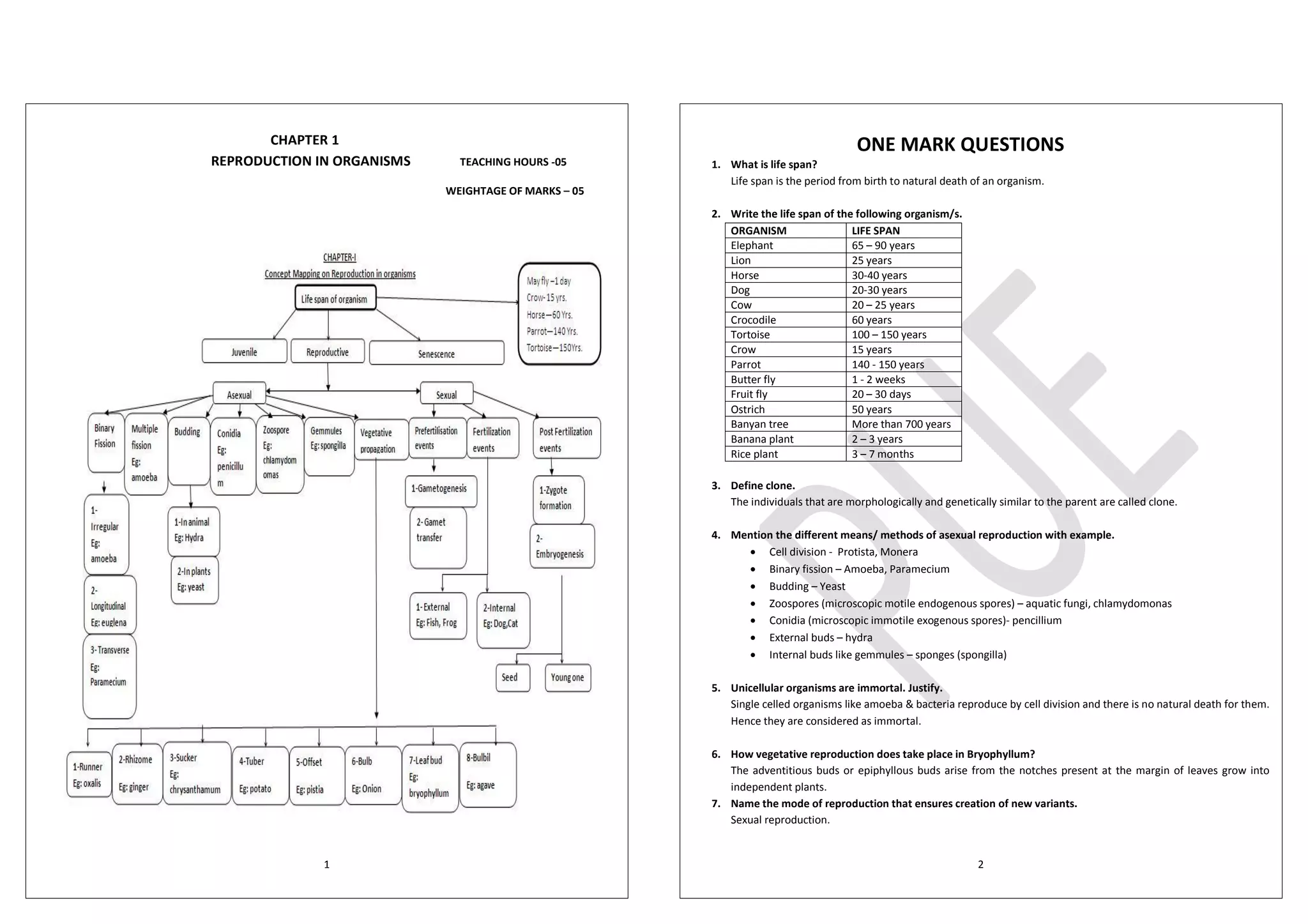
CHAPTER 1
REPRODUCTION IN ORGANISMS TEACHING HOURS -05
WEIGHTAGE OF MARKS – 05
2
ONE MARK QUESTIONS
1. What is life span?
Life span is the period from birth to natural death of an organism.
2. Write the life span of the following organism/s.
ORGANISM LIFE SPAN
Elephant 65 – 90 years
Lion 25 years
Horse 30-40 years
Dog 20-30 years
Cow 20 – 25 years
Crocodile 60 years
Tortoise 100 – 150 years
Crow 15 years
Parrot 140 - 150 years
Butter fly 1 - 2 weeks
Fruit fly 20 – 30 days
Ostrich 50 years
Banyan tree More than 700 years
Banana plant 2 – 3 years
Rice plant 3 – 7 months
3. Define clone.
The individuals that are morphologically and genetically similar to the parent are called clone.
4. Mention the different means/ methods of asexual reproduction with example.
· Cell division - Protista, Monera
· Binary fission – Amoeba, Paramecium
· Budding – Yeast
· Zoospores (microscopic motile endogenous spores) – aquatic fungi, chlamydomonas
· Conidia (microscopic immotile exogenous spores)- pencillium
· External buds – hydra
· Internal buds like gemmules – sponges (spongilla)
5. Unicellular organisms are immortal. Justify.
Single celled organisms like amoeba & bacteria reproduce by cell division and there is no natural death for them.
Hence they are considered as immortal.
6. How vegetative reproduction does take place in Bryophyllum?
The adventitious buds or epiphyllous buds arise from the notches present at the margin of leaves grow into
independent plants.
7. Name the mode of reproduction that ensures creation of new variants.
Sexual reproduction.
3
8. How does the progeny formed from asexual reproduction differ from those formed by sexual reproduction?
The progeny formed from asexual reproduction are genetically similar to the parents, but offsprings formed by
sexual reproduction show genetic variations due to genetic recombination occurred during gamete formation
and random fertilization.
9. Name the species of plant that flowers once in life time.
Bamboo species flowers only once in life time generally after 50 – 100 years.
10. Between an annual and a perennial plant, which one has shorter juvenile phase? Give reason.
An annual has a shorter juvenile phase as its entire life cycle has to be completed in one growing season within a year.
11. Name the plant that flowers once in 12 years.
Strobilanthus kunthiana (Neelakuranji). It flowered during September – October 2006 which made the hilly areas
of Karnataka, Kerala & Tamil Nadu appear as blue stretches.
12. In haploid organisms that undergo sexual reproduction, name the stage in the lifecycle when meiosis occurs?
Meiosis occurs during its post zygotic stage. As the organism is haploid meiosis cannot occur during
gametogenesis.
13. A haploid organism produces gametes by mitosis. Does it mean that meiosis never occurs in such organisms
In haploid organisms meiosis occurs during the germination of zygote because the zygote is the only diploid cell
in the life cycle of such organisms.
14. Write the chromosome number in meiocytes (2n) and gametes (n) for the following organisms.
Name of organism Chromosome number in meiocytes(2n) Chromosome number in gametes (n)
Human beings 46 23
House fly 12 6
Rat 42 21
Dog 78 39
Cat 38 19
Fruit fly 8 4
Butter fly 380 190
Ophioglossum(fern) 1260 630
Apple 34 17
Rice 24 12
Maize 20 10
Potato 48 24
onion 32 16
15. All papaya plants bear flowers but fruits are seen only in some. Why?
Papaya is a dioecious plant. Only female plants produce fruits.
16. Why is fertilization in bryophytes and pteridophytes considered as internal fertilization?
The fertilization occurs inside the archegonium of these plants.
4
17. Why are meiosis & gametogenesis always interlinked?
The diploid organisms have to produce haploid gametes by meiosis to maintain diploidy through generations. So
they are always interlinked.
TWO MARKS QUESTIONS
1. Is there a relationship between the size of an organism and its life span? Justify your answer with two
examples.
There is no relationship between the size and lifespan of an organism.
Eg: The size of crow and parrot is almost same but the life span is 15years and 150 years respectively.
The Mango tree has a shorter life span compare to a Peepal tree though both are of the same size.
2. Define reproduction. What is its significance?
Reproduction is a biological process in which an organism gives rise to young ones (off springs) of its own kind.
It enables the continuity of the species generation after generation. Thus ensures the continuity of every
organism.
3. What is asexual reproduction? Mention its features.
It is a type of reproduction in which offspring are produced from a single parent without the involvement of the
formation and fusion gametes. The features are
1. Uniparental
2. Somatic cells are involved
3.It involves the production of asexual spores
4. Offsprings are genetically similar to parents
5. The rate of reproduction is faster
4. What are the differences between Zoospore & Conidium?
ZOOSPORE CONIDIUM
1. Flagellated Non – flagellated
2. Motile spores Non – motile spores
3. Formed inside sporangium (Endogenous) Formed at the tip of conidiophores.
Eg: Chlamydomonas Eg: Pencillium
5. What is regeneration? Give example.
Regeneration is a process in which the animal regrows or repairs its lost or damaged body parts.
Eg: Planaria, Star fish.
6. What is vegetative propagation? Why is it called asexual reproduction?
5
Vegetative propagation is a type of asexual reproduction in plants in which the somatic cells or vegetative parts
give rise to new individuals. It is not biparental and does not involve the formation of gametes. So it is also called
asexual reproduction.
7. What are vegetative propagules? Mention them with examples.
The somatic structures of plants involved in vegetative propagation are called vegetative propagules.
Vegetative propagules Examples
Runner Grass, Gladiolus, oxalis
Rhizome Ginger, Banana
Sucker Chrysanthemum
Tuber (eyes) Potato
Offset Water hyacinth(Eichhornia),Pistia
Bulb Onion
Bulbils Agave
Epiphyllous buds Bryophyllum
Stolon Marsilea
Adventitious tuberous roots Dahlia
Stem cutting Sugarcane
8. Although potato tuber is an underground part. It is considered as a stem. Give two reasons.
1. Potato tuber has nodes & internodes
2. Leafy shoots appear from the nodes
9. Which is a better mode of reproduction, sexual or asexual? Why?
Sexual reproduction is the better mode of reproduction, because the better offspring are produced with genetic
variations. Such variations enable the organisms to survive in unfavorable conditions or adapt to changing
environmental conditions.
10. Define the following with examples
a) Oestrus cycle : The cyclical changes in the activities of ovaries & accessory ducts as well as hormones
secretion during the reproductive phase of non-primate mammals like cows, sheep, rats, deers, dogs, tigers etc.,
is called Oestrus cycle.
Monoestrus animal: Single oestrus cycle in a year. Eg: Deer.
Dioestrus animal: Two oestrus cycle a year. Eg: Dog.
Polyoestrus animal: Many oestrus cycles in a year. Eg: Mouse.
b) Menstrual cycle: The cyclical changes in the activities of ovaries & accessory ducts as well as hormones
secretion during the reproductive phase of primate mammals like monkeys, apes & humans is called Menstrual
cycle.
c) Seasonal breeders: These are the organisms that reproduce only in some favorable seasons.
Eg: Mammals living in natural & wild conditions.
d) Continuous breeders: These are the organisms that are reproductively active throughout their reproductive
phase are called continuous breeders.
Eg: Human beings.
11. The cell division involved in gamete formation is not of the same type in different organisms. Justify.
6
In haploid organisms showing haplontic life cycle, gamete formation involves only mitosis. In these diploid
zygote undergoes meiosis to produce haploid organisms.
In diploid organisms showing diplontic or haplo-diplontic life cycle, gamete formation involves meiosis. In these
the zygote undergoes mitosis to produce diploid organisms.
12. Fertilization is not an obligatory event for fruit production in certain plants. Explain the statement.
Some fruits are developed from unfertilized ovary called parthenocarpic fruits. These are seedless fruits.
Parthenocarpy can be induced by spraying growth hormones. So fertilization is not an obligatory event for fruit
production. Example: grapes, pomegranate etc.
13. Define the following with examples
a) Bisexual animals or Hermaphrodites: The animals which possess both male and female reproductive organs
in the same body. Eg: Tape worm, earth worm, leech, sponges etc.,
b) Unisexual animals or homophrodites: The animals which possess male or female reproductive organs.
Eg: Cockroach, round worm, human. These exhibit sexual dimorphism.
c) Homothallic plants or bisexual or monoecious: The plant body having both male and female reproductive
structures. Eg: Fungi, Hibiscus, cucurbita, coconut, chara, sweet potato.
d)Heterothallic plants or unisexual or dioecious: The plant body having either male or female reproductive
structures. Eg: Papaya, Date palm, Marchantia
· The flowers with only stamens are called male flowers or staminate flowers.
· The flowers with only pistil are called female flowers or pistillate flowers.
14. The probability of fruit set in a self pollinated bisexual flower of a plant is far greater than dioecious plant.
Why?
In bisexual flowers, the anther and stigma lie close to each other and when the anther dehisce the pollen grains
fall on stigma and pollination is effected even in the absence of pollinator. But in dioecious plants pollinator is
necessary to bring about effective pollination.
15. Which of the following are monoecious and dioecious?
Earthworm – monoecious/hermaphrodite
Chara – monoecious
Marchantia – dioecious
Cockroach – dioecious/homophrodites
16. Both coconut and date palm produce staminate flowers. One is monoecious & the other is dioecious. Write
the difference.
Coconut palm is monoecious. It bears staminate and pistillate flowers in the same plant.
Date palm is dioecious. It bears staminate flowers in one plant & pistillate flowers in another.
17. What are the differences between Zoospore & Zygote?
ZOOSPORE ZYGOTE
7
1. It is a microscopic haploid spore produced in
sporangia.
It is a diploid cell formed by the fusion of male &
female gametes.
2. It Is motile having flagella. It is non – motile, does not have flagella.
Eg: Phycomycetes, Green algae, Brown algae Eg: Sexually reproducing plants & animals.
18. Identify each part in a flowering plant & write whether it is haploid or diploid or triploid.
a) Ovary – diploid
b) Anther – diploid
c) Egg cell – haploid
d) Pollen – haploid
e) Male gamete – haploid
f) Zygote – diploid
g)Endosperm - triploid
f) Embryo sac (female gametophyte) – haploid
19. What is parthenogenesis? Name an animal that shows parthenogenesis.
The process of development of unfertilized egg into an individual is called parthenogenesis.
Eg: Formation of drones (male bees) in honey bee colony.
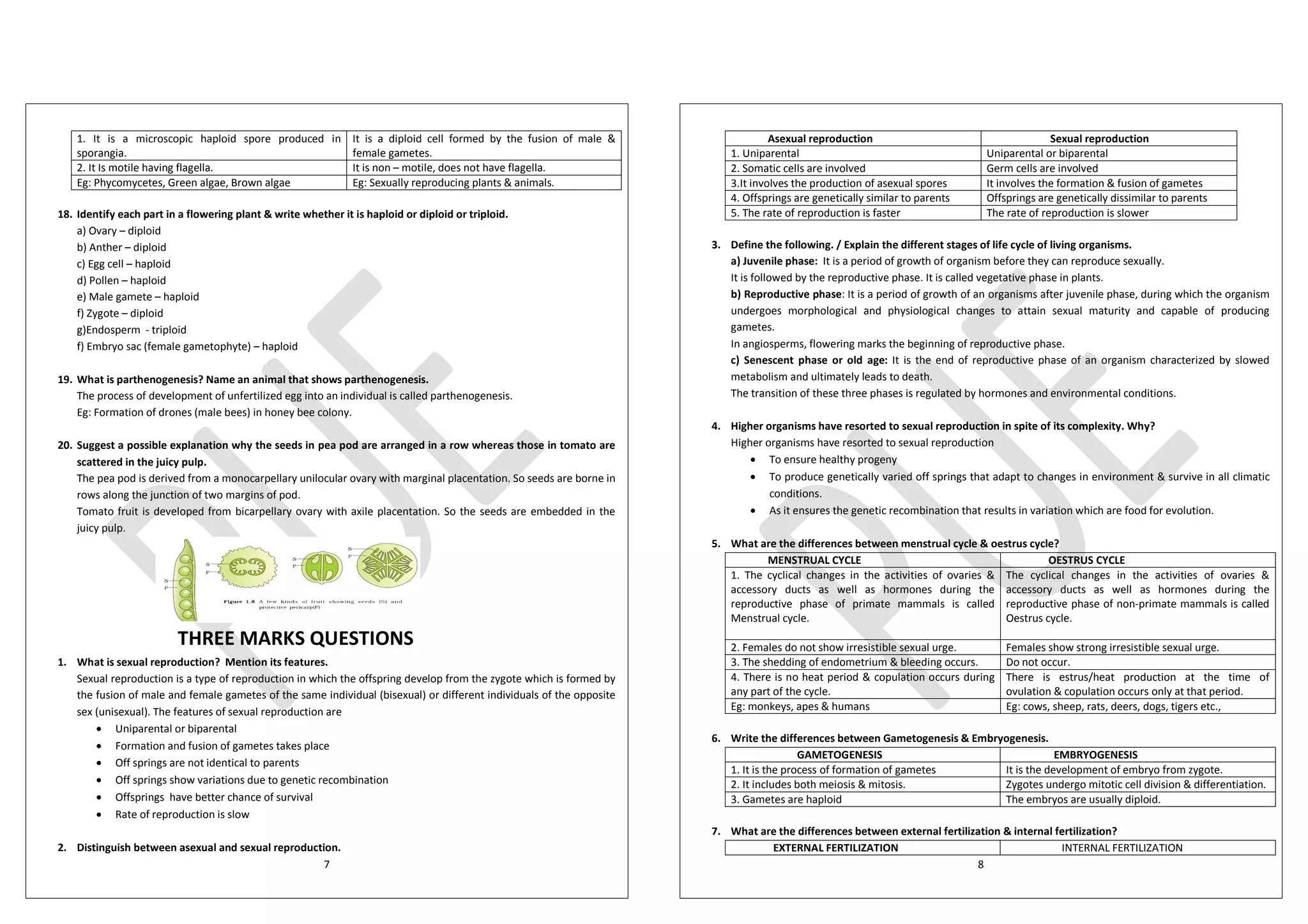
20. Suggest a possible explanation why the seeds in pea pod are arranged in a row whereas those in tomato are
scattered in the juicy pulp.
The pea pod is derived from a monocarpellary unilocular ovary with marginal placentation. So seeds are borne in
rows along the junction of two margins of pod.
Tomato fruit is developed from bicarpellary ovary with axile placentation. So the seeds are embedded in the
juicy pulp.
THREE MARKS QUESTIONS
1. What is sexual reproduction? Mention its features.
Sexual reproduction is a type of reproduction in which the offspring develop from the zygote which is formed by
the fusion of male and female gametes of the same individual (bisexual) or different individuals of the opposite
sex (unisexual). The features of sexual reproduction are
· Uniparental or biparental
· Formation and fusion of gametes takes place
· Off springs are not identical to parents
· Off springs show variations due to genetic recombination
· Offsprings have better chance of survival
· Rate of reproduction is slow
2. Distinguish between asexual and sexual reproduction.
8
Asexual reproduction Sexual reproduction
1. Uniparental Uniparental or biparental
2. Somatic cells are involved Germ cells are involved
3.It involves the production of asexual spores It involves the formation & fusion of gametes
4. Offsprings are genetically similar to parents Offsprings are genetically dissimilar to parents
5. The rate of reproduction is faster The rate of reproduction is slower
3. Define the following. / Explain the different stages of life cycle of living organisms.
a) Juvenile phase: It is a period of growth of organism before they can reproduce sexually.
It is followed by the reproductive phase. It is called vegetative phase in plants.
b) Reproductive phase: It is a period of growth of an organisms after juvenile phase, during which the organism
undergoes morphological and physiological changes to attain sexual maturity and capable of producing
gametes.
In angiosperms, flowering marks the beginning of reproductive phase.
c) Senescent phase or old age: It is the end of reproductive phase of an organism characterized by slowed
metabolism and ultimately leads to death.
The transition of these three phases is regulated by hormones and environmental conditions.
4. Higher organisms have resorted to sexual reproduction in spite of its complexity. Why?
Higher organisms have resorted to sexual reproduction
· To ensure healthy progeny
· To produce genetically varied off springs that adapt to changes in environment & survive in all climatic
conditions.
· As it ensures the genetic recombination that results in variation which are food for evolution.
5. What are the differences between menstrual cycle & oestrus cycle?
MENSTRUAL CYCLE OESTRUS CYCLE
1. The cyclical changes in the activities of ovaries &
accessory ducts as well as hormones during the
reproductive phase of primate mammals is called
Menstrual cycle.
The cyclical changes in the activities of ovaries &
accessory ducts as well as hormones during the
reproductive phase of non-primate mammals is called
Oestrus cycle.
2. Females do not show irresistible sexual urge. Females show strong irresistible sexual urge.
3. The shedding of endometrium & bleeding occurs. Do not occur.
4. There is no heat period & copulation occurs during
any part of the cycle.
There is estrus/heat production at the time of
ovulation & copulation occurs only at that period.
Eg: monkeys, apes & humans Eg: cows, sheep, rats, deers, dogs, tigers etc.,
6. Write the differences between Gametogenesis & Embryogenesis.
GAMETOGENESIS EMBRYOGENESIS
1. It is the process of formation of gametes It is the development of embryo from zygote.
2. It includes both meiosis & mitosis. Zygotes undergo mitotic cell division & differentiation.
3. Gametes are haploid The embryos are usually diploid.
7. What are the differences between external fertilization & internal fertilization?
EXTERNAL FERTILIZATION INTERNAL FERTILIZATION
9
1. The fertilization occurs outside the body of parents
in water medium.
The fertilization occurs inside the body of female in
body fluid.
2. The chances of fertilization are less. The chances of fertilization are more.
3. More number of male and female gametes are
formed.
More number of male gametes & less number of
female gametes are formed.
4. offsprings are vulnerable to predators. Offsprings are highly protected.
Eg: Bony fishes, frogs & algae. Eg: members of Plantae, reptiles, birds & mammals.
8. Write the differences between oviparous & viviparous animals.
OVIPAROUS ANIMALS VIVIPAROUS ANIMALS
1. These lay eggs These give birth to young ones.
2. The eggs are covered by hard calcareous shell. ovum are not covered by calcareous shell
3. After a period of incubation, the young ones hatch
out.
The zygote develops into young ones inside the body
of female.
4. The chances of survival of young ones are less due
to predation & unfavorable environmental conditions.
The chances of survival of young ones is more because
of proper embryonic care & protection by the mother.
Eg: Reptiles, birds. Eg: Human beings.
9. What is bisexual flower? Write common & scientific names of any one bisexual flowers.
The flower having both androecium & gynoecium is called bisexual flower.
COMMON NAME SCIENTIFIC NAME
1. Shoe flower Hibiscus rosasinensis
2. Lady’s finger Abelmoschus esculentus
3. Castor Ricinus communis
4. Brinjal Solanum melongena
5. tomato Lxcopersican esculentum
10. What is a seed? Name the plants having the largest and smallest seed.
Seed is a matured, fertilized ovule that possesses embryonic axis, cotyledon, seed coat & maybe endosperm.
Lodoicea (double coconut) is largest seed. Orchid seed is smallest seed.
FIVE MARKS QUESTIONS
1. Explain the process of asexual reproduction in amoeba and yeast cells with the help of diagrams.
Asexual reproduction in amoeba takes place by binary fission. It is the division of parental cell into two equal
halves and each half grows into an adult.
In amoeba the nucleus of the cell elongates and divides into two. This is followed by the division of cytoplasm
resulting in two equal sized daughter cells.
In yeast, the cell division is unequal and small buds are formed. They remain attached initially to the parental
cell and eventually get separated and mature into new yeast cells.
10
2. Explain the events of sexual reproduction.
The events of sexual reproduction are grouped under 3 distinct stages as follows:
i) Pre-fertilization events: These are the events prior to the fusion of gametes.
They are gametogenesis & gamete transfer.
a) Gametogenesis: It is the process of formation of haploid male and female gametes.
The shape and size of the gametes vary in different organisms.
· In algae like Chlamydomonos & Cladophore the male & female gametes are similar in their shape & size
called homogametes or isogametes.
· The majority of sexually reproducing organisms produce two morphologically dissimilar gametes called
heterogametes.
· Male gamete is called sperm or antherozoid & female gamete is called ovum or egg.
The type of cell division differs during gamete formation.
· The haploid parents produce haploid gametes by mitosis.
Eg: Monera, algae, fungi & bryophytes.
· The diploid parents produce haploid gametes by meiosis.
Eg: Pteridophytes, Gymnosperms, Angiosperms & human beings.
· The diploid organisms have specialized diploid gamete producing cells called meiocytes or gamete
mother cells which undergo meiosis to produce haploid gametes.
b) Gamete transfer:
· In most of the organisms male gamete is motile & female gamete is stationary.
· But in some fungi & algae both are motile.
· In algae, bryophytes & Pteridophytes, the gamete transfer takes place through water.
11
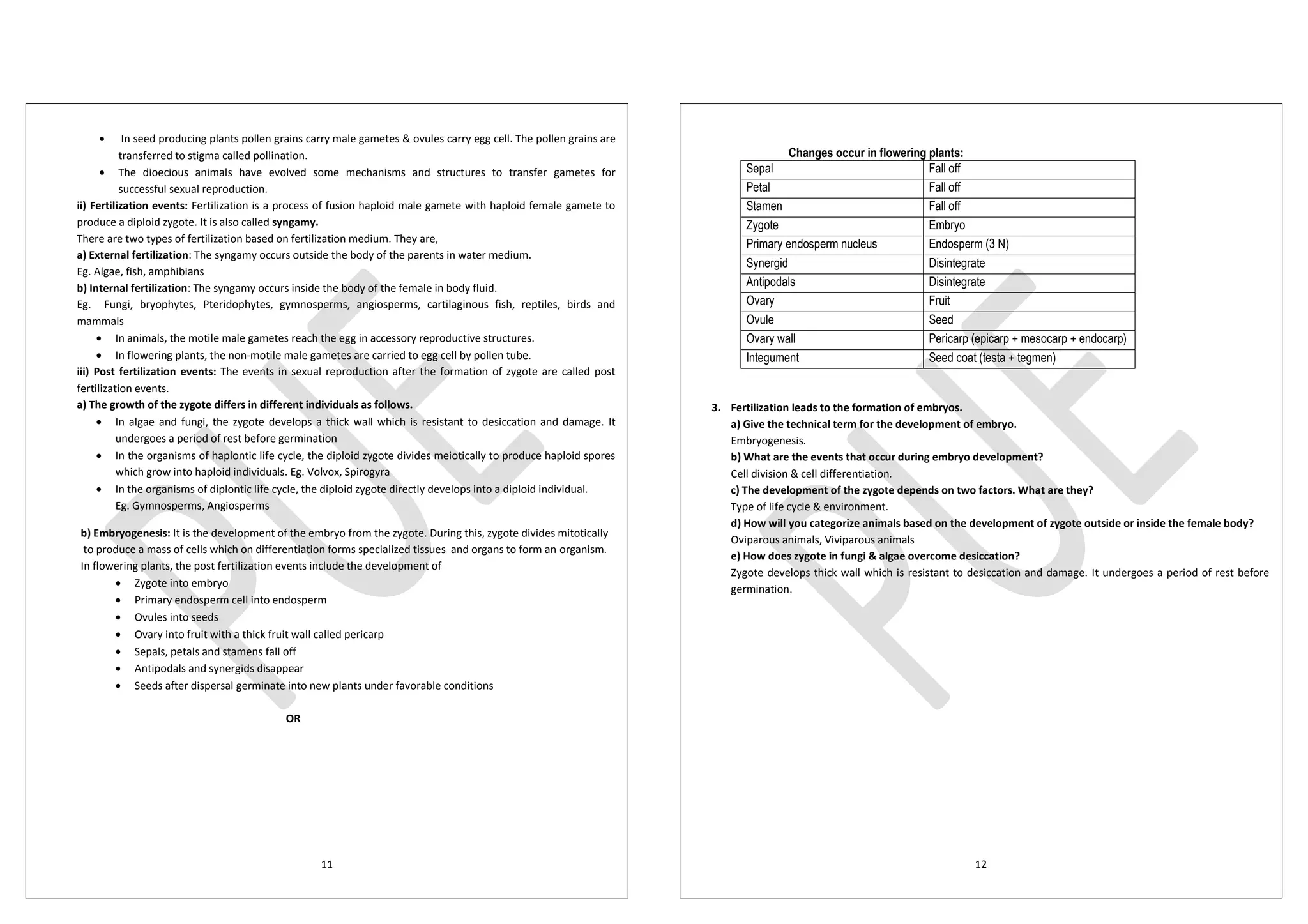
· In seed producing plants pollen grains carry male gametes & ovules carry egg cell. The pollen grains are
transferred to stigma called pollination.
· The dioecious animals have evolved some mechanisms and structures to transfer gametes for
successful sexual reproduction.
ii) Fertilization events: Fertilization is a process of fusion haploid male gamete with haploid female gamete to
produce a diploid zygote. It is also called syngamy.
There are two types of fertilization based on fertilization medium. They are,
a) External fertilization: The syngamy occurs outside the body of the parents in water medium.
Eg. Algae, fish, amphibians
b) Internal fertilization: The syngamy occurs inside the body of the female in body fluid.
Eg. Fungi, bryophytes, Pteridophytes, gymnosperms, angiosperms, cartilaginous fish, reptiles, birds and
mammals
· In animals, the motile male gametes reach the egg in accessory reproductive structures.
· In flowering plants, the non-motile male gametes are carried to egg cell by pollen tube.
iii) Post fertilization events: The events in sexual reproduction after the formation of zygote are called post
fertilization events.
a) The growth of the zygote differs in different individuals as follows.
· In algae and fungi, the zygote develops a thick wall which is resistant to desiccation and damage. It
undergoes a period of rest before germination
· In the organisms of haplontic life cycle, the diploid zygote divides meiotically to produce haploid spores
which grow into haploid individuals. Eg. Volvox, Spirogyra
· In the organisms of diplontic life cycle, the diploid zygote directly develops into a diploid individual.
Eg. Gymnosperms, Angiosperms
b) Embryogenesis: It is the development of the embryo from the zygote. During this, zygote divides mitotically
to produce a mass of cells which on differentiation forms specialized tissues and organs to form an organism.
In flowering plants, the post fertilization events include the development of
· Zygote into embryo
· Primary endosperm cell into endosperm
· Ovules into seeds
· Ovary into fruit with a thick fruit wall called pericarp
· Sepals, petals and stamens fall off
· Antipodals and synergids disappear
· Seeds after dispersal germinate into new plants under favorable conditions
OR
12
Changes occur in flowering plants:
Sepal Fall off
Petal Fall off
Stamen Fall off
Zygote Embryo
Primary endosperm nucleus Endosperm (3 N)
Synergid Disintegrate
Antipodals Disintegrate
Ovary Fruit
Ovule Seed
Ovary wall Pericarp (epicarp + mesocarp + endocarp)
Integument Seed coat (testa + tegmen)
3. Fertilization leads to the formation of embryos.
a) Give the technical term for the development of embryo.
Embryogenesis.
b) What are the events that occur during embryo development?
Cell division & cell differentiation.
c) The development of the zygote depends on two factors. What are they?
Type of life cycle & environment.
d) How will you categorize animals based on the development of zygote outside or inside the female body?
Oviparous animals, Viviparous animals
e) How does zygote in fungi & algae overcome desiccation?
Zygote develops thick wall which is resistant to desiccation and damage. It undergoes a period of rest before
germination.
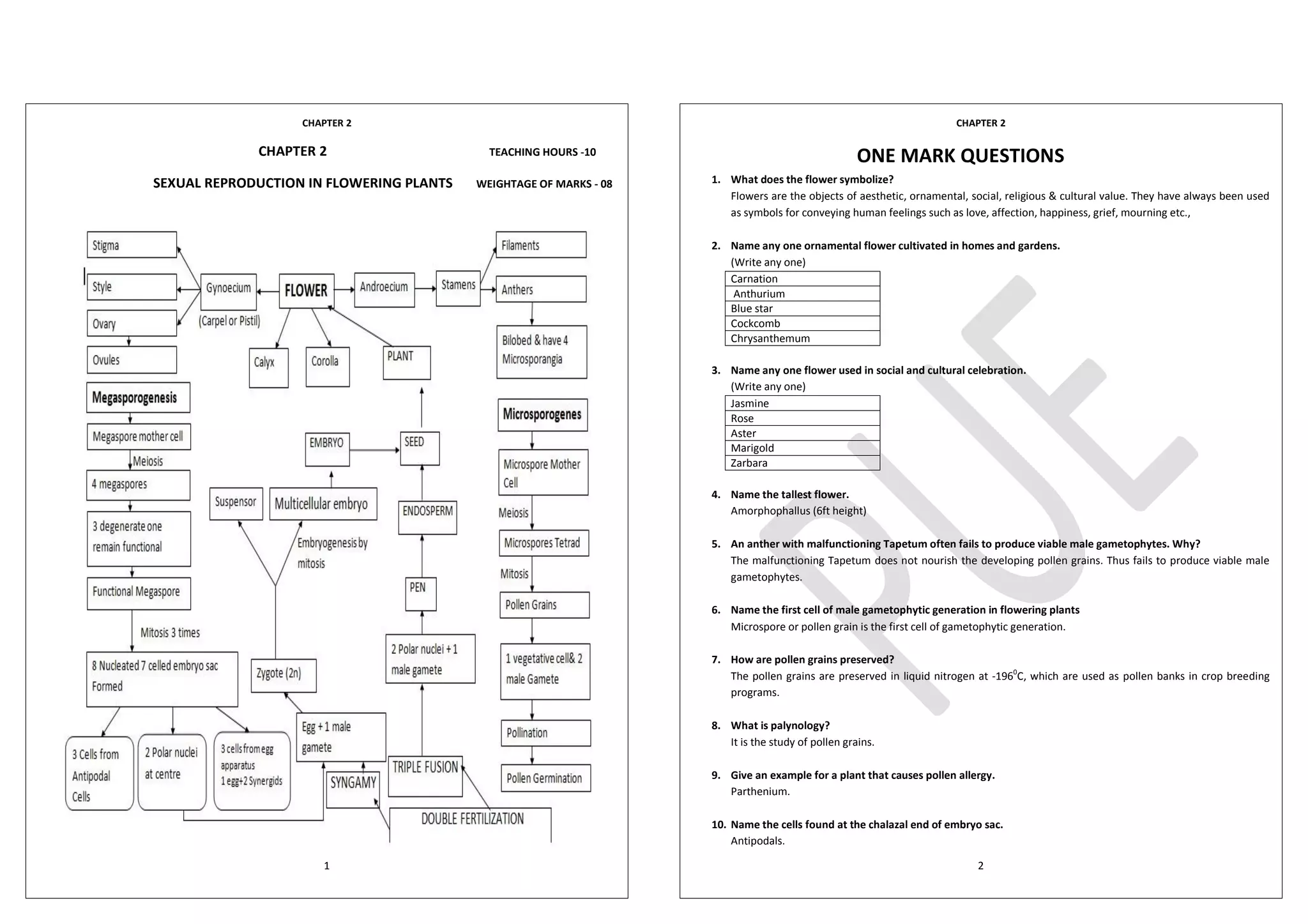
CHAPTER 2
1
CHAPTER 2 TEACHING HOURS -10
SEXUAL REPRODUCTION IN FLOWERING PLANTS WEIGHTAGE OF MARKS - 08
CHAPTER 2
2
ONE MARK QUESTIONS
1. What does the flower symbolize?
Flowers are the objects of aesthetic, ornamental, social, religious & cultural value. They have always been used
as symbols for conveying human feelings such as love, affection, happiness, grief, mourning etc.,
2. Name any one ornamental flower cultivated in homes and gardens.
(Write any one)
Carnation
Anthurium
Blue star
Cockcomb
Chrysanthemum
3. Name any one flower used in social and cultural celebration.
(Write any one)
Jasmine
Rose
Aster
Marigold
Zarbara
4. Name the tallest flower.
Amorphophallus (6ft height)
5. An anther with malfunctioning Tapetum often fails to produce viable male gametophytes. Why?
The malfunctioning Tapetum does not nourish the developing pollen grains. Thus fails to produce viable male
gametophytes.
6. Name the first cell of male gametophytic generation in flowering plants
Microspore or pollen grain is the first cell of gametophytic generation.
7. How are pollen grains preserved?
The pollen grains are preserved in liquid nitrogen at -1960
C, which are used as pollen banks in crop breeding
programs.
8. What is palynology?
It is the study of pollen grains.
9. Give an example for a plant that causes pollen allergy.
Parthenium.
10. Name the cells found at the chalazal end of embryo sac.
Antipodals.
CHAPTER 2
3
11. What is meant by monosporic development of female gametophyte?
The method of embryo sac formation from a single haploid functional megaspore is called monosporic
development.
12. Name the component cells of the egg apparatus in embryo sac.
Egg apparatus has two synergids and an egg cell.
13. Name the diploid nucleus of the mature embryo sac.
Secondary nucleus of the central cell
14. The meiocyte of rice has 24 chromosomes. How many chromosomes are present in its endosperm?
The endosperm will have 36 chromosomes.
15. Name the type of pollination in self-incompatible plants.
Cross pollination.
16. How does Yucca and Pronuba moth depend on each other?
The Pronuba moth deposits its eggs in the locule of the ovary of Yucca and the flower in turn get pollinated by
the moth. The larvae of moth come out of the eggs as the seed starts developing.
17. What are pollen robbers or nectar robbers?
The floral visitors or insects that consume pollen and nectar without bringing about pollination are called pollen
robbers.
18. Why do corn cobs have long tassels?
The long tassels of corn cobs are the style and stigma which help to trap the pollen grains carried by wind.
19. How do pollen grains of water pollinated plants like vallisneria protect themselves?
In water pollinated species like vallisneria, pollen grains are protected from wetting by a mucilaginous covering.
20. How does pollination occur in aquatic plants like water hyacinth & water lily?
In water hyacinth and water lily, the flowers emerge above the level of water and are pollinated by insects or
wind as in most of the land plants.
21. How is it possible in oxalis and viola plant to produce assured seed sets even in the absence of pollinators?
Oxalis and Viola plants produce cleistogamaous flowers in which anther and stigma lie close to each other that
favors self pollination and lead to assured seed sets.
22. Name the part of gynoecium that determines the compatible nature of pollen grain.
Stigma.
23. Which cell forms the kernel of coconut?
A triploid primary endosperm cell of embryo sac.
CHAPTER 2
4
24. How does the kernel and coconut water differ?
The kernel of coconut is cellular endosperm while coconut water is free nuclear endosperm.
25. Name the common function that cotyledon and nucellus perform.
Nourishment.
26. What are the components of embryo of a seed?
Embryo of a seed has cotyledons and embryonic axis with plumule and radical.
27. Name the fruits containing thousands of tiny seeds.
Orchid fruits and the fruits of parasitic species such as orobanche and striga.
TWO MARKS QUESTIONS
1. Name the parts of an angiosperm flower in which development of male and female gametophyte takes place.
The development of male gametophyte takes place in the microsporangium (pollen chamber) of anther.
The development of female gametophyte (embryo sac) takes place in the mega sporangium(ovule) of ovary.
2. Explain the role of Endothecium.
· Endothecium provides protection to pollen grains
· These cells are hygroscopic. When they lose water, they contract and cause dehiscence of anther for the
release of pollen grains.
3. Arrange the following terms in the correct developmental sequence: pollen grain, Sporogenous tissue,
Microspore tetrad, Pollen mother cell, Male gametes.
Sporogenous tissue à Pollen mother cell à microspore tetrad à pollen grain à male gamete
4. Identify the type of carpel in the following diagrams b and c.
b) It is multicarpellary, syncarpous pistil of Papaver
c) It is multicarpellary, apocarpous pistil of Michelia
5. Papavar and Michelia both have multicarpellary ovaries. How do they differ from each other?
The papavar ovary is syncarpous, whereas Michelia ovary is apocarpous.
CHAPTER 2
5
6. Name the cells that undergo meiosis in a bisexual flower
Microspore mother cell to produce haploid microspores (pollen grains)
Megaspore mother cell to produce haploid megaspore (embryo sac)
7. What is filiform apparatus? What is its significance?
The synergids have special cellular thickenings at the micropilar end called filiform apparatus. It plays an
important role in guiding pollen tube into embryo sac through synergid.
8. Name the male and female gametophytes of angiosperms.
Male gametophyte is microspore or pollen grain. Female gametophyte is embryo sac.
9. Mention the advantage and disadvantage of cleistogamaous flowers.
Cleistogamous flowers undergo autogamy so there is an assured seed set but the continued self pollination
leads to inbreeding depression.
10. What is perisperm? Give examples.
The remnants of persistent nucellus in a seed are called perisperm.
Eg: Nymphaea, Black pepper and beetroot.
11. Why do you think the zygote is dormant for some time in a fertilized ovule?
The zygote remains dormant for some time in a fertilized ovule and divides only after certain amount of
endosperm is formed from PEN, because the zygote requires reserve food materials of endosperm for the
nutrition of the developing embryo.
12. Why does the zygote begin to divide only after the division of primary endosperm cell?
The zygote needs nourishment during its development as the mature, fertilized embryo sac offers little
nourishment to the zygote. So, the primary endosperm cell divides and generates the endosperm tissue which
nourishes the zygote. Hence the zygote always divides after the division primary endosperm cell.
13. Differentiate between the following.
Hypocotyl Epicotyl
The cylindrical portion of the embryonic axis below the
level of cotyledon is called hypocotyl that terminates
in radical.
The portion of the embryonic axis above the level of
cotyledon is called epicotyl that terminates in plumule.
Coleoptile Coleorhiza
In monocot seeds, plumule is covered by a protective
sheath called coleoptiles.
In monocot seeds, radical and root cap are covered by
a protective sheath called coleorhizae.
Integument Testa
The protective envelop of the ovule is called
integument.
The outer protective seed layer is called testa.
Perisperm Pericarp
The remnants of persistent nucellus in a seed are
called perisperm.
The wall of ripened ovary or fruit is called pericarp.
CHAPTER 2
6
14. What are false fruits? Give example.
The fruits developed from the floral parts other than the ovary are called false fruits. Eg: Apple, Strawberry,
cashew, etc. In these fruits, the thalamus forms into the edible part.
15. What are parthenocarpic fruits? Give example.
The fruits developed from unfertilized ovary are called parthenocarpic fruits. They are seedless fruits. It can be
induced by the application of growth harmones. Eg: Banana, grape, etc.
16. Why apple is called a false fruit? Which part of the flower forms the fruit?
The fruits developed from the parts other than the ovary are called false fruits. Apple is called so because the
thalamus forms the edible part of the apple.
17. If one can induce parthenocarpy through the application of growth substances, which fruit would you select
to use parthenocarpy and why?
Parthenocarpy can be induced in banana, grapes and guava to obtain seedless fruits.
18. Are pollination and fertilization necessary in apomixes? Give reasons.
Pollination and fertilization are not necessary because in apomicts, the embryos develop directly develop from
the cells of nucellus, integument or megaspore mother cell.
19. Embryo sacs of some apomictic species appear normal but contain diploid cells. Why?
It is true that many apomicts possess normal looking embryo sacs. The only possibility of the embryo sac
possessing diploid cells is due to failure of meiotic division of megaspore mother cell. The MMC undergo mitosis
instead of meiosis to produce all diploid cells.
20. Can an unfertilized, apomictic embryo sac give rise to a diploid embryo? If yes, How?
Yes. If the embryo develops from the cells of nucellus or integument as they are diploid.
21. Name the mechanism responsible for the formation of seed without fertilization in angiosperms. Give an
example.
Apomixis Eg: grasses and members of asteraceae.
22. Are parthenocarpy and apomixis different phenomenon?
Parthenocarpy and apomixis are different phenomena. Parthenocarpy is the formation of fruits without
fertilization and hence the fruits are seedless. Whereas, apomixis is the phenomenon of formation of seeds
without fertilization. These embryos are genetically identical to the parental plant.
CHAPTER 2
7
23. In case of Polyembryony, if an embryo develops from synergid, and another from the nucellus, which is
haploid and which is diploid?
Synergid embryo is haploid and Nucellar embryo is diploid.
THREE MARKS QUESTIONS
1. Explain the role of Tapetum in the formation of pollen grain.
During microsporogenesis, the Tapetum performs the following functions:
· It transports nutrients to developing pollen grains.
· It secretes enzymes (callase) and hormones.
· It produces ubisch bodies which are coated with sporopollenin to cause thickening of exine.
· Secretes oil coating over pollen grains called pollen kit. It protects the pollen from UV radiations and
attracts insects.
· Secretes special protein to recognize compatibility
2. What is the importance of pollen grains?
· Pollen grains of many species cause severe allergies and bronchial afflictions leading to chronic
respiratory disorders like asthma, bronchitis etc.,
· They are rich in nutrients. So the pollen tablets and syrups are used as food supplements.
· Consumption of pollen grains may increase the performance of athletes & race horses.
3. Write a note on viability of pollen grains.
· Viability of pollen grains depends on the prevailing temperature and humidity
· In some cereals like rice and wheat, pollen grains lose viability within 30minutes of their release
· The pollen grains of some members of Rosaceae, Leguminaceae and Solanaceae can be preserved in liquid
nitrogen at -1960
C, for many years and used as pollen banks in crop breeding programs.
4. Describe the structure of gynoecium or pistil with a neat labelled diagram.
Pistil is a female reproductive structure of flower. It has one or more units called carpels. Carpels are also called
megasporophylls. Each carpel has a basal swollen ovary, a long stalk called style that terminates in stigma.
The pistil with one carpel is called monocarpellary and with many carpels is called multicarpellary pistil.
If the carpels are fused, the condition is called syncarpous, and if the carpels are free, the condition is called
apocarpous.
CHAPTER 2
8
5. What are the differences between a matured unfertilized embryo sac and a fertilized embryo sac?
Unfertilized embryo sac Fertilized embryo sac
All the cells are haploid Zygote is diploid, PEN is triploid and other cells are
haploid
Antipodals and synergids are distinctly present Antipodals and synergids gradually degenerate
The haploid polar nuclei may fuse to form a diploid
secondary nucleus
Diploid secondary nucleus fertilizes with a haploid male
gamete to form a triploid PEN
Egg cell is haploid Egg cell fertilizes with the male gamete to form a
diploid zygote
6. What are chasmogamous flowers? Can cross pollination occur in cleistogamous flowers? Give reasons.
Chasmagamous flowers open at maturity and expose their anthers and stigma.
Cross pollination does not occur in cleistogamous flowers as they do not bloom or bloom after self pollination.
They are autogamous. Eg: Viola, Oxalis and Commelina
7. What are the characters of insect pollinated flowers (entamophilous flowers)?
The insect pollinated flowers are
· Large
· Colourful
· Showy
· fragrant
· rich in nectar
· provide reward in the form of nectar and pollen
· safe place to lay eggs
· some flowers produce foul odour to attract flies and beetles
· pollen grains are sticky
8. What are the characters of wind pollinated flowers (anemophilous flowers)? Give example.
· Pollen grains are light and non-sticky.
· Stigma is large & feathery to trap pollen grains.
· They have single ovule in each ovary and numerous flowers packed into an inflorescence.
Eg: corn cob & grasses.
CHAPTER 2
9
9. What are the characters of water pollinated (hydrophilous) flowers?Give examples
· Pollen grains are long and ribbon like
· Pollen grains are protected from wetting by mucilaginous covering
Eg: vallisneria, hydrilla, marine sea grasses like zostera
10. Explain the mechanism of pollination in water plants like vallisneria and sea grass (Zostera).
In vallisneria, the female flowers reach the surface of water by the long stalk and the male flowers are released
onto the surface of water. They are carried by water currents and some of them eventually contact with female
flowers and its stigma to bring about pollination.
In sea grass, female flowers remain submerged in water and the pollen grains are released inside the water.
Pollen grains are long, ribbon like and they are carried passively inside the water; some of them reach the stigma
and achieve pollination.
11. Write a note on pollen – pistil interaction.
All the events from pollen deposition on the stigma until the entry of the pollen tube into the ovule are together
called pollen-pistil interaction. It is a dynamic process involving pollen recognition by stigma/pistil for
compatible pollen by accepting them and if incompatible rejecting them.
· The pistil has the ability to recognize the compatible or incompatible pollen
· If the pollen is compatible, the pistil accepts the pollen and promotes post pollination events that leads to
fertilization
· This pollen – pistil interaction is governed by chemical components of pollen and pistil
12. What is self-incompatibility? Does it impose any restrictions on autogamy? Give reasons and suggest the
method of pollination in such plants.
In some plants, when mature pollen grain falls on the receptive stigma of the same flower, it fails to bring about
self-pollination. It is called self-incompatibility. Eg: Potato, Tobacco, Petunia.
It imposes restrictions on autogamy. These plants undergo only cross pollination.
13. What is artificial hybridization? How is it achieved? What is its significance?
It is a process of transferring desired pollen grains onto the stigma by preventing contamination from unwanted
pollen to obtain improved crop varieties.
It is achieved by:
· Emasculation: The technique of removal of anthers from a bisexual floral bud before their dehiscence
using a pair of forceps or scissors is called emasculation.
· Bagging: The process of covering of emasculated flowers with a bag made of butter paper to prevent
the contamination of stigma from unwanted pollen is called bagging.
Then the matured pollen grains collected from the anther are dusted onto stigma. Then the flowers are
rebagged and the fruits are allowed to develop. Plant breeders employ this technique in artificial hybridization
technique to perform crossing experiments and also to produce commercially superior varieties of plants.
CHAPTER 2
10
14. What is meant by emasculation? When and why does a plant breeder employ this technique?
The technique of removal of anthers from the floral bud before their dehiscence using a pair of forceps or
scissors is called emasculation.
Plant breeders employ this technique in artificial hybridization technique to perform crossing experiments and
also to produce commercially superior varieties of plants.
15. What is bagging technique? How is it useful in a plant breeding programme?
The process of covering of emasculated flowers with a bag made of butter paper to prevent the contamination
of stigma from unwanted pollen is called bagging.
· It is used to carry out cross breeding by desired pollen for crop improvement programmes.
· It is used in the production of commercially superior hybrid varieties.
16. What is triple fusion? Where does it take place? Name the nuclei involved in the triple fusion.
The fusion of one haploid male gamete with two haploid polar nuclei or one diploid secondary nucleus to
produce a triploid endosperm nucleus in the embryo sac is called triple fusion.
It occurs in the central cell of embryo sac.
The nuclei involved in triple fusion are one nucleus from male gamete and two polar nuclei.
17. Explain the development of embryo in angiosperms.
The process of development of embryo from zygote is called embryogenesis. The embryo develops from a
diploid zygote located at the micropylar region of embryo sac. The zygote development takes place after the
formation of certain amount of endosperm from PEN as it requires nourishment. The zygote divides mitotically
to form pro embryo and subsequently into the globular, heart shaped and mature embryo. The mature embryo
has cotyledon/s and an embryonic axis with plumule and radicle.
18. Write a note on viability of seeds.
· In a few species the seeds loose viability within few months.
· The seeds of large number of species live for several years.
· The oldest viable seed is that of lupine, Lupinus arcticus excavated from Arctic tundra. The seed
germinated and flowered after an estimated record of 10000 years of dormancy.
· The recent record of 2000 years old viable seed is of the date palm, Phoenix dactylifera discovered
during the archeological excavation at King Herod’s palace near ‘The Dead Sea’.
CHAPTER 2
11
19. What are the advantages of seeds?
· The reproductive processes like pollination and fertilization are independent of water. So the seed
formation is more dependable.
· Seeds have better adoptive strategies for dispersal to new habitats and help the species to colonize in
other areas.
· As they have sufficient food reserves, young seedlings are nourished until they are capable of
photosynthesis on their own. The hard seed coats provide protection to the young embryo.
· As they are the products of sexual reproduction, they generate new genetic combinations leading to
variations.
· Seeds are used as food by animals.
20. What is a fruit? Mention the types with example.
Fruit is a matured ripened fertilized or unfertilized ovary. It has a fruit wall called pericarp enclosing the seeds.
The types are:
a) Fleshy fruits: Pericarp is fleshy. Eg- Orange, mango, guava etc.
b) Dry fruits: Pericarp is dry. Eg- Groundnut, mustard etc.
FIVE MARKS QUESTIONS
1. Describe the LS of a typical flower with a neat labelled diagram.
Flower is a modified condensed shoot for sexual reproduction. The stalk of flower is called pedicel. The upper
swollen part of pedicel is called Thalamus. The modified leaves as floral whorls are arranged on the thalamus.
They are
· Calyx – units called sepals (for protection)
· Corolla – units called petals (to attract pollinators)
· Androecium – units called stamens (microsporophylls to produce microspores in their microsporangia)
· Gynoecium/pistil – units called carpels (megasporophylls to produce megaspores in their
Mega sporangia/ovules)
2. Explain the T.S of mature dithecous anther lobe with a neat labelled diagram.
The androecium is a male reproductive whorl of flower composed of units called stamens. The stamen has a
long narrow slender stalk called filament and a knob like bilobed anther.
The bilobed anther (dithecous) is made up of two anther lobes connected by a sterile connective. It has four
microsporangia (pollen chambers). So it is called tetrasporangiate anther lobe. Each microsporangium has a
sporogenous tissue surrounded by an anther wall made up of four wall layers. These wall layers are produced
from primary parietal cells derived from archesporial cells.
CHAPTER 2
12
The four layers of anther wall are:
a) Epidermis: It is outer single layer of flattened cells which provides protection.
b) Endothecium: It is present below the epidermis. It is a single layer of radially elongated cells with fibrous
thickenings. These cells are hygroscopic. When they lose water, they contract and cause dehiscence of anther
for the release of pollen grains.
c) Middle layer of cells: These are two to three layers of cells present between Endothecium and Tapetum. They
store food materials.
d) Tapetum: It is the innermost layer of anther wall containing the cells with rich cytoplasm and nuclei. It
· Nourishes pollen grains
· Forms pollen wall
· Secretes callase enzyme
· Secretes oil coating over pollen grains called pollen kit. It protects the pollen from UV radiations and
attracts insects.
The Sporogenous cells produce diploid microspore mother cells. These diploid mother cells undergo meiosis to
produce microspore tetrad. Each cell of tetrad separates to form microspore or pollen grain.
3. Explain the process of microsporogenesis (or) Explain the development of male gametophyte (pollen grain) in
flowering plants.
The process of formation of microspores or pollen grains or male gametophytes from pollen mother cell through
meiosis in the pollen chambers (micro sporangia) of anther is called microsporogenesis.
The primary hypodermal cells of young anther called archesporial cells differentiate into primary parietal cells
and primary Sporogenous cells. The primary parietal cells produce 4 layers of anther wall namely Epidermis,
Endothecium, middle layer of cells & Tapetum. Sporogenous cells develop into microspore mother cells (MMC)
or pollen mother cells (PMC). The diploid MMC undergoes meiosis to produce a haploid microspore tetrad held
CHAPTER 2
13
together by callose. Each haploid microspore separates from microspore tetrad by callase enzyme secreted by
tapetum layer.
Microspore or pollen grain is the first cell of gametophytic generation. As it produces the male gametes, it is
called male gametophyte. As the microspores develop within the microsporangium, it is called precocious
germination.
MICROSPOROGENESIS
ARCHESPORIAL CELL
SPOROGENOUS CELLS
MITOSIS
MICROSPORE MOTHER
CELL
MEIOSIS
MICROSPORE TETRAD
MICROSPORE
(POLLEN GRAIN)
4. Explain the development and structure of male gametophyte or pollen grain or microspore.
Development of male gametophyte: Microspore is the first cell of gametophytic generation. The nucleus of the
microspore migrates from center to periphery and divides to produce a large vegetative cell (tube cell) and a
small generative cell. Temporary callose wall is laid between the two cells. It dissolves by callase enzyme and the
nucleus of generative cell floats in the cytoplasm of tube cell. This two celled pollen grain is ready to liberate
from pollen sac.
Structure of pollen grain:
· It is spherical, oval, ellipsoidal & triangular in shape and 25-50 micrometer in diameter
· It has two layered wall namely outer exine & inner intine.
· Exine is hard, made up of sporopollenin. Sporopollenin is the most resistant organic material that can
withstand high temperature, strong acids, alkalis & enzymes. It has prominent apertures called germ
pores where sporopollenin is absent. Pollens can be well preserved as fossils because of the presence of
sporopollenin.
CHAPTER 2
14
· The intine is thin continuous layer made up of cellulose and pectin.
· It is two or three celled. One vegetative cell and one generative cell / two gametic cells.
· The vegetative cell is large with abundant food reserve (starch & unsaturated oils) and large irregularly
shaped nucleus.
· The generative cell is small and floats in the cytoplasm of vegetative cell. It is spindle shaped with dense
cytoplasm and nucleus.
· Usually the pollen grain is shed at two cell stage in 60% of the angiosperms. In the remaining species,
the generative cell divides mitotically and a three celled pollen grain is shed.
·
5. Describe the structure of an anatropous ovule or megasporangium with a neat labelled diagram.
The ovule is a small structure attached to the placenta by means of a stalk called funicle. The body of the ovule
fuses with funicle in the region called hilum. The ovule has one or two protective envelopes called Integuments.
These encircle the ovule except at the tip where a small opening called micropyle is organized. The chalaza is
present opposite to the micropylar end representing the basal part of the ovule. The integuments enclose a
mass of cells with reserved food called nucellus. Nucellus encloses the embryo sac or female gametophyte.
OR
Ovule ( megasporangium) has
· Funicle – stalk of ovule
· Hilum – body of ovule that attaches to funicle
· Raphe – a ridge formed by funicle
· Integuments – covering of nucellus
CHAPTER 2
15
· Nucellus – a mass of thin walled parenchymetous tissue that covers embryo sac
· Embryo sac – seven celled, eight nucleated female gametophyte
· Chalaza – basal portion of the ovule from where integuments arise
· Micropyle – a small opening left at the apex of integuments
6. Explain the process of megasporogenesis and megagametogenesis (the development of female gametophyte)
(embryosac).
Megasporogenesis: The process of formation of megaspore from megaspore mother cell by the process of
meiosis is called megasporogenesis.
The process of megasporogenesis occurs in megasporangia (ovules) present inside the ovary. Each ovule has
outer integuments enclosing the nutritive tissue called nucellus. Some cells of nucellus develop into diploid
archesporial cells. The archesporial cells undergo periclinal divisions to form outer parietal layer which adds cells
to sporogenous mass during division and inner sporogenous cell that develop into megaspore mother cell
(MMC).
The MMC divides by meiosis to produce a linear tetrad of haploid megaspores. Out of 4 megaspores usually the
upper three degenerate and the lowermost towards
micropylar region enlarges to become a functional
megaspore called embryosac. (This type of development is
called monosporic development)
Megagametogenesis: It is the process of formation of egg
cell from a functional megaspore (embryo sac)
The nucleus of embryo sac divides mitotically to form two
nuclei which move to opposite poles. Two more successive
mitotic divisions occur in each nucleus resulting in eight
nucleate stage.
· Three nuclei in chalazal end are surrounded by cell wall
and organized to form three antipodal cells.
· Two nuclei from each pole move to the centre to form
polar nuclei present in a large central cell
· Three nuclei in the micropylar end are surrounded by cell
wall and organize into three celled egg apparatus. It
consists of two synergids and an egg cell.
So the mature embryo sac is eight nucleated and seven
celled.
MEGASPOROGENESIS &MEGAGAMETOGENESIS
ARCHESPORIAL CELL
MEGASPORE MOTHER CELL (MMC)
(meiosis)
FOUR MEGASPORES
(3 megaspores degenerate)
FUNCTIONAL MEGASPORE (EMBRYOSAC)
(Female gametophyte)
NUCLEUS OF EMBRYO SAC
(3 mitotic division)
8 NUCLEATED & 7 CELLED EMBRYO SAC
[3 ANTIPODALS (Chalazal end)
2 POLAR NUCLEI (Central cell)
2 SYNERGIDS + 1 EGG CELL (egg aparatus)
(micropylar end)]
CHAPTER 2
16
7. Differentiate between microsporogenesis and megasporogenesis. Which type of cell division occurs during
these events? Name the structures formed at the end of these events.
Microsporogenesis Megasporogenesis
1) The process of formation of microspores from
microspore mother cell through meiosis is called
microsporogenesis.
1) The process of formation of megaspores from
megaspore mother cell through meiosis is called
megasporogenesis.
2) It occurs inside the microsporangium of anther. 2) It occurs in nucellus of ovule.
3) Many microspore mother cells are differentiated. 3) Only one megaspore mother cell is differentiated.
4) Microspore mother cell produces tetrad of
microspores.
4) Megaspore mother cell produces a linear tetrad of
megaspores.
5) All the four cells of microspore tetrad are functional. 5) Three megaspores degenerate and only one
megaspore becomes functional and develops into
embryo sac (female gametophyte)
Meiosis occurs during these events.
Microspore and megaspore are the cells produced at the end of these two events.
8. What is pollination? Explain the types and factors favouring self pollination.
Pollination is the transfer of pollen grains from anther to receptive stigma of same or another flower.
The types are
I. Autogamy: It is the transfer of pollen grains from anther to stigma of the flowers of the same plant.
a) Homogamy – It is the transfer of pollen grains from anther to the stigma of the same flower
b) Geitonogamy: It is the transfer of pollen grain from anther of one flower to the stigma of another flower of
the same plant.
Autogamy is favored when
· Synchronisation in the release of pollen and stigma receptivity
· The flowers are bisexual
· Anther and stigma of a flower attain maturation at the same time
· Cleistogamy : The flowers do not bloom. Eg: Oxalis, Viola (common pansy) commelina
· The anther and stigma lie close to one another
II. Allogamy or cross pollination: The transfer of pollen from anther of one flower to stigma of another flower of
another plant is called allogamy.
Xenogamy: The transfer of pollen grains for anther of one flower to stigma of another flower of a different
plant. It results in genetic recombination.
CHAPTER 2
17
9. Mention the types of pollination based on the respective pollinating agents
TYPES OF POLLINATION I ABIOTIC AGENTS
a) Anemophily Pollination by wind
b) Hydrophily Pollination by water
II BIOTIC AGENTS
c) Zoophily Pollination by animals (lemurs, rodents, gecko, garden
lizard)
d)Ornithophily Pollination by birds (sun bird, humming bird)
e) Entamophily Pollination by insects (bees, beetles, wasps, moths)
f) Malacophily Pollination by snails
g) Myrmacophily Pollination by ants
f) Chiropterophily Pollination by bats
10. What are outbreeding devices? Explain.
The outbreeding devices are the devices or mechanisms to prevent self pollination and favor cross pollination to
overcome the problem of inbreeding depression (caused due to continuous self pollination). These are also
called contrivances for cross pollination. The factors favoring cross pollination are
· Unisexual flowers or dioecious plants or dicliny
· Male and female flowers are present in different plants which prevents homogamy and geitonogamy
Eg: Papaya
· In monoecious plants like castor and maize homogamy is prevented but not geitonogamy
· Chasmogamous flowers: the flowers with exposed anther and stigma to facilitate pollination
· Dichogamy: The bisexual flowers in which male and female reproductive parts mature at different times, so
prevents self pollination and favors cross pollination
a) Protandry: Flower in which anther mature earlier to stigma to prevent self pollination.
Eg: sunflower, cotton
b)Protogyny : Flower in which stigma matures earlier to anther to prevent self pollination
Eg: Mirabilis jalapa
· Pollen release and stigma receptivity are not synchronized due to dichogamy (protandry and protogyny)
· Herkogamy: It is flower in which there are physical barrier between anther and stigma
Eg: calotropis
· Heterostyles: The flower with different length of styles and stamens that prevents self pollination
Eg: Prim rose, Oxalis
· Self sterility or self incompatibility: The pollen grains do not germinate on stigma of same flower due to mutual
inhibition. In this the genetic mechanism prevents the pollen germination on stigma
Eg: Potato, Tobacco, Petunia.
· Suppression of one sex: In bisexual flower stamen or carpel is completely suppressed and become sterile
11. Explain the post pollination events or double fertilization process in angiosperms.
The pollen grains usually shed at two celled stage namely vegetative cell and generative cell. Further the
generative cell divides to produce two haploid male gametes in pollen tube. In some plants, the pollen grains
shed at three celled stage where pollen tube carries two male gametes from the beginning.
CHAPTER 2
18
After pollination, the compatible pollen grain germinates on stigma by obtaining nourishment from stigmatic
tissue. The vegetative cell or tube cell germinates into pollen tube through the style called siphonogamy. Then
the pollen tube enters the embryo sac through different regions of ovule. They are
· Chalazogamy – pollen tube enters through chalaza
· Mesogamy - pollen tube enters laterally through integuments
· Porogamy – pollen tube enters through micropyle
Normally the pollen tube enters through micropyle into the embryosac through synergids. Synergids have
filiform apparatus that guide the entry of the pollen tube into embryo sac. The tip of the pollen tube ruptures to
release two haploid male gametes into embryosac.
One haploid male gamete fertilizes with the diploid secondary nucleus of central cell to form a triploid primary
endosperm cell. This process is called triple fusion. The other haploid male gamete fertilizes with the haploid
egg cell to form a diploid zygote.
Double fertilization: In the above process one haploid male gamete fertilizes with a diploid secondary nucleus to
form a triploid primary endosperm nucleus and the other haploid male gamete fertilizes with the haploid egg
cell to form a diploid zygote (syngamy). Hence is called double fertilization.
12. Write the post fertilization events that occur in angiosperm flower.
The post fertilization events are
· Antipodals and synergids disappear
· Sepals, petals and stamens wither off
· Ovules develop into seeds
· Integuments form the seed coats namely testa and tegmen
· Primary endosperm cell develops into endosperm that provides nourishment for developing embryo
· Zygote develops into embryo
· Ovary develops into fruits
Changes occur in flowering plants:
Sepal Fall off
Petal Fall off
Stamen Fall off
Zygote Embryo
Primary endosperm nucleus Endosperm (3 N)
Synergid Disintegrate
CHAPTER 2
19
Antipodals Disintegrate
Ovary Fruit
Ovule Seed
Ovary wall Pericarp (epicarp + mesocarp + endocarp)
Integument Seed coat (testa + tegmen)
13. Explain the development of endosperms in angiosperms.
The endosperm is developed from triploid primary endosperm nucleus (PEN). It precedes embryo development
from zygote. During this process the triploid PEN divides mitotically to produce endosperm tissue filled with
food materials. It is used for nourishing developing embryo.
There are two types of endosperm development
· Free nuclear endosperm development: The PEN undergoes successive nuclear division to give rise to
free nuclei. This does not involve the cell wall formation. Eg: coconut water
· Cellular endosperm development: The PEN undergoes successive nuclear division followed by the cell
wall formation. Eg: White kernel of coconut
During the embryonic development, the embryo may completely consume the endosperm before the seed
matures. This results in non endospermic seeds or exalbuminous seeds. Eg: pea, ground nut, bean, etc.
The embryo may not utilize the endosperm completely and some amount of endosperm persists in the matured
seeds. This results in the formation of endospermic seeds or albuminous seeds. Eg: castor, maize.
14. Explain the structure of a typical dicot embryo with a labelled diagram.
A typical dicot embryo consists of an embryonic axis and two cotyledons. The portion of the embryonic axis
above the cotyledons is called epicotyl, which terminates with the plumule (embryonic shoot). The cylindrical
portion below the level of cotyledons is called hypocotyl, which terminates at its lower end in the radicle
(embryonic root). The root tip is covered by root cap
.
15. Explain the structure of a typical monocot embryo with a labelled diagram.
The monocot embryo possesses only one cotyledon called scutellum, which is situated towards one side of the
embryonic axis. The embryonic axis has the radicle and root cap enclosed in an undifferentiated sheath called
coleorrhiza. The portion of the embryonic axis above the level of attachment of scutellum is the epicotyl.
Epicotyl has a shoot apex and a few leaf primordial enclosed in a hollow foliar structure called coleoptile.
CHAPTER 2
20
16. Draw a VS of maize grain and LS of an albuminous seed.
17. What is a seed? Explain the structure and types of seeds.
Seed is a matured fertilized ovule. It has seed coats, cotyledon/s and an embryo. Cotyledon is thick and swollen
due to storage of food reserves. There are two types of seeds:
· Albuminous seeds: Have endosperm. Eg: Wheat, maize, barley, castor, sunflower etc.,
· Exalbuminous seeds: Do not have endosperm. Eg: Pea, groundnut etc.,
The black pepper and beet seeds have remnants of nucellus in their seeds called perisperm. The micropyle
remains a pore that facilitates the entry of water and oxygen into the seed during germination.
As the seed matures, it loses 10 – 15 % of moisture by mass and metabolic activities of the embryo slows
down. This inactive state is called dormancy. During favorable conditions like the availability of adequate
moisture, oxygen & suitable temperature induces the germination of seeds.
18. What is Apomixis (Agamospermy)? How do they develop? What is its importance?
The development of seeds without involving meiosis and fertilization is called apomixis. It is a kind of asexual
reproduction that mimics sexual reproduction.
Apomictic embryos develop from:
· Haploid gametophytes (Apogamy)
· Diploid megaspores (Apospory)
· Diploid Nucellar cell and integument cells (Adventative embryony)
The advantages of apomixis are:
CHAPTER 2
21
· The segregation of characters does not take place in the seeds of apomictic hybrids. This helps in conserving
desired traits of hybrids. Hence extensively used in agriculture and horticulture.
· Reduced cost of hybrid production.
· Accelerated breeding.
· Maintain hybrid vigour.
· Free from diseases.
· Nucellar seedlings of citrus provide better clones.
19. What is Polyembryony? How do they develop? How can it be commercially exploited?
Polyembryony is the occurrence of more than one embryo in a seed.
Polyembryos develop from:
• Diploid egg cells
• Haploid egg cells (Parthenogenesis)
• Secondary nucleus (Parthenogamy)
• Megaspores (Diplospory)
• Synergids & Antipodals
• Nucellar cells & Integument cells (Citrus, Mango) (Adventative embryony)
• Cleavage Polyembryony (Gymnosperms, Nicotiana)
All these embryos can be isolated and cultured in artificial medium under aseptic conditions in vitro. Through
micropropagation, many plants can be raised from one seed.
1 | P a g e
CHAPTER -3: HUMAN REPRODUCTION
1. Define gametogenesis?
The process of formation of gametes.
2. What is insemination?
The transfer of sperms into the female genital tract.
3. What is fertilization?
Fusion of male and female gametes leads to the formation of zygote.
4. What is implantation?
Attachment of blastocyst itself to the inner uterine wall (endometrium).
5. What is gestation period?
The period of development between fertilization to parturition (child birth)
6. What is parturition?
Birth of the infant called parturition.
7. Name the pouch in which testes are present.
Scrotum.
8. Mention the significance of scrotum.
The scrotum helps in maintaining the low temperature of the testes (2–2.5o C lower than the normal
internal body temperature) necessary for spermatogenesis.
9. What are seminiferous tubules?
Seminiferous tubules are highly coiled structures present in a testicular lobule or structural and functional units
of testis.
10. What are spermatogonia?
Spermatogonia are the diploid male germ cells that give rise to spermatozoons.
11. Name the cell that provides nutrition to the male germ cells.
Sertoli cells provide nutrition to the germ cells.
12. Name the cell that secretes androgen or testosterone.
Leydig cells or interstitial cells.
13. Name the duct through which seminal vesicle opens into the urethra.
Ejaculatory duct.
14. Name the finger shaped projections of fallopian tube near the ovary.
Fimbriae.
15. Name the layer of uterus that undergoes cyclical changes or shedding during menstrual cycle.
Endometrium.
16. Name the cluster of cells in mammary lobes.
Alveoli.
17. What is spermatogenesis?
The process of formation of functional haploid male gametes or sperms in the testis of males.
18. What is spermiogenesis?
The process of conversion of haploid, non-motile and non-functional spermatids into functional motile
sperms.
19. What is spermiation?
The process of release of sperms from the seminiferous tubules.
20. Name the hormone that stimulates spermatogenesis.
LH –Luteinizing hormone.
21. Mention the function of LH?
LH acts on Leydig cells and stimulates synthesis and secretion of androgens.
22. What is semen?
The seminal plasma along with the sperms constitutes the semen.
23. What is acrosome?
The anterior portion of sperm is covered by a cap-like structure, acrosome.
24. Mention the function of acrosome?
The acrosome is filled with enzymes that help fertilization of the ovum.
2 | P a g e
25. Name the fluid filled cavity of Graafian follicle.
Antrum.
26. What is menarche?
Menarche is the first menstrual period of young woman.
27. What causes rupturing of Graafian follicle and release of ovum?
Increased concentration of LH.
28. What is corpus luteum?
Yellow coloured body developed by the ruptured Graafian follicle .
29. What is the function of corpus luteum?
Secrete progesterone hormone
30. Name the hormone that is essential for maintenance of the endometrium.
Progesterone
31. What is menopause?
Menstrual cycles cease around 50 years of age
32. In which part of the fallopian tube does fertilization occur?
Ampullary-isthmic junction
33. What is monospermy?
Only one sperm can fertilize an ovum
34. What is cleavage?
Repeated rapid mitotic cell division of diploid zygote
35. What is morula?
The embryo with 8 to 16 blastomeres stage
36. Name the outer layer of cells in blastocyst.
Trophoblast
37. Where does the implantation of blastocyst occur?
Endometrium of the uterus
38. What is placenta?
Placenta is a connection between developing embryo and mother.
39. Name the structure that connects placenta to the embryo.
Umbilical cord
40. What is the function of umbilical cord?
It helps in the transport of substances to and from the developing embryo.
41. What are stem cells?
Stem cells which have the potency to give rise to all the tissues and organs.
42. Name the hormone produced from the ovary in later phase of pregnancy.
Relaxin
43. What is foetal ejection reflex?
Mild uterine contractions from the placenta during parturition called foetal ejection reflex
44. What is colostrum?
The milk produced during the initial few days of lactation is called Colostrum
TWO MARKS QUESTIONS
45. Name the two types of cells present on inner lining of seminiferous tubules.
Sertoli cells and gonial cells
46. Mention two female sex hormones.
FSH AND LH
47. Write any four functions of placenta.
Ø Transport of oxygen and nutrients from mother’s blood to the developing foetus.
Ø Transportation of carbon dioxide and nitrogenous wastes from the foetal blood into the mother’s blood.
Ø The storage of food materials like glycogen, fat, iron etc., All these contents are utilized by the foetus before the
formation of functional liver
Ø The transportation of antibodies from mother’s blood into the foetal blood.
3 | P a g e
Ø It acts as a barrier and prevents the entry of microorganisms and some harmful materials like blood proteins and
sex hormones from mother’s blood into the foetal blood.
Ø It also acts as an endocrine gland and secretes several hormones like human chorionic gonadotropin (hCG),
human placental lactogen (hPL) progesterone, estrogen, and relaxin (secreted more at the later stages of
pregnancy) & helps to maintain pregnancy.
48. List the hormones that are secreted only during pregnancy in women.
Estrogen, progesterone, prolactin and thyroxin
49. List any four reproductive events in humans.
Gametogenesis, insemination, fertilization, implantation, gestation and parturition
THREE MARKS QUESTIONS
50. Draw a neat labeled diagram of section view of ovary
51. Write diagrammatic enlarged sectional view of a seminiferous tubule showing spermatogenesis.
52. List the different parts of the male reproductive system and mention their specific function each
PARTS OF MALE REPRODUCTIVE SYSTEM FUNCTIONS
Testes Productions of sperms and male sex hormone
Epididymis Storage and maturation of sperms
Vas deferens Transportation of sperms
Ejaculatory duct Conduction of sperms
Penis Organ of copulation
4 | P a g e
Accessory glands:
Seminal vesicle
Prostate gland
Bulbourethral gland/ Cowper’s glands
Fructose rich secretions provides energy source
Citric acid rich secretions and helps in sperm motility
Mucus rich secretions provide lubrication
53. List the different parts of the female reproductive system and mention their specific function.
PARTS OF THE FEMALE
REPRODUCTIVE SYSTEM
FUNCTIONS
Ovary Production of ova and female sex hormones
Oviduct Transportation of ova from the ovary to uterus
Uterus Site of menstruation, implantation of a fertilized ovum,
development of the foetus and labor
Cervix Secretes mucus that enhances sperm movement into uterus
and prevents the embryo from bacterial infection
Vagina Organ of sexual intercourse and birth canal
Lesser and greater vestibular glands Secrete mucus that provides lubrication during sexual
intercourse
54. Draw a neat labeled diagrammatic sectional view of mammary gland. [3/5m]
55. List the major features of embryonic developments in various
months of pregnancy?
Ø The major features of embryonic development at various months of pregnancy are;
Ø The human pregnancy lasts 9 months
Ø In human beings, after one month of pregnancy, the embryo’s heart is formed.
Ø By the end of the second month of pregnancy, the foetus develops limbs and digits.
Ø By the end of 12 weeks (first trimester), most of the major organ systems are formed, for example, the limbs and
external genital organs are well-developed.
Ø The first movements of the foetus and appearance of hair on the head are usually observed during the fifth month.
Ø By the end of 24 weeks (second trimester), the body is covered with fine hair, eye-lids separate, and eyelashes
are formed.
Ø By the end of nine months of pregnancy, the foetus is fully developed and is ready for delivery.
56. Differences between Spermatogenesis and oogenesis
5 | P a g e
Spermatogenesis Oogenesis
1. Production of sperms called spermatogenesis
2. Spermatogenesis occurs in testis
3. Four functional sperms are produced
4. There is no formation of polar body.
5. There is no vitellogenesis
1. Production of ovum is called oogenesis.
2. Oogenesis occurs in ovary.
3. Only one functional ovum is produced.
4. Three polar bodies are produced.
5. There is vitellogenesis
FIVE MARKS QUESTIONS
57. Write diagrammatic view of male reproductive system.
58. Draw a neat labeled
diagrammatic sectional view of female reproductive
system.[5m]
59. Explain the process of oogenesis with the help of schematic representation .Oogenesis: The formation of functional
haploid ovum in the ovary by meiosis is called oogenesis.
Phases of oogenesis: It occurs in three phases.
1. Multiplication phase
6 | P a g e
2. Growth phase
3. Maturation phase
Multiplication phase: The diploid oogonial cells of the ovarian follicles divides repeatedly by mitosis produce more
oogonium cells.
Growth phase: During this phase the diploid oogonium synthesis (yolk reserve food material) or vitelline in the cytoplasm,
increases in its size and volume to form primary oocyte. This process is called vitellogenesis.
Maturation phase: This phase involves two successive division namely meiosis I and meiosis II. The meiosis I is
reductional and produce two unequal sized cells from each primary oocyte are produced. In which one cell is smaller in
size is often called I polar body, and the other one is larger in size called secondary oocyte.
They undergo meiosis II, resulting in the formation of four haploid cells, in which one is larger in size called ootid and other
three are smaller in size called polar bodies. Finally the ootid converted into functional ovum. So at the end of
oogenesis one functional ovum and 3 polar bodies are formed. These polar bodies will not survive they undergo
disintegration.
60. Explain the spermatogenesis with the help of schematic representation.
Phases of spermatogenesis: It occurs in four phases.
1. Multiplication phase
2. Growth phase
3. Maturation phase
4. Spermiogenesis or spermateliosis
1. Multiplication phase: The diploid spermatogonial cells of the seminiferous tubules divide repeatedly by mitosis to form
number of diploid spermatogonia. Among them only few entered into growth phase and others are kept reserve.
2. Growth phase: The spermatogonium grows and increases the cell cytoplasm, volume and becomes larger called
primary spermatocytes.
3. Maturation phase: This phase involves two successive divisions namely meiosis I and meiosis II. The meiosis I is
reductional by which primary spermatocyte produce two haploid daughter cells called secondary spermocytes. These
secondary spermatocytes undergo meiosis II, which is equational. As a result four equal sized haploid cells are
produced called ‘spermatids’.
4. Spermeogenesis (spermateliosis): the differentiation of inactive, non-motile, spherical Spermatids into active, motile
and tadpole shaped sperms is called spermeogenesis.. The discharge of spermatozoans from the seminiferous
tubules called spermiation.
Schematic representation of spermatogenesis
7 | P a g e
61. Draw a neat labeled diagram of typical sperm
62. Describe the structure of human sperm. [5m]
Structure of a typical sperm: Sperm is a male gamete produced in the testis by spermatogenesis. The sperms are
mature, haploid, microscopic, elongated and motile male gametes.
A typical sperm shows four regions. They are head, neck, middle piece and tail.
Head: Head is the anterior segment of the sperm which is oval in shape. Head includes a paternal haploid nucleus (n).
Above the nucleus cap like structure present called Acrosome, which consisting hydrolytic enzymes like acrosin,
hyalourinidase and proteinase. Acrosome helps in the penetration of sperm into ovum. Acrosome is formed by Golgi
apparatus.
Neck: It is an indistinct part connects the middle piece. It includes a proximal centriole; it lies close to the sperm
nucleus. It helps in the formation of spindle fibers in diploid zygote.
8 | P a g e
Middle piece: It contains distal centriole. It gives rise to a long slender axial filament. Around the axial filament double
row of mitochondrial sheath is present called Neubenkern, which provides energy needed for the movement of the
sperm, hence middle piece may also be referred to as engine room of the sperm.
Axial filament is also called Axoneme and arises from the distal centriole which forms the axis of tail.
Tail: It is divided into two parts namely, main piece covered by a cytoplasmic sheath and end piece and it is naked
forms terminal part of the tail.
Human male ejects about 200 to 300 million sperms during coitus. For normal fertility at least 60% of sperms must
have normal shape and size, about 40% of them must shoe vigorous motility.
63. What is menstrual cycle? Explain the phases of menstrual cycle.
A series of rhythmical changes that take place in female reproductive system from puberty (menarche) to menopause
in woman is called menstrual cycle
Menstrual phase: it involves shedding off uterine endometrium. Hence there will be discharge of blood, tissue fluid,
mucous and epithelial cells. This phenomenon is also called menses. It lasts from about 1st to 5th day of the
cycle.
Pre-Ovulatory phase or proliferative phase: During this phase regeneration and thickening of endometrium of the
uterus occurs. It lasts from about 6th to 13th day of the cycle. During this phase, the secretion of gonadotropins (LH
and FSH) increases gradually during the follicular phase, and stimulates follicular development as well as secretion of
estrogens by the growing follicles.
Ovulatory phase: It involves the release of ovum from the Graafian follicle called ovulation. It takes place on 14th day
of menstrual cycle. During this phase, both LH and FSH attain a peak level in the middle of cycle (about 14th day).
Rapid secretion of LH leading to its maximum level during the mid-cycle called LH surge (increased concentration of
LH) induces rupture of Graafian follicle and thereby the release of ovum (ovulation).
Post Ovulatory phase or secretary phase: During this phase Graafian follicle will be converted into yellow coloured
body corpus luteum. The corpus luteum secretes large amounts of progesterone which is essential for maintenance
of the endometrium. The endometrium is necessary for implantation of the fertilized ovum and other events of
pregnancy. In the absence of fertilization corpus luteum degenerated into corpus albicans and leading to menstrual
phase. In human beings, menstrual cycles cease around 50 years of age; that is termed as menopause. Post
Ovulatory phase lasts for about 15th to 28th day of the cycle.
1 | P a g e
CHAPTER-4
RERPODUCTIVE HEALTH
1. Define reproductive health
Healthy reproductive organs with normal functions.
OR
“A total well-being in all aspects of reproduction, i.e., physical, emotional, behavioral and social.
2. Expand the abbreviation WHO.
World health organization
3. Expand the abbreviation RCH.
Reproductive and Child Health Care programmes
4. Expand the abbreviation STD.
Sexually Transmitted Disease
5. What is amniocentesis?
Amniocentesis is a foetal sex determination test based on the chromosomal pattern in the amniotic fluid
surrounding the developing embryo.
6. Expand the abbreviation CDRI.
Central Drug Research Institute
7. Name the new oral contraceptive of female developed by CDRI.
Saheli
8. Expand the abbreviation MMR.
Maternal mortality rate
9. Expand the abbreviation IMR.
Infant mortality rate
10. What is family planning?
It is method to limit the number children's by using various contraceptives.
11. Mention the principle involved in natural method of contraception.
Avoiding chances of ovum and sperms meeting
12. What is the reason to avoid coitus from day of 14th to 17th of menstrual cycle in natural method of contraception?
Because chances of fertilization are very high during this period
13. What is lactational amenorrhea?
Absence menstruation during the period of intense lactation following parturition
14. What are diaphragms/cervical caps/vaults?
They are female contraceptive barriears inserted into female reproductive tract to cover the cervix during coitus.
15. Expand the abbreviation IUDs.
Intra uterine devices
16. Where are IUDs inserted in woman?
Uterus
17. Give an example for non-medicated IUDs.
Lippes loop
18. Give an example for copper releasing IUDs.
CuT, Cu7, Multiload 375.
19. Give an example for hormone releasing IUDs.
Progestasert, LNG-20
20. How do copper releasing IUDs prevent conception?
Suppress the sperm motality and the fertilizing capacity of sperms.
2 | P a g e
21. How do hormone releasing IUDs prevent conception?
Make the uterus unsuitable for implantation and cervix hostile to the sperms.
22. Name “once a week” new oral contraceptive pill.
Saheli, Mala - D
23. What is sterilization?
Terminal method to prevent pregnancies
24. What is vasectomy?
Sterlization procedure in the male
25. What is tubectomy?
Sterlization procedure in the female.
26. Expand the abbreviation MTP.
Medical Termination of Pregnancy.
27. What is medical termination of pregnancy?
Intentional or voluntary termination of pregnancy before full term is called medical termination of pregnancy (MTP) or
induced abortion.
28. Expand the abbreviation RTI.
Reproductive Tract Infections.
29. Expand the abbreviation VD.
Venereal Diseases
30. Expand the abbreviation PID.
Pelvic Inflammatory Diseases.
31. What is infertility?
Couples are unable to produce children inspite of unprotected sexual co-habitation
32. Expand the abbreviation ART.
Assisted Reproductive Technologies.
33. Expand the abbreviation IVF-ET.
Invitrofertilization-Embryo Transfer
34. What is invitro fertilization?
Fertilization outside the body in almost similar conditions as that in the body.
35. Expand the abbreviation ZIFT.
Zygote intra fallopian transfer
36. Expand the abbreviation GIFT.
Gamete Intra Fallopian Transfer
37. What is artificial insemination?
Semen collected either from the husband or healthy donor is artificially introduced either into the vagina or into the
uterus.
38. Expand the abbreviation AI.
Artificial insemination
39. Expand the abbreviation IUT.
Intra uterine transfer
40. Expand the abbreviation ICSI.
Intra cytoplasmic sperm injection
41. Name the method of obtaining embryo in the laboratory by direct injection of sperm into ovum.
ICSI
42. Expand the abbreviation IUI.
Intra Uterine Insemination
3 | P a g e
TWO MARKS QUESTIONS:
43. What are the problems of reproductive health?
Ø Myths and misconceptions about sex related aspects
Ø Improper information about reproductive organs, adolescent and the related body changes
Ø Unsafe and unhygienic sexual practices and STDs etc.,
Ø population growth
Ø sex abuse
Ø sex related crimes
44. Briefly describe the principle of working of IUDs.
Ø Increase phagocytosis of sperm within the uterus.
Ø Cu ion released suppresses sperm motility and fertilizing capacity of sperm.
Ø Hormone releasing IUDs make the uterus unsuitable for implantation and the cervix hostile to the sperm.
45. Mention the reasons for infertility.
Reasons for infertility
Ø physical
Ø congenital
Ø diseases
Ø drugs
Ø immunological
Ø psychological
46. List special techniques to control infertility /Types of Assisted reproductive technologies.
Ø GIFT, ZIFT, IVF-ET, IUI,ICSI, IUT
47. List any four sexually transmitted diseases-2m
Ø Gonorrhea
Ø Syphilis, Genital herpes
Ø Chlamydiasis
Ø Genital warts
Ø Trichomoniasis
Ø Hepatitis-B
Ø HIV
48. Mention any two symptoms of STDs.
Ø Itching, fluid discharge, slight pain, swelling in the genital region.
Ø STDs remain asymptomatic in female and remain undetected for long.
Ø In the later stage it may lead to Pelvic inflammatory diseases (PID), abortion, still births, ectopic pregnancy,
infertility or even cancer in reproductive tract.
49. List any two preventive measures of STD.
Ø Avoid sex with unknown partners/ multiple partners.
Ø Always use condoms during coitus.
Ø In case of doubt, consult with a qualified doctor for early detection.
Ø Get complete treatment if diagnosed with disease
THREE MARKS QUESTIONS
50. What are contraceptives? Mention any four characteristics of ideal contraceptives.
Contraceptives are the devices or methods or pills to prevent conception
Characteristics of ideal contraceptive:
Ø User friendly.
Ø Easily available.
Ø Effective
Ø Reversible with no or least side – effects.
Ø No way interferes with sexual drive.
4 | P a g e
51. Mention the strategies of reproductive health.
Ø Wide publicity to create awareness among people about reproduction related aspects;
Ø Take help of audio-visual and print media
Ø Introduction of sex education in schools to give right information about reproductive organs
Ø Avoid misconceptions and myths regarding sex related aspects.
Ø Proper information regarding sex organs, adolescent stage and hormonal changes in the body
Ø Giving knowledge about safe and hygienic sexual practices
Ø Knowledge about unsafe sex and sexually transmitted diseases.
52. How educating couples or those in marriageable age group to maintain the healthy family of desired size?
Ø Available birth control options
Ø Care of pregnant woman
Ø Postnatal care of the mother and child
Ø Importance of breast feeding
Ø Equal opportunities for the female and male child
Ø Statutory ban on amniocentesis.
53. Write a note on intra uterine devices and mention the types.
Ø The devices are only used by female.
Ø Inserted by doctor or by expert nurses in the uterus through vagina.
Ø Non-medicated IUDs e.g. Lippies loop.
Ø Copper releasing IUDs (CuT, Cu7, Multiload 375)
Ø Hormone releasing IUDs (Progestasert, LNG-20)
FIVE MARKS QUESTIONS
54. Explain any five birth control/contraceptive methods.
[REFER TEXT BOOK FOR DETAILED ANSWER]
Natural methods:
Ø Periodic abstinence: avoid fertile period
Ø Withdrawal or coitus interruption
Ø Lactational amenorrhea
Barrier methods:
Ø condoms-male and female
Ø Diaphragm-female contraceptive
Ø Cervical caps and vaults
Intra uterine devices
Oral contraceptives
Injections or implants
Emergency contraceptives
Surgical methods
Oral contraceptives:
This method is used by female only.
Ø Used in the form of tablets hence popularly called pills.
Ø Pills contain progestogens or progesteron-estrogen combination.
Ø Pills have to be taken daily for a period of 21 days.
Ø Started within first five days of menstruation.
Ø Pills are very effective with lesser side effect.
Ø Saheli- a non steroidal preparation used as oral contraceptive pills.
Principle of working of oral pills:
Ø Inhibit ovulation.
Ø Inhibit implantation.
Ø Alter the quality of cervical mucus to prevent/retard entry of sperms.
Injections or implants
5 | P a g e
Ø Progestogens alone or in combination with estrogen are used as injections or implants under the skin by female.
Ø Mode of action is similar as in pills
Ø It is very effective for long periods.
SURGICAL METHODS-
Ø Tubectomy
Ø vasectomy
Ø MTP
55. Explain briefly any five assisted reproductive technologies to overcome from infertility problems.
The most recent line of treatment for infertility involves the use of several progressive techniques, which are collectively
known as assisted conception or assisted reproductive technologies (ART).
The couples could be assisted to have children through some special techniques like IVF and ET, GIFT, ZIFT, IUT, ICSI.
Ø IVF and ET – Invitro fertilization and Embryo transfer: Popularly called test tube baby programme.
Ø Fertilization taken place outside the female body means in the lab i.e., in the test tube called invitrofertilization.
Ø GIFT- Gamete intra-fallopian transfer technique: the healthy ova and potent sperms are introduced into the upper
part of the fallopian tube, where fertilization takes place.
Ø ZIFT-Zygote intra-fallopian transfer technique: In this method, after invitro fertilization, the zygotes are transferred
into the fallopian tube.
Ø IUT( intra uterine transfer): Embryos with more than 8 blastomeres, into the uterus, to complete its further
development.
Ø ICSI (Intra cytoplasmic sperm injection): It is another specialized procedure to form an embryo in the laboratory in
which a sperm is directly injected into the ovum.
Ø AI (Artificial insemination): Infertility cases either due to inability of the male partner to inseminate the female or
due to very low sperm counts (oligospermia) in the ejaculates, could be corrected by artificial insemination
technique
Ø IUI (Intra-uterine insemination): In this technique, the semen collected either from the husband or a healthy donor
is artificially introduced either into the vagina or into the uterus of the female.
1 | P a g e
Chapter-6
MOLECULAR BASIS OF INHERITANCE
I ONE MARKS QUESTIONS
1. Name the nitrogen base present in DNA, but absent RNA.
ANS - Thymine
2. Define transcription.
ANS- the process of synthesis of mRNA from DNA by enzymes
3. What are purines / pyrimidines?
ANS - Double ring nitrogen base called purines. Ex- A& G
Single ring nitrogen base called purines. EX- C, T & U.
4. Name the bond linked between nitrogenous base & sugar.
ANS – N – glycosidic linkage
5. What is polynucleotide chain?
ANS- more than 5 nucleotide are join end to end to form chain called polypeptide
chain.
6. Who elucidate the structure of DNA?
ANS- Watson & crick
7. Define Erwin Chargaff rule.
ANS – amount of purines are equal to Pyrimidines.
8. Define central dogma.
ANS - flow of genetic information from DNA to RNA to polypeptide or protein.
9. What is nucleosome?
ANS- The negatively charged DNA is wrapped around the positively charged
histones octomer to form a structure called nucleosome
10. What is replication?
ANS – DNA produce an exact copy of itself called replication.
11. What is RNA splicing?
ANS – The introns are removed & exons are joined in a definite order
12. How many sensible codons in genetic code dictionary?
ANS - 61
13. UAA, UAG & UGA are called Nonsense codon, why?
ANS – these codons do not code for any amino acids.
14. What is mutation?
2 | P a g e
ANS- the alteration of DNA sequences results in changes in the genotype &
phenotype of an organism.
15. Define DNA finger printing.
ANS- an analytical technique, sequence of DNA repeats to Identify of individual at
DNA level is known as DNA finger printing
16. Define bioinformatics.
ANS- the management & analysis of the biological information stored in the
databases using computers.
17. In a double strand DNA the percentage of Adenine (A) is 15%. Calculate the % of
Guanine (G).
ANS – 35%
II TWO MARKS QUESTIONS
1. Nucleosome composed off?
Histones octomer & DNA
2. Name the amino acids residue carry positive charge of histones.
Lysines & arginines
3. Mention 4 properties of genetic material.
i. Undergo replication
ii. Chemically & structurally be stable
iii. Slow changes (mutation) that are required for evolution.
iv. Able to express itself in the form of ‘ Mendelian Characters’
4. Differentiate template strand & coding strand.
One of the DNA strand act as template to produce mRNA called template strand.
The DNA strand which does not code for anything is referred as coding strand
5. Write the function of DNA- dependent RNA polymerase & RNA- dependent DNA
polymerase.
DNA- dependent RNA polymerase - synthesis of mRNA, dependent on DNA strand
RNA- dependent DNA polymerase - synthesis of DNA, dependent on genetic RNA
strand.
6. What are exons & introns?
The coding sequences or expressed sequence of mRNA called Exons.
3 | P a g e
The non coding sequence of mRNA called introns.
7. What is capping & tailing?
Unusual nucleotide (methyl Guanosine triphosphate) is added to the 5’ – end of
hnRNA called capping
Adenylate residue (200-300) are added at 3’– end called tailing
8. Mention the two essential role of ribosome during translation.
i. Synthesizing polypeptide chain or protein
ii. Act as catalyst for the formation of polypeptide bond.
9. Differentiate between Repetitive DNA & satellite DNA.
Unusual base pairs sequence (10-15) repeated many times in DNA called
Repetitive DNA. (It varies from person to person, but unique to a person)
The small peaks are separated from bulk DNA during DNA finger printing called
satellite DNA.
10. Mention the application of DNA finger printing.
i. Solving disputed parentage
ii. To identify criminals & rapists
iii. Reuniting the lost children
iv. Immigrant dispute
v. To establish the identity of dead bodies.
III THREE MARKS QUESTIONS.
1. Name the three component of nucleotide.
Nitrogen bases. Pentose sugar & phosphate groups.
2. Draw a schematic structure of a transcription unit.
3. Where do you find code, codon & anticodon?
4 | P a g e
Code - DNA
Codon - mRNA
Anticodon - tRNA
4. Mention the function of RNA polymerase I, II & III.
RNA polymerase I - Transcribe rRNA
RNA polymerase II - Transcribe precursor of mRNA
RNA polymerase III - Transcription of tRNA, 5srRNA & snRNAs
5. What are the goals of HGP?
i. Mention a Identify genes in human DNA
ii. Determine the sequence of human DNA
iii. Store information in databases.
iv. Improve data analysis
6. Mention any three level of regulation of gene expression.
i. Transcriptional level
ii. Splicing level
iii. Translational level
IV FIVE MARKS QUESTIONS
1. Explain the structure of Watson & Crick model of structure of DNA.
In 1953 James Watson and Francis Crick, based on the X-ray diffraction data produced
by Maurice Wilkins and Rosalind Franklin, proposed a very simple but famous Double
Helix model for the structure of DNA.
i. The backbone of DNA strand composed of repeated units of sugar and phosphate
molecules.
ii. The pairing of nitrogen bases are always between a specific purins and specific
pyrimidines that is between A and T, G and C and vice versa. This type of base
pairing is called complementary base pairing.
iii. Due to complementary base pairing the amount of purines and pyrimidines in DNA
are equal. The ratios between Adenine and Thymine, Guanine and Cytosine are
5 | P a g e
constant and equals to one (That is amount of A=T, and G=C) this is called
Chargaff’s rule of base equivalence.
iv. The bases in two strands are paired through hydrogen bond (H – bonds) forming
base pairs (bp). There are two hydrogen bonds between A and T, three hydrogen
bonds between G and C.
v. The two chains are coiled in a right –handed fashion.
vi. The pitch of the helix is 3.4 nm or 34 Å & there are roughly 10 bp in each turn.
vii. Double stranded DNA molecule has a diameter of 20Å and distance between two
successive base pairs is 0.34nm (3.4 Å).
viii.The plane of one base pairs stacks over the other in double helix. This in addition
to H – bonds, confers stability of the helical structures.
2. With labeled diagram explain packaging of DNA helix.
The human DNA in a cell contains 6.6 × 10⁹ base pairs and its length is about 2.2
meters (6.6× 109x0.34x109m/bp). It is greater than the dimension of the nucleus (106).
The long polymer DNA is present in highly folded or packed form in the nucleus.
In prokaryotes the negatively charged DNA held with some positively charged proteins
in a region called nucleoid. Thus DNA forms large loops held by proteins in
prokaryotes.
In eukaryotes
· A positively charged protein called histones held with DNA.
· Histones contain amino acids lysine and arginines residues that carry positive
charges in their side chains.
· Eight histones molecules are organized to form a structure called histone
octomer.
6 | P a g e
· The negatively charged DNA is wrapped around the positively charged histone
octomer to form a complex called nucleosome.
· A typical nucleosome contains 200 bp of DNA helix.
· Nucleosomes constitute the repeating unit of a structure in nucleus called
chromatin. The nucleosomes in chromatin are seen as ‘ beads –on –string’
The chromatin fibers are further coiled and condensed at metaphase stage of cell division to
form chromosomes. The packaging of chromatin at higher level requires additional set of
proteins called Non-histone Chromosomal (NHC) proteins. In a typical nucleus, some
regions of chromatin are loosely packed and lightly stained called euchromatin. The highly
coiled and darkly stained regions of chromatin are called heterochromatin. Euchromatin is
said to be transcriptionally active chromatin, whereas heterochromatin is inactive.
3. Explain Griffith transforming principle to search for genetic material.
Frederick Griffith showed transformation in the bacterium Diplococcus
pneumoniae which cause pneumonia disease in mammals.
This bacterium (Diplococcus pneumonia) is found in two forms or strains as
Smooth Strain (S) and Rough strain (R). The S strains are with mucous (polysaccharide)
coat and pathogenic hence called Virulent Strains. The R Strains are without mucous coat
and non-pathogenic called avirulent strains.
Griffith showed that injections of S-strains into mice produce Pneumonia disease.
But an injection of R-strains does not produce the disease. The heat killed S-strains does
not produce the disease. But the mixture of live R-strains and heat killed S-strains produce
the disease in mice. Griffith recovered S-strains of bacteria from the dead mice.
7 | P a g e
S strain ——-> Inject into mice ——> Mice die
R strain ——–> Inject into mice ——-> Mice live
Heat killed-S strain ——-> Inject into mice ——> Mice live
S strain (heat killed) + R strain (live) ——–> Inject into mice ——-> Mice die
Griffith concluded that some transforming principle transferred from the heat killed S-strains
to produce mucous coat in R-strains and they become virulent. The transforming principle is
genetic material, But he fail to define biochemical nature of it through his experiments.
(However, the biochemical nature of genetic material was not defined from his
experiments).
4. Explain semi conservative replication of DNA.
The replication occurs during S-phase of Interphase during cell cycle. The process
of replication is proved qualitatively by J.Herbert Tayler and quantitatively by Meselson
and Stahl.
Requirements:
8 | P a g e
• Four types of nucleotides of DNA
• Energy source (ATP)
• RNA primers
• Inorganic ions:- Mg+2
• Enzymes: a) Topoisomerases: - Breaking and
(DNA Gyrases) resealing DNA strand.
b) Helicases: - Unwinding DNA helix
C) DNA Polymerase I, II and III - Catalyze replication
d) RNA Primase: - Synthesize RNA primers
e) DNA Ligase: - Join DNA fragments.
The main enzyme is referred to as DNA –dependent DNA polymerase. The average rate
of polymerization has to be approximately 2000 bp per second.
Mechanism: The process of replication involves the following steps.
a. Activation of nucleotides:
The nucleotides of DNA such as d-AMP, d-TMP, d-GMP and d-CMP are activated
and phosphorylated by ATP in to d-ATP, d-TTP, d-GTP and d-CTP respectively.
b. Unwinding of DNA helix:
The initiation of replication or uncoiling of the DNA helix starts at a specific point
called origin of replication or Ori. There is a single Ori in prokaryotes but many Ori are
present in eukaryotes.
The unwinding of DNA strands is catalyzed by Helicases. DNA Gyrases
(Topoisomerases) remove the coils that accumulate in front of the replication fork. The
separation of DNA strands during the initiation of replication forms a Y-shaped structure
called replication fork. The separated DNA strands act as master strands or template
strands for the formation of new strands.
c. Formation of RNA-primer:
9 | P a g e
The synthesis of new strand always proceeds in 5'"3' direction. During the initiation
of replication a short segment of RNA is synthesized with the help of an enzyme RNA
primase called RNA primer.
d. Initiation and elongation of DNA strand:
The DNA nucleotides are now added to exposed bases of parental DNA strand from
the end of RNA primer. This process is catalyzed by DNA Polymerase III and Mg+2. The
addition of nucleotides of DNA proceeds only in 5'"3' direction. The two new strands of
DNA produced in opposite or antiparallel direction called bidirectional replication.
In one strand the synthesis of new DNA strand goes on continuously in 5'"3'
direction and this new strand is called leading strand. In the opposite strand (3'"5') the
addition of nucleotides proceeds as short segments away from the replication fork called
lagging strand. The short single stranded fragments of DNA of the lagging strand are called
Okazaki fragments. The lagging strand has many RNA primers.
Later the RNA primers are removed and replaced by DNA nucleotides by an enzyme
DNA polymerase I. The Okazaki fragments are joined by DNA Ligase enzyme.
e. Termination of replication:
The termination of replication is signaled by specific sequence of DNA nucleotides.
After replication the DNA polymerase II takes an editing role to remove abnormal nitrogen
bases and incorporate the normal bases (proof reading). This process is called genetic
repair mechanism. (In E.coli the replication of DNA completes in 38 minutes. The average
rate of polymerization is approximately 2000 base pairs per second. It contains 4.6x10⁶
bp.)
5. Explain the process of transcription
The process of copying genetic information from one strand of the DNA into RNA is
called transcription. (The biosynthesis of RNA from DNA is called transcription.)
10 | P a g e
i. The transcription unit of DNA consists of three regions as a promoter, structural
gene and a terminator.
ii. The transcription begins by the uncoiling of DNA strands due to the breakage of
hydrogen bonds.
iii. After the unwinding DNA dependent RNA polymerase is only capable of catalyzing
the process of elongation in association with initiation – factor (σ). It binds to
promoter and initiate transcription.
iv. One of the strand of DNA (3'"5' strand) act as a template to produce RNA by
complementary base arrangement is called antisense strand
v. The strand of DNA which bears the same sequence as the RNA and not used as
template during transcription is called sense strand or coding strand.
vi. The nucleotides of RNA are attracted and assembled complementary to template in
the presence of DNA dependent RNA-polymerase and Mg+. Only a short stretch of
RNA remains bound to the enzyme.
vii. The termination of RNA chain is brought about by certain terminator sequences on
DNA & termination factor (ρ).
viii.Finally the new RNA formed and RNA-polymerase gets detached from the DNA.
Again the two strands of DNA rewind by the hydrogen bonds.
11 | P a g e
In eukaryotes the introns are removed from precursor m-RNA, the exons are joined
in defined order to produce functional m-RNA. This process is called splicing
(Capping and tailing processes occurs in hnRNA)
In eukaryotes there are at least three types of RNA polymerases performs different
functions. (RNA polymerase I – transcribes t-RNA, RNA polymerase II –
transcribes precursor m-RNA and heterogeneous nuclear RNA or hnRNA and RNA
polymerase III – transcribes t-RNA, r-RNA and small nuclear RNA or snRNAs)
6. Explain any 5 salient feature of genetic code.
i. Genetic code is triplet in nature: The sequence of three nucleotides or nitrogen
bases codes for one amino acid. Ex: AAA, UAC, AAU, etc.
ii. Genetic code is universal: A particular codon codes for the same amino acid in all
organisms from bacteria to higher plants and animals. Ex: AUG codes for
Methionine, UUU codes for phenylalanine. (some exceptions in mitochondrial and
protozoan codons)
iii. Genetic code is non-overlapping: The nitrogen bases are read continuously in
groups of three without sharing or overlapping.
iv. Genetic code is degenerate: Most of the amino acids are coded by more than one
codon, such codons are called degenerate or synonymous Codons and the
phenomenon is called degeneracy. Ex: Alanine is coded by GCA, GCC, GCU and
GCG.
v. Genetic code is comma less: The codons are read continuously from one end to
other without any break or punctuation marks between the codons.
vi. Genetic code is non-ambiguous or specific: A particular codon always codes for
the same amino acid without any mistake this characteristic is called non-
ambiguity.
vii. Genetic code has an initiator codon: The protein synthesis starts or initiates by a
particular codon called initiator codon. Ex: AUG present near the 5' end of the m-
RNA act as initiator codon in most of the organisms which codes for methionine.
Therefore methionine is the first amino acid in most of the proteins. Rarely GUG act
as initiator codon in some bacteria which codes for formyl-methionine.
viii. Genetic code has non-sense or terminator codons: The codons which do
not code for any amino acid and signal the termination of protein synthesis are called
non-sense codons. Ex: UAA, UAG and UGA.
ix. Principle of co linearity: The linear order of the nitrogen bases in DNA determines
the linear order of m-RNA codons. This in turn determines the linear order of amino
acids in a polypeptide. This principle is called co linearity.
12 | P a g e
7. Explain the process of translation
Translation refers to the process of polymerization of amino acids to form a polypeptide.
The order and sequence of amino acids are defined by the sequence of bases in the
mRNA.
The amino acids are joined by a bond which is known as a peptide bond. Formation of a
peptide bond requires energy.
Ø Therefore, in the first phase itself amino acids are activated in the presence of ATP
and linked to their cognate tRNA–a process commonly called as charging of tRNA or
aminoacylation of tRNA to be more specific. If two such charged tRNAs are brought
close enough, the formation of peptide bond.
Ø The presence of a catalyst would enhance the rate of peptide bond formation. The
cellular factory responsible for synthesizing proteins is the ribosome. The ribosome
consists of structural RNAs and about 80 different proteins.
Ø Ribosome exists as two subunits; a large subunit and a small subunit.
Total number of triplet codons =64
Number of sense codons =61
Number of non-sense codons =03(UAA, UAG & UGA)
13 | P a g e
Ø When the small subunit encounters an mRNA, the process of translation of the
mRNA to protein begins. For initiation, the ribosome binds to the mRNA at the start
codon (AUG) that is recognized only by the initiator tRNA.
Ø There are two sites in the large subunit, for subsequent amino acids to bind to and
thus, be close enough to each other for the formation of a peptide bond. The
ribosome also acts as a catalyst (23S rRNA in bacteria is the enzyme- ribozyme) for
the formation of peptide bond. The ribosome moves from codon to codon along the
mRNA. Amino acids are added one by one.
Ø At the end, a release factor binds to the stop codon, terminating translation and
releasing the complete polypeptide from the ribosome.
Ø An mRNA also has some additional sequences that are not translated and are
referred as untranslated regions (UTR). The UTRs are present at both 5' -end
(before start codon) and at 3'-end (after stop codon). They are required for efficient
translation process.
4. With schematic representation, explain Lac Operon concept.
Jacob and Monod proposed the Lac-Operon concept in 1961 to explain the gene
action or regulation of protein synthesis. It is controlled by “switching on” and
“switching off” of the different parts of the gene.
Jacob and Monod explained the activation and inactivation of genes that control
lactose catabolism in Escherichia coli (E.coli). The group of closely related structural
and control genes that regulate lactose catabolism in E.coli is called Lac-operon.
According to lac-operon concept a gene consist of a structural gene and three control
genes as follows.
14 | P a g e
The elucidation of the lac operon was also a result of a close association between a
geneticist, Francois Jacob and a biochemist, Jacque Monod. They were the first to elucidate
a transcriptionally regulated system.
In lac Operon (here lac refers to lactose), a Polycistronic structural gene is regulated by a
common promoter and regulatory genes. Such arrangement is referred to as operon.
To name few such examples, lac operon, trp operon, ara operon, his operon, Val operon,
etc.
The lac operon consists of
A.one regulatory gene.
i. The i gene codes for the repressor of the lac operon.
(Control gene –regulatory gene, operator gene & promoter gene)
b. Three structural genes (z, y, and a).
ii. The z gene codes for beta-galactosidase (b-gal), which is primarily
responsible for the hydrolysis of the disaccharide, lactose into its
monomeric units, galactose and glucose.
iii. The y gene codes for permease, which increases permeability of the
cell to b-galactosidase.
iv. The a gene encodes a transacetylase
Lactose is the substrate for the enzyme beta-galactosidase and it regulates switching on
and off of the operon. Hence, it is termed as inducer.
The lactose then induces the operon in the following manner.
The repressor of the operon is synthesized (all-the-time – constitutively) from the i gene.
In the absence of inducer-The repressor protein binds to the operator region of the
operon and prevents RNA polymerase from transcribing the operon. The process is switch
off.
In the presence of an inducer, such as lactose or allolactose, the repressor is inactivated
by interaction with the inducer. This allows RNA polymerase access to the promoter and
transcription proceeds. The process is switched on.
Regulation of lac operon by repressor is referred to as negative regulation.
15 | P a g e
6. Mention the salient feature of HGP.
i. It contains 3164.7 million nucleotide bases
ii. The average gene consist of 3000 bases (largest human gene dystrophin
contains 2.4 million bases)
iii. Human genome consists of about 30,000 genes. ( 99.9% of nucleotide bases are
same in all people)
iv. The function of over 50% discovered genes are unknown.
v. Less than 2% of the genome codes for proteins
vi. Large portion of human genome contains repetitive sequences.
vii. The repetitive DNA sequences are repeated hundred or thousand times not
having any coding function. They shed light on chromosome structure, dynamics
and evolution.
viii.Chromosome -1 has most genes (2968) and Y has fewest genes (231)
ix. Scientists have identified about 1.4 million locations where single base DNA
differences (SNP-single nucleotide polymorphism) occur in humans. (This helps
to find chromosomal locations for diseases and tracing human history).
Applications of HGP:
i. Helps in identifying genes associated with various diseases.
ii. Helpful for modern medical practice (production of antiviral proteins and
pharmaceuticals)
iii. Knowledge can be used to study mechanism of drug action that leads to faster
clinical trials.
iv. This knowledge can be used for the development of gene therapies.
16 | P a g e
8. What is DNA finger printing? Mention the steps of DNA finger printing.
The identification of an individual at genetic level through sample of DNA is called DNA
finger printing. As we know 99.9% of human DNA is same among human beings. The
DNA finger printing is based on identifying differences in some specific regions in DNA
sequence that repeated many times called repetitive DNA. These repetitive DNA are
separated from bulk genomic DNA by density gradient centrifugation. The small peaks of
DNA separated from bulk DNA referred as satellite DNA. Depending upon the base
composition, length of segment and number of repetitive units there are many types of
satellite DNA as micro satellites, mini satellites, etc. these repetitive units show high
degree of polymorphism and form the basis of DNA finger printing.
The junk DNA containing specific repeated sequence of nitrogen bases in different
persons is called variable number of tandem repeats (VNTR). Therefore each individual
has a unique type of VNTR’s (except identical twins). Persons are genetically identified
depending upon these specific VNTR’s.
Steps of DNA finger printing technique:
Ø Collection of biological samples like blood, saliva, semen, root hair cells, skin
cells, etc.
Ø Isolation of DNA from the sample and multiplying DNA by polymerase chain
reaction (PCR) or DNA amplification. (If sample of DNA is very little).
Ø The DNA samples are cut into fragments using specific REN. The different
length DNA fragments produced by REN are called restriction fragment
length polymorphs (RFLP). They are the outcome of VNTR’s hence specific
to each person.
Ø The DNA fragments are separated according to their length and arranged on
electrophoretic gel slab by a process called gel electrophoresis.
Ø The double stranded DNA is split into single stranded DNA by the action of
alkaline chemicals.
Ø The separated DNA fragments are transferred from the gel slab into nylon or
nitro-cellulose sheet. This technique is called southern blotting.
Ø Radioactive DNA probes are added to hybridize complementarily with VNTR
sequence on nitrocellulose sheet. The un-hybridized radioactive probes of
DNA are washed off with water.
17 | P a g e
Ø The entire nitrocellulose sheet is X-ray photographed; only the radioactive
probes of DNA appear as dark bands in the autoradiograph.
Ø The position and number of such dark bands on the autoradiograph are
unique to a person called DNA finger prints.
Ø By obtaining and comparing the DNA finger prints of sample and that of
suspected person, it is possible to establish the identity of a person/criminal.
Page 1 of 8
Chapter-8
HUMAN HEALTH AND DISEASES
ONE MARK QUESTIONS
1. Who disproved the ‘good humor’ hypothesis of health?
William Harvey
2. Define health.
A state of complete physical, mental and social well-being is called health.
3. What is a pathogen?
A disease causing organism is called pathogen.
4. Name the confirmation test for typhoid disease.
Widal test
5. Name the antibody secreted through colostrum.
IgA
6. What are genetic disorders?
Disorders due to defective genetic material transferred from parents to offsprings.
7. What is vaccine?
A suspension of killed or attenuated pathogen or an antigenic preparation of pathogen that provides
artificial active immunity.
8. Define allergy.
The exaggerated response of the immune system to certain antigens present in the environment is
called allergy. OR
The hypersensitivity of immune system towards a generally harmless foreign substance or antigen
present in the environment is called allergy.
9. Name the type of antibody responsible for allergy.
IgE (Present only in Mammals)
10. Name the diagnostic test widely used for the detection of AIDS.
ELISA (Enzyme linked immuno sorbent assay) – preliminary test. Western Blotting - confirmatory
test.
11. What is cancer?
A condition with uncontrolled cell division resulting in abnormal growth or excess tissue is called
cancer.
12. What is metastasis?
Spreading of tumour cells to different parts of the body through circulatory system or blood is called
metastasis.
13. What is drug abuse?
Drugs are taken for other than medical use or in amounts or frequency that impairs one’s physical,
physiological or psychological function is called drug abuse.
14. Define alcoholism.
An addiction to excessive consumption of alcohol is called alcoholism. OR
The mental illness and compulsive behaviour resulting from alcohol dependence is called alcoholism.
15. What is adolescence?
A “period” and a “process” during which a child becomes mature in terms of his or her attitudes and
beliefs for effective participation in society is called adolescence. (The transitional age from childhood
to adulthood)
16. Name the plant that gives cocaine.
Erythroxylum coca
17. What is addiction?
Psychological attachment to certain effects associated with drugs and alcohol is called addiction
18. What is an interferon?
Antiviral protein produced from virus infected cells is called interferon.
Page 2 of 8
19. What is contact inhibition?
Normal cells by contact with neighbouring cells inhibit or control their growth process called contact
inhibition.
TWO MARKS QUESTIONS:
1. Mention any four factors helpful to maintain good health.
· Balanced diet.
· Personal hygiene and regular exercise
· Vaccination against infectious diseases
· Proper disposal of wastes.
· Controlling vectors.
· Life style including food and water we take, rest and exercise we give to our body, habits we
have or lack, etc.
2. What is disease? Mention two broad groups of diseases.
The state where functioning of one or more organs or organ systems or the body is adversely affected,
characterised by various signs and symptoms is called disease.
Groups:1. Infectious diseases 2. Non-infectious diseases
3. What is infectious disease? Give an example.
Diseases which are easily transmitted from one person to another are called infectious diseases. Ex:
AIDS, Tuberculosis, influenza, etc.
4. What is non-infectious disease? Give an example.
Diseases which are confined to a person and do not spread to others are called non infectious
diseases. Ex: Cancer.
5. Define immunity. Mention two type of immunity.
The overall ability of the host to fight against disease causing organisms or agents is called immunity.
Two types are
1. Innate immunity and
2. Acquired immunity.
6. Mention four types of innate immunity barriers with an example each.
1. Physical barriers: Skin, Mucus coating of the epithelium lining the respiratory, gastrointestinal
and uro-genital tracts.
2. Physiological barriers: HCl in stomach, Saliva in mouth (Lysozyme), tears, sweat (sudorific
glands), Oil (sebaceous glands), etc.
3. Cellular barriers: Leukocytes like Polymorpho-nuclear leukocytes (PMNL-Neutrophils),
monocytes, natural killer cells (lymphocytes), etc.
4. Cytokine barriers: Interferon’s.
7. What are allergens? Give two examples.
The substances that cause allergy are allergens. OR the substances to which allergic immune
responses are produced are called allergens. Ex: Pollen grains, mites, dust, animal dander, etc.
8. Name any two drugs used to reduce symptoms of allergy.
Anti-histamines and steroids.
9. Name two allergic chemicals released from mast cells.
Histamine and serotonin.
10. What is auto immune disease? Give an example.
The misdirected immune response of the body against the healthy self cells is called auto immune
disease.
Ex: Rheumatoid arthritis
11. Differentiate cell mediated and antibody mediated immunity.
Cell mediated immunity Antibody mediated immunity (Humoral)
1.the immunity produced by T-lymphocytes is
called cell mediated immunity
1. The immunity produced by antibodies in the
body fluid or humor derived from B-lymphocytes
is called antibody mediated immunity.
2. It reacts against transplants 2. It does not react against transplants
Page 3 of 8
12. What is tumour? Mention two types of tumours.
The extra mass of tissues produced due to cancer is called tumour.
1. Benign tumours (remain at their original location and do not spread to other parts of the body)
2. Malignant tumours (the tumour cells which damage, invade or migrate to surrounding tissues)
13. Write a note on different approaches of cancer treatment.
Following are the common treatment approaches of cancer
1. Surgery
2. Radiation therapy (tumour cells are irradiated lethally by taking proper care of surrounding
normal tissue).
3. Immunotherapy (patients are given substances called biological response modifiers such as
α-interferon which activates their immune system and helps in destroying the tumour).
4. Chemotherapy (drugs used to kill certain tumour cells, mostly cause side effects like
anaemia, hair loss, etc.) Ex: Vincristin & Vinblastin from Vinca rosea, Taxol, etc.
5. Gene therapy (transformation of certain cells to produce anti tumour substance called
Tumour necrosis factor-TNF)
Most cancers are treated by combination of surgery, radiotherapy and chemotherapy.
14. What are opioids? Give an example.
Drugs bind to specific opioids receptors present in our nervous system and gastro-intestinal tract,
extracted from Papaver somniferum (Opium) plant are called opioids.
Ex: Opium, Morphine, Heroine, etc
15. What are cannabinoids? Give an example.
The group of chemicals interacts with cannabinoid receptors in the brain, extracted from Cannabis
sativa (Indian hemp) plant are called cannabinoids.
Ex: Marijuana, hashish, Charas, ganja, etc.
16. List the causes of drug abuse in adolescence.
a) Curiosity b) need for adventure and excitement
c) Experimentation d) Peer pressure from friends
e) Unstable or unsupportive family structures
17. Why sports persons often fall victims to drug addiction?
Sportspersons misuse narcotic analgesics, anabolic steroids, diuretics and certain hormones. Drugs
are used to increase muscle strength, to promote aggressiveness and to increase overall
athletic performance.
18. Mention the withdrawal symptoms of drug addicts.
If the regular dose of drugs or alcohol is suddenly discontinued, it leads some withdrawal symptoms or
syndrome like
· anxiety,
· shakiness,
· nausea,
· sweating,
· muscle cramps,
· abdominal pain,
· Vomiting, etc.
The withdrawal symptoms are severe and need medical supervision.
19. Mention the measures practiced to prevent drug and alcohol by adolescent.
· Avoiding undue peer pressure in studies, sports and other activities.
· Educating and counselling the child to face problems, stress, disappointments and failures as
a part of life. Promoting healthy habits like sports, reading, music, yoga, etc.
· Seeking the help of parents, peers and friends to solve their problems.
· Alert parents, teachers and friends should identify the danger signs of drug abuse. This would
help in initiating proper remedial steps or treatment.
· Seeking professional and medical help from qualified persons for de-addiction and
rehabilitation programmes.
20. Using tobacco in any form is injurious to health. Give reasons?
Tobacco is smoked, chewed or used as snuff. It contains large number of toxic chemicals including
nicotine. Use of tobacco causes following health problems:
Page 4 of 8
· Cancer of lung, urinary bladder and throat.
· Bronchitis
· Emphysema
· Coronary heart diseases
· Gastric ulcer
· Increases BP and rate of heart beat.
· Carbon monoxide content in blood reduces the concentration of haem-bound oxygen leads
oxygen deficiency in the body.
21. From which plant opium is obtained? Name any two derivatives of opium
Opium is extracted from Papaver somniferum. The two derivatives of opium are Morphine and
Heroin.
22. Differentiate a cancer cell from a normal cell.
Cancer cell Normal cell
1. exhibit immortality 1. do not exhibit immortality
2. Undifferentiated cells 2. cells undergo differentiation
3. lead parasitic life on other normal cells 3. they are not parasitic cells
4. divide without control 4. division is controlled phenomenon
5. Lost the property of contact inhibition due to
absence of surface glycoprotein-Fibronectin.
5. exhibit contact inhibition due to presence of
fibronectin
THREE MARKS QUESTIONS:
1. Write the pathogen/causative organism, mode of infection and symptoms of typhoid/
Pneumonia/ common cold / ascariasis / Filariasis / ringworms / amoebiasis / malaria.
(NOTE: some extra points were given, with respect to symptoms and control measures)
A) Typhoid (enteric fever):-
Causative organism/pathogen: Salmonella typhi (bacterium)
Mode of infection: Enter the small intestine through contaminated food and water and migrate
to other organs through blood.
Symptoms:-
1. High fever (39° to 40°C or 104°F) 2. Weakness
3. Stomach pain 4. Constipation
5. Headache and 6. Loss of appetite
7. Intestinal perforation and death may occur in severe cases.
Typhoid fever could be confirmed by Widal test. (Mary Mallon known as Typhoid Mary, was a cook
by profession and a typhoid carrier, who continued to spread typhoid for several years through the food she
prepared.)
Preventive measures:-
1. Providing proper community sanitation
2. Supplying screened pure drinking water
3. Providing hygienic food free from flies
4. Taking typhoid vaccine
5. Treating with antibiotics
B) Pneumonia:-
Bacteria like Streptococcus pneumoniae, Diplococcus pneumoniae and Haemophilus influenzae
cause disease pneumonia in humans. [There are different types of pneumonia according to causative
organism such as bacterial pneumonia, viral pneumonia (Adeno virus), amoebic pneumonia (Entamoeba
histolytica), etc.]
Mode of infection: occurs through sputum (Phlegm) of patient. Enter the lungs by inhaling contaminated air
or aerosols or droplets.
Symptoms:-
1. Alveoli get filled with fluid leading to severe problems in respiration.
2. Fever & chills
3. Cough and headache
Page 5 of 8
4. In severe cases, the lips and finger nails may turn gray to bluish in colour.
C) Common cold: The most common infectious human disease
Causative organism/pathogen: Rhino viruses.
Mode of infection: cough or sneezes of infected persons through inhalation. It may be also
transmitted through contaminated objects like books, pens, cups, doorknobs, computer mouse & key
board, etc. (They infect the nose and respiratory passage but not the lungs.)
Symptoms:
1. Nasal congestion and discharge
2. Sore throat, hoarseness & cough
3. Headache,
4. Tiredness, etc., which usually last for 3-7 days.
D) Amoebiasis (amoebic dysentery):-
Causative organism: Entamoeba histolytica. (Protozoa) That inhabits in the large intestine of
human beings.
Mode of infection: The infection occurs by house flies through faecal contaminated food and water.
Symptoms:-
1. Constipation 2. Abdominal pain and cramps
3. Stools with excess mucous and blood clots
It can be controlled by hygienic condition, preventing the contamination of water, food, fruits,
vegetables, etc.
E) Ascariasis:-
Causative pathogen: Ascaris lumbricoides. (Ascaris is an intestinal parasite)
Mode of infection: contaminated water, vegetables, fruits, etc.
Symptoms: 1.internal bleeding 2.muscular pain, 3.fever,
4. Anaemia 5.blockage of the intestinal passage.
The eggs (about 15000/day) of the parasite are excreted along with the faeces of infected
persons which contaminate soil, water, plants, etc.
F) Filariasis (Elephantiasis):-
Causative pathogen: Wuchereria bancrofti and W. malayi.
Mode of infection: The pathogens are transmitted to a healthy person through the bite by the female
mosquito vectors (Culex and Aedes species).
Symptoms: 1. head ache 2. Mental depression 3. Fever (in mild cases).
4. Inflammation of the organs in which they live for many years.
5. The blockage of lymphatic vessels resulting in gross enlargement of lower limbs called
elephantiasis or Filariasis.
6. The genital organs are also often affected leads to deformation.
G) Ring worm (Tinea):-
The ring shaped or circular scaly patches of the skin by the infection of some fungi is called ring
worm (tinea). It is one of the most common infectious diseases in man.
Causative pathogen: The common fungal genera that produce ring worm are Microsporum,
Trichophyton and Epidermophyton.
Mode of infection: Ringworms are generally acquired from contact with soil or by using towels,
clothes or even the comb of infected individuals
Symptoms:-
1. Appearance of dry, scaly lesions on various parts of the body such as face and neck (tinea
barbae/barber’s itch), foot (tinea pedis or athletes foot), groin (tinea cruis) scalp (tinea
capitis) and nails.
2. These lesions are accompanied by intense itching.
3. Heat and moisture helps to thrive in skin folds such as those in the groin or between the toes.
H) Malaria:-
Causative pathogen: a protozoan parasite Plasmodium
Page 6 of 8
There are four species of plasmodium such as Plasmodium vivax, P. malaria, P. falciparum and P.
ovale are responsible for different types of malaria. Of these, most serious and fatal malignant malaria
caused by Plasmodium falciparum.
Mode of infection: bite of vector - Female Anopheles mosquitoes.
Symptoms: -
1. Loss of appetite and nausea 2. Head ache
3. Muscular pain and joint pain 4. Chill and high fever
5. Alternate high and low body temperature 6. Weakness and anaemia
7. Enlargement of liver and spleen
2. What is acquired immunity? Differentiate primary and secondary immune responses.
The ability of the body to resist any specific living or non-living agent that can cause disease is called
specific body defence. It is acquired by an individual after the birth & it forms the third line of body
defence.
The response produced by the body when it encounters a pathogen for the first time is called primary
response.
The response of the body against the same pathogen during subsequent encounter is called
secondary or anamnestic response. The secondary response is highly intensified and faster as
our body has memory of the first encounter.
3. Write a note on mode of infection and prevention of AIDS.
Mode of HIV infection:
(a) Sexual contact with infected person
(b) By transfusion of contaminated blood and blood products
(c) By sharing infected needles as in the case of intravenous drug abusers
(d) From infected mother to her child through placenta.
Prevention of AIDS:
· Making transfusing blood (from blood banks) safe from HIV
· ensuring the use of only disposable needles and syringes in public and private hospitals and
clinics
· Free distribution of condoms & advocating safe sex
· Controlling drug abuse, and
· promoting regular check-ups for HIV in susceptible populations
4. Write a note on cancer detection and diagnosis.
The early detection of cancer by following diagnostic methods is essential for successful treatment.
· biopsy and histo-pathological studies of tissues (A piece of the suspected tissue cut into thin
sections, stained and examined under microscope by a pathologist).
· Blood and bone marrow test helpful to identify increased cell counts in case of leukemia.
· Techniques like radiography (use of X-rays), CT (Computed tomography) and MRI (magnetic
resonance imaging) scanning are used to detect cancers of internal organs.
· CT uses X-rays to generate a three dimensional image of the internal structure. MRI uses strong
magnetic fields and non–ionizing radiations to accurately detect pathological and physiological
changes in the living tissue.
· Antibodies against specific cancer antigens are also used for the detection of certain cancers.
· Some techniques of molecular biology can be applied to detect genes in individuals with inherited
susceptibility to certain cancers. Ex: tobacco smoke in case of lung cancer.
5. What are carcinogens? Mention any two types of carcinogens.
The agents causing cancer are called carcinogens. There are three groups of carcinogens as physical,
chemical and biological carcinogens.
· Physical carcinogens: - Ionising radiations like X-rays and gamma rays and non-ionizing radiations
like UV radiations.
· Chemical carcinogens: - Tobacco smoke, industrial chemicals like vinyl chloride, arsenic, nickel
compounds, Azo dyes, etc.
· Biological carcinogens:- The viruses causing cancer called oncogenic viruses with oncogenes.
Ex:- Rous sarcoma viruses(RSV) cause fowl cancer.(Peyton Rous got noble prize in 1966), Human
Papilloma virus(HPV) cause cervical cancer, etc.
Page 7 of 8
Cellular oncogenes (c-onc) or proto oncogenes have been identified in normal cells, activated under
certain conditions leads to oncogenic transformation of the cells.
FIVE MARKS QUESTIONS:
1. Describe the structure of antibody with neat labelled diagram.
Structure of antibody (Immunoglobulin or Ig): Each antibody molecule is “Y” shaped with four
peptide chains, two small chains called light chains
and two longer called heavy chains. Hence, an
antibody is represented as H2L2.
The peptide chains are held together by
disulphide bonds. Each peptide chain consists of
one constant region (C) and one variable region
(V). There are two antigen binding sites or prongs in
each antibody.
There are five different types of antibodies
as IgA, IgD, IgM, IgE and IgG (most abundant
antibody that can pass through placenta). These
antibodies are responsible for humoral immune
response.
(Only diagram for 2 or 3 marks)
2. Describe replication of HIV or retrovirus
with schematic/diagrammatic representation.
Multiplication or replication of retrovirus
(HIV):-
· After entering into the body of the
person, the virus enters into
macrophages, where RNA genome
of the virus replicates to form viral
DNA with the help of the enzyme
reverse transcriptase.
· This viral DNA gets incorporated
into host cell’s DNA and directs the
infected cells to produce virus
particles.
· The macrophages continue to
produce virus and in this way acts
like a HIV factory.
· Simultaneously, HIV enters into
helper T-lymphocytes (TH),
replicates and produce progeny
viruses. The progeny viruses
released in the blood attack other helper T-lymphocytes.
· Leading to a progressive decrease in the number of helper T-lymphocytes in the body of the infected
person.
· During this period, the person suffers from bouts of fever, diarrhea and weight loss.
· The person starts suffering from infectious diseases by bacteria especially Mycobacterium or
viruses, fungi and even parasites like Toxoplasma.
· The patient becomes so immuno-deficient that he is unable to protect himself against these infections.
· Widely used diagnostic tests for AIDS are enzyme linked immuno-sorbent assay (ELISA) or
Western Blotting. Treatment of AIDS with anti-retroviral drugs is only partially effective. They can
only prolong the life of the patient but cannot prevent death, which is inevitable.
3. List the effects of drug / alcohol abuse. (May be for 3 marks)
Page 8 of 8
· reckless behavior, vandalism and violence
· Excessive doses of drugs may lead to coma and death due to respiratory failure, heart
failure or cerebral hemorrhage
· Depression, hangover, dry cough, etc
· Drowsiness, mental confusion, trembling, etc.
· Lack of personal hygiene and withdrawal isolation.
· Loss of interest in hobbies, change of sleeping and eating habits
· Fluctuations in weight, appetite etc.
· Cause mental and financial distress to family and friends
· Intra-venous injection of drugs leads serious infections like AIDS and hepatitis B.
· Steroid drugs in females induce masculinisation (features like males), increased
aggressiveness, mood swings, depression, abnormal menstrual cycles, excessive hair
growth on the face and body, enlargement of clitoris, deepening of voice.
· In males it includes acne, increased aggressiveness, mood swings, depression, and
reduction of size of the testicles, decreased sperm production, potential for kidney and
liver dysfunction, breast enlargement, premature baldness, enlargement of the prostate
gland.
· The premature closure of the growth centers of the long bones may result in stunted
growth.
· Overdosing may leads to death
· Chronic alcoholism damages nervous system and liver (Cirrhosis)
· Use during pregnancy affect foetus
· Loss of consciousness and body balance
· Gastritis
· Pancreatitis
Page 1
CHAPTER 10
MICROBES IN HUMAN WELFARE
A. One mark questions:
1. Name a bacterium that is involved in the conversion of milk into curd.
Lactic acid bacteria / Lactobacillus bacteria.
2. Give the scientific name of baker’s yeast.
Saccharomyces cervisiae.
3. Large holes in ‘Swiss cheese’ are due to production of large amount of CO2 by a
bacterium. Name the bacterium cause for it.
Propionibacterium sharmanii.
4. Name the vessels in which microbes are grown in the large scale industrial
production.
Fermentors.
5. Name a fungus from which penicillin antibiotic is obtained.
Penicillium notatum.
6. Name an organic acid produced by Aspegillus niger
Citric acid.
7. Name a bacterium that produces acetic acid.
Acetobacter aceti.
8. Name a bacterium that produces butyric acid
Clostridium butylicum.
9. Name a chemical produced by streptococcus bacterium used as a ‘clot buster’, for
removing clots from the blood vessels of patients who have undergone myocardial
infarction.
Streptokinase .
10.Name a fungus that produces Cyclosporin-A.
Trichoderma polysporum
11.Cyclosporin-A is produced by a fungus called Trichoderma polysporum. Write its
significance.
Cyclosporin-A is used as immunosuppressive agent during organ transplantation.
Page 2
12.Name a chemical produced by the yeast Monascus purpureus used as blood
cholesterol lowering agents.
Statins
13.Statins used as blood cholesterol lowering agents. Name the fungus that produces
Statins.
Monascus purpureus
14.Statins produced by Monascus purpureus used as blood cholesterol lowering agents.
How does it work?
It acts as competitive inhibitor for the enzyme responsible for the synthesis of cholesterol.
15.What is sewage?
The waste water generated in cities and towns containing human excreta, organic matter
and microbes.
OR
The municipal waste water is called sewage.
16.Expand the abbreviation BOD.
Biochemical Oxygen Demand
17.Define BOD.
BOD refers to the amount of oxygen required to oxidize total organic matter by bacteria,
present in one liter of water.
18.How does BOD of sewage water determine polluting potential?
Greater the BOD of the waste water more is its polluting potential and vice versa.
19.What is a biogas?
Biogas is a mixture of gases containing predominantly methane produced by the microbial
activity and is used as fuel.
20.Name a bacterium (archaebacterium) involved in the production of biogas.
Methanogens or Methanobacterium
21.What is biocontrol?
Biocontrol refers to the use of biological methods for controlling plant diseases and pests.
22.Name a bacterium that is present in the root nodules and fix atmospheric nitrogen.
Rhizobium.
23.Name the genus to which Baculoviruses belong.
Nucleopolyhedrovirus.
Page 3
24.How does Bacillus thuringiensis (Bt) used to protect plants from butterfly
caterpillers?
Dried spores of Bt are mixed with water and sprayed onto vulnerable plants such as
brassicas and fruit trees, where these are eaten by the insect larvae. In the gut of the
larvae, the toxin are released and the larvae get killed.
25.Name the organism commercially used for the production of single cell protein.
Spirulina.
26.Which of the folowing is a cyanobacterium that can fix atmospheric nitrogen?
a) Spirulina, b) Rhizobium, c) Oscillatoria.
Oscillatoria.
27.How is the presence of cyanobacteria in the paddy fields beneficial to rice crop?
Cyanobacgeria can fix atmospheric nitrogen into nitrates and increase soil fertility.
28.Write the scientific name of the fungal microbe used for fermenting malted cereals
and fruit juices.
Saccharomyces cerevisiae.
29.What causes doughing of flour?
Release of CO2 during fermentation.
30.Name a bacterium used in the production of ‘Swiss cheese’.
Propionibacterium sharmanii.
31.Expand the term STP.
Sewage Treatment Plant.
32.What are baculoviruses?
Viruses used in biological control of insects, pests and other arthropods.
33.What are flocs?
Flocs are masses of bacteria associated with fungal hyphae which form mesh-like structures
during secondary treatment of sewage.
34.What function do methanogens perform in the rumen of cattle?
Digestion of cellulose.
35.Mention the importance of Lactic acid bacteria to humans other than setting milk into
curd.
LAB increases vitamin B12 in the curd.
36.Name a genus of fungi that forms a mycorrhizal association with plants.
Page 4
Glomus.
B. Two marks questions:
1. Name any two free living bacteria that fix atmospheric nitrogen and increase nitrogen
content in the soil.
Azospirilium and Azotobacter
2. What is the key difference between primary and secondary sewage treatment?
Primary treatment is the physical process where filtration and sedimentation takes place
while in secondary treatment, biological process is involved.
3. Expand the abbreviations a) LAB b) BOD
a) LAB – Lactic Acid Bacteria
b) BOD – Biochemical Oxygen Demand
4. Who discovered the first antibiotic? Name the organism from which it was discovered.
Alexander Fleming discovered penicillin from an organism Penicillium notatum.
5. Name a microbe used for statin production. How do Statin lower the blood
cholesterol?
Monascus purpureus is used to produce Statin. Statins lower the blood cholesterol level by
competitively inhibiting the enzyme responsible for the synthesis of cholesterol.
6. Name the source of streptokinase. How does this bioactive molecule function in our
body?
Source is Streptococcus. It removes the clot form the blood vessels of patients who had a
heart attack.
7. How does anabaena and mycorrhiza act as biofertilisers?
a) Anabaena fix atmospheric nitrogen
b) Mycorrhiza absorbs phosphorus from soil and passes it to the plant.
8. Why is Rhizobium called as ‘symbiotic bacterium’? How does it act as a biofertiliser?
Rhizobium is present in the root nodules of leguminous plants. These bacteria fix
atmospheric nitrogen into nitrate.
9. Name any two distilled and undistilled alcoholic beverages.
a) Distilled alcoholic beverages: Whisky, Rum, Brandy
b) Undistilled alcoholic beverages: Beer and Wine
10.Write any two advantages of biofertilisers.
a) Biofertiliser do not cause pollution
Page 5
b) These are not expensive
11.What is activated sludge in a sewage treatment tank? How this activated sludge is
used?
a) Once that BOD of sewage water is reduced significantly, the effluent is passed into a
settling tank where aerobic bacterial flocs undergo sedimentation and is called
activated sludge.
b) A small part of the activated sludge is pumped into aeration tank as inoculum for the
treatment of sewage water.
12.Expand the term BOD and give the meaning of it.
a) Biochemical Oxygen Demand.
b) The amount of oxygen required for micro organism to break organic content present
in one litre of water.
13.Legumes fertilise the soil but cereals do not. Discuss.
a) Leguminous plants posses root nodules where nitrogen is fixed by symbiotic nitrogen
fixing bacteria like Rhizobium.
b) Whereas cereals do not possess nitrogen fixing bacteria in their root nodules, so they
cannot fertilise the soil.
C. Three marks questions:
1. Mycorrhiza, a fungus symbiotically associated with root of few plants. List any three
benefits for plants from Mycorrhiza.
a) Mycorrhiza provides phosphorus to the plants from the soil.
b) Make the plant resistant to root-borne pathogen.
c) Increase tolerance to salinity and drought.
2. Mention the three enzymes of industrial importance.
Proteases, Pectinases, Lipases, Cellulases.
3. Name the different categories of microbes naturally occurring in sewage water.
Explain their role in sewage water treatment.
a) Aerobic and anaerobic bacteria exist in sewage water.
b) After the primary treatment aerobic bacteria will reduces BOD in aeration tanks by
degrading organic matter.
c) Anaerobic bacteria are the sludge digesters, where these digest the sludge and form
biogas.
4. What is the chemical nature of biogas?
Biogas contains methane (CH4), carbon dioxide (CO2) and hydrogen (H2) gases.
D. Five marks questions:
1. Describe any five useful household products in which microbes are involved.
Page 6
a) Lactic acid Bacteria: Lactic acid Bacteria (LAB) grow in milk and convert it to curd.
LAB produces acids that coagulate and partially digest milk proteins. A small amount
of curd added to fresh milk as inoculums or starter. LAB improves nutritional quality of
milk by increasing vitamin B12. LAB plays very important role in checking disease
causing microbes.
b) Dough, used to make dosa and idli is also fermented by bacteria. The puffed-up
appearance of dough is due to the production of CO2.
c) Baker’s yeast (Saccharomyces cervisiae) is used to making bread.
d) ‘Toddy’ a traditional drink is made by fermentation of sap from palms.
e) Large holes in ‘Swiss cheese’ are due to production of large amount of CO2 by a
bacterium named Propionibacterium sharmanii.
f) The ‘Roquefort cheese’ is ripened by specific fungi, which gives specific flavor.
2. Describe the role of microbes in sewage treatment.
a) The primary effluent is passed into large aeration tanks.
b) This allows vigorous growth of useful aerobic microbes into flocs.
c) The growth of microbes consumes the major part of the organic matter in the effluent.
This significantly reduces the BOD (biochemical oxygen demand) of the effluent.
d) BOD refers to the amount of oxygen required to oxidize total organic matter by
bacteria, present in one liter of water.
e) BOD is the measures of the organic matter present in the water.
f) Greater the BOD of the waste water more is its polluting potential.
g) Once the BOD of sewage reduced significantly, the effluent is then passed into the
settling tank where the bacterial ’flocs’ are allowed to sediment. This sediment is
called activated sludge.
h) Small part of activated sludge is pumped back to aeration tank to serve as the
inoculums.
i) The remaining sludge is pumped into anaerobic sludge digester.
j) In the anaerobic sludge digester there is other kinds of bacteria which grow
anaerobically, digest the bacteria and fungi in the sludge.
k) During this digestion bacteria produce biogas, (mixture of methane, hydrogen
sulphide and carbon dioxide)
l) The effluent from the secondary treatment plant is released into natural water body
like rivers and streams.
3. Describe process of primary treatment of sewage water.
a) Involves the physical removal of particles – large and small from sewage through
filtration and sedimentation.
b) Initially floating debris is removed by sequential filtration.
c) The grit (soil and small pebbles) are removed by sedimentation.
d) All solids that settle form the primary sludge, and the supernatant forms the effluents.
e) The effluents are from the primary settling tank taken for secondary treatment.
4. Describe the structure of biogas plant with a neat labelled diagram.
a) The biogas plant consists of a concrete tank (10-15 ft deep) in which bio-wastes are
collected and slurry of dung is fed.
Page 7
b) A floating cover is placed over the slurry, which keeps on rising as the gas is
produced in the tank due to microbial (methanogens) activity.
c) The biogas plant has an outlet, which is connected to a pipe to supply biogas to
nearby houses.
d) Used slurry is removed through another outlet and may be used as fertiliser.
e) The biogas thus produced is used for cooking and lighting.
5. Describe any five biological controls of pest and disease.
a) The Ladybird (a familiar beetle with red and black markings) and Dragonflies are
useful to get rid of aphids and mosquitoes respectively.
b) Bacillus thuringiensis (Bt) used to control butterfly caterpillars. Dried spores are mixed
with water and sprayed onto vulnerable plants such as brassicas and fruit trees,
where these are eaten by the insect larvae. In the gut of the larvae, the toxin is
released and the larvae get killed.
c) Trichoderma a free living fungus used to control several plant pathogens.
d) Baculoviruses are pathogen that attack insects and other arthropods. The majority
of Baculoviruses used as biological control agents are in the
genus Nucleopolyhedrovirus.
e) These viruses are excellent candidates for species-specific, narrow spectrum
insecticidal application. They have no negative impacts on plants, mammals, birds,
fish, etc. This is very use full in integrated pest management programme (IPM).
6. Explain the role of any five microbes which enriches soil nutrients.
a) Rhizobium form root nodules in leguminous plants and fix atmospheric nitrogen into
organic forms which is used by the plant as nutrient.
b) Azospirilium is living bacteria fix atmospheric nitrogen and thus increasing nitrogen
content of the soil.
c) Azotobacter is free living bacteria fix atmospheric nitrogen and thus increasing
nitrogen content of the soil.
d) Mycorrhiza fungi symbiotically associated with root of plants. Many members of the
genus Glomus form Mycorrhiza. It provides phosphorus to the plants from the soil.
Make the plant resistant to root-borne pathogen and increase tolerance to salinity and
drought.
Page 8
e) Cyanobacteria are autotrophic microbes widely distributed in aquatic and terrestrial
habitats. Many of which fix atmospheric nitrogen. They help in nitrogen fixation, add
organic matter to the soil and increase soil fertility. Ex. Anabaena,
Nostoc, and Oscillatoria etc.
7. Write the scientific name of a microbe from which following product is obtained:
a) Statins
b) Penicillin
c) Citric acid
d) Streptokinase
e) Cyclosporin – A
a) Statins – Monascus purpureus
b) Penicillin – Penicillium notatum
c) Citric acid – Asperigillus niger
d) Streptokinase – Streptococcus
e) Cyclosporin – A – Trichoderma polysporum
8. Write the scientific name of a microbe from which following product is obtained.
Write one function each on the products.
a) Statins b) Penicillin c) Acetic acid d) Streptokinase e) Cyclosporin – A
a) Statins – Monascus purpureus
Function: Used as blood cholesterol lowering agents. It acts as competitive
inhibitor for the enzyme responsible for the synthesis of cholesterol.
b) Penicillin – Penicillium notatum
Function: Used to cure many bacterial diseases.
c) Acetic acid – Acetobacter aceti
Function: Used as food preservative.
d) Streptokinase – Streptococcus
Function: used as a ‘clot buster’, for removing clots from the blood vessels of
patients who have undergone myocardial infarction.
e) Cyclosporin – A – Trichoderma polysporum
Function: used as immunosuppressive agent during organ transplantation.
CLASS: II PUC. SUBJECT : BIOLOGY.
UNIT IX .
CHAPTER 11: BIOTECHNOLOGY : PRINCIPLES AND PROCESSES.
ONE MARK QUESTION AND ANSWERS .
1. Define Biotechnology.
ANS : Bio technology deals with the techniques of using live organisms or enzymes from organisms to
produce products and processes useful to humans .
2. What are plasmids?
ANS: Autonomously replicating circular extra-chromosomal DNA.
Or
Plasmid is a small, circular, extra chromosomal dsDNA occurring in some bacteria which can undergo
replication independently.
3. What are palindromic nucleotide sequences ?
Ans: Palindromic sequences are ‘invert repeats’ which have the same nucleotide sequences when read
in 5' 3' on both the strands.
4. Mention the function of DNA ligase.
Ans: These are enzymes which can join fragments of DNA which have complementary sticky ends or
blunt ends.
5. What do you mean by insertional inactivation ?
• Ans : The inactivation of gene due to insertion of alien DNA is called insertional inactivation.
6. Name the plasmid isolated from Agrobacterium tumifaciens.
Ans : Ti plasmind or tumor inducing plasmid.
7. What is agarose ?
Ans : Agarose is a natural polymer extracted from sea weeds.
8. Name the stain used in gel- electrophoresis.
Ans : Ethidium bromide
9. What is bioreactor ?
Ans : It is a vessel in which raw materials are biologically converted in to specific products using microbial
plants, animal or human cells.
10. What is down stream process ?
Ans : Separation, purification of the products obtained from recombinant DNA technique is called
downstream processing (DSP).
11. Name the enzyme used in linking the DNA segments together.
Ans : DNA ligase.
12. Which technique is commonly used to isolate DNA fragments ?
Ans : Gel- electrophoresis.
13. What do mean by Ori ?
Ans : Sequence from where replication starts and any piece of DNA when linked in this sequence can be
made to replicate within the host cells.
14. Name the enzyme which is also called “molecular scissors”.
Ans : restriction endonuclease.
15. What is transformation ?
Ans : A process by which a piece of DNA is introduced into a host bacterium.
16. What is elution ?
Ans : In gel-electrophoresis, the separated bands of DNA are cut out from the agarose gel and extracted
from the gel piece. This step is called elution.
17. Who constructed the first artificial recombinant DNA molecule ?
Ans : Stanley Cohen and Herbert Boyer .
18. Name the scientists who constructed pBR 322.
Ans : Bolivar and Rodringuez.
19. What is signeficance of selectable marker in plasmids ?
Ans : selectable markers help in identifying and eliminating non-transformants and selectively
permitting the growth of the transformants.
20. What is micro-injection ?
Ans : Method of introducing recombinant DNA in to host cell using fine needle is called micro-
injection. Or
Recombinant DNA is directly injected in to the nucleus of animal cell.
21. What is biolastics or gene gun ?
Ans : Method of introducing recombinant DNA in to host cell by bombarding high velocity
microparticles of gold or tungsten coated with DNA.
22. What is competent host ?
Ans : The cell which is capable of taking up an alien DNA is called competent host.
23. What is recombinant protein ?
Ans : Protein encoding gene is expressed in heterologous host , it is called recombinant protein.
24. Expand EFB.
Ans : European Federation Of Biotechnology.
25. Name the enzyme commonly used to dissolve bacterial cell wall.
Ans : Lysozymes.
26. . Name the enzyme used as an alternate selectable marker.
Ans : ᵝ --Galactosidase.
Two marks question and answers :
1. Name the other processes included under biotechnology.
Ans : In vitro fertilization leading to test tube baby, synthesis of gene, developing DNA Vaccine and
correcting a defective gene.
2. Name the two types of restriction enzymes .
Ans : 1). Exonucleases. 2). Endonucleases .
3. Name two enzymes used in biotechnological processes.
Ans : Restiction enzymes (REN) , DNA ligase , lysozymes, cellulase,chitinase , ribonuclease, proteases.
( any two ).
4. Name the tools of recombinant DNA technology.
Ans : Restriction enzymes, Polymerase enzymes , DNA ligases , vectors, host organism and bioreactors.
( Any four)
5. Name the selectable markers of E, coli.
Ans : the genes encoding resistance to antibiotics like ampicillin, tetracycline, chloramphenicol and
kanamycin are selectable markers in E.coli.
6. What is a palindrome sequence of DNA ? Illustrate with a suitable example.
Ans : Palindromic sequences are ‘invert repeats’ which have the same nucleotide sequences when read
in 5' 3' on both the strands.
Ex :
7. Differentiate between exonuclease and endonuclease .
Ans : Exonucleases remove nucleotides from ends of the DNA.
Endonucleases make cuts at specific positions within the DNA.
8. Mention the function of Ti plasmid. Name the source organism from which it is isolated.
Ans : 1) Ti plasmid is used as a vector for delivering genes of our interest in to variety of plants.
2) Ti plasmid is obtained from bacteria Agrobacterium tumifaciens.
9. Mention the methods of making bacteria capable to take up recombinant DNA.
Ans : 1. Calcium chloride heat treatment.
2. Micro- injection.
3. Gene- gun or biolastics. And
4. Disarmed pathogens .
10. Name any two important sites of a plasmid .
Ans : 1) Ori site. 2) selectable markers. 3) Cloning sites . (any two )
Three marks question and answer :
1. Name the three basic steps involved in genetically modifying an organism.
Ans : a. Identification of DNA with desirable genes.
b. Introduction of indentified DNA in to the host.
c. Maintenance of introduced DNA in the host and transfer of DNA in to its progeny.
2. Draw a neat labeled diagram of pBR322. Plasmid.
Ans :
3. List the features of a vector required to facilitate cloning.
Ans : : 1) Ori site. 2) selectable markers. 3) Cloning sites .
4. Give a brief account of vectors used for cloning genes in plants and animals.
Ans :
1. Tumour inducing Ti plasmid of `Agrobactrium tumifaciens , has now been modified into a
cloning vector which is no more pathiogenic to the plants but can be used to deliver genes of
our interest in to variety of plants.
2. Retroviruses. Have been disarmed and are used to deliver desirable genes into animal cells.
5. .Explain briefly the process of isolation of DNA.
Ans : In order to cut the DNA with restriction enzymes, It needs to be in pure form , free from other
macro-molecules like RNA, histones, chitin, cellulose, etc,. the contents of the cell is treated with enzymes
like chitinase, lysozymes, cellulose , ribonuclease and proteases and ultimately chilled ethnol is added to
get purified DNA.
6. Mention the steps involved in recombinant DNA terchnology.
Ans : 1. Isolation of desired DNA .
2. fragmentation of DNA by restriction endonucleases.
3. Isolation of a desired DNA fragment.
4. Ligation of DNA fragment in to vector.
5.Transferring the recombinant DNA in to host.
6. culturing the host cell and extraction of desired product.
7. How are restriction enzymes named ?
Ans : The naming of restriction enzyme is based on the name of bacterium from which they have
been isolated. The first letter of the name comes from the genus, and second letter come from the
species of the bacterium, the third letter indicate the strain of the organism, Roman numbers
following the name indicate the order in which the enzymes were isolated from that strain of
bacteria.
8. Explain the action of restriction endinuclease.
Ans : Restriction endonuclease enzyme functions by inspecting the length of a DNA.
It recognizes a specific restriction site on DNA .(palimdromic nucleotide sequence).
It will bind to the DNA and cut each of the two strands of the double helix at specific point in
their sugar-phosphate backbones.
Five marks question and answers :
1. Name the tools of recombinant DNA technology . Write a note on restriction enzymes .
Ans : The tools of recombinant DNA technology of Restriction enzymes, Polymerase enzymes , DNA
ligases , vectors, host organism and bioreactors.
• These are enzymes naturally occurring in bacteria (for defence) which recognize specific
palindromic sequences in the DNA and cut it at those places. Palindromic sequences are ‘invert
repeats’ which have the same nucleotide sequences when read in 5' 3' on both the strands. Some
RENs are Eco RI, Hind III, Sma I, Hae III, etc.,. These RENs are also called ‘molecular knives’ or
‘molecular scissors’ or ‘natures’s scalpels’ as they cut DNA. The fragments of DNA produced are
called restriction fragments. The fragments of DNA may have ‘blunt ends’ or ‘staggered ends’
(sticky ends).
• Endonuclease : They breaks DNA double helix at any point except the ends. They produce internal
cuts called nick's or cleavage.
• Exonuclease : They breaks or cuts the 5' or 3' ends of DNA molecule i.e. they remove nucleotides
from terminal ends of DNA in one strand of double helix.
2. Explain the process of gel electrophoresis.
Ans : Gel Electrophoresis
· The fragments obtained after cutting with restriction enzymes are separated by using gel
electrophoresis.
· Electric field is applied to the electrophoresis matrix (commonly agarose gel) and negatively
charged DNA fragments move towards the anode.
· Fragments separate according to their size by the sieving properties of agarose gel. Smaller the
fragment, farther it moves.
· Staining dyes such as ethidium bromide followed by exposure to UV radiations are used to visualise
the DNA fragments.
· DNA fragments are visible as bright orange coloured bands in the agarose matrix.
· These bands are cut from the agarose gel and extracted from the gel piece (elution).
· DNA fragments are purified and these purified DNA fragments are used in constructing
recombinant DNAs
3. Explain rDNA technology .
Ans : RECOMBINANT DNA (rDNA) TECHNOLOGY:
Ans : Recombinant DNA technology involves;
1. Isolation of DNA.
2. Fragmentation of DNA by restriction enzymes and Isolation of desired gene by electrophoresis.
3. Ligation of desired gene in to plasmid. (creation of recombinant plasmid)
4. Transferring of recombinant plasmid in to the host cell. (transformation)
5. Culturing the transformed cells in a medium at large scale and Extraction of desired product.
1. Isolation of DNA.
DNA is genetic material . It is present in nucleus of the cell. Cells also contain other macromolicules
like cellulose, chitin,proteins, carbhydrates, lipids, RNA, etc,. The cellular contents is treated with
various enzymes like cellulase, chitenase, proteases, ribonucleases to to hydrolyse these
macromolicules and we get pure DNA.
2. Fragmentation of DNA by restriction enzymes and Isolation of desired gene by electrophoresis.
Restriction endonucleases are used to cut DNA at specific palindromic sequences to isolate the
desired gene. This DNA fragment which is to be inserted into plasmid for cloning is called passenger
DNA. And the desired gene is isolated by a process called gel-electrophoresis.
3. Ligation of desired gene in to plasmid. (creation of recombinant plasmid)
A suitable plasmid is selected. It is treated with the same restriction enzyme to break open the
plasmid at specific sites with sticky ends.
Now the desired gene and the plasmid are mixed and enzyme DNA Ligase is added . The desired
gene gets incorporated in to the plasmid .
4. Transferring of recombinant plasmid in to the host cell. (transformation)
The recombinant plasmid is introduced in to the host cell by cold calcium chloride method or by
using microinjection or by gene gun or using retrovirus.
5. Culturing the transformed cells in a medium at large scale and Extraction of desired product.
The ultimate aim is to produce desirable protein.
There is a need for the recombinant DNA to express . The foreign gets expressed under appropriate
conditions.
The host cells are culrured in a vessel called Bioreactor.
The desired protein is extracted and purified by
Using different separation techniques called DOWN STREAM PROCESSING.
4. Explain with the help of a neat labeled diagram structure of pBR322 plasmid.
Ans : The best known vector which is available commercially is pBR322. (plasmid of Boliver and
Rodringuez).
It is modified from natural plasmid of Escherichia coli .
It is about 4.3 Kb in size.
It has the following features:
1. Origin of replication site .(ori)
2. Selectable marker.
3. Cloning site or restriction site .
1. Origin of replication site .(ori): sequence from where replication starts and any piece of DNA
when linked in this sequence can be made to replicate within the host cells. This sequence is also
responsible for controlling the copy number of linked DNA.
2. Selectable marker. It helps in identifying and eliminating non-transformants and selectively
permitting the growth of the transformants. The genes encoding resistance to antibiotics such as
ampicillin, chloramphenical , tetracyclin or canamycin , are considered as useful selectable markers for
E.coli.
3. Cloning site or restriction site :The vector should have single or few recognition site for the
commonly used restriction enzymes in order to insert foreign DNA. In pBR322 alian DNA is ligated in
the area of Bam HI site of tetracycline resistance gene. The recombinanat plasmide does not possess
tetracycline resistance but continues to have ampicilline resistance.
6. Write short notes on :
(a) Bio -reactor . (3 marks)
(b) Downstream processing.(2 marks)
(a) Bioreactor is a vessel in which raw materials are biologically converted in to specific products,
individual enzymes, etc. A bioreactor provides the optimal growth conditions for achieving the
desired product by providing optimum growth conditions .The most commonly used bioreactors
are stirred tank reactor. It is cylindrical with curved base to facilitate the mixing of the reactor
contents. The stirrer facilitates even mixing and oxygen availability. Air also can be bubbled through
the reactor. The reactor has an agitator system, an oxygen delivery system and a foam control
system, a temperature control system , pH control system and sampling ports.
(b) Downstream processing: Separation, purification of the products obtained from recombinant DNA
technique is called downstream processing (DSP). The product has to be formulated with suitable
preservatives . Thorough clinical trials and strict quality control testing is also conducted before
marketing of the product.
7. Give the diagrammatic representation of recombinant DNA technology.
Page | 1
CHAPTER 13
ORGANISMS AND POPULATIONS
ONE MARK QUESTIONS:
1. Define the term, ‘Ecology’.
Ecology is defined as the branch of biology that deals with the study of interaction among
organisms and between the organism and its physical (abiotic) environment.
2. What is the main reason for creation of seasons?
Rotation of sun and the tilt of its axis cause annual variations in the intensity and duration of
temperature, resulting distinct seasons.
3. Mention the factors that account for the formation of major biomes in the earth.
Annual variations in the intensity and duration of temperature along with annual variations in
precipitation are responsible for the formation of major biomes.
4. Give an example for biome.
Desert biome/Tundra biome/Rainforest biome
5. Why light is considered as an important abiotic factor for animals?
Animals use diurnal and seasonal variations in light intensity and photoperiod as cues for timing
their foraging, reproductive and migration.
6. Define the term, Homeostasis.
Homeostasis is the process by which the organisms maintain a constant internal environment in
respect to changing external environment.
7. Define the term, Regulate.
Some organisms are able to maintain homeostasis by physiological (sometimes behavioral
also) means which ensures constant body temperature, constant osmotic concentration. This is
called Regulate.
8. What feature of a mammal is largely responsible for their "success" in either the
environmental conditions of Antarctica or Sahara desert?
Thermoregulation.
9. The smaller animals are rarely found in Polar Regions. Give reason.
Small animals have larger surface area relative to their volume, they tend to lose body heat very
fast when it is cold outside and hence they have to expend much energy to generate body heat
through metabolism.
10. What is migration?
The organism can move away temporarily from the stressful habitats to a more hospitable area
and return when stressful period is over. This is called migration.
11. The species that can tolerate narrow range of temperatures are called what?
Stenothermal
12. What is dormancy?
Dormancy is a stage during which the organisms reduce their metabolic activity become
inactive.
13. What is hibernation?
Page | 2
Hibernation is a process by which the animals like bear avoid the stress and become inactive
during winter.
14. What is aestivation?
Aestivation is a process by which the animals like snails and fishes avoid the stress and
summer related problems like heat and desiccation and become inactive during summer.
15. What is diapause?
It is a stage of suspended development seen in many zooplanktons to avoid unfavorable
conditions.
16. "In animals, the organism, if unable to migrate, might avoid the stress by escaping in
time". Justify the statement by giving one example.
1. Bears going into hibernation during winter.
OR
2. Snails and fishes going into aestivation in summer.
OR
3. Many Zooplankton species undergoing a stage of suspended development called diapause.
17. What is adaptation?
Adaptation is any attribute of the organism (morphological, physiological, and behavioral) that
enables the organism to survive and reproduce in its habitat
18. Define the term, “population”.
Population can be defined as a group of individual living in a well defined geographical area,
share or compete for similar resources, potentially interbreed.
19. What is an age pyramid?
It is the graphical representation of population of an area at a given time, in which percentage of
individuals of an age group is plotted for the population.
20. What does the age pyramid reflects?
It shows whether the population is growing or stable or decreasing.
21. What is population density?
The size of the population in numbers of a given area.
22. What is Allen’s rule?
Allen’s rule states that those animals, e.g., mammals from colder climates generally have
shorter ears and limbs to minimize heat loss.
23. Give an example for Allen’s rule.
Seals of polar aquatic seas have a thick layer of fat called blubber below their skin that acts as
insulator and reduces loss of body heat.
24. Why the seals of polar aquatic seas posses a thick layer of fat below the skin?
It is an adaptation to reduce loss of body and also acts as insulator.
25. Why body develops nausea, fatigue and heart palpitations when a person move to
high altitude (>3,500 meter)?
This is due to low atmospheric pressure of high altitudes; the body does not get enough
oxygen.
26. Mention any one behavioral adaptation observed in animals.
Some species burrowing into the soil to hide and escape from the above-ground heat.
27. Define population.
Page | 3
A group of individual living in a well defined geographical area, share or compete for similar
resources, potentially interbreed is called population.
28. What is an age pyramid?
The graphical representation derived when the age distribution is plotted for a population the
resulting structure is called age pyramid.
29. What is the letter used to designate population density?
N
30. List the methods used to estimate population size during tiger census recently.
Pug marks and fecal pellets for tiger census.
31. Define Natality.
Natality refers to the number of birth in given period in the population.
32. Define Mortality
Mortality refers to the number of deaths in the population in a given period of time.
33. Define Birth rate
The birth rate is the total number of births per 1000 of a population each year
34. Define death rate
Mortality rate is a measure of the number of deaths (in general, or due to a specific cause) in a
population, scaled to the size of that population, per unit of time.
35. Define Immigration
Immigration refers to the number of individuals of same species that have come into the habitat
from elsewhere during a given period of time.
36. Define emigration.
Emigration refers to the number of individuals of the population who left the habitat and gone
elsewhere during a given time period.
37. Mention the significance of the study of population ecology.
Population ecology is an important area of ecology because it links ecology to population
genetics and evolution.
38. "Although total number is generally the most appropriate measure of population
density, it is in some cases either meaningless or difficult to determine. What is the
alternative method?
In such cases, the per cent cover or biomass is a more meaningful measure of the population
size.
39. if N is the population density at time t, mention the formula to show its density at time
t +1.
N t+1 = N t + [(B + I) – (D + E)]
40. Mention the formula to express exponential growth.
dN/dt = rN
41. In the formula dN/dt = rN, 'r" represents what?
'r' represents ‘intrinsic rate of natural increase'.
42. Write the equation for describing the Verhulst-Pearl Logistic Growth
dN/dt = rN (K–N / N)
43.What is Carrying capacity?
The maximum population size that an environment can sustain is called carrying capacity.
Page | 4
44. What are the factors that govern of logistic growth?
A population growing in a habitat with limited resources, then logistic growth curve is obtained.
45. Define the term "competition" in terms of ecological interaction.
Competition is best defined as a process in which the fitness of one species (measured in terms
of its ‘r’ the intrinsic rate of increase) is significantly lower in the presence of another species
46. "Totally unrelated species could also compete for the same resource". Give an
example.
In some shallow South American lakes visiting flamingoes and resident fishes compete for their
common food, the zooplankton in the lake.
47. Resources need not be limiting for competition to occur”. Give an example.
In interference competition, the feeding efficiency of one species might be reduced due to the
interfering and inhibitory presence of the other species, even if resources (food and space) are
abundant.
48. When resources are limited the competitively superior species will eventually
eliminate the other species". Substantiate this with an example.
The Abingdon tortoise in Galapagos Islands became extinct within a decade after goats were
introduced on the island, apparently due to the greater browsing efficiency of the goats.
49. What is competitive release?
"A species, whose distribution is restricted to a small geographical area because of the
presence of a competitively superior species, is found to expand its distributional range
dramatically when the competing species is experimentally removed.
50. State Gause’s ‘Competitive Exclusion Principle'.
Gause’s ‘Competitive Exclusion Principle ‘states that two closely related species competing for
the same resources cannot co-exist indefinitely and the competitively inferior one will be
eliminated eventually.
43. What is ‘resource partitioning'?
If two species compete for the same resource, they could avoid competition by choosing, for
instance, different times for feeding or different foraging patterns. This is called resource
partitioning.
51. What is commensalism?
This is the interaction in which one species benefits and the other is neither harmed nor
benefited.
52. Give an example for commensalism.
An orchid growing as an epiphyte on a mango branch
OR
Barnacles growing on the back of a whale.
OR
The cattle egret and grazing cattle.
OR
Sea anemone that has stinging tentacles and the clown fish that lives among them
53. What is mutualism?
This interaction confers benefits on both the interacting species/both the organisms are
benefited.
Page | 5
54. Give an example for mutualism.
Lichens represent an intimate mutualistic relationship between a fungus and photosynthesising
algae or cyanobacteria.
OR
The mycorrhizae are associations between fungi and the roots of higher plant.
55. Give an example for mutualism as a plant-animal interaction.
Animals pollinating their flowers and dispersing their seeds.
56. Give an example for "tight one-to-one relationship with the pollinator" in mutualism.
Fig trees and the pollinator species of wasp.
57. What is the meaning of "carrying capacity"?
In nature, a given habitat has enough resources to support a maximum possible number,
beyond which no further growth is possible
58. What is commensalism?
The interaction where one species is benefitted and the other is neither benefitted nor harmed
is called commensalism.
59. What is ammensalism?
In amensalism on the other hand one species is harmed whereas the other is unaffected.
60. "Certain exotic species are introduced into a geographical area, they become
invasive and start spreading fast because the invaded land does not have its natural
predators”. Substantiate this with one example.
The prickly pear cactus introduced into Australia in the early 1920’s caused havoc by spreading
rapidly into millions of hectares of rangeland.
61. How the highly invasive prickly pear cactus was controlled in Australia in early
1920’s?
By introducing the cactus-feeding predator (a moth) from its natural habitat into the country.
62. In mutualism, how the two different organisms in mycorrhizae gets benefited?
The fungi help the plant in the absorption of essential nutrients from the soil while the plant in
turn provides the fungi with energy-yielding carbohydrates.
63. An orchid plant is growing on a mango tree. How do you describe the interaction
between the orchid and the mango tree? 1
Commensalisms, In this interaction the orchid is benefitted on attaining the support whereas,
mango tree is neither benefitted nor harmed.
64. Cattle or goats never graze on weeds of calotropis. Give reasons.
The plant produces highly poisonous cardiac glycosides.
65. ‘Two closely related species competing for the same resources cannot co-exist
indefinitely’. State the principle which supports this phenomenon.
Gause's competitive exclusion principle
66. What type of growth status the following pyramid represents
Declining population
Page | 6
67. "Abingdon tortoise in Galapagos islands became extinct within a decade after goats
were introduced in that island". Can you cite the possible reason for the same?
Goats have greater browsing efficiency and hence the tortoises died of lack of food.
68. If a marine fish is placed in fresh water aquarium, will the fish be able to survive?
Why?
No, it will not survive in fresh water aquarium because of osmotic problem it would face.
69. Which are the factor responsible for the wide variety of habitat formed within
each biome?
Regional and local variations
70. Fresh water animals are unable to survive for long in sea water. Give reason.
Due to osmotic problems.
71. With which population growth model is the Verhulst Pearl equation associated?
Logistic Growth.
72. Define diapause.
A stage of suspended development,
73. Name the group of organisms that exhibit diapause.
zooplanktons.
74. In biological control method, one living organism is used against another to
check its uncontrolled growth. Which kind of population interaction is involved in
this?
Predation.
75. Why thermoregulation is more effectively achieved in larger animals than in smaller
ones?
Because, thermoregulation is a function of surface area. larger animals possess larger surface
area and so they can achieve thermoregulation easily when compared to smaller animals.;
76. Calculate the death rate if 6 individuals in a laboratory population of 60 fruit
flies died during a particular week.
6/60 =0.1 individuals per fruit fly per week
77. Very small animals like shrews and humming birds are rarely found in Polar
Regions. Why?
They have large surface area relative to their volume so lose body heat very fast in
colder regions. Hence, occur rarely in polar region.
78. Write what do phytophagous insects feed on?
Plant sap and other parts of plant..
79. Why are the Polar Regions not a suitable habitat for tiny humming birds?
When volume is considered surface area is large, loss of heat is more in cooler areas/difficult to
generate more heat.
80. What is sex ratio?
The ratio between male female in a population
2 MARK QUESTIONS:
1. Most living organisms cannot survive at temperatures above 45°c. How are some
microbes able to live in habitats with temperature beyond 100°c?
Page | 7
Microbes posses physiological and biochemical adaptations which allow them to live in habitats
with temperature exceeding. 100°c. There are branched chain lipids in the cell membrane and
special resistant enzymes which deal with high temperatures.
2. People living in higher altitudes have higher RBC count. Give reasons
Due to low atmospheric pressure at higher attitudes body compensates low oxygen availability
by increasing red blood cell production, decreasing the binding affinity of hemoglobin and
by increasing breathing rate.
3. Write a note on temperature as abiotic factor.
Temperature is the most ecologically relevant ecological factor.
Temperature affects the kinetics of enzymes, BMR (Basic Metabolic Rate) and other
physiological actions in organisms.
Eurythermal: A few organisms which can tolerate wide range of temperatures. They are called
eurythermal organisms.
Stenothermal: Many organisms which can tolerate narrow range of temperatures are called
stenothermal organisms.
4. Write a note on water as abiotic factor.
Life is originated in water and it is unsustainable without water.
The productivity and distribution of plants is also heavily dependent on water.
For aquatic organisms, the quality (chemical composition, pH) is very important.
Euryhaline: The organisms which can tolerate wide range of salinity are called euryhaline
organisms.
Stenohaline: The organisms which can tolerate narrow range of salinity stenohaline organisms.
5. Explain the mechanism by which humans regulate their body temperature.
We maintain a constant body temperature of 37oC.
When outside temperature is high we sweat profusely and evaporative cooling take place to
bring body temperature down.
In winter due to low temperature outside our body temperature falls below 37oC, we start to
shiver, to generate heat to raise body temperature.
6. Write a note on Conformers.
Majority (99%) of animals and plants cannot maintain a constant internal environment and
hence their body temperature varies according to ambient temperature.
In aquatic animals the osmotic concentration of body fluid varies with ambient water osmotic
concentration. Such animals and plants are simply called as conformers.
7. Write a note on migration.
The organism can move away temporarily from the stressful habitat to a more hospitable area
and return when stressful period is over. This is called migration.
Many animals, particularly birds, during winter undertake long-distance migrations to more
hospitable areas.
Every winter the famous Keolado National Park (Bharatpur) in Rajasthan host thousands of
migratory birds coming from Siberia and other extremely cold northern regions.
8. Write a note on suspend.
Page | 8
In bacteria, fungi and lower plants, various kinds of thick walled spores are formed which help
them to survive unfavorable conditions – these germinate on availability of suitable
environment.
In higher plants, seeds and some other vegetative reproductive structures serve as means to
tide over periods of stress besides helping in dispersal.
They germinate to form new plants under favorable moisture and temperature conditions. They
do so by reducing their metabolic activity and going into a state of ‘dormancy’.
9. How is kangaroo rat adapted for lack of external source of water?
Kangaroo rat meets their water requirement from oxidation of fat, in which water is a byproduct.
They excrete very concentrate urine to conserve water.
10. List the adaptation seen in animals for cold climate.
Mammals from colder climates generally have shorter ears and limbs to minimize heat loss.
This is called Allen’s Rule.
Seals of polar aquatic seas have a thick layer of fat called blubber below their skin that acts as
insulator and reduces loss of body heat
11. How the body of humans gets adapted for high altitudes?
The body compensates low oxygen availability by increasing red blood cell production.
The body compensates decreasing binding capacity of hemoglobin with oxygen by increasing
rate of breathing.
12. “Desert lizards are conformer hence they cope with the stressful environment by
behavioral adaptations”. How?
They bask in the sun and absorb heat when their body temperature drops below the comfort
zone in winter.
They move to shade when the ambient temperature starts increasing
13. Mention any two attributes that as individual organism does not have but shown by a
population.
Birth rate, Death rate and sex ratio.
14. List the methods used to estimate population size.
Counting the number
Percent cover estimation.
Biomass estimation.
Counting Pug marks and fecal pellets for tiger census
15. Write a note on Allen’s rule.
Allen’s Rule states that animals i.e., mammals from colder climates generally have shorter ears
and limbs to minimize heat loss.
Seals of polar aquatic seas have a thick layer of fat called blubber below their skin that acts as
insulator and reduces loss of body heat.
16. What are the symptoms of altitude sickness?
Symptoms developed are nausea, fatigue and heart palpitations.
17. How the body solves the problem of Altitude sicknes?
The body compensates low oxygen availability by increasing red blood cell production.
The body compensates decreasing binding capacity of hemoglobin with oxygen by increasing
rate of breathing.
Page | 9
18. How the desert lizards cope with the stressful environment by behavioral
adaptations?
They bask in the sun and absorb heat when their body temperature drops below the comfort
zone in winter.
They move to shade when the ambient temperature starts increasing.
19. In a pond there are 20 lotus plants last year and through reproduction 8 new plants
are added, taking the current population to 28, calculate the birth rate.
8/20 = 0.4 offspring per lotus per year.
20. If 4 individuals in a laboratory population of 40 fruit flies died during a specified time
interval, say a week, calculate the death rate in the population during that period.
4/40 = 0.1 individuals per fruit fly per week.
21. Mention the characteristic features of age pyramid.
1. The age pyramids generally show age distribution of males and females in a combined
diagram.
2. The shape of the pyramids reflects the growth status of the population - (a) whether it is
growing, (b) stable or (c) declining.
22. Give the diagrammatic representation of an expanding age pyramid.
23. Give the diagrammatic representation of a stable age pyramid.
24. Give the diagrammatic representation of a declining age pyramid.
25. What are the observations one can make from the study of population?
1. The outcome of competition with another species.
2. The impact of a Predator or the effect of a pesticide application.
26. "Although total number is generally the most appropriate measure of population
density, it is in some cases either meaningless or difficult to determine."Justify with an
example.
For example, in an area, if there are 200 Parthenium plants but only a single huge banyan tree
with a large canopy, stating that the population density of banyan is low relative to that of
Parthenium amounts to underestimating the enormous role of the Banyan in that community.
27. Mention the four basic processes, becase of which density of a population in a given
habitat during a given period, fluctuates.
Page | 10
Natality, Mortality, Immigration, Emmigration.
28. Give the 'r" value (intrinsic rate of natural increase) value for Humans (in 1981) and
Norway rat.
For the Norway rat the r is 0.015, and for the flour beetle it is 0.12.
In 1981, the r value for human population in India was 0.0205.
29. Mention the characteristic of exponential growth.
When resources in the habitat are unlimited, each species has the ability to realize fully its
innate potential to grow in number and shows exponential growth.
Any species growing exponentially under unlimited resource conditions can reach enormous
population densities in a short time.
30. If in a population of size N, the birth rates represented as b and death rates as d,
then derive the formula to calculate the increase or decrease in N during a unit time
period t (dN/dt).
dN/dt = (b – d) × N
Let (b–d) = r, then
dN/dt = rN.
31. Explain the characteristic features of a population showing logistic growth?
A population growing in a habitat with limited resources show initially a lag phase, followed by
phases of acceleration and deceleration and finally an asymptote, when the population density
reaches the carrying capacity.
32. Explain Cornell's experiment.
Connell’s elegant field experiment showed that superior barnacle Balanus dominates the
intertidal area and excludes the smaller barnacle Chathamalus from that zone.
33. Explain the experiment of MacArthur to show resource partitioning.
MacArthur showed that five closely related species of warblers living on the same tree were
able to avoid competition and co-exist due to behavioral differences in their foraging activities.
Explain the different adaptations of parasites.
34. Write a note on brood parasitism.
Brood parasitism in birds is fascinating example of parasitism in which the parasitic bird lays its
eggs in the nest of its host and lets the host incubate them.
During the course of evolution, the eggs of the parasitic bird have evolved to resemble the
host’s egg in size and color to reduce the chances of the host bird detecting the foreign eggs
and ejecting them from the nest.
35. Explain mutualism taking the interaction between fig trees and wasp as an example.
A given fig species can be pollinated only by its ‘partner’ wasp species and no other species.
The female wasp uses the fruit not only as an oviposition (egg-laying) site but uses the
developing seeds within the fruit for nourishing its larvae.
The wasp pollinates the fig inflorescence while searching for suitable egg-laying sites.
In return for the favor of pollination the fig offers the wasp some of its devloping seeds, as food
for the developing wasp larvae.
36. Predators also help in maintaining species diversity in a community, by reducing the
intensity of competition among competing prey species". Give an example.
Page | 11
In the rocky intertidal communities of the American Pacific Coast the starfish Pisaster is an
important predator.
In a field experiment, when all the starfish were removed from an enclosed intertidal area, more
than 10 species of invertebrates became extinct within a year, because of inter-specific
competition.
37. How monarch butterfly survives from its predator?
The Monarch butterfly is highly distasteful to its predator (bird) because of a special chemical
present in its body.
Interestingly, the butterfly acquires this chemical during its caterpillar stage by feeding on a
poisonous weed.
38. Kangaroo rats can survive in the absence of an external source of water. How do
they adapt themselves to such conditions?
Kangaroo rat is capable of meeting its entire water requirement through its internal fat oxidation
in which water is a by -product. It has the ability to concentrate urine.
39. Small animals are rarely found in Polar Regions. Give reasons.
Smaller animals tend to lose more body heat due to large surface area relative to their volume.
Therefore, they have to spend more energy to generate body heat.
40. An organism has to overcome stressful condition for a limited period of time.
Which strategies can it adopt to do so?
(i) Migration
(ii) Suspension of active life by hibernation/aestivation/ thick walled spore formation.
41. Why do clown fish and sea anemone pair up? What is this relationship called?
This is the interaction in which clown fish species benefits and the sea anemone is neither
benefited nor harmed.
Commensalism.
42. Why are the small birds like humming birds are not found in Polar Regions?
Thermoregulation is energetically expensive for many organisms and this is particularly true for
small animals like shrews and humming birds.
43. State two important defense mechanisms in plants against herbivory, with an
example each.
Plants have evolved an astonishing variety of morphological and chemical defenses against
herbivores.
Thorns (Acacia, Cactus) are the most common morphological means of defence.
Many plants produce and store chemicals that make the herbivore sick when they are eaten,
inhibit feeding or digestion, disrupt its reproduction or even kill it.
The weed Calotropis growing in abandoned fields. The plant produces highly poisonous cardiac
glycosides and that is why you never see any cattle or goats browsing on this plant.
A wide variety of chemical substances that we extract from plants on a commercial scale
(nicotine, caffeine, quinine, strychnine, opium, etc.,) are produced by them actually as defenses
against grazers and browsers
44. Some organisms suspend their metabolic activities to survive in unfavourable
conditions. Explain with the help of four examples.
Page | 12
Thick walled spores are formed in microbes to overcome unfavorable stressful external
environment. Spores germinate in favorable condition.
In higher plants seeds and other vegetative reproductive structures are means to tide over the
stress. They reduce their metabolic activity and going into a state of ‘dormancy’.
Hibernation: during winter animals like bears escape in time
Aestivation: animals like snail and fish avoid summer related problem like heat and desiccation.
Diapause: many zooplanktons undergo a stage of suspended development in unfavourable
conditions.
45. Why are herbivores considered similar to predators in the ecological context?
Explain.
Transfer of energy fixed by plants to the next trophic level - carnivores,
Maintain the plant population under control = ½ + ½
46. "Snow leopards are not found in Kerala forests and tuna fish are rarely found beyond
tropical latitude in the ocean". Study the above two cases and states the possible
reasons for the same.
Change in temperature from their established habitats affects the kinetics of the enzymes
and through it the basal metabolism, activity and other physiological functions of the
organism.
47. How do the increase and the decrease in the value of ‘r’ affect the population size?
The value of ‘r” is affected by increase or decrease in birth rates and death rates.
48. When and why do some animals like snails undergo aestivations?
Summer
To survive from heat/to avoid dessication.
49. What are the four levels of biological organisation with which ecology basically
deals?
Organisms, population, communities and biomes.
50. Differentiate between stenohaline and euryhaline organisms.
Euryhaline: Organisms tolerant in wide range of salinities.
Stenohaline: Organisms tolerant to narrow range of salinities.
51. List four features which enable the Xeric plants to survive in the desert
conditions.
(i) Thick cuticle
(ii) Stomata in deep pits
(iii) Stomata closed during day time
(iv) Leaves reduced to spines (CAM photosynthetic pathway).
52. Mention the attributes which a population has but not an individual organism.
Birth rate, Death rate, Sex ratio, age groups.
53. Differentiate between stenothermal and eurythermal organisms.
Eurythermal : Organisms that can tolerate and thrive in wide range of temperatures
Stenothermal: Organisms restricted to a narrow range of temperature.
54. What are the four ways through which the living organisms respond to abiotic
factors?
(i) Regulate (ii) Conform (iii) migrate (iv) Suspend
Page | 13
55. Why do clown fish and sea anemone pair up? What is this relationship?
Clown fish lives in tentacles of sea Anemone and gets protection from predators.
Interaction – commensalism.
56. What does S-Shaped pattern of population growth represent? How is J-shaped
pattern different from it and why?
S shaped pattern is represents:
S shaped growth represents
A kind of growth when responses are limiting the Growth.
Resources for growth for most animal populations are finite and become limiting.
The logistic growth model is a more realistic one.
J shaped pattern represents a kind of growth when the resources are not limiting, where as the
S shaped curve represents when resources are limiting the Growth.
57. Bear hibernates whereas some species of zooplankton enter diapause to avoid
stressful external conditions. How are these two ways different from each other?
Bears suppress their metabolic activity in winter and avoid stressful conditions in winter, where
as zooplanktons suspend their development during unfavorable conditions.
3 MARKS QUESTIONS
1. Write a note on the importance of light as abiotic factor for plants.
Plants produce food by photosynthesis, which is possible only in the presence of light. Hence it
is very important for autotrophs.
Plant species (herbs and shrubs) adapted for photosynthesize optimally under low light
conditions because they are constantly overshadowed by tall canopied trees.
Sunlight is required for photoperiodic response like flowering in plants.
2. Write a note on soil as abiotic factor.
Properties of soil vary according to the climate, the weathering process.
Soil composition, grain size and aggregation determine the percolation and water holding
capacity of the soil.
These characteristic along with pH, mineral composition and topography determine to a large
extent the vegetation in any area. This in turn dictates the type of animals that can be
supported.
The sediment-characteristic often determine the type of benthic animal in aquatic environment.
3. "The conformer had not evolved to become regulators". Justify the statement.
Thermoregulation is energetically expensive for many animals.
Small animal like shrews and humming birds cannot afford so much energy for
thermoregulation.
Heat loss or heat gain is a function of surface area.
Small animals have larger surface area relative to their volume. They tend to lose body heat
very fast when it is cold outside. Then they have to expend much energy to generate body heat
through metabolism.
4. Describe the adaptation of desert plants.
The presence of thick cuticle on their leaf surfaces.
The presence of sunken stomata to reduce transpiration.
Page | 14
They have special photosynthetic pathway (CAM), in which stomata closed during day time and
remained open during night.
Desert plants like Opuntia have no leaves and they are reduced to spines.
In such plants,photosynthesis takes place in flat green stems
5. How behavioral responses are achieved by animals during variation in the
environment?
Desert lizards are conformer hence they cope with the stressful environment by behavioral
adaptations:
They bask in the sun and absorb heat when their body temperature drops below the comfort
zone in winter.
They move to shade when the ambient temperature starts increasing.
Some species burrowing into the soil to hide and escape from the above-ground heat.
6. What is the significant of age pyramids? List the different types of age pyramids.
The shape of the pyramids reflects the growth status of the population.For example growing,
stable or declining population.
7. Population size, more technically called population density (designated as N), need
not necessarily be measured in numbers only. Explain the reasons for this with
examples.
If the population is huge and counting is impossible or very time-consuming. If you have a
dense laboratory culture of bacteria in a Petri dish what is the best measure to report its density
for certain ecological investigations, there is no need to know the absolute population densities;
relative densities serve the purpose equally well.
For example, the number of fish caught per trap is good enough measure of its total population
density in the lake.
For example, the tiger census in our national parks and tiger reserves is often based on pug
marks and fecal pellets.
8. Mention factors that keeps the population size changing in time.
Food availability, predation pressure and adverse weather.
9. In the equation, dN/dt = rN (K–N / N), r,K,N stand for what?
N = Population density at time t
r = Intrinsic rate of natural increase
K = Carrying capacity.
10. Graphically represent the exponential growth curve with the equation.
11. Graphically represent the logistic growth curve with the equation.
Page | 15
12. Differentiate between exponential growth and logistic growth.
exponential growth logistic growth
1. When resources are not limiting the growth.
1. When responses are limiting the
Growth.
2. Any species growth exponentially under
unlimited resources conditions can reach
enormous population densities in a short time.
2. Resources for growth for most
animal populations are finite and
become limiting.
3. Growth is not so realistic
3. The logistic growth model is a more
realistic one
13. List the defense developed by prey against predator in animal communities.
Insects and frogs are cryptically colored (camouflaged) to avoid being detected by the predator.
Some are poisonous and therefore avoided by the predators.
Monarch butterfly is highly distasteful to its predator (bird) due to presence of special chemical it
its body. The chemical acquired by feeding a poisonous weed during caterpillar stage.
14. List the defense developed by prey against predator in animal communities.
Thorns in Acacia, Cactus are morphological means of defense.
Many plants produce and store some chemical which make the herbivore sick if eaten, inhibit
feeding, digestion disrupt reproduction, even kill the predators.
Calotropis produces poisonous cardiac glycosides against herbivores.
Nicotine, caffeine, quinine, strychnine, opium etc. are produced by plant actually as defenses
against the grazers and browsers.
15. What are ectoparasites? Give any four examples for ectoparasites.
Ectoparasites are those organisms that feed on the external surface of the host.
Lice on human
Ticks on dog
Marine fish infested with copepods
Cuscuta, a parasitic plant that grow on hedge plants.
16. How do organisms cope with stressful environmental conditions which are localized
or of short duration?
Migrate temporarily from the stressful habitat to a hospitable area / suspended activities / Form
thick walled spores / Form dormant seeds / Hibernate during winter / Aestivate during summer /
Planktons diapause (Any four)
17. How does the floral pattern of Mediterranean orchid Ophrys guarantee cross
pollination?
Page | 16
One petal of Ophrys resembles the female of a bee, male bees are attracted to it / perceives it
as female, pseudocopulates, same male bee pseudocopulates with another flower of Ophrys
and pollination is completed.
18. How do organisms like fungi, zooplanktons and bears overcome the temporary short-
lived climatic stressful conditions? Explain.
Fungi - produce thick walled spores to survive unfavorable condition
Zooplanktons - diapause to suspend development
Bear – undergo hibernation in winter
19. How does our body adapt to low oxygen availability at high attitudes?
Increased RBC production
Decreasing binding capacity of haemoglobin
Increasing breathing rate
20. Why are small animals rarely found in Polar Regions?
Heat loss or heat gain is a function of surface area
Small animals – large surface area relative to volume
Lose body heat fast – have to expend more energy through metabolism
21. How do organisms cope with stressful external environmental conditions which are
localized or for short duration?
If the stressful external environmental conditions which are localized or for short
duration, the animals have two options.
Migrate: The organism can move away temporarily from the stressful habitat to a more
hospitable area and return when stressful period is over. In human analogy, this strategy is like
a person moving from Delhi to Shimla for the duration of summer. Many animals, particularly
birds, during winter undertake long-distance migrations to more hospitable areas. Every winter
the famous Keolado National Park (Bharatpur) in Rajasthan host thousands of migratory birds
coming from Siberia and other extremely cold northern regions.
Suspend: In bacteria, fungi and lower plants, various kinds of thick-walled spores are formed
which help them to survive unfavourable conditions – these germinate on availability of suitable
environment. In higher plants, seeds and some other vegetative reproductive structures serve
as means to tide over periods of stress besides helping in dispersal – they germinate to form
new plants under favourable moisture and temperature conditions. They do so by reducing their
metabolic activity and going into a state of ‘dormancy’
22. Mr. Ram on a trip to Rohtang Pass Suddenly experienced heart Palpitations, Nausea,
fatigue etc on reaching the destination. Suggest the reasons for his sudden deterioration
of health and also state Whether his body will withstand this problem if he stays there
for long and how?
1) Atmospheric pressure in Rohtang pass, which is at high altitude, is low and hence the body
does not get enough oxygen. Ram is suffering from altitude sickness. 1+1
If he stays for long the following change will occur in the body and he will become acclimatised
to the conditions. 1
a) RBC production increases
b) Breathing rate increases
c) Binding capacity of hemoglobin decreases.
Page | 17
23. Anand on a visit through an under the ocean aquarium found that many sea
anemones are attached to hermit crab shells, sucker fisher attached to the ventral
surface of sharks and clown fish living among the sea anemones. He wondered whether
all these associations are of the same type; can you help him to arrive at the correct
conclusion. 3
a) Relation between sea anemones and hermit crab is mutualism since sea anemones protects
the hermit crab and crab provides bits of food to sea anemone, thus both benefitted. 1
b) Relation between shark and suckerfish is commensalisms because only sucker fish gets
food and is benefitted while shark is neither harmed nor benefitted. 1
c) Relation between sea anemone and clown fish is also commensalism since only the fish gets
protection from predators.
24. Darwin showed that even a slow growing animal like elephant could reach
enormous number in absence of checks. With the help of your understanding of
growth models, explain when is this possible? Why is this notion unrealistic?
Possible if the growth model is Exponential, i.e., having unlimited resources.
It is an unrealistic situation because resources are limited. Hence, it follows logistic growth
model.
25. How will you measure population density in following cases?
(i) fish in a lake (ii) tiger census in a national park (iii) single huge banyan tree with large
canopy.
(a) Fish caught per trap.
(b) Number per unit area
(c) Percentage covers in biomass.
26. List the characteristic features of endoparasites.
Life cycle is more complex in endoparasites.
Morphological and anatomical features are greatly simplified.
Highly developed reproductive system.
27.Explain brood parasitism with the help of an example.
Brood parasitism in birds is fascinating examples of parasitism in which the parasitic bird lays its
eggs in the nest of its host and lets the host incubate them. During the course of evolution, the
eggs of the parasitic bird have evolved to resemble the host’s egg in size and color to reduce
the chances of the host bird detecting the foreign eggs and ejecting them from the nest. Try to
follow the movements of the cuckoo (koel) and the crow in your neighborhood park during the
breeding season (spring to summer) and watch brood parasitism in action
5 MARK QUESTIONS
1. Explain Physiological adaptation to high altitude by humans. How the bodies solve the
problem?
Adaptation in high altitude:
A person move to high altitude (>3,500 meter), develop altitude sickness.
Symptoms developed are nausea, fatigue and heart palpitations.
This is due to low atmospheric pressure of high altitudes; the body does not get enough
oxygen.
Page | 18
The body compensates low oxygen availability by increasing red blood cell production.
The body compensates decreasing binding capacity of hemoglobin with oxygen by increasing
rate of breathing.
2. Explain Different strategies developed by animals to escape in time.
In animals, the organism, if unable to migrate, might avoid the stress by escaping in time.
The familiar case of bears going into hibernation during winter is an example of escape in time.
Some snails and fish go into aestivation to avoid summer–related problems-heat and
desiccation. Under unfavorable conditions many zooplankton species in lakes and ponds are
known to enter diapause, a stage of suspended development
3.Explain different Adaptation of plants and animals for dry conditions.
Adaptation of animal in desert:
Kangaroo rat meets their water requirement from oxidation of fat.
Excrete very concentrate urine to conserve water.
Adaptation of plant in desert (xerophytes)
Thick cuticle on their leaf surfaces.
Sunken stomata, both to reduce transpiration.
Have special photosynthetic pathway (CAM), stomata closed during day time and remained
open during night.
Opuntia has no leaf- they are reduced to spines.
Photosynthesis takes place in flat green stems.
4. Explain Exponential growth and its characteristics.
Exponential growth:
The Exponential growth equation is Nt = N0ert
Nt = Population density after time t
N0 = Population density at time zero
r = intrinsic rate of natural increase
e = the base of natural logarithms (2.71828)
Exponential growth (‘J’ shape curve is obtained).
When resources are not limiting the growth.
Any species growth exponentially under unlimited resources conditions can reach
enormous population densities in a short time.
Growth is not so realistic.
5. Explain Logistic growth and its characteristics..
Page | 19
Verhulst-Pearl Logistic Growth is described by the following equations
dN/dt = rN (K–N / N)
Where N = Population density at time t
r = Intrinsic rate of natural increase
K = Carrying capacity
Logistic Growth (Sigmoid curve is obtained)
When resources are limiting the Growth.
Resources for growth for most animal populations are finite and become limiting.
The logistic growth model is a more realistic one.
6. What is predation? Explain the characteristic of predation.
Organism of higher trophic level (predator) feeds on organism of lower trophic level (prey) is
called the predation.
Even the herbivores are not very different from predator.
Predator acts as a passage for transfer of energy across trophic level.
Predators keep prey populations under control.
If exotic species have no natural predator hence they grow very rapidly. (E.g.,Prickly pear
cactus introduced in Australia created problem)
Predators also help in maintaining species diversity in a community, by reducing the intensity of
competition among competing prey species. (Pisaster starfish field experiment).
7. Describe the adaptation of parasites.
Loss of unnecessary sense organs.
Presence of adhesive organs or suckers to cling on to the host.
Loss of digestive system.
High reproductive capacity
Parasites having one or more intermediate host or vectors to facilitate parasitisation of its
primary host.
Liver fluke has two intermediate hosts (snail and a fish) to complete its live cycle.
The malaria parasite needs a vector{mosquito} to complete its life cycle.
8. Explain the pollination in Mediterranean orchid Ophrys and its significance in the
process of co-evolution.
The Mediterranean orchid Ophrys employs ‘sexual deceit’ to get pollination done by a species
of bee. One petal of its flower bears an uncanny resemblance to the female of the bee in size,
color and markings.
The male bee is attracted to what it perceives as a female, ‘pseudocopulates’ with the flower,
and during that process is dusted with pollen from the flower.
Page | 20
When this same bee ‘pseudocopulates’ with another flower, it transfers pollen to it and thus,
pollinates the flower.
This is an example for how co-evolution operates. If the female bee’s colour patterns change
even slightly for any reason during evolution, pollination success will be reduced unless the
orchid flower co-evolves to maintain the resemblance of its petal to the female bee.
9. Draw and explain a logistic curve for a population of density (N) at time (t) whose’
intrinsic rate of natural increase is (r) and carrying capacity is (k).
A population growing in a habitat with limited resources show initially a lag phase , this is
followed by phases of acceleration and deceleration , and finally an asymptote when the
population density reaches carrying capacity (K) , A plot of N in relation to time (t) result in a
sigmoid curve (Verhulst - Pearl Logistic Growth)
Verhulst-Pearl Logistic Growth is described by the following equations
dN/dt = rN (K–N / N)
Where N = Population density at time t
r = Intrinsic rate of natural increase
K = Carrying capacity
Logistic Growth (Sigmoid curve is obtained)
When resources are limiting the Growth.
Resources for growth for most animal populations are finite and become limiting.
The logistic growth model is a more realistic one.
10. Differentiate between the following inter-specific interactions in a population:
(i) Mutualism and Competition
(ii) Commensalism and Amensalism
Page | 21
(b) (i) In mutualism both the species benefit = 1
In competition - survival of both challenged / struggle for existence = 1
(ii) Commensalism – One is benefitted. The other is neither benefitted nor harmed =1
Amensalism – One is harmed and the other is unaffected = 1
1) Study the graphical representation shown below and mention the conditions
responsible for the curves “a” and “b” respectively. 2
1) Curve 'a' represents exponential growth where the resources are not limiting the growth.
1
b) Curve 'b' represents logistic growth where the resources are limiting the growth 1
2)
a) Which type of growth curve does it represent?
2) a) Logistic growth curve ½
b) What do the notations represent in the above equation?
b) N= population density at-time’t’1½
r=Intrinsic rate of increase
K= carrying capacity
19. Species facing competition might evolve mechanism that promotes co-
existence rather than exclusion. Justify this statement in light of Gause’s
competitive exclusion principle, citing suitable examples.
Gause’s ‘Competitive Exclusion Principle’ states that two closely related species competing for
the same resources cannot co-exist indefinitely and the competitively inferior one will be
eliminated eventually. This may be true if resources are limiting, but not otherwise.
More recent studies do not support such gross generalizations about competition. While they do
not rule out the occurrence of inter-specific competition in nature, they point out that species
facing competition might evolve mechanisms that promote co-existence rather than exclusion.
One such mechanism is ‘resource partitioning’.
If two species compete for the same resource, they could avoid competition by choosing, for
instance, different times for feeding or different foraging patterns.
MacArthur showed that five closely related species of warblers living on the same tree were
able to avoid competition and co-exist due to behavioral differences in their foraging activities
20. What is altitude sickness? What its causes and symptoms? How does human body
try to overcome altitude sickness?
Breathlessness at high attitudes:
Page | 22
Cause : Low atmospheric pressure at high altitudes due to which body does not get
enough oxygen.
Symptoms: Nausea, fatigue and heart palpitations.
Body adapts by:
(a) Increasing red blood cell production
(b) Decreasing binding affinity of haemoglobin
(c) By increasing breathing rate.
21.Orchid flower, Ophrys co-evolves to maintain resembelance of its petal to
female bee. Explain how and why does it do so?
Ophrys employs ‘Sexual deceit’
1.one petal bears uncanny resemblance to female of the bee.
2.Male bee is attracted to what it perceives as a female ‘pseudocopulates,’ during which
pollen dusted on male bee¡¦s body.
3. Male bee transfers pollen to another flower when the same bee pseudocopulates with
another flower.
4.Ophrys does so because pollination success will be reduced unlessit co-evolves with
female bee.
21. Study the 3 representative figures of age pyramid relating to human population given
below and answer the following question:
(a) Mention the names given to the 3 kinds of age profiles (i), (ii), and (iii).
(b) Which one of them is ideal for a population and why?
a)Expanding, Stable and Declining.
b) Stable (ii) is ideal for a population. Because such growth helps in maintenance of resources.
22. Answer the following questions:
(a) Write an equation for Verhulst Pearl logistic Growth Where
N = Population density at a time t
r = Intrinsic rate of natural increase
and
K = Carrying Capacity 1
(b) Draw a graph for a population whose population density has reached the carrying
capacity.
(c) Why is this logistic growth model considered a more realistic one for most animal
populations? 1
Ans:
Page | 23
a) dN/dt = rN (K–N / N)
b)
c) Since resources for growth for most animal populations are finite and become limiting sooner
or later, the logistic growth model is considered a more realistic one.
26. Name the type of interactions seen in each of the following examples:
(a) Ascaris worms living in the intestine of Human
Ans:Parasitism
(b) Wasp pollinating fig inflorescence :
Ans:Mutualsim
(c) Clown fish living among the tentacles of Sea –anemone
Ans:Commensalism
(d) Mycorrhizae living on the roots of higher plants
Mutualsim
(e) Orchid growing on the branch of a Mango tree.
Ans:Commensalism
(f) Disappearance of smaller barnacles when Balanus dominated in the coast of Scotland.
Ans: Competitive release
27. Name the interaction in each of the following:
a) Cuscuta growing on a shoe flower plant.
b) Mycorrhizaa living on the roots of higher plants.
c) Clown fish living among the tentacles of sea anemone.
d) Koel laying her eggs in crow's nest.
e) Five closely related species of warblers living on the same tree
a. Parasitism
b. Mutualism
c. Commensalism
d. Brood parasitism
e).Competition with resource partitioning.
Page | 1
ECOSYSTEM
1 MARK QUESTIONS
1. Define ecosystem.
An ecosystem can be visualized as a functional unit of nature, where living organisms interact
among themselves and also with the surrounding physical environment.
2. Mention the two categories of ecosystem.
Terrestrial and the aquatic
3. Give an example for manmade ecosystem.
Crop fields and an aquarium is considered as man-made ecosystems.
4. Define primary production.
Primary production is defined as the amount of biomass or organic matter produced per unit
area over a time period by plants during photosynthesis.
5. What is the unit for measuring primary production?
It is expressed in terms of weight (g – 2) or energy (kcal m – 2)
6. Define the term "productivity".
The rate of biomass production is called productivity.
7. What is the unit of measurement for productivity?
It is expressed in terms of g –2 yr –1 or (kcal m – 2) yr –1 to compare the productivity of different
ecosystems.
8. Define Gross Primary Productivity.
Gross primary productivity of an ecosystem is the rate of production of organic matter during
photosynthesis.
9. Why GPP is not equal to NPP?
A considerable amount of GPP is utilized by plants in respiration.
10. Define Net primary productivity.
Gross primary productivity minus respiration losses (R), is the net primary productivity (NPP)
11. What is secondary productivity?
Secondary productivity is defined as the rate of formation of new organic matter by consumers.
12. What is the annual net primary productivity of whole biosphere?
The annual net primary productivity of the whole biosphere is approximately 170 billion tons (dry
weight) of organic matter.
13. What is the productivity of oceans?
The productivity of the oceans is only 55 billion tons. Rest of course, is on land.
14. What is decomposition?
The process by which decomposers break down complex organic matter into inorganic
substances like carbon dioxide, water and nutrients and the process is called decomposition.
15. What is detritus?
Dead plant remains such as leaves, bark, flowers and dead remains of animals, including fecal
matter, constitute detritus,
16. What is the raw material for decomposition?
Detritus is the raw material for decomposition.
17. What are producers in an ecosystem?
Page | 2
The green plant in the ecosystem-terminology are called producers
18. What are consumers in an ecosystem?
All animals depend on plants (directly or indirectly) for their food needs. They are hence called
consumers and also heterotrophs
19.With what the detritus food chain begins?
The detritus food chain (DFC) begins with dead organic matter.
20. What is standing crop?
Each trophic level has a certain mass of living material at a particular time called as the
standing crop
21. How the standing crop is is measured?
The standing crop is measured as the mass of living organisms (biomass) or the number in a
unit area
22. What is 10% law?
The number of trophic levels in the grazing food chain is restricted as the transfer of energy
follows 10 per cent law – only 10 per cent of the energy is transferred to each trophic level from
the lower trophic level
23. Which pyramid is always upright?
Pyramid of energy is always upright, can never be inverted, because when energy flows from a
particular trophic level to the next trophic level.
24. Why pyramid of energy cannot be inverted?
Because, when the energy flows from a particular trophic level to the next trophic level.
25. The pyramid of biomass in sea is also inverted, why?
The pyramid of biomass in sea is also generally inverted because the biomass of fishes far
exceeds that of phytoplankton.
26. What is food web?
The natural interconnection of food chains forms a food web.
27. Detritus contribute to the biogeochemical cycles, how?
By the decomposition of detritus, the simple minerals are released into the atmosphere & from
there it comes back to the earth.
28. Can temperature regulate the rate of decomposition how?
High temperature favors decomposition and low temperature inhibits decomposition.
29. The detritus food chain and grazing food chain differ. How?
Detritus food chain begins from the dead and decaying matter while grazing food chain starts
from the green plants (Producers).
30. As succession proceeds the numbers and types of animals and decomposers also
change. How?
Vegetation changes in turn change the food and shelter for various types of animals. As a result
the foresaid changes happen.
31. In burnt out Forests and flooded lands succession takes place faster. Why?
In burnt out forests and flooded lands some soil or sediment is present. There is no need for soil
to be formed.
32. Sedimentary cycle is quite different from a gaseous cycle with respect to its
reservoir. Bring out the difference.
Page | 3
The reservoir of gaseous cycle exists in the atmosphere and for the sedimentary
cycle it is located in earth's crust
33. Decomposition is faster if detritus is rich in nitrogen and water soluble
substance like sugars. When is the decomposition process slower?
Its slower if detritus is rich in lignin and chitin.
34. If we count the number of insects on a tree and number of small birds
depending on those insects as also the number of larger birds eating the smaller,
what kind of pyramid of number would we get?
Inverted Pyramid of Number.
35. Differentiate between Sere and Seral communities.
Sere: Entire sequence of communities that successively change in a given area.
Seral community: Individual transitional community.
36. Who are generally the pioneer species in a Xerarch succession and in a
Hydrarch succession?
Pioneer species in Hydrarch succession are usually the small phytoplanktons and that in
Xerarch succession are usually lichens.
37. What percentage of photosynthetically active radiation is captured by plants?
10%
38. Name the pioners of primary succession in water.
Phytoplanktons
39. Why an earth worm is called a detrivore?
Earthworm breaks down detritus into smaller particles.
40. When is the structure and composition of a community expected to remain
unchanged?
When the environment remains unchanged.
41. What is the starting point of a detritus food chain?
Death of an organism is the starting point of detritus food chain.
42. Give an example to show how the same species can occupy more than one
trophic level in the same ecosystem.
Sparrow is primary consumer when eats seeds and secondary consumer when it eats
worms.
43. What is a climax community?
A community that is in near equilibrium with the environment.
44. What is ecological succession?
The gradual and fairly predictable change in the species composition of a given area is called
ecological succession.
45. What are sere(s)?
The entire sequence of communities that successively change in a given area are called
sere(s).
46. What are seral communities?
During succession, the individual transitional communities are termed seral stages or seral
communities.
Page | 4
47. What is the characteristic feaure that is observed in searl communities during
different stages succession?
In the successive seral stages there is a change in the diversity of species of organisms,
increase in the number of species and organisms as well as an increase in the total biomass.
48. What is primary succession?
Succession is hence a process that starts where no living organisms are there.
49. Give an example for an area where the primary succession begins.
Newly cooled lava, bare rock, newly created pond or reservoir.
50. What is secondary succession?
Succession that occurs in areas that somehow, lost all the living organisms that existed there.
51. Give an example for an area where secondary succession begins.
Secondary succession begins in areas where natural biotic communities have been destroyed
such as in abandoned farm lands, burned or cut forests, lands that have been flooded.
52. Why secondary succession is faster than primary succession?
Since some soil or sediment is present, succession is faster than primary succession.
53. Based on the nature of the habitat, what are the types of succession is present?
Two types-hydrarch or xerarch
54. What is hydrarch succession?
Hydrarch succession takes place in wetter areas and the successional series progress from
hydric to the mesic conditions
55. What is xerach succession?
Xerarch succession takes place in dry areas and the series progress from xeric to mesic
conditions.
56. What is a pioneer species?
The species that invade a bare area are called pioneer species.
57. Define 'standing state'
The amount of nutrients, such as carbon, nitrogen, phosphorus, calcium, etc., present in the soil
at any given time, is referred to as the standing state
58. What is nutrient cycling?
The movement of nutrient elements through the various components of an ecosystem is called
nutrient cycling.
59. What is the other name for nutrient cycling?
Another name of nutrient cycling is biogeochemical cycles.
60. What is the reservoir for the carbon cycle?
Atmosphere
61. What is the reservoir for the phosphorus cycle?
Earth's crust
62. What is the function of reservoir in nutrient cycling?
The function of the reservoir is to meet with the deficit which occurs due to imbalance in the rate
of influx and efflux.
63. Write one difference between net primary productivity and gross productivity.
Gross productivity - Rate of production of organic matter during photosynthesis
Net primary productivity - Available biomass for the consumption to heterotrophs /
Page | 5
GPP - R = NPP
64. Name the dominant producers in a aquatic ecosystem. What other name could you
give to primary consumers?
Plants, Herbivores.
65. What is meant by saying that the energy flow in an ecosystem is unidirectional?
The energy flow in an ecosystem is unidirectional means energy flows in one direction only from
producer to consumers and does not come back to source.
66. Name the ecological pyramid that can be inverted in a tree eco-system.
Pyramid of Number
67. What are the starting points of grazing food chain and detritus food chain?
Grass and Detirus respectively.
68. What is meant by species composition of any ecosystem?
Species composition means all the plant, animal and microbial species present in an ecosystem
69. What is the approximate value of net primary productivity of the Biosphere?
170 billion tons (Dry Weight)
70. What % of Productivity is contributed by Oceans?
55 billion tons
71. What is meant by Humification?
It is the process of formation of humus.
72. What is meant by PAR?
Photosynthetically Active Radiation
73. What are producers in an Eco System?
Green Plants
74. Why is food chain formed in a nature?
Food chain is formed because one organism depends on other for food.
75. What are consumers in an eco system?
Animals
76. Name the trophic level occupied by a secondary & tertiary consumers.
Primary Carnivores and Secondary Carnivores
77. Why is measurement of bio-mass in terms of dry weight more accurate than fresh
weight?
Measurement of bio-mass in terms of dry weight more accurate than fresh weight because
fresh weight contains a large amount of water which decreases due to drying.
78. Name the ecological pyramid that is always upright.
Pyramid of Energy
79. Why is pyramid of biomass inverted in a water body?
Pyramid of Biomass is inverted in a water body because the biomass possessed by fish
(Consumer) is larger than the phytoplanktons (producers)
80. Mention one similarity between hydrach & xerarch succession
Both type of succession leads to medium water conditions or mesic conditions i.e. neither too
dry nor too wet.
81. Name any two factors on which the type of pioneer species if plant develops in
secondary succession.
Page | 6
Condition of Soil
Availability of water
82. How much of carbon is fixed in the biosphere through photosynthesis annually?
4x10 13 kg
83. How much carbon is dissolved in the Ocean?
71% of global carbon.
84. Which metabolic process causes a reduction in the Gross Primary Productivity?
Respiration
2 MARKS QUESTIONS
1. Why the primary productivity differs in different ecosystems?
Primary productivity depends on the plant species inhabiting a particular area. It also depends
on a variety of environmental factors, availability of nutrients and photosynthetic capacity of
plants. Therefore, it varies in different types of ecosystems.
2. Depict a simple grazing food chain.
A simple grazing food chain (GFC) is depicted below:
Grass→ Goat → Man
(Producer)→ (Primary Consumer) → (Secondary consumer)
3. Write a note on detritus food chain.
Detritus food chain: Begins with dead organic matter (detritus) and pass through detritus
feeding organism in soil to organisms feeding on detritus-feeders.
In aquatic ecosystem GFC is the major conduit for energy flow.
In terrestrial ecosystems a much larger fraction of energy flows through the detritus food chain
than through GFC.
4. Cite an example of an inverted ecological pyramid. What kind of pyramid of energy
would it have?
Pyramid of biomass of sea.
Always upright.
5. List the two types of nutrient cycles.
Nutrient cycles are of two types: (a) gaseous and (b) sedimentary.
6. Explain the impact of human activity of carbon cycle.
Human activities have significantly influenced the carbon cycle.
Rapid deforestation and massive burning of fossil fuel for energy and transport have
significantly increased the rate of release of carbon dioxide into the atmosphere
7. What are decomposers? Write their function.
a) Saprotrophs feed on dead bodies of organisms,
b) Decomposition and mineralization.
8. What is the difference between gaseous and sedimentary cycle?
a) Gaseous-Reservoir in atmosphere, Carbon/Nitrogen cycle
b) Sedimentary-Soil, eg-phosphorus.
9. Why is the length of a food chain in an ecosystem generally limited to 3-4 trophic levels?
As 90% energy is lost in the form of heat from one trophic level to another, residual energy
decreases drastically within 2-3 trophic levels.
Page | 7
10. What are the differences between detritus and grazing food chains?
Ans-a) Begins with Detritus-dead and decaying organic matter. b) Grazing-Begins with
living green plants.
11. What are the two basic catagories of ecosystem? Give example.
Ans-a) Terrestrial-Forest, grassland, desert. b) Aquatic-Pond, lake, sea, ocean
12. Mention two factors by which productivity is limited in an aquatic ecosystem.
Ans-a) Light-decreases with increasing water depth. b) Nutrient –Limiting factor in
Deep Ocean.
13. What is food chain? Give an example.
Ans-a) Food and feeding relation among organisms makes a chain like structure b) Grass—
Deer—Lion
14. "Flow of energy is unidirectional but nutrient flow is in a cycle" Give reason
Energy flow is always from the sun to 'producers' and to the different trophic levels. so it is
unidirectional. But the nutrients are moving from the living to non-living and vice-versa.
15. "Decomposition is an oxygen requiring process" comment.
Detritus is rich in nitrogen and sugars. For oxidation of nitrogen and sugars oxygen is required
by a class of aerobic microbes.
16. Some organisms are called top carnivores. Why? Give some examples.
Top carnivores do not have direct predators. so they are referred to as top carnivoreseg: Man,
Lion, Tiger etc.
17. Given below is the primary hydrarch succession. Bring out the missing sere stages
in the process.
A-Submerged plant stage, B-Reed swamp stage C-scrub stage, D-Forest
18. Given below is a simplified model of phosphorus cycle. Write down the natural
reservoir of phosphorus and also the processes that put in phosphorus to the soil.
A. Rock minerals B. Weathering C. Decomposition
19. What is the shape of pyramid of biomass in sea? Why?
Inverted, because biomass of fishes far exceeds that of phytoplankton.
20. Give an example of an ecological pyramid which is always upright. Justify your
answer.
Pyramid of energy is always upright and can never be inverted, because when energy
flows from a trophic level to the next trophic level some energy is always lost as heat
at each step.
21. Differentiate between primary succession and secondary succession. Which one
occurs faster?
Primary Succession: A process that starts where no living organisms are there.
Secondary succession : A process that starts in areas which have lostall the living
organisms that existed there.
22. Gaseous nutrient cycle and sedimentary nutrient cycles have the reservoir. Name
them. Why is a reservoir necessary?
Reservoir for Gaseous nutrient cycle: Atmosphere; for sedimentary
Nutrient cycle: Earth’s crust. Reservoir is needed to meet with the deficit
which occurs due to imbalance in the rate of influx and efflux.
Page | 8
23. Fill up the missing links depicted as A, B, C and D in the given model of
primary succession.
A = Submerged plant stage B = Reed Swamp Stage C = Scrub stage D = Forest
stage
24. Fill up the missing links depicted as A, B, C and D in the given nutrient cycle.
A = Detritus B = Decomposition C = Weathering D = Producers.
25. Differentiate between Hydrarch and a xerarch succession.
Hydrarch Succession : Starts in water proceeds from hydric (aquatic) to mesic (neither
dry nor wet) situations.
Xerarch succession: Starts on barren rock Proceeds from Xeric (dry) conditions.
26. What is the effect on decomposition rate if:–
a) Detritus is rich in lignin and chitin
Decomposition rate is slower
b) Detritus is rich is nitrogen and sugars
Decomposition rate is faster.
27. What are the limitations of ecological pyramids?
(i) Does not take into account same species belonging to two or more trophic levels.
(ii) Assumes simple food chain, does not accommodate food web.
(iii) Saprophytes have not been given any place in ecological pyramids.
28. Name any four ecosystem services. Who gave the price tags on nature’s life support
services? Which is the most important ecosystem service provider?
Forest (ecosystem) purifies water and air.
1. Mitigate Droughts and floods
Page | 9
2. Nutrient cycling
3. Generate fertile soil
4. Provide habitat for wildlife
5. Pollinate flower
6. Maintain Biodiversity
7. Provide aesthetic, cultural & spiritual values
Robert Constanza gave price tags to ecosystem services.
Most important ecosystem services provider: Soil formation.
29. State the difference between the first trophic levels of detritus food chain and grazing
food chain
DFC-Dead and decaying organic matter/ Dead remains of plants and animals
GFC-Living green plants/producers
30. Cite an example for inverted ecological pyramid. What kind of pyramid of energy
would it have?
Sea/ forest large tree. Upright.
31. When is the structure and composition of a community remain unchanged?
When the environment remains unchanged
32. a) Compare detritus food chain and grazing food chain in terms of their origin.
b) Which among the two is the major contributor to energy flow in aquatic
ecosystem?
Detritus food chain begins from the dead and decaying matter while grazing food chain starts
from the green plants (Producers).
Major contributor to energy flow: Grazing food chain.
33. Name the type of food chains responsible for the flow of larger fraction of energy in
an aquatic and a terrestrial ecosystem respectively. Mention one difference between the
two food chains.
Aquatic ecosystem - Grazing Food Chain / GFC.
Terrestrial ecosystem - Detritus Food Chain / DFC.
Difference: GFC begins with phytoplanktons / producers whereas DFC begins with dead
organisms/ detritus.
34. How are standing crop and biomass related to each other?
Each trophic level has a certain mass of living material at a particular time called as the
standing crop.
The standing crop is measured as the mass of living organisms (biomass) or the number in a
unit area. The biomass of a species is expressed in terms of fresh or dry weight.
35. Differentiate between a detrivore and a decomposer giving an example of each.
Detrivore feeds on dead plants and animals / detritus
Example: Earthworm / Nematodes
Decomposer breaks down complex ( organic ) matter into simpler ( inorganic ) matter
Example: Fungus / Bacteria.
36. The gradual and predictable change in the species composition of a given area is
called ecological succession. What do you understand with the pioneer and climax
community in this context?
Page | 10
Pioneer Community (Species) – Community that invades a bare area
Climax community – Last sustainable community that is in near equilibrium with the
environment
37. Give reasons why measurement of bio-mass in terms of dry weight is more accurate
than fresh weight.
Dry weight is total amount of living (or) organic matter in a tropic level / organism after water is
removed. Hence it is more accurate
38. How is a detritivore different from a decomposer? Give one example for each.
Detrivore breakdown detritus into smaller fragments called fragmentation. Eg.,earthworm
Enzymes degrade detritus into simpler organic substances-eg.,bacteria and fungi.
39. Which organisms are usually the pioneer species in a (i) Hydrarch and (ii)Xerarch
succession?
Hydrarch Succession: Usually small phytoplanktons.
Xerarch Succession: Usually lichens.
40. What would happen to the successive trophic level in the pyramid of energy, if
the rate of reproduction of phytoplankton slows down? Suggest two factors which
could cause such a reduction is phytoplankton reproduction.
They will become narrow.
Because, the energy flow will decrease with each level of the trophic.
Energy flow is not dependent on the rate of reproduction.
Even if the rate of reproduction is low or high the energy will decrease on next trophic level.
The rate of reproduction in phytoplankton can be reduced either by lack of nutrients or by
extremely high or low temperature. Phytoplankton reproduction is reduced due to:
• Pollution
• Eutrophication
41. Expand PAR, How much PAR is used in gross primary productivity?
Ans .Photosynthetically Active Radiation.
2-10%.
42. How does the man made ecosystem differ from the natural ecosystem?
1) Manmade ecosystem
Under regular control and monitored by man
1) Natural ecosystem
Not under the control of man
43. Name the basic requirements of any ecosystem to function and sustain?
Productivity
Decomposition
Energy Flow and
Nutrient Cycling
44. Among the ecosystem services are control of floods and soil erosion. How is
this achieved by the biotic components of the ecosystem?
Plants – roots hold Soil Particles - explain
Litter and humus – retains water - explain
Page | 11
3 MARKS QUESTIONS
1. What are the limitations of ecological pyramids?
It does not take into account the same species belonging to two or more trophic levels.
It assumes a simple food chain, it never exits in nature.
It does not accommodate food web.
Saprophytes are not given place in ecological pyramids
2. How does phosphorus cycle differs from carbon cycle?
There is no respiratory release of phosphorus into atmosphere.
Atmospheric inputs of phosphorus through rainfall are much smaller.
Gaseous exchange of phosphorus between organism and environment are negligible.
3. Study the table given below and fill the blanks from ‘A’ to ‘F’.
A = First trophic level
B = Primary consumer
C = Zooplankton, Cow, Grass hopper
D = Third trophic level
E = Tertiary consumer
F = Man, Lion
4. In the pyramid of biomass drawn below, name the two crops (i) one which is
supported (ii) one which supports in which ecosystem is such a pyramid found?
(i) Supported trophic level is founded by zooplanktons
(ii) Supporting trophic level is formed by phytoplanktons ecosystem
It is found in aquatic ecosystem.
5. Both carbon and phosphorus cycles are biogeochemical cycles but they differ in three
aspects. List them.
1) CARBON CYCLE
1. Reservoir exists in atmosphere
2. Considerable inputs of carbon through rainfall
3. Evident gaseous exchange betweenorganism and environment takes place
PHOSPHORUS CYCLE
Page | 12
1. Reservoir exists in earth's crust
2. Negligible inputs of phosphorus through rain fall.
3. Gaseous exchange between Organism and environment is extremely negligible.
6. Ecosystems should carry a hefty price tag for its various services. Enlist six of them.
1. Purify air and water
2. Mitigate droughts and floods
3. Cycle nutrients
4. Generate fertile soils
5. Provide wide life habitat
6. Pollinate flowers
7. Provide aesthetic, cultural and spiritual values
7. Construct an ideal pyramid of energy when 1, 000, 000 joules of sunlight is available.
Label all its tropic levels.
8. Name the pioneer species on a bare rock. How do they help in establishing the next
type of vegetation? Mention the type of climax community that will ultimately get
established.
Lichens
Lichens which are able to secrete acids to dissolve rock, helping in weathering and soil
formation.
Climax community is forest community.
9. Construct an ideal pyramid of biomass
Page | 13
10. Construct an ideal pyramid of numbers
11. Construct an inverted pyramid of biomass.
12. Explain how does a primary succession start on a bare rock and reach climax
community.
The species that invade a bare area are called pioneer species. In primary succession on rocks
these are usually lichens which are able to secrete acids to dissolve rock, helping in weathering
and soil formation. These later pave way to some very small plants like bryophytes, which are
able to take hold in the small amount of soil. They are, with time, succeeded by bigger plants,
and after several more stages, ultimately a stable climax forest community is formed. The
climax community remains stable as long as the environment remains unchanged. With time
the xerophytic habitat gets converted into a mesophytic one.
13. Answer the following:
a) Explain primary productivity and the factors influence it.
b) Describe how oxygen and chemical composition of detritus control decomposition do.
a) Primary productivity depends on the plant species inhabiting a particular area. It also
depends on a variety of environmental factors, availability of nutrients and photosynthetic
Page | 14
capacity of plants. Therefore, it varies in different types of ecosystems. The annual net primary
productivity of the whole biosphere is approximately 170 billion tons (dry weight) of organic
matter. Of this, despite occupying about 70 per cent of the surface, the productivity of the
oceans is only 55 billion tons. Rest of course, is on land.
b) Decomposition is largely an oxygen-requiring process. The rate of decomposition is
controlled by chemical composition of detritus and climatic factors. In a particular climatic
condition, decomposition rate is slower if detritus is rich in lignin and chitin, and quicker, if
detritus is rich in nitrogen and water-soluble substances like sugars. Temperature and soil
moisture are the most important climatic factors that regulate decomposition through their
effects on the activities of soil microbes. Warm and moist environment favor decomposition
whereas low temperature and anaerobiosis inhibit decomposition resulting in buildup of organic
materials.
14. Interspecific interactions of two species of any population may be beneficial,
detrimental or neutral. Explain each of them with the help of suitable examples.
(i) + Beneficial- Bothe species benefit in Mutualism e.g. lichens
(ii) - Detrimental – Both species loose in competition e.g. (detrimental)
- In Predation & Parasitism the predator and the parasite benefits but it is detrimental to the
other species (host and prey respectively)
(iii) Neutral – In commensalism one species is benefits but the other is neither harmed nor
benefitted.
15. Water is very essential for life. List any three features that enable plants and animals
to survive in water scarce environment.
Plants: Ephemeral mode (complete life cycle in short period) / Deep tap roots / Deciduous
leaves / Waxy cuticle / sunken stomata / Succulence to store water / C 4 Pathway of
Photosynthesis. (Any 3)
Animals: No sweating / uricotelic / deposition of fat in sub epidermal layer / burrowing nature /
thick skin / body covered with
Scales. (Any 3)
16. Under what circumstances secondary succession does begins? Why does it proceed
faster than primary succession?
Page | 15
Secondary succession begins in areas where natural biotic communities have been destroyed
such as in abandoned farm lands, burned or cut forests, lands that have been flooded.
Since some soil or sediment is present, succession is faster than primary succession
17. Explain why ecological succession will be faster in a forest devastated by fire than on
a bare rock? Also compare succession in case of an abandoned land after floods with
that on a bare rock?
Since some soil or sediment is present, succession is faster in a forest devastated by fire than
on a bare rock.
In secondary succession in an abandoned land after floods, the species that invade depend on
the condition of the soil, availability of water, the environment as also the seeds or other
propagules present. Since soil is already there, the rate of succession is much faster and
hence, climax is also reached more quickly.
On a bare rock, the establishment of a new biotic community is generally slow. Before a biotic
community of diverse organisms can become established, there must be soil. Depending mostly
on the climate, it takes natural processes several hundred to several thousand years to produce
fertile soil on bare rock
18. What will happen to an ecosystem if:- (a) all producers are removed; (b) All
organisms of herbivore level are eliminated and; (c) All top carnivore population is
removed.
a. Reduction in Primary Productivity and biomass of producers. No biomass available for
transfer to next higher tropic levels.
b. Increase in Primary productivity and biomass of producers. Carnivore population will
dwindle.
c. Overgrazing leading to desertification
20. How does primary succession start in water and lead to the climax community?
Explain.
In primary succession in water, the pioneers are the small phytoplanktons, they are replaced
with time by free-floating angiosperms, then by rooted hydrophytes, sedges, grasses and finally
the trees. The climax again would be a forest. With time the water body is converted into land
21. Schematically represent simplified model of carbon cycle.
Page | 16
22. Schematically represent simplified model of phosphorus cycle.
23. Explain the function of reservoir in a nutrient cycle. List the two types of nutrient
cycles in nature.
The function of reservoir is to meet with the deficit which occurs due to imbalance in the rate of
influx and efflux.
Gaseous cycle and Sedimentary cycle.
5 MARKS QUESTIONS
1. Describe pond ecosystem.
The abiotic components include all dissolved inorganic and organic substances and the rich soil
deposit at the bottom of the pond.
Page | 17
The solar input, cycle of temperature, day length, regulates the rater of function of the entire
pond.
The producer (autotrophic) includes phytoplankton, some algae and the floating, submerged
and marginal plants found in edge of pond.
The consumers are represented by zooplankton, free swimming and bottom dwelling animals.
2. Describe the process of decomposition.
The decomposers are the fungi, bacteria especially abundant at the bottom of the pond.
Detritivores (e.g., earthworm) break down detritus into smaller particles. This process is called
fragmentation.
By the process of leaching, water- soluble inorganic nutrients go down into the soil horizon and
get precipitated as unavailable salts. Bacterial and fungal enzymes degrade detritus into simpler
inorganic substances. This process is called as catabolism.
It is important to note that all the above steps in decomposition operate simultaneously on the
Humification and mineralization occur during decomposition in the soil.
Humification leads to accumulation of a dark colored amorphous substance called humus that is
highly resistant to microbial action and undergoes decomposition at an extremely slow rate.
Being colloidal in nature it serves as a reservoir of nutrients.
The humus is further degraded by some microbes and release of inorganic nutrients occurs by
the process known as mineralization.
3. Explain the factors affecting the process of decomposition.
Decomposition is largely an oxygen-requiring process.
The rate of decomposition is controlled by chemical composition of detritus and climatic factors.
In a particular climatic condition, decomposition rate is slower if detritus is rich in lignin and
chitin, and quicker, if detritus is rich in nitrogen and water-soluble substances like sugars.
Temperature and soil moisture are the most important climatic factors that regulate
decomposition through their effects on the activities of soil microbes.
Warm and moist environment favor decomposition whereas low temperature and anaerobiosis
inhibit decomposition resulting in buildup of organic materials
4. Schematically represent decomposition cycle with a simplified model.
Page | 18
5. Explain the characteristic features of ecological pyramids.
The base of the pyramid is broad and it narrows down at the apex. The similar shape is
obtained when food or energy relationship between organisms at different trophic level.
The relationship can be expressed in terms of number, energy or biomass.
The base of the pyramid represented by producer and apex is the top consumer; other trophic
levels are in between.
In most ecosystems, all the pyramids, of number, of energy and biomass are upright.
The pyramid of number in a tree ecosystem is inverted.
The pyramid of biomass in sea also inverted because the biomass of fishes is far exceeds that
of phytoplankton.
Pyramid of energy is always upright, can never be inverted, because when energy flows from
a particular trophic level to the next, some energy is always lost as heat at each step.
6. Explain the carbon cycle with a simplified model.
Page | 19
Fossil fuel also represents a reservoir of carbon. Carbon cycling occurs through atmosphere,
ocean and through living and dead organisms. According to one estimate 4 × 10 13 kg of carbon
is fixed in the biosphere through photosynthesis annually. A considerable amount of carbon
returns to the atmosphere as CO2 through respiratory activities of the producers and
consumers. Decomposers also contribute substantially to CO2 pool by their processing of waste
materials and dead organic matter of land or oceans. Some amount of the fixed carbon is lost to
sediments and removed from circulation. Burning of wood, forest fire and combustion of organic
matter, fossil fuel, and volcanic activity are additional sources for releasing CO2 in the
atmosphere.
7. Detrivores like earthworm are involved in the process of decomposition of dead
plants and animals. Describe the different steps involved in the process of
decomposition.
The dead remains of plants and animals called detritus undergo decomposition and are
converted into simpler substances. The steps of this process are:
(i) Fragmentation : Breakdown of detritus into smaller pieces by detrivores like
earthworm.
(ii) Leaching : Water soluble inorganic nutrients go down into soil horizon and get precipitated
as unavailable salts.
(iii) Catabolism: Bacterial and fungal enzymes degrade detritus into simpler inorganic
substances.
(iv) Humification : It leads to accumulation of dark coloured amorphous substance called
humus which is highly resistant to microbial action so decomposes at slow rate and is
rich in nutrients.
(v) Mineralization : Humus is further degraded by some microbes and release of inorganic
nutrients occurs.
8. Answer the following:
(a) Trace the succession of plants on a dry bare rock.
(a) Primary succession - lichens, secrete acids to cause weathering of rock and soil formation,
Small plants like bryophytes, to hold the soil,
Herbs, scrubs, shrubs succeed in existence,
Trees, forest, climax community.
(b) How does phosphorus cycle differ from carbon cycle?
(b) – No respiratory release of phosphorus unlike CO2. In carbon cycle / No gaseous exchange
– Inputs of phosphorus through rainfall is less than carbon input.
9. Answer the following:
(a) Explain primary productivity and the factors that influence it.
Ans. (a) Primary productivity: amount of biomass / organic matter produced per unit area over a
time period by the plant during photosynthesis.
Factors: availability of nutrients / quality of light available / availability of water / temperature of
the given place / type of plant species of the area / photosynthetic capacity of the plants. (Any
Four)
Page | 20
(b) Describe how oxygen and chemical composition of detritus control decomposition
do.
(b) Oxygen increases rate of decomposition
Chemical: decomposition is slow when chitin and lignin are present
10. Answer the following:
(i) Define decomposition and describe the process of decomposition.
(ii) Draw schematically the phosphorus cycle in nature.
(i) The process by which decomposers break down complex organic matter into inorganic
substances like carbon dioxide, water and nutrients and the process is called decomposition
The decomposers are the fungi, bacteria especially abundant at the bottom of the pond.
Detritivores (e.g., earthworm) break down detritus into smaller particles. This process is called
fragmentation.
By the process of leaching, water- soluble inorganic nutrients go down into the soil horizon and
get precipitated as unavailable salts. Bacterial and fungal enzymes degrade detritus into simpler
inorganic substances. This process is called as catabolism.
It is important to note that all the above steps in decomposition operate simultaneously on the
Humification and mineralization occur during decomposition in the soil.
Humification leads to accumulation of a dark colored amorphous substance called humus that is
highly resistant to microbial action and undergoes decomposition at an extremely slow rate.
Being colloidal in nature it serves as a reservoir of nutrients.
The humus is further degraded by some microbes and release of inorganic nutrients occurs by
the process known as mineralization.
(ii)
11. Explain how does:
a. a primary succession start one bare rock and reach a climax community?
b. The phosphorus cycle operates.
The species that invade a bare area are called pioneer species. In primary succession on rocks
these are usually lichens which are able to secrete acids to dissolve rock, helping in weathering
and soil formation. These later pave way to some very small plants like bryophytes, which are
Page | 21
able to take hold in the small amount of soil. They are, with time, succeeded by bigger plants,
and after several more stages, ultimately a stable climax forest community is formed. The
climax community remains stable as long as the environment remains unchanged. With time
the xerophytic habitat gets converted into a mesophytic one.
(ii) Phosphorus is a major constituent of biological membranes, nucleic acids and cellular
energy transfer systems. Many animals also need large quantities of this element to make
shells, bones and teeth. The natural reservoir of phosphorus is rock, which contains
phosphorus in the form of phosphates. When rocks are weathered, minute amounts of these
phosphates dissolve in soil solution and are absorbed by the roots of the plants. Herbivores and
other animals obtain this element from plants. The waste products and the dead organisms are
decomposed by phosphate-solubilising bacteria releasing phosphorus. Unlike carbon cycle,
there is no respiratory release of phosphorus into atmosphere
12. Explain xerarch succession.
The species that invades bare area are called pioneer species.
In primary succession on bare rock the pioneer species is the lichen.
Lichen secretes acid to dissolve rock, helping in weathering and soil formation.
The little soil, leads to growth of bryophytes (mosses).
The mosses speed up the process of soil accumulation by trapping wind-blown particles.
Lichen moss carpet provides suitable substratum for the germination of seeds of herbaceous
plants.
Gradually more soil is accumulated and herbaceous species make way for the invasion of
shrubs followed by trees.
The climax community is generally dominated by trees.
13. Explain hydrarch succession.
In primary succession in water, the pioneers are the small phytoplanktons,
They are replaced with time by free-floating angiosperms,
Then by rooted hydrophytes, sedges, grasses and finally the trees.
The climax again would be a forest. With time the water body is converted into land
All the succession whether taking place in water or on land, proceeds to a similar climax
community – the mesic.
14. Explain Carbon cycle.
Carbon constitutes 49 percent of dry weight of organism.
Out of total global carbon,71 percent carbon found dissolved in ocean. About 1 percent in the
atmosphere. 4 X 10¹³ kg of carbon is fixed in the biosphere by photosynthesis, annually.
Large amount of carbon returned to the atmosphere as CO2 through respiration of producers
and consumers.
Decomposers also return CO2 to reservoir during decomposition process.
Some amount of Carbon is lost to sediments and removed from circulation.
Burning wood, forest fire, combustion of organic matter, fossil fuel, volcanic activities are
additional sources for releasing CO2 to atmosphere.
15. Explain phosphorus cycle.
Phosphorus is a major constituent of biological membranes, nucleic acids and cellular energy
transfer system (ATP)
Page | 22
Animals need phosphorus to make shell, bones and teeth.
Reservoir pool of phosphorus is the rock, which contain phosphorus in the form of phosphates.
During weathering of rock small amount of phosphates dissolved in soil solution and are
absorbed by the roots of the plants.
Herbivore and other animals obtain organic form of phosphorus from plants.
The waste product and dead organisms are decomposed by phosphate-solubilising bacteria
releasing phosphorus.
16. Describe ecosystem services.
Healthy ecosystems are the base for a wide range of economic, environmental and aesthetic
goods and services.
The products of ecosystem processes are named as ecosystem services, for example, healthy
forest ecosystems purify air and water, mitigate droughts and floods, cycle nutrients, generate
fertile soils, provide wildlife habitat, maintain biodiversity, pollinate crops, provide storage site
for carbon and also provide aesthetic, cultural and spiritual values. Though value of such
services of biodiversity is difficult to determine, it seems reasonable to think that biodiversity
should carry a hefty price tag.
Robert Constanza and his colleagues have very recently tried to put price tags on nature’s life-
support services.
Researchers have put an average price tag of US $ 33 trillion a year on these fundamental
ecosystems services, which is largely taken for granted because they are free. This is nearly
twice the value of the global gross national product GNP which is (US $ 18 trillion).
Out of the total cost of various ecosystem services, the soil formation accounts for about 50 per
cent, and contributions of other services like recreation and nutrient cycling, are less than 10
percent each. The cost of climate regulation and habitat for wildlife are about 6 per cent each
17. Answer the following:
a) What is meant by ecological succession? How does it occur?
The gradual and fairly predictable change in the species composition of a given area.
During succession, some species colonies area and their population become more numerous
whereas the population of other species decline and even disappear.
b) Differentiate between primary and secondary succession.
PRIMARY SUCCESSION SECONDARY SUCCESSION
It occurs in an area which has been bare
from the beginning.
It occurs in an area which has been denuded
recently.
Soil is absent in the beginning of primary
succession
Soil is present in the area where secondary
succession begins.
Takes a long time for completion Takes less time for completion
Chapter-16
ENVIRONMENTAL ISSUES.
Q1. Define pollution.
A. Undesirable change in the environment physically, chemically and biologically due to
the addition of pollutants.
Q2. What are biodegradable pollutants ?
A. The pollutants which are degraded in the nature by the microbes over a period of
time.
Q3. What are the primary components of acid rain ?
A. Oxides of Sulphur, Oxides of and water.
Q4. What is CNG ?
A. CNG is Compressed Natural Gas which burns completely and is a good substitute for
diesel.
Q5. Define water pollution.
A. An undesirable change in the nature of water rendering unfit for human
consumption.
Q6. Which of the pollutant element caused minamata disease ?
A. Mercury.
Q7. What is the effect of asbestos on animal and human health ?
A. It causes gastric and intestinal cancer.
Q8. Define eutrophication.
A. It is a natural process of ageing of any waterbody due to the influx of rich nutrients.
Q9. What is biomagnifications ?
A. The process of accumulation of toxins in the cells and tissues with increased
concentrations along the food chain.
Q10. Expand DDT.
A. Dichloro-Diphenyl-Trichloroethane.
Q11. What are indicator species ? OR What are bioindicators ?
A. Certain species whose presence or dominance foretell or predict the change in the
environment in the near future.
Q12. What is ecosan ?
A. Ecosan is ecological sanitation. This approach is useful in converting the solid human
excreta into manure.
Q13. What is a solid waste ?
A. Any garbage which is considered as useless.
Q14. What is E-waste ?
A. It is the electronic waste which includes irreparable components of electronic
gadgets.
Q15. Name the green house gases.
A. Carbon dioxide, methane, Chloro-Fluoro-Carbon, ozone etc.
Q16. What is global warming ?
A. The raised atmospheric temperature by the increase in the concentration of green
house gases.
Q17. Who coined the term Green House Effect ?
A. Arrhenius and J. Fourier in 1827.
Q18. What is ozone hole ?
A. Decrease in the thickness of ozone in the stratosphere due to CFC release.
Q19. What are freons ?
A. Chloro-Fluoro-Carbons are called freons.
Q20. Name any one people’s participation in the conservation of forests.
A. Chipko movement in Uttarakhand, Joint Forest Management (JFM).
Model Questions of two / three marks each.
Q1. Why is the load of biodegradable material dangerous to the water bodies?
A. When the large amount of sewage water enters into the ponds, rivers, lakes, seas
and oceans, it reduces the amount of free oxygen. This depletes the respiratory
oxygen levels and causes suffocation for aquatic fauna thereby killing aquatic life.
BOD is measured to assess the quality of water with respect to the amount of
organic load.
Q2. Explain the effects of air pollution.
A. Carbon monoxide pollutant - Inhalation of CO combines with
haemoglobin of blood to form carboxy-
haemoglobin which reduces the oxygen
carrying capacity of blood.
Sulphur dioxide gas - Causes chlorosis, defoliation in plants.
Irritation to throat & eyes, respiratory
diseases in animals.
Q3. Briefly explain Biological Oxygen Demand in water.
A. When the water is eutrophic, BOD values cross 1.0 level. It is a test used to
determine the amount of oxygen needed by microbes to breakdown organic matter
completely into inorganic materials over a period of time. When the amount of
organic load is more in the water the BOD value also increases.
Q4. Why is waste considered as hazardous and the major environmental issue ?
A. The wastes have increased immensely in the present time due to anthropocentric
activities. As the industrialization produces maximum residues, the nature is not able
to degrade it completely in the given period of time. Hence they accumulate and
cause adverse effects to organisms including man. To overcome this havoc, waste
depositories could be used where the wastes are compressed and buried
underground which may be hazardous in the future days. Alternative method being
incineration where wastes are burnt completely yet there is a risk of air pollution.
Q5. What are the reasons for the degradation of natural resources by improper
resources utilization and maintenance ?
A. Soil erosion – removal of the fertile top soil by wind and water action, human
interventions like modern agricultural practices, deforestation etc.
Desertification – degradation of fertile and into sterile barren land. It results in the
destruction of natural vegetation cover making prone to erosion thereby losing the
nutrients. The main causes are climatic changes, over grazing, intensive cultivation,
deforestation, improper irrigation methods etc.
Water logging – irrigation without proper drainage makes water log. It brings
underground salts to the surface. It is called soil salinity. When this is absorbed by
the roots hinders the growth of the plants.
Model Questions of five marks each.
Q1. Discuss the causes and effects of global warming. What measures to be taken to
control global warming ?.
A. The largest ecological unit is the biosphere. Global warming & green house effect are
the two faces of a single coin. 'The raised atmospheric temperature by the increase
in concentration of green house gases is global warming.' CO2 & water vapour
absorb IR radiation & become hot. PIERRE LAPLACE observed the operation of the
atmosphere to a green house. The earth harbouring all forms of life is a green house.
It is covered by an atmospheric blanket having gases. These gases reflect 30% of
sun’s heat & traps 70%. This is called green house effect. Water vapour, CO2, N2O,
CH4, O3 gases are trapped by the atmosphere. These gases are called green house
gases (GHGs). Increased global warming causes problem to all organisms.
Causes
It is caused mainly due to CO2, automobiles, burning coals by power plants, soil
erosion, desertification, increased CFC output into atmosphere etc.
Effects
The effects are extreme heat waves killing life. Arctic polar ice cap is declining at the
rate of 9% per decade, rise is the sea level to flood certain countries like Bangladesh,
Maldives etc. It causes food & water shortage. Destruction of underwater cities
(coral reefs) & meadows result in extinction. But only in the colder climatic regions
global warming brings comfort but in various other places its effect is negative.
Control measures
· Constructing green houses in winter for plants. The green house allows only light
to enter into the house & the heat is kept inside the house. This provides warmth
to the plants.
· Reforestation replaces maximum carbon dioxide by oxygen.
· Reduction of fossil fuel burning can minimize global warming.
· Hybrid gas electric engines can cut global warming by one third.
· Recycling products can conserve energy as they are made from used ones.
· Using natural resources like wind energy, solar energy and wave energy may help
to overcome global warming.
· Conservation of energy by using eco-friendly bulbs, carpooling & adopting CFC
free zone.
Q2. What is ozone layer? How will the enhanced ultraviolet radiation affect us ?
A. Ozone is a form of oxygen that is in the form of unstable O3 gas which lies as a belt
with pungent odour in the stratosphere of the earth’s atmosphere. This layer
absorbs ultraviolet radiation shorter than 290nµ wavelength & prevents UV
radiation from reaching the earth’s surface.
It is also contributed by oxides of Nitrogen & hydrocarbons. Burning of fossil fuels
contribute oxide of Nitrogen. Hydrocarbons & Nitrogen oxides react together in the
presence of UV radiation resulting in Peroxy-Acetyl-Nitrate (PAN) & ozone, together
they form photochemical smog.
Suphate aerosol emitted through volcanic eruptions cause O3 depletion. Chloro-
Fluoro-Carbon from air conditioners, refrigerators, coolers, coolants cross the ozone
& react with UV rays & chlorine is separated from CFC. And the chlorine atom
attacks ozone and converts as many as 100,000 molecules of ozone into oxygen and
nascent oxygen. (MOLINA CRUTZEN ROWLAND)
CFCs result in the formation of ozone holes through which UV radiation reaches
earth’s surface directly causing skin cancer, blindness, cataract, herpes, reduces
immune functioning etc. Plants show reduced rate of photosynthesis, retarded
growth. UV damages nucleic acids leading to more number of mutations. Minimizing
the burning of fossil fuels, replacing CFC with substitutes & ban on CFC emitting
materials, reducing rocket firing activities are certain measures to control ozone
depletion.
Q3. Discuss briefly i)Radio-active wastes. ii) Defunct ships and e-wastes iii) Municipal
solid
wastes.
A. Radioactive wastes are the products of nuclear power stations or weapons which
emit radioactive particles. Low level radiation wastes have low level radioactivity.
These are produced in the laboratory while using radioactive isotopes, radiotherapy
etc. High level radioactive wastes are destructive and are produced from the atomic
reactors. These pollutants are highly dangerous and the wastes need to be buried
deeper into the earth.
Defunct ships are the worn out and damaged, sunken ships or vessels that need to
be dismantled as scrap. They are also hazardous to the health as they contain
asbestos, mercury, lead etc.
E-wastes are the electronic wastes that are not useful anymore to the computer and
need to be recycled as they contain copper, iron, silicon, gold, and cause hazard to
the health of organisms.
Municipal solid wastes are the debris generated from human habitation, offices,
schools, colleges, hospitals and other public utility buildings. The waste may include
unused food, spoilt food, medicines, waste clothes, garbage, garden waste, dust,
used furnitures, old appliances, news papers, plastics, bottles, broken objects,
metallic goods, bandages, syringes, urine, stool, blood, worn and torn foot wares etc.
all these wastes need to be segregated and disposed either by natural composting,
vermicomposting, dumping in the dumping yard or burning into ashes.

Biology chapter wise important questions

  • 1.
    1 CHAPTER 1 REPRODUCTION INORGANISMS TEACHING HOURS -05 WEIGHTAGE OF MARKS – 05 2 ONE MARK QUESTIONS 1. What is life span? Life span is the period from birth to natural death of an organism. 2. Write the life span of the following organism/s. ORGANISM LIFE SPAN Elephant 65 – 90 years Lion 25 years Horse 30-40 years Dog 20-30 years Cow 20 – 25 years Crocodile 60 years Tortoise 100 – 150 years Crow 15 years Parrot 140 - 150 years Butter fly 1 - 2 weeks Fruit fly 20 – 30 days Ostrich 50 years Banyan tree More than 700 years Banana plant 2 – 3 years Rice plant 3 – 7 months 3. Define clone. The individuals that are morphologically and genetically similar to the parent are called clone. 4. Mention the different means/ methods of asexual reproduction with example. · Cell division - Protista, Monera · Binary fission – Amoeba, Paramecium · Budding – Yeast · Zoospores (microscopic motile endogenous spores) – aquatic fungi, chlamydomonas · Conidia (microscopic immotile exogenous spores)- pencillium · External buds – hydra · Internal buds like gemmules – sponges (spongilla) 5. Unicellular organisms are immortal. Justify. Single celled organisms like amoeba & bacteria reproduce by cell division and there is no natural death for them. Hence they are considered as immortal. 6. How vegetative reproduction does take place in Bryophyllum? The adventitious buds or epiphyllous buds arise from the notches present at the margin of leaves grow into independent plants. 7. Name the mode of reproduction that ensures creation of new variants. Sexual reproduction.
  • 2.
    3 8. How doesthe progeny formed from asexual reproduction differ from those formed by sexual reproduction? The progeny formed from asexual reproduction are genetically similar to the parents, but offsprings formed by sexual reproduction show genetic variations due to genetic recombination occurred during gamete formation and random fertilization. 9. Name the species of plant that flowers once in life time. Bamboo species flowers only once in life time generally after 50 – 100 years. 10. Between an annual and a perennial plant, which one has shorter juvenile phase? Give reason. An annual has a shorter juvenile phase as its entire life cycle has to be completed in one growing season within a year. 11. Name the plant that flowers once in 12 years. Strobilanthus kunthiana (Neelakuranji). It flowered during September – October 2006 which made the hilly areas of Karnataka, Kerala & Tamil Nadu appear as blue stretches. 12. In haploid organisms that undergo sexual reproduction, name the stage in the lifecycle when meiosis occurs? Meiosis occurs during its post zygotic stage. As the organism is haploid meiosis cannot occur during gametogenesis. 13. A haploid organism produces gametes by mitosis. Does it mean that meiosis never occurs in such organisms In haploid organisms meiosis occurs during the germination of zygote because the zygote is the only diploid cell in the life cycle of such organisms. 14. Write the chromosome number in meiocytes (2n) and gametes (n) for the following organisms. Name of organism Chromosome number in meiocytes(2n) Chromosome number in gametes (n) Human beings 46 23 House fly 12 6 Rat 42 21 Dog 78 39 Cat 38 19 Fruit fly 8 4 Butter fly 380 190 Ophioglossum(fern) 1260 630 Apple 34 17 Rice 24 12 Maize 20 10 Potato 48 24 onion 32 16 15. All papaya plants bear flowers but fruits are seen only in some. Why? Papaya is a dioecious plant. Only female plants produce fruits. 16. Why is fertilization in bryophytes and pteridophytes considered as internal fertilization? The fertilization occurs inside the archegonium of these plants. 4 17. Why are meiosis & gametogenesis always interlinked? The diploid organisms have to produce haploid gametes by meiosis to maintain diploidy through generations. So they are always interlinked. TWO MARKS QUESTIONS 1. Is there a relationship between the size of an organism and its life span? Justify your answer with two examples. There is no relationship between the size and lifespan of an organism. Eg: The size of crow and parrot is almost same but the life span is 15years and 150 years respectively. The Mango tree has a shorter life span compare to a Peepal tree though both are of the same size. 2. Define reproduction. What is its significance? Reproduction is a biological process in which an organism gives rise to young ones (off springs) of its own kind. It enables the continuity of the species generation after generation. Thus ensures the continuity of every organism. 3. What is asexual reproduction? Mention its features. It is a type of reproduction in which offspring are produced from a single parent without the involvement of the formation and fusion gametes. The features are 1. Uniparental 2. Somatic cells are involved 3.It involves the production of asexual spores 4. Offsprings are genetically similar to parents 5. The rate of reproduction is faster 4. What are the differences between Zoospore & Conidium? ZOOSPORE CONIDIUM 1. Flagellated Non – flagellated 2. Motile spores Non – motile spores 3. Formed inside sporangium (Endogenous) Formed at the tip of conidiophores. Eg: Chlamydomonas Eg: Pencillium 5. What is regeneration? Give example. Regeneration is a process in which the animal regrows or repairs its lost or damaged body parts. Eg: Planaria, Star fish. 6. What is vegetative propagation? Why is it called asexual reproduction?
  • 3.
    5 Vegetative propagation isa type of asexual reproduction in plants in which the somatic cells or vegetative parts give rise to new individuals. It is not biparental and does not involve the formation of gametes. So it is also called asexual reproduction. 7. What are vegetative propagules? Mention them with examples. The somatic structures of plants involved in vegetative propagation are called vegetative propagules. Vegetative propagules Examples Runner Grass, Gladiolus, oxalis Rhizome Ginger, Banana Sucker Chrysanthemum Tuber (eyes) Potato Offset Water hyacinth(Eichhornia),Pistia Bulb Onion Bulbils Agave Epiphyllous buds Bryophyllum Stolon Marsilea Adventitious tuberous roots Dahlia Stem cutting Sugarcane 8. Although potato tuber is an underground part. It is considered as a stem. Give two reasons. 1. Potato tuber has nodes & internodes 2. Leafy shoots appear from the nodes 9. Which is a better mode of reproduction, sexual or asexual? Why? Sexual reproduction is the better mode of reproduction, because the better offspring are produced with genetic variations. Such variations enable the organisms to survive in unfavorable conditions or adapt to changing environmental conditions. 10. Define the following with examples a) Oestrus cycle : The cyclical changes in the activities of ovaries & accessory ducts as well as hormones secretion during the reproductive phase of non-primate mammals like cows, sheep, rats, deers, dogs, tigers etc., is called Oestrus cycle. Monoestrus animal: Single oestrus cycle in a year. Eg: Deer. Dioestrus animal: Two oestrus cycle a year. Eg: Dog. Polyoestrus animal: Many oestrus cycles in a year. Eg: Mouse. b) Menstrual cycle: The cyclical changes in the activities of ovaries & accessory ducts as well as hormones secretion during the reproductive phase of primate mammals like monkeys, apes & humans is called Menstrual cycle. c) Seasonal breeders: These are the organisms that reproduce only in some favorable seasons. Eg: Mammals living in natural & wild conditions. d) Continuous breeders: These are the organisms that are reproductively active throughout their reproductive phase are called continuous breeders. Eg: Human beings. 11. The cell division involved in gamete formation is not of the same type in different organisms. Justify. 6 In haploid organisms showing haplontic life cycle, gamete formation involves only mitosis. In these diploid zygote undergoes meiosis to produce haploid organisms. In diploid organisms showing diplontic or haplo-diplontic life cycle, gamete formation involves meiosis. In these the zygote undergoes mitosis to produce diploid organisms. 12. Fertilization is not an obligatory event for fruit production in certain plants. Explain the statement. Some fruits are developed from unfertilized ovary called parthenocarpic fruits. These are seedless fruits. Parthenocarpy can be induced by spraying growth hormones. So fertilization is not an obligatory event for fruit production. Example: grapes, pomegranate etc. 13. Define the following with examples a) Bisexual animals or Hermaphrodites: The animals which possess both male and female reproductive organs in the same body. Eg: Tape worm, earth worm, leech, sponges etc., b) Unisexual animals or homophrodites: The animals which possess male or female reproductive organs. Eg: Cockroach, round worm, human. These exhibit sexual dimorphism. c) Homothallic plants or bisexual or monoecious: The plant body having both male and female reproductive structures. Eg: Fungi, Hibiscus, cucurbita, coconut, chara, sweet potato. d)Heterothallic plants or unisexual or dioecious: The plant body having either male or female reproductive structures. Eg: Papaya, Date palm, Marchantia · The flowers with only stamens are called male flowers or staminate flowers. · The flowers with only pistil are called female flowers or pistillate flowers. 14. The probability of fruit set in a self pollinated bisexual flower of a plant is far greater than dioecious plant. Why? In bisexual flowers, the anther and stigma lie close to each other and when the anther dehisce the pollen grains fall on stigma and pollination is effected even in the absence of pollinator. But in dioecious plants pollinator is necessary to bring about effective pollination. 15. Which of the following are monoecious and dioecious? Earthworm – monoecious/hermaphrodite Chara – monoecious Marchantia – dioecious Cockroach – dioecious/homophrodites 16. Both coconut and date palm produce staminate flowers. One is monoecious & the other is dioecious. Write the difference. Coconut palm is monoecious. It bears staminate and pistillate flowers in the same plant. Date palm is dioecious. It bears staminate flowers in one plant & pistillate flowers in another. 17. What are the differences between Zoospore & Zygote? ZOOSPORE ZYGOTE
  • 4.
    7 1. It isa microscopic haploid spore produced in sporangia. It is a diploid cell formed by the fusion of male & female gametes. 2. It Is motile having flagella. It is non – motile, does not have flagella. Eg: Phycomycetes, Green algae, Brown algae Eg: Sexually reproducing plants & animals. 18. Identify each part in a flowering plant & write whether it is haploid or diploid or triploid. a) Ovary – diploid b) Anther – diploid c) Egg cell – haploid d) Pollen – haploid e) Male gamete – haploid f) Zygote – diploid g)Endosperm - triploid f) Embryo sac (female gametophyte) – haploid 19. What is parthenogenesis? Name an animal that shows parthenogenesis. The process of development of unfertilized egg into an individual is called parthenogenesis. Eg: Formation of drones (male bees) in honey bee colony. 20. Suggest a possible explanation why the seeds in pea pod are arranged in a row whereas those in tomato are scattered in the juicy pulp. The pea pod is derived from a monocarpellary unilocular ovary with marginal placentation. So seeds are borne in rows along the junction of two margins of pod. Tomato fruit is developed from bicarpellary ovary with axile placentation. So the seeds are embedded in the juicy pulp. THREE MARKS QUESTIONS 1. What is sexual reproduction? Mention its features. Sexual reproduction is a type of reproduction in which the offspring develop from the zygote which is formed by the fusion of male and female gametes of the same individual (bisexual) or different individuals of the opposite sex (unisexual). The features of sexual reproduction are · Uniparental or biparental · Formation and fusion of gametes takes place · Off springs are not identical to parents · Off springs show variations due to genetic recombination · Offsprings have better chance of survival · Rate of reproduction is slow 2. Distinguish between asexual and sexual reproduction. 8 Asexual reproduction Sexual reproduction 1. Uniparental Uniparental or biparental 2. Somatic cells are involved Germ cells are involved 3.It involves the production of asexual spores It involves the formation & fusion of gametes 4. Offsprings are genetically similar to parents Offsprings are genetically dissimilar to parents 5. The rate of reproduction is faster The rate of reproduction is slower 3. Define the following. / Explain the different stages of life cycle of living organisms. a) Juvenile phase: It is a period of growth of organism before they can reproduce sexually. It is followed by the reproductive phase. It is called vegetative phase in plants. b) Reproductive phase: It is a period of growth of an organisms after juvenile phase, during which the organism undergoes morphological and physiological changes to attain sexual maturity and capable of producing gametes. In angiosperms, flowering marks the beginning of reproductive phase. c) Senescent phase or old age: It is the end of reproductive phase of an organism characterized by slowed metabolism and ultimately leads to death. The transition of these three phases is regulated by hormones and environmental conditions. 4. Higher organisms have resorted to sexual reproduction in spite of its complexity. Why? Higher organisms have resorted to sexual reproduction · To ensure healthy progeny · To produce genetically varied off springs that adapt to changes in environment & survive in all climatic conditions. · As it ensures the genetic recombination that results in variation which are food for evolution. 5. What are the differences between menstrual cycle & oestrus cycle? MENSTRUAL CYCLE OESTRUS CYCLE 1. The cyclical changes in the activities of ovaries & accessory ducts as well as hormones during the reproductive phase of primate mammals is called Menstrual cycle. The cyclical changes in the activities of ovaries & accessory ducts as well as hormones during the reproductive phase of non-primate mammals is called Oestrus cycle. 2. Females do not show irresistible sexual urge. Females show strong irresistible sexual urge. 3. The shedding of endometrium & bleeding occurs. Do not occur. 4. There is no heat period & copulation occurs during any part of the cycle. There is estrus/heat production at the time of ovulation & copulation occurs only at that period. Eg: monkeys, apes & humans Eg: cows, sheep, rats, deers, dogs, tigers etc., 6. Write the differences between Gametogenesis & Embryogenesis. GAMETOGENESIS EMBRYOGENESIS 1. It is the process of formation of gametes It is the development of embryo from zygote. 2. It includes both meiosis & mitosis. Zygotes undergo mitotic cell division & differentiation. 3. Gametes are haploid The embryos are usually diploid. 7. What are the differences between external fertilization & internal fertilization? EXTERNAL FERTILIZATION INTERNAL FERTILIZATION
  • 5.
    9 1. The fertilizationoccurs outside the body of parents in water medium. The fertilization occurs inside the body of female in body fluid. 2. The chances of fertilization are less. The chances of fertilization are more. 3. More number of male and female gametes are formed. More number of male gametes & less number of female gametes are formed. 4. offsprings are vulnerable to predators. Offsprings are highly protected. Eg: Bony fishes, frogs & algae. Eg: members of Plantae, reptiles, birds & mammals. 8. Write the differences between oviparous & viviparous animals. OVIPAROUS ANIMALS VIVIPAROUS ANIMALS 1. These lay eggs These give birth to young ones. 2. The eggs are covered by hard calcareous shell. ovum are not covered by calcareous shell 3. After a period of incubation, the young ones hatch out. The zygote develops into young ones inside the body of female. 4. The chances of survival of young ones are less due to predation & unfavorable environmental conditions. The chances of survival of young ones is more because of proper embryonic care & protection by the mother. Eg: Reptiles, birds. Eg: Human beings. 9. What is bisexual flower? Write common & scientific names of any one bisexual flowers. The flower having both androecium & gynoecium is called bisexual flower. COMMON NAME SCIENTIFIC NAME 1. Shoe flower Hibiscus rosasinensis 2. Lady’s finger Abelmoschus esculentus 3. Castor Ricinus communis 4. Brinjal Solanum melongena 5. tomato Lxcopersican esculentum 10. What is a seed? Name the plants having the largest and smallest seed. Seed is a matured, fertilized ovule that possesses embryonic axis, cotyledon, seed coat & maybe endosperm. Lodoicea (double coconut) is largest seed. Orchid seed is smallest seed. FIVE MARKS QUESTIONS 1. Explain the process of asexual reproduction in amoeba and yeast cells with the help of diagrams. Asexual reproduction in amoeba takes place by binary fission. It is the division of parental cell into two equal halves and each half grows into an adult. In amoeba the nucleus of the cell elongates and divides into two. This is followed by the division of cytoplasm resulting in two equal sized daughter cells. In yeast, the cell division is unequal and small buds are formed. They remain attached initially to the parental cell and eventually get separated and mature into new yeast cells. 10 2. Explain the events of sexual reproduction. The events of sexual reproduction are grouped under 3 distinct stages as follows: i) Pre-fertilization events: These are the events prior to the fusion of gametes. They are gametogenesis & gamete transfer. a) Gametogenesis: It is the process of formation of haploid male and female gametes. The shape and size of the gametes vary in different organisms. · In algae like Chlamydomonos & Cladophore the male & female gametes are similar in their shape & size called homogametes or isogametes. · The majority of sexually reproducing organisms produce two morphologically dissimilar gametes called heterogametes. · Male gamete is called sperm or antherozoid & female gamete is called ovum or egg. The type of cell division differs during gamete formation. · The haploid parents produce haploid gametes by mitosis. Eg: Monera, algae, fungi & bryophytes. · The diploid parents produce haploid gametes by meiosis. Eg: Pteridophytes, Gymnosperms, Angiosperms & human beings. · The diploid organisms have specialized diploid gamete producing cells called meiocytes or gamete mother cells which undergo meiosis to produce haploid gametes. b) Gamete transfer: · In most of the organisms male gamete is motile & female gamete is stationary. · But in some fungi & algae both are motile. · In algae, bryophytes & Pteridophytes, the gamete transfer takes place through water.
  • 6.
    11 · In seedproducing plants pollen grains carry male gametes & ovules carry egg cell. The pollen grains are transferred to stigma called pollination. · The dioecious animals have evolved some mechanisms and structures to transfer gametes for successful sexual reproduction. ii) Fertilization events: Fertilization is a process of fusion haploid male gamete with haploid female gamete to produce a diploid zygote. It is also called syngamy. There are two types of fertilization based on fertilization medium. They are, a) External fertilization: The syngamy occurs outside the body of the parents in water medium. Eg. Algae, fish, amphibians b) Internal fertilization: The syngamy occurs inside the body of the female in body fluid. Eg. Fungi, bryophytes, Pteridophytes, gymnosperms, angiosperms, cartilaginous fish, reptiles, birds and mammals · In animals, the motile male gametes reach the egg in accessory reproductive structures. · In flowering plants, the non-motile male gametes are carried to egg cell by pollen tube. iii) Post fertilization events: The events in sexual reproduction after the formation of zygote are called post fertilization events. a) The growth of the zygote differs in different individuals as follows. · In algae and fungi, the zygote develops a thick wall which is resistant to desiccation and damage. It undergoes a period of rest before germination · In the organisms of haplontic life cycle, the diploid zygote divides meiotically to produce haploid spores which grow into haploid individuals. Eg. Volvox, Spirogyra · In the organisms of diplontic life cycle, the diploid zygote directly develops into a diploid individual. Eg. Gymnosperms, Angiosperms b) Embryogenesis: It is the development of the embryo from the zygote. During this, zygote divides mitotically to produce a mass of cells which on differentiation forms specialized tissues and organs to form an organism. In flowering plants, the post fertilization events include the development of · Zygote into embryo · Primary endosperm cell into endosperm · Ovules into seeds · Ovary into fruit with a thick fruit wall called pericarp · Sepals, petals and stamens fall off · Antipodals and synergids disappear · Seeds after dispersal germinate into new plants under favorable conditions OR 12 Changes occur in flowering plants: Sepal Fall off Petal Fall off Stamen Fall off Zygote Embryo Primary endosperm nucleus Endosperm (3 N) Synergid Disintegrate Antipodals Disintegrate Ovary Fruit Ovule Seed Ovary wall Pericarp (epicarp + mesocarp + endocarp) Integument Seed coat (testa + tegmen) 3. Fertilization leads to the formation of embryos. a) Give the technical term for the development of embryo. Embryogenesis. b) What are the events that occur during embryo development? Cell division & cell differentiation. c) The development of the zygote depends on two factors. What are they? Type of life cycle & environment. d) How will you categorize animals based on the development of zygote outside or inside the female body? Oviparous animals, Viviparous animals e) How does zygote in fungi & algae overcome desiccation? Zygote develops thick wall which is resistant to desiccation and damage. It undergoes a period of rest before germination.
  • 7.
    CHAPTER 2 1 CHAPTER 2TEACHING HOURS -10 SEXUAL REPRODUCTION IN FLOWERING PLANTS WEIGHTAGE OF MARKS - 08 CHAPTER 2 2 ONE MARK QUESTIONS 1. What does the flower symbolize? Flowers are the objects of aesthetic, ornamental, social, religious & cultural value. They have always been used as symbols for conveying human feelings such as love, affection, happiness, grief, mourning etc., 2. Name any one ornamental flower cultivated in homes and gardens. (Write any one) Carnation Anthurium Blue star Cockcomb Chrysanthemum 3. Name any one flower used in social and cultural celebration. (Write any one) Jasmine Rose Aster Marigold Zarbara 4. Name the tallest flower. Amorphophallus (6ft height) 5. An anther with malfunctioning Tapetum often fails to produce viable male gametophytes. Why? The malfunctioning Tapetum does not nourish the developing pollen grains. Thus fails to produce viable male gametophytes. 6. Name the first cell of male gametophytic generation in flowering plants Microspore or pollen grain is the first cell of gametophytic generation. 7. How are pollen grains preserved? The pollen grains are preserved in liquid nitrogen at -1960 C, which are used as pollen banks in crop breeding programs. 8. What is palynology? It is the study of pollen grains. 9. Give an example for a plant that causes pollen allergy. Parthenium. 10. Name the cells found at the chalazal end of embryo sac. Antipodals.
  • 8.
    CHAPTER 2 3 11. Whatis meant by monosporic development of female gametophyte? The method of embryo sac formation from a single haploid functional megaspore is called monosporic development. 12. Name the component cells of the egg apparatus in embryo sac. Egg apparatus has two synergids and an egg cell. 13. Name the diploid nucleus of the mature embryo sac. Secondary nucleus of the central cell 14. The meiocyte of rice has 24 chromosomes. How many chromosomes are present in its endosperm? The endosperm will have 36 chromosomes. 15. Name the type of pollination in self-incompatible plants. Cross pollination. 16. How does Yucca and Pronuba moth depend on each other? The Pronuba moth deposits its eggs in the locule of the ovary of Yucca and the flower in turn get pollinated by the moth. The larvae of moth come out of the eggs as the seed starts developing. 17. What are pollen robbers or nectar robbers? The floral visitors or insects that consume pollen and nectar without bringing about pollination are called pollen robbers. 18. Why do corn cobs have long tassels? The long tassels of corn cobs are the style and stigma which help to trap the pollen grains carried by wind. 19. How do pollen grains of water pollinated plants like vallisneria protect themselves? In water pollinated species like vallisneria, pollen grains are protected from wetting by a mucilaginous covering. 20. How does pollination occur in aquatic plants like water hyacinth & water lily? In water hyacinth and water lily, the flowers emerge above the level of water and are pollinated by insects or wind as in most of the land plants. 21. How is it possible in oxalis and viola plant to produce assured seed sets even in the absence of pollinators? Oxalis and Viola plants produce cleistogamaous flowers in which anther and stigma lie close to each other that favors self pollination and lead to assured seed sets. 22. Name the part of gynoecium that determines the compatible nature of pollen grain. Stigma. 23. Which cell forms the kernel of coconut? A triploid primary endosperm cell of embryo sac. CHAPTER 2 4 24. How does the kernel and coconut water differ? The kernel of coconut is cellular endosperm while coconut water is free nuclear endosperm. 25. Name the common function that cotyledon and nucellus perform. Nourishment. 26. What are the components of embryo of a seed? Embryo of a seed has cotyledons and embryonic axis with plumule and radical. 27. Name the fruits containing thousands of tiny seeds. Orchid fruits and the fruits of parasitic species such as orobanche and striga. TWO MARKS QUESTIONS 1. Name the parts of an angiosperm flower in which development of male and female gametophyte takes place. The development of male gametophyte takes place in the microsporangium (pollen chamber) of anther. The development of female gametophyte (embryo sac) takes place in the mega sporangium(ovule) of ovary. 2. Explain the role of Endothecium. · Endothecium provides protection to pollen grains · These cells are hygroscopic. When they lose water, they contract and cause dehiscence of anther for the release of pollen grains. 3. Arrange the following terms in the correct developmental sequence: pollen grain, Sporogenous tissue, Microspore tetrad, Pollen mother cell, Male gametes. Sporogenous tissue à Pollen mother cell à microspore tetrad à pollen grain à male gamete 4. Identify the type of carpel in the following diagrams b and c. b) It is multicarpellary, syncarpous pistil of Papaver c) It is multicarpellary, apocarpous pistil of Michelia 5. Papavar and Michelia both have multicarpellary ovaries. How do they differ from each other? The papavar ovary is syncarpous, whereas Michelia ovary is apocarpous.
  • 9.
    CHAPTER 2 5 6. Namethe cells that undergo meiosis in a bisexual flower Microspore mother cell to produce haploid microspores (pollen grains) Megaspore mother cell to produce haploid megaspore (embryo sac) 7. What is filiform apparatus? What is its significance? The synergids have special cellular thickenings at the micropilar end called filiform apparatus. It plays an important role in guiding pollen tube into embryo sac through synergid. 8. Name the male and female gametophytes of angiosperms. Male gametophyte is microspore or pollen grain. Female gametophyte is embryo sac. 9. Mention the advantage and disadvantage of cleistogamaous flowers. Cleistogamous flowers undergo autogamy so there is an assured seed set but the continued self pollination leads to inbreeding depression. 10. What is perisperm? Give examples. The remnants of persistent nucellus in a seed are called perisperm. Eg: Nymphaea, Black pepper and beetroot. 11. Why do you think the zygote is dormant for some time in a fertilized ovule? The zygote remains dormant for some time in a fertilized ovule and divides only after certain amount of endosperm is formed from PEN, because the zygote requires reserve food materials of endosperm for the nutrition of the developing embryo. 12. Why does the zygote begin to divide only after the division of primary endosperm cell? The zygote needs nourishment during its development as the mature, fertilized embryo sac offers little nourishment to the zygote. So, the primary endosperm cell divides and generates the endosperm tissue which nourishes the zygote. Hence the zygote always divides after the division primary endosperm cell. 13. Differentiate between the following. Hypocotyl Epicotyl The cylindrical portion of the embryonic axis below the level of cotyledon is called hypocotyl that terminates in radical. The portion of the embryonic axis above the level of cotyledon is called epicotyl that terminates in plumule. Coleoptile Coleorhiza In monocot seeds, plumule is covered by a protective sheath called coleoptiles. In monocot seeds, radical and root cap are covered by a protective sheath called coleorhizae. Integument Testa The protective envelop of the ovule is called integument. The outer protective seed layer is called testa. Perisperm Pericarp The remnants of persistent nucellus in a seed are called perisperm. The wall of ripened ovary or fruit is called pericarp. CHAPTER 2 6 14. What are false fruits? Give example. The fruits developed from the floral parts other than the ovary are called false fruits. Eg: Apple, Strawberry, cashew, etc. In these fruits, the thalamus forms into the edible part. 15. What are parthenocarpic fruits? Give example. The fruits developed from unfertilized ovary are called parthenocarpic fruits. They are seedless fruits. It can be induced by the application of growth harmones. Eg: Banana, grape, etc. 16. Why apple is called a false fruit? Which part of the flower forms the fruit? The fruits developed from the parts other than the ovary are called false fruits. Apple is called so because the thalamus forms the edible part of the apple. 17. If one can induce parthenocarpy through the application of growth substances, which fruit would you select to use parthenocarpy and why? Parthenocarpy can be induced in banana, grapes and guava to obtain seedless fruits. 18. Are pollination and fertilization necessary in apomixes? Give reasons. Pollination and fertilization are not necessary because in apomicts, the embryos develop directly develop from the cells of nucellus, integument or megaspore mother cell. 19. Embryo sacs of some apomictic species appear normal but contain diploid cells. Why? It is true that many apomicts possess normal looking embryo sacs. The only possibility of the embryo sac possessing diploid cells is due to failure of meiotic division of megaspore mother cell. The MMC undergo mitosis instead of meiosis to produce all diploid cells. 20. Can an unfertilized, apomictic embryo sac give rise to a diploid embryo? If yes, How? Yes. If the embryo develops from the cells of nucellus or integument as they are diploid. 21. Name the mechanism responsible for the formation of seed without fertilization in angiosperms. Give an example. Apomixis Eg: grasses and members of asteraceae. 22. Are parthenocarpy and apomixis different phenomenon? Parthenocarpy and apomixis are different phenomena. Parthenocarpy is the formation of fruits without fertilization and hence the fruits are seedless. Whereas, apomixis is the phenomenon of formation of seeds without fertilization. These embryos are genetically identical to the parental plant.
  • 10.
    CHAPTER 2 7 23. Incase of Polyembryony, if an embryo develops from synergid, and another from the nucellus, which is haploid and which is diploid? Synergid embryo is haploid and Nucellar embryo is diploid. THREE MARKS QUESTIONS 1. Explain the role of Tapetum in the formation of pollen grain. During microsporogenesis, the Tapetum performs the following functions: · It transports nutrients to developing pollen grains. · It secretes enzymes (callase) and hormones. · It produces ubisch bodies which are coated with sporopollenin to cause thickening of exine. · Secretes oil coating over pollen grains called pollen kit. It protects the pollen from UV radiations and attracts insects. · Secretes special protein to recognize compatibility 2. What is the importance of pollen grains? · Pollen grains of many species cause severe allergies and bronchial afflictions leading to chronic respiratory disorders like asthma, bronchitis etc., · They are rich in nutrients. So the pollen tablets and syrups are used as food supplements. · Consumption of pollen grains may increase the performance of athletes & race horses. 3. Write a note on viability of pollen grains. · Viability of pollen grains depends on the prevailing temperature and humidity · In some cereals like rice and wheat, pollen grains lose viability within 30minutes of their release · The pollen grains of some members of Rosaceae, Leguminaceae and Solanaceae can be preserved in liquid nitrogen at -1960 C, for many years and used as pollen banks in crop breeding programs. 4. Describe the structure of gynoecium or pistil with a neat labelled diagram. Pistil is a female reproductive structure of flower. It has one or more units called carpels. Carpels are also called megasporophylls. Each carpel has a basal swollen ovary, a long stalk called style that terminates in stigma. The pistil with one carpel is called monocarpellary and with many carpels is called multicarpellary pistil. If the carpels are fused, the condition is called syncarpous, and if the carpels are free, the condition is called apocarpous. CHAPTER 2 8 5. What are the differences between a matured unfertilized embryo sac and a fertilized embryo sac? Unfertilized embryo sac Fertilized embryo sac All the cells are haploid Zygote is diploid, PEN is triploid and other cells are haploid Antipodals and synergids are distinctly present Antipodals and synergids gradually degenerate The haploid polar nuclei may fuse to form a diploid secondary nucleus Diploid secondary nucleus fertilizes with a haploid male gamete to form a triploid PEN Egg cell is haploid Egg cell fertilizes with the male gamete to form a diploid zygote 6. What are chasmogamous flowers? Can cross pollination occur in cleistogamous flowers? Give reasons. Chasmagamous flowers open at maturity and expose their anthers and stigma. Cross pollination does not occur in cleistogamous flowers as they do not bloom or bloom after self pollination. They are autogamous. Eg: Viola, Oxalis and Commelina 7. What are the characters of insect pollinated flowers (entamophilous flowers)? The insect pollinated flowers are · Large · Colourful · Showy · fragrant · rich in nectar · provide reward in the form of nectar and pollen · safe place to lay eggs · some flowers produce foul odour to attract flies and beetles · pollen grains are sticky 8. What are the characters of wind pollinated flowers (anemophilous flowers)? Give example. · Pollen grains are light and non-sticky. · Stigma is large & feathery to trap pollen grains. · They have single ovule in each ovary and numerous flowers packed into an inflorescence. Eg: corn cob & grasses.
  • 11.
    CHAPTER 2 9 9. Whatare the characters of water pollinated (hydrophilous) flowers?Give examples · Pollen grains are long and ribbon like · Pollen grains are protected from wetting by mucilaginous covering Eg: vallisneria, hydrilla, marine sea grasses like zostera 10. Explain the mechanism of pollination in water plants like vallisneria and sea grass (Zostera). In vallisneria, the female flowers reach the surface of water by the long stalk and the male flowers are released onto the surface of water. They are carried by water currents and some of them eventually contact with female flowers and its stigma to bring about pollination. In sea grass, female flowers remain submerged in water and the pollen grains are released inside the water. Pollen grains are long, ribbon like and they are carried passively inside the water; some of them reach the stigma and achieve pollination. 11. Write a note on pollen – pistil interaction. All the events from pollen deposition on the stigma until the entry of the pollen tube into the ovule are together called pollen-pistil interaction. It is a dynamic process involving pollen recognition by stigma/pistil for compatible pollen by accepting them and if incompatible rejecting them. · The pistil has the ability to recognize the compatible or incompatible pollen · If the pollen is compatible, the pistil accepts the pollen and promotes post pollination events that leads to fertilization · This pollen – pistil interaction is governed by chemical components of pollen and pistil 12. What is self-incompatibility? Does it impose any restrictions on autogamy? Give reasons and suggest the method of pollination in such plants. In some plants, when mature pollen grain falls on the receptive stigma of the same flower, it fails to bring about self-pollination. It is called self-incompatibility. Eg: Potato, Tobacco, Petunia. It imposes restrictions on autogamy. These plants undergo only cross pollination. 13. What is artificial hybridization? How is it achieved? What is its significance? It is a process of transferring desired pollen grains onto the stigma by preventing contamination from unwanted pollen to obtain improved crop varieties. It is achieved by: · Emasculation: The technique of removal of anthers from a bisexual floral bud before their dehiscence using a pair of forceps or scissors is called emasculation. · Bagging: The process of covering of emasculated flowers with a bag made of butter paper to prevent the contamination of stigma from unwanted pollen is called bagging. Then the matured pollen grains collected from the anther are dusted onto stigma. Then the flowers are rebagged and the fruits are allowed to develop. Plant breeders employ this technique in artificial hybridization technique to perform crossing experiments and also to produce commercially superior varieties of plants. CHAPTER 2 10 14. What is meant by emasculation? When and why does a plant breeder employ this technique? The technique of removal of anthers from the floral bud before their dehiscence using a pair of forceps or scissors is called emasculation. Plant breeders employ this technique in artificial hybridization technique to perform crossing experiments and also to produce commercially superior varieties of plants. 15. What is bagging technique? How is it useful in a plant breeding programme? The process of covering of emasculated flowers with a bag made of butter paper to prevent the contamination of stigma from unwanted pollen is called bagging. · It is used to carry out cross breeding by desired pollen for crop improvement programmes. · It is used in the production of commercially superior hybrid varieties. 16. What is triple fusion? Where does it take place? Name the nuclei involved in the triple fusion. The fusion of one haploid male gamete with two haploid polar nuclei or one diploid secondary nucleus to produce a triploid endosperm nucleus in the embryo sac is called triple fusion. It occurs in the central cell of embryo sac. The nuclei involved in triple fusion are one nucleus from male gamete and two polar nuclei. 17. Explain the development of embryo in angiosperms. The process of development of embryo from zygote is called embryogenesis. The embryo develops from a diploid zygote located at the micropylar region of embryo sac. The zygote development takes place after the formation of certain amount of endosperm from PEN as it requires nourishment. The zygote divides mitotically to form pro embryo and subsequently into the globular, heart shaped and mature embryo. The mature embryo has cotyledon/s and an embryonic axis with plumule and radicle. 18. Write a note on viability of seeds. · In a few species the seeds loose viability within few months. · The seeds of large number of species live for several years. · The oldest viable seed is that of lupine, Lupinus arcticus excavated from Arctic tundra. The seed germinated and flowered after an estimated record of 10000 years of dormancy. · The recent record of 2000 years old viable seed is of the date palm, Phoenix dactylifera discovered during the archeological excavation at King Herod’s palace near ‘The Dead Sea’.
  • 12.
    CHAPTER 2 11 19. Whatare the advantages of seeds? · The reproductive processes like pollination and fertilization are independent of water. So the seed formation is more dependable. · Seeds have better adoptive strategies for dispersal to new habitats and help the species to colonize in other areas. · As they have sufficient food reserves, young seedlings are nourished until they are capable of photosynthesis on their own. The hard seed coats provide protection to the young embryo. · As they are the products of sexual reproduction, they generate new genetic combinations leading to variations. · Seeds are used as food by animals. 20. What is a fruit? Mention the types with example. Fruit is a matured ripened fertilized or unfertilized ovary. It has a fruit wall called pericarp enclosing the seeds. The types are: a) Fleshy fruits: Pericarp is fleshy. Eg- Orange, mango, guava etc. b) Dry fruits: Pericarp is dry. Eg- Groundnut, mustard etc. FIVE MARKS QUESTIONS 1. Describe the LS of a typical flower with a neat labelled diagram. Flower is a modified condensed shoot for sexual reproduction. The stalk of flower is called pedicel. The upper swollen part of pedicel is called Thalamus. The modified leaves as floral whorls are arranged on the thalamus. They are · Calyx – units called sepals (for protection) · Corolla – units called petals (to attract pollinators) · Androecium – units called stamens (microsporophylls to produce microspores in their microsporangia) · Gynoecium/pistil – units called carpels (megasporophylls to produce megaspores in their Mega sporangia/ovules) 2. Explain the T.S of mature dithecous anther lobe with a neat labelled diagram. The androecium is a male reproductive whorl of flower composed of units called stamens. The stamen has a long narrow slender stalk called filament and a knob like bilobed anther. The bilobed anther (dithecous) is made up of two anther lobes connected by a sterile connective. It has four microsporangia (pollen chambers). So it is called tetrasporangiate anther lobe. Each microsporangium has a sporogenous tissue surrounded by an anther wall made up of four wall layers. These wall layers are produced from primary parietal cells derived from archesporial cells. CHAPTER 2 12 The four layers of anther wall are: a) Epidermis: It is outer single layer of flattened cells which provides protection. b) Endothecium: It is present below the epidermis. It is a single layer of radially elongated cells with fibrous thickenings. These cells are hygroscopic. When they lose water, they contract and cause dehiscence of anther for the release of pollen grains. c) Middle layer of cells: These are two to three layers of cells present between Endothecium and Tapetum. They store food materials. d) Tapetum: It is the innermost layer of anther wall containing the cells with rich cytoplasm and nuclei. It · Nourishes pollen grains · Forms pollen wall · Secretes callase enzyme · Secretes oil coating over pollen grains called pollen kit. It protects the pollen from UV radiations and attracts insects. The Sporogenous cells produce diploid microspore mother cells. These diploid mother cells undergo meiosis to produce microspore tetrad. Each cell of tetrad separates to form microspore or pollen grain. 3. Explain the process of microsporogenesis (or) Explain the development of male gametophyte (pollen grain) in flowering plants. The process of formation of microspores or pollen grains or male gametophytes from pollen mother cell through meiosis in the pollen chambers (micro sporangia) of anther is called microsporogenesis. The primary hypodermal cells of young anther called archesporial cells differentiate into primary parietal cells and primary Sporogenous cells. The primary parietal cells produce 4 layers of anther wall namely Epidermis, Endothecium, middle layer of cells & Tapetum. Sporogenous cells develop into microspore mother cells (MMC) or pollen mother cells (PMC). The diploid MMC undergoes meiosis to produce a haploid microspore tetrad held
  • 13.
    CHAPTER 2 13 together bycallose. Each haploid microspore separates from microspore tetrad by callase enzyme secreted by tapetum layer. Microspore or pollen grain is the first cell of gametophytic generation. As it produces the male gametes, it is called male gametophyte. As the microspores develop within the microsporangium, it is called precocious germination. MICROSPOROGENESIS ARCHESPORIAL CELL SPOROGENOUS CELLS MITOSIS MICROSPORE MOTHER CELL MEIOSIS MICROSPORE TETRAD MICROSPORE (POLLEN GRAIN) 4. Explain the development and structure of male gametophyte or pollen grain or microspore. Development of male gametophyte: Microspore is the first cell of gametophytic generation. The nucleus of the microspore migrates from center to periphery and divides to produce a large vegetative cell (tube cell) and a small generative cell. Temporary callose wall is laid between the two cells. It dissolves by callase enzyme and the nucleus of generative cell floats in the cytoplasm of tube cell. This two celled pollen grain is ready to liberate from pollen sac. Structure of pollen grain: · It is spherical, oval, ellipsoidal & triangular in shape and 25-50 micrometer in diameter · It has two layered wall namely outer exine & inner intine. · Exine is hard, made up of sporopollenin. Sporopollenin is the most resistant organic material that can withstand high temperature, strong acids, alkalis & enzymes. It has prominent apertures called germ pores where sporopollenin is absent. Pollens can be well preserved as fossils because of the presence of sporopollenin. CHAPTER 2 14 · The intine is thin continuous layer made up of cellulose and pectin. · It is two or three celled. One vegetative cell and one generative cell / two gametic cells. · The vegetative cell is large with abundant food reserve (starch & unsaturated oils) and large irregularly shaped nucleus. · The generative cell is small and floats in the cytoplasm of vegetative cell. It is spindle shaped with dense cytoplasm and nucleus. · Usually the pollen grain is shed at two cell stage in 60% of the angiosperms. In the remaining species, the generative cell divides mitotically and a three celled pollen grain is shed. · 5. Describe the structure of an anatropous ovule or megasporangium with a neat labelled diagram. The ovule is a small structure attached to the placenta by means of a stalk called funicle. The body of the ovule fuses with funicle in the region called hilum. The ovule has one or two protective envelopes called Integuments. These encircle the ovule except at the tip where a small opening called micropyle is organized. The chalaza is present opposite to the micropylar end representing the basal part of the ovule. The integuments enclose a mass of cells with reserved food called nucellus. Nucellus encloses the embryo sac or female gametophyte. OR Ovule ( megasporangium) has · Funicle – stalk of ovule · Hilum – body of ovule that attaches to funicle · Raphe – a ridge formed by funicle · Integuments – covering of nucellus
  • 14.
    CHAPTER 2 15 · Nucellus– a mass of thin walled parenchymetous tissue that covers embryo sac · Embryo sac – seven celled, eight nucleated female gametophyte · Chalaza – basal portion of the ovule from where integuments arise · Micropyle – a small opening left at the apex of integuments 6. Explain the process of megasporogenesis and megagametogenesis (the development of female gametophyte) (embryosac). Megasporogenesis: The process of formation of megaspore from megaspore mother cell by the process of meiosis is called megasporogenesis. The process of megasporogenesis occurs in megasporangia (ovules) present inside the ovary. Each ovule has outer integuments enclosing the nutritive tissue called nucellus. Some cells of nucellus develop into diploid archesporial cells. The archesporial cells undergo periclinal divisions to form outer parietal layer which adds cells to sporogenous mass during division and inner sporogenous cell that develop into megaspore mother cell (MMC). The MMC divides by meiosis to produce a linear tetrad of haploid megaspores. Out of 4 megaspores usually the upper three degenerate and the lowermost towards micropylar region enlarges to become a functional megaspore called embryosac. (This type of development is called monosporic development) Megagametogenesis: It is the process of formation of egg cell from a functional megaspore (embryo sac) The nucleus of embryo sac divides mitotically to form two nuclei which move to opposite poles. Two more successive mitotic divisions occur in each nucleus resulting in eight nucleate stage. · Three nuclei in chalazal end are surrounded by cell wall and organized to form three antipodal cells. · Two nuclei from each pole move to the centre to form polar nuclei present in a large central cell · Three nuclei in the micropylar end are surrounded by cell wall and organize into three celled egg apparatus. It consists of two synergids and an egg cell. So the mature embryo sac is eight nucleated and seven celled. MEGASPOROGENESIS &MEGAGAMETOGENESIS ARCHESPORIAL CELL MEGASPORE MOTHER CELL (MMC) (meiosis) FOUR MEGASPORES (3 megaspores degenerate) FUNCTIONAL MEGASPORE (EMBRYOSAC) (Female gametophyte) NUCLEUS OF EMBRYO SAC (3 mitotic division) 8 NUCLEATED & 7 CELLED EMBRYO SAC [3 ANTIPODALS (Chalazal end) 2 POLAR NUCLEI (Central cell) 2 SYNERGIDS + 1 EGG CELL (egg aparatus) (micropylar end)] CHAPTER 2 16 7. Differentiate between microsporogenesis and megasporogenesis. Which type of cell division occurs during these events? Name the structures formed at the end of these events. Microsporogenesis Megasporogenesis 1) The process of formation of microspores from microspore mother cell through meiosis is called microsporogenesis. 1) The process of formation of megaspores from megaspore mother cell through meiosis is called megasporogenesis. 2) It occurs inside the microsporangium of anther. 2) It occurs in nucellus of ovule. 3) Many microspore mother cells are differentiated. 3) Only one megaspore mother cell is differentiated. 4) Microspore mother cell produces tetrad of microspores. 4) Megaspore mother cell produces a linear tetrad of megaspores. 5) All the four cells of microspore tetrad are functional. 5) Three megaspores degenerate and only one megaspore becomes functional and develops into embryo sac (female gametophyte) Meiosis occurs during these events. Microspore and megaspore are the cells produced at the end of these two events. 8. What is pollination? Explain the types and factors favouring self pollination. Pollination is the transfer of pollen grains from anther to receptive stigma of same or another flower. The types are I. Autogamy: It is the transfer of pollen grains from anther to stigma of the flowers of the same plant. a) Homogamy – It is the transfer of pollen grains from anther to the stigma of the same flower b) Geitonogamy: It is the transfer of pollen grain from anther of one flower to the stigma of another flower of the same plant. Autogamy is favored when · Synchronisation in the release of pollen and stigma receptivity · The flowers are bisexual · Anther and stigma of a flower attain maturation at the same time · Cleistogamy : The flowers do not bloom. Eg: Oxalis, Viola (common pansy) commelina · The anther and stigma lie close to one another II. Allogamy or cross pollination: The transfer of pollen from anther of one flower to stigma of another flower of another plant is called allogamy. Xenogamy: The transfer of pollen grains for anther of one flower to stigma of another flower of a different plant. It results in genetic recombination.
  • 15.
    CHAPTER 2 17 9. Mentionthe types of pollination based on the respective pollinating agents TYPES OF POLLINATION I ABIOTIC AGENTS a) Anemophily Pollination by wind b) Hydrophily Pollination by water II BIOTIC AGENTS c) Zoophily Pollination by animals (lemurs, rodents, gecko, garden lizard) d)Ornithophily Pollination by birds (sun bird, humming bird) e) Entamophily Pollination by insects (bees, beetles, wasps, moths) f) Malacophily Pollination by snails g) Myrmacophily Pollination by ants f) Chiropterophily Pollination by bats 10. What are outbreeding devices? Explain. The outbreeding devices are the devices or mechanisms to prevent self pollination and favor cross pollination to overcome the problem of inbreeding depression (caused due to continuous self pollination). These are also called contrivances for cross pollination. The factors favoring cross pollination are · Unisexual flowers or dioecious plants or dicliny · Male and female flowers are present in different plants which prevents homogamy and geitonogamy Eg: Papaya · In monoecious plants like castor and maize homogamy is prevented but not geitonogamy · Chasmogamous flowers: the flowers with exposed anther and stigma to facilitate pollination · Dichogamy: The bisexual flowers in which male and female reproductive parts mature at different times, so prevents self pollination and favors cross pollination a) Protandry: Flower in which anther mature earlier to stigma to prevent self pollination. Eg: sunflower, cotton b)Protogyny : Flower in which stigma matures earlier to anther to prevent self pollination Eg: Mirabilis jalapa · Pollen release and stigma receptivity are not synchronized due to dichogamy (protandry and protogyny) · Herkogamy: It is flower in which there are physical barrier between anther and stigma Eg: calotropis · Heterostyles: The flower with different length of styles and stamens that prevents self pollination Eg: Prim rose, Oxalis · Self sterility or self incompatibility: The pollen grains do not germinate on stigma of same flower due to mutual inhibition. In this the genetic mechanism prevents the pollen germination on stigma Eg: Potato, Tobacco, Petunia. · Suppression of one sex: In bisexual flower stamen or carpel is completely suppressed and become sterile 11. Explain the post pollination events or double fertilization process in angiosperms. The pollen grains usually shed at two celled stage namely vegetative cell and generative cell. Further the generative cell divides to produce two haploid male gametes in pollen tube. In some plants, the pollen grains shed at three celled stage where pollen tube carries two male gametes from the beginning. CHAPTER 2 18 After pollination, the compatible pollen grain germinates on stigma by obtaining nourishment from stigmatic tissue. The vegetative cell or tube cell germinates into pollen tube through the style called siphonogamy. Then the pollen tube enters the embryo sac through different regions of ovule. They are · Chalazogamy – pollen tube enters through chalaza · Mesogamy - pollen tube enters laterally through integuments · Porogamy – pollen tube enters through micropyle Normally the pollen tube enters through micropyle into the embryosac through synergids. Synergids have filiform apparatus that guide the entry of the pollen tube into embryo sac. The tip of the pollen tube ruptures to release two haploid male gametes into embryosac. One haploid male gamete fertilizes with the diploid secondary nucleus of central cell to form a triploid primary endosperm cell. This process is called triple fusion. The other haploid male gamete fertilizes with the haploid egg cell to form a diploid zygote. Double fertilization: In the above process one haploid male gamete fertilizes with a diploid secondary nucleus to form a triploid primary endosperm nucleus and the other haploid male gamete fertilizes with the haploid egg cell to form a diploid zygote (syngamy). Hence is called double fertilization. 12. Write the post fertilization events that occur in angiosperm flower. The post fertilization events are · Antipodals and synergids disappear · Sepals, petals and stamens wither off · Ovules develop into seeds · Integuments form the seed coats namely testa and tegmen · Primary endosperm cell develops into endosperm that provides nourishment for developing embryo · Zygote develops into embryo · Ovary develops into fruits Changes occur in flowering plants: Sepal Fall off Petal Fall off Stamen Fall off Zygote Embryo Primary endosperm nucleus Endosperm (3 N) Synergid Disintegrate
  • 16.
    CHAPTER 2 19 Antipodals Disintegrate OvaryFruit Ovule Seed Ovary wall Pericarp (epicarp + mesocarp + endocarp) Integument Seed coat (testa + tegmen) 13. Explain the development of endosperms in angiosperms. The endosperm is developed from triploid primary endosperm nucleus (PEN). It precedes embryo development from zygote. During this process the triploid PEN divides mitotically to produce endosperm tissue filled with food materials. It is used for nourishing developing embryo. There are two types of endosperm development · Free nuclear endosperm development: The PEN undergoes successive nuclear division to give rise to free nuclei. This does not involve the cell wall formation. Eg: coconut water · Cellular endosperm development: The PEN undergoes successive nuclear division followed by the cell wall formation. Eg: White kernel of coconut During the embryonic development, the embryo may completely consume the endosperm before the seed matures. This results in non endospermic seeds or exalbuminous seeds. Eg: pea, ground nut, bean, etc. The embryo may not utilize the endosperm completely and some amount of endosperm persists in the matured seeds. This results in the formation of endospermic seeds or albuminous seeds. Eg: castor, maize. 14. Explain the structure of a typical dicot embryo with a labelled diagram. A typical dicot embryo consists of an embryonic axis and two cotyledons. The portion of the embryonic axis above the cotyledons is called epicotyl, which terminates with the plumule (embryonic shoot). The cylindrical portion below the level of cotyledons is called hypocotyl, which terminates at its lower end in the radicle (embryonic root). The root tip is covered by root cap . 15. Explain the structure of a typical monocot embryo with a labelled diagram. The monocot embryo possesses only one cotyledon called scutellum, which is situated towards one side of the embryonic axis. The embryonic axis has the radicle and root cap enclosed in an undifferentiated sheath called coleorrhiza. The portion of the embryonic axis above the level of attachment of scutellum is the epicotyl. Epicotyl has a shoot apex and a few leaf primordial enclosed in a hollow foliar structure called coleoptile. CHAPTER 2 20 16. Draw a VS of maize grain and LS of an albuminous seed. 17. What is a seed? Explain the structure and types of seeds. Seed is a matured fertilized ovule. It has seed coats, cotyledon/s and an embryo. Cotyledon is thick and swollen due to storage of food reserves. There are two types of seeds: · Albuminous seeds: Have endosperm. Eg: Wheat, maize, barley, castor, sunflower etc., · Exalbuminous seeds: Do not have endosperm. Eg: Pea, groundnut etc., The black pepper and beet seeds have remnants of nucellus in their seeds called perisperm. The micropyle remains a pore that facilitates the entry of water and oxygen into the seed during germination. As the seed matures, it loses 10 – 15 % of moisture by mass and metabolic activities of the embryo slows down. This inactive state is called dormancy. During favorable conditions like the availability of adequate moisture, oxygen & suitable temperature induces the germination of seeds. 18. What is Apomixis (Agamospermy)? How do they develop? What is its importance? The development of seeds without involving meiosis and fertilization is called apomixis. It is a kind of asexual reproduction that mimics sexual reproduction. Apomictic embryos develop from: · Haploid gametophytes (Apogamy) · Diploid megaspores (Apospory) · Diploid Nucellar cell and integument cells (Adventative embryony) The advantages of apomixis are:
  • 17.
    CHAPTER 2 21 · Thesegregation of characters does not take place in the seeds of apomictic hybrids. This helps in conserving desired traits of hybrids. Hence extensively used in agriculture and horticulture. · Reduced cost of hybrid production. · Accelerated breeding. · Maintain hybrid vigour. · Free from diseases. · Nucellar seedlings of citrus provide better clones. 19. What is Polyembryony? How do they develop? How can it be commercially exploited? Polyembryony is the occurrence of more than one embryo in a seed. Polyembryos develop from: • Diploid egg cells • Haploid egg cells (Parthenogenesis) • Secondary nucleus (Parthenogamy) • Megaspores (Diplospory) • Synergids & Antipodals • Nucellar cells & Integument cells (Citrus, Mango) (Adventative embryony) • Cleavage Polyembryony (Gymnosperms, Nicotiana) All these embryos can be isolated and cultured in artificial medium under aseptic conditions in vitro. Through micropropagation, many plants can be raised from one seed. 1 | P a g e CHAPTER -3: HUMAN REPRODUCTION 1. Define gametogenesis? The process of formation of gametes. 2. What is insemination? The transfer of sperms into the female genital tract. 3. What is fertilization? Fusion of male and female gametes leads to the formation of zygote. 4. What is implantation? Attachment of blastocyst itself to the inner uterine wall (endometrium). 5. What is gestation period? The period of development between fertilization to parturition (child birth) 6. What is parturition? Birth of the infant called parturition. 7. Name the pouch in which testes are present. Scrotum. 8. Mention the significance of scrotum. The scrotum helps in maintaining the low temperature of the testes (2–2.5o C lower than the normal internal body temperature) necessary for spermatogenesis. 9. What are seminiferous tubules? Seminiferous tubules are highly coiled structures present in a testicular lobule or structural and functional units of testis. 10. What are spermatogonia? Spermatogonia are the diploid male germ cells that give rise to spermatozoons. 11. Name the cell that provides nutrition to the male germ cells. Sertoli cells provide nutrition to the germ cells. 12. Name the cell that secretes androgen or testosterone. Leydig cells or interstitial cells. 13. Name the duct through which seminal vesicle opens into the urethra. Ejaculatory duct. 14. Name the finger shaped projections of fallopian tube near the ovary. Fimbriae. 15. Name the layer of uterus that undergoes cyclical changes or shedding during menstrual cycle. Endometrium. 16. Name the cluster of cells in mammary lobes. Alveoli. 17. What is spermatogenesis? The process of formation of functional haploid male gametes or sperms in the testis of males. 18. What is spermiogenesis? The process of conversion of haploid, non-motile and non-functional spermatids into functional motile sperms. 19. What is spermiation? The process of release of sperms from the seminiferous tubules. 20. Name the hormone that stimulates spermatogenesis. LH –Luteinizing hormone. 21. Mention the function of LH? LH acts on Leydig cells and stimulates synthesis and secretion of androgens. 22. What is semen? The seminal plasma along with the sperms constitutes the semen. 23. What is acrosome? The anterior portion of sperm is covered by a cap-like structure, acrosome. 24. Mention the function of acrosome? The acrosome is filled with enzymes that help fertilization of the ovum.
  • 18.
    2 | Pa g e 25. Name the fluid filled cavity of Graafian follicle. Antrum. 26. What is menarche? Menarche is the first menstrual period of young woman. 27. What causes rupturing of Graafian follicle and release of ovum? Increased concentration of LH. 28. What is corpus luteum? Yellow coloured body developed by the ruptured Graafian follicle . 29. What is the function of corpus luteum? Secrete progesterone hormone 30. Name the hormone that is essential for maintenance of the endometrium. Progesterone 31. What is menopause? Menstrual cycles cease around 50 years of age 32. In which part of the fallopian tube does fertilization occur? Ampullary-isthmic junction 33. What is monospermy? Only one sperm can fertilize an ovum 34. What is cleavage? Repeated rapid mitotic cell division of diploid zygote 35. What is morula? The embryo with 8 to 16 blastomeres stage 36. Name the outer layer of cells in blastocyst. Trophoblast 37. Where does the implantation of blastocyst occur? Endometrium of the uterus 38. What is placenta? Placenta is a connection between developing embryo and mother. 39. Name the structure that connects placenta to the embryo. Umbilical cord 40. What is the function of umbilical cord? It helps in the transport of substances to and from the developing embryo. 41. What are stem cells? Stem cells which have the potency to give rise to all the tissues and organs. 42. Name the hormone produced from the ovary in later phase of pregnancy. Relaxin 43. What is foetal ejection reflex? Mild uterine contractions from the placenta during parturition called foetal ejection reflex 44. What is colostrum? The milk produced during the initial few days of lactation is called Colostrum TWO MARKS QUESTIONS 45. Name the two types of cells present on inner lining of seminiferous tubules. Sertoli cells and gonial cells 46. Mention two female sex hormones. FSH AND LH 47. Write any four functions of placenta. Ø Transport of oxygen and nutrients from mother’s blood to the developing foetus. Ø Transportation of carbon dioxide and nitrogenous wastes from the foetal blood into the mother’s blood. Ø The storage of food materials like glycogen, fat, iron etc., All these contents are utilized by the foetus before the formation of functional liver Ø The transportation of antibodies from mother’s blood into the foetal blood. 3 | P a g e Ø It acts as a barrier and prevents the entry of microorganisms and some harmful materials like blood proteins and sex hormones from mother’s blood into the foetal blood. Ø It also acts as an endocrine gland and secretes several hormones like human chorionic gonadotropin (hCG), human placental lactogen (hPL) progesterone, estrogen, and relaxin (secreted more at the later stages of pregnancy) & helps to maintain pregnancy. 48. List the hormones that are secreted only during pregnancy in women. Estrogen, progesterone, prolactin and thyroxin 49. List any four reproductive events in humans. Gametogenesis, insemination, fertilization, implantation, gestation and parturition THREE MARKS QUESTIONS 50. Draw a neat labeled diagram of section view of ovary 51. Write diagrammatic enlarged sectional view of a seminiferous tubule showing spermatogenesis. 52. List the different parts of the male reproductive system and mention their specific function each PARTS OF MALE REPRODUCTIVE SYSTEM FUNCTIONS Testes Productions of sperms and male sex hormone Epididymis Storage and maturation of sperms Vas deferens Transportation of sperms Ejaculatory duct Conduction of sperms Penis Organ of copulation
  • 19.
    4 | Pa g e Accessory glands: Seminal vesicle Prostate gland Bulbourethral gland/ Cowper’s glands Fructose rich secretions provides energy source Citric acid rich secretions and helps in sperm motility Mucus rich secretions provide lubrication 53. List the different parts of the female reproductive system and mention their specific function. PARTS OF THE FEMALE REPRODUCTIVE SYSTEM FUNCTIONS Ovary Production of ova and female sex hormones Oviduct Transportation of ova from the ovary to uterus Uterus Site of menstruation, implantation of a fertilized ovum, development of the foetus and labor Cervix Secretes mucus that enhances sperm movement into uterus and prevents the embryo from bacterial infection Vagina Organ of sexual intercourse and birth canal Lesser and greater vestibular glands Secrete mucus that provides lubrication during sexual intercourse 54. Draw a neat labeled diagrammatic sectional view of mammary gland. [3/5m] 55. List the major features of embryonic developments in various months of pregnancy? Ø The major features of embryonic development at various months of pregnancy are; Ø The human pregnancy lasts 9 months Ø In human beings, after one month of pregnancy, the embryo’s heart is formed. Ø By the end of the second month of pregnancy, the foetus develops limbs and digits. Ø By the end of 12 weeks (first trimester), most of the major organ systems are formed, for example, the limbs and external genital organs are well-developed. Ø The first movements of the foetus and appearance of hair on the head are usually observed during the fifth month. Ø By the end of 24 weeks (second trimester), the body is covered with fine hair, eye-lids separate, and eyelashes are formed. Ø By the end of nine months of pregnancy, the foetus is fully developed and is ready for delivery. 56. Differences between Spermatogenesis and oogenesis 5 | P a g e Spermatogenesis Oogenesis 1. Production of sperms called spermatogenesis 2. Spermatogenesis occurs in testis 3. Four functional sperms are produced 4. There is no formation of polar body. 5. There is no vitellogenesis 1. Production of ovum is called oogenesis. 2. Oogenesis occurs in ovary. 3. Only one functional ovum is produced. 4. Three polar bodies are produced. 5. There is vitellogenesis FIVE MARKS QUESTIONS 57. Write diagrammatic view of male reproductive system. 58. Draw a neat labeled diagrammatic sectional view of female reproductive system.[5m] 59. Explain the process of oogenesis with the help of schematic representation .Oogenesis: The formation of functional haploid ovum in the ovary by meiosis is called oogenesis. Phases of oogenesis: It occurs in three phases. 1. Multiplication phase
  • 20.
    6 | Pa g e 2. Growth phase 3. Maturation phase Multiplication phase: The diploid oogonial cells of the ovarian follicles divides repeatedly by mitosis produce more oogonium cells. Growth phase: During this phase the diploid oogonium synthesis (yolk reserve food material) or vitelline in the cytoplasm, increases in its size and volume to form primary oocyte. This process is called vitellogenesis. Maturation phase: This phase involves two successive division namely meiosis I and meiosis II. The meiosis I is reductional and produce two unequal sized cells from each primary oocyte are produced. In which one cell is smaller in size is often called I polar body, and the other one is larger in size called secondary oocyte. They undergo meiosis II, resulting in the formation of four haploid cells, in which one is larger in size called ootid and other three are smaller in size called polar bodies. Finally the ootid converted into functional ovum. So at the end of oogenesis one functional ovum and 3 polar bodies are formed. These polar bodies will not survive they undergo disintegration. 60. Explain the spermatogenesis with the help of schematic representation. Phases of spermatogenesis: It occurs in four phases. 1. Multiplication phase 2. Growth phase 3. Maturation phase 4. Spermiogenesis or spermateliosis 1. Multiplication phase: The diploid spermatogonial cells of the seminiferous tubules divide repeatedly by mitosis to form number of diploid spermatogonia. Among them only few entered into growth phase and others are kept reserve. 2. Growth phase: The spermatogonium grows and increases the cell cytoplasm, volume and becomes larger called primary spermatocytes. 3. Maturation phase: This phase involves two successive divisions namely meiosis I and meiosis II. The meiosis I is reductional by which primary spermatocyte produce two haploid daughter cells called secondary spermocytes. These secondary spermatocytes undergo meiosis II, which is equational. As a result four equal sized haploid cells are produced called ‘spermatids’. 4. Spermeogenesis (spermateliosis): the differentiation of inactive, non-motile, spherical Spermatids into active, motile and tadpole shaped sperms is called spermeogenesis.. The discharge of spermatozoans from the seminiferous tubules called spermiation. Schematic representation of spermatogenesis 7 | P a g e 61. Draw a neat labeled diagram of typical sperm 62. Describe the structure of human sperm. [5m] Structure of a typical sperm: Sperm is a male gamete produced in the testis by spermatogenesis. The sperms are mature, haploid, microscopic, elongated and motile male gametes. A typical sperm shows four regions. They are head, neck, middle piece and tail. Head: Head is the anterior segment of the sperm which is oval in shape. Head includes a paternal haploid nucleus (n). Above the nucleus cap like structure present called Acrosome, which consisting hydrolytic enzymes like acrosin, hyalourinidase and proteinase. Acrosome helps in the penetration of sperm into ovum. Acrosome is formed by Golgi apparatus. Neck: It is an indistinct part connects the middle piece. It includes a proximal centriole; it lies close to the sperm nucleus. It helps in the formation of spindle fibers in diploid zygote.
  • 21.
    8 | Pa g e Middle piece: It contains distal centriole. It gives rise to a long slender axial filament. Around the axial filament double row of mitochondrial sheath is present called Neubenkern, which provides energy needed for the movement of the sperm, hence middle piece may also be referred to as engine room of the sperm. Axial filament is also called Axoneme and arises from the distal centriole which forms the axis of tail. Tail: It is divided into two parts namely, main piece covered by a cytoplasmic sheath and end piece and it is naked forms terminal part of the tail. Human male ejects about 200 to 300 million sperms during coitus. For normal fertility at least 60% of sperms must have normal shape and size, about 40% of them must shoe vigorous motility. 63. What is menstrual cycle? Explain the phases of menstrual cycle. A series of rhythmical changes that take place in female reproductive system from puberty (menarche) to menopause in woman is called menstrual cycle Menstrual phase: it involves shedding off uterine endometrium. Hence there will be discharge of blood, tissue fluid, mucous and epithelial cells. This phenomenon is also called menses. It lasts from about 1st to 5th day of the cycle. Pre-Ovulatory phase or proliferative phase: During this phase regeneration and thickening of endometrium of the uterus occurs. It lasts from about 6th to 13th day of the cycle. During this phase, the secretion of gonadotropins (LH and FSH) increases gradually during the follicular phase, and stimulates follicular development as well as secretion of estrogens by the growing follicles. Ovulatory phase: It involves the release of ovum from the Graafian follicle called ovulation. It takes place on 14th day of menstrual cycle. During this phase, both LH and FSH attain a peak level in the middle of cycle (about 14th day). Rapid secretion of LH leading to its maximum level during the mid-cycle called LH surge (increased concentration of LH) induces rupture of Graafian follicle and thereby the release of ovum (ovulation). Post Ovulatory phase or secretary phase: During this phase Graafian follicle will be converted into yellow coloured body corpus luteum. The corpus luteum secretes large amounts of progesterone which is essential for maintenance of the endometrium. The endometrium is necessary for implantation of the fertilized ovum and other events of pregnancy. In the absence of fertilization corpus luteum degenerated into corpus albicans and leading to menstrual phase. In human beings, menstrual cycles cease around 50 years of age; that is termed as menopause. Post Ovulatory phase lasts for about 15th to 28th day of the cycle. 1 | P a g e CHAPTER-4 RERPODUCTIVE HEALTH 1. Define reproductive health Healthy reproductive organs with normal functions. OR “A total well-being in all aspects of reproduction, i.e., physical, emotional, behavioral and social. 2. Expand the abbreviation WHO. World health organization 3. Expand the abbreviation RCH. Reproductive and Child Health Care programmes 4. Expand the abbreviation STD. Sexually Transmitted Disease 5. What is amniocentesis? Amniocentesis is a foetal sex determination test based on the chromosomal pattern in the amniotic fluid surrounding the developing embryo. 6. Expand the abbreviation CDRI. Central Drug Research Institute 7. Name the new oral contraceptive of female developed by CDRI. Saheli 8. Expand the abbreviation MMR. Maternal mortality rate 9. Expand the abbreviation IMR. Infant mortality rate 10. What is family planning? It is method to limit the number children's by using various contraceptives. 11. Mention the principle involved in natural method of contraception. Avoiding chances of ovum and sperms meeting 12. What is the reason to avoid coitus from day of 14th to 17th of menstrual cycle in natural method of contraception? Because chances of fertilization are very high during this period 13. What is lactational amenorrhea? Absence menstruation during the period of intense lactation following parturition 14. What are diaphragms/cervical caps/vaults? They are female contraceptive barriears inserted into female reproductive tract to cover the cervix during coitus. 15. Expand the abbreviation IUDs. Intra uterine devices 16. Where are IUDs inserted in woman? Uterus 17. Give an example for non-medicated IUDs. Lippes loop 18. Give an example for copper releasing IUDs. CuT, Cu7, Multiload 375. 19. Give an example for hormone releasing IUDs. Progestasert, LNG-20 20. How do copper releasing IUDs prevent conception? Suppress the sperm motality and the fertilizing capacity of sperms.
  • 22.
    2 | Pa g e 21. How do hormone releasing IUDs prevent conception? Make the uterus unsuitable for implantation and cervix hostile to the sperms. 22. Name “once a week” new oral contraceptive pill. Saheli, Mala - D 23. What is sterilization? Terminal method to prevent pregnancies 24. What is vasectomy? Sterlization procedure in the male 25. What is tubectomy? Sterlization procedure in the female. 26. Expand the abbreviation MTP. Medical Termination of Pregnancy. 27. What is medical termination of pregnancy? Intentional or voluntary termination of pregnancy before full term is called medical termination of pregnancy (MTP) or induced abortion. 28. Expand the abbreviation RTI. Reproductive Tract Infections. 29. Expand the abbreviation VD. Venereal Diseases 30. Expand the abbreviation PID. Pelvic Inflammatory Diseases. 31. What is infertility? Couples are unable to produce children inspite of unprotected sexual co-habitation 32. Expand the abbreviation ART. Assisted Reproductive Technologies. 33. Expand the abbreviation IVF-ET. Invitrofertilization-Embryo Transfer 34. What is invitro fertilization? Fertilization outside the body in almost similar conditions as that in the body. 35. Expand the abbreviation ZIFT. Zygote intra fallopian transfer 36. Expand the abbreviation GIFT. Gamete Intra Fallopian Transfer 37. What is artificial insemination? Semen collected either from the husband or healthy donor is artificially introduced either into the vagina or into the uterus. 38. Expand the abbreviation AI. Artificial insemination 39. Expand the abbreviation IUT. Intra uterine transfer 40. Expand the abbreviation ICSI. Intra cytoplasmic sperm injection 41. Name the method of obtaining embryo in the laboratory by direct injection of sperm into ovum. ICSI 42. Expand the abbreviation IUI. Intra Uterine Insemination 3 | P a g e TWO MARKS QUESTIONS: 43. What are the problems of reproductive health? Ø Myths and misconceptions about sex related aspects Ø Improper information about reproductive organs, adolescent and the related body changes Ø Unsafe and unhygienic sexual practices and STDs etc., Ø population growth Ø sex abuse Ø sex related crimes 44. Briefly describe the principle of working of IUDs. Ø Increase phagocytosis of sperm within the uterus. Ø Cu ion released suppresses sperm motility and fertilizing capacity of sperm. Ø Hormone releasing IUDs make the uterus unsuitable for implantation and the cervix hostile to the sperm. 45. Mention the reasons for infertility. Reasons for infertility Ø physical Ø congenital Ø diseases Ø drugs Ø immunological Ø psychological 46. List special techniques to control infertility /Types of Assisted reproductive technologies. Ø GIFT, ZIFT, IVF-ET, IUI,ICSI, IUT 47. List any four sexually transmitted diseases-2m Ø Gonorrhea Ø Syphilis, Genital herpes Ø Chlamydiasis Ø Genital warts Ø Trichomoniasis Ø Hepatitis-B Ø HIV 48. Mention any two symptoms of STDs. Ø Itching, fluid discharge, slight pain, swelling in the genital region. Ø STDs remain asymptomatic in female and remain undetected for long. Ø In the later stage it may lead to Pelvic inflammatory diseases (PID), abortion, still births, ectopic pregnancy, infertility or even cancer in reproductive tract. 49. List any two preventive measures of STD. Ø Avoid sex with unknown partners/ multiple partners. Ø Always use condoms during coitus. Ø In case of doubt, consult with a qualified doctor for early detection. Ø Get complete treatment if diagnosed with disease THREE MARKS QUESTIONS 50. What are contraceptives? Mention any four characteristics of ideal contraceptives. Contraceptives are the devices or methods or pills to prevent conception Characteristics of ideal contraceptive: Ø User friendly. Ø Easily available. Ø Effective Ø Reversible with no or least side – effects. Ø No way interferes with sexual drive.
  • 23.
    4 | Pa g e 51. Mention the strategies of reproductive health. Ø Wide publicity to create awareness among people about reproduction related aspects; Ø Take help of audio-visual and print media Ø Introduction of sex education in schools to give right information about reproductive organs Ø Avoid misconceptions and myths regarding sex related aspects. Ø Proper information regarding sex organs, adolescent stage and hormonal changes in the body Ø Giving knowledge about safe and hygienic sexual practices Ø Knowledge about unsafe sex and sexually transmitted diseases. 52. How educating couples or those in marriageable age group to maintain the healthy family of desired size? Ø Available birth control options Ø Care of pregnant woman Ø Postnatal care of the mother and child Ø Importance of breast feeding Ø Equal opportunities for the female and male child Ø Statutory ban on amniocentesis. 53. Write a note on intra uterine devices and mention the types. Ø The devices are only used by female. Ø Inserted by doctor or by expert nurses in the uterus through vagina. Ø Non-medicated IUDs e.g. Lippies loop. Ø Copper releasing IUDs (CuT, Cu7, Multiload 375) Ø Hormone releasing IUDs (Progestasert, LNG-20) FIVE MARKS QUESTIONS 54. Explain any five birth control/contraceptive methods. [REFER TEXT BOOK FOR DETAILED ANSWER] Natural methods: Ø Periodic abstinence: avoid fertile period Ø Withdrawal or coitus interruption Ø Lactational amenorrhea Barrier methods: Ø condoms-male and female Ø Diaphragm-female contraceptive Ø Cervical caps and vaults Intra uterine devices Oral contraceptives Injections or implants Emergency contraceptives Surgical methods Oral contraceptives: This method is used by female only. Ø Used in the form of tablets hence popularly called pills. Ø Pills contain progestogens or progesteron-estrogen combination. Ø Pills have to be taken daily for a period of 21 days. Ø Started within first five days of menstruation. Ø Pills are very effective with lesser side effect. Ø Saheli- a non steroidal preparation used as oral contraceptive pills. Principle of working of oral pills: Ø Inhibit ovulation. Ø Inhibit implantation. Ø Alter the quality of cervical mucus to prevent/retard entry of sperms. Injections or implants 5 | P a g e Ø Progestogens alone or in combination with estrogen are used as injections or implants under the skin by female. Ø Mode of action is similar as in pills Ø It is very effective for long periods. SURGICAL METHODS- Ø Tubectomy Ø vasectomy Ø MTP 55. Explain briefly any five assisted reproductive technologies to overcome from infertility problems. The most recent line of treatment for infertility involves the use of several progressive techniques, which are collectively known as assisted conception or assisted reproductive technologies (ART). The couples could be assisted to have children through some special techniques like IVF and ET, GIFT, ZIFT, IUT, ICSI. Ø IVF and ET – Invitro fertilization and Embryo transfer: Popularly called test tube baby programme. Ø Fertilization taken place outside the female body means in the lab i.e., in the test tube called invitrofertilization. Ø GIFT- Gamete intra-fallopian transfer technique: the healthy ova and potent sperms are introduced into the upper part of the fallopian tube, where fertilization takes place. Ø ZIFT-Zygote intra-fallopian transfer technique: In this method, after invitro fertilization, the zygotes are transferred into the fallopian tube. Ø IUT( intra uterine transfer): Embryos with more than 8 blastomeres, into the uterus, to complete its further development. Ø ICSI (Intra cytoplasmic sperm injection): It is another specialized procedure to form an embryo in the laboratory in which a sperm is directly injected into the ovum. Ø AI (Artificial insemination): Infertility cases either due to inability of the male partner to inseminate the female or due to very low sperm counts (oligospermia) in the ejaculates, could be corrected by artificial insemination technique Ø IUI (Intra-uterine insemination): In this technique, the semen collected either from the husband or a healthy donor is artificially introduced either into the vagina or into the uterus of the female.
  • 24.
    1 | Pa g e Chapter-6 MOLECULAR BASIS OF INHERITANCE I ONE MARKS QUESTIONS 1. Name the nitrogen base present in DNA, but absent RNA. ANS - Thymine 2. Define transcription. ANS- the process of synthesis of mRNA from DNA by enzymes 3. What are purines / pyrimidines? ANS - Double ring nitrogen base called purines. Ex- A& G Single ring nitrogen base called purines. EX- C, T & U. 4. Name the bond linked between nitrogenous base & sugar. ANS – N – glycosidic linkage 5. What is polynucleotide chain? ANS- more than 5 nucleotide are join end to end to form chain called polypeptide chain. 6. Who elucidate the structure of DNA? ANS- Watson & crick 7. Define Erwin Chargaff rule. ANS – amount of purines are equal to Pyrimidines. 8. Define central dogma. ANS - flow of genetic information from DNA to RNA to polypeptide or protein. 9. What is nucleosome? ANS- The negatively charged DNA is wrapped around the positively charged histones octomer to form a structure called nucleosome 10. What is replication? ANS – DNA produce an exact copy of itself called replication. 11. What is RNA splicing? ANS – The introns are removed & exons are joined in a definite order 12. How many sensible codons in genetic code dictionary? ANS - 61 13. UAA, UAG & UGA are called Nonsense codon, why? ANS – these codons do not code for any amino acids. 14. What is mutation? 2 | P a g e ANS- the alteration of DNA sequences results in changes in the genotype & phenotype of an organism. 15. Define DNA finger printing. ANS- an analytical technique, sequence of DNA repeats to Identify of individual at DNA level is known as DNA finger printing 16. Define bioinformatics. ANS- the management & analysis of the biological information stored in the databases using computers. 17. In a double strand DNA the percentage of Adenine (A) is 15%. Calculate the % of Guanine (G). ANS – 35% II TWO MARKS QUESTIONS 1. Nucleosome composed off? Histones octomer & DNA 2. Name the amino acids residue carry positive charge of histones. Lysines & arginines 3. Mention 4 properties of genetic material. i. Undergo replication ii. Chemically & structurally be stable iii. Slow changes (mutation) that are required for evolution. iv. Able to express itself in the form of ‘ Mendelian Characters’ 4. Differentiate template strand & coding strand. One of the DNA strand act as template to produce mRNA called template strand. The DNA strand which does not code for anything is referred as coding strand 5. Write the function of DNA- dependent RNA polymerase & RNA- dependent DNA polymerase. DNA- dependent RNA polymerase - synthesis of mRNA, dependent on DNA strand RNA- dependent DNA polymerase - synthesis of DNA, dependent on genetic RNA strand. 6. What are exons & introns? The coding sequences or expressed sequence of mRNA called Exons.
  • 25.
    3 | Pa g e The non coding sequence of mRNA called introns. 7. What is capping & tailing? Unusual nucleotide (methyl Guanosine triphosphate) is added to the 5’ – end of hnRNA called capping Adenylate residue (200-300) are added at 3’– end called tailing 8. Mention the two essential role of ribosome during translation. i. Synthesizing polypeptide chain or protein ii. Act as catalyst for the formation of polypeptide bond. 9. Differentiate between Repetitive DNA & satellite DNA. Unusual base pairs sequence (10-15) repeated many times in DNA called Repetitive DNA. (It varies from person to person, but unique to a person) The small peaks are separated from bulk DNA during DNA finger printing called satellite DNA. 10. Mention the application of DNA finger printing. i. Solving disputed parentage ii. To identify criminals & rapists iii. Reuniting the lost children iv. Immigrant dispute v. To establish the identity of dead bodies. III THREE MARKS QUESTIONS. 1. Name the three component of nucleotide. Nitrogen bases. Pentose sugar & phosphate groups. 2. Draw a schematic structure of a transcription unit. 3. Where do you find code, codon & anticodon? 4 | P a g e Code - DNA Codon - mRNA Anticodon - tRNA 4. Mention the function of RNA polymerase I, II & III. RNA polymerase I - Transcribe rRNA RNA polymerase II - Transcribe precursor of mRNA RNA polymerase III - Transcription of tRNA, 5srRNA & snRNAs 5. What are the goals of HGP? i. Mention a Identify genes in human DNA ii. Determine the sequence of human DNA iii. Store information in databases. iv. Improve data analysis 6. Mention any three level of regulation of gene expression. i. Transcriptional level ii. Splicing level iii. Translational level IV FIVE MARKS QUESTIONS 1. Explain the structure of Watson & Crick model of structure of DNA. In 1953 James Watson and Francis Crick, based on the X-ray diffraction data produced by Maurice Wilkins and Rosalind Franklin, proposed a very simple but famous Double Helix model for the structure of DNA. i. The backbone of DNA strand composed of repeated units of sugar and phosphate molecules. ii. The pairing of nitrogen bases are always between a specific purins and specific pyrimidines that is between A and T, G and C and vice versa. This type of base pairing is called complementary base pairing. iii. Due to complementary base pairing the amount of purines and pyrimidines in DNA are equal. The ratios between Adenine and Thymine, Guanine and Cytosine are
  • 26.
    5 | Pa g e constant and equals to one (That is amount of A=T, and G=C) this is called Chargaff’s rule of base equivalence. iv. The bases in two strands are paired through hydrogen bond (H – bonds) forming base pairs (bp). There are two hydrogen bonds between A and T, three hydrogen bonds between G and C. v. The two chains are coiled in a right –handed fashion. vi. The pitch of the helix is 3.4 nm or 34 Å & there are roughly 10 bp in each turn. vii. Double stranded DNA molecule has a diameter of 20Å and distance between two successive base pairs is 0.34nm (3.4 Å). viii.The plane of one base pairs stacks over the other in double helix. This in addition to H – bonds, confers stability of the helical structures. 2. With labeled diagram explain packaging of DNA helix. The human DNA in a cell contains 6.6 × 10⁹ base pairs and its length is about 2.2 meters (6.6× 109x0.34x109m/bp). It is greater than the dimension of the nucleus (106). The long polymer DNA is present in highly folded or packed form in the nucleus. In prokaryotes the negatively charged DNA held with some positively charged proteins in a region called nucleoid. Thus DNA forms large loops held by proteins in prokaryotes. In eukaryotes · A positively charged protein called histones held with DNA. · Histones contain amino acids lysine and arginines residues that carry positive charges in their side chains. · Eight histones molecules are organized to form a structure called histone octomer. 6 | P a g e · The negatively charged DNA is wrapped around the positively charged histone octomer to form a complex called nucleosome. · A typical nucleosome contains 200 bp of DNA helix. · Nucleosomes constitute the repeating unit of a structure in nucleus called chromatin. The nucleosomes in chromatin are seen as ‘ beads –on –string’ The chromatin fibers are further coiled and condensed at metaphase stage of cell division to form chromosomes. The packaging of chromatin at higher level requires additional set of proteins called Non-histone Chromosomal (NHC) proteins. In a typical nucleus, some regions of chromatin are loosely packed and lightly stained called euchromatin. The highly coiled and darkly stained regions of chromatin are called heterochromatin. Euchromatin is said to be transcriptionally active chromatin, whereas heterochromatin is inactive. 3. Explain Griffith transforming principle to search for genetic material. Frederick Griffith showed transformation in the bacterium Diplococcus pneumoniae which cause pneumonia disease in mammals. This bacterium (Diplococcus pneumonia) is found in two forms or strains as Smooth Strain (S) and Rough strain (R). The S strains are with mucous (polysaccharide) coat and pathogenic hence called Virulent Strains. The R Strains are without mucous coat and non-pathogenic called avirulent strains. Griffith showed that injections of S-strains into mice produce Pneumonia disease. But an injection of R-strains does not produce the disease. The heat killed S-strains does not produce the disease. But the mixture of live R-strains and heat killed S-strains produce the disease in mice. Griffith recovered S-strains of bacteria from the dead mice.
  • 27.
    7 | Pa g e S strain ——-> Inject into mice ——> Mice die R strain ——–> Inject into mice ——-> Mice live Heat killed-S strain ——-> Inject into mice ——> Mice live S strain (heat killed) + R strain (live) ——–> Inject into mice ——-> Mice die Griffith concluded that some transforming principle transferred from the heat killed S-strains to produce mucous coat in R-strains and they become virulent. The transforming principle is genetic material, But he fail to define biochemical nature of it through his experiments. (However, the biochemical nature of genetic material was not defined from his experiments). 4. Explain semi conservative replication of DNA. The replication occurs during S-phase of Interphase during cell cycle. The process of replication is proved qualitatively by J.Herbert Tayler and quantitatively by Meselson and Stahl. Requirements: 8 | P a g e • Four types of nucleotides of DNA • Energy source (ATP) • RNA primers • Inorganic ions:- Mg+2 • Enzymes: a) Topoisomerases: - Breaking and (DNA Gyrases) resealing DNA strand. b) Helicases: - Unwinding DNA helix C) DNA Polymerase I, II and III - Catalyze replication d) RNA Primase: - Synthesize RNA primers e) DNA Ligase: - Join DNA fragments. The main enzyme is referred to as DNA –dependent DNA polymerase. The average rate of polymerization has to be approximately 2000 bp per second. Mechanism: The process of replication involves the following steps. a. Activation of nucleotides: The nucleotides of DNA such as d-AMP, d-TMP, d-GMP and d-CMP are activated and phosphorylated by ATP in to d-ATP, d-TTP, d-GTP and d-CTP respectively. b. Unwinding of DNA helix: The initiation of replication or uncoiling of the DNA helix starts at a specific point called origin of replication or Ori. There is a single Ori in prokaryotes but many Ori are present in eukaryotes. The unwinding of DNA strands is catalyzed by Helicases. DNA Gyrases (Topoisomerases) remove the coils that accumulate in front of the replication fork. The separation of DNA strands during the initiation of replication forms a Y-shaped structure called replication fork. The separated DNA strands act as master strands or template strands for the formation of new strands. c. Formation of RNA-primer:
  • 28.
    9 | Pa g e The synthesis of new strand always proceeds in 5'"3' direction. During the initiation of replication a short segment of RNA is synthesized with the help of an enzyme RNA primase called RNA primer. d. Initiation and elongation of DNA strand: The DNA nucleotides are now added to exposed bases of parental DNA strand from the end of RNA primer. This process is catalyzed by DNA Polymerase III and Mg+2. The addition of nucleotides of DNA proceeds only in 5'"3' direction. The two new strands of DNA produced in opposite or antiparallel direction called bidirectional replication. In one strand the synthesis of new DNA strand goes on continuously in 5'"3' direction and this new strand is called leading strand. In the opposite strand (3'"5') the addition of nucleotides proceeds as short segments away from the replication fork called lagging strand. The short single stranded fragments of DNA of the lagging strand are called Okazaki fragments. The lagging strand has many RNA primers. Later the RNA primers are removed and replaced by DNA nucleotides by an enzyme DNA polymerase I. The Okazaki fragments are joined by DNA Ligase enzyme. e. Termination of replication: The termination of replication is signaled by specific sequence of DNA nucleotides. After replication the DNA polymerase II takes an editing role to remove abnormal nitrogen bases and incorporate the normal bases (proof reading). This process is called genetic repair mechanism. (In E.coli the replication of DNA completes in 38 minutes. The average rate of polymerization is approximately 2000 base pairs per second. It contains 4.6x10⁶ bp.) 5. Explain the process of transcription The process of copying genetic information from one strand of the DNA into RNA is called transcription. (The biosynthesis of RNA from DNA is called transcription.) 10 | P a g e i. The transcription unit of DNA consists of three regions as a promoter, structural gene and a terminator. ii. The transcription begins by the uncoiling of DNA strands due to the breakage of hydrogen bonds. iii. After the unwinding DNA dependent RNA polymerase is only capable of catalyzing the process of elongation in association with initiation – factor (σ). It binds to promoter and initiate transcription. iv. One of the strand of DNA (3'"5' strand) act as a template to produce RNA by complementary base arrangement is called antisense strand v. The strand of DNA which bears the same sequence as the RNA and not used as template during transcription is called sense strand or coding strand. vi. The nucleotides of RNA are attracted and assembled complementary to template in the presence of DNA dependent RNA-polymerase and Mg+. Only a short stretch of RNA remains bound to the enzyme. vii. The termination of RNA chain is brought about by certain terminator sequences on DNA & termination factor (ρ). viii.Finally the new RNA formed and RNA-polymerase gets detached from the DNA. Again the two strands of DNA rewind by the hydrogen bonds.
  • 29.
    11 | Pa g e In eukaryotes the introns are removed from precursor m-RNA, the exons are joined in defined order to produce functional m-RNA. This process is called splicing (Capping and tailing processes occurs in hnRNA) In eukaryotes there are at least three types of RNA polymerases performs different functions. (RNA polymerase I – transcribes t-RNA, RNA polymerase II – transcribes precursor m-RNA and heterogeneous nuclear RNA or hnRNA and RNA polymerase III – transcribes t-RNA, r-RNA and small nuclear RNA or snRNAs) 6. Explain any 5 salient feature of genetic code. i. Genetic code is triplet in nature: The sequence of three nucleotides or nitrogen bases codes for one amino acid. Ex: AAA, UAC, AAU, etc. ii. Genetic code is universal: A particular codon codes for the same amino acid in all organisms from bacteria to higher plants and animals. Ex: AUG codes for Methionine, UUU codes for phenylalanine. (some exceptions in mitochondrial and protozoan codons) iii. Genetic code is non-overlapping: The nitrogen bases are read continuously in groups of three without sharing or overlapping. iv. Genetic code is degenerate: Most of the amino acids are coded by more than one codon, such codons are called degenerate or synonymous Codons and the phenomenon is called degeneracy. Ex: Alanine is coded by GCA, GCC, GCU and GCG. v. Genetic code is comma less: The codons are read continuously from one end to other without any break or punctuation marks between the codons. vi. Genetic code is non-ambiguous or specific: A particular codon always codes for the same amino acid without any mistake this characteristic is called non- ambiguity. vii. Genetic code has an initiator codon: The protein synthesis starts or initiates by a particular codon called initiator codon. Ex: AUG present near the 5' end of the m- RNA act as initiator codon in most of the organisms which codes for methionine. Therefore methionine is the first amino acid in most of the proteins. Rarely GUG act as initiator codon in some bacteria which codes for formyl-methionine. viii. Genetic code has non-sense or terminator codons: The codons which do not code for any amino acid and signal the termination of protein synthesis are called non-sense codons. Ex: UAA, UAG and UGA. ix. Principle of co linearity: The linear order of the nitrogen bases in DNA determines the linear order of m-RNA codons. This in turn determines the linear order of amino acids in a polypeptide. This principle is called co linearity. 12 | P a g e 7. Explain the process of translation Translation refers to the process of polymerization of amino acids to form a polypeptide. The order and sequence of amino acids are defined by the sequence of bases in the mRNA. The amino acids are joined by a bond which is known as a peptide bond. Formation of a peptide bond requires energy. Ø Therefore, in the first phase itself amino acids are activated in the presence of ATP and linked to their cognate tRNA–a process commonly called as charging of tRNA or aminoacylation of tRNA to be more specific. If two such charged tRNAs are brought close enough, the formation of peptide bond. Ø The presence of a catalyst would enhance the rate of peptide bond formation. The cellular factory responsible for synthesizing proteins is the ribosome. The ribosome consists of structural RNAs and about 80 different proteins. Ø Ribosome exists as two subunits; a large subunit and a small subunit. Total number of triplet codons =64 Number of sense codons =61 Number of non-sense codons =03(UAA, UAG & UGA)
  • 30.
    13 | Pa g e Ø When the small subunit encounters an mRNA, the process of translation of the mRNA to protein begins. For initiation, the ribosome binds to the mRNA at the start codon (AUG) that is recognized only by the initiator tRNA. Ø There are two sites in the large subunit, for subsequent amino acids to bind to and thus, be close enough to each other for the formation of a peptide bond. The ribosome also acts as a catalyst (23S rRNA in bacteria is the enzyme- ribozyme) for the formation of peptide bond. The ribosome moves from codon to codon along the mRNA. Amino acids are added one by one. Ø At the end, a release factor binds to the stop codon, terminating translation and releasing the complete polypeptide from the ribosome. Ø An mRNA also has some additional sequences that are not translated and are referred as untranslated regions (UTR). The UTRs are present at both 5' -end (before start codon) and at 3'-end (after stop codon). They are required for efficient translation process. 4. With schematic representation, explain Lac Operon concept. Jacob and Monod proposed the Lac-Operon concept in 1961 to explain the gene action or regulation of protein synthesis. It is controlled by “switching on” and “switching off” of the different parts of the gene. Jacob and Monod explained the activation and inactivation of genes that control lactose catabolism in Escherichia coli (E.coli). The group of closely related structural and control genes that regulate lactose catabolism in E.coli is called Lac-operon. According to lac-operon concept a gene consist of a structural gene and three control genes as follows. 14 | P a g e The elucidation of the lac operon was also a result of a close association between a geneticist, Francois Jacob and a biochemist, Jacque Monod. They were the first to elucidate a transcriptionally regulated system. In lac Operon (here lac refers to lactose), a Polycistronic structural gene is regulated by a common promoter and regulatory genes. Such arrangement is referred to as operon. To name few such examples, lac operon, trp operon, ara operon, his operon, Val operon, etc. The lac operon consists of A.one regulatory gene. i. The i gene codes for the repressor of the lac operon. (Control gene –regulatory gene, operator gene & promoter gene) b. Three structural genes (z, y, and a). ii. The z gene codes for beta-galactosidase (b-gal), which is primarily responsible for the hydrolysis of the disaccharide, lactose into its monomeric units, galactose and glucose. iii. The y gene codes for permease, which increases permeability of the cell to b-galactosidase. iv. The a gene encodes a transacetylase Lactose is the substrate for the enzyme beta-galactosidase and it regulates switching on and off of the operon. Hence, it is termed as inducer. The lactose then induces the operon in the following manner. The repressor of the operon is synthesized (all-the-time – constitutively) from the i gene. In the absence of inducer-The repressor protein binds to the operator region of the operon and prevents RNA polymerase from transcribing the operon. The process is switch off. In the presence of an inducer, such as lactose or allolactose, the repressor is inactivated by interaction with the inducer. This allows RNA polymerase access to the promoter and transcription proceeds. The process is switched on. Regulation of lac operon by repressor is referred to as negative regulation.
  • 31.
    15 | Pa g e 6. Mention the salient feature of HGP. i. It contains 3164.7 million nucleotide bases ii. The average gene consist of 3000 bases (largest human gene dystrophin contains 2.4 million bases) iii. Human genome consists of about 30,000 genes. ( 99.9% of nucleotide bases are same in all people) iv. The function of over 50% discovered genes are unknown. v. Less than 2% of the genome codes for proteins vi. Large portion of human genome contains repetitive sequences. vii. The repetitive DNA sequences are repeated hundred or thousand times not having any coding function. They shed light on chromosome structure, dynamics and evolution. viii.Chromosome -1 has most genes (2968) and Y has fewest genes (231) ix. Scientists have identified about 1.4 million locations where single base DNA differences (SNP-single nucleotide polymorphism) occur in humans. (This helps to find chromosomal locations for diseases and tracing human history). Applications of HGP: i. Helps in identifying genes associated with various diseases. ii. Helpful for modern medical practice (production of antiviral proteins and pharmaceuticals) iii. Knowledge can be used to study mechanism of drug action that leads to faster clinical trials. iv. This knowledge can be used for the development of gene therapies. 16 | P a g e 8. What is DNA finger printing? Mention the steps of DNA finger printing. The identification of an individual at genetic level through sample of DNA is called DNA finger printing. As we know 99.9% of human DNA is same among human beings. The DNA finger printing is based on identifying differences in some specific regions in DNA sequence that repeated many times called repetitive DNA. These repetitive DNA are separated from bulk genomic DNA by density gradient centrifugation. The small peaks of DNA separated from bulk DNA referred as satellite DNA. Depending upon the base composition, length of segment and number of repetitive units there are many types of satellite DNA as micro satellites, mini satellites, etc. these repetitive units show high degree of polymorphism and form the basis of DNA finger printing. The junk DNA containing specific repeated sequence of nitrogen bases in different persons is called variable number of tandem repeats (VNTR). Therefore each individual has a unique type of VNTR’s (except identical twins). Persons are genetically identified depending upon these specific VNTR’s. Steps of DNA finger printing technique: Ø Collection of biological samples like blood, saliva, semen, root hair cells, skin cells, etc. Ø Isolation of DNA from the sample and multiplying DNA by polymerase chain reaction (PCR) or DNA amplification. (If sample of DNA is very little). Ø The DNA samples are cut into fragments using specific REN. The different length DNA fragments produced by REN are called restriction fragment length polymorphs (RFLP). They are the outcome of VNTR’s hence specific to each person. Ø The DNA fragments are separated according to their length and arranged on electrophoretic gel slab by a process called gel electrophoresis. Ø The double stranded DNA is split into single stranded DNA by the action of alkaline chemicals. Ø The separated DNA fragments are transferred from the gel slab into nylon or nitro-cellulose sheet. This technique is called southern blotting. Ø Radioactive DNA probes are added to hybridize complementarily with VNTR sequence on nitrocellulose sheet. The un-hybridized radioactive probes of DNA are washed off with water.
  • 32.
    17 | Pa g e Ø The entire nitrocellulose sheet is X-ray photographed; only the radioactive probes of DNA appear as dark bands in the autoradiograph. Ø The position and number of such dark bands on the autoradiograph are unique to a person called DNA finger prints. Ø By obtaining and comparing the DNA finger prints of sample and that of suspected person, it is possible to establish the identity of a person/criminal. Page 1 of 8 Chapter-8 HUMAN HEALTH AND DISEASES ONE MARK QUESTIONS 1. Who disproved the ‘good humor’ hypothesis of health? William Harvey 2. Define health. A state of complete physical, mental and social well-being is called health. 3. What is a pathogen? A disease causing organism is called pathogen. 4. Name the confirmation test for typhoid disease. Widal test 5. Name the antibody secreted through colostrum. IgA 6. What are genetic disorders? Disorders due to defective genetic material transferred from parents to offsprings. 7. What is vaccine? A suspension of killed or attenuated pathogen or an antigenic preparation of pathogen that provides artificial active immunity. 8. Define allergy. The exaggerated response of the immune system to certain antigens present in the environment is called allergy. OR The hypersensitivity of immune system towards a generally harmless foreign substance or antigen present in the environment is called allergy. 9. Name the type of antibody responsible for allergy. IgE (Present only in Mammals) 10. Name the diagnostic test widely used for the detection of AIDS. ELISA (Enzyme linked immuno sorbent assay) – preliminary test. Western Blotting - confirmatory test. 11. What is cancer? A condition with uncontrolled cell division resulting in abnormal growth or excess tissue is called cancer. 12. What is metastasis? Spreading of tumour cells to different parts of the body through circulatory system or blood is called metastasis. 13. What is drug abuse? Drugs are taken for other than medical use or in amounts or frequency that impairs one’s physical, physiological or psychological function is called drug abuse. 14. Define alcoholism. An addiction to excessive consumption of alcohol is called alcoholism. OR The mental illness and compulsive behaviour resulting from alcohol dependence is called alcoholism. 15. What is adolescence? A “period” and a “process” during which a child becomes mature in terms of his or her attitudes and beliefs for effective participation in society is called adolescence. (The transitional age from childhood to adulthood) 16. Name the plant that gives cocaine. Erythroxylum coca 17. What is addiction? Psychological attachment to certain effects associated with drugs and alcohol is called addiction 18. What is an interferon? Antiviral protein produced from virus infected cells is called interferon.
  • 33.
    Page 2 of8 19. What is contact inhibition? Normal cells by contact with neighbouring cells inhibit or control their growth process called contact inhibition. TWO MARKS QUESTIONS: 1. Mention any four factors helpful to maintain good health. · Balanced diet. · Personal hygiene and regular exercise · Vaccination against infectious diseases · Proper disposal of wastes. · Controlling vectors. · Life style including food and water we take, rest and exercise we give to our body, habits we have or lack, etc. 2. What is disease? Mention two broad groups of diseases. The state where functioning of one or more organs or organ systems or the body is adversely affected, characterised by various signs and symptoms is called disease. Groups:1. Infectious diseases 2. Non-infectious diseases 3. What is infectious disease? Give an example. Diseases which are easily transmitted from one person to another are called infectious diseases. Ex: AIDS, Tuberculosis, influenza, etc. 4. What is non-infectious disease? Give an example. Diseases which are confined to a person and do not spread to others are called non infectious diseases. Ex: Cancer. 5. Define immunity. Mention two type of immunity. The overall ability of the host to fight against disease causing organisms or agents is called immunity. Two types are 1. Innate immunity and 2. Acquired immunity. 6. Mention four types of innate immunity barriers with an example each. 1. Physical barriers: Skin, Mucus coating of the epithelium lining the respiratory, gastrointestinal and uro-genital tracts. 2. Physiological barriers: HCl in stomach, Saliva in mouth (Lysozyme), tears, sweat (sudorific glands), Oil (sebaceous glands), etc. 3. Cellular barriers: Leukocytes like Polymorpho-nuclear leukocytes (PMNL-Neutrophils), monocytes, natural killer cells (lymphocytes), etc. 4. Cytokine barriers: Interferon’s. 7. What are allergens? Give two examples. The substances that cause allergy are allergens. OR the substances to which allergic immune responses are produced are called allergens. Ex: Pollen grains, mites, dust, animal dander, etc. 8. Name any two drugs used to reduce symptoms of allergy. Anti-histamines and steroids. 9. Name two allergic chemicals released from mast cells. Histamine and serotonin. 10. What is auto immune disease? Give an example. The misdirected immune response of the body against the healthy self cells is called auto immune disease. Ex: Rheumatoid arthritis 11. Differentiate cell mediated and antibody mediated immunity. Cell mediated immunity Antibody mediated immunity (Humoral) 1.the immunity produced by T-lymphocytes is called cell mediated immunity 1. The immunity produced by antibodies in the body fluid or humor derived from B-lymphocytes is called antibody mediated immunity. 2. It reacts against transplants 2. It does not react against transplants Page 3 of 8 12. What is tumour? Mention two types of tumours. The extra mass of tissues produced due to cancer is called tumour. 1. Benign tumours (remain at their original location and do not spread to other parts of the body) 2. Malignant tumours (the tumour cells which damage, invade or migrate to surrounding tissues) 13. Write a note on different approaches of cancer treatment. Following are the common treatment approaches of cancer 1. Surgery 2. Radiation therapy (tumour cells are irradiated lethally by taking proper care of surrounding normal tissue). 3. Immunotherapy (patients are given substances called biological response modifiers such as α-interferon which activates their immune system and helps in destroying the tumour). 4. Chemotherapy (drugs used to kill certain tumour cells, mostly cause side effects like anaemia, hair loss, etc.) Ex: Vincristin & Vinblastin from Vinca rosea, Taxol, etc. 5. Gene therapy (transformation of certain cells to produce anti tumour substance called Tumour necrosis factor-TNF) Most cancers are treated by combination of surgery, radiotherapy and chemotherapy. 14. What are opioids? Give an example. Drugs bind to specific opioids receptors present in our nervous system and gastro-intestinal tract, extracted from Papaver somniferum (Opium) plant are called opioids. Ex: Opium, Morphine, Heroine, etc 15. What are cannabinoids? Give an example. The group of chemicals interacts with cannabinoid receptors in the brain, extracted from Cannabis sativa (Indian hemp) plant are called cannabinoids. Ex: Marijuana, hashish, Charas, ganja, etc. 16. List the causes of drug abuse in adolescence. a) Curiosity b) need for adventure and excitement c) Experimentation d) Peer pressure from friends e) Unstable or unsupportive family structures 17. Why sports persons often fall victims to drug addiction? Sportspersons misuse narcotic analgesics, anabolic steroids, diuretics and certain hormones. Drugs are used to increase muscle strength, to promote aggressiveness and to increase overall athletic performance. 18. Mention the withdrawal symptoms of drug addicts. If the regular dose of drugs or alcohol is suddenly discontinued, it leads some withdrawal symptoms or syndrome like · anxiety, · shakiness, · nausea, · sweating, · muscle cramps, · abdominal pain, · Vomiting, etc. The withdrawal symptoms are severe and need medical supervision. 19. Mention the measures practiced to prevent drug and alcohol by adolescent. · Avoiding undue peer pressure in studies, sports and other activities. · Educating and counselling the child to face problems, stress, disappointments and failures as a part of life. Promoting healthy habits like sports, reading, music, yoga, etc. · Seeking the help of parents, peers and friends to solve their problems. · Alert parents, teachers and friends should identify the danger signs of drug abuse. This would help in initiating proper remedial steps or treatment. · Seeking professional and medical help from qualified persons for de-addiction and rehabilitation programmes. 20. Using tobacco in any form is injurious to health. Give reasons? Tobacco is smoked, chewed or used as snuff. It contains large number of toxic chemicals including nicotine. Use of tobacco causes following health problems:
  • 34.
    Page 4 of8 · Cancer of lung, urinary bladder and throat. · Bronchitis · Emphysema · Coronary heart diseases · Gastric ulcer · Increases BP and rate of heart beat. · Carbon monoxide content in blood reduces the concentration of haem-bound oxygen leads oxygen deficiency in the body. 21. From which plant opium is obtained? Name any two derivatives of opium Opium is extracted from Papaver somniferum. The two derivatives of opium are Morphine and Heroin. 22. Differentiate a cancer cell from a normal cell. Cancer cell Normal cell 1. exhibit immortality 1. do not exhibit immortality 2. Undifferentiated cells 2. cells undergo differentiation 3. lead parasitic life on other normal cells 3. they are not parasitic cells 4. divide without control 4. division is controlled phenomenon 5. Lost the property of contact inhibition due to absence of surface glycoprotein-Fibronectin. 5. exhibit contact inhibition due to presence of fibronectin THREE MARKS QUESTIONS: 1. Write the pathogen/causative organism, mode of infection and symptoms of typhoid/ Pneumonia/ common cold / ascariasis / Filariasis / ringworms / amoebiasis / malaria. (NOTE: some extra points were given, with respect to symptoms and control measures) A) Typhoid (enteric fever):- Causative organism/pathogen: Salmonella typhi (bacterium) Mode of infection: Enter the small intestine through contaminated food and water and migrate to other organs through blood. Symptoms:- 1. High fever (39° to 40°C or 104°F) 2. Weakness 3. Stomach pain 4. Constipation 5. Headache and 6. Loss of appetite 7. Intestinal perforation and death may occur in severe cases. Typhoid fever could be confirmed by Widal test. (Mary Mallon known as Typhoid Mary, was a cook by profession and a typhoid carrier, who continued to spread typhoid for several years through the food she prepared.) Preventive measures:- 1. Providing proper community sanitation 2. Supplying screened pure drinking water 3. Providing hygienic food free from flies 4. Taking typhoid vaccine 5. Treating with antibiotics B) Pneumonia:- Bacteria like Streptococcus pneumoniae, Diplococcus pneumoniae and Haemophilus influenzae cause disease pneumonia in humans. [There are different types of pneumonia according to causative organism such as bacterial pneumonia, viral pneumonia (Adeno virus), amoebic pneumonia (Entamoeba histolytica), etc.] Mode of infection: occurs through sputum (Phlegm) of patient. Enter the lungs by inhaling contaminated air or aerosols or droplets. Symptoms:- 1. Alveoli get filled with fluid leading to severe problems in respiration. 2. Fever & chills 3. Cough and headache Page 5 of 8 4. In severe cases, the lips and finger nails may turn gray to bluish in colour. C) Common cold: The most common infectious human disease Causative organism/pathogen: Rhino viruses. Mode of infection: cough or sneezes of infected persons through inhalation. It may be also transmitted through contaminated objects like books, pens, cups, doorknobs, computer mouse & key board, etc. (They infect the nose and respiratory passage but not the lungs.) Symptoms: 1. Nasal congestion and discharge 2. Sore throat, hoarseness & cough 3. Headache, 4. Tiredness, etc., which usually last for 3-7 days. D) Amoebiasis (amoebic dysentery):- Causative organism: Entamoeba histolytica. (Protozoa) That inhabits in the large intestine of human beings. Mode of infection: The infection occurs by house flies through faecal contaminated food and water. Symptoms:- 1. Constipation 2. Abdominal pain and cramps 3. Stools with excess mucous and blood clots It can be controlled by hygienic condition, preventing the contamination of water, food, fruits, vegetables, etc. E) Ascariasis:- Causative pathogen: Ascaris lumbricoides. (Ascaris is an intestinal parasite) Mode of infection: contaminated water, vegetables, fruits, etc. Symptoms: 1.internal bleeding 2.muscular pain, 3.fever, 4. Anaemia 5.blockage of the intestinal passage. The eggs (about 15000/day) of the parasite are excreted along with the faeces of infected persons which contaminate soil, water, plants, etc. F) Filariasis (Elephantiasis):- Causative pathogen: Wuchereria bancrofti and W. malayi. Mode of infection: The pathogens are transmitted to a healthy person through the bite by the female mosquito vectors (Culex and Aedes species). Symptoms: 1. head ache 2. Mental depression 3. Fever (in mild cases). 4. Inflammation of the organs in which they live for many years. 5. The blockage of lymphatic vessels resulting in gross enlargement of lower limbs called elephantiasis or Filariasis. 6. The genital organs are also often affected leads to deformation. G) Ring worm (Tinea):- The ring shaped or circular scaly patches of the skin by the infection of some fungi is called ring worm (tinea). It is one of the most common infectious diseases in man. Causative pathogen: The common fungal genera that produce ring worm are Microsporum, Trichophyton and Epidermophyton. Mode of infection: Ringworms are generally acquired from contact with soil or by using towels, clothes or even the comb of infected individuals Symptoms:- 1. Appearance of dry, scaly lesions on various parts of the body such as face and neck (tinea barbae/barber’s itch), foot (tinea pedis or athletes foot), groin (tinea cruis) scalp (tinea capitis) and nails. 2. These lesions are accompanied by intense itching. 3. Heat and moisture helps to thrive in skin folds such as those in the groin or between the toes. H) Malaria:- Causative pathogen: a protozoan parasite Plasmodium
  • 35.
    Page 6 of8 There are four species of plasmodium such as Plasmodium vivax, P. malaria, P. falciparum and P. ovale are responsible for different types of malaria. Of these, most serious and fatal malignant malaria caused by Plasmodium falciparum. Mode of infection: bite of vector - Female Anopheles mosquitoes. Symptoms: - 1. Loss of appetite and nausea 2. Head ache 3. Muscular pain and joint pain 4. Chill and high fever 5. Alternate high and low body temperature 6. Weakness and anaemia 7. Enlargement of liver and spleen 2. What is acquired immunity? Differentiate primary and secondary immune responses. The ability of the body to resist any specific living or non-living agent that can cause disease is called specific body defence. It is acquired by an individual after the birth & it forms the third line of body defence. The response produced by the body when it encounters a pathogen for the first time is called primary response. The response of the body against the same pathogen during subsequent encounter is called secondary or anamnestic response. The secondary response is highly intensified and faster as our body has memory of the first encounter. 3. Write a note on mode of infection and prevention of AIDS. Mode of HIV infection: (a) Sexual contact with infected person (b) By transfusion of contaminated blood and blood products (c) By sharing infected needles as in the case of intravenous drug abusers (d) From infected mother to her child through placenta. Prevention of AIDS: · Making transfusing blood (from blood banks) safe from HIV · ensuring the use of only disposable needles and syringes in public and private hospitals and clinics · Free distribution of condoms & advocating safe sex · Controlling drug abuse, and · promoting regular check-ups for HIV in susceptible populations 4. Write a note on cancer detection and diagnosis. The early detection of cancer by following diagnostic methods is essential for successful treatment. · biopsy and histo-pathological studies of tissues (A piece of the suspected tissue cut into thin sections, stained and examined under microscope by a pathologist). · Blood and bone marrow test helpful to identify increased cell counts in case of leukemia. · Techniques like radiography (use of X-rays), CT (Computed tomography) and MRI (magnetic resonance imaging) scanning are used to detect cancers of internal organs. · CT uses X-rays to generate a three dimensional image of the internal structure. MRI uses strong magnetic fields and non–ionizing radiations to accurately detect pathological and physiological changes in the living tissue. · Antibodies against specific cancer antigens are also used for the detection of certain cancers. · Some techniques of molecular biology can be applied to detect genes in individuals with inherited susceptibility to certain cancers. Ex: tobacco smoke in case of lung cancer. 5. What are carcinogens? Mention any two types of carcinogens. The agents causing cancer are called carcinogens. There are three groups of carcinogens as physical, chemical and biological carcinogens. · Physical carcinogens: - Ionising radiations like X-rays and gamma rays and non-ionizing radiations like UV radiations. · Chemical carcinogens: - Tobacco smoke, industrial chemicals like vinyl chloride, arsenic, nickel compounds, Azo dyes, etc. · Biological carcinogens:- The viruses causing cancer called oncogenic viruses with oncogenes. Ex:- Rous sarcoma viruses(RSV) cause fowl cancer.(Peyton Rous got noble prize in 1966), Human Papilloma virus(HPV) cause cervical cancer, etc. Page 7 of 8 Cellular oncogenes (c-onc) or proto oncogenes have been identified in normal cells, activated under certain conditions leads to oncogenic transformation of the cells. FIVE MARKS QUESTIONS: 1. Describe the structure of antibody with neat labelled diagram. Structure of antibody (Immunoglobulin or Ig): Each antibody molecule is “Y” shaped with four peptide chains, two small chains called light chains and two longer called heavy chains. Hence, an antibody is represented as H2L2. The peptide chains are held together by disulphide bonds. Each peptide chain consists of one constant region (C) and one variable region (V). There are two antigen binding sites or prongs in each antibody. There are five different types of antibodies as IgA, IgD, IgM, IgE and IgG (most abundant antibody that can pass through placenta). These antibodies are responsible for humoral immune response. (Only diagram for 2 or 3 marks) 2. Describe replication of HIV or retrovirus with schematic/diagrammatic representation. Multiplication or replication of retrovirus (HIV):- · After entering into the body of the person, the virus enters into macrophages, where RNA genome of the virus replicates to form viral DNA with the help of the enzyme reverse transcriptase. · This viral DNA gets incorporated into host cell’s DNA and directs the infected cells to produce virus particles. · The macrophages continue to produce virus and in this way acts like a HIV factory. · Simultaneously, HIV enters into helper T-lymphocytes (TH), replicates and produce progeny viruses. The progeny viruses released in the blood attack other helper T-lymphocytes. · Leading to a progressive decrease in the number of helper T-lymphocytes in the body of the infected person. · During this period, the person suffers from bouts of fever, diarrhea and weight loss. · The person starts suffering from infectious diseases by bacteria especially Mycobacterium or viruses, fungi and even parasites like Toxoplasma. · The patient becomes so immuno-deficient that he is unable to protect himself against these infections. · Widely used diagnostic tests for AIDS are enzyme linked immuno-sorbent assay (ELISA) or Western Blotting. Treatment of AIDS with anti-retroviral drugs is only partially effective. They can only prolong the life of the patient but cannot prevent death, which is inevitable. 3. List the effects of drug / alcohol abuse. (May be for 3 marks)
  • 36.
    Page 8 of8 · reckless behavior, vandalism and violence · Excessive doses of drugs may lead to coma and death due to respiratory failure, heart failure or cerebral hemorrhage · Depression, hangover, dry cough, etc · Drowsiness, mental confusion, trembling, etc. · Lack of personal hygiene and withdrawal isolation. · Loss of interest in hobbies, change of sleeping and eating habits · Fluctuations in weight, appetite etc. · Cause mental and financial distress to family and friends · Intra-venous injection of drugs leads serious infections like AIDS and hepatitis B. · Steroid drugs in females induce masculinisation (features like males), increased aggressiveness, mood swings, depression, abnormal menstrual cycles, excessive hair growth on the face and body, enlargement of clitoris, deepening of voice. · In males it includes acne, increased aggressiveness, mood swings, depression, and reduction of size of the testicles, decreased sperm production, potential for kidney and liver dysfunction, breast enlargement, premature baldness, enlargement of the prostate gland. · The premature closure of the growth centers of the long bones may result in stunted growth. · Overdosing may leads to death · Chronic alcoholism damages nervous system and liver (Cirrhosis) · Use during pregnancy affect foetus · Loss of consciousness and body balance · Gastritis · Pancreatitis Page 1 CHAPTER 10 MICROBES IN HUMAN WELFARE A. One mark questions: 1. Name a bacterium that is involved in the conversion of milk into curd. Lactic acid bacteria / Lactobacillus bacteria. 2. Give the scientific name of baker’s yeast. Saccharomyces cervisiae. 3. Large holes in ‘Swiss cheese’ are due to production of large amount of CO2 by a bacterium. Name the bacterium cause for it. Propionibacterium sharmanii. 4. Name the vessels in which microbes are grown in the large scale industrial production. Fermentors. 5. Name a fungus from which penicillin antibiotic is obtained. Penicillium notatum. 6. Name an organic acid produced by Aspegillus niger Citric acid. 7. Name a bacterium that produces acetic acid. Acetobacter aceti. 8. Name a bacterium that produces butyric acid Clostridium butylicum. 9. Name a chemical produced by streptococcus bacterium used as a ‘clot buster’, for removing clots from the blood vessels of patients who have undergone myocardial infarction. Streptokinase . 10.Name a fungus that produces Cyclosporin-A. Trichoderma polysporum 11.Cyclosporin-A is produced by a fungus called Trichoderma polysporum. Write its significance. Cyclosporin-A is used as immunosuppressive agent during organ transplantation.
  • 37.
    Page 2 12.Name achemical produced by the yeast Monascus purpureus used as blood cholesterol lowering agents. Statins 13.Statins used as blood cholesterol lowering agents. Name the fungus that produces Statins. Monascus purpureus 14.Statins produced by Monascus purpureus used as blood cholesterol lowering agents. How does it work? It acts as competitive inhibitor for the enzyme responsible for the synthesis of cholesterol. 15.What is sewage? The waste water generated in cities and towns containing human excreta, organic matter and microbes. OR The municipal waste water is called sewage. 16.Expand the abbreviation BOD. Biochemical Oxygen Demand 17.Define BOD. BOD refers to the amount of oxygen required to oxidize total organic matter by bacteria, present in one liter of water. 18.How does BOD of sewage water determine polluting potential? Greater the BOD of the waste water more is its polluting potential and vice versa. 19.What is a biogas? Biogas is a mixture of gases containing predominantly methane produced by the microbial activity and is used as fuel. 20.Name a bacterium (archaebacterium) involved in the production of biogas. Methanogens or Methanobacterium 21.What is biocontrol? Biocontrol refers to the use of biological methods for controlling plant diseases and pests. 22.Name a bacterium that is present in the root nodules and fix atmospheric nitrogen. Rhizobium. 23.Name the genus to which Baculoviruses belong. Nucleopolyhedrovirus. Page 3 24.How does Bacillus thuringiensis (Bt) used to protect plants from butterfly caterpillers? Dried spores of Bt are mixed with water and sprayed onto vulnerable plants such as brassicas and fruit trees, where these are eaten by the insect larvae. In the gut of the larvae, the toxin are released and the larvae get killed. 25.Name the organism commercially used for the production of single cell protein. Spirulina. 26.Which of the folowing is a cyanobacterium that can fix atmospheric nitrogen? a) Spirulina, b) Rhizobium, c) Oscillatoria. Oscillatoria. 27.How is the presence of cyanobacteria in the paddy fields beneficial to rice crop? Cyanobacgeria can fix atmospheric nitrogen into nitrates and increase soil fertility. 28.Write the scientific name of the fungal microbe used for fermenting malted cereals and fruit juices. Saccharomyces cerevisiae. 29.What causes doughing of flour? Release of CO2 during fermentation. 30.Name a bacterium used in the production of ‘Swiss cheese’. Propionibacterium sharmanii. 31.Expand the term STP. Sewage Treatment Plant. 32.What are baculoviruses? Viruses used in biological control of insects, pests and other arthropods. 33.What are flocs? Flocs are masses of bacteria associated with fungal hyphae which form mesh-like structures during secondary treatment of sewage. 34.What function do methanogens perform in the rumen of cattle? Digestion of cellulose. 35.Mention the importance of Lactic acid bacteria to humans other than setting milk into curd. LAB increases vitamin B12 in the curd. 36.Name a genus of fungi that forms a mycorrhizal association with plants.
  • 38.
    Page 4 Glomus. B. Twomarks questions: 1. Name any two free living bacteria that fix atmospheric nitrogen and increase nitrogen content in the soil. Azospirilium and Azotobacter 2. What is the key difference between primary and secondary sewage treatment? Primary treatment is the physical process where filtration and sedimentation takes place while in secondary treatment, biological process is involved. 3. Expand the abbreviations a) LAB b) BOD a) LAB – Lactic Acid Bacteria b) BOD – Biochemical Oxygen Demand 4. Who discovered the first antibiotic? Name the organism from which it was discovered. Alexander Fleming discovered penicillin from an organism Penicillium notatum. 5. Name a microbe used for statin production. How do Statin lower the blood cholesterol? Monascus purpureus is used to produce Statin. Statins lower the blood cholesterol level by competitively inhibiting the enzyme responsible for the synthesis of cholesterol. 6. Name the source of streptokinase. How does this bioactive molecule function in our body? Source is Streptococcus. It removes the clot form the blood vessels of patients who had a heart attack. 7. How does anabaena and mycorrhiza act as biofertilisers? a) Anabaena fix atmospheric nitrogen b) Mycorrhiza absorbs phosphorus from soil and passes it to the plant. 8. Why is Rhizobium called as ‘symbiotic bacterium’? How does it act as a biofertiliser? Rhizobium is present in the root nodules of leguminous plants. These bacteria fix atmospheric nitrogen into nitrate. 9. Name any two distilled and undistilled alcoholic beverages. a) Distilled alcoholic beverages: Whisky, Rum, Brandy b) Undistilled alcoholic beverages: Beer and Wine 10.Write any two advantages of biofertilisers. a) Biofertiliser do not cause pollution Page 5 b) These are not expensive 11.What is activated sludge in a sewage treatment tank? How this activated sludge is used? a) Once that BOD of sewage water is reduced significantly, the effluent is passed into a settling tank where aerobic bacterial flocs undergo sedimentation and is called activated sludge. b) A small part of the activated sludge is pumped into aeration tank as inoculum for the treatment of sewage water. 12.Expand the term BOD and give the meaning of it. a) Biochemical Oxygen Demand. b) The amount of oxygen required for micro organism to break organic content present in one litre of water. 13.Legumes fertilise the soil but cereals do not. Discuss. a) Leguminous plants posses root nodules where nitrogen is fixed by symbiotic nitrogen fixing bacteria like Rhizobium. b) Whereas cereals do not possess nitrogen fixing bacteria in their root nodules, so they cannot fertilise the soil. C. Three marks questions: 1. Mycorrhiza, a fungus symbiotically associated with root of few plants. List any three benefits for plants from Mycorrhiza. a) Mycorrhiza provides phosphorus to the plants from the soil. b) Make the plant resistant to root-borne pathogen. c) Increase tolerance to salinity and drought. 2. Mention the three enzymes of industrial importance. Proteases, Pectinases, Lipases, Cellulases. 3. Name the different categories of microbes naturally occurring in sewage water. Explain their role in sewage water treatment. a) Aerobic and anaerobic bacteria exist in sewage water. b) After the primary treatment aerobic bacteria will reduces BOD in aeration tanks by degrading organic matter. c) Anaerobic bacteria are the sludge digesters, where these digest the sludge and form biogas. 4. What is the chemical nature of biogas? Biogas contains methane (CH4), carbon dioxide (CO2) and hydrogen (H2) gases. D. Five marks questions: 1. Describe any five useful household products in which microbes are involved.
  • 39.
    Page 6 a) Lacticacid Bacteria: Lactic acid Bacteria (LAB) grow in milk and convert it to curd. LAB produces acids that coagulate and partially digest milk proteins. A small amount of curd added to fresh milk as inoculums or starter. LAB improves nutritional quality of milk by increasing vitamin B12. LAB plays very important role in checking disease causing microbes. b) Dough, used to make dosa and idli is also fermented by bacteria. The puffed-up appearance of dough is due to the production of CO2. c) Baker’s yeast (Saccharomyces cervisiae) is used to making bread. d) ‘Toddy’ a traditional drink is made by fermentation of sap from palms. e) Large holes in ‘Swiss cheese’ are due to production of large amount of CO2 by a bacterium named Propionibacterium sharmanii. f) The ‘Roquefort cheese’ is ripened by specific fungi, which gives specific flavor. 2. Describe the role of microbes in sewage treatment. a) The primary effluent is passed into large aeration tanks. b) This allows vigorous growth of useful aerobic microbes into flocs. c) The growth of microbes consumes the major part of the organic matter in the effluent. This significantly reduces the BOD (biochemical oxygen demand) of the effluent. d) BOD refers to the amount of oxygen required to oxidize total organic matter by bacteria, present in one liter of water. e) BOD is the measures of the organic matter present in the water. f) Greater the BOD of the waste water more is its polluting potential. g) Once the BOD of sewage reduced significantly, the effluent is then passed into the settling tank where the bacterial ’flocs’ are allowed to sediment. This sediment is called activated sludge. h) Small part of activated sludge is pumped back to aeration tank to serve as the inoculums. i) The remaining sludge is pumped into anaerobic sludge digester. j) In the anaerobic sludge digester there is other kinds of bacteria which grow anaerobically, digest the bacteria and fungi in the sludge. k) During this digestion bacteria produce biogas, (mixture of methane, hydrogen sulphide and carbon dioxide) l) The effluent from the secondary treatment plant is released into natural water body like rivers and streams. 3. Describe process of primary treatment of sewage water. a) Involves the physical removal of particles – large and small from sewage through filtration and sedimentation. b) Initially floating debris is removed by sequential filtration. c) The grit (soil and small pebbles) are removed by sedimentation. d) All solids that settle form the primary sludge, and the supernatant forms the effluents. e) The effluents are from the primary settling tank taken for secondary treatment. 4. Describe the structure of biogas plant with a neat labelled diagram. a) The biogas plant consists of a concrete tank (10-15 ft deep) in which bio-wastes are collected and slurry of dung is fed. Page 7 b) A floating cover is placed over the slurry, which keeps on rising as the gas is produced in the tank due to microbial (methanogens) activity. c) The biogas plant has an outlet, which is connected to a pipe to supply biogas to nearby houses. d) Used slurry is removed through another outlet and may be used as fertiliser. e) The biogas thus produced is used for cooking and lighting. 5. Describe any five biological controls of pest and disease. a) The Ladybird (a familiar beetle with red and black markings) and Dragonflies are useful to get rid of aphids and mosquitoes respectively. b) Bacillus thuringiensis (Bt) used to control butterfly caterpillars. Dried spores are mixed with water and sprayed onto vulnerable plants such as brassicas and fruit trees, where these are eaten by the insect larvae. In the gut of the larvae, the toxin is released and the larvae get killed. c) Trichoderma a free living fungus used to control several plant pathogens. d) Baculoviruses are pathogen that attack insects and other arthropods. The majority of Baculoviruses used as biological control agents are in the genus Nucleopolyhedrovirus. e) These viruses are excellent candidates for species-specific, narrow spectrum insecticidal application. They have no negative impacts on plants, mammals, birds, fish, etc. This is very use full in integrated pest management programme (IPM). 6. Explain the role of any five microbes which enriches soil nutrients. a) Rhizobium form root nodules in leguminous plants and fix atmospheric nitrogen into organic forms which is used by the plant as nutrient. b) Azospirilium is living bacteria fix atmospheric nitrogen and thus increasing nitrogen content of the soil. c) Azotobacter is free living bacteria fix atmospheric nitrogen and thus increasing nitrogen content of the soil. d) Mycorrhiza fungi symbiotically associated with root of plants. Many members of the genus Glomus form Mycorrhiza. It provides phosphorus to the plants from the soil. Make the plant resistant to root-borne pathogen and increase tolerance to salinity and drought.
  • 40.
    Page 8 e) Cyanobacteriaare autotrophic microbes widely distributed in aquatic and terrestrial habitats. Many of which fix atmospheric nitrogen. They help in nitrogen fixation, add organic matter to the soil and increase soil fertility. Ex. Anabaena, Nostoc, and Oscillatoria etc. 7. Write the scientific name of a microbe from which following product is obtained: a) Statins b) Penicillin c) Citric acid d) Streptokinase e) Cyclosporin – A a) Statins – Monascus purpureus b) Penicillin – Penicillium notatum c) Citric acid – Asperigillus niger d) Streptokinase – Streptococcus e) Cyclosporin – A – Trichoderma polysporum 8. Write the scientific name of a microbe from which following product is obtained. Write one function each on the products. a) Statins b) Penicillin c) Acetic acid d) Streptokinase e) Cyclosporin – A a) Statins – Monascus purpureus Function: Used as blood cholesterol lowering agents. It acts as competitive inhibitor for the enzyme responsible for the synthesis of cholesterol. b) Penicillin – Penicillium notatum Function: Used to cure many bacterial diseases. c) Acetic acid – Acetobacter aceti Function: Used as food preservative. d) Streptokinase – Streptococcus Function: used as a ‘clot buster’, for removing clots from the blood vessels of patients who have undergone myocardial infarction. e) Cyclosporin – A – Trichoderma polysporum Function: used as immunosuppressive agent during organ transplantation. CLASS: II PUC. SUBJECT : BIOLOGY. UNIT IX . CHAPTER 11: BIOTECHNOLOGY : PRINCIPLES AND PROCESSES. ONE MARK QUESTION AND ANSWERS . 1. Define Biotechnology. ANS : Bio technology deals with the techniques of using live organisms or enzymes from organisms to produce products and processes useful to humans . 2. What are plasmids? ANS: Autonomously replicating circular extra-chromosomal DNA. Or Plasmid is a small, circular, extra chromosomal dsDNA occurring in some bacteria which can undergo replication independently. 3. What are palindromic nucleotide sequences ? Ans: Palindromic sequences are ‘invert repeats’ which have the same nucleotide sequences when read in 5' 3' on both the strands. 4. Mention the function of DNA ligase. Ans: These are enzymes which can join fragments of DNA which have complementary sticky ends or blunt ends. 5. What do you mean by insertional inactivation ? • Ans : The inactivation of gene due to insertion of alien DNA is called insertional inactivation. 6. Name the plasmid isolated from Agrobacterium tumifaciens. Ans : Ti plasmind or tumor inducing plasmid. 7. What is agarose ? Ans : Agarose is a natural polymer extracted from sea weeds. 8. Name the stain used in gel- electrophoresis. Ans : Ethidium bromide
  • 41.
    9. What isbioreactor ? Ans : It is a vessel in which raw materials are biologically converted in to specific products using microbial plants, animal or human cells. 10. What is down stream process ? Ans : Separation, purification of the products obtained from recombinant DNA technique is called downstream processing (DSP). 11. Name the enzyme used in linking the DNA segments together. Ans : DNA ligase. 12. Which technique is commonly used to isolate DNA fragments ? Ans : Gel- electrophoresis. 13. What do mean by Ori ? Ans : Sequence from where replication starts and any piece of DNA when linked in this sequence can be made to replicate within the host cells. 14. Name the enzyme which is also called “molecular scissors”. Ans : restriction endonuclease. 15. What is transformation ? Ans : A process by which a piece of DNA is introduced into a host bacterium. 16. What is elution ? Ans : In gel-electrophoresis, the separated bands of DNA are cut out from the agarose gel and extracted from the gel piece. This step is called elution. 17. Who constructed the first artificial recombinant DNA molecule ? Ans : Stanley Cohen and Herbert Boyer . 18. Name the scientists who constructed pBR 322. Ans : Bolivar and Rodringuez. 19. What is signeficance of selectable marker in plasmids ? Ans : selectable markers help in identifying and eliminating non-transformants and selectively permitting the growth of the transformants. 20. What is micro-injection ? Ans : Method of introducing recombinant DNA in to host cell using fine needle is called micro- injection. Or Recombinant DNA is directly injected in to the nucleus of animal cell. 21. What is biolastics or gene gun ? Ans : Method of introducing recombinant DNA in to host cell by bombarding high velocity microparticles of gold or tungsten coated with DNA. 22. What is competent host ? Ans : The cell which is capable of taking up an alien DNA is called competent host. 23. What is recombinant protein ? Ans : Protein encoding gene is expressed in heterologous host , it is called recombinant protein. 24. Expand EFB. Ans : European Federation Of Biotechnology. 25. Name the enzyme commonly used to dissolve bacterial cell wall. Ans : Lysozymes. 26. . Name the enzyme used as an alternate selectable marker. Ans : ᵝ --Galactosidase. Two marks question and answers : 1. Name the other processes included under biotechnology. Ans : In vitro fertilization leading to test tube baby, synthesis of gene, developing DNA Vaccine and correcting a defective gene. 2. Name the two types of restriction enzymes . Ans : 1). Exonucleases. 2). Endonucleases . 3. Name two enzymes used in biotechnological processes. Ans : Restiction enzymes (REN) , DNA ligase , lysozymes, cellulase,chitinase , ribonuclease, proteases. ( any two ). 4. Name the tools of recombinant DNA technology.
  • 42.
    Ans : Restrictionenzymes, Polymerase enzymes , DNA ligases , vectors, host organism and bioreactors. ( Any four) 5. Name the selectable markers of E, coli. Ans : the genes encoding resistance to antibiotics like ampicillin, tetracycline, chloramphenicol and kanamycin are selectable markers in E.coli. 6. What is a palindrome sequence of DNA ? Illustrate with a suitable example. Ans : Palindromic sequences are ‘invert repeats’ which have the same nucleotide sequences when read in 5' 3' on both the strands. Ex : 7. Differentiate between exonuclease and endonuclease . Ans : Exonucleases remove nucleotides from ends of the DNA. Endonucleases make cuts at specific positions within the DNA. 8. Mention the function of Ti plasmid. Name the source organism from which it is isolated. Ans : 1) Ti plasmid is used as a vector for delivering genes of our interest in to variety of plants. 2) Ti plasmid is obtained from bacteria Agrobacterium tumifaciens. 9. Mention the methods of making bacteria capable to take up recombinant DNA. Ans : 1. Calcium chloride heat treatment. 2. Micro- injection. 3. Gene- gun or biolastics. And 4. Disarmed pathogens . 10. Name any two important sites of a plasmid . Ans : 1) Ori site. 2) selectable markers. 3) Cloning sites . (any two ) Three marks question and answer : 1. Name the three basic steps involved in genetically modifying an organism. Ans : a. Identification of DNA with desirable genes. b. Introduction of indentified DNA in to the host. c. Maintenance of introduced DNA in the host and transfer of DNA in to its progeny. 2. Draw a neat labeled diagram of pBR322. Plasmid. Ans : 3. List the features of a vector required to facilitate cloning. Ans : : 1) Ori site. 2) selectable markers. 3) Cloning sites .
  • 43.
    4. Give abrief account of vectors used for cloning genes in plants and animals. Ans : 1. Tumour inducing Ti plasmid of `Agrobactrium tumifaciens , has now been modified into a cloning vector which is no more pathiogenic to the plants but can be used to deliver genes of our interest in to variety of plants. 2. Retroviruses. Have been disarmed and are used to deliver desirable genes into animal cells. 5. .Explain briefly the process of isolation of DNA. Ans : In order to cut the DNA with restriction enzymes, It needs to be in pure form , free from other macro-molecules like RNA, histones, chitin, cellulose, etc,. the contents of the cell is treated with enzymes like chitinase, lysozymes, cellulose , ribonuclease and proteases and ultimately chilled ethnol is added to get purified DNA. 6. Mention the steps involved in recombinant DNA terchnology. Ans : 1. Isolation of desired DNA . 2. fragmentation of DNA by restriction endonucleases. 3. Isolation of a desired DNA fragment. 4. Ligation of DNA fragment in to vector. 5.Transferring the recombinant DNA in to host. 6. culturing the host cell and extraction of desired product. 7. How are restriction enzymes named ? Ans : The naming of restriction enzyme is based on the name of bacterium from which they have been isolated. The first letter of the name comes from the genus, and second letter come from the species of the bacterium, the third letter indicate the strain of the organism, Roman numbers following the name indicate the order in which the enzymes were isolated from that strain of bacteria. 8. Explain the action of restriction endinuclease. Ans : Restriction endonuclease enzyme functions by inspecting the length of a DNA. It recognizes a specific restriction site on DNA .(palimdromic nucleotide sequence). It will bind to the DNA and cut each of the two strands of the double helix at specific point in their sugar-phosphate backbones. Five marks question and answers : 1. Name the tools of recombinant DNA technology . Write a note on restriction enzymes . Ans : The tools of recombinant DNA technology of Restriction enzymes, Polymerase enzymes , DNA ligases , vectors, host organism and bioreactors. • These are enzymes naturally occurring in bacteria (for defence) which recognize specific palindromic sequences in the DNA and cut it at those places. Palindromic sequences are ‘invert repeats’ which have the same nucleotide sequences when read in 5' 3' on both the strands. Some RENs are Eco RI, Hind III, Sma I, Hae III, etc.,. These RENs are also called ‘molecular knives’ or ‘molecular scissors’ or ‘natures’s scalpels’ as they cut DNA. The fragments of DNA produced are called restriction fragments. The fragments of DNA may have ‘blunt ends’ or ‘staggered ends’ (sticky ends). • Endonuclease : They breaks DNA double helix at any point except the ends. They produce internal cuts called nick's or cleavage. • Exonuclease : They breaks or cuts the 5' or 3' ends of DNA molecule i.e. they remove nucleotides from terminal ends of DNA in one strand of double helix. 2. Explain the process of gel electrophoresis. Ans : Gel Electrophoresis · The fragments obtained after cutting with restriction enzymes are separated by using gel electrophoresis. · Electric field is applied to the electrophoresis matrix (commonly agarose gel) and negatively charged DNA fragments move towards the anode. · Fragments separate according to their size by the sieving properties of agarose gel. Smaller the fragment, farther it moves. · Staining dyes such as ethidium bromide followed by exposure to UV radiations are used to visualise the DNA fragments. · DNA fragments are visible as bright orange coloured bands in the agarose matrix. · These bands are cut from the agarose gel and extracted from the gel piece (elution).
  • 44.
    · DNA fragmentsare purified and these purified DNA fragments are used in constructing recombinant DNAs 3. Explain rDNA technology . Ans : RECOMBINANT DNA (rDNA) TECHNOLOGY: Ans : Recombinant DNA technology involves; 1. Isolation of DNA. 2. Fragmentation of DNA by restriction enzymes and Isolation of desired gene by electrophoresis. 3. Ligation of desired gene in to plasmid. (creation of recombinant plasmid) 4. Transferring of recombinant plasmid in to the host cell. (transformation) 5. Culturing the transformed cells in a medium at large scale and Extraction of desired product. 1. Isolation of DNA. DNA is genetic material . It is present in nucleus of the cell. Cells also contain other macromolicules like cellulose, chitin,proteins, carbhydrates, lipids, RNA, etc,. The cellular contents is treated with various enzymes like cellulase, chitenase, proteases, ribonucleases to to hydrolyse these macromolicules and we get pure DNA. 2. Fragmentation of DNA by restriction enzymes and Isolation of desired gene by electrophoresis. Restriction endonucleases are used to cut DNA at specific palindromic sequences to isolate the desired gene. This DNA fragment which is to be inserted into plasmid for cloning is called passenger DNA. And the desired gene is isolated by a process called gel-electrophoresis. 3. Ligation of desired gene in to plasmid. (creation of recombinant plasmid) A suitable plasmid is selected. It is treated with the same restriction enzyme to break open the plasmid at specific sites with sticky ends. Now the desired gene and the plasmid are mixed and enzyme DNA Ligase is added . The desired gene gets incorporated in to the plasmid . 4. Transferring of recombinant plasmid in to the host cell. (transformation) The recombinant plasmid is introduced in to the host cell by cold calcium chloride method or by using microinjection or by gene gun or using retrovirus. 5. Culturing the transformed cells in a medium at large scale and Extraction of desired product. The ultimate aim is to produce desirable protein. There is a need for the recombinant DNA to express . The foreign gets expressed under appropriate conditions. The host cells are culrured in a vessel called Bioreactor. The desired protein is extracted and purified by Using different separation techniques called DOWN STREAM PROCESSING. 4. Explain with the help of a neat labeled diagram structure of pBR322 plasmid. Ans : The best known vector which is available commercially is pBR322. (plasmid of Boliver and Rodringuez). It is modified from natural plasmid of Escherichia coli . It is about 4.3 Kb in size. It has the following features:
  • 45.
    1. Origin ofreplication site .(ori) 2. Selectable marker. 3. Cloning site or restriction site . 1. Origin of replication site .(ori): sequence from where replication starts and any piece of DNA when linked in this sequence can be made to replicate within the host cells. This sequence is also responsible for controlling the copy number of linked DNA. 2. Selectable marker. It helps in identifying and eliminating non-transformants and selectively permitting the growth of the transformants. The genes encoding resistance to antibiotics such as ampicillin, chloramphenical , tetracyclin or canamycin , are considered as useful selectable markers for E.coli. 3. Cloning site or restriction site :The vector should have single or few recognition site for the commonly used restriction enzymes in order to insert foreign DNA. In pBR322 alian DNA is ligated in the area of Bam HI site of tetracycline resistance gene. The recombinanat plasmide does not possess tetracycline resistance but continues to have ampicilline resistance. 6. Write short notes on : (a) Bio -reactor . (3 marks) (b) Downstream processing.(2 marks) (a) Bioreactor is a vessel in which raw materials are biologically converted in to specific products, individual enzymes, etc. A bioreactor provides the optimal growth conditions for achieving the desired product by providing optimum growth conditions .The most commonly used bioreactors are stirred tank reactor. It is cylindrical with curved base to facilitate the mixing of the reactor contents. The stirrer facilitates even mixing and oxygen availability. Air also can be bubbled through the reactor. The reactor has an agitator system, an oxygen delivery system and a foam control system, a temperature control system , pH control system and sampling ports. (b) Downstream processing: Separation, purification of the products obtained from recombinant DNA technique is called downstream processing (DSP). The product has to be formulated with suitable preservatives . Thorough clinical trials and strict quality control testing is also conducted before marketing of the product. 7. Give the diagrammatic representation of recombinant DNA technology.
  • 46.
    Page | 1 CHAPTER13 ORGANISMS AND POPULATIONS ONE MARK QUESTIONS: 1. Define the term, ‘Ecology’. Ecology is defined as the branch of biology that deals with the study of interaction among organisms and between the organism and its physical (abiotic) environment. 2. What is the main reason for creation of seasons? Rotation of sun and the tilt of its axis cause annual variations in the intensity and duration of temperature, resulting distinct seasons. 3. Mention the factors that account for the formation of major biomes in the earth. Annual variations in the intensity and duration of temperature along with annual variations in precipitation are responsible for the formation of major biomes. 4. Give an example for biome. Desert biome/Tundra biome/Rainforest biome 5. Why light is considered as an important abiotic factor for animals? Animals use diurnal and seasonal variations in light intensity and photoperiod as cues for timing their foraging, reproductive and migration. 6. Define the term, Homeostasis. Homeostasis is the process by which the organisms maintain a constant internal environment in respect to changing external environment. 7. Define the term, Regulate. Some organisms are able to maintain homeostasis by physiological (sometimes behavioral also) means which ensures constant body temperature, constant osmotic concentration. This is called Regulate. 8. What feature of a mammal is largely responsible for their "success" in either the environmental conditions of Antarctica or Sahara desert? Thermoregulation. 9. The smaller animals are rarely found in Polar Regions. Give reason. Small animals have larger surface area relative to their volume, they tend to lose body heat very fast when it is cold outside and hence they have to expend much energy to generate body heat through metabolism. 10. What is migration? The organism can move away temporarily from the stressful habitats to a more hospitable area and return when stressful period is over. This is called migration. 11. The species that can tolerate narrow range of temperatures are called what? Stenothermal 12. What is dormancy? Dormancy is a stage during which the organisms reduce their metabolic activity become inactive. 13. What is hibernation?
  • 47.
    Page | 2 Hibernationis a process by which the animals like bear avoid the stress and become inactive during winter. 14. What is aestivation? Aestivation is a process by which the animals like snails and fishes avoid the stress and summer related problems like heat and desiccation and become inactive during summer. 15. What is diapause? It is a stage of suspended development seen in many zooplanktons to avoid unfavorable conditions. 16. "In animals, the organism, if unable to migrate, might avoid the stress by escaping in time". Justify the statement by giving one example. 1. Bears going into hibernation during winter. OR 2. Snails and fishes going into aestivation in summer. OR 3. Many Zooplankton species undergoing a stage of suspended development called diapause. 17. What is adaptation? Adaptation is any attribute of the organism (morphological, physiological, and behavioral) that enables the organism to survive and reproduce in its habitat 18. Define the term, “population”. Population can be defined as a group of individual living in a well defined geographical area, share or compete for similar resources, potentially interbreed. 19. What is an age pyramid? It is the graphical representation of population of an area at a given time, in which percentage of individuals of an age group is plotted for the population. 20. What does the age pyramid reflects? It shows whether the population is growing or stable or decreasing. 21. What is population density? The size of the population in numbers of a given area. 22. What is Allen’s rule? Allen’s rule states that those animals, e.g., mammals from colder climates generally have shorter ears and limbs to minimize heat loss. 23. Give an example for Allen’s rule. Seals of polar aquatic seas have a thick layer of fat called blubber below their skin that acts as insulator and reduces loss of body heat. 24. Why the seals of polar aquatic seas posses a thick layer of fat below the skin? It is an adaptation to reduce loss of body and also acts as insulator. 25. Why body develops nausea, fatigue and heart palpitations when a person move to high altitude (>3,500 meter)? This is due to low atmospheric pressure of high altitudes; the body does not get enough oxygen. 26. Mention any one behavioral adaptation observed in animals. Some species burrowing into the soil to hide and escape from the above-ground heat. 27. Define population. Page | 3 A group of individual living in a well defined geographical area, share or compete for similar resources, potentially interbreed is called population. 28. What is an age pyramid? The graphical representation derived when the age distribution is plotted for a population the resulting structure is called age pyramid. 29. What is the letter used to designate population density? N 30. List the methods used to estimate population size during tiger census recently. Pug marks and fecal pellets for tiger census. 31. Define Natality. Natality refers to the number of birth in given period in the population. 32. Define Mortality Mortality refers to the number of deaths in the population in a given period of time. 33. Define Birth rate The birth rate is the total number of births per 1000 of a population each year 34. Define death rate Mortality rate is a measure of the number of deaths (in general, or due to a specific cause) in a population, scaled to the size of that population, per unit of time. 35. Define Immigration Immigration refers to the number of individuals of same species that have come into the habitat from elsewhere during a given period of time. 36. Define emigration. Emigration refers to the number of individuals of the population who left the habitat and gone elsewhere during a given time period. 37. Mention the significance of the study of population ecology. Population ecology is an important area of ecology because it links ecology to population genetics and evolution. 38. "Although total number is generally the most appropriate measure of population density, it is in some cases either meaningless or difficult to determine. What is the alternative method? In such cases, the per cent cover or biomass is a more meaningful measure of the population size. 39. if N is the population density at time t, mention the formula to show its density at time t +1. N t+1 = N t + [(B + I) – (D + E)] 40. Mention the formula to express exponential growth. dN/dt = rN 41. In the formula dN/dt = rN, 'r" represents what? 'r' represents ‘intrinsic rate of natural increase'. 42. Write the equation for describing the Verhulst-Pearl Logistic Growth dN/dt = rN (K–N / N) 43.What is Carrying capacity? The maximum population size that an environment can sustain is called carrying capacity.
  • 48.
    Page | 4 44.What are the factors that govern of logistic growth? A population growing in a habitat with limited resources, then logistic growth curve is obtained. 45. Define the term "competition" in terms of ecological interaction. Competition is best defined as a process in which the fitness of one species (measured in terms of its ‘r’ the intrinsic rate of increase) is significantly lower in the presence of another species 46. "Totally unrelated species could also compete for the same resource". Give an example. In some shallow South American lakes visiting flamingoes and resident fishes compete for their common food, the zooplankton in the lake. 47. Resources need not be limiting for competition to occur”. Give an example. In interference competition, the feeding efficiency of one species might be reduced due to the interfering and inhibitory presence of the other species, even if resources (food and space) are abundant. 48. When resources are limited the competitively superior species will eventually eliminate the other species". Substantiate this with an example. The Abingdon tortoise in Galapagos Islands became extinct within a decade after goats were introduced on the island, apparently due to the greater browsing efficiency of the goats. 49. What is competitive release? "A species, whose distribution is restricted to a small geographical area because of the presence of a competitively superior species, is found to expand its distributional range dramatically when the competing species is experimentally removed. 50. State Gause’s ‘Competitive Exclusion Principle'. Gause’s ‘Competitive Exclusion Principle ‘states that two closely related species competing for the same resources cannot co-exist indefinitely and the competitively inferior one will be eliminated eventually. 43. What is ‘resource partitioning'? If two species compete for the same resource, they could avoid competition by choosing, for instance, different times for feeding or different foraging patterns. This is called resource partitioning. 51. What is commensalism? This is the interaction in which one species benefits and the other is neither harmed nor benefited. 52. Give an example for commensalism. An orchid growing as an epiphyte on a mango branch OR Barnacles growing on the back of a whale. OR The cattle egret and grazing cattle. OR Sea anemone that has stinging tentacles and the clown fish that lives among them 53. What is mutualism? This interaction confers benefits on both the interacting species/both the organisms are benefited. Page | 5 54. Give an example for mutualism. Lichens represent an intimate mutualistic relationship between a fungus and photosynthesising algae or cyanobacteria. OR The mycorrhizae are associations between fungi and the roots of higher plant. 55. Give an example for mutualism as a plant-animal interaction. Animals pollinating their flowers and dispersing their seeds. 56. Give an example for "tight one-to-one relationship with the pollinator" in mutualism. Fig trees and the pollinator species of wasp. 57. What is the meaning of "carrying capacity"? In nature, a given habitat has enough resources to support a maximum possible number, beyond which no further growth is possible 58. What is commensalism? The interaction where one species is benefitted and the other is neither benefitted nor harmed is called commensalism. 59. What is ammensalism? In amensalism on the other hand one species is harmed whereas the other is unaffected. 60. "Certain exotic species are introduced into a geographical area, they become invasive and start spreading fast because the invaded land does not have its natural predators”. Substantiate this with one example. The prickly pear cactus introduced into Australia in the early 1920’s caused havoc by spreading rapidly into millions of hectares of rangeland. 61. How the highly invasive prickly pear cactus was controlled in Australia in early 1920’s? By introducing the cactus-feeding predator (a moth) from its natural habitat into the country. 62. In mutualism, how the two different organisms in mycorrhizae gets benefited? The fungi help the plant in the absorption of essential nutrients from the soil while the plant in turn provides the fungi with energy-yielding carbohydrates. 63. An orchid plant is growing on a mango tree. How do you describe the interaction between the orchid and the mango tree? 1 Commensalisms, In this interaction the orchid is benefitted on attaining the support whereas, mango tree is neither benefitted nor harmed. 64. Cattle or goats never graze on weeds of calotropis. Give reasons. The plant produces highly poisonous cardiac glycosides. 65. ‘Two closely related species competing for the same resources cannot co-exist indefinitely’. State the principle which supports this phenomenon. Gause's competitive exclusion principle 66. What type of growth status the following pyramid represents Declining population
  • 49.
    Page | 6 67."Abingdon tortoise in Galapagos islands became extinct within a decade after goats were introduced in that island". Can you cite the possible reason for the same? Goats have greater browsing efficiency and hence the tortoises died of lack of food. 68. If a marine fish is placed in fresh water aquarium, will the fish be able to survive? Why? No, it will not survive in fresh water aquarium because of osmotic problem it would face. 69. Which are the factor responsible for the wide variety of habitat formed within each biome? Regional and local variations 70. Fresh water animals are unable to survive for long in sea water. Give reason. Due to osmotic problems. 71. With which population growth model is the Verhulst Pearl equation associated? Logistic Growth. 72. Define diapause. A stage of suspended development, 73. Name the group of organisms that exhibit diapause. zooplanktons. 74. In biological control method, one living organism is used against another to check its uncontrolled growth. Which kind of population interaction is involved in this? Predation. 75. Why thermoregulation is more effectively achieved in larger animals than in smaller ones? Because, thermoregulation is a function of surface area. larger animals possess larger surface area and so they can achieve thermoregulation easily when compared to smaller animals.; 76. Calculate the death rate if 6 individuals in a laboratory population of 60 fruit flies died during a particular week. 6/60 =0.1 individuals per fruit fly per week 77. Very small animals like shrews and humming birds are rarely found in Polar Regions. Why? They have large surface area relative to their volume so lose body heat very fast in colder regions. Hence, occur rarely in polar region. 78. Write what do phytophagous insects feed on? Plant sap and other parts of plant.. 79. Why are the Polar Regions not a suitable habitat for tiny humming birds? When volume is considered surface area is large, loss of heat is more in cooler areas/difficult to generate more heat. 80. What is sex ratio? The ratio between male female in a population 2 MARK QUESTIONS: 1. Most living organisms cannot survive at temperatures above 45°c. How are some microbes able to live in habitats with temperature beyond 100°c? Page | 7 Microbes posses physiological and biochemical adaptations which allow them to live in habitats with temperature exceeding. 100°c. There are branched chain lipids in the cell membrane and special resistant enzymes which deal with high temperatures. 2. People living in higher altitudes have higher RBC count. Give reasons Due to low atmospheric pressure at higher attitudes body compensates low oxygen availability by increasing red blood cell production, decreasing the binding affinity of hemoglobin and by increasing breathing rate. 3. Write a note on temperature as abiotic factor. Temperature is the most ecologically relevant ecological factor. Temperature affects the kinetics of enzymes, BMR (Basic Metabolic Rate) and other physiological actions in organisms. Eurythermal: A few organisms which can tolerate wide range of temperatures. They are called eurythermal organisms. Stenothermal: Many organisms which can tolerate narrow range of temperatures are called stenothermal organisms. 4. Write a note on water as abiotic factor. Life is originated in water and it is unsustainable without water. The productivity and distribution of plants is also heavily dependent on water. For aquatic organisms, the quality (chemical composition, pH) is very important. Euryhaline: The organisms which can tolerate wide range of salinity are called euryhaline organisms. Stenohaline: The organisms which can tolerate narrow range of salinity stenohaline organisms. 5. Explain the mechanism by which humans regulate their body temperature. We maintain a constant body temperature of 37oC. When outside temperature is high we sweat profusely and evaporative cooling take place to bring body temperature down. In winter due to low temperature outside our body temperature falls below 37oC, we start to shiver, to generate heat to raise body temperature. 6. Write a note on Conformers. Majority (99%) of animals and plants cannot maintain a constant internal environment and hence their body temperature varies according to ambient temperature. In aquatic animals the osmotic concentration of body fluid varies with ambient water osmotic concentration. Such animals and plants are simply called as conformers. 7. Write a note on migration. The organism can move away temporarily from the stressful habitat to a more hospitable area and return when stressful period is over. This is called migration. Many animals, particularly birds, during winter undertake long-distance migrations to more hospitable areas. Every winter the famous Keolado National Park (Bharatpur) in Rajasthan host thousands of migratory birds coming from Siberia and other extremely cold northern regions. 8. Write a note on suspend.
  • 50.
    Page | 8 Inbacteria, fungi and lower plants, various kinds of thick walled spores are formed which help them to survive unfavorable conditions – these germinate on availability of suitable environment. In higher plants, seeds and some other vegetative reproductive structures serve as means to tide over periods of stress besides helping in dispersal. They germinate to form new plants under favorable moisture and temperature conditions. They do so by reducing their metabolic activity and going into a state of ‘dormancy’. 9. How is kangaroo rat adapted for lack of external source of water? Kangaroo rat meets their water requirement from oxidation of fat, in which water is a byproduct. They excrete very concentrate urine to conserve water. 10. List the adaptation seen in animals for cold climate. Mammals from colder climates generally have shorter ears and limbs to minimize heat loss. This is called Allen’s Rule. Seals of polar aquatic seas have a thick layer of fat called blubber below their skin that acts as insulator and reduces loss of body heat 11. How the body of humans gets adapted for high altitudes? The body compensates low oxygen availability by increasing red blood cell production. The body compensates decreasing binding capacity of hemoglobin with oxygen by increasing rate of breathing. 12. “Desert lizards are conformer hence they cope with the stressful environment by behavioral adaptations”. How? They bask in the sun and absorb heat when their body temperature drops below the comfort zone in winter. They move to shade when the ambient temperature starts increasing 13. Mention any two attributes that as individual organism does not have but shown by a population. Birth rate, Death rate and sex ratio. 14. List the methods used to estimate population size. Counting the number Percent cover estimation. Biomass estimation. Counting Pug marks and fecal pellets for tiger census 15. Write a note on Allen’s rule. Allen’s Rule states that animals i.e., mammals from colder climates generally have shorter ears and limbs to minimize heat loss. Seals of polar aquatic seas have a thick layer of fat called blubber below their skin that acts as insulator and reduces loss of body heat. 16. What are the symptoms of altitude sickness? Symptoms developed are nausea, fatigue and heart palpitations. 17. How the body solves the problem of Altitude sicknes? The body compensates low oxygen availability by increasing red blood cell production. The body compensates decreasing binding capacity of hemoglobin with oxygen by increasing rate of breathing. Page | 9 18. How the desert lizards cope with the stressful environment by behavioral adaptations? They bask in the sun and absorb heat when their body temperature drops below the comfort zone in winter. They move to shade when the ambient temperature starts increasing. 19. In a pond there are 20 lotus plants last year and through reproduction 8 new plants are added, taking the current population to 28, calculate the birth rate. 8/20 = 0.4 offspring per lotus per year. 20. If 4 individuals in a laboratory population of 40 fruit flies died during a specified time interval, say a week, calculate the death rate in the population during that period. 4/40 = 0.1 individuals per fruit fly per week. 21. Mention the characteristic features of age pyramid. 1. The age pyramids generally show age distribution of males and females in a combined diagram. 2. The shape of the pyramids reflects the growth status of the population - (a) whether it is growing, (b) stable or (c) declining. 22. Give the diagrammatic representation of an expanding age pyramid. 23. Give the diagrammatic representation of a stable age pyramid. 24. Give the diagrammatic representation of a declining age pyramid. 25. What are the observations one can make from the study of population? 1. The outcome of competition with another species. 2. The impact of a Predator or the effect of a pesticide application. 26. "Although total number is generally the most appropriate measure of population density, it is in some cases either meaningless or difficult to determine."Justify with an example. For example, in an area, if there are 200 Parthenium plants but only a single huge banyan tree with a large canopy, stating that the population density of banyan is low relative to that of Parthenium amounts to underestimating the enormous role of the Banyan in that community. 27. Mention the four basic processes, becase of which density of a population in a given habitat during a given period, fluctuates.
  • 51.
    Page | 10 Natality,Mortality, Immigration, Emmigration. 28. Give the 'r" value (intrinsic rate of natural increase) value for Humans (in 1981) and Norway rat. For the Norway rat the r is 0.015, and for the flour beetle it is 0.12. In 1981, the r value for human population in India was 0.0205. 29. Mention the characteristic of exponential growth. When resources in the habitat are unlimited, each species has the ability to realize fully its innate potential to grow in number and shows exponential growth. Any species growing exponentially under unlimited resource conditions can reach enormous population densities in a short time. 30. If in a population of size N, the birth rates represented as b and death rates as d, then derive the formula to calculate the increase or decrease in N during a unit time period t (dN/dt). dN/dt = (b – d) × N Let (b–d) = r, then dN/dt = rN. 31. Explain the characteristic features of a population showing logistic growth? A population growing in a habitat with limited resources show initially a lag phase, followed by phases of acceleration and deceleration and finally an asymptote, when the population density reaches the carrying capacity. 32. Explain Cornell's experiment. Connell’s elegant field experiment showed that superior barnacle Balanus dominates the intertidal area and excludes the smaller barnacle Chathamalus from that zone. 33. Explain the experiment of MacArthur to show resource partitioning. MacArthur showed that five closely related species of warblers living on the same tree were able to avoid competition and co-exist due to behavioral differences in their foraging activities. Explain the different adaptations of parasites. 34. Write a note on brood parasitism. Brood parasitism in birds is fascinating example of parasitism in which the parasitic bird lays its eggs in the nest of its host and lets the host incubate them. During the course of evolution, the eggs of the parasitic bird have evolved to resemble the host’s egg in size and color to reduce the chances of the host bird detecting the foreign eggs and ejecting them from the nest. 35. Explain mutualism taking the interaction between fig trees and wasp as an example. A given fig species can be pollinated only by its ‘partner’ wasp species and no other species. The female wasp uses the fruit not only as an oviposition (egg-laying) site but uses the developing seeds within the fruit for nourishing its larvae. The wasp pollinates the fig inflorescence while searching for suitable egg-laying sites. In return for the favor of pollination the fig offers the wasp some of its devloping seeds, as food for the developing wasp larvae. 36. Predators also help in maintaining species diversity in a community, by reducing the intensity of competition among competing prey species". Give an example. Page | 11 In the rocky intertidal communities of the American Pacific Coast the starfish Pisaster is an important predator. In a field experiment, when all the starfish were removed from an enclosed intertidal area, more than 10 species of invertebrates became extinct within a year, because of inter-specific competition. 37. How monarch butterfly survives from its predator? The Monarch butterfly is highly distasteful to its predator (bird) because of a special chemical present in its body. Interestingly, the butterfly acquires this chemical during its caterpillar stage by feeding on a poisonous weed. 38. Kangaroo rats can survive in the absence of an external source of water. How do they adapt themselves to such conditions? Kangaroo rat is capable of meeting its entire water requirement through its internal fat oxidation in which water is a by -product. It has the ability to concentrate urine. 39. Small animals are rarely found in Polar Regions. Give reasons. Smaller animals tend to lose more body heat due to large surface area relative to their volume. Therefore, they have to spend more energy to generate body heat. 40. An organism has to overcome stressful condition for a limited period of time. Which strategies can it adopt to do so? (i) Migration (ii) Suspension of active life by hibernation/aestivation/ thick walled spore formation. 41. Why do clown fish and sea anemone pair up? What is this relationship called? This is the interaction in which clown fish species benefits and the sea anemone is neither benefited nor harmed. Commensalism. 42. Why are the small birds like humming birds are not found in Polar Regions? Thermoregulation is energetically expensive for many organisms and this is particularly true for small animals like shrews and humming birds. 43. State two important defense mechanisms in plants against herbivory, with an example each. Plants have evolved an astonishing variety of morphological and chemical defenses against herbivores. Thorns (Acacia, Cactus) are the most common morphological means of defence. Many plants produce and store chemicals that make the herbivore sick when they are eaten, inhibit feeding or digestion, disrupt its reproduction or even kill it. The weed Calotropis growing in abandoned fields. The plant produces highly poisonous cardiac glycosides and that is why you never see any cattle or goats browsing on this plant. A wide variety of chemical substances that we extract from plants on a commercial scale (nicotine, caffeine, quinine, strychnine, opium, etc.,) are produced by them actually as defenses against grazers and browsers 44. Some organisms suspend their metabolic activities to survive in unfavourable conditions. Explain with the help of four examples.
  • 52.
    Page | 12 Thickwalled spores are formed in microbes to overcome unfavorable stressful external environment. Spores germinate in favorable condition. In higher plants seeds and other vegetative reproductive structures are means to tide over the stress. They reduce their metabolic activity and going into a state of ‘dormancy’. Hibernation: during winter animals like bears escape in time Aestivation: animals like snail and fish avoid summer related problem like heat and desiccation. Diapause: many zooplanktons undergo a stage of suspended development in unfavourable conditions. 45. Why are herbivores considered similar to predators in the ecological context? Explain. Transfer of energy fixed by plants to the next trophic level - carnivores, Maintain the plant population under control = ½ + ½ 46. "Snow leopards are not found in Kerala forests and tuna fish are rarely found beyond tropical latitude in the ocean". Study the above two cases and states the possible reasons for the same. Change in temperature from their established habitats affects the kinetics of the enzymes and through it the basal metabolism, activity and other physiological functions of the organism. 47. How do the increase and the decrease in the value of ‘r’ affect the population size? The value of ‘r” is affected by increase or decrease in birth rates and death rates. 48. When and why do some animals like snails undergo aestivations? Summer To survive from heat/to avoid dessication. 49. What are the four levels of biological organisation with which ecology basically deals? Organisms, population, communities and biomes. 50. Differentiate between stenohaline and euryhaline organisms. Euryhaline: Organisms tolerant in wide range of salinities. Stenohaline: Organisms tolerant to narrow range of salinities. 51. List four features which enable the Xeric plants to survive in the desert conditions. (i) Thick cuticle (ii) Stomata in deep pits (iii) Stomata closed during day time (iv) Leaves reduced to spines (CAM photosynthetic pathway). 52. Mention the attributes which a population has but not an individual organism. Birth rate, Death rate, Sex ratio, age groups. 53. Differentiate between stenothermal and eurythermal organisms. Eurythermal : Organisms that can tolerate and thrive in wide range of temperatures Stenothermal: Organisms restricted to a narrow range of temperature. 54. What are the four ways through which the living organisms respond to abiotic factors? (i) Regulate (ii) Conform (iii) migrate (iv) Suspend Page | 13 55. Why do clown fish and sea anemone pair up? What is this relationship? Clown fish lives in tentacles of sea Anemone and gets protection from predators. Interaction – commensalism. 56. What does S-Shaped pattern of population growth represent? How is J-shaped pattern different from it and why? S shaped pattern is represents: S shaped growth represents A kind of growth when responses are limiting the Growth. Resources for growth for most animal populations are finite and become limiting. The logistic growth model is a more realistic one. J shaped pattern represents a kind of growth when the resources are not limiting, where as the S shaped curve represents when resources are limiting the Growth. 57. Bear hibernates whereas some species of zooplankton enter diapause to avoid stressful external conditions. How are these two ways different from each other? Bears suppress their metabolic activity in winter and avoid stressful conditions in winter, where as zooplanktons suspend their development during unfavorable conditions. 3 MARKS QUESTIONS 1. Write a note on the importance of light as abiotic factor for plants. Plants produce food by photosynthesis, which is possible only in the presence of light. Hence it is very important for autotrophs. Plant species (herbs and shrubs) adapted for photosynthesize optimally under low light conditions because they are constantly overshadowed by tall canopied trees. Sunlight is required for photoperiodic response like flowering in plants. 2. Write a note on soil as abiotic factor. Properties of soil vary according to the climate, the weathering process. Soil composition, grain size and aggregation determine the percolation and water holding capacity of the soil. These characteristic along with pH, mineral composition and topography determine to a large extent the vegetation in any area. This in turn dictates the type of animals that can be supported. The sediment-characteristic often determine the type of benthic animal in aquatic environment. 3. "The conformer had not evolved to become regulators". Justify the statement. Thermoregulation is energetically expensive for many animals. Small animal like shrews and humming birds cannot afford so much energy for thermoregulation. Heat loss or heat gain is a function of surface area. Small animals have larger surface area relative to their volume. They tend to lose body heat very fast when it is cold outside. Then they have to expend much energy to generate body heat through metabolism. 4. Describe the adaptation of desert plants. The presence of thick cuticle on their leaf surfaces. The presence of sunken stomata to reduce transpiration.
  • 53.
    Page | 14 Theyhave special photosynthetic pathway (CAM), in which stomata closed during day time and remained open during night. Desert plants like Opuntia have no leaves and they are reduced to spines. In such plants,photosynthesis takes place in flat green stems 5. How behavioral responses are achieved by animals during variation in the environment? Desert lizards are conformer hence they cope with the stressful environment by behavioral adaptations: They bask in the sun and absorb heat when their body temperature drops below the comfort zone in winter. They move to shade when the ambient temperature starts increasing. Some species burrowing into the soil to hide and escape from the above-ground heat. 6. What is the significant of age pyramids? List the different types of age pyramids. The shape of the pyramids reflects the growth status of the population.For example growing, stable or declining population. 7. Population size, more technically called population density (designated as N), need not necessarily be measured in numbers only. Explain the reasons for this with examples. If the population is huge and counting is impossible or very time-consuming. If you have a dense laboratory culture of bacteria in a Petri dish what is the best measure to report its density for certain ecological investigations, there is no need to know the absolute population densities; relative densities serve the purpose equally well. For example, the number of fish caught per trap is good enough measure of its total population density in the lake. For example, the tiger census in our national parks and tiger reserves is often based on pug marks and fecal pellets. 8. Mention factors that keeps the population size changing in time. Food availability, predation pressure and adverse weather. 9. In the equation, dN/dt = rN (K–N / N), r,K,N stand for what? N = Population density at time t r = Intrinsic rate of natural increase K = Carrying capacity. 10. Graphically represent the exponential growth curve with the equation. 11. Graphically represent the logistic growth curve with the equation. Page | 15 12. Differentiate between exponential growth and logistic growth. exponential growth logistic growth 1. When resources are not limiting the growth. 1. When responses are limiting the Growth. 2. Any species growth exponentially under unlimited resources conditions can reach enormous population densities in a short time. 2. Resources for growth for most animal populations are finite and become limiting. 3. Growth is not so realistic 3. The logistic growth model is a more realistic one 13. List the defense developed by prey against predator in animal communities. Insects and frogs are cryptically colored (camouflaged) to avoid being detected by the predator. Some are poisonous and therefore avoided by the predators. Monarch butterfly is highly distasteful to its predator (bird) due to presence of special chemical it its body. The chemical acquired by feeding a poisonous weed during caterpillar stage. 14. List the defense developed by prey against predator in animal communities. Thorns in Acacia, Cactus are morphological means of defense. Many plants produce and store some chemical which make the herbivore sick if eaten, inhibit feeding, digestion disrupt reproduction, even kill the predators. Calotropis produces poisonous cardiac glycosides against herbivores. Nicotine, caffeine, quinine, strychnine, opium etc. are produced by plant actually as defenses against the grazers and browsers. 15. What are ectoparasites? Give any four examples for ectoparasites. Ectoparasites are those organisms that feed on the external surface of the host. Lice on human Ticks on dog Marine fish infested with copepods Cuscuta, a parasitic plant that grow on hedge plants. 16. How do organisms cope with stressful environmental conditions which are localized or of short duration? Migrate temporarily from the stressful habitat to a hospitable area / suspended activities / Form thick walled spores / Form dormant seeds / Hibernate during winter / Aestivate during summer / Planktons diapause (Any four) 17. How does the floral pattern of Mediterranean orchid Ophrys guarantee cross pollination?
  • 54.
    Page | 16 Onepetal of Ophrys resembles the female of a bee, male bees are attracted to it / perceives it as female, pseudocopulates, same male bee pseudocopulates with another flower of Ophrys and pollination is completed. 18. How do organisms like fungi, zooplanktons and bears overcome the temporary short- lived climatic stressful conditions? Explain. Fungi - produce thick walled spores to survive unfavorable condition Zooplanktons - diapause to suspend development Bear – undergo hibernation in winter 19. How does our body adapt to low oxygen availability at high attitudes? Increased RBC production Decreasing binding capacity of haemoglobin Increasing breathing rate 20. Why are small animals rarely found in Polar Regions? Heat loss or heat gain is a function of surface area Small animals – large surface area relative to volume Lose body heat fast – have to expend more energy through metabolism 21. How do organisms cope with stressful external environmental conditions which are localized or for short duration? If the stressful external environmental conditions which are localized or for short duration, the animals have two options. Migrate: The organism can move away temporarily from the stressful habitat to a more hospitable area and return when stressful period is over. In human analogy, this strategy is like a person moving from Delhi to Shimla for the duration of summer. Many animals, particularly birds, during winter undertake long-distance migrations to more hospitable areas. Every winter the famous Keolado National Park (Bharatpur) in Rajasthan host thousands of migratory birds coming from Siberia and other extremely cold northern regions. Suspend: In bacteria, fungi and lower plants, various kinds of thick-walled spores are formed which help them to survive unfavourable conditions – these germinate on availability of suitable environment. In higher plants, seeds and some other vegetative reproductive structures serve as means to tide over periods of stress besides helping in dispersal – they germinate to form new plants under favourable moisture and temperature conditions. They do so by reducing their metabolic activity and going into a state of ‘dormancy’ 22. Mr. Ram on a trip to Rohtang Pass Suddenly experienced heart Palpitations, Nausea, fatigue etc on reaching the destination. Suggest the reasons for his sudden deterioration of health and also state Whether his body will withstand this problem if he stays there for long and how? 1) Atmospheric pressure in Rohtang pass, which is at high altitude, is low and hence the body does not get enough oxygen. Ram is suffering from altitude sickness. 1+1 If he stays for long the following change will occur in the body and he will become acclimatised to the conditions. 1 a) RBC production increases b) Breathing rate increases c) Binding capacity of hemoglobin decreases. Page | 17 23. Anand on a visit through an under the ocean aquarium found that many sea anemones are attached to hermit crab shells, sucker fisher attached to the ventral surface of sharks and clown fish living among the sea anemones. He wondered whether all these associations are of the same type; can you help him to arrive at the correct conclusion. 3 a) Relation between sea anemones and hermit crab is mutualism since sea anemones protects the hermit crab and crab provides bits of food to sea anemone, thus both benefitted. 1 b) Relation between shark and suckerfish is commensalisms because only sucker fish gets food and is benefitted while shark is neither harmed nor benefitted. 1 c) Relation between sea anemone and clown fish is also commensalism since only the fish gets protection from predators. 24. Darwin showed that even a slow growing animal like elephant could reach enormous number in absence of checks. With the help of your understanding of growth models, explain when is this possible? Why is this notion unrealistic? Possible if the growth model is Exponential, i.e., having unlimited resources. It is an unrealistic situation because resources are limited. Hence, it follows logistic growth model. 25. How will you measure population density in following cases? (i) fish in a lake (ii) tiger census in a national park (iii) single huge banyan tree with large canopy. (a) Fish caught per trap. (b) Number per unit area (c) Percentage covers in biomass. 26. List the characteristic features of endoparasites. Life cycle is more complex in endoparasites. Morphological and anatomical features are greatly simplified. Highly developed reproductive system. 27.Explain brood parasitism with the help of an example. Brood parasitism in birds is fascinating examples of parasitism in which the parasitic bird lays its eggs in the nest of its host and lets the host incubate them. During the course of evolution, the eggs of the parasitic bird have evolved to resemble the host’s egg in size and color to reduce the chances of the host bird detecting the foreign eggs and ejecting them from the nest. Try to follow the movements of the cuckoo (koel) and the crow in your neighborhood park during the breeding season (spring to summer) and watch brood parasitism in action 5 MARK QUESTIONS 1. Explain Physiological adaptation to high altitude by humans. How the bodies solve the problem? Adaptation in high altitude: A person move to high altitude (>3,500 meter), develop altitude sickness. Symptoms developed are nausea, fatigue and heart palpitations. This is due to low atmospheric pressure of high altitudes; the body does not get enough oxygen.
  • 55.
    Page | 18 Thebody compensates low oxygen availability by increasing red blood cell production. The body compensates decreasing binding capacity of hemoglobin with oxygen by increasing rate of breathing. 2. Explain Different strategies developed by animals to escape in time. In animals, the organism, if unable to migrate, might avoid the stress by escaping in time. The familiar case of bears going into hibernation during winter is an example of escape in time. Some snails and fish go into aestivation to avoid summer–related problems-heat and desiccation. Under unfavorable conditions many zooplankton species in lakes and ponds are known to enter diapause, a stage of suspended development 3.Explain different Adaptation of plants and animals for dry conditions. Adaptation of animal in desert: Kangaroo rat meets their water requirement from oxidation of fat. Excrete very concentrate urine to conserve water. Adaptation of plant in desert (xerophytes) Thick cuticle on their leaf surfaces. Sunken stomata, both to reduce transpiration. Have special photosynthetic pathway (CAM), stomata closed during day time and remained open during night. Opuntia has no leaf- they are reduced to spines. Photosynthesis takes place in flat green stems. 4. Explain Exponential growth and its characteristics. Exponential growth: The Exponential growth equation is Nt = N0ert Nt = Population density after time t N0 = Population density at time zero r = intrinsic rate of natural increase e = the base of natural logarithms (2.71828) Exponential growth (‘J’ shape curve is obtained). When resources are not limiting the growth. Any species growth exponentially under unlimited resources conditions can reach enormous population densities in a short time. Growth is not so realistic. 5. Explain Logistic growth and its characteristics.. Page | 19 Verhulst-Pearl Logistic Growth is described by the following equations dN/dt = rN (K–N / N) Where N = Population density at time t r = Intrinsic rate of natural increase K = Carrying capacity Logistic Growth (Sigmoid curve is obtained) When resources are limiting the Growth. Resources for growth for most animal populations are finite and become limiting. The logistic growth model is a more realistic one. 6. What is predation? Explain the characteristic of predation. Organism of higher trophic level (predator) feeds on organism of lower trophic level (prey) is called the predation. Even the herbivores are not very different from predator. Predator acts as a passage for transfer of energy across trophic level. Predators keep prey populations under control. If exotic species have no natural predator hence they grow very rapidly. (E.g.,Prickly pear cactus introduced in Australia created problem) Predators also help in maintaining species diversity in a community, by reducing the intensity of competition among competing prey species. (Pisaster starfish field experiment). 7. Describe the adaptation of parasites. Loss of unnecessary sense organs. Presence of adhesive organs or suckers to cling on to the host. Loss of digestive system. High reproductive capacity Parasites having one or more intermediate host or vectors to facilitate parasitisation of its primary host. Liver fluke has two intermediate hosts (snail and a fish) to complete its live cycle. The malaria parasite needs a vector{mosquito} to complete its life cycle. 8. Explain the pollination in Mediterranean orchid Ophrys and its significance in the process of co-evolution. The Mediterranean orchid Ophrys employs ‘sexual deceit’ to get pollination done by a species of bee. One petal of its flower bears an uncanny resemblance to the female of the bee in size, color and markings. The male bee is attracted to what it perceives as a female, ‘pseudocopulates’ with the flower, and during that process is dusted with pollen from the flower.
  • 56.
    Page | 20 Whenthis same bee ‘pseudocopulates’ with another flower, it transfers pollen to it and thus, pollinates the flower. This is an example for how co-evolution operates. If the female bee’s colour patterns change even slightly for any reason during evolution, pollination success will be reduced unless the orchid flower co-evolves to maintain the resemblance of its petal to the female bee. 9. Draw and explain a logistic curve for a population of density (N) at time (t) whose’ intrinsic rate of natural increase is (r) and carrying capacity is (k). A population growing in a habitat with limited resources show initially a lag phase , this is followed by phases of acceleration and deceleration , and finally an asymptote when the population density reaches carrying capacity (K) , A plot of N in relation to time (t) result in a sigmoid curve (Verhulst - Pearl Logistic Growth) Verhulst-Pearl Logistic Growth is described by the following equations dN/dt = rN (K–N / N) Where N = Population density at time t r = Intrinsic rate of natural increase K = Carrying capacity Logistic Growth (Sigmoid curve is obtained) When resources are limiting the Growth. Resources for growth for most animal populations are finite and become limiting. The logistic growth model is a more realistic one. 10. Differentiate between the following inter-specific interactions in a population: (i) Mutualism and Competition (ii) Commensalism and Amensalism Page | 21 (b) (i) In mutualism both the species benefit = 1 In competition - survival of both challenged / struggle for existence = 1 (ii) Commensalism – One is benefitted. The other is neither benefitted nor harmed =1 Amensalism – One is harmed and the other is unaffected = 1 1) Study the graphical representation shown below and mention the conditions responsible for the curves “a” and “b” respectively. 2 1) Curve 'a' represents exponential growth where the resources are not limiting the growth. 1 b) Curve 'b' represents logistic growth where the resources are limiting the growth 1 2) a) Which type of growth curve does it represent? 2) a) Logistic growth curve ½ b) What do the notations represent in the above equation? b) N= population density at-time’t’1½ r=Intrinsic rate of increase K= carrying capacity 19. Species facing competition might evolve mechanism that promotes co- existence rather than exclusion. Justify this statement in light of Gause’s competitive exclusion principle, citing suitable examples. Gause’s ‘Competitive Exclusion Principle’ states that two closely related species competing for the same resources cannot co-exist indefinitely and the competitively inferior one will be eliminated eventually. This may be true if resources are limiting, but not otherwise. More recent studies do not support such gross generalizations about competition. While they do not rule out the occurrence of inter-specific competition in nature, they point out that species facing competition might evolve mechanisms that promote co-existence rather than exclusion. One such mechanism is ‘resource partitioning’. If two species compete for the same resource, they could avoid competition by choosing, for instance, different times for feeding or different foraging patterns. MacArthur showed that five closely related species of warblers living on the same tree were able to avoid competition and co-exist due to behavioral differences in their foraging activities 20. What is altitude sickness? What its causes and symptoms? How does human body try to overcome altitude sickness? Breathlessness at high attitudes:
  • 57.
    Page | 22 Cause: Low atmospheric pressure at high altitudes due to which body does not get enough oxygen. Symptoms: Nausea, fatigue and heart palpitations. Body adapts by: (a) Increasing red blood cell production (b) Decreasing binding affinity of haemoglobin (c) By increasing breathing rate. 21.Orchid flower, Ophrys co-evolves to maintain resembelance of its petal to female bee. Explain how and why does it do so? Ophrys employs ‘Sexual deceit’ 1.one petal bears uncanny resemblance to female of the bee. 2.Male bee is attracted to what it perceives as a female ‘pseudocopulates,’ during which pollen dusted on male bee¡¦s body. 3. Male bee transfers pollen to another flower when the same bee pseudocopulates with another flower. 4.Ophrys does so because pollination success will be reduced unlessit co-evolves with female bee. 21. Study the 3 representative figures of age pyramid relating to human population given below and answer the following question: (a) Mention the names given to the 3 kinds of age profiles (i), (ii), and (iii). (b) Which one of them is ideal for a population and why? a)Expanding, Stable and Declining. b) Stable (ii) is ideal for a population. Because such growth helps in maintenance of resources. 22. Answer the following questions: (a) Write an equation for Verhulst Pearl logistic Growth Where N = Population density at a time t r = Intrinsic rate of natural increase and K = Carrying Capacity 1 (b) Draw a graph for a population whose population density has reached the carrying capacity. (c) Why is this logistic growth model considered a more realistic one for most animal populations? 1 Ans: Page | 23 a) dN/dt = rN (K–N / N) b) c) Since resources for growth for most animal populations are finite and become limiting sooner or later, the logistic growth model is considered a more realistic one. 26. Name the type of interactions seen in each of the following examples: (a) Ascaris worms living in the intestine of Human Ans:Parasitism (b) Wasp pollinating fig inflorescence : Ans:Mutualsim (c) Clown fish living among the tentacles of Sea –anemone Ans:Commensalism (d) Mycorrhizae living on the roots of higher plants Mutualsim (e) Orchid growing on the branch of a Mango tree. Ans:Commensalism (f) Disappearance of smaller barnacles when Balanus dominated in the coast of Scotland. Ans: Competitive release 27. Name the interaction in each of the following: a) Cuscuta growing on a shoe flower plant. b) Mycorrhizaa living on the roots of higher plants. c) Clown fish living among the tentacles of sea anemone. d) Koel laying her eggs in crow's nest. e) Five closely related species of warblers living on the same tree a. Parasitism b. Mutualism c. Commensalism d. Brood parasitism e).Competition with resource partitioning.
  • 58.
    Page | 1 ECOSYSTEM 1MARK QUESTIONS 1. Define ecosystem. An ecosystem can be visualized as a functional unit of nature, where living organisms interact among themselves and also with the surrounding physical environment. 2. Mention the two categories of ecosystem. Terrestrial and the aquatic 3. Give an example for manmade ecosystem. Crop fields and an aquarium is considered as man-made ecosystems. 4. Define primary production. Primary production is defined as the amount of biomass or organic matter produced per unit area over a time period by plants during photosynthesis. 5. What is the unit for measuring primary production? It is expressed in terms of weight (g – 2) or energy (kcal m – 2) 6. Define the term "productivity". The rate of biomass production is called productivity. 7. What is the unit of measurement for productivity? It is expressed in terms of g –2 yr –1 or (kcal m – 2) yr –1 to compare the productivity of different ecosystems. 8. Define Gross Primary Productivity. Gross primary productivity of an ecosystem is the rate of production of organic matter during photosynthesis. 9. Why GPP is not equal to NPP? A considerable amount of GPP is utilized by plants in respiration. 10. Define Net primary productivity. Gross primary productivity minus respiration losses (R), is the net primary productivity (NPP) 11. What is secondary productivity? Secondary productivity is defined as the rate of formation of new organic matter by consumers. 12. What is the annual net primary productivity of whole biosphere? The annual net primary productivity of the whole biosphere is approximately 170 billion tons (dry weight) of organic matter. 13. What is the productivity of oceans? The productivity of the oceans is only 55 billion tons. Rest of course, is on land. 14. What is decomposition? The process by which decomposers break down complex organic matter into inorganic substances like carbon dioxide, water and nutrients and the process is called decomposition. 15. What is detritus? Dead plant remains such as leaves, bark, flowers and dead remains of animals, including fecal matter, constitute detritus, 16. What is the raw material for decomposition? Detritus is the raw material for decomposition. 17. What are producers in an ecosystem? Page | 2 The green plant in the ecosystem-terminology are called producers 18. What are consumers in an ecosystem? All animals depend on plants (directly or indirectly) for their food needs. They are hence called consumers and also heterotrophs 19.With what the detritus food chain begins? The detritus food chain (DFC) begins with dead organic matter. 20. What is standing crop? Each trophic level has a certain mass of living material at a particular time called as the standing crop 21. How the standing crop is is measured? The standing crop is measured as the mass of living organisms (biomass) or the number in a unit area 22. What is 10% law? The number of trophic levels in the grazing food chain is restricted as the transfer of energy follows 10 per cent law – only 10 per cent of the energy is transferred to each trophic level from the lower trophic level 23. Which pyramid is always upright? Pyramid of energy is always upright, can never be inverted, because when energy flows from a particular trophic level to the next trophic level. 24. Why pyramid of energy cannot be inverted? Because, when the energy flows from a particular trophic level to the next trophic level. 25. The pyramid of biomass in sea is also inverted, why? The pyramid of biomass in sea is also generally inverted because the biomass of fishes far exceeds that of phytoplankton. 26. What is food web? The natural interconnection of food chains forms a food web. 27. Detritus contribute to the biogeochemical cycles, how? By the decomposition of detritus, the simple minerals are released into the atmosphere & from there it comes back to the earth. 28. Can temperature regulate the rate of decomposition how? High temperature favors decomposition and low temperature inhibits decomposition. 29. The detritus food chain and grazing food chain differ. How? Detritus food chain begins from the dead and decaying matter while grazing food chain starts from the green plants (Producers). 30. As succession proceeds the numbers and types of animals and decomposers also change. How? Vegetation changes in turn change the food and shelter for various types of animals. As a result the foresaid changes happen. 31. In burnt out Forests and flooded lands succession takes place faster. Why? In burnt out forests and flooded lands some soil or sediment is present. There is no need for soil to be formed. 32. Sedimentary cycle is quite different from a gaseous cycle with respect to its reservoir. Bring out the difference.
  • 59.
    Page | 3 Thereservoir of gaseous cycle exists in the atmosphere and for the sedimentary cycle it is located in earth's crust 33. Decomposition is faster if detritus is rich in nitrogen and water soluble substance like sugars. When is the decomposition process slower? Its slower if detritus is rich in lignin and chitin. 34. If we count the number of insects on a tree and number of small birds depending on those insects as also the number of larger birds eating the smaller, what kind of pyramid of number would we get? Inverted Pyramid of Number. 35. Differentiate between Sere and Seral communities. Sere: Entire sequence of communities that successively change in a given area. Seral community: Individual transitional community. 36. Who are generally the pioneer species in a Xerarch succession and in a Hydrarch succession? Pioneer species in Hydrarch succession are usually the small phytoplanktons and that in Xerarch succession are usually lichens. 37. What percentage of photosynthetically active radiation is captured by plants? 10% 38. Name the pioners of primary succession in water. Phytoplanktons 39. Why an earth worm is called a detrivore? Earthworm breaks down detritus into smaller particles. 40. When is the structure and composition of a community expected to remain unchanged? When the environment remains unchanged. 41. What is the starting point of a detritus food chain? Death of an organism is the starting point of detritus food chain. 42. Give an example to show how the same species can occupy more than one trophic level in the same ecosystem. Sparrow is primary consumer when eats seeds and secondary consumer when it eats worms. 43. What is a climax community? A community that is in near equilibrium with the environment. 44. What is ecological succession? The gradual and fairly predictable change in the species composition of a given area is called ecological succession. 45. What are sere(s)? The entire sequence of communities that successively change in a given area are called sere(s). 46. What are seral communities? During succession, the individual transitional communities are termed seral stages or seral communities. Page | 4 47. What is the characteristic feaure that is observed in searl communities during different stages succession? In the successive seral stages there is a change in the diversity of species of organisms, increase in the number of species and organisms as well as an increase in the total biomass. 48. What is primary succession? Succession is hence a process that starts where no living organisms are there. 49. Give an example for an area where the primary succession begins. Newly cooled lava, bare rock, newly created pond or reservoir. 50. What is secondary succession? Succession that occurs in areas that somehow, lost all the living organisms that existed there. 51. Give an example for an area where secondary succession begins. Secondary succession begins in areas where natural biotic communities have been destroyed such as in abandoned farm lands, burned or cut forests, lands that have been flooded. 52. Why secondary succession is faster than primary succession? Since some soil or sediment is present, succession is faster than primary succession. 53. Based on the nature of the habitat, what are the types of succession is present? Two types-hydrarch or xerarch 54. What is hydrarch succession? Hydrarch succession takes place in wetter areas and the successional series progress from hydric to the mesic conditions 55. What is xerach succession? Xerarch succession takes place in dry areas and the series progress from xeric to mesic conditions. 56. What is a pioneer species? The species that invade a bare area are called pioneer species. 57. Define 'standing state' The amount of nutrients, such as carbon, nitrogen, phosphorus, calcium, etc., present in the soil at any given time, is referred to as the standing state 58. What is nutrient cycling? The movement of nutrient elements through the various components of an ecosystem is called nutrient cycling. 59. What is the other name for nutrient cycling? Another name of nutrient cycling is biogeochemical cycles. 60. What is the reservoir for the carbon cycle? Atmosphere 61. What is the reservoir for the phosphorus cycle? Earth's crust 62. What is the function of reservoir in nutrient cycling? The function of the reservoir is to meet with the deficit which occurs due to imbalance in the rate of influx and efflux. 63. Write one difference between net primary productivity and gross productivity. Gross productivity - Rate of production of organic matter during photosynthesis Net primary productivity - Available biomass for the consumption to heterotrophs /
  • 60.
    Page | 5 GPP- R = NPP 64. Name the dominant producers in a aquatic ecosystem. What other name could you give to primary consumers? Plants, Herbivores. 65. What is meant by saying that the energy flow in an ecosystem is unidirectional? The energy flow in an ecosystem is unidirectional means energy flows in one direction only from producer to consumers and does not come back to source. 66. Name the ecological pyramid that can be inverted in a tree eco-system. Pyramid of Number 67. What are the starting points of grazing food chain and detritus food chain? Grass and Detirus respectively. 68. What is meant by species composition of any ecosystem? Species composition means all the plant, animal and microbial species present in an ecosystem 69. What is the approximate value of net primary productivity of the Biosphere? 170 billion tons (Dry Weight) 70. What % of Productivity is contributed by Oceans? 55 billion tons 71. What is meant by Humification? It is the process of formation of humus. 72. What is meant by PAR? Photosynthetically Active Radiation 73. What are producers in an Eco System? Green Plants 74. Why is food chain formed in a nature? Food chain is formed because one organism depends on other for food. 75. What are consumers in an eco system? Animals 76. Name the trophic level occupied by a secondary & tertiary consumers. Primary Carnivores and Secondary Carnivores 77. Why is measurement of bio-mass in terms of dry weight more accurate than fresh weight? Measurement of bio-mass in terms of dry weight more accurate than fresh weight because fresh weight contains a large amount of water which decreases due to drying. 78. Name the ecological pyramid that is always upright. Pyramid of Energy 79. Why is pyramid of biomass inverted in a water body? Pyramid of Biomass is inverted in a water body because the biomass possessed by fish (Consumer) is larger than the phytoplanktons (producers) 80. Mention one similarity between hydrach & xerarch succession Both type of succession leads to medium water conditions or mesic conditions i.e. neither too dry nor too wet. 81. Name any two factors on which the type of pioneer species if plant develops in secondary succession. Page | 6 Condition of Soil Availability of water 82. How much of carbon is fixed in the biosphere through photosynthesis annually? 4x10 13 kg 83. How much carbon is dissolved in the Ocean? 71% of global carbon. 84. Which metabolic process causes a reduction in the Gross Primary Productivity? Respiration 2 MARKS QUESTIONS 1. Why the primary productivity differs in different ecosystems? Primary productivity depends on the plant species inhabiting a particular area. It also depends on a variety of environmental factors, availability of nutrients and photosynthetic capacity of plants. Therefore, it varies in different types of ecosystems. 2. Depict a simple grazing food chain. A simple grazing food chain (GFC) is depicted below: Grass→ Goat → Man (Producer)→ (Primary Consumer) → (Secondary consumer) 3. Write a note on detritus food chain. Detritus food chain: Begins with dead organic matter (detritus) and pass through detritus feeding organism in soil to organisms feeding on detritus-feeders. In aquatic ecosystem GFC is the major conduit for energy flow. In terrestrial ecosystems a much larger fraction of energy flows through the detritus food chain than through GFC. 4. Cite an example of an inverted ecological pyramid. What kind of pyramid of energy would it have? Pyramid of biomass of sea. Always upright. 5. List the two types of nutrient cycles. Nutrient cycles are of two types: (a) gaseous and (b) sedimentary. 6. Explain the impact of human activity of carbon cycle. Human activities have significantly influenced the carbon cycle. Rapid deforestation and massive burning of fossil fuel for energy and transport have significantly increased the rate of release of carbon dioxide into the atmosphere 7. What are decomposers? Write their function. a) Saprotrophs feed on dead bodies of organisms, b) Decomposition and mineralization. 8. What is the difference between gaseous and sedimentary cycle? a) Gaseous-Reservoir in atmosphere, Carbon/Nitrogen cycle b) Sedimentary-Soil, eg-phosphorus. 9. Why is the length of a food chain in an ecosystem generally limited to 3-4 trophic levels? As 90% energy is lost in the form of heat from one trophic level to another, residual energy decreases drastically within 2-3 trophic levels.
  • 61.
    Page | 7 10.What are the differences between detritus and grazing food chains? Ans-a) Begins with Detritus-dead and decaying organic matter. b) Grazing-Begins with living green plants. 11. What are the two basic catagories of ecosystem? Give example. Ans-a) Terrestrial-Forest, grassland, desert. b) Aquatic-Pond, lake, sea, ocean 12. Mention two factors by which productivity is limited in an aquatic ecosystem. Ans-a) Light-decreases with increasing water depth. b) Nutrient –Limiting factor in Deep Ocean. 13. What is food chain? Give an example. Ans-a) Food and feeding relation among organisms makes a chain like structure b) Grass— Deer—Lion 14. "Flow of energy is unidirectional but nutrient flow is in a cycle" Give reason Energy flow is always from the sun to 'producers' and to the different trophic levels. so it is unidirectional. But the nutrients are moving from the living to non-living and vice-versa. 15. "Decomposition is an oxygen requiring process" comment. Detritus is rich in nitrogen and sugars. For oxidation of nitrogen and sugars oxygen is required by a class of aerobic microbes. 16. Some organisms are called top carnivores. Why? Give some examples. Top carnivores do not have direct predators. so they are referred to as top carnivoreseg: Man, Lion, Tiger etc. 17. Given below is the primary hydrarch succession. Bring out the missing sere stages in the process. A-Submerged plant stage, B-Reed swamp stage C-scrub stage, D-Forest 18. Given below is a simplified model of phosphorus cycle. Write down the natural reservoir of phosphorus and also the processes that put in phosphorus to the soil. A. Rock minerals B. Weathering C. Decomposition 19. What is the shape of pyramid of biomass in sea? Why? Inverted, because biomass of fishes far exceeds that of phytoplankton. 20. Give an example of an ecological pyramid which is always upright. Justify your answer. Pyramid of energy is always upright and can never be inverted, because when energy flows from a trophic level to the next trophic level some energy is always lost as heat at each step. 21. Differentiate between primary succession and secondary succession. Which one occurs faster? Primary Succession: A process that starts where no living organisms are there. Secondary succession : A process that starts in areas which have lostall the living organisms that existed there. 22. Gaseous nutrient cycle and sedimentary nutrient cycles have the reservoir. Name them. Why is a reservoir necessary? Reservoir for Gaseous nutrient cycle: Atmosphere; for sedimentary Nutrient cycle: Earth’s crust. Reservoir is needed to meet with the deficit which occurs due to imbalance in the rate of influx and efflux. Page | 8 23. Fill up the missing links depicted as A, B, C and D in the given model of primary succession. A = Submerged plant stage B = Reed Swamp Stage C = Scrub stage D = Forest stage 24. Fill up the missing links depicted as A, B, C and D in the given nutrient cycle. A = Detritus B = Decomposition C = Weathering D = Producers. 25. Differentiate between Hydrarch and a xerarch succession. Hydrarch Succession : Starts in water proceeds from hydric (aquatic) to mesic (neither dry nor wet) situations. Xerarch succession: Starts on barren rock Proceeds from Xeric (dry) conditions. 26. What is the effect on decomposition rate if:– a) Detritus is rich in lignin and chitin Decomposition rate is slower b) Detritus is rich is nitrogen and sugars Decomposition rate is faster. 27. What are the limitations of ecological pyramids? (i) Does not take into account same species belonging to two or more trophic levels. (ii) Assumes simple food chain, does not accommodate food web. (iii) Saprophytes have not been given any place in ecological pyramids. 28. Name any four ecosystem services. Who gave the price tags on nature’s life support services? Which is the most important ecosystem service provider? Forest (ecosystem) purifies water and air. 1. Mitigate Droughts and floods
  • 62.
    Page | 9 2.Nutrient cycling 3. Generate fertile soil 4. Provide habitat for wildlife 5. Pollinate flower 6. Maintain Biodiversity 7. Provide aesthetic, cultural & spiritual values Robert Constanza gave price tags to ecosystem services. Most important ecosystem services provider: Soil formation. 29. State the difference between the first trophic levels of detritus food chain and grazing food chain DFC-Dead and decaying organic matter/ Dead remains of plants and animals GFC-Living green plants/producers 30. Cite an example for inverted ecological pyramid. What kind of pyramid of energy would it have? Sea/ forest large tree. Upright. 31. When is the structure and composition of a community remain unchanged? When the environment remains unchanged 32. a) Compare detritus food chain and grazing food chain in terms of their origin. b) Which among the two is the major contributor to energy flow in aquatic ecosystem? Detritus food chain begins from the dead and decaying matter while grazing food chain starts from the green plants (Producers). Major contributor to energy flow: Grazing food chain. 33. Name the type of food chains responsible for the flow of larger fraction of energy in an aquatic and a terrestrial ecosystem respectively. Mention one difference between the two food chains. Aquatic ecosystem - Grazing Food Chain / GFC. Terrestrial ecosystem - Detritus Food Chain / DFC. Difference: GFC begins with phytoplanktons / producers whereas DFC begins with dead organisms/ detritus. 34. How are standing crop and biomass related to each other? Each trophic level has a certain mass of living material at a particular time called as the standing crop. The standing crop is measured as the mass of living organisms (biomass) or the number in a unit area. The biomass of a species is expressed in terms of fresh or dry weight. 35. Differentiate between a detrivore and a decomposer giving an example of each. Detrivore feeds on dead plants and animals / detritus Example: Earthworm / Nematodes Decomposer breaks down complex ( organic ) matter into simpler ( inorganic ) matter Example: Fungus / Bacteria. 36. The gradual and predictable change in the species composition of a given area is called ecological succession. What do you understand with the pioneer and climax community in this context? Page | 10 Pioneer Community (Species) – Community that invades a bare area Climax community – Last sustainable community that is in near equilibrium with the environment 37. Give reasons why measurement of bio-mass in terms of dry weight is more accurate than fresh weight. Dry weight is total amount of living (or) organic matter in a tropic level / organism after water is removed. Hence it is more accurate 38. How is a detritivore different from a decomposer? Give one example for each. Detrivore breakdown detritus into smaller fragments called fragmentation. Eg.,earthworm Enzymes degrade detritus into simpler organic substances-eg.,bacteria and fungi. 39. Which organisms are usually the pioneer species in a (i) Hydrarch and (ii)Xerarch succession? Hydrarch Succession: Usually small phytoplanktons. Xerarch Succession: Usually lichens. 40. What would happen to the successive trophic level in the pyramid of energy, if the rate of reproduction of phytoplankton slows down? Suggest two factors which could cause such a reduction is phytoplankton reproduction. They will become narrow. Because, the energy flow will decrease with each level of the trophic. Energy flow is not dependent on the rate of reproduction. Even if the rate of reproduction is low or high the energy will decrease on next trophic level. The rate of reproduction in phytoplankton can be reduced either by lack of nutrients or by extremely high or low temperature. Phytoplankton reproduction is reduced due to: • Pollution • Eutrophication 41. Expand PAR, How much PAR is used in gross primary productivity? Ans .Photosynthetically Active Radiation. 2-10%. 42. How does the man made ecosystem differ from the natural ecosystem? 1) Manmade ecosystem Under regular control and monitored by man 1) Natural ecosystem Not under the control of man 43. Name the basic requirements of any ecosystem to function and sustain? Productivity Decomposition Energy Flow and Nutrient Cycling 44. Among the ecosystem services are control of floods and soil erosion. How is this achieved by the biotic components of the ecosystem? Plants – roots hold Soil Particles - explain Litter and humus – retains water - explain
  • 63.
    Page | 11 3MARKS QUESTIONS 1. What are the limitations of ecological pyramids? It does not take into account the same species belonging to two or more trophic levels. It assumes a simple food chain, it never exits in nature. It does not accommodate food web. Saprophytes are not given place in ecological pyramids 2. How does phosphorus cycle differs from carbon cycle? There is no respiratory release of phosphorus into atmosphere. Atmospheric inputs of phosphorus through rainfall are much smaller. Gaseous exchange of phosphorus between organism and environment are negligible. 3. Study the table given below and fill the blanks from ‘A’ to ‘F’. A = First trophic level B = Primary consumer C = Zooplankton, Cow, Grass hopper D = Third trophic level E = Tertiary consumer F = Man, Lion 4. In the pyramid of biomass drawn below, name the two crops (i) one which is supported (ii) one which supports in which ecosystem is such a pyramid found? (i) Supported trophic level is founded by zooplanktons (ii) Supporting trophic level is formed by phytoplanktons ecosystem It is found in aquatic ecosystem. 5. Both carbon and phosphorus cycles are biogeochemical cycles but they differ in three aspects. List them. 1) CARBON CYCLE 1. Reservoir exists in atmosphere 2. Considerable inputs of carbon through rainfall 3. Evident gaseous exchange betweenorganism and environment takes place PHOSPHORUS CYCLE Page | 12 1. Reservoir exists in earth's crust 2. Negligible inputs of phosphorus through rain fall. 3. Gaseous exchange between Organism and environment is extremely negligible. 6. Ecosystems should carry a hefty price tag for its various services. Enlist six of them. 1. Purify air and water 2. Mitigate droughts and floods 3. Cycle nutrients 4. Generate fertile soils 5. Provide wide life habitat 6. Pollinate flowers 7. Provide aesthetic, cultural and spiritual values 7. Construct an ideal pyramid of energy when 1, 000, 000 joules of sunlight is available. Label all its tropic levels. 8. Name the pioneer species on a bare rock. How do they help in establishing the next type of vegetation? Mention the type of climax community that will ultimately get established. Lichens Lichens which are able to secrete acids to dissolve rock, helping in weathering and soil formation. Climax community is forest community. 9. Construct an ideal pyramid of biomass
  • 64.
    Page | 13 10.Construct an ideal pyramid of numbers 11. Construct an inverted pyramid of biomass. 12. Explain how does a primary succession start on a bare rock and reach climax community. The species that invade a bare area are called pioneer species. In primary succession on rocks these are usually lichens which are able to secrete acids to dissolve rock, helping in weathering and soil formation. These later pave way to some very small plants like bryophytes, which are able to take hold in the small amount of soil. They are, with time, succeeded by bigger plants, and after several more stages, ultimately a stable climax forest community is formed. The climax community remains stable as long as the environment remains unchanged. With time the xerophytic habitat gets converted into a mesophytic one. 13. Answer the following: a) Explain primary productivity and the factors influence it. b) Describe how oxygen and chemical composition of detritus control decomposition do. a) Primary productivity depends on the plant species inhabiting a particular area. It also depends on a variety of environmental factors, availability of nutrients and photosynthetic Page | 14 capacity of plants. Therefore, it varies in different types of ecosystems. The annual net primary productivity of the whole biosphere is approximately 170 billion tons (dry weight) of organic matter. Of this, despite occupying about 70 per cent of the surface, the productivity of the oceans is only 55 billion tons. Rest of course, is on land. b) Decomposition is largely an oxygen-requiring process. The rate of decomposition is controlled by chemical composition of detritus and climatic factors. In a particular climatic condition, decomposition rate is slower if detritus is rich in lignin and chitin, and quicker, if detritus is rich in nitrogen and water-soluble substances like sugars. Temperature and soil moisture are the most important climatic factors that regulate decomposition through their effects on the activities of soil microbes. Warm and moist environment favor decomposition whereas low temperature and anaerobiosis inhibit decomposition resulting in buildup of organic materials. 14. Interspecific interactions of two species of any population may be beneficial, detrimental or neutral. Explain each of them with the help of suitable examples. (i) + Beneficial- Bothe species benefit in Mutualism e.g. lichens (ii) - Detrimental – Both species loose in competition e.g. (detrimental) - In Predation & Parasitism the predator and the parasite benefits but it is detrimental to the other species (host and prey respectively) (iii) Neutral – In commensalism one species is benefits but the other is neither harmed nor benefitted. 15. Water is very essential for life. List any three features that enable plants and animals to survive in water scarce environment. Plants: Ephemeral mode (complete life cycle in short period) / Deep tap roots / Deciduous leaves / Waxy cuticle / sunken stomata / Succulence to store water / C 4 Pathway of Photosynthesis. (Any 3) Animals: No sweating / uricotelic / deposition of fat in sub epidermal layer / burrowing nature / thick skin / body covered with Scales. (Any 3) 16. Under what circumstances secondary succession does begins? Why does it proceed faster than primary succession?
  • 65.
    Page | 15 Secondarysuccession begins in areas where natural biotic communities have been destroyed such as in abandoned farm lands, burned or cut forests, lands that have been flooded. Since some soil or sediment is present, succession is faster than primary succession 17. Explain why ecological succession will be faster in a forest devastated by fire than on a bare rock? Also compare succession in case of an abandoned land after floods with that on a bare rock? Since some soil or sediment is present, succession is faster in a forest devastated by fire than on a bare rock. In secondary succession in an abandoned land after floods, the species that invade depend on the condition of the soil, availability of water, the environment as also the seeds or other propagules present. Since soil is already there, the rate of succession is much faster and hence, climax is also reached more quickly. On a bare rock, the establishment of a new biotic community is generally slow. Before a biotic community of diverse organisms can become established, there must be soil. Depending mostly on the climate, it takes natural processes several hundred to several thousand years to produce fertile soil on bare rock 18. What will happen to an ecosystem if:- (a) all producers are removed; (b) All organisms of herbivore level are eliminated and; (c) All top carnivore population is removed. a. Reduction in Primary Productivity and biomass of producers. No biomass available for transfer to next higher tropic levels. b. Increase in Primary productivity and biomass of producers. Carnivore population will dwindle. c. Overgrazing leading to desertification 20. How does primary succession start in water and lead to the climax community? Explain. In primary succession in water, the pioneers are the small phytoplanktons, they are replaced with time by free-floating angiosperms, then by rooted hydrophytes, sedges, grasses and finally the trees. The climax again would be a forest. With time the water body is converted into land 21. Schematically represent simplified model of carbon cycle. Page | 16 22. Schematically represent simplified model of phosphorus cycle. 23. Explain the function of reservoir in a nutrient cycle. List the two types of nutrient cycles in nature. The function of reservoir is to meet with the deficit which occurs due to imbalance in the rate of influx and efflux. Gaseous cycle and Sedimentary cycle. 5 MARKS QUESTIONS 1. Describe pond ecosystem. The abiotic components include all dissolved inorganic and organic substances and the rich soil deposit at the bottom of the pond.
  • 66.
    Page | 17 Thesolar input, cycle of temperature, day length, regulates the rater of function of the entire pond. The producer (autotrophic) includes phytoplankton, some algae and the floating, submerged and marginal plants found in edge of pond. The consumers are represented by zooplankton, free swimming and bottom dwelling animals. 2. Describe the process of decomposition. The decomposers are the fungi, bacteria especially abundant at the bottom of the pond. Detritivores (e.g., earthworm) break down detritus into smaller particles. This process is called fragmentation. By the process of leaching, water- soluble inorganic nutrients go down into the soil horizon and get precipitated as unavailable salts. Bacterial and fungal enzymes degrade detritus into simpler inorganic substances. This process is called as catabolism. It is important to note that all the above steps in decomposition operate simultaneously on the Humification and mineralization occur during decomposition in the soil. Humification leads to accumulation of a dark colored amorphous substance called humus that is highly resistant to microbial action and undergoes decomposition at an extremely slow rate. Being colloidal in nature it serves as a reservoir of nutrients. The humus is further degraded by some microbes and release of inorganic nutrients occurs by the process known as mineralization. 3. Explain the factors affecting the process of decomposition. Decomposition is largely an oxygen-requiring process. The rate of decomposition is controlled by chemical composition of detritus and climatic factors. In a particular climatic condition, decomposition rate is slower if detritus is rich in lignin and chitin, and quicker, if detritus is rich in nitrogen and water-soluble substances like sugars. Temperature and soil moisture are the most important climatic factors that regulate decomposition through their effects on the activities of soil microbes. Warm and moist environment favor decomposition whereas low temperature and anaerobiosis inhibit decomposition resulting in buildup of organic materials 4. Schematically represent decomposition cycle with a simplified model. Page | 18 5. Explain the characteristic features of ecological pyramids. The base of the pyramid is broad and it narrows down at the apex. The similar shape is obtained when food or energy relationship between organisms at different trophic level. The relationship can be expressed in terms of number, energy or biomass. The base of the pyramid represented by producer and apex is the top consumer; other trophic levels are in between. In most ecosystems, all the pyramids, of number, of energy and biomass are upright. The pyramid of number in a tree ecosystem is inverted. The pyramid of biomass in sea also inverted because the biomass of fishes is far exceeds that of phytoplankton. Pyramid of energy is always upright, can never be inverted, because when energy flows from a particular trophic level to the next, some energy is always lost as heat at each step. 6. Explain the carbon cycle with a simplified model.
  • 67.
    Page | 19 Fossilfuel also represents a reservoir of carbon. Carbon cycling occurs through atmosphere, ocean and through living and dead organisms. According to one estimate 4 × 10 13 kg of carbon is fixed in the biosphere through photosynthesis annually. A considerable amount of carbon returns to the atmosphere as CO2 through respiratory activities of the producers and consumers. Decomposers also contribute substantially to CO2 pool by their processing of waste materials and dead organic matter of land or oceans. Some amount of the fixed carbon is lost to sediments and removed from circulation. Burning of wood, forest fire and combustion of organic matter, fossil fuel, and volcanic activity are additional sources for releasing CO2 in the atmosphere. 7. Detrivores like earthworm are involved in the process of decomposition of dead plants and animals. Describe the different steps involved in the process of decomposition. The dead remains of plants and animals called detritus undergo decomposition and are converted into simpler substances. The steps of this process are: (i) Fragmentation : Breakdown of detritus into smaller pieces by detrivores like earthworm. (ii) Leaching : Water soluble inorganic nutrients go down into soil horizon and get precipitated as unavailable salts. (iii) Catabolism: Bacterial and fungal enzymes degrade detritus into simpler inorganic substances. (iv) Humification : It leads to accumulation of dark coloured amorphous substance called humus which is highly resistant to microbial action so decomposes at slow rate and is rich in nutrients. (v) Mineralization : Humus is further degraded by some microbes and release of inorganic nutrients occurs. 8. Answer the following: (a) Trace the succession of plants on a dry bare rock. (a) Primary succession - lichens, secrete acids to cause weathering of rock and soil formation, Small plants like bryophytes, to hold the soil, Herbs, scrubs, shrubs succeed in existence, Trees, forest, climax community. (b) How does phosphorus cycle differ from carbon cycle? (b) – No respiratory release of phosphorus unlike CO2. In carbon cycle / No gaseous exchange – Inputs of phosphorus through rainfall is less than carbon input. 9. Answer the following: (a) Explain primary productivity and the factors that influence it. Ans. (a) Primary productivity: amount of biomass / organic matter produced per unit area over a time period by the plant during photosynthesis. Factors: availability of nutrients / quality of light available / availability of water / temperature of the given place / type of plant species of the area / photosynthetic capacity of the plants. (Any Four) Page | 20 (b) Describe how oxygen and chemical composition of detritus control decomposition do. (b) Oxygen increases rate of decomposition Chemical: decomposition is slow when chitin and lignin are present 10. Answer the following: (i) Define decomposition and describe the process of decomposition. (ii) Draw schematically the phosphorus cycle in nature. (i) The process by which decomposers break down complex organic matter into inorganic substances like carbon dioxide, water and nutrients and the process is called decomposition The decomposers are the fungi, bacteria especially abundant at the bottom of the pond. Detritivores (e.g., earthworm) break down detritus into smaller particles. This process is called fragmentation. By the process of leaching, water- soluble inorganic nutrients go down into the soil horizon and get precipitated as unavailable salts. Bacterial and fungal enzymes degrade detritus into simpler inorganic substances. This process is called as catabolism. It is important to note that all the above steps in decomposition operate simultaneously on the Humification and mineralization occur during decomposition in the soil. Humification leads to accumulation of a dark colored amorphous substance called humus that is highly resistant to microbial action and undergoes decomposition at an extremely slow rate. Being colloidal in nature it serves as a reservoir of nutrients. The humus is further degraded by some microbes and release of inorganic nutrients occurs by the process known as mineralization. (ii) 11. Explain how does: a. a primary succession start one bare rock and reach a climax community? b. The phosphorus cycle operates. The species that invade a bare area are called pioneer species. In primary succession on rocks these are usually lichens which are able to secrete acids to dissolve rock, helping in weathering and soil formation. These later pave way to some very small plants like bryophytes, which are
  • 68.
    Page | 21 ableto take hold in the small amount of soil. They are, with time, succeeded by bigger plants, and after several more stages, ultimately a stable climax forest community is formed. The climax community remains stable as long as the environment remains unchanged. With time the xerophytic habitat gets converted into a mesophytic one. (ii) Phosphorus is a major constituent of biological membranes, nucleic acids and cellular energy transfer systems. Many animals also need large quantities of this element to make shells, bones and teeth. The natural reservoir of phosphorus is rock, which contains phosphorus in the form of phosphates. When rocks are weathered, minute amounts of these phosphates dissolve in soil solution and are absorbed by the roots of the plants. Herbivores and other animals obtain this element from plants. The waste products and the dead organisms are decomposed by phosphate-solubilising bacteria releasing phosphorus. Unlike carbon cycle, there is no respiratory release of phosphorus into atmosphere 12. Explain xerarch succession. The species that invades bare area are called pioneer species. In primary succession on bare rock the pioneer species is the lichen. Lichen secretes acid to dissolve rock, helping in weathering and soil formation. The little soil, leads to growth of bryophytes (mosses). The mosses speed up the process of soil accumulation by trapping wind-blown particles. Lichen moss carpet provides suitable substratum for the germination of seeds of herbaceous plants. Gradually more soil is accumulated and herbaceous species make way for the invasion of shrubs followed by trees. The climax community is generally dominated by trees. 13. Explain hydrarch succession. In primary succession in water, the pioneers are the small phytoplanktons, They are replaced with time by free-floating angiosperms, Then by rooted hydrophytes, sedges, grasses and finally the trees. The climax again would be a forest. With time the water body is converted into land All the succession whether taking place in water or on land, proceeds to a similar climax community – the mesic. 14. Explain Carbon cycle. Carbon constitutes 49 percent of dry weight of organism. Out of total global carbon,71 percent carbon found dissolved in ocean. About 1 percent in the atmosphere. 4 X 10¹³ kg of carbon is fixed in the biosphere by photosynthesis, annually. Large amount of carbon returned to the atmosphere as CO2 through respiration of producers and consumers. Decomposers also return CO2 to reservoir during decomposition process. Some amount of Carbon is lost to sediments and removed from circulation. Burning wood, forest fire, combustion of organic matter, fossil fuel, volcanic activities are additional sources for releasing CO2 to atmosphere. 15. Explain phosphorus cycle. Phosphorus is a major constituent of biological membranes, nucleic acids and cellular energy transfer system (ATP) Page | 22 Animals need phosphorus to make shell, bones and teeth. Reservoir pool of phosphorus is the rock, which contain phosphorus in the form of phosphates. During weathering of rock small amount of phosphates dissolved in soil solution and are absorbed by the roots of the plants. Herbivore and other animals obtain organic form of phosphorus from plants. The waste product and dead organisms are decomposed by phosphate-solubilising bacteria releasing phosphorus. 16. Describe ecosystem services. Healthy ecosystems are the base for a wide range of economic, environmental and aesthetic goods and services. The products of ecosystem processes are named as ecosystem services, for example, healthy forest ecosystems purify air and water, mitigate droughts and floods, cycle nutrients, generate fertile soils, provide wildlife habitat, maintain biodiversity, pollinate crops, provide storage site for carbon and also provide aesthetic, cultural and spiritual values. Though value of such services of biodiversity is difficult to determine, it seems reasonable to think that biodiversity should carry a hefty price tag. Robert Constanza and his colleagues have very recently tried to put price tags on nature’s life- support services. Researchers have put an average price tag of US $ 33 trillion a year on these fundamental ecosystems services, which is largely taken for granted because they are free. This is nearly twice the value of the global gross national product GNP which is (US $ 18 trillion). Out of the total cost of various ecosystem services, the soil formation accounts for about 50 per cent, and contributions of other services like recreation and nutrient cycling, are less than 10 percent each. The cost of climate regulation and habitat for wildlife are about 6 per cent each 17. Answer the following: a) What is meant by ecological succession? How does it occur? The gradual and fairly predictable change in the species composition of a given area. During succession, some species colonies area and their population become more numerous whereas the population of other species decline and even disappear. b) Differentiate between primary and secondary succession. PRIMARY SUCCESSION SECONDARY SUCCESSION It occurs in an area which has been bare from the beginning. It occurs in an area which has been denuded recently. Soil is absent in the beginning of primary succession Soil is present in the area where secondary succession begins. Takes a long time for completion Takes less time for completion
  • 69.
    Chapter-16 ENVIRONMENTAL ISSUES. Q1. Definepollution. A. Undesirable change in the environment physically, chemically and biologically due to the addition of pollutants. Q2. What are biodegradable pollutants ? A. The pollutants which are degraded in the nature by the microbes over a period of time. Q3. What are the primary components of acid rain ? A. Oxides of Sulphur, Oxides of and water. Q4. What is CNG ? A. CNG is Compressed Natural Gas which burns completely and is a good substitute for diesel. Q5. Define water pollution. A. An undesirable change in the nature of water rendering unfit for human consumption. Q6. Which of the pollutant element caused minamata disease ? A. Mercury. Q7. What is the effect of asbestos on animal and human health ? A. It causes gastric and intestinal cancer. Q8. Define eutrophication. A. It is a natural process of ageing of any waterbody due to the influx of rich nutrients. Q9. What is biomagnifications ? A. The process of accumulation of toxins in the cells and tissues with increased concentrations along the food chain. Q10. Expand DDT. A. Dichloro-Diphenyl-Trichloroethane. Q11. What are indicator species ? OR What are bioindicators ? A. Certain species whose presence or dominance foretell or predict the change in the environment in the near future. Q12. What is ecosan ? A. Ecosan is ecological sanitation. This approach is useful in converting the solid human excreta into manure. Q13. What is a solid waste ? A. Any garbage which is considered as useless. Q14. What is E-waste ? A. It is the electronic waste which includes irreparable components of electronic gadgets. Q15. Name the green house gases. A. Carbon dioxide, methane, Chloro-Fluoro-Carbon, ozone etc. Q16. What is global warming ? A. The raised atmospheric temperature by the increase in the concentration of green house gases. Q17. Who coined the term Green House Effect ? A. Arrhenius and J. Fourier in 1827. Q18. What is ozone hole ? A. Decrease in the thickness of ozone in the stratosphere due to CFC release. Q19. What are freons ? A. Chloro-Fluoro-Carbons are called freons. Q20. Name any one people’s participation in the conservation of forests. A. Chipko movement in Uttarakhand, Joint Forest Management (JFM). Model Questions of two / three marks each. Q1. Why is the load of biodegradable material dangerous to the water bodies?
  • 70.
    A. When thelarge amount of sewage water enters into the ponds, rivers, lakes, seas and oceans, it reduces the amount of free oxygen. This depletes the respiratory oxygen levels and causes suffocation for aquatic fauna thereby killing aquatic life. BOD is measured to assess the quality of water with respect to the amount of organic load. Q2. Explain the effects of air pollution. A. Carbon monoxide pollutant - Inhalation of CO combines with haemoglobin of blood to form carboxy- haemoglobin which reduces the oxygen carrying capacity of blood. Sulphur dioxide gas - Causes chlorosis, defoliation in plants. Irritation to throat & eyes, respiratory diseases in animals. Q3. Briefly explain Biological Oxygen Demand in water. A. When the water is eutrophic, BOD values cross 1.0 level. It is a test used to determine the amount of oxygen needed by microbes to breakdown organic matter completely into inorganic materials over a period of time. When the amount of organic load is more in the water the BOD value also increases. Q4. Why is waste considered as hazardous and the major environmental issue ? A. The wastes have increased immensely in the present time due to anthropocentric activities. As the industrialization produces maximum residues, the nature is not able to degrade it completely in the given period of time. Hence they accumulate and cause adverse effects to organisms including man. To overcome this havoc, waste depositories could be used where the wastes are compressed and buried underground which may be hazardous in the future days. Alternative method being incineration where wastes are burnt completely yet there is a risk of air pollution. Q5. What are the reasons for the degradation of natural resources by improper resources utilization and maintenance ? A. Soil erosion – removal of the fertile top soil by wind and water action, human interventions like modern agricultural practices, deforestation etc. Desertification – degradation of fertile and into sterile barren land. It results in the destruction of natural vegetation cover making prone to erosion thereby losing the nutrients. The main causes are climatic changes, over grazing, intensive cultivation, deforestation, improper irrigation methods etc. Water logging – irrigation without proper drainage makes water log. It brings underground salts to the surface. It is called soil salinity. When this is absorbed by the roots hinders the growth of the plants. Model Questions of five marks each. Q1. Discuss the causes and effects of global warming. What measures to be taken to control global warming ?. A. The largest ecological unit is the biosphere. Global warming & green house effect are the two faces of a single coin. 'The raised atmospheric temperature by the increase in concentration of green house gases is global warming.' CO2 & water vapour absorb IR radiation & become hot. PIERRE LAPLACE observed the operation of the atmosphere to a green house. The earth harbouring all forms of life is a green house. It is covered by an atmospheric blanket having gases. These gases reflect 30% of sun’s heat & traps 70%. This is called green house effect. Water vapour, CO2, N2O, CH4, O3 gases are trapped by the atmosphere. These gases are called green house gases (GHGs). Increased global warming causes problem to all organisms. Causes It is caused mainly due to CO2, automobiles, burning coals by power plants, soil erosion, desertification, increased CFC output into atmosphere etc. Effects The effects are extreme heat waves killing life. Arctic polar ice cap is declining at the rate of 9% per decade, rise is the sea level to flood certain countries like Bangladesh, Maldives etc. It causes food & water shortage. Destruction of underwater cities (coral reefs) & meadows result in extinction. But only in the colder climatic regions global warming brings comfort but in various other places its effect is negative. Control measures · Constructing green houses in winter for plants. The green house allows only light to enter into the house & the heat is kept inside the house. This provides warmth to the plants. · Reforestation replaces maximum carbon dioxide by oxygen. · Reduction of fossil fuel burning can minimize global warming. · Hybrid gas electric engines can cut global warming by one third. · Recycling products can conserve energy as they are made from used ones. · Using natural resources like wind energy, solar energy and wave energy may help to overcome global warming. · Conservation of energy by using eco-friendly bulbs, carpooling & adopting CFC free zone.
  • 71.
    Q2. What isozone layer? How will the enhanced ultraviolet radiation affect us ? A. Ozone is a form of oxygen that is in the form of unstable O3 gas which lies as a belt with pungent odour in the stratosphere of the earth’s atmosphere. This layer absorbs ultraviolet radiation shorter than 290nµ wavelength & prevents UV radiation from reaching the earth’s surface. It is also contributed by oxides of Nitrogen & hydrocarbons. Burning of fossil fuels contribute oxide of Nitrogen. Hydrocarbons & Nitrogen oxides react together in the presence of UV radiation resulting in Peroxy-Acetyl-Nitrate (PAN) & ozone, together they form photochemical smog. Suphate aerosol emitted through volcanic eruptions cause O3 depletion. Chloro- Fluoro-Carbon from air conditioners, refrigerators, coolers, coolants cross the ozone & react with UV rays & chlorine is separated from CFC. And the chlorine atom attacks ozone and converts as many as 100,000 molecules of ozone into oxygen and nascent oxygen. (MOLINA CRUTZEN ROWLAND) CFCs result in the formation of ozone holes through which UV radiation reaches earth’s surface directly causing skin cancer, blindness, cataract, herpes, reduces immune functioning etc. Plants show reduced rate of photosynthesis, retarded growth. UV damages nucleic acids leading to more number of mutations. Minimizing the burning of fossil fuels, replacing CFC with substitutes & ban on CFC emitting materials, reducing rocket firing activities are certain measures to control ozone depletion. Q3. Discuss briefly i)Radio-active wastes. ii) Defunct ships and e-wastes iii) Municipal solid wastes. A. Radioactive wastes are the products of nuclear power stations or weapons which emit radioactive particles. Low level radiation wastes have low level radioactivity. These are produced in the laboratory while using radioactive isotopes, radiotherapy etc. High level radioactive wastes are destructive and are produced from the atomic reactors. These pollutants are highly dangerous and the wastes need to be buried deeper into the earth. Defunct ships are the worn out and damaged, sunken ships or vessels that need to be dismantled as scrap. They are also hazardous to the health as they contain asbestos, mercury, lead etc. E-wastes are the electronic wastes that are not useful anymore to the computer and need to be recycled as they contain copper, iron, silicon, gold, and cause hazard to the health of organisms. Municipal solid wastes are the debris generated from human habitation, offices, schools, colleges, hospitals and other public utility buildings. The waste may include unused food, spoilt food, medicines, waste clothes, garbage, garden waste, dust, used furnitures, old appliances, news papers, plastics, bottles, broken objects, metallic goods, bandages, syringes, urine, stool, blood, worn and torn foot wares etc. all these wastes need to be segregated and disposed either by natural composting, vermicomposting, dumping in the dumping yard or burning into ashes.