CLASS 12th BIOLOGY
POWER NOTES AND MIND MAPS BY KT SIR
NCERT Based KT’s PowerNotes
https://www.google.com/imgres?imgurl=https%3A%2F%2Fi.pinimg.com%2Foriginals%2F2b%2Fd5%2F13%2F2bd5136ecf91f8f079093
Biology BOMB Telegram Link Click : https://t.me/biology_BOMB_for_NEET
• The period from birth to the natural death of an organism
represents its life span
• Death of every individual organism is a certainty, i.e., no
individual is immortal, except single-celled organisms.
• Reproduction is defined as a biological process in which an
organism gives rise to young ones (offspring) similar to itself
 When offspring is produced by a single parent with or without
the involvement of gamete formation, the reproduction is
asexual.
 When two parents (opposite sex) participate in the reproductive
process and also involve fusion of male and female gametes, it
is called sexual reproduction.
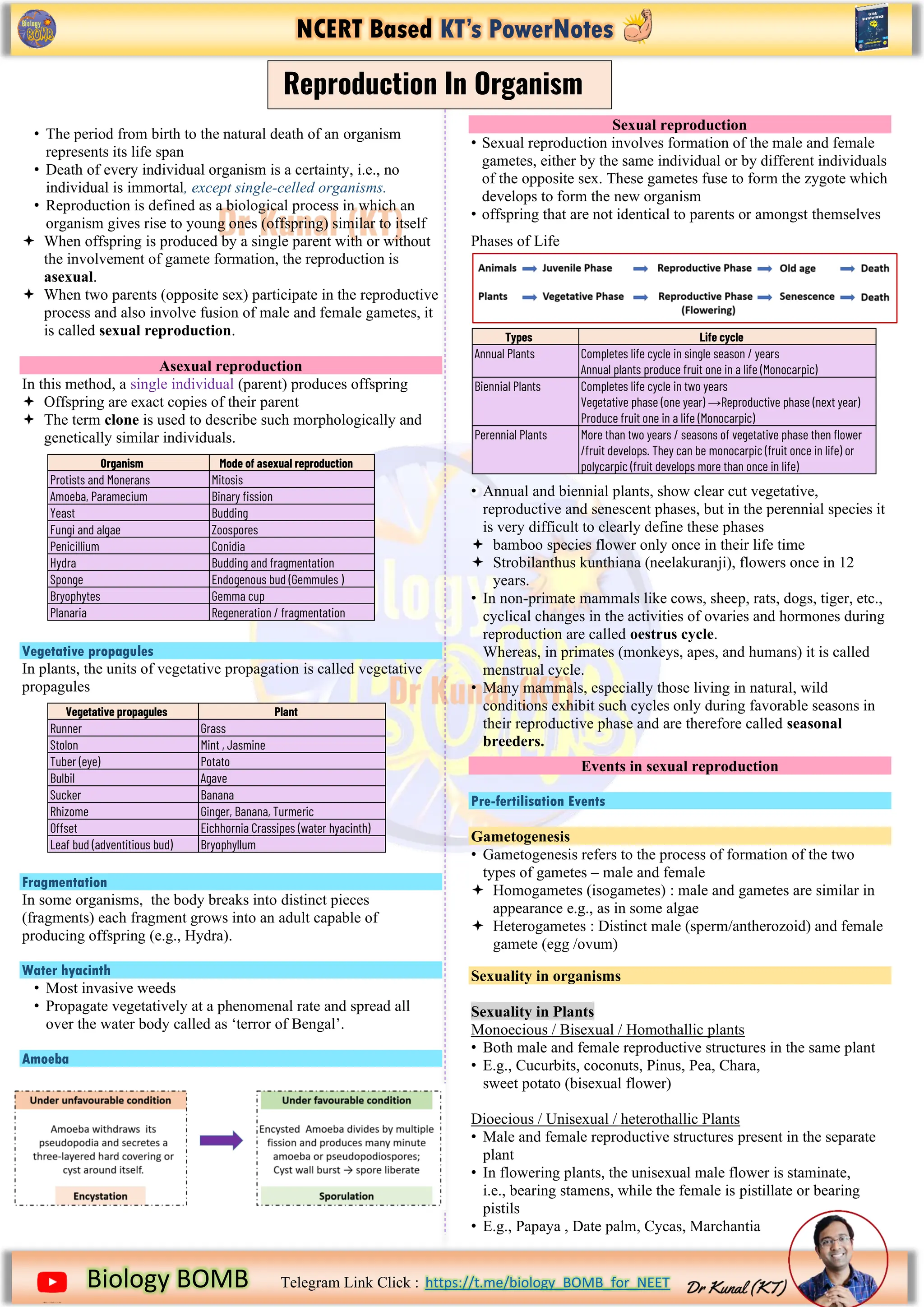
Asexual reproduction
In this method, a single individual (parent) produces offspring
 Offspring are exact copies of their parent
 The term clone is used to describe such morphologically and
genetically similar individuals.
Vegetative propagules
In plants, the units of vegetative propagation is called vegetative
propagules
Fragmentation
In some organisms, the body breaks into distinct pieces
(fragments) each fragment grows into an adult capable of
producing offspring (e.g., Hydra).
Water hyacinth
• Most invasive weeds
• Propagate vegetatively at a phenomenal rate and spread all
over the water body called as ‘terror of Bengal’.
Amoeba
Sexual reproduction
• Sexual reproduction involves formation of the male and female
gametes, either by the same individual or by different individuals
of the opposite sex. These gametes fuse to form the zygote which
develops to form the new organism
• offspring that are not identical to parents or amongst themselves
Phases of Life
• Annual and biennial plants, show clear cut vegetative,
reproductive and senescent phases, but in the perennial species it
is very difficult to clearly define these phases
 bamboo species flower only once in their life time
 Strobilanthus kunthiana (neelakuranji), flowers once in 12
years.
• In non-primate mammals like cows, sheep, rats, dogs, tiger, etc.,
cyclical changes in the activities of ovaries and hormones during
reproduction are called oestrus cycle.
Whereas, in primates (monkeys, apes, and humans) it is called
menstrual cycle.
• Many mammals, especially those living in natural, wild
conditions exhibit such cycles only during favorable seasons in
their reproductive phase and are therefore called seasonal
breeders.
Events in sexual reproduction
Pre-fertilisation Events
Gametogenesis
• Gametogenesis refers to the process of formation of the two
types of gametes – male and female
 Homogametes (isogametes) : male and gametes are similar in
appearance e.g., as in some algae
 Heterogametes : Distinct male (sperm/antherozoid) and female
gamete (egg /ovum)
Sexuality in organisms
Sexuality in Plants
Monoecious / Bisexual / Homothallic plants
• Both male and female reproductive structures in the same plant
• E.g., Cucurbits, coconuts, Pinus, Pea, Chara,
sweet potato (bisexual flower)
Dioecious / Unisexual / heterothallic Plants
• Male and female reproductive structures present in the separate
plant
• In flowering plants, the unisexual male flower is staminate,
i.e., bearing stamens, while the female is pistillate or bearing
pistils
• E.g., Papaya , Date palm, Cycas, Marchantia
Reproduction In Organism
Organism Mode of asexual reproduction
Protists and Monerans Mitosis
Amoeba, Paramecium Binary fission
Yeast Budding
Fungi and algae Zoospores
Penicillium Conidia
Hydra Budding and fragmentation
Sponge Endogenous bud (Gemmules )
Bryophytes Gemma cup
Planaria Regeneration / fragmentation
Types Life cycle
Annual Plants Completes life cycle in single season / years
Annual plants produce fruit one in a life (Monocarpic)
Biennial Plants Completes life cycle in two years
Vegetative phase (one year) →Reproductive phase (next year)
Produce fruit one in a life (Monocarpic)
Perennial Plants More than two years / seasons of vegetative phase then flower
/fruit develops. They can be monocarpic (fruit once in life) or
polycarpic (fruit develops more than once in life)
Vegetative propagules Plant
Runner Grass
Stolon Mint , Jasmine
Tuber (eye) Potato
Bulbil Agave
Sucker Banana
Rhizome Ginger, Banana, Turmeric
Offset Eichhornia Crassipes (water hyacinth)
Leaf bud (adventitious bud) Bryophyllum
NCERT Based KT’s PowerNotes
https://www.google.com/imgres?imgurl=https%3A%2F%2Fi.pinimg.com%2Foriginals%2F2b%2Fd5%2F13%2F2bd5136ecf91f8f079093
Biology BOMB Telegram Link Click : https://t.me/biology_BOMB_for_NEET
Sexuality in animals
Unisexual animals:
• Unisexual animals possess either male or female reproductive
organ E.g., Cockroach
Bisexual / hermaphrodite animals:
• Bisexual animals possess both male and female reproductive
organs in same individual
• e.g., Earthworms, sponge, tapeworm, leech
Gamete Transfer
• Algae, bryophytes and Pteridophytes: gametes are transferred by
water
• In seed plants, pollen grains are the carriers of male gametes
Fertilisation
• Fusion of gametes is called syngamy (Fertilization)
• A form of reproduction in which an egg can develop into an
embryo without being fertilized by a sperm is called
Parthenogenesis.
Seen in rotifers, honeybees , some lizards, birds (turkey),
Where does syngamy occur?
External fertilisation
• Syngamy in the external medium (water), i.e., outside the body
of the organism is called external fertilisation
• zygote is formed in the external medium (usually water)
• Seen in most algae, fishes, Amphibians
• Requirement :
Synchrony between the sexes and release a large number of
gametes into the surrounding medium (water) by both sexes
• Disadvantage :
Offspring are extremely vulnerable to predators
Internal fertilisation
• Syngamy occurs inside the body of the organism
• Seen in most fungi, reptiles, birds, mammals, bryophytes,
pteridophytes, gymnosperms and angiosperms
• Requirement
 Motile male gamete and Egg is formed inside female body
 In these even though the number of sperms produced is very
large, there is a significant reduction in the number of eggs
produced
 In seed plants, however, the non-motile male gametes are
carried to female gamete by pollen tubes
-----------------------------------------------------------------------------
Post-fertilisation Events
• In organisms belonging to fungi and algae, zygote develops a
thick wall that is resistant to desiccation and damage →
undergoes a period of rest → then germinates
• In organisms with haplontic life cycle zygote divides by meiosis
to form haploid spores that grow into haploid individuals.
Embryogenesis
• Embryogenesis refers to the process of development of embryo
from the zygote.
• During embryogenesis, zygote undergoes cell division (mitosis)
and cell differentiation [In Haplontic life cycle zygote undergoes
meiosis]
Oviparous animals
• Lay fertilized/ unfertilized eggs
• In oviparous animals like reptiles and birds, the fertilised eggs
covered by hard calcareous shell are laid in a safe place in the
environment;
Viviparous animals
Includes majority of mammals including human beings
Zygote develops into a young one inside the body of the female
organism and young ones are delivered out of the body
Flowering plants
• Zygote is formed inside the ovule. After fertilisation the sepals,
petals and stamens of the flower wither and fall off. (exception :
sepals remain attached in tomatoes, strawberries, raspberries,
brinjal, etc.)
• The pistil however, remains attached to the plant
• Zygote develops into embryo
• Ovule develops into seed
• Ovary develops into the fruit
• Protective thick wall of ovary is called pericarp
Also note :
---------------------------------------------------------------------------
Organism Diploid number
Human beings 46
House fly 12
Fruit fly 8
Maize 20
END
NCERT Based KT’s PowerNotes
https://www.google.com/imgres?imgurl=https%3A%2F%2Fi.pinimg.com%2Foriginals%2F2b%2Fd5%2F13%2F2bd5136ecf91f8f079093
Biology BOMB
NEET 2022
Male reproductive structure of flower
Stamen
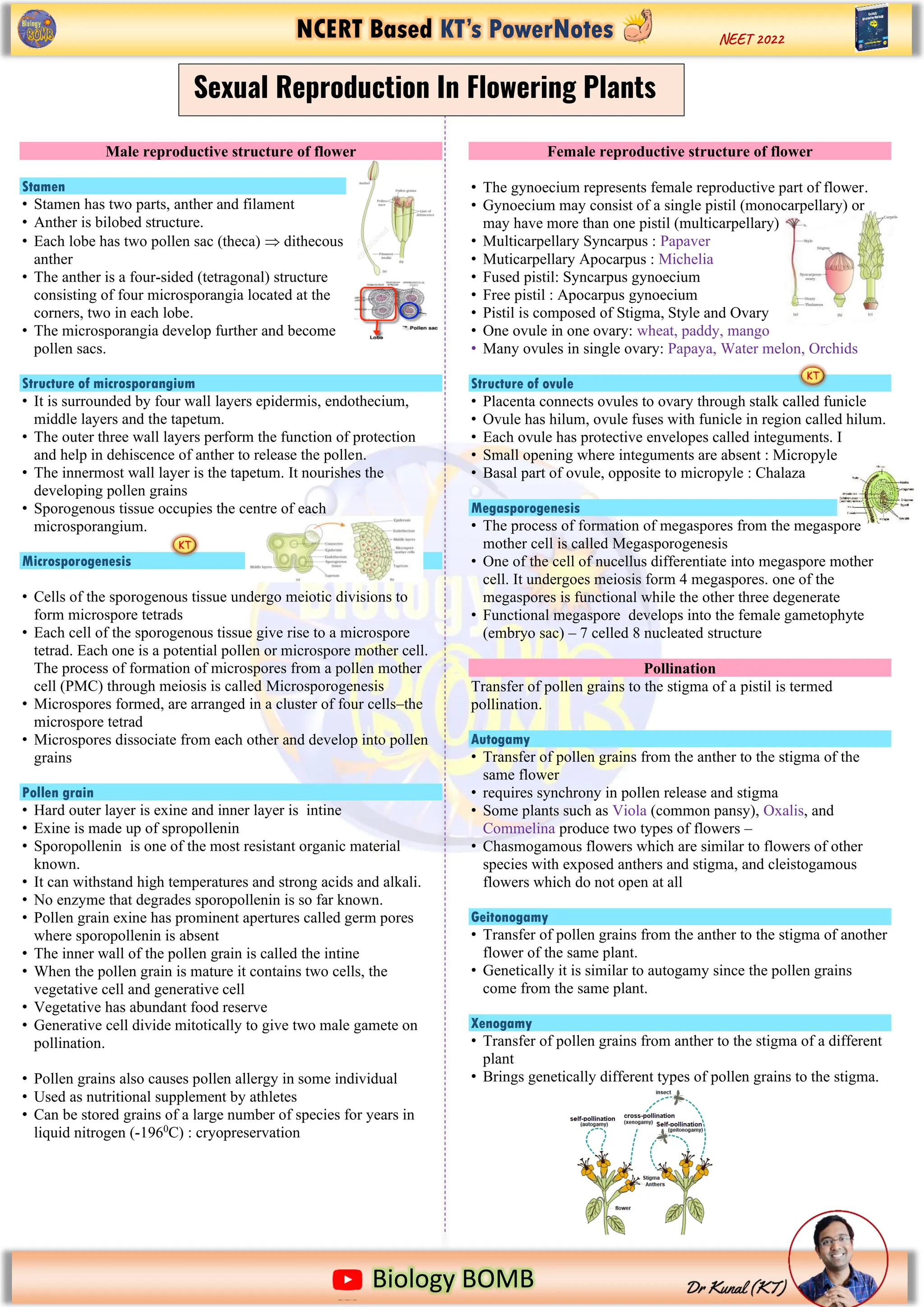
• Stamen has two parts, anther and filament
• Anther is bilobed structure.
• Each lobe has two pollen sac (theca)  dithecous
anther
• The anther is a four-sided (tetragonal) structure
consisting of four microsporangia located at the
corners, two in each lobe.
• The microsporangia develop further and become
pollen sacs.
Structure of microsporangium
• It is surrounded by four wall layers epidermis, endothecium,
middle layers and the tapetum.
• The outer three wall layers perform the function of protection
and help in dehiscence of anther to release the pollen.
• The innermost wall layer is the tapetum. It nourishes the
developing pollen grains
• Sporogenous tissue occupies the centre of each
microsporangium.
Microsporogenesis
• Cells of the sporogenous tissue undergo meiotic divisions to
form microspore tetrads
• Each cell of the sporogenous tissue give rise to a microspore
tetrad. Each one is a potential pollen or microspore mother cell.
The process of formation of microspores from a pollen mother
cell (PMC) through meiosis is called Microsporogenesis
• Microspores formed, are arranged in a cluster of four cells–the
microspore tetrad
• Microspores dissociate from each other and develop into pollen
grains
Pollen grain
• Hard outer layer is exine and inner layer is intine
• Exine is made up of spropollenin
• Sporopollenin is one of the most resistant organic material
known.
• It can withstand high temperatures and strong acids and alkali.
• No enzyme that degrades sporopollenin is so far known.
• Pollen grain exine has prominent apertures called germ pores
where sporopollenin is absent
• The inner wall of the pollen grain is called the intine
• When the pollen grain is mature it contains two cells, the
vegetative cell and generative cell
• Vegetative has abundant food reserve
• Generative cell divide mitotically to give two male gamete on
pollination.
• Pollen grains also causes pollen allergy in some individual
• Used as nutritional supplement by athletes
• Can be stored grains of a large number of species for years in
liquid nitrogen (-1960
C) : cryopreservation
Female reproductive structure of flower
• The gynoecium represents female reproductive part of flower.
• Gynoecium may consist of a single pistil (monocarpellary) or
may have more than one pistil (multicarpellary)
• Multicarpellary Syncarpus : Papaver
• Muticarpellary Apocarpus : Michelia
• Fused pistil: Syncarpus gynoecium
• Free pistil : Apocarpus gynoecium
• Pistil is composed of Stigma, Style and Ovary
• One ovule in one ovary: wheat, paddy, mango
• Many ovules in single ovary: Papaya, Water melon, Orchids
Structure of ovule
• Placenta connects ovules to ovary through stalk called funicle
• Ovule has hilum, ovule fuses with funicle in region called hilum.
• Each ovule has protective envelopes called integuments. I
• Small opening where integuments are absent : Micropyle
• Basal part of ovule, opposite to micropyle : Chalaza
Megasporogenesis
• The process of formation of megaspores from the megaspore
mother cell is called Megasporogenesis
• One of the cell of nucellus differentiate into megaspore mother
cell. It undergoes meiosis form 4 megaspores. one of the
megaspores is functional while the other three degenerate
• Functional megaspore develops into the female gametophyte
(embryo sac) – 7 celled 8 nucleated structure
Pollination
Transfer of pollen grains to the stigma of a pistil is termed
pollination.
Autogamy
• Transfer of pollen grains from the anther to the stigma of the
same flower
• requires synchrony in pollen release and stigma
• Some plants such as Viola (common pansy), Oxalis, and
Commelina produce two types of flowers –
• Chasmogamous flowers which are similar to flowers of other
species with exposed anthers and stigma, and cleistogamous
flowers which do not open at all
Geitonogamy
• Transfer of pollen grains from the anther to the stigma of another
flower of the same plant.
• Genetically it is similar to autogamy since the pollen grains
come from the same plant.
Xenogamy
• Transfer of pollen grains from anther to the stigma of a different
plant
• Brings genetically different types of pollen grains to the stigma.
Sexual Reproduction In Flowering Plants
NCERT Based KT’s PowerNotes
https://www.google.com/imgres?imgurl=https%3A%2F%2Fi.pinimg.com%2Foriginals%2F2b%2Fd5%2F13%2F2bd5136ecf91f8f079093
Biology BOMB
NEET 2022
Agents of Pollination
Majority of plants use biotic agents (eg honeybee) for pollination
Abiotic pollinating agent
Wind Pollination
• Pollination by wind is more common amongst abiotic
pollinations
• Requirements for wind pollination
 Light non sticky pollen
 Well exposed stamens
• Wind pollinated flowers often have a single ovule in each ovary
and numerous flowers packed into an inflorescence; a familiar
example is the corn cob
Pollination by water
• Shown by Vallisneria and Hydrilla and sea-grasses such as
Zoster
• In Vallisneria , pollen grains are released on to the surface of
water
• In sea-grasses such as Zoster , pollens are released inside water
• In most of the water-pollinated species, pollen grains are
protected from wetting by a mucilaginous covering
Both wind and water pollinated flowers are not very colourful and
do not produce nectar.
Biotic pollinating agent
• Majority of flowering plants use a range of animals as
pollinating agents eg Bees, butterflies, flies, beetles, wasps, ants,
moths, birds, (lemurs), arboreal (tree-dwelling) rodents, or even
reptiles (gecko lizard and garden lizard)
• Insects, particularly bees are the dominant biotic pollinating
agents
• Requirement for biotic pollination
 Large, colourful, fragrant and rich in nectar flowers
 Secretion of foul odour to attract insect
• Special examples
 Amorphophallus (the flower itself is about 6 feet in height)
provide safe places to pollinating agent to lay eggs
 Moth and Yucca plant : cannot complete their life cycles
without each other.
Outbreeding Devices
• Continued self-pollination result in inbreeding depression, so
discourage self-pollination some plants have evolved various
mechanisms called as outbreeding devices such as :
1. Pollen release and stigma receptivity are desynchronised
2. The anther and stigma are placed at positions unfavourable
for self-pollination
3. self-incompatibility ,this is a genetic mechanism and
prevents self-pollen (from the same flower or other flowers
of the same plant) from fertilising the ovules
4. Production of unisexual flowers (seen in castor , maize etc),
it prevents autogamy but not geitonogamy
5. Dioceous plant e.g. Papaya, in this plant male and female
flowers are present on different plants
Pollen-pistil Interaction
• The pistil has the ability to recognise the pollen, whether it is of
the right type (compatible) or of the wrong type (incompatible).
• Pollen grain germinates on the stigma to produce a pollen tube
through one of the germ pores.
• Generative cell divides and forms two male gametes
• Pollen tube enters the ovule through the micropyle
• Filiform apparatus guides the entry of pollen tube
Artificial hybridisation
• This is a method where desired pollen grains are used for
pollination and the stigma is protected from contamination (from
unwanted pollen). This achieved by emasculation and bagging
• Emasculation: removal of anthers,
• Bagging: covering of flower with a bag made up of butter paper
 In Bisexual flower : Both emasculation & bagging is done
 In unisexual flower: no need for emasculation, only
bagging is done
Double fertilisation
• Pollen tube releases two male gametes into the cytoplasm of the
synergid.
• One male gamete fuses with egg cell nucleus  zygote formed
• Another male gamete fuses with central cell  k/a triple fusion
triploid primary endosperm nucleus forms
Post-fertilisation : structures and events
Endosperm
• PEN undergoes successive nuclear divisions to give rise to free
nuclei. This stage of endosperm development is called free-
nuclear endosperm e.g. Coconut water
Endospermic seed
• Endosperm persist in the mature seed (e.g. wheat, maize, barley
castor and coconut)
Non endospermic seed
• Also k/a non-albuminous or ex-albuminous
• Endosperm is completely consumed by the developing embryo
before seed maturation (e.g., pea, groundnut, beans)
Embryo
Zygote divide only after certain amount of endosperm is formed.
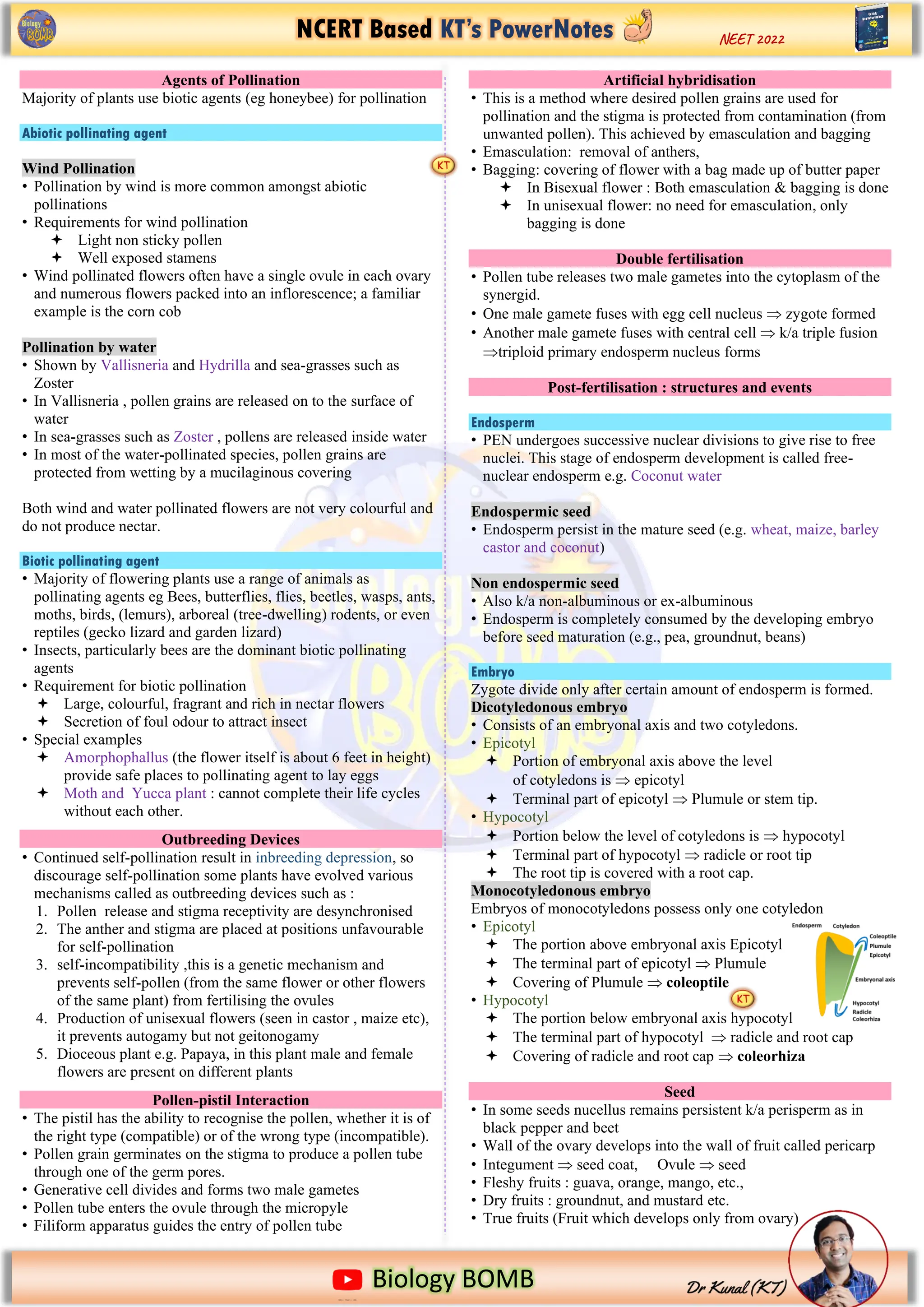
Dicotyledonous embryo
• Consists of an embryonal axis and two cotyledons.
• Epicotyl
 Portion of embryonal axis above the level
of cotyledons is  epicotyl
 Terminal part of epicotyl  Plumule or stem tip.
• Hypocotyl
 Portion below the level of cotyledons is  hypocotyl
 Terminal part of hypocotyl  radicle or root tip
 The root tip is covered with a root cap.
Monocotyledonous embryo
Embryos of monocotyledons possess only one cotyledon
• Epicotyl
 The portion above embryonal axis Epicotyl
 The terminal part of epicotyl  Plumule
 Covering of Plumule  coleoptile
• Hypocotyl
 The portion below embryonal axis hypocotyl
 The terminal part of hypocotyl  radicle and root cap
 Covering of radicle and root cap  coleorhiza
Seed
• In some seeds nucellus remains persistent k/a perisperm as in
black pepper and beet
• Wall of the ovary develops into the wall of fruit called pericarp
• Integument  seed coat, Ovule  seed
• Fleshy fruits : guava, orange, mango, etc.,
• Dry fruits : groundnut, and mustard etc.
• True fruits (Fruit which develops only from ovary)
NCERT Based KT’s PowerNotes
https://www.google.com/imgres?imgurl=https%3A%2F%2Fi.pinimg.com%2Foriginals%2F2b%2Fd5%2F13%2F2bd5136ecf91f8f079093
Biology BOMB
NEET 2022
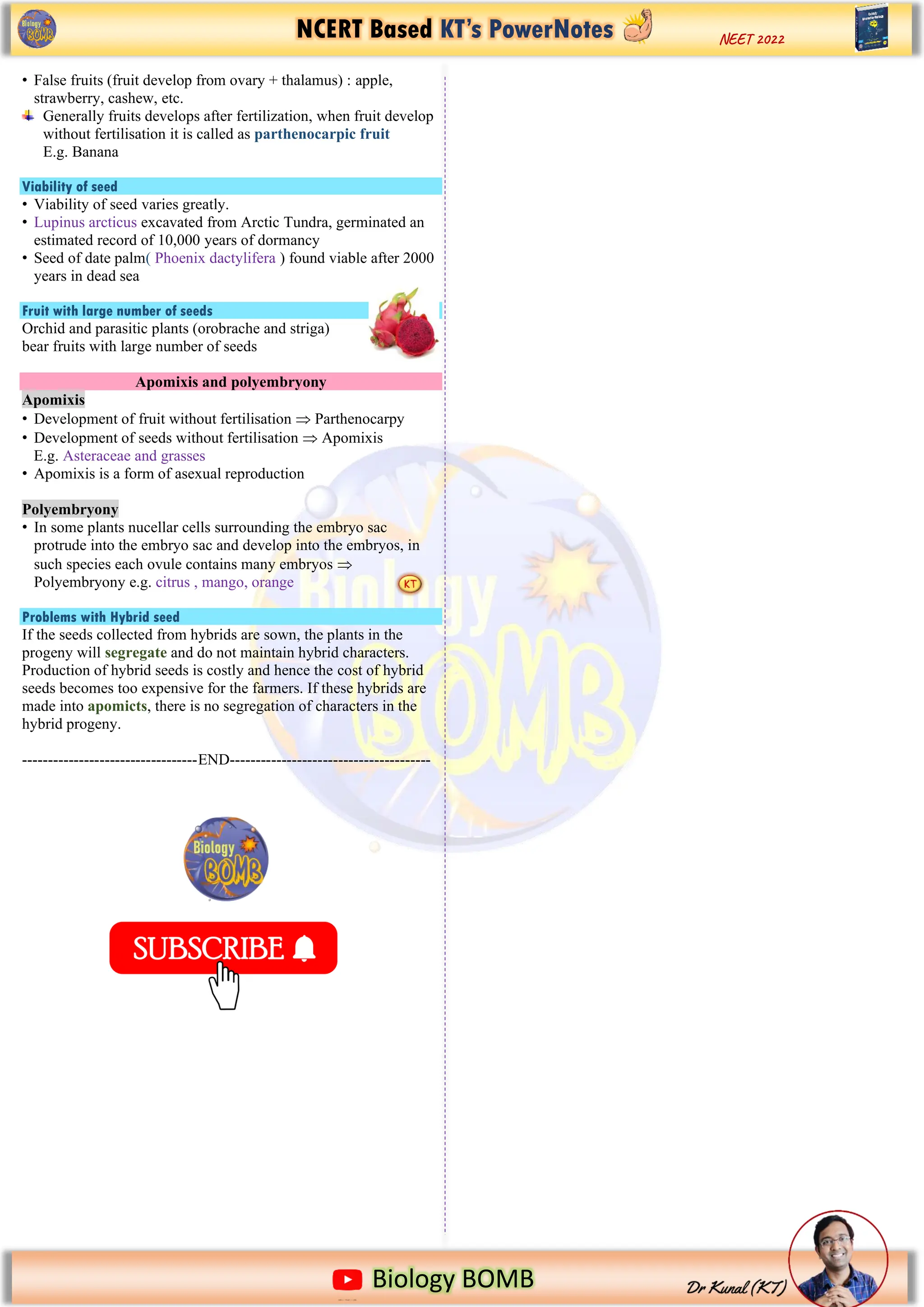
• False fruits (fruit develop from ovary + thalamus) : apple,
strawberry, cashew, etc.
Generally fruits develops after fertilization, when fruit develop
without fertilisation it is called as parthenocarpic fruit
E.g. Banana
Viability of seed
• Viability of seed varies greatly.
• Lupinus arcticus excavated from Arctic Tundra, germinated an
estimated record of 10,000 years of dormancy
• Seed of date palm( Phoenix dactylifera ) found viable after 2000
years in dead sea
Fruit with large number of seeds
Orchid and parasitic plants (orobrache and striga)
bear fruits with large number of seeds
Apomixis and polyembryony
Apomixis
• Development of fruit without fertilisation  Parthenocarpy
• Development of seeds without fertilisation  Apomixis
E.g. Asteraceae and grasses
• Apomixis is a form of asexual reproduction
Polyembryony
• In some plants nucellar cells surrounding the embryo sac
protrude into the embryo sac and develop into the embryos, in
such species each ovule contains many embryos 
Polyembryony e.g. citrus , mango, orange
Problems with Hybrid seed
If the seeds collected from hybrids are sown, the plants in the
progeny will segregate and do not maintain hybrid characters.
Production of hybrid seeds is costly and hence the cost of hybrid
seeds becomes too expensive for the farmers. If these hybrids are
made into apomicts, there is no segregation of characters in the
hybrid progeny.
----------------------------------END---------------------------------------
NCERT Based KT’s PowerNotes
Biology BOMB
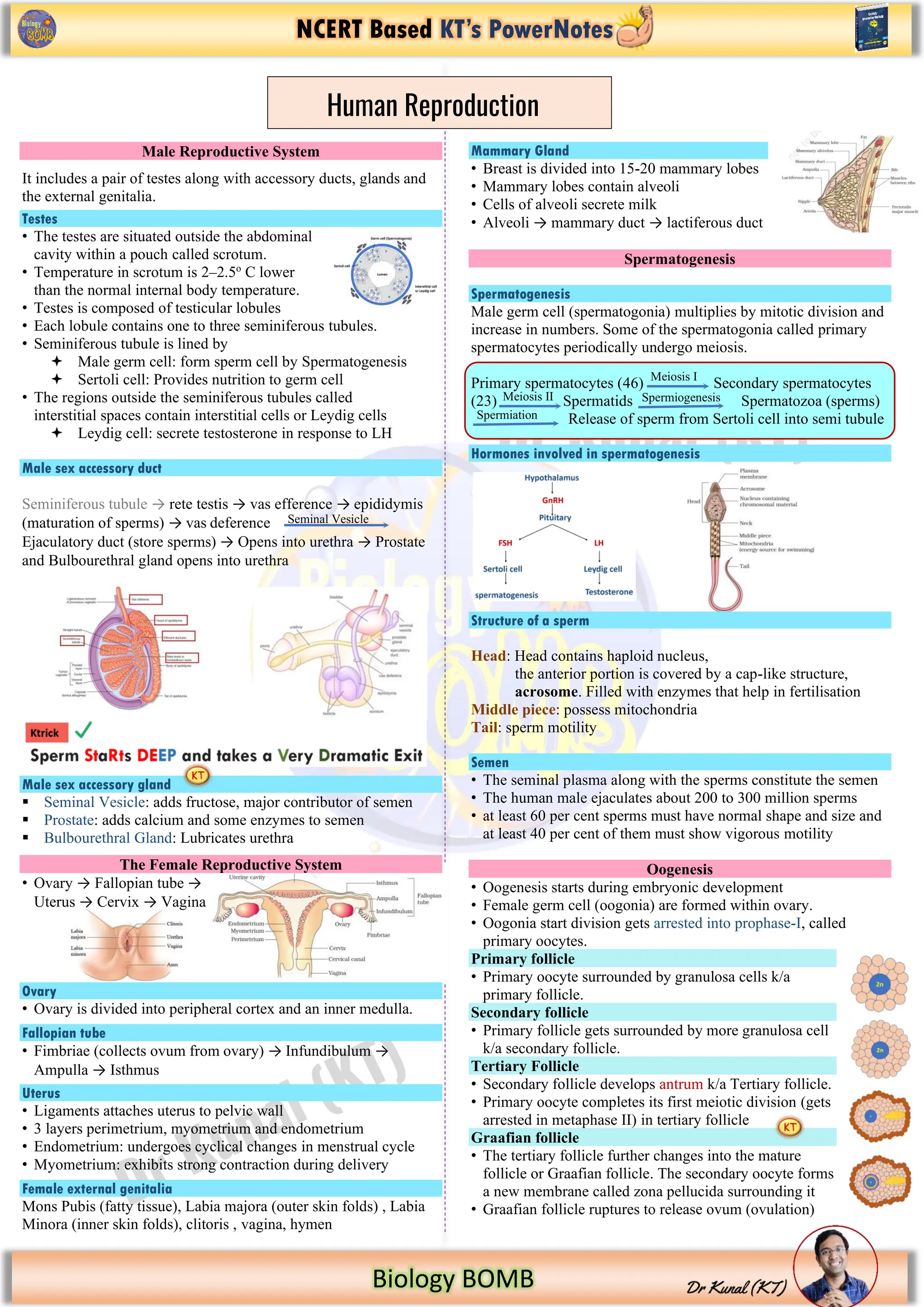
Male Reproductive System
It includes a pair of testes along with accessory ducts, glands and
the external genitalia.
Testes
• The testes are situated outside the abdominal
cavity within a pouch called scrotum.
• Temperature in scrotum is 2–2.5o
C lower
than the normal internal body temperature.
• Testes is composed of testicular lobules
• Each lobule contains one to three seminiferous tubules.
• Seminiferous tubule is lined by
 Male germ cell: form sperm cell by Spermatogenesis
 Sertoli cell: Provides nutrition to germ cell
• The regions outside the seminiferous tubules called
interstitial spaces contain interstitial cells or Leydig cells
 Leydig cell: secrete testosterone in response to LH
Male sex accessory duct
Seminiferous tubule → rete testis → vas efference → epididymis
(maturation of sperms) → vas deference
Ejaculatory duct (store sperms) → Opens into urethra → Prostate
and Bulbourethral gland opens into urethra
Male sex accessory gland
▪ Seminal Vesicle: adds fructose, major contributor of semen
▪ Prostate: adds calcium and some enzymes to semen
▪ Bulbourethral Gland: Lubricates urethra
The Female Reproductive System
• Ovary → Fallopian tube →
Uterus → Cervix → Vagina
Ovary
• Ovary is divided into peripheral cortex and an inner medulla.
Fallopian tube
• Fimbriae (collects ovum from ovary) → Infundibulum →
Ampulla → Isthmus
Uterus
• Ligaments attaches uterus to pelvic wall
• 3 layers perimetrium, myometrium and endometrium
• Endometrium: undergoes cyclical changes in menstrual cycle
• Myometrium: exhibits strong contraction during delivery
Female external genitalia
Mons Pubis (fatty tissue), Labia majora (outer skin folds) , Labia
Minora (inner skin folds), clitoris , vagina, hymen
Mammary Gland
• Breast is divided into 15-20 mammary lobes
• Mammary lobes contain alveoli
• Cells of alveoli secrete milk
• Alveoli → mammary duct → lactiferous duct
Spermatogenesis
Spermatogenesis
Male germ cell (spermatogonia) multiplies by mitotic division and
increase in numbers. Some of the spermatogonia called primary
spermatocytes periodically undergo meiosis.
Primary spermatocytes (46) Secondary spermatocytes
(23) Spermatids Spermatozoa (sperms)
Release of sperm from Sertoli cell into semi tubule
Hormones involved in spermatogenesis
Structure of a sperm
Head: Head contains haploid nucleus,
the anterior portion is covered by a cap-like structure,
acrosome. Filled with enzymes that help in fertilisation
Middle piece: possess mitochondria
Tail: sperm motility
Semen
• The seminal plasma along with the sperms constitute the semen
• The human male ejaculates about 200 to 300 million sperms
• at least 60 per cent sperms must have normal shape and size and
at least 40 per cent of them must show vigorous motility
Oogenesis
• Oogenesis starts during embryonic development
• Female germ cell (oogonia) are formed within ovary.
• Oogonia start division gets arrested into prophase-I, called
primary oocytes.
Primary follicle
• Primary oocyte surrounded by granulosa cells k/a
primary follicle.
Secondary follicle
• Primary follicle gets surrounded by more granulosa cell
k/a secondary follicle.
Tertiary Follicle
• Secondary follicle develops antrum k/a Tertiary follicle.
• Primary oocyte completes its first meiotic division (gets
arrested in metaphase II) in tertiary follicle
Graafian follicle
• The tertiary follicle further changes into the mature
follicle or Graafian follicle. The secondary oocyte forms
a new membrane called zona pellucida surrounding it
• Graafian follicle ruptures to release ovum (ovulation)
Human Reproduction
Seminal Vesicle
Meiosis I
Meiosis II Spermiogenesis
Spermiation
NCERT Based KT’s PowerNotes
Biology BOMB
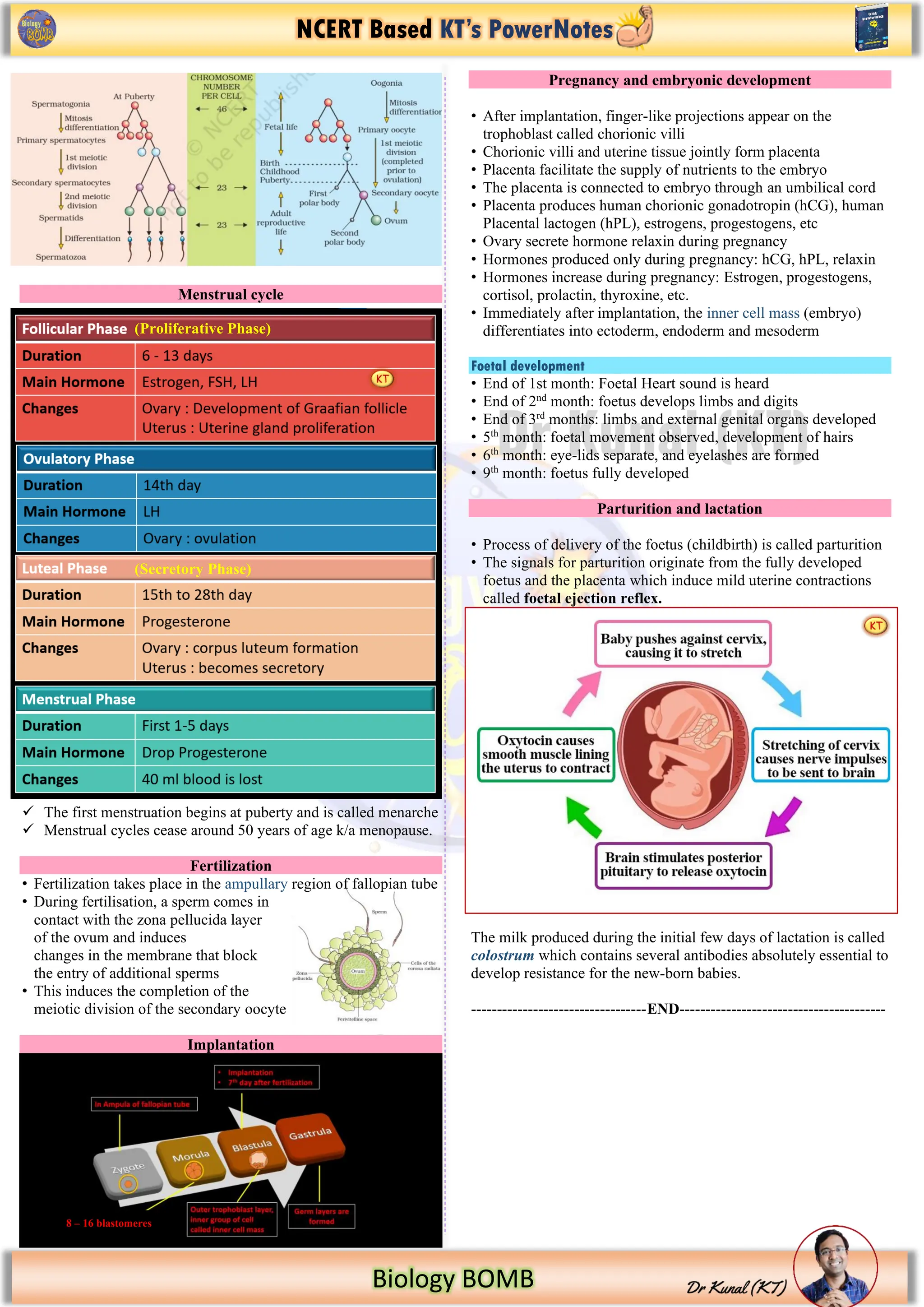
Menstrual cycle
✓ The first menstruation begins at puberty and is called menarche
✓ Menstrual cycles cease around 50 years of age k/a menopause.
Fertilization
• Fertilization takes place in the ampullary region of fallopian tube
• During fertilisation, a sperm comes in
contact with the zona pellucida layer
of the ovum and induces
changes in the membrane that block
the entry of additional sperms
• This induces the completion of the
meiotic division of the secondary oocyte
Implantation
Pregnancy and embryonic development
• After implantation, finger-like projections appear on the
trophoblast called chorionic villi
• Chorionic villi and uterine tissue jointly form placenta
• Placenta facilitate the supply of nutrients to the embryo
• The placenta is connected to embryo through an umbilical cord
• Placenta produces human chorionic gonadotropin (hCG), human
Placental lactogen (hPL), estrogens, progestogens, etc
• Ovary secrete hormone relaxin during pregnancy
• Hormones produced only during pregnancy: hCG, hPL, relaxin
• Hormones increase during pregnancy: Estrogen, progestogens,
cortisol, prolactin, thyroxine, etc.
• Immediately after implantation, the inner cell mass (embryo)
differentiates into ectoderm, endoderm and mesoderm
Foetal development
• End of 1st month: Foetal Heart sound is heard
• End of 2nd
month: foetus develops limbs and digits
• End of 3rd
months: limbs and external genital organs developed
• 5th
month: foetal movement observed, development of hairs
• 6th
month: eye-lids separate, and eyelashes are formed
• 9th
month: foetus fully developed
Parturition and lactation
• Process of delivery of the foetus (childbirth) is called parturition
• The signals for parturition originate from the fully developed
foetus and the placenta which induce mild uterine contractions
called foetal ejection reflex.
The milk produced during the initial few days of lactation is called
colostrum which contains several antibodies absolutely essential to
develop resistance for the new-born babies.
----------------------------------END----------------------------------------
8 – 16 blastomeres
(Proliferative Phase)
(Secretory Phase)
NCERT Based KT’s PowerNotes
Biology BOMB
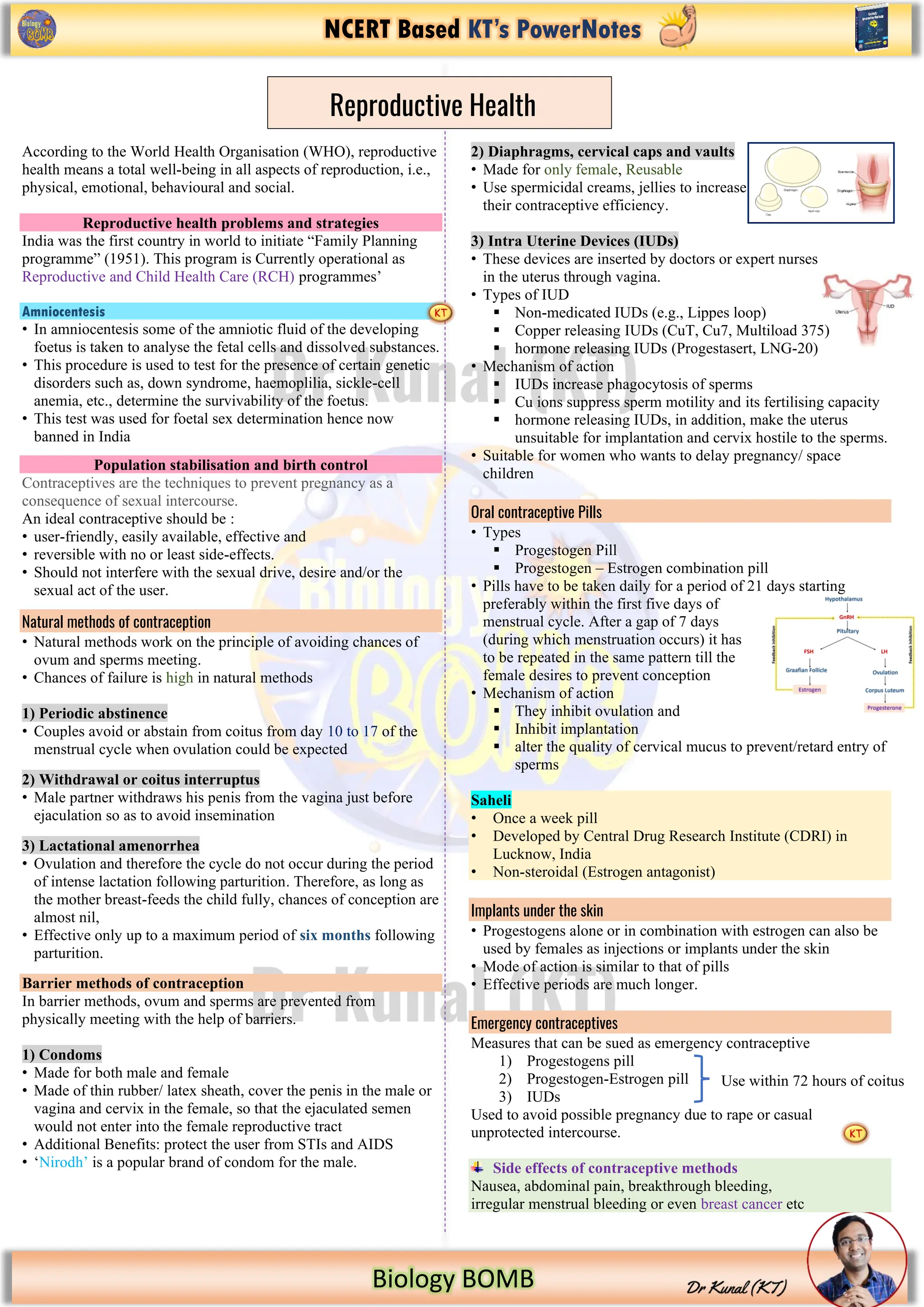
According to the World Health Organisation (WHO), reproductive
health means a total well-being in all aspects of reproduction, i.e.,
physical, emotional, behavioural and social.
Reproductive health problems and strategies
India was the first country in world to initiate “Family Planning
programme” (1951). This program is Currently operational as
Reproductive and Child Health Care (RCH) programmes’
Amniocentesis
• In amniocentesis some of the amniotic fluid of the developing
foetus is taken to analyse the fetal cells and dissolved substances.
• This procedure is used to test for the presence of certain genetic
disorders such as, down syndrome, haemoplilia, sickle-cell
anemia, etc., determine the survivability of the foetus.
• This test was used for foetal sex determination hence now
banned in India
Population stabilisation and birth control
Contraceptives are the techniques to prevent pregnancy as a
consequence of sexual intercourse.
An ideal contraceptive should be :
• user-friendly, easily available, effective and
• reversible with no or least side-effects.
• Should not interfere with the sexual drive, desire and/or the
sexual act of the user.
Natural methods of contraception
• Natural methods work on the principle of avoiding chances of
ovum and sperms meeting.
• Chances of failure is high in natural methods
1) Periodic abstinence
• Couples avoid or abstain from coitus from day 10 to 17 of the
menstrual cycle when ovulation could be expected
2) Withdrawal or coitus interruptus
• Male partner withdraws his penis from the vagina just before
ejaculation so as to avoid insemination
3) Lactational amenorrhea
• Ovulation and therefore the cycle do not occur during the period
of intense lactation following parturition. Therefore, as long as
the mother breast-feeds the child fully, chances of conception are
almost nil,
• Effective only up to a maximum period of six months following
parturition.
Barrier methods of contraception
In barrier methods, ovum and sperms are prevented from
physically meeting with the help of barriers.
1) Condoms
• Made for both male and female
• Made of thin rubber/ latex sheath, cover the penis in the male or
vagina and cervix in the female, so that the ejaculated semen
would not enter into the female reproductive tract
• Additional Benefits: protect the user from STIs and AIDS
• ‘Nirodh’ is a popular brand of condom for the male.
2) Diaphragms, cervical caps and vaults
• Made for only female, Reusable
• Use spermicidal creams, jellies to increase
their contraceptive efficiency.
3) Intra Uterine Devices (IUDs)
• These devices are inserted by doctors or expert nurses
in the uterus through vagina.
• Types of IUD
▪ Non-medicated IUDs (e.g., Lippes loop)
▪ Copper releasing IUDs (CuT, Cu7, Multiload 375)
▪ hormone releasing IUDs (Progestasert, LNG-20)
• Mechanism of action
▪ IUDs increase phagocytosis of sperms
▪ Cu ions suppress sperm motility and its fertilising capacity
▪ hormone releasing IUDs, in addition, make the uterus
unsuitable for implantation and cervix hostile to the sperms.
• Suitable for women who wants to delay pregnancy/ space
children
Oral contraceptive Pills
• Types
▪ Progestogen Pill
▪ Progestogen – Estrogen combination pill
• Pills have to be taken daily for a period of 21 days starting
preferably within the first five days of
menstrual cycle. After a gap of 7 days
(during which menstruation occurs) it has
to be repeated in the same pattern till the
female desires to prevent conception
• Mechanism of action
▪ They inhibit ovulation and
▪ Inhibit implantation
▪ alter the quality of cervical mucus to prevent/retard entry of
sperms
Saheli
• Once a week pill
• Developed by Central Drug Research Institute (CDRI) in
Lucknow, India
• Non-steroidal (Estrogen antagonist)
Implants under the skin
• Progestogens alone or in combination with estrogen can also be
used by females as injections or implants under the skin
• Mode of action is similar to that of pills
• Effective periods are much longer.
Emergency contraceptives
Measures that can be sued as emergency contraceptive
1) Progestogens pill
2) Progestogen-Estrogen pill
3) IUDs
Used to avoid possible pregnancy due to rape or casual
unprotected intercourse.
Side effects of contraceptive methods
Nausea, abdominal pain, breakthrough bleeding,
irregular menstrual bleeding or even breast cancer etc
Reproductive Health
Use within 72 hours of coitus
NCERT Based KT’s PowerNotes
Biology BOMB
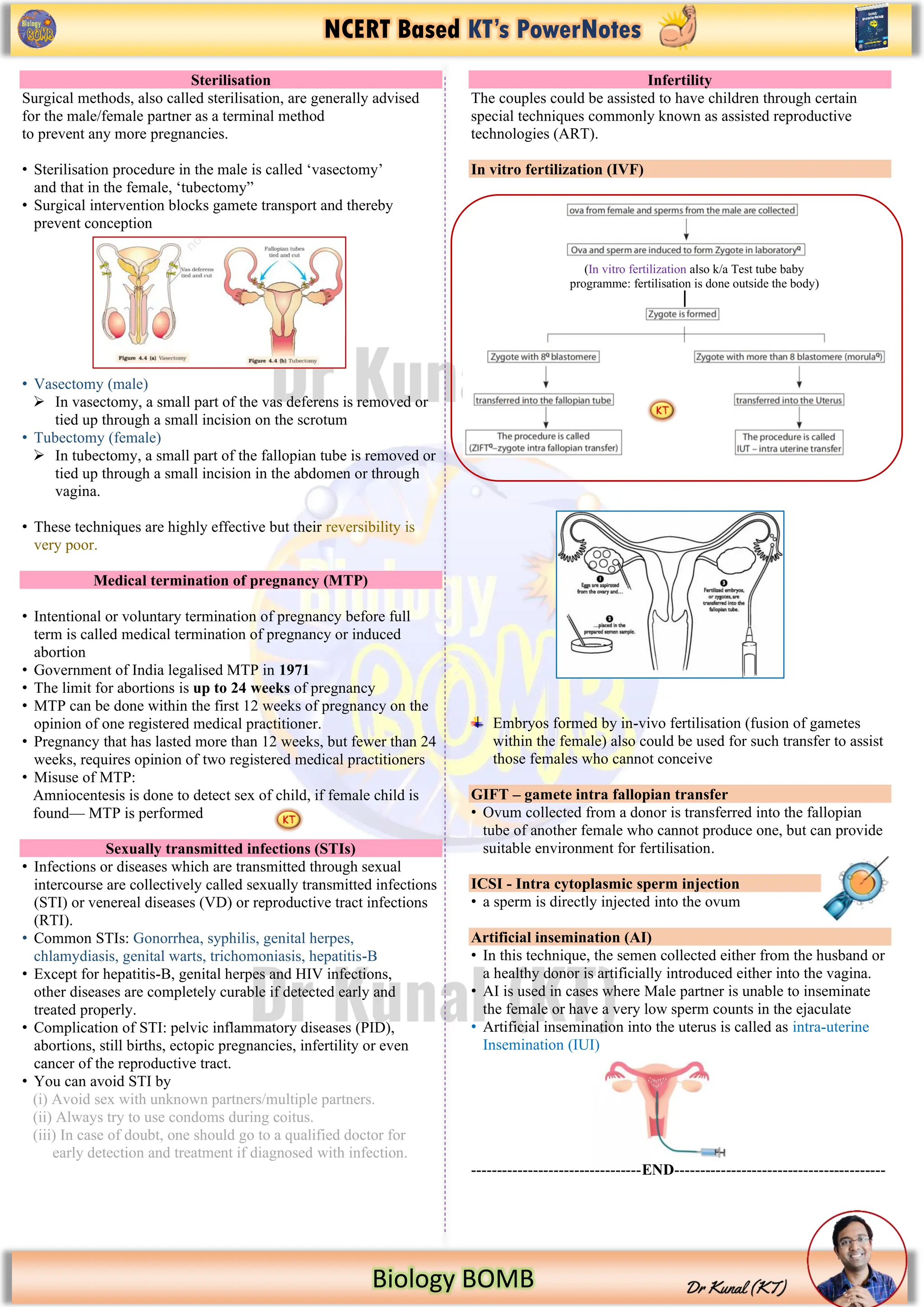
Sterilisation
Surgical methods, also called sterilisation, are generally advised
for the male/female partner as a terminal method
to prevent any more pregnancies.
• Sterilisation procedure in the male is called ‘vasectomy’
and that in the female, ‘tubectomy”
• Surgical intervention blocks gamete transport and thereby
prevent conception
• Vasectomy (male)
➢ In vasectomy, a small part of the vas deferens is removed or
tied up through a small incision on the scrotum
• Tubectomy (female)
➢ In tubectomy, a small part of the fallopian tube is removed or
tied up through a small incision in the abdomen or through
vagina.
• These techniques are highly effective but their reversibility is
very poor.
Medical termination of pregnancy (MTP)
• Intentional or voluntary termination of pregnancy before full
term is called medical termination of pregnancy or induced
abortion
• Government of India legalised MTP in 1971
• The limit for abortions is up to 24 weeks of pregnancy
• MTP can be done within the first 12 weeks of pregnancy on the
opinion of one registered medical practitioner.
• Pregnancy that has lasted more than 12 weeks, but fewer than 24
weeks, requires opinion of two registered medical practitioners
• Misuse of MTP:
Amniocentesis is done to detect sex of child, if female child is
found— MTP is performed
Sexually transmitted infections (STIs)
• Infections or diseases which are transmitted through sexual
intercourse are collectively called sexually transmitted infections
(STI) or venereal diseases (VD) or reproductive tract infections
(RTI).
• Common STIs: Gonorrhea, syphilis, genital herpes,
chlamydiasis, genital warts, trichomoniasis, hepatitis-B
• Except for hepatitis-B, genital herpes and HIV infections,
other diseases are completely curable if detected early and
treated properly.
• Complication of STI: pelvic inflammatory diseases (PID),
abortions, still births, ectopic pregnancies, infertility or even
cancer of the reproductive tract.
• You can avoid STI by
(i) Avoid sex with unknown partners/multiple partners.
(ii) Always try to use condoms during coitus.
(iii) In case of doubt, one should go to a qualified doctor for
early detection and treatment if diagnosed with infection.
Infertility
The couples could be assisted to have children through certain
special techniques commonly known as assisted reproductive
technologies (ART).
In vitro fertilization (IVF)
Embryos formed by in-vivo fertilisation (fusion of gametes
within the female) also could be used for such transfer to assist
those females who cannot conceive
GIFT – gamete intra fallopian transfer
• Ovum collected from a donor is transferred into the fallopian
tube of another female who cannot produce one, but can provide
suitable environment for fertilisation.
ICSI - Intra cytoplasmic sperm injection
• a sperm is directly injected into the ovum
Artificial insemination (AI)
• In this technique, the semen collected either from the husband or
a healthy donor is artificially introduced either into the vagina.
• AI is used in cases where Male partner is unable to inseminate
the female or have a very low sperm counts in the ejaculate
• Artificial insemination into the uterus is called as intra-uterine
Insemination (IUI)
---------------------------------END-----------------------------------------
(In vitro fertilization also k/a Test tube baby
programme: fertilisation is done outside the body)
NCERT Based KT’s PowerNotes
Biology BOMB
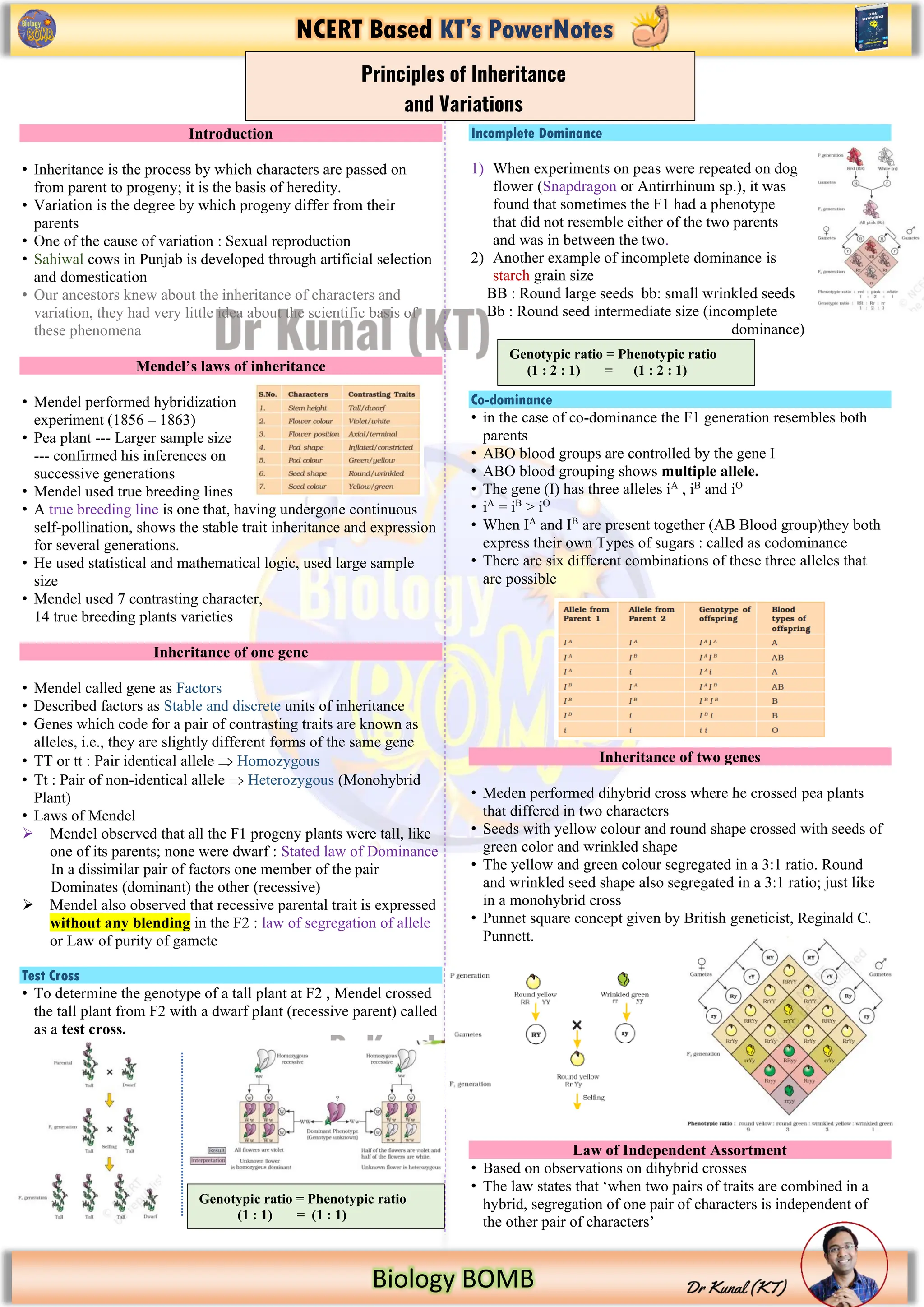
Introduction
• Inheritance is the process by which characters are passed on
from parent to progeny; it is the basis of heredity.
• Variation is the degree by which progeny differ from their
parents
• One of the cause of variation : Sexual reproduction
• Sahiwal cows in Punjab is developed through artificial selection
and domestication
• Our ancestors knew about the inheritance of characters and
variation, they had very little idea about the scientific basis of
these phenomena
Mendel’s laws of inheritance
• Mendel performed hybridization
experiment (1856 – 1863)
• Pea plant --- Larger sample size
--- confirmed his inferences on
successive generations
• Mendel used true breeding lines
• A true breeding line is one that, having undergone continuous
self-pollination, shows the stable trait inheritance and expression
for several generations.
• He used statistical and mathematical logic, used large sample
size
• Mendel used 7 contrasting character,
14 true breeding plants varieties
Inheritance of one gene
• Mendel called gene as Factors
• Described factors as Stable and discrete units of inheritance
• Genes which code for a pair of contrasting traits are known as
alleles, i.e., they are slightly different forms of the same gene
• TT or tt : Pair identical allele  Homozygous
• Tt : Pair of non-identical allele  Heterozygous (Monohybrid
Plant)
• Laws of Mendel
➢ Mendel observed that all the F1 progeny plants were tall, like
one of its parents; none were dwarf : Stated law of Dominance
In a dissimilar pair of factors one member of the pair
Dominates (dominant) the other (recessive)
➢ Mendel also observed that recessive parental trait is expressed
without any blending in the F2 : law of segregation of allele
or Law of purity of gamete
Test Cross
• To determine the genotype of a tall plant at F2 , Mendel crossed
the tall plant from F2 with a dwarf plant (recessive parent) called
as a test cross.
Incomplete Dominance
1) When experiments on peas were repeated on dog
flower (Snapdragon or Antirrhinum sp.), it was
found that sometimes the F1 had a phenotype
that did not resemble either of the two parents
and was in between the two.
2) Another example of incomplete dominance is
starch grain size
BB : Round large seeds bb: small wrinkled seeds
Bb : Round seed intermediate size (incomplete
dominance)
Co-dominance
• in the case of co-dominance the F1 generation resembles both
parents
• ABO blood groups are controlled by the gene I
• ABO blood grouping shows multiple allele.
• The gene (I) has three alleles iA
, iB
and iO
• iA
= iB
> iO
• When IA
and IB
are present together (AB Blood group)they both
express their own Types of sugars : called as codominance
• There are six different combinations of these three alleles that
are possible
Inheritance of two genes
• Meden performed dihybrid cross where he crossed pea plants
that differed in two characters
• Seeds with yellow colour and round shape crossed with seeds of
green color and wrinkled shape
• The yellow and green colour segregated in a 3:1 ratio. Round
and wrinkled seed shape also segregated in a 3:1 ratio; just like
in a monohybrid cross
• Punnet square concept given by British geneticist, Reginald C.
Punnett.
Law of Independent Assortment
• Based on observations on dihybrid crosses
• The law states that ‘when two pairs of traits are combined in a
hybrid, segregation of one pair of characters is independent of
the other pair of characters’
Principles of Inheritance
and Variations
Genotypic ratio = Phenotypic ratio
(1 : 1) = (1 : 1)
Genotypic ratio = Phenotypic ratio
(1 : 2 : 1) = (1 : 2 : 1)
NCERT Based KT’s PowerNotes
Biology BOMB
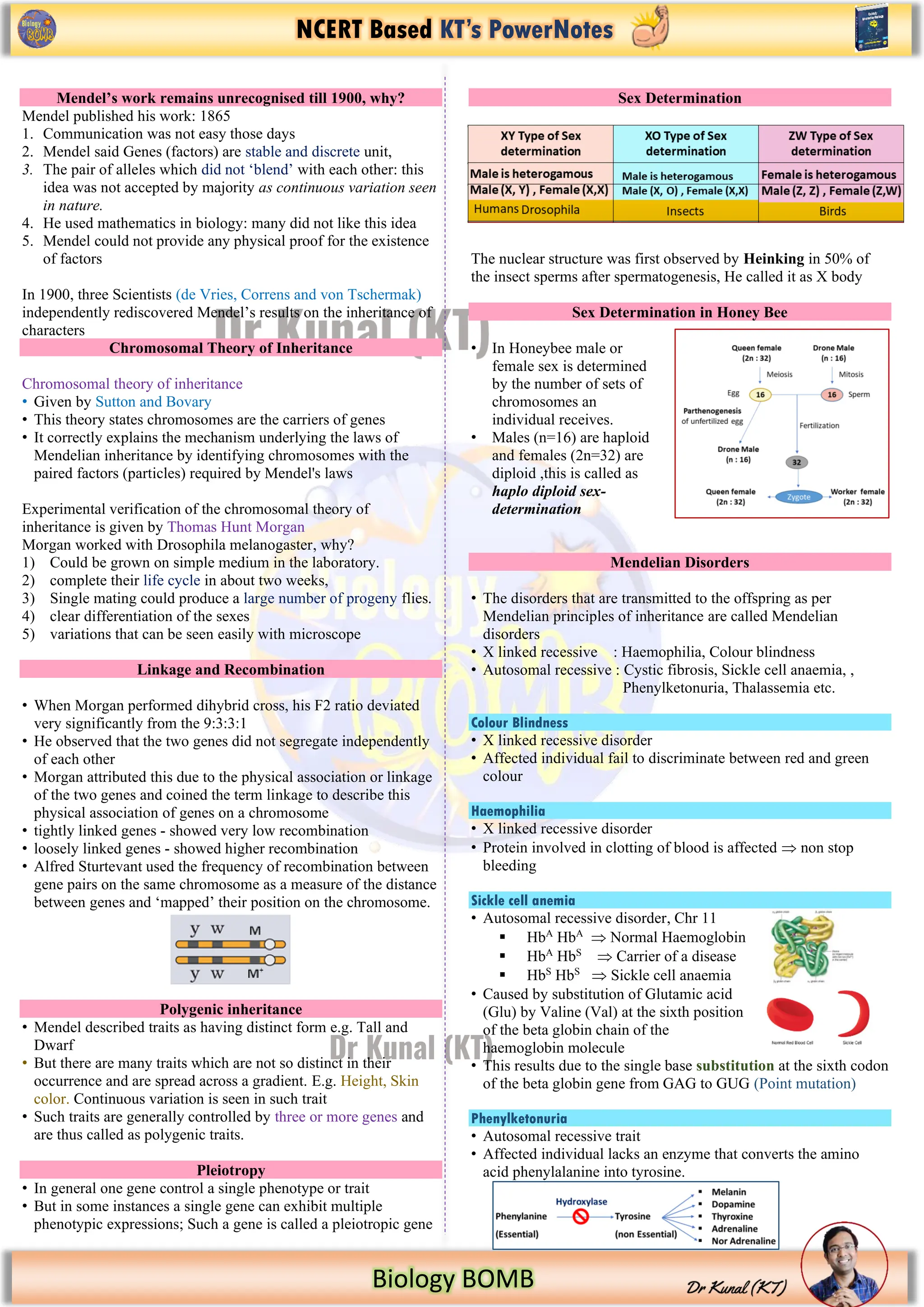
Mendel’s work remains unrecognised till 1900, why?
Mendel published his work: 1865
1. Communication was not easy those days
2. Mendel said Genes (factors) are stable and discrete unit,
3. The pair of alleles which did not ‘blend’ with each other: this
idea was not accepted by majority as continuous variation seen
in nature.
4. He used mathematics in biology: many did not like this idea
5. Mendel could not provide any physical proof for the existence
of factors
In 1900, three Scientists (de Vries, Correns and von Tschermak)
independently rediscovered Mendel’s results on the inheritance of
characters
Chromosomal Theory of Inheritance
Chromosomal theory of inheritance
• Given by Sutton and Bovary
• This theory states chromosomes are the carriers of genes
• It correctly explains the mechanism underlying the laws of
Mendelian inheritance by identifying chromosomes with the
paired factors (particles) required by Mendel's laws
Experimental verification of the chromosomal theory of
inheritance is given by Thomas Hunt Morgan
Morgan worked with Drosophila melanogaster, why?
1) Could be grown on simple medium in the laboratory.
2) complete their life cycle in about two weeks,
3) Single mating could produce a large number of progeny flies.
4) clear differentiation of the sexes
5) variations that can be seen easily with microscope
Linkage and Recombination
• When Morgan performed dihybrid cross, his F2 ratio deviated
very significantly from the 9:3:3:1
• He observed that the two genes did not segregate independently
of each other
• Morgan attributed this due to the physical association or linkage
of the two genes and coined the term linkage to describe this
physical association of genes on a chromosome
• tightly linked genes - showed very low recombination
• loosely linked genes - showed higher recombination
• Alfred Sturtevant used the frequency of recombination between
gene pairs on the same chromosome as a measure of the distance
between genes and ‘mapped’ their position on the chromosome.
Polygenic inheritance
• Mendel described traits as having distinct form e.g. Tall and
Dwarf
• But there are many traits which are not so distinct in their
occurrence and are spread across a gradient. E.g. Height, Skin
color. Continuous variation is seen in such trait
• Such traits are generally controlled by three or more genes and
are thus called as polygenic traits.
Pleiotropy
• In general one gene control a single phenotype or trait
• But in some instances a single gene can exhibit multiple
phenotypic expressions; Such a gene is called a pleiotropic gene
Sex Determination
The nuclear structure was first observed by Heinking in 50% of
the insect sperms after spermatogenesis, He called it as X body
Sex Determination in Honey Bee
• In Honeybee male or
female sex is determined
by the number of sets of
chromosomes an
individual receives.
• Males (n=16) are haploid
and females (2n=32) are
diploid ,this is called as
haplo diploid sex-
determination
Mendelian Disorders
• The disorders that are transmitted to the offspring as per
Mendelian principles of inheritance are called Mendelian
disorders
• X linked recessive : Haemophilia, Colour blindness
• Autosomal recessive : Cystic fibrosis, Sickle cell anaemia, ,
Phenylketonuria, Thalassemia etc.
Colour Blindness
• X linked recessive disorder
• Affected individual fail to discriminate between red and green
colour
Haemophilia
• X linked recessive disorder
• Protein involved in clotting of blood is affected  non stop
bleeding
Sickle cell anemia
• Autosomal recessive disorder, Chr 11
▪ HbA
HbA
 Normal Haemoglobin
▪ HbA
HbS
 Carrier of a disease
▪ HbS
HbS
 Sickle cell anaemia
• Caused by substitution of Glutamic acid
(Glu) by Valine (Val) at the sixth position
of the beta globin chain of the
haemoglobin molecule
• This results due to the single base substitution at the sixth codon
of the beta globin gene from GAG to GUG (Point mutation)
Phenylketonuria
• Autosomal recessive trait
• Affected individual lacks an enzyme that converts the amino
acid phenylalanine into tyrosine.
NCERT Based KT’s PowerNotes
Biology BOMB
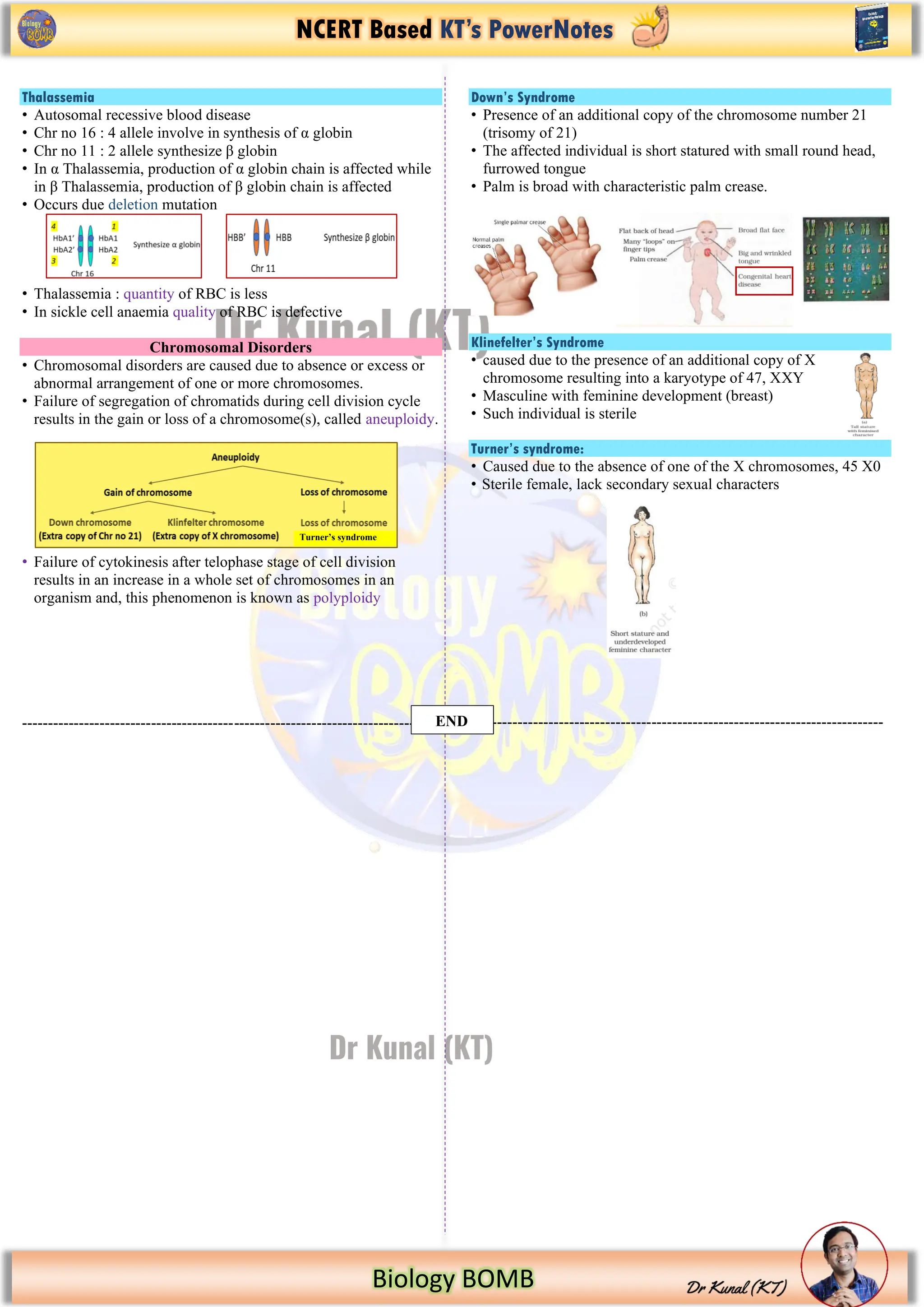
Thalassemia
• Autosomal recessive blood disease
• Chr no 16 : 4 allele involve in synthesis of α globin
• Chr no 11 : 2 allele synthesize β globin
• In α Thalassemia, production of α globin chain is affected while
in β Thalassemia, production of β globin chain is affected
• Occurs due deletion mutation
• Thalassemia : quantity of RBC is less
• In sickle cell anaemia quality of RBC is defective
Chromosomal Disorders
• Chromosomal disorders are caused due to absence or excess or
abnormal arrangement of one or more chromosomes.
• Failure of segregation of chromatids during cell division cycle
results in the gain or loss of a chromosome(s), called aneuploidy.
• Failure of cytokinesis after telophase stage of cell division
results in an increase in a whole set of chromosomes in an
organism and, this phenomenon is known as polyploidy
-------------------------------------------------------------------------------
Down’s Syndrome
• Presence of an additional copy of the chromosome number 21
(trisomy of 21)
• The affected individual is short statured with small round head,
furrowed tongue
• Palm is broad with characteristic palm crease.
Klinefelter’s Syndrome
• caused due to the presence of an additional copy of X
chromosome resulting into a karyotype of 47, XXY
• Masculine with feminine development (breast)
• Such individual is sterile
Turner’s syndrome:
• Caused due to the absence of one of the X chromosomes, 45 X0
• Sterile female, lack secondary sexual characters
--------------------------------------------------------------------------------
END
Turner’s syndrome
NCERT Based KT’s PowerNotes
Biology BOMB
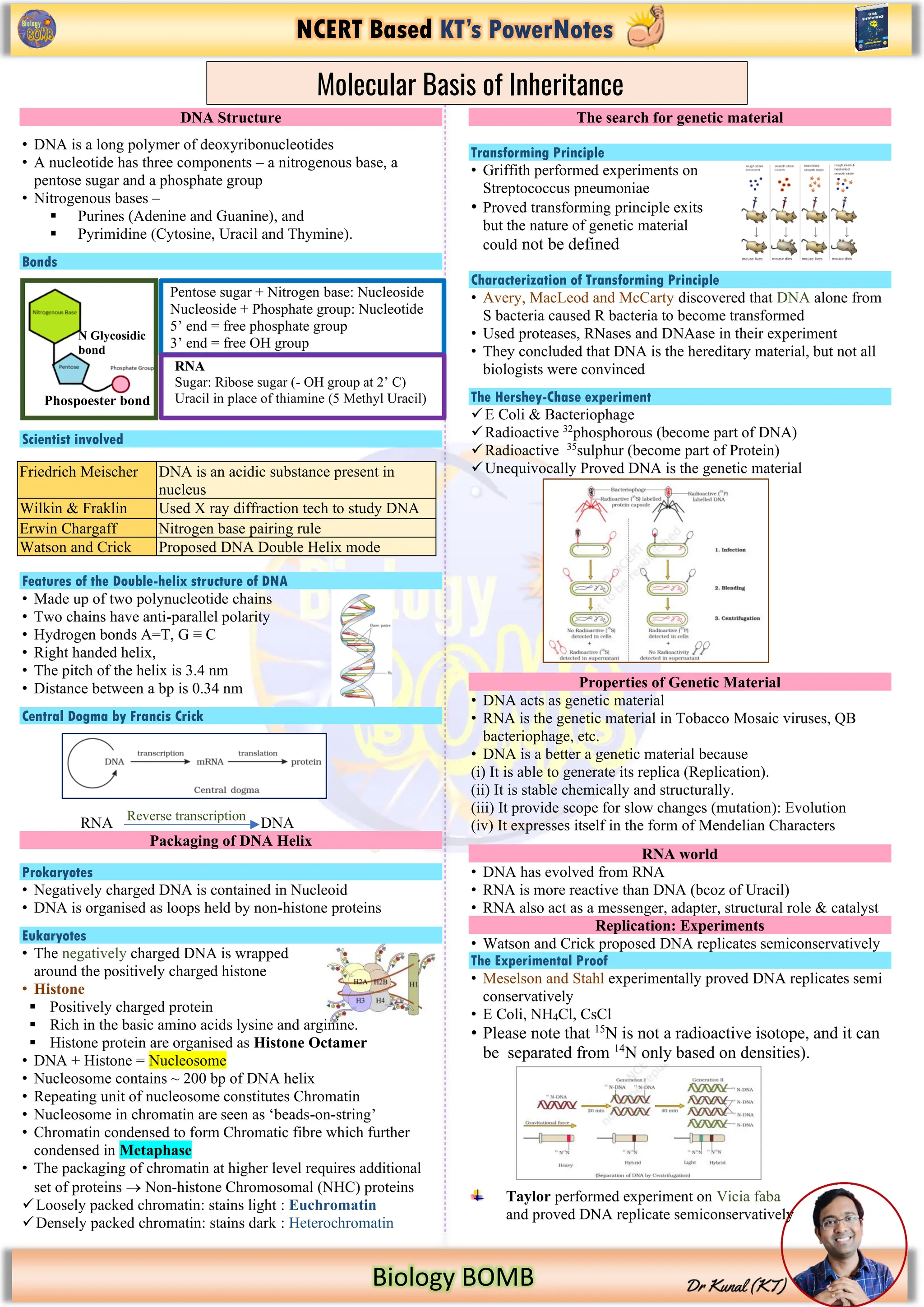
DNA Structure
• DNA is a long polymer of deoxyribonucleotides
• A nucleotide has three components – a nitrogenous base, a
pentose sugar and a phosphate group
• Nitrogenous bases –
▪ Purines (Adenine and Guanine), and
▪ Pyrimidine (Cytosine, Uracil and Thymine).
Bonds
Scientist involved
Features of the Double-helix structure of DNA
• Made up of two polynucleotide chains
• Two chains have anti-parallel polarity
• Hydrogen bonds A=T, G ≡ C
• Right handed helix,
• The pitch of the helix is 3.4 nm
• Distance between a bp is 0.34 nm
Central Dogma by Francis Crick
RNA DNA
Packaging of DNA Helix
Prokaryotes
• Negatively charged DNA is contained in Nucleoid
• DNA is organised as loops held by non-histone proteins
Eukaryotes
• The negatively charged DNA is wrapped
around the positively charged histone
• Histone
▪ Positively charged protein
▪ Rich in the basic amino acids lysine and arginine.
▪ Histone protein are organised as Histone Octamer
• DNA + Histone = Nucleosome
• Nucleosome contains ~ 200 bp of DNA helix
• Repeating unit of nucleosome constitutes Chromatin
• Nucleosome in chromatin are seen as ‘beads-on-string’
• Chromatin condensed to form Chromatic fibre which further
condensed in Metaphase
• The packaging of chromatin at higher level requires additional
set of proteins → Non-histone Chromosomal (NHC) proteins
✓Loosely packed chromatin: stains light : Euchromatin
✓Densely packed chromatin: stains dark : Heterochromatin
The search for genetic material
Transforming Principle
• Griffith performed experiments on
Streptococcus pneumoniae
• Proved transforming principle exits
but the nature of genetic material
could not be defined
Characterization of Transforming Principle
• Avery, MacLeod and McCarty discovered that DNA alone from
S bacteria caused R bacteria to become transformed
• Used proteases, RNases and DNAase in their experiment
• They concluded that DNA is the hereditary material, but not all
biologists were convinced
The Hershey-Chase experiment
✓E Coli & Bacteriophage
✓Radioactive 32
phosphorous (become part of DNA)
✓Radioactive 35
sulphur (become part of Protein)
✓Unequivocally Proved DNA is the genetic material
Properties of Genetic Material
• DNA acts as genetic material
• RNA is the genetic material in Tobacco Mosaic viruses, QB
bacteriophage, etc.
• DNA is a better a genetic material because
(i) It is able to generate its replica (Replication).
(ii) It is stable chemically and structurally.
(iii) It provide scope for slow changes (mutation): Evolution
(iv) It expresses itself in the form of Mendelian Characters
RNA world
• DNA has evolved from RNA
• RNA is more reactive than DNA (bcoz of Uracil)
• RNA also act as a messenger, adapter, structural role & catalyst
Replication: Experiments
• Watson and Crick proposed DNA replicates semiconservatively
The Experimental Proof
• Meselson and Stahl experimentally proved DNA replicates semi
conservatively
• E Coli, NH4Cl, CsCl
• Please note that 15
N is not a radioactive isotope, and it can
be separated from 14
N only based on densities).
Taylor performed experiment on Vicia faba
and proved DNA replicate semiconservatively
Molecular Basis of Inheritance
N Glycosidic
bond
Phospoester bond
Pentose sugar + Nitrogen base: Nucleoside
Nucleoside + Phosphate group: Nucleotide
5’ end = free phosphate group
3’ end = free OH group
RNA
Sugar: Ribose sugar (- OH group at 2’ C)
Uracil in place of thiamine (5 Methyl Uracil)
Friedrich Meischer DNA is an acidic substance present in
nucleus
Wilkin & Fraklin Used X ray diffraction tech to study DNA
Erwin Chargaff Nitrogen base pairing rule
Watson and Crick Proposed DNA Double Helix mode
Reverse transcription
NCERT Based KT’s PowerNotes
Biology BOMB
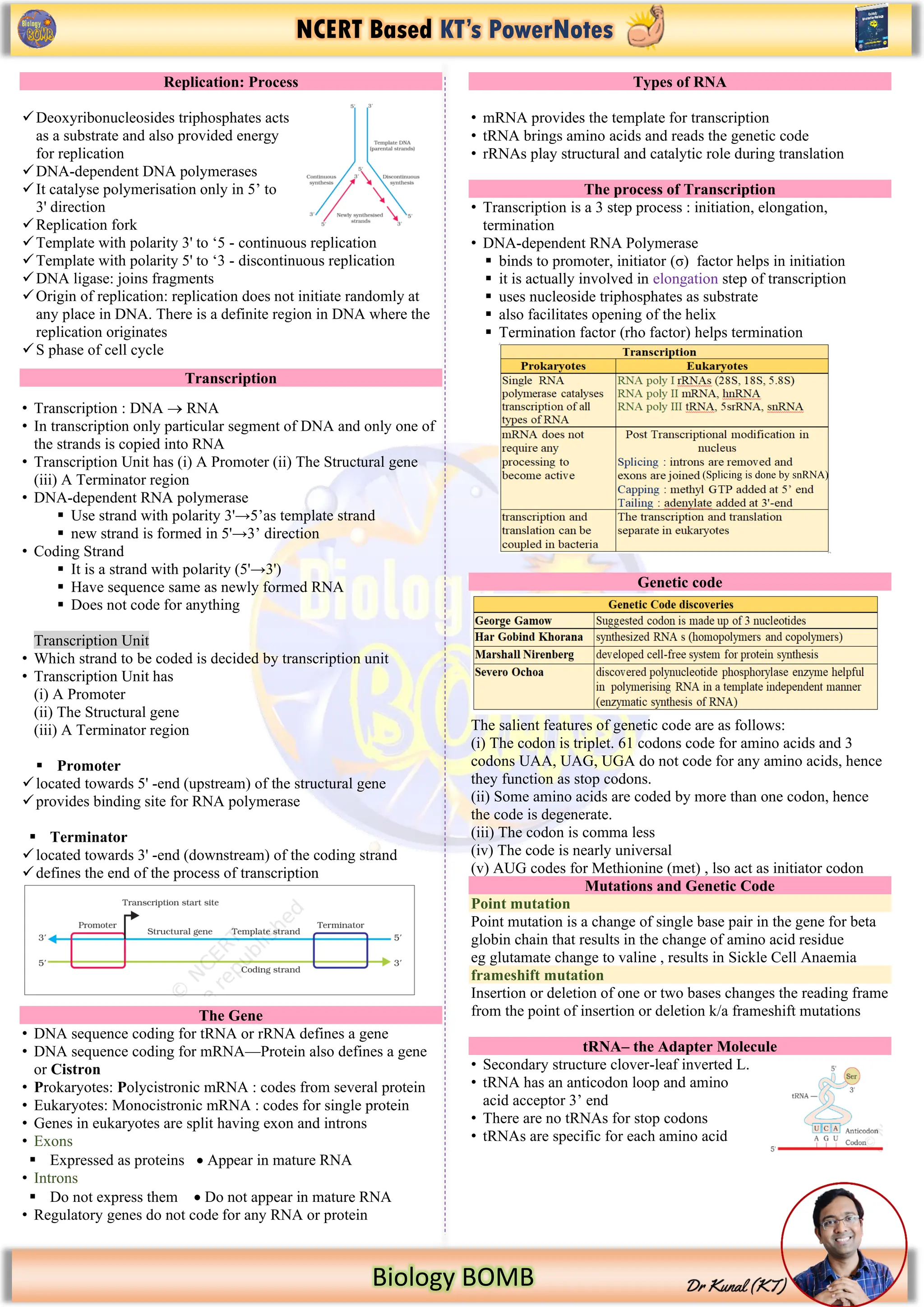
Replication: Process
✓Deoxyribonucleosides triphosphates acts
as a substrate and also provided energy
for replication
✓DNA-dependent DNA polymerases
✓It catalyse polymerisation only in 5’ to
3' direction
✓Replication fork
✓Template with polarity 3' to ‘5 - continuous replication
✓Template with polarity 5' to ‘3 - discontinuous replication
✓DNA ligase: joins fragments
✓Origin of replication: replication does not initiate randomly at
any place in DNA. There is a definite region in DNA where the
replication originates
✓S phase of cell cycle
Transcription
• Transcription : DNA → RNA
• In transcription only particular segment of DNA and only one of
the strands is copied into RNA
• Transcription Unit has (i) A Promoter (ii) The Structural gene
(iii) A Terminator region
• DNA-dependent RNA polymerase
▪ Use strand with polarity 3'→5’as template strand
▪ new strand is formed in 5'→3’ direction
• Coding Strand
▪ It is a strand with polarity (5'→3')
▪ Have sequence same as newly formed RNA
▪ Does not code for anything
Transcription Unit
• Which strand to be coded is decided by transcription unit
• Transcription Unit has
(i) A Promoter
(ii) The Structural gene
(iii) A Terminator region
▪ Promoter
✓located towards 5' -end (upstream) of the structural gene
✓provides binding site for RNA polymerase
▪ Terminator
✓located towards 3' -end (downstream) of the coding strand
✓defines the end of the process of transcription
The Gene
• DNA sequence coding for tRNA or rRNA defines a gene
• DNA sequence coding for mRNA—Protein also defines a gene
or Cistron
• Prokaryotes: Polycistronic mRNA : codes from several protein
• Eukaryotes: Monocistronic mRNA : codes for single protein
• Genes in eukaryotes are split having exon and introns
• Exons
▪ Expressed as proteins • Appear in mature RNA
• Introns
▪ Do not express them • Do not appear in mature RNA
• Regulatory genes do not code for any RNA or protein
Types of RNA
• mRNA provides the template for transcription
• tRNA brings amino acids and reads the genetic code
• rRNAs play structural and catalytic role during translation
The process of Transcription
• Transcription is a 3 step process : initiation, elongation,
termination
• DNA-dependent RNA Polymerase
▪ binds to promoter, initiator (σ) factor helps in initiation
▪ it is actually involved in elongation step of transcription
▪ uses nucleoside triphosphates as substrate
▪ also facilitates opening of the helix
▪ Termination factor (rho factor) helps termination
Genetic code
The salient features of genetic code are as follows:
(i) The codon is triplet. 61 codons code for amino acids and 3
codons UAA, UAG, UGA do not code for any amino acids, hence
they function as stop codons.
(ii) Some amino acids are coded by more than one codon, hence
the code is degenerate.
(iii) The codon is comma less
(iv) The code is nearly universal
(v) AUG codes for Methionine (met) , lso act as initiator codon
Mutations and Genetic Code
Point mutation
Point mutation is a change of single base pair in the gene for beta
globin chain that results in the change of amino acid residue
eg glutamate change to valine , results in Sickle Cell Anaemia
frameshift mutation
Insertion or deletion of one or two bases changes the reading frame
from the point of insertion or deletion k/a frameshift mutations
tRNA– the Adapter Molecule
• Secondary structure clover-leaf inverted L.
• tRNA has an anticodon loop and amino
acid acceptor 3’ end
• There are no tRNAs for stop codons
• tRNAs are specific for each amino acid
(Splicing is done by snRNA)
NCERT Based KT’s PowerNotes
Biology BOMB
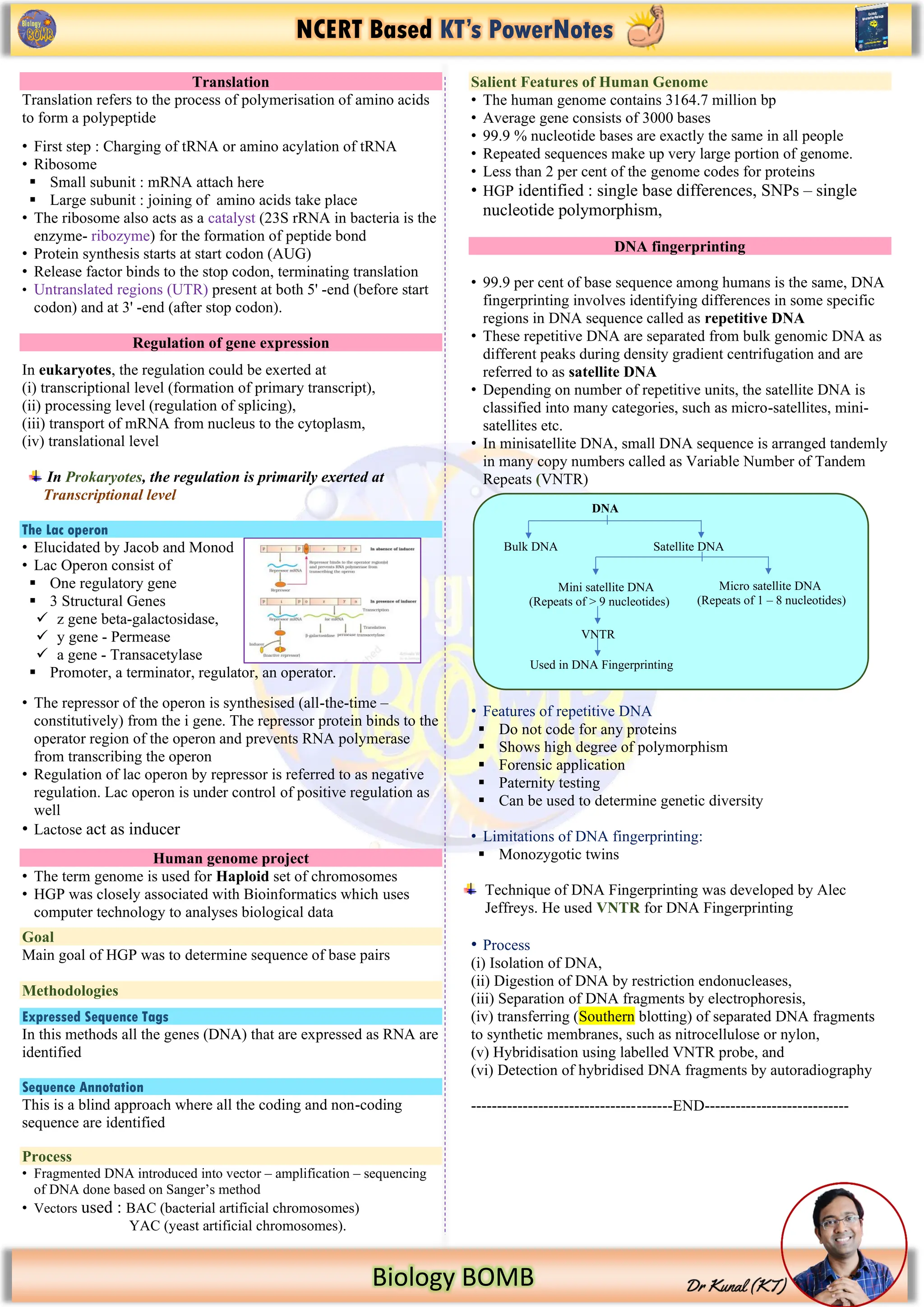
Translation
Translation refers to the process of polymerisation of amino acids
to form a polypeptide
• First step : Charging of tRNA or amino acylation of tRNA
• Ribosome
▪ Small subunit : mRNA attach here
▪ Large subunit : joining of amino acids take place
• The ribosome also acts as a catalyst (23S rRNA in bacteria is the
enzyme- ribozyme) for the formation of peptide bond
• Protein synthesis starts at start codon (AUG)
• Release factor binds to the stop codon, terminating translation
• Untranslated regions (UTR) present at both 5' -end (before start
codon) and at 3' -end (after stop codon).
Regulation of gene expression
In eukaryotes, the regulation could be exerted at
(i) transcriptional level (formation of primary transcript),
(ii) processing level (regulation of splicing),
(iii) transport of mRNA from nucleus to the cytoplasm,
(iv) translational level
In Prokaryotes, the regulation is primarily exerted at
Transcriptional level
The Lac operon
• Elucidated by Jacob and Monod
• Lac Operon consist of
▪ One regulatory gene
▪ 3 Structural Genes
✓ z gene beta-galactosidase,
✓ y gene - Permease
✓ a gene - Transacetylase
▪ Promoter, a terminator, regulator, an operator.
• The repressor of the operon is synthesised (all-the-time –
constitutively) from the i gene. The repressor protein binds to the
operator region of the operon and prevents RNA polymerase
from transcribing the operon
• Regulation of lac operon by repressor is referred to as negative
regulation. Lac operon is under control of positive regulation as
well
• Lactose act as inducer
Human genome project
• The term genome is used for Haploid set of chromosomes
• HGP was closely associated with Bioinformatics which uses
computer technology to analyses biological data
Goal
Main goal of HGP was to determine sequence of base pairs
Methodologies
Expressed Sequence Tags
In this methods all the genes (DNA) that are expressed as RNA are
identified
Sequence Annotation
This is a blind approach where all the coding and non-coding
sequence are identified
Process
• Fragmented DNA introduced into vector – amplification – sequencing
of DNA done based on Sanger’s method
• Vectors used : BAC (bacterial artificial chromosomes)
YAC (yeast artificial chromosomes).
Salient Features of Human Genome
• The human genome contains 3164.7 million bp
• Average gene consists of 3000 bases
• 99.9 % nucleotide bases are exactly the same in all people
• Repeated sequences make up very large portion of genome.
• Less than 2 per cent of the genome codes for proteins
• HGP identified : single base differences, SNPs – single
nucleotide polymorphism,
DNA fingerprinting
• 99.9 per cent of base sequence among humans is the same, DNA
fingerprinting involves identifying differences in some specific
regions in DNA sequence called as repetitive DNA
• These repetitive DNA are separated from bulk genomic DNA as
different peaks during density gradient centrifugation and are
referred to as satellite DNA
• Depending on number of repetitive units, the satellite DNA is
classified into many categories, such as micro-satellites, mini-
satellites etc.
• In minisatellite DNA, small DNA sequence is arranged tandemly
in many copy numbers called as Variable Number of Tandem
Repeats (VNTR)
• Features of repetitive DNA
▪ Do not code for any proteins
▪ Shows high degree of polymorphism
▪ Forensic application
▪ Paternity testing
▪ Can be used to determine genetic diversity
• Limitations of DNA fingerprinting:
▪ Monozygotic twins
Technique of DNA Fingerprinting was developed by Alec
Jeffreys. He used VNTR for DNA Fingerprinting
• Process
(i) Isolation of DNA,
(ii) Digestion of DNA by restriction endonucleases,
(iii) Separation of DNA fragments by electrophoresis,
(iv) transferring (Southern blotting) of separated DNA fragments
to synthetic membranes, such as nitrocellulose or nylon,
(v) Hybridisation using labelled VNTR probe, and
(vi) Detection of hybridised DNA fragments by autoradiography
---------------------------------------END----------------------------
DNA
Bulk DNA Satellite DNA
Micro satellite DNA
((Repeats of 1 – 8 nucleotides)
Mini satellite DNA
(Repeats of > 9 nucleotides)
VNTR
Used in DNA Fingerprinting
KT’S PowerNotes
Biology BOMB
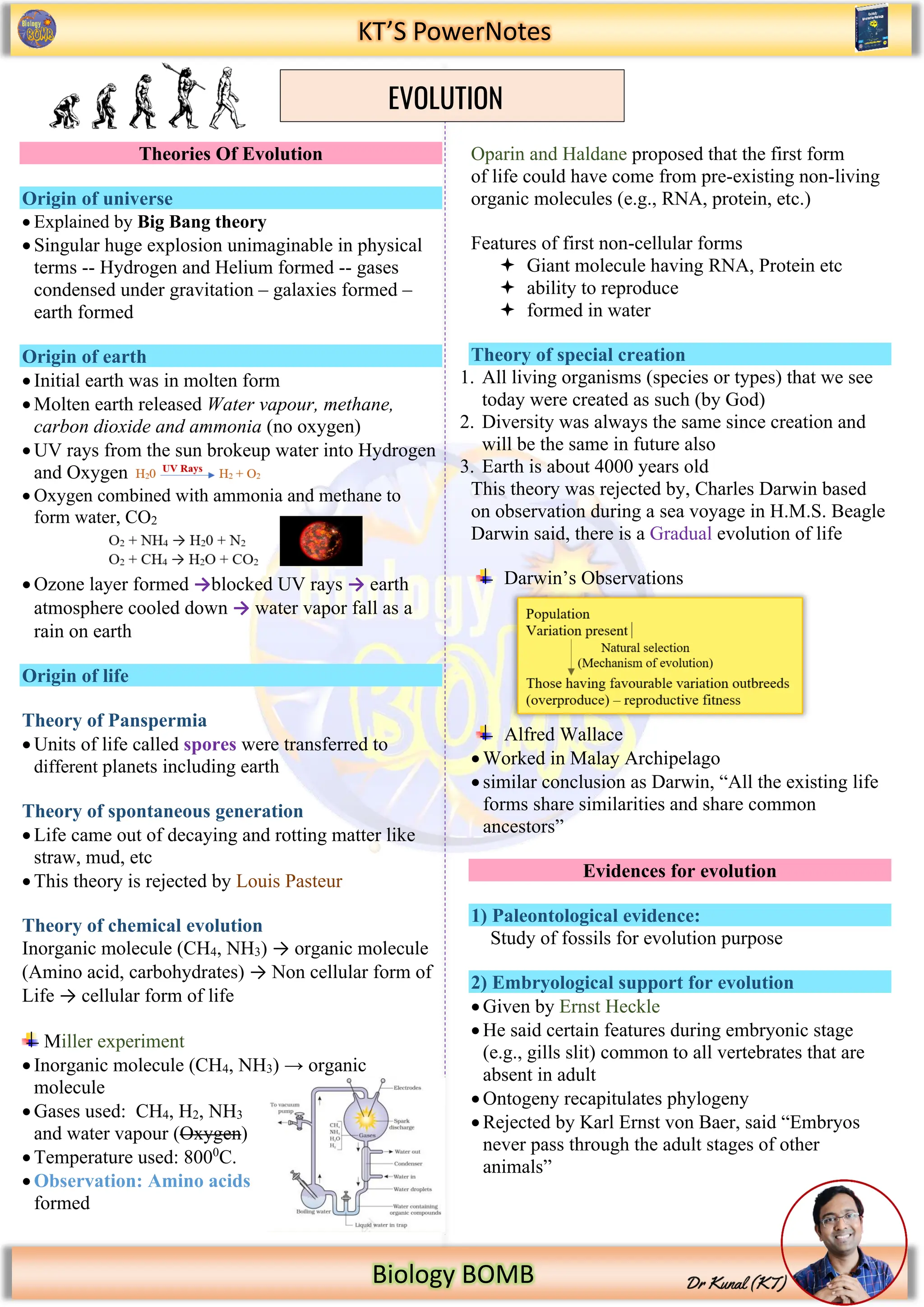
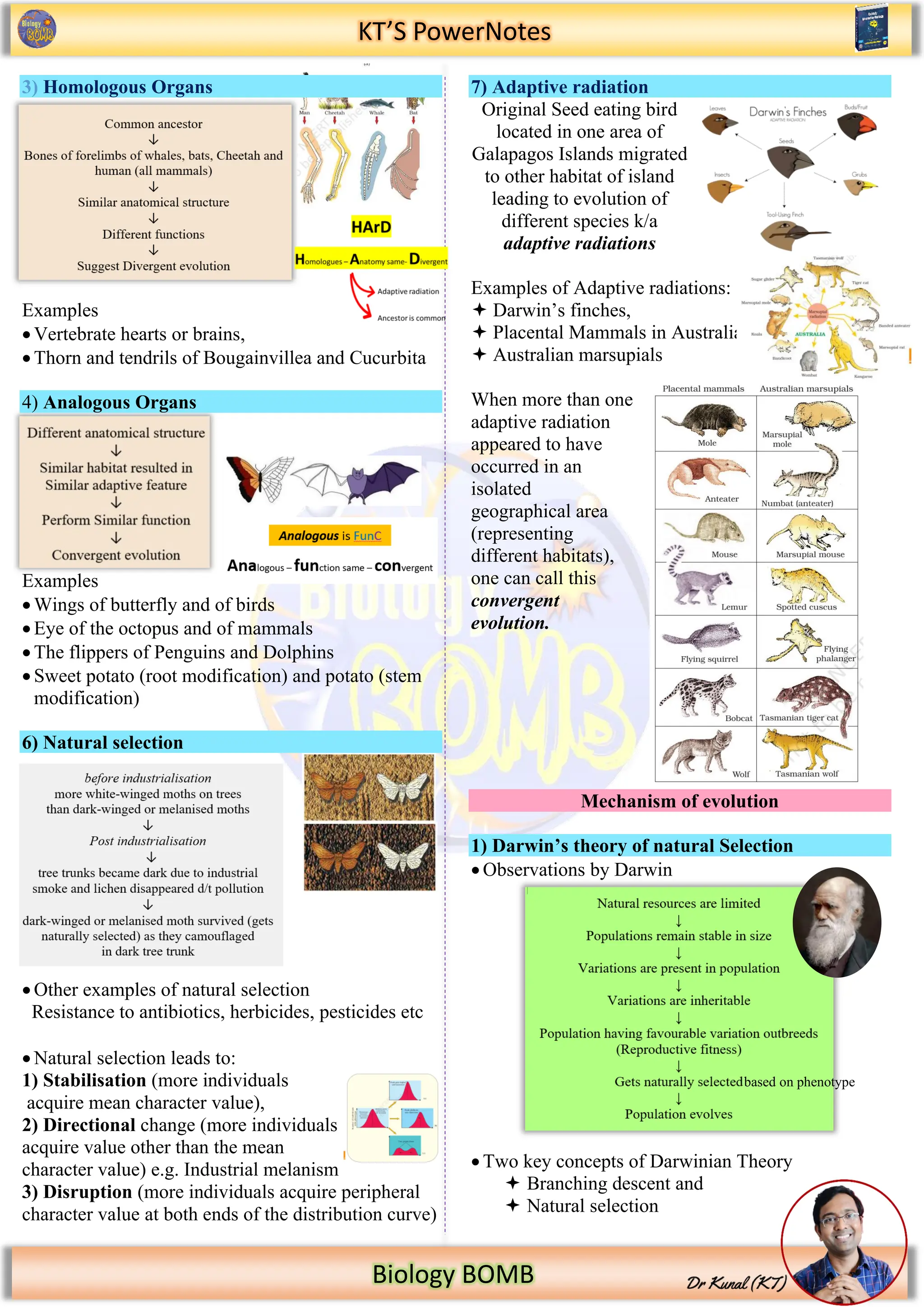
Theories Of Evolution
Origin of universe
• Explained by Big Bang theory
• Singular huge explosion unimaginable in physical
terms -- Hydrogen and Helium formed -- gases
condensed under gravitation – galaxies formed –
earth formed
Origin of earth
• Initial earth was in molten form
• Molten earth released Water vapour, methane,
carbon dioxide and ammonia (no oxygen)
• UV rays from the sun brokeup water into Hydrogen
and Oxygen
• Oxygen combined with ammonia and methane to
form water, CO2
• Ozone layer formed →blocked UV rays → earth
atmosphere cooled down → water vapor fall as a
rain on earth
Origin of life
Theory of Panspermia
• Units of life called spores were transferred to
different planets including earth
Theory of spontaneous generation
• Life came out of decaying and rotting matter like
straw, mud, etc
• This theory is rejected by Louis Pasteur
Theory of chemical evolution
Inorganic molecule (CH4, NH3) → organic molecule
(Amino acid, carbohydrates) → Non cellular form of
Life → cellular form of life
Miller experiment
• Inorganic molecule (CH4, NH3) → organic
molecule
• Gases used: CH4, H2, NH3
and water vapour (Oxygen)
• Temperature used: 8000
C.
• Observation: Amino acids
formed
Oparin and Haldane proposed that the first form
of life could have come from pre-existing non-living
organic molecules (e.g., RNA, protein, etc.)
Features of first non-cellular forms
 Giant molecule having RNA, Protein etc
 ability to reproduce
 formed in water
Theory of special creation
1. All living organisms (species or types) that we see
today were created as such (by God)
2. Diversity was always the same since creation and
will be the same in future also
3. Earth is about 4000 years old
This theory was rejected by, Charles Darwin based
on observation during a sea voyage in H.M.S. Beagle
Darwin said, there is a Gradual evolution of life
Darwin’s Observations
Alfred Wallace
• Worked in Malay Archipelago
• similar conclusion as Darwin, “All the existing life
forms share similarities and share common
ancestors”
Evidences for evolution
1) Paleontological evidence:
Study of fossils for evolution purpose
2) Embryological support for evolution
• Given by Ernst Heckle
• He said certain features during embryonic stage
(e.g., gills slit) common to all vertebrates that are
absent in adult
• Ontogeny recapitulates phylogeny
• Rejected by Karl Ernst von Baer, said “Embryos
never pass through the adult stages of other
animals”
EVOLUTION
KT’S PowerNotes
Biology BOMB
3) Homologous Organs
Examples
• Vertebrate hearts or brains,
• Thorn and tendrils of Bougainvillea and Cucurbita
4) Analogous Organs
Examples
• Wings of butterfly and of birds
• Eye of the octopus and of mammals
• The flippers of Penguins and Dolphins
• Sweet potato (root modification) and potato (stem
modification)
6) Natural selection
• Other examples of natural selection
Resistance to antibiotics, herbicides, pesticides etc
• Natural selection leads to:
1) Stabilisation (more individuals
acquire mean character value),
2) Directional change (more individuals
acquire value other than the mean
character value) e.g. Industrial melanism
3) Disruption (more individuals acquire peripheral
character value at both ends of the distribution curve)
7) Adaptive radiation
Original Seed eating bird
located in one area of
Galapagos Islands migrated
to other habitat of island
leading to evolution of
different species k/a
adaptive radiations
Examples of Adaptive radiations:
 Darwin’s finches,
 Placental Mammals in Australia
 Australian marsupials
When more than one
adaptive radiation
appeared to have
occurred in an
isolated
geographical area
(representing
different habitats),
one can call this
convergent
evolution.
Mechanism of evolution
1) Darwin’s theory of natural Selection
• Observations by Darwin
• Two key concepts of Darwinian Theory
 Branching descent and
 Natural selection
based on phenotype
KT’S PowerNotes
Biology BOMB
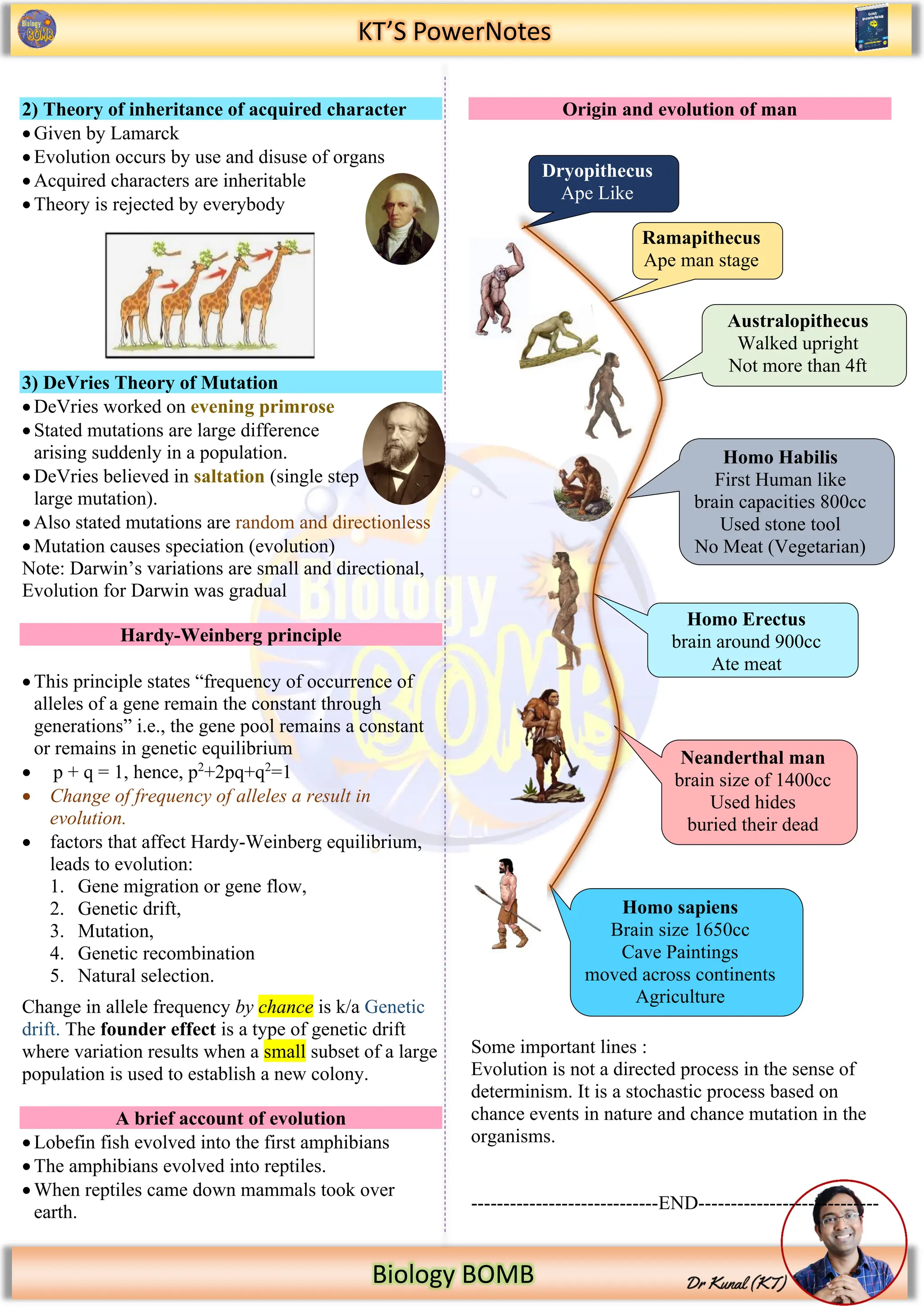
2) Theory of inheritance of acquired character
• Given by Lamarck
• Evolution occurs by use and disuse of organs
• Acquired characters are inheritable
• Theory is rejected by everybody
3) DeVries Theory of Mutation
• DeVries worked on evening primrose
• Stated mutations are large difference
arising suddenly in a population.
• DeVries believed in saltation (single step
large mutation).
• Also stated mutations are random and directionless
• Mutation causes speciation (evolution)
Note: Darwin’s variations are small and directional,
Evolution for Darwin was gradual
Hardy-Weinberg principle
• This principle states “frequency of occurrence of
alleles of a gene remain the constant through
generations” i.e., the gene pool remains a constant
or remains in genetic equilibrium
• p + q = 1, hence, p2
+2pq+q2
=1
• Change of frequency of alleles a result in
evolution.
• factors that affect Hardy-Weinberg equilibrium,
leads to evolution:
1. Gene migration or gene flow,
2. Genetic drift,
3. Mutation,
4. Genetic recombination
5. Natural selection.
Change in allele frequency by chance is k/a Genetic
drift. The founder effect is a type of genetic drift
where variation results when a small subset of a large
population is used to establish a new colony.
A brief account of evolution
• Lobefin fish evolved into the first amphibians
• The amphibians evolved into reptiles.
• When reptiles came down mammals took over
earth.
Origin and evolution of man
Some important lines :
Evolution is not a directed process in the sense of
determinism. It is a stochastic process based on
chance events in nature and chance mutation in the
organisms.
-----------------------------END----------------------------
Dryopithecus
Ape Like
Ramapithecus
Ape man stage
Australopithecus
Walked upright
Not more than 4ft
Homo Habilis
First Human like
brain capacities 800cc
Used stone tool
No Meat (Vegetarian)
Homo Erectus
brain around 900cc
Ate meat
Neanderthal man
brain size of 1400cc
Used hides
buried their dead
Homo sapiens
Brain size 1650cc
Cave Paintings
moved across continents
Agriculture
NCERT Based KT’s PowerNotes
https://www.google.com/imgres?imgurl=https%3A%2F%2Fi.pinimg.com%2Foriginals%2F2b%2Fd5%2F13%2F2bd5136ecf91f8f079093
Biology BOMB
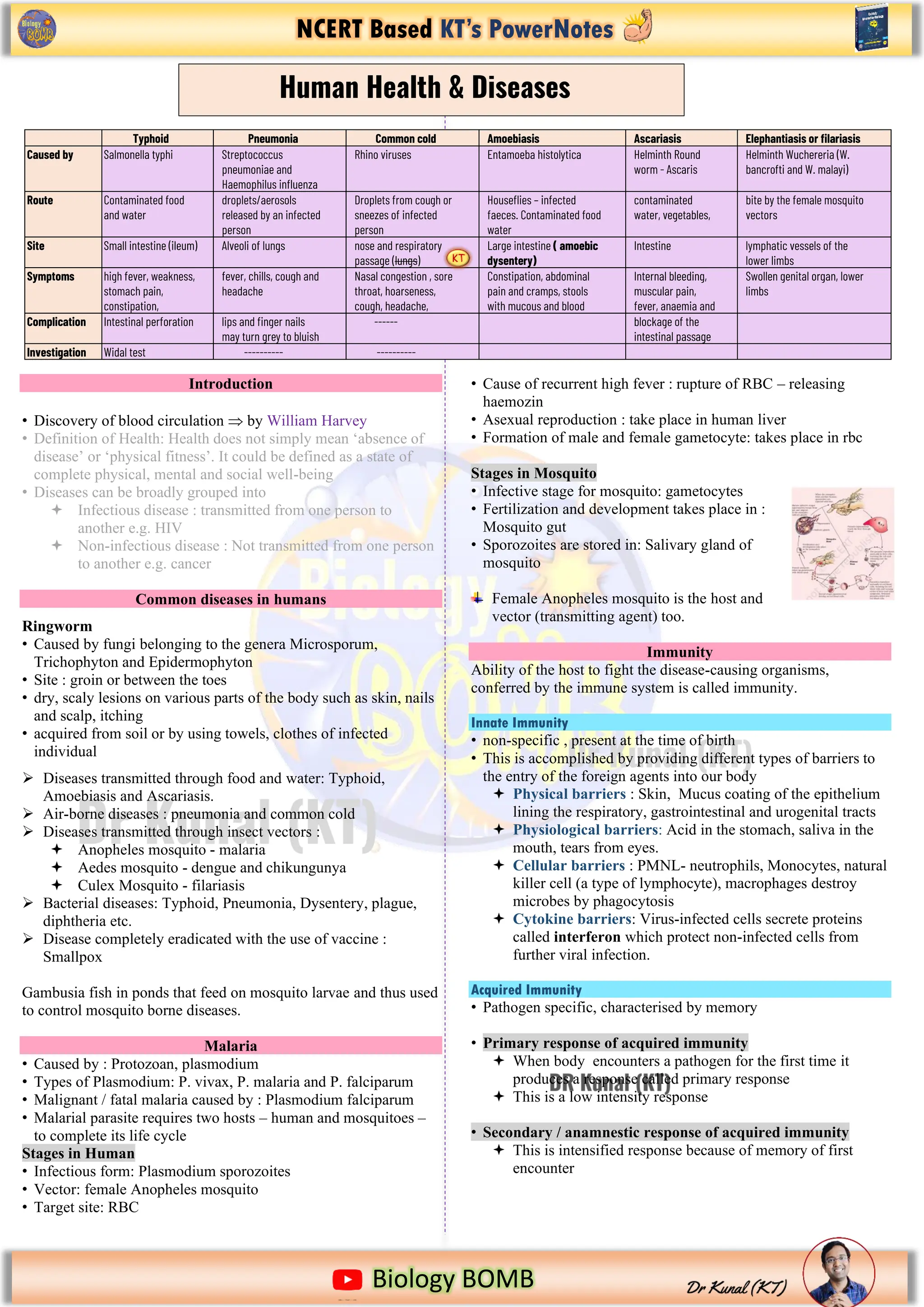
Introduction
• Discovery of blood circulation  by William Harvey
• Definition of Health: Health does not simply mean ‘absence of
disease’ or ‘physical fitness’. It could be defined as a state of
complete physical, mental and social well-being
• Diseases can be broadly grouped into
 Infectious disease : transmitted from one person to
another e.g. HIV
 Non-infectious disease : Not transmitted from one person
to another e.g. cancer
Common diseases in humans
Ringworm
• Caused by fungi belonging to the genera Microsporum,
Trichophyton and Epidermophyton
• Site : groin or between the toes
• dry, scaly lesions on various parts of the body such as skin, nails
and scalp, itching
• acquired from soil or by using towels, clothes of infected
individual
➢ Diseases transmitted through food and water: Typhoid,
Amoebiasis and Ascariasis.
➢ Air-borne diseases : pneumonia and common cold
➢ Diseases transmitted through insect vectors :
 Anopheles mosquito - malaria
 Aedes mosquito - dengue and chikungunya
 Culex Mosquito - filariasis
➢ Bacterial diseases: Typhoid, Pneumonia, Dysentery, plague,
diphtheria etc.
➢ Disease completely eradicated with the use of vaccine :
Smallpox
Gambusia fish in ponds that feed on mosquito larvae and thus used
to control mosquito borne diseases.
Malaria
• Caused by : Protozoan, plasmodium
• Types of Plasmodium: P. vivax, P. malaria and P. falciparum
• Malignant / fatal malaria caused by : Plasmodium falciparum
• Malarial parasite requires two hosts – human and mosquitoes –
to complete its life cycle
Stages in Human
• Infectious form: Plasmodium sporozoites
• Vector: female Anopheles mosquito
• Target site: RBC
• Cause of recurrent high fever : rupture of RBC – releasing
haemozin
• Asexual reproduction : take place in human liver
• Formation of male and female gametocyte: takes place in rbc
Stages in Mosquito
• Infective stage for mosquito: gametocytes
• Fertilization and development takes place in :
Mosquito gut
• Sporozoites are stored in: Salivary gland of
mosquito
Female Anopheles mosquito is the host and
vector (transmitting agent) too.
Immunity
Ability of the host to fight the disease-causing organisms,
conferred by the immune system is called immunity.
Innate Immunity
• non-specific , present at the time of birth
• This is accomplished by providing different types of barriers to
the entry of the foreign agents into our body
 Physical barriers : Skin, Mucus coating of the epithelium
lining the respiratory, gastrointestinal and urogenital tracts
 Physiological barriers: Acid in the stomach, saliva in the
mouth, tears from eyes.
 Cellular barriers : PMNL- neutrophils, Monocytes, natural
killer cell (a type of lymphocyte), macrophages destroy
microbes by phagocytosis
 Cytokine barriers: Virus-infected cells secrete proteins
called interferon which protect non-infected cells from
further viral infection.
Acquired Immunity
• Pathogen specific, characterised by memory
• Primary response of acquired immunity
 When body encounters a pathogen for the first time it
produces a response called primary response
 This is a low intensity response
• Secondary / anamnestic response of acquired immunity
 This is intensified response because of memory of first
encounter
Human Health & Diseases
Typhoid Pneumonia Common cold Amoebiasis Ascariasis Elephantiasis or filariasis
Caused by Salmonella typhi Streptococcus
pneumoniae and
Haemophilus influenza
Rhino viruses Entamoeba histolytica Helminth Round
worm - Ascaris
Helminth Wuchereria (W.
bancrofti and W. malayi)
Route Contaminated food
and water
droplets/aerosols
released by an infected
person
Droplets from cough or
sneezes of infected
person
Houseflies – infected
faeces. Contaminated food
water
contaminated
water, vegetables,
bite by the female mosquito
vectors
Site Small intestine (ileum) Alveoli of lungs nose and respiratory
passage (lungs)
Large intestine ( amoebic
dysentery)
Intestine lymphatic vessels of the
lower limbs
Symptoms high fever, weakness,
stomach pain,
constipation,
fever, chills, cough and
headache
Nasal congestion , sore
throat, hoarseness,
cough, headache,
Constipation, abdominal
pain and cramps, stools
with mucous and blood
Internal bleeding,
muscular pain,
fever, anaemia and
Swollen genital organ, lower
limbs
Complication Intestinal perforation lips and finger nails
may turn grey to bluish
------ blockage of the
intestinal passage
Investigation Widal test ---------- ----------
NCERT Based KT’s PowerNotes
https://www.google.com/imgres?imgurl=https%3A%2F%2Fi.pinimg.com%2Foriginals%2F2b%2Fd5%2F13%2F2bd5136ecf91f8f079093
Biology BOMB
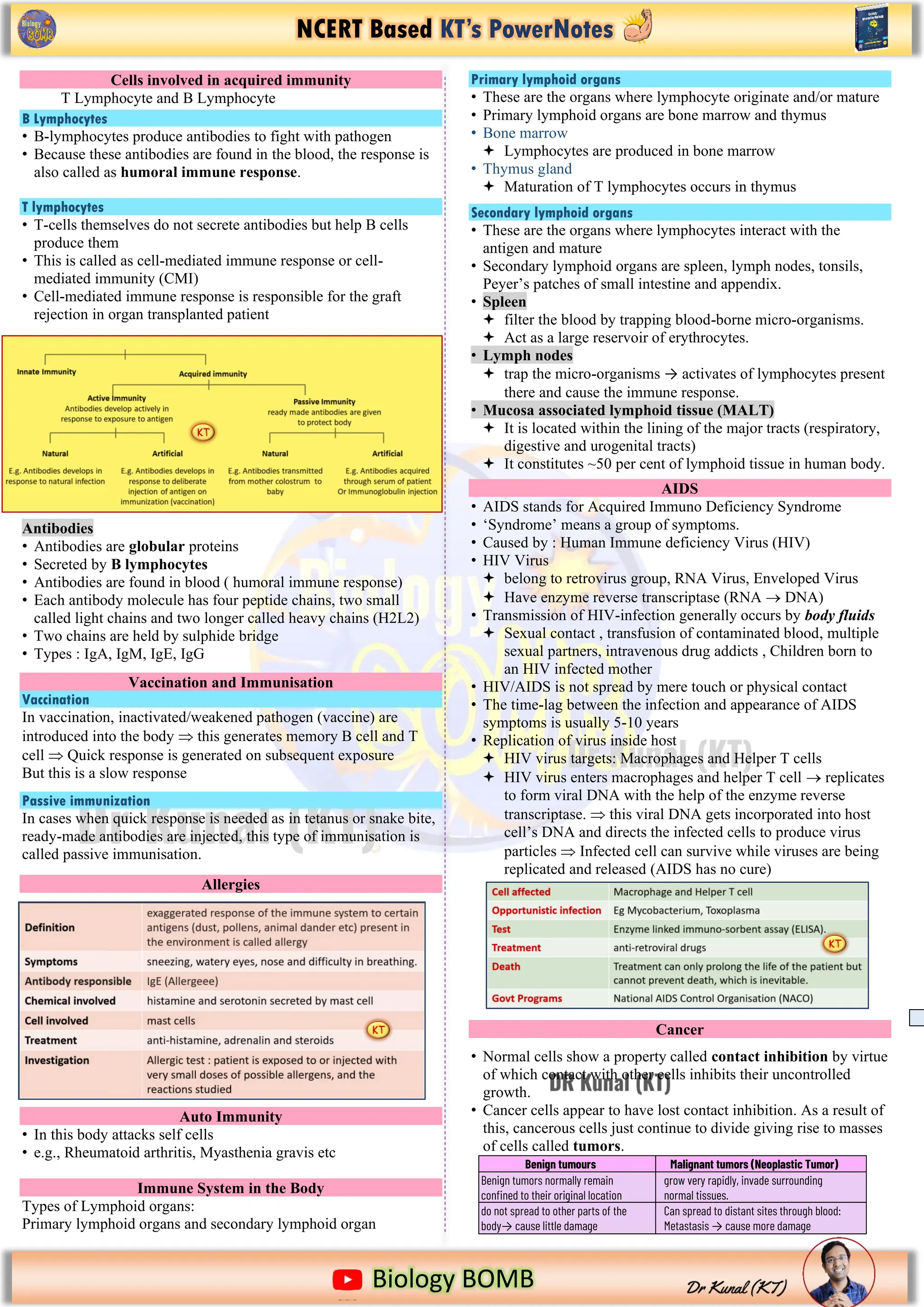
Benign tumours Malignant tumors (Neoplastic Tumor)
Benign tumors normally remain
confined to their original location
grow very rapidly, invade surrounding
normal tissues.
do not spread to other parts of the
body→ cause little damage
Can spread to distant sites through blood:
Metastasis → cause more damage
Cells involved in acquired immunity
T Lymphocyte and B Lymphocyte
B Lymphocytes
• B-lymphocytes produce antibodies to fight with pathogen
• Because these antibodies are found in the blood, the response is
also called as humoral immune response.
T lymphocytes
• T-cells themselves do not secrete antibodies but help B cells
produce them
• This is called as cell-mediated immune response or cell-
mediated immunity (CMI)
• Cell-mediated immune response is responsible for the graft
rejection in organ transplanted patient
Antibodies
• Antibodies are globular proteins
• Secreted by B lymphocytes
• Antibodies are found in blood ( humoral immune response)
• Each antibody molecule has four peptide chains, two small
called light chains and two longer called heavy chains (H2L2)
• Two chains are held by sulphide bridge
• Types : IgA, IgM, IgE, IgG
Vaccination and Immunisation
Vaccination
In vaccination, inactivated/weakened pathogen (vaccine) are
introduced into the body  this generates memory B cell and T
cell  Quick response is generated on subsequent exposure
But this is a slow response
Passive immunization
In cases when quick response is needed as in tetanus or snake bite,
ready-made antibodies are injected, this type of immunisation is
called passive immunisation.
Allergies
Auto Immunity
• In this body attacks self cells
• e.g., Rheumatoid arthritis, Myasthenia gravis etc
Immune System in the Body
Types of Lymphoid organs:
Primary lymphoid organs and secondary lymphoid organ
Primary lymphoid organs
• These are the organs where lymphocyte originate and/or mature
• Primary lymphoid organs are bone marrow and thymus
• Bone marrow
 Lymphocytes are produced in bone marrow
• Thymus gland
 Maturation of T lymphocytes occurs in thymus
Secondary lymphoid organs
• These are the organs where lymphocytes interact with the
antigen and mature
• Secondary lymphoid organs are spleen, lymph nodes, tonsils,
Peyer’s patches of small intestine and appendix.
• Spleen
 filter the blood by trapping blood-borne micro-organisms.
 Act as a large reservoir of erythrocytes.
• Lymph nodes
 trap the micro-organisms → activates of lymphocytes present
there and cause the immune response.
• Mucosa associated lymphoid tissue (MALT)
 It is located within the lining of the major tracts (respiratory,
digestive and urogenital tracts)
 It constitutes ~50 per cent of lymphoid tissue in human body.
AIDS
• AIDS stands for Acquired Immuno Deficiency Syndrome
• ‘Syndrome’ means a group of symptoms.
• Caused by : Human Immune deficiency Virus (HIV)
• HIV Virus
 belong to retrovirus group, RNA Virus, Enveloped Virus
 Have enzyme reverse transcriptase (RNA → DNA)
• Transmission of HIV-infection generally occurs by body fluids
 Sexual contact , transfusion of contaminated blood, multiple
sexual partners, intravenous drug addicts , Children born to
an HIV infected mother
• HIV/AIDS is not spread by mere touch or physical contact
• The time-lag between the infection and appearance of AIDS
symptoms is usually 5-10 years
• Replication of virus inside host
 HIV virus targets: Macrophages and Helper T cells
 HIV virus enters macrophages and helper T cell → replicates
to form viral DNA with the help of the enzyme reverse
transcriptase.  this viral DNA gets incorporated into host
cell’s DNA and directs the infected cells to produce virus
particles  Infected cell can survive while viruses are being
replicated and released (AIDS has no cure)
Cancer
• Normal cells show a property called contact inhibition by virtue
of which contact with other cells inhibits their uncontrolled
growth.
• Cancer cells appear to have lost contact inhibition. As a result of
this, cancerous cells just continue to divide giving rise to masses
of cells called tumors.
NCERT Based KT’s PowerNotes
https://www.google.com/imgres?imgurl=https%3A%2F%2Fi.pinimg.com%2Foriginals%2F2b%2Fd5%2F13%2F2bd5136ecf91f8f079093
Biology BOMB
Histopathological study
Biopsy a piece of the suspected tissue is studied under microscope
Radiological study
CT Scan (Computed
Tomography)
CT Scan uses X-rays to generate a three-dimensional image
of internals of an object (e.g., bone)
MRI (magnetic
resonance imaging)
MRI uses strong magnetic fields and non-ionising radiations
To detect changes in tissue
X ray Done to study internal objects ( e.g. Bone)
Molecular Biology
Antibody detection Antibodies against cancer -specific antigens are used for
detection of certain cancers.
Test positive individuals are advised to avoid exposure to
particular carcinogens
Radiotherapy Tumor cells are irradiated lethally,
Chemotherapeutic
drugs
Chemotherapeutic drugs kills cancerous cells.
Side effects :hair loss, anaemia, etc
Immunotherapy α-interferon activates immune system → attack tumour cells
Targets GIT, CNS Cardiovascular system CNS
Physical Carcinogen Ionising radiations like X-ray and Gamma rays
Non-ionizing radiations like UV rays
Damages DNA → CANCER
Chemical carcinogens Tobacco smoke : Lung cancer
Oncogenic viruses Certain viruses possess Viral oncogenes which
can activate (c-onc) or proto oncogene in normal
cell  causes cancer
Causes of cancer
Agents that cause cancer are called carcinogens
Note: UV B rays also causes snow blindness and skin cancer
Diagnosis of cancer
Early detection essential to successfully treat the disease
Treatment of cancer
Best approach is to use combination of surgery, radiotherapy and
chemotherapy
Drugs and alcohol abuse
• Morphine
 sedative and painkiller→ useful in patients undergone surgery
• Heroin (smack)
 Heroin is chemically diacetylmorphine
 It is a white, odourless, bitter powder
 taken by snorting and injection
• Cocaine (Coke /crack)
 It interferes with neuro-transmitter dopamine
 usually snorted
 act on CNS → euphoria and increased energy, hallucination
Hallucinogenic property: Atropa belladonna, Datura, crocacin
Tobacco
• It is smoked, chewed and snuff
• Nicotine in tobacco → act on adrenal gland → release adrenalin
and nor adrenalin → raises blood pressure
• Causes cancers of lung, urinary bladder and throat
• Tobacco also causes bronchitis, emphysema, coronary heart
disease, gastric ulcer, oxygen deficiency in body etc
• Tobacco chewing → cancer of the oral cavity.
Adolescence and Drug/Alcohol Abuse
• Adolescence period: It is a period between 12-18 years
• Drug abuse: When drugs are taken in amounts/frequency that
impairs one’s physical, physiological or psychological functions
• Addiction: Psychological attachment to certain effects –such as
euphoria and a temporary feeling of well-being
• Dependence: It is the tendency of the body to manifest nausea,
vomiting, anxiety etc (withdrawal syndrome) if regular dose of
drugs/alcohol is abruptly discontinued.
Note :
• Intravenous drug abuser prone for infections like AIDS and
Hepatitis B.
• Chronic use of Alcohol → Liver cirrhosis
• Drugs abuse by sport person: narcotic analgesics, anabolic
steroids, diuretics
The side-effects of the use of anabolic steroids
• In females
 masculinisation (features like males), aggressiveness,
abnormal menstrual cycles, excessive hair growth on the face
and deepening of voice.
• In males
 Acne, depression, reduction of size of the testicles, breast
enlargement, premature baldness, stunted growth
-----------------------------------END---------------------------------
Abused by sportspersons
NCERT Based KT’s PowerNotes
https://www.google.com/imgres?imgurl=https%3A%2F%2Fi.pinimg.com%2Foriginals%2F2b%2Fd5%2F13%2F2bd5136ecf91f8f079093
Biology BOMB
NEET 2022
Animal Husbandry
Animal husbandry is the agricultural practice of breeding
and raising livestock e.g., buffaloes, cows, pigs, horses, cattle etc
70 per cent of the world livestock population is in India and China.
but contribution to the world farm produce is only 25 %
Management of Farms and Farm Animals
Dairy Farm Management
• Dairying is the management of animals for milk and its products
for human consumption.
• To Improve quantity (Yield) Of milk
 House well, provide adequate water, food, Veterinary doctor
• To Improve quality of milk
 Stringent cleanliness, Proper storage and transport facility
Poultry Farm Management
• Includes chicken and ducks, turkey, geese etc.
• ‘Bird flu virus’ once affected egg and chicken
Animal Breeding
• Breed: A group of animals related by descent and similar in most
characters like general appearance, features, size, configuration,
etc., are said to belong to a breed.
• Animal breeding aims at increasing the yield of animals
Inbreeding
• Inbreeding refers to the mating of more closely related
individuals within the same breed for 4- 6 generations.
• Effects of inbreeding
 increases homozygosity
 necessary to evolve pure lines in any animals
 helps in accumulation of superior genes and elimination of less
desirable genes
 exposes harmful recessive genes: inbreeding depression,
 Inbreeding depression leads to reduction in fertility and
productivity
➢ Selection of superior males and females is crucial to avoid
inbreeding depression
➢ To eliminate inbreeding depression: selected animal is mated
with unrelated superior animal of same breed. A single
outcross often helps to overcome inbreeding depression
Outbreeding
A single outcross often helps to overcome inbreeding depression
Controlled breeding experiments
Artificial insemination
The semen is collected from the male that is chosen as a parent and
injected into the reproductive tract of the selected female
Multiple Ovulation Embryo Transfer Technology (MOET)
• To improve chances of successful production of hybrids MOET
Is used
• Give FSH like hormones to cow → Produce 6 – 8 egg
→Artificial insemination →Egg fertilized → 8 – 32 cell embryos
→ Transfer to surrogate mother → The genetic mother is
available for another round of super ovulation
Bee-keeping
• Bee-keeping or apiculture is the maintenance of hives of
honeybees for the production of honey.
• Most common species that is reared  Apis indica.
• Bees provide Honey, Bee wax, Pollinators
Fisheries
• Fishery is an industry devoted to the catching, processing or
selling of fish, shellfish or other aquatic animal
• Freshwater fishes : Catla, Rohu and common carp etc
• Marine fishes : Hilsa, Sardines, Mackerel and Pomfrets etc
• Difference between Aquaculture and pisciculture
 Aquaculture involves the rearing and culture of all aquatic
organisms such as fish, prawns, oysters, etc., whereas
pisciculture refers to only the rearing and culture of fish
• Significant growth of global aquaculture production is called as
Blue Revolution
Plant breeding
Plant breeding is the purposeful manipulation of plant species in
order to create desired plant types that are better suited for
cultivation, give better yields and are disease resistant
The main steps of plant breeding
1) Collection of variability:
• Genetic variability is the root of any breeding programme.
• You may select wild relative of crop
• The entire collection (of plants/seeds) having all the diverse
alleles for all genes in a given crop is called germplasm
collection
2) Evaluation and selection of parents
• Evaluate germplasm and identify parents with desired character
3) Cross hybridisation among the selected parents
• Very time-consuming and tedious process since the pollen
grains from the desirable plant have placed on the stigma of
selected female parent
4) Selection and testing of superior recombinants
• Plants that are superior to both of the parents are selected
• Self-pollination is done to achieve a state of uniformity
(homozygosity), so that characters will not segregate in progeny.
5) Testing, release and commercialisation of new cultivars
• New cultivar is tested in farmers’ fields, for at least three
growing seasons.
Green revolution
• Plant breeding techniques (in 1960s) →development of several
high yielding varieties of wheat and rice → increases in food
production in country → Green revolution
• Norman Borlaug is often called "the father of the Green
Revolution"
• M. S. Swaminathan, is the main architect or the Father of the
Green Revolution in India
Outcrossing Crossbreeding Interspecific Hybridization
Breeding of animals within the same
breed, but having no common
ancestors on either side of their
pedigree up to 4-6 generations
Superior males of one
breed are mated with
superior females of
another breed.
male and female animals of
two different related species
are mated.
Best for animals that are below
average in productivity in milk
production, growth rate in beef
cattle etc
Hisardale (Sheep)
developed in Punjab
by crossing Bikaneri
ewes & Marino rams
A mule is the offspring of a
male donkey (jack) and a
female horse (mare)
Strategies for enhancement in food production
NCERT Based KT’s PowerNotes
https://www.google.com/imgres?imgurl=https%3A%2F%2Fi.pinimg.com%2Foriginals%2F2b%2Fd5%2F13%2F2bd5136ecf91f8f079093
Biology BOMB
NEET 2022
Crops developed through Plant breeding
Wheat
Rice
Sugarcane
Millets
Hybrid maize, jowar and bajra have been developed in India.
Plant Breeding for Disease Resistance
Plant breeding for disease resistance
1) Diseases resistant varieties developed through Conventional
method of breeding (hybridisation and selection)
2) Diseases resistant varieties developed by mutational breeding
• Mutations are induced by gamma radiations
• In mung bean, resistance to yellow mosaic virus and powdery
mildew were induced by mutations.
3) Diseases resistant varieties developed by wild cross
• Bhindi (Parbhani Kranti) is resistant to yellow mosaic virus.
• Developed by crossing Abelmoschus esculentus (bhindi) with its
wild variety
Plant Breeding for Developing Resistance to Insect Pests
Biofortification
• World facing challenge of hidden hunger
• Hidden hunger is a form of undernutrition that occurs when
intake of vitamins and minerals are low to sustain good health
• Solution to hidden hunger is Biofortification
Examples of Fortified crops:
Single cell protein (scp)
One of the alternate sources of proteins for animal and human
nutrition is Single Cell Protein (SCP).
Tissue culture
• Tissue culture is a in-vitro technique of regenerating whole plant
from explant i.e., any part of plant in a test tube, under sterile
conditions in special nutrient media.
• Nutrient medium must provide carbon sources as sucrose and
inorganic salts, vitamins, amino acids and auxins, cytokinin etc
• Capacity to generate a whole plant from any cell/explant is
called totipotency.
• Tissue culture is for crop improvement, it is possible to produce
thousands of plants in short duration, this process is k/a
Micropropagation
• All the plants that are produced are genetically same called as
soma clones.
• Plants produced on commercial scale: Tomato Banana, Apple
• Virus free plant can be obtained by culture of meristematic
tissue
• Protoplasts are isolated cells which do not have cell walls
• Isolated protoplasts from two different varieties of plants –can be
fused to get hybrid protoplasts, these hybrids are called somatic
hybrids while the process is called somatic hybridisation
------------------------------------END-------------------------------
Various plants show certain characteristics for insect resistance
Development of Semi dwarf variety of Wheat
Developed by Nobel laureate Norman E. Borlaug
Developed at International Centre for Wheat and Maize
Improvement in Mexico
Other varieties of wheat in India Sonalika and Kalyan Sona
Development of Semi dwarf variety of rice developed from IR8
and Taichung Native-1
Developed at IR 8 (International Rice Research Institute
(IRRI), Philippines)
Taichung Native-1 (Taiwan).
Other varieties of wheat in India Jaya and Ratna
Saccharum barberi Saccharum officinarum
Poor sugar content but grow well in
north India
High sugar content variety of south India
but not grown well in North India
Crossed these two varieties to get sugarcane that can grow in north India
Crop bred by hybridization and selection
Diseases caused by fungi brown rust of wheat, red rot of sugarcane and
late blight of potato
Diseases caused by bacteria black rot of crucifers
Diseases caused by Virus tobacco mosaic, turnip mosaic, etc.
Definition breeding crops with higher levels of vitamins and
minerals, or higher protein and healthier fats is called
Biofortification
Developed by Indian Agricultural Research Institute, New Delhi
Single cell Protein Advantages
Blue-green algae like Spirulina grown easily on materials like waste
water, also reduces water pollution.
Methylophilus Methylotrophus Have High biomass → High Protein
Mushroom This is fungi that is used as food
NCERT Based KT’s PowerNotes
https://www.google.com/imgres?imgurl=https%3A%2F%2Fi.pinimg.com%2Foriginals%2F2b%2Fd5%2F13%2F2bd5136ecf91f8f079093
Biology BOMB
NEET 2022
Microbes
• Microbes are diverse–protozoa, bacteria, fungi and microscopic
plant viruses, viroids and also prions.
• Microbes like bacteria and many fungi can be grown on nutritive
media to form colonies, that can be seen with the naked eyes
Microbes in household products
Curd
• Lactic acid bacteria (LAB) such as lactobacillus grow in milk
and convert it to curd
• LAB produce acids that coagulate and digest the milk proteins
• LAB increases vitamin B12
• LAB also checks growth of disease causing microbes in GIT
Idli, Dosa
• Dough, used for making dosa and idli is fermented by bacteria
• The puffed-up appearance of dough is due to the production of
CO2 gas (anaerobic respiration)
• Two metabolic pathways takes place here
 Alcoholic pathway: Pyruvate → alcohol and CO2 (by yeast)
 Lactic acid fermentation : Pyruvate is converted to lactic acid
Bread
• Dough, which is used for making bread, is fermented using
baker’s yeast (Saccharomyces cerevisiae)
Cheese
• Sweese Cheese, hv large holes (d/t CO2) → Propionibacterium
sharmanii
• Roquefort cheese → ripened by fungi
Toddy
• Toddy, is a drink, can be obtained by fermenting sap from palm
• Other fermented product: fermented fish, soyabean, bamboo
shoots
Microbes in industrial products
• Microbes are used in industry to produce alcohol and antibiotics
• Production on an industrial scale, requires growing microbes in
very large vessels called fermenters
Fermented Beverages
Antibiotics
• Antibiotics are chemical substances, which are produced by
some microbes and can kills other (disease-causing) microbes
• First antibiotic discovered is Penicilin, Discovered by : Fleming
• Penicillin is produced by fungus Penicillium notatum → kills
Staphylococci bacteria
• Penicillin full potential established by Ernest Chain and Florey
• Fleming, Chain and Florey were awarded the Nobel Prize in
1945, for this discovery.
• Antibiotics are useful in bacterial diseases such as plague,
whooping cough (kali khansi), diphtheria (gal ghotu) and leprosy
(kusht rog)
Note : Relationship between antibiotic producing fungus and
bacteria is Amensalism
Chemicals, Enzymes and other Bioactive Molecules
Other microbial products
• Lipase : Used in detergents → remove oily stains
• Pectinases and proteases → Clear bottled juice
Microbes in sewage treatment
Municipal waste-water is also called sewage → major component
is human excreta → have large organic matter and microbes
Sewage treatment plants (STPs)
Primary treatment
• In this Large and small physical particle are removed
 Floating debris is removed by → sequential filtration
 Grit (soil and small pebbles) are removed by →sedimentation
• Solid that settles down is called Primary sludge
• Supernatant that floats out is called effluent
Secondary treatment or biological treatment
Aeriation tank
• Effluent is passed into large aeration tanks → air is pumped →
growth of aerobic microbes k/a flocs forms (mass of fungus+
bacteria) → these microbes digest organic matter
Sedimentation tank
• Effluent is passed into sedimentation tank → flocs settled down
k/a activated sludge
Anaerobic sludge digestor
• Here anaerobic bacteria digest bacteria and fungi in the flocs →
methane, hydrogen sulphide and carbon dioxide (Biogas) forms
The Ministry of Environment and Forests has initiated Ganga
Action Plan and Yamuna Action Plan → proposed to build a
large number of sewage treatment plants
BOD (biochemical oxygen demand)
• BOD refers to amount of the oxygen that would be consumed if
all organic matter in one liter of water were oxidized by bacteria
• BOD is a measure of the organic matter present in the water
• Greater the BOD of waste water, more is its polluting potential.
• The sewage water is treated till the BOD is reduced
Microbes used Saccharomyces cerevisiae (brewer’s yeast)
Substrate used Malted cereals and fruit juices
Metabolic reaction Alcoholic fermentation
Product Ethyl alcohol
Beverage Without distillation Wine and beer
Distilled beverage whisky, brandy and rum
Microbes In Human welfare
Fungal products
Aspergillus Niger Citric acid
Trichoderma polysporum immunosuppressive agent in organ-transplant patients
Saccharomyces cerevisiae Ethyl alcohol
Monascus purpures Produce statin → lowers blood cholesterol
Bacterial Products
Acetobacter aceti Acetic acid
Clostridium butylicum Butyric acid
Lactobacillus Lactic acid
Streptococcus Streptokinase useful in myocardial infarction
NCERT Based KT’s PowerNotes
https://www.google.com/imgres?imgurl=https%3A%2F%2Fi.pinimg.com%2Foriginals%2F2b%2Fd5%2F13%2F2bd5136ecf91f8f079093
Biology BOMB
NEET 2022
Microbes in production of biogas
Methanogens (e.g., Methanobacterium)
• Methane producing bacteria
• Found in :
 Found in the anaerobic sludge during sewage treatment.
 Also present in the rumen (a part of stomach) of cattle
• Metabolic pathway: Anaerobic digestion
• Substrate used: cellulosic material
• Gas produced: Methane, CO2, H2
• Nutritional activity :These bacteria help in the breakdown of
cellulose present in rumen of cattle Note : Humans cannot digest
cellulose
Biogas plant
• Excreta (dung /gobar) of cattle, rich in methanogens, can be used
for generation of biogas (gobar gas)
• Biogas plant consists of a concrete tank,
floating cover
• Spent slurry can be used as fertilizer
• Developed by Indian Agricultural
Research Institute (IARI) and Khadi and
Village Industries Commission (KVIC).
Microbes as biocontrol agents
• Bio control refers to the use of biological methods for
controlling plant diseases and pests.
• Advantages of Bio control methods over insecticides
 insecticides and pesticides chemicals are toxic, to human
beings, animals, and pollute our environment
 chemical methods kill both useful and harmful life forms
indiscriminately
 Bio control methods do not eradicate pest completely, rather
keep it at manageable levels → maintains biodiversity, food
chain
Bacillus thuringiensis
• Control butterfly caterpillars
• Bacillus thuringiensis → available in sachets as dried spores
which are mixed with water and sprayed onto vulnerable plants
such as brassicas and fruit trees → these are eaten by the insect
larvae → toxin is released, caterpillar larvae get killed
Microbes as biofertilisers
• Organic farming emphasised the use of biofertilisers to avoid
problems associated with overuse of chemical fertilisers
• Biofertilisers are organisms that enrich the nutrient quality of
soil by adding nitrogen , phosphorous etc to soil
• Source of biofertilisers : bacteria, fungi and cyanobacteria
Nitrogen fixing bacteria
• Rhizobium forms association with roots of leguminous plant and
fix nitrogen
• Azospirillum and Azotobacter can fix atmospheric nitrogen
while free-living in the soil
Fungus
• Genus Glomus form association with roots of plants called
mycorrhiza.
• Fungus provide phosphorous to plant
• Plant provide nutrition to fungus
Nitrogen fixing Cyanobacteria
• Cyanobacteria are autotrophic microbes many of which can fix
atmospheric nitrogen, e.g. Anabaena, Nostoc, Oscillatoria
• Cyanobacteria (e.g., Azolla) fix Nitrogen in leaves of fern and
paddy field
• Cyanobacteria shows association with coralloid root of cycas
• Blue green algae also add organic matter to the soil
----------------------------------END----------------------------------------
Bio control agent Targets
Ladybird Aphids
Dragonflies mosquitoes
Trichoderma (fungus) Kills root born pathogen
Baculoviruses
(Nucleopolyhedrovirus)
• attack insects
• species-specific, narrow spectrum
• no negative impacts on plants, mammals, birds,
fish or even on non-target insects
• excellent bio control agent
• useful in integrated pest management programme
Bacillus thuringiensis butterfly caterpillars
NCERT Based KT’s PowerNotes
https://www.google.com/imgres?imgurl=https%3A%2F%2Fi.pinimg.com%2Foriginals%2F2b%2Fd5%2F13%2F2bd5136ecf91f8f079093
Biology BOMB
NEET 2022
What is Biotechnology?
• Biotechnology deals with techniques of using live organisms or
enzymes from organisms to produce products and processes
useful to humans
• Biotechnology involve genetically modified organism
• Example of Biotechnology processes : Test tube baby,
developing vaccine, correcting defective gene
• Making curd, bread or wine, though microbial product but these
are not part of biotechnology process
Principles of biotechnology
Techniques of biotechnology:
• Genetic engineering
 Alter the Genetic material (DNA and RNA) → microbe is
modified → changes the phenotype of organism
• Bioprocess engineering
 Growing modified microbes in ambience → vaccine, enzyme
etc is produced
Traditional hybridisation procedures used in plant and animal
breeding, very often lead to inclusion of undesirable genes this
limitation is overcome by biotechnology which to allows only set
of desirable genes into the target organism
Construction of First recombinant DNA
Stanley Cohen and Herbert Boyer isolated antibiotic resistance
gene from Salmonella Typhi by molecular scissors’– restriction
enzymes → The cut piece of DNA was then linked with the
plasmid (Vector) DNA by DNA Ligase → recombinant DNA is
introduced into E coli which multiplied using DNA polymerase
enzyme → multiply copies of antibiotic resistance gene formed in
E Coli (cloning)
Isolation of the Genetic Material (DNA)
• DNA is precipitate with chilled ethanol
• DNA that separates out can be removed by spooling
Cutting of DNA at Specific Locations
DNA is cut at specific location by restriction endonuclease
Discovery of restriction endonuclease
• In 1963, Two enzymes were discovered from E Coli which
protect E Coli from bacterial infection (bacteriophage)
 Methylase : It adds methyl group to palindrome of E Coli
 Restriction endonuclease : Cut palindrome of virus
• First restriction endonuclease that was characterized – HIND II
Convention for naming restriction enzyme
EcoRI comes from Escherichia coli RY 13
1. First letter indicates genus E for E Coli
2. Second two letters come from the species of prokaryotic cell
from which enzyme is isolated (co of E coli)
3. R is strain of E Coli RY 13
4. Roman numbers following the names indicate the order in
which the enzyme was isolated from strain of bacteria
Action of Restriction nuclease
• Types
 Exonucleases remove nucleotides from the ends of the DNA
 Endonucleases make cuts at specific positions within the DNA
• Restriction endonuclease
 Restriction endonuclease recognises a specific palindromic
nucleotide sequence in the DNA → sticky ends are formed that
can be joined by DNA ligase
 EcoRl recognition sequence is 5' GAATTC 3'
 When cut by the same restriction enzyme, the resultant DNA
fragments have the same kind of ‘sticky-ends’ and, these can
be joined together (end-to-end) using DNA ligases
Separation and isolation of DNA fragments
Agarose Gel electrophoresis
Cloning vector
Cloning vectors produces multiple copies of desired gene
Vectors: Plasmid or bacteriophage (have high copy number)
Features of cloning vector
1) Origin of replication (ori)
• This is a sequence from where replication starts
• ori responsible for controlling the copy number of DNA
• Foreign DNA linked to ori also replicates when vector DNA
replicates
2) Cloning sites
• Vector preferably should have single recognition site for the
commonly used restriction enzymes
• Presence of more than one recognition sites within the vector
will generate several fragments
3) pBR 322
• Bollivar and Rodrigues synthesized pBR 322
• pBR322 is the plasmid and most used cloning vector of E. coli.
• Ampicillin (ampR
) & tetracycline (tetR
) are selectable markers.
• It has ori and different cloning like BamHl in tetR
,
Pvul and Pstl in ampR
• rop codes for the proteins involved in the replication of plasmid.
Motive Fragments cut by restriction endonuclease are separated by Gel
electrophoresis
Charge DNA fragments are negatively charge, move towards anode
Separation Fragments are separated based on size, smaller moves farther
Gel Gel is obtained from sea weed (red algae)
Elution The separated bands of DNA are cut out from the agarose gel and
extracted from the gel piece
Visualize DNA Use ethidium bromide, followed by UV exposure --- orange colour
Sieving effect Provided by gel
Biotechnology Principle and Processes
Component Digestive enzyme
Bacteria Lysozyme
Plant cells Cellulase
Fungus Chitinase
RNA Ribonuclease
Proteins Protease
NCERT Based KT’s PowerNotes
https://www.google.com/imgres?imgurl=https%3A%2F%2Fi.pinimg.com%2Foriginals%2F2b%2Fd5%2F13%2F2bd5136ecf91f8f079093
Biology BOMB
NEET 2022
4) Selectable marker
• Selectable marker, helps in identifying transformants and non
transformants
• Antibiotic resistance genes are considered useful selectable
markers for E. coli
• Antibiotic resistance gene allow the growth of only
transformants in the media
a) Antibiotic resistance gene
Antibiotic resistance gene are called as selection marker as it helps
in selection of recombinants.
b) Beta galactosidase enzyme
Beta galactosidase help differentiate recombinants from non-
recombinants on the basis of their ability to produce colour
c) Ampicillin resistance gene
if a recombinant DNA bearing gene for resistance to an antibiotic
(e.g., ampicillin) is transferred into E. coli cells, the host cells
become transformed into ampicillin-resistant cells. When
transformed cells are spread on agar plates containing ampicillin,
only transformants will grow, untransformed recipient cells will
die. The ampicillin resistance gene in this case is called
a selectable marker.
5) Vectors for cloning genes in plants and animals
Also note : Human genome project use : BAC (bacterial
artificial chromosomes)YAC (yeast artificial chromosomes).
Agrobacterium tumefaciens
• It is a pathogen of Dicot plants
• It transfers its T DNA into plant cell and transform normal plant
cells into a tumorous cells
• Modified Ti plasmid (tumor inducing plasmid) is used as vector
to deliver gene of interest in plant cell
Retrovirus
• Retroviruses have the ability to transform normal animal cells
into cancerous cells
• Retrovirus is disarmed and then used to deliver desirable genes
into animal cells.
Competent Host
• Host cell must be made competent to take up DNA
• DNA is a hydrophilic molecule, it cannot pass through cell
membranes host (bacterial cell)
• Transformation is a procedure through which a piece of DNA is
introduced in a host bacterium
1) To Pass DNA into host cell
 Treat bacterial cell with divalent cation (calcium) → this
creates pores in cell wall→ recombinant DNA enters the cell
 Animal cell → micro-injection technique : recombinant DNA
is directly injected into the nucleus of an animal cell
 Plant cell → biolistic or gene gun (micro-particles of gold or
tungsten is used) : plants, cells are bombarded with high
velocity micro-particles of gold or tungsten coated with DNA
 Disarmed pathogen vectors like retrovirus having recombinant
DNA are used to infect the cell
2) To enable bacterial cell take up DNA
 Heat shock treatment enables bacteria to take up DNA
Obtaining the Foreign Gene Product
Heterologous expression refers to the expression of a gene in a
host organism which does not naturally have this gene
eg Insulin is not produce naturally by E Coli but if insulin gene is
introduced into then E Coli starts producing Insulin so here E Coli
is called Heterologous host which produced recombinant protein
Bioreactor
Bioreactor is a vessel where large volumes (100-1000 litres) of
culture can be processed.
• A bioreactor provides the optimal conditions for desired product
• The most commonly used bioreactors are of stirring type
• Stirring type bioreactors are of two kinds:
Simple stirred tank bioreactor, Sparged stirred-tank bioreactor
Downstream Processing
• Downstream processing includes Separation and purification
• Add preservative, do clinical trial, do quality control testing
PCR
• PCR stands for Polymerase Chain Reaction
• Multiple copies of the gene (or DNA) of interest is synthesized
• in vitro procedure
• Steps of PCR :
• Amplification : above steps of PCR can be repeated to make
billion copies of DNA, such repeated amplification is achieved
by the use of a thermostable DNA polymerase which remain
active during the high temperature induced denaturation of
double stranded DNA
• After 30 cycles, what began as a single molecule of DNA has
been amplified into more than a billion copies
• Uses of PCR : Forensic study (DNA fingerprinting) ,
Biotechnology, HIV testing, Gene Therapy
Denaturation Separation of DNA strands : 95 0
C
Annealing Joining of DNA primer : 55 0
C
Primer is small chemically synthesised oligonucleotides
that are complementary to the regions of DNA
Extension /
elongation
/polymerization
Occurs at : 72 0
C
Taq polymerase isolated from Thermus aquaticus is
used in this process
Vector Host cell (to which vector delivers a gene)
pbr 322 Bacterium
Agrobacterium Plant cell
Retrovirus animal cell
Simple stirred tank bioreactor Sparged stirred-tank bioreacto
Has stirrer which helps in uniform mixing
and availability of oxygen throughout the
bioreactor.
This has increased surface area for
oxygen transfer than simple stirred-
tank
NCERT Based KT’s PowerNotes
https://www.google.com/imgres?imgurl=https%3A%2F%2Fi.pinimg.com%2Foriginals%2F2b%2Fd5%2F13%2F2bd5136ecf91f8f079093
Biology BOMB
NEET 2022
Applications of biotechnology include
• Therapeutics, diagnostics, genetically modified crops for
agriculture, processed food, bioremediation, waste treatment,
and energy production
• Bioremediation employs the use of living organisms, like
microbes, in the removal of contaminants, pollutants, and toxins
from soil, water
• Genetic modification has:
(i) made crops more tolerant to abiotic stresses (cold, drought,)
(ii) Reduced reliance on chemical pesticides (pest-resistant crops).
(iii) Helped to reduce post-harvest losses.
(iv) Increased efficiency of mineral usage by plants
(v) Enhanced nutritional value of food, e.g., golden rice, i.e.,
Vitamin ‘A’ (carotene) enriched rice
Genetically Modified Plants
Bacillus thuringiensis
• Bacillus thuringiensis bacterium produce Bt toxin
• Bt toxin gene has been cloned from the bacteria and been
expressed in plants to provide resistance to insects without the
need for insecticides; in effect created a bio-pesticide
• Examples : Bt cotton, Bt corn, rice, tomato, potato & soyabean
Bt Cotton
• Bacillus thuringiensis produce proteins that kill insects
• Bt toxin is insect group specific
lepidopterans (tobacco budworm, armyworm),
Coleopterans (beetles)
Dipterans (flies, mosquitoes)
• Bt toxin exist as crystalline inactive form, gets activated in
alkaline pH – binds to midgut epithelial cell receptor in
bollworm (not pathogenic to cattle) create pores that cause cell
swelling and lysis and eventually cause death of the insect
• Specific Bt toxin genes were isolated from Bacillus thuringiensis
and incorporated into the several crop with the help of vector
Agrobacterium tumefaciens plants such as cotton
Tobacco Plant
• A nematode Meloidegyne incognitia infects the roots of
tobacco plants and causes a great reduction in yield.
• Nematode specific genes (DNA) were isolated from nematode
and introduced into plant cell using vector Agrobacterium
• This Nematode’s DNA produces both sense and anti-sense RNA
in the host (Plant cell) cells. These two RNA’s being
complementary to each other formed a double stranded (dsRNA)
• When nematode feeds on plant cell. Ds RNA enters into
nematode binds to and prevents (interfere) translation of the
mRNA (silencing). This mechanism is called as rna interference
• The consequence is that the parasite cannot survive in a
transgenic host
RNA interference
• RNAi takes place in all eukaryotic organisms
• It is a a method of cellular defence.
• This method involves silencing of a specific mRNA due to a
complementary dsRNA molecule that binds to and prevents
translation of the mRNA (silencing).
• The source of this complementary RNA could be from an
infection by viruses having RNA genomes or mobile genetic
elements (transposons) that replicate via an RNA intermediate
Biotechnological applications in medicine
• Insulin used for diabetes was earlier extracted from pancreas of
slaughtered cattle and pigs  develops allergic reaction
• Insulin consists of two short polypeptide chains: chain A and B
Two chains are linked together by disulphide bridges
• Insulin is synthesised as pro hormone which contains an extra
stretch called the C peptide. This C peptide is not present in the
mature insulin and is removed during maturation into insulin.
• The main challenge for production of insulin using rDNA
techniques was getting insulin assembled into a mature form.
• Eli Lilly an American company prepared two DNA sequences
corresponding to A and B, chains of human insulin and
introduced them in plasmids of E. coli to produce insulin chains.
• Chains A and B were produced separately, extracted and
combined by creating disulphide bonds to form human insulin.
Gene Therapy
Gene therapy is the insertion of genes into an individual’s cells and
tissues to treat diseases especially hereditary diseases
Adenosine deaminase (ADA) deficiency
• Adenosine deaminase (ADA) enzyme is crucial for the immune
system to function
• ADA deficiency is caused due to the deletion of the gene for
adenosine deaminase
• Treatment
Temporary Cure
 Bone marrow transplantation
 Enzyme replacement therapy
Permanent cure (Gene Therapy)
 Infusion of Genetically engineered lymphocytes
- Blood lymphocytes are cultured outside body, functional
ADA cDNA* (using a retroviral vector) is then
introduced into these lymphocytes
- Problem: Patient requires periodic infusion of such
genetically engineered lymphocytes as lymphocytes are
not immortal
- Solution : Infuse Genetically engineered lymphocytes at
early embryonic stages
* Complementary DNA (cDNA) is a DNA synthesized from a single-stranded
RNA template in a reaction catalysed by the enzyme reverse transcriptase.
Molecular Diagnosis
Molecular diagnostic methods help early diagnosis of disease
Probe Hybridization technique
Polymerase Chain Reaction (PCR)
• PCR can detects very low concentration of pathogen even when
the symptoms of the disease are not yet visible
• PCR detects low amount of DNA by amplication of DNA
• PCR is used to :
 Detect HIV in suspected AIDS patients
 Detect mutations in genes in suspected cancer patients
 Identify many other genetic disorders
ELISA
• ELISA is based on the principle of antigen-antibody interaction
• It can detect antigen or antibodies: Detect HIV
Biotechnology and Its Applications
Gene Plants gets protection from Plant
cry I Ac, cry II Ab Cotton bollworm Cotton
cry I Ab Corn borer Corn / Maize
Probe Single stranded radioactive DNA or RNA
Hybridization Probe hybridise (binds) to its complementary DNA
Detection Hybridized probe is detected using autoradiography
Inference Probe cannot bind to Mutated gene  do not appear in auto radiography
Probe can bind to normal gene  appear in autoradiography
NCERT Based KT’s PowerNotes
https://www.google.com/imgres?imgurl=https%3A%2F%2Fi.pinimg.com%2Foriginals%2F2b%2Fd5%2F13%2F2bd5136ecf91f8f079093
Biology BOMB
NEET 2022
Transgenic animals
• Animals that have had their DNA manipulated to possess and
express an extra (foreign) gene are known as transgenic animals
• Over 95 % of all existing transgenic animals are mice
• To study normal physiology and development
 e.g., study of complex factors involved in growth such as
insulin-like growth factor
• Study of disease:
 To study diseases like cancer, cystic fibrosis, rheumatoid
arthritis and Alzheimer’s
• Transgenic animals produce biological products
 α-1-antitrypsin used to treat emphysema
 first transgenic cow, Rosie, produced alpha-lactalbumin-
enriched milk
• Transgenic animals are used to test vaccine safety
Ethical issues
• Indian Government has set up organisations such as GEAC
(Genetic Engineering Approval Committee), which will make
decisions regarding the validity of GM research and the safety of
introducing GM-organisms for public services.
• Biopiracy is the term used to refer to the use of bio-resources by
multinational companies and other organisations without proper
authorisation from the countries and people concerned without
compensatory payment
• The diversity of rice (2 lac varieties) in India is one of the richest
in the world.
• Unites status had bio pirated Indian origin basmati rice for its
aroma, turmeric neem etc
------------------------------------END-------------------------------------
NCERT Based KT’s PowerNotes
https://www.google.com/imgres?imgurl=https%3A%2F%2Fi.pinimg.com%2Foriginals%2F2b%2Fd5%2F13%
Biology BOMB
Ecology
Biological Organisation:
Macromolecules → cells → tissues → organs, → individual
organism
Ecological organization
Individual organism → population →communities, →
ecosystems → biomes
Ecology is a subject which studies the interactions among
organisms and between the organism and its physical
(abiotic) environment.
Father of Ecology in India : Ramdeo Misra
Biomes
Ecological Niche
The condition an organism can tolerate (E.g., Temperature,
water salinity, Light etc.) and the resources (E.g., food,
Space etc.) organism use is k/a Ecological Niche of that organism
Abiotic Factors
Temperature
• Temperature affects kinetics of enzymes → affects
physiological function of organism
• A few organisms can tolerate and thrive in a wide range of
temperatures k/a eurythermals e.g. Man
• Vast majority of animals are restricted to a narrow range of
temperatures k/a stenothermal
Water
Some organism tolerates wide range of salinity of water k/a
Euryhaline organisms and those that are restricted to a
narrow range are k/a stenohaline organism
Light
• Light affect photosynthesis and photoperiodism in plant
• Light also affect animal’s foraging, reproductive and
migratory activities
Soil
Climate determines soil composition → soil determines
vegetation → Vegetation determines the supported animals
Response to abiotic factors
Regulators
• Organism ability to maintain constant internal environment
(e.g. Temperature, Osmolality) is called k/a Homeostasis
• Homeostasis can be achieved by:
▪ i) Physiological means
E.g. profuse sweating in summer,
Shivering in winter
▪ ii) Behavioral means
E.g. In winter lizard bask in Sun
• All birds and mammals, very few lower vertebrate are
capable of such regulation (Thermoregulation and
osmoregulation), these are called as regulators
Confirmers
• Majority (99 per cent) of animals and nearly all plants
cannot maintain a constant internal environment as it is an
energy consuming process.
• These animals resign themselves to surrounding, and k/a
conformers
• Why very small animals are rarely found in Polar Regions?
: Small animals have large surface area to volume ratio →
loose heat to surrounding → can’t tolerate cold
• Confirmers either migrate or suspend in surroundings
Migrators
• The organism can move away temporarily from the
stressful habitat to a more hospitable area and return when
stressful period is over
• Keolado National Park (Bharatpur) in Rajasthan host
thousands of migratory birds coming from Siberia
Suspend
• In animals, the organism, if unable to migrate, reduce their
metabolic activity and going into a state of ‘dormancy’
• Dormant stage in winter → Hibernation
• Dormant stage in summer → Aestivation
• Dormant stage in Zooplankton → Diapause
Adaptation
Adaptation is any attribute of the organism (morphological,
physiological, behavioural) that enables the organism to
survive and reproduce in its habitat
Examples:
• Kangaroo rat in North American deserts → meets its water
requirement by fat oxidation (Physiological adaptation)
• Desert plant → CAM Pathway, Sunken stomata
• Opuntia, Desert Plant → leaves reduced to spine
• Mammals from cool climates → shorter ears and limbs
(Allen’s rule)
• Polar seal → have fat blubber, act as insulator
• Lizard bask in sun (behavioural adaptation)
• Deep sea animal can tolerate high pressure because of
biochemical adaptation
Earth rotates around sun
Earth tilt at axis
Organism and Population
Variation in temperature
and light on Earth
Earth tilt at axis
Leads to formation
of biomes
Earth tilt at axis
• Desert
• Grassland
• Tropical Forest
• Temperate forest
NCERT Based KT’s PowerNotes
https://www.google.com/imgres?imgurl=https%3A%2F%2Fi.pinimg.com%2Foriginals%2F2b%2Fd5%2F13%
Biology BOMB
Altitude sickness
High altitude → low atm pressure → less oxygen →nausea,
fatigue and heart palpitations (Altitude sickness) → increase
in RBC, Shift of O2 disso Curve to right (Acclimatization)
This is a physiological adaptation
Population
Growth Models
Exponential growth
When resources in the habitat are unlimited, any species can
grow exponentially
Logistic growth
• No population of any species in nature has unlimited
resources to permit exponential growth.
• In nature, a given habitat has enough resources to support a
maximum possible number, beyond which no further
growth is possible
• This limit as nature’s carrying capacity (K) for
that species in that habitat
Population Interactions
Predation
• Predators keep population of prey under control
E.g., Prickly pear cactus introduced into
Australia caused havoc by spreading rapidly later cactus
feeding moth was introduced into country to control cactus
• Predators maintain species diversity
Starfish Pisaster is an important predator, when all the
starfish were removed experimentally; more than 10
species of invertebrates became extinct
• Adaptation to avoid Predation
Some species are cryptically-coloured (camouflaged)
 Monarch butterfly → highly distasteful to its predator
 Acacia, Cactus → plant have thorn to avoid cattle
 Calotropis → poisonous cardiac glycosides to avoid cattle
Competition
• Darwin said interspecific competition is a potent force in
organic evolution.
• But totally unrelated species could also compete for the
same resource e.g. flamingoes and resident fishes compete
for their common food, zooplankton
Interference competition
• The feeding efficiency of one species is reduced due to the
interference of the other species
• E.g. Abingdon tortoise in Galapagos Islands became
extinct after goats were introduced on the island,
apparently due to the greater browsing efficiency of goats.
• Interference competition leads to exclusion of weaker
species k/a Gauze’s ‘Competitive Exclusion Principle’
Competitive release
• Shown by Connell’s elegant field experiments
• When competitively superior barnacle Balanus were
removed, Chathamalus expanded its distributional range
MacArthur’s Resource partitioning
• Related species do not necessarily compete for resources
• MacArthur showed that five closely related species of
warblers living on the same tree were able to avoid
competition and co-exist
Parasitism
• Parasitic Adaptations :
▪ loss of unnecessary sense organs,
▪ presence of adhesive organs or suckers
▪ loss of digestive system
▪ high reproductive capacity
• Ectoparasites: e.g., Cuscuta plant
• Brood Parasitism
Commensalism
• One species benefits and the other is neither harmed nor
benefited
✓ Orchid growing as an epiphyte on
a mango branches
✓ Cattle egret and grazing cattle
✓ Sea anemone and the clown fish
Amensalism
• One species is harmed whereas the other is unaffected
• E.g., Penicillium produces antibiotics that kills bacteria
Mutualism
• This interaction benefits both the interacting species
✓ Lichens : fungus and algae association
✓ Mycorrhizae : fungi and roots of higher plants
✓ Fig tree and female wasp
✓ Orchid Ophry: sexual deceit, pseudocopulates
Lag Phase
Phase of acceleration
Phase of deceleration
Asymptote
NCERT Based KT’s PowerNotes
Biology BOMB
NEET 2022
Ecosystem : Structure
An ecosystem is a self-sustainable functional unit of nature,
where living organisms interact among themselves and also
with the surrounding physical environment
Stratification
Vertical distribution of different species
occupying different levels is called
stratification.
Components of Ecosystem
1) Productivity 2) Decomposition
3) Energy Flow 4) Nutrient cycling
Productivity
Primary production
• It is defined as the amount of biomass or organic matter
produced per unit area by plants during photosynthesis
• It is expressed as weight (g / m2
) or energy (kcal / m2
)
Productivity
• The rate of biomass production is called productivity.
• It is expressed as (g / m2
/year) or energy (kcal / m2
/yr )
Gross primary productivity
GPP of an ecosystem is the rate of production of organic
matter during photosynthesis.
Net primary productivity (NPP)
A considerable amount of GPP is utilised by plants in
respiration GPP – R = NPP
Secondary productivity
It is rate of formation of new organic matter by consumers
Decomposition
• Break down complex organic matter into inorganic
substances like carbon dioxide, water and nutrients is
called decomposition
• Raw material for decomposition : Detritus
• Dead plant remains such as leaves, bark, flowers and dead
remains of animals, fecal matter, constitute detritus
1) Fragmentation
Detritivores (e.g., earthworm) break down detritus into
smaller particles k/a fragmentation
2) Leaching
Water soluble inorganic nutrients go down into the soil
horizon and get precipitated as unavailable salts
3) Catabolism
Bacterial and fungal enzymes degrade detritus into simpler
inorganic substances k/a catabolism
4) Humification
Accumulation of a dark coloured amorphous substance;
humus is called Humification
Humus contain lignin, resin etc , hence highly resistant to
microbial action and undergoes decomposition at an
extremely slow rate
5) Mineralization
Release of inorganic nutrients from humus by some
microbes is called Mineralisation
Factors affecting decomposition:
• Detritus rich in lignin and chitin : decomposition rate 
• Detritus rich in sugar and nitrogen : decomposition rate 
• Warm and moist environment : decomposition rate 
• low temperature and anaerobiosis : decomposition rate 
Energy flow
Photosynthetically active radiation (PAR).
• It is the light available for photosynthesis (400 to 700 nm)
• Of the incident solar radiation less than 50 % is PAR
• Plants capture only 2-10 per cent of the PAR
Grazing food chain (GFC)
Detritus food chain (DFC)
• Begins with dead organic matter
• It is made up of decomposers (fungi and bacteria)
• Decomposers are also known as saprotrophs
• In Aquatic ecosystem, GFC is major conduit for energy flow.
• In terrestrial ecosystem, DFC is major conduit for energy flow.
Standing crop
Biomass at a particular trophic level is k/a Standing Crop
10 per cent law
Only 10 per cent of the energy is
transferred to each trophic level
from the lower trophic level
Laws followed by Ecosystem
1) First law of thermodynamics
• One form of energy is converted to another
• Plants convert light energy to chemical energy
2) Second Law of thermodynamics
• In food chain energy is lost in respiration, to counter
this, continuous input of energy from sun takes place
Ecological pyramids
• In most ecosystems, all the pyramids, of number, of energy
and biomass are upright, except
✓Pyramid of number in forest ecosystem is inverted
✓Pyramid of biomass in aquatic ecosystem is inverted
ECOSYSTEM
NCERT Based KT’s PowerNotes
Biology BOMB
NEET 2022
Pyramid of energy in all ecosystem is
always upright
Limitations of ecological pyramids:
• It does not take into account the same species belonging to
two or more trophic level
• It assumes a simple food chain, no place for food web
• Saprophytes are not given any place
Ecological succession
• The gradual and fairly predictable change in the species
composition of a given area is called ecological succession
• These changes lead finally to a community that is in near
equilibrium with the environment and that is called a
climax community
• Very first species that invade a bare area are k/a pioneer
species
• The entire sequence of communities that successively
change in a given area are called sere(s).
• The individual transitional communities are termed seral
stages or seral communities
All succession whether taking place in water or on land,
proceeds to a similar climax community – the mesic.
Nutrient cycling
• The amount of nutrients, such as carbon, nitrogen,
phosphorus, calcium, etc., present in the soil at any given
time, is referred to as the standing state.
• The movement of nutrient elements through the various
components of an ecosystem is called nutrient cycling /
biogeochemical cycles
• Nutrient cycles are of two types:
(a) Gaseous cycle (e.g., nitrogen, carbon cycle)
(b) Sedimentary cycle (e.g., sulphur and phosphorus cycle)
Phosphorous cycle
Carbon cycle
71 per cent carbon is found dissolved in oceans
This oceanic reservoir regulates the amount of carbon
dioxide in the atmosphere
Difference between Carbon and Phosphorous cycle
• Atmospheric inputs of phosphorus through rainfall are
much smaller than carbon inputs
• Gaseous exchanges of phosphorus between organism and
environment are negligible.
Ecosystem services
• Ecosystem services include cycle nutrients, generation of
fertile soils, providing wildlife habitat etc.
• Robert Constanza put price tags on ecosystem services
• He put an average price tag of US $ 33 trillion a year
• Soil formation accounts for about 50 per cent of the cost
-------------------------------END-----------------------------------
Primary succession Secondary succession
Succession in areas
where no living
organisms ever existed,
say bare rock is called
primary succession
Succession in areas which lost
all the living organisms that
existed there e.g. due forest
fire is called secondary
succession
begins in newly cooled
lava, bare rock, newly
created pond etc.
begins in abandoned farm
lands, burned or cut forests,
lands that have been flooded
Slower process faster than primary succession
Xerarch succession Hydrarch succession
takes place in dry areas takes place in wet area
Pioneer species -
Lichen
Pioneer species -
Phytoplankton
Lichen secreted acid to
dissolve rock - soil
formation – bryophytes
- grass—forest (mesic
condition)
Phytoplankton - rooted-
submerged plants - free-
floating plants, - reed swamp -
marsh-meadow, scrub and
forest (mesic condition)
NCERT Based KT’s PowerNotes
https://www.google.com/imgres?imgurl=https%3A%2F%2Fi.pinimg.com%2Foriginals%2F2b%2Fd5%2F13%2F2bd5136ecf91f8f079093
Biology BOMB Click https://t.me/biology_BOMB_for_NEET
Biodiversity
• There are more than 20,000 species of ants, 3,00,000 species of
beetles, 28,000 species of fishes and 20,000 species of orchids.
• Biodiversity (= Heterogenity) is the term popularised by Edward
Wilson
Levels of Biodiversity
Genetic diversity
• Rauwolfia vomitoria is a medicinal plant, it shows genetic
diversity in terms of potency and concentration of chemical
reserpine, other examples are rice (50k strains) , mango (1000
varieties) etc.
Species diversity
• Western Ghats have a greater amphibian species diversity than
the Eastern Ghats
Ecological diversity:
• India has a greater ecosystem diversity e.g. deserts, rain forests,
mangroves, coral reefs etc.
How Many Species are there on Earth and How Many in India?
• Species inventories are more complete in temperate than in
tropical countries
• Robert May places the global species diversity at about 7
million.
• According to May’s global estimates, only 22 per cent of the
total species have been recorded so far
• More than 70 % of all the species are animals, (Animals >
plants)
• Insects are the most species-rich taxonomic group, out of every
10 animals on this planet, 7 are insects
• Among vertebrates fishes show maximum diversity
Fishes > Birds > Reptile > amphibian > mammal
• Among plants diversity is as follows
Fungi > Angiosperm > Algae > Pteridophytes
• Biologist are not sure about diversity amongst prokaryotes ,
because
 Conventional taxonomic methods are not suitable for
identifying microbial species
 many species are simply not culturable under laboratory
conditions
Patterns of Biodiversity
Latitudinal gradients
Species diversity decreases as we move away from the equator
towards the poles, reasons:
1)Tropical latitudes have remained relatively undisturbed for
millions → evolution → species diversification
2)Tropical environments, unlike temperate ones, are less
seasonal, more constant and predictable
3)There is more solar energy available in the tropics 
productivity is higher
✓ Tropical Amazonian rain forest has greatest biodiversity on earth
Species-Area relationships
• Alexander von Humboldt explained Species-Area relationships
• He observed that within a region species richness increased with
increasing explored area, but only up to a limit
• Relationship graph is rectangular hyperbola
Z value
• Z lies in the range of 0.1 to 0.2
• Independent of the taxonomic group or the region
• For large continent,
▪ Z value lies in the range of 0.6 to 1.2
▪ Shows steeper curve
▪ Eg for frugivorous (fruit-eating) birds and mammals in
the tropical forests of different continents, Z=1.15,
steeper curve (matlab birds aur mammal ki jyada variety
kam area me milti hai)
The importance of Species Diversity to the Ecosystem
• Communities with more species, generally, tend to be more
stable than those with less species
• Features of stable community
▪ do not show too much variation in productivity from year to
year;
▪ resistant or resilient to occasional disturbances
▪ resistant to invasions by alien species
• David Tilman performed long-term ecosystem experiments
using outdoor plots , showed :
▪ Plots with more species showed less year-to-year variation
in total biomass
▪ Increased diversity contributed to higher productivity.
• Paul Ehrlich used rivet popper hypothesis; The hypothesis
suggests the importance of species richness in the
maintenance of the ecosystem.
Airplane  ecosystem I Rivets  Species,
Loss of Biodiversity
• IUCN (International Union for conservation of nature) red
list documents recent extinctions include the dodo (Mauritius),
Quagga (Africa), Thylacine (Australia), Steller’s Sea Cow
(Russia) and three subspecies (Bali, Javan, Caspian) of tiger.
• Mainly Amphibians and Gymnosperms are facing the threat of
extinction
• we are currently witnessing ‘Sixth Mass Extinction’ current
species extinction rates are estimated to be 100 to 1,000 times
faster than earlier extinctions
• Loss of biodiversity in a region may lead to (a) decline in plant
production, (b) lowered resistance to environmental
perturbations such as drought and (c) increased variability in
ecosystem processes
Biodiversity And Conservation
NCERT Based KT’s PowerNotes
https://www.google.com/imgres?imgurl=https%3A%2F%2Fi.pinimg.com%2Foriginals%2F2b%2Fd5%2F13%2F2bd5136ecf91f8f079093
Biology BOMB Click https://t.me/biology_BOMB_for_NEET
Causes of biodiversity losses:
Four major causes (‘ The Evil Quartet’)
Habitat loss and fragmentation:
• Amazon rain forest (‘lungs of the planet”)
▪ cleared for cultivating soya beans and for raising beef cattle
▪ used to cover more than 14 per cent of the earth’s land
surface, now cover no more than 6 per cent
• Mammals (e.g., elephants) and birds are badly affected by
fragmentation
Over-exploitation
Steller’s sea cow, passenger pigeon overexploited
by humans  now extinct
Alien species invasions
• Introduction of Nile perch into Lake Victoria  led to extinction
of more than 200 species of cichlid fish
• Invasive weed species carrot grass (Parthenium), Lantana and
water hyacinth (Eicchornia)  threat to environmental damage
• Catfishh Clarias gariepinus  threat to indigenous catfishes
Co-extinctions
When a species becomes extinct, the plant and animal species
associated with it in an obligatory way also become extinct.
When a host fish species becomes extinct, its unique assemblage
of parasites also meets the same fate.
Biodiversity conservation
Why Should We Conserve Biodiversity?
Narrowly utilitarian arguments
• Humans derive countless direct economic benefits from nature
through firewood, fibre, construction material, medicine etc.
• Bioprospecting is exploring molecular, genetic and species-
level diversity for products of economic importance
Broadly utilitarian argument
Amazon forest produces 20 % of the total oxygen in the earth’s
Ecosystem provides pollination, pleasures of walking through
thick woods, watching spring flowers or a bulbul’s song etc
Ethical argument
A moral duty to care for well-being of other species
How do we conserve Biodiversity?
in situ (on site) conservation
1) Hot spots
• it is unrealistic and economically not feasible to conserve
biological wealth  Biodiversity “Hot Spots” regions have been
identified
• Biodiversity Hot spots are regions with very high levels of
species richness and high degree of endemism (that is, species
confined to that region and not found anywhere else)
• Total number of biodiversity hotspots in world: 34.
• Hot spots covering Indian regions : Western Ghats and Sri
Lanka, Indo-Burma and Himalaya
• Hot spots covers less than 2% of earth’s land but can reduce the
ongoing mass extinctions by almost 30 per cent.
2) Biosphere reserves
• Large area, not limited by state legislation
• Tourism not permissible, Scientific research are carried out
3) National parks
• Offers protection to entire plants , animals, landscape of region
• Highly restricted area, permission requires for entry
4) Wildlife sanctuaries.
• Mainly offers protection to wildlife
• Less restriction, opens to public, activities like cattle grazing
allowed
5) Sacred grove
Regions that emphasised protection of nature as per religious and
cultural tradition.
Ex situ (off site) conservation
• In this approach, threatened animals and plants are taken out
from their natural habitat and placed in special setting where
they can be protected and given special care.
• Ex situ conservation is done in:
1) Zoological parks,
2) Botanical gardens and
3) Wildlife safari parks
4) Cryopreservation
5)
Also note :
The historic Convention on Biological Diversity (‘The Earth
Summit’) held in Rio de Janeiro in 1992, called upon all nations to
take appropriate measures for conservation of biodiversity and
sustainable utilisation of its benefits.
……………………………..END……………………..
NCERT Based KT’s PowerNotes
Biology BOMB
NEET 2022
• Pollution is any undesirable change in physical, chemical or
biological characteristics of air, land, water or soil.
• Agents that bring about such an undesirable change are called as
pollutants
• Environment (Protection) Act  1986
Air pollution and its control
Air (Prevention and Control of Pollution) Act, 1981
Smokestacks of thermal power plants, smelters and other
industries release (1) particulate and (2) gaseous air pollutants
Removal of particulate matter
• Electrostatic precipitator removes over 99 % particulate matter
• Electrodes → produce corona of electrons → electrons attach to
dust particles giving them a net negative charge → collecting
plates attract the charged dust particle
Removal of gaseous air pollutant
• A scrubber can remove gases like sulphur dioxide
• In a scrubber, the exhaust is passed through a spray of water or
lime, sulphur dioxide is removed as calcium sulphate
According to Central Pollution Control Board (CPCB),
particulate size 2.5 micrometres or less in diameter (PM 2.5)
are responsible for causing the greatest harm to human health
Automobiles Pollution
• Catalytic converters, having expensive metals namely platinum-
palladium and rhodium are fitted into automobiles to reduce
emission of poisonous gases.
• Function of catalytic converter:
 Unburnt hydrocarbons  carbon dioxide and water
 Carbon monoxide  carbon dioxide
 Nitric oxide  nitrogen gas
• Catalytic converter is inactivated by : Lead in Petrol
Sound Pollution
• Air (Prevention and Control of Pollution) Act 1981, was
amended in 1987 to include noise as an air pollutant.
• Sound level, 150 dB or more may damage ear drum Permanent
hearing loss
• Effect noise : sleeplessness, increased heartbeat, altered
breathing pattern
Controlling Vehicular Air Pollution: A Case Study of Delhi
As per Supreme Court directive all the buses of Delhi were
converted to run on CNG by the end of 2002
Advantages of CNG
• CNG burns most efficiently, unlike petrol or diesel,
• CNG is cheaper than petrol or diesel,
• CNG cannot be siphoned off and adulterated like petrol or diesel
Euro III norms
• Sulphur to be controlled at 350 parts-per-million (ppm)
in diesel and 150 ppm in petrol  Goal : Sulphur 50 ppm
• Aromatic hydrocarbons are to be
contained at 42 per cent  Goal: Hydrocarbon 35 %
Bharat stage emission standards
Bharat stage emission standards is instituted in India to regulate
Air pollution. It is based on the European regulation (Euro Norms)
There are a set of norms laid down by the government, which has
to be followed by every automobile industry in order to control air
pollution. The vehicles have to adhere to these norms. Currently,
the vehicles that are being released in the market are Bharat Stage-
VI (BS -VI) vehicles. This norm was effective from 1* April
2020.
Water pollution and its control
A mere 0.1 per cent impurities make domestic sewage unfit for
human use
Sewage water
• Solids are easy to remove
• Dissolved salts such as nitrates, phosphates, heavy metals are
most difficult to remove
1) Algal bloom
• Presence of large amounts of nutrients in waters causes
excessive growth of planktonic (free-floating) algae, called an
algal bloom
2) Water hyacinth (Eichhornia crassipes)
• It is world’s most problematic aquatic weed,
• Terror of Bengal
• They grow abundantly in eutrophic water bodies, and lead to an
imbalance in the ecosystem dynamics of the water body.
3) Biomagnification
• Biomagnification refers to increase in concentration of the
toxicant at successive trophic levels.
• This happens because a toxic substance accumulated by an
organism cannot be metabolized or excreted, and is thus passed
on to the next higher trophic level.
• Biomagnification is shown by mercury and DDT
Effect of DDT
• DDT disturb calcium metabolism in birds,
• Thinning of eggshell and their premature breaking,
• Eventually causing decline in bird populations.
Environmental Issues
NCERT Based KT’s PowerNotes
Biology BOMB
NEET 2022
4) Cultural or Accelerated Eutrophication
• Eutrophication is the natural aging of a lake by nutrient
enrichment of its water. (Lake is converted to land over a period of time )
• Introduction of nutrients such as nitrogen and phosphorus
radically accelerate the aging process has been called Cultural or
Accelerated Eutrophication
A Case Study of Integrated Waste Water Treatment
Humboldt State University
Waste water  conventional sedimentation, filtering and chlorine
treatments are given  dangerous pollutants like dissolved heavy
metals still remain  series of six connected marshes over 60
hectares of marshland having appropriate plants, algae, fungi and
bacteria  These marshes absorb and assimilate the pollutants
6) EcoSan toilets
These are dry composting toilets.
Human is recycled into a natural fertiliser
Solid wastes
Solid wastes refer to everything that goes out in trash.
Municipal Waste
The municipal solid wastes generally comprise paper, food wastes,
plastics, glass, metals etc.
Burning
Burning reduces the volume of the wastes, although it is generally
not burnt to completion and open dumps often serve as the
breeding ground for rats and flies
Sanitary landfills
• In a sanitary landfill, wastes are dumped in a depression or
trench after compaction, and covered with dirt everyday
• Disadvantage: Chemical seepage and space is limited
Hospital wastes
• Hospitals generate hazardous wastes containing pathogenic
organism
• Hospital waste is disposed using incinerator
Electronic wastes (e-wastes).
• E-wastes are buried in landfills or incinerated.
• Best solution: recycling of E waste
Case Study of Remedy for Plastic Waste
• Ahmed Khan, Bangalore developed Polyblend, a fine powder of
recycled modified plastic.
• Polybend is mixed with the bitumen is used to lay roads.
• This increased road life by a factor of three
Radioactive wastes
• Two Major problems of radioactive waste: Accidental leakage
and Safe disposal
• Accidental leakage incidents: Three Mile Island and Chernobyl
• Hazardous effects: mutation in DNA  cancer
• Safe disposal method : store in containers buried within the
rocks about 500 m deep below the earth’s surface
• Bhopal gas Tragedy is not an example of leakage of radioactive waste
Agro-chemicals and their effects
Use of inorganic fertilisers and pesticides affects non target
organisms and may lead to eutrophication also.
Case Study of Organic Farming
• Integrated organic farming is a cyclical, zero-waste procedure,
where waste products from one process are cycled in as nutrients
for other processes.
• Ramesh Chandra Dagar, a farmer included bee-keeping, dairy
management, water harvesting, composting and agriculture in a
chain of processes, which support each other and allow an
extremely economical and sustainable venture
Greenhouse effect and global warming
Analogy with Green house and Car heating
The greenhouse effect is a naturally occurring phenomenon that is
responsible for heating of Earth’s surface and atmosphere.
➢Greenhouse gases
• Carbon dioxide (major greenhouse gas)
• CFC, Methane, N20
➢Greenhouse effect
• 25% of solar radiations are absorbed by clouds.
• 25% of solar radiations get reflected.
• 50% of solar radiations heats the Earth’s surface, gets reflected
as infrared wave (heat wave).
• Greenhouse gases absorb and reemit infrared radiations raising
the temperature of Earth.
➢Advantage of Green House effect
• Without greenhouse effect the average temperature at surface of
Earth would have been a chilly –18 0
C rather than the present
average of 150
C
• The greenhouse effect, leads to a mean surface temperature that
is 33 °C greater than it would be in its absence.
➢Disadvantages of increase in level of Greenhouse gases
• The temperature of Earth has increased by 0.60c in past century,
this heating of Earth is called “global warming”
➢Effects of Global Warming
• Odd climatic changes (e.g. El Nino effect)
• Melting of polar and Himalayan ice caps
• rise in sea level
➢How can we control global warming?
• Cutting down use of fossil fuel, improving efficiency of energy
usage, reducing deforestation, planting trees
Ozone depletion in the stratosphere
Formation of Ozone
Ozone gas is continuously formed by the action of UV rays on
molecular oxygen, and also degraded into molecular oxygen in the
stratosphere.
Ozone is formed in Stratosphere  Good Ozone (absorb UV ryas)
Ozone formed in troposphere is called  Bad Ozone (affect health)
Thickness of ozone is measured in terms of Dobson units (DU).
NCERT Based KT’s PowerNotes
Biology BOMB
NEET 2022
Degradation of Ozone
• Chlorofluorocarbons (CFCs) used in refrigerant degrades ozone
• CFC reach stratosphere, UV rays act on CFC to release Cl atom
• Cl atoms degrades ozone releasing molecular oxygen
• Cl atoms act as catalyst and they have Permanent and continuing
effects on Ozone
• Ozone depletion is particularly marked over the Antarctic region,
commonly called as the ozone hole
Effects of degradation of Ozone
1.UV B is not reabsorbed  damages DNA  Skin Cancer
2.UV B also affects cornea → snow blindness
3.Also causes Cataract
An international treaty, known as the Montreal Protocol, was
signed at Montreal (Canada) in 1987 (effective in 1989) to control
the emission of ozone depleting substances
Degradation by improper resource utilisation and
maintenance
The degradation of natural resources can occur, not just by the
action of pollutants but also by improper resource utilisation
practices.
1. Soil erosion and desertification
2. Waterlogging and soil salinity
• Improper irrigation led to water logging,
• Waterlogging draws salt to the surface of the soil ,this salt is then
deposited at the roots of the plants and decreases crop yield
• Waterlogging and soil salinity are some of the problems that
have come in the wake of the Green Revolution.
----------------------------------------------------------------------------
Deforestation
Deforestation is the conversion of forested areas to non-forested
ones
Slash and burn agriculture (Jhum cultivation)
North east farmers cut down the trees of the forest and burn the
plant remains → ash is used as a fertiliser → land is used for
farming or cattle grazing → after cultivation, the area is left for
several years so as to allow its recovery → with increase in
population → the recovery phase is done away with, resulting in
deforestation.
Case Study of People’s Participation in Conservation of
Forests
King of Jodhpur, asked minister to arrange
wood to construct new palace → Amruta
Devi from Bishnoi community opposed
cutting of tress → Amruta Devi, her
daughters, fellow villagers had to lost their
life to protect tress
Govt of India instituted Amrita Devi Bishnoi Wildlife Protection
Award
Chipko Movement
Garhwal Himalayas, local women showed enormous bravery in
protecting trees from the axe of contractors by hugging them.
People all over the world have acclaimed the Chipko movement
Government of India has introduced the concept of Joint Forest
Management (JFM) so as to work closely with the local
communities for protecting and managing forests
-----------------------------------------------------------------------------
END

1) Class 12 Bio - MIND MAPS and Power notes - KT sir.pdf

  • 1.
    CLASS 12th BIOLOGY POWERNOTES AND MIND MAPS BY KT SIR
  • 2.
    NCERT Based KT’sPowerNotes https://www.google.com/imgres?imgurl=https%3A%2F%2Fi.pinimg.com%2Foriginals%2F2b%2Fd5%2F13%2F2bd5136ecf91f8f079093 Biology BOMB Telegram Link Click : https://t.me/biology_BOMB_for_NEET • The period from birth to the natural death of an organism represents its life span • Death of every individual organism is a certainty, i.e., no individual is immortal, except single-celled organisms. • Reproduction is defined as a biological process in which an organism gives rise to young ones (offspring) similar to itself  When offspring is produced by a single parent with or without the involvement of gamete formation, the reproduction is asexual.  When two parents (opposite sex) participate in the reproductive process and also involve fusion of male and female gametes, it is called sexual reproduction. Asexual reproduction In this method, a single individual (parent) produces offspring  Offspring are exact copies of their parent  The term clone is used to describe such morphologically and genetically similar individuals. Vegetative propagules In plants, the units of vegetative propagation is called vegetative propagules Fragmentation In some organisms, the body breaks into distinct pieces (fragments) each fragment grows into an adult capable of producing offspring (e.g., Hydra). Water hyacinth • Most invasive weeds • Propagate vegetatively at a phenomenal rate and spread all over the water body called as ‘terror of Bengal’. Amoeba Sexual reproduction • Sexual reproduction involves formation of the male and female gametes, either by the same individual or by different individuals of the opposite sex. These gametes fuse to form the zygote which develops to form the new organism • offspring that are not identical to parents or amongst themselves Phases of Life • Annual and biennial plants, show clear cut vegetative, reproductive and senescent phases, but in the perennial species it is very difficult to clearly define these phases  bamboo species flower only once in their life time  Strobilanthus kunthiana (neelakuranji), flowers once in 12 years. • In non-primate mammals like cows, sheep, rats, dogs, tiger, etc., cyclical changes in the activities of ovaries and hormones during reproduction are called oestrus cycle. Whereas, in primates (monkeys, apes, and humans) it is called menstrual cycle. • Many mammals, especially those living in natural, wild conditions exhibit such cycles only during favorable seasons in their reproductive phase and are therefore called seasonal breeders. Events in sexual reproduction Pre-fertilisation Events Gametogenesis • Gametogenesis refers to the process of formation of the two types of gametes – male and female  Homogametes (isogametes) : male and gametes are similar in appearance e.g., as in some algae  Heterogametes : Distinct male (sperm/antherozoid) and female gamete (egg /ovum) Sexuality in organisms Sexuality in Plants Monoecious / Bisexual / Homothallic plants • Both male and female reproductive structures in the same plant • E.g., Cucurbits, coconuts, Pinus, Pea, Chara, sweet potato (bisexual flower) Dioecious / Unisexual / heterothallic Plants • Male and female reproductive structures present in the separate plant • In flowering plants, the unisexual male flower is staminate, i.e., bearing stamens, while the female is pistillate or bearing pistils • E.g., Papaya , Date palm, Cycas, Marchantia Reproduction In Organism Organism Mode of asexual reproduction Protists and Monerans Mitosis Amoeba, Paramecium Binary fission Yeast Budding Fungi and algae Zoospores Penicillium Conidia Hydra Budding and fragmentation Sponge Endogenous bud (Gemmules ) Bryophytes Gemma cup Planaria Regeneration / fragmentation Types Life cycle Annual Plants Completes life cycle in single season / years Annual plants produce fruit one in a life (Monocarpic) Biennial Plants Completes life cycle in two years Vegetative phase (one year) →Reproductive phase (next year) Produce fruit one in a life (Monocarpic) Perennial Plants More than two years / seasons of vegetative phase then flower /fruit develops. They can be monocarpic (fruit once in life) or polycarpic (fruit develops more than once in life) Vegetative propagules Plant Runner Grass Stolon Mint , Jasmine Tuber (eye) Potato Bulbil Agave Sucker Banana Rhizome Ginger, Banana, Turmeric Offset Eichhornia Crassipes (water hyacinth) Leaf bud (adventitious bud) Bryophyllum
  • 3.
    NCERT Based KT’sPowerNotes https://www.google.com/imgres?imgurl=https%3A%2F%2Fi.pinimg.com%2Foriginals%2F2b%2Fd5%2F13%2F2bd5136ecf91f8f079093 Biology BOMB Telegram Link Click : https://t.me/biology_BOMB_for_NEET Sexuality in animals Unisexual animals: • Unisexual animals possess either male or female reproductive organ E.g., Cockroach Bisexual / hermaphrodite animals: • Bisexual animals possess both male and female reproductive organs in same individual • e.g., Earthworms, sponge, tapeworm, leech Gamete Transfer • Algae, bryophytes and Pteridophytes: gametes are transferred by water • In seed plants, pollen grains are the carriers of male gametes Fertilisation • Fusion of gametes is called syngamy (Fertilization) • A form of reproduction in which an egg can develop into an embryo without being fertilized by a sperm is called Parthenogenesis. Seen in rotifers, honeybees , some lizards, birds (turkey), Where does syngamy occur? External fertilisation • Syngamy in the external medium (water), i.e., outside the body of the organism is called external fertilisation • zygote is formed in the external medium (usually water) • Seen in most algae, fishes, Amphibians • Requirement : Synchrony between the sexes and release a large number of gametes into the surrounding medium (water) by both sexes • Disadvantage : Offspring are extremely vulnerable to predators Internal fertilisation • Syngamy occurs inside the body of the organism • Seen in most fungi, reptiles, birds, mammals, bryophytes, pteridophytes, gymnosperms and angiosperms • Requirement  Motile male gamete and Egg is formed inside female body  In these even though the number of sperms produced is very large, there is a significant reduction in the number of eggs produced  In seed plants, however, the non-motile male gametes are carried to female gamete by pollen tubes ----------------------------------------------------------------------------- Post-fertilisation Events • In organisms belonging to fungi and algae, zygote develops a thick wall that is resistant to desiccation and damage → undergoes a period of rest → then germinates • In organisms with haplontic life cycle zygote divides by meiosis to form haploid spores that grow into haploid individuals. Embryogenesis • Embryogenesis refers to the process of development of embryo from the zygote. • During embryogenesis, zygote undergoes cell division (mitosis) and cell differentiation [In Haplontic life cycle zygote undergoes meiosis] Oviparous animals • Lay fertilized/ unfertilized eggs • In oviparous animals like reptiles and birds, the fertilised eggs covered by hard calcareous shell are laid in a safe place in the environment; Viviparous animals Includes majority of mammals including human beings Zygote develops into a young one inside the body of the female organism and young ones are delivered out of the body Flowering plants • Zygote is formed inside the ovule. After fertilisation the sepals, petals and stamens of the flower wither and fall off. (exception : sepals remain attached in tomatoes, strawberries, raspberries, brinjal, etc.) • The pistil however, remains attached to the plant • Zygote develops into embryo • Ovule develops into seed • Ovary develops into the fruit • Protective thick wall of ovary is called pericarp Also note : --------------------------------------------------------------------------- Organism Diploid number Human beings 46 House fly 12 Fruit fly 8 Maize 20 END
  • 4.
    NCERT Based KT’sPowerNotes https://www.google.com/imgres?imgurl=https%3A%2F%2Fi.pinimg.com%2Foriginals%2F2b%2Fd5%2F13%2F2bd5136ecf91f8f079093 Biology BOMB NEET 2022 Male reproductive structure of flower Stamen • Stamen has two parts, anther and filament • Anther is bilobed structure. • Each lobe has two pollen sac (theca)  dithecous anther • The anther is a four-sided (tetragonal) structure consisting of four microsporangia located at the corners, two in each lobe. • The microsporangia develop further and become pollen sacs. Structure of microsporangium • It is surrounded by four wall layers epidermis, endothecium, middle layers and the tapetum. • The outer three wall layers perform the function of protection and help in dehiscence of anther to release the pollen. • The innermost wall layer is the tapetum. It nourishes the developing pollen grains • Sporogenous tissue occupies the centre of each microsporangium. Microsporogenesis • Cells of the sporogenous tissue undergo meiotic divisions to form microspore tetrads • Each cell of the sporogenous tissue give rise to a microspore tetrad. Each one is a potential pollen or microspore mother cell. The process of formation of microspores from a pollen mother cell (PMC) through meiosis is called Microsporogenesis • Microspores formed, are arranged in a cluster of four cells–the microspore tetrad • Microspores dissociate from each other and develop into pollen grains Pollen grain • Hard outer layer is exine and inner layer is intine • Exine is made up of spropollenin • Sporopollenin is one of the most resistant organic material known. • It can withstand high temperatures and strong acids and alkali. • No enzyme that degrades sporopollenin is so far known. • Pollen grain exine has prominent apertures called germ pores where sporopollenin is absent • The inner wall of the pollen grain is called the intine • When the pollen grain is mature it contains two cells, the vegetative cell and generative cell • Vegetative has abundant food reserve • Generative cell divide mitotically to give two male gamete on pollination. • Pollen grains also causes pollen allergy in some individual • Used as nutritional supplement by athletes • Can be stored grains of a large number of species for years in liquid nitrogen (-1960 C) : cryopreservation Female reproductive structure of flower • The gynoecium represents female reproductive part of flower. • Gynoecium may consist of a single pistil (monocarpellary) or may have more than one pistil (multicarpellary) • Multicarpellary Syncarpus : Papaver • Muticarpellary Apocarpus : Michelia • Fused pistil: Syncarpus gynoecium • Free pistil : Apocarpus gynoecium • Pistil is composed of Stigma, Style and Ovary • One ovule in one ovary: wheat, paddy, mango • Many ovules in single ovary: Papaya, Water melon, Orchids Structure of ovule • Placenta connects ovules to ovary through stalk called funicle • Ovule has hilum, ovule fuses with funicle in region called hilum. • Each ovule has protective envelopes called integuments. I • Small opening where integuments are absent : Micropyle • Basal part of ovule, opposite to micropyle : Chalaza Megasporogenesis • The process of formation of megaspores from the megaspore mother cell is called Megasporogenesis • One of the cell of nucellus differentiate into megaspore mother cell. It undergoes meiosis form 4 megaspores. one of the megaspores is functional while the other three degenerate • Functional megaspore develops into the female gametophyte (embryo sac) – 7 celled 8 nucleated structure Pollination Transfer of pollen grains to the stigma of a pistil is termed pollination. Autogamy • Transfer of pollen grains from the anther to the stigma of the same flower • requires synchrony in pollen release and stigma • Some plants such as Viola (common pansy), Oxalis, and Commelina produce two types of flowers – • Chasmogamous flowers which are similar to flowers of other species with exposed anthers and stigma, and cleistogamous flowers which do not open at all Geitonogamy • Transfer of pollen grains from the anther to the stigma of another flower of the same plant. • Genetically it is similar to autogamy since the pollen grains come from the same plant. Xenogamy • Transfer of pollen grains from anther to the stigma of a different plant • Brings genetically different types of pollen grains to the stigma. Sexual Reproduction In Flowering Plants
  • 5.
    NCERT Based KT’sPowerNotes https://www.google.com/imgres?imgurl=https%3A%2F%2Fi.pinimg.com%2Foriginals%2F2b%2Fd5%2F13%2F2bd5136ecf91f8f079093 Biology BOMB NEET 2022 Agents of Pollination Majority of plants use biotic agents (eg honeybee) for pollination Abiotic pollinating agent Wind Pollination • Pollination by wind is more common amongst abiotic pollinations • Requirements for wind pollination  Light non sticky pollen  Well exposed stamens • Wind pollinated flowers often have a single ovule in each ovary and numerous flowers packed into an inflorescence; a familiar example is the corn cob Pollination by water • Shown by Vallisneria and Hydrilla and sea-grasses such as Zoster • In Vallisneria , pollen grains are released on to the surface of water • In sea-grasses such as Zoster , pollens are released inside water • In most of the water-pollinated species, pollen grains are protected from wetting by a mucilaginous covering Both wind and water pollinated flowers are not very colourful and do not produce nectar. Biotic pollinating agent • Majority of flowering plants use a range of animals as pollinating agents eg Bees, butterflies, flies, beetles, wasps, ants, moths, birds, (lemurs), arboreal (tree-dwelling) rodents, or even reptiles (gecko lizard and garden lizard) • Insects, particularly bees are the dominant biotic pollinating agents • Requirement for biotic pollination  Large, colourful, fragrant and rich in nectar flowers  Secretion of foul odour to attract insect • Special examples  Amorphophallus (the flower itself is about 6 feet in height) provide safe places to pollinating agent to lay eggs  Moth and Yucca plant : cannot complete their life cycles without each other. Outbreeding Devices • Continued self-pollination result in inbreeding depression, so discourage self-pollination some plants have evolved various mechanisms called as outbreeding devices such as : 1. Pollen release and stigma receptivity are desynchronised 2. The anther and stigma are placed at positions unfavourable for self-pollination 3. self-incompatibility ,this is a genetic mechanism and prevents self-pollen (from the same flower or other flowers of the same plant) from fertilising the ovules 4. Production of unisexual flowers (seen in castor , maize etc), it prevents autogamy but not geitonogamy 5. Dioceous plant e.g. Papaya, in this plant male and female flowers are present on different plants Pollen-pistil Interaction • The pistil has the ability to recognise the pollen, whether it is of the right type (compatible) or of the wrong type (incompatible). • Pollen grain germinates on the stigma to produce a pollen tube through one of the germ pores. • Generative cell divides and forms two male gametes • Pollen tube enters the ovule through the micropyle • Filiform apparatus guides the entry of pollen tube Artificial hybridisation • This is a method where desired pollen grains are used for pollination and the stigma is protected from contamination (from unwanted pollen). This achieved by emasculation and bagging • Emasculation: removal of anthers, • Bagging: covering of flower with a bag made up of butter paper  In Bisexual flower : Both emasculation & bagging is done  In unisexual flower: no need for emasculation, only bagging is done Double fertilisation • Pollen tube releases two male gametes into the cytoplasm of the synergid. • One male gamete fuses with egg cell nucleus  zygote formed • Another male gamete fuses with central cell  k/a triple fusion triploid primary endosperm nucleus forms Post-fertilisation : structures and events Endosperm • PEN undergoes successive nuclear divisions to give rise to free nuclei. This stage of endosperm development is called free- nuclear endosperm e.g. Coconut water Endospermic seed • Endosperm persist in the mature seed (e.g. wheat, maize, barley castor and coconut) Non endospermic seed • Also k/a non-albuminous or ex-albuminous • Endosperm is completely consumed by the developing embryo before seed maturation (e.g., pea, groundnut, beans) Embryo Zygote divide only after certain amount of endosperm is formed. Dicotyledonous embryo • Consists of an embryonal axis and two cotyledons. • Epicotyl  Portion of embryonal axis above the level of cotyledons is  epicotyl  Terminal part of epicotyl  Plumule or stem tip. • Hypocotyl  Portion below the level of cotyledons is  hypocotyl  Terminal part of hypocotyl  radicle or root tip  The root tip is covered with a root cap. Monocotyledonous embryo Embryos of monocotyledons possess only one cotyledon • Epicotyl  The portion above embryonal axis Epicotyl  The terminal part of epicotyl  Plumule  Covering of Plumule  coleoptile • Hypocotyl  The portion below embryonal axis hypocotyl  The terminal part of hypocotyl  radicle and root cap  Covering of radicle and root cap  coleorhiza Seed • In some seeds nucellus remains persistent k/a perisperm as in black pepper and beet • Wall of the ovary develops into the wall of fruit called pericarp • Integument  seed coat, Ovule  seed • Fleshy fruits : guava, orange, mango, etc., • Dry fruits : groundnut, and mustard etc. • True fruits (Fruit which develops only from ovary)
  • 6.
    NCERT Based KT’sPowerNotes https://www.google.com/imgres?imgurl=https%3A%2F%2Fi.pinimg.com%2Foriginals%2F2b%2Fd5%2F13%2F2bd5136ecf91f8f079093 Biology BOMB NEET 2022 • False fruits (fruit develop from ovary + thalamus) : apple, strawberry, cashew, etc. Generally fruits develops after fertilization, when fruit develop without fertilisation it is called as parthenocarpic fruit E.g. Banana Viability of seed • Viability of seed varies greatly. • Lupinus arcticus excavated from Arctic Tundra, germinated an estimated record of 10,000 years of dormancy • Seed of date palm( Phoenix dactylifera ) found viable after 2000 years in dead sea Fruit with large number of seeds Orchid and parasitic plants (orobrache and striga) bear fruits with large number of seeds Apomixis and polyembryony Apomixis • Development of fruit without fertilisation  Parthenocarpy • Development of seeds without fertilisation  Apomixis E.g. Asteraceae and grasses • Apomixis is a form of asexual reproduction Polyembryony • In some plants nucellar cells surrounding the embryo sac protrude into the embryo sac and develop into the embryos, in such species each ovule contains many embryos  Polyembryony e.g. citrus , mango, orange Problems with Hybrid seed If the seeds collected from hybrids are sown, the plants in the progeny will segregate and do not maintain hybrid characters. Production of hybrid seeds is costly and hence the cost of hybrid seeds becomes too expensive for the farmers. If these hybrids are made into apomicts, there is no segregation of characters in the hybrid progeny. ----------------------------------END---------------------------------------
  • 7.
    NCERT Based KT’sPowerNotes Biology BOMB Male Reproductive System It includes a pair of testes along with accessory ducts, glands and the external genitalia. Testes • The testes are situated outside the abdominal cavity within a pouch called scrotum. • Temperature in scrotum is 2–2.5o C lower than the normal internal body temperature. • Testes is composed of testicular lobules • Each lobule contains one to three seminiferous tubules. • Seminiferous tubule is lined by  Male germ cell: form sperm cell by Spermatogenesis  Sertoli cell: Provides nutrition to germ cell • The regions outside the seminiferous tubules called interstitial spaces contain interstitial cells or Leydig cells  Leydig cell: secrete testosterone in response to LH Male sex accessory duct Seminiferous tubule → rete testis → vas efference → epididymis (maturation of sperms) → vas deference Ejaculatory duct (store sperms) → Opens into urethra → Prostate and Bulbourethral gland opens into urethra Male sex accessory gland ▪ Seminal Vesicle: adds fructose, major contributor of semen ▪ Prostate: adds calcium and some enzymes to semen ▪ Bulbourethral Gland: Lubricates urethra The Female Reproductive System • Ovary → Fallopian tube → Uterus → Cervix → Vagina Ovary • Ovary is divided into peripheral cortex and an inner medulla. Fallopian tube • Fimbriae (collects ovum from ovary) → Infundibulum → Ampulla → Isthmus Uterus • Ligaments attaches uterus to pelvic wall • 3 layers perimetrium, myometrium and endometrium • Endometrium: undergoes cyclical changes in menstrual cycle • Myometrium: exhibits strong contraction during delivery Female external genitalia Mons Pubis (fatty tissue), Labia majora (outer skin folds) , Labia Minora (inner skin folds), clitoris , vagina, hymen Mammary Gland • Breast is divided into 15-20 mammary lobes • Mammary lobes contain alveoli • Cells of alveoli secrete milk • Alveoli → mammary duct → lactiferous duct Spermatogenesis Spermatogenesis Male germ cell (spermatogonia) multiplies by mitotic division and increase in numbers. Some of the spermatogonia called primary spermatocytes periodically undergo meiosis. Primary spermatocytes (46) Secondary spermatocytes (23) Spermatids Spermatozoa (sperms) Release of sperm from Sertoli cell into semi tubule Hormones involved in spermatogenesis Structure of a sperm Head: Head contains haploid nucleus, the anterior portion is covered by a cap-like structure, acrosome. Filled with enzymes that help in fertilisation Middle piece: possess mitochondria Tail: sperm motility Semen • The seminal plasma along with the sperms constitute the semen • The human male ejaculates about 200 to 300 million sperms • at least 60 per cent sperms must have normal shape and size and at least 40 per cent of them must show vigorous motility Oogenesis • Oogenesis starts during embryonic development • Female germ cell (oogonia) are formed within ovary. • Oogonia start division gets arrested into prophase-I, called primary oocytes. Primary follicle • Primary oocyte surrounded by granulosa cells k/a primary follicle. Secondary follicle • Primary follicle gets surrounded by more granulosa cell k/a secondary follicle. Tertiary Follicle • Secondary follicle develops antrum k/a Tertiary follicle. • Primary oocyte completes its first meiotic division (gets arrested in metaphase II) in tertiary follicle Graafian follicle • The tertiary follicle further changes into the mature follicle or Graafian follicle. The secondary oocyte forms a new membrane called zona pellucida surrounding it • Graafian follicle ruptures to release ovum (ovulation) Human Reproduction Seminal Vesicle Meiosis I Meiosis II Spermiogenesis Spermiation
  • 8.
    NCERT Based KT’sPowerNotes Biology BOMB Menstrual cycle ✓ The first menstruation begins at puberty and is called menarche ✓ Menstrual cycles cease around 50 years of age k/a menopause. Fertilization • Fertilization takes place in the ampullary region of fallopian tube • During fertilisation, a sperm comes in contact with the zona pellucida layer of the ovum and induces changes in the membrane that block the entry of additional sperms • This induces the completion of the meiotic division of the secondary oocyte Implantation Pregnancy and embryonic development • After implantation, finger-like projections appear on the trophoblast called chorionic villi • Chorionic villi and uterine tissue jointly form placenta • Placenta facilitate the supply of nutrients to the embryo • The placenta is connected to embryo through an umbilical cord • Placenta produces human chorionic gonadotropin (hCG), human Placental lactogen (hPL), estrogens, progestogens, etc • Ovary secrete hormone relaxin during pregnancy • Hormones produced only during pregnancy: hCG, hPL, relaxin • Hormones increase during pregnancy: Estrogen, progestogens, cortisol, prolactin, thyroxine, etc. • Immediately after implantation, the inner cell mass (embryo) differentiates into ectoderm, endoderm and mesoderm Foetal development • End of 1st month: Foetal Heart sound is heard • End of 2nd month: foetus develops limbs and digits • End of 3rd months: limbs and external genital organs developed • 5th month: foetal movement observed, development of hairs • 6th month: eye-lids separate, and eyelashes are formed • 9th month: foetus fully developed Parturition and lactation • Process of delivery of the foetus (childbirth) is called parturition • The signals for parturition originate from the fully developed foetus and the placenta which induce mild uterine contractions called foetal ejection reflex. The milk produced during the initial few days of lactation is called colostrum which contains several antibodies absolutely essential to develop resistance for the new-born babies. ----------------------------------END---------------------------------------- 8 – 16 blastomeres (Proliferative Phase) (Secretory Phase)
  • 9.
    NCERT Based KT’sPowerNotes Biology BOMB According to the World Health Organisation (WHO), reproductive health means a total well-being in all aspects of reproduction, i.e., physical, emotional, behavioural and social. Reproductive health problems and strategies India was the first country in world to initiate “Family Planning programme” (1951). This program is Currently operational as Reproductive and Child Health Care (RCH) programmes’ Amniocentesis • In amniocentesis some of the amniotic fluid of the developing foetus is taken to analyse the fetal cells and dissolved substances. • This procedure is used to test for the presence of certain genetic disorders such as, down syndrome, haemoplilia, sickle-cell anemia, etc., determine the survivability of the foetus. • This test was used for foetal sex determination hence now banned in India Population stabilisation and birth control Contraceptives are the techniques to prevent pregnancy as a consequence of sexual intercourse. An ideal contraceptive should be : • user-friendly, easily available, effective and • reversible with no or least side-effects. • Should not interfere with the sexual drive, desire and/or the sexual act of the user. Natural methods of contraception • Natural methods work on the principle of avoiding chances of ovum and sperms meeting. • Chances of failure is high in natural methods 1) Periodic abstinence • Couples avoid or abstain from coitus from day 10 to 17 of the menstrual cycle when ovulation could be expected 2) Withdrawal or coitus interruptus • Male partner withdraws his penis from the vagina just before ejaculation so as to avoid insemination 3) Lactational amenorrhea • Ovulation and therefore the cycle do not occur during the period of intense lactation following parturition. Therefore, as long as the mother breast-feeds the child fully, chances of conception are almost nil, • Effective only up to a maximum period of six months following parturition. Barrier methods of contraception In barrier methods, ovum and sperms are prevented from physically meeting with the help of barriers. 1) Condoms • Made for both male and female • Made of thin rubber/ latex sheath, cover the penis in the male or vagina and cervix in the female, so that the ejaculated semen would not enter into the female reproductive tract • Additional Benefits: protect the user from STIs and AIDS • ‘Nirodh’ is a popular brand of condom for the male. 2) Diaphragms, cervical caps and vaults • Made for only female, Reusable • Use spermicidal creams, jellies to increase their contraceptive efficiency. 3) Intra Uterine Devices (IUDs) • These devices are inserted by doctors or expert nurses in the uterus through vagina. • Types of IUD ▪ Non-medicated IUDs (e.g., Lippes loop) ▪ Copper releasing IUDs (CuT, Cu7, Multiload 375) ▪ hormone releasing IUDs (Progestasert, LNG-20) • Mechanism of action ▪ IUDs increase phagocytosis of sperms ▪ Cu ions suppress sperm motility and its fertilising capacity ▪ hormone releasing IUDs, in addition, make the uterus unsuitable for implantation and cervix hostile to the sperms. • Suitable for women who wants to delay pregnancy/ space children Oral contraceptive Pills • Types ▪ Progestogen Pill ▪ Progestogen – Estrogen combination pill • Pills have to be taken daily for a period of 21 days starting preferably within the first five days of menstrual cycle. After a gap of 7 days (during which menstruation occurs) it has to be repeated in the same pattern till the female desires to prevent conception • Mechanism of action ▪ They inhibit ovulation and ▪ Inhibit implantation ▪ alter the quality of cervical mucus to prevent/retard entry of sperms Saheli • Once a week pill • Developed by Central Drug Research Institute (CDRI) in Lucknow, India • Non-steroidal (Estrogen antagonist) Implants under the skin • Progestogens alone or in combination with estrogen can also be used by females as injections or implants under the skin • Mode of action is similar to that of pills • Effective periods are much longer. Emergency contraceptives Measures that can be sued as emergency contraceptive 1) Progestogens pill 2) Progestogen-Estrogen pill 3) IUDs Used to avoid possible pregnancy due to rape or casual unprotected intercourse. Side effects of contraceptive methods Nausea, abdominal pain, breakthrough bleeding, irregular menstrual bleeding or even breast cancer etc Reproductive Health Use within 72 hours of coitus
  • 10.
    NCERT Based KT’sPowerNotes Biology BOMB Sterilisation Surgical methods, also called sterilisation, are generally advised for the male/female partner as a terminal method to prevent any more pregnancies. • Sterilisation procedure in the male is called ‘vasectomy’ and that in the female, ‘tubectomy” • Surgical intervention blocks gamete transport and thereby prevent conception • Vasectomy (male) ➢ In vasectomy, a small part of the vas deferens is removed or tied up through a small incision on the scrotum • Tubectomy (female) ➢ In tubectomy, a small part of the fallopian tube is removed or tied up through a small incision in the abdomen or through vagina. • These techniques are highly effective but their reversibility is very poor. Medical termination of pregnancy (MTP) • Intentional or voluntary termination of pregnancy before full term is called medical termination of pregnancy or induced abortion • Government of India legalised MTP in 1971 • The limit for abortions is up to 24 weeks of pregnancy • MTP can be done within the first 12 weeks of pregnancy on the opinion of one registered medical practitioner. • Pregnancy that has lasted more than 12 weeks, but fewer than 24 weeks, requires opinion of two registered medical practitioners • Misuse of MTP: Amniocentesis is done to detect sex of child, if female child is found— MTP is performed Sexually transmitted infections (STIs) • Infections or diseases which are transmitted through sexual intercourse are collectively called sexually transmitted infections (STI) or venereal diseases (VD) or reproductive tract infections (RTI). • Common STIs: Gonorrhea, syphilis, genital herpes, chlamydiasis, genital warts, trichomoniasis, hepatitis-B • Except for hepatitis-B, genital herpes and HIV infections, other diseases are completely curable if detected early and treated properly. • Complication of STI: pelvic inflammatory diseases (PID), abortions, still births, ectopic pregnancies, infertility or even cancer of the reproductive tract. • You can avoid STI by (i) Avoid sex with unknown partners/multiple partners. (ii) Always try to use condoms during coitus. (iii) In case of doubt, one should go to a qualified doctor for early detection and treatment if diagnosed with infection. Infertility The couples could be assisted to have children through certain special techniques commonly known as assisted reproductive technologies (ART). In vitro fertilization (IVF) Embryos formed by in-vivo fertilisation (fusion of gametes within the female) also could be used for such transfer to assist those females who cannot conceive GIFT – gamete intra fallopian transfer • Ovum collected from a donor is transferred into the fallopian tube of another female who cannot produce one, but can provide suitable environment for fertilisation. ICSI - Intra cytoplasmic sperm injection • a sperm is directly injected into the ovum Artificial insemination (AI) • In this technique, the semen collected either from the husband or a healthy donor is artificially introduced either into the vagina. • AI is used in cases where Male partner is unable to inseminate the female or have a very low sperm counts in the ejaculate • Artificial insemination into the uterus is called as intra-uterine Insemination (IUI) ---------------------------------END----------------------------------------- (In vitro fertilization also k/a Test tube baby programme: fertilisation is done outside the body)
  • 11.
    NCERT Based KT’sPowerNotes Biology BOMB Introduction • Inheritance is the process by which characters are passed on from parent to progeny; it is the basis of heredity. • Variation is the degree by which progeny differ from their parents • One of the cause of variation : Sexual reproduction • Sahiwal cows in Punjab is developed through artificial selection and domestication • Our ancestors knew about the inheritance of characters and variation, they had very little idea about the scientific basis of these phenomena Mendel’s laws of inheritance • Mendel performed hybridization experiment (1856 – 1863) • Pea plant --- Larger sample size --- confirmed his inferences on successive generations • Mendel used true breeding lines • A true breeding line is one that, having undergone continuous self-pollination, shows the stable trait inheritance and expression for several generations. • He used statistical and mathematical logic, used large sample size • Mendel used 7 contrasting character, 14 true breeding plants varieties Inheritance of one gene • Mendel called gene as Factors • Described factors as Stable and discrete units of inheritance • Genes which code for a pair of contrasting traits are known as alleles, i.e., they are slightly different forms of the same gene • TT or tt : Pair identical allele  Homozygous • Tt : Pair of non-identical allele  Heterozygous (Monohybrid Plant) • Laws of Mendel ➢ Mendel observed that all the F1 progeny plants were tall, like one of its parents; none were dwarf : Stated law of Dominance In a dissimilar pair of factors one member of the pair Dominates (dominant) the other (recessive) ➢ Mendel also observed that recessive parental trait is expressed without any blending in the F2 : law of segregation of allele or Law of purity of gamete Test Cross • To determine the genotype of a tall plant at F2 , Mendel crossed the tall plant from F2 with a dwarf plant (recessive parent) called as a test cross. Incomplete Dominance 1) When experiments on peas were repeated on dog flower (Snapdragon or Antirrhinum sp.), it was found that sometimes the F1 had a phenotype that did not resemble either of the two parents and was in between the two. 2) Another example of incomplete dominance is starch grain size BB : Round large seeds bb: small wrinkled seeds Bb : Round seed intermediate size (incomplete dominance) Co-dominance • in the case of co-dominance the F1 generation resembles both parents • ABO blood groups are controlled by the gene I • ABO blood grouping shows multiple allele. • The gene (I) has three alleles iA , iB and iO • iA = iB > iO • When IA and IB are present together (AB Blood group)they both express their own Types of sugars : called as codominance • There are six different combinations of these three alleles that are possible Inheritance of two genes • Meden performed dihybrid cross where he crossed pea plants that differed in two characters • Seeds with yellow colour and round shape crossed with seeds of green color and wrinkled shape • The yellow and green colour segregated in a 3:1 ratio. Round and wrinkled seed shape also segregated in a 3:1 ratio; just like in a monohybrid cross • Punnet square concept given by British geneticist, Reginald C. Punnett. Law of Independent Assortment • Based on observations on dihybrid crosses • The law states that ‘when two pairs of traits are combined in a hybrid, segregation of one pair of characters is independent of the other pair of characters’ Principles of Inheritance and Variations Genotypic ratio = Phenotypic ratio (1 : 1) = (1 : 1) Genotypic ratio = Phenotypic ratio (1 : 2 : 1) = (1 : 2 : 1)
  • 12.
    NCERT Based KT’sPowerNotes Biology BOMB Mendel’s work remains unrecognised till 1900, why? Mendel published his work: 1865 1. Communication was not easy those days 2. Mendel said Genes (factors) are stable and discrete unit, 3. The pair of alleles which did not ‘blend’ with each other: this idea was not accepted by majority as continuous variation seen in nature. 4. He used mathematics in biology: many did not like this idea 5. Mendel could not provide any physical proof for the existence of factors In 1900, three Scientists (de Vries, Correns and von Tschermak) independently rediscovered Mendel’s results on the inheritance of characters Chromosomal Theory of Inheritance Chromosomal theory of inheritance • Given by Sutton and Bovary • This theory states chromosomes are the carriers of genes • It correctly explains the mechanism underlying the laws of Mendelian inheritance by identifying chromosomes with the paired factors (particles) required by Mendel's laws Experimental verification of the chromosomal theory of inheritance is given by Thomas Hunt Morgan Morgan worked with Drosophila melanogaster, why? 1) Could be grown on simple medium in the laboratory. 2) complete their life cycle in about two weeks, 3) Single mating could produce a large number of progeny flies. 4) clear differentiation of the sexes 5) variations that can be seen easily with microscope Linkage and Recombination • When Morgan performed dihybrid cross, his F2 ratio deviated very significantly from the 9:3:3:1 • He observed that the two genes did not segregate independently of each other • Morgan attributed this due to the physical association or linkage of the two genes and coined the term linkage to describe this physical association of genes on a chromosome • tightly linked genes - showed very low recombination • loosely linked genes - showed higher recombination • Alfred Sturtevant used the frequency of recombination between gene pairs on the same chromosome as a measure of the distance between genes and ‘mapped’ their position on the chromosome. Polygenic inheritance • Mendel described traits as having distinct form e.g. Tall and Dwarf • But there are many traits which are not so distinct in their occurrence and are spread across a gradient. E.g. Height, Skin color. Continuous variation is seen in such trait • Such traits are generally controlled by three or more genes and are thus called as polygenic traits. Pleiotropy • In general one gene control a single phenotype or trait • But in some instances a single gene can exhibit multiple phenotypic expressions; Such a gene is called a pleiotropic gene Sex Determination The nuclear structure was first observed by Heinking in 50% of the insect sperms after spermatogenesis, He called it as X body Sex Determination in Honey Bee • In Honeybee male or female sex is determined by the number of sets of chromosomes an individual receives. • Males (n=16) are haploid and females (2n=32) are diploid ,this is called as haplo diploid sex- determination Mendelian Disorders • The disorders that are transmitted to the offspring as per Mendelian principles of inheritance are called Mendelian disorders • X linked recessive : Haemophilia, Colour blindness • Autosomal recessive : Cystic fibrosis, Sickle cell anaemia, , Phenylketonuria, Thalassemia etc. Colour Blindness • X linked recessive disorder • Affected individual fail to discriminate between red and green colour Haemophilia • X linked recessive disorder • Protein involved in clotting of blood is affected  non stop bleeding Sickle cell anemia • Autosomal recessive disorder, Chr 11 ▪ HbA HbA  Normal Haemoglobin ▪ HbA HbS  Carrier of a disease ▪ HbS HbS  Sickle cell anaemia • Caused by substitution of Glutamic acid (Glu) by Valine (Val) at the sixth position of the beta globin chain of the haemoglobin molecule • This results due to the single base substitution at the sixth codon of the beta globin gene from GAG to GUG (Point mutation) Phenylketonuria • Autosomal recessive trait • Affected individual lacks an enzyme that converts the amino acid phenylalanine into tyrosine.
  • 13.
    NCERT Based KT’sPowerNotes Biology BOMB Thalassemia • Autosomal recessive blood disease • Chr no 16 : 4 allele involve in synthesis of α globin • Chr no 11 : 2 allele synthesize β globin • In α Thalassemia, production of α globin chain is affected while in β Thalassemia, production of β globin chain is affected • Occurs due deletion mutation • Thalassemia : quantity of RBC is less • In sickle cell anaemia quality of RBC is defective Chromosomal Disorders • Chromosomal disorders are caused due to absence or excess or abnormal arrangement of one or more chromosomes. • Failure of segregation of chromatids during cell division cycle results in the gain or loss of a chromosome(s), called aneuploidy. • Failure of cytokinesis after telophase stage of cell division results in an increase in a whole set of chromosomes in an organism and, this phenomenon is known as polyploidy ------------------------------------------------------------------------------- Down’s Syndrome • Presence of an additional copy of the chromosome number 21 (trisomy of 21) • The affected individual is short statured with small round head, furrowed tongue • Palm is broad with characteristic palm crease. Klinefelter’s Syndrome • caused due to the presence of an additional copy of X chromosome resulting into a karyotype of 47, XXY • Masculine with feminine development (breast) • Such individual is sterile Turner’s syndrome: • Caused due to the absence of one of the X chromosomes, 45 X0 • Sterile female, lack secondary sexual characters -------------------------------------------------------------------------------- END Turner’s syndrome
  • 14.
    NCERT Based KT’sPowerNotes Biology BOMB DNA Structure • DNA is a long polymer of deoxyribonucleotides • A nucleotide has three components – a nitrogenous base, a pentose sugar and a phosphate group • Nitrogenous bases – ▪ Purines (Adenine and Guanine), and ▪ Pyrimidine (Cytosine, Uracil and Thymine). Bonds Scientist involved Features of the Double-helix structure of DNA • Made up of two polynucleotide chains • Two chains have anti-parallel polarity • Hydrogen bonds A=T, G ≡ C • Right handed helix, • The pitch of the helix is 3.4 nm • Distance between a bp is 0.34 nm Central Dogma by Francis Crick RNA DNA Packaging of DNA Helix Prokaryotes • Negatively charged DNA is contained in Nucleoid • DNA is organised as loops held by non-histone proteins Eukaryotes • The negatively charged DNA is wrapped around the positively charged histone • Histone ▪ Positively charged protein ▪ Rich in the basic amino acids lysine and arginine. ▪ Histone protein are organised as Histone Octamer • DNA + Histone = Nucleosome • Nucleosome contains ~ 200 bp of DNA helix • Repeating unit of nucleosome constitutes Chromatin • Nucleosome in chromatin are seen as ‘beads-on-string’ • Chromatin condensed to form Chromatic fibre which further condensed in Metaphase • The packaging of chromatin at higher level requires additional set of proteins → Non-histone Chromosomal (NHC) proteins ✓Loosely packed chromatin: stains light : Euchromatin ✓Densely packed chromatin: stains dark : Heterochromatin The search for genetic material Transforming Principle • Griffith performed experiments on Streptococcus pneumoniae • Proved transforming principle exits but the nature of genetic material could not be defined Characterization of Transforming Principle • Avery, MacLeod and McCarty discovered that DNA alone from S bacteria caused R bacteria to become transformed • Used proteases, RNases and DNAase in their experiment • They concluded that DNA is the hereditary material, but not all biologists were convinced The Hershey-Chase experiment ✓E Coli & Bacteriophage ✓Radioactive 32 phosphorous (become part of DNA) ✓Radioactive 35 sulphur (become part of Protein) ✓Unequivocally Proved DNA is the genetic material Properties of Genetic Material • DNA acts as genetic material • RNA is the genetic material in Tobacco Mosaic viruses, QB bacteriophage, etc. • DNA is a better a genetic material because (i) It is able to generate its replica (Replication). (ii) It is stable chemically and structurally. (iii) It provide scope for slow changes (mutation): Evolution (iv) It expresses itself in the form of Mendelian Characters RNA world • DNA has evolved from RNA • RNA is more reactive than DNA (bcoz of Uracil) • RNA also act as a messenger, adapter, structural role & catalyst Replication: Experiments • Watson and Crick proposed DNA replicates semiconservatively The Experimental Proof • Meselson and Stahl experimentally proved DNA replicates semi conservatively • E Coli, NH4Cl, CsCl • Please note that 15 N is not a radioactive isotope, and it can be separated from 14 N only based on densities). Taylor performed experiment on Vicia faba and proved DNA replicate semiconservatively Molecular Basis of Inheritance N Glycosidic bond Phospoester bond Pentose sugar + Nitrogen base: Nucleoside Nucleoside + Phosphate group: Nucleotide 5’ end = free phosphate group 3’ end = free OH group RNA Sugar: Ribose sugar (- OH group at 2’ C) Uracil in place of thiamine (5 Methyl Uracil) Friedrich Meischer DNA is an acidic substance present in nucleus Wilkin & Fraklin Used X ray diffraction tech to study DNA Erwin Chargaff Nitrogen base pairing rule Watson and Crick Proposed DNA Double Helix mode Reverse transcription
  • 15.
    NCERT Based KT’sPowerNotes Biology BOMB Replication: Process ✓Deoxyribonucleosides triphosphates acts as a substrate and also provided energy for replication ✓DNA-dependent DNA polymerases ✓It catalyse polymerisation only in 5’ to 3' direction ✓Replication fork ✓Template with polarity 3' to ‘5 - continuous replication ✓Template with polarity 5' to ‘3 - discontinuous replication ✓DNA ligase: joins fragments ✓Origin of replication: replication does not initiate randomly at any place in DNA. There is a definite region in DNA where the replication originates ✓S phase of cell cycle Transcription • Transcription : DNA → RNA • In transcription only particular segment of DNA and only one of the strands is copied into RNA • Transcription Unit has (i) A Promoter (ii) The Structural gene (iii) A Terminator region • DNA-dependent RNA polymerase ▪ Use strand with polarity 3'→5’as template strand ▪ new strand is formed in 5'→3’ direction • Coding Strand ▪ It is a strand with polarity (5'→3') ▪ Have sequence same as newly formed RNA ▪ Does not code for anything Transcription Unit • Which strand to be coded is decided by transcription unit • Transcription Unit has (i) A Promoter (ii) The Structural gene (iii) A Terminator region ▪ Promoter ✓located towards 5' -end (upstream) of the structural gene ✓provides binding site for RNA polymerase ▪ Terminator ✓located towards 3' -end (downstream) of the coding strand ✓defines the end of the process of transcription The Gene • DNA sequence coding for tRNA or rRNA defines a gene • DNA sequence coding for mRNA—Protein also defines a gene or Cistron • Prokaryotes: Polycistronic mRNA : codes from several protein • Eukaryotes: Monocistronic mRNA : codes for single protein • Genes in eukaryotes are split having exon and introns • Exons ▪ Expressed as proteins • Appear in mature RNA • Introns ▪ Do not express them • Do not appear in mature RNA • Regulatory genes do not code for any RNA or protein Types of RNA • mRNA provides the template for transcription • tRNA brings amino acids and reads the genetic code • rRNAs play structural and catalytic role during translation The process of Transcription • Transcription is a 3 step process : initiation, elongation, termination • DNA-dependent RNA Polymerase ▪ binds to promoter, initiator (σ) factor helps in initiation ▪ it is actually involved in elongation step of transcription ▪ uses nucleoside triphosphates as substrate ▪ also facilitates opening of the helix ▪ Termination factor (rho factor) helps termination Genetic code The salient features of genetic code are as follows: (i) The codon is triplet. 61 codons code for amino acids and 3 codons UAA, UAG, UGA do not code for any amino acids, hence they function as stop codons. (ii) Some amino acids are coded by more than one codon, hence the code is degenerate. (iii) The codon is comma less (iv) The code is nearly universal (v) AUG codes for Methionine (met) , lso act as initiator codon Mutations and Genetic Code Point mutation Point mutation is a change of single base pair in the gene for beta globin chain that results in the change of amino acid residue eg glutamate change to valine , results in Sickle Cell Anaemia frameshift mutation Insertion or deletion of one or two bases changes the reading frame from the point of insertion or deletion k/a frameshift mutations tRNA– the Adapter Molecule • Secondary structure clover-leaf inverted L. • tRNA has an anticodon loop and amino acid acceptor 3’ end • There are no tRNAs for stop codons • tRNAs are specific for each amino acid (Splicing is done by snRNA)
  • 16.
    NCERT Based KT’sPowerNotes Biology BOMB Translation Translation refers to the process of polymerisation of amino acids to form a polypeptide • First step : Charging of tRNA or amino acylation of tRNA • Ribosome ▪ Small subunit : mRNA attach here ▪ Large subunit : joining of amino acids take place • The ribosome also acts as a catalyst (23S rRNA in bacteria is the enzyme- ribozyme) for the formation of peptide bond • Protein synthesis starts at start codon (AUG) • Release factor binds to the stop codon, terminating translation • Untranslated regions (UTR) present at both 5' -end (before start codon) and at 3' -end (after stop codon). Regulation of gene expression In eukaryotes, the regulation could be exerted at (i) transcriptional level (formation of primary transcript), (ii) processing level (regulation of splicing), (iii) transport of mRNA from nucleus to the cytoplasm, (iv) translational level In Prokaryotes, the regulation is primarily exerted at Transcriptional level The Lac operon • Elucidated by Jacob and Monod • Lac Operon consist of ▪ One regulatory gene ▪ 3 Structural Genes ✓ z gene beta-galactosidase, ✓ y gene - Permease ✓ a gene - Transacetylase ▪ Promoter, a terminator, regulator, an operator. • The repressor of the operon is synthesised (all-the-time – constitutively) from the i gene. The repressor protein binds to the operator region of the operon and prevents RNA polymerase from transcribing the operon • Regulation of lac operon by repressor is referred to as negative regulation. Lac operon is under control of positive regulation as well • Lactose act as inducer Human genome project • The term genome is used for Haploid set of chromosomes • HGP was closely associated with Bioinformatics which uses computer technology to analyses biological data Goal Main goal of HGP was to determine sequence of base pairs Methodologies Expressed Sequence Tags In this methods all the genes (DNA) that are expressed as RNA are identified Sequence Annotation This is a blind approach where all the coding and non-coding sequence are identified Process • Fragmented DNA introduced into vector – amplification – sequencing of DNA done based on Sanger’s method • Vectors used : BAC (bacterial artificial chromosomes) YAC (yeast artificial chromosomes). Salient Features of Human Genome • The human genome contains 3164.7 million bp • Average gene consists of 3000 bases • 99.9 % nucleotide bases are exactly the same in all people • Repeated sequences make up very large portion of genome. • Less than 2 per cent of the genome codes for proteins • HGP identified : single base differences, SNPs – single nucleotide polymorphism, DNA fingerprinting • 99.9 per cent of base sequence among humans is the same, DNA fingerprinting involves identifying differences in some specific regions in DNA sequence called as repetitive DNA • These repetitive DNA are separated from bulk genomic DNA as different peaks during density gradient centrifugation and are referred to as satellite DNA • Depending on number of repetitive units, the satellite DNA is classified into many categories, such as micro-satellites, mini- satellites etc. • In minisatellite DNA, small DNA sequence is arranged tandemly in many copy numbers called as Variable Number of Tandem Repeats (VNTR) • Features of repetitive DNA ▪ Do not code for any proteins ▪ Shows high degree of polymorphism ▪ Forensic application ▪ Paternity testing ▪ Can be used to determine genetic diversity • Limitations of DNA fingerprinting: ▪ Monozygotic twins Technique of DNA Fingerprinting was developed by Alec Jeffreys. He used VNTR for DNA Fingerprinting • Process (i) Isolation of DNA, (ii) Digestion of DNA by restriction endonucleases, (iii) Separation of DNA fragments by electrophoresis, (iv) transferring (Southern blotting) of separated DNA fragments to synthetic membranes, such as nitrocellulose or nylon, (v) Hybridisation using labelled VNTR probe, and (vi) Detection of hybridised DNA fragments by autoradiography ---------------------------------------END---------------------------- DNA Bulk DNA Satellite DNA Micro satellite DNA ((Repeats of 1 – 8 nucleotides) Mini satellite DNA (Repeats of > 9 nucleotides) VNTR Used in DNA Fingerprinting
  • 17.
    KT’S PowerNotes Biology BOMB TheoriesOf Evolution Origin of universe • Explained by Big Bang theory • Singular huge explosion unimaginable in physical terms -- Hydrogen and Helium formed -- gases condensed under gravitation – galaxies formed – earth formed Origin of earth • Initial earth was in molten form • Molten earth released Water vapour, methane, carbon dioxide and ammonia (no oxygen) • UV rays from the sun brokeup water into Hydrogen and Oxygen • Oxygen combined with ammonia and methane to form water, CO2 • Ozone layer formed →blocked UV rays → earth atmosphere cooled down → water vapor fall as a rain on earth Origin of life Theory of Panspermia • Units of life called spores were transferred to different planets including earth Theory of spontaneous generation • Life came out of decaying and rotting matter like straw, mud, etc • This theory is rejected by Louis Pasteur Theory of chemical evolution Inorganic molecule (CH4, NH3) → organic molecule (Amino acid, carbohydrates) → Non cellular form of Life → cellular form of life Miller experiment • Inorganic molecule (CH4, NH3) → organic molecule • Gases used: CH4, H2, NH3 and water vapour (Oxygen) • Temperature used: 8000 C. • Observation: Amino acids formed Oparin and Haldane proposed that the first form of life could have come from pre-existing non-living organic molecules (e.g., RNA, protein, etc.) Features of first non-cellular forms  Giant molecule having RNA, Protein etc  ability to reproduce  formed in water Theory of special creation 1. All living organisms (species or types) that we see today were created as such (by God) 2. Diversity was always the same since creation and will be the same in future also 3. Earth is about 4000 years old This theory was rejected by, Charles Darwin based on observation during a sea voyage in H.M.S. Beagle Darwin said, there is a Gradual evolution of life Darwin’s Observations Alfred Wallace • Worked in Malay Archipelago • similar conclusion as Darwin, “All the existing life forms share similarities and share common ancestors” Evidences for evolution 1) Paleontological evidence: Study of fossils for evolution purpose 2) Embryological support for evolution • Given by Ernst Heckle • He said certain features during embryonic stage (e.g., gills slit) common to all vertebrates that are absent in adult • Ontogeny recapitulates phylogeny • Rejected by Karl Ernst von Baer, said “Embryos never pass through the adult stages of other animals” EVOLUTION
  • 18.
    KT’S PowerNotes Biology BOMB 3)Homologous Organs Examples • Vertebrate hearts or brains, • Thorn and tendrils of Bougainvillea and Cucurbita 4) Analogous Organs Examples • Wings of butterfly and of birds • Eye of the octopus and of mammals • The flippers of Penguins and Dolphins • Sweet potato (root modification) and potato (stem modification) 6) Natural selection • Other examples of natural selection Resistance to antibiotics, herbicides, pesticides etc • Natural selection leads to: 1) Stabilisation (more individuals acquire mean character value), 2) Directional change (more individuals acquire value other than the mean character value) e.g. Industrial melanism 3) Disruption (more individuals acquire peripheral character value at both ends of the distribution curve) 7) Adaptive radiation Original Seed eating bird located in one area of Galapagos Islands migrated to other habitat of island leading to evolution of different species k/a adaptive radiations Examples of Adaptive radiations:  Darwin’s finches,  Placental Mammals in Australia  Australian marsupials When more than one adaptive radiation appeared to have occurred in an isolated geographical area (representing different habitats), one can call this convergent evolution. Mechanism of evolution 1) Darwin’s theory of natural Selection • Observations by Darwin • Two key concepts of Darwinian Theory  Branching descent and  Natural selection based on phenotype
  • 19.
    KT’S PowerNotes Biology BOMB 2)Theory of inheritance of acquired character • Given by Lamarck • Evolution occurs by use and disuse of organs • Acquired characters are inheritable • Theory is rejected by everybody 3) DeVries Theory of Mutation • DeVries worked on evening primrose • Stated mutations are large difference arising suddenly in a population. • DeVries believed in saltation (single step large mutation). • Also stated mutations are random and directionless • Mutation causes speciation (evolution) Note: Darwin’s variations are small and directional, Evolution for Darwin was gradual Hardy-Weinberg principle • This principle states “frequency of occurrence of alleles of a gene remain the constant through generations” i.e., the gene pool remains a constant or remains in genetic equilibrium • p + q = 1, hence, p2 +2pq+q2 =1 • Change of frequency of alleles a result in evolution. • factors that affect Hardy-Weinberg equilibrium, leads to evolution: 1. Gene migration or gene flow, 2. Genetic drift, 3. Mutation, 4. Genetic recombination 5. Natural selection. Change in allele frequency by chance is k/a Genetic drift. The founder effect is a type of genetic drift where variation results when a small subset of a large population is used to establish a new colony. A brief account of evolution • Lobefin fish evolved into the first amphibians • The amphibians evolved into reptiles. • When reptiles came down mammals took over earth. Origin and evolution of man Some important lines : Evolution is not a directed process in the sense of determinism. It is a stochastic process based on chance events in nature and chance mutation in the organisms. -----------------------------END---------------------------- Dryopithecus Ape Like Ramapithecus Ape man stage Australopithecus Walked upright Not more than 4ft Homo Habilis First Human like brain capacities 800cc Used stone tool No Meat (Vegetarian) Homo Erectus brain around 900cc Ate meat Neanderthal man brain size of 1400cc Used hides buried their dead Homo sapiens Brain size 1650cc Cave Paintings moved across continents Agriculture
  • 20.
    NCERT Based KT’sPowerNotes https://www.google.com/imgres?imgurl=https%3A%2F%2Fi.pinimg.com%2Foriginals%2F2b%2Fd5%2F13%2F2bd5136ecf91f8f079093 Biology BOMB Introduction • Discovery of blood circulation  by William Harvey • Definition of Health: Health does not simply mean ‘absence of disease’ or ‘physical fitness’. It could be defined as a state of complete physical, mental and social well-being • Diseases can be broadly grouped into  Infectious disease : transmitted from one person to another e.g. HIV  Non-infectious disease : Not transmitted from one person to another e.g. cancer Common diseases in humans Ringworm • Caused by fungi belonging to the genera Microsporum, Trichophyton and Epidermophyton • Site : groin or between the toes • dry, scaly lesions on various parts of the body such as skin, nails and scalp, itching • acquired from soil or by using towels, clothes of infected individual ➢ Diseases transmitted through food and water: Typhoid, Amoebiasis and Ascariasis. ➢ Air-borne diseases : pneumonia and common cold ➢ Diseases transmitted through insect vectors :  Anopheles mosquito - malaria  Aedes mosquito - dengue and chikungunya  Culex Mosquito - filariasis ➢ Bacterial diseases: Typhoid, Pneumonia, Dysentery, plague, diphtheria etc. ➢ Disease completely eradicated with the use of vaccine : Smallpox Gambusia fish in ponds that feed on mosquito larvae and thus used to control mosquito borne diseases. Malaria • Caused by : Protozoan, plasmodium • Types of Plasmodium: P. vivax, P. malaria and P. falciparum • Malignant / fatal malaria caused by : Plasmodium falciparum • Malarial parasite requires two hosts – human and mosquitoes – to complete its life cycle Stages in Human • Infectious form: Plasmodium sporozoites • Vector: female Anopheles mosquito • Target site: RBC • Cause of recurrent high fever : rupture of RBC – releasing haemozin • Asexual reproduction : take place in human liver • Formation of male and female gametocyte: takes place in rbc Stages in Mosquito • Infective stage for mosquito: gametocytes • Fertilization and development takes place in : Mosquito gut • Sporozoites are stored in: Salivary gland of mosquito Female Anopheles mosquito is the host and vector (transmitting agent) too. Immunity Ability of the host to fight the disease-causing organisms, conferred by the immune system is called immunity. Innate Immunity • non-specific , present at the time of birth • This is accomplished by providing different types of barriers to the entry of the foreign agents into our body  Physical barriers : Skin, Mucus coating of the epithelium lining the respiratory, gastrointestinal and urogenital tracts  Physiological barriers: Acid in the stomach, saliva in the mouth, tears from eyes.  Cellular barriers : PMNL- neutrophils, Monocytes, natural killer cell (a type of lymphocyte), macrophages destroy microbes by phagocytosis  Cytokine barriers: Virus-infected cells secrete proteins called interferon which protect non-infected cells from further viral infection. Acquired Immunity • Pathogen specific, characterised by memory • Primary response of acquired immunity  When body encounters a pathogen for the first time it produces a response called primary response  This is a low intensity response • Secondary / anamnestic response of acquired immunity  This is intensified response because of memory of first encounter Human Health & Diseases Typhoid Pneumonia Common cold Amoebiasis Ascariasis Elephantiasis or filariasis Caused by Salmonella typhi Streptococcus pneumoniae and Haemophilus influenza Rhino viruses Entamoeba histolytica Helminth Round worm - Ascaris Helminth Wuchereria (W. bancrofti and W. malayi) Route Contaminated food and water droplets/aerosols released by an infected person Droplets from cough or sneezes of infected person Houseflies – infected faeces. Contaminated food water contaminated water, vegetables, bite by the female mosquito vectors Site Small intestine (ileum) Alveoli of lungs nose and respiratory passage (lungs) Large intestine ( amoebic dysentery) Intestine lymphatic vessels of the lower limbs Symptoms high fever, weakness, stomach pain, constipation, fever, chills, cough and headache Nasal congestion , sore throat, hoarseness, cough, headache, Constipation, abdominal pain and cramps, stools with mucous and blood Internal bleeding, muscular pain, fever, anaemia and Swollen genital organ, lower limbs Complication Intestinal perforation lips and finger nails may turn grey to bluish ------ blockage of the intestinal passage Investigation Widal test ---------- ----------
  • 21.
    NCERT Based KT’sPowerNotes https://www.google.com/imgres?imgurl=https%3A%2F%2Fi.pinimg.com%2Foriginals%2F2b%2Fd5%2F13%2F2bd5136ecf91f8f079093 Biology BOMB Benign tumours Malignant tumors (Neoplastic Tumor) Benign tumors normally remain confined to their original location grow very rapidly, invade surrounding normal tissues. do not spread to other parts of the body→ cause little damage Can spread to distant sites through blood: Metastasis → cause more damage Cells involved in acquired immunity T Lymphocyte and B Lymphocyte B Lymphocytes • B-lymphocytes produce antibodies to fight with pathogen • Because these antibodies are found in the blood, the response is also called as humoral immune response. T lymphocytes • T-cells themselves do not secrete antibodies but help B cells produce them • This is called as cell-mediated immune response or cell- mediated immunity (CMI) • Cell-mediated immune response is responsible for the graft rejection in organ transplanted patient Antibodies • Antibodies are globular proteins • Secreted by B lymphocytes • Antibodies are found in blood ( humoral immune response) • Each antibody molecule has four peptide chains, two small called light chains and two longer called heavy chains (H2L2) • Two chains are held by sulphide bridge • Types : IgA, IgM, IgE, IgG Vaccination and Immunisation Vaccination In vaccination, inactivated/weakened pathogen (vaccine) are introduced into the body  this generates memory B cell and T cell  Quick response is generated on subsequent exposure But this is a slow response Passive immunization In cases when quick response is needed as in tetanus or snake bite, ready-made antibodies are injected, this type of immunisation is called passive immunisation. Allergies Auto Immunity • In this body attacks self cells • e.g., Rheumatoid arthritis, Myasthenia gravis etc Immune System in the Body Types of Lymphoid organs: Primary lymphoid organs and secondary lymphoid organ Primary lymphoid organs • These are the organs where lymphocyte originate and/or mature • Primary lymphoid organs are bone marrow and thymus • Bone marrow  Lymphocytes are produced in bone marrow • Thymus gland  Maturation of T lymphocytes occurs in thymus Secondary lymphoid organs • These are the organs where lymphocytes interact with the antigen and mature • Secondary lymphoid organs are spleen, lymph nodes, tonsils, Peyer’s patches of small intestine and appendix. • Spleen  filter the blood by trapping blood-borne micro-organisms.  Act as a large reservoir of erythrocytes. • Lymph nodes  trap the micro-organisms → activates of lymphocytes present there and cause the immune response. • Mucosa associated lymphoid tissue (MALT)  It is located within the lining of the major tracts (respiratory, digestive and urogenital tracts)  It constitutes ~50 per cent of lymphoid tissue in human body. AIDS • AIDS stands for Acquired Immuno Deficiency Syndrome • ‘Syndrome’ means a group of symptoms. • Caused by : Human Immune deficiency Virus (HIV) • HIV Virus  belong to retrovirus group, RNA Virus, Enveloped Virus  Have enzyme reverse transcriptase (RNA → DNA) • Transmission of HIV-infection generally occurs by body fluids  Sexual contact , transfusion of contaminated blood, multiple sexual partners, intravenous drug addicts , Children born to an HIV infected mother • HIV/AIDS is not spread by mere touch or physical contact • The time-lag between the infection and appearance of AIDS symptoms is usually 5-10 years • Replication of virus inside host  HIV virus targets: Macrophages and Helper T cells  HIV virus enters macrophages and helper T cell → replicates to form viral DNA with the help of the enzyme reverse transcriptase.  this viral DNA gets incorporated into host cell’s DNA and directs the infected cells to produce virus particles  Infected cell can survive while viruses are being replicated and released (AIDS has no cure) Cancer • Normal cells show a property called contact inhibition by virtue of which contact with other cells inhibits their uncontrolled growth. • Cancer cells appear to have lost contact inhibition. As a result of this, cancerous cells just continue to divide giving rise to masses of cells called tumors.
  • 22.
    NCERT Based KT’sPowerNotes https://www.google.com/imgres?imgurl=https%3A%2F%2Fi.pinimg.com%2Foriginals%2F2b%2Fd5%2F13%2F2bd5136ecf91f8f079093 Biology BOMB Histopathological study Biopsy a piece of the suspected tissue is studied under microscope Radiological study CT Scan (Computed Tomography) CT Scan uses X-rays to generate a three-dimensional image of internals of an object (e.g., bone) MRI (magnetic resonance imaging) MRI uses strong magnetic fields and non-ionising radiations To detect changes in tissue X ray Done to study internal objects ( e.g. Bone) Molecular Biology Antibody detection Antibodies against cancer -specific antigens are used for detection of certain cancers. Test positive individuals are advised to avoid exposure to particular carcinogens Radiotherapy Tumor cells are irradiated lethally, Chemotherapeutic drugs Chemotherapeutic drugs kills cancerous cells. Side effects :hair loss, anaemia, etc Immunotherapy α-interferon activates immune system → attack tumour cells Targets GIT, CNS Cardiovascular system CNS Physical Carcinogen Ionising radiations like X-ray and Gamma rays Non-ionizing radiations like UV rays Damages DNA → CANCER Chemical carcinogens Tobacco smoke : Lung cancer Oncogenic viruses Certain viruses possess Viral oncogenes which can activate (c-onc) or proto oncogene in normal cell  causes cancer Causes of cancer Agents that cause cancer are called carcinogens Note: UV B rays also causes snow blindness and skin cancer Diagnosis of cancer Early detection essential to successfully treat the disease Treatment of cancer Best approach is to use combination of surgery, radiotherapy and chemotherapy Drugs and alcohol abuse • Morphine  sedative and painkiller→ useful in patients undergone surgery • Heroin (smack)  Heroin is chemically diacetylmorphine  It is a white, odourless, bitter powder  taken by snorting and injection • Cocaine (Coke /crack)  It interferes with neuro-transmitter dopamine  usually snorted  act on CNS → euphoria and increased energy, hallucination Hallucinogenic property: Atropa belladonna, Datura, crocacin Tobacco • It is smoked, chewed and snuff • Nicotine in tobacco → act on adrenal gland → release adrenalin and nor adrenalin → raises blood pressure • Causes cancers of lung, urinary bladder and throat • Tobacco also causes bronchitis, emphysema, coronary heart disease, gastric ulcer, oxygen deficiency in body etc • Tobacco chewing → cancer of the oral cavity. Adolescence and Drug/Alcohol Abuse • Adolescence period: It is a period between 12-18 years • Drug abuse: When drugs are taken in amounts/frequency that impairs one’s physical, physiological or psychological functions • Addiction: Psychological attachment to certain effects –such as euphoria and a temporary feeling of well-being • Dependence: It is the tendency of the body to manifest nausea, vomiting, anxiety etc (withdrawal syndrome) if regular dose of drugs/alcohol is abruptly discontinued. Note : • Intravenous drug abuser prone for infections like AIDS and Hepatitis B. • Chronic use of Alcohol → Liver cirrhosis • Drugs abuse by sport person: narcotic analgesics, anabolic steroids, diuretics The side-effects of the use of anabolic steroids • In females  masculinisation (features like males), aggressiveness, abnormal menstrual cycles, excessive hair growth on the face and deepening of voice. • In males  Acne, depression, reduction of size of the testicles, breast enlargement, premature baldness, stunted growth -----------------------------------END--------------------------------- Abused by sportspersons
  • 23.
    NCERT Based KT’sPowerNotes https://www.google.com/imgres?imgurl=https%3A%2F%2Fi.pinimg.com%2Foriginals%2F2b%2Fd5%2F13%2F2bd5136ecf91f8f079093 Biology BOMB NEET 2022 Animal Husbandry Animal husbandry is the agricultural practice of breeding and raising livestock e.g., buffaloes, cows, pigs, horses, cattle etc 70 per cent of the world livestock population is in India and China. but contribution to the world farm produce is only 25 % Management of Farms and Farm Animals Dairy Farm Management • Dairying is the management of animals for milk and its products for human consumption. • To Improve quantity (Yield) Of milk  House well, provide adequate water, food, Veterinary doctor • To Improve quality of milk  Stringent cleanliness, Proper storage and transport facility Poultry Farm Management • Includes chicken and ducks, turkey, geese etc. • ‘Bird flu virus’ once affected egg and chicken Animal Breeding • Breed: A group of animals related by descent and similar in most characters like general appearance, features, size, configuration, etc., are said to belong to a breed. • Animal breeding aims at increasing the yield of animals Inbreeding • Inbreeding refers to the mating of more closely related individuals within the same breed for 4- 6 generations. • Effects of inbreeding  increases homozygosity  necessary to evolve pure lines in any animals  helps in accumulation of superior genes and elimination of less desirable genes  exposes harmful recessive genes: inbreeding depression,  Inbreeding depression leads to reduction in fertility and productivity ➢ Selection of superior males and females is crucial to avoid inbreeding depression ➢ To eliminate inbreeding depression: selected animal is mated with unrelated superior animal of same breed. A single outcross often helps to overcome inbreeding depression Outbreeding A single outcross often helps to overcome inbreeding depression Controlled breeding experiments Artificial insemination The semen is collected from the male that is chosen as a parent and injected into the reproductive tract of the selected female Multiple Ovulation Embryo Transfer Technology (MOET) • To improve chances of successful production of hybrids MOET Is used • Give FSH like hormones to cow → Produce 6 – 8 egg →Artificial insemination →Egg fertilized → 8 – 32 cell embryos → Transfer to surrogate mother → The genetic mother is available for another round of super ovulation Bee-keeping • Bee-keeping or apiculture is the maintenance of hives of honeybees for the production of honey. • Most common species that is reared  Apis indica. • Bees provide Honey, Bee wax, Pollinators Fisheries • Fishery is an industry devoted to the catching, processing or selling of fish, shellfish or other aquatic animal • Freshwater fishes : Catla, Rohu and common carp etc • Marine fishes : Hilsa, Sardines, Mackerel and Pomfrets etc • Difference between Aquaculture and pisciculture  Aquaculture involves the rearing and culture of all aquatic organisms such as fish, prawns, oysters, etc., whereas pisciculture refers to only the rearing and culture of fish • Significant growth of global aquaculture production is called as Blue Revolution Plant breeding Plant breeding is the purposeful manipulation of plant species in order to create desired plant types that are better suited for cultivation, give better yields and are disease resistant The main steps of plant breeding 1) Collection of variability: • Genetic variability is the root of any breeding programme. • You may select wild relative of crop • The entire collection (of plants/seeds) having all the diverse alleles for all genes in a given crop is called germplasm collection 2) Evaluation and selection of parents • Evaluate germplasm and identify parents with desired character 3) Cross hybridisation among the selected parents • Very time-consuming and tedious process since the pollen grains from the desirable plant have placed on the stigma of selected female parent 4) Selection and testing of superior recombinants • Plants that are superior to both of the parents are selected • Self-pollination is done to achieve a state of uniformity (homozygosity), so that characters will not segregate in progeny. 5) Testing, release and commercialisation of new cultivars • New cultivar is tested in farmers’ fields, for at least three growing seasons. Green revolution • Plant breeding techniques (in 1960s) →development of several high yielding varieties of wheat and rice → increases in food production in country → Green revolution • Norman Borlaug is often called "the father of the Green Revolution" • M. S. Swaminathan, is the main architect or the Father of the Green Revolution in India Outcrossing Crossbreeding Interspecific Hybridization Breeding of animals within the same breed, but having no common ancestors on either side of their pedigree up to 4-6 generations Superior males of one breed are mated with superior females of another breed. male and female animals of two different related species are mated. Best for animals that are below average in productivity in milk production, growth rate in beef cattle etc Hisardale (Sheep) developed in Punjab by crossing Bikaneri ewes & Marino rams A mule is the offspring of a male donkey (jack) and a female horse (mare) Strategies for enhancement in food production
  • 24.
    NCERT Based KT’sPowerNotes https://www.google.com/imgres?imgurl=https%3A%2F%2Fi.pinimg.com%2Foriginals%2F2b%2Fd5%2F13%2F2bd5136ecf91f8f079093 Biology BOMB NEET 2022 Crops developed through Plant breeding Wheat Rice Sugarcane Millets Hybrid maize, jowar and bajra have been developed in India. Plant Breeding for Disease Resistance Plant breeding for disease resistance 1) Diseases resistant varieties developed through Conventional method of breeding (hybridisation and selection) 2) Diseases resistant varieties developed by mutational breeding • Mutations are induced by gamma radiations • In mung bean, resistance to yellow mosaic virus and powdery mildew were induced by mutations. 3) Diseases resistant varieties developed by wild cross • Bhindi (Parbhani Kranti) is resistant to yellow mosaic virus. • Developed by crossing Abelmoschus esculentus (bhindi) with its wild variety Plant Breeding for Developing Resistance to Insect Pests Biofortification • World facing challenge of hidden hunger • Hidden hunger is a form of undernutrition that occurs when intake of vitamins and minerals are low to sustain good health • Solution to hidden hunger is Biofortification Examples of Fortified crops: Single cell protein (scp) One of the alternate sources of proteins for animal and human nutrition is Single Cell Protein (SCP). Tissue culture • Tissue culture is a in-vitro technique of regenerating whole plant from explant i.e., any part of plant in a test tube, under sterile conditions in special nutrient media. • Nutrient medium must provide carbon sources as sucrose and inorganic salts, vitamins, amino acids and auxins, cytokinin etc • Capacity to generate a whole plant from any cell/explant is called totipotency. • Tissue culture is for crop improvement, it is possible to produce thousands of plants in short duration, this process is k/a Micropropagation • All the plants that are produced are genetically same called as soma clones. • Plants produced on commercial scale: Tomato Banana, Apple • Virus free plant can be obtained by culture of meristematic tissue • Protoplasts are isolated cells which do not have cell walls • Isolated protoplasts from two different varieties of plants –can be fused to get hybrid protoplasts, these hybrids are called somatic hybrids while the process is called somatic hybridisation ------------------------------------END------------------------------- Various plants show certain characteristics for insect resistance Development of Semi dwarf variety of Wheat Developed by Nobel laureate Norman E. Borlaug Developed at International Centre for Wheat and Maize Improvement in Mexico Other varieties of wheat in India Sonalika and Kalyan Sona Development of Semi dwarf variety of rice developed from IR8 and Taichung Native-1 Developed at IR 8 (International Rice Research Institute (IRRI), Philippines) Taichung Native-1 (Taiwan). Other varieties of wheat in India Jaya and Ratna Saccharum barberi Saccharum officinarum Poor sugar content but grow well in north India High sugar content variety of south India but not grown well in North India Crossed these two varieties to get sugarcane that can grow in north India Crop bred by hybridization and selection Diseases caused by fungi brown rust of wheat, red rot of sugarcane and late blight of potato Diseases caused by bacteria black rot of crucifers Diseases caused by Virus tobacco mosaic, turnip mosaic, etc. Definition breeding crops with higher levels of vitamins and minerals, or higher protein and healthier fats is called Biofortification Developed by Indian Agricultural Research Institute, New Delhi Single cell Protein Advantages Blue-green algae like Spirulina grown easily on materials like waste water, also reduces water pollution. Methylophilus Methylotrophus Have High biomass → High Protein Mushroom This is fungi that is used as food
  • 25.
    NCERT Based KT’sPowerNotes https://www.google.com/imgres?imgurl=https%3A%2F%2Fi.pinimg.com%2Foriginals%2F2b%2Fd5%2F13%2F2bd5136ecf91f8f079093 Biology BOMB NEET 2022 Microbes • Microbes are diverse–protozoa, bacteria, fungi and microscopic plant viruses, viroids and also prions. • Microbes like bacteria and many fungi can be grown on nutritive media to form colonies, that can be seen with the naked eyes Microbes in household products Curd • Lactic acid bacteria (LAB) such as lactobacillus grow in milk and convert it to curd • LAB produce acids that coagulate and digest the milk proteins • LAB increases vitamin B12 • LAB also checks growth of disease causing microbes in GIT Idli, Dosa • Dough, used for making dosa and idli is fermented by bacteria • The puffed-up appearance of dough is due to the production of CO2 gas (anaerobic respiration) • Two metabolic pathways takes place here  Alcoholic pathway: Pyruvate → alcohol and CO2 (by yeast)  Lactic acid fermentation : Pyruvate is converted to lactic acid Bread • Dough, which is used for making bread, is fermented using baker’s yeast (Saccharomyces cerevisiae) Cheese • Sweese Cheese, hv large holes (d/t CO2) → Propionibacterium sharmanii • Roquefort cheese → ripened by fungi Toddy • Toddy, is a drink, can be obtained by fermenting sap from palm • Other fermented product: fermented fish, soyabean, bamboo shoots Microbes in industrial products • Microbes are used in industry to produce alcohol and antibiotics • Production on an industrial scale, requires growing microbes in very large vessels called fermenters Fermented Beverages Antibiotics • Antibiotics are chemical substances, which are produced by some microbes and can kills other (disease-causing) microbes • First antibiotic discovered is Penicilin, Discovered by : Fleming • Penicillin is produced by fungus Penicillium notatum → kills Staphylococci bacteria • Penicillin full potential established by Ernest Chain and Florey • Fleming, Chain and Florey were awarded the Nobel Prize in 1945, for this discovery. • Antibiotics are useful in bacterial diseases such as plague, whooping cough (kali khansi), diphtheria (gal ghotu) and leprosy (kusht rog) Note : Relationship between antibiotic producing fungus and bacteria is Amensalism Chemicals, Enzymes and other Bioactive Molecules Other microbial products • Lipase : Used in detergents → remove oily stains • Pectinases and proteases → Clear bottled juice Microbes in sewage treatment Municipal waste-water is also called sewage → major component is human excreta → have large organic matter and microbes Sewage treatment plants (STPs) Primary treatment • In this Large and small physical particle are removed  Floating debris is removed by → sequential filtration  Grit (soil and small pebbles) are removed by →sedimentation • Solid that settles down is called Primary sludge • Supernatant that floats out is called effluent Secondary treatment or biological treatment Aeriation tank • Effluent is passed into large aeration tanks → air is pumped → growth of aerobic microbes k/a flocs forms (mass of fungus+ bacteria) → these microbes digest organic matter Sedimentation tank • Effluent is passed into sedimentation tank → flocs settled down k/a activated sludge Anaerobic sludge digestor • Here anaerobic bacteria digest bacteria and fungi in the flocs → methane, hydrogen sulphide and carbon dioxide (Biogas) forms The Ministry of Environment and Forests has initiated Ganga Action Plan and Yamuna Action Plan → proposed to build a large number of sewage treatment plants BOD (biochemical oxygen demand) • BOD refers to amount of the oxygen that would be consumed if all organic matter in one liter of water were oxidized by bacteria • BOD is a measure of the organic matter present in the water • Greater the BOD of waste water, more is its polluting potential. • The sewage water is treated till the BOD is reduced Microbes used Saccharomyces cerevisiae (brewer’s yeast) Substrate used Malted cereals and fruit juices Metabolic reaction Alcoholic fermentation Product Ethyl alcohol Beverage Without distillation Wine and beer Distilled beverage whisky, brandy and rum Microbes In Human welfare Fungal products Aspergillus Niger Citric acid Trichoderma polysporum immunosuppressive agent in organ-transplant patients Saccharomyces cerevisiae Ethyl alcohol Monascus purpures Produce statin → lowers blood cholesterol Bacterial Products Acetobacter aceti Acetic acid Clostridium butylicum Butyric acid Lactobacillus Lactic acid Streptococcus Streptokinase useful in myocardial infarction
  • 26.
    NCERT Based KT’sPowerNotes https://www.google.com/imgres?imgurl=https%3A%2F%2Fi.pinimg.com%2Foriginals%2F2b%2Fd5%2F13%2F2bd5136ecf91f8f079093 Biology BOMB NEET 2022 Microbes in production of biogas Methanogens (e.g., Methanobacterium) • Methane producing bacteria • Found in :  Found in the anaerobic sludge during sewage treatment.  Also present in the rumen (a part of stomach) of cattle • Metabolic pathway: Anaerobic digestion • Substrate used: cellulosic material • Gas produced: Methane, CO2, H2 • Nutritional activity :These bacteria help in the breakdown of cellulose present in rumen of cattle Note : Humans cannot digest cellulose Biogas plant • Excreta (dung /gobar) of cattle, rich in methanogens, can be used for generation of biogas (gobar gas) • Biogas plant consists of a concrete tank, floating cover • Spent slurry can be used as fertilizer • Developed by Indian Agricultural Research Institute (IARI) and Khadi and Village Industries Commission (KVIC). Microbes as biocontrol agents • Bio control refers to the use of biological methods for controlling plant diseases and pests. • Advantages of Bio control methods over insecticides  insecticides and pesticides chemicals are toxic, to human beings, animals, and pollute our environment  chemical methods kill both useful and harmful life forms indiscriminately  Bio control methods do not eradicate pest completely, rather keep it at manageable levels → maintains biodiversity, food chain Bacillus thuringiensis • Control butterfly caterpillars • Bacillus thuringiensis → available in sachets as dried spores which are mixed with water and sprayed onto vulnerable plants such as brassicas and fruit trees → these are eaten by the insect larvae → toxin is released, caterpillar larvae get killed Microbes as biofertilisers • Organic farming emphasised the use of biofertilisers to avoid problems associated with overuse of chemical fertilisers • Biofertilisers are organisms that enrich the nutrient quality of soil by adding nitrogen , phosphorous etc to soil • Source of biofertilisers : bacteria, fungi and cyanobacteria Nitrogen fixing bacteria • Rhizobium forms association with roots of leguminous plant and fix nitrogen • Azospirillum and Azotobacter can fix atmospheric nitrogen while free-living in the soil Fungus • Genus Glomus form association with roots of plants called mycorrhiza. • Fungus provide phosphorous to plant • Plant provide nutrition to fungus Nitrogen fixing Cyanobacteria • Cyanobacteria are autotrophic microbes many of which can fix atmospheric nitrogen, e.g. Anabaena, Nostoc, Oscillatoria • Cyanobacteria (e.g., Azolla) fix Nitrogen in leaves of fern and paddy field • Cyanobacteria shows association with coralloid root of cycas • Blue green algae also add organic matter to the soil ----------------------------------END---------------------------------------- Bio control agent Targets Ladybird Aphids Dragonflies mosquitoes Trichoderma (fungus) Kills root born pathogen Baculoviruses (Nucleopolyhedrovirus) • attack insects • species-specific, narrow spectrum • no negative impacts on plants, mammals, birds, fish or even on non-target insects • excellent bio control agent • useful in integrated pest management programme Bacillus thuringiensis butterfly caterpillars
  • 27.
    NCERT Based KT’sPowerNotes https://www.google.com/imgres?imgurl=https%3A%2F%2Fi.pinimg.com%2Foriginals%2F2b%2Fd5%2F13%2F2bd5136ecf91f8f079093 Biology BOMB NEET 2022 What is Biotechnology? • Biotechnology deals with techniques of using live organisms or enzymes from organisms to produce products and processes useful to humans • Biotechnology involve genetically modified organism • Example of Biotechnology processes : Test tube baby, developing vaccine, correcting defective gene • Making curd, bread or wine, though microbial product but these are not part of biotechnology process Principles of biotechnology Techniques of biotechnology: • Genetic engineering  Alter the Genetic material (DNA and RNA) → microbe is modified → changes the phenotype of organism • Bioprocess engineering  Growing modified microbes in ambience → vaccine, enzyme etc is produced Traditional hybridisation procedures used in plant and animal breeding, very often lead to inclusion of undesirable genes this limitation is overcome by biotechnology which to allows only set of desirable genes into the target organism Construction of First recombinant DNA Stanley Cohen and Herbert Boyer isolated antibiotic resistance gene from Salmonella Typhi by molecular scissors’– restriction enzymes → The cut piece of DNA was then linked with the plasmid (Vector) DNA by DNA Ligase → recombinant DNA is introduced into E coli which multiplied using DNA polymerase enzyme → multiply copies of antibiotic resistance gene formed in E Coli (cloning) Isolation of the Genetic Material (DNA) • DNA is precipitate with chilled ethanol • DNA that separates out can be removed by spooling Cutting of DNA at Specific Locations DNA is cut at specific location by restriction endonuclease Discovery of restriction endonuclease • In 1963, Two enzymes were discovered from E Coli which protect E Coli from bacterial infection (bacteriophage)  Methylase : It adds methyl group to palindrome of E Coli  Restriction endonuclease : Cut palindrome of virus • First restriction endonuclease that was characterized – HIND II Convention for naming restriction enzyme EcoRI comes from Escherichia coli RY 13 1. First letter indicates genus E for E Coli 2. Second two letters come from the species of prokaryotic cell from which enzyme is isolated (co of E coli) 3. R is strain of E Coli RY 13 4. Roman numbers following the names indicate the order in which the enzyme was isolated from strain of bacteria Action of Restriction nuclease • Types  Exonucleases remove nucleotides from the ends of the DNA  Endonucleases make cuts at specific positions within the DNA • Restriction endonuclease  Restriction endonuclease recognises a specific palindromic nucleotide sequence in the DNA → sticky ends are formed that can be joined by DNA ligase  EcoRl recognition sequence is 5' GAATTC 3'  When cut by the same restriction enzyme, the resultant DNA fragments have the same kind of ‘sticky-ends’ and, these can be joined together (end-to-end) using DNA ligases Separation and isolation of DNA fragments Agarose Gel electrophoresis Cloning vector Cloning vectors produces multiple copies of desired gene Vectors: Plasmid or bacteriophage (have high copy number) Features of cloning vector 1) Origin of replication (ori) • This is a sequence from where replication starts • ori responsible for controlling the copy number of DNA • Foreign DNA linked to ori also replicates when vector DNA replicates 2) Cloning sites • Vector preferably should have single recognition site for the commonly used restriction enzymes • Presence of more than one recognition sites within the vector will generate several fragments 3) pBR 322 • Bollivar and Rodrigues synthesized pBR 322 • pBR322 is the plasmid and most used cloning vector of E. coli. • Ampicillin (ampR ) & tetracycline (tetR ) are selectable markers. • It has ori and different cloning like BamHl in tetR , Pvul and Pstl in ampR • rop codes for the proteins involved in the replication of plasmid. Motive Fragments cut by restriction endonuclease are separated by Gel electrophoresis Charge DNA fragments are negatively charge, move towards anode Separation Fragments are separated based on size, smaller moves farther Gel Gel is obtained from sea weed (red algae) Elution The separated bands of DNA are cut out from the agarose gel and extracted from the gel piece Visualize DNA Use ethidium bromide, followed by UV exposure --- orange colour Sieving effect Provided by gel Biotechnology Principle and Processes Component Digestive enzyme Bacteria Lysozyme Plant cells Cellulase Fungus Chitinase RNA Ribonuclease Proteins Protease
  • 28.
    NCERT Based KT’sPowerNotes https://www.google.com/imgres?imgurl=https%3A%2F%2Fi.pinimg.com%2Foriginals%2F2b%2Fd5%2F13%2F2bd5136ecf91f8f079093 Biology BOMB NEET 2022 4) Selectable marker • Selectable marker, helps in identifying transformants and non transformants • Antibiotic resistance genes are considered useful selectable markers for E. coli • Antibiotic resistance gene allow the growth of only transformants in the media a) Antibiotic resistance gene Antibiotic resistance gene are called as selection marker as it helps in selection of recombinants. b) Beta galactosidase enzyme Beta galactosidase help differentiate recombinants from non- recombinants on the basis of their ability to produce colour c) Ampicillin resistance gene if a recombinant DNA bearing gene for resistance to an antibiotic (e.g., ampicillin) is transferred into E. coli cells, the host cells become transformed into ampicillin-resistant cells. When transformed cells are spread on agar plates containing ampicillin, only transformants will grow, untransformed recipient cells will die. The ampicillin resistance gene in this case is called a selectable marker. 5) Vectors for cloning genes in plants and animals Also note : Human genome project use : BAC (bacterial artificial chromosomes)YAC (yeast artificial chromosomes). Agrobacterium tumefaciens • It is a pathogen of Dicot plants • It transfers its T DNA into plant cell and transform normal plant cells into a tumorous cells • Modified Ti plasmid (tumor inducing plasmid) is used as vector to deliver gene of interest in plant cell Retrovirus • Retroviruses have the ability to transform normal animal cells into cancerous cells • Retrovirus is disarmed and then used to deliver desirable genes into animal cells. Competent Host • Host cell must be made competent to take up DNA • DNA is a hydrophilic molecule, it cannot pass through cell membranes host (bacterial cell) • Transformation is a procedure through which a piece of DNA is introduced in a host bacterium 1) To Pass DNA into host cell  Treat bacterial cell with divalent cation (calcium) → this creates pores in cell wall→ recombinant DNA enters the cell  Animal cell → micro-injection technique : recombinant DNA is directly injected into the nucleus of an animal cell  Plant cell → biolistic or gene gun (micro-particles of gold or tungsten is used) : plants, cells are bombarded with high velocity micro-particles of gold or tungsten coated with DNA  Disarmed pathogen vectors like retrovirus having recombinant DNA are used to infect the cell 2) To enable bacterial cell take up DNA  Heat shock treatment enables bacteria to take up DNA Obtaining the Foreign Gene Product Heterologous expression refers to the expression of a gene in a host organism which does not naturally have this gene eg Insulin is not produce naturally by E Coli but if insulin gene is introduced into then E Coli starts producing Insulin so here E Coli is called Heterologous host which produced recombinant protein Bioreactor Bioreactor is a vessel where large volumes (100-1000 litres) of culture can be processed. • A bioreactor provides the optimal conditions for desired product • The most commonly used bioreactors are of stirring type • Stirring type bioreactors are of two kinds: Simple stirred tank bioreactor, Sparged stirred-tank bioreactor Downstream Processing • Downstream processing includes Separation and purification • Add preservative, do clinical trial, do quality control testing PCR • PCR stands for Polymerase Chain Reaction • Multiple copies of the gene (or DNA) of interest is synthesized • in vitro procedure • Steps of PCR : • Amplification : above steps of PCR can be repeated to make billion copies of DNA, such repeated amplification is achieved by the use of a thermostable DNA polymerase which remain active during the high temperature induced denaturation of double stranded DNA • After 30 cycles, what began as a single molecule of DNA has been amplified into more than a billion copies • Uses of PCR : Forensic study (DNA fingerprinting) , Biotechnology, HIV testing, Gene Therapy Denaturation Separation of DNA strands : 95 0 C Annealing Joining of DNA primer : 55 0 C Primer is small chemically synthesised oligonucleotides that are complementary to the regions of DNA Extension / elongation /polymerization Occurs at : 72 0 C Taq polymerase isolated from Thermus aquaticus is used in this process Vector Host cell (to which vector delivers a gene) pbr 322 Bacterium Agrobacterium Plant cell Retrovirus animal cell Simple stirred tank bioreactor Sparged stirred-tank bioreacto Has stirrer which helps in uniform mixing and availability of oxygen throughout the bioreactor. This has increased surface area for oxygen transfer than simple stirred- tank
  • 29.
    NCERT Based KT’sPowerNotes https://www.google.com/imgres?imgurl=https%3A%2F%2Fi.pinimg.com%2Foriginals%2F2b%2Fd5%2F13%2F2bd5136ecf91f8f079093 Biology BOMB NEET 2022 Applications of biotechnology include • Therapeutics, diagnostics, genetically modified crops for agriculture, processed food, bioremediation, waste treatment, and energy production • Bioremediation employs the use of living organisms, like microbes, in the removal of contaminants, pollutants, and toxins from soil, water • Genetic modification has: (i) made crops more tolerant to abiotic stresses (cold, drought,) (ii) Reduced reliance on chemical pesticides (pest-resistant crops). (iii) Helped to reduce post-harvest losses. (iv) Increased efficiency of mineral usage by plants (v) Enhanced nutritional value of food, e.g., golden rice, i.e., Vitamin ‘A’ (carotene) enriched rice Genetically Modified Plants Bacillus thuringiensis • Bacillus thuringiensis bacterium produce Bt toxin • Bt toxin gene has been cloned from the bacteria and been expressed in plants to provide resistance to insects without the need for insecticides; in effect created a bio-pesticide • Examples : Bt cotton, Bt corn, rice, tomato, potato & soyabean Bt Cotton • Bacillus thuringiensis produce proteins that kill insects • Bt toxin is insect group specific lepidopterans (tobacco budworm, armyworm), Coleopterans (beetles) Dipterans (flies, mosquitoes) • Bt toxin exist as crystalline inactive form, gets activated in alkaline pH – binds to midgut epithelial cell receptor in bollworm (not pathogenic to cattle) create pores that cause cell swelling and lysis and eventually cause death of the insect • Specific Bt toxin genes were isolated from Bacillus thuringiensis and incorporated into the several crop with the help of vector Agrobacterium tumefaciens plants such as cotton Tobacco Plant • A nematode Meloidegyne incognitia infects the roots of tobacco plants and causes a great reduction in yield. • Nematode specific genes (DNA) were isolated from nematode and introduced into plant cell using vector Agrobacterium • This Nematode’s DNA produces both sense and anti-sense RNA in the host (Plant cell) cells. These two RNA’s being complementary to each other formed a double stranded (dsRNA) • When nematode feeds on plant cell. Ds RNA enters into nematode binds to and prevents (interfere) translation of the mRNA (silencing). This mechanism is called as rna interference • The consequence is that the parasite cannot survive in a transgenic host RNA interference • RNAi takes place in all eukaryotic organisms • It is a a method of cellular defence. • This method involves silencing of a specific mRNA due to a complementary dsRNA molecule that binds to and prevents translation of the mRNA (silencing). • The source of this complementary RNA could be from an infection by viruses having RNA genomes or mobile genetic elements (transposons) that replicate via an RNA intermediate Biotechnological applications in medicine • Insulin used for diabetes was earlier extracted from pancreas of slaughtered cattle and pigs  develops allergic reaction • Insulin consists of two short polypeptide chains: chain A and B Two chains are linked together by disulphide bridges • Insulin is synthesised as pro hormone which contains an extra stretch called the C peptide. This C peptide is not present in the mature insulin and is removed during maturation into insulin. • The main challenge for production of insulin using rDNA techniques was getting insulin assembled into a mature form. • Eli Lilly an American company prepared two DNA sequences corresponding to A and B, chains of human insulin and introduced them in plasmids of E. coli to produce insulin chains. • Chains A and B were produced separately, extracted and combined by creating disulphide bonds to form human insulin. Gene Therapy Gene therapy is the insertion of genes into an individual’s cells and tissues to treat diseases especially hereditary diseases Adenosine deaminase (ADA) deficiency • Adenosine deaminase (ADA) enzyme is crucial for the immune system to function • ADA deficiency is caused due to the deletion of the gene for adenosine deaminase • Treatment Temporary Cure  Bone marrow transplantation  Enzyme replacement therapy Permanent cure (Gene Therapy)  Infusion of Genetically engineered lymphocytes - Blood lymphocytes are cultured outside body, functional ADA cDNA* (using a retroviral vector) is then introduced into these lymphocytes - Problem: Patient requires periodic infusion of such genetically engineered lymphocytes as lymphocytes are not immortal - Solution : Infuse Genetically engineered lymphocytes at early embryonic stages * Complementary DNA (cDNA) is a DNA synthesized from a single-stranded RNA template in a reaction catalysed by the enzyme reverse transcriptase. Molecular Diagnosis Molecular diagnostic methods help early diagnosis of disease Probe Hybridization technique Polymerase Chain Reaction (PCR) • PCR can detects very low concentration of pathogen even when the symptoms of the disease are not yet visible • PCR detects low amount of DNA by amplication of DNA • PCR is used to :  Detect HIV in suspected AIDS patients  Detect mutations in genes in suspected cancer patients  Identify many other genetic disorders ELISA • ELISA is based on the principle of antigen-antibody interaction • It can detect antigen or antibodies: Detect HIV Biotechnology and Its Applications Gene Plants gets protection from Plant cry I Ac, cry II Ab Cotton bollworm Cotton cry I Ab Corn borer Corn / Maize Probe Single stranded radioactive DNA or RNA Hybridization Probe hybridise (binds) to its complementary DNA Detection Hybridized probe is detected using autoradiography Inference Probe cannot bind to Mutated gene  do not appear in auto radiography Probe can bind to normal gene  appear in autoradiography
  • 30.
    NCERT Based KT’sPowerNotes https://www.google.com/imgres?imgurl=https%3A%2F%2Fi.pinimg.com%2Foriginals%2F2b%2Fd5%2F13%2F2bd5136ecf91f8f079093 Biology BOMB NEET 2022 Transgenic animals • Animals that have had their DNA manipulated to possess and express an extra (foreign) gene are known as transgenic animals • Over 95 % of all existing transgenic animals are mice • To study normal physiology and development  e.g., study of complex factors involved in growth such as insulin-like growth factor • Study of disease:  To study diseases like cancer, cystic fibrosis, rheumatoid arthritis and Alzheimer’s • Transgenic animals produce biological products  α-1-antitrypsin used to treat emphysema  first transgenic cow, Rosie, produced alpha-lactalbumin- enriched milk • Transgenic animals are used to test vaccine safety Ethical issues • Indian Government has set up organisations such as GEAC (Genetic Engineering Approval Committee), which will make decisions regarding the validity of GM research and the safety of introducing GM-organisms for public services. • Biopiracy is the term used to refer to the use of bio-resources by multinational companies and other organisations without proper authorisation from the countries and people concerned without compensatory payment • The diversity of rice (2 lac varieties) in India is one of the richest in the world. • Unites status had bio pirated Indian origin basmati rice for its aroma, turmeric neem etc ------------------------------------END-------------------------------------
  • 31.
    NCERT Based KT’sPowerNotes https://www.google.com/imgres?imgurl=https%3A%2F%2Fi.pinimg.com%2Foriginals%2F2b%2Fd5%2F13% Biology BOMB Ecology Biological Organisation: Macromolecules → cells → tissues → organs, → individual organism Ecological organization Individual organism → population →communities, → ecosystems → biomes Ecology is a subject which studies the interactions among organisms and between the organism and its physical (abiotic) environment. Father of Ecology in India : Ramdeo Misra Biomes Ecological Niche The condition an organism can tolerate (E.g., Temperature, water salinity, Light etc.) and the resources (E.g., food, Space etc.) organism use is k/a Ecological Niche of that organism Abiotic Factors Temperature • Temperature affects kinetics of enzymes → affects physiological function of organism • A few organisms can tolerate and thrive in a wide range of temperatures k/a eurythermals e.g. Man • Vast majority of animals are restricted to a narrow range of temperatures k/a stenothermal Water Some organism tolerates wide range of salinity of water k/a Euryhaline organisms and those that are restricted to a narrow range are k/a stenohaline organism Light • Light affect photosynthesis and photoperiodism in plant • Light also affect animal’s foraging, reproductive and migratory activities Soil Climate determines soil composition → soil determines vegetation → Vegetation determines the supported animals Response to abiotic factors Regulators • Organism ability to maintain constant internal environment (e.g. Temperature, Osmolality) is called k/a Homeostasis • Homeostasis can be achieved by: ▪ i) Physiological means E.g. profuse sweating in summer, Shivering in winter ▪ ii) Behavioral means E.g. In winter lizard bask in Sun • All birds and mammals, very few lower vertebrate are capable of such regulation (Thermoregulation and osmoregulation), these are called as regulators Confirmers • Majority (99 per cent) of animals and nearly all plants cannot maintain a constant internal environment as it is an energy consuming process. • These animals resign themselves to surrounding, and k/a conformers • Why very small animals are rarely found in Polar Regions? : Small animals have large surface area to volume ratio → loose heat to surrounding → can’t tolerate cold • Confirmers either migrate or suspend in surroundings Migrators • The organism can move away temporarily from the stressful habitat to a more hospitable area and return when stressful period is over • Keolado National Park (Bharatpur) in Rajasthan host thousands of migratory birds coming from Siberia Suspend • In animals, the organism, if unable to migrate, reduce their metabolic activity and going into a state of ‘dormancy’ • Dormant stage in winter → Hibernation • Dormant stage in summer → Aestivation • Dormant stage in Zooplankton → Diapause Adaptation Adaptation is any attribute of the organism (morphological, physiological, behavioural) that enables the organism to survive and reproduce in its habitat Examples: • Kangaroo rat in North American deserts → meets its water requirement by fat oxidation (Physiological adaptation) • Desert plant → CAM Pathway, Sunken stomata • Opuntia, Desert Plant → leaves reduced to spine • Mammals from cool climates → shorter ears and limbs (Allen’s rule) • Polar seal → have fat blubber, act as insulator • Lizard bask in sun (behavioural adaptation) • Deep sea animal can tolerate high pressure because of biochemical adaptation Earth rotates around sun Earth tilt at axis Organism and Population Variation in temperature and light on Earth Earth tilt at axis Leads to formation of biomes Earth tilt at axis • Desert • Grassland • Tropical Forest • Temperate forest
  • 32.
    NCERT Based KT’sPowerNotes https://www.google.com/imgres?imgurl=https%3A%2F%2Fi.pinimg.com%2Foriginals%2F2b%2Fd5%2F13% Biology BOMB Altitude sickness High altitude → low atm pressure → less oxygen →nausea, fatigue and heart palpitations (Altitude sickness) → increase in RBC, Shift of O2 disso Curve to right (Acclimatization) This is a physiological adaptation Population Growth Models Exponential growth When resources in the habitat are unlimited, any species can grow exponentially Logistic growth • No population of any species in nature has unlimited resources to permit exponential growth. • In nature, a given habitat has enough resources to support a maximum possible number, beyond which no further growth is possible • This limit as nature’s carrying capacity (K) for that species in that habitat Population Interactions Predation • Predators keep population of prey under control E.g., Prickly pear cactus introduced into Australia caused havoc by spreading rapidly later cactus feeding moth was introduced into country to control cactus • Predators maintain species diversity Starfish Pisaster is an important predator, when all the starfish were removed experimentally; more than 10 species of invertebrates became extinct • Adaptation to avoid Predation Some species are cryptically-coloured (camouflaged)  Monarch butterfly → highly distasteful to its predator  Acacia, Cactus → plant have thorn to avoid cattle  Calotropis → poisonous cardiac glycosides to avoid cattle Competition • Darwin said interspecific competition is a potent force in organic evolution. • But totally unrelated species could also compete for the same resource e.g. flamingoes and resident fishes compete for their common food, zooplankton Interference competition • The feeding efficiency of one species is reduced due to the interference of the other species • E.g. Abingdon tortoise in Galapagos Islands became extinct after goats were introduced on the island, apparently due to the greater browsing efficiency of goats. • Interference competition leads to exclusion of weaker species k/a Gauze’s ‘Competitive Exclusion Principle’ Competitive release • Shown by Connell’s elegant field experiments • When competitively superior barnacle Balanus were removed, Chathamalus expanded its distributional range MacArthur’s Resource partitioning • Related species do not necessarily compete for resources • MacArthur showed that five closely related species of warblers living on the same tree were able to avoid competition and co-exist Parasitism • Parasitic Adaptations : ▪ loss of unnecessary sense organs, ▪ presence of adhesive organs or suckers ▪ loss of digestive system ▪ high reproductive capacity • Ectoparasites: e.g., Cuscuta plant • Brood Parasitism Commensalism • One species benefits and the other is neither harmed nor benefited ✓ Orchid growing as an epiphyte on a mango branches ✓ Cattle egret and grazing cattle ✓ Sea anemone and the clown fish Amensalism • One species is harmed whereas the other is unaffected • E.g., Penicillium produces antibiotics that kills bacteria Mutualism • This interaction benefits both the interacting species ✓ Lichens : fungus and algae association ✓ Mycorrhizae : fungi and roots of higher plants ✓ Fig tree and female wasp ✓ Orchid Ophry: sexual deceit, pseudocopulates Lag Phase Phase of acceleration Phase of deceleration Asymptote
  • 33.
    NCERT Based KT’sPowerNotes Biology BOMB NEET 2022 Ecosystem : Structure An ecosystem is a self-sustainable functional unit of nature, where living organisms interact among themselves and also with the surrounding physical environment Stratification Vertical distribution of different species occupying different levels is called stratification. Components of Ecosystem 1) Productivity 2) Decomposition 3) Energy Flow 4) Nutrient cycling Productivity Primary production • It is defined as the amount of biomass or organic matter produced per unit area by plants during photosynthesis • It is expressed as weight (g / m2 ) or energy (kcal / m2 ) Productivity • The rate of biomass production is called productivity. • It is expressed as (g / m2 /year) or energy (kcal / m2 /yr ) Gross primary productivity GPP of an ecosystem is the rate of production of organic matter during photosynthesis. Net primary productivity (NPP) A considerable amount of GPP is utilised by plants in respiration GPP – R = NPP Secondary productivity It is rate of formation of new organic matter by consumers Decomposition • Break down complex organic matter into inorganic substances like carbon dioxide, water and nutrients is called decomposition • Raw material for decomposition : Detritus • Dead plant remains such as leaves, bark, flowers and dead remains of animals, fecal matter, constitute detritus 1) Fragmentation Detritivores (e.g., earthworm) break down detritus into smaller particles k/a fragmentation 2) Leaching Water soluble inorganic nutrients go down into the soil horizon and get precipitated as unavailable salts 3) Catabolism Bacterial and fungal enzymes degrade detritus into simpler inorganic substances k/a catabolism 4) Humification Accumulation of a dark coloured amorphous substance; humus is called Humification Humus contain lignin, resin etc , hence highly resistant to microbial action and undergoes decomposition at an extremely slow rate 5) Mineralization Release of inorganic nutrients from humus by some microbes is called Mineralisation Factors affecting decomposition: • Detritus rich in lignin and chitin : decomposition rate  • Detritus rich in sugar and nitrogen : decomposition rate  • Warm and moist environment : decomposition rate  • low temperature and anaerobiosis : decomposition rate  Energy flow Photosynthetically active radiation (PAR). • It is the light available for photosynthesis (400 to 700 nm) • Of the incident solar radiation less than 50 % is PAR • Plants capture only 2-10 per cent of the PAR Grazing food chain (GFC) Detritus food chain (DFC) • Begins with dead organic matter • It is made up of decomposers (fungi and bacteria) • Decomposers are also known as saprotrophs • In Aquatic ecosystem, GFC is major conduit for energy flow. • In terrestrial ecosystem, DFC is major conduit for energy flow. Standing crop Biomass at a particular trophic level is k/a Standing Crop 10 per cent law Only 10 per cent of the energy is transferred to each trophic level from the lower trophic level Laws followed by Ecosystem 1) First law of thermodynamics • One form of energy is converted to another • Plants convert light energy to chemical energy 2) Second Law of thermodynamics • In food chain energy is lost in respiration, to counter this, continuous input of energy from sun takes place Ecological pyramids • In most ecosystems, all the pyramids, of number, of energy and biomass are upright, except ✓Pyramid of number in forest ecosystem is inverted ✓Pyramid of biomass in aquatic ecosystem is inverted ECOSYSTEM
  • 34.
    NCERT Based KT’sPowerNotes Biology BOMB NEET 2022 Pyramid of energy in all ecosystem is always upright Limitations of ecological pyramids: • It does not take into account the same species belonging to two or more trophic level • It assumes a simple food chain, no place for food web • Saprophytes are not given any place Ecological succession • The gradual and fairly predictable change in the species composition of a given area is called ecological succession • These changes lead finally to a community that is in near equilibrium with the environment and that is called a climax community • Very first species that invade a bare area are k/a pioneer species • The entire sequence of communities that successively change in a given area are called sere(s). • The individual transitional communities are termed seral stages or seral communities All succession whether taking place in water or on land, proceeds to a similar climax community – the mesic. Nutrient cycling • The amount of nutrients, such as carbon, nitrogen, phosphorus, calcium, etc., present in the soil at any given time, is referred to as the standing state. • The movement of nutrient elements through the various components of an ecosystem is called nutrient cycling / biogeochemical cycles • Nutrient cycles are of two types: (a) Gaseous cycle (e.g., nitrogen, carbon cycle) (b) Sedimentary cycle (e.g., sulphur and phosphorus cycle) Phosphorous cycle Carbon cycle 71 per cent carbon is found dissolved in oceans This oceanic reservoir regulates the amount of carbon dioxide in the atmosphere Difference between Carbon and Phosphorous cycle • Atmospheric inputs of phosphorus through rainfall are much smaller than carbon inputs • Gaseous exchanges of phosphorus between organism and environment are negligible. Ecosystem services • Ecosystem services include cycle nutrients, generation of fertile soils, providing wildlife habitat etc. • Robert Constanza put price tags on ecosystem services • He put an average price tag of US $ 33 trillion a year • Soil formation accounts for about 50 per cent of the cost -------------------------------END----------------------------------- Primary succession Secondary succession Succession in areas where no living organisms ever existed, say bare rock is called primary succession Succession in areas which lost all the living organisms that existed there e.g. due forest fire is called secondary succession begins in newly cooled lava, bare rock, newly created pond etc. begins in abandoned farm lands, burned or cut forests, lands that have been flooded Slower process faster than primary succession Xerarch succession Hydrarch succession takes place in dry areas takes place in wet area Pioneer species - Lichen Pioneer species - Phytoplankton Lichen secreted acid to dissolve rock - soil formation – bryophytes - grass—forest (mesic condition) Phytoplankton - rooted- submerged plants - free- floating plants, - reed swamp - marsh-meadow, scrub and forest (mesic condition)
  • 35.
    NCERT Based KT’sPowerNotes https://www.google.com/imgres?imgurl=https%3A%2F%2Fi.pinimg.com%2Foriginals%2F2b%2Fd5%2F13%2F2bd5136ecf91f8f079093 Biology BOMB Click https://t.me/biology_BOMB_for_NEET Biodiversity • There are more than 20,000 species of ants, 3,00,000 species of beetles, 28,000 species of fishes and 20,000 species of orchids. • Biodiversity (= Heterogenity) is the term popularised by Edward Wilson Levels of Biodiversity Genetic diversity • Rauwolfia vomitoria is a medicinal plant, it shows genetic diversity in terms of potency and concentration of chemical reserpine, other examples are rice (50k strains) , mango (1000 varieties) etc. Species diversity • Western Ghats have a greater amphibian species diversity than the Eastern Ghats Ecological diversity: • India has a greater ecosystem diversity e.g. deserts, rain forests, mangroves, coral reefs etc. How Many Species are there on Earth and How Many in India? • Species inventories are more complete in temperate than in tropical countries • Robert May places the global species diversity at about 7 million. • According to May’s global estimates, only 22 per cent of the total species have been recorded so far • More than 70 % of all the species are animals, (Animals > plants) • Insects are the most species-rich taxonomic group, out of every 10 animals on this planet, 7 are insects • Among vertebrates fishes show maximum diversity Fishes > Birds > Reptile > amphibian > mammal • Among plants diversity is as follows Fungi > Angiosperm > Algae > Pteridophytes • Biologist are not sure about diversity amongst prokaryotes , because  Conventional taxonomic methods are not suitable for identifying microbial species  many species are simply not culturable under laboratory conditions Patterns of Biodiversity Latitudinal gradients Species diversity decreases as we move away from the equator towards the poles, reasons: 1)Tropical latitudes have remained relatively undisturbed for millions → evolution → species diversification 2)Tropical environments, unlike temperate ones, are less seasonal, more constant and predictable 3)There is more solar energy available in the tropics  productivity is higher ✓ Tropical Amazonian rain forest has greatest biodiversity on earth Species-Area relationships • Alexander von Humboldt explained Species-Area relationships • He observed that within a region species richness increased with increasing explored area, but only up to a limit • Relationship graph is rectangular hyperbola Z value • Z lies in the range of 0.1 to 0.2 • Independent of the taxonomic group or the region • For large continent, ▪ Z value lies in the range of 0.6 to 1.2 ▪ Shows steeper curve ▪ Eg for frugivorous (fruit-eating) birds and mammals in the tropical forests of different continents, Z=1.15, steeper curve (matlab birds aur mammal ki jyada variety kam area me milti hai) The importance of Species Diversity to the Ecosystem • Communities with more species, generally, tend to be more stable than those with less species • Features of stable community ▪ do not show too much variation in productivity from year to year; ▪ resistant or resilient to occasional disturbances ▪ resistant to invasions by alien species • David Tilman performed long-term ecosystem experiments using outdoor plots , showed : ▪ Plots with more species showed less year-to-year variation in total biomass ▪ Increased diversity contributed to higher productivity. • Paul Ehrlich used rivet popper hypothesis; The hypothesis suggests the importance of species richness in the maintenance of the ecosystem. Airplane  ecosystem I Rivets  Species, Loss of Biodiversity • IUCN (International Union for conservation of nature) red list documents recent extinctions include the dodo (Mauritius), Quagga (Africa), Thylacine (Australia), Steller’s Sea Cow (Russia) and three subspecies (Bali, Javan, Caspian) of tiger. • Mainly Amphibians and Gymnosperms are facing the threat of extinction • we are currently witnessing ‘Sixth Mass Extinction’ current species extinction rates are estimated to be 100 to 1,000 times faster than earlier extinctions • Loss of biodiversity in a region may lead to (a) decline in plant production, (b) lowered resistance to environmental perturbations such as drought and (c) increased variability in ecosystem processes Biodiversity And Conservation
  • 36.
    NCERT Based KT’sPowerNotes https://www.google.com/imgres?imgurl=https%3A%2F%2Fi.pinimg.com%2Foriginals%2F2b%2Fd5%2F13%2F2bd5136ecf91f8f079093 Biology BOMB Click https://t.me/biology_BOMB_for_NEET Causes of biodiversity losses: Four major causes (‘ The Evil Quartet’) Habitat loss and fragmentation: • Amazon rain forest (‘lungs of the planet”) ▪ cleared for cultivating soya beans and for raising beef cattle ▪ used to cover more than 14 per cent of the earth’s land surface, now cover no more than 6 per cent • Mammals (e.g., elephants) and birds are badly affected by fragmentation Over-exploitation Steller’s sea cow, passenger pigeon overexploited by humans  now extinct Alien species invasions • Introduction of Nile perch into Lake Victoria  led to extinction of more than 200 species of cichlid fish • Invasive weed species carrot grass (Parthenium), Lantana and water hyacinth (Eicchornia)  threat to environmental damage • Catfishh Clarias gariepinus  threat to indigenous catfishes Co-extinctions When a species becomes extinct, the plant and animal species associated with it in an obligatory way also become extinct. When a host fish species becomes extinct, its unique assemblage of parasites also meets the same fate. Biodiversity conservation Why Should We Conserve Biodiversity? Narrowly utilitarian arguments • Humans derive countless direct economic benefits from nature through firewood, fibre, construction material, medicine etc. • Bioprospecting is exploring molecular, genetic and species- level diversity for products of economic importance Broadly utilitarian argument Amazon forest produces 20 % of the total oxygen in the earth’s Ecosystem provides pollination, pleasures of walking through thick woods, watching spring flowers or a bulbul’s song etc Ethical argument A moral duty to care for well-being of other species How do we conserve Biodiversity? in situ (on site) conservation 1) Hot spots • it is unrealistic and economically not feasible to conserve biological wealth  Biodiversity “Hot Spots” regions have been identified • Biodiversity Hot spots are regions with very high levels of species richness and high degree of endemism (that is, species confined to that region and not found anywhere else) • Total number of biodiversity hotspots in world: 34. • Hot spots covering Indian regions : Western Ghats and Sri Lanka, Indo-Burma and Himalaya • Hot spots covers less than 2% of earth’s land but can reduce the ongoing mass extinctions by almost 30 per cent. 2) Biosphere reserves • Large area, not limited by state legislation • Tourism not permissible, Scientific research are carried out 3) National parks • Offers protection to entire plants , animals, landscape of region • Highly restricted area, permission requires for entry 4) Wildlife sanctuaries. • Mainly offers protection to wildlife • Less restriction, opens to public, activities like cattle grazing allowed 5) Sacred grove Regions that emphasised protection of nature as per religious and cultural tradition. Ex situ (off site) conservation • In this approach, threatened animals and plants are taken out from their natural habitat and placed in special setting where they can be protected and given special care. • Ex situ conservation is done in: 1) Zoological parks, 2) Botanical gardens and 3) Wildlife safari parks 4) Cryopreservation 5) Also note : The historic Convention on Biological Diversity (‘The Earth Summit’) held in Rio de Janeiro in 1992, called upon all nations to take appropriate measures for conservation of biodiversity and sustainable utilisation of its benefits. ……………………………..END……………………..
  • 37.
    NCERT Based KT’sPowerNotes Biology BOMB NEET 2022 • Pollution is any undesirable change in physical, chemical or biological characteristics of air, land, water or soil. • Agents that bring about such an undesirable change are called as pollutants • Environment (Protection) Act  1986 Air pollution and its control Air (Prevention and Control of Pollution) Act, 1981 Smokestacks of thermal power plants, smelters and other industries release (1) particulate and (2) gaseous air pollutants Removal of particulate matter • Electrostatic precipitator removes over 99 % particulate matter • Electrodes → produce corona of electrons → electrons attach to dust particles giving them a net negative charge → collecting plates attract the charged dust particle Removal of gaseous air pollutant • A scrubber can remove gases like sulphur dioxide • In a scrubber, the exhaust is passed through a spray of water or lime, sulphur dioxide is removed as calcium sulphate According to Central Pollution Control Board (CPCB), particulate size 2.5 micrometres or less in diameter (PM 2.5) are responsible for causing the greatest harm to human health Automobiles Pollution • Catalytic converters, having expensive metals namely platinum- palladium and rhodium are fitted into automobiles to reduce emission of poisonous gases. • Function of catalytic converter:  Unburnt hydrocarbons  carbon dioxide and water  Carbon monoxide  carbon dioxide  Nitric oxide  nitrogen gas • Catalytic converter is inactivated by : Lead in Petrol Sound Pollution • Air (Prevention and Control of Pollution) Act 1981, was amended in 1987 to include noise as an air pollutant. • Sound level, 150 dB or more may damage ear drum Permanent hearing loss • Effect noise : sleeplessness, increased heartbeat, altered breathing pattern Controlling Vehicular Air Pollution: A Case Study of Delhi As per Supreme Court directive all the buses of Delhi were converted to run on CNG by the end of 2002 Advantages of CNG • CNG burns most efficiently, unlike petrol or diesel, • CNG is cheaper than petrol or diesel, • CNG cannot be siphoned off and adulterated like petrol or diesel Euro III norms • Sulphur to be controlled at 350 parts-per-million (ppm) in diesel and 150 ppm in petrol  Goal : Sulphur 50 ppm • Aromatic hydrocarbons are to be contained at 42 per cent  Goal: Hydrocarbon 35 % Bharat stage emission standards Bharat stage emission standards is instituted in India to regulate Air pollution. It is based on the European regulation (Euro Norms) There are a set of norms laid down by the government, which has to be followed by every automobile industry in order to control air pollution. The vehicles have to adhere to these norms. Currently, the vehicles that are being released in the market are Bharat Stage- VI (BS -VI) vehicles. This norm was effective from 1* April 2020. Water pollution and its control A mere 0.1 per cent impurities make domestic sewage unfit for human use Sewage water • Solids are easy to remove • Dissolved salts such as nitrates, phosphates, heavy metals are most difficult to remove 1) Algal bloom • Presence of large amounts of nutrients in waters causes excessive growth of planktonic (free-floating) algae, called an algal bloom 2) Water hyacinth (Eichhornia crassipes) • It is world’s most problematic aquatic weed, • Terror of Bengal • They grow abundantly in eutrophic water bodies, and lead to an imbalance in the ecosystem dynamics of the water body. 3) Biomagnification • Biomagnification refers to increase in concentration of the toxicant at successive trophic levels. • This happens because a toxic substance accumulated by an organism cannot be metabolized or excreted, and is thus passed on to the next higher trophic level. • Biomagnification is shown by mercury and DDT Effect of DDT • DDT disturb calcium metabolism in birds, • Thinning of eggshell and their premature breaking, • Eventually causing decline in bird populations. Environmental Issues
  • 38.
    NCERT Based KT’sPowerNotes Biology BOMB NEET 2022 4) Cultural or Accelerated Eutrophication • Eutrophication is the natural aging of a lake by nutrient enrichment of its water. (Lake is converted to land over a period of time ) • Introduction of nutrients such as nitrogen and phosphorus radically accelerate the aging process has been called Cultural or Accelerated Eutrophication A Case Study of Integrated Waste Water Treatment Humboldt State University Waste water  conventional sedimentation, filtering and chlorine treatments are given  dangerous pollutants like dissolved heavy metals still remain  series of six connected marshes over 60 hectares of marshland having appropriate plants, algae, fungi and bacteria  These marshes absorb and assimilate the pollutants 6) EcoSan toilets These are dry composting toilets. Human is recycled into a natural fertiliser Solid wastes Solid wastes refer to everything that goes out in trash. Municipal Waste The municipal solid wastes generally comprise paper, food wastes, plastics, glass, metals etc. Burning Burning reduces the volume of the wastes, although it is generally not burnt to completion and open dumps often serve as the breeding ground for rats and flies Sanitary landfills • In a sanitary landfill, wastes are dumped in a depression or trench after compaction, and covered with dirt everyday • Disadvantage: Chemical seepage and space is limited Hospital wastes • Hospitals generate hazardous wastes containing pathogenic organism • Hospital waste is disposed using incinerator Electronic wastes (e-wastes). • E-wastes are buried in landfills or incinerated. • Best solution: recycling of E waste Case Study of Remedy for Plastic Waste • Ahmed Khan, Bangalore developed Polyblend, a fine powder of recycled modified plastic. • Polybend is mixed with the bitumen is used to lay roads. • This increased road life by a factor of three Radioactive wastes • Two Major problems of radioactive waste: Accidental leakage and Safe disposal • Accidental leakage incidents: Three Mile Island and Chernobyl • Hazardous effects: mutation in DNA  cancer • Safe disposal method : store in containers buried within the rocks about 500 m deep below the earth’s surface • Bhopal gas Tragedy is not an example of leakage of radioactive waste Agro-chemicals and their effects Use of inorganic fertilisers and pesticides affects non target organisms and may lead to eutrophication also. Case Study of Organic Farming • Integrated organic farming is a cyclical, zero-waste procedure, where waste products from one process are cycled in as nutrients for other processes. • Ramesh Chandra Dagar, a farmer included bee-keeping, dairy management, water harvesting, composting and agriculture in a chain of processes, which support each other and allow an extremely economical and sustainable venture Greenhouse effect and global warming Analogy with Green house and Car heating The greenhouse effect is a naturally occurring phenomenon that is responsible for heating of Earth’s surface and atmosphere. ➢Greenhouse gases • Carbon dioxide (major greenhouse gas) • CFC, Methane, N20 ➢Greenhouse effect • 25% of solar radiations are absorbed by clouds. • 25% of solar radiations get reflected. • 50% of solar radiations heats the Earth’s surface, gets reflected as infrared wave (heat wave). • Greenhouse gases absorb and reemit infrared radiations raising the temperature of Earth. ➢Advantage of Green House effect • Without greenhouse effect the average temperature at surface of Earth would have been a chilly –18 0 C rather than the present average of 150 C • The greenhouse effect, leads to a mean surface temperature that is 33 °C greater than it would be in its absence. ➢Disadvantages of increase in level of Greenhouse gases • The temperature of Earth has increased by 0.60c in past century, this heating of Earth is called “global warming” ➢Effects of Global Warming • Odd climatic changes (e.g. El Nino effect) • Melting of polar and Himalayan ice caps • rise in sea level ➢How can we control global warming? • Cutting down use of fossil fuel, improving efficiency of energy usage, reducing deforestation, planting trees Ozone depletion in the stratosphere Formation of Ozone Ozone gas is continuously formed by the action of UV rays on molecular oxygen, and also degraded into molecular oxygen in the stratosphere. Ozone is formed in Stratosphere  Good Ozone (absorb UV ryas) Ozone formed in troposphere is called  Bad Ozone (affect health) Thickness of ozone is measured in terms of Dobson units (DU).
  • 39.
    NCERT Based KT’sPowerNotes Biology BOMB NEET 2022 Degradation of Ozone • Chlorofluorocarbons (CFCs) used in refrigerant degrades ozone • CFC reach stratosphere, UV rays act on CFC to release Cl atom • Cl atoms degrades ozone releasing molecular oxygen • Cl atoms act as catalyst and they have Permanent and continuing effects on Ozone • Ozone depletion is particularly marked over the Antarctic region, commonly called as the ozone hole Effects of degradation of Ozone 1.UV B is not reabsorbed  damages DNA  Skin Cancer 2.UV B also affects cornea → snow blindness 3.Also causes Cataract An international treaty, known as the Montreal Protocol, was signed at Montreal (Canada) in 1987 (effective in 1989) to control the emission of ozone depleting substances Degradation by improper resource utilisation and maintenance The degradation of natural resources can occur, not just by the action of pollutants but also by improper resource utilisation practices. 1. Soil erosion and desertification 2. Waterlogging and soil salinity • Improper irrigation led to water logging, • Waterlogging draws salt to the surface of the soil ,this salt is then deposited at the roots of the plants and decreases crop yield • Waterlogging and soil salinity are some of the problems that have come in the wake of the Green Revolution. ---------------------------------------------------------------------------- Deforestation Deforestation is the conversion of forested areas to non-forested ones Slash and burn agriculture (Jhum cultivation) North east farmers cut down the trees of the forest and burn the plant remains → ash is used as a fertiliser → land is used for farming or cattle grazing → after cultivation, the area is left for several years so as to allow its recovery → with increase in population → the recovery phase is done away with, resulting in deforestation. Case Study of People’s Participation in Conservation of Forests King of Jodhpur, asked minister to arrange wood to construct new palace → Amruta Devi from Bishnoi community opposed cutting of tress → Amruta Devi, her daughters, fellow villagers had to lost their life to protect tress Govt of India instituted Amrita Devi Bishnoi Wildlife Protection Award Chipko Movement Garhwal Himalayas, local women showed enormous bravery in protecting trees from the axe of contractors by hugging them. People all over the world have acclaimed the Chipko movement Government of India has introduced the concept of Joint Forest Management (JFM) so as to work closely with the local communities for protecting and managing forests ----------------------------------------------------------------------------- END