REPRODUCTION IN ORGANISMS
CLASS XII
UNIT- 1
Chapter-1
PRESENTATION BY –
ANITA MISHRA
BIRLA BALIKA VIDYAPEETH, PILANI
RAJASTHAN
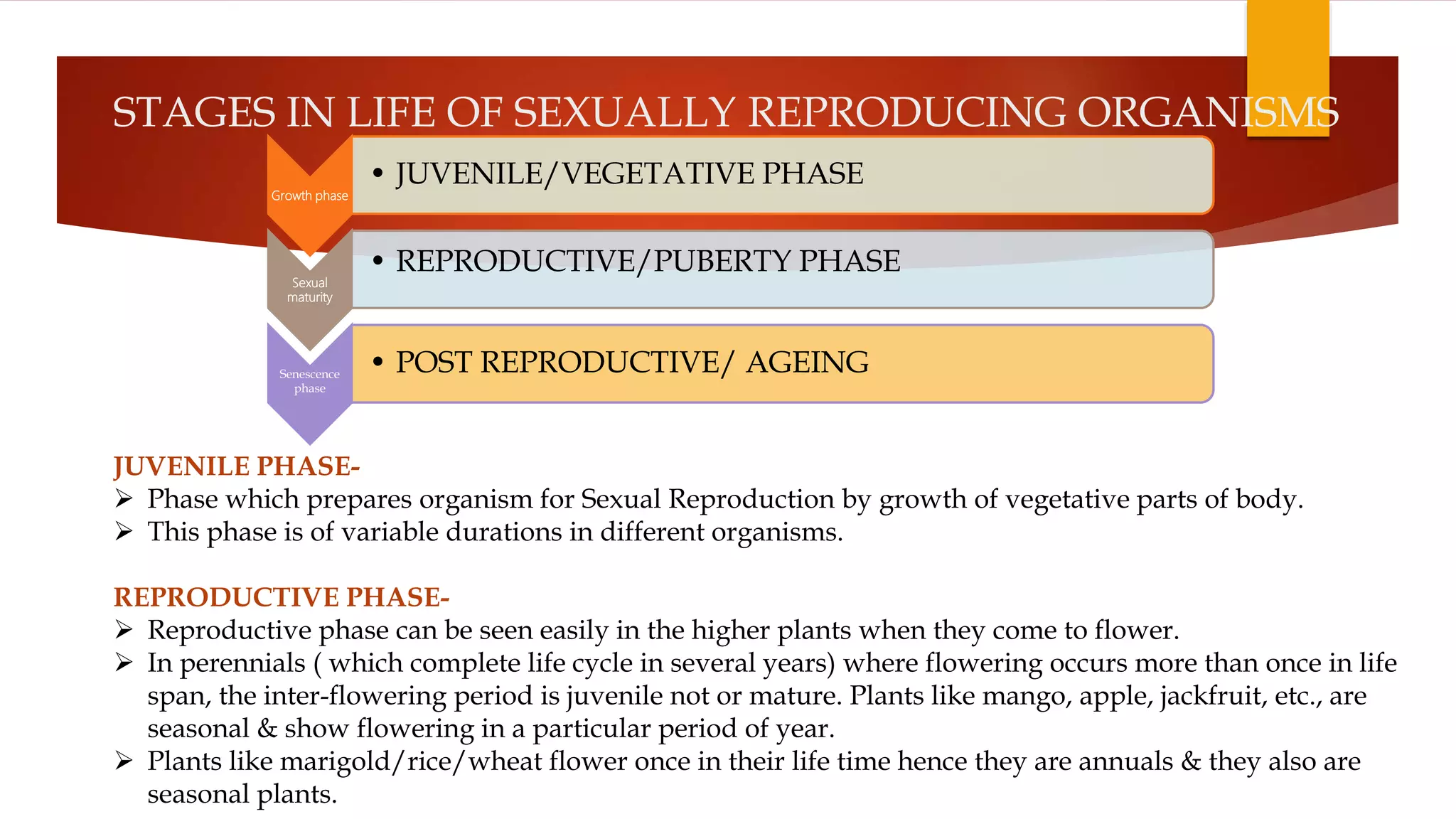
STAGES IN LIFE OF SEXUALLY REPRODUCING ORGANISMS
JUVENILE PHASE-
 Phase which prepares organism for Sexual Reproduction by growth of vegetative parts of body.
 This phase is of variable durations in different organisms.
REPRODUCTIVE PHASE-
 Reproductive phase can be seen easily in the higher plants when they come to flower.
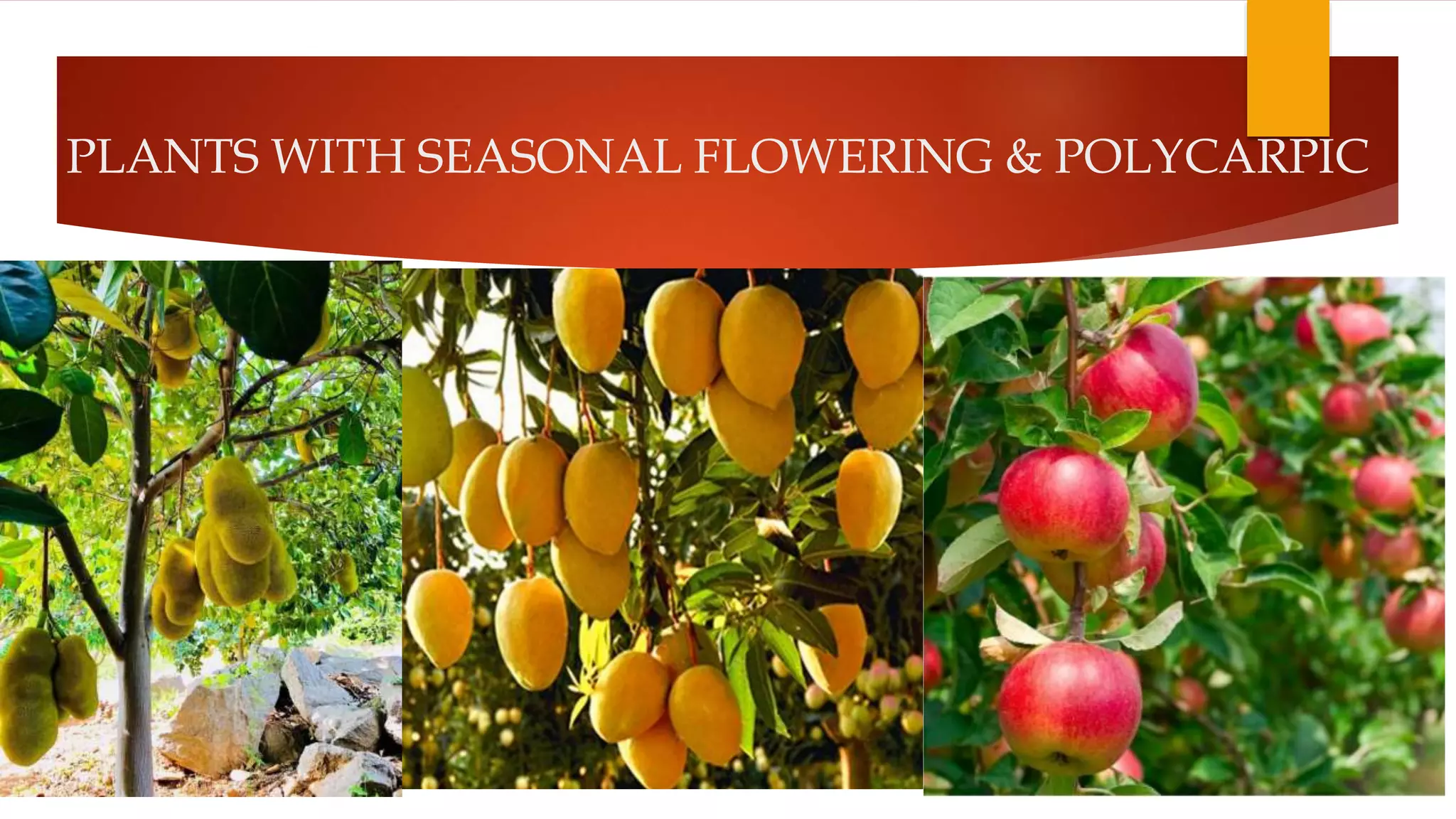
 In perennials ( which complete life cycle in several years) where flowering occurs more than once in life
span, the inter-flowering period is juvenile not or mature. Plants like mango, apple, jackfruit, etc., are
seasonal & show flowering in a particular period of year.
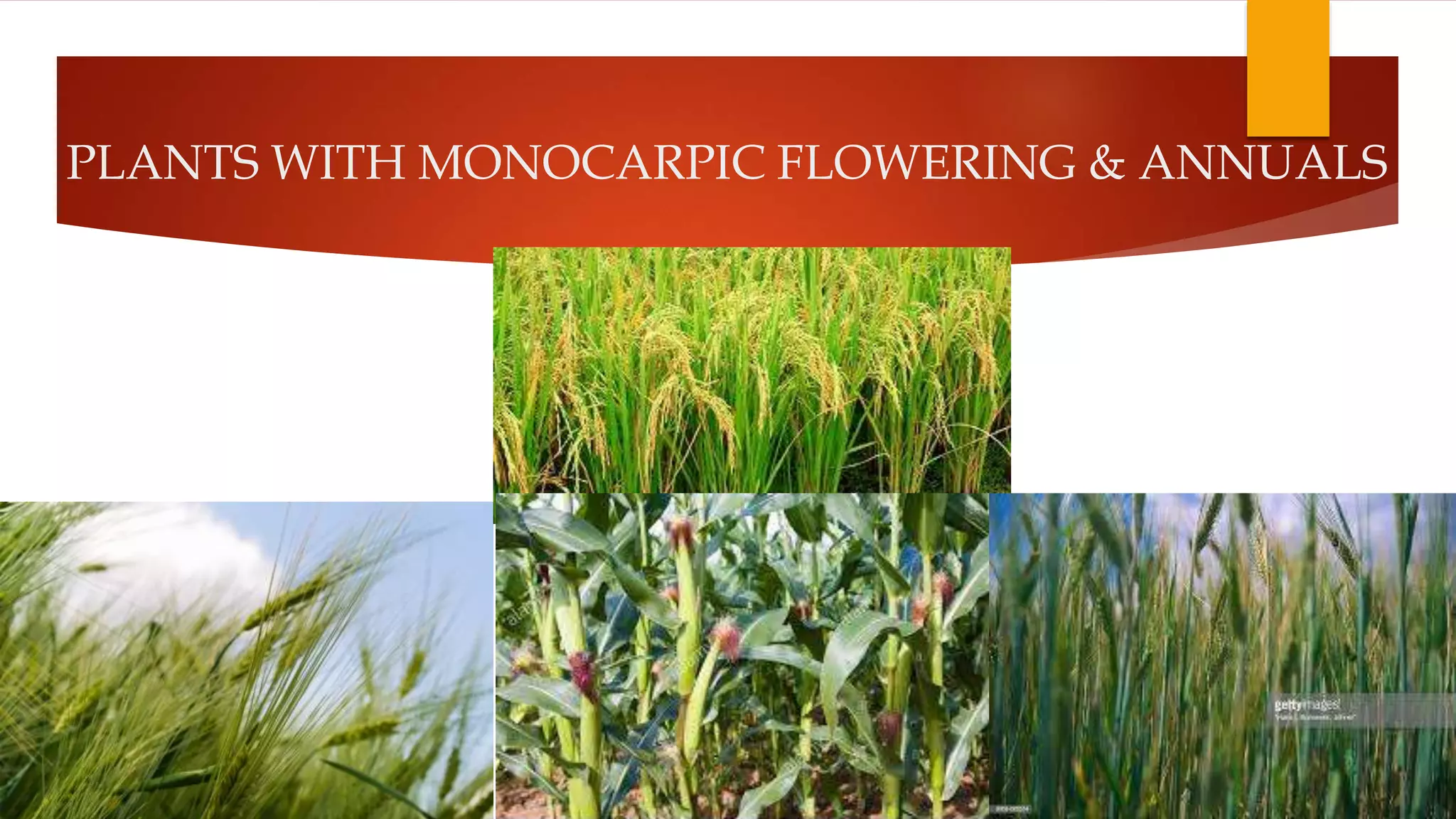
 Plants like marigold/rice/wheat flower once in their life time hence they are annuals & they also are
seasonal plants.
Growth phase
• JUVENILE/VEGETATIVE PHASE
Sexual
maturity
• REPRODUCTIVE/PUBERTY PHASE
Senescence
phase
• POST REPRODUCTIVE/ AGEING
PLANTS WITH SEASONAL FLOWERING & POLYCARPIC
PLANTS WITH MONOCARPIC FLOWERING & ANNUALS
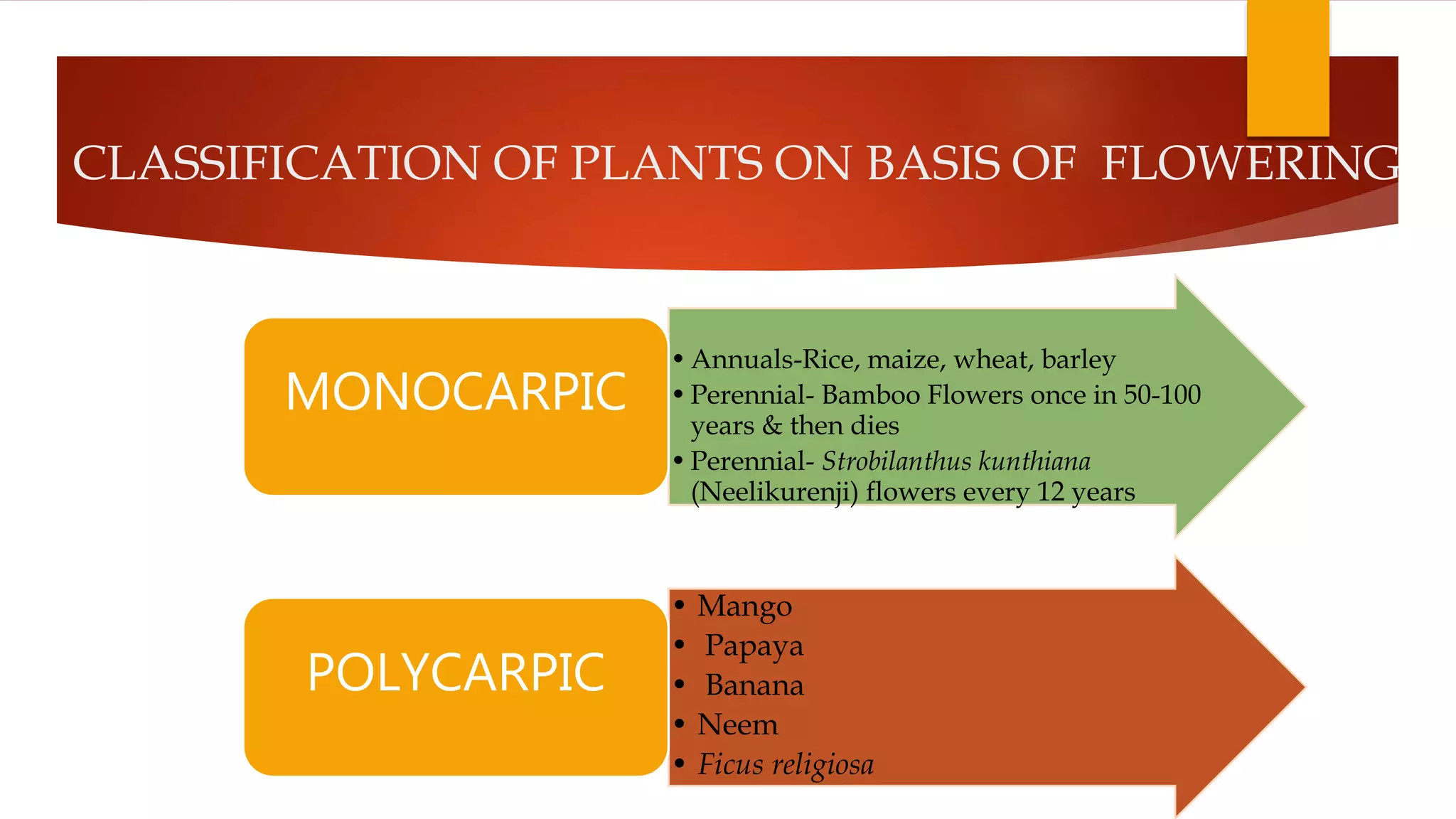
CLASSIFICATION OF PLANTS ON BASIS OF FLOWERING
•Annuals-Rice, maize, wheat, barley
•Perennial- Bamboo Flowers once in 50-100
years & then dies
•Perennial- Strobilanthus kunthiana
(Neelikurenji) flowers every 12 years
MONOCARPIC
• Mango
• Papaya
• Banana
• Neem
• Ficus religiosa
POLYCARPIC
MONOCARPIC PERINNEAL PLANTS
CLASSIFICATION OF ANIMALS ON BASIS OF
CONTINUOUS/SEASONAL BREEDING
The organisms which are reproductively active throughout their reproductive phase
and hence are called continuous breeders.
• Non Primates exhibiting Oestrous Cycle- Cow, Sheep, Buffalo, rat, deer, dog,
• Tiger, Poultry birds
• Primates exhibiting Menstrual Cycle- Apes, Chimpanzees, Gorillas, human beings
CONTINUOUS
BREEDERS
• Many mammals, especially those living in natural, wild conditions
exhibit such cycles only during favourable seasons in their
reproductivephase and are therefore called seasonal breeders.
• Birds other than poultry birds, Frogs, Lizards
• Mammals
SEASONAL
BREEDERS
OESTROUS VS MENSTRUAL CYCLE
S. No. Menstrual Cycle Oestrous Cycle
1 This cycle consists of menstrual phase,
proliferative phase and the secretory phase.
It consists of a short period of oestrous or heat
(e.g., 12-24 hours in cow) followed by anoestrous
or passive period.
2 Blood flows in the last few days of this cycle
which is called menstrual phase.
Blood does into flow in this cycle.
3 The broken uterine endometrium is passed out
during menstruation.
The broken endometrium is reabsorbed
4 Sex urge is not increased during menstruation. Sex urge is increased during oestrous period.
5 Female does not permit copulation during
menstrual phase of the cycle.
Female permits copulation only during oestrous
period.
6 It occurs in primates (monkeys, apes and
human beings) only.
It occurs in non-primates such as cows, dogs, etc.
SEXUAL REPRODUCTION
means the reproduction involves the coming together of genetic material from two
parents so as to produce an offspring. Two haploid gametes unite resulting in a
genetically distinct diploid offspring.
PRE-FERTILIZATION
Gametogenesis- It refers to the process of formation of the two types of germ
cells or gametes – male and female.
Gametes are haploid cells (n) with single set of chromosomes .
The gametes in an organism can be of following three types:
Isogamous/ Homogamous- Both male & female gametes are morphologically similar. Cladophora,
Chlamydomonas
Anisogamous/ Heterogamous- Both male & female gametes are morphologically different. In such
organisms the male gametes are antherozooides or sperms & female gametes are egg or ova For eg:
Fucus, a multicellular algae, Human beings
SEXUALITY IN PLANTS
• Plants may have both male/Stamen and female/Pistil reproductive structures in the same
plant they are bisexual
• In several fungi and plants, terms such as homothallic and monoecious are used to
denote the bisexual condition
• In some flowering plants, both male/Staminate and female/ Pistillate flowers may be
present on the same individuals monoecious) cucurbits and coconuts.
Homothallic/
isexual
• Plants may have both male/Stamen and female/Pistil reproductive structures in different plants they are unisexual.
They are called heterothallic and dioecious also.
• In flowering plants, the unisexual male flower is staminate, i.e., bearing stamens, while the female is pistillate or
bearing pistils.
• In some flowering plants, both male/Staminate and female/ Pistillate flowers may be present on the different
individuals they are dioecious plants are papaya and date palm.
Heterothallic/
Unisexual
Dioecious / Unisexual Plants of Papaya & Date
palm
Monoecious/ Bisexual Plants of
Pea, Hibiscus Bisexual flowers
Monoecious/ Bisexual Plants of
Cucumber, Coconut with unisexual flowers
Heterothallic Marchantia plant, Homothallic plant of
Chara algae & Bisexual Flower
Female & Male thallus of Marchantia- Bryophyte
Bisexual flower
Chara Algae
SEXUALITY IN ANIMALS
• The species which possess both the reproductive organs (bisexual or
Hermaphrodite
• These animals that possess both male and female reproductive organs, are
hermaphrodites.
• Earthworms, sponge, tapeworm and leech, typical examples of bisexual
Bisexual/
Hermaphrodi
e
• The species which possess single the reproductive organ
either male or female are unisexual.
• Cockroach, Human beings
Unisexual
Hermaphrodite- Earthworm/ Pheritima posthuma,
Unisexual- Cockroach/ Periplanata americana
CELL DIVISION FOR GAMETE FORMATION
In Haploid Organisms- Mitosis/ Mitotic
 The haploid organisms which have haploid
no. of chromosomes (1 set) like Monera,
fungi, algae and bryophytes means the
body is a gametophyte undergo
mitotic/mitosis cell division for gamete
formation.
CELL DIVISION FOR GAMETE FORMATION in
Diploid organisms is Meiotic/ Meiosis
 The diploid organisms which have diploid no. of
chromosomes (2 sets) like gymnosperms,
angiosperms and most of the animals including
human undergo meiotic/ meiosis cell division for
gamete formation.
 In such organisms the diploid cells which
undergo meiosis to produce haploid gametes are
called meiocytes (2n)/ gamete mother cell.
CHROMOSOME NO. IN MEIOCYTES IN DIPLOID
ORGANISMS & IN GAMETES
GAMETE TRANSFER
 In a majority of organisms, male gamete is motile and the female gamete is stationary.
 Exceptions are a few fungi and algae in which both types of gametes are motile
 There is a need for a medium through which the male gametes move. In several simple plants like algae,
bryophytes and pteridophytes, water is the medium through which this gamete transfer takes place.
 A large number of the male gametes, however, fail to reach the female gametes.
 To compensate this loss of male gametes during transport, the number of male gametes produced is
several thousand times the number of female gametes produced.
GAMETE TRANSFER IN PLANTS
 In seed plants, pollen grains carry male gametes & ovule has the egg/ female
gamete.
 Pollen grains produced in anthers therefore, have to be transferred to the
stigma before it can lead to fertilisation.
 In bisexual, self-fertilising plants, e.g., peas, transfer of pollen grains to the
stigma is relatively easy as anthers and stigma are located close to each other;
pollen grains soon after they are shed, come in contact with the stigma.
 But in cross pollinating plants (including dioecious plants), a specialised event
called pollination facilitates transfer of pollen grains to the stigma.
 Pollen grains germinate on the stigma and the pollen tubes carrying the male
gametes reach the ovule and discharge male gametes near the egg.
 In dioecious animals, since male and female gametes are formed in
different individuals, the organism must evolve a special mechanism for
gamete transfer.
 Successful transfer and coming together of gametes is essential for the
most critical event in sexual reproduction, the fertilisation.
GAMETE TRANSFER IN ANIMALS
FERTILIZATION
This process called syngamy (syn- fusion, gamy- gamete) / Fertilization results into
formation of a diploid zygote by fusion of male & female gametes.
NO FERTILIZATION
• Parthenogenesis- the female gamete undergoes development to form new
organisms without fertilisation
• like rotifers, honeybees and even some lizards and birds (turkey)
EXTERNAL FERTILIZATION
• Syngamy occurs in the external medium (water), i.e., outside the body of the female
• They exhibit great synchrony in gamete formation by male & female partners.
• The male release a large number of gametes into the surrounding medium (water) to enhance
the chances of syngamy.
• The gametes are vulnerable to the attack of predators For eg: Bony fish, frogs
INTERNAL FERTILIZATION
• Syngamy occurs inside the body of the female, hence it is called internal fertilisation.
• In these organisms male gamete is motile either flagellated or has tail & reaches to the female
gamete or egg.
• Large no. of male gametes are produced to compensate the loss during transfer while eggs are
limited. For eg: fungi, reptiles birds, mammals bryophytes, pteridophytes, gymnosperms and
angiosperms
ZYGOTE
A diploid cell formed after fusion of male & female gamete it is a vital link
between organisms of different generations to continue their race.
 In organisms belonging to fungi and algae, zygote develops a thick wall that is
resistant to desiccation and damage.
 It undergoes a period of rest before germination.
 In organisms with haplontic life cycle, zygote divides by meiosis to form
haploid spores that grow into haploid individuals. For eg: Algae, Fungi
 In organisms with diplontic life cycle, gametes are formed by meiosis which
fuse to form diploid zygote for eg: Angiosperms, Gymnosperms.
 In organisms with haplo-diplontic life cycle, gametes are formed by mitosis in
Bryophytes which have main plant body a haploid Gametophyte & in Ferns it
is formed by meiosis in the Fern prothallus the diploid gametophyte. For eg:
Bryophytes & Pteridophytes.
TYPES OF LIFE CYCLES OF ORGANISMS
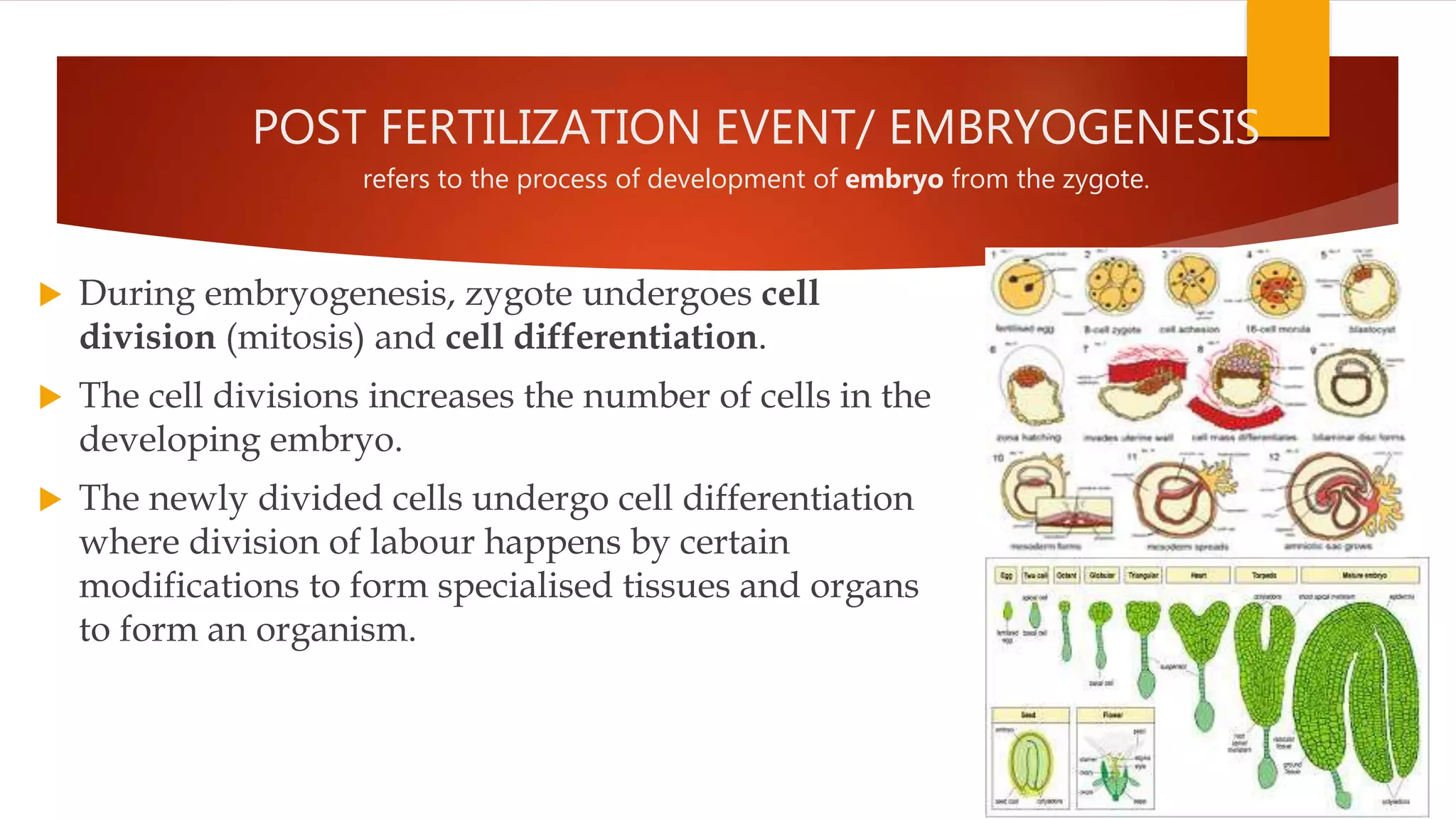
POST FERTILIZATION EVENT/ EMBRYOGENESIS
refers to the process of development of embryo from the zygote.
 During embryogenesis, zygote undergoes cell
division (mitosis) and cell differentiation.
 The cell divisions increases the number of cells in the
developing embryo.
 The newly divided cells undergo cell differentiation
where division of labour happens by certain
modifications to form specialised tissues and organs
to form an organism.
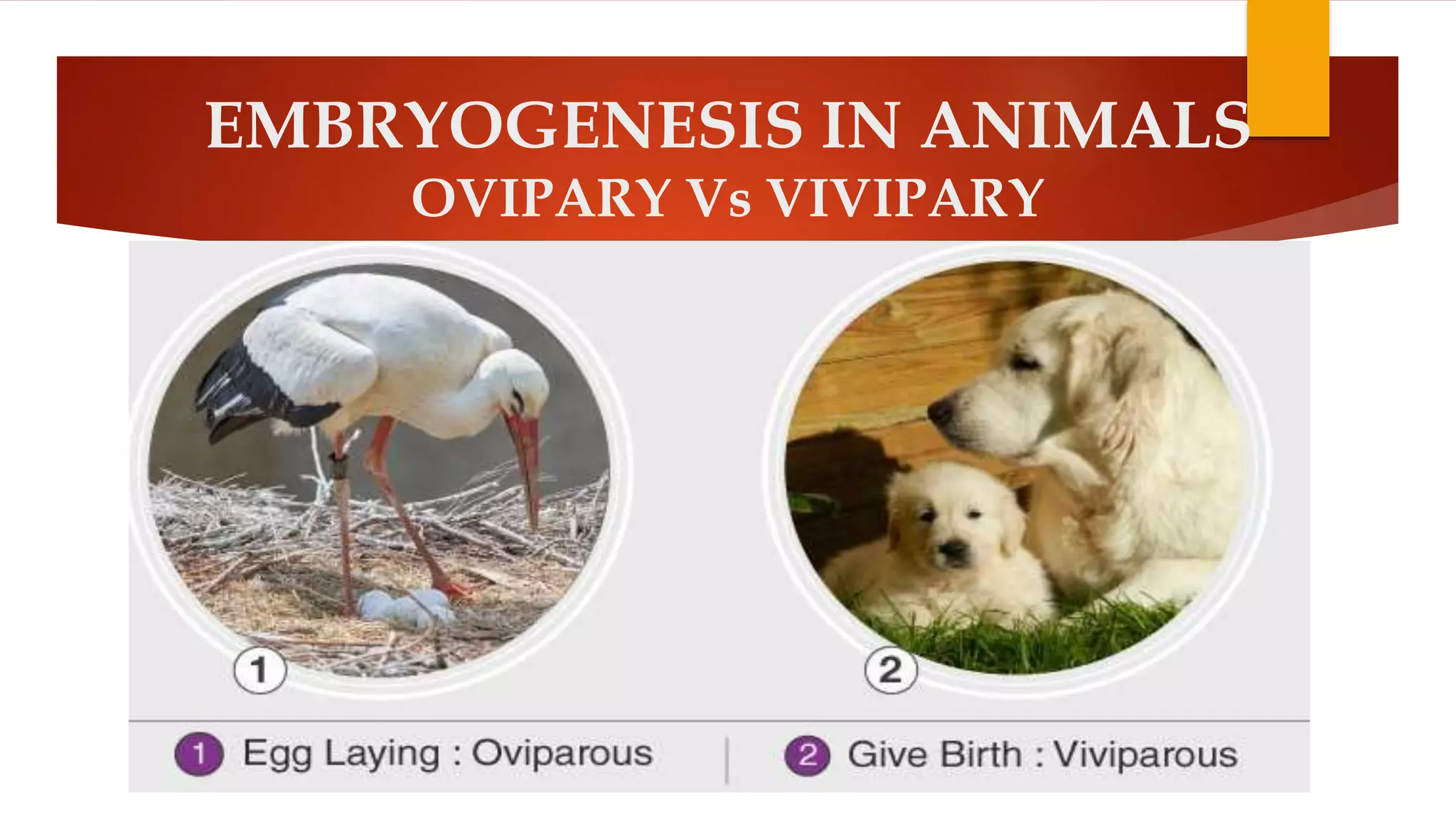
EMBRYOGENESIS IN ANIMALS
OVIPARY Vs VIVIPARY
EMBRYOGENESIS IN ANIMALS
OVIPARY Vs VIVIPARY
EMBRYOGENESIS IN PLANTS
 In flowering plants, the zygote is formed inside the ovule of the ovary
 After fertilisation the sepals, petals and stamens of the flower wither & fall off.
Brinjal, Chilli, Tomatoes are examples of a fruits which are an exception where sepals
are retained in the fruit.
 The pistil however, remains attached to the plant. The zygote develops into the
embryo and the ovules develop into the seed.
 The ovary develops into the fruit which develops a thick wall called pericarp
that is protective in function.
 After dispersal, seeds germinate under favourable conditions to produce new
plants.
EMBRYOGENESIS IN PLANTS
THANK
YOU

Reproduction in organisms

  • 1.
    REPRODUCTION IN ORGANISMS CLASSXII UNIT- 1 Chapter-1 PRESENTATION BY – ANITA MISHRA BIRLA BALIKA VIDYAPEETH, PILANI RAJASTHAN
  • 2.
    STAGES IN LIFEOF SEXUALLY REPRODUCING ORGANISMS JUVENILE PHASE-  Phase which prepares organism for Sexual Reproduction by growth of vegetative parts of body.  This phase is of variable durations in different organisms. REPRODUCTIVE PHASE-  Reproductive phase can be seen easily in the higher plants when they come to flower.  In perennials ( which complete life cycle in several years) where flowering occurs more than once in life span, the inter-flowering period is juvenile not or mature. Plants like mango, apple, jackfruit, etc., are seasonal & show flowering in a particular period of year.  Plants like marigold/rice/wheat flower once in their life time hence they are annuals & they also are seasonal plants. Growth phase • JUVENILE/VEGETATIVE PHASE Sexual maturity • REPRODUCTIVE/PUBERTY PHASE Senescence phase • POST REPRODUCTIVE/ AGEING
  • 3.
    PLANTS WITH SEASONALFLOWERING & POLYCARPIC
  • 4.
    PLANTS WITH MONOCARPICFLOWERING & ANNUALS
  • 5.
    CLASSIFICATION OF PLANTSON BASIS OF FLOWERING •Annuals-Rice, maize, wheat, barley •Perennial- Bamboo Flowers once in 50-100 years & then dies •Perennial- Strobilanthus kunthiana (Neelikurenji) flowers every 12 years MONOCARPIC • Mango • Papaya • Banana • Neem • Ficus religiosa POLYCARPIC
  • 6.
  • 7.
    CLASSIFICATION OF ANIMALSON BASIS OF CONTINUOUS/SEASONAL BREEDING The organisms which are reproductively active throughout their reproductive phase and hence are called continuous breeders. • Non Primates exhibiting Oestrous Cycle- Cow, Sheep, Buffalo, rat, deer, dog, • Tiger, Poultry birds • Primates exhibiting Menstrual Cycle- Apes, Chimpanzees, Gorillas, human beings CONTINUOUS BREEDERS • Many mammals, especially those living in natural, wild conditions exhibit such cycles only during favourable seasons in their reproductivephase and are therefore called seasonal breeders. • Birds other than poultry birds, Frogs, Lizards • Mammals SEASONAL BREEDERS
  • 8.
    OESTROUS VS MENSTRUALCYCLE S. No. Menstrual Cycle Oestrous Cycle 1 This cycle consists of menstrual phase, proliferative phase and the secretory phase. It consists of a short period of oestrous or heat (e.g., 12-24 hours in cow) followed by anoestrous or passive period. 2 Blood flows in the last few days of this cycle which is called menstrual phase. Blood does into flow in this cycle. 3 The broken uterine endometrium is passed out during menstruation. The broken endometrium is reabsorbed 4 Sex urge is not increased during menstruation. Sex urge is increased during oestrous period. 5 Female does not permit copulation during menstrual phase of the cycle. Female permits copulation only during oestrous period. 6 It occurs in primates (monkeys, apes and human beings) only. It occurs in non-primates such as cows, dogs, etc.
  • 9.
    SEXUAL REPRODUCTION means thereproduction involves the coming together of genetic material from two parents so as to produce an offspring. Two haploid gametes unite resulting in a genetically distinct diploid offspring.
  • 10.
    PRE-FERTILIZATION Gametogenesis- It refersto the process of formation of the two types of germ cells or gametes – male and female. Gametes are haploid cells (n) with single set of chromosomes . The gametes in an organism can be of following three types: Isogamous/ Homogamous- Both male & female gametes are morphologically similar. Cladophora, Chlamydomonas Anisogamous/ Heterogamous- Both male & female gametes are morphologically different. In such organisms the male gametes are antherozooides or sperms & female gametes are egg or ova For eg: Fucus, a multicellular algae, Human beings
  • 11.
    SEXUALITY IN PLANTS •Plants may have both male/Stamen and female/Pistil reproductive structures in the same plant they are bisexual • In several fungi and plants, terms such as homothallic and monoecious are used to denote the bisexual condition • In some flowering plants, both male/Staminate and female/ Pistillate flowers may be present on the same individuals monoecious) cucurbits and coconuts. Homothallic/ isexual • Plants may have both male/Stamen and female/Pistil reproductive structures in different plants they are unisexual. They are called heterothallic and dioecious also. • In flowering plants, the unisexual male flower is staminate, i.e., bearing stamens, while the female is pistillate or bearing pistils. • In some flowering plants, both male/Staminate and female/ Pistillate flowers may be present on the different individuals they are dioecious plants are papaya and date palm. Heterothallic/ Unisexual
  • 12.
    Dioecious / UnisexualPlants of Papaya & Date palm
  • 13.
    Monoecious/ Bisexual Plantsof Pea, Hibiscus Bisexual flowers
  • 14.
    Monoecious/ Bisexual Plantsof Cucumber, Coconut with unisexual flowers
  • 15.
    Heterothallic Marchantia plant,Homothallic plant of Chara algae & Bisexual Flower Female & Male thallus of Marchantia- Bryophyte Bisexual flower Chara Algae
  • 16.
    SEXUALITY IN ANIMALS •The species which possess both the reproductive organs (bisexual or Hermaphrodite • These animals that possess both male and female reproductive organs, are hermaphrodites. • Earthworms, sponge, tapeworm and leech, typical examples of bisexual Bisexual/ Hermaphrodi e • The species which possess single the reproductive organ either male or female are unisexual. • Cockroach, Human beings Unisexual
  • 17.
    Hermaphrodite- Earthworm/ Pheritimaposthuma, Unisexual- Cockroach/ Periplanata americana
  • 18.
    CELL DIVISION FORGAMETE FORMATION In Haploid Organisms- Mitosis/ Mitotic  The haploid organisms which have haploid no. of chromosomes (1 set) like Monera, fungi, algae and bryophytes means the body is a gametophyte undergo mitotic/mitosis cell division for gamete formation.
  • 19.
    CELL DIVISION FORGAMETE FORMATION in Diploid organisms is Meiotic/ Meiosis  The diploid organisms which have diploid no. of chromosomes (2 sets) like gymnosperms, angiosperms and most of the animals including human undergo meiotic/ meiosis cell division for gamete formation.  In such organisms the diploid cells which undergo meiosis to produce haploid gametes are called meiocytes (2n)/ gamete mother cell.
  • 20.
    CHROMOSOME NO. INMEIOCYTES IN DIPLOID ORGANISMS & IN GAMETES
  • 21.
    GAMETE TRANSFER  Ina majority of organisms, male gamete is motile and the female gamete is stationary.  Exceptions are a few fungi and algae in which both types of gametes are motile  There is a need for a medium through which the male gametes move. In several simple plants like algae, bryophytes and pteridophytes, water is the medium through which this gamete transfer takes place.  A large number of the male gametes, however, fail to reach the female gametes.  To compensate this loss of male gametes during transport, the number of male gametes produced is several thousand times the number of female gametes produced.
  • 22.
    GAMETE TRANSFER INPLANTS  In seed plants, pollen grains carry male gametes & ovule has the egg/ female gamete.  Pollen grains produced in anthers therefore, have to be transferred to the stigma before it can lead to fertilisation.  In bisexual, self-fertilising plants, e.g., peas, transfer of pollen grains to the stigma is relatively easy as anthers and stigma are located close to each other; pollen grains soon after they are shed, come in contact with the stigma.  But in cross pollinating plants (including dioecious plants), a specialised event called pollination facilitates transfer of pollen grains to the stigma.  Pollen grains germinate on the stigma and the pollen tubes carrying the male gametes reach the ovule and discharge male gametes near the egg.
  • 23.
     In dioeciousanimals, since male and female gametes are formed in different individuals, the organism must evolve a special mechanism for gamete transfer.  Successful transfer and coming together of gametes is essential for the most critical event in sexual reproduction, the fertilisation. GAMETE TRANSFER IN ANIMALS
  • 24.
    FERTILIZATION This process calledsyngamy (syn- fusion, gamy- gamete) / Fertilization results into formation of a diploid zygote by fusion of male & female gametes. NO FERTILIZATION • Parthenogenesis- the female gamete undergoes development to form new organisms without fertilisation • like rotifers, honeybees and even some lizards and birds (turkey) EXTERNAL FERTILIZATION • Syngamy occurs in the external medium (water), i.e., outside the body of the female • They exhibit great synchrony in gamete formation by male & female partners. • The male release a large number of gametes into the surrounding medium (water) to enhance the chances of syngamy. • The gametes are vulnerable to the attack of predators For eg: Bony fish, frogs INTERNAL FERTILIZATION • Syngamy occurs inside the body of the female, hence it is called internal fertilisation. • In these organisms male gamete is motile either flagellated or has tail & reaches to the female gamete or egg. • Large no. of male gametes are produced to compensate the loss during transfer while eggs are limited. For eg: fungi, reptiles birds, mammals bryophytes, pteridophytes, gymnosperms and angiosperms
  • 25.
    ZYGOTE A diploid cellformed after fusion of male & female gamete it is a vital link between organisms of different generations to continue their race.  In organisms belonging to fungi and algae, zygote develops a thick wall that is resistant to desiccation and damage.  It undergoes a period of rest before germination.  In organisms with haplontic life cycle, zygote divides by meiosis to form haploid spores that grow into haploid individuals. For eg: Algae, Fungi  In organisms with diplontic life cycle, gametes are formed by meiosis which fuse to form diploid zygote for eg: Angiosperms, Gymnosperms.  In organisms with haplo-diplontic life cycle, gametes are formed by mitosis in Bryophytes which have main plant body a haploid Gametophyte & in Ferns it is formed by meiosis in the Fern prothallus the diploid gametophyte. For eg: Bryophytes & Pteridophytes.
  • 26.
    TYPES OF LIFECYCLES OF ORGANISMS
  • 27.
    POST FERTILIZATION EVENT/EMBRYOGENESIS refers to the process of development of embryo from the zygote.  During embryogenesis, zygote undergoes cell division (mitosis) and cell differentiation.  The cell divisions increases the number of cells in the developing embryo.  The newly divided cells undergo cell differentiation where division of labour happens by certain modifications to form specialised tissues and organs to form an organism.
  • 28.
  • 29.
  • 30.
    EMBRYOGENESIS IN PLANTS In flowering plants, the zygote is formed inside the ovule of the ovary  After fertilisation the sepals, petals and stamens of the flower wither & fall off. Brinjal, Chilli, Tomatoes are examples of a fruits which are an exception where sepals are retained in the fruit.  The pistil however, remains attached to the plant. The zygote develops into the embryo and the ovules develop into the seed.  The ovary develops into the fruit which develops a thick wall called pericarp that is protective in function.  After dispersal, seeds germinate under favourable conditions to produce new plants.
  • 31.
  • 32.