APOLLOJAMES
LECTURER
NANDHA COLLEGE OF PHARMACY
1
DEFINITION
The hospital formulary is a list of pharmaceutical agents
with its important informations which reflects the current
clinical views of the medical staff.
The hospital formulary system is a method whereby the
medical staff of a hospital with the help of pharmacy and
therapeutic committee selects and evaluate medical agents
and their dosage form which are considered to be most
useful in the patient care. The hospital formulary system
provides the information for procuring, prescribing,
dispensing and administering of drugs under non-
proprietary or proprietary(brands)names in instances
where drugs have both names.
2
AJ
origin
The first scientific hospital formulary in India was published
in 1968 by the pharmacy department of CMC Vellore.
The first HF for a Government teaching hospital in India
was published in 1997 at Govt.Medical College Hospital,
Trivandrum.
3
AJ
ADVANTAGES:
Therapeutic
Economic
Educational
Rational drug use
4
AJ
DISADVANTAGES:
Deprive the physician of his right and privilege to
prescribe and obtain the brand of his choice.
Permits the pharmacist to act as the sole judge of
which brands of drugs are to be purchased &
dispensed.
5
AJ
GUIDELINE FOR HOSPITAL FORMULARY
The governing body of the hospital should appoint a pharmacy and
therapeutic committee composed of physician and pharmacist
which will prepare the hospital formulary system.
PTC shall sponsor and outline the purpose, organization function
and scope of the hospital formulary system, it should adopt the
principle as per the need of particular hospital.
PTC develop policies and procedures - medical staff adopt these -
subject to administrative approval.
The policy and procedures shall afford guidance in the appraisal,
selection, procurement, storage, distribution, use, safety procedures
and other matter relating to drug in the hospital and shall be
published in the hospital’s formulary or other media available to
the member of medical team
6
AJ
Prescribers should be strongly encouraged to
prescribe drugs by their nonproprietary names.
Generic equivalents & therapeutic equivalents.
a.Pharmacist is responsible for selecting from available
generic equivalents.
b.That the prescriber has the option, to specify the
brand for that particular prescription.
c. PTC is responsible for determining those drug
products and entities.
medical & nursing staffs are informed about the
changes in the HF system.
Labeling of medicine with non-proprietary names,
followed by decided formats.
7
AJ
To develop an effective formulary system, PTC has to
consult various references on a drug regarding its
pharmacokinetic profile, interactions, ADR, etc.,,,
8
AJ
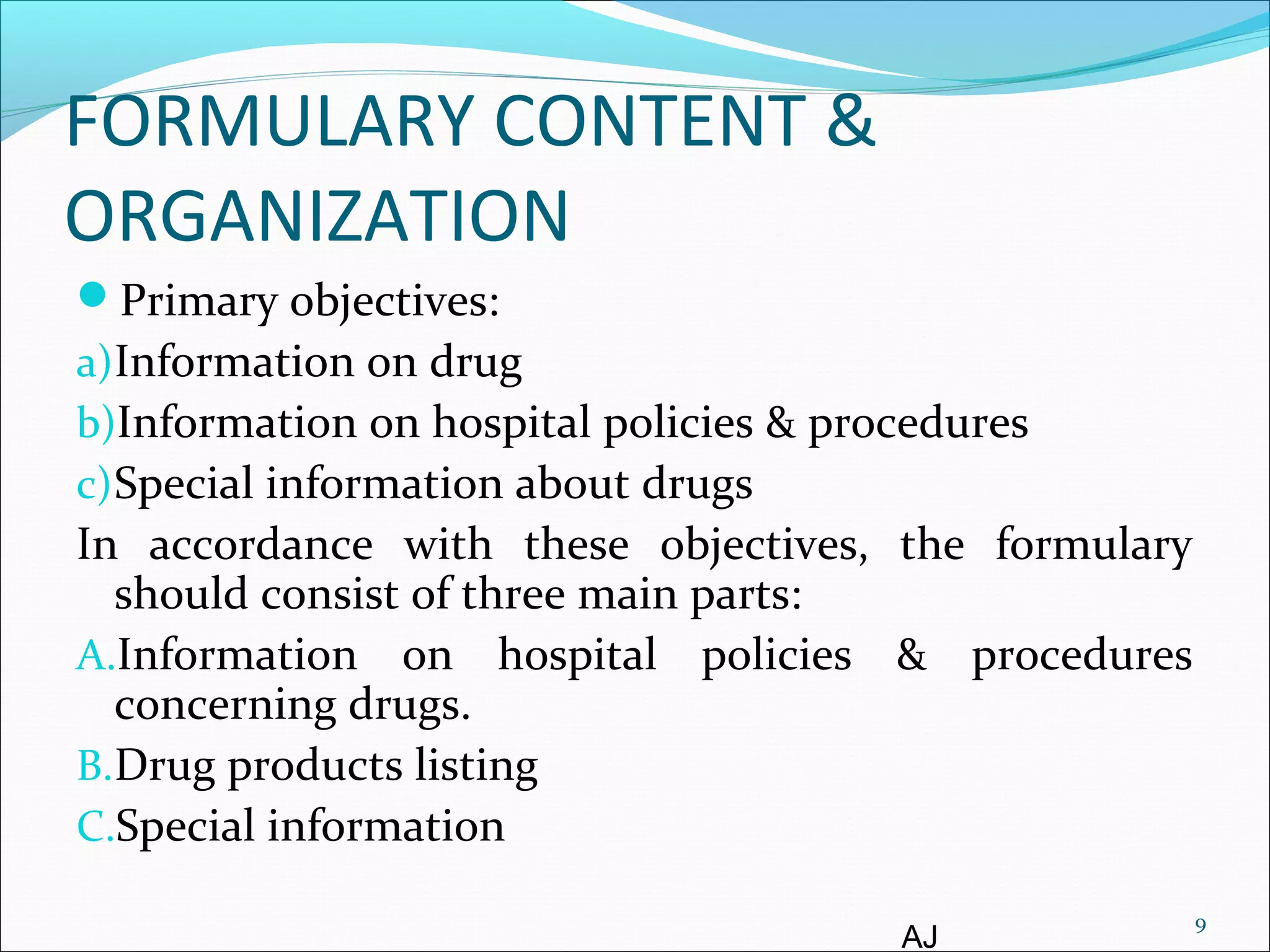
FORMULARY CONTENT &
ORGANIZATION
Primary objectives:
a)Information on drug
b)Information on hospital policies & procedures
c)Special information about drugs
In accordance with these objectives, the formulary
should consist of three main parts:
A.Information on hospital policies & procedures
concerning drugs.
B.Drug products listing
C.Special information
9
AJ
A. HOSPITAL POLICIES AND
PROCEDURES
Drug use
Description of PTC
Hospital regulations about prescribing, dispensing &
administration of drug, rules for Medical Reps, emergency
drug products,
Pharmacy operating procedures
Information on using formulary
10
AJ
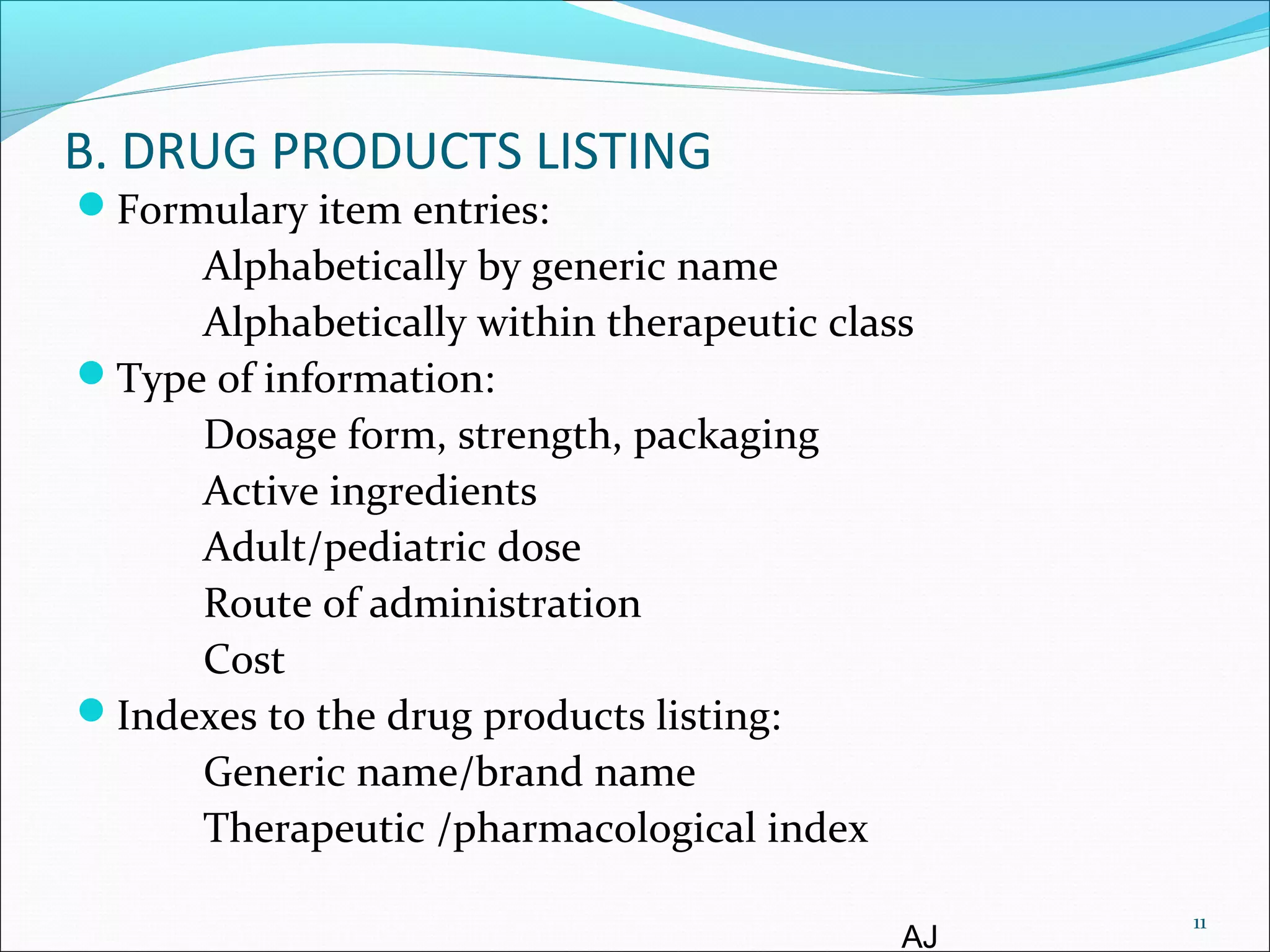
B. DRUG PRODUCTS LISTING
Formulary item entries:
Alphabetically by generic name
Alphabetically within therapeutic class
Type of information:
Dosage form, strength, packaging
Active ingredients
Adult/pediatric dose
Route of administration
Cost
Indexes to the drug products listing:
Generic name/brand name
Therapeutic /pharmacological index
11
AJ
C.SPECIAL INFORMATION:
Equivalent dosages of similar drugs
Hospital approved abbreviations
Rules for calculating pediatric dosages
List of sugar free drugs
List of dialyzable poisons
Metric conversion tables
Poison control information
Table of drug interactions
12
AJ
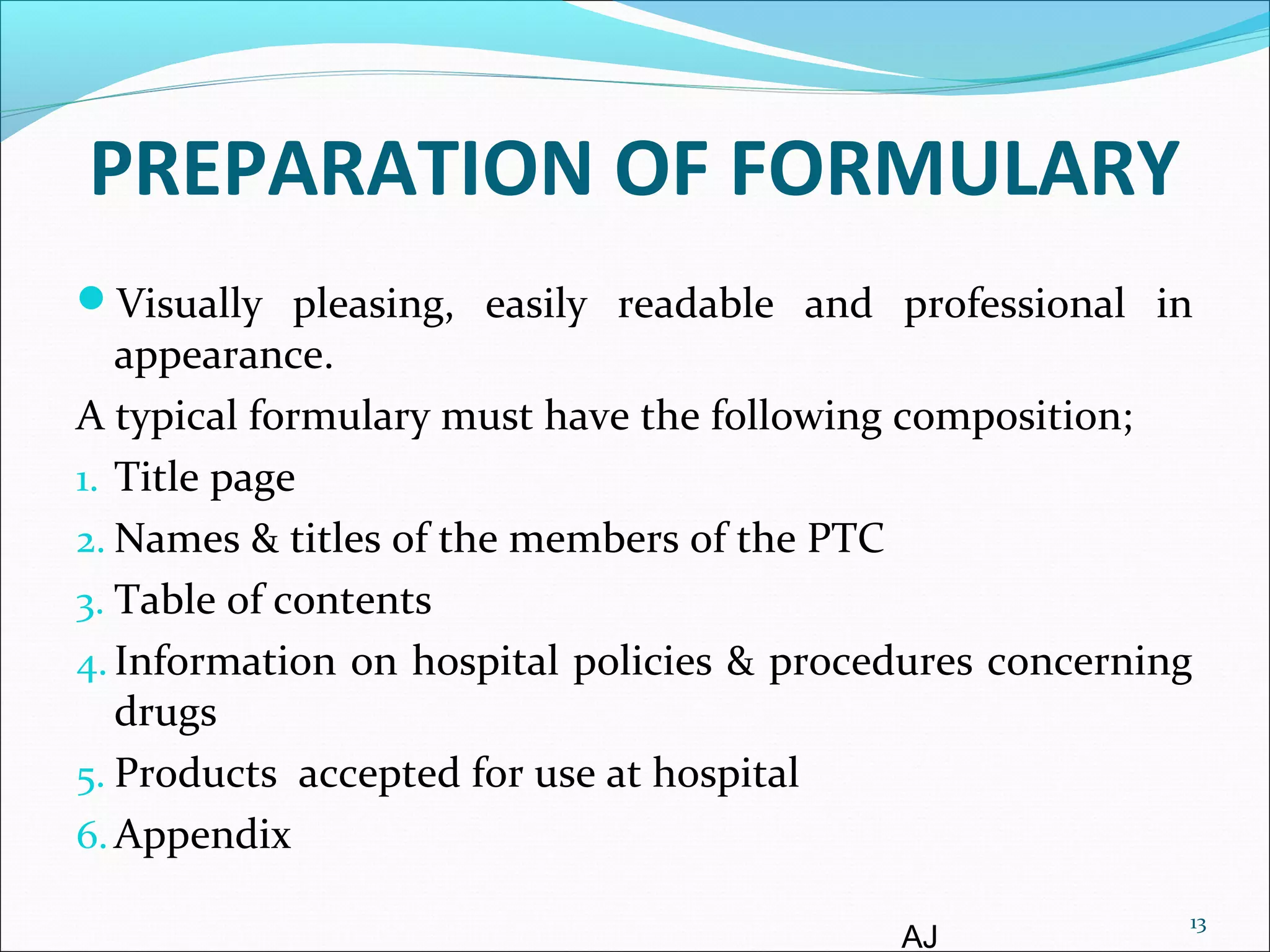
PREPARATION OF FORMULARY
Visually pleasing, easily readable and professional in
appearance.
A typical formulary must have the following composition;
1. Title page
2. Names & titles of the members of the PTC
3. Table of contents
4. Information on hospital policies & procedures concerning
drugs
5. Products accepted for use at hospital
6.Appendix
13
AJ
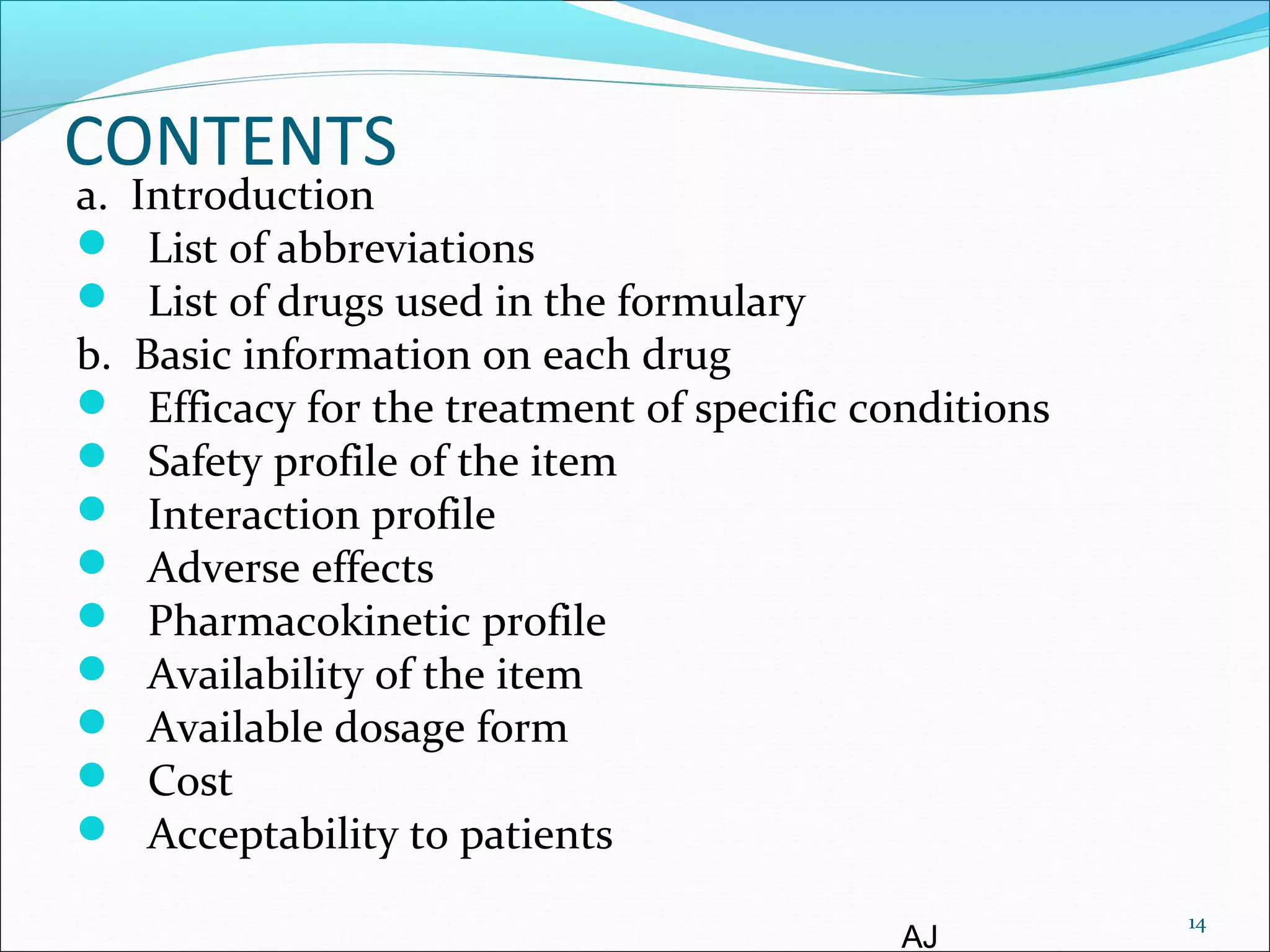
CONTENTS
a. Introduction
 List of abbreviations
 List of drugs used in the formulary
b. Basic information on each drug
 Efficacy for the treatment of specific conditions
 Safety profile of the item
 Interaction profile
 Adverse effects
 Pharmacokinetic profile
 Availability of the item
 Available dosage form
 Cost
 Acceptability to patients
14
AJ
c. Supplementary information on each drug
 Storage guidelines
 Patient counselling information
 Labelling information
 Brand names and prices
d. Prescribing and dispensing guidelines
 Principles of prescription writing
 Reporting of ADR
 Prevention of ADR
15
AJ
e. General drug use and advice
 Use of IV drugs
 Special situations like pregnancy, breast feeding,
liver/kidney diseases
 Poisoning information and antidotes
 Treatment of snakebites and insect bites
f. Miscellaneous section
 Children’s dose
 Renal adjustments
 Metric units
 Diagnostic aids
16
AJ
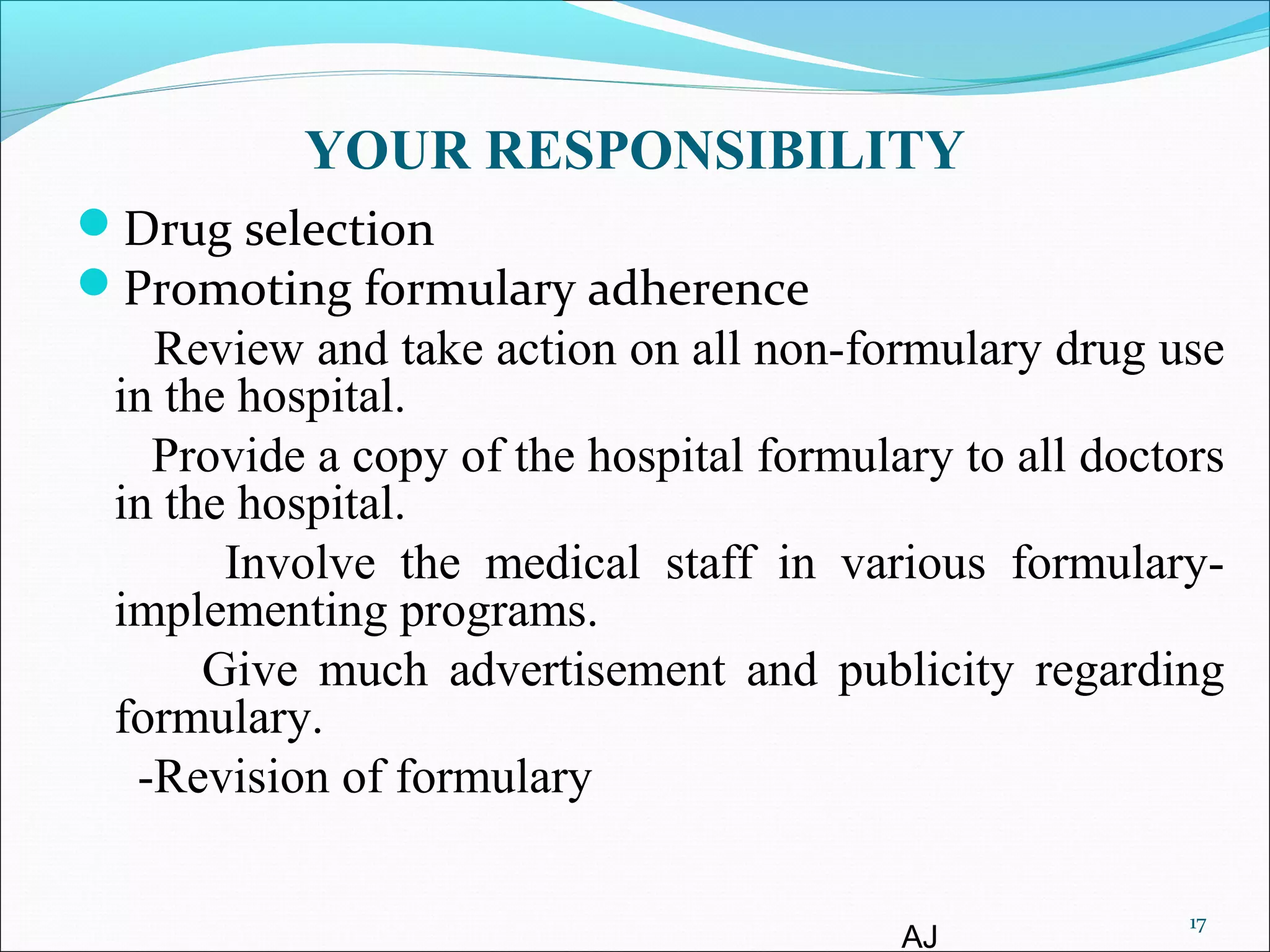
YOUR RESPONSIBILITY
Drug selection
Promoting formulary adherence
Review and take action on all non-formulary drug use
in the hospital.
Provide a copy of the hospital formulary to all doctors
in the hospital.
Involve the medical staff in various formulary-
implementing programs.
Give much advertisement and publicity regarding
formulary.
-Revision of formulary
17
AJ
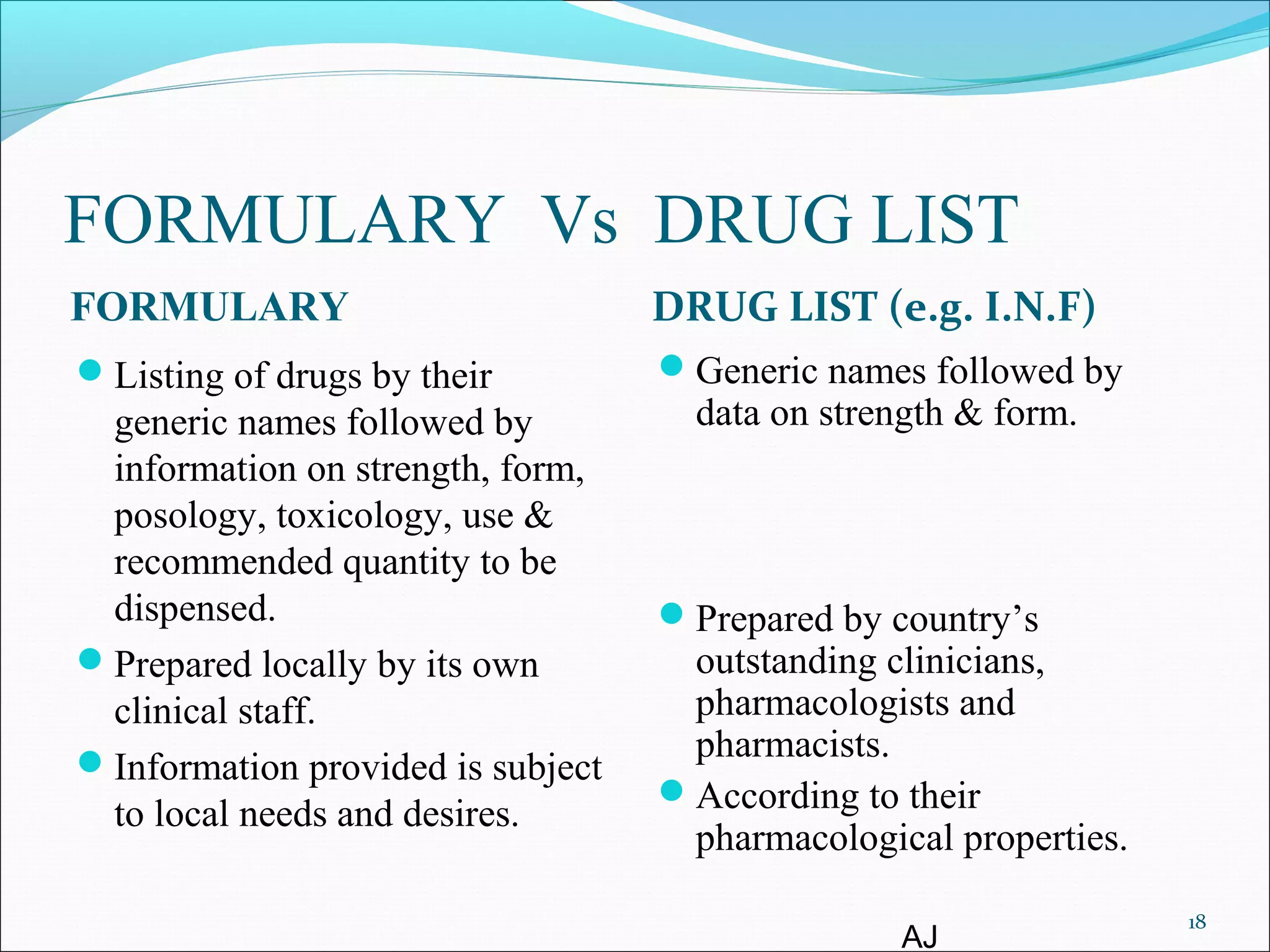
FORMULARY Vs DRUG LIST
FORMULARY DRUG LIST (e.g. I.N.F)
Listing of drugs by their
generic names followed by
information on strength, form,
posology, toxicology, use &
recommended quantity to be
dispensed.
Prepared locally by its own
clinical staff.
Information provided is subject
to local needs and desires.
Generic names followed by
data on strength & form.
Prepared by country’s
outstanding clinicians,
pharmacologists and
pharmacists.
According to their
pharmacological properties.
18
AJ
REFERENCES
1. Hospital pharmacy by William E. Hassan, JR 5th
edition. Pg no.124-153.
2. A textbook of pharmacy practice by K.G. Revikumar,
B.D.Miglani . 1st
edition.pg no.82.
3. Remington –The science and practice of pharmacy 21st
edition volume 2, pg no.2259.
4. Merchant and Qadry’s-A text book of Hospital
Pharmacy. Pg no.39-50
19
AJ

Hospital formulary

  • 1.
  • 2.
    DEFINITION The hospital formularyis a list of pharmaceutical agents with its important informations which reflects the current clinical views of the medical staff. The hospital formulary system is a method whereby the medical staff of a hospital with the help of pharmacy and therapeutic committee selects and evaluate medical agents and their dosage form which are considered to be most useful in the patient care. The hospital formulary system provides the information for procuring, prescribing, dispensing and administering of drugs under non- proprietary or proprietary(brands)names in instances where drugs have both names. 2 AJ
  • 3.
    origin The first scientifichospital formulary in India was published in 1968 by the pharmacy department of CMC Vellore. The first HF for a Government teaching hospital in India was published in 1997 at Govt.Medical College Hospital, Trivandrum. 3 AJ
  • 4.
  • 5.
    DISADVANTAGES: Deprive the physicianof his right and privilege to prescribe and obtain the brand of his choice. Permits the pharmacist to act as the sole judge of which brands of drugs are to be purchased & dispensed. 5 AJ
  • 6.
    GUIDELINE FOR HOSPITALFORMULARY The governing body of the hospital should appoint a pharmacy and therapeutic committee composed of physician and pharmacist which will prepare the hospital formulary system. PTC shall sponsor and outline the purpose, organization function and scope of the hospital formulary system, it should adopt the principle as per the need of particular hospital. PTC develop policies and procedures - medical staff adopt these - subject to administrative approval. The policy and procedures shall afford guidance in the appraisal, selection, procurement, storage, distribution, use, safety procedures and other matter relating to drug in the hospital and shall be published in the hospital’s formulary or other media available to the member of medical team 6 AJ
  • 7.
    Prescribers should bestrongly encouraged to prescribe drugs by their nonproprietary names. Generic equivalents & therapeutic equivalents. a.Pharmacist is responsible for selecting from available generic equivalents. b.That the prescriber has the option, to specify the brand for that particular prescription. c. PTC is responsible for determining those drug products and entities. medical & nursing staffs are informed about the changes in the HF system. Labeling of medicine with non-proprietary names, followed by decided formats. 7 AJ
  • 8.
    To develop aneffective formulary system, PTC has to consult various references on a drug regarding its pharmacokinetic profile, interactions, ADR, etc.,,, 8 AJ
  • 9.
    FORMULARY CONTENT & ORGANIZATION Primaryobjectives: a)Information on drug b)Information on hospital policies & procedures c)Special information about drugs In accordance with these objectives, the formulary should consist of three main parts: A.Information on hospital policies & procedures concerning drugs. B.Drug products listing C.Special information 9 AJ
  • 10.
    A. HOSPITAL POLICIESAND PROCEDURES Drug use Description of PTC Hospital regulations about prescribing, dispensing & administration of drug, rules for Medical Reps, emergency drug products, Pharmacy operating procedures Information on using formulary 10 AJ
  • 11.
    B. DRUG PRODUCTSLISTING Formulary item entries: Alphabetically by generic name Alphabetically within therapeutic class Type of information: Dosage form, strength, packaging Active ingredients Adult/pediatric dose Route of administration Cost Indexes to the drug products listing: Generic name/brand name Therapeutic /pharmacological index 11 AJ
  • 12.
    C.SPECIAL INFORMATION: Equivalent dosagesof similar drugs Hospital approved abbreviations Rules for calculating pediatric dosages List of sugar free drugs List of dialyzable poisons Metric conversion tables Poison control information Table of drug interactions 12 AJ
  • 13.
    PREPARATION OF FORMULARY Visuallypleasing, easily readable and professional in appearance. A typical formulary must have the following composition; 1. Title page 2. Names & titles of the members of the PTC 3. Table of contents 4. Information on hospital policies & procedures concerning drugs 5. Products accepted for use at hospital 6.Appendix 13 AJ
  • 14.
    CONTENTS a. Introduction  Listof abbreviations  List of drugs used in the formulary b. Basic information on each drug  Efficacy for the treatment of specific conditions  Safety profile of the item  Interaction profile  Adverse effects  Pharmacokinetic profile  Availability of the item  Available dosage form  Cost  Acceptability to patients 14 AJ
  • 15.
    c. Supplementary informationon each drug  Storage guidelines  Patient counselling information  Labelling information  Brand names and prices d. Prescribing and dispensing guidelines  Principles of prescription writing  Reporting of ADR  Prevention of ADR 15 AJ
  • 16.
    e. General druguse and advice  Use of IV drugs  Special situations like pregnancy, breast feeding, liver/kidney diseases  Poisoning information and antidotes  Treatment of snakebites and insect bites f. Miscellaneous section  Children’s dose  Renal adjustments  Metric units  Diagnostic aids 16 AJ
  • 17.
    YOUR RESPONSIBILITY Drug selection Promotingformulary adherence Review and take action on all non-formulary drug use in the hospital. Provide a copy of the hospital formulary to all doctors in the hospital. Involve the medical staff in various formulary- implementing programs. Give much advertisement and publicity regarding formulary. -Revision of formulary 17 AJ
  • 18.
    FORMULARY Vs DRUGLIST FORMULARY DRUG LIST (e.g. I.N.F) Listing of drugs by their generic names followed by information on strength, form, posology, toxicology, use & recommended quantity to be dispensed. Prepared locally by its own clinical staff. Information provided is subject to local needs and desires. Generic names followed by data on strength & form. Prepared by country’s outstanding clinicians, pharmacologists and pharmacists. According to their pharmacological properties. 18 AJ
  • 19.
    REFERENCES 1. Hospital pharmacyby William E. Hassan, JR 5th edition. Pg no.124-153. 2. A textbook of pharmacy practice by K.G. Revikumar, B.D.Miglani . 1st edition.pg no.82. 3. Remington –The science and practice of pharmacy 21st edition volume 2, pg no.2259. 4. Merchant and Qadry’s-A text book of Hospital Pharmacy. Pg no.39-50 19 AJ