Electric current Electromotive force & Potential Difference Resistance Chapter 16:  Current Electricity Part I
state that current is a rate of flow of charge and that it is measured in amperes recall the relationship charge = current x time apply the relationship to new situations or to solve related problems Chapter 14 At the end of the chapter, you should be able to: 1. Electric Current
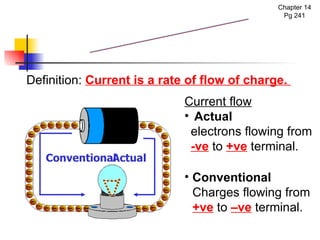
Electric Current Current flow Actual  electrons flowing from  -ve  to  +ve  terminal. Chapter 14 Pg 241 Definition:  Current is a rate of flow of charge.  Conventional Charges flowing from  +ve  to  –ve  terminal. Actual Conventional
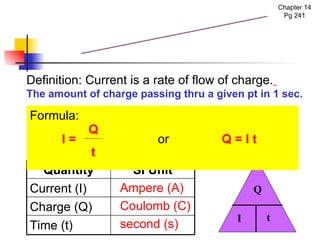
Ampere (A) Coulomb (C) second (s) Measurement of Current Definition: Current is a rate of flow of charge.   The amount of charge passing thru a given pt in 1 sec. Chapter 14 Pg 241 Time (t) Charge (Q) Current (I) SI Unit Quantity Q _______ I t Formula: I =  or Q = I t Q t
Example 1:  A current of 10 A flows through an electric heater for 10 minutes. What is the total charge circulated through the heater? [Solution] t = 10 min x 60 = 600 s I = 10 A Q  = I t    = 10 A x 600 s =  6000 C The total charge is 6000 C Measurement of Current Chapter 14 Q _______ I t
Example 2:  In an electrical circuit, a charge of 60C flows past a point in 10s. What is the current in the circuit? Measurement of Current Chapter 14 [Solution] t  = 10 s ; Q = 60 C Q  = I t    I  =   = 60 / 10   =  6 A The current is 6 A Q _______ I t Q t
Example 3:  A lightning flash carries 25 C of charge and lasts for 0.01 s.  What is the current? [Solution] Q = 25 C ; t = 0.01 s   Q  = I t   25 C  = I x 0.01s   25 / 0.01  = I   I  =  2500A Current is 2500A Measurement of Current Chapter 14
Example 4:  A current of 2 A is flowing through a conductor. How long  does it take for 10 C of charge to pass any point? [Solution] I = 2 A ; Q = 10 C   Q =  I t 10C  =  2A x t 10 / 2 =  t   t  =  5 s Time taken is 5 s Measurement of Current Chapter 14
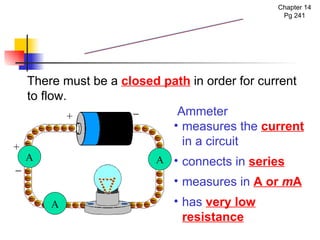
Ammeter measures the  current   in a circuit connects in  series measures in  A or  m A has  very low resistance There must be a  closed path  in order for current to flow. Ammeter Chapter 14 Pg 241 A A A +  + 
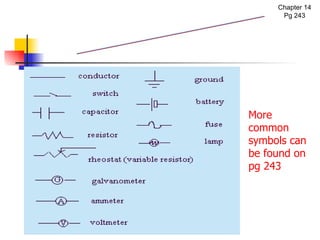
More common symbols can be found on pg 243 Chapter 14 Pg 243 Electric Symbols
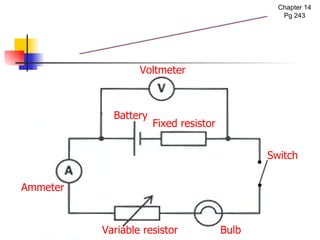
Circuit Diagram Variable resistor Bulb Ammeter Voltmeter Battery Fixed resistor Switch Chapter 14 Pg 243
Electric current Electromotive force & Potential Difference Resistance Chapter 14:  Current Electricity Chapter 14 Pg 245 Part II
define electromotive force (e.m.f.) as the work done by a source in driving a unit charge around a complete circuit state that the potential difference (p.d.) across a circuit component is measured in volts At the end of the chapter, you should be able to: 2. Electromotive Force & Potential Difference Chapter 14 Pg 245
Electromotive Force (e.m.f) Chapter 14 Pg 245 Definition:  Electromotive force is defined as the total work done by a source in driving a  unit charge  around a complete circuit 1 Unit charge = 1 coulomb of charge
Electromotive Force (e.m.f) Chapter 14 Pg 245 Sources of e.m.f are: Electrical cells (i.e. batteries) Thermocouples Generators etc
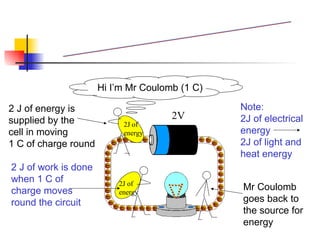
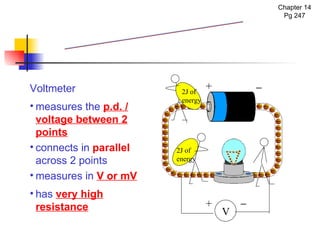
2V Electromotive Force (e.m.f) Hi I’m Mr Coulomb (1 C) 2J of  energy 2J of  energy 2 J of work is done when 1 C of charge moves round the circuit Mr Coulomb goes back to  the source for energy Note: 2J of electrical energy 2J of light and heat energy 2 J of energy is  supplied by the  cell in moving 1 C of charge round
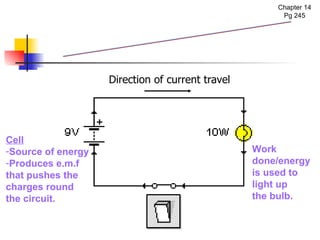
Electromotive Force (e.m.f) Chapter 14 Pg 245 Cell Source of energy Produces e.m.f that pushes the charges round the circuit. Work done/energy  is used to light up the bulb. Direction of current travel
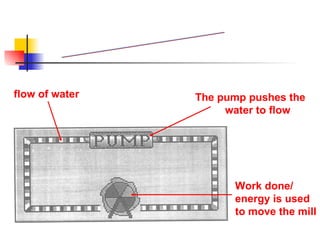
Analogy The pump pushes the  water to flow flow of water Work done/ energy is used to move the mill
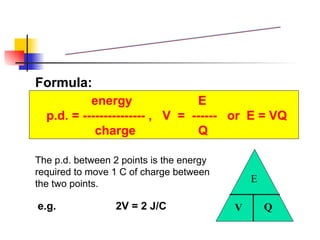
Potential Difference (p.d.) Chapter 14 Pg 246 Definition:  The p.d. between two points is the energy required to move 1 C of charge between them.  Potential Difference (p.d.)  OR   Voltage (V) SI Unit :  V (volts)
The p.d. between 2 points is the energy required to move 1 C of charge between the two points. energy  E  p.d. = --------------- ,  V  =  ------  or  E = VQ  charge  Q e.g.  2V = 2 J/C Potential Difference (p.d.) Formula: E _______ V Q
V Voltmeter measures the   p.d. / voltage   between 2 points connects in   parallel   across 2 points measures in   V or mV has   very high resistance +  +  Voltmeter Chapter 14 Pg 247 2J of  energy 2J of  energy
The diagram shows a battery with an electromotive force of  6 V in a circuit. How much energy is needed to drive 30C of  charge round the circuit? E = VQ = 6V x 30C =  180 J or [Solution] Example 1 6 V
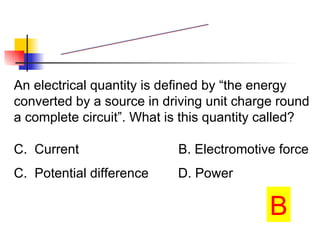
An electrical quantity is defined by “the energy converted by a source in driving unit charge round a complete circuit”. What is this quantity called? Current  B. Electromotive force C.  Potential difference  D. Power Example 2 B
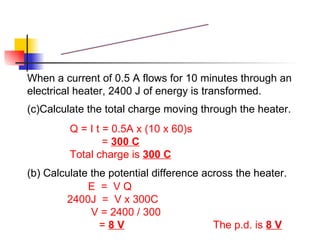
When a current of 0.5 A flows for 10 minutes through an electrical heater, 2400 J of energy is transformed. Calculate the total charge moving through the heater. (b) Calculate the potential difference across the heater. Q = I t = 0.5A x (10 x 60)s =  300 C   Total charge is  300 C   E  =  V Q 2400J  =  V x 300C V = 2400 / 300  =  8 V     The p.d. is  8 V Example 3
Electric current Electromotive force & Potential Difference Resistance Chapter 14:  Current Electricity Chapter 14 Pg 247 Part III
Chapter 14 Pg 247 The resistance is a measure of how difficult it is for an electric current to pass through a substance. Resistance
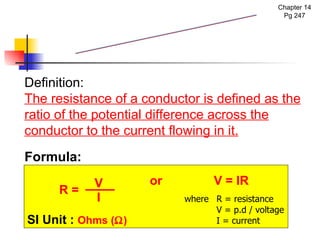
Chapter 14 Pg 247 Definition:  The resistance of a conductor is defined as the ratio of the potential difference across the conductor to the current flowing in it. Resistance Formula: R = SI Unit :   Ohms (  ) V I where R = resistance V = p.d / voltage I = current or   V = IR
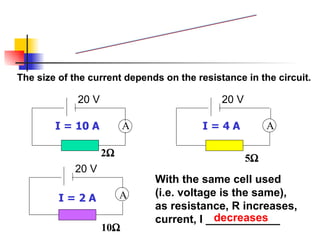
The size of the current depends on the resistance in the circuit. A A 2  5  10  With the same cell used  (i.e. voltage is the same),  as resistance, R increases,  current, I ____________  Resistance 20 V 20 V 20 V decreases I = 10 A I = 4 A I = 2 A A
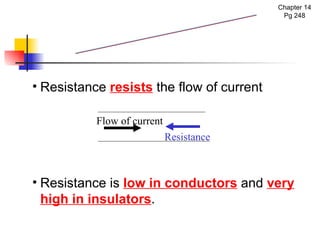
Resistance  resists  the flow of current Resistance is  low in conductors  and  very high in insulators .  Flow of current Resistance Resistance Chapter 14 Pg 248
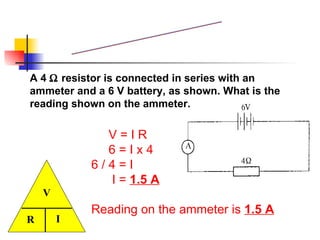
V = I R  6 = I x 4 6 / 4 = I I =  1.5 A Reading on the ammeter is  1.5 A A 4    resistor is connected in series with an ammeter and a 6 V battery, as shown. What is the reading shown on the ammeter.  Example 1 R I _______ V
Chapter 14 Pg 249 The resistance R (= V / I) of a metallic conductor is  CONSTANT  under steady physical conditions Ohm's Law
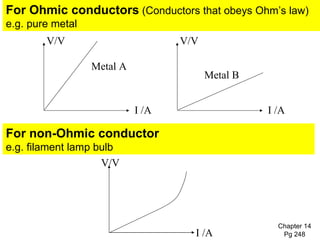
For Ohmic conductors  (Conductors that obeys Ohm’s law) e.g. pure metal Chapter 14 Pg 248 For non-Ohmic conductor e.g. filament lamp bulb I /A V/V I /A V/V Metal A Metal B I /A V/V
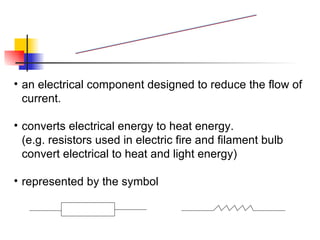
an electrical component designed to reduce the flow of current. converts electrical energy to heat energy. (e.g. resistors used in electric fire and filament bulb  convert electrical to heat and light energy) represented by the symbol  Resistor
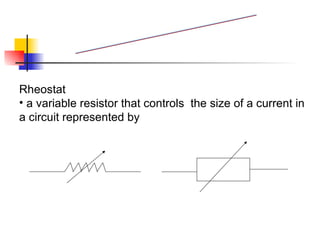
Rheostat a variable resistor that controls  the size of a current in a circuit represented by  Resistor
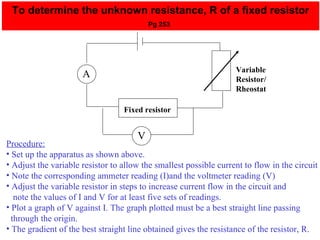
Procedure: Set up the apparatus as shown above. Adjust the variable resistor to allow the smallest possible current to flow in the circuit Note the corresponding ammeter reading (I)and the voltmeter reading (V) Adjust the variable resistor in steps to increase current flow in the circuit and  note the values of I and V for at least five sets of readings. Plot a graph of V against I. The graph plotted must be a best straight line passing through the origin. The gradient of the best straight line obtained gives the resistance of the resistor, R.  To determine the unknown resistance, R of a fixed resistor Pg 253   Fixed resistor A V Variable  Resistor/ Rheostat
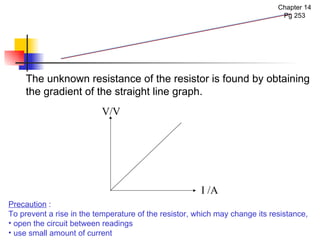
The unknown resistance of the resistor is found by obtaining the gradient of the straight line graph. Precaution  :  To prevent a rise in the temperature of the resistor, which may change its resistance, open the circuit between readings use small amount of current  Experiment to find Resistance Chapter 14 Pg 253 I /A V/V
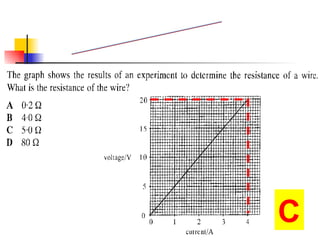
Example 2 C
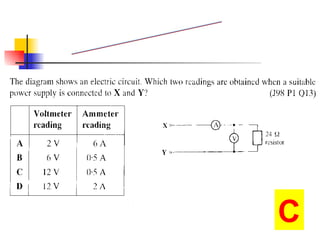
Example 3 C
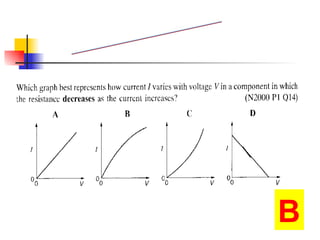
Example 4 B
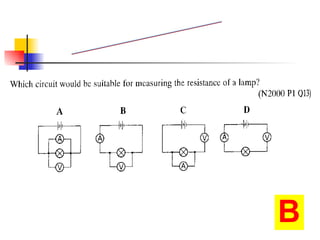
Example 5 B
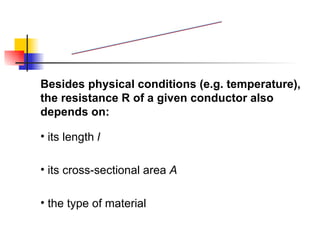
Resistivity Besides physical conditions (e.g. temperature), the resistance R of a given conductor also depends on: its length  l its cross-sectional area  A the type of material
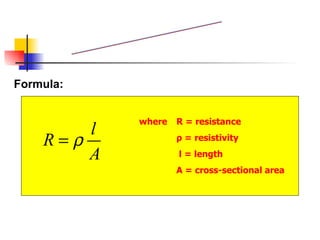
Resistivity Formula: where    R = resistance   ρ = resistivity   l = length   A = cross-sectional area
Example 6
Example 7
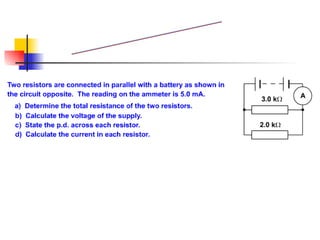
Resistors in Series Resistors in Parallel Simulation from Crocodile Physics
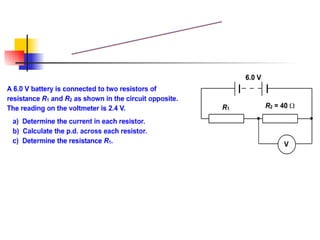
Example 8
Example 9

Current Electricity (NA)

  • 1.
    Electric current Electromotiveforce & Potential Difference Resistance Chapter 16: Current Electricity Part I
  • 2.
    state that currentis a rate of flow of charge and that it is measured in amperes recall the relationship charge = current x time apply the relationship to new situations or to solve related problems Chapter 14 At the end of the chapter, you should be able to: 1. Electric Current
  • 3.
    Electric Current Currentflow Actual electrons flowing from -ve to +ve terminal. Chapter 14 Pg 241 Definition: Current is a rate of flow of charge. Conventional Charges flowing from +ve to –ve terminal. Actual Conventional
  • 4.
    Ampere (A) Coulomb(C) second (s) Measurement of Current Definition: Current is a rate of flow of charge. The amount of charge passing thru a given pt in 1 sec. Chapter 14 Pg 241 Time (t) Charge (Q) Current (I) SI Unit Quantity Q _______ I t Formula: I = or Q = I t Q t
  • 5.
    Example 1: A current of 10 A flows through an electric heater for 10 minutes. What is the total charge circulated through the heater? [Solution] t = 10 min x 60 = 600 s I = 10 A Q = I t = 10 A x 600 s = 6000 C The total charge is 6000 C Measurement of Current Chapter 14 Q _______ I t
  • 6.
    Example 2: In an electrical circuit, a charge of 60C flows past a point in 10s. What is the current in the circuit? Measurement of Current Chapter 14 [Solution] t = 10 s ; Q = 60 C Q = I t I = = 60 / 10 = 6 A The current is 6 A Q _______ I t Q t
  • 7.
    Example 3: A lightning flash carries 25 C of charge and lasts for 0.01 s. What is the current? [Solution] Q = 25 C ; t = 0.01 s Q = I t 25 C = I x 0.01s 25 / 0.01 = I I = 2500A Current is 2500A Measurement of Current Chapter 14
  • 8.
    Example 4: A current of 2 A is flowing through a conductor. How long does it take for 10 C of charge to pass any point? [Solution] I = 2 A ; Q = 10 C Q = I t 10C = 2A x t 10 / 2 = t t = 5 s Time taken is 5 s Measurement of Current Chapter 14
  • 9.
    Ammeter measures the current in a circuit connects in series measures in A or m A has very low resistance There must be a closed path in order for current to flow. Ammeter Chapter 14 Pg 241 A A A +  + 
  • 10.
    More common symbolscan be found on pg 243 Chapter 14 Pg 243 Electric Symbols
  • 11.
    Circuit Diagram Variableresistor Bulb Ammeter Voltmeter Battery Fixed resistor Switch Chapter 14 Pg 243
  • 12.
    Electric current Electromotiveforce & Potential Difference Resistance Chapter 14: Current Electricity Chapter 14 Pg 245 Part II
  • 13.
    define electromotive force(e.m.f.) as the work done by a source in driving a unit charge around a complete circuit state that the potential difference (p.d.) across a circuit component is measured in volts At the end of the chapter, you should be able to: 2. Electromotive Force & Potential Difference Chapter 14 Pg 245
  • 14.
    Electromotive Force (e.m.f)Chapter 14 Pg 245 Definition: Electromotive force is defined as the total work done by a source in driving a unit charge around a complete circuit 1 Unit charge = 1 coulomb of charge
  • 15.
    Electromotive Force (e.m.f)Chapter 14 Pg 245 Sources of e.m.f are: Electrical cells (i.e. batteries) Thermocouples Generators etc
  • 16.
    2V Electromotive Force(e.m.f) Hi I’m Mr Coulomb (1 C) 2J of energy 2J of energy 2 J of work is done when 1 C of charge moves round the circuit Mr Coulomb goes back to the source for energy Note: 2J of electrical energy 2J of light and heat energy 2 J of energy is supplied by the cell in moving 1 C of charge round
  • 17.
    Electromotive Force (e.m.f)Chapter 14 Pg 245 Cell Source of energy Produces e.m.f that pushes the charges round the circuit. Work done/energy is used to light up the bulb. Direction of current travel
  • 18.
    Analogy The pumppushes the water to flow flow of water Work done/ energy is used to move the mill
  • 19.
    Potential Difference (p.d.)Chapter 14 Pg 246 Definition: The p.d. between two points is the energy required to move 1 C of charge between them. Potential Difference (p.d.) OR Voltage (V) SI Unit : V (volts)
  • 20.
    The p.d. between2 points is the energy required to move 1 C of charge between the two points. energy E p.d. = --------------- , V = ------ or E = VQ charge Q e.g. 2V = 2 J/C Potential Difference (p.d.) Formula: E _______ V Q
  • 21.
    V Voltmeter measuresthe p.d. / voltage between 2 points connects in parallel across 2 points measures in V or mV has very high resistance +  +  Voltmeter Chapter 14 Pg 247 2J of energy 2J of energy
  • 22.
    The diagram showsa battery with an electromotive force of 6 V in a circuit. How much energy is needed to drive 30C of charge round the circuit? E = VQ = 6V x 30C = 180 J or [Solution] Example 1 6 V
  • 23.
    An electrical quantityis defined by “the energy converted by a source in driving unit charge round a complete circuit”. What is this quantity called? Current B. Electromotive force C. Potential difference D. Power Example 2 B
  • 24.
    When a currentof 0.5 A flows for 10 minutes through an electrical heater, 2400 J of energy is transformed. Calculate the total charge moving through the heater. (b) Calculate the potential difference across the heater. Q = I t = 0.5A x (10 x 60)s = 300 C Total charge is 300 C E = V Q 2400J = V x 300C V = 2400 / 300 = 8 V The p.d. is 8 V Example 3
  • 25.
    Electric current Electromotiveforce & Potential Difference Resistance Chapter 14: Current Electricity Chapter 14 Pg 247 Part III
  • 26.
    Chapter 14 Pg247 The resistance is a measure of how difficult it is for an electric current to pass through a substance. Resistance
  • 27.
    Chapter 14 Pg247 Definition: The resistance of a conductor is defined as the ratio of the potential difference across the conductor to the current flowing in it. Resistance Formula: R = SI Unit : Ohms (  ) V I where R = resistance V = p.d / voltage I = current or V = IR
  • 28.
    The size ofthe current depends on the resistance in the circuit. A A 2  5  10  With the same cell used (i.e. voltage is the same), as resistance, R increases, current, I ____________ Resistance 20 V 20 V 20 V decreases I = 10 A I = 4 A I = 2 A A
  • 29.
    Resistance resists the flow of current Resistance is low in conductors and very high in insulators . Flow of current Resistance Resistance Chapter 14 Pg 248
  • 30.
    V = IR 6 = I x 4 6 / 4 = I I = 1.5 A Reading on the ammeter is 1.5 A A 4  resistor is connected in series with an ammeter and a 6 V battery, as shown. What is the reading shown on the ammeter. Example 1 R I _______ V
  • 31.
    Chapter 14 Pg249 The resistance R (= V / I) of a metallic conductor is CONSTANT under steady physical conditions Ohm's Law
  • 32.
    For Ohmic conductors (Conductors that obeys Ohm’s law) e.g. pure metal Chapter 14 Pg 248 For non-Ohmic conductor e.g. filament lamp bulb I /A V/V I /A V/V Metal A Metal B I /A V/V
  • 33.
    an electrical componentdesigned to reduce the flow of current. converts electrical energy to heat energy. (e.g. resistors used in electric fire and filament bulb convert electrical to heat and light energy) represented by the symbol Resistor
  • 34.
    Rheostat a variableresistor that controls the size of a current in a circuit represented by Resistor
  • 35.
    Procedure: Set upthe apparatus as shown above. Adjust the variable resistor to allow the smallest possible current to flow in the circuit Note the corresponding ammeter reading (I)and the voltmeter reading (V) Adjust the variable resistor in steps to increase current flow in the circuit and note the values of I and V for at least five sets of readings. Plot a graph of V against I. The graph plotted must be a best straight line passing through the origin. The gradient of the best straight line obtained gives the resistance of the resistor, R. To determine the unknown resistance, R of a fixed resistor Pg 253 Fixed resistor A V Variable Resistor/ Rheostat
  • 36.
    The unknown resistanceof the resistor is found by obtaining the gradient of the straight line graph. Precaution : To prevent a rise in the temperature of the resistor, which may change its resistance, open the circuit between readings use small amount of current Experiment to find Resistance Chapter 14 Pg 253 I /A V/V
  • 37.
  • 38.
  • 39.
  • 40.
  • 41.
    Resistivity Besides physicalconditions (e.g. temperature), the resistance R of a given conductor also depends on: its length l its cross-sectional area A the type of material
  • 42.
    Resistivity Formula: where R = resistance ρ = resistivity l = length A = cross-sectional area
  • 43.
  • 44.
  • 45.
    Resistors in SeriesResistors in Parallel Simulation from Crocodile Physics
  • 46.
  • 47.