Physics Formula guide for ICSE standard 10
Author Srikanth K S
All rights reserved Page 1
Page | 1
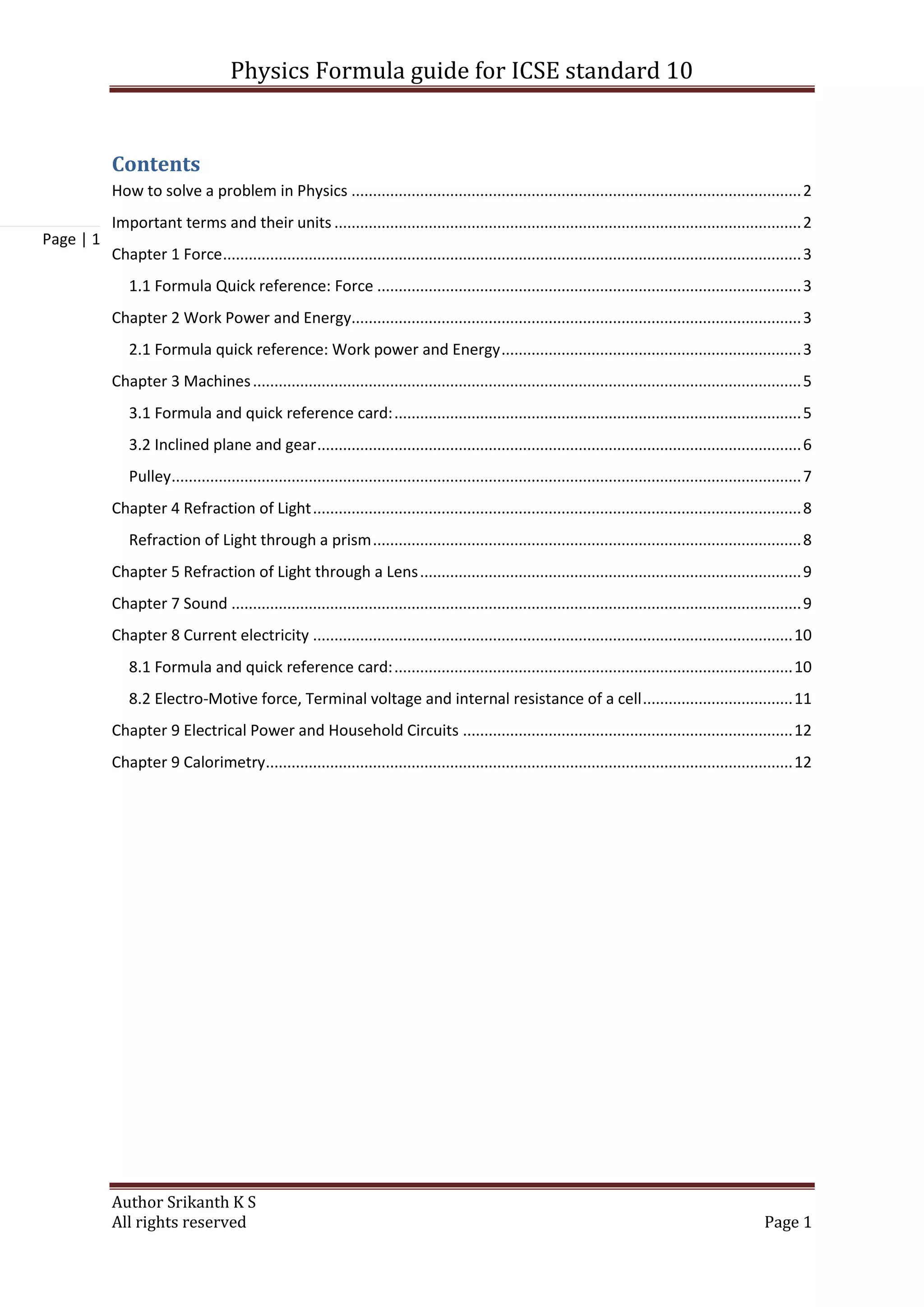
Contents
How to solve a problem in Physics .........................................................................................................2
Important terms and their units .............................................................................................................2
Chapter 1 Force.......................................................................................................................................3
1.1 Formula Quick reference: Force ...................................................................................................3
Chapter 2 Work Power and Energy.........................................................................................................3
2.1 Formula quick reference: Work power and Energy......................................................................3
Chapter 3 Machines................................................................................................................................5
3.1 Formula and quick reference card:...............................................................................................5
3.2 Inclined plane and gear.................................................................................................................6
Pulley...................................................................................................................................................7
Chapter 4 Refraction of Light..................................................................................................................8
Refraction of Light through a prism....................................................................................................8
Chapter 5 Refraction of Light through a Lens.........................................................................................9
Chapter 7 Sound .....................................................................................................................................9
Chapter 8 Current electricity ................................................................................................................10
8.1 Formula and quick reference card:.............................................................................................10
8.2 Electro-Motive force, Terminal voltage and internal resistance of a cell...................................11
Chapter 9 Electrical Power and Household Circuits .............................................................................12
Chapter 9 Calorimetry...........................................................................................................................12
Physics Formula guide for ICSE standard 10
Author Srikanth K S
All rights reserved Page 2
Page | 2
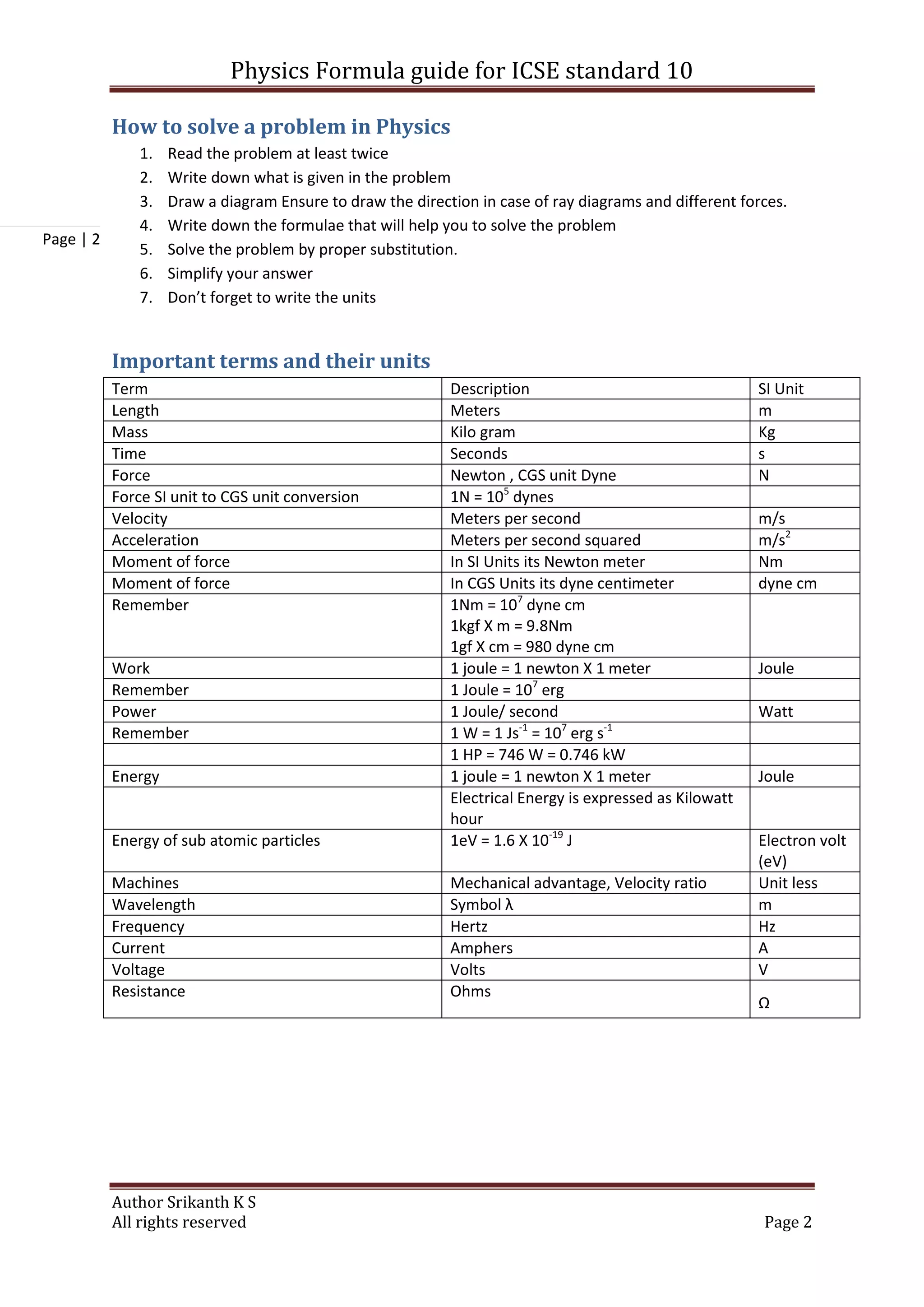
How to solve a problem in Physics
1. Read the problem at least twice
2. Write down what is given in the problem
3. Draw a diagram Ensure to draw the direction in case of ray diagrams and different forces.
4. Write down the formulae that will help you to solve the problem
5. Solve the problem by proper substitution.
6. Simplify your answer
7. Don’t forget to write the units
Important terms and their units
Term Description SI Unit
Length Meters m
Mass Kilo gram Kg
Time Seconds s
Force Newton , CGS unit Dyne N
Force SI unit to CGS unit conversion 1N = 105
dynes
Velocity Meters per second m/s
Acceleration Meters per second squared m/s2
Moment of force In SI Units its Newton meter Nm
Moment of force In CGS Units its dyne centimeter dyne cm
Remember 1Nm = 107
dyne cm
1kgf X m = 9.8Nm
1gf X cm = 980 dyne cm
Work 1 joule = 1 newton X 1 meter Joule
Remember 1 Joule = 107
erg
Power 1 Joule/ second Watt
Remember 1 W = 1 Js-1
= 107
erg s-1
1 HP = 746 W = 0.746 kW
Energy 1 joule = 1 newton X 1 meter Joule
Electrical Energy is expressed as Kilowatt
hour
Energy of sub atomic particles 1eV = 1.6 X 10⁻¹⁹
J Electron volt
(eV)
Machines Mechanical advantage, Velocity ratio Unit less
Wavelength Symbol λ m
Frequency Hertz Hz
Current Amphers A
Voltage Volts V
Resistance Ohms
Ω
Physics Formula guide for ICSE standard 10
Author Srikanth K S
All rights reserved Page 3
Page | 3
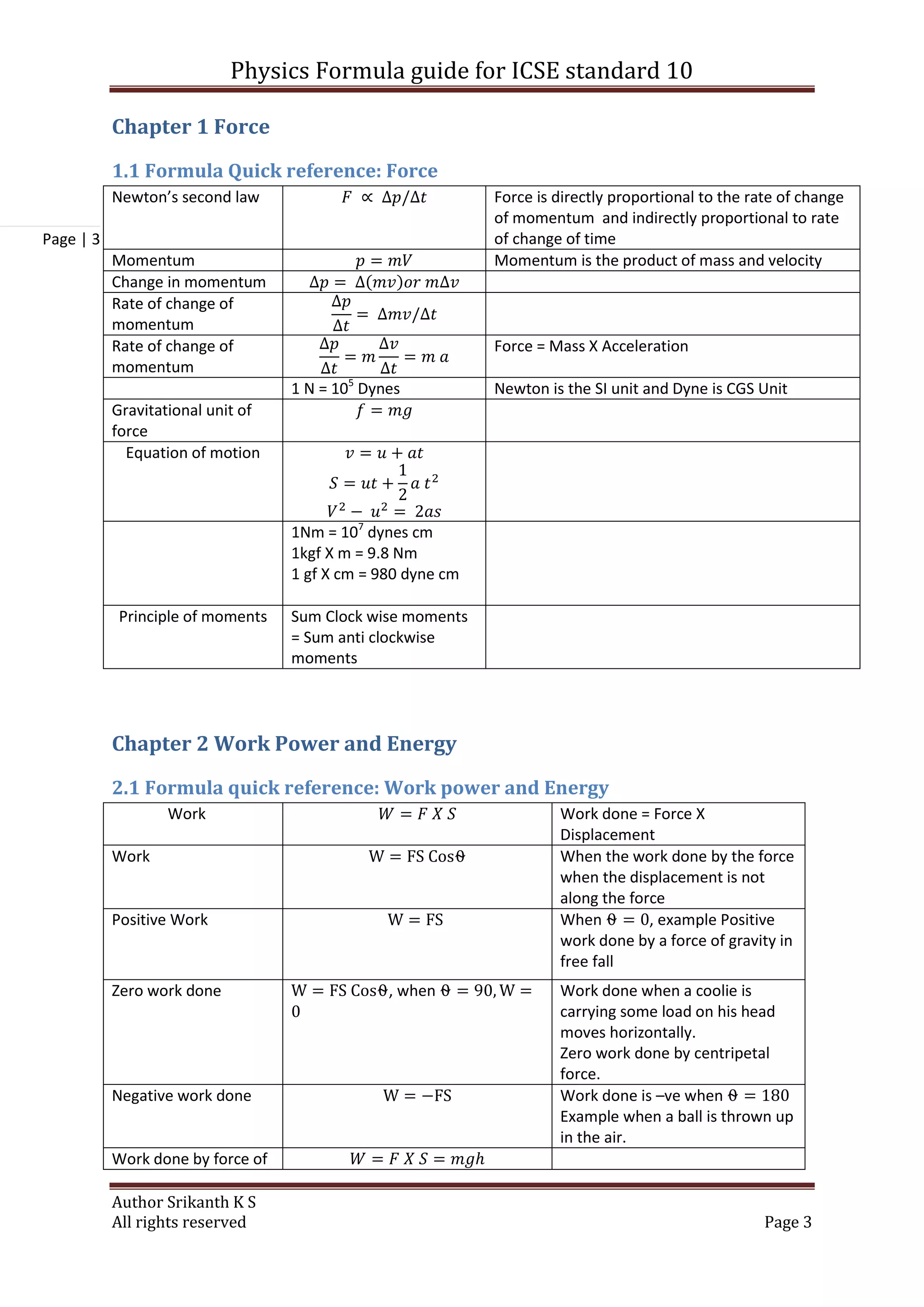
Chapter 1 Force
1.1 Formula Quick reference: Force
Newton’s second law Force is directly proportional to the rate of change
of momentum and indirectly proportional to rate
of change of time
Momentum Momentum is the product of mass and velocity
Change in momentum ( )
Rate of change of
momentum
Rate of change of
momentum
Force = Mass X Acceleration
1 N = 105
Dynes Newton is the SI unit and Dyne is CGS Unit
Gravitational unit of
force
Equation of motion
1Nm = 107
dynes cm
1kgf X m = 9.8 Nm
1 gf X cm = 980 dyne cm
Principle of moments Sum Clock wise moments
= Sum anti clockwise
moments
Chapter 2 Work Power and Energy
2.1 Formula quick reference: Work power and Energy
Work Work done = Force X
Displacement
Work When the work done by the force
when the displacement is not
along the force
Positive Work When , example Positive
work done by a force of gravity in
free fall
Zero work done , when Work done when a coolie is
carrying some load on his head
moves horizontally.
Note : Zero work done by
centripetal force.
Negative work done Work done is –ve when
Example when a ball is thrown up
in the air.
Work done by force of
Physics Formula guide for ICSE standard 10
Author Srikanth K S
All rights reserved Page 4
Page | 4
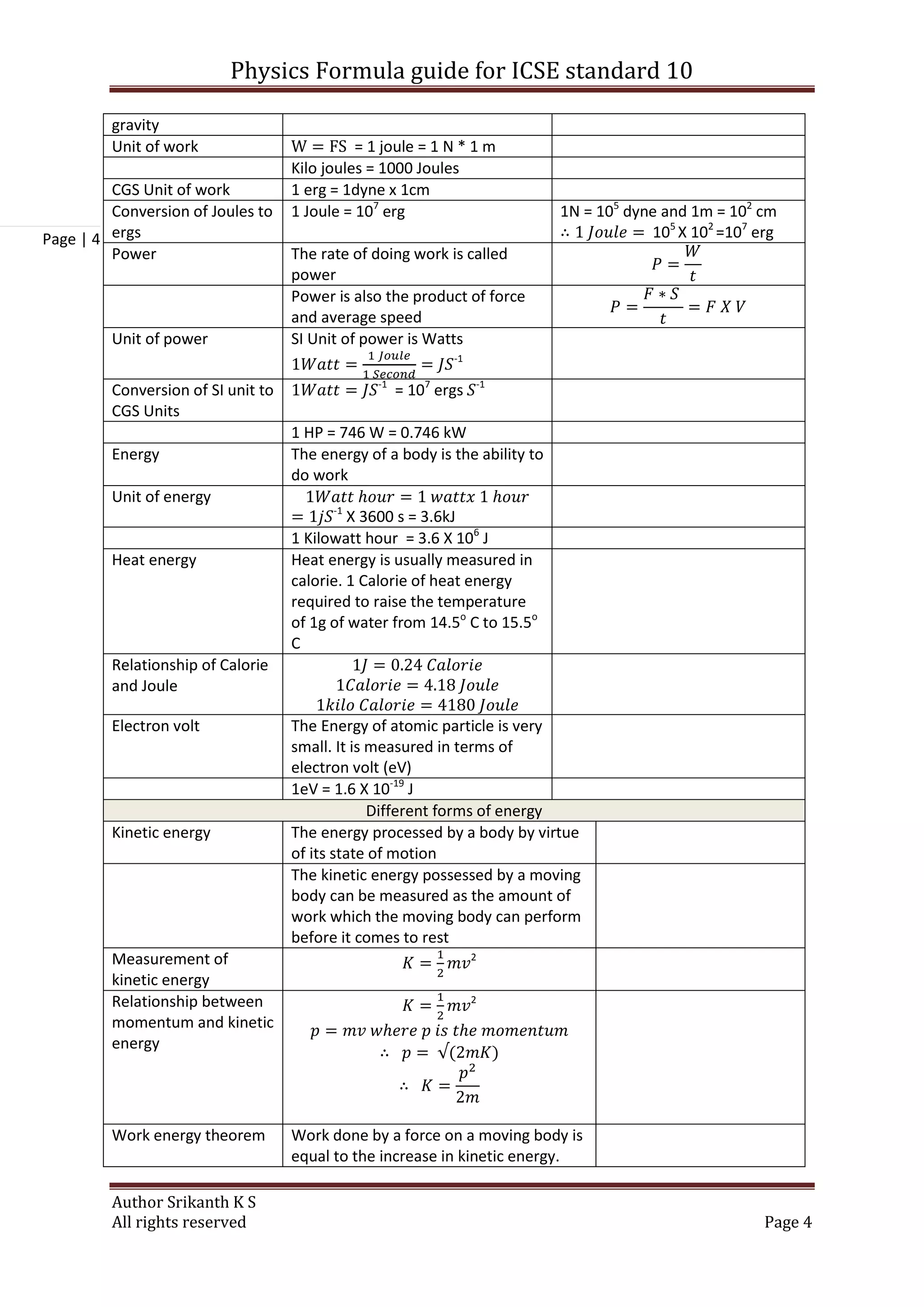
gravity
Unit of work = 1 joule = 1 N * 1 m
Kilo joules = 1000 Joules
CGS Unit of work 1 erg = 1dyne x 1cm
Conversion of Joules to
ergs
1 Joule = 107
erg 1N = 105
dyne and 1m = 102
cm
105
X 102
=107
erg
Power The rate of doing work is called
power
Power is also the product of force
and average speed
Unit of power SI Unit of power is Watts
-1
Conversion of SI unit to
CGS Units
-1
= 107
ergs -1
1 HP = 746 W = 0.746 kW
Energy The energy of a body is the ability to
do work
Unit of energy
-1
X 3600 s = 3.6kJ
1 Kilowatt hour = 3.6 X 10⁶
J
Heat energy Heat energy is usually measured in
calorie. 1 Calorie of heat energy
required to raise the temperature
of 1g of water from 14.5o
C to 15.5o
C
Relationship of Calorie
and Joule
Electron volt The Energy of atomic particle is very
small. It is measured in terms of
electron volt (eV)
1eV = 1.6 X 10⁻¹⁹
J
Different forms of energy
Kinetic energy The energy processed by a body by virtue
of its state of motion
The kinetic energy possessed by a moving
body can be measured as the amount of
work which the moving body can perform
before it comes to rest
Measurement of
kinetic energy
2
Relationship between
momentum and kinetic
energy
2
( )
Work energy theorem Work done by a force on a moving body is
equal to the increase in kinetic energy.
Physics Formula guide for ICSE standard 10
Author Srikanth K S
All rights reserved Page 5
Page | 5
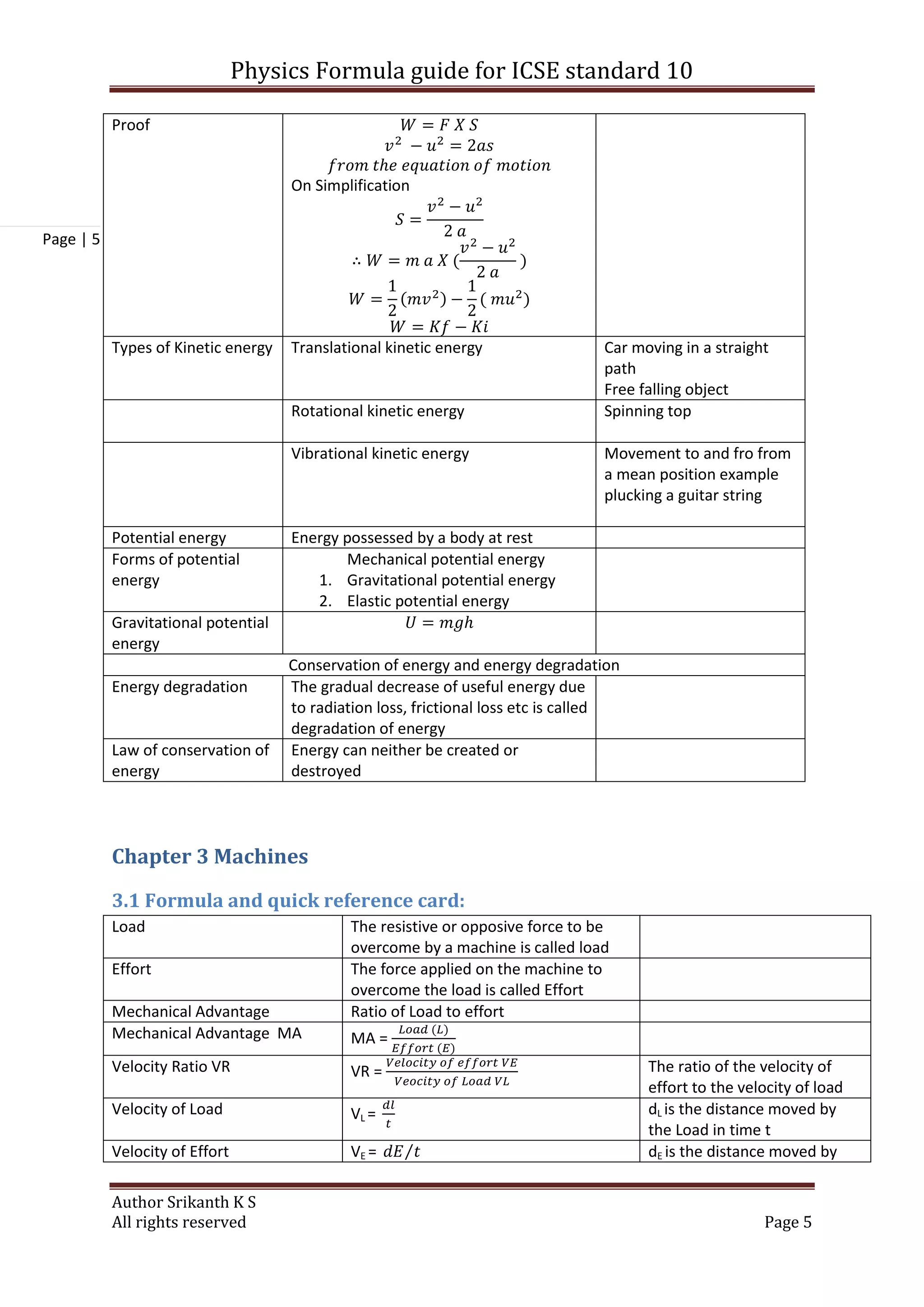
Proof
On Simplification
( )
( ) ( )
Types of Kinetic energy Translational kinetic energy Car moving in a straight
path
Free falling object
Rotational kinetic energy Spinning top
Vibrational kinetic energy Movement to and fro from
a mean position example
plucking a guitar string
Potential energy Energy possessed by a body at rest
Forms of potential
energy
Mechanical potential energy
1. Gravitational potential energy
2. Elastic potential energy
Gravitational potential
energy
Conservation of energy and energy degradation
Energy degradation The gradual decrease of useful energy due
to radiation loss, frictional loss etc is called
degradation of energy
Law of conservation of
energy
Energy can neither be created or
destroyed
Chapter 3 Machines
3.1 Formula and quick reference card:
Load The resistive or opposive force to be
overcome by a machine is called load
Effort The force applied on the machine to
overcome the load is called Effort
Mechanical Advantage Ratio of Load to effort
Mechanical Advantage MA MA =
( )
( )
Velocity Ratio VR VR = The ratio of the velocity of
effort to the velocity of load
Velocity of Load VL = dL is the distance moved by
the Load in time t
Velocity of Effort VE = ⁄ dE is the distance moved by
Physics Formula guide for ICSE standard 10
Author Srikanth K S
All rights reserved Page 6
Page | 6
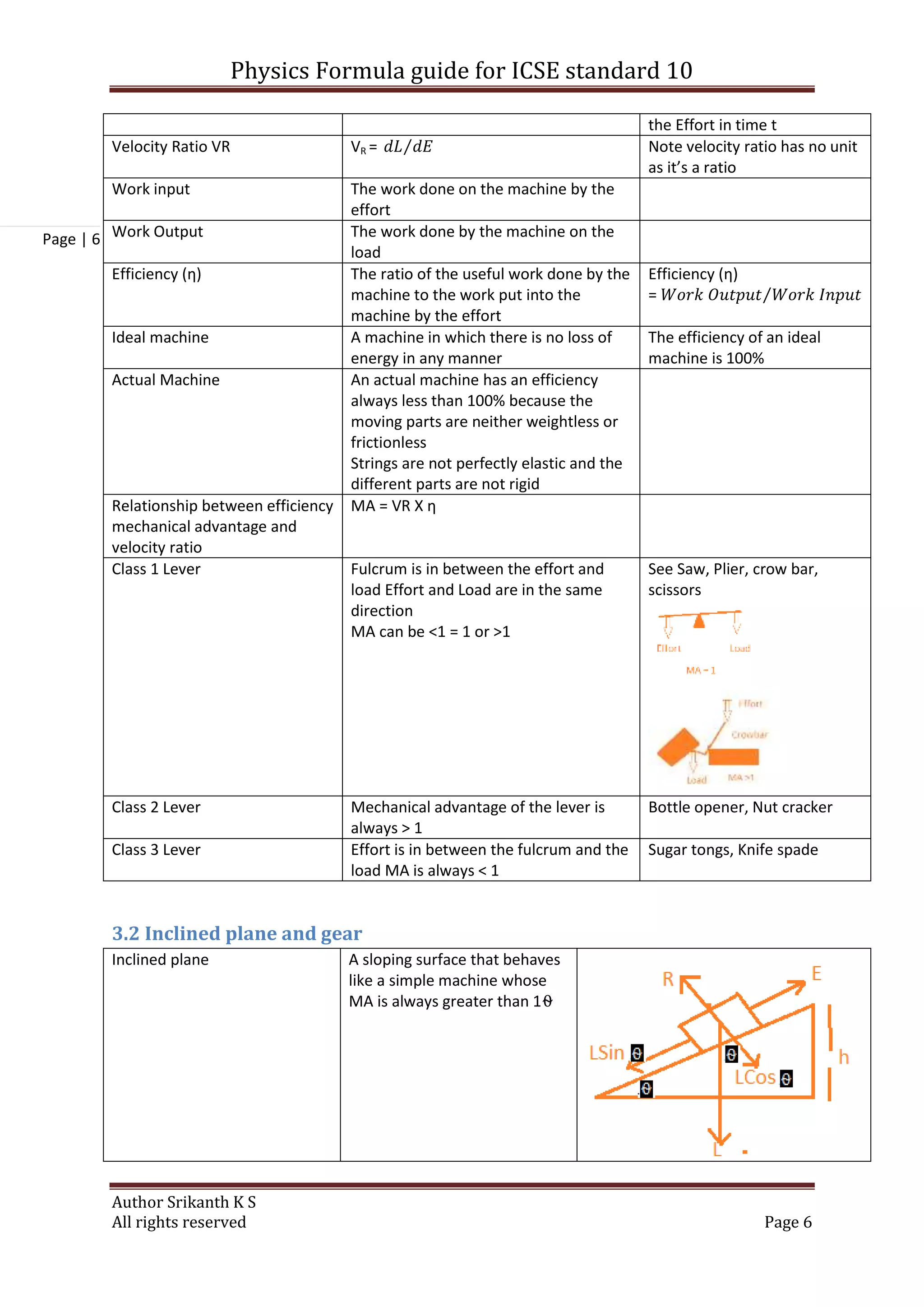
the Effort in time t
Velocity Ratio VR VR = ⁄ Note velocity ratio has no unit
as it’s a ratio
Work input The work done on the machine by the
effort
Work Output The work done by the machine on the
load
Efficiency (ƞ) The ratio of the useful work done by the
machine to the work put into the
machine by the effort
Efficiency (ƞ)
= ⁄
Ideal machine A machine in which there is no loss of
energy in any manner
The efficiency of an ideal
machine is 100%
Actual Machine An actual machine has an efficiency
always less than 100% because the
moving parts are neither weightless or
frictionless
Strings are not perfectly elastic and the
different parts are not rigid
Relationship between efficiency
mechanical advantage and
velocity ratio
MA = VR X ƞ
Class 1 Lever Fulcrum is in between the effort and
load Effort and Load are in the same
direction
MA can be <1 = 1 or >1
See Saw, Plier, crow bar,
scissors
Class 2 Lever Mechanical advantage of the lever is
always > 1
Bottle opener, Nut cracker
Class 3 Lever Effort is in between the fulcrum and the
load MA is always < 1
Sugar tongs, Knife spade
3.2 Inclined plane and gear
Inclined plane A sloping surface that behaves
like a simple machine whose
MA is always greater than 1
Physics Formula guide for ICSE standard 10
Author Srikanth K S
All rights reserved Page 7
Page | 7
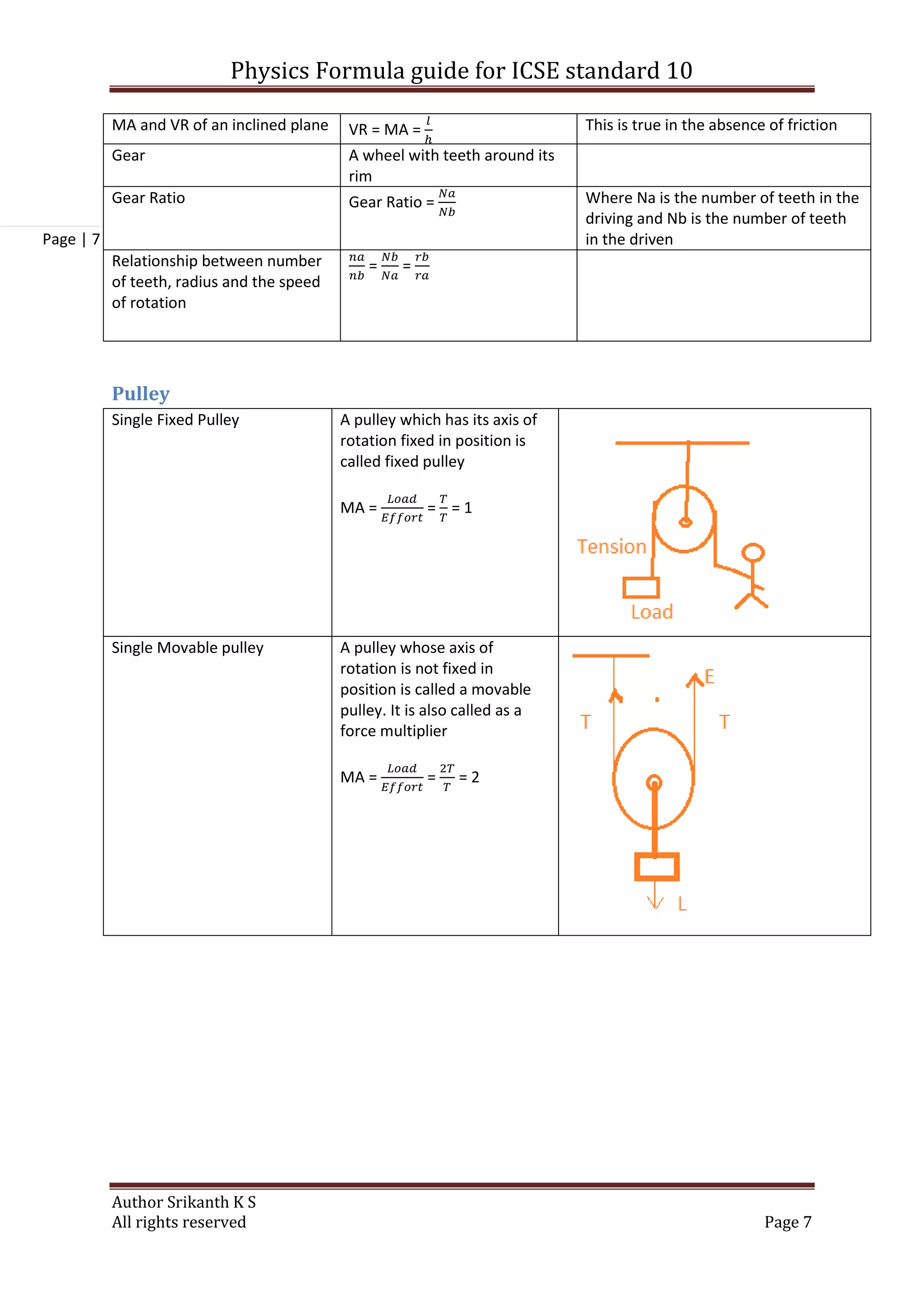
MA and VR of an inclined plane VR = MA = This is true in the absence of friction
Gear A wheel with teeth around its
rim
Gear Ratio Gear Ratio = Where Na is the number of teeth in the
driving and Nb is the number of teeth
in the driven
Relationship between number
of teeth, radius and the speed
of rotation
= =
Pulley
Single Fixed Pulley A pulley which has its axis of
rotation fixed in position is
called fixed pulley
MA = = = 1
Single Movable pulley A pulley whose axis of
rotation is not fixed in
position is called a movable
pulley. It is also called as a
force multiplier
MA = = = 2
Physics Formula guide for ICSE standard 10
Author Srikanth K S
All rights reserved Page 8
Page | 8
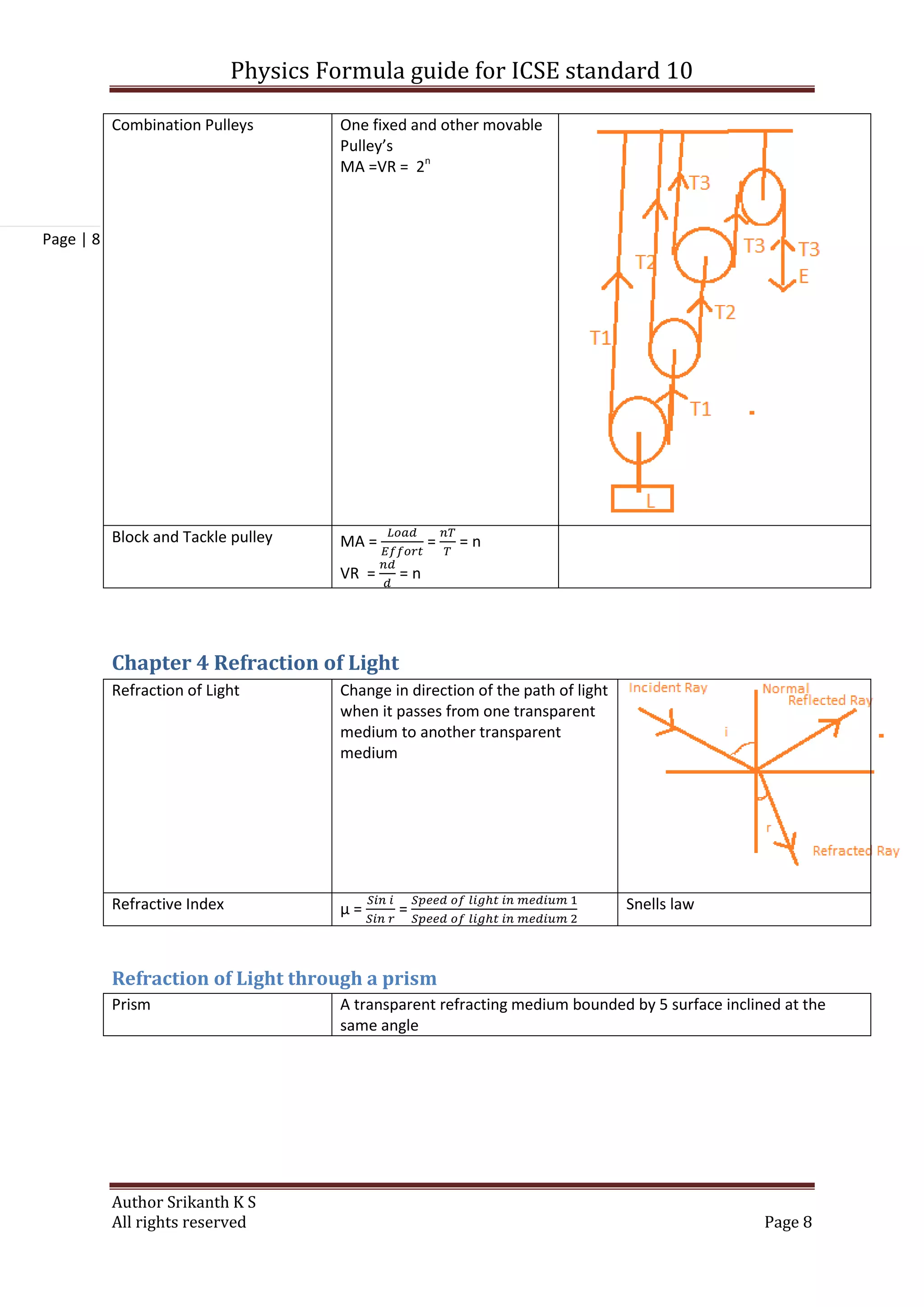
Combination Pulleys One fixed and other movable
Pulley’s
MA =VR = 2n
Block and Tackle pulley MA = = = n
VR = = n
Chapter 4 Refraction of Light
Refraction of Light Change in direction of the path of light
when it passes from one transparent
medium to another transparent
medium
Refractive Index µ = = Snells law
Refraction of Light through a prism
Prism A transparent refracting medium bounded by 5 surface inclined at the
same angle
Physics Formula guide for ICSE standard 10
Author Srikanth K S
All rights reserved Page 9
Page | 9
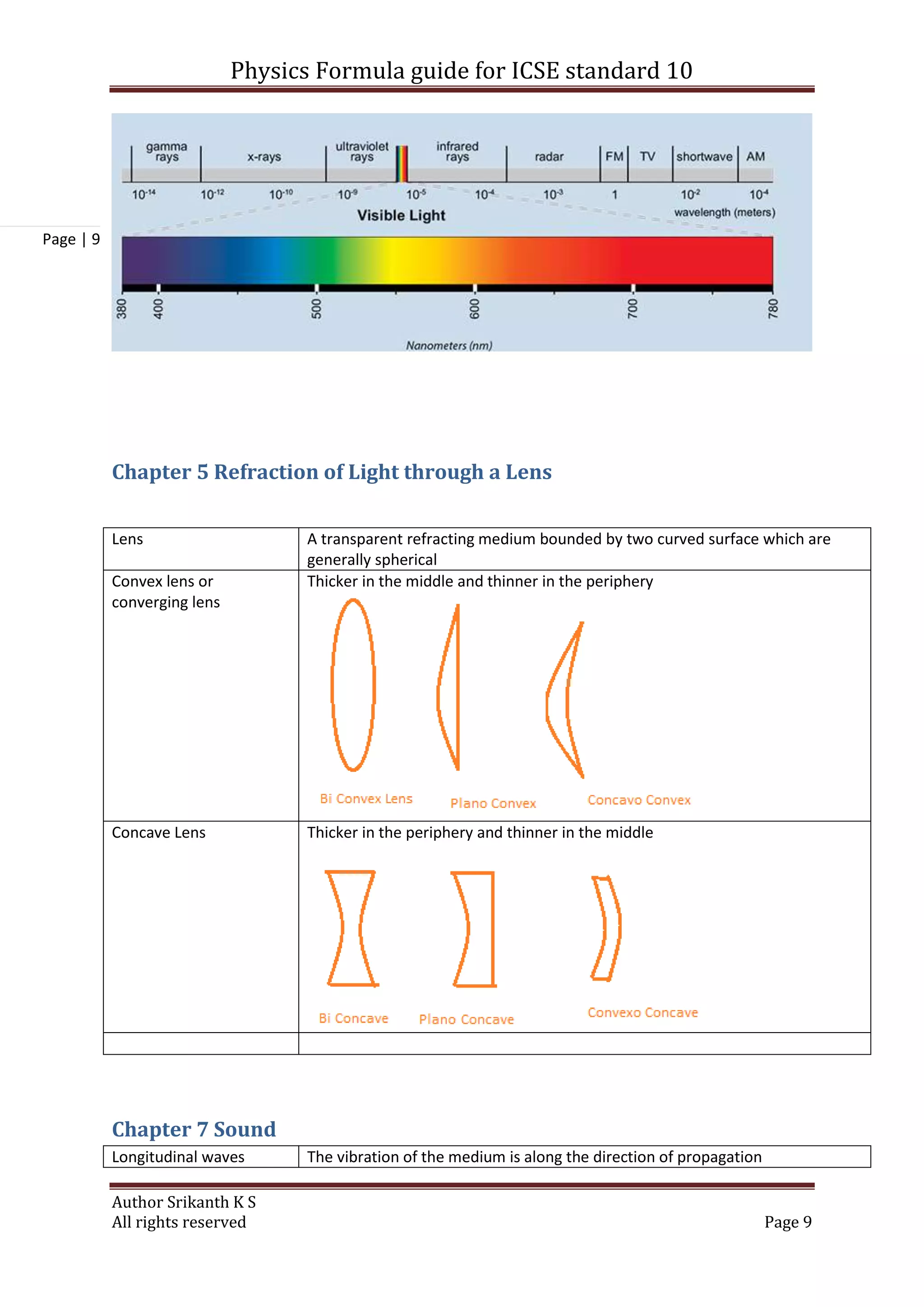
Chapter 5 Refraction of Light through a Lens
Lens A transparent refracting medium bounded by two curved surface which are
generally spherical
Convex lens or
converging lens
Thicker in the middle and thinner in the periphery
Concave Lens Thicker in the periphery and thinner in the middle
Chapter 7 Sound
Longitudinal waves The vibration of the medium is along the direction of propagation
Physics Formula guide for ICSE standard 10
Author Srikanth K S
All rights reserved Page 10
Page | 10
They can travel in solids liquids or gases
Transverse wave The vibration of the medium is perpendicular to the direction of propagation
They can only travel in solids or liquids
Echo The sound heard after reflection from a distant obstacle after the original sound
has ceased is called an echo.
An echo is heard only if the distance between the person producing the sound
and the rigid obstacle is long enough to allow the reflected sound to reach the
person at least 0.1 second later
Distance D =
Relations between
velocity and frequency
V = f λ
Frequency of vibration f = ( )
Chapter 8 Current electricity
8.1 Formula and quick reference card:
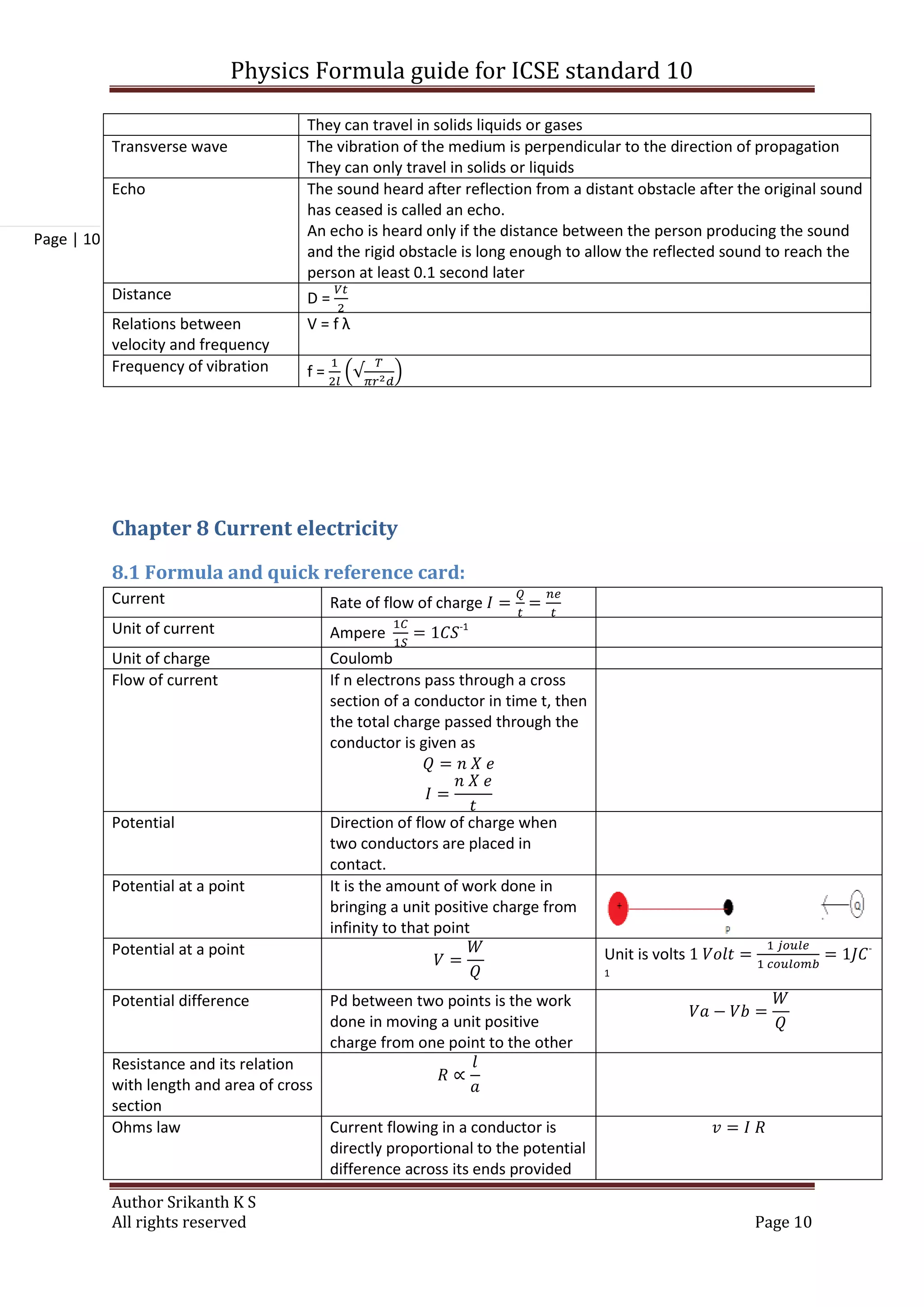
Current Rate of flow of charge
Unit of current Ampere -1
Unit of charge Coulomb
Flow of current If n electrons pass through a cross
section of a conductor in time t, then
the total charge passed through the
conductor is given as
Potential Direction of flow of charge when
two conductors are placed in
contact.
Potential at a point It is the amount of work done in
bringing a unit positive charge from
infinity to that point
Potential at a point Unit is volts -
1
Potential difference Pd between two points is the work
done in moving a unit positive
charge from one point to the other
Resistance and its relation
with length and area of cross
section
Ohms law Current flowing in a conductor is
directly proportional to the potential
difference across its ends provided
Physics Formula guide for ICSE standard 10
Author Srikanth K S
All rights reserved Page 11
Page | 11
the physical conditions and the
temperature of the conductor
remain constant
Specific resistance or
resistivity
Where is the specific resistance
8.2 Electro-Motive force, Terminal voltage and internal resistance of a cell
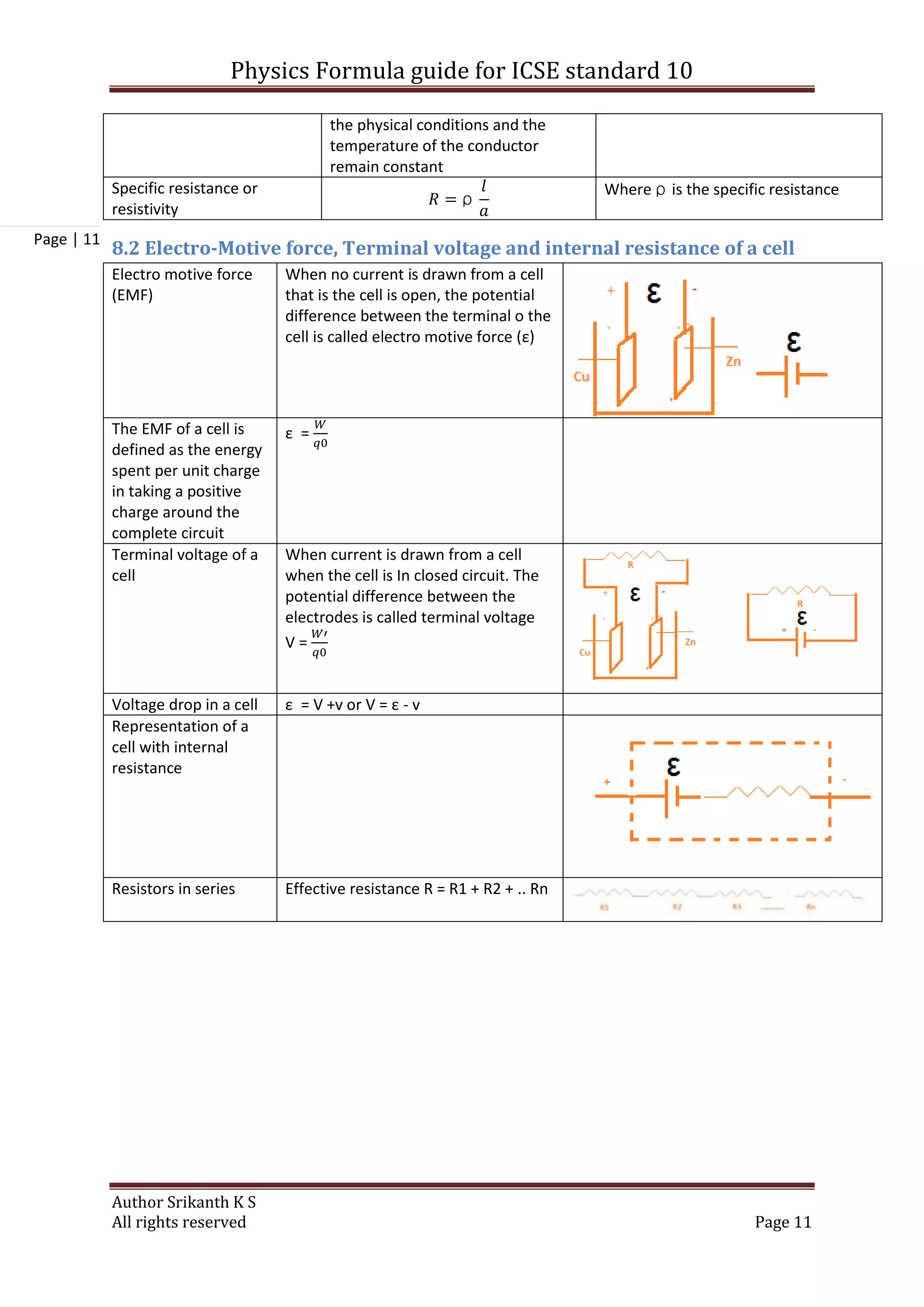
Electro motive force
(EMF)
When no current is drawn from a cell
that is the cell is open, the potential
difference between the terminal o the
cell is called electro motive force (ε)
The EMF of a cell is
defined as the energy
spent per unit charge
in taking a positive
charge around the
complete circuit
ε =
Terminal voltage of a
cell
When current is drawn from a cell
when the cell is In closed circuit. The
potential difference between the
electrodes is called terminal voltage
V =
Voltage drop in a cell ε = V +v or V = ε - v
Representation of a
cell with internal
resistance
Resistors in series Effective resistance R = R1 + R2 + .. Rn
Physics Formula guide for ICSE standard 10
Author Srikanth K S
All rights reserved Page 12
Page | 12
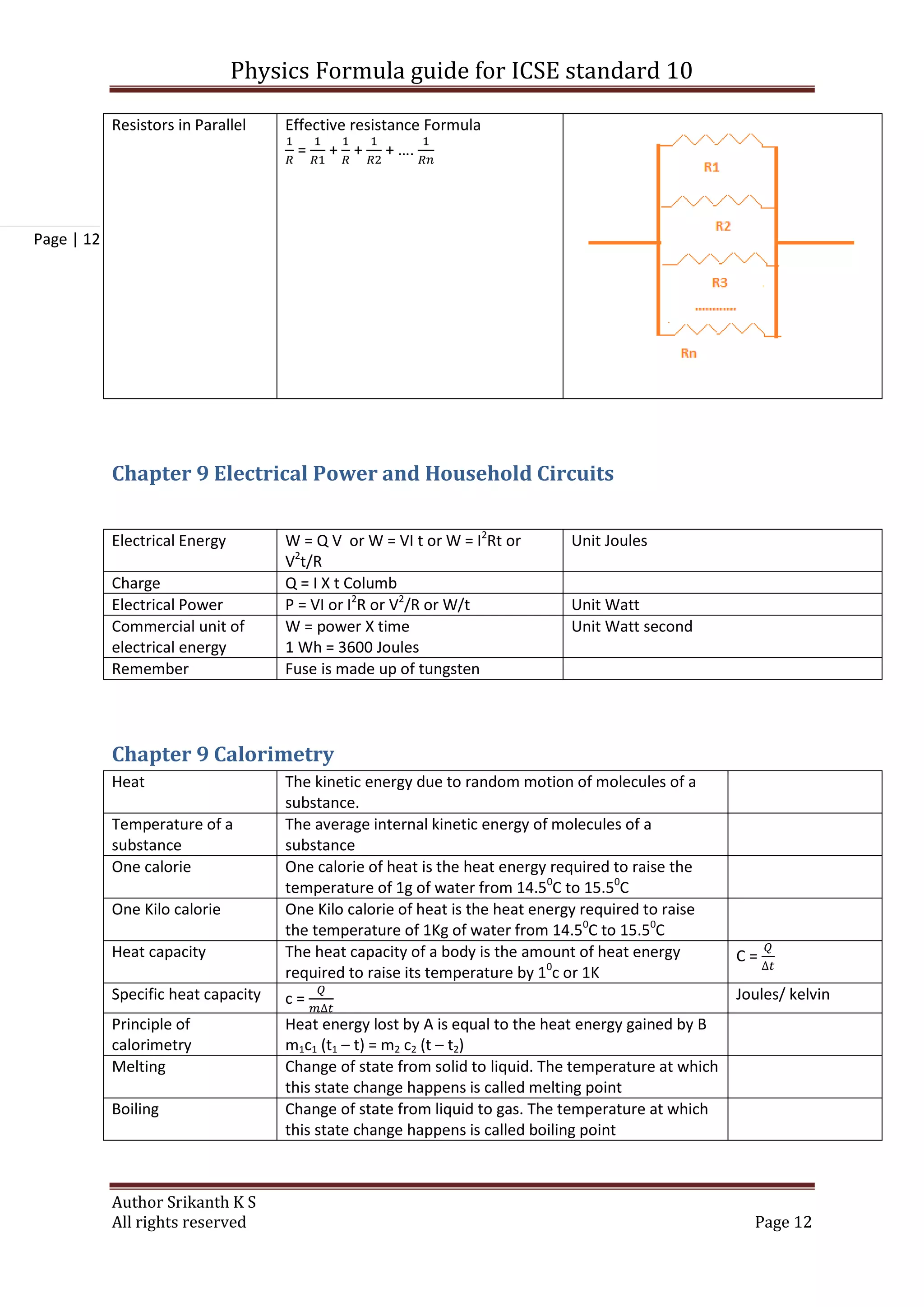
Resistors in Parallel Effective resistance Formula
= + + + ….
Chapter 9 Electrical Power and Household Circuits
Electrical Energy W = Q V or W = VI t or W = I2
Rt or
V2
t/R
Unit Joules
Charge Q = I X t Columb
Electrical Power P = VI or I2
R or V2
/R or W/t Unit Watt
Commercial unit of
electrical energy
W = power X time
1 Wh = 3600 Joules
Unit Watt second
Remember Fuse is made up of an alloy of Lead
and Tin
Remember A bulb (incandescent lamp) filament is
made up of tungsten
Chapter 10 Calorimetry
Heat The kinetic energy due to random motion of molecules of a
substance.
Temperature of a
substance
The average internal kinetic energy of molecules of a
substance
One calorie One calorie of heat is the heat energy required to raise the
temperature of 1g of water from 14.50
C to 15.50
C
One Kilo calorie One Kilo calorie of heat is the heat energy required to raise
the temperature of 1Kg of water from 14.50
C to 15.50
C
Heat capacity The heat capacity of a body is the amount of heat energy
required to raise its temperature by 10
c or 1K
C =
Specific heat capacity c = Joules/ kelvin
Principle of
calorimetry
Heat energy lost by A is equal to the heat energy gained by B
m1c1 (t1 – t) = m2 c2 (t – t2)
Melting Change of state from solid to liquid. The temperature at which
this state change happens is called melting point
Boiling Change of state from liquid to gas. The temperature at which
this state change happens is called boiling point

Physics formula ICSE_Standard 10

  • 1.
    Physics Formula guidefor ICSE standard 10 Author Srikanth K S All rights reserved Page 1 Page | 1 Contents How to solve a problem in Physics .........................................................................................................2 Important terms and their units .............................................................................................................2 Chapter 1 Force.......................................................................................................................................3 1.1 Formula Quick reference: Force ...................................................................................................3 Chapter 2 Work Power and Energy.........................................................................................................3 2.1 Formula quick reference: Work power and Energy......................................................................3 Chapter 3 Machines................................................................................................................................5 3.1 Formula and quick reference card:...............................................................................................5 3.2 Inclined plane and gear.................................................................................................................6 Pulley...................................................................................................................................................7 Chapter 4 Refraction of Light..................................................................................................................8 Refraction of Light through a prism....................................................................................................8 Chapter 5 Refraction of Light through a Lens.........................................................................................9 Chapter 7 Sound .....................................................................................................................................9 Chapter 8 Current electricity ................................................................................................................10 8.1 Formula and quick reference card:.............................................................................................10 8.2 Electro-Motive force, Terminal voltage and internal resistance of a cell...................................11 Chapter 9 Electrical Power and Household Circuits .............................................................................12 Chapter 9 Calorimetry...........................................................................................................................12
  • 2.
    Physics Formula guidefor ICSE standard 10 Author Srikanth K S All rights reserved Page 2 Page | 2 How to solve a problem in Physics 1. Read the problem at least twice 2. Write down what is given in the problem 3. Draw a diagram Ensure to draw the direction in case of ray diagrams and different forces. 4. Write down the formulae that will help you to solve the problem 5. Solve the problem by proper substitution. 6. Simplify your answer 7. Don’t forget to write the units Important terms and their units Term Description SI Unit Length Meters m Mass Kilo gram Kg Time Seconds s Force Newton , CGS unit Dyne N Force SI unit to CGS unit conversion 1N = 105 dynes Velocity Meters per second m/s Acceleration Meters per second squared m/s2 Moment of force In SI Units its Newton meter Nm Moment of force In CGS Units its dyne centimeter dyne cm Remember 1Nm = 107 dyne cm 1kgf X m = 9.8Nm 1gf X cm = 980 dyne cm Work 1 joule = 1 newton X 1 meter Joule Remember 1 Joule = 107 erg Power 1 Joule/ second Watt Remember 1 W = 1 Js-1 = 107 erg s-1 1 HP = 746 W = 0.746 kW Energy 1 joule = 1 newton X 1 meter Joule Electrical Energy is expressed as Kilowatt hour Energy of sub atomic particles 1eV = 1.6 X 10⁻¹⁹ J Electron volt (eV) Machines Mechanical advantage, Velocity ratio Unit less Wavelength Symbol λ m Frequency Hertz Hz Current Amphers A Voltage Volts V Resistance Ohms Ω
  • 3.
    Physics Formula guidefor ICSE standard 10 Author Srikanth K S All rights reserved Page 3 Page | 3 Chapter 1 Force 1.1 Formula Quick reference: Force Newton’s second law Force is directly proportional to the rate of change of momentum and indirectly proportional to rate of change of time Momentum Momentum is the product of mass and velocity Change in momentum ( ) Rate of change of momentum Rate of change of momentum Force = Mass X Acceleration 1 N = 105 Dynes Newton is the SI unit and Dyne is CGS Unit Gravitational unit of force Equation of motion 1Nm = 107 dynes cm 1kgf X m = 9.8 Nm 1 gf X cm = 980 dyne cm Principle of moments Sum Clock wise moments = Sum anti clockwise moments Chapter 2 Work Power and Energy 2.1 Formula quick reference: Work power and Energy Work Work done = Force X Displacement Work When the work done by the force when the displacement is not along the force Positive Work When , example Positive work done by a force of gravity in free fall Zero work done , when Work done when a coolie is carrying some load on his head moves horizontally. Note : Zero work done by centripetal force. Negative work done Work done is –ve when Example when a ball is thrown up in the air. Work done by force of
  • 4.
    Physics Formula guidefor ICSE standard 10 Author Srikanth K S All rights reserved Page 4 Page | 4 gravity Unit of work = 1 joule = 1 N * 1 m Kilo joules = 1000 Joules CGS Unit of work 1 erg = 1dyne x 1cm Conversion of Joules to ergs 1 Joule = 107 erg 1N = 105 dyne and 1m = 102 cm 105 X 102 =107 erg Power The rate of doing work is called power Power is also the product of force and average speed Unit of power SI Unit of power is Watts -1 Conversion of SI unit to CGS Units -1 = 107 ergs -1 1 HP = 746 W = 0.746 kW Energy The energy of a body is the ability to do work Unit of energy -1 X 3600 s = 3.6kJ 1 Kilowatt hour = 3.6 X 10⁶ J Heat energy Heat energy is usually measured in calorie. 1 Calorie of heat energy required to raise the temperature of 1g of water from 14.5o C to 15.5o C Relationship of Calorie and Joule Electron volt The Energy of atomic particle is very small. It is measured in terms of electron volt (eV) 1eV = 1.6 X 10⁻¹⁹ J Different forms of energy Kinetic energy The energy processed by a body by virtue of its state of motion The kinetic energy possessed by a moving body can be measured as the amount of work which the moving body can perform before it comes to rest Measurement of kinetic energy 2 Relationship between momentum and kinetic energy 2 ( ) Work energy theorem Work done by a force on a moving body is equal to the increase in kinetic energy.
  • 5.
    Physics Formula guidefor ICSE standard 10 Author Srikanth K S All rights reserved Page 5 Page | 5 Proof On Simplification ( ) ( ) ( ) Types of Kinetic energy Translational kinetic energy Car moving in a straight path Free falling object Rotational kinetic energy Spinning top Vibrational kinetic energy Movement to and fro from a mean position example plucking a guitar string Potential energy Energy possessed by a body at rest Forms of potential energy Mechanical potential energy 1. Gravitational potential energy 2. Elastic potential energy Gravitational potential energy Conservation of energy and energy degradation Energy degradation The gradual decrease of useful energy due to radiation loss, frictional loss etc is called degradation of energy Law of conservation of energy Energy can neither be created or destroyed Chapter 3 Machines 3.1 Formula and quick reference card: Load The resistive or opposive force to be overcome by a machine is called load Effort The force applied on the machine to overcome the load is called Effort Mechanical Advantage Ratio of Load to effort Mechanical Advantage MA MA = ( ) ( ) Velocity Ratio VR VR = The ratio of the velocity of effort to the velocity of load Velocity of Load VL = dL is the distance moved by the Load in time t Velocity of Effort VE = ⁄ dE is the distance moved by
  • 6.
    Physics Formula guidefor ICSE standard 10 Author Srikanth K S All rights reserved Page 6 Page | 6 the Effort in time t Velocity Ratio VR VR = ⁄ Note velocity ratio has no unit as it’s a ratio Work input The work done on the machine by the effort Work Output The work done by the machine on the load Efficiency (ƞ) The ratio of the useful work done by the machine to the work put into the machine by the effort Efficiency (ƞ) = ⁄ Ideal machine A machine in which there is no loss of energy in any manner The efficiency of an ideal machine is 100% Actual Machine An actual machine has an efficiency always less than 100% because the moving parts are neither weightless or frictionless Strings are not perfectly elastic and the different parts are not rigid Relationship between efficiency mechanical advantage and velocity ratio MA = VR X ƞ Class 1 Lever Fulcrum is in between the effort and load Effort and Load are in the same direction MA can be <1 = 1 or >1 See Saw, Plier, crow bar, scissors Class 2 Lever Mechanical advantage of the lever is always > 1 Bottle opener, Nut cracker Class 3 Lever Effort is in between the fulcrum and the load MA is always < 1 Sugar tongs, Knife spade 3.2 Inclined plane and gear Inclined plane A sloping surface that behaves like a simple machine whose MA is always greater than 1
  • 7.
    Physics Formula guidefor ICSE standard 10 Author Srikanth K S All rights reserved Page 7 Page | 7 MA and VR of an inclined plane VR = MA = This is true in the absence of friction Gear A wheel with teeth around its rim Gear Ratio Gear Ratio = Where Na is the number of teeth in the driving and Nb is the number of teeth in the driven Relationship between number of teeth, radius and the speed of rotation = = Pulley Single Fixed Pulley A pulley which has its axis of rotation fixed in position is called fixed pulley MA = = = 1 Single Movable pulley A pulley whose axis of rotation is not fixed in position is called a movable pulley. It is also called as a force multiplier MA = = = 2
  • 8.
    Physics Formula guidefor ICSE standard 10 Author Srikanth K S All rights reserved Page 8 Page | 8 Combination Pulleys One fixed and other movable Pulley’s MA =VR = 2n Block and Tackle pulley MA = = = n VR = = n Chapter 4 Refraction of Light Refraction of Light Change in direction of the path of light when it passes from one transparent medium to another transparent medium Refractive Index µ = = Snells law Refraction of Light through a prism Prism A transparent refracting medium bounded by 5 surface inclined at the same angle
  • 9.
    Physics Formula guidefor ICSE standard 10 Author Srikanth K S All rights reserved Page 9 Page | 9 Chapter 5 Refraction of Light through a Lens Lens A transparent refracting medium bounded by two curved surface which are generally spherical Convex lens or converging lens Thicker in the middle and thinner in the periphery Concave Lens Thicker in the periphery and thinner in the middle Chapter 7 Sound Longitudinal waves The vibration of the medium is along the direction of propagation
  • 10.
    Physics Formula guidefor ICSE standard 10 Author Srikanth K S All rights reserved Page 10 Page | 10 They can travel in solids liquids or gases Transverse wave The vibration of the medium is perpendicular to the direction of propagation They can only travel in solids or liquids Echo The sound heard after reflection from a distant obstacle after the original sound has ceased is called an echo. An echo is heard only if the distance between the person producing the sound and the rigid obstacle is long enough to allow the reflected sound to reach the person at least 0.1 second later Distance D = Relations between velocity and frequency V = f λ Frequency of vibration f = ( ) Chapter 8 Current electricity 8.1 Formula and quick reference card: Current Rate of flow of charge Unit of current Ampere -1 Unit of charge Coulomb Flow of current If n electrons pass through a cross section of a conductor in time t, then the total charge passed through the conductor is given as Potential Direction of flow of charge when two conductors are placed in contact. Potential at a point It is the amount of work done in bringing a unit positive charge from infinity to that point Potential at a point Unit is volts - 1 Potential difference Pd between two points is the work done in moving a unit positive charge from one point to the other Resistance and its relation with length and area of cross section Ohms law Current flowing in a conductor is directly proportional to the potential difference across its ends provided
  • 11.
    Physics Formula guidefor ICSE standard 10 Author Srikanth K S All rights reserved Page 11 Page | 11 the physical conditions and the temperature of the conductor remain constant Specific resistance or resistivity Where is the specific resistance 8.2 Electro-Motive force, Terminal voltage and internal resistance of a cell Electro motive force (EMF) When no current is drawn from a cell that is the cell is open, the potential difference between the terminal o the cell is called electro motive force (ε) The EMF of a cell is defined as the energy spent per unit charge in taking a positive charge around the complete circuit ε = Terminal voltage of a cell When current is drawn from a cell when the cell is In closed circuit. The potential difference between the electrodes is called terminal voltage V = Voltage drop in a cell ε = V +v or V = ε - v Representation of a cell with internal resistance Resistors in series Effective resistance R = R1 + R2 + .. Rn
  • 12.
    Physics Formula guidefor ICSE standard 10 Author Srikanth K S All rights reserved Page 12 Page | 12 Resistors in Parallel Effective resistance Formula = + + + …. Chapter 9 Electrical Power and Household Circuits Electrical Energy W = Q V or W = VI t or W = I2 Rt or V2 t/R Unit Joules Charge Q = I X t Columb Electrical Power P = VI or I2 R or V2 /R or W/t Unit Watt Commercial unit of electrical energy W = power X time 1 Wh = 3600 Joules Unit Watt second Remember Fuse is made up of an alloy of Lead and Tin Remember A bulb (incandescent lamp) filament is made up of tungsten Chapter 10 Calorimetry Heat The kinetic energy due to random motion of molecules of a substance. Temperature of a substance The average internal kinetic energy of molecules of a substance One calorie One calorie of heat is the heat energy required to raise the temperature of 1g of water from 14.50 C to 15.50 C One Kilo calorie One Kilo calorie of heat is the heat energy required to raise the temperature of 1Kg of water from 14.50 C to 15.50 C Heat capacity The heat capacity of a body is the amount of heat energy required to raise its temperature by 10 c or 1K C = Specific heat capacity c = Joules/ kelvin Principle of calorimetry Heat energy lost by A is equal to the heat energy gained by B m1c1 (t1 – t) = m2 c2 (t – t2) Melting Change of state from solid to liquid. The temperature at which this state change happens is called melting point Boiling Change of state from liquid to gas. The temperature at which this state change happens is called boiling point