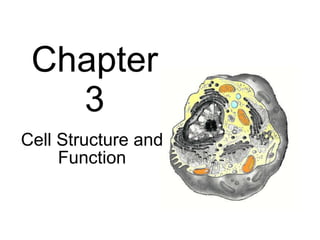
Chapter 3 Cell Structure and Function
Section 3-1 The History of the Cell Theory and Microscopes
Historical View of the Cell Theory As science improves, so do improvements in scientific instruments, and improved scientific instruments lead to new discoveries.
1590 – Zacharias Janssen Built first simple microscope (one set of lenses)
1670’s Anton Van Leeuwenhoek Made improvements 270x magnification Saw bacteria, protozoa, sperm cells, red blood cells and yeast cells
1665 – Robert Hooke Produced a  compound microscope Saw hollow boxes and named them  “cells”
1831 – Robert Brown Saw central structure in plant cells, called this structure a  nucleus
1838 – Matthias Schleiden Concluded that all plants are made of  cells
1838 – Theodor Schwann Concluded that all animals are made of cells
1839 – Johannes Purkinje Stated that  “the cell is the unit of function of life”
1858 – Rudolf Virchow Concluded that  “ cells come only from previously existing cells”
The Cell Theory All living things are composed of cells Cells are the basic units of structure and function New cells are produced from existing cells
Compound Microscope Contains a combination of two lenses
Eyepiece or ocular lens Lens closest to the eye
Objective Lens Lens closest to the specimen or object
How to figure out magnification Eyepiece  X  objective  =  Magnification  10x  X 10x  X 10x  X
Nosepiece Objectives fastened to this revolving structure
Stage Where you place your slide
Stage clips Hold slide in place
Body Tube Light travels through here
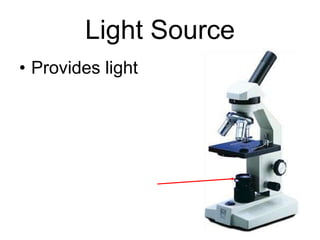
Light Source Provides light
Diaphragm Regulates the light reaching the objective lens
Base Supports the microscope
Arm Holds the body tube, acts as a handle
Coarse focusing knob Used to focus under low power only
Fine focusing knob Used to focus under high power only
A microscope reverses and inverts the image of an object seen under it e e Before viewing under the microscope While viewing under the microscope
Things moving under a microscope are actually moving in the opposite direction
Stereomicroscope Binocular microscope Object is seen in  3-D Only used to see large objects Does not reverse or invert images
Transmission Electron Microscope Uses a beam of electrons instead of light rays 200,000x magnification tissues have to be sliced really thin, dry and in a vacuum chamber can’t be used with living material
 
 
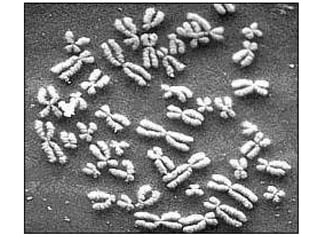
Scanning Electron Microscope provides images with 3-D quality can’t be used with living material


Micromanipulator Used to dissect cells, can remove nuclei Knowledge of cells has been increased by manipulation and dissection of cells
 
High – Speed Centrifuge Spin at high speeds Cell components sort out at different layers according to density
Microscopic Measurements Use the unit called the  micrometer 1/1000 of a meter
How to convert millimeters to micrometers Multiply by one thousand…or  Move the decimal point 3 places to the right
How to convert micrometers to millimeters Divide by 1,000…or Move the decimal point 3 places to the left Ex.) 2,500 micrometers =  .15 micrometers  =
How to find the diameter of your field of view Place a transparent plastic ruler in the field of view like this 1.3 mm Convert to micrometers 1.3 mm =
Section 3-2 Prokaryotes and Eukaryotes
Eukaryotes Have a nucleus and membrane covered organelles
Prokaryotes Don’t have a nucleus and membrane covered organelles
 
Eukaryotic Cell Structures
Plasma Membrane Separates the cell from its environment Controls the transport of materials in and out Allows some materials but not others to pass through this is called… Selectively permeable
 
Endoplasmic Reticulum Extensive network of tube-like structures that forms a passageway that functions in the transport of materials throughout the cells
 
Ribosomes Site of protein synthesis Attached to the walls of the ER or move freely in the cytoplasm
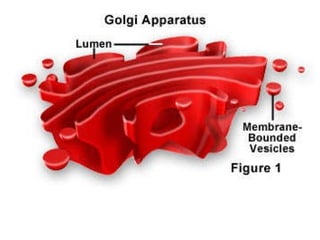
Golgi Bodies Stack of tiny, flattened sac-like tubes used in secretion Package protein molecules in a membrane and send the package to the cells surface
 
Mitochondria Where cellular respiration takes place to release energy “ Mighty Mitochondria” Powerhouse of the cell
 
Microtubules Tubes that serve as support for the cell
 
Microfilaments Thin threads attached to the cell membranes, play a role in movement
 
Lysosomes Vesicles that contain enzymes used in digestion Fuses with food vacuoles to digest food into smaller pieces Digest old cell structures to dispose of them or even entire cells
 
 
Nucleus Regulates all the cells activities
 
Chromosomes Long coiled fibers that carry the material of heredity Made of protein and DNA
 
Nucleolus Composed of RNA Involved in the passage of RNA into the cytoplasm
Centrioles Small cylinders in the cytoplasm that play a role in cell division
 
Cilia
 
Flagella
 
Chloroplasts Organelle found only in plants, used to make food
 
Vacuoles Spherical, bubble-like storage sacs Plant cells have very large vacuoles compared to animal cells
Cell Wall Rigid structure that surrounds the cell membrane Made of cellulose Permits most things to pass through Cell Wall
Section 3-3 Cellular Processes
The Big Idea Cells need to regulate the movement of dissolved molecules on either side of the membrane
Cell membrane Regulates what enters and leaves the cell and also provides protection and support Outside of cell Inside of cell (cytoplasm) Cell membrane Proteins Protein channel Lipid bilayer Carbohydrate chains
Cell membrane Made of a double layered sheet called a  lipid bilayer Outside of cell Inside of cell (cytoplasm) Cell membrane Proteins Protein channel Lipid bilayer Carbohydrate chains
Cell Wall Provide support and protection for cell Found in more than just plants Contrary to popular belief, not selectively permeable
Cell Walls
Diffusion Through Cell Boundaries One of the more important functions of the cell membrane is to regulate the movement of dissolved molecules from one side of a membrane to the other
Concentration The mass of solute in a given volume of solution Mass/volume
What is the concentration of 12 grams of salt in 3 liters of water? What is the concentration of 12 grams of salt in 6 liters of water?
In a solution, particles move constantly
Diffusion Process by which molecules of a substance move from areas of high concentration to areas of low concentration
Diffusion
Diffusion
Equilibrium When the concentration of the solute is the same throughout a system
Because diffusion depends on random particle movements, substances diffuse across membranes without  energy  being used Even during equilibrium, particles still move, but there is no net change in concentration
Osmosis The diffusion of water
Osmosis
 
 
Isotonic The concentration of solutes is the same inside and outside the cell
Hypertonic Solution has a higher solute concentration than the cell
Hypotonic   Solution has a lower solute concentration than the cell
 
Facilitated Diffusion Movement of specific molecules across cell membranes through protein channels High Concentration Low Concentration Cell Membrane Glucose molecules Protein channel Only go from high  concentrations to low concentrations Does not require energy
Types of Active Transport Sometimes cells must move materials in the opposite direction Low concentrations to high concentrations
Active Transport Energy requiring process that moves materials across a cell membrane against a concentration gradient
Active Transport Molecule to be carried Molecule being carried Energy
Molecular transport Small molecules and ions are actively transported
Carrier proteins Proteins that act like pumps
 
 
Endocytosis The process of taking material into the cell by means of infolding of the membrane Food particle engulfing Forms a vacuole
Phagocytosis Cell eating White blood cells do this
 
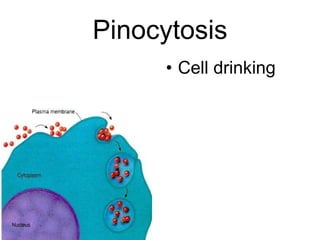
Pinocytosis Cell drinking
Exocytosis Forces contents out of the cell Endocytosis in reverse
 
 
Section 3-4 The Diversity of Cellular life
Unicellular Organism Single celled Do everything a living organism does
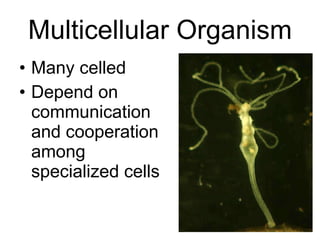
Multicellular Organism Many celled Depend on communication and cooperation among specialized cells
Specialization   When cells develop in different ways to perform different tasks
Red Blood Cells Transport oxygen
Pancreatic Cells Make proteins Packed with ribosomes
Skeletal Muscle Generate force Packed with mitochondria Overdeveloped cytoskeleton
Nerve Cell Send messages
Guard Cells Open and close the stomata
Levels of Organization Cells Tissues Organs Organ Systems
Tissues Group of similar cells that perform specific function Ex.) smooth muscle
Organ Group of tissues that work together to perform a specific function Ex.) stomach
Organ System Group of organs that work together to perform a specific function Ex.) digestive system This organization creates a division of labor that makes multicellular life possible
Biological organization

Biology - Chp 3 - Cells - PowerPoint