AP Biology 2007-2008
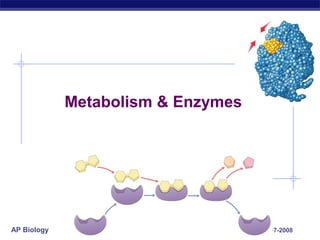
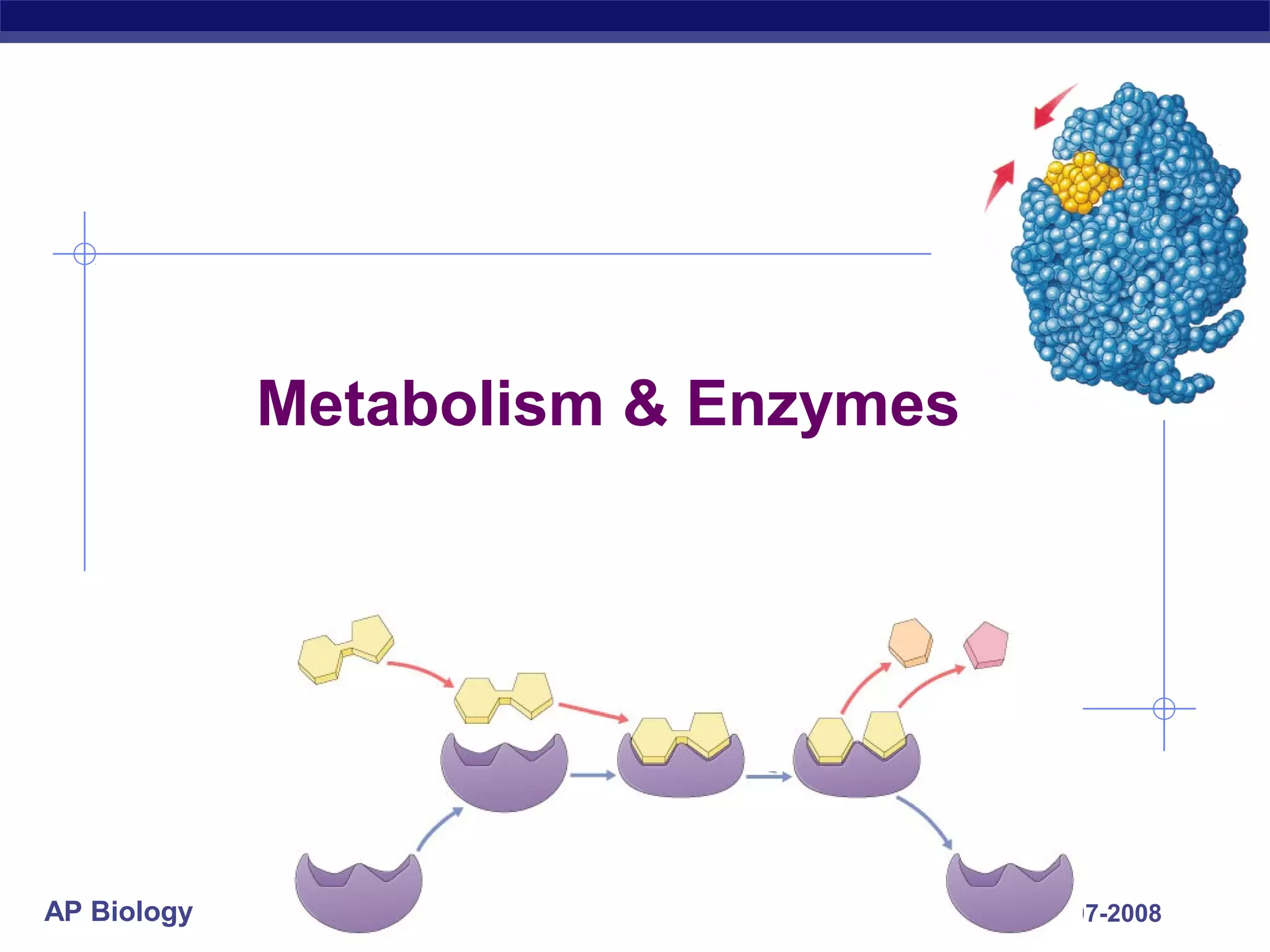
Metabolism & Enzymes
AP Biology
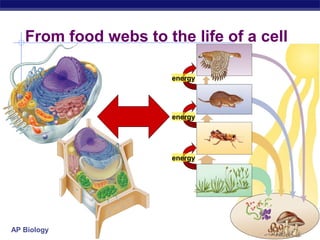
From food webs to the life of a cell
energy
energy
energy
AP Biology
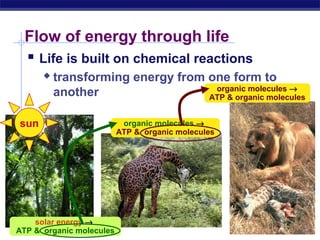
Flow of energy through life
 Life is built on chemical reactions
 transforming energy from one form to
another
organic molecules →
ATP & organic molecules
organic molecules →
ATP & organic molecules
sun
solar energy →
ATP & organic molecules
AP Biology
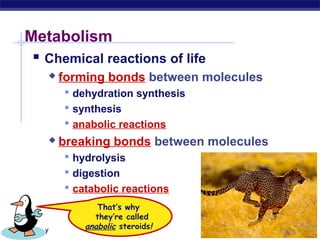
Metabolism
 Chemical reactions of life
 forming bonds between molecules
 dehydration synthesis
 synthesis
 anabolic reactions
 breaking bonds between molecules
 hydrolysis
 digestion
 catabolic reactions
That’s why
they’re called
anabolic steroids!
AP Biology
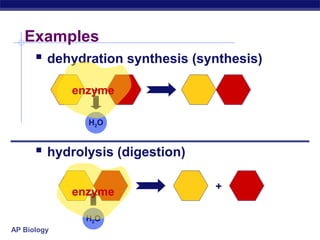
Examples
 dehydration synthesis (synthesis)
 hydrolysis (digestion)
+
H2O
+
H2O
enzyme
enzyme
AP Biology
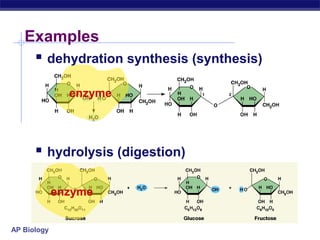
Examples
 dehydration synthesis (synthesis)
 hydrolysis (digestion)
enzyme
enzyme
AP Biology
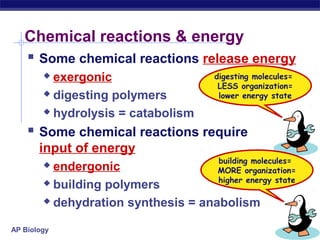
Chemical reactions & energy
 Some chemical reactions release energy
 exergonic
 digesting polymers
 hydrolysis = catabolism
 Some chemical reactions require
input of energy
 endergonic
 building polymers
 dehydration synthesis = anabolism
digesting molecules=
LESS organization=
lower energy state
building molecules=
MORE organization=
higher energy state
AP Biology
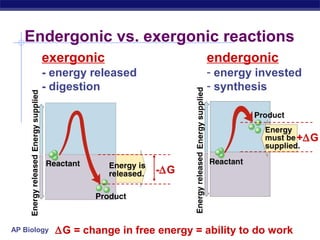
Endergonic vs. exergonic reactions
exergonic endergonic
- energy released
- digestion
- energy invested
- synthesis
-∆G
∆G = change in free energy = ability to do work
+∆G
AP Biology
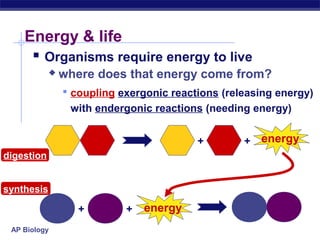
Energy & life
 Organisms require energy to live
 where does that energy come from?
 coupling exergonic reactions (releasing energy)
with endergonic reactions (needing energy)
+ + energy
+ energy+
digestion
synthesis
AP Biology
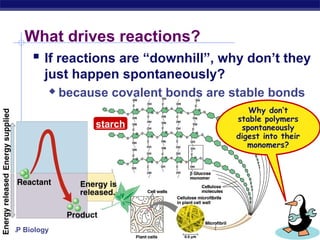
What drives reactions?
 If reactions are “downhill”, why don’t they
just happen spontaneously?
 because covalent bonds are stable bonds
Why don’t
stable polymers
spontaneously
digest into their
monomers?
starch
AP Biology
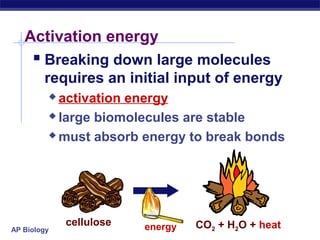
Activation energy
 Breaking down large molecules
requires an initial input of energy
 activation energy
 large biomolecules are stable
 must absorb energy to break bonds
energycellulose CO2 + H2O + heat
AP Biology
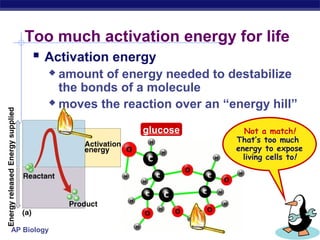
Too much activation energy for life
 Activation energy
 amount of energy needed to destabilize
the bonds of a molecule
 moves the reaction over an “energy hill”
Not a match!
That’s too much
energy to expose
living cells to!
glucose
AP Biology
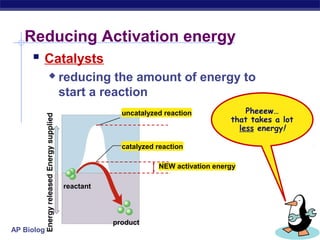
Reducing Activation energy
 Catalysts
 reducing the amount of energy to
start a reaction
Pheeew…
that takes a lot
less energy!
reactant
product
uncatalyzed reaction
catalyzed reaction
NEW activation energy
AP Biology
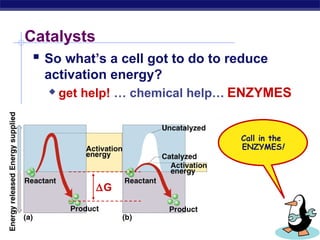
Catalysts
 So what’s a cell got to do to reduce
activation energy?
 get help! … chemical help… ENZYMES
∆G
Call in the
ENZYMES!
AP Biology
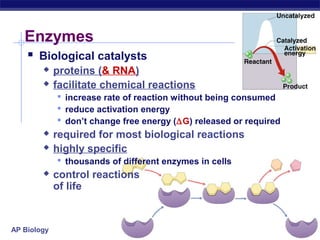
Enzymes
 Biological catalysts
 proteins (& RNA)
 facilitate chemical reactions
 increase rate of reaction without being consumed
 reduce activation energy
 don’t change free energy (∆G) released or required
 required for most biological reactions
 highly specific
 thousands of different enzymes in cells
 control reactions
of life
AP Biology
Enzymes vocabulary
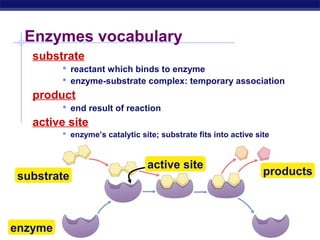
substrate
 reactant which binds to enzyme
 enzyme-substrate complex: temporary association
product
 end result of reaction
active site
 enzyme’s catalytic site; substrate fits into active site
substrate
enzyme
products
active site
AP Biology
Properties of enzymes
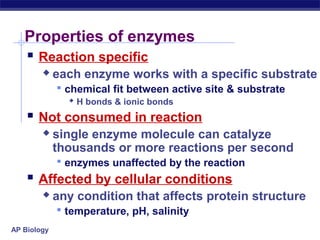
 Reaction specific
 each enzyme works with a specific substrate
 chemical fit between active site & substrate
 H bonds & ionic bonds
 Not consumed in reaction
 single enzyme molecule can catalyze
thousands or more reactions per second
 enzymes unaffected by the reaction
 Affected by cellular conditions
 any condition that affects protein structure
 temperature, pH, salinity
AP Biology
Naming conventions
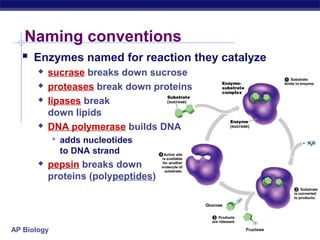
 Enzymes named for reaction they catalyze
 sucrase breaks down sucrose
 proteases break down proteins
 lipases break
down lipids
 DNA polymerase builds DNA
 adds nucleotides
to DNA strand
 pepsin breaks down
proteins (polypeptides)
AP Biology
Lock and Key model
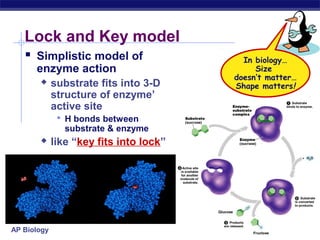
 Simplistic model of
enzyme action
 substrate fits into 3-D
structure of enzyme’
active site
 H bonds between
substrate & enzyme
 like “key fits into lock”
In biology…
Size
doesn’t matter…
Shape matters!
AP Biology
Induced fit model
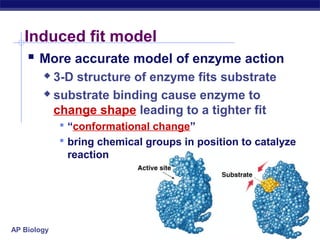
 More accurate model of enzyme action
 3-D structure of enzyme fits substrate
 substrate binding cause enzyme to
change shape leading to a tighter fit
 “conformational change”
 bring chemical groups in position to catalyze
reaction
AP Biology
How does it work?
 Variety of mechanisms to lower
activation energy & speed up reaction
 synthesis
 active site orients substrates in correct
position for reaction
 enzyme brings substrate closer together
 digestion
 active site binds substrate & puts stress on
bonds that must be broken, making it easier
to separate molecules
AP Biology 2007-2008
Got any Questions?!
AP Biology 2007-2008
Factors that Affect Enzymes
AP Biology
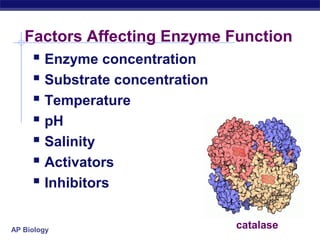
Factors Affecting Enzyme Function
 Enzyme concentration
 Substrate concentration
 Temperature
 pH
 Salinity
 Activators
 Inhibitors
catalase
AP Biology
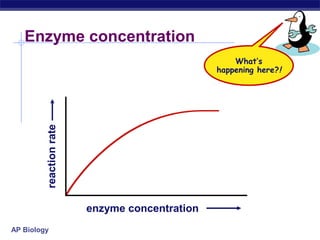
Enzyme concentration
enzyme concentration
reactionrate
What’s
happening here?!
AP Biology
Factors affecting enzyme function
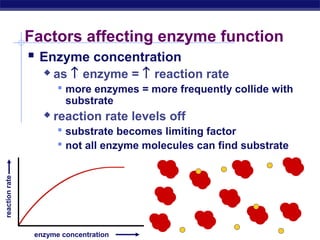
 Enzyme concentration
 as ↑ enzyme = ↑ reaction rate
 more enzymes = more frequently collide with
substrate
 reaction rate levels off
 substrate becomes limiting factor
 not all enzyme molecules can find substrate
enzyme concentration
reactionrate
AP Biology
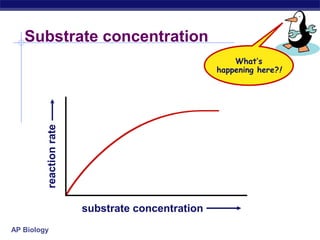
Substrate concentration
substrate concentration
reactionrate
What’s
happening here?!
AP Biology
Factors affecting enzyme function
substrate concentration
reactionrate
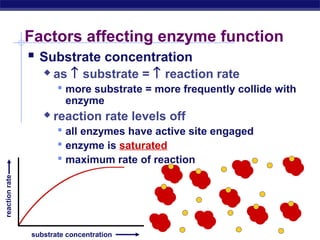
 Substrate concentration
 as ↑ substrate = ↑ reaction rate
 more substrate = more frequently collide with
enzyme
 reaction rate levels off
 all enzymes have active site engaged
 enzyme is saturated
 maximum rate of reaction
AP Biology
37°
Temperature
temperature
reactionrate
What’s
happening here?!
AP Biology
Factors affecting enzyme function
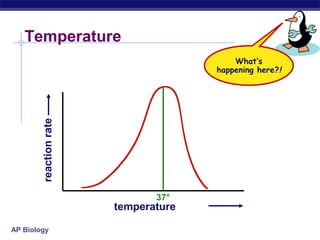
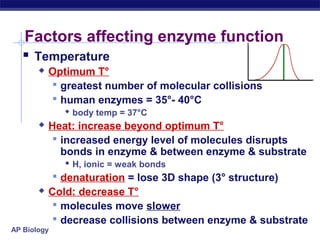
 Temperature
 Optimum T°
 greatest number of molecular collisions
 human enzymes = 35°- 40°C
 body temp = 37°C
 Heat: increase beyond optimum T°
 increased energy level of molecules disrupts
bonds in enzyme & between enzyme & substrate
 H, ionic = weak bonds
 denaturation = lose 3D shape (3° structure)
 Cold: decrease T°
 molecules move slower
 decrease collisions between enzyme & substrate
AP Biology
Enzymes and temperature
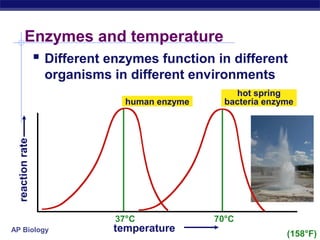
 Different enzymes function in different
organisms in different environments
37°C
temperature
reactionrate
70°C
human enzyme
hot spring
bacteria enzyme
(158°F)
AP Biology
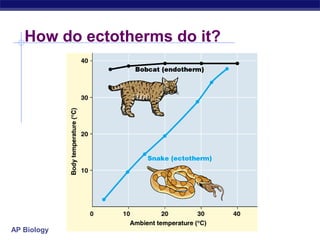
How do ectotherms do it?
AP Biology
7
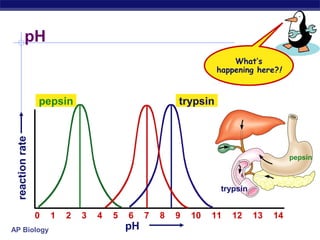
pH
pH
reactionrate
20 1 3 4 5 6 8 9 10
pepsin trypsin
What’s
happening here?!
11 12 13 14
pepsin
trypsin
AP Biology
Factors affecting enzyme function
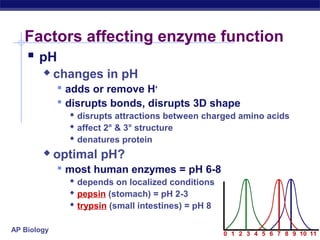
 pH
 changes in pH
 adds or remove H+
 disrupts bonds, disrupts 3D shape
 disrupts attractions between charged amino acids
 affect 2° & 3° structure
 denatures protein
 optimal pH?
 most human enzymes = pH 6-8
 depends on localized conditions
 pepsin (stomach) = pH 2-3
 trypsin (small intestines) = pH 8
720 1 3 4 5 6 8 9 10 11
AP Biology
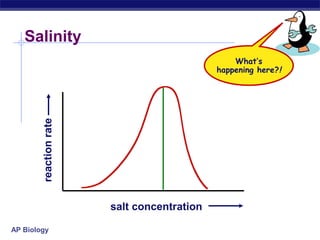
Salinity
salt concentration
reactionrate
What’s
happening here?!
AP Biology
Factors affecting enzyme function
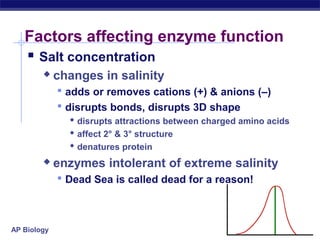
 Salt concentration
 changes in salinity
 adds or removes cations (+) & anions (–)
 disrupts bonds, disrupts 3D shape
 disrupts attractions between charged amino acids
 affect 2° & 3° structure
 denatures protein
 enzymes intolerant of extreme salinity
 Dead Sea is called dead for a reason!
AP Biology
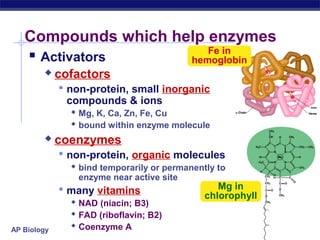
Compounds which help enzymes
 Activators
 cofactors
 non-protein, small inorganic
compounds & ions
 Mg, K, Ca, Zn, Fe, Cu
 bound within enzyme molecule
 coenzymes
 non-protein, organic molecules
 bind temporarily or permanently to
enzyme near active site
 many vitamins
 NAD (niacin; B3)
 FAD (riboflavin; B2)
 Coenzyme A
Mg in
chlorophyll
Fe in
hemoglobin
AP Biology
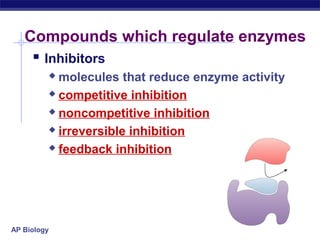
Compounds which regulate enzymes
 Inhibitors
 molecules that reduce enzyme activity
 competitive inhibition
 noncompetitive inhibition
 irreversible inhibition
 feedback inhibition
AP Biology
Competitive Inhibitor
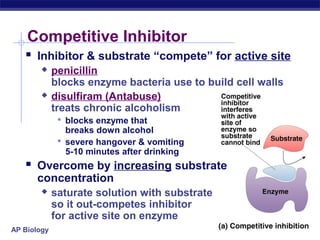
 Inhibitor & substrate “compete” for active site
 penicillin
blocks enzyme bacteria use to build cell walls
 disulfiram (Antabuse)
treats chronic alcoholism
 blocks enzyme that
breaks down alcohol
 severe hangover & vomiting
5-10 minutes after drinking
 Overcome by increasing substrate
concentration
 saturate solution with substrate
so it out-competes inhibitor
for active site on enzyme
AP Biology
Non-Competitive Inhibitor
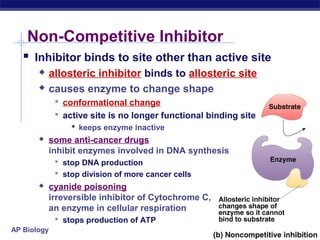
 Inhibitor binds to site other than active site
 allosteric inhibitor binds to allosteric site
 causes enzyme to change shape
 conformational change
 active site is no longer functional binding site
 keeps enzyme inactive
 some anti-cancer drugs
inhibit enzymes involved in DNA synthesis
 stop DNA production
 stop division of more cancer cells
 cyanide poisoning
irreversible inhibitor of Cytochrome C,
an enzyme in cellular respiration
 stops production of ATP
AP Biology
Irreversible inhibition
 Inhibitor permanently binds to enzyme
 competitor
 permanently binds to active site
 allosteric
 permanently binds to allosteric site
 permanently changes shape of enzyme
 nerve gas, sarin, many insecticides
(malathion, parathion…)
 cholinesterase inhibitors
 doesn’t breakdown the neurotransmitter,
acetylcholine
AP Biology
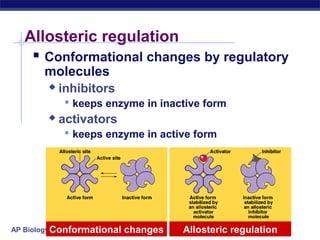
Allosteric regulation
 Conformational changes by regulatory
molecules
 inhibitors
 keeps enzyme in inactive form
 activators
 keeps enzyme in active form
Conformational changes Allosteric regulation
AP Biology
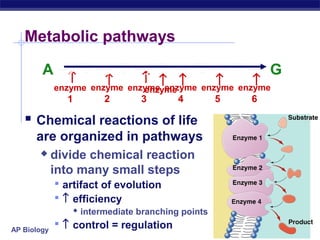
Metabolic pathways
A → B → C → D → E → F → G
enzyme
1
→
enzyme
2
→
enzyme
3
→
enzyme
4
→
enzyme
5
→
enzyme
6
→
 Chemical reactions of life
are organized in pathways
 divide chemical reaction
into many small steps
 artifact of evolution
 ↑ efficiency
 intermediate branching points
 ↑ control = regulation
A → B → C → D → E → F → G
enzyme
→
AP Biology
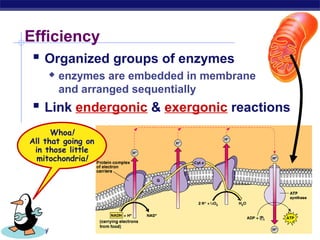
Efficiency
 Organized groups of enzymes
 enzymes are embedded in membrane
and arranged sequentially
 Link endergonic & exergonic reactions
Whoa!
All that going on
in those little
mitochondria!
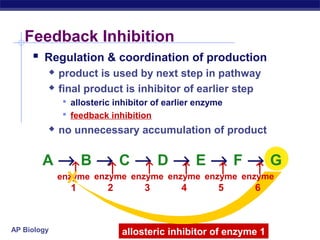
AP Biology allosteric inhibitor of enzyme 1
Feedback Inhibition
 Regulation & coordination of production
 product is used by next step in pathway
 final product is inhibitor of earlier step
 allosteric inhibitor of earlier enzyme
 feedback inhibition
 no unnecessary accumulation of product
A → B → C → D → E → F → G
enzyme
1
→
enzyme
2
→
enzyme
3
→
enzyme
4→
enzyme
5
→
enzyme
6
→
X
AP Biology
Feedback inhibition
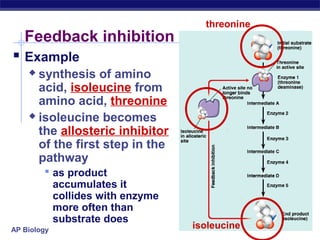
 Example
 synthesis of amino
acid, isoleucine from
amino acid, threonine
 isoleucine becomes
the allosteric inhibitor
of the first step in the
pathway
 as product
accumulates it
collides with enzyme
more often than
substrate does
threonine
isoleucine
AP Biology 2007-2008
Don’t be inhibited!
Ask Questions!
AP Biology 2007-2008
Ghosts of Lectures Past
(storage)
AP Biology
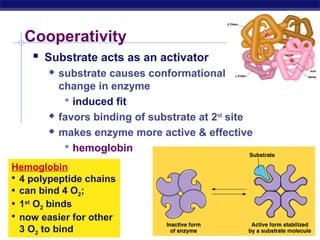
Cooperativity
 Substrate acts as an activator
 substrate causes conformational
change in enzyme
 induced fit
 favors binding of substrate at 2nd
site
 makes enzyme more active & effective
 hemoglobin
Hemoglobin
 4 polypeptide chains
 can bind 4 O2;
 1st
O2 binds
 now easier for other
3 O2 to bind

Enzymes

  • 1.
  • 2.
    AP Biology From foodwebs to the life of a cell energy energy energy
  • 3.
    AP Biology Flow ofenergy through life  Life is built on chemical reactions  transforming energy from one form to another organic molecules → ATP & organic molecules organic molecules → ATP & organic molecules sun solar energy → ATP & organic molecules
  • 4.
    AP Biology Metabolism  Chemicalreactions of life  forming bonds between molecules  dehydration synthesis  synthesis  anabolic reactions  breaking bonds between molecules  hydrolysis  digestion  catabolic reactions That’s why they’re called anabolic steroids!
  • 5.
    AP Biology Examples  dehydrationsynthesis (synthesis)  hydrolysis (digestion) + H2O + H2O enzyme enzyme
  • 6.
    AP Biology Examples  dehydrationsynthesis (synthesis)  hydrolysis (digestion) enzyme enzyme
  • 7.
    AP Biology Chemical reactions& energy  Some chemical reactions release energy  exergonic  digesting polymers  hydrolysis = catabolism  Some chemical reactions require input of energy  endergonic  building polymers  dehydration synthesis = anabolism digesting molecules= LESS organization= lower energy state building molecules= MORE organization= higher energy state
  • 8.
    AP Biology Endergonic vs.exergonic reactions exergonic endergonic - energy released - digestion - energy invested - synthesis -∆G ∆G = change in free energy = ability to do work +∆G
  • 9.
    AP Biology Energy &life  Organisms require energy to live  where does that energy come from?  coupling exergonic reactions (releasing energy) with endergonic reactions (needing energy) + + energy + energy+ digestion synthesis
  • 10.
    AP Biology What drivesreactions?  If reactions are “downhill”, why don’t they just happen spontaneously?  because covalent bonds are stable bonds Why don’t stable polymers spontaneously digest into their monomers? starch
  • 11.
    AP Biology Activation energy Breaking down large molecules requires an initial input of energy  activation energy  large biomolecules are stable  must absorb energy to break bonds energycellulose CO2 + H2O + heat
  • 12.
    AP Biology Too muchactivation energy for life  Activation energy  amount of energy needed to destabilize the bonds of a molecule  moves the reaction over an “energy hill” Not a match! That’s too much energy to expose living cells to! glucose
  • 13.
    AP Biology Reducing Activationenergy  Catalysts  reducing the amount of energy to start a reaction Pheeew… that takes a lot less energy! reactant product uncatalyzed reaction catalyzed reaction NEW activation energy
  • 14.
    AP Biology Catalysts  Sowhat’s a cell got to do to reduce activation energy?  get help! … chemical help… ENZYMES ∆G Call in the ENZYMES!
  • 15.
    AP Biology Enzymes  Biologicalcatalysts  proteins (& RNA)  facilitate chemical reactions  increase rate of reaction without being consumed  reduce activation energy  don’t change free energy (∆G) released or required  required for most biological reactions  highly specific  thousands of different enzymes in cells  control reactions of life
  • 16.
    AP Biology Enzymes vocabulary substrate reactant which binds to enzyme  enzyme-substrate complex: temporary association product  end result of reaction active site  enzyme’s catalytic site; substrate fits into active site substrate enzyme products active site
  • 17.
    AP Biology Properties ofenzymes  Reaction specific  each enzyme works with a specific substrate  chemical fit between active site & substrate  H bonds & ionic bonds  Not consumed in reaction  single enzyme molecule can catalyze thousands or more reactions per second  enzymes unaffected by the reaction  Affected by cellular conditions  any condition that affects protein structure  temperature, pH, salinity
  • 18.
    AP Biology Naming conventions Enzymes named for reaction they catalyze  sucrase breaks down sucrose  proteases break down proteins  lipases break down lipids  DNA polymerase builds DNA  adds nucleotides to DNA strand  pepsin breaks down proteins (polypeptides)
  • 19.
    AP Biology Lock andKey model  Simplistic model of enzyme action  substrate fits into 3-D structure of enzyme’ active site  H bonds between substrate & enzyme  like “key fits into lock” In biology… Size doesn’t matter… Shape matters!
  • 20.
    AP Biology Induced fitmodel  More accurate model of enzyme action  3-D structure of enzyme fits substrate  substrate binding cause enzyme to change shape leading to a tighter fit  “conformational change”  bring chemical groups in position to catalyze reaction
  • 21.
    AP Biology How doesit work?  Variety of mechanisms to lower activation energy & speed up reaction  synthesis  active site orients substrates in correct position for reaction  enzyme brings substrate closer together  digestion  active site binds substrate & puts stress on bonds that must be broken, making it easier to separate molecules
  • 22.
    AP Biology 2007-2008 Gotany Questions?!
  • 23.
    AP Biology 2007-2008 Factorsthat Affect Enzymes
  • 24.
    AP Biology Factors AffectingEnzyme Function  Enzyme concentration  Substrate concentration  Temperature  pH  Salinity  Activators  Inhibitors catalase
  • 25.
    AP Biology Enzyme concentration enzymeconcentration reactionrate What’s happening here?!
  • 26.
    AP Biology Factors affectingenzyme function  Enzyme concentration  as ↑ enzyme = ↑ reaction rate  more enzymes = more frequently collide with substrate  reaction rate levels off  substrate becomes limiting factor  not all enzyme molecules can find substrate enzyme concentration reactionrate
  • 27.
    AP Biology Substrate concentration substrateconcentration reactionrate What’s happening here?!
  • 28.
    AP Biology Factors affectingenzyme function substrate concentration reactionrate  Substrate concentration  as ↑ substrate = ↑ reaction rate  more substrate = more frequently collide with enzyme  reaction rate levels off  all enzymes have active site engaged  enzyme is saturated  maximum rate of reaction
  • 29.
  • 30.
    AP Biology Factors affectingenzyme function  Temperature  Optimum T°  greatest number of molecular collisions  human enzymes = 35°- 40°C  body temp = 37°C  Heat: increase beyond optimum T°  increased energy level of molecules disrupts bonds in enzyme & between enzyme & substrate  H, ionic = weak bonds  denaturation = lose 3D shape (3° structure)  Cold: decrease T°  molecules move slower  decrease collisions between enzyme & substrate
  • 31.
    AP Biology Enzymes andtemperature  Different enzymes function in different organisms in different environments 37°C temperature reactionrate 70°C human enzyme hot spring bacteria enzyme (158°F)
  • 32.
    AP Biology How doectotherms do it?
  • 33.
    AP Biology 7 pH pH reactionrate 20 13 4 5 6 8 9 10 pepsin trypsin What’s happening here?! 11 12 13 14 pepsin trypsin
  • 34.
    AP Biology Factors affectingenzyme function  pH  changes in pH  adds or remove H+  disrupts bonds, disrupts 3D shape  disrupts attractions between charged amino acids  affect 2° & 3° structure  denatures protein  optimal pH?  most human enzymes = pH 6-8  depends on localized conditions  pepsin (stomach) = pH 2-3  trypsin (small intestines) = pH 8 720 1 3 4 5 6 8 9 10 11
  • 35.
  • 36.
    AP Biology Factors affectingenzyme function  Salt concentration  changes in salinity  adds or removes cations (+) & anions (–)  disrupts bonds, disrupts 3D shape  disrupts attractions between charged amino acids  affect 2° & 3° structure  denatures protein  enzymes intolerant of extreme salinity  Dead Sea is called dead for a reason!
  • 37.
    AP Biology Compounds whichhelp enzymes  Activators  cofactors  non-protein, small inorganic compounds & ions  Mg, K, Ca, Zn, Fe, Cu  bound within enzyme molecule  coenzymes  non-protein, organic molecules  bind temporarily or permanently to enzyme near active site  many vitamins  NAD (niacin; B3)  FAD (riboflavin; B2)  Coenzyme A Mg in chlorophyll Fe in hemoglobin
  • 38.
    AP Biology Compounds whichregulate enzymes  Inhibitors  molecules that reduce enzyme activity  competitive inhibition  noncompetitive inhibition  irreversible inhibition  feedback inhibition
  • 39.
    AP Biology Competitive Inhibitor Inhibitor & substrate “compete” for active site  penicillin blocks enzyme bacteria use to build cell walls  disulfiram (Antabuse) treats chronic alcoholism  blocks enzyme that breaks down alcohol  severe hangover & vomiting 5-10 minutes after drinking  Overcome by increasing substrate concentration  saturate solution with substrate so it out-competes inhibitor for active site on enzyme
  • 40.
    AP Biology Non-Competitive Inhibitor Inhibitor binds to site other than active site  allosteric inhibitor binds to allosteric site  causes enzyme to change shape  conformational change  active site is no longer functional binding site  keeps enzyme inactive  some anti-cancer drugs inhibit enzymes involved in DNA synthesis  stop DNA production  stop division of more cancer cells  cyanide poisoning irreversible inhibitor of Cytochrome C, an enzyme in cellular respiration  stops production of ATP
  • 41.
    AP Biology Irreversible inhibition Inhibitor permanently binds to enzyme  competitor  permanently binds to active site  allosteric  permanently binds to allosteric site  permanently changes shape of enzyme  nerve gas, sarin, many insecticides (malathion, parathion…)  cholinesterase inhibitors  doesn’t breakdown the neurotransmitter, acetylcholine
  • 42.
    AP Biology Allosteric regulation Conformational changes by regulatory molecules  inhibitors  keeps enzyme in inactive form  activators  keeps enzyme in active form Conformational changes Allosteric regulation
  • 43.
    AP Biology Metabolic pathways A→ B → C → D → E → F → G enzyme 1 → enzyme 2 → enzyme 3 → enzyme 4 → enzyme 5 → enzyme 6 →  Chemical reactions of life are organized in pathways  divide chemical reaction into many small steps  artifact of evolution  ↑ efficiency  intermediate branching points  ↑ control = regulation A → B → C → D → E → F → G enzyme →
  • 44.
    AP Biology Efficiency  Organizedgroups of enzymes  enzymes are embedded in membrane and arranged sequentially  Link endergonic & exergonic reactions Whoa! All that going on in those little mitochondria!
  • 45.
    AP Biology allostericinhibitor of enzyme 1 Feedback Inhibition  Regulation & coordination of production  product is used by next step in pathway  final product is inhibitor of earlier step  allosteric inhibitor of earlier enzyme  feedback inhibition  no unnecessary accumulation of product A → B → C → D → E → F → G enzyme 1 → enzyme 2 → enzyme 3 → enzyme 4→ enzyme 5 → enzyme 6 → X
  • 46.
    AP Biology Feedback inhibition Example  synthesis of amino acid, isoleucine from amino acid, threonine  isoleucine becomes the allosteric inhibitor of the first step in the pathway  as product accumulates it collides with enzyme more often than substrate does threonine isoleucine
  • 47.
    AP Biology 2007-2008 Don’tbe inhibited! Ask Questions!
  • 48.
    AP Biology 2007-2008 Ghostsof Lectures Past (storage)
  • 49.
    AP Biology Cooperativity  Substrateacts as an activator  substrate causes conformational change in enzyme  induced fit  favors binding of substrate at 2nd site  makes enzyme more active & effective  hemoglobin Hemoglobin  4 polypeptide chains  can bind 4 O2;  1st O2 binds  now easier for other 3 O2 to bind

Editor's Notes

  • #12 Need a spark to start a fire
  • #13 2nd Law of thermodynamics Universe tends to disorder so why don’t proteins, carbohydrates & other biomolecules breakdown? at temperatures typical of the cell, molecules don’t make it over the hump of activation energy but, a cell must be metabolically active heat would speed reactions, but… would denature proteins & kill cells
  • #25 Living with oxygen is dangerous. We rely on oxygen to power our cells, but oxygen is a reactive molecule that can cause serious problems if not carefully controlled. One of the dangers of oxygen is that it is easily converted into other reactive compounds. Inside our cells, electrons are continually shuttled from site to site by carrier molecules, such as carriers derived from riboflavin and niacin. If oxygen runs into one of these carrier molecules, the electron may be accidentally transferred to it. This converts oxygen into dangerous compounds such as superoxide radicals and hydrogen peroxide, which can attack the delicate sulfur atoms and metal ions in proteins. To make things even worse, free iron ions in the cell occasionally convert hydrogen peroxide into hydroxyl radicals. These deadly molecules attack and mutate DNA. Fortunately, cells make a variety of antioxidant enzymes to fight the dangerous side-effects of life with oxygen. Two important players are superoxide dismutase, which converts superoxide radicals into hydrogen peroxide, and catalase, which converts hydrogen peroxide into water and oxygen gas. The importance of these enzymes is demonstrated by their prevalence, ranging from about 0.1% of the protein in an E. coli cell to upwards of a quarter of the protein in susceptible cell types. These many catalase molecules patrol the cell, counteracting the steady production of hydrogen peroxide and keeping it at a safe level. Catalases are some of the most efficient enzymes found in cells. Each catalase molecule can decompose millions of hydrogen peroxide molecules every second. The cow catalase shown here and our own catalases use an iron ion to assist in this speedy reaction. The enzyme is composed of four identical subunits, each with its own active site buried deep inside. The iron ion, shown in green, is gripped at the center of a disk-shaped heme group. Catalases, since they must fight against reactive molecules, are also unusually stable enzymes. Notice how the four chains interweave, locking the entire complex into the proper shape.
  • #27 Why is it a good adaptation to organize the cell in organelles? Sequester enzymes with their substrates!
  • #29 Why is it a good adaptation to organize the cell in organelles? Sequester enzymes with their substrates!
  • #33 Enzymes work within narrow temperature ranges. Ectotherms, like snakes, do not use their metabolism extensively to regulate body temperature. Their body temperature is significantly influenced by environmental temperature. Desert reptiles can experience body temperature fluctuations of ~40°C (that’s a ~100°F span!). What mechanism has evolved to allow their metabolic pathways to continue to function across that wide temperature span?
  • #38 Hemoglobin is aided by Fe Chlorophyll is aided by Mg
  • #40 Ethanol is metabolized in the body by oxidation to acetaldehyde, which is in turn further oxidized to acetic acid by aldehyde oxidase enzymes. Normally, the second reaction is rapid so that acetaldehyde does not accumulate in the body. A drug, disulfiram (Antabuse) inhibits the aldehyde oxidase which causes the accumulation of acetaldehyde with subsequent unpleasant side-effects of nausea and vomiting. This drug is sometimes used to help people overcome the drinking habit. Methanol (wood alcohol) poisoning occurs because methanol is oxidized to formaldehyde and formic acid which attack the optic nerve causing blindness. Ethanol is given as an antidote for methanol poisoning because ethanol competitively inhibits the oxidation of methanol. Ethanol is oxidized in preference to methanol and consequently, the oxidation of methanol is slowed down so that the toxic by-products do not have a chance to accumulate.
  • #41 Basis of most chemotherapytreatments is enzyme inhibition. Many health disorders can be controlled, in principle, by inhibiting selected enzymes. Two examples include methotrexate and FdUMP, common anticancer drugs which inhibit enzymes involved in the synthesis of thymidine and hence DNA. Since many enzymes contain sulfhydral (-SH), alcohol, or acid groups as part of their active sites, any chemical which can react with them acts as a noncompetitive inhibitor. Heavy metals such as silver (Ag+), mercury (Hg2+), lead ( Pb2+) have strong affinities for -SH groups. Cyanide combines with the copper prosthetic groups of the enzyme cytochrome C oxidase, thus inhibiting respiration which causes an organism to run out of ATP (energy) Oxalic and citric acid inhibit blood clotting by forming complexes with calcium ions necessary for the enzyme metal ion activator.
  • #42 Another example of irreversible inhibition is provided by the nerve gas diisopropylfluorophosphate (DFP) designed for use in warfare. It combines with the amino acid serine (contains the –SH group) at the active site of the enzyme acetylcholinesterase. The enzyme deactivates the neurotransmitter acetylcholine. Neurotransmitters are needed to continue the passage of nerve impulses from one neurone to another across the synapse. Once the impulse has been transmitted, acetylcholinesterase functions to deactivate the acetycholine almost immediately by breaking it down. If the enzyme is inhibited, acetylcholine accumulates and nerve impulses cannot be stopped, causing prolonged muscle contration. Paralysis occurs and death may result since the respiratory muscles are affected. Some insecticides currently in use, including those known as organophosphates (e.g. parathion), have a similar effect on insects, and can also cause harm to nervous and muscular system of humans who are overexposed to them.