
PRESENTING BY : NABEEL.B.AZEEZ
M.Sc STUDENT AT YILDIZ TECHNIC UNIVERSITY
DEPARTMENT OF CHEMISTRY
Introduction to Liquid Crystals
The study of liquid crystals began in 1888 when an Austrian botanist named Friedrich Reinitzer
observed that a material known as cholesteryl benzoate had two distinct melting points. In his
experiments, Reinitzer increased the temperature of a solid sample and watched the crystal change
into a hazy liquid. As he increased the temperature further, the material changed again into a clear,
transparent liquid. Because of this early work, Reinitzer is often credited with discovering a new phase
of matter - the liquid crystal phase.
Liquid crystal materials are unique in their properties and uses., liquid crystals will play an important
role in modern technology.
What are Liquid Crystals?
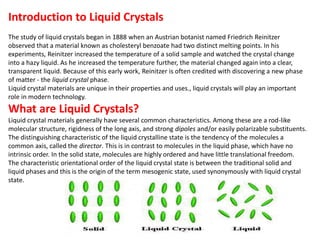
Liquid crystal materials generally have several common characteristics. Among these are a rod-like
molecular structure, rigidness of the long axis, and strong dipoles and/or easily polarizable substituents.
The distinguishing characteristic of the liquid crystalline state is the tendency of the molecules a
common axis, called the director. This is in contrast to molecules in the liquid phase, which have no
intrinsic order. In the solid state, molecules are highly ordered and have little translational freedom.
The characteristic orientational order of the liquid crystal state is between the traditional solid and
liquid phases and this is the origin of the term mesogenic state, used synonymously with liquid crystal
state.
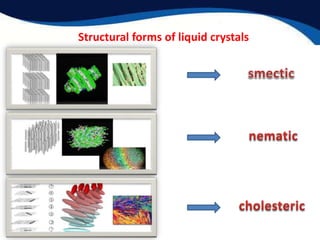
Structural forms of liquid crystals
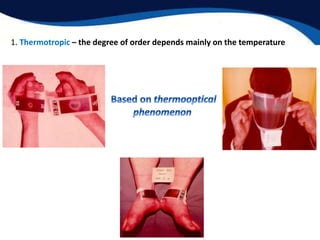
1. Thermotropic – the degree of order depends mainly on the temperature
:
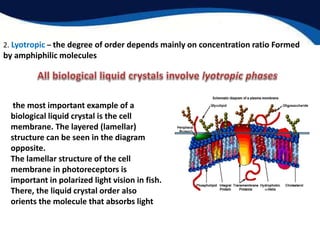
2. Lyotropic – the degree of order depends mainly on concentration ratio Formed
by amphiphilic molecules
the most important example of a
biological liquid crystal is the cell
membrane. The layered (lamellar)
structure can be seen in the diagram
opposite.
The lamellar structure of the cell
membrane in photoreceptors is
important in polarized light vision in fish.
There, the liquid crystal order also
orients the molecule that absorbs light
The role of biological membranes
• Separation of different fluid
compartments
• Selective transport of ions and
molecules
• Signal transduction
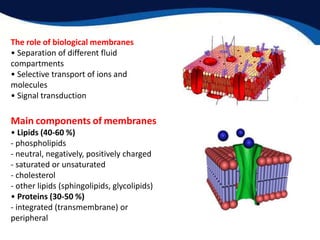
Main components of membranes
• Lipids (40-60 %)
- phospholipids
- neutral, negatively, positively charged
- saturated or unsaturated
- cholesterol
- other lipids (sphingolipids, glycolipids)
• Proteins (30-50 %)
- integrated (transmembrane) or
peripheral
Transport across membrane (1)
• Passive – according to concentration drop
(=towards lower concentration) → diffusion,
osmosis (water, O2, CO2)
• Facilitated diffusion – across channel, according
to concentration drop. Opening and closing of the
channel is controlled by ligand, voltage or other
factors.
Transport across membrane (2)
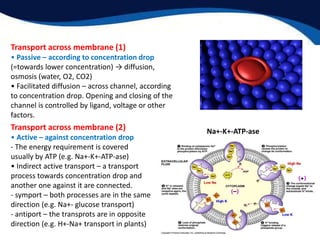
• Active – against concentration drop
- The energy requirement is covered
usually by ATP (e.g. Na+-K+-ATP-ase)
• Indirect active transport – a transport
process towards concentration drop and
another one against it are connected.
- symport – both processes are in the same
direction (e.g. Na+- glucose transport)
- antiport – the transprots are in opposite
direction (e.g. H+-Na+ transport in plants)
Na+-K+-ATP-ase
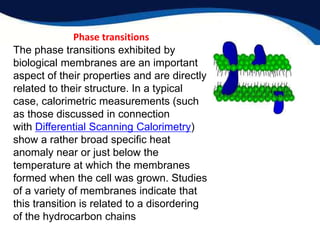
Phase transitions
The phase transitions exhibited by
biological membranes are an important
aspect of their properties and are directly
related to their structure. In a typical
case, calorimetric measurements (such
as those discussed in connection
with Differential Scanning Calorimetry)
show a rather broad specific heat
anomaly near or just below the
temperature at which the membranes
formed when the cell was grown. Studies
of a variety of membranes indicate that
this transition is related to a disordering
of the hydrocarbon chains
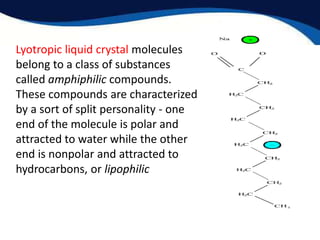
Lyotropic liquid crystal molecules
belong to a class of substances
called amphiphilic compounds.
These compounds are characterized
by a sort of split personality - one
end of the molecule is polar and
attracted to water while the other
end is nonpolar and attracted to
hydrocarbons, or lipophilic
Artificialmembranes
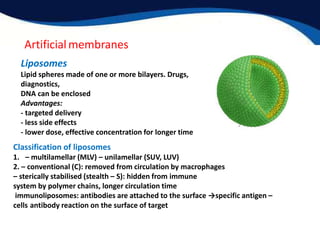
Liposomes
Lipid spheres made of one or more bilayers. Drugs,
diagnostics,
DNA can be enclosed
Advantages:
- targeted delivery
- less side effects
- lower dose, effective concentration for longer time
Classification of liposomes
1. – multilamellar (MLV) – unilamellar (SUV, LUV)
2. – conventional (C): removed from circulation by macrophages
– sterically stabilised (stealth – S): hidden from immune
system by polymer chains, longer circulation time
immunoliposomes: antibodies are attached to the surface →specific antigen –
antibody reaction on the surface of targetcells
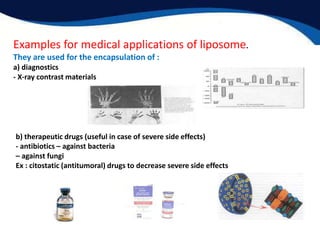
Examples for medical applications of liposome.
They are used for the encapsulation of :
a) diagnostics
- X-ray contrast materials
b) therapeutic drugs (useful in case of severe side effects)
- antibiotics – against bacteria
– against fungi
Ex : citostatic (antitumoral) drugs to decrease severe side effects
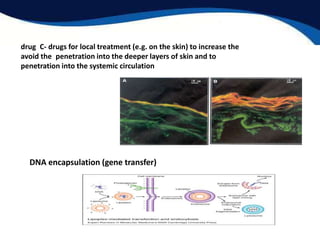
C- drugs for local treatment (e.g. on the skin) to increase thedrug
penetration into the deeper layers of skin and toavoid the
penetration into the systemic circulation
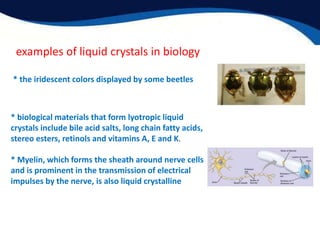
DNA encapsulation (gene transfer)
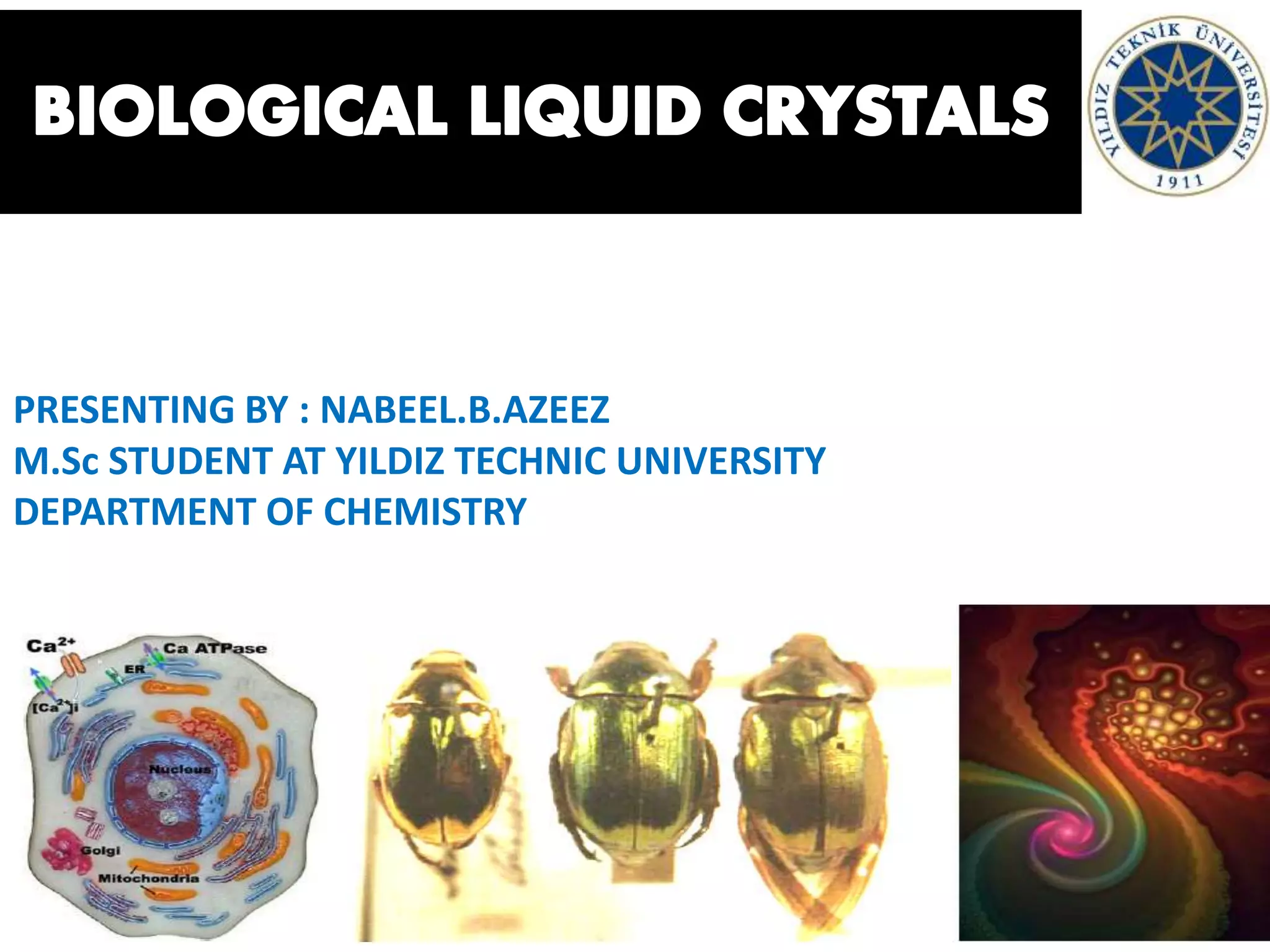
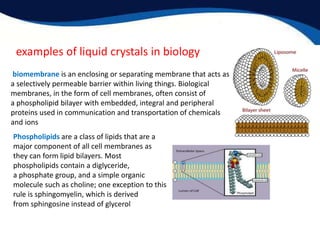
examples of liquid crystals in biology
* the iridescent colors displayed by some beetles
* biological materials that form lyotropic liquid
crystals include bile acid salts, long chain fatty acids,
stereo esters, retinols and vitamins A, E and K.
* Myelin, which forms the sheath around nerve cells
and is prominent in the transmission of electrical
impulses by the nerve, is also liquid crystalline
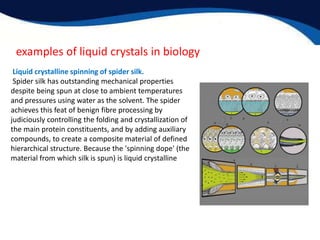
examples of liquid crystals in biology
biomembrane is an enclosing or separating membrane that acts as
a selectively permeable barrier within living things. Biological
membranes, in the form of cell membranes, often consist of
a phospholipid bilayer with embedded, integral and peripheral
proteins used in communication and transportation of chemicals
and ions
Phospholipids are a class of lipids that are a
major component of all cell membranes as
they can form lipid bilayers. Most
phospholipids contain a diglyceride,
a phosphate group, and a simple organic
molecule such as choline; one exception to this
rule is sphingomyelin, which is derived
from sphingosine instead of glycerol
examples of liquid crystals in biology
Liquid crystalline spinning of spider silk.
Spider silk has outstanding mechanical properties
despite being spun at close to ambient temperatures
and pressures using water as the solvent. The spider
achieves this feat of benign fibre processing by
judiciously controlling the folding and crystallization of
the main protein constituents, and by adding auxiliary
compounds, to create a composite material of defined
hierarchical structure. Because the 'spinning dope' (the
material from which silk is spun) is liquid crystalline
REFRENCES
1. http://pubs.rsc.org/en/content/articlelanding/2010/sm/b921576j#!divAbstract
2. Liquid Crystals and Life .. Helen Gleeson, University of Manchester, 2010
3.S. V. Shiyanovskii O. D. Lavrentovich Chemical Physics Interdisciplinary Program
and Liquid Crystal Institute, Kent State University, Kent, Ohio3.
4. Applications of liquid crystals in chemical and biological detection
5. http://plc.cwru.edu/tutorial/enhanced/files/lc/intro.htm
Biological liquid crystals

Biological liquid crystals

  • 1.
    PRESENTING BY :NABEEL.B.AZEEZ M.Sc STUDENT AT YILDIZ TECHNIC UNIVERSITY DEPARTMENT OF CHEMISTRY
  • 2.
    Introduction to LiquidCrystals The study of liquid crystals began in 1888 when an Austrian botanist named Friedrich Reinitzer observed that a material known as cholesteryl benzoate had two distinct melting points. In his experiments, Reinitzer increased the temperature of a solid sample and watched the crystal change into a hazy liquid. As he increased the temperature further, the material changed again into a clear, transparent liquid. Because of this early work, Reinitzer is often credited with discovering a new phase of matter - the liquid crystal phase. Liquid crystal materials are unique in their properties and uses., liquid crystals will play an important role in modern technology. What are Liquid Crystals? Liquid crystal materials generally have several common characteristics. Among these are a rod-like molecular structure, rigidness of the long axis, and strong dipoles and/or easily polarizable substituents. The distinguishing characteristic of the liquid crystalline state is the tendency of the molecules a common axis, called the director. This is in contrast to molecules in the liquid phase, which have no intrinsic order. In the solid state, molecules are highly ordered and have little translational freedom. The characteristic orientational order of the liquid crystal state is between the traditional solid and liquid phases and this is the origin of the term mesogenic state, used synonymously with liquid crystal state.
  • 3.
    Structural forms ofliquid crystals
  • 4.
    1. Thermotropic –the degree of order depends mainly on the temperature
  • 5.
  • 6.
    2. Lyotropic –the degree of order depends mainly on concentration ratio Formed by amphiphilic molecules the most important example of a biological liquid crystal is the cell membrane. The layered (lamellar) structure can be seen in the diagram opposite. The lamellar structure of the cell membrane in photoreceptors is important in polarized light vision in fish. There, the liquid crystal order also orients the molecule that absorbs light
  • 7.
    The role ofbiological membranes • Separation of different fluid compartments • Selective transport of ions and molecules • Signal transduction Main components of membranes • Lipids (40-60 %) - phospholipids - neutral, negatively, positively charged - saturated or unsaturated - cholesterol - other lipids (sphingolipids, glycolipids) • Proteins (30-50 %) - integrated (transmembrane) or peripheral
  • 8.
    Transport across membrane(1) • Passive – according to concentration drop (=towards lower concentration) → diffusion, osmosis (water, O2, CO2) • Facilitated diffusion – across channel, according to concentration drop. Opening and closing of the channel is controlled by ligand, voltage or other factors. Transport across membrane (2) • Active – against concentration drop - The energy requirement is covered usually by ATP (e.g. Na+-K+-ATP-ase) • Indirect active transport – a transport process towards concentration drop and another one against it are connected. - symport – both processes are in the same direction (e.g. Na+- glucose transport) - antiport – the transprots are in opposite direction (e.g. H+-Na+ transport in plants) Na+-K+-ATP-ase
  • 9.
    Phase transitions The phasetransitions exhibited by biological membranes are an important aspect of their properties and are directly related to their structure. In a typical case, calorimetric measurements (such as those discussed in connection with Differential Scanning Calorimetry) show a rather broad specific heat anomaly near or just below the temperature at which the membranes formed when the cell was grown. Studies of a variety of membranes indicate that this transition is related to a disordering of the hydrocarbon chains
  • 10.
    Lyotropic liquid crystalmolecules belong to a class of substances called amphiphilic compounds. These compounds are characterized by a sort of split personality - one end of the molecule is polar and attracted to water while the other end is nonpolar and attracted to hydrocarbons, or lipophilic
  • 11.
    Artificialmembranes Liposomes Lipid spheres madeof one or more bilayers. Drugs, diagnostics, DNA can be enclosed Advantages: - targeted delivery - less side effects - lower dose, effective concentration for longer time Classification of liposomes 1. – multilamellar (MLV) – unilamellar (SUV, LUV) 2. – conventional (C): removed from circulation by macrophages – sterically stabilised (stealth – S): hidden from immune system by polymer chains, longer circulation time immunoliposomes: antibodies are attached to the surface →specific antigen – antibody reaction on the surface of targetcells
  • 12.
    Examples for medicalapplications of liposome. They are used for the encapsulation of : a) diagnostics - X-ray contrast materials b) therapeutic drugs (useful in case of severe side effects) - antibiotics – against bacteria – against fungi Ex : citostatic (antitumoral) drugs to decrease severe side effects
  • 13.
    C- drugs forlocal treatment (e.g. on the skin) to increase thedrug penetration into the deeper layers of skin and toavoid the penetration into the systemic circulation DNA encapsulation (gene transfer)
  • 14.
    examples of liquidcrystals in biology * the iridescent colors displayed by some beetles * biological materials that form lyotropic liquid crystals include bile acid salts, long chain fatty acids, stereo esters, retinols and vitamins A, E and K. * Myelin, which forms the sheath around nerve cells and is prominent in the transmission of electrical impulses by the nerve, is also liquid crystalline
  • 15.
    examples of liquidcrystals in biology biomembrane is an enclosing or separating membrane that acts as a selectively permeable barrier within living things. Biological membranes, in the form of cell membranes, often consist of a phospholipid bilayer with embedded, integral and peripheral proteins used in communication and transportation of chemicals and ions Phospholipids are a class of lipids that are a major component of all cell membranes as they can form lipid bilayers. Most phospholipids contain a diglyceride, a phosphate group, and a simple organic molecule such as choline; one exception to this rule is sphingomyelin, which is derived from sphingosine instead of glycerol
  • 16.
    examples of liquidcrystals in biology Liquid crystalline spinning of spider silk. Spider silk has outstanding mechanical properties despite being spun at close to ambient temperatures and pressures using water as the solvent. The spider achieves this feat of benign fibre processing by judiciously controlling the folding and crystallization of the main protein constituents, and by adding auxiliary compounds, to create a composite material of defined hierarchical structure. Because the 'spinning dope' (the material from which silk is spun) is liquid crystalline
  • 17.
    REFRENCES 1. http://pubs.rsc.org/en/content/articlelanding/2010/sm/b921576j#!divAbstract 2. LiquidCrystals and Life .. Helen Gleeson, University of Manchester, 2010 3.S. V. Shiyanovskii O. D. Lavrentovich Chemical Physics Interdisciplinary Program and Liquid Crystal Institute, Kent State University, Kent, Ohio3. 4. Applications of liquid crystals in chemical and biological detection 5. http://plc.cwru.edu/tutorial/enhanced/files/lc/intro.htm