Downloaded 137 times
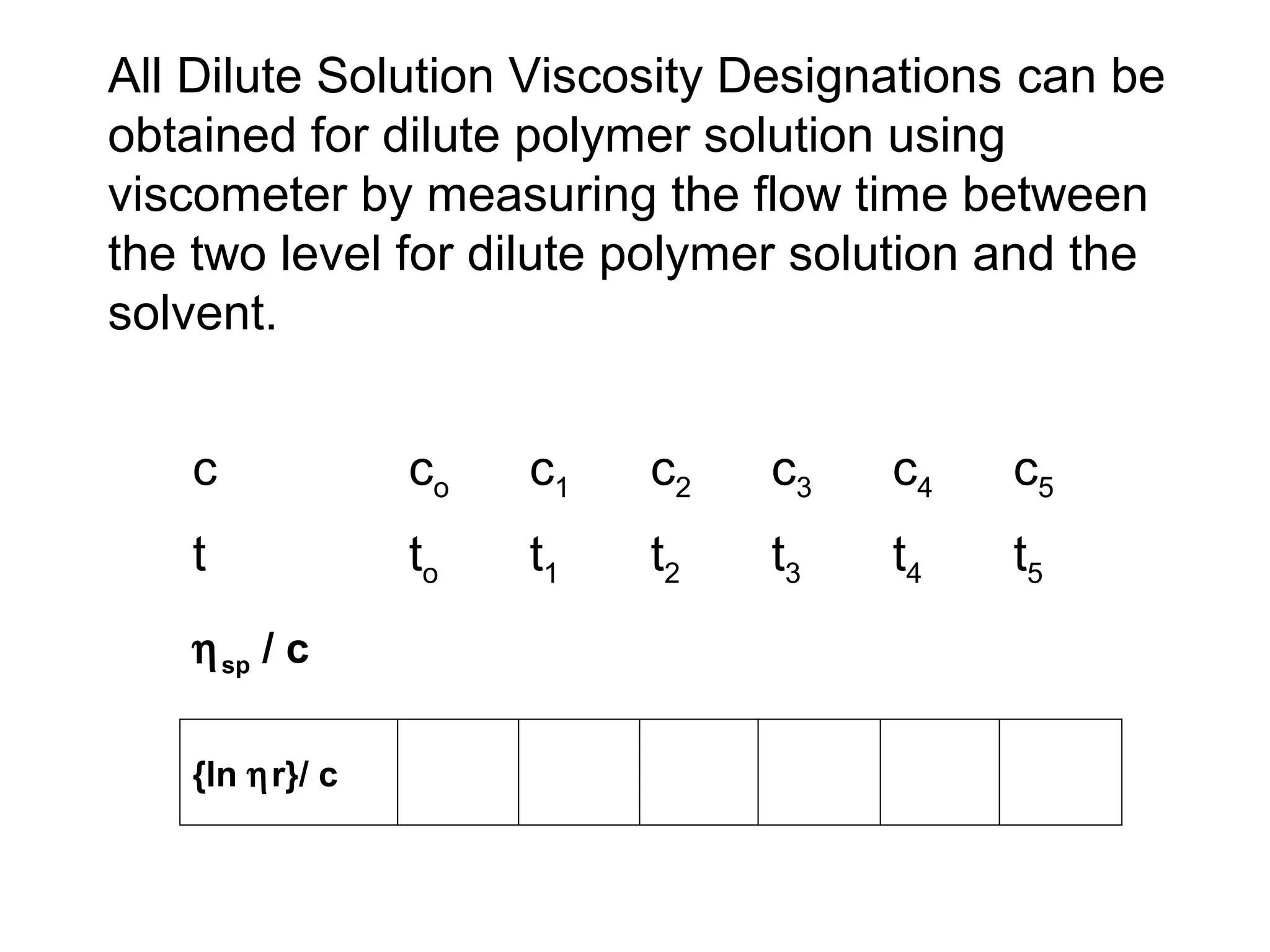
![Dilute Solution Viscosity Designationsa
Common name IUPAC name Definition
= = t
h
h h
rel t
o o
t t
-
= rel
= - 1
-
=
o
o
h h
o
o
sp t
h
h
h
h h
sp rel
C C
red
-1
= =
h
C
rel
inh
h
h ln =
ö
æ
=
sp h
0 ) ( ] [ = = ÷ ÷ø
ç çè
=
C
C inh
c o
h
h
Relative viscosity Viscosity ratio
Specific viscosity -
Reduced viscosity Viscosity number
Inherent viscosity Logarithmic viscosity
number
Intrinsic viscosity Limiting viscosity
number
aConcentrations (most commonly expressed in
grams per 100 mL of solvent) of about 0.5 g/dL](https://image.slidesharecdn.com/kuliah1chm3102-140918090044-phpapp01/75/Viscosity-measurement-2-2048.jpg)
![Huggins (a ) & Kramer (b) Equations
(a)h/ c = [h] + k[h]2C
sp 1 (b){ln hr}/ c = [h] + k[h]2
C
2 Graph,:
k1 + k2 = 1/2
[h]
(a)
(b)
x
x x
x
x
xx
x
x x
hsp / c
or
{ln hr}/ c
C
Concentration C x 10-2 (g cm-3)](https://image.slidesharecdn.com/kuliah1chm3102-140918090044-phpapp01/75/Viscosity-measurement-4-2048.jpg)
![Intrinssic visscosity is the most useful of the various
Viscosity designations because it can be related to
molecular weight by the Mark-Houwink-Sakurada equation:
a
-
K M v
[h] =
where , v M -
is the viscosity average molecular weight, defined as
a
- +
M N M
1 1/
i i
a
i i
S
v N M
ö
÷ ÷ø
ç çè æ
S
=
Log [ ŋ ] = log K + a log Mv](https://image.slidesharecdn.com/kuliah1chm3102-140918090044-phpapp01/75/Viscosity-measurement-5-2048.jpg)
![Log K and a are the intercept and slope, respectively,
of a plot of log [h] versus log Mv
Log [ ŋ ] = log K + a log Mv
Value of K between 0.001 – 0.5 and a between 0.5 – 0.8
…………. Mv can be calculated (approximation value)
Measurement of [ ŋ ], just for estimation, can also be conducted from a
value of one solution concentration using Schulz dan Blaschke Equation
Value of [ ŋ ] can be calculated using the following
equation
Ŋsp / C
[ ŋ ] =
1 + kn Ŋsp
For most of polymer solvent system,
kn = 0.28](https://image.slidesharecdn.com/kuliah1chm3102-140918090044-phpapp01/75/Viscosity-measurement-6-2048.jpg)


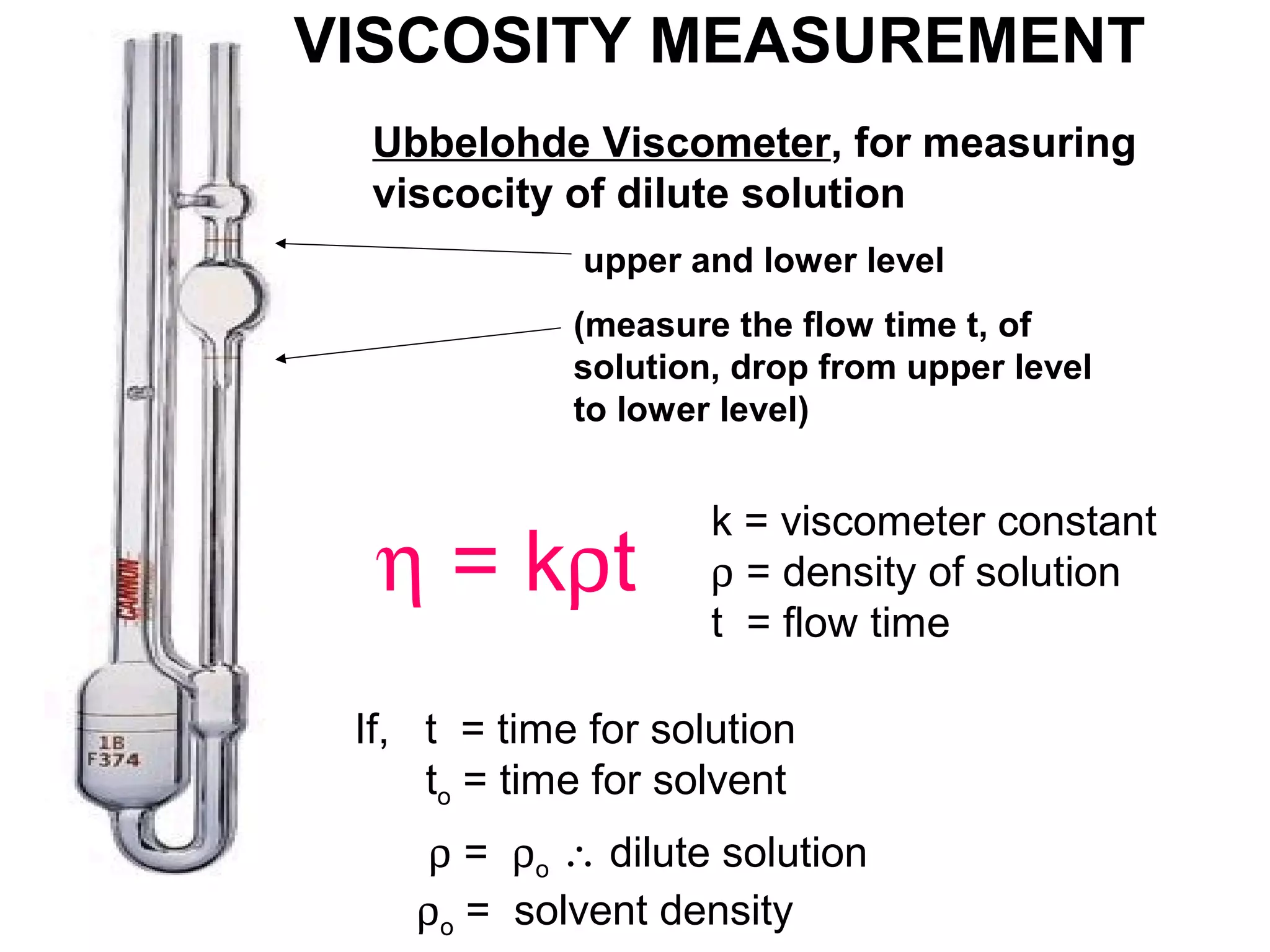
The document discusses viscosity measurement using a Ubbelohde viscometer. It measures the flow time of a dilute polymer solution dropping between two levels to calculate viscosity values like relative viscosity, specific viscosity, reduced viscosity, and inherent viscosity. These viscosity designations can be related to the molecular weight of the polymer using equations like the Mark-Houwink-Sakurada equation. Precise viscosity measurements require a clean vertical viscometer and constant temperature control.


