MetamaterialsAnd Its
clocking
Presented
By
P. KIRAN (09F01A0488)
Under the esteemed guidance
of
B. V. V. Ravindra Babu ,M.Tech.
ELECTRONICS AND COMMUNICATION ENGINEERING
Presentation Outline
 Introduction to Metamaterials
 Definition of Metamaterial
 How Metamaterials work
 Time Line
 What are Negative Index Metamaterials (NIMs)?
Negative Index Metamaterial Features
Negative Refraction
 Applications
 Conclusion
Introduction to Metamaterials
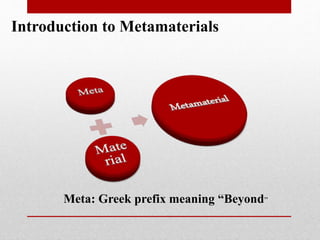
Meta: Greek prefix meaning “Beyond”
Introduction to Metamaterials:
Why are they called Metamaterials?
 Existing materials only exhibit a small subset of electromagnetic
properties theoretically available
 Metamaterials can have their electromagnetic properties altered
to something beyond what can be found in nature.
 Can achieve negative index of refraction, zero index of refraction,
magnetism at optical frequencies, etc.
Introduction to Metamaterials :
Definition of Metamaterial:
“Metamaterial” coined in the late 1990’s
 Any material composed of periodic, macroscopic
structures so as to achieve a desired electromagnetic
response can be referred to as a Metamaterial
very broad definition:
 Others prefer to restrict the term Metamaterial to
materials with electromagnetic properties not found in
nature
 Still some ambiguity as the exact definition
Veselago first studies the effect a negative permittivity and permeability has on
wave propagation 1968
Pendry proposes wire structures to realize a negative
permittivity1996
Pendry proposes Split Ring Resonators (SRR’s) to realize a
negative permeability
Pendry proposes another wire structures to realize a
negative permittivity
1999
2000
T
I
M
E
L
I
N
E
How Metamaterials Work
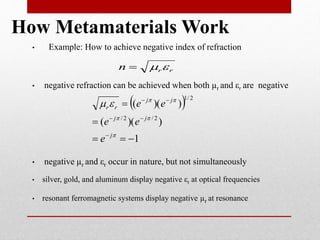
• Example: How to achieve negative index of refraction
• negative refraction can be achieved when both µr and εr are negative
• negative µr and εr occur in nature, but not simultaneously
• silver, gold, and aluminum display negative εr at optical frequencies
• resonant ferromagnetic systems display negative µr at resonance
rrn 
 
1
))((
))((
2/2/
2/1










j
jj
jj
rr
e
ee
ee
Negative Refraction
n > 0 n > 0n < 0
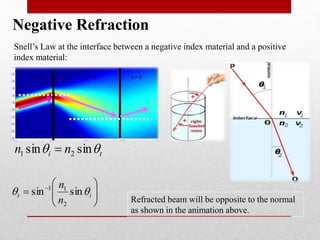
Snell’s Law at the interface between a negative index material and a positive
index material:
ti nn  sinsin 21 






 
it
n
n
 sinsin
2
11
Refracted beam will be opposite to the normal
as shown in the animation above.
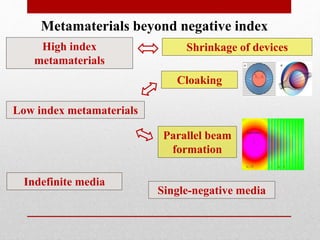
Metamaterials beyond negative index
Low index metamaterials
Indefinite media
High index
metamaterials
Shrinkage of devices
Cloaking
Single-negative media
Parallel beam
formation
Applications
• Terahertz requirement
• Photonic applicati
• Cloaking devices
• Radar applications
• Mobile applications
conclusion
Introduction of metamaterials in 1990’s opened new
possibilities in electromagnetics.
 Successful implementation of metamaterial technology
in the microwave spectrum.
 Inherent difficulties exist in fabricating optical
metamaterials
 Most work to date related to modeling proposed designs
References:
• Smith, D. R., et al., Phys. Rev. Lett. (2000) 84, 4184
• Pendry, J. B., et al., IEEE Trans. Microw. Theory
Tech. (1999) 47, 2075
• Veselago, V. G., Sov. Phys. Usp. (1968) 10, 509
• www.google.com
• www.nanotechnology.bilkent.edu.tr/research%20areas
/documents/mm-waveleft-handed.htm
• http://en.wikipedia.org/wiki/Metamaterial
Copyright
2003
Applied
Logic
Engineering
Copyright
2003
Applied
Logic
Engineering

Metamaterial

  • 1.
    MetamaterialsAnd Its clocking Presented By P. KIRAN(09F01A0488) Under the esteemed guidance of B. V. V. Ravindra Babu ,M.Tech. ELECTRONICS AND COMMUNICATION ENGINEERING
  • 2.
    Presentation Outline  Introductionto Metamaterials  Definition of Metamaterial  How Metamaterials work  Time Line  What are Negative Index Metamaterials (NIMs)? Negative Index Metamaterial Features Negative Refraction  Applications  Conclusion
  • 3.
    Introduction to Metamaterials Meta:Greek prefix meaning “Beyond”
  • 4.
    Introduction to Metamaterials: Whyare they called Metamaterials?  Existing materials only exhibit a small subset of electromagnetic properties theoretically available  Metamaterials can have their electromagnetic properties altered to something beyond what can be found in nature.  Can achieve negative index of refraction, zero index of refraction, magnetism at optical frequencies, etc.
  • 5.
  • 6.
    Definition of Metamaterial: “Metamaterial”coined in the late 1990’s  Any material composed of periodic, macroscopic structures so as to achieve a desired electromagnetic response can be referred to as a Metamaterial very broad definition:  Others prefer to restrict the term Metamaterial to materials with electromagnetic properties not found in nature  Still some ambiguity as the exact definition
  • 7.
    Veselago first studiesthe effect a negative permittivity and permeability has on wave propagation 1968 Pendry proposes wire structures to realize a negative permittivity1996 Pendry proposes Split Ring Resonators (SRR’s) to realize a negative permeability Pendry proposes another wire structures to realize a negative permittivity 1999 2000 T I M E L I N E
  • 8.
    How Metamaterials Work •Example: How to achieve negative index of refraction • negative refraction can be achieved when both µr and εr are negative • negative µr and εr occur in nature, but not simultaneously • silver, gold, and aluminum display negative εr at optical frequencies • resonant ferromagnetic systems display negative µr at resonance rrn    1 ))(( ))(( 2/2/ 2/1           j jj jj rr e ee ee
  • 9.
    Negative Refraction n >0 n > 0n < 0 Snell’s Law at the interface between a negative index material and a positive index material: ti nn  sinsin 21          it n n  sinsin 2 11 Refracted beam will be opposite to the normal as shown in the animation above.
  • 10.
    Metamaterials beyond negativeindex Low index metamaterials Indefinite media High index metamaterials Shrinkage of devices Cloaking Single-negative media Parallel beam formation
  • 11.
    Applications • Terahertz requirement •Photonic applicati • Cloaking devices • Radar applications • Mobile applications
  • 12.
    conclusion Introduction of metamaterialsin 1990’s opened new possibilities in electromagnetics.  Successful implementation of metamaterial technology in the microwave spectrum.  Inherent difficulties exist in fabricating optical metamaterials  Most work to date related to modeling proposed designs
  • 13.
    References: • Smith, D.R., et al., Phys. Rev. Lett. (2000) 84, 4184 • Pendry, J. B., et al., IEEE Trans. Microw. Theory Tech. (1999) 47, 2075 • Veselago, V. G., Sov. Phys. Usp. (1968) 10, 509 • www.google.com • www.nanotechnology.bilkent.edu.tr/research%20areas /documents/mm-waveleft-handed.htm • http://en.wikipedia.org/wiki/Metamaterial
  • 14.
  • 15.