 Introduction to Bioinformatics
 DNA Microarrays
 Internet Sites onWeb
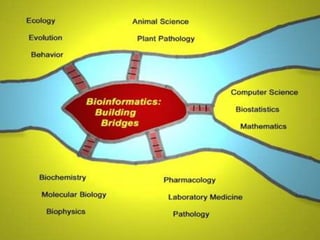
 "Bioinformatics is the field of science in which
biology, computer science, and information
technology merge into a single discipline”
OR
 The use of computational & statistical
techniques for the analysis of biological data.
 In1960s: the birth of bioinformatics.
 The branch of science concerned with
information and information flow in
biological systems, esp. the use of
computational methods in genetics and
genomics.
 The field of science in which biology,
computer science and information
technology merge into a single discipline
 Over a century ago, bioinformatics work
started with an Austrian monk namedGregor
Mendel .
 He is known as” Father of genetics “.
 Mendel illustrated that the inheritance of
traits could be more easily explained if it was
controlled by factors passed down from
generation to generation
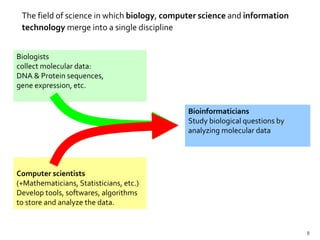
Biologists
collect molecular data:
DNA & Protein sequences,
gene expression, etc.
Computer scientists
(+Mathematicians, Statisticians, etc.)
Develop tools, softwares, algorithms
to store and analyze the data.
Bioinformaticians
Study biological questions by
analyzing molecular data
The field of science in which biology, computer science and information
technology merge into a single discipline
8
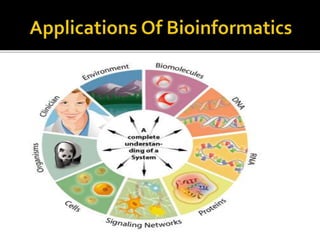
The science of bioinformatics has many
beneficial uses in the modern day world.
These Include the following :
 Molecular medicine
 Microbial genome application
 Agriculture
 Animals
 Comparative studies
 Gene therapy
 Human genome will have profound effects on
the field of biomedical research and clinical
medicine.
 Every disease has a genetic component and
inherited to body’s response to an
environmental stress which called alterations
In the genome ( e.g cancers, heart disease
and diabetes)
 The sequencing of the genomes of plants and
animals should have enormous benefits for the
agricultural community and can be used to
search for the genes within these genomes and
their functions, making them healthier, more
disease resistance and more productive.
 Crops
 Insect resistance
 Improve nutritional quality
 Grow in poorer soils and drought resistant
 Sequencing projects of many farm animals
including cows, pigs and sheep are now well
under way in the hope that a better
understanding of the biology of these
organisms will have huge impacts for
improving the production and health of
livestock and ultimately have benefits for
human nutrition.
 Analyzing and comparing the genetic material of
different species is an important method for
studying functions of genes, mechanism of
inherited diseases and species evolution.
 Bioinformatics tools can be used to make
comparisons between the numbers, locations
and biochemical functions of genes in different
organisms.
 Organisms that are suitable for use in
experiments are termed as MODEL ORGANISMS
 Gene therapy is the approach used to treat,
cure or even prevent disease by changing the
expression of a person’s gene.
 In the not too distant future, the potential for
using genes themselves to treat disease may
become a reality.
 Microorganisms are ubiquitous, that is they
are found everywhere.They have been found
surviving and thriving in extremes of heat,
cold, radiation, salt, acidity, and pressure.
 By studying the genetics material of these
organisms, scientists can begin to understand
these microbes at a very fundamental level
and isolate the genes that give them their
unique abilities to survive under the extreme
conditions.
 Waste cleanup
 Climate change studies
 Alternative energy sources
 Biotechnology
 Antibiotic resistance
 Forensic analysis of microbes
 Bio-weapon creation
 Evolutionary studies
 Molecular Bioinformatics involves the use of
computational tools to discover new
information in complex data sets (from the
one-dimensional information of DNA through
the two-dimensional information of RNA and
the three-dimensional information of proteins,
to the four-dimensional information of
evolving living systems).
 A Recombinant DNA Method
 Also known as DNA Chip
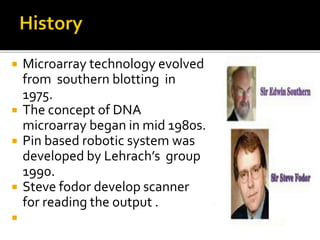
 Microarray technology evolved
from southern blotting in
1975.
 The concept of DNA
microarray began in mid 1980s.
 Pin based robotic system was
developed by Lehrach’s group
1990.
 Steve fodor develop scanner
for reading the output .

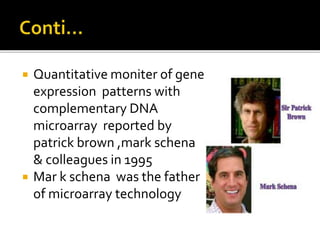
 Quantitative moniter of gene
expression patterns with
complementary DNA
microarray reported by
patrick brown ,mark schena
& colleagues in 1995
 Mar k schena was the father
of microarray technology
 The DNA microarray is a tool used to determine
whether the DNA from a particular individual
contains a mutation in genes
 The chip consists of a small glass plate encased in
plastic. Some companies manufacture
microarrays using methods similar to those used
to make computer microchips. On the surface,
each chip contains thousands of short, synthetic,
single-stranded DNA sequences, which together
add up to the normal gene in question, and to
variants (mutations) of that gene that have been
found in the human population
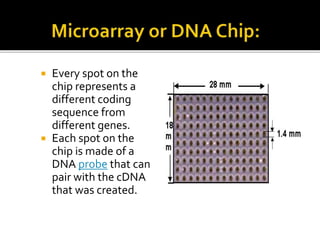
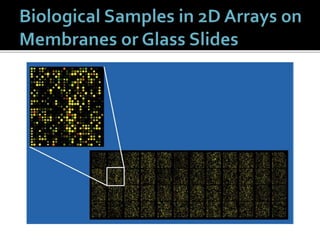
 Every spot on the
chip represents a
different coding
sequence from
different genes.
 Each spot on the
chip is made of a
DNA probe that can
pair with the cDNA
that was created.
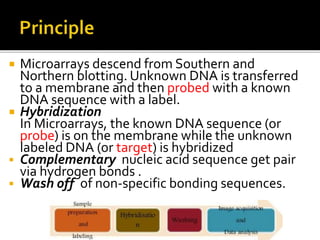
 Microarrays descend from Southern and
Northern blotting. Unknown DNA is transferred
to a membrane and then probed with a known
DNA sequence with a label.
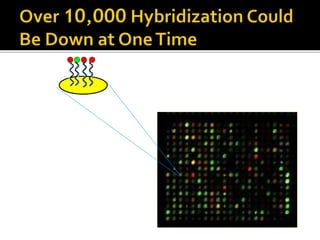
 Hybridization
In Microarrays, the known DNA sequence (or
probe) is on the membrane while the unknown
labeled DNA (or target) is hybridized
 Complementary nucleic acid sequence get pair
via hydrogen bonds .
 Wash off of non-specific bonding sequences.
 Microarray is a general term there are many
type now
 DNA microarray
 Protein microarray
 Tissue microarray
 Transfection microarray
 Chemical compound microarray
 Antibody microarray
1. Amount of mRNA expressed by a gene.
2. Amount of mRNA expressed by an exon.
3. Amount of RNA expressed by a region of DNA.
4.Which strand of DNA is expressed.
5.Which of several similar DNA sequences
6. How many copies of a gene is present in the
genome.
7.Where a known protein has bound to the DNA.
 Spotted DNA arrays
 Affymetrix gene chips
 Ink-jet microarrays from Agilent
 First type of DNA microarray technology
develop
 It was pioneered by Patrick brown and his
colleagues at Stanford University .
 Produced by using a robotic device which
deposits (spots) a nanoliter of DNA onto a
coated microscopic glass slides (50-150 um in
diameter)
 High-density oligonucleotide microarray
often referred to as a chips which involves in
situ oligonucleotide synthesis
 25-60-mers “printed directly on glass slides
 Flexible, rapid, but expensive
 Collect tissue
 Isolate RNA
 Isolate m RNA
 Make labeled DNA copy
 Apply DNA
 Scan microarray
 Analyze data
 Isolate a total RNA containing mRNA
that ideally represents a quantitative
copy of genes expressed at the time of
sample collection .
 Preparation of cDNA from mRNA using a
reverse-transcriptase enzyme .
 Short primer is required to initiate cDNA
synthesis.
 Each cDNA (sample & control ) is labelled
with fluorescent cyanine dyes (i.e cy3
&cy5)
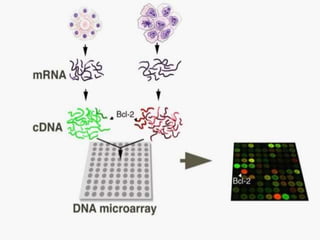
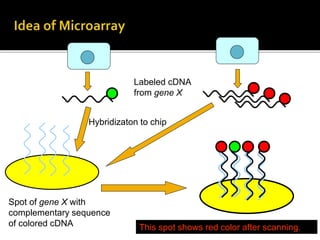
Cell A Cell B
Hybridizaton to chip
Labeled cDNA
from gene X
Spot of gene X with
complementary sequence
of colored cDNA This spot shows red color after scanning.
…
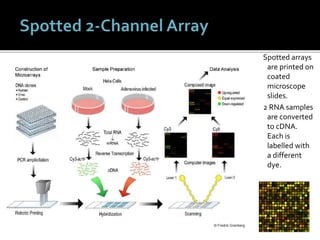
Spotted arrays
are printed on
coated
microscope
slides.
2 RNA samples
are converted
to cDNA.
Each is
labelled with
a different
dye.
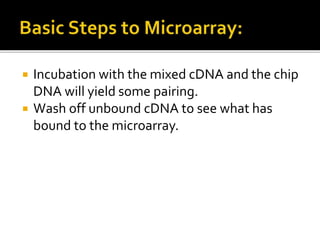
 Incubation with the mixed cDNA and the chip
DNA will yield some pairing.
 Wash off unbound cDNA to see what has
bound to the microarray.
 The slide with the microarray chip is placed
inside a dark box where it is scanned with a
high resolution laser that detects the bound
fluorescent labels.
 The information and images are then sent to the
computer for analysis.
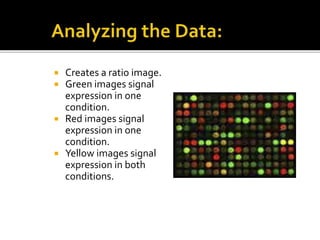
 Creates a ratio image.
 Green images signal
expression in one
condition.
 Red images signal
expression in one
condition.
 Yellow images signal
expression in both
conditions.
 Not limited to human genetic material.
 Can be used for all species.
 Can display thousands of different genes.
 Allows the study of multiple genes at once.
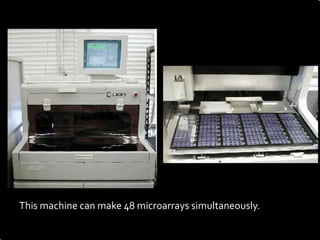
This machine can make 48 microarrays simultaneously.
 They are big databases and searching either one should
produce
 Similar results because they exchange information
routinely.
 Gene Bank (NCBI): http://www.ncbi.nlm.nih.gov
 Ensembl: http://useast.ensembl.org/index.html
DDBJ (DNA DataBase of Japan):
http://www.ddbj.nig.ac.jp
TIGR: http://tigr.org/tdb/tgi
 Translated databases:
 TREMBL (translated EMBL): includes
entries that have
 not been annotated yet into Swiss-Prot.
 http://www.ebi.ac.uk/trembl/access.html
 Sites for DNA to ProteinTranslation:
 These algorithms can translate DNA sequences in
any of the 3 forward or three
 reverse sense frames.
Translate (http://au.expasy.org/tools/dna.html)
Translate a DNA sequence:
(http://www.vivo.colostate.edu/molkit/translate/index.html)
Translation sequence
(http://www.ebi.ac.uk/emboss/transeq)
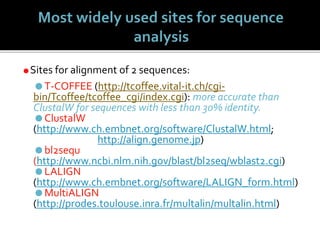
Sites for alignment of 2 sequences:
T-COFFEE (http://tcoffee.vital-it.ch/cgi-
bin/Tcoffee/tcoffee_cgi/index.cgi): more accurate than
ClustalW for sequences with less than 30% identity.
ClustalW
(http://www.ch.embnet.org/software/ClustalW.html;
http://align.genome.jp)
bl2sequ
(http://www.ncbi.nlm.nih.gov/blast/bl2seq/wblast2.cgi)
LALIGN
(http://www.ch.embnet.org/software/LALIGN_form.html)
MultiALIGN
(http://prodes.toulouse.inra.fr/multalin/multalin.html)
http://www.mbio.ncsu.edu/bioedit/bioedit.html
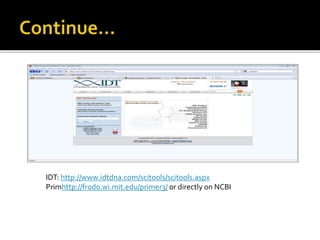
IDT: http://www.idtdna.com/scitools/scitools.aspx
Primhttp://frodo.wi.mit.edu/primer3/ or directly on NCBI
 Strachan,Tom; Read, Andrew. Human Molecular Genetics 3.
pp 175-178. NewYork. Garland Publishing. 2004.
 Campbell,A. Malcom. Microarray Animation. Davidson
College. 2001.
www.bio.davidson.edu/courses/genomics/chip/chip.html
 http://cmgm.stanford.edu
 http://www.gene-chips.com/

Bioinformatics group presentation

  • 2.
     Introduction toBioinformatics  DNA Microarrays  Internet Sites onWeb
  • 3.
     "Bioinformatics isthe field of science in which biology, computer science, and information technology merge into a single discipline” OR  The use of computational & statistical techniques for the analysis of biological data.  In1960s: the birth of bioinformatics.
  • 4.
     The branchof science concerned with information and information flow in biological systems, esp. the use of computational methods in genetics and genomics.
  • 6.
     The fieldof science in which biology, computer science and information technology merge into a single discipline
  • 7.
     Over acentury ago, bioinformatics work started with an Austrian monk namedGregor Mendel .  He is known as” Father of genetics “.  Mendel illustrated that the inheritance of traits could be more easily explained if it was controlled by factors passed down from generation to generation
  • 8.
    Biologists collect molecular data: DNA& Protein sequences, gene expression, etc. Computer scientists (+Mathematicians, Statisticians, etc.) Develop tools, softwares, algorithms to store and analyze the data. Bioinformaticians Study biological questions by analyzing molecular data The field of science in which biology, computer science and information technology merge into a single discipline 8
  • 10.
    The science ofbioinformatics has many beneficial uses in the modern day world. These Include the following :  Molecular medicine  Microbial genome application  Agriculture  Animals  Comparative studies  Gene therapy
  • 11.
     Human genomewill have profound effects on the field of biomedical research and clinical medicine.  Every disease has a genetic component and inherited to body’s response to an environmental stress which called alterations In the genome ( e.g cancers, heart disease and diabetes)
  • 12.
     The sequencingof the genomes of plants and animals should have enormous benefits for the agricultural community and can be used to search for the genes within these genomes and their functions, making them healthier, more disease resistance and more productive.  Crops  Insect resistance  Improve nutritional quality  Grow in poorer soils and drought resistant
  • 13.
     Sequencing projectsof many farm animals including cows, pigs and sheep are now well under way in the hope that a better understanding of the biology of these organisms will have huge impacts for improving the production and health of livestock and ultimately have benefits for human nutrition.
  • 14.
     Analyzing andcomparing the genetic material of different species is an important method for studying functions of genes, mechanism of inherited diseases and species evolution.  Bioinformatics tools can be used to make comparisons between the numbers, locations and biochemical functions of genes in different organisms.  Organisms that are suitable for use in experiments are termed as MODEL ORGANISMS
  • 15.
     Gene therapyis the approach used to treat, cure or even prevent disease by changing the expression of a person’s gene.  In the not too distant future, the potential for using genes themselves to treat disease may become a reality.
  • 16.
     Microorganisms areubiquitous, that is they are found everywhere.They have been found surviving and thriving in extremes of heat, cold, radiation, salt, acidity, and pressure.  By studying the genetics material of these organisms, scientists can begin to understand these microbes at a very fundamental level and isolate the genes that give them their unique abilities to survive under the extreme conditions.
  • 17.
     Waste cleanup Climate change studies  Alternative energy sources  Biotechnology  Antibiotic resistance  Forensic analysis of microbes  Bio-weapon creation  Evolutionary studies
  • 18.
     Molecular Bioinformaticsinvolves the use of computational tools to discover new information in complex data sets (from the one-dimensional information of DNA through the two-dimensional information of RNA and the three-dimensional information of proteins, to the four-dimensional information of evolving living systems).
  • 19.
     A RecombinantDNA Method  Also known as DNA Chip
  • 20.
     Microarray technologyevolved from southern blotting in 1975.  The concept of DNA microarray began in mid 1980s.  Pin based robotic system was developed by Lehrach’s group 1990.  Steve fodor develop scanner for reading the output . 
  • 21.
     Quantitative moniterof gene expression patterns with complementary DNA microarray reported by patrick brown ,mark schena & colleagues in 1995  Mar k schena was the father of microarray technology
  • 22.
     The DNAmicroarray is a tool used to determine whether the DNA from a particular individual contains a mutation in genes  The chip consists of a small glass plate encased in plastic. Some companies manufacture microarrays using methods similar to those used to make computer microchips. On the surface, each chip contains thousands of short, synthetic, single-stranded DNA sequences, which together add up to the normal gene in question, and to variants (mutations) of that gene that have been found in the human population
  • 23.
     Every spoton the chip represents a different coding sequence from different genes.  Each spot on the chip is made of a DNA probe that can pair with the cDNA that was created.
  • 24.
     Microarrays descendfrom Southern and Northern blotting. Unknown DNA is transferred to a membrane and then probed with a known DNA sequence with a label.  Hybridization In Microarrays, the known DNA sequence (or probe) is on the membrane while the unknown labeled DNA (or target) is hybridized  Complementary nucleic acid sequence get pair via hydrogen bonds .  Wash off of non-specific bonding sequences.
  • 25.
     Microarray isa general term there are many type now  DNA microarray  Protein microarray  Tissue microarray  Transfection microarray  Chemical compound microarray  Antibody microarray
  • 26.
    1. Amount ofmRNA expressed by a gene. 2. Amount of mRNA expressed by an exon. 3. Amount of RNA expressed by a region of DNA. 4.Which strand of DNA is expressed. 5.Which of several similar DNA sequences 6. How many copies of a gene is present in the genome. 7.Where a known protein has bound to the DNA.
  • 29.
     Spotted DNAarrays  Affymetrix gene chips  Ink-jet microarrays from Agilent
  • 30.
     First typeof DNA microarray technology develop  It was pioneered by Patrick brown and his colleagues at Stanford University .  Produced by using a robotic device which deposits (spots) a nanoliter of DNA onto a coated microscopic glass slides (50-150 um in diameter)
  • 31.
     High-density oligonucleotidemicroarray often referred to as a chips which involves in situ oligonucleotide synthesis
  • 32.
     25-60-mers “printeddirectly on glass slides  Flexible, rapid, but expensive
  • 33.
     Collect tissue Isolate RNA  Isolate m RNA  Make labeled DNA copy  Apply DNA  Scan microarray  Analyze data
  • 34.
     Isolate atotal RNA containing mRNA that ideally represents a quantitative copy of genes expressed at the time of sample collection .  Preparation of cDNA from mRNA using a reverse-transcriptase enzyme .  Short primer is required to initiate cDNA synthesis.  Each cDNA (sample & control ) is labelled with fluorescent cyanine dyes (i.e cy3 &cy5)
  • 36.
    Cell A CellB Hybridizaton to chip Labeled cDNA from gene X Spot of gene X with complementary sequence of colored cDNA This spot shows red color after scanning.
  • 37.
    … Spotted arrays are printedon coated microscope slides. 2 RNA samples are converted to cDNA. Each is labelled with a different dye.
  • 38.
     Incubation withthe mixed cDNA and the chip DNA will yield some pairing.  Wash off unbound cDNA to see what has bound to the microarray.
  • 39.
     The slidewith the microarray chip is placed inside a dark box where it is scanned with a high resolution laser that detects the bound fluorescent labels.  The information and images are then sent to the computer for analysis.
  • 40.
     Creates aratio image.  Green images signal expression in one condition.  Red images signal expression in one condition.  Yellow images signal expression in both conditions.
  • 41.
     Not limitedto human genetic material.  Can be used for all species.  Can display thousands of different genes.  Allows the study of multiple genes at once.
  • 42.
    This machine canmake 48 microarrays simultaneously.
  • 44.
     They arebig databases and searching either one should produce  Similar results because they exchange information routinely.  Gene Bank (NCBI): http://www.ncbi.nlm.nih.gov  Ensembl: http://useast.ensembl.org/index.html
  • 45.
    DDBJ (DNA DataBaseof Japan): http://www.ddbj.nig.ac.jp TIGR: http://tigr.org/tdb/tgi
  • 46.
     Translated databases: TREMBL (translated EMBL): includes entries that have  not been annotated yet into Swiss-Prot.  http://www.ebi.ac.uk/trembl/access.html
  • 47.
     Sites forDNA to ProteinTranslation:  These algorithms can translate DNA sequences in any of the 3 forward or three  reverse sense frames. Translate (http://au.expasy.org/tools/dna.html) Translate a DNA sequence: (http://www.vivo.colostate.edu/molkit/translate/index.html) Translation sequence (http://www.ebi.ac.uk/emboss/transeq)
  • 48.
    Sites for alignmentof 2 sequences: T-COFFEE (http://tcoffee.vital-it.ch/cgi- bin/Tcoffee/tcoffee_cgi/index.cgi): more accurate than ClustalW for sequences with less than 30% identity. ClustalW (http://www.ch.embnet.org/software/ClustalW.html; http://align.genome.jp) bl2sequ (http://www.ncbi.nlm.nih.gov/blast/bl2seq/wblast2.cgi) LALIGN (http://www.ch.embnet.org/software/LALIGN_form.html) MultiALIGN (http://prodes.toulouse.inra.fr/multalin/multalin.html)
  • 49.
  • 50.
  • 51.
     Strachan,Tom; Read,Andrew. Human Molecular Genetics 3. pp 175-178. NewYork. Garland Publishing. 2004.  Campbell,A. Malcom. Microarray Animation. Davidson College. 2001. www.bio.davidson.edu/courses/genomics/chip/chip.html  http://cmgm.stanford.edu  http://www.gene-chips.com/