Online
assignment
TOPIC
HUMAN GENOME PROJECTAND TISSUE
CULTURE
SUBMITTEDTO,
RESHMA THULASI T.L
ASSISTANT PROF.IN N.S
FMTC , MYLAPORE
DATE:9/02/2016
SUBMITTED BY
PALLAVI P.J
First yr B.Ed
Roll no: 1811534006
NATURAL SCIENCE
F.M.T.C MYLAPORE
index
SL.NO TITLE PAGENO.
1 introduction 4
2 content 5-8
3 conclusion 9
4 reference 9
Introduction
Despite all the thingsthathumanbeingcando or are capable of doing,theirbodiesare builtonandrun
by lessthan100,000 proteinmolecules.Eachof these proteinmoleculeshasacorrespondinggene,
whichisresponsibleforensuringthatthere isatimelyflow of instructions.The humanbeing,therefore,
functionsbya setof geneticinstructions. The Human genome isa complementof geneticmaterialthat
isfoundinthe humancell.Thoughthere are overa billionpeople inthe worldtoday,there are only
minute differencesbetweengenomes,whichiswhyitisusuallyreferredtoasthe humangenome,asif
there isonlyone inthe whole world.The singularreference tothe humangenome isonlyintendedto
stipulate howlittledifferencethere isthe genomesfoundindifferenthumancells.
Tissue culture as a technique was first used almost 100 years ago to elucidate some of the most basic
questions in developmental biology. Ross Harrison at the Rockefeller Institute, in an attempt to observe
living, developing nerve fibers, cultured frog embryo tissues in plasma clots for 1 to 4 weeks (Harrison,
1907). He was able to observe the development and outgrowth of nerve fibers in these cultures. In 1912,
Alexis Carrel, also at the Rockefeller Institute, attempted to improve the state of the art of animal cell
culture with experiments on the culture of chick embryo tissue
HumanGenomeProject
The term GENOME is derived as full complement of genetic information,coding and
non-coding, present in each cell of an organism, irrespective of whether they are expressed or
not. The scientific study of the full complement of genetic material in each cell or organism,
whether active or silent and their interactions with each other are collectively called
GENOMICS. The last two decades have witnessed immense research activity in elucidating and
characterizing genes and gene products of several organisms.More than 3000 whole genomes
have been sequenced till date and added to public databases.
The human genome is identical to the extend of 99.9% between individuals. So it is
evident that minor changes in the genetic make up may often end in abnormal conditions, and
changes in physiological conditions, leading to disease and ill health. Finding such differences
can help in the discovery and invention of corrective measures. It is generally measured that in
the very near future, such inventions can be carried out by gene therapy or by appropriate
physiological interventions. A new branch of heaqlth science called personolised medicine has
already come into existence, taking note of the fact that the metabolism of pharmaceutical drugs
are different in each persons and is dependent on his genetic make up.
History
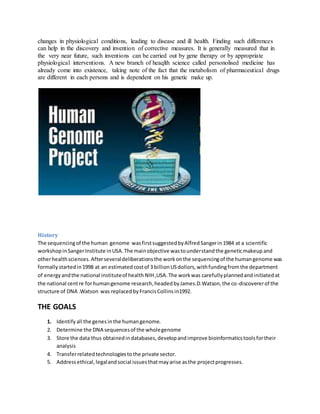
The sequencingof the human genome wasfirstsuggestedbyAlfredSangerin1984 at a scientific
workshopinSangerInstitute inUSA.The mainobjective wastounderstandthe geneticmakeup and
otherhealthsciences.Afterseveraldeliberationsthe workonthe sequencingof the humangenome was
formallystartedin1998 at an estimatedcostof 3 billionUSdollors,withfundingfromthe department
of energyandthe national instituteof health NIH,USA.The workwas carefullyplannedandinitiatedat
the national centre forhumangenome research,headedbyJames.D.Watson,the co-discovererof the
structure of DNA .Watson was replacedbyFrancisCollinsin1992.
THE GOALS
1. Identify all the genes inthe humangenome.
2. Determine the DNA sequencesof the wholegenome
3. Store the data thus obtainedindatabases,developandimprove bioinformaticstoolsfortheir
analysis
4. Transferrelatedtechnologiestothe private sector.
5. Addressethical,legalandsocial issuesthatmayarise asthe projectprogresses.
THE PLAN
The humangenome projecthasbeentermedasthe largestsingle investigationalprojectin
modernscience.The original planwastocomplete the projectby2005. In1990, takingintoaccount
the huge expenseslarge manpowerandthe extendedtime estimatedtofinishthe project;the USA
formed an internationalconsortiumwithcountriessuchasChina,France,Germany,Japanandthe
UK. Each of the membercountrieswasassignedparticularchromosomesof the genomefor
sequence analysis.The geneticmaterial usedwasobtainedfromasmall setof anonymousdonors
and hence,the dataobtainedbythe Human genome projecthastobe consideredonlyasa
combinedreference sequence .The identityof the personorpersonswhose geneticmaterialis
beingusedhasbeenkeptsecretandwill notbe revealed.
THE TECHNIQUE
The technique adoptedwasamethodcalledhierarchialshot-gunmethod.Thisinvolved
cuttingup the chromosomesintomanageablefragmentsbya processcalledrestrictiondigestion
usingendonucleases.The fragmentsthus createdare clonedintosuitable vectorsinmicrobesby
recombinantDNA technology,whichresultsinthe productionof Bacterial Artificial Chromosomes
carryingthe humangenome fragments.Since several suchfragmentsare combinedinasingle
bacterium,theyare called DNAlibraries. Copiesof the librariesare thenproducedbyallowingthe
microbestomultiplyinsuitablemedia,sothatsufficientnumbersof the fragmentscouldbe
obtained.The microbeswere thengathered,lysed,the DNA fragmentsharvestedandsequenced
by Sanger’sdi-deoxymethod.
TISSUECULTURE
tissue culture isthe growthof tissues orcellsseparate fromthe organism.Thisistypicallyfacilitated
viause of a liquid,semi-solid,orsolid growthmedium,suchasbrothor agar. Tissue culture commonly
referstothe culture of animal cellsandtissues,withthe more specificterm planttissue culture being
usedforplants.The term "tissue culture"wascoinedbyAmericanpathologist Montrose Thomas
Burrows.
Modern usage
Main article:cell culture
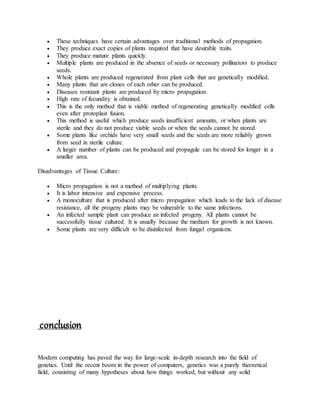
Culturedcellsgrowingin growthmedium
In modern usage, tissue culture generally refers to the growth of cells from a tissue from a
multicellular organism in vitro. These cells may be cells isolated from a donor organism, primary
cells, or an immortalised cell line. The cells are bathed in a culture medium, which contains
essential nutrients and energy sources necessary for the cells' survival.The term tissue culture is
often used interchangeably with cell culture
The literal meaning of tissue culture refers to the culturing of tissue pieces, i.e. explant culture.
Tissue culture is an important tool for the study of the biology of cells from multicellular
organisms. It provides an in vitro model of the tissue in a well defined environment which can be
easily manipulated and analysed.
Plant tissue culture in particular is concerned with the growing of entire plants from small pieces
of plant tissue, cultured in medium
. Advantages and Disadvantages of Tissue
Culture
Advantages of Tissue Culture:
 These techniques have certain advantages over traditional methods of propagation.
 They produce exact copies of plants required that have desirable traits.
 They produce mature plants quickly.
 Multiple plants are produced in the absence of seeds or necessary pollinators to produce
seeds.
 Whole plants are produced regenerated from plant cells that are genetically modified.
 Many plants that are clones of each other can be produced.
 Diseases resistant plants are produced by micro propagation.
 High rate of fecundity is obtained.
 This is the only method that is viable method of regenerating genetically modified cells
even after protoplast fusion.
 This method is useful which produce seeds insufficient amounts, or when plants are
sterile and they do not produce viable seeds or when the seeds cannot be stored.
 Some plants like orchids have very small seeds and the seeds are more reliably grown
from seed in sterile culture.
 A larger number of plants can be produced and propagule can be stored for longer in a
smaller area.
Disadvantages of Tissue Culture:
 Micro propagation is not a method of multiplying plants.
 It is labor intensive and expensive process.
 A monoculture that is produced after micro propagation which leads to the lack of disease
resistance, all the progeny plants may be vulnerable to the same infections.
 An infected sample plant can produce an infected progeny. All plants cannot be
successfully tissue cultured. It is usually because the medium for growth is not known.
 Some plants are very difficult to be disinfected from fungal organisms.
conclusion
Modern computing has paved the way for large-scale in-depth research into the field of
genetics. Until the recent boom in the power of computers, genetics was a purely theoretical
field, consisting of many hypotheses about how things worked, but without any solid
evidence to back it up. With the advent of modern computers, it became possible to delve
into large-scale sequencing and develop the field known as genomics. In looking at the
history of genetic research, it is obvious that without modern computing power, most
modern developments in genetics would not have been possible. Even with modern
sequencing techniques, reliance on human resources in a divide and conquer strategy could
not come close to completing the sequencing of the human genome within its predicted 15
year period. The development of a technique that eliminates the need for this divide and
conquer strategy and completely relies on an algorithm utilizing high amounts of computing
power, however, resulted in the completion of the project from scratch in under a year. This
clearly shows the power that modern computing offers to the field of genetics. In addition,
genomics is centered around databases and algorithms that predict functionality and activity
of genes that control cellular physiology, and ultimately the physiology of the organism.
REFERENCE
GeneticsandBiotechnology:KVijayakumaranNair
http://humangenes.org/human-genome-introduction
https://en.wikipedia.org/wiki/Human_Genome_Project
Checked and corrected by
RESHMA THULASI T L
Asst.professor in NaturalScience
F M T C Mylapore

Pallavi online assignment

  • 1.
  • 2.
    TOPIC HUMAN GENOME PROJECTANDTISSUE CULTURE SUBMITTEDTO, RESHMA THULASI T.L ASSISTANT PROF.IN N.S FMTC , MYLAPORE
  • 3.
    DATE:9/02/2016 SUBMITTED BY PALLAVI P.J Firstyr B.Ed Roll no: 1811534006 NATURAL SCIENCE F.M.T.C MYLAPORE index SL.NO TITLE PAGENO. 1 introduction 4 2 content 5-8 3 conclusion 9 4 reference 9
  • 4.
    Introduction Despite all thethingsthathumanbeingcando or are capable of doing,theirbodiesare builtonandrun by lessthan100,000 proteinmolecules.Eachof these proteinmoleculeshasacorrespondinggene, whichisresponsibleforensuringthatthere isatimelyflow of instructions.The humanbeing,therefore, functionsbya setof geneticinstructions. The Human genome isa complementof geneticmaterialthat isfoundinthe humancell.Thoughthere are overa billionpeople inthe worldtoday,there are only minute differencesbetweengenomes,whichiswhyitisusuallyreferredtoasthe humangenome,asif there isonlyone inthe whole world.The singularreference tothe humangenome isonlyintendedto stipulate howlittledifferencethere isthe genomesfoundindifferenthumancells. Tissue culture as a technique was first used almost 100 years ago to elucidate some of the most basic questions in developmental biology. Ross Harrison at the Rockefeller Institute, in an attempt to observe living, developing nerve fibers, cultured frog embryo tissues in plasma clots for 1 to 4 weeks (Harrison, 1907). He was able to observe the development and outgrowth of nerve fibers in these cultures. In 1912, Alexis Carrel, also at the Rockefeller Institute, attempted to improve the state of the art of animal cell culture with experiments on the culture of chick embryo tissue
  • 5.
    HumanGenomeProject The term GENOMEis derived as full complement of genetic information,coding and non-coding, present in each cell of an organism, irrespective of whether they are expressed or not. The scientific study of the full complement of genetic material in each cell or organism, whether active or silent and their interactions with each other are collectively called GENOMICS. The last two decades have witnessed immense research activity in elucidating and characterizing genes and gene products of several organisms.More than 3000 whole genomes have been sequenced till date and added to public databases. The human genome is identical to the extend of 99.9% between individuals. So it is evident that minor changes in the genetic make up may often end in abnormal conditions, and
  • 6.
    changes in physiologicalconditions, leading to disease and ill health. Finding such differences can help in the discovery and invention of corrective measures. It is generally measured that in the very near future, such inventions can be carried out by gene therapy or by appropriate physiological interventions. A new branch of heaqlth science called personolised medicine has already come into existence, taking note of the fact that the metabolism of pharmaceutical drugs are different in each persons and is dependent on his genetic make up. History The sequencingof the human genome wasfirstsuggestedbyAlfredSangerin1984 at a scientific workshopinSangerInstitute inUSA.The mainobjective wastounderstandthe geneticmakeup and otherhealthsciences.Afterseveraldeliberationsthe workonthe sequencingof the humangenome was formallystartedin1998 at an estimatedcostof 3 billionUSdollors,withfundingfromthe department of energyandthe national instituteof health NIH,USA.The workwas carefullyplannedandinitiatedat the national centre forhumangenome research,headedbyJames.D.Watson,the co-discovererof the structure of DNA .Watson was replacedbyFrancisCollinsin1992. THE GOALS 1. Identify all the genes inthe humangenome. 2. Determine the DNA sequencesof the wholegenome 3. Store the data thus obtainedindatabases,developandimprove bioinformaticstoolsfortheir analysis 4. Transferrelatedtechnologiestothe private sector. 5. Addressethical,legalandsocial issuesthatmayarise asthe projectprogresses.
  • 7.
    THE PLAN The humangenomeprojecthasbeentermedasthe largestsingle investigationalprojectin modernscience.The original planwastocomplete the projectby2005. In1990, takingintoaccount the huge expenseslarge manpowerandthe extendedtime estimatedtofinishthe project;the USA formed an internationalconsortiumwithcountriessuchasChina,France,Germany,Japanandthe UK. Each of the membercountrieswasassignedparticularchromosomesof the genomefor sequence analysis.The geneticmaterial usedwasobtainedfromasmall setof anonymousdonors and hence,the dataobtainedbythe Human genome projecthastobe consideredonlyasa combinedreference sequence .The identityof the personorpersonswhose geneticmaterialis beingusedhasbeenkeptsecretandwill notbe revealed. THE TECHNIQUE The technique adoptedwasamethodcalledhierarchialshot-gunmethod.Thisinvolved cuttingup the chromosomesintomanageablefragmentsbya processcalledrestrictiondigestion usingendonucleases.The fragmentsthus createdare clonedintosuitable vectorsinmicrobesby recombinantDNA technology,whichresultsinthe productionof Bacterial Artificial Chromosomes carryingthe humangenome fragments.Since several suchfragmentsare combinedinasingle bacterium,theyare called DNAlibraries. Copiesof the librariesare thenproducedbyallowingthe microbestomultiplyinsuitablemedia,sothatsufficientnumbersof the fragmentscouldbe obtained.The microbeswere thengathered,lysed,the DNA fragmentsharvestedandsequenced by Sanger’sdi-deoxymethod. TISSUECULTURE tissue culture isthe growthof tissues orcellsseparate fromthe organism.Thisistypicallyfacilitated viause of a liquid,semi-solid,orsolid growthmedium,suchasbrothor agar. Tissue culture commonly referstothe culture of animal cellsandtissues,withthe more specificterm planttissue culture being
  • 8.
    usedforplants.The term "tissueculture"wascoinedbyAmericanpathologist Montrose Thomas Burrows. Modern usage Main article:cell culture Culturedcellsgrowingin growthmedium In modern usage, tissue culture generally refers to the growth of cells from a tissue from a multicellular organism in vitro. These cells may be cells isolated from a donor organism, primary cells, or an immortalised cell line. The cells are bathed in a culture medium, which contains essential nutrients and energy sources necessary for the cells' survival.The term tissue culture is often used interchangeably with cell culture The literal meaning of tissue culture refers to the culturing of tissue pieces, i.e. explant culture. Tissue culture is an important tool for the study of the biology of cells from multicellular organisms. It provides an in vitro model of the tissue in a well defined environment which can be easily manipulated and analysed. Plant tissue culture in particular is concerned with the growing of entire plants from small pieces of plant tissue, cultured in medium . Advantages and Disadvantages of Tissue Culture Advantages of Tissue Culture:
  • 9.
     These techniqueshave certain advantages over traditional methods of propagation.  They produce exact copies of plants required that have desirable traits.  They produce mature plants quickly.  Multiple plants are produced in the absence of seeds or necessary pollinators to produce seeds.  Whole plants are produced regenerated from plant cells that are genetically modified.  Many plants that are clones of each other can be produced.  Diseases resistant plants are produced by micro propagation.  High rate of fecundity is obtained.  This is the only method that is viable method of regenerating genetically modified cells even after protoplast fusion.  This method is useful which produce seeds insufficient amounts, or when plants are sterile and they do not produce viable seeds or when the seeds cannot be stored.  Some plants like orchids have very small seeds and the seeds are more reliably grown from seed in sterile culture.  A larger number of plants can be produced and propagule can be stored for longer in a smaller area. Disadvantages of Tissue Culture:  Micro propagation is not a method of multiplying plants.  It is labor intensive and expensive process.  A monoculture that is produced after micro propagation which leads to the lack of disease resistance, all the progeny plants may be vulnerable to the same infections.  An infected sample plant can produce an infected progeny. All plants cannot be successfully tissue cultured. It is usually because the medium for growth is not known.  Some plants are very difficult to be disinfected from fungal organisms. conclusion Modern computing has paved the way for large-scale in-depth research into the field of genetics. Until the recent boom in the power of computers, genetics was a purely theoretical field, consisting of many hypotheses about how things worked, but without any solid
  • 10.
    evidence to backit up. With the advent of modern computers, it became possible to delve into large-scale sequencing and develop the field known as genomics. In looking at the history of genetic research, it is obvious that without modern computing power, most modern developments in genetics would not have been possible. Even with modern sequencing techniques, reliance on human resources in a divide and conquer strategy could not come close to completing the sequencing of the human genome within its predicted 15 year period. The development of a technique that eliminates the need for this divide and conquer strategy and completely relies on an algorithm utilizing high amounts of computing power, however, resulted in the completion of the project from scratch in under a year. This clearly shows the power that modern computing offers to the field of genetics. In addition, genomics is centered around databases and algorithms that predict functionality and activity of genes that control cellular physiology, and ultimately the physiology of the organism. REFERENCE GeneticsandBiotechnology:KVijayakumaranNair http://humangenes.org/human-genome-introduction https://en.wikipedia.org/wiki/Human_Genome_Project Checked and corrected by RESHMA THULASI T L Asst.professor in NaturalScience F M T C Mylapore