CORRELATION OF IN-VIVO DATA
WITH IN-VITRO DISSOLUTION DATA
PRESENTED BY
NAVYASHREE G
II SEM M PHARMACY
DEPT PHARMACEUTICS
PRESENTED TO
PROF H S KEERTHY
DEPT OF PHARMACEUTICS
MALLIGE COLLEGE OF PHARMACY
1/18
CONTENTS
 Introduction
 Objectives
 Levels of correlation
 Application of IVIVC
2/18
INTRODUCTION
 In vitro - In vivo correlation is defined as the
predictive mathematical model that describes the
relationship between an in-vitro property(such as
the rate of dissolution) of a dosage form and an in-
vivo response( such as the plasma drug
concentration).
 In vitro property is the rate or extent of drug
dissolution or release while , in-vivo response is the
plasma drug concentration or amount of drug
absorbed.
3/18
 OBJECTIVES
1. Setting up of an in-vitro release test that would
serve as a surrogate for in- vivo plasma profiles
(bio equivalence testing)
2. To minimize unnecessary human testing.
3. Decreased regulatory burdens.
4. To set up bio pharmaceutically meaningful in-vitro
release specifications.
5. Minimization of cost and time required in
additional bioavailability studies.
4/18
 LEVELS OF CORRELATION
 Four levels of correlation can be found in FDA
guidelines.
 Each level denotes its ability to predict invivo
response of dosage form from its in vitro property.
 The higher the level better is the correlation.
1) Level A correlation
2) Level B correlation
3) Level C correlation
4) Multiple level C correlation
5) Level D correlation
5/18
LEVEL A CORRELATION
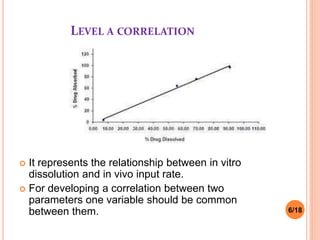
 It represents the relationship between in vitro
dissolution and in vivo input rate.
 For developing a correlation between two
parameters one variable should be common
between them. 6/18
 Here the data available is in vitro dissolution profile
and in vivo plasma drug concentration profile.
 A correlation of this type is generally linear and
represents a point to point relationship between in-
vitro dissolution and in-vivo input rate.
 Advantages of level A correlation
 A point to point correlation is developed. The invitro
dissolition curve serves as a surrogate for invivo
performance. Any change in manufacturing procedure
or modification in the formula can be justified without
the need for additional human studies.
 The invivo dissolution serves as an invivo indicating
quality control procedure for predicting dosage form’s
performance.
7/18
LEVEL B CORRELATION
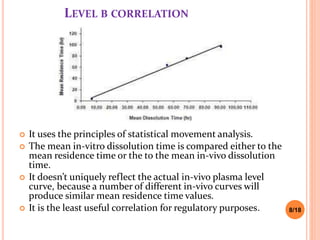
 It uses the principles of statistical movement analysis.
 The mean in-vitro dissolution time is compared either to the
mean residence time or the to the mean in-vivo dissolution
time.
 It doesn’t uniquely reflect the actual in-vivo plasma level
curve, because a number of different in-vivo curves will
produce similar mean residence time values.
 It is the least useful correlation for regulatory purposes. 8/18
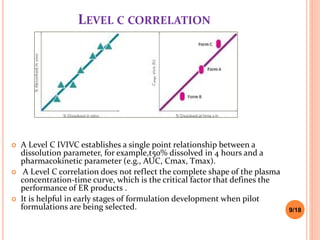
 A Level C IVIVC establishes a single point relationship between a
dissolution parameter, for example,t50% dissolved in 4 hours and a
pharmacokinetic parameter (e.g., AUC, Cmax, Tmax).
 A Level C correlation does not reflect the complete shape of the plasma
concentration-time curve, which is the critical factor that defines the
performance of ER products .
 It is helpful in early stages of formulation development when pilot
formulations are being selected. 9/18
LEVEL C CORRELATION
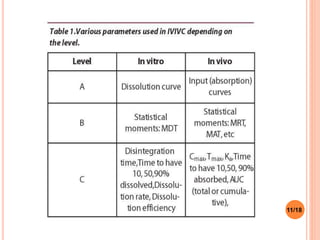
 In addition to these three levels, a combination of
various levels C is also described: A multiple Level
C correlation relates one or several
pharmacokinetic parameters of interest to the
amount of drug dissolved at several time points of
the dissolution profile.
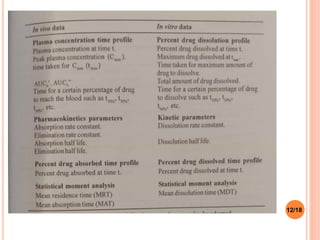
 For the establishment of a correlation as described
in the FDA guidance, various parameters can be
used as presented in following table.
10/18
11/18
12/18
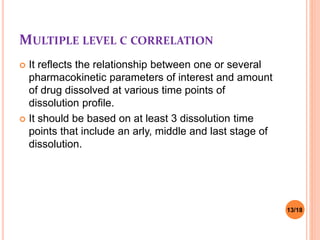
MULTIPLE LEVEL C CORRELATION
 It reflects the relationship between one or several
pharmacokinetic parameters of interest and amount
of drug dissolved at various time points of
dissolution profile.
 It should be based on at least 3 dissolution time
points that include an arly, middle and last stage of
dissolution.
13/18
LEVEL D CORRELATION
 It is a rank order and qualitative analysis and is not
considered useful for regulatory purposes.
 It is not a formal correlation but serves as an aid in
the development of a formulation or processing
procedue.
14/18
APPLICATIONS OF IVIVC
 To use in in-vitro dissolution study as a surrogate for
human BE studies. This will reduce the number of
human BE studies during the initial approval process
as well as scale up and post approval changes.
 Justification for therapeutic product quality.
 Enhanced significance of invitro testing.
 During scale up, the dissolution data to judge the
impact of process changes as well establishing final
specifications for dissolution.
 The database may be utilized during further scale up
and site transfer as well as supporting post approval
changes.
 It ensure batch to batch consistency in the
physiological performance of a drug product.
15/18
UNIVERSITY QUESTIONS
 Discuss briefly in-vitro, in-vivo correlation of drug
dissolution. ( june 2023)
16/18
REFERENCES
17/18
• A Text book of ADVANCED BIOPHARMACEUTICS AND
PHARMACOKINETICS BY PV PUBLICATIONS
• SLIDESHARE NOTES
THANK
YOU
18/18

correlation of invivo data with invitro dissolution data.pptx

  • 1.
    CORRELATION OF IN-VIVODATA WITH IN-VITRO DISSOLUTION DATA PRESENTED BY NAVYASHREE G II SEM M PHARMACY DEPT PHARMACEUTICS PRESENTED TO PROF H S KEERTHY DEPT OF PHARMACEUTICS MALLIGE COLLEGE OF PHARMACY 1/18
  • 2.
    CONTENTS  Introduction  Objectives Levels of correlation  Application of IVIVC 2/18
  • 3.
    INTRODUCTION  In vitro- In vivo correlation is defined as the predictive mathematical model that describes the relationship between an in-vitro property(such as the rate of dissolution) of a dosage form and an in- vivo response( such as the plasma drug concentration).  In vitro property is the rate or extent of drug dissolution or release while , in-vivo response is the plasma drug concentration or amount of drug absorbed. 3/18
  • 4.
     OBJECTIVES 1. Settingup of an in-vitro release test that would serve as a surrogate for in- vivo plasma profiles (bio equivalence testing) 2. To minimize unnecessary human testing. 3. Decreased regulatory burdens. 4. To set up bio pharmaceutically meaningful in-vitro release specifications. 5. Minimization of cost and time required in additional bioavailability studies. 4/18
  • 5.
     LEVELS OFCORRELATION  Four levels of correlation can be found in FDA guidelines.  Each level denotes its ability to predict invivo response of dosage form from its in vitro property.  The higher the level better is the correlation. 1) Level A correlation 2) Level B correlation 3) Level C correlation 4) Multiple level C correlation 5) Level D correlation 5/18
  • 6.
    LEVEL A CORRELATION It represents the relationship between in vitro dissolution and in vivo input rate.  For developing a correlation between two parameters one variable should be common between them. 6/18
  • 7.
     Here thedata available is in vitro dissolution profile and in vivo plasma drug concentration profile.  A correlation of this type is generally linear and represents a point to point relationship between in- vitro dissolution and in-vivo input rate.  Advantages of level A correlation  A point to point correlation is developed. The invitro dissolition curve serves as a surrogate for invivo performance. Any change in manufacturing procedure or modification in the formula can be justified without the need for additional human studies.  The invivo dissolution serves as an invivo indicating quality control procedure for predicting dosage form’s performance. 7/18
  • 8.
    LEVEL B CORRELATION It uses the principles of statistical movement analysis.  The mean in-vitro dissolution time is compared either to the mean residence time or the to the mean in-vivo dissolution time.  It doesn’t uniquely reflect the actual in-vivo plasma level curve, because a number of different in-vivo curves will produce similar mean residence time values.  It is the least useful correlation for regulatory purposes. 8/18
  • 9.
     A LevelC IVIVC establishes a single point relationship between a dissolution parameter, for example,t50% dissolved in 4 hours and a pharmacokinetic parameter (e.g., AUC, Cmax, Tmax).  A Level C correlation does not reflect the complete shape of the plasma concentration-time curve, which is the critical factor that defines the performance of ER products .  It is helpful in early stages of formulation development when pilot formulations are being selected. 9/18 LEVEL C CORRELATION
  • 10.
     In additionto these three levels, a combination of various levels C is also described: A multiple Level C correlation relates one or several pharmacokinetic parameters of interest to the amount of drug dissolved at several time points of the dissolution profile.  For the establishment of a correlation as described in the FDA guidance, various parameters can be used as presented in following table. 10/18
  • 11.
  • 12.
  • 13.
    MULTIPLE LEVEL CCORRELATION  It reflects the relationship between one or several pharmacokinetic parameters of interest and amount of drug dissolved at various time points of dissolution profile.  It should be based on at least 3 dissolution time points that include an arly, middle and last stage of dissolution. 13/18
  • 14.
    LEVEL D CORRELATION It is a rank order and qualitative analysis and is not considered useful for regulatory purposes.  It is not a formal correlation but serves as an aid in the development of a formulation or processing procedue. 14/18
  • 15.
    APPLICATIONS OF IVIVC To use in in-vitro dissolution study as a surrogate for human BE studies. This will reduce the number of human BE studies during the initial approval process as well as scale up and post approval changes.  Justification for therapeutic product quality.  Enhanced significance of invitro testing.  During scale up, the dissolution data to judge the impact of process changes as well establishing final specifications for dissolution.  The database may be utilized during further scale up and site transfer as well as supporting post approval changes.  It ensure batch to batch consistency in the physiological performance of a drug product. 15/18
  • 16.
    UNIVERSITY QUESTIONS  Discussbriefly in-vitro, in-vivo correlation of drug dissolution. ( june 2023) 16/18
  • 17.
    REFERENCES 17/18 • A Textbook of ADVANCED BIOPHARMACEUTICS AND PHARMACOKINETICS BY PV PUBLICATIONS • SLIDESHARE NOTES
  • 18.