Definition
Requirements/Objectives of Bioequivalence
Types of Bioequivalence
 In vivo
 In vitro
4 July 2023 2
Dept. Of Pharmaceutics
 It refers to the drug substance in two or more identical
dosage forms, reaches systemic circulation at the same
rate and to the same relative extent.
 i.e. their plasma concentration-time profiles will be
identical without significant statistical differences.
4 July 2023 3
Dept. Of Pharmaceutics
 Minimizes the effect of inter subject
variability.
 It minimizes the carry over effect.
 Requires less number of subjects to get
meaningful results.
4 July 2023 4
Dept. Of Pharmaceutics
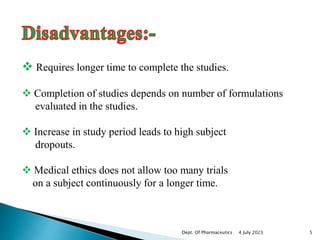
 Requires longer time to complete the studies.
 Completion of studies depends on number of formulations
evaluated in the studies.
 Increase in study period leads to high subject
dropouts.
 Medical ethics does not allow too many trials
on a subject continuously for a longer time.
4 July 2023 5
Dept. Of Pharmaceutics
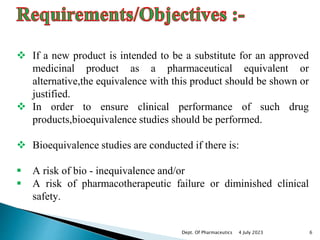
 If a new product is intended to be a substitute for an approved
medicinal product as a pharmaceutical equivalent or
alternative,the equivalence with this product should be shown or
justified.
 In order to ensure clinical performance of such drug
products,bioequivalence studies should be performed.
 Bioequivalence studies are conducted if there is:
 A risk of bio - inequivalence and/or
 A risk of pharmacotherapeutic failure or diminished clinical
safety.
4 July 2023 6
Dept. Of Pharmaceutics
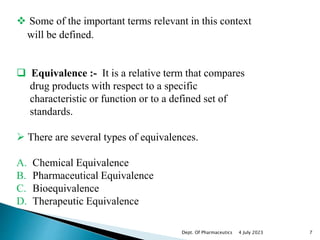
 Some of the important terms relevant in this context
will be defined.
 Equivalence :- It is a relative term that compares
drug products with respect to a specific
characteristic or function or to a defined set of
standards.
 There are several types of equivalences.
A. Chemical Equivalence
B. Pharmaceutical Equivalence
C. Bioequivalence
D. Therapeutic Equivalence
4 July 2023 7
Dept. Of Pharmaceutics
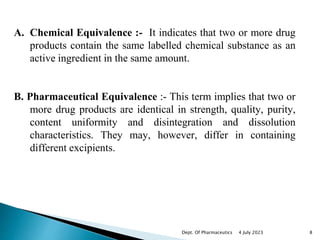
A. Chemical Equivalence :- It indicates that two or more drug
products contain the same labelled chemical substance as an
active ingredient in the same amount.
B. Pharmaceutical Equivalence :- This term implies that two or
more drug products are identical in strength, quality, purity,
content uniformity and disintegration and dissolution
characteristics. They may, however, differ in containing
different excipients.
4 July 2023 8
Dept. Of Pharmaceutics
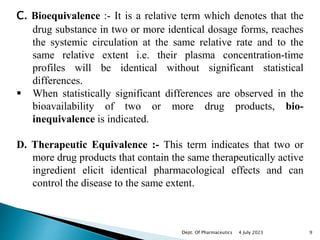
C. Bioequivalence :- It is a relative term which denotes that the
drug substance in two or more identical dosage forms, reaches
the systemic circulation at the same relative rate and to the
same relative extent i.e. their plasma concentration-time
profiles will be identical without significant statistical
differences.
 When statistically significant differences are observed in the
bioavailability of two or more drug products, bio-
inequivalence is indicated.
D. Therapeutic Equivalence :- This term indicates that two or
more drug products that contain the same therapeutically active
ingredient elicit identical pharmacological effects and can
control the disease to the same extent.
4 July 2023 9
Dept. Of Pharmaceutics
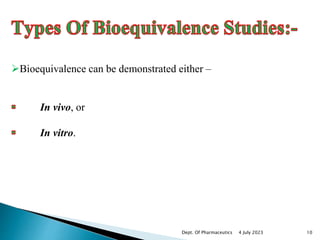
Bioequivalence can be demonstrated either –
In vivo, or
In vitro.
4 July 2023 10
Dept. Of Pharmaceutics
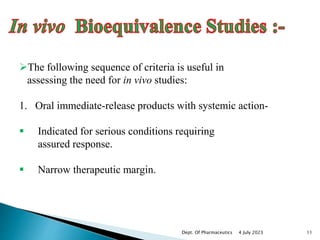
The following sequence of criteria is useful in
assessing the need for in vivo studies:
1. Oral immediate-release products with systemic action-
 Indicated for serious conditions requiring
assured response.
 Narrow therapeutic margin.
4 July 2023 11
Dept. Of Pharmaceutics
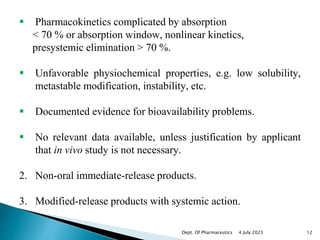
 Pharmacokinetics complicated by absorption
< 70 % or absorption window, nonlinear kinetics,
presystemic elimination > 70 %.
 Unfavorable physiochemical properties, e.g. low solubility,
metastable modification, instability, etc.
 Documented evidence for bioavailability problems.
 No relevant data available, unless justification by applicant
that in vivo study is not necessary.
2. Non-oral immediate-release products.
3. Modified-release products with systemic action.
4 July 2023 12
Dept. Of Pharmaceutics
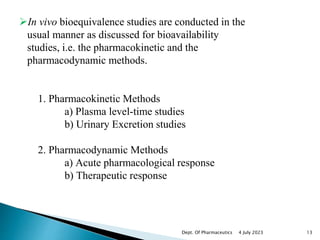
In vivo bioequivalence studies are conducted in the
usual manner as discussed for bioavailability
studies, i.e. the pharmacokinetic and the
pharmacodynamic methods.
1. Pharmacokinetic Methods
a) Plasma level-time studies
b) Urinary Excretion studies
2. Pharmacodynamic Methods
a) Acute pharmacological response
b) Therapeutic response
4 July 2023 13
Dept. Of Pharmaceutics
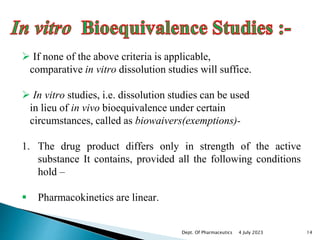
 If none of the above criteria is applicable,
comparative in vitro dissolution studies will suffice.
 In vitro studies, i.e. dissolution studies can be used
in lieu of in vivo bioequivalence under certain
circumstances, called as biowaivers(exemptions)-
1. The drug product differs only in strength of the active
substance It contains, provided all the following conditions
hold –
 Pharmacokinetics are linear.
4 July 2023 14
Dept. Of Pharmaceutics
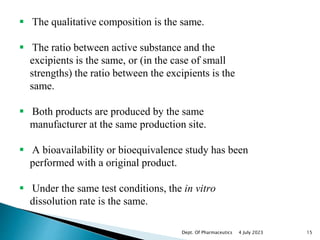
 The qualitative composition is the same.
 The ratio between active substance and the
excipients is the same, or (in the case of small
strengths) the ratio between the excipients is the
same.
 Both products are produced by the same
manufacturer at the same production site.
 A bioavailability or bioequivalence study has been
performed with a original product.
 Under the same test conditions, the in vitro
dissolution rate is the same.
4 July 2023 15
Dept. Of Pharmaceutics
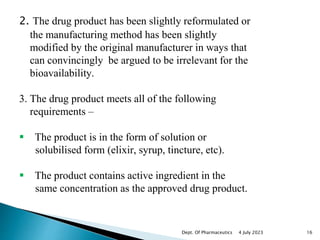
2. The drug product has been slightly reformulated or
the manufacturing method has been slightly
modified by the original manufacturer in ways that
can convincingly be argued to be irrelevant for the
bioavailability.
3. The drug product meets all of the following
requirements –
 The product is in the form of solution or
solubilised form (elixir, syrup, tincture, etc).
 The product contains active ingredient in the
same concentration as the approved drug product.
4 July 2023 16
Dept. Of Pharmaceutics
 The product contains no excipients known to
significantly affect absorption of the active
ingredient.
4. An acceptable IVIVC and the in vitro dissolution
rate of the new product is equivalent with that of
the already approved medicinal product.
Moreover,
 The product is intended for topical administration
(cream, ointment, gel, etc.) for local effect.
 The product is for oral administration but not
intended to be absorbed (antacid or radio-opaque
medium).
4 July 2023 17
Dept. Of Pharmaceutics
 The product is administered by inhalation as a gas
or vapour.
 The criteria for drug products listed above indicate
that bioavailability and bioequivalence are self-
evident.
4 July 2023 18
Dept. Of Pharmaceutics
Thank You
4 July 2023 19
Dept. Of Pharmaceutics

bioequivalencestudies-130210235231-phpapp02.pptx

  • 2.
    Definition Requirements/Objectives of Bioequivalence Typesof Bioequivalence  In vivo  In vitro 4 July 2023 2 Dept. Of Pharmaceutics
  • 3.
     It refersto the drug substance in two or more identical dosage forms, reaches systemic circulation at the same rate and to the same relative extent.  i.e. their plasma concentration-time profiles will be identical without significant statistical differences. 4 July 2023 3 Dept. Of Pharmaceutics
  • 4.
     Minimizes theeffect of inter subject variability.  It minimizes the carry over effect.  Requires less number of subjects to get meaningful results. 4 July 2023 4 Dept. Of Pharmaceutics
  • 5.
     Requires longertime to complete the studies.  Completion of studies depends on number of formulations evaluated in the studies.  Increase in study period leads to high subject dropouts.  Medical ethics does not allow too many trials on a subject continuously for a longer time. 4 July 2023 5 Dept. Of Pharmaceutics
  • 6.
     If anew product is intended to be a substitute for an approved medicinal product as a pharmaceutical equivalent or alternative,the equivalence with this product should be shown or justified.  In order to ensure clinical performance of such drug products,bioequivalence studies should be performed.  Bioequivalence studies are conducted if there is:  A risk of bio - inequivalence and/or  A risk of pharmacotherapeutic failure or diminished clinical safety. 4 July 2023 6 Dept. Of Pharmaceutics
  • 7.
     Some ofthe important terms relevant in this context will be defined.  Equivalence :- It is a relative term that compares drug products with respect to a specific characteristic or function or to a defined set of standards.  There are several types of equivalences. A. Chemical Equivalence B. Pharmaceutical Equivalence C. Bioequivalence D. Therapeutic Equivalence 4 July 2023 7 Dept. Of Pharmaceutics
  • 8.
    A. Chemical Equivalence:- It indicates that two or more drug products contain the same labelled chemical substance as an active ingredient in the same amount. B. Pharmaceutical Equivalence :- This term implies that two or more drug products are identical in strength, quality, purity, content uniformity and disintegration and dissolution characteristics. They may, however, differ in containing different excipients. 4 July 2023 8 Dept. Of Pharmaceutics
  • 9.
    C. Bioequivalence :-It is a relative term which denotes that the drug substance in two or more identical dosage forms, reaches the systemic circulation at the same relative rate and to the same relative extent i.e. their plasma concentration-time profiles will be identical without significant statistical differences.  When statistically significant differences are observed in the bioavailability of two or more drug products, bio- inequivalence is indicated. D. Therapeutic Equivalence :- This term indicates that two or more drug products that contain the same therapeutically active ingredient elicit identical pharmacological effects and can control the disease to the same extent. 4 July 2023 9 Dept. Of Pharmaceutics
  • 10.
    Bioequivalence can bedemonstrated either – In vivo, or In vitro. 4 July 2023 10 Dept. Of Pharmaceutics
  • 11.
    The following sequenceof criteria is useful in assessing the need for in vivo studies: 1. Oral immediate-release products with systemic action-  Indicated for serious conditions requiring assured response.  Narrow therapeutic margin. 4 July 2023 11 Dept. Of Pharmaceutics
  • 12.
     Pharmacokinetics complicatedby absorption < 70 % or absorption window, nonlinear kinetics, presystemic elimination > 70 %.  Unfavorable physiochemical properties, e.g. low solubility, metastable modification, instability, etc.  Documented evidence for bioavailability problems.  No relevant data available, unless justification by applicant that in vivo study is not necessary. 2. Non-oral immediate-release products. 3. Modified-release products with systemic action. 4 July 2023 12 Dept. Of Pharmaceutics
  • 13.
    In vivo bioequivalencestudies are conducted in the usual manner as discussed for bioavailability studies, i.e. the pharmacokinetic and the pharmacodynamic methods. 1. Pharmacokinetic Methods a) Plasma level-time studies b) Urinary Excretion studies 2. Pharmacodynamic Methods a) Acute pharmacological response b) Therapeutic response 4 July 2023 13 Dept. Of Pharmaceutics
  • 14.
     If noneof the above criteria is applicable, comparative in vitro dissolution studies will suffice.  In vitro studies, i.e. dissolution studies can be used in lieu of in vivo bioequivalence under certain circumstances, called as biowaivers(exemptions)- 1. The drug product differs only in strength of the active substance It contains, provided all the following conditions hold –  Pharmacokinetics are linear. 4 July 2023 14 Dept. Of Pharmaceutics
  • 15.
     The qualitativecomposition is the same.  The ratio between active substance and the excipients is the same, or (in the case of small strengths) the ratio between the excipients is the same.  Both products are produced by the same manufacturer at the same production site.  A bioavailability or bioequivalence study has been performed with a original product.  Under the same test conditions, the in vitro dissolution rate is the same. 4 July 2023 15 Dept. Of Pharmaceutics
  • 16.
    2. The drugproduct has been slightly reformulated or the manufacturing method has been slightly modified by the original manufacturer in ways that can convincingly be argued to be irrelevant for the bioavailability. 3. The drug product meets all of the following requirements –  The product is in the form of solution or solubilised form (elixir, syrup, tincture, etc).  The product contains active ingredient in the same concentration as the approved drug product. 4 July 2023 16 Dept. Of Pharmaceutics
  • 17.
     The productcontains no excipients known to significantly affect absorption of the active ingredient. 4. An acceptable IVIVC and the in vitro dissolution rate of the new product is equivalent with that of the already approved medicinal product. Moreover,  The product is intended for topical administration (cream, ointment, gel, etc.) for local effect.  The product is for oral administration but not intended to be absorbed (antacid or radio-opaque medium). 4 July 2023 17 Dept. Of Pharmaceutics
  • 18.
     The productis administered by inhalation as a gas or vapour.  The criteria for drug products listed above indicate that bioavailability and bioequivalence are self- evident. 4 July 2023 18 Dept. Of Pharmaceutics
  • 19.
    Thank You 4 July2023 19 Dept. Of Pharmaceutics