BIODIVERSITY CONSERVATION
DEFINITION:
• Biodiversity is the degree of variation of life. It is a measure
of the variety of organisms present in different ecosystems.
• This can refer to genetic variation, ecosystem variation, or
species variation (number of species) Species diversity
• The Global Convention on Biological Diversity, signed in
1992 at the Earth Summit.
REASON FOR THE LOSS OF BIO-DIVERSITY
There are four main reasons why species are being
threatened in these biodiversity hotspots
• Habitat destruction
• Resource mismanagement
• Poaching
• Climate change
• Pollution
• Species diversity is the number of different species
that are represented in a collection of individuals The
effective number of species refers to the number of equally
abundant species needed to obtain the same mean
proportional species abundance as that observed in the
data set of interest (where all species may not be equally
abundant).
• Species diversity consists of two components: species
richness and species evenness. Species richness is a simple
count of species, whereas species evenness quantifies how
equal the abundances of the species are.
 Ecosystem diversity refers to the diversity of a
place at the level of ecosystems.
 The term differs from biodiversity, which refers to
variation in species rather than ecosystems.
 Ecosystem diversity can also refer to the variety of
ecosystems present in a biosphere, the variety of species and
ecological processes that occur in different .physical settings.
Genetic diversity
Genetic diversity: The level of biodiversity, refers
to the total number of genetic characteristics in the genetic
makeup of a species. It is distinguished from genetic
variability, which describes the tendency of genetic
characteristics to vary.
1. LEGISLATION
 Environment Protection Act, 1986
 Fisheries Act, 1897
 Forest Act, 1927
 Forest (Conservation) Act, 1980
 Wildlife (Protection) Act 1972 and Wildlife
(Protection) Amendment Act 1991
Biological Diversity Act, 2002
IN-SITU CONSERVATION
Conserving the animals and plants in their natural habitats
is known as in situ conservation. The established natural
habitats are:
• National parks and sanctuaries
• Biosphere reserves
• Nature reserves
• Reserved and protected forests
• Preservation plots
• Reserved forests
• The first such initiative was the establishment of the Corbett
National Park in 1936.
• National Parks are highly protected by law.
Nine of the eighteen biosphere reserves are a part of the
World Network of Biosphere Reserves, based on the
UNESCO Man and the Biosphere (MAB) Programme list
Ex-situ Conservation
• Ex-situ conservation of plants and animals preserve/ or
protect them away from their natural habitat.eg
zoological parks and botanical gardens and
agricultural research centres. A lot of effort is under
way to collect and preserve the genetic material of crops,
animal, bird and fish species. This work is being done by
institutions such as the National Bureau of Plant Genetic
Resources, New Delhi, the National Bureau of Animal
Genetic Resources, etc
Seed banks, botanical gardens, horticultural and
recreational gardens are important centres for ex situ
conservation.
Recording Indigenous Knowledge:
These communities have a vast knowledge about local
flora and fauna which is very important for biodiversity
conservation. Much of this knowledge is orally passed on
from generation to generation Such indigenous
knowledge needs to be recorded and preserved before it
is lost.
The Convention on Biological Diversity:
• This was signed during the Earth Summit in 1992. It
focuses not only on conserving biodiversity but also on
sustainable use of biological resources and equitable
sharing of benefits arising from its use.
The Convention on International Trade in
Endangered Species of (Wild Flora and
Fauna)CITES
This is an international treaty which is designed to protect
wild plants and animals affected by international trade.
Role of Communities in Biodiversity
conservation
Protecting the environment is everyone’s responsibility.
There is an increased awareness among the people towards
the conservation of ecologically sensitive area
Green India Mission
Its major focus is to increase cover and density of India’s
medium density forests and degraded forests.
Saving biodiversity - Saving life
Following are some conservation actions that we can
take up:
 Plant trees (this would attract local wildlife such as
birds, butterflies and insects.)
Grow local vegetables in your school garden that are not
usually available in the markets. Make a list of different
kinds of trees in your campus or locality. For each one find
out the names, uses, flowering season, animals and birds
that depends on it. Present this information in an
interesting way, and put it up by the tree.
Avoid using insecticides, pesticides and inorganic
fertilizers
Create ‘Biodiversity Registers’ in communities, schools,
villages.
(The register may include minute details about plants and
animals, both wild and Domesticated)
Definition:
• Endangered animals are species or populations that are
at risk of becoming extinct. There are numerous policies
and organizations that help to protect endangered
species. Some of these include the International Union
for the Conservation of Nature (IUCN) and the
Endangered Species Act.
The IUCN maintains a list of endangered animals.
• Threatened
• Vulnerable
• Endangered -
• Critically Endangered (Rare species)
• Extinct
Extinct in the Wild -India has more than 200
wildlife sanctuaries and about 100 of them are classified
as National Parks.
• Corbett National Park, Uttarakhand
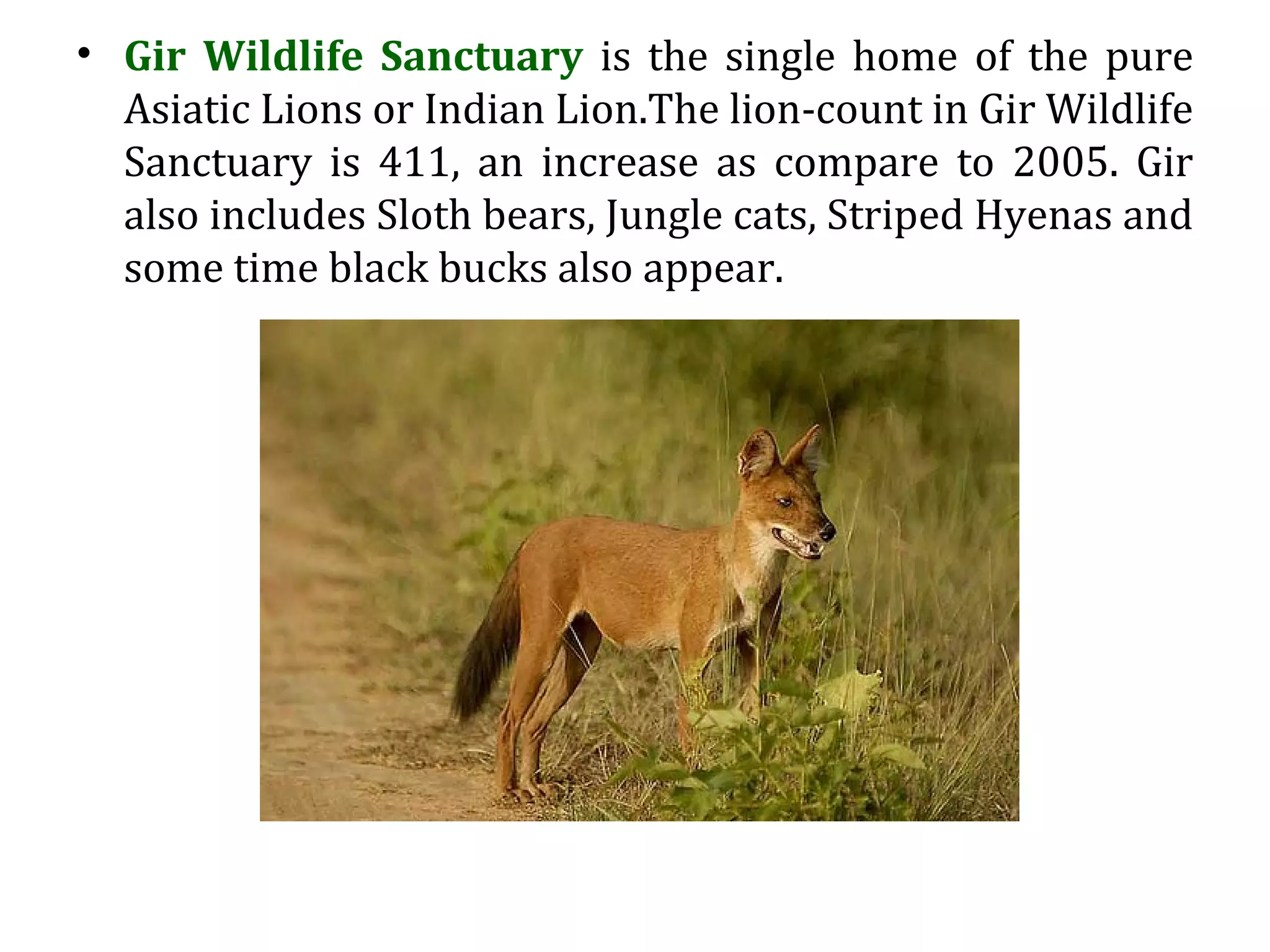
• Gir Wildlife Sanctuary is the single home of the pure
Asiatic Lions or Indian Lion.The lion-count in Gir Wildlife
Sanctuary is 411, an increase as compare to 2005. Gir
also includes Sloth bears, Jungle cats, Striped Hyenas and
some time black bucks also appear.
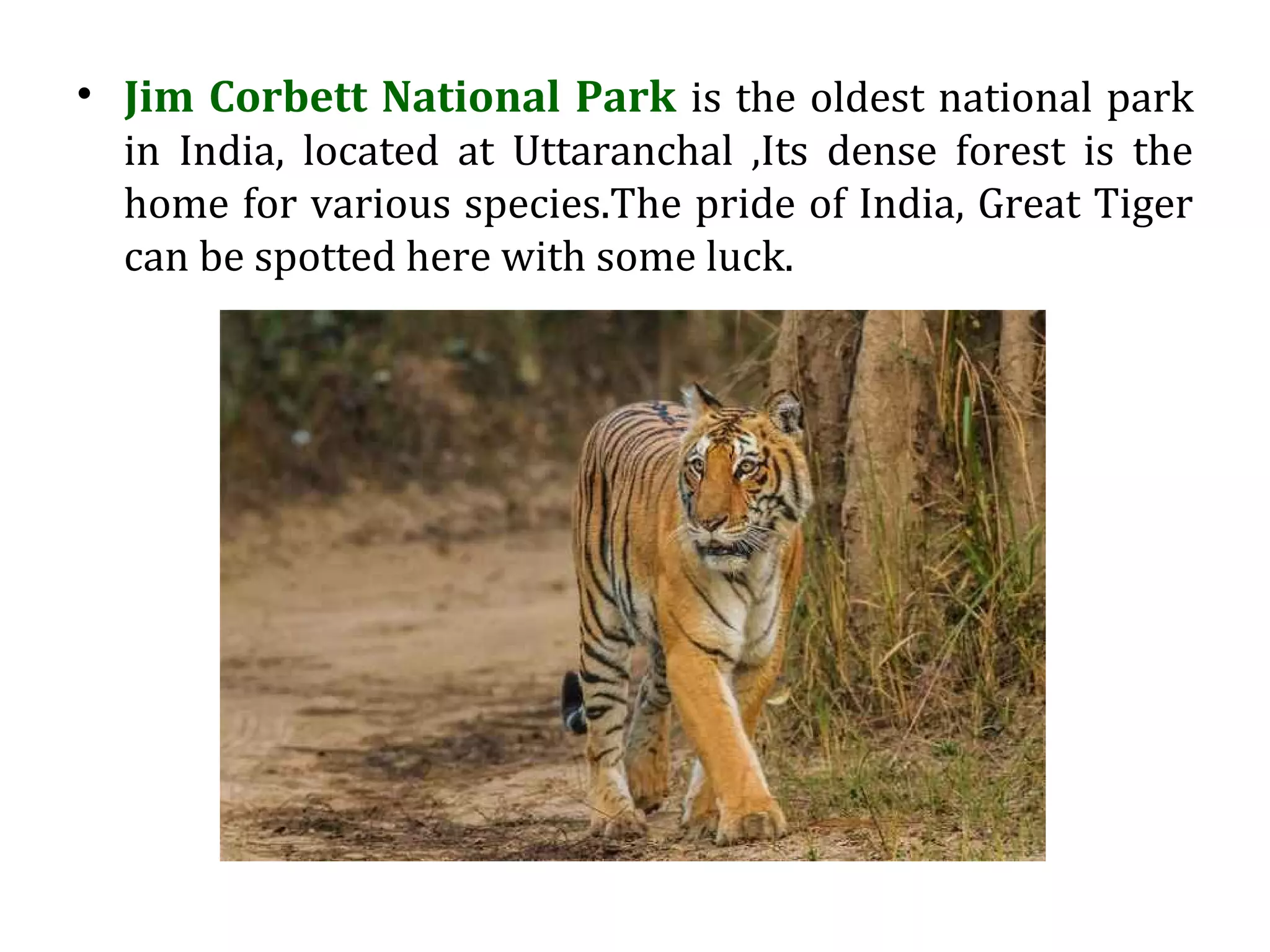
• Jim Corbett National Park is the oldest national park
in India, located at Uttaranchal ,Its dense forest is the
home for various species.The pride of India, Great Tiger
can be spotted here with some luck.
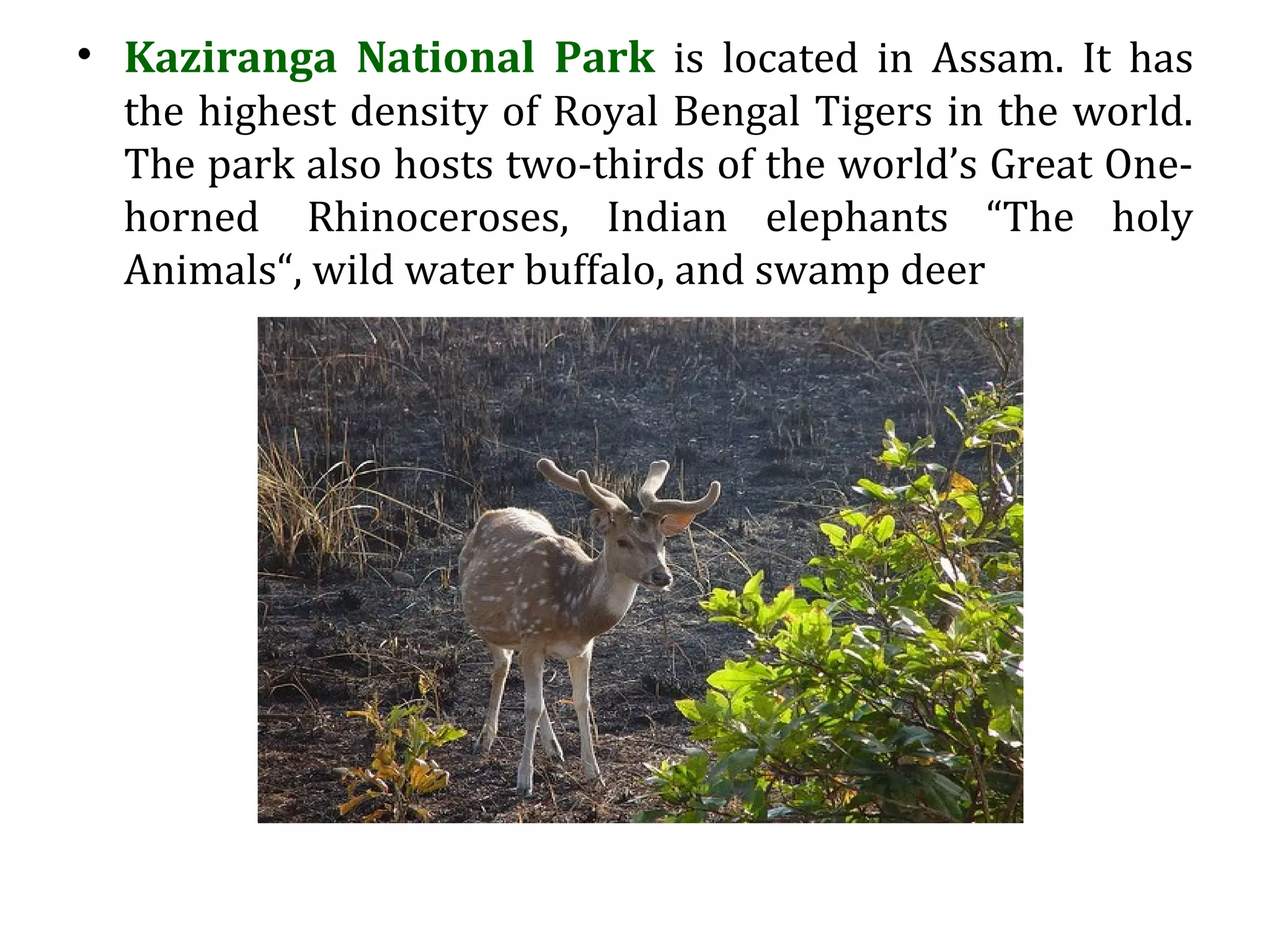
• Kaziranga National Park is located in Assam. It has
the highest density of Royal Bengal Tigers in the world.
The park also hosts two-thirds of the world’s Great One-
horned Rhinoceroses, Indian elephants “The holy
Animals“, wild water buffalo, and swamp deer
• Sundarbans National Park is one of the largest reserves
home for the Royal Bengal Tiger. This area is covered by
dense rain forest,sunder ban is located in west Bengal. The
park has got protection since its creation. The core area is
free from all human disturbances and is habitat of many
toxic reptiles in India.
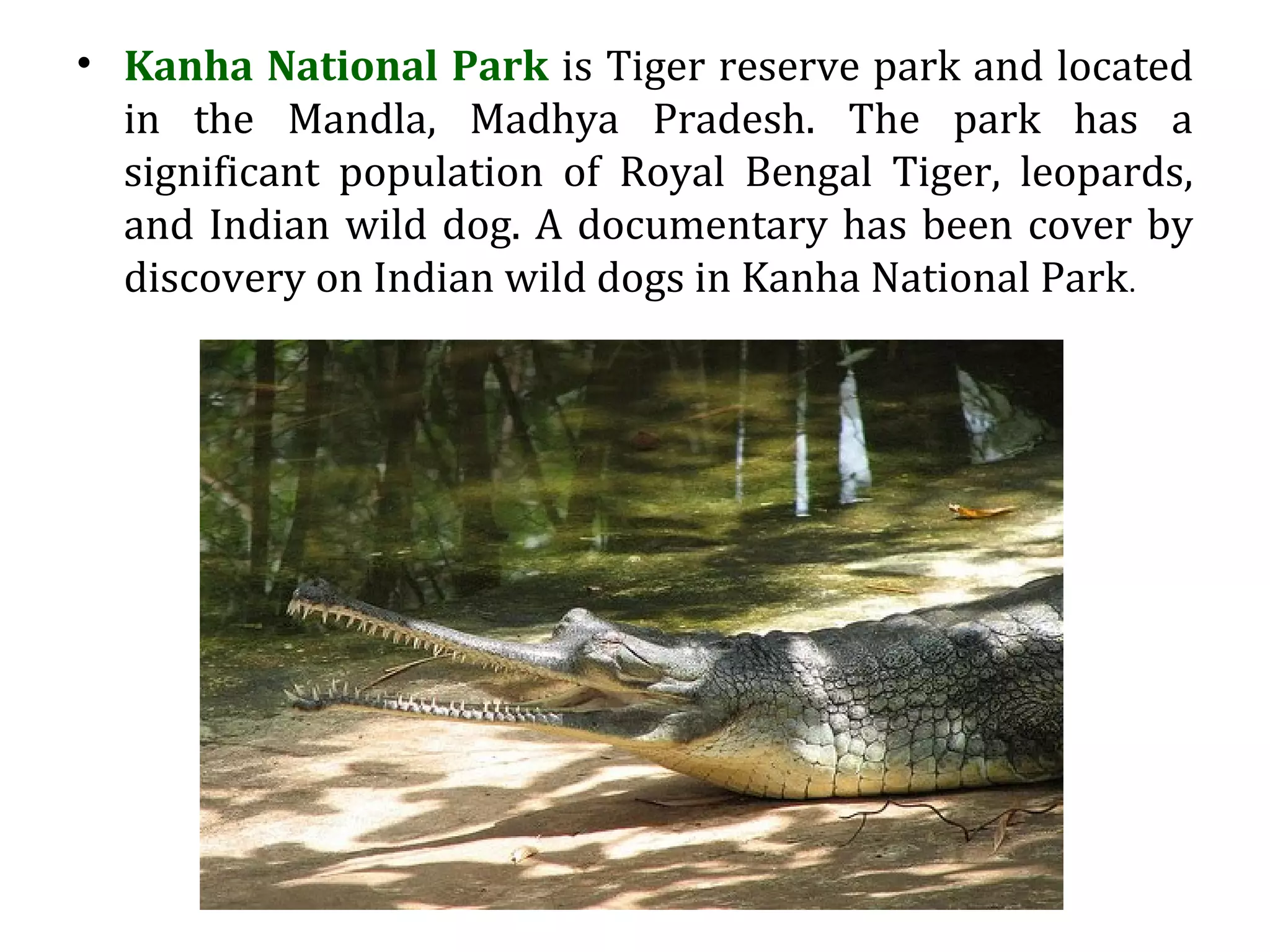
• Kanha National Park is Tiger reserve park and located
in the Mandla, Madhya Pradesh. The park has a
significant population of Royal Bengal Tiger, leopards,
and Indian wild dog. A documentary has been cover by
discovery on Indian wild dogs in Kanha National Park.
• Gir Wildlife Sanctuary is the single home of the pure
Asiatic Lions or Indian Lion.The lion-count in Gir Wildlife
Sanctuary is 411, an increase as compare to 2005. Gir
also includes Sloth bears, Jungle cats, Striped Hyenas and
some time black bucks also appear.
• Periyar National Park area lies in the middle of a
mountainous area of the Cardamom Hills in Land of
Attraction Kerala. ,which is also home for the biggest
snake in India, the Giant King Kobra.
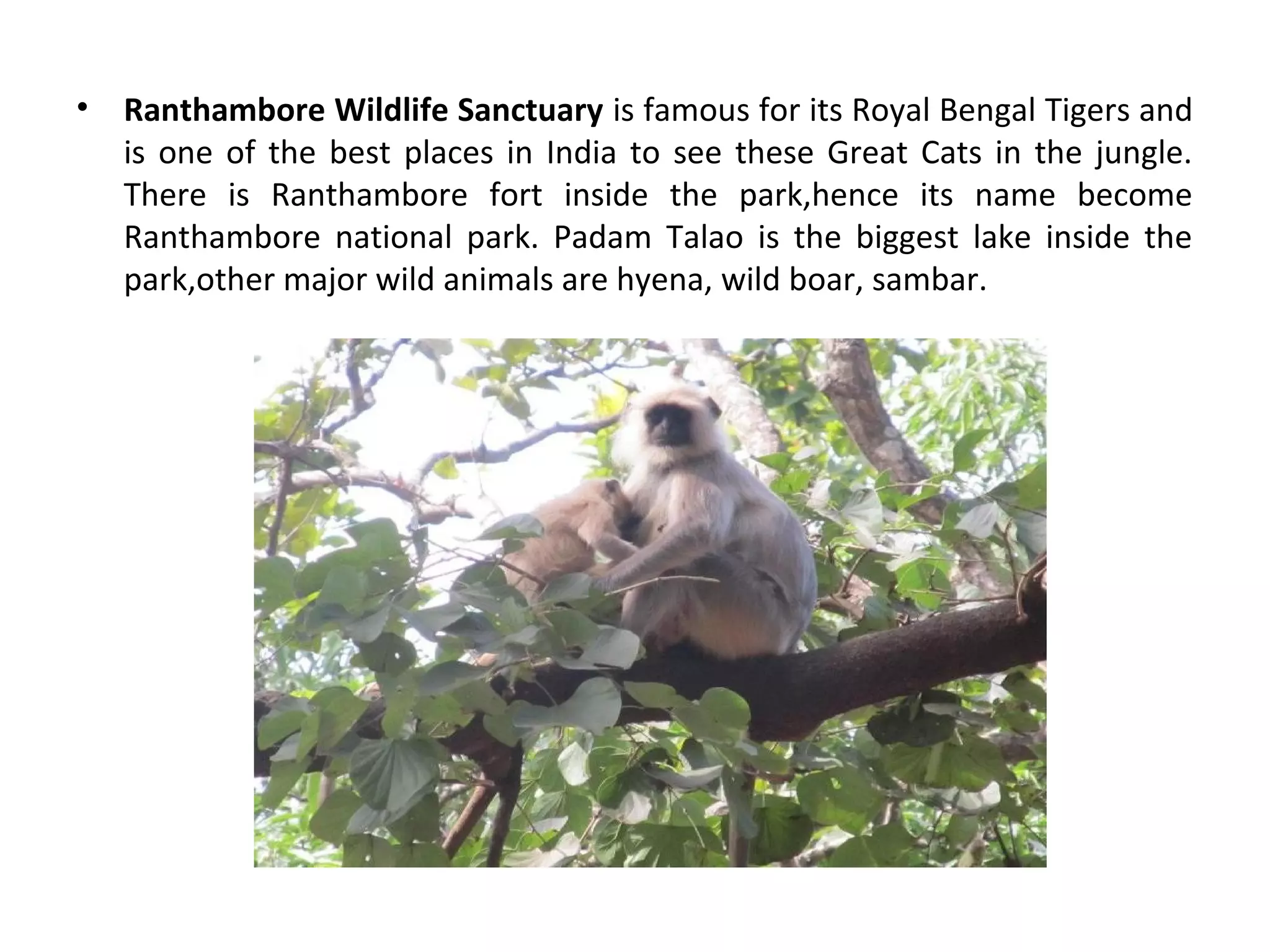
• Ranthambore Wildlife Sanctuary is famous for its Royal Bengal Tigers and
is one of the best places in India to see these Great Cats in the jungle.
There is Ranthambore fort inside the park,hence its name become
Ranthambore national park. Padam Talao is the biggest lake inside the
park,other major wild animals are hyena, wild boar, sambar.
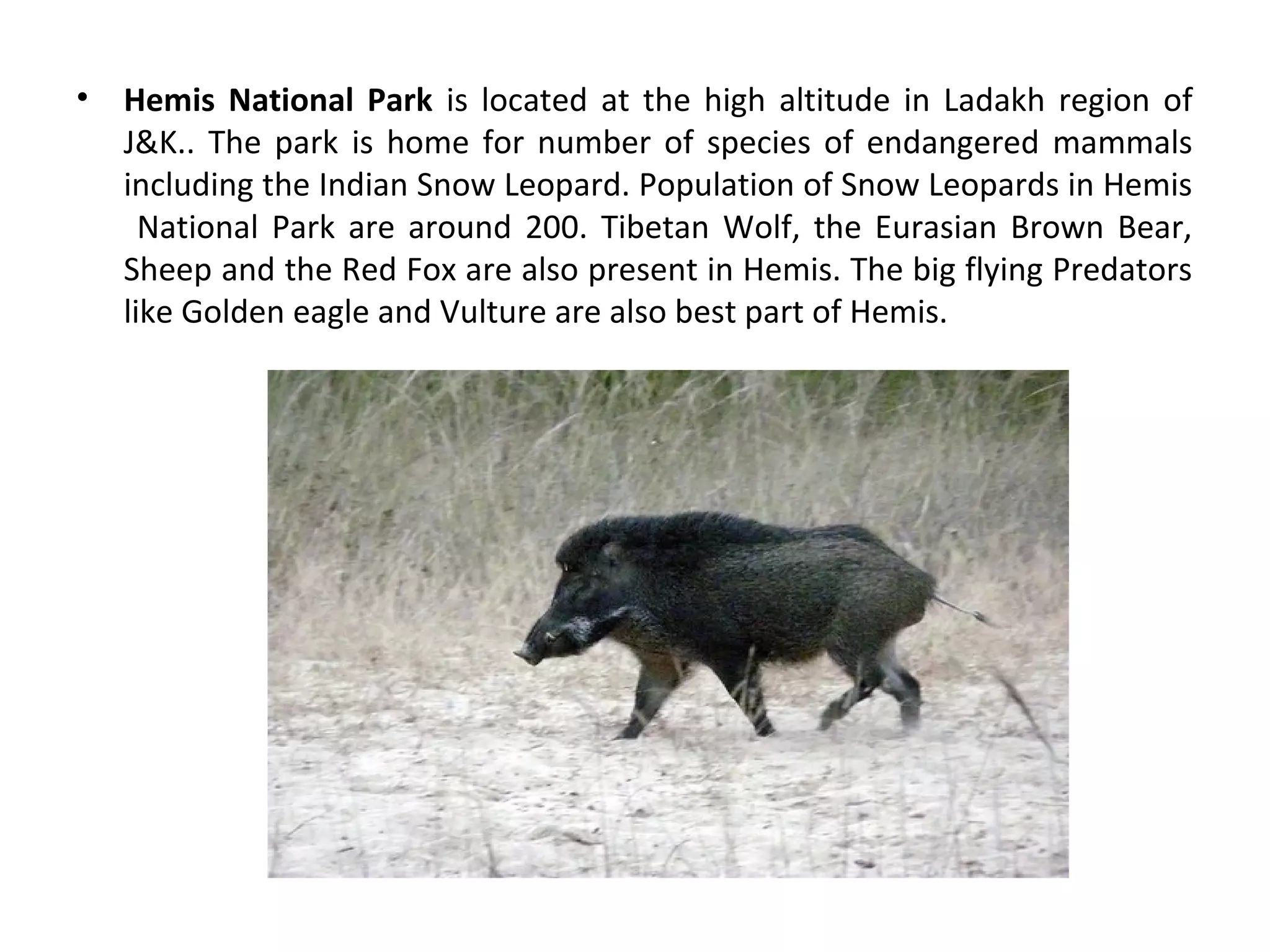
• Hemis National Park is located at the high altitude in Ladakh region of
J&K.. The park is home for number of species of endangered mammals
including the Indian Snow Leopard. Population of Snow Leopards in Hemis
National Park are around 200. Tibetan Wolf, the Eurasian Brown Bear,
Sheep and the Red Fox are also present in Hemis. The big flying Predators
like Golden eagle and Vulture are also best part of Hemis.
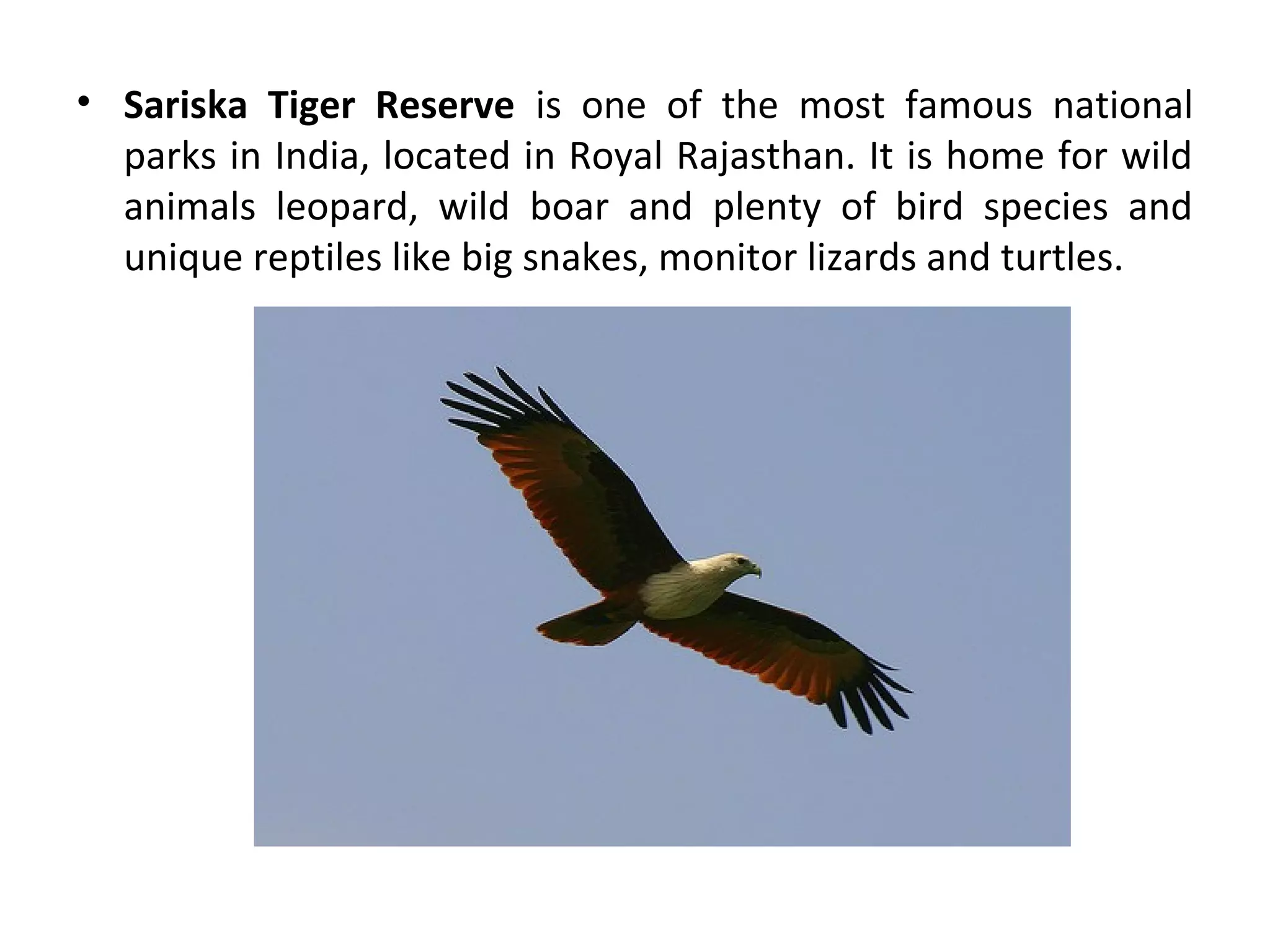
• Sariska Tiger Reserve is one of the most famous national
parks in India, located in Royal Rajasthan. It is home for wild
animals leopard, wild boar and plenty of bird species and
unique reptiles like big snakes, monitor lizards and turtles.
• Rajaji National Park
Rajaji National Park includes the Shivaliks, close to the foothills of the Himalayas. It
is named after the well known freedom fighter and the last Governor-General of
independent India, C. Rajagopalachari (Rajaji), who was the first one to receive the
highest civilian award of India, Bharat Ratna.
The fauna includes dense green forests, 23 species of mammals and315 species of
birds. It has the largest population of elephants in Uttarakhand
–Renuka Wildlife Sanctuary
•The Renuka sanctuary is located in Sirmour district in Himachal Pradesh. This park
was established in 1983.
•Renuka Wildlife Sanctuary is home to a large number of animals including Asiatic
lions, spotted deer, , peacocks, barking deer and Himalayan black bears. Some of the
bird species like, red jungle fowl, peacock, green pigeons, hill crow, and water birds
are also found here. You can also large variety of butterflies that flutter around this
region.
Sultanpur Bird Sanctuary
Sultanpur Bird Sanctuary is a home to plenty of domestic and
migratory birds. It is situated 46 km from Delhi, Some of its major attractions
are the enriching flora and fauna. The Siberian cranes and migratory geese
spend the winter, here, local species includes red wattled lapwings, plovers,
herons and many more.
• Endangered Species.
Giant Tortoises
• Rare White Rhino Dies, Breed Close to Extinction( Only six of
the creatures left, having been hunted by poachers in central
and east Africa for their horns. )
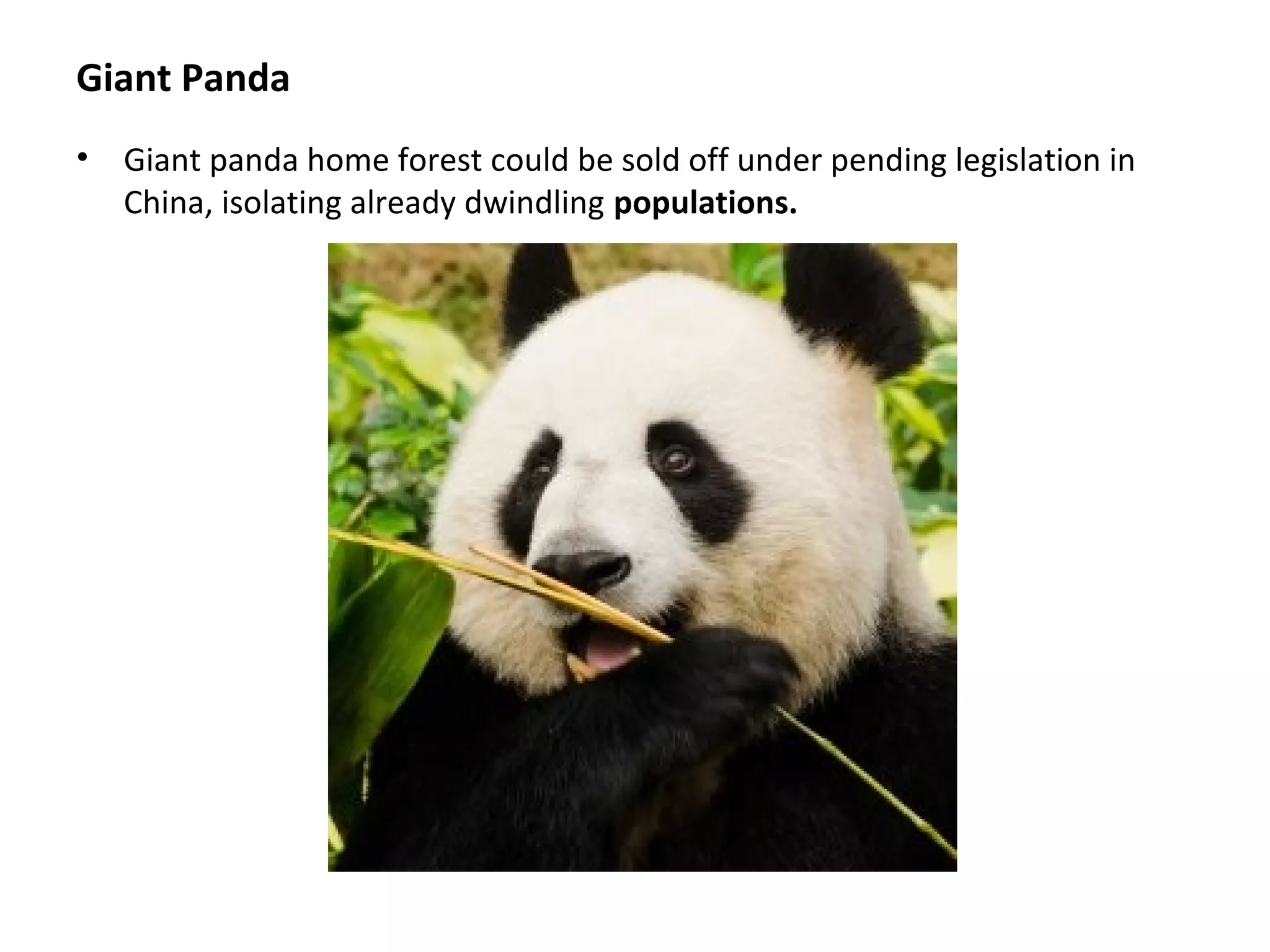
Giant Panda
• Giant panda home forest could be sold off under pending legislation in
China, isolating already dwindling populations.
Chimps
Endangered species
Ivory-billed Woodpecker. A native of the south-eastern US, it
may already be extinct, the victim of loss of habitat and hunting
for its feathers.
North Atlantic Right Whale. Hunted almost to
extinction, only 350 are believed to be left in the
Atlantic.
Mountain Gorilla. Just 700 remain, poached to the
edge of extinction in east-central Africa.
Leatherback Sea Turtle. The world’s largest turtle, its
numbers have dropped alarmingly. Eggs laid on beaches are
snatched by humans. Nesting grounds have also been lost
through coastal erosion.
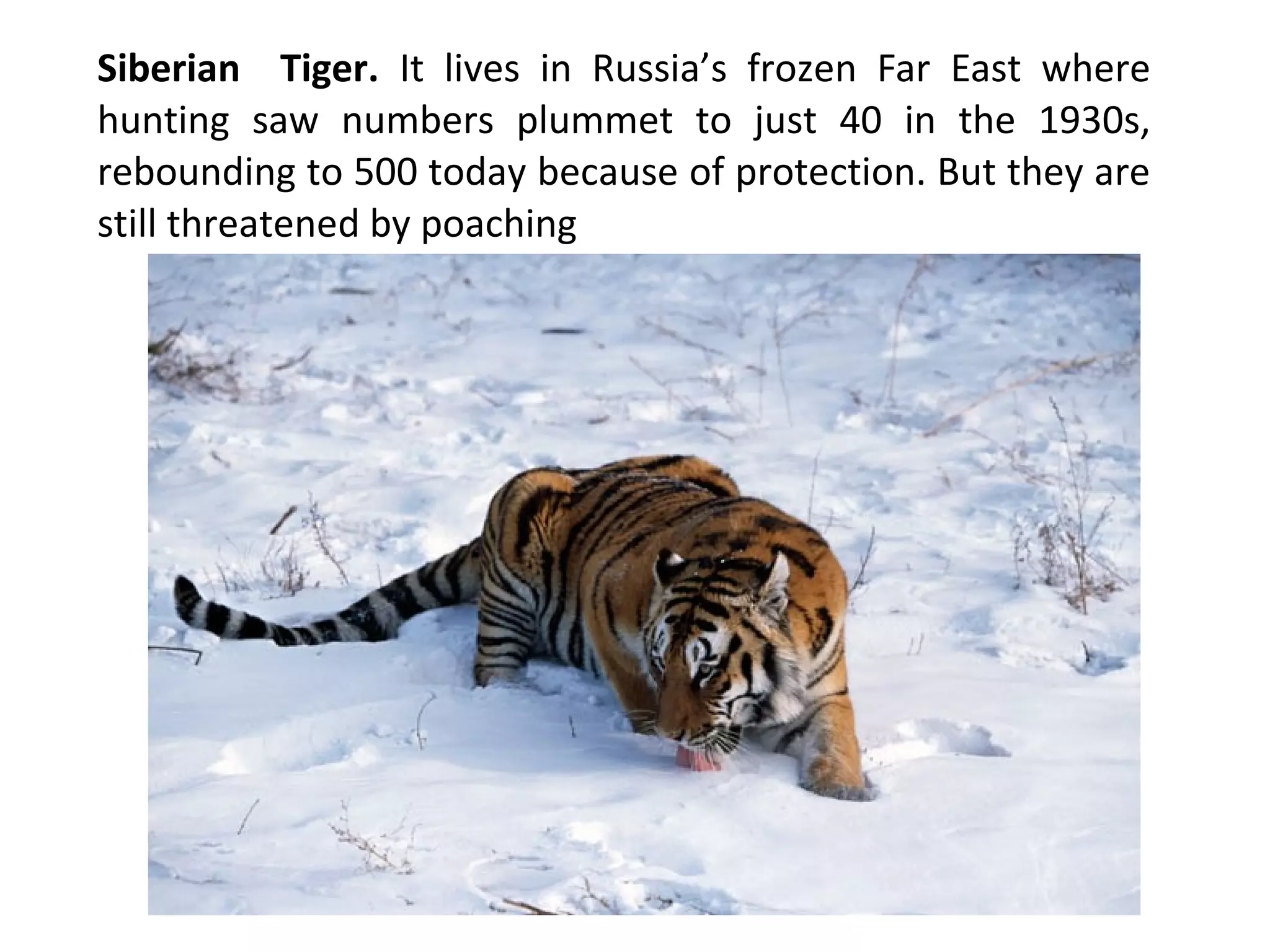
Siberian Tiger. It lives in Russia’s frozen Far East where
hunting saw numbers plummet to just 40 in the 1930s,
rebounding to 500 today because of protection. But they are
still threatened by poaching
Giant Chinese Salamander. The world’s largest amphibian -
it can grow to 6ft long - is being eaten to extinction in its
native areas of central and southern China
Hawaiian Monk Seal. Fewer than 1,000 remain, living far from humans
across the whole Hawaiian island chain. Their numbers are falling,
Greater Bamboo Lemur. This is the rarest of Madagascar’s
dwindling lemur species. Just 100 remain, threatened by
illegal hunting and habitat loss.
Javan Rhinoceros. (HUNTING) Only between 40 and 60 of
the Javan rhino now survive in the world in Indonesia's
Ujung Kulon National Park.
Amur Leopard. Found in Russia’s Far East in remote snowy forests,
there are thought to be only 40 left. They are the victim of poaching and
logging.
Endangered Rain Forest Plants
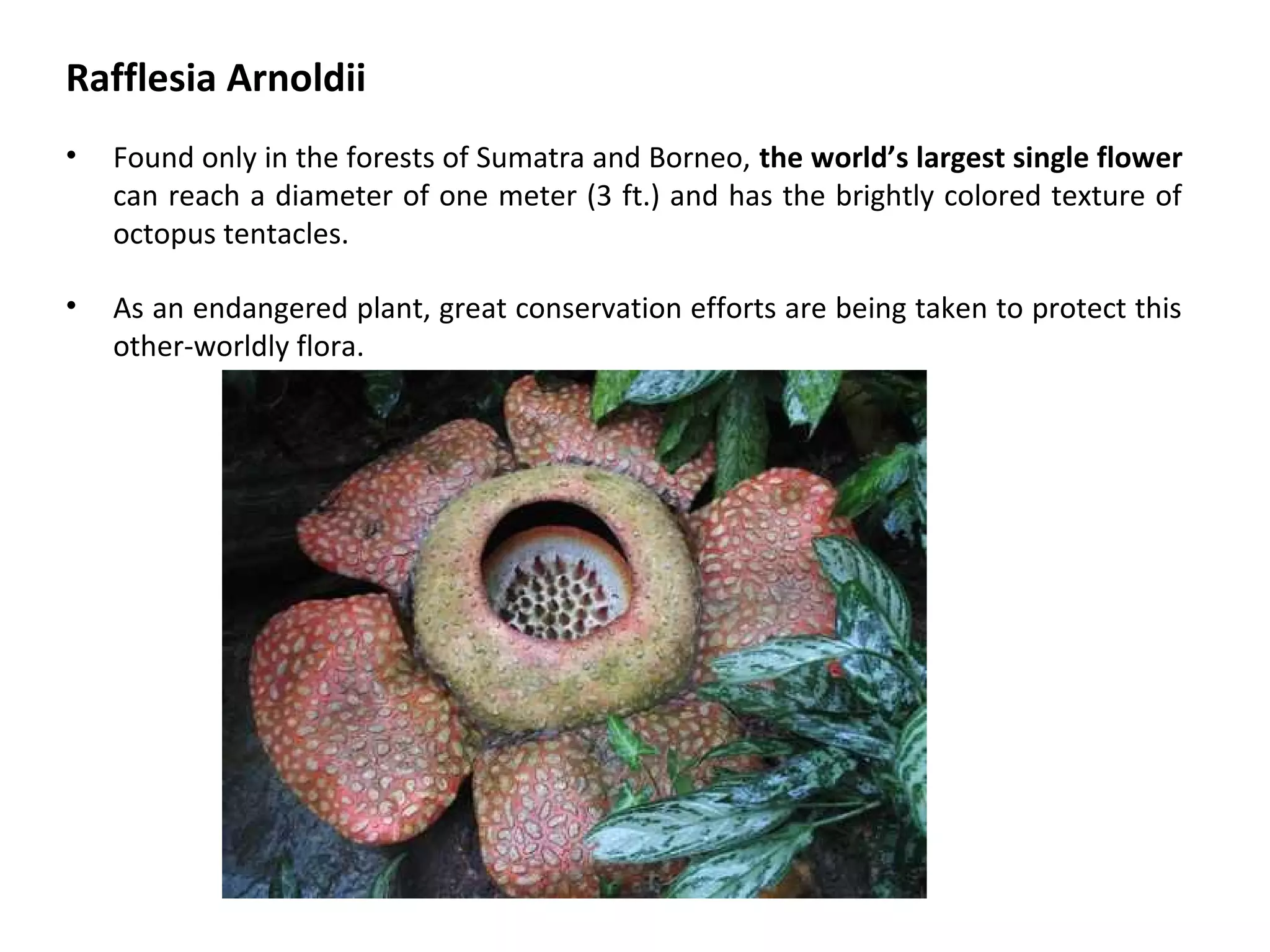
Rafflesia Arnoldii
• Found only in the forests of Sumatra and Borneo, the world’s largest single flower
can reach a diameter of one meter (3 ft.) and has the brightly colored texture of
octopus tentacles.
• As an endangered plant, great conservation efforts are being taken to protect this
other-worldly flora.
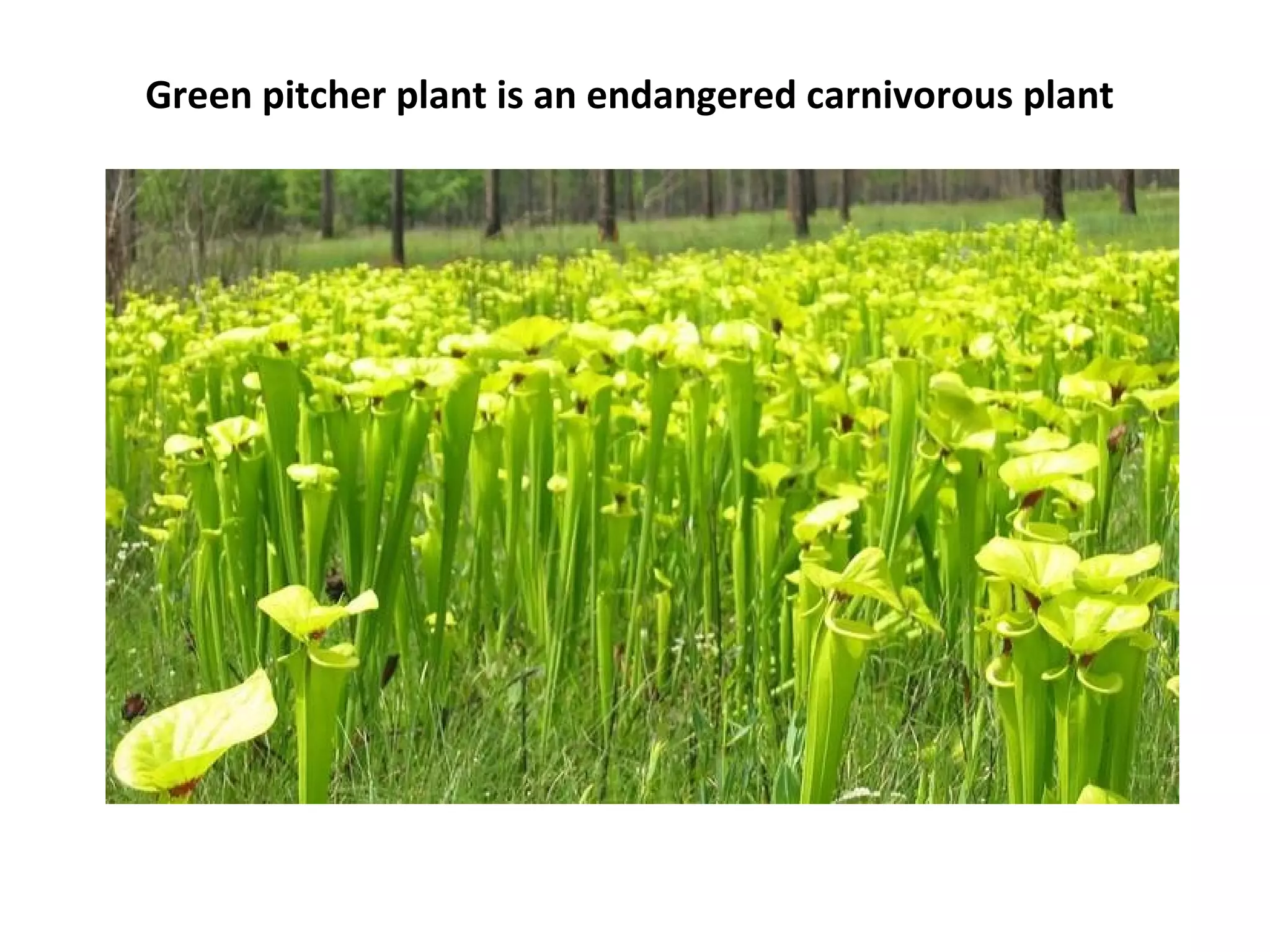
Green pitcher plant is an endangered carnivorous plant
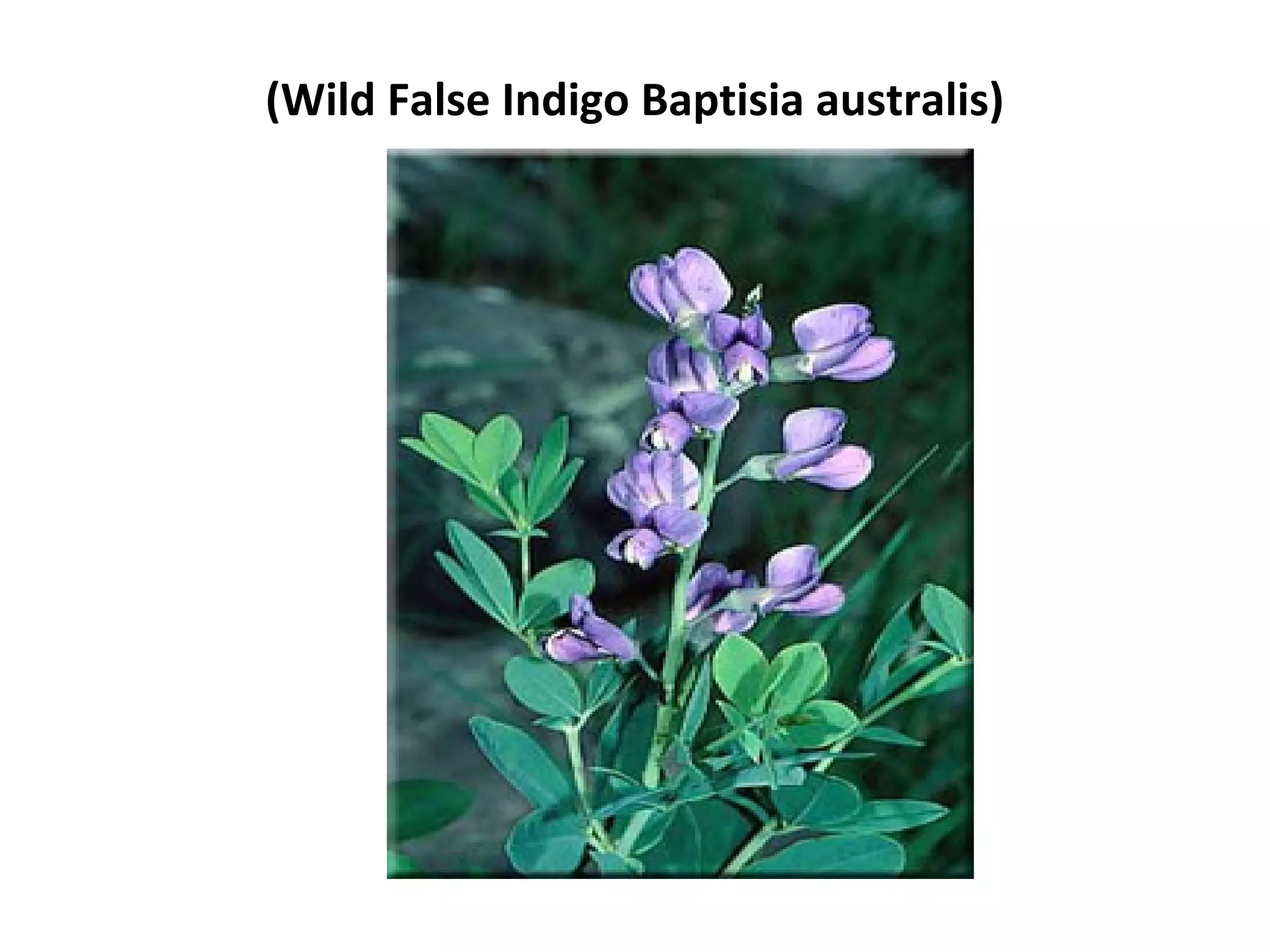
(Wild False Indigo Baptisia australis)
• This species may have declined because of the suppression of
forest fires, Wood Lily, Lilium philadelphicum
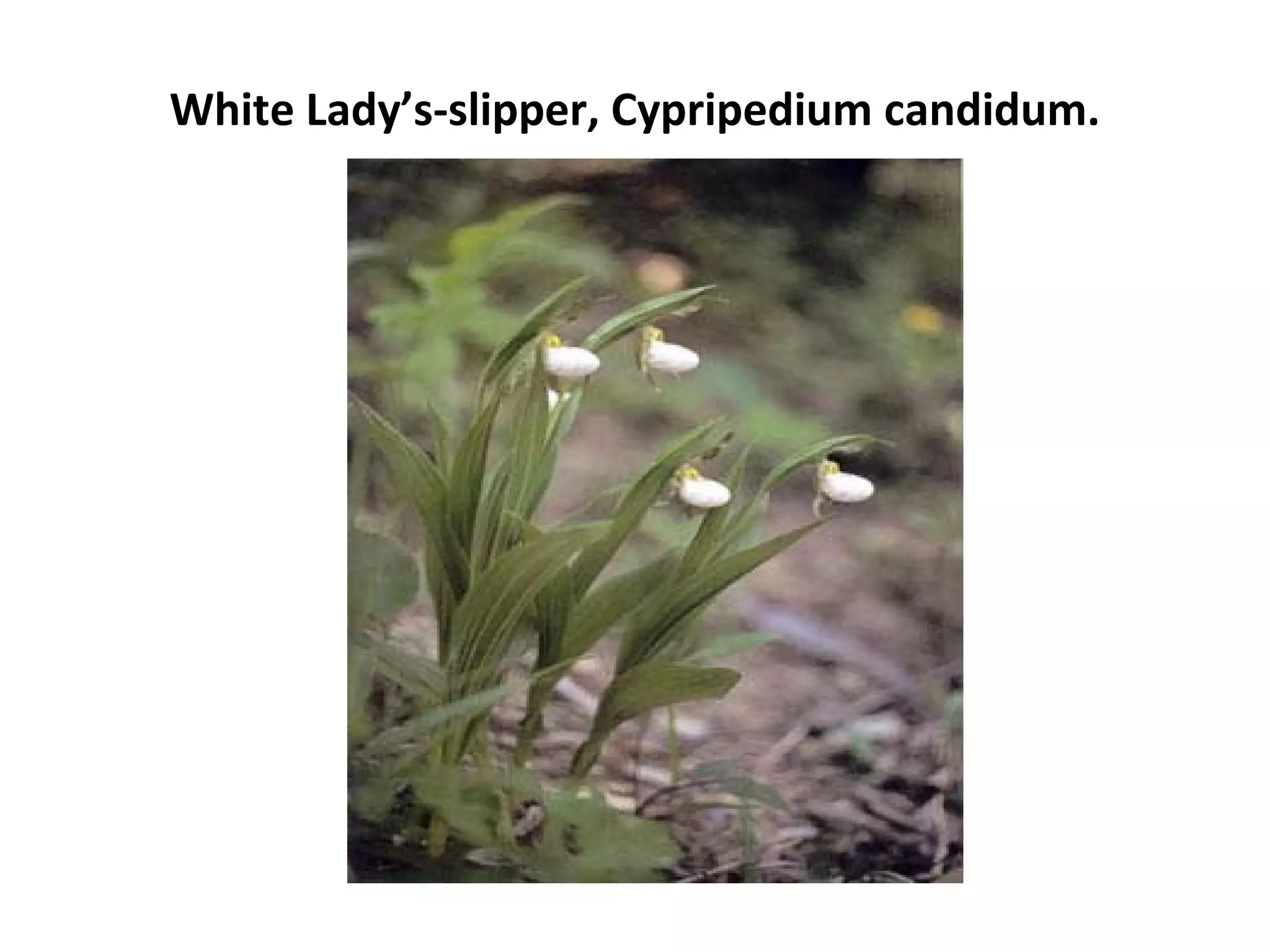
White Lady’s-slipper, Cypripedium candidum.
Grass-pink (Calopogon tuberosus)
Dragon’s Mouth Orchid, Arethusa bulbosa.
Indian paintbrush, Castilleja coccinea
Pitcher-Plant
Corpse Flower,
• Similar to the Rafflesia and also endemic to the forests of Sumatra, the corpse
flower (or titan arum) uses a putrefying smell to attract insects.
• It can reach up to 3 meters (10 ft.) and weigh as much as 50kg (110 lbs).
• The Corpse Flower mimics a decomposing body to attract insects
Colchicum luteums(Medicinal plant)
• It was also observed that a plant species Trillidium govanianum evaluated
according to IUCN Regional Guidelines, as Least Concern (LC) in 2012, had due to
recent indiscriminate extraction now become threatened.
• Trillidium govanianum, a species considered Least Concern may be
threatened .Western Ghats Medicinal Plants face Extinction Threats (May 5,
2012)
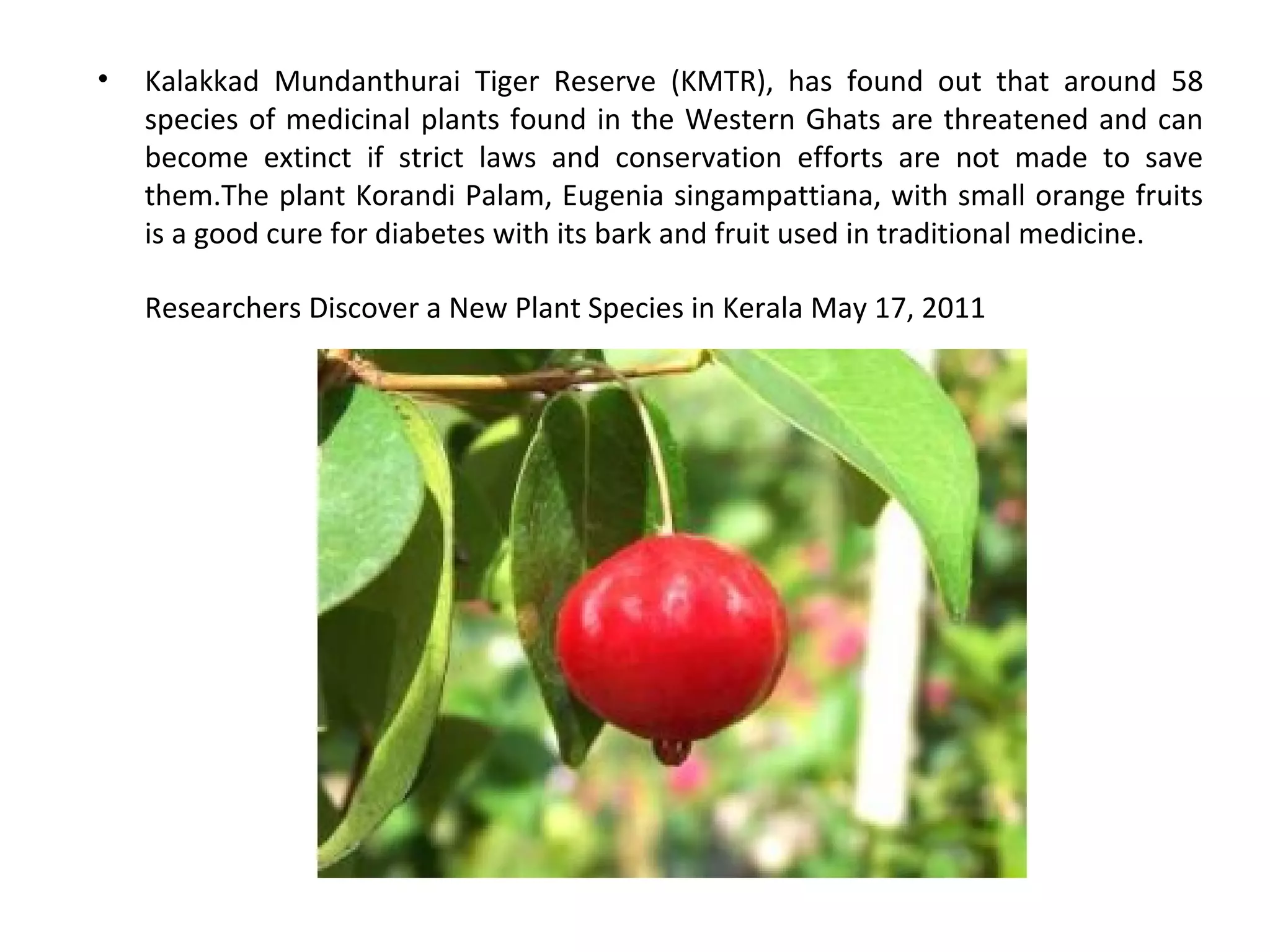
• Kalakkad Mundanthurai Tiger Reserve (KMTR), has found out that around 58
species of medicinal plants found in the Western Ghats are threatened and can
become extinct if strict laws and conservation efforts are not made to save
them.The plant Korandi Palam, Eugenia singampattiana, with small orange fruits
is a good cure for diabetes with its bark and fruit used in traditional medicine.
Researchers Discover a New Plant Species in Kerala May 17, 2011
• Researchers from the School of Environmental Science of Mahatma Gandhi
University in Kottayam, Kerala have discovered a new plant species belonging to
the ‘Commelinaceae’ flora family of the ‘Murdannia’ genus
24/02/18
24/02/18

Bio diversity conservation

  • 1.
    BIODIVERSITY CONSERVATION DEFINITION: • Biodiversityis the degree of variation of life. It is a measure of the variety of organisms present in different ecosystems. • This can refer to genetic variation, ecosystem variation, or species variation (number of species) Species diversity • The Global Convention on Biological Diversity, signed in 1992 at the Earth Summit.
  • 2.
    REASON FOR THELOSS OF BIO-DIVERSITY There are four main reasons why species are being threatened in these biodiversity hotspots • Habitat destruction • Resource mismanagement • Poaching • Climate change • Pollution
  • 3.
    • Species diversityis the number of different species that are represented in a collection of individuals The effective number of species refers to the number of equally abundant species needed to obtain the same mean proportional species abundance as that observed in the data set of interest (where all species may not be equally abundant). • Species diversity consists of two components: species richness and species evenness. Species richness is a simple count of species, whereas species evenness quantifies how equal the abundances of the species are.
  • 4.
     Ecosystem diversityrefers to the diversity of a place at the level of ecosystems.  The term differs from biodiversity, which refers to variation in species rather than ecosystems.  Ecosystem diversity can also refer to the variety of ecosystems present in a biosphere, the variety of species and ecological processes that occur in different .physical settings. Genetic diversity
  • 5.
    Genetic diversity: Thelevel of biodiversity, refers to the total number of genetic characteristics in the genetic makeup of a species. It is distinguished from genetic variability, which describes the tendency of genetic characteristics to vary.
  • 6.
    1. LEGISLATION  EnvironmentProtection Act, 1986  Fisheries Act, 1897  Forest Act, 1927  Forest (Conservation) Act, 1980  Wildlife (Protection) Act 1972 and Wildlife (Protection) Amendment Act 1991 Biological Diversity Act, 2002
  • 7.
    IN-SITU CONSERVATION Conserving theanimals and plants in their natural habitats is known as in situ conservation. The established natural habitats are: • National parks and sanctuaries • Biosphere reserves • Nature reserves • Reserved and protected forests • Preservation plots • Reserved forests • The first such initiative was the establishment of the Corbett National Park in 1936. • National Parks are highly protected by law.
  • 8.
    Nine of theeighteen biosphere reserves are a part of the World Network of Biosphere Reserves, based on the UNESCO Man and the Biosphere (MAB) Programme list
  • 9.
    Ex-situ Conservation • Ex-situconservation of plants and animals preserve/ or protect them away from their natural habitat.eg zoological parks and botanical gardens and agricultural research centres. A lot of effort is under way to collect and preserve the genetic material of crops, animal, bird and fish species. This work is being done by institutions such as the National Bureau of Plant Genetic Resources, New Delhi, the National Bureau of Animal Genetic Resources, etc
  • 10.
    Seed banks, botanicalgardens, horticultural and recreational gardens are important centres for ex situ conservation. Recording Indigenous Knowledge: These communities have a vast knowledge about local flora and fauna which is very important for biodiversity conservation. Much of this knowledge is orally passed on from generation to generation Such indigenous knowledge needs to be recorded and preserved before it is lost.
  • 11.
    The Convention onBiological Diversity: • This was signed during the Earth Summit in 1992. It focuses not only on conserving biodiversity but also on sustainable use of biological resources and equitable sharing of benefits arising from its use.
  • 12.
    The Convention onInternational Trade in Endangered Species of (Wild Flora and Fauna)CITES This is an international treaty which is designed to protect wild plants and animals affected by international trade. Role of Communities in Biodiversity conservation Protecting the environment is everyone’s responsibility. There is an increased awareness among the people towards the conservation of ecologically sensitive area
  • 13.
    Green India Mission Itsmajor focus is to increase cover and density of India’s medium density forests and degraded forests. Saving biodiversity - Saving life Following are some conservation actions that we can take up:  Plant trees (this would attract local wildlife such as birds, butterflies and insects.)
  • 14.
    Grow local vegetablesin your school garden that are not usually available in the markets. Make a list of different kinds of trees in your campus or locality. For each one find out the names, uses, flowering season, animals and birds that depends on it. Present this information in an interesting way, and put it up by the tree. Avoid using insecticides, pesticides and inorganic fertilizers Create ‘Biodiversity Registers’ in communities, schools, villages. (The register may include minute details about plants and animals, both wild and Domesticated)
  • 15.
    Definition: • Endangered animalsare species or populations that are at risk of becoming extinct. There are numerous policies and organizations that help to protect endangered species. Some of these include the International Union for the Conservation of Nature (IUCN) and the Endangered Species Act.
  • 16.
    The IUCN maintainsa list of endangered animals. • Threatened • Vulnerable • Endangered - • Critically Endangered (Rare species) • Extinct
  • 17.
    Extinct in theWild -India has more than 200 wildlife sanctuaries and about 100 of them are classified as National Parks. • Corbett National Park, Uttarakhand
  • 18.
    • Gir WildlifeSanctuary is the single home of the pure Asiatic Lions or Indian Lion.The lion-count in Gir Wildlife Sanctuary is 411, an increase as compare to 2005. Gir also includes Sloth bears, Jungle cats, Striped Hyenas and some time black bucks also appear.
  • 19.
    • Jim CorbettNational Park is the oldest national park in India, located at Uttaranchal ,Its dense forest is the home for various species.The pride of India, Great Tiger can be spotted here with some luck.
  • 20.
    • Kaziranga NationalPark is located in Assam. It has the highest density of Royal Bengal Tigers in the world. The park also hosts two-thirds of the world’s Great One- horned Rhinoceroses, Indian elephants “The holy Animals“, wild water buffalo, and swamp deer
  • 21.
    • Sundarbans NationalPark is one of the largest reserves home for the Royal Bengal Tiger. This area is covered by dense rain forest,sunder ban is located in west Bengal. The park has got protection since its creation. The core area is free from all human disturbances and is habitat of many toxic reptiles in India.
  • 22.
    • Kanha NationalPark is Tiger reserve park and located in the Mandla, Madhya Pradesh. The park has a significant population of Royal Bengal Tiger, leopards, and Indian wild dog. A documentary has been cover by discovery on Indian wild dogs in Kanha National Park.
  • 23.
    • Gir WildlifeSanctuary is the single home of the pure Asiatic Lions or Indian Lion.The lion-count in Gir Wildlife Sanctuary is 411, an increase as compare to 2005. Gir also includes Sloth bears, Jungle cats, Striped Hyenas and some time black bucks also appear.
  • 24.
    • Periyar NationalPark area lies in the middle of a mountainous area of the Cardamom Hills in Land of Attraction Kerala. ,which is also home for the biggest snake in India, the Giant King Kobra.
  • 25.
    • Ranthambore WildlifeSanctuary is famous for its Royal Bengal Tigers and is one of the best places in India to see these Great Cats in the jungle. There is Ranthambore fort inside the park,hence its name become Ranthambore national park. Padam Talao is the biggest lake inside the park,other major wild animals are hyena, wild boar, sambar.
  • 26.
    • Hemis NationalPark is located at the high altitude in Ladakh region of J&K.. The park is home for number of species of endangered mammals including the Indian Snow Leopard. Population of Snow Leopards in Hemis National Park are around 200. Tibetan Wolf, the Eurasian Brown Bear, Sheep and the Red Fox are also present in Hemis. The big flying Predators like Golden eagle and Vulture are also best part of Hemis.
  • 27.
    • Sariska TigerReserve is one of the most famous national parks in India, located in Royal Rajasthan. It is home for wild animals leopard, wild boar and plenty of bird species and unique reptiles like big snakes, monitor lizards and turtles.
  • 28.
    • Rajaji NationalPark Rajaji National Park includes the Shivaliks, close to the foothills of the Himalayas. It is named after the well known freedom fighter and the last Governor-General of independent India, C. Rajagopalachari (Rajaji), who was the first one to receive the highest civilian award of India, Bharat Ratna. The fauna includes dense green forests, 23 species of mammals and315 species of birds. It has the largest population of elephants in Uttarakhand
  • 29.
    –Renuka Wildlife Sanctuary •TheRenuka sanctuary is located in Sirmour district in Himachal Pradesh. This park was established in 1983. •Renuka Wildlife Sanctuary is home to a large number of animals including Asiatic lions, spotted deer, , peacocks, barking deer and Himalayan black bears. Some of the bird species like, red jungle fowl, peacock, green pigeons, hill crow, and water birds are also found here. You can also large variety of butterflies that flutter around this region.
  • 30.
    Sultanpur Bird Sanctuary SultanpurBird Sanctuary is a home to plenty of domestic and migratory birds. It is situated 46 km from Delhi, Some of its major attractions are the enriching flora and fauna. The Siberian cranes and migratory geese spend the winter, here, local species includes red wattled lapwings, plovers, herons and many more.
  • 31.
  • 32.
    • Rare WhiteRhino Dies, Breed Close to Extinction( Only six of the creatures left, having been hunted by poachers in central and east Africa for their horns. )
  • 33.
    Giant Panda • Giantpanda home forest could be sold off under pending legislation in China, isolating already dwindling populations.
  • 34.
  • 35.
    Endangered species Ivory-billed Woodpecker.A native of the south-eastern US, it may already be extinct, the victim of loss of habitat and hunting for its feathers.
  • 36.
    North Atlantic RightWhale. Hunted almost to extinction, only 350 are believed to be left in the Atlantic.
  • 37.
    Mountain Gorilla. Just700 remain, poached to the edge of extinction in east-central Africa.
  • 38.
    Leatherback Sea Turtle.The world’s largest turtle, its numbers have dropped alarmingly. Eggs laid on beaches are snatched by humans. Nesting grounds have also been lost through coastal erosion.
  • 39.
    Siberian Tiger. Itlives in Russia’s frozen Far East where hunting saw numbers plummet to just 40 in the 1930s, rebounding to 500 today because of protection. But they are still threatened by poaching
  • 40.
    Giant Chinese Salamander.The world’s largest amphibian - it can grow to 6ft long - is being eaten to extinction in its native areas of central and southern China
  • 41.
    Hawaiian Monk Seal.Fewer than 1,000 remain, living far from humans across the whole Hawaiian island chain. Their numbers are falling,
  • 42.
    Greater Bamboo Lemur.This is the rarest of Madagascar’s dwindling lemur species. Just 100 remain, threatened by illegal hunting and habitat loss.
  • 43.
    Javan Rhinoceros. (HUNTING)Only between 40 and 60 of the Javan rhino now survive in the world in Indonesia's Ujung Kulon National Park.
  • 44.
    Amur Leopard. Foundin Russia’s Far East in remote snowy forests, there are thought to be only 40 left. They are the victim of poaching and logging.
  • 45.
  • 46.
    Rafflesia Arnoldii • Foundonly in the forests of Sumatra and Borneo, the world’s largest single flower can reach a diameter of one meter (3 ft.) and has the brightly colored texture of octopus tentacles. • As an endangered plant, great conservation efforts are being taken to protect this other-worldly flora.
  • 47.
    Green pitcher plantis an endangered carnivorous plant
  • 48.
    (Wild False IndigoBaptisia australis)
  • 49.
    • This speciesmay have declined because of the suppression of forest fires, Wood Lily, Lilium philadelphicum
  • 50.
  • 51.
  • 52.
    Dragon’s Mouth Orchid,Arethusa bulbosa.
  • 53.
  • 54.
  • 55.
    Corpse Flower, • Similarto the Rafflesia and also endemic to the forests of Sumatra, the corpse flower (or titan arum) uses a putrefying smell to attract insects. • It can reach up to 3 meters (10 ft.) and weigh as much as 50kg (110 lbs). • The Corpse Flower mimics a decomposing body to attract insects
  • 56.
    Colchicum luteums(Medicinal plant) •It was also observed that a plant species Trillidium govanianum evaluated according to IUCN Regional Guidelines, as Least Concern (LC) in 2012, had due to recent indiscriminate extraction now become threatened.
  • 57.
    • Trillidium govanianum,a species considered Least Concern may be threatened .Western Ghats Medicinal Plants face Extinction Threats (May 5, 2012)
  • 58.
    • Kalakkad MundanthuraiTiger Reserve (KMTR), has found out that around 58 species of medicinal plants found in the Western Ghats are threatened and can become extinct if strict laws and conservation efforts are not made to save them.The plant Korandi Palam, Eugenia singampattiana, with small orange fruits is a good cure for diabetes with its bark and fruit used in traditional medicine. Researchers Discover a New Plant Species in Kerala May 17, 2011
  • 59.
    • Researchers fromthe School of Environmental Science of Mahatma Gandhi University in Kottayam, Kerala have discovered a new plant species belonging to the ‘Commelinaceae’ flora family of the ‘Murdannia’ genus
  • 60.
  • 61.