» GOMATHI’S
CONVENTION ON BIOLOGICAL DIVERSITY
» variability among living organisms from all sources
and the ecosystem
» CONVENTION?
AGREEMENT
» CBD is a comprehensive, binding agreement covering
the use and conservation of biodiversity.
http://www.cbd.int/
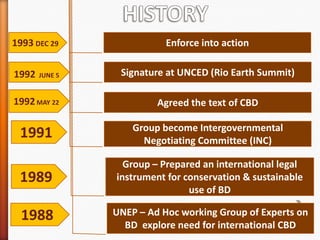
1993 DEC 29

1992

JUNE 5

Enforce into action
Signature at UNCED (Rio Earth Summit)

1992 MAY 22

Agreed the text of CBD

1991

Group become Intergovernmental
Negotiating Committee (INC)

1989

Group – Prepared an international legal
instrument for conservation & sustainable
use of BD

1988

UNEP – Ad Hoc working Group of Experts on
BD explore need for international CBD
- 22 May, 1992 in Nairobi, Kenya
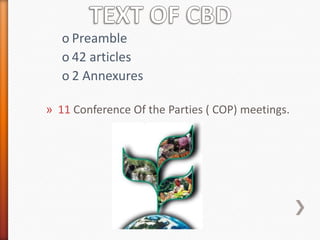
o Preamble
o 42 articles
o 2 Annexures
» 11 Conference Of the Parties ( COP) meetings.
»
»
»
»
»

»
»
»

Conscious of values & components of BD.
Conservation & maintenance of sustainable use of BD.
Reaffirming sovereign rights & responsibility of BD.
Aware of BD loss by human activities & plan to take
measures.
Need of full participation of women from policy
making to implementation.
Establish strong cooperation among states, regions..
Provide additional financial resources & relevant
technologies.
Commitment to conserve & sustainable use of BD for
the benefit of present and future generations.
» OBJECTIVES OF CBD:

1

» Conservation & sustainable use of BD.
» Fair & equitable sharing of benefits arising from the
use of genetic resources.
» Appropriate access to genetic resources.
» Transfer of required technologies.
» Appropriate funding.

2
» USE OF TERMS:
» "Biological diversity" – the variability among
living
organisms
from
all
sources
including, terrestrial, marine and other aquatic
ecosystems and the ecological complexes of
which they are part; this includes diversity within
species, between species and of ecosystems.
3
» PRINCIPLE:
» States have sovereign right to exploit their biological
diversity as per their policies. Previously biodiversity
was considered heritage of humankind.
» State is responsible to control their resources without
damaging the environment of other states.
4
» JURIDICTIONAL SCOPE: The geographic area over
which authority extends

5
» COOPERATION:
» Each contracting country has to cooperate other
countries for the conservation and sustainable use of
biodiversity.
» The cooperation can be bilateral or multilateral.
» If necessary, any party can ask help from competent
international organizations for arranging cooperation.
6
» GENERAL MEASURES FOR CONSERVATION AND
SUSTAINABLE USE (OBLIGATIONS OF THE STATES):
» Develop or adopt national strategies, plans or
programmes for the conservation and sustainable use
of BD.
» Integrate these plans into sectoral or cross sectoral
plans, programmes and policies.

7
» IDENTIFICATION AND MONITORING
8
» IN-SITU CONSERVATION:

9
» EX-SITU CONSERVATION:

10
» SUSTAINABLE USE OF COMPONENTS OF BD:

11
» INCENTIVE MEASURES: motivational measures
12
» RESEARCH AND TRAINING:

13
» PUBLIC EDUCATION AND AWARENESS:

14
» IMPACT ASSESSMENT AND MINIMIZING ADVERSE
IMPACTS:

15
» ACCESS TO GENETIC RESOURCES:
16
» ACCESS TO AND TRANSFER OF TECHNOLOGY:

17
» EXCHANGE OF INFORMATION:

18
» TECHNICAL AND SCIENTIFIC COOPERATION:

19
» HANDLING OF BIOTECHNOLOGY AND DISTRIBUTION
OF ITS BENEFITS
20
» FINANCIAL RESOURCES

21
» FINANCIAL MECHANISM

22
» RELATIONSHIP WITH OTHER INTERNATIONAL
CONVENTIONS:

23
» CONFERENCE OF PARTIES (COP)
24
» SECRETRAIAT

25
» SUBSIDIARY BODY ON SCIENTIFIC, TECHNICAL AND
TECHNOLOGICAL ADVICE:

26
» REPORTS:

27
» SETTLEMENT OF DISPUTES:
28
» ADOPTION OF PROTOCOL

29
» AMENDMENT OF THE CONVENTION OR PROTOCOLS:

30
» ADOPTION AND AMENDMENT OF ANNEXES:

31
» RIGHT TO VOTE:
ARTICLE 33. RELATIONSHIP BETWEEN THIS CONVENTION AND ITS PROTOCOL

ARTICLE 33. SIGNATURE
ARTICLE 34. RATIFICATION (signing an agreement), ACCEPTANCE OR
APPROVAL
ARTICLE 35. ACCESSION (particular period for signature & its extension)
ARTICLE 36. ENTRY INTO FORCE
ARTICLE 37. RESERVATIONS
ARTICLE 38. WITHDRAWALS
ARTICLE 39. FINANCIAL INTERIM ARRANGEMENTS
ARTICLE 40. SECRETARIAT INTERIM ARRANGEMENTS
ARTICLE 41. DEPOSITARY
ARTICLE 42. AUTHENTIC TEXTS
ANNEX I. IDENTIFICATION AND MONITORING
ANNEX II - PART 1. ARBITRATION
ANNEX II - PART 2. CONCILIATION
COP

PLACE

YEAR

DOCUMENTS

DECISIONS

MAJOR THEMES

1

Nassau,
Bahamas

28 Nov 9 Dec
1994

33

13

Guidance to the financial
mechanism;
Medium-term programme of work;

2

Indonesia

6 - 17
Nov
1995

56

23

Marine and coastal biological
diversity;
Access to genetic resources;
Conservation and sustainable use
of biological diversity;
Biosafety;

3

Argentina

4 - 15
Nov
1996

112

27

Agricultural biodiversity;
Financial resources and
mechanism;
Identification, monitoring and
assessment;
Intellectual property rights;

4

Slovakia

4 - 15
May
1998

71

19

Inland water ecosystems;
Review of the operations of the
Convention;
Article 8(j) and related issues
(traditional knowledge);
Benefit sharing;
EX1

Cartagena,
Colombia &
Montreal,
Canada

22 - 23
Feb 1999
& 24 - 28
Jan 2000

24

3

CARTEGENA PROTOCOL

5

Nairobi, Kenya

15 - 26
May 2000

81

29

Dryland, mediterranean, arid, semi-arid,
grassland and savannah ecosystems;
Sustainable use, including tourism;
Access to genetic resources;

6

Netherlands

7 - 19
April
2002

114

32

Forest ecosystems; Alien species;
Benefit-sharing;
Strategic plan 2002-2010;

7

Malaysia

9 - 20
February
2004

94

36

Mountain ecosystems;
Protected areas;
Transfer of technology and technology
cooperation.

8

Brazil

20 - 31
March
2006

106

34

Island biodiversity;
Biological diversity of dry and sub-humid
lands;
Global Taxonomy Initiative;
Access and benefit-sharing (Article 15);
Article 8(j) and related provisions;
Communication, education and public
awareness (Article 13).
9

Germany

19 - 30
May
2008

110

36

Agricultural, Forest biodiversity
Global Strategy for Plant Conservation;
Invasive alien species; Incentive
measures; Progress in the implementation
of the Strategic Plan and progress towards
the 2010 traget and relevant Millennium
Development Goals;

10

Nagoya, Aichi
Prefecture,
Japan

18 - 29
October
2010

107

47

NAGOYA PROTOCOL

11

India

8 - 19
October
2012

125

33

BD & livelihoodss, integration of value of
BD in national planning &accounting
process, strategy for resource
mobilization, coastal & marine BD ,
operationalization of Nagoya protocol
» Raise awareness of:
˃the importance of biodiversity
˃accomplishments to save biodiversity

» Promote innovative solutions
» Take immediate steps to reduce the rate of loss
of biodiversity
» Biodiversity is important for human wellbeing
» The current rate of biodiversity loss is
severe, by some accounts up to 100 times
the natural rate of extinction
» We need to work together to halt this loss.
Many “success stories” point the way to the
future
» Provide a global message which offers partners the
chance to highlight their work and activities
» Create information products that highlight success
stories and the work of the Convention
» Take advantage of existing international and
national events to promote the biodiversity agenda
to new audiences and mobilize their support
“To achieve, by 2010, a significant reduction of the current rate
of biodiversity loss at the global, regional and national level,
as a contribution to poverty alleviation and to the benefit of
all life on Earth”
» Gene rich countries: have sovereign rights on their BD.
» Farming communities: will receive their share from the
benefits of BD.
» Future generations: conservation of resources for future
need.
» Scientific communities: benefited by conservation and
improvement of genetic resources.
ALL THE
PEOPLE
WILL BE
BENEFITED
»Wild life trade – big business
between countries – leads to
endangering of species.
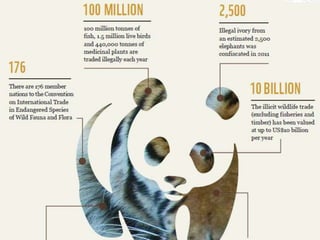
» Unsustainable trade in wildlife is one of the
central threats to biodiversity as it concerns
thousands of plant and animal species, and can
push them close to extinction.
» This issue affects a wide range of live animals and
plants as well as a vast array of products derived
from them, including food, fur, leather
goods, musical instruments, timber, tourist
souvenirs, perfumes, and medicines.
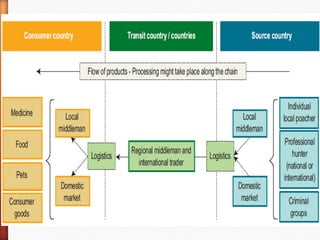
» To regulate this extra efforts, international cooperation
are necessary.
» Effective regulation – convention to prevent
commercial trade in endangered species
»CITES
»Convention on International
Trade in Endangered Species of
Wild Fauna and Flora
» CITES is an international convention that
combines wildlife and trade themes with a
legally binding instrument for achieving
conservation and sustainable use objectives
» The largest conservation oriented Convention.

» Resolution adopted by the 8TH General Assembly of
IUCN, in Nairobi in 1963.
» Drafting of the text started in 1964.
» The final text was adopted in Washington in 3 March
1973, and entered into force on 1 July 1975.
» Washington Convention
» CITES – agreement between governments
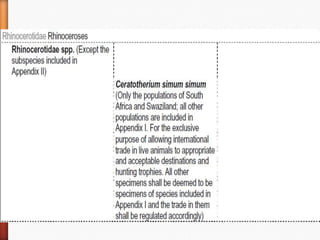
» The regulation is based upon the appendices :
» Appendix 1
» Appendix 2
» Appendix 3
&
» Regulates the export, re-export and import of live
and dead animals and plants and their parts and
derivatives (for listed species only) through a system
of permits and certificates
» Species threatened with extinction
» International (commercial) trade is generally
prohibited.
» Almost 530 animal species and 300 plant
species
» Species not threatened with extinction, but trade
must be controlled to avoid their becoming
threatened.
» International trade is permitted but regulated.
» More than 4,400 animal species and more than
28,000 plant species
» Species for which a country is asking Parties to
help with its protection.
» International trade is permitted but regulated
(less restrictive than Appendix II)
» Some 240 animal species and about 40 plant
species
»
»
»
»

Export permits
Import permits
Re-export certificates
Other certificates
» Designate a Management Authority and a
Scientific Authority

» Prohibit trade in specimens in violation of the
Convention
» Penalize such trade
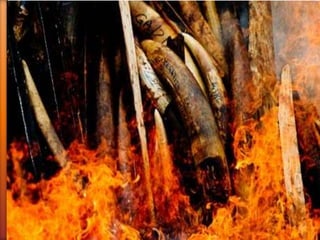
» Allow for elimination of specimens illegally traded
or possessed
» Effective and consistent international regulation
of trade in wildlife for conservation and
sustainable use.

» International cooperation on trade and
conservation, legislation and
enforcement, resource
management, conservation science.
Biodiversity cites seminar

Biodiversity cites seminar

  • 1.
  • 2.
  • 3.
    » variability amongliving organisms from all sources and the ecosystem
  • 4.
    » CONVENTION? AGREEMENT » CBDis a comprehensive, binding agreement covering the use and conservation of biodiversity.
  • 5.
  • 8.
    1993 DEC 29 1992 JUNE5 Enforce into action Signature at UNCED (Rio Earth Summit) 1992 MAY 22 Agreed the text of CBD 1991 Group become Intergovernmental Negotiating Committee (INC) 1989 Group – Prepared an international legal instrument for conservation & sustainable use of BD 1988 UNEP – Ad Hoc working Group of Experts on BD explore need for international CBD
  • 10.
    - 22 May,1992 in Nairobi, Kenya
  • 11.
    o Preamble o 42articles o 2 Annexures » 11 Conference Of the Parties ( COP) meetings.
  • 12.
    » » » » » » » » Conscious of values& components of BD. Conservation & maintenance of sustainable use of BD. Reaffirming sovereign rights & responsibility of BD. Aware of BD loss by human activities & plan to take measures. Need of full participation of women from policy making to implementation. Establish strong cooperation among states, regions.. Provide additional financial resources & relevant technologies. Commitment to conserve & sustainable use of BD for the benefit of present and future generations.
  • 13.
    » OBJECTIVES OFCBD: 1 » Conservation & sustainable use of BD. » Fair & equitable sharing of benefits arising from the use of genetic resources. » Appropriate access to genetic resources. » Transfer of required technologies. » Appropriate funding. 2 » USE OF TERMS:
  • 14.
    » "Biological diversity"– the variability among living organisms from all sources including, terrestrial, marine and other aquatic ecosystems and the ecological complexes of which they are part; this includes diversity within species, between species and of ecosystems.
  • 15.
    3 » PRINCIPLE: » Stateshave sovereign right to exploit their biological diversity as per their policies. Previously biodiversity was considered heritage of humankind. » State is responsible to control their resources without damaging the environment of other states.
  • 16.
    4 » JURIDICTIONAL SCOPE:The geographic area over which authority extends 5 » COOPERATION: » Each contracting country has to cooperate other countries for the conservation and sustainable use of biodiversity. » The cooperation can be bilateral or multilateral. » If necessary, any party can ask help from competent international organizations for arranging cooperation.
  • 17.
    6 » GENERAL MEASURESFOR CONSERVATION AND SUSTAINABLE USE (OBLIGATIONS OF THE STATES): » Develop or adopt national strategies, plans or programmes for the conservation and sustainable use of BD. » Integrate these plans into sectoral or cross sectoral plans, programmes and policies. 7 » IDENTIFICATION AND MONITORING
  • 18.
    8 » IN-SITU CONSERVATION: 9 »EX-SITU CONSERVATION: 10 » SUSTAINABLE USE OF COMPONENTS OF BD: 11 » INCENTIVE MEASURES: motivational measures
  • 19.
    12 » RESEARCH ANDTRAINING: 13 » PUBLIC EDUCATION AND AWARENESS: 14 » IMPACT ASSESSMENT AND MINIMIZING ADVERSE IMPACTS: 15 » ACCESS TO GENETIC RESOURCES:
  • 20.
    16 » ACCESS TOAND TRANSFER OF TECHNOLOGY: 17 » EXCHANGE OF INFORMATION: 18 » TECHNICAL AND SCIENTIFIC COOPERATION: 19 » HANDLING OF BIOTECHNOLOGY AND DISTRIBUTION OF ITS BENEFITS
  • 21.
    20 » FINANCIAL RESOURCES 21 »FINANCIAL MECHANISM 22 » RELATIONSHIP WITH OTHER INTERNATIONAL CONVENTIONS: 23 » CONFERENCE OF PARTIES (COP)
  • 22.
    24 » SECRETRAIAT 25 » SUBSIDIARYBODY ON SCIENTIFIC, TECHNICAL AND TECHNOLOGICAL ADVICE: 26 » REPORTS: 27 » SETTLEMENT OF DISPUTES:
  • 23.
    28 » ADOPTION OFPROTOCOL 29 » AMENDMENT OF THE CONVENTION OR PROTOCOLS: 30 » ADOPTION AND AMENDMENT OF ANNEXES: 31 » RIGHT TO VOTE:
  • 24.
    ARTICLE 33. RELATIONSHIPBETWEEN THIS CONVENTION AND ITS PROTOCOL ARTICLE 33. SIGNATURE ARTICLE 34. RATIFICATION (signing an agreement), ACCEPTANCE OR APPROVAL ARTICLE 35. ACCESSION (particular period for signature & its extension) ARTICLE 36. ENTRY INTO FORCE ARTICLE 37. RESERVATIONS ARTICLE 38. WITHDRAWALS ARTICLE 39. FINANCIAL INTERIM ARRANGEMENTS ARTICLE 40. SECRETARIAT INTERIM ARRANGEMENTS ARTICLE 41. DEPOSITARY ARTICLE 42. AUTHENTIC TEXTS ANNEX I. IDENTIFICATION AND MONITORING ANNEX II - PART 1. ARBITRATION ANNEX II - PART 2. CONCILIATION
  • 27.
    COP PLACE YEAR DOCUMENTS DECISIONS MAJOR THEMES 1 Nassau, Bahamas 28 Nov9 Dec 1994 33 13 Guidance to the financial mechanism; Medium-term programme of work; 2 Indonesia 6 - 17 Nov 1995 56 23 Marine and coastal biological diversity; Access to genetic resources; Conservation and sustainable use of biological diversity; Biosafety; 3 Argentina 4 - 15 Nov 1996 112 27 Agricultural biodiversity; Financial resources and mechanism; Identification, monitoring and assessment; Intellectual property rights; 4 Slovakia 4 - 15 May 1998 71 19 Inland water ecosystems; Review of the operations of the Convention; Article 8(j) and related issues (traditional knowledge); Benefit sharing;
  • 28.
    EX1 Cartagena, Colombia & Montreal, Canada 22 -23 Feb 1999 & 24 - 28 Jan 2000 24 3 CARTEGENA PROTOCOL 5 Nairobi, Kenya 15 - 26 May 2000 81 29 Dryland, mediterranean, arid, semi-arid, grassland and savannah ecosystems; Sustainable use, including tourism; Access to genetic resources; 6 Netherlands 7 - 19 April 2002 114 32 Forest ecosystems; Alien species; Benefit-sharing; Strategic plan 2002-2010; 7 Malaysia 9 - 20 February 2004 94 36 Mountain ecosystems; Protected areas; Transfer of technology and technology cooperation. 8 Brazil 20 - 31 March 2006 106 34 Island biodiversity; Biological diversity of dry and sub-humid lands; Global Taxonomy Initiative; Access and benefit-sharing (Article 15); Article 8(j) and related provisions; Communication, education and public awareness (Article 13).
  • 29.
    9 Germany 19 - 30 May 2008 110 36 Agricultural,Forest biodiversity Global Strategy for Plant Conservation; Invasive alien species; Incentive measures; Progress in the implementation of the Strategic Plan and progress towards the 2010 traget and relevant Millennium Development Goals; 10 Nagoya, Aichi Prefecture, Japan 18 - 29 October 2010 107 47 NAGOYA PROTOCOL 11 India 8 - 19 October 2012 125 33 BD & livelihoodss, integration of value of BD in national planning &accounting process, strategy for resource mobilization, coastal & marine BD , operationalization of Nagoya protocol
  • 32.
    » Raise awarenessof: ˃the importance of biodiversity ˃accomplishments to save biodiversity » Promote innovative solutions » Take immediate steps to reduce the rate of loss of biodiversity
  • 33.
    » Biodiversity isimportant for human wellbeing » The current rate of biodiversity loss is severe, by some accounts up to 100 times the natural rate of extinction » We need to work together to halt this loss. Many “success stories” point the way to the future
  • 34.
    » Provide aglobal message which offers partners the chance to highlight their work and activities » Create information products that highlight success stories and the work of the Convention » Take advantage of existing international and national events to promote the biodiversity agenda to new audiences and mobilize their support
  • 35.
    “To achieve, by2010, a significant reduction of the current rate of biodiversity loss at the global, regional and national level, as a contribution to poverty alleviation and to the benefit of all life on Earth”
  • 40.
    » Gene richcountries: have sovereign rights on their BD. » Farming communities: will receive their share from the benefits of BD. » Future generations: conservation of resources for future need. » Scientific communities: benefited by conservation and improvement of genetic resources. ALL THE PEOPLE WILL BE BENEFITED
  • 43.
    »Wild life trade– big business between countries – leads to endangering of species.
  • 44.
    » Unsustainable tradein wildlife is one of the central threats to biodiversity as it concerns thousands of plant and animal species, and can push them close to extinction. » This issue affects a wide range of live animals and plants as well as a vast array of products derived from them, including food, fur, leather goods, musical instruments, timber, tourist souvenirs, perfumes, and medicines.
  • 45.
    » To regulatethis extra efforts, international cooperation are necessary. » Effective regulation – convention to prevent commercial trade in endangered species
  • 46.
    »CITES »Convention on International Tradein Endangered Species of Wild Fauna and Flora
  • 47.
    » CITES isan international convention that combines wildlife and trade themes with a legally binding instrument for achieving conservation and sustainable use objectives
  • 49.
    » The largestconservation oriented Convention. » Resolution adopted by the 8TH General Assembly of IUCN, in Nairobi in 1963. » Drafting of the text started in 1964. » The final text was adopted in Washington in 3 March 1973, and entered into force on 1 July 1975. » Washington Convention

  • 54.
    » CITES –agreement between governments » The regulation is based upon the appendices : » Appendix 1 » Appendix 2 » Appendix 3 & » Regulates the export, re-export and import of live and dead animals and plants and their parts and derivatives (for listed species only) through a system of permits and certificates
  • 55.
    » Species threatenedwith extinction » International (commercial) trade is generally prohibited. » Almost 530 animal species and 300 plant species
  • 56.
    » Species notthreatened with extinction, but trade must be controlled to avoid their becoming threatened. » International trade is permitted but regulated. » More than 4,400 animal species and more than 28,000 plant species
  • 57.
    » Species forwhich a country is asking Parties to help with its protection. » International trade is permitted but regulated (less restrictive than Appendix II) » Some 240 animal species and about 40 plant species
  • 65.
  • 68.
    » Designate aManagement Authority and a Scientific Authority » Prohibit trade in specimens in violation of the Convention » Penalize such trade » Allow for elimination of specimens illegally traded or possessed
  • 70.
    » Effective andconsistent international regulation of trade in wildlife for conservation and sustainable use. » International cooperation on trade and conservation, legislation and enforcement, resource management, conservation science.