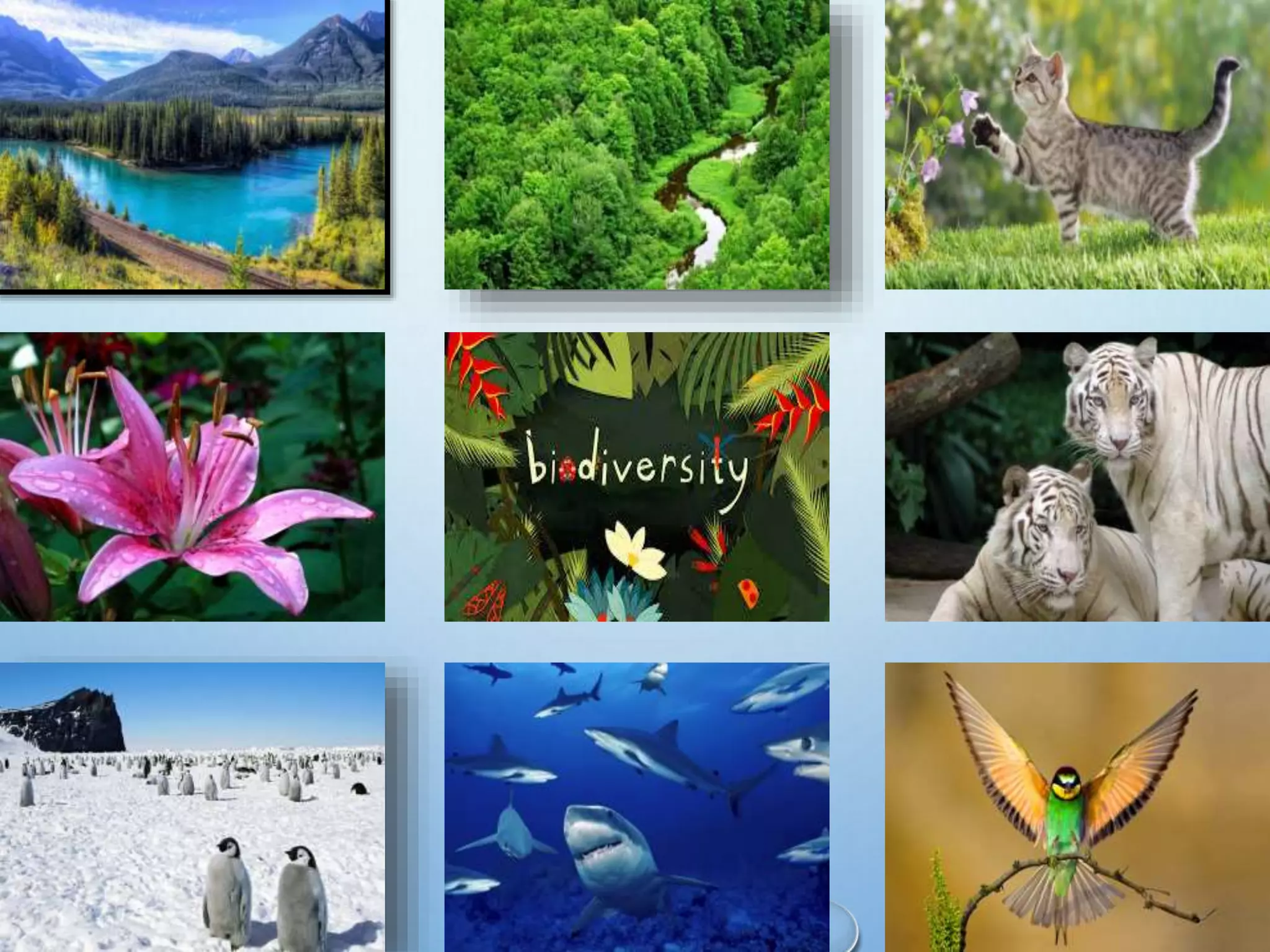
• Biodiversity is the variety of Life on Earth. It includes all life forms-from the
unicellular fungi, protozoa and bacteria to complex multicellular organisms
such as plants, birds, fishes and animals.
• Biodiversity is the variety of flora and fauna on this planet earth.
• The term Biodiversity, the short form of biological diversity, was coined by
Walter & Rosen in 1985.
• Everything that lives in an ecosystem is part of the web of life, including
humans. Each species of vegetation and each creature has a place on the
earth and plays a vital role in the circle of life. plant, animal, and insect
species interact and depend upon one another for what each offers, such as
food, shelter, oxygen, and soil enrichment.
• Maintaining a wide diversity of species in each ecosystem is necessary to
preserve the web of life that sustains all living things.
• Rain forests contain 50 percent of the world’s animal and plant species. the
biodiversity of these forests regulates weather patterns on earth.
• The Tree that live for 50 years generates Rs 5.3 Lakhs worth of oxygen.
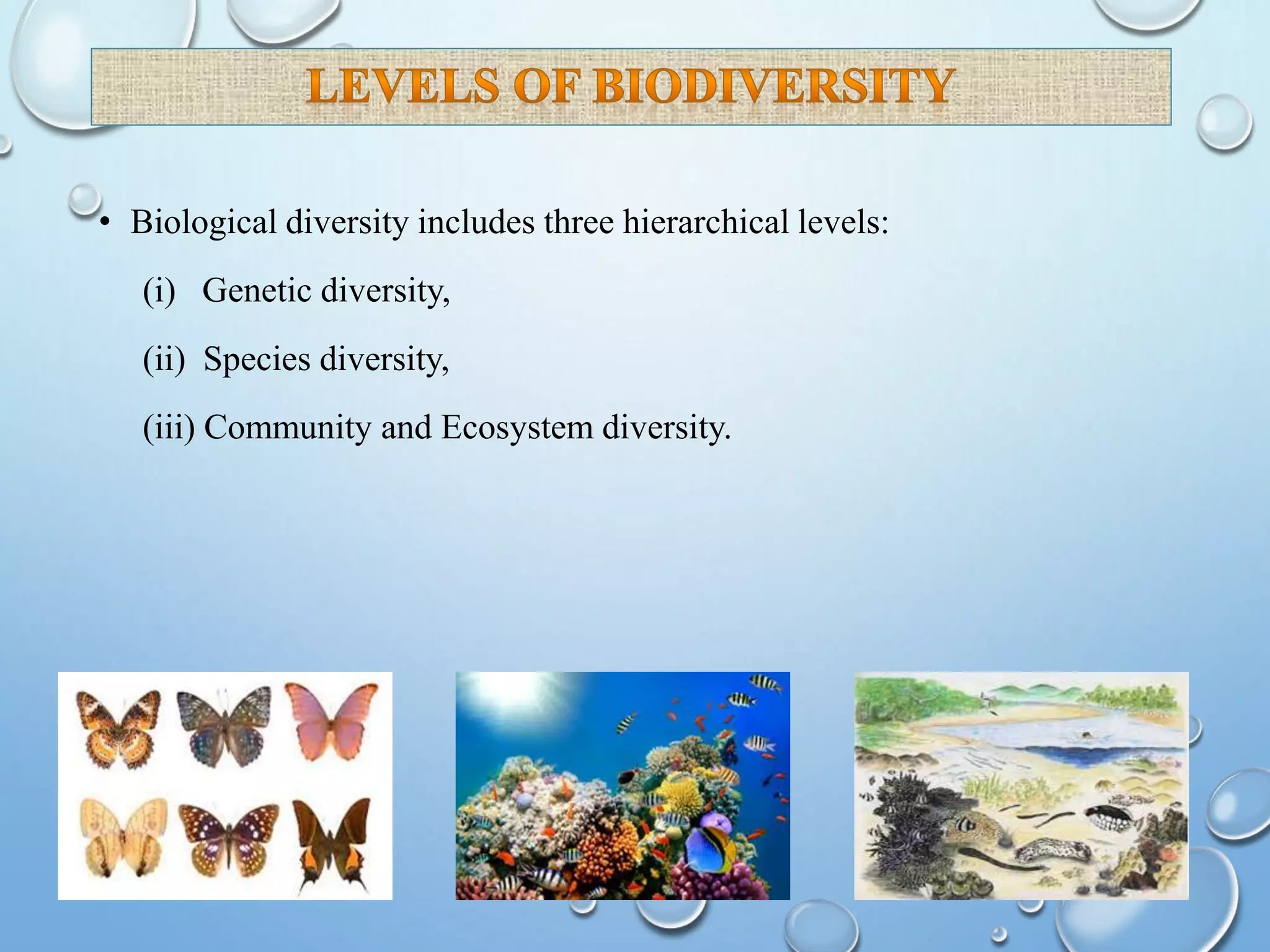
• Biological diversity includes three hierarchical levels:
(i) Genetic diversity,
(ii) Species diversity,
(iii) Community and Ecosystem diversity.
• Genetic diversity refers to the variation of genes within species; the
differences could be in alleles (different variants of same genes), in entire
genes (the traits determining particular characteristics) or in
chromosomal structures.
• If a species has more genetic diversity, it can adapt better to the changed
environmental conditions.
• Genes are the basic units of hereditary information, transmitted from one
generation to other.
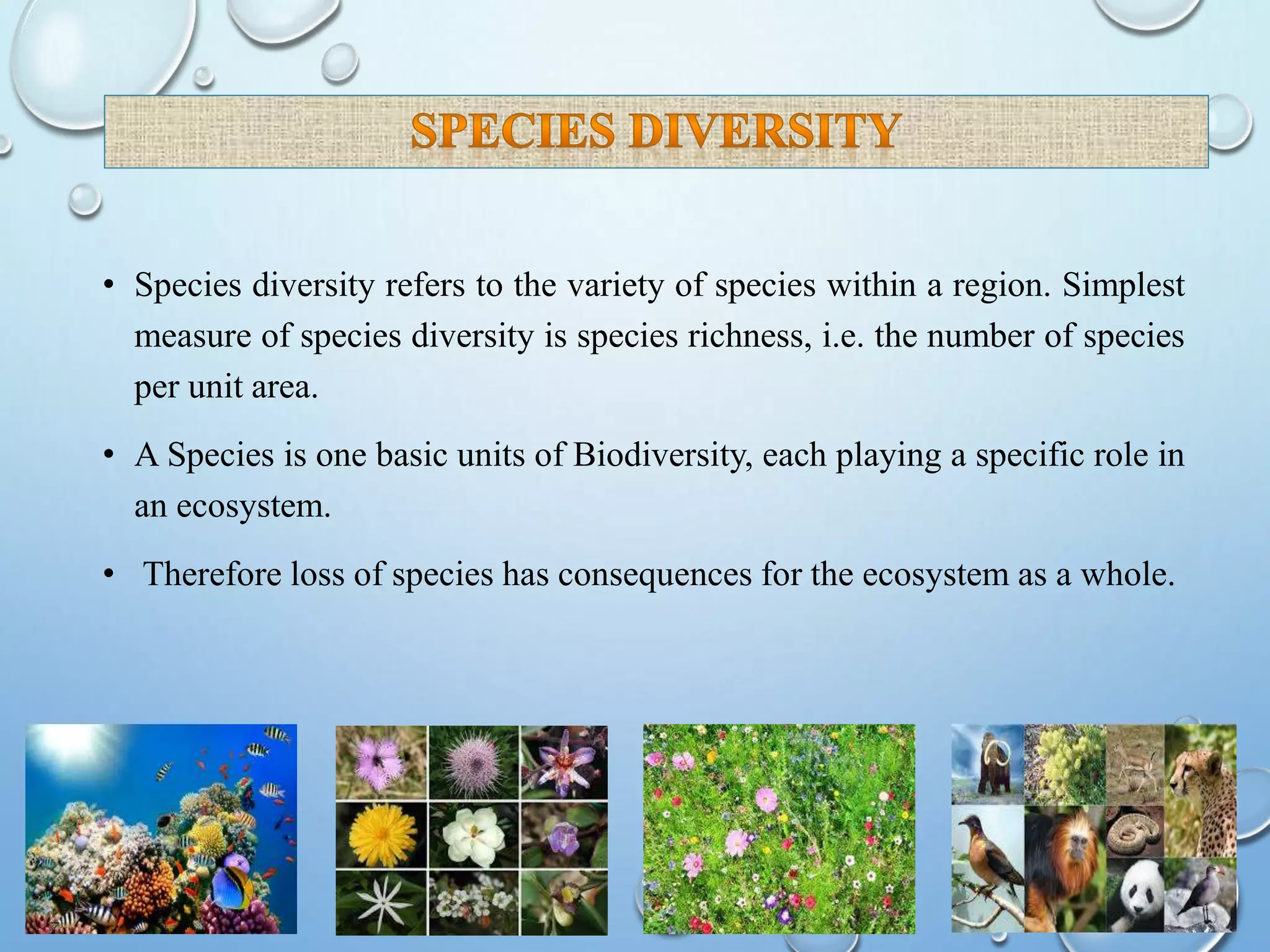
• Species diversity refers to the variety of species within a region. Simplest
measure of species diversity is species richness, i.e. the number of species
per unit area.
• A Species is one basic units of Biodiversity, each playing a specific role in
an ecosystem.
• Therefore loss of species has consequences for the ecosystem as a whole.
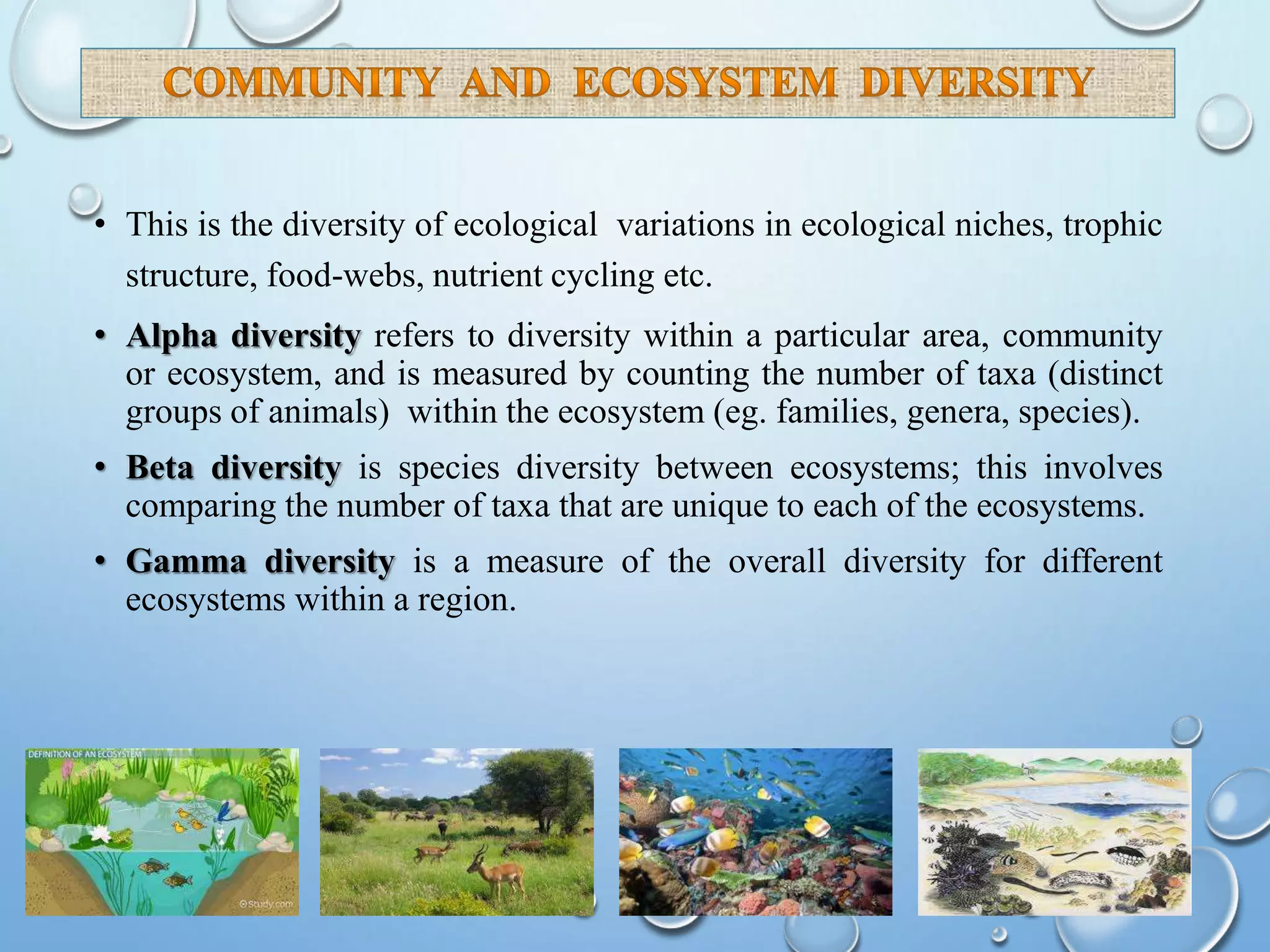
• This is the diversity of ecological variations in ecological niches, trophic
structure, food-webs, nutrient cycling etc.
• Alpha diversity refers to diversity within a particular area, community
or ecosystem, and is measured by counting the number of taxa (distinct
groups of animals) within the ecosystem (eg. families, genera, species).
• Beta diversity is species diversity between ecosystems; this involves
comparing the number of taxa that are unique to each of the ecosystems.
• Gamma diversity is a measure of the overall diversity for different
ecosystems within a region.
• India is known for its Rich Heritage of Biodiversity.
• India is one of the 17 mega-diverse countries in the world.
• With only 2.4 % of the Global land area and 4 % of total water, India accounts for 7–
8 % of the world’s recorded plant and animal species.
• Amongst the existing biota, 91,364 species of animals of which 2,557 Protista ,
12,470 general invertebrates, 69,903 arthropods, 4,994 vertebrates, and 45,968
species of plants (of which 1200 Species of Food Plants, 3000 Species of Medicinal
Herbs)as well as 5,650 microbial species have been documented in its 10 bio-
geographic regions.
• India has 4 out of 34 global biodiversity hotspots, which is an indicator of high
degree of endemism (of species) in India.
• About 5,150 plant species and 1,837 animal species are endemic to India.
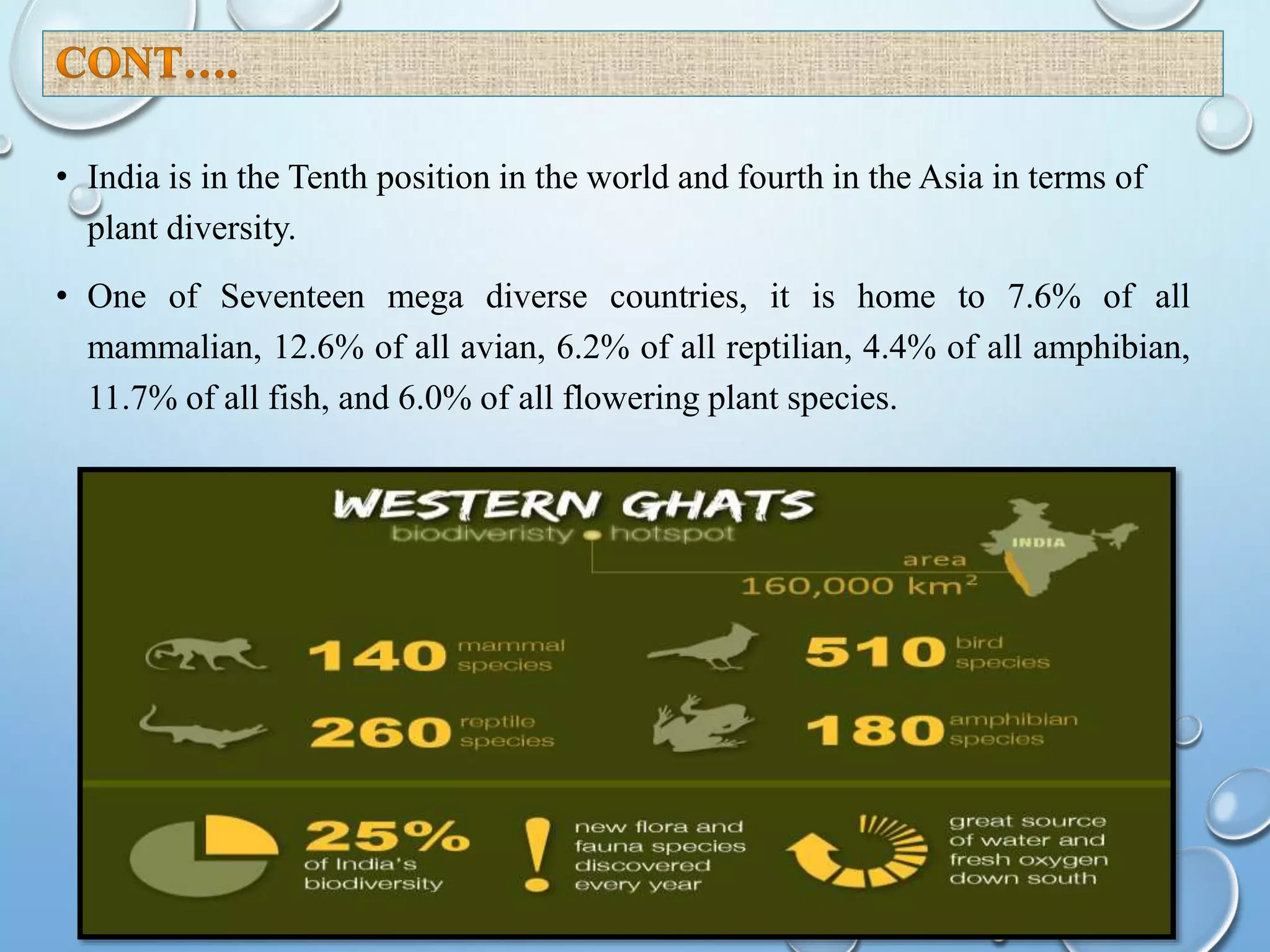
• India is in the Tenth position in the world and fourth in the Asia in terms of
plant diversity.
• One of Seventeen mega diverse countries, it is home to 7.6% of all
mammalian, 12.6% of all avian, 6.2% of all reptilian, 4.4% of all amphibian,
11.7% of all fish, and 6.0% of all flowering plant species.
Sr.no Biogeographic zone Biotic provinces
1 Trans Himalaya Upper reaches of Himalaya
2 Himalaya North west Himalaya, West, Central and East Himalaya
3 Dessert Kutch, Thar ,Ladhakh
4 Semi – arid Central India ,Gujarat Rajwara
5 Western Ghats Malabar Coast, Western Ghats mountains
6 Deccan peninsula Deccan Plateau, South central plateau, Eastern Plateau,
7 Gangetic plain Upper Gangetic plain, Lower Gangetic plain
8 Coasts West Coast, East Coast
9 North east India Brahmaputra valley, North eastern Hills
10 Islands Andaman, Nicobar, Lakshadweep Island
• We know that Ecosystems are undergoing change due to pollution,
invasive species, over exploitation by humans, and climate change.
• There are two basic strategies of biodiversity conservation, in situ (on
site) and ex situ (off site).
National park
Sanctuaries
Biosphere reserve
Eco sensitive zones
Botanical Garden
Zoo
Gene Bank
• Conserving the Animals and Plants in their Natural habitats is
known as in situ conservation.
1. PROTECTED AREA’S :
• These are areas of land and/or sea especially dedicated to the protection
and maintenance of biological diversity, and of natural and associated
cultural resources.
• Examples of protected areas are national parks, and wildlife sanctuaries.
World conservation monitoring center has recognized 37000 protected
areas around the world.
• India has 628 protected areas (103 national parks and 537 wildlife
sanctuaries) covering 4.7% of the total area.
• A Wildlife Sanctuary, is a naturally occurring sanctuary, that provides
protection to species from hunting, predation or competition; it is
a protected area, a geographic territory within which wildlife is protected.
• The first wildlife sanctuary in India is Maenam wildlife sanctuary which is
being established in south Sikkim in 1987
• Certain rights of people living inside the sanctuary could be permitted.
• Grazing, Firewood collection by tribal’s is allowed but strictly regulated.
• There are 537 wildlife sanctuaries in India.
• National parks are areas reserved for wild life where they can freely use
the habitats and natural resources.
• Commercial exploitation of natural resources in a national park is illegal.
• No grazing of any livestock shall also be permitted inside a National park.
• Jim Corbett National Park is the oldest national park in India and was
established in 1936 as Hailey national park to protect the endangered
Bengal tiger.
• There are 103 national park in India.
• The land falling within 10 km of the boundaries of national parks and wildlife
sanctuaries known as eco fragile zones or ECZ’S under the environmental
(protection) act, 1986.
• The purpose of the establishment of eco-sensitive zones is to prohibit all kinds
of human activities in those zones except agriculture.
• Eco-sensitive zones would minimize forest depletion and man-animal conflict.
• There are 29 eco sensitive zone’s in India.
• Large areas of protected land for conservation of wild life, plant and
animal resources and traditional life of the Tribal’s living in the area.
• May have one more National parks or Wildlife sanctuaries in it.
• There are 18 biosphere reserve zones in India.
• In this approach, Threatened animals and plants are taken out from
their natural habitat and placed in special setting where they can be
protected and given special care.
• Zoological parks, botanical gardens, wildlife safari parks and Gene
banks serve this purpose.
• Botanical garden refers to the Scientifically planned collection of
living trees, shrubs, herbs, and other plants from various parts of the
globe.
• There are 122 Botanical gardens in India.
• Acharya Jagadish Chandra Bose Botanical garden (Kolkata) is the
largest botanical garden in India. there are 12,000 species of plants,
trees, shrubs, and herbs in this botanical garden.
• An establishment which maintains a collection of wild animals,
typically in a park or gardens, for study, conservation, or display to the
public.
• There are 355 Zoo’s in India.
• The largest Zoo in India is Arignar anna zoological park, it is located in
Chennai (Tamilnadu).In which total 1657 animal of 163 species are
conserved in this zoo.
• Gene banks are a type of bio repository which preserve genetic material.
• For plants, this could be by freezing cuttings from the plant, or stocking
the seeds (e.g. in a seed bank ).
• Plant genetic material in a 'gene bank' is preserved at -196° in liquid
nitrogen as mature seed (dry).
• For animals, this is the freezing of sperm and eggs in zoological
freezers until further need.
• The National Biodiversity Authority (NBA) was established in 2003
(Chennai) to implement India’s biological diversity act (2002).
• The functions of NBA include:
• Creating an enabling environment, as appropriate, to promote conservation
and sustainable use of biodiversity.
• Advising the government of India on matters relating to conservation of
biodiversity, sustainable use of its components and equitable sharing of
benefits arising out of utilization of biological resources.
• Advising the state governments in the selection of areas of biodiversity
importance to be notified as Heritage sites and suggest measures for their
management.
State Biodiversity Boards 26
Biodiversity Management Committees 32796
States that have notified state-wise Rules 14
Biodiversity Heritage Sites 4
• Indian forest act, 1927
• Wild life (protection) act,1972
• Forest (conservation) act,1980
• Environment protection act, 1986
• The biological diversity act,2002
• The biological diversity rule,2004
• The scheduled tribes and other forest dweller ( recognition of forest rights )
act, 2006
National biodiversity protection initiatives

National biodiversity protection initiatives

  • 3.
    • Biodiversity isthe variety of Life on Earth. It includes all life forms-from the unicellular fungi, protozoa and bacteria to complex multicellular organisms such as plants, birds, fishes and animals. • Biodiversity is the variety of flora and fauna on this planet earth. • The term Biodiversity, the short form of biological diversity, was coined by Walter & Rosen in 1985.
  • 4.
    • Everything thatlives in an ecosystem is part of the web of life, including humans. Each species of vegetation and each creature has a place on the earth and plays a vital role in the circle of life. plant, animal, and insect species interact and depend upon one another for what each offers, such as food, shelter, oxygen, and soil enrichment. • Maintaining a wide diversity of species in each ecosystem is necessary to preserve the web of life that sustains all living things. • Rain forests contain 50 percent of the world’s animal and plant species. the biodiversity of these forests regulates weather patterns on earth. • The Tree that live for 50 years generates Rs 5.3 Lakhs worth of oxygen.
  • 5.
    • Biological diversityincludes three hierarchical levels: (i) Genetic diversity, (ii) Species diversity, (iii) Community and Ecosystem diversity.
  • 6.
    • Genetic diversityrefers to the variation of genes within species; the differences could be in alleles (different variants of same genes), in entire genes (the traits determining particular characteristics) or in chromosomal structures. • If a species has more genetic diversity, it can adapt better to the changed environmental conditions. • Genes are the basic units of hereditary information, transmitted from one generation to other.
  • 7.
    • Species diversityrefers to the variety of species within a region. Simplest measure of species diversity is species richness, i.e. the number of species per unit area. • A Species is one basic units of Biodiversity, each playing a specific role in an ecosystem. • Therefore loss of species has consequences for the ecosystem as a whole.
  • 8.
    • This isthe diversity of ecological variations in ecological niches, trophic structure, food-webs, nutrient cycling etc. • Alpha diversity refers to diversity within a particular area, community or ecosystem, and is measured by counting the number of taxa (distinct groups of animals) within the ecosystem (eg. families, genera, species). • Beta diversity is species diversity between ecosystems; this involves comparing the number of taxa that are unique to each of the ecosystems. • Gamma diversity is a measure of the overall diversity for different ecosystems within a region.
  • 9.
    • India isknown for its Rich Heritage of Biodiversity. • India is one of the 17 mega-diverse countries in the world. • With only 2.4 % of the Global land area and 4 % of total water, India accounts for 7– 8 % of the world’s recorded plant and animal species. • Amongst the existing biota, 91,364 species of animals of which 2,557 Protista , 12,470 general invertebrates, 69,903 arthropods, 4,994 vertebrates, and 45,968 species of plants (of which 1200 Species of Food Plants, 3000 Species of Medicinal Herbs)as well as 5,650 microbial species have been documented in its 10 bio- geographic regions. • India has 4 out of 34 global biodiversity hotspots, which is an indicator of high degree of endemism (of species) in India. • About 5,150 plant species and 1,837 animal species are endemic to India.
  • 10.
    • India isin the Tenth position in the world and fourth in the Asia in terms of plant diversity. • One of Seventeen mega diverse countries, it is home to 7.6% of all mammalian, 12.6% of all avian, 6.2% of all reptilian, 4.4% of all amphibian, 11.7% of all fish, and 6.0% of all flowering plant species.
  • 11.
    Sr.no Biogeographic zoneBiotic provinces 1 Trans Himalaya Upper reaches of Himalaya 2 Himalaya North west Himalaya, West, Central and East Himalaya 3 Dessert Kutch, Thar ,Ladhakh 4 Semi – arid Central India ,Gujarat Rajwara 5 Western Ghats Malabar Coast, Western Ghats mountains 6 Deccan peninsula Deccan Plateau, South central plateau, Eastern Plateau, 7 Gangetic plain Upper Gangetic plain, Lower Gangetic plain 8 Coasts West Coast, East Coast 9 North east India Brahmaputra valley, North eastern Hills 10 Islands Andaman, Nicobar, Lakshadweep Island
  • 12.
    • We knowthat Ecosystems are undergoing change due to pollution, invasive species, over exploitation by humans, and climate change. • There are two basic strategies of biodiversity conservation, in situ (on site) and ex situ (off site). National park Sanctuaries Biosphere reserve Eco sensitive zones Botanical Garden Zoo Gene Bank
  • 13.
    • Conserving theAnimals and Plants in their Natural habitats is known as in situ conservation. 1. PROTECTED AREA’S : • These are areas of land and/or sea especially dedicated to the protection and maintenance of biological diversity, and of natural and associated cultural resources. • Examples of protected areas are national parks, and wildlife sanctuaries. World conservation monitoring center has recognized 37000 protected areas around the world. • India has 628 protected areas (103 national parks and 537 wildlife sanctuaries) covering 4.7% of the total area.
  • 14.
    • A WildlifeSanctuary, is a naturally occurring sanctuary, that provides protection to species from hunting, predation or competition; it is a protected area, a geographic territory within which wildlife is protected. • The first wildlife sanctuary in India is Maenam wildlife sanctuary which is being established in south Sikkim in 1987 • Certain rights of people living inside the sanctuary could be permitted. • Grazing, Firewood collection by tribal’s is allowed but strictly regulated. • There are 537 wildlife sanctuaries in India.
  • 15.
    • National parksare areas reserved for wild life where they can freely use the habitats and natural resources. • Commercial exploitation of natural resources in a national park is illegal. • No grazing of any livestock shall also be permitted inside a National park. • Jim Corbett National Park is the oldest national park in India and was established in 1936 as Hailey national park to protect the endangered Bengal tiger. • There are 103 national park in India.
  • 16.
    • The landfalling within 10 km of the boundaries of national parks and wildlife sanctuaries known as eco fragile zones or ECZ’S under the environmental (protection) act, 1986. • The purpose of the establishment of eco-sensitive zones is to prohibit all kinds of human activities in those zones except agriculture. • Eco-sensitive zones would minimize forest depletion and man-animal conflict. • There are 29 eco sensitive zone’s in India.
  • 17.
    • Large areasof protected land for conservation of wild life, plant and animal resources and traditional life of the Tribal’s living in the area. • May have one more National parks or Wildlife sanctuaries in it. • There are 18 biosphere reserve zones in India.
  • 18.
    • In thisapproach, Threatened animals and plants are taken out from their natural habitat and placed in special setting where they can be protected and given special care. • Zoological parks, botanical gardens, wildlife safari parks and Gene banks serve this purpose.
  • 19.
    • Botanical gardenrefers to the Scientifically planned collection of living trees, shrubs, herbs, and other plants from various parts of the globe. • There are 122 Botanical gardens in India. • Acharya Jagadish Chandra Bose Botanical garden (Kolkata) is the largest botanical garden in India. there are 12,000 species of plants, trees, shrubs, and herbs in this botanical garden.
  • 20.
    • An establishmentwhich maintains a collection of wild animals, typically in a park or gardens, for study, conservation, or display to the public. • There are 355 Zoo’s in India. • The largest Zoo in India is Arignar anna zoological park, it is located in Chennai (Tamilnadu).In which total 1657 animal of 163 species are conserved in this zoo.
  • 21.
    • Gene banksare a type of bio repository which preserve genetic material. • For plants, this could be by freezing cuttings from the plant, or stocking the seeds (e.g. in a seed bank ). • Plant genetic material in a 'gene bank' is preserved at -196° in liquid nitrogen as mature seed (dry). • For animals, this is the freezing of sperm and eggs in zoological freezers until further need.
  • 22.
    • The NationalBiodiversity Authority (NBA) was established in 2003 (Chennai) to implement India’s biological diversity act (2002). • The functions of NBA include: • Creating an enabling environment, as appropriate, to promote conservation and sustainable use of biodiversity. • Advising the government of India on matters relating to conservation of biodiversity, sustainable use of its components and equitable sharing of benefits arising out of utilization of biological resources. • Advising the state governments in the selection of areas of biodiversity importance to be notified as Heritage sites and suggest measures for their management.
  • 23.
    State Biodiversity Boards26 Biodiversity Management Committees 32796 States that have notified state-wise Rules 14 Biodiversity Heritage Sites 4
  • 24.
    • Indian forestact, 1927 • Wild life (protection) act,1972 • Forest (conservation) act,1980 • Environment protection act, 1986 • The biological diversity act,2002 • The biological diversity rule,2004 • The scheduled tribes and other forest dweller ( recognition of forest rights ) act, 2006