PRESENTATION
ON
RAMSAR CONVENTION ON WETLANDS
PRESENTED TO PRESENTED BY
DR.MEENAKSHI NANDAL ANU GAHLAWAT
ASSOCIATE PROFESSOR 1903
DEPARTMENT-ENVIRONMENTAL SCIENCES MSC-4TH SEM
SUB- ENV. MANAGEMENT & PLANNING MDU ROHTAK
Ramsar Convention
• Ramsar Convention or the Convention of Wetlands was signed on 2nd February
1971 in the Iranian city of Ramsar.
• This is where it gets its name from-The Ramsar Convention. 2nd February is
celebrated as World Wetlands Day every year.
• It came into force in the year 1975, upon receipt by UNESCO.
• There are 171 contracting parties to the Ramsar Convention.
• India signed the Ramsar Convention on 1 February 1982.
• Ramsar Convention is not legally binding.
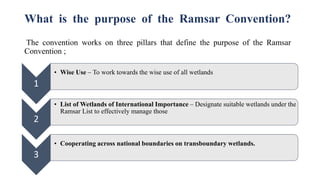
What is the purpose of the Ramsar Convention?
The convention works on three pillars that define the purpose of the Ramsar
Convention ;
1
• Wise Use – To work towards the wise use of all wetlands
2
• List of Wetlands of International Importance – Designate suitable wetlands under the
Ramsar List to effectively manage those
3
• Cooperating across national boundaries on transboundary wetlands.
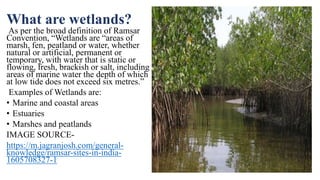
What are wetlands?
As per the broad definition of Ramsar
Convention, “Wetlands are “areas of
marsh, fen, peatland or water, whether
natural or artificial, permanent or
temporary, with water that is static or
flowing, fresh, brackish or salt, including
areas of marine water the depth of which
at low tide does not exceed six metres.”
Examples of Wetlands are:
• Marine and coastal areas
• Estuaries
• Marshes and peatlands
IMAGE SOURCE-
https://m.jagranjosh.com/general-
knowledge/ramsar-sites-in-india-
1605708327-1
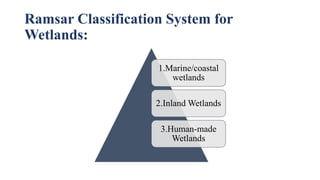
Ramsar Classification System for
Wetlands:
1.Marine/coastal
wetlands
2.Inland Wetlands
3.Human-made
Wetlands
1.Marine wetlands- are saltwater wetlands exposed to waves, currents
and tides in an oceanic setting. • Marine wetlands include coral reefs,
and aquatic subtidal beds with sea grass and kelps.
• Coastal and marine wetlands are important nursery and feeding areas
for animals such as fish, dugongs, and marine turtles.
2. Inland wetlands- include marshes and wet meadows dominated by
herbaceous plants, swamps dominated by shrubs, and wooded swamps
dominated by trees.
3. Human-made Wetlands-Any type of wetland constructed or
maintained by humans for e.g. water storage, irrigation, aquaculture.
The main threats to wetlands-
1.Pollution-80% of our global wastewater is released into wetlands untreated.
Pollution from factories, fertilizers, pesticides or from major spills, all pose
serious threats to wetlands.
2.Invasive species-The introduction of invasive species like the common water
hyacinth and animals like the killer shrimp have had a devastating impact on wetlands.
Wetland wildlife is particularly vulnerable to INNS because water provides easy
pathways for them to spread and grow.
3.Climate change-The relationship between wetlands and climate change is
complex. Changes in rainfall and temperature pose a significant threat to wetlands,
causing them to dry out. This is just one of the reasons that wetland species like
amphibians, migratory birds and corals are among the first and hardest hit by climate
change.
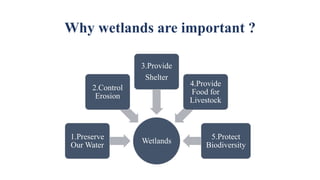
Why wetlands are important ?
Wetlands
1.Preserve
Our Water
2.Control
Erosion
3.Provide
Shelter
4.Provide
Food for
Livestock
5.Protect
Biodiversity
1. Wetlands purify our water
Wetlands are great filters! They trap sediments and remove pollutants,
which helps to purify water. This certainly beats expensive, human-
made filtration systems.
2. Wetlands help to control erosion
Sediments are also trapped by wetlands. In a semi-arid country like
South Africa, the role of wetlands in trapping sediments, before the
sediment-laden water joins a river course and just washes away, is really
useful.
3. Wetlands provide homes for animals and plants
Biodiversity is high around wetlands habitats. These areas provide food
and shelter for many animals, in particular bird species such as herons,
spoonbills and flamingos, and amphibians such as frogs.
4.Wetlands provide food for livestock
Wetlands provide good areas for grazing, and the variety of grasses,
along with a supply of running water, can be beneficial to farming
livestock.
5. Wetlands protect biodiversity
Many different kinds of creatures depend on wetlands – and on each
other. The insects that are attracted to the plants provide food for other
animals like fish, frogs and birds, who in turn attract other predators.
The biodiversity of wetlands has produced some incredible specialist
species that are only found in these habitats.
•
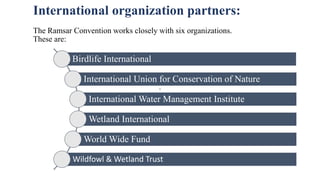
International organization partners:
The Ramsar Convention works closely with six organizations.
These are:
Birdlife International
International Union for Conservation of Nature
International Water Management Institute
• I
Wetland International
World Wide Fund
• Worldwide
Wildfowl & Wetland Trust
OTHER PARTNERS:
• Biodiversity-related conventions including the Convention on
Biological Diversity (CBD), the Convention to Combat Desertification
(UNCCD), Convention on Migratory Species (CMS), the World
Heritage Convention (WHC).
• Project funding bodies including global environmental funds,
multilateral development banks and bilateral donors.
• UNEP, UNDP, UNESCO and the UN Economic Commission for
Europe, and specific programmers such as UNESCO’s Man and the
Biosphere (MAB) programme
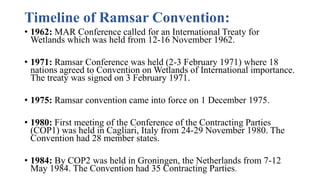
Timeline of Ramsar Convention:
• 1962: MAR Conference called for an International Treaty for
Wetlands which was held from 12-16 November 1962.
• 1971: Ramsar Conference was held (2-3 February 1971) where 18
nations agreed to Convention on Wetlands of International importance.
The treaty was signed on 3 February 1971.
• 1975: Ramsar convention came into force on 1 December 1975.
• 1980: First meeting of the Conference of the Contracting Parties
(COP1) was held in Cagliari, Italy from 24-29 November 1980. The
Convention had 28 member states.
• 1984: By COP2 was held in Groningen, the Netherlands from 7-12
May 1984. The Convention had 35 Contracting Parties.
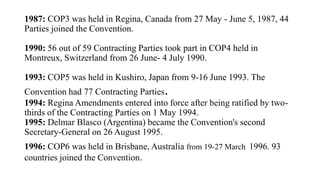
1987: COP3 was held in Regina, Canada from 27 May - June 5, 1987, 44
Parties joined the Convention.
1990: 56 out of 59 Contracting Parties took part in COP4 held in
Montreux, Switzerland from 26 June- 4 July 1990.
1993: COP5 was held in Kushiro, Japan from 9-16 June 1993. The
Convention had 77 Contracting Parties.
1994: Regina Amendments entered into force after being ratified by two-
thirds of the Contracting Parties on 1 May 1994.
1995: Delmar Blasco (Argentina) became the Convention's second
Secretary-General on 26 August 1995.
1996: COP6 was held in Brisbane, Australia from 19-27 March 1996. 93
countries joined the Convention.
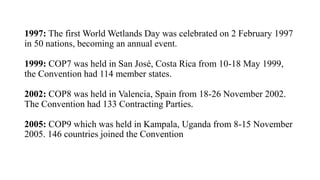
1997: The first World Wetlands Day was celebrated on 2 February 1997
in 50 nations, becoming an annual event.
1999: COP7 was held in San José, Costa Rica from 10-18 May 1999,
the Convention had 114 member states.
2002: COP8 was held in Valencia, Spain from 18-26 November 2002.
The Convention had 133 Contracting Parties.
2005: COP9 which was held in Kampala, Uganda from 8-15 November
2005. 146 countries joined the Convention
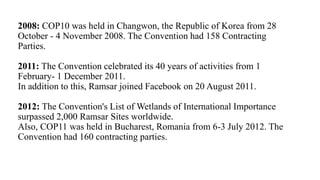
2008: COP10 was held in Changwon, the Republic of Korea from 28
October - 4 November 2008. The Convention had 158 Contracting
Parties.
2011: The Convention celebrated its 40 years of activities from 1
February- 1 December 2011.
In addition to this, Ramsar joined Facebook on 20 August 2011.
2012: The Convention's List of Wetlands of International Importance
surpassed 2,000 Ramsar Sites worldwide.
Also, COP11 was held in Bucharest, Romania from 6-3 July 2012. The
Convention had 160 contracting parties.
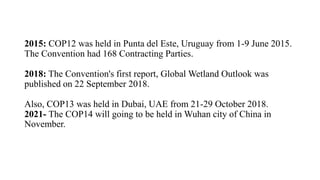
2015: COP12 was held in Punta del Este, Uruguay from 1-9 June 2015.
The Convention had 168 Contracting Parties.
2018: The Convention's first report, Global Wetland Outlook was
published on 22 September 2018.
Also, COP13 was held in Dubai, UAE from 21-29 October 2018.
2021- The COP14 will going to be held in Wuhan city of China in
November.
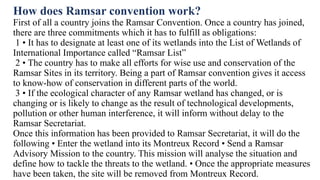
How does Ramsar convention work?
First of all a country joins the Ramsar Convention. Once a country has joined,
there are three commitments which it has to fulfill as obligations:
1 • It has to designate at least one of its wetlands into the List of Wetlands of
International Importance called “Ramsar List”
2 • The country has to make all efforts for wise use and conservation of the
Ramsar Sites in its territory. Being a part of Ramsar convention gives it access
to know-how of conservation in different parts of the world.
3 • If the ecological character of any Ramsar wetland has changed, or is
changing or is likely to change as the result of technological developments,
pollution or other human interference, it will inform without delay to the
Ramsar Secretariat.
Once this information has been provided to Ramsar Secretariat, it will do the
following • Enter the wetland into its Montreux Record • Send a Ramsar
Advisory Mission to the country. This mission will analyse the situation and
define how to tackle the threats to the wetland. • Once the appropriate measures
have been taken, the site will be removed from Montreux Record.
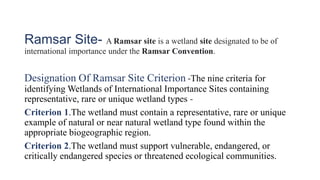
Ramsar Site- A Ramsar site is a wetland site designated to be of
international importance under the Ramsar Convention.
Designation Of Ramsar Site Criterion -The nine criteria for
identifying Wetlands of International Importance Sites containing
representative, rare or unique wetland types -
Criterion 1.The wetland must contain a representative, rare or unique
example of natural or near natural wetland type found within the
appropriate biogeographic region.
Criterion 2.The wetland must support vulnerable, endangered, or
critically endangered species or threatened ecological communities.
Criterion 3. The wetland must support populations of plant and or
animal species important to maintain the biodiversity of a particular
biogeographic region.
Criterion 4.The wetland must support plant and or animal species at a
critical stage in their life cycles, or provides refuge during adverse
conditions.
Criterion 5. The wetland must support 20,000 or more waterbirds.
Criterion 6. The wetland must regularly support 1% of the individuals
in a population of one species or subspecies of waterbirds.
Criterion 7.The wetland must support a significant proportion of
indigenous fish subspecies.
Criterion 8. The wetland must be an important source of food for
fishes, spawning ground, nursery.
Criterion 9. The wetland must support 1% of the individuals in a
population of one species of wetland dependent non-avian animal
species
Interesting facts about Ramsar sites:
• The Ramsar sites are one of the major protected areas in the
world.
• There are 2,414 Ramsar sites in the world.
• In 1974, the world's first Ramsar site was identified (Cobourg
Peninsula; Australia).
• With 175 Ramsar sites, the United Kingdom has the largest
number of such sites in the world.
• There are a total of 42 Ramsar Sites in India with a surface area of
1,081,438 hectares (as of December 2020).
• Chilika Lake is the largest Ramsar Site of India with a surface area of
1,16,500 hectares.
• Chilika Lake (Orissa) and Keoladeo National Park (Rajasthan) were
recognized as the first Ramsar Sites of India.
• Uttar Pradesh has the largest number of Ramsar Sites in India with 8
Indian Wetlands.
• Renuka Wetland in Himachal Pradesh is the smallest wetland of India
a surface area of 20 hectares.
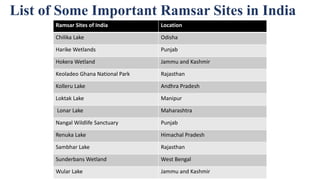
Ramsar Sites of India Location
Chilika Lake Odisha
Harike Wetlands Punjab
Hokera Wetland Jammu and Kashmir
Keoladeo Ghana National Park Rajasthan
Kolleru Lake Andhra Pradesh
Loktak Lake Manipur
Lonar Lake Maharashtra
Nangal Wildlife Sanctuary Punjab
Renuka Lake Himachal Pradesh
Sambhar Lake Rajasthan
Sunderbans Wetland West Bengal
Wular Lake Jammu and Kashmir
List of Some Important Ramsar Sites in India
Montreux Record
• The Montreux Record is a register of listed Ramsar sites where
changes in ecological character have occurred, are occurring, or are
likely to occur as a result of technological developments, pollution or
other human interference.
• The registered was established in 1990.
• Keoladeo National Park and Loktak lake from India are included in the
Montreux Record. Earlier Chilka Lake was part, but, it has been
removed in 2002.
References-
1.http://sdg.iisd.org/commentary/guest-articles/ramsar-convention-on-wetlands-40-years-of-
biodiversity-conservation-and-wise-use/
2. https://i.unu.edu/media/ourworld.unu.edu-
en/article/4660/Ramsar_IEDSResearchSeries.pdf
3.https://www.ramsar.org/sites/default/files/documents/library/handbook1_5ed_introductiont
oconvention_e.pdf
4. https://www.environment.gov.au/water/wetlands/ramsar
5.https://www.researchgate.net/publication/282124983_The_Ramsar_Convention_a_review
_of_wetlands_management_in_New_Zealand
6. https://www.sciencedirect.com/topics/earth-and-planetary-sciences/ramsar-convention
7. https://www.frontiersin.org/articles/10.3389/fevo.2019.00021/full
8. https://m.jagranjosh.com/general-knowledge/ramsar-sites-in-india-1605708327-1
9. https://blog.ipleaders.in/ramsar-convention-wetlands/
Thank You

Ramsar convention (1)

  • 1.
    PRESENTATION ON RAMSAR CONVENTION ONWETLANDS PRESENTED TO PRESENTED BY DR.MEENAKSHI NANDAL ANU GAHLAWAT ASSOCIATE PROFESSOR 1903 DEPARTMENT-ENVIRONMENTAL SCIENCES MSC-4TH SEM SUB- ENV. MANAGEMENT & PLANNING MDU ROHTAK
  • 2.
    Ramsar Convention • RamsarConvention or the Convention of Wetlands was signed on 2nd February 1971 in the Iranian city of Ramsar. • This is where it gets its name from-The Ramsar Convention. 2nd February is celebrated as World Wetlands Day every year. • It came into force in the year 1975, upon receipt by UNESCO. • There are 171 contracting parties to the Ramsar Convention. • India signed the Ramsar Convention on 1 February 1982. • Ramsar Convention is not legally binding.
  • 3.
    What is thepurpose of the Ramsar Convention? The convention works on three pillars that define the purpose of the Ramsar Convention ; 1 • Wise Use – To work towards the wise use of all wetlands 2 • List of Wetlands of International Importance – Designate suitable wetlands under the Ramsar List to effectively manage those 3 • Cooperating across national boundaries on transboundary wetlands.
  • 4.
    What are wetlands? Asper the broad definition of Ramsar Convention, “Wetlands are “areas of marsh, fen, peatland or water, whether natural or artificial, permanent or temporary, with water that is static or flowing, fresh, brackish or salt, including areas of marine water the depth of which at low tide does not exceed six metres.” Examples of Wetlands are: • Marine and coastal areas • Estuaries • Marshes and peatlands IMAGE SOURCE- https://m.jagranjosh.com/general- knowledge/ramsar-sites-in-india- 1605708327-1
  • 5.
    Ramsar Classification Systemfor Wetlands: 1.Marine/coastal wetlands 2.Inland Wetlands 3.Human-made Wetlands
  • 6.
    1.Marine wetlands- aresaltwater wetlands exposed to waves, currents and tides in an oceanic setting. • Marine wetlands include coral reefs, and aquatic subtidal beds with sea grass and kelps. • Coastal and marine wetlands are important nursery and feeding areas for animals such as fish, dugongs, and marine turtles. 2. Inland wetlands- include marshes and wet meadows dominated by herbaceous plants, swamps dominated by shrubs, and wooded swamps dominated by trees. 3. Human-made Wetlands-Any type of wetland constructed or maintained by humans for e.g. water storage, irrigation, aquaculture.
  • 7.
    The main threatsto wetlands- 1.Pollution-80% of our global wastewater is released into wetlands untreated. Pollution from factories, fertilizers, pesticides or from major spills, all pose serious threats to wetlands. 2.Invasive species-The introduction of invasive species like the common water hyacinth and animals like the killer shrimp have had a devastating impact on wetlands. Wetland wildlife is particularly vulnerable to INNS because water provides easy pathways for them to spread and grow. 3.Climate change-The relationship between wetlands and climate change is complex. Changes in rainfall and temperature pose a significant threat to wetlands, causing them to dry out. This is just one of the reasons that wetland species like amphibians, migratory birds and corals are among the first and hardest hit by climate change.
  • 8.
    Why wetlands areimportant ? Wetlands 1.Preserve Our Water 2.Control Erosion 3.Provide Shelter 4.Provide Food for Livestock 5.Protect Biodiversity
  • 9.
    1. Wetlands purifyour water Wetlands are great filters! They trap sediments and remove pollutants, which helps to purify water. This certainly beats expensive, human- made filtration systems. 2. Wetlands help to control erosion Sediments are also trapped by wetlands. In a semi-arid country like South Africa, the role of wetlands in trapping sediments, before the sediment-laden water joins a river course and just washes away, is really useful. 3. Wetlands provide homes for animals and plants Biodiversity is high around wetlands habitats. These areas provide food and shelter for many animals, in particular bird species such as herons, spoonbills and flamingos, and amphibians such as frogs.
  • 10.
    4.Wetlands provide foodfor livestock Wetlands provide good areas for grazing, and the variety of grasses, along with a supply of running water, can be beneficial to farming livestock. 5. Wetlands protect biodiversity Many different kinds of creatures depend on wetlands – and on each other. The insects that are attracted to the plants provide food for other animals like fish, frogs and birds, who in turn attract other predators. The biodiversity of wetlands has produced some incredible specialist species that are only found in these habitats.
  • 11.
    • International organization partners: TheRamsar Convention works closely with six organizations. These are: Birdlife International International Union for Conservation of Nature International Water Management Institute • I Wetland International World Wide Fund • Worldwide Wildfowl & Wetland Trust
  • 12.
    OTHER PARTNERS: • Biodiversity-relatedconventions including the Convention on Biological Diversity (CBD), the Convention to Combat Desertification (UNCCD), Convention on Migratory Species (CMS), the World Heritage Convention (WHC). • Project funding bodies including global environmental funds, multilateral development banks and bilateral donors. • UNEP, UNDP, UNESCO and the UN Economic Commission for Europe, and specific programmers such as UNESCO’s Man and the Biosphere (MAB) programme
  • 13.
    Timeline of RamsarConvention: • 1962: MAR Conference called for an International Treaty for Wetlands which was held from 12-16 November 1962. • 1971: Ramsar Conference was held (2-3 February 1971) where 18 nations agreed to Convention on Wetlands of International importance. The treaty was signed on 3 February 1971. • 1975: Ramsar convention came into force on 1 December 1975. • 1980: First meeting of the Conference of the Contracting Parties (COP1) was held in Cagliari, Italy from 24-29 November 1980. The Convention had 28 member states. • 1984: By COP2 was held in Groningen, the Netherlands from 7-12 May 1984. The Convention had 35 Contracting Parties.
  • 14.
    1987: COP3 washeld in Regina, Canada from 27 May - June 5, 1987, 44 Parties joined the Convention. 1990: 56 out of 59 Contracting Parties took part in COP4 held in Montreux, Switzerland from 26 June- 4 July 1990. 1993: COP5 was held in Kushiro, Japan from 9-16 June 1993. The Convention had 77 Contracting Parties. 1994: Regina Amendments entered into force after being ratified by two- thirds of the Contracting Parties on 1 May 1994. 1995: Delmar Blasco (Argentina) became the Convention's second Secretary-General on 26 August 1995. 1996: COP6 was held in Brisbane, Australia from 19-27 March 1996. 93 countries joined the Convention.
  • 15.
    1997: The firstWorld Wetlands Day was celebrated on 2 February 1997 in 50 nations, becoming an annual event. 1999: COP7 was held in San José, Costa Rica from 10-18 May 1999, the Convention had 114 member states. 2002: COP8 was held in Valencia, Spain from 18-26 November 2002. The Convention had 133 Contracting Parties. 2005: COP9 which was held in Kampala, Uganda from 8-15 November 2005. 146 countries joined the Convention
  • 16.
    2008: COP10 washeld in Changwon, the Republic of Korea from 28 October - 4 November 2008. The Convention had 158 Contracting Parties. 2011: The Convention celebrated its 40 years of activities from 1 February- 1 December 2011. In addition to this, Ramsar joined Facebook on 20 August 2011. 2012: The Convention's List of Wetlands of International Importance surpassed 2,000 Ramsar Sites worldwide. Also, COP11 was held in Bucharest, Romania from 6-3 July 2012. The Convention had 160 contracting parties.
  • 17.
    2015: COP12 washeld in Punta del Este, Uruguay from 1-9 June 2015. The Convention had 168 Contracting Parties. 2018: The Convention's first report, Global Wetland Outlook was published on 22 September 2018. Also, COP13 was held in Dubai, UAE from 21-29 October 2018. 2021- The COP14 will going to be held in Wuhan city of China in November.
  • 18.
    How does Ramsarconvention work? First of all a country joins the Ramsar Convention. Once a country has joined, there are three commitments which it has to fulfill as obligations: 1 • It has to designate at least one of its wetlands into the List of Wetlands of International Importance called “Ramsar List” 2 • The country has to make all efforts for wise use and conservation of the Ramsar Sites in its territory. Being a part of Ramsar convention gives it access to know-how of conservation in different parts of the world. 3 • If the ecological character of any Ramsar wetland has changed, or is changing or is likely to change as the result of technological developments, pollution or other human interference, it will inform without delay to the Ramsar Secretariat. Once this information has been provided to Ramsar Secretariat, it will do the following • Enter the wetland into its Montreux Record • Send a Ramsar Advisory Mission to the country. This mission will analyse the situation and define how to tackle the threats to the wetland. • Once the appropriate measures have been taken, the site will be removed from Montreux Record.
  • 19.
    Ramsar Site- ARamsar site is a wetland site designated to be of international importance under the Ramsar Convention. Designation Of Ramsar Site Criterion -The nine criteria for identifying Wetlands of International Importance Sites containing representative, rare or unique wetland types - Criterion 1.The wetland must contain a representative, rare or unique example of natural or near natural wetland type found within the appropriate biogeographic region. Criterion 2.The wetland must support vulnerable, endangered, or critically endangered species or threatened ecological communities.
  • 20.
    Criterion 3. Thewetland must support populations of plant and or animal species important to maintain the biodiversity of a particular biogeographic region. Criterion 4.The wetland must support plant and or animal species at a critical stage in their life cycles, or provides refuge during adverse conditions. Criterion 5. The wetland must support 20,000 or more waterbirds. Criterion 6. The wetland must regularly support 1% of the individuals in a population of one species or subspecies of waterbirds. Criterion 7.The wetland must support a significant proportion of indigenous fish subspecies. Criterion 8. The wetland must be an important source of food for fishes, spawning ground, nursery. Criterion 9. The wetland must support 1% of the individuals in a population of one species of wetland dependent non-avian animal species
  • 21.
    Interesting facts aboutRamsar sites: • The Ramsar sites are one of the major protected areas in the world. • There are 2,414 Ramsar sites in the world. • In 1974, the world's first Ramsar site was identified (Cobourg Peninsula; Australia). • With 175 Ramsar sites, the United Kingdom has the largest number of such sites in the world.
  • 22.
    • There area total of 42 Ramsar Sites in India with a surface area of 1,081,438 hectares (as of December 2020). • Chilika Lake is the largest Ramsar Site of India with a surface area of 1,16,500 hectares. • Chilika Lake (Orissa) and Keoladeo National Park (Rajasthan) were recognized as the first Ramsar Sites of India. • Uttar Pradesh has the largest number of Ramsar Sites in India with 8 Indian Wetlands. • Renuka Wetland in Himachal Pradesh is the smallest wetland of India a surface area of 20 hectares.
  • 23.
    Ramsar Sites ofIndia Location Chilika Lake Odisha Harike Wetlands Punjab Hokera Wetland Jammu and Kashmir Keoladeo Ghana National Park Rajasthan Kolleru Lake Andhra Pradesh Loktak Lake Manipur Lonar Lake Maharashtra Nangal Wildlife Sanctuary Punjab Renuka Lake Himachal Pradesh Sambhar Lake Rajasthan Sunderbans Wetland West Bengal Wular Lake Jammu and Kashmir List of Some Important Ramsar Sites in India
  • 24.
    Montreux Record • TheMontreux Record is a register of listed Ramsar sites where changes in ecological character have occurred, are occurring, or are likely to occur as a result of technological developments, pollution or other human interference. • The registered was established in 1990. • Keoladeo National Park and Loktak lake from India are included in the Montreux Record. Earlier Chilka Lake was part, but, it has been removed in 2002.
  • 25.
    References- 1.http://sdg.iisd.org/commentary/guest-articles/ramsar-convention-on-wetlands-40-years-of- biodiversity-conservation-and-wise-use/ 2. https://i.unu.edu/media/ourworld.unu.edu- en/article/4660/Ramsar_IEDSResearchSeries.pdf 3.https://www.ramsar.org/sites/default/files/documents/library/handbook1_5ed_introductiont oconvention_e.pdf 4. https://www.environment.gov.au/water/wetlands/ramsar 5.https://www.researchgate.net/publication/282124983_The_Ramsar_Convention_a_review _of_wetlands_management_in_New_Zealand 6.https://www.sciencedirect.com/topics/earth-and-planetary-sciences/ramsar-convention 7. https://www.frontiersin.org/articles/10.3389/fevo.2019.00021/full 8. https://m.jagranjosh.com/general-knowledge/ramsar-sites-in-india-1605708327-1 9. https://blog.ipleaders.in/ramsar-convention-wetlands/
  • 26.