[Cover Page]
A Study into the Effectiveness of
Advertising to Millennials on the Facebook
Mobile App
Guilherme Addor Torres Ribeiro
RIB12356294
MSc Marketing
The University of Lincoln
16th
September 2016
Word Count: 10,106
[Title Page]
A Study into the Effectiveness of
Advertising to Millennials on the Facebook
Mobile App
Guilherme Addor Torres Ribeiro
RIB12356294
MSc Marketing
Supervisor: Mizanur Rahman
I
Acknowledgements
I would like to thank my dissertation tutor Mizanur Rahman for his guidance along
the development of this research.
I would like to thank my partner for her support and reassurance during the bulk of
the research.
I would like to thank the respondents of my questionnaire, your answers were
instrumental in the development of this research.
I would like to thank my family for supporting me emotionally and financially during
this journey.
II
Abstract
This paper concerns the investigation of the effectiveness of mobile advertisements
within the social networking site Facebook, which are geared towards consumers of
the Millennial generation. The paper argues that for such ads to be effective, they
must follow the Weak theory of advertising, seeking to remind users of products,
and gently nudge them towards the purchase behaviour without being seemingly
obtrusive.
It was found that Millennials tend to consider mobile advertisements on Facebook
as a hindrance to the social media experience, and therefore consciously ignored
these ads, thus defeating the purpose of their presence. Ads appeared obtrusive in
nature because they are currently used by businesses as a seemingly powerful
persuasion tool to generate purchase intention, following the disciplines of the
Strong theory of advertising.
Therefore, primary research was conducted through an online questionnaire aimed
at measuring and understanding the reactions Millennials had to mobile ads on
Facebook. For this purpose, an example product, the mobile game Game of War,
was chosen and its adverts used to gauge respondents’ reactions.
Finally, the survey results were compiled and analysed using the Strong and Weak
theories of advertising as the theoretical basis for understanding how Facebook ads
affected Millennials, while literature on the personality traits of Millennials was used
to understand why such results were achieved.
In conclusion it was found that ultimately Millennials will not respond to ads using
the Strong theory as the basis for promotion, but would rather the subtle nature of
the Weak theory. Therefore, it was found that the purpose of mobile advertising on
Facebook is to slowly elicit awareness overtime through unobtrusive adverts, which
serve as reminders and not sales pitches for the product or brand in question.
Table of Contents
Acknowledgements..................................................................................................I	
Abstract...................................................................................................................II	
1. Introduction .........................................................................................................3	
2. Literature Review.................................................................................................6	
2.1 Practical Setting ............................................................................................................6	
2.1.1 Facebook................................................................................................................6	
2.1.2 Millennials...............................................................................................................7	
2.1.3 Facebook for Mobile & Mobile Devices ................................................................10	
2.1.4 Mobile Gaming .....................................................................................................10	
2.2 Theoretical Setting ......................................................................................................11	
2.2.1 Strong Theory of Advertising................................................................................11	
2.2.2 Weak Theory of Advertising .................................................................................12	
2.3 Research Questions....................................................................................................13	
3. Methodology......................................................................................................14	
3.1 Purpose of Research...................................................................................................14	
3.2 Philosophical Considerations ......................................................................................14	
3.3 Strategy of Inquiry & Data Collection Method .............................................................15	
3.4 Ethical Considerations.................................................................................................17	
4. Findings & Analysis...........................................................................................18	
4.1 Questionnaire Design..................................................................................................18	
4.2 Desktop usage ............................................................................................................20	
4.3 Mobile Usage ..............................................................................................................21	
4.4 Mobile Gaming ............................................................................................................23	
4.5 Facebook Ads .............................................................................................................25	
4.5.1 Research Question 1: Do Facebook ads on mobile increase users’ awareness for
a given product or brand?..............................................................................................25	
4.5.2 Research Question 2: Does the social aspect of Facebook ads on mobile
influence users’ interests and desires? .........................................................................28	
4.5.3 Research Question 3: Given that there is interest, do Facebook ads on mobile
incite user interaction?...................................................................................................30	
4.6 Final Considerations & General Discussion ................................................................33	
5. Conclusion.........................................................................................................37
1
5.1 Limitations, Improvements & Recommendations ........................................................37	
5.3 Overall Summary.........................................................................................................39	
Reference List .......................................................................................................40	
Bibliography ..........................................................................................................46	
Appendices...........................................................................................................52	
1.0	 Copy of Questionnaire...........................................................................................52	
1.1 All Graphical Analysis..................................................................................................59	
2.0	 Ethical Approval Form (EA2) .................................................................................69	
3.0	 Tiered Questionnaire Design.................................................................................72	
4.0	 Game of War Still Image Ad ..................................................................................73	
4.1 Game of War Video Ad ...............................................................................................73
2
Figure 1: Illustration of the Tiered Questionnaire Design......................................18	
Figure 2: Number of Respondents which fit the Millennial Criteria .......................19	
Figure 3: Preference of Device for Accessing Facebook .....................................20	
Figure 4: Prevalence of Ad-blocking Programs within Desktop Users .................21	
Figure 5: Ad-blocking Behaviour whilst on Facebook...........................................21	
Figure 6: Facebook Usage Frequency amongst Mobile Users ............................22	
Figure 7: Further Inspection of Facebook Mobile Usage......................................22	
Figure 8: Percentage of Respondents who Play Mobile Games...........................24	
Figure 9: Gaming Frequency Among Respondents .............................................24	
Figure 10: Measure of Respondents' Investment in Mobile Games .....................24	
Figure 11: Respondents' Propensity to Engage with new Mobile Games ............25	
Figure 12: Respondents' Reactions to Still Image Ad...........................................26	
Figure 13: Respondents' Reactions to Video Ad ..................................................27	
Figure 14: Impact of Social Spheres on Product Promotion .................................29	
Figure 15: Perceived Influence of Advertising, based on Figure 9.3 from Egan
(2015, p.175)..................................................................................................31	
Figure 16: Level of Social Interaction with Ad Content .........................................35
3
1. Introduction
With the growth of social media in recent years, both in popularity and technological
capabilities, these networks have become more effective platforms for direct-to-
consumer communication. Social media networks like Facebook have become
leading tools for marketing research and strategy, providing marketers cost effective
marketing communications platforms, a direct access to millions of potential
customers, and key market segmentation data on users’ demographics,
psychographics, behavioural patterns and geographic locations. The ease of access
to this wealth of knowledge has led to the creation and implementation of more
precise targeting and communications techniques by marketers worldwide.
Facebook has become a leader at the forefront of social media marketing (Isaac,
2016). The social network holds vast detailed user profiles of millions of people
worldwide. Through their Facebook for Business program, Facebook Inc. has
created a platform for businesses to buy user information in exchange for running
adverts and other marketing communications on the site; these are then charged by
Facebook on the basis of ad revenue for hosting the content. Facebook for Business
allows for a cost-effective way of direct-to-consumer targeted communications. The
site targets its users based on the advertising and marketing goals set out by the
business, which it categorises into 3 broad sections: awareness (i.e. brand
awareness), considerations (i.e. getting app installs or video views) and conversions
(i.e. increased engagement in apps) (Facebook Inc., 2016a). The entire process has
been streamlined by Facebook, and gives businesses total control over the entire
marketing campaign from the target audience, placement of ads within the site, ad
formatting, and even scheduling and budgeting allocation.
Despite all these tools, however, marketers still need to be able to clearly
understand their target audience and how best to approach and target them, or else
the business risks not meeting desired marketing communications objectives and
producing ineffective marketing communications campaigns. This can be
4
detrimental to the business, and may not only cause monetary loss but harm their
public brand image altogether.
This is why the purpose of this research is to better understand how Millennials react
towards Facebook ads on mobile devices. Millennials are defined as those who
were born between the years of 1980 and 2000, and are sometimes referred to as
Generation Y (Howe & Strauss, 2007). They were chosen as the main focus for the
research because they are currently the youngest generation among the adult
workforce. As a result, they are the most technologically affluent generation with a
growing disposable income (DeVaney, 2015). Therefore, it will become increasingly
important for businesses to understand how to target these individuals using one of
their most native environments, social media.
The research also focuses on Facebook explicitly for mobile devices, the rational
behind this being that mobile devices do not currently have ad blocking programs
which affect ads on the Facebook app, and thereby hinder the communications
attempts by businesses, whereas the prevalence of Adblock for desktops is
widespread (Marshall, 2016; Russon, 2016; Stone, 2014). Secondly, Facebook ad
revenue from mobiles account for a the majority of their revenue stream, with this
proportion reaching 90% in the second quarter of 2016 (Isaac, 2016; Murillo, et al.,
2016; Statista, 2016a). Thirdly, it is believed that Millennials will prefer to use
Facebook more frequently on their mobile devices, due to its convenience (Murillo,
et al., 2016). Therefore, should the results of the research bear fruit, they may serve
to improve business marketing communications strategies targeted at Millennials on
Facebook.
Similarly, the chosen exemplary product used within the research to simulate
Facebook ads was that of a mobile game. The mobile gaming industry is quickly
becoming one of the largest and most predominant gaming industries in the world,
and is predicted to soon overpass even home console games (Needleman, 2016a;
Needleman, 2016b; Statista, 2016d). Also, the nature of both the product and the
social media platform being located on the same device makes it easier to measure
5
things like download intention from targeted ads. The chosen product was Game of
War: Fire Age, one of the most popular free-to-play games on the market (Gilbert,
2015; Kolker, 2015). This specific game was chosen however, for their well known
and widespread online/offline ad campaign in 2014, involving celebrity model Kate
Upton (Gilbert, 2015; Monllos, 2014; Tassi, 2014).
The theoretical models used in the research to measure mobile Facebook
advertising effectiveness on Millennials were the strong and weak theories of
advertising, and their corresponding models, AIDA and ATR. These opposing
schools of thought each try to explain the effectiveness of advertising in influencing
the consumption process of customers. The strong theory, which is more commonly
associated with marketing communications, proposes that ads are very persuasive
and a strong influence on consumers’ actions; the model associated with this theory
is the Awareness Interest Desire Action or AIDA model (Egan, 2015). The weak
theory contrasts this idea by stating that ads only serve to remind and gently nudge
consumers towards the trial of a product or brand; the associated model is the
Awareness Trial Reinforcement or ATR model (Jones, 1997).
The structure of this research will be as follows: a literature review whereby the
above points are further expanded, and the rational behind them explained in more
detail; this section will be divided into 2 subsections – a practical setting and a
theoretical setting – and will conclude with the formulation of the research questions.
Following will be the methodological section which is divided into various
subsections which will cover the purpose of the research, the philosophical
considerations involved, the chosen strategy of inquiry and data collection method
and the possible ethical considerations involved. After which the research findings
will be presented and analysed, with application to the literature review, including
the attempt to answer the research questions, and a general discussion will be made
about the overall conclusions of the research. The report will conclude with
reflections on the limitations of the research, improvements that could have been
made, recommendations for future research on the subject, and an overall review
of the research.
6
2. Literature Review
2.1 Practical Setting
2.1.1 Facebook
The bulk of the research revolves around the social media network Facebook.	
Facebook is a free social networking site where users can create personal profiles
and use these to interact with other users, by posting or sharing ideas, photos,
videos, and other forms of communication (MarketLine, 2016). In 2015, Facebook
Inc. boasted $22.16bn in revenue and currently has an estimated user base of 1.7bn
active users, ranking as the highest social media network in the world (Financial
Times, 2016; Statista, 2016c).	Of these users, those accessing the network via
mobile devices account for over 90%, with an estimated that 1.57bn monthly active
users (MAUs) on mobile in the second quarter of 2016 (Statista, 2016a).	Therefore,
it comes to no surprise that Facebook’s ad-driven business model earns an
estimated $3.82 per user globally, with mobile ads forming roughly 84% of its overall
ad revenue (Isaac, 2016; MarketLine, 2013).
The ALS Association in 2014 launched a viral campaign for promoting the
awareness of victims of the Amyotrophic Lateral Sclerosis disease on Facebook by
posting videos of people around the world dumping buckets of ice water over their
heads and challenging others to do so as well. The ALS Ice Bucket Challenge, as it
became known as, resulted in 17 million videos all around the world, with even
celebrities and people of interest such as Bill Gates and Mark Zuckerberg posting
videos. It was estimated that the campaign generated 17 billion video views and
raised $220 million, even though the ALS association spent no money to promote
the campaign (Sloane, 2015).
These figures are meant to illustrate the importance of understanding and
implementing advertising effectively on Facebook, especially with regards to its
mobile application. The business potential on Facebook is large enough that
incorrect or ineffective marketing techniques could result in monetary loss and risk
damaging the public facade of the business. Therefore, it is imperative that
7
businesses fully appreciate and understand their target audiences before attempting
to engage with them through marketing communications.
This research will focus on measuring the effectiveness of advertisements on a
Millennial control group, in an attempt to understand their cognitive and affective
reactions to mobile adverts within the Facebook platform. It is hoped that through
this, the research will gain a clearer understanding of why and how Millennials react
to the presence of advertising on the Facebook mobile app, thus presenting practical
opportunities for future businesses to mould these results into clearer and more
effective social media advertising campaigns with more realistic communications
goals and strategies.
2.1.2 Millennials
The target population chosen for the research were the Millennial generation, or
Generation Y. A generation can be defined as a group of individuals who happen to
live through and share similar life events or experiences, which have influenced their
collective attitudes and behaviours in a similar way (DeVaney, 2015; Cutler, 2015);
because of this, generational boundaries often shift depending on the definition. The
research therefore chooses to use the popular definition that Millennials are those
who were born between 1980-2000 (DeVaney, 2015) however, the years were
capped at 1997, to ensure that all participants were a minimum age of 18 years old.
Millennials are often described as being technologically-savvy, having grown up
surrounded by such advancements as the internet, personal computers and
portable mobile phones; these have played a vital role in their lives and the formation
of their personalities (Cutler, 2015; DeVaney, 2015; Howe & Strauss, 2007; Murillo,
et al., 2016; Zaydon, 2016). This was one of the prime reasons for selecting
Millennials as the target population for the research.
Several researches into understanding the personalities of Millennials and how this
affects businesses have been made in more recent years. Cutler (2015) looks at
how Millennials perceive and interact with financial services. A main staple of the
8
Millennial personality within the research is their strong sense of independence and
often times feeling of detachment from the societal constraints established by former
generations (Cutler, 2015).
Another research into the impact of Millennials on financial services found that
technology was a formative part of the generations’ upbringing (DeVaney, 2015).
The same research also concluded that Millennials have a strong need to feel
valued in both in the workplace and in their personal lives, often choosing to work
for small to medium enterprises (SMEs), and support altruistic businesses such as
non-profit organisations (DeVaney, 2015). As such, Millennials also presented a
strong sense of entitlement, and were often demanding about a balanced work-life
schedule; it was not uncommon for Millennials to switch jobs purely because they
believed their own personal moral interests were not met (DeVaney, 2015).
A study on Millennials’ perceptions of Twitter advertising in Mexico found that a
majority of respondents were able to derive some form of value from ads, claiming
that they were in some way informative, entertaining, and credible (Murillo, et al.,
2016). This tackled previous studies that suggested Millennials were sceptic
towards conventional advertising, with only 1% of a surveyed group claiming to find
advertisement credible (Schawbel, 2015 in Murillo et al., 2016).
Howe and Strauss (2007) wrote an article for the Harvard Business Review which
analysed the American Millennial generation in detail, tracing its origins, analysing
their shared personalities, and placing the Millennial generation in the context of
previous generations, such as the Baby Boomers and Generation X. The paper
found that due to turbulent events in their past (such as the 9/11 terrorist attacks),
Millennials have become risk averse individuals, who carefully plan their life choices
and even professional lives (Howe & Strauss, 2007). The paper also focuses heavily
on the notion that Millennials are very community-based individuals, and share a
sense for civic duty (Howe & Strauss, 2007). A separate article from the
Pennsylvania CPA Journal (Zaydon, 2016), reached similar conclusions, claiming
community and work-life balance to be pivotal in the lives of Millennials.
9
Other personality traits commonly shared by Millennials as found within the literature
include: team-orientation, constant multitasking, impatience, close parental bonds
and the need for a balanced lifestyle (DeVaney, 2015; Howe & Strauss, 2007; Kilber,
et al., 2014; Zaydon, 2016).
These personality traits affect how Millennials interact with ads, especially those
within social media. Their impatience and entitlement may lead them to view ads in
general as an annoyance, and may ignore or react negatively to an ads’ message.
Their strong need for independence suggests they will not be easily swayed by
advertisements, but rather reach their own conclusions about products after careful
deliberation; this also shares links to their planning and risk-averse personalities
(Barron, 2015).
Impatience and multitasking may result in shorter attention spans, meaning ads
need to deliver their messages very precisely and effectively; it is implied that
Millennials will not stop to consider an ads’ proposition for a long period of time,
even if the product advertised interests them (Barron, 2015). Also, Millennials are
often cynical towards advertising; credibility of an ad often comes from past
experiences or the recommendations of trusted individuals (Barron, 2015; Smith,
2011; Smith, 2012).
Their sense of civic duty, community and team-orientation will lead them to share
products and brands which they deem trustworthy amongst their social spheres.
This coupled with their need for a balanced lifestyle could mean stronger integration
of brands into their lives (Smith, 2012; Solomon, 2014).
Millennials were also chosen for this research, because of their recent entry into the
workforce, comprising of the youngest adults amongst the population, and as such
are a growing consumer base with disposable income (Cutler, 2015; DeVaney,
2015; Howe & Strauss, 2007; Kilber, et al., 2014). Thus in the near future, Millennials
will become the prominent adult audience for many products and services, and as
10
such there will be an ever-growing desire to understand how to effectively market
and advertise to them.
2.1.3 Facebook for Mobile & Mobile Devices
The research will focus on advertising content within the Facebook app for mobile
devices. The reasoning behind this is partially because the increasing popularity of
ad-blocking programs such as Adblock on personal computers may affect the
findings of the research for future application (Stone, 2014); in fact, Adblock has had
several battles with Facebook and advertising regulation boards on this subject in
the past (Russon, 2016; Marshall, 2016). Therefore, it is believed that advertising
on mobile, where currently there exists no form of blocking ads within the Facebook
app, is the most profitable route for future marketers. Another reason for focusing
on mobile ads only, is the belief that Millennials, due to their described personality
traits, will have a preference for mobile use over desktop, due to their impatient and
multitasking personalities, thus being able to consume and post content on-the-go;
this belief will be measured, as part of the research.
2.1.4 Mobile Gaming
The chosen product whose ad was used within the research was the popular mobile
game Game of War: Fire Age, for android and iOS devices. Mobile gaming was
selected because of its wide popularity and increasing importance within the overall
gaming industry; in 2014 mobile gaming generated $24.4bn in revenue, with roughly
1.48bn mobile gamers worldwide (Statista, 2016d). The company behind Game of
War, consistently holds titles within the top 10 mobile games and had an estimated
$913.2mn in revenue in 2015, and the sales and acquisitions of videogame deals in
2016 have totalled $25.1bn, with 88% of the market consisting of mobile game-
makers (Needleman, 2016b). Game of War’s parent company, Machine Zone,
launched a massive advertising campaign in 2014, spending roughly $40mn
developing TV spot as well as digital and social media ads, and hiring celebrity Kate
Upton to star as the celebrity lead for the game; they released the first of many ads
during the American Football season, leading up to a Super Bowl ad spot and the
campaign is considered to have been in large part a success, with an estimated
11
daily revenue of $1mn, and an estimated $600mn annual revenue in 2014 (Monllos,
2014; Tassi, 2014; Kolker, 2015; Gilbert, 2015). Therefore, for the purposes of the
research, Game of War was used because it was believed there was a high chance
of respondents recognising the advert and the product, as well as perhaps having
pre-existing attitudes towards the game which could serve useful to the research.
2.2 Theoretical Setting
2.2.1 Strong Theory of Advertising
The research considers two opposing advertising ideologies as the theoretical
foundations for analysing the findings. The first is the Strong Theory of advertising,
propagated through the use of the AIDA model. The theory itself was developed
centuries ago for studying how customers reacted to a new idea or product, for use
in the life insurance industry (Shahizan, et al., 2015). AIDA stands for Awareness,
Interest, Desire, and Action, and the model serves to outline the psychological
process a consumer goes through when experiencing an advert, through to the final
moments of purchasing the advertised product or service; thus creating a four step
process which can be measured and controlled by marketers to increase the
likelihood of purchase behaviour (Shahizan, et al., 2015).
The essence of the model suggests that advertising is a powerful persuasion tool
on consumers, and that most consumers who are naturally apathetic to the product
or brand, can be swayed through creative arguments on the business’s side to want
and purchase their products; the aggressive and straightforward nature of the model
is why it is sometimes referred to as the Strong theory of advertising (Jones, 1990;
Jones, 1997).
Research conducted by Shahizan et al. (2015) suggested the AIDA model to be
the ideal backbone for generating an effective social media marketing strategy, for
both large companies but also small businesses (the focus of the research was
admittedly on SMEs). Nonetheless, they presented the argument that all four steps
of the model can be adapted to an online scenario, whereby internet ads, such as
banners, and other forms of online communication, such as social media posts and
12
tags, can capture the user’s attention, at which point clear information and imagery
about the product or brand generates interest; desire is created through promotions
or other forms of enticement, as well as repetition for enforcement, which would
eventually lead to an action by the user, whereby the role of the business is to
provide a simple and hassle-free transactional process (Shahizan, et al., 2015).
This application of the AIDA model correlates with the advertising strategies found
to be used by the focus product within this research. Game of War commonly
advertises on Facebook through the use of eye-catching images and videos, while
creating interest and desire through regular posts about in-game events, tips,
updates, celebrity endorsements and other humorous adverts. Lastly, the app
incites action from the user through links, install buttons, and other forms of
interaction (Game of War, 2016).
2.2.2 Weak Theory of Advertising
The other opposing theoretical ideology is that of the Weak theory of advertising.
This theory proposes that advertising has a much more indirect affect on consumers’
purchasing behaviour, claiming that advertising plays a passive or defensive role in
promoting products (Jones, 1990). The theory originated from a longitudinal study
of consumers’ purchasing patterns by the statistician Andrew Ehrenberg, whereby
he postulated that advertising only truly served to encourage current consumers to
continue patronage to the brand, or nudge potential customers in the correct
direction; resulting in the Awareness-Trial-Reinforcement (ATR) model, through
which advertising served to play a defensive role by maintaining the status quo in
markets where competition was too high to further increase penetration of market
share (i.e. most fast moving consumer goods) (Jones, 1990; Jones, 1997).
Jones (1997) working off the premises set by Ehrenberg, proposed that the purpose
of advertising was neither the extreme passiveness of the Weak Theory, nor the
ham-fisted attempts of persuasion by the Strong Theory; he proposed that while the
repetitive and defensive nature of the Weak Theory seemed to fit most practical
scenarios in his experience, the short term boosts in sales after advertising
13
campaigns clearly indicated that advertising must have some direct meaningful
impact on purchase behaviour, which his study attributed to creatively
communicating a brand’s offerings more than the competition.
Similarly, the same may be said to Facebook adverts; their purpose is to increase
users’ awareness of a brand through continuous repetition of ads within the
newsfeed, until the consumer (of their own volition) trials the product, having slowly
gained positive attitudes toward the brand or product. After which, the advertising
serves as a reinforcing tool for users to ensure they remain loyal to the brand,
possibly even recommending the product to their friends, further propagating the
cycle (Woodcock, et al., 2011).
2.3 Research Questions
Therefore, the objectives of this research are to analyse Millennials’ reactions to
Facebook adverts for the popular mobile game Game of War, measuring whether
these ads are more succinct in generating high levels of Awareness, Interest, Desire
and Action, or whether their purpose is more passive, in slowly generating
awareness through repetition, resulting in an eventual trial and then reinforcing
existing users’ of their purchase decisions (in this case downloading and installing
the game, as it is free-to-play). As such, the research questions outlined to measure
these objectives are as following:
§ RQ1: Do Facebook ads on mobile increase users’ awareness for a given
product or brand?
§ RQ2: Does the social aspect of Facebook ads on mobile influence users’
interests and desires?
§ RQ3: Given that there is interest, do Facebook ads on mobile incite user
interaction?
14
3. Methodology
3.1 Purpose of Research
As demonstrated within the literature review, both the AIDA and ATR models can
be applicable to explaining the function of advertising online via Facebook. The
purpose of the research therefore, was to study the interactions Millennials have
with these types of ads, in order to understand which model was more accurate in
practice. This was done via primary research, using quantitative methods to collect
survey data on a sample size of Millennial participants who used Facebook on
mobile frequently. A questionnaire was designed so as to better understand
theoretical aspects in practice, such as the ads’ ability to raise awareness for a
product, their effectiveness at capturing users’ attention and interest, and their
effectiveness at pushing users to interact with them.
3.2 Philosophical Considerations
It is often important to understand the philosophical approach a research takes in
order to fully appreciate the significance and meaning of its findings. These are
considered in the following philosophical schools: ontology and epistemology.
Ontology is defined as the philosophical underpinnings which deal with the nature
of reality (Easterby-Smith, et al., 2015; Saunders, et al., 2009). For the purposes of
this research, the ontological philosophy chosen was a relativist one. Relativism is
an ontological school of thought which considers the truth of a studied phenomenon
dependent upon the perspective from which it is observed; as such, the outcome of
a research is influenced by the criteria surrounding the studied phenomenon
(Easterby-Smith, et al., 2015).
This ontological view point was chosen, as it reflects the notion that both theoretical
models used for the basis of this research are equally valid in explaining the
effectiveness of online advertising on Facebook, however, the findings of this
research will be reflective of the limiting factors imposed by it, such as the chosen
population of Millennials, the sample size achieved, the geographic location of the
15
research, etc. Therefore, it would not be incomprehensible that the same research
at a later time, or with a different group of respondents results in different findings,
although it is strongly believed by the researcher this is not the case, as exemplified
by the following epistemological view.
Epistemology may be defined as the philosophy concerning what knowledge is to
be considered acceptable in any given field of study (Bryman & Bell, 2015;
Saunders, et al., 2009). The epistemological approach used for the research was
that of critical realism, a subset of the realist approach (Bryman & Bell, 2015;
Easterby-Smith, et al., 2015; Gray, 2014).
Critical realism is a view point which is widely considered to mix views from both the
positivist and constructionist camps (Easterby-Smith, et al., 2015). . It considers that
phenomena can occur naturally and independently of the research and as such can
be observed and measured empirically, however, it also holds that the conclusions
drawn from empirical study of said phenomena are inherently biased by the
research’s own expectations and other influencing stimuli (Easterby-Smith, et al.,
2015; Gray, 2014).
As such, the philosophical underpinnings of this research recognises that multiple
iterations of data collection from differing view points would have benefited the
findings greatly, adding further credibility to the argument for either theoretical
model. However, due to time constraints placed upon the research, as well as
sample size limitations, the study hopes to contribute to the academic field, by
supplying a specific ‘snapshot’ of the given argument, and recognises that its
findings cannot be all inclusive nor definitive proof that either theoretical model is
solely responsible for explaining the interactions between Millennials and adverts
on the Facebook app.
3.3 Strategy of Inquiry & Data Collection Method
The primary method of inquiry for the research was that of an inferential survey,
which are described as data collection tools which aim at establishing or confirming
16
existing relationships between variables often found in theoretical assumptions
(Easterby-Smith, et al., 2015). The research thus deconstructed the two theoretical
models, AIDA and ATR, into four predictor variables for analysing ad effectiveness:
awareness, interest/desire, interaction, and reinforcement; as such, these correlate
with the research questions.
The study implemented a cross-sectional timeframe for research, meaning that the
data collected via the survey was meant to serve as a small representation of what
is believed to be an on-going phenomenon (Bryman & Bell, 2015; Gray, 2014).
However, the researcher recognises the limitations of said method in providing
reliable findings for this specific research argument, and contends that had time and
other resources not been limitations of the study, a longitudinal approach would
have been preferable.
Similarly, the sampling method used for the research was Snowball sampling, which
is a non-probability sampling technique, which further limits the applicability and
reliability of the findings to a wider population (Saunders, et al., 2009). However, the
reasoning behind this sampling method was to ensure that all respondents met the
necessary criteria prior to taking part in the research; because the criteria were so
selective in nature, respondents needed to be Millennials who actively use
Facebook on mobile devices, and are prone to mobile gaming. Snowball sampling
is a technique whereby a group of respondents selected by the researcher known
to meet the necessary criteria for participation are then asked to name others who
they know to also qualify for the given research; as the name suggests, this
produces a ‘snowball effect’ thereby increasing the sample size beyond that of the
original researcher’s scope (Bryman & Bell, 2015; Easterby-Smith, et al., 2015;
Gray, 2014).
The survey was conducted via an online questionnaire. The research chose to use
questionnaires rather than other survey techniques, such as structure interviews,
both for their higher response rate and sample size, as well for their simplicity and
17
quicker turnover times (Easterby-Smith, et al., 2015; Gray, 2014); also, the data
deemed necessary for the research was achievable via this quantitative approach
and did not call for more complex forms of data collection. The questionnaire was
designed using a tiered system which followed skip-logic and conditional branching,
whereby respondents were selectively chosen to continue, based on their answers.
This was done to ensure respondents met the sample criteria, as well as attempt to
generate more reliable data sets. A copy of the questionnaire may be found in
Appendix 1.0, while a copy of the graphical analysis of each question may be found
in Appendix 1.1.
3.4 Ethical Considerations
Initially, the research was meant to follow the original definition of Millennials set out
by DeVaney (2015), which considers anyone born between the years 1980-2000,
however, this would inevitably include participants who were under 18 years of age,
the legal age of consent in the UK, and thus the researcher was advised by the
academic staff of the University of Lincoln to limit the sample age to a maximum of
those born in 1997, to ensure all respondents were 18 or over.
Furthermore, the research follows the ethical guidelines provided by the University
of Lincoln and outlined in the Ethical Approval Form for Human Research Projects,
which can be found in Appendix 2.0. All participants were informed of the
anonymous and voluntary nature of the questionnaire, and informed of their rights
to terminate participation in the research at any moment. All data gathered was held
securely and confidential. No personal information of any kind was asked of
participants, and the data collected was purely for academic purposes and will be
destroyed upon completion and submission of the research.
18
4. Findings & Analysis
The following section consists of the results from the primary data collected via the
online questionnaires. The following will be presented on the basis of the research
questions set out in the literature review, analysing the relevant results and links to
the theoretical models outlined by the research.
4.1 Questionnaire Design
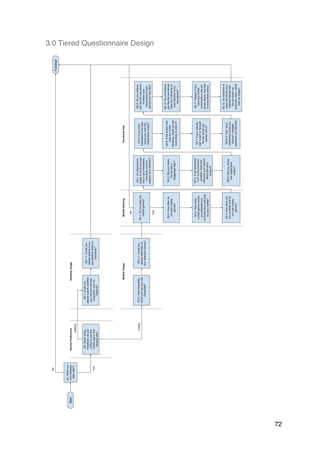
As previously stated, the online questionnaire was structured in a tiered system,
whereby the answers given determined whether the participant continued to the
next question or not. This form of questionnaire design could only be achieved
electronically, and as such, lends to the rational for using an online-based survey
method. Figure 1 (larger image in Appendix 3.0) illustrates the tiered procedure of
the questionnaire. As can be noted in the figure, the questionnaire was designed to
focus specifically on those respondents which were: a) Millennials born between
1980-1997, b) Preferred to use the mobile Facebook app, c) Played mobile games.
Overall there were 122 total responses to the online questionnaire.
Figure 1: Illustration of the Tiered Questionnaire Design
19
Due to the snowball sampling technique outlined in the methodology of this
research, not all respondents were within the Millennial criteria range. The first
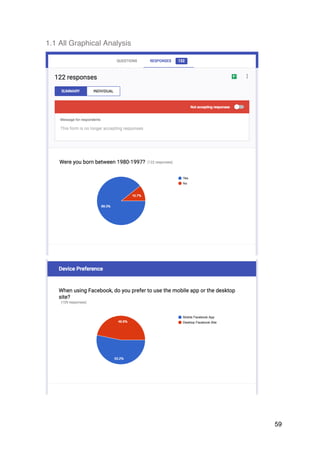
question served as a filter for this specific reason, asking respondents “Were you
born between 1980-1997?”. The results were 109 valid respondents and 13 who did
not meet the criteria, this can be seen in Figure 2 below.
Figure 2: Number of Respondents which fit the Millennial Criteria
The following question also served to filter respondents, by separating those who
preferred to access Facebook via the mobile app and those who preferred to use
the desktop site. Although the research focuses on the usage of the mobile
Facebook app, the researcher thought it best to ask some secondary questions to
those respondents who chose desktop as their preference. The reasoning behind
this was to explore the postulation within the literature which suggested that ad-
blocking software was increasingly pervasive and detrimental to online advertising
initiatives.
The findings suggest a majority of people prefer to access the mobile Facebook
app, as was hypothesised within the literature review, however, the difference in
preference is quite small, with only 6.8% of respondents preferring mobile (see
Figure 3 below). This is contradictory to the literature which suggested that roughly
20
90% of all MAUs were on mobile devices (Statista, 2016a). The discrepancy can,
however, be explained by the limited sample size obtained by the research. The
study had hoped that larger figures for mobile users would affirm the belief within
the literature that Millennials have an inherent preference for multitasking due to
their impatient nature; as it stands a blanket statement cannot be made, although
the finding do indicate a slight preference.
Figure 3: Preference of Device for Accessing Facebook
4.2 Desktop usage
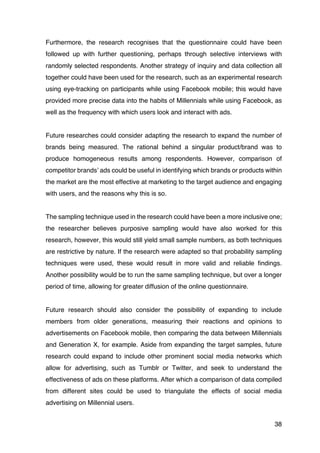
As previously mentioned, the research was curious as to the prevalence of ad-
blocking software for desktops, and believed the findings could indicate further
evidence for using the mobile Facebook app for future advertising purposes. The
literature suggested that the use of ad-blocking software was increasing and
clashing with the advertising objectives of marketers online, especially those on
Facebook (Marshall, 2016; Russon, 2016; Stone, 2014). The findings show that a
majority of respondents (roughly 2/3) use ad-block consistently, with another 21.6%
claiming to use it on specific sites only; therefore, early 90% (88.3%) of respondents
were using ad-blocking software in some way or another (see Figure 4 below). A
follow-up question was used to measure the usage of ad-block specifically when
21
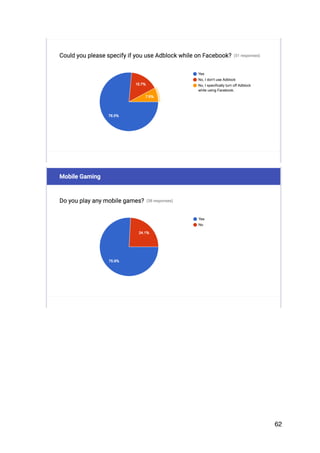
accessing Facebook and found that over 75% of respondents admitted to doing so
(see Figure 5 below).
Figure 4: Prevalence of Ad-blocking Programs within Desktop Users
Figure 5: Ad-blocking Behaviour whilst on Facebook
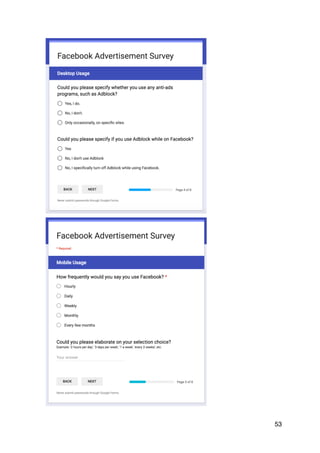
4.3 Mobile Usage
Respondents who preferred to access Facebook on their mobiles were asked about
their usage patterns, to gauge both the potential for ad spots and repeat frequency
within the app, but also to gauge the level of dependency Millennials have towards
technology and social media. The data found that a majority of respondents (nearly
22
2/3) will access Facebook daily on their mobiles, with 24% claiming to use it hourly;
only one respondent claimed to use the app sparingly, every few months (see Figure
6 below). A follow-up question was asked to delve deeper into their Facebook usage
patterns, and it was found that a majority of people will use Facebook between 1-3
hours (see Figure 7 below).
Figure 6: Facebook Usage Frequency amongst Mobile Users
Figure 7: Further Inspection of Facebook Mobile Usage
24%
64%
2%
10%
Could you please elaborate on your selection
choice? (43 responses)
<1	hour	per	day
1-3	hours	per	day
4-6	hours	per	day
6+	hours	per	day
23
The large numbers of respondents using Facebook with relative frequency both
daily and hourly suggests that Millennials are poised for being targeted by
advertising at high frequency rates; it would seem that the audience is certainly
there, ads only need know how to target them effectively and efficiently. Also, the
data perhaps lends to the literature’s claims that Millennials have a sense of civic
duty and team-orientation, implying that the ‘social’ in social media is a necessity to
them.
4.4 Mobile Gaming
In order to assess the respondents’ ability to relate to the example advert later
implemented within the questionnaire, one final screening question was used to
identify those respondents who played mobile games. A series of follow up
questions about their habits as mobile gamers served to measure the respondents’
propensities towards the mobile gaming industry, therefore allowing the research to
better measure and understand their opinions and reactions to mobile game
adverts; in essence, the research wished to know whether they would care deeply
enough for games in order to make rational and justified opinions about the adverts.
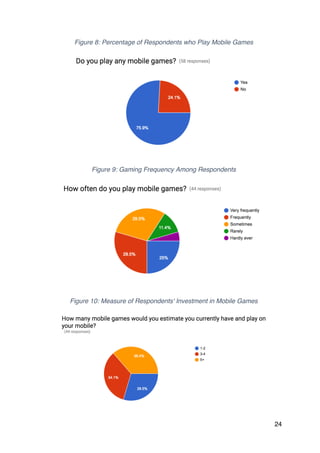
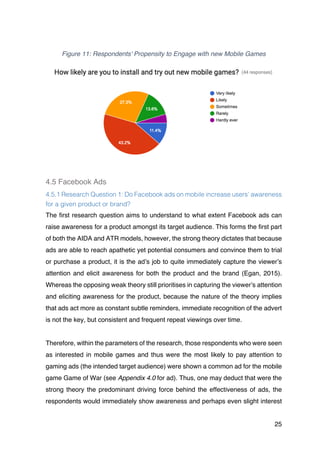
Of the 58 respondents who preferred to access Facebook on their mobiles, over
75% identified as players of mobile games (see Figure 8 below). Of these, over 50%
claimed to play mobile games either ‘frequently’ or ‘very frequently’, affirming that
the majority of respondents are somewhat interested in mobile gaming (see Figure
9 below). However, when asked how many games they currently have and play on
their devices, the respondents were almost evenly split into thirds, with a very slight
majority claiming to have 5 or more games on their mobiles (see Figure 10 below).
Despite this, nearly 55% of respondents claimed they were either ‘likely’ or ‘very
likely’ to install and try new games, showing a propensity to engage in the final steps
of the consumption process for mobile games (see Figure 11 below).
24
Figure 8: Percentage of Respondents who Play Mobile Games
Figure 9: Gaming Frequency Among Respondents
Figure 10: Measure of Respondents' Investment in Mobile Games
25
Figure 11: Respondents' Propensity to Engage with new Mobile Games
4.5 Facebook Ads
4.5.1 Research Question 1: Do Facebook ads on mobile increase users’ awareness
for a given product or brand?
The first research question aims to understand to what extent Facebook ads can
raise awareness for a product amongst its target audience. This forms the first part
of both the AIDA and ATR models, however, the strong theory dictates that because
ads are able to reach apathetic yet potential consumers and convince them to trial
or purchase a product, it is the ad’s job to quite immediately capture the viewer’s
attention and elicit awareness for both the product and the brand (Egan, 2015).
Whereas the opposing weak theory still prioritises in capturing the viewer’s attention
and eliciting awareness for the product, because the nature of the theory implies
that ads act more as constant subtle reminders, immediate recognition of the advert
is not the key, but consistent and frequent repeat viewings over time.
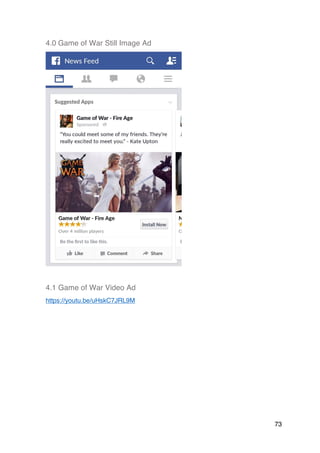
Therefore, within the parameters of the research, those respondents who were seen
as interested in mobile games and thus were the most likely to pay attention to
gaming ads (the intended target audience) were shown a common ad for the mobile
game Game of War (see Appendix 4.0 for ad). Thus, one may deduct that were the
strong theory the predominant driving force behind the effectiveness of ads, the
respondents would immediately show awareness and perhaps even slight interest
26
for the ad shown, whereas with the weak theory, signs of apathy or general lack of
awareness and interest for the ad would not be so detrimental.
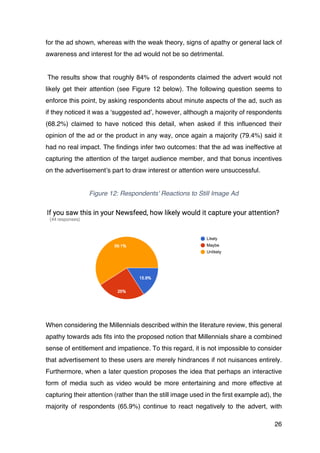
The results show that roughly 84% of respondents claimed the advert would not
likely get their attention (see Figure 12 below). The following question seems to
enforce this point, by asking respondents about minute aspects of the ad, such as
if they noticed it was a ‘suggested ad’, however, although a majority of respondents
(68.2%) claimed to have noticed this detail, when asked if this influenced their
opinion of the ad or the product in any way, once again a majority (79.4%) said it
had no real impact. The findings infer two outcomes: that the ad was ineffective at
capturing the attention of the target audience member, and that bonus incentives
on the advertisement’s part to draw interest or attention were unsuccessful.
Figure 12: Respondents' Reactions to Still Image Ad
When considering the Millennials described within the literature review, this general
apathy towards ads fits into the proposed notion that Millennials share a combined
sense of entitlement and impatience. To this regard, it is not impossible to consider
that advertisement to these users are merely hindrances if not nuisances entirely.
Furthermore, when a later question proposes the idea that perhaps an interactive
form of media such as video would be more entertaining and more effective at
capturing their attention (rather than the still image used in the first example ad), the
majority of respondents (65.9%) continue to react negatively to the advert, with
27
34.1% claiming the video format would have indeed annoyed them (see Figure 13
below).
It should be noted, however, that the purpose of the video ad is to draw more
attention visually (and optionally audibly) to the advert within the newsfeed, and this
can be seen in the 34.1% of respondents who claimed the ad would capture their
attention, in comparison with only 15.9% from the still image ad (Facebook Inc.,
2016b).
Figure 13: Respondents' Reactions to Video Ad
Furthermore, to illustrate the point that the ad was ineffective at increasing
awareness for the product, respondents were asked whether they believed the ad
increased their awareness for new games which they might enjoy (not necessarily
awareness for the product advertised). Although 54.5% of respondents said ‘No’,
this measurement was relatively close; later in the questionnaire when encouraged
to leave a comment about the example ad, one participant stated, “It's good to raise
the awareness of new available games on the market” although most other
comments reviewed the ad negatively, such as “It looks like clickbait/spam which is
why I am less likely to interact with it” or “I tend to avoid ads such as this because
they're terribly made and annoying […]”.
28
4.5.2 Research Question 2: Does the social aspect of Facebook ads on mobile
influence users’ interests and desires?
The second research question is aimed at evaluating whether the social aspect of
Facebook has any promotional impact on ads, specifically, if the introduction of
social interaction is more likely to generate interest and desire for the product
advertised. The literature on Millennials would suggest that due to their strong sense
of civic duty and team-orientation, introducing a social aspect into the advertising
medium (i.e. likes or shares), would positively influence users’ opinions towards the
product, thus increasing their own interests and desires towards the product. This
research question is particularly interested in measuring the strong theory’s
effectiveness on adverts within a social media.
The findings suggest that this is not necessarily the case; two respondents left
comments which implied that social interaction might better persuade them to
interact with the ad, commenting “I would like an ad if my friend shared it on
Facebook of a game that I knew or played already” and “I tend to avoid ads such as
this because they're terribly made and annoying, but if my friends had the game I
might be more inclined to try it out”.
However, notice how both comments are double-edged swords, with the first
mentioning “[…] a game that I knew or played already” implying that previous
interaction independent from the advertisement is necessary for future interactions
with the product, suggesting the role of the advertisement here is not to sell the
game, but reinforce the existing players into continued patronage with the product
or brand.
Similarly, the other comment also suggests that previous interaction with the
product, independent from the current ad, is necessary albeit not their own, “[…] if
my friends had the game I might be more inclined to try it out”. Therefore, it would
seem that the unobtrusive nature of the weak theory is more relevant to these
comments made by respondents, rather than the salesman-like nature of the strong
theory.
29
Further evidence of the apparent dissonance between social spheres and a positive
cognitive response towards the ad comes from a question which directly asks if
respondents would be more inclined to interact with the ad in some way had their
friends already ‘liked’ or ‘shared’ the ad. 68.2 % of respondents claimed ‘No’,
implying that perhaps social interaction as a proponent of promotion is not as
effective as the literature appeared to imply (see Figure 14 below).
Of those who said they would interact with the ad, 46.7% said that they would install
the game, however, 93.3% said they would simply ‘like’ it, a more passive method
of interaction.
Facebook can use these likes to further promote the advert among the user’s group
of friends. However, a similar process is used for suggesting apps and other content,
and when respondents were asked whether seeing that an ad was suggested would
influence their opinions, a majority said it wouldn’t. Therefore, ‘likes’ as a form of ad
interaction, may not necessarily benefit the promotion of said advert.
Figure 14: Impact of Social Spheres on Product Promotion
Therefore, it would seem that even when social interaction is introduced as an
added bonus to the promotion of products on Facebook, the impact on Millennials
remains the same. Rather, social constructs appear to add towards the defensive
nature of Facebook ads, by subtly encouraging users that their friends are also
30
interested in the product being promoted. In essence, social interaction appears to
be far more effective at reinforcing a positive purchase decision rather than outright
generating interest or desire for a product, from a Millennial’s perspective.
4.5.3 Research Question 3: Given that there is interest, do Facebook ads on mobile
incite user interaction?
Lastly, the final research question is concerned with Facebook ads’ ability to
influence user interaction with the ad post, whether this be through social interaction
and self-promotion, such as a ‘like’, ‘share’, or ‘comment’, or through direct trial and
engagement with the product. The strong theory would suggest that action, the final
step of the AIDA model, is not only achievable but encouraged via advertising, and
that the final purpose of any form of promotion is in achieving this step. Conversely,
the weak theory postulates that action will occur naturally over time, if the advert
and the product being promoted can succeed in creating positive attitudes within
the viewer, which is achieved over time through subtle nudges, rather than
salesmanship.
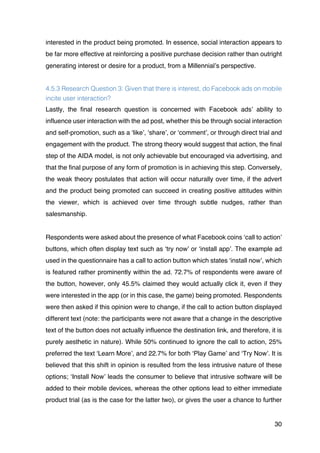
Respondents were asked about the presence of what Facebook coins ‘call to action’
buttons, which often display text such as ‘try now’ or ‘install app’. The example ad
used in the questionnaire has a call to action button which states ‘install now’, which
is featured rather prominently within the ad. 72.7% of respondents were aware of
the button, however, only 45.5% claimed they would actually click it, even if they
were interested in the app (or in this case, the game) being promoted. Respondents
were then asked if this opinion were to change, if the call to action button displayed
different text (note: the participants were not aware that a change in the descriptive
text of the button does not actually influence the destination link, and therefore, it is
purely aesthetic in nature). While 50% continued to ignore the call to action, 25%
preferred the text ‘Learn More’, and 22.7% for both ‘Play Game’ and ‘Try Now’. It is
believed that this shift in opinion is resulted from the less intrusive nature of these
options; ‘Install Now’ leads the consumer to believe that intrusive software will be
added to their mobile devices, whereas the other options lead to either immediate
product trial (as is the case for the latter two), or gives the user a chance to further
31
consider the proposition (as is the case with the former). These findings are more
akin to the strong theory of advertising, playing towards the users’ affects and
cognitions in order to achieve a conative response.
Further examples of the respondents’ opinions towards the effectiveness of the ad’s
ability to incite action can be seen in the question “Do you believe ads like the one
above have any influence on your decision to try new games?” to which 64.1%
claimed ‘No’ as their answer.
It is difficult to see a concrete pattern of behaviour emerging from the data which
suggests either the strong or weak theory is more effective in generating interaction.
This is reflective in the theoretical literature itself, whereby proponents of both
ideologies find it difficult to establish links between advertising and sales.
As estimated by Brierley (2002) within Egan (2015), sometimes as little as 0.01% of
advertising results in an immediate reaction. Rather, the proponents of the theory
propose that with products which the potential consumer deems to be resource
intensive (i.e. large monetary loss, careful time and consideration needed, or even
great opportunity costs), the role of advertising is to continually drive the promotional
message over time until the customer decides upon the purchase decision; this is
visualised in Figure 15 below.
Figure 15: Perceived Influence of Advertising, based on Figure 9.3 from Egan
(2015, p.175)
32
However, for the purposes of the research, it may be argued that mobile games are
not at all resource intensive, many of which are free-to-play (including Game of War,
the game used in the example ad), and as such gain money through a series of
advertising ploys and micro-transactions within the game. Thus, it would not logically
follow that the cognitive, affective and conative processes behind trial of a free
mobile game follow such a lengthy and complex model.
Rather, the free nature of mobile games results in high competition and saturation
within the market, and thus they are more akin to fast-moving consumer goods
(FMCG), which compete at similar price levels for minute amounts of market share.
This shares many similarities with the weak theory of advertising, the most
prominent of which is Ehrenberg’s negative binomial distribution theory (Egan,
2015).
This is the phenomenon by which the ATR model and by extension the weak theory
serves to reinforce rather than persuade (a concept that has become central to the
analysis of the findings and the research questions). As proposed by Ehrenberg,
advertising cannot directly convince consumers to switch from one brand to another
simply through pure salesmanship, but rather, ads serve to slowly push the idea of
the product into the consumer’s mind, so eventually, when the opportunity for trial
arises, the consumer does so of their own volition. After which, the purpose of
advertising is to maintain the patronage of the consumer, through reinforcement of
the correct purchase decision.
It has become clear from the findings that Millennials tend to find ads intrusive, if not
misleading and untrustworthy. The literature on Millennial behaviour and personality
has served a great deal in assigning behavioural explanations to the data in the
findings. Due to their impatience and entitlement, but also perhaps to their cynicism,
Millennials prefer to feel as though advertising has little affect on their decisions.
There is no doubt however, that the affects of advertising must occur subconsciously
over time. Thus when the opportunity arises, they do not feel as if they are being
forced or pressured by an advert or any other outside force to execute the trial
33
decision, much in the same way the ATR model and weak theory are expected to
function.
4.6 Final Considerations & General Discussion
Therefore, to conclude the analysis of the findings, a definitive answer will be
reached for each research question.
Research question 1 sought to understand whether adverts on Facebook were
successful in achieving awareness of a brand or product when targeting Millennials.
The answer would appear to be yes, however, this awareness is achieved through
the theoretical underpinnings of the weak theory of advertising, and thus it would be
incorrect to assume that Facebook ads have any immediate impact on users’
awareness of a product or brand. It was shown that for a majority of cases,
Facebook ads will be ignored, therefore, Facebook ads serve to slowly build
awareness over time through frequent viewings.
Research question 2 was aimed at understanding the impact that social interactions
have on Facebook ads targeted towards Millennials, specifically whether the
inclusion of these social spheres increases the chances of viewers showing greater
interest for the product or brand, and a desire to interact with the ad. Once again,
the answer is not a simple yes or no; the findings suggest seemingly contradictory
evidence with a majority of respondents claiming they would not interact with an ad
regardless of social stimuli, however, a few participants also claim to trust products
more readily if their friends have trialled them.
Therefore, there seems to exist a duality between the value placed upon friendly
endorsement of ad content, with a majority group continuing to dislike ads all
together. This is contradictory to the literature on Millennials which suggested the
generation as having a sense of team-orientation and civic duty, thus implying that
Millennials should enjoy what their friends enjoy, and feel the need to share it with
others.
34
If we consider the problem within a theoretical context, social interaction on
Facebook can be seen as the modern equivalent of word of mouth marketing; the
basic principles for word of mouth marketing can be transplanted onto social media:
friends indicating and recommending products and services to other friends based
on their own experiences. An article from Forbes magazine claims a Nielsen report
found that 92% of consumers readily believe a recommendation from their friends,
while a joint study by the American Marketing Association (AMA) and the Word of
Mouth Marketing Association (WOMMA) found that 64% of marketing executives
believe word of mouth to be the most effective marketing form (Whitler, 2014).
Therefore, why do Millennials reject to social interaction on ads?
The key is to understand that social interaction on Facebook follows what the
research calls an incremental degree of credibility. This idea suggests that different
actions on Facebook hold different values to the users witnessing and performing
them. As such, the ‘like’ is the most basic of social interactions, requiring almost no
effort and widely used to show some form of support or agreement; the next level of
interaction would be the general comment, which shows an extra step of
engagement and effort on the user’s part, but no real peer-to-peer engagement;
following is the ‘share’ whereby sufficient praise of the product has led the user to
endorse the content post amongst their community; lastly, is the ‘tag’, the most direct
form of recommendation within Facebook, whereby the user links another user to a
content post; this can be seen as the most literal digital form of word of mouth.
Therefore, by applying the incremental degree of credibility to the questionnaire
scenario, we can see from the respondents’ answers to the following question that
the actions involving a more perceived effort of interaction were less likely to be
chosen by respondents.
35
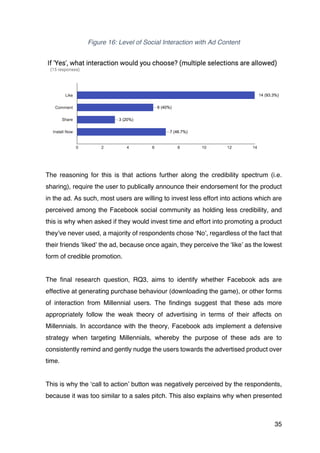
Figure 16: Level of Social Interaction with Ad Content
The reasoning for this is that actions further along the credibility spectrum (i.e.
sharing), require the user to publically announce their endorsement for the product
in the ad. As such, most users are willing to invest less effort into actions which are
perceived among the Facebook social community as holding less credibility, and
this is why when asked if they would invest time and effort into promoting a product
they’ve never used, a majority of respondents chose ‘No’, regardless of the fact that
their friends ‘liked’ the ad, because once again, they perceive the ‘like’ as the lowest
form of credible promotion.
The final research question, RQ3, aims to identify whether Facebook ads are
effective at generating purchase behaviour (downloading the game), or other forms
of interaction from Millennial users. The findings suggest that these ads more
appropriately follow the weak theory of advertising in terms of their affects on
Millennials. In accordance with the theory, Facebook ads implement a defensive
strategy when targeting Millennials, whereby the purpose of these ads are to
consistently remind and gently nudge the users towards the advertised product over
time.
This is why the ‘call to action’ button was negatively perceived by the respondents,
because it was too similar to a sales pitch. This also explains why when presented
36
with other call to action options, the most popular choices were either unobtrusive
texts or texts which implied immediate trial opportunity.
In terms of non-purchasing forms of engagement, the incremental degree of
credibility, as previously outlined, can be used to explain the lack of respondents’
apathy towards engaging with the ad post. The effort and risk of social promotion of
the product without prior trial is too high, and users are wary to place their social
credibility on the line. In order to overcome this, friends of the user must show high
enough levels of credibility in their social interactions.
37
5. Conclusion
5.1 Limitations, Improvements & Recommendations
This research had several limitations, both in its design as well as external ones
placed upon it, which need to be taken into consideration. Many of the mentioned
limitations can be used as the basis for further investigation in future researches.
Firstly, perhaps the largest limitation of the research was the limited respondent
sample size. The online survey produced for the research was only able to gather
information from a total of 122 respondents, only a minute portion of the much larger
target population of Millennials.
This is why the researcher believes, there may have been discrepancies between
the research findings and the literature, such as mobiles only accounting for 53.2%
of Facebook usage in this research although the literature suggests that mobile
usage accounts for nearly 90% of all Facebook monthly active users.
Another important limitation related to the sample size is the chosen population
itself. An entire generation as the focus of a research is a daunting task, which will
likely yield inaccurate results; thus the results of this research cannot be said to
apply to all Millennials across the world. A more focused approach, such as, those
aged 18-36, living in university halls, and and currently employed within the city of
Lincoln, may have provided more broadly applicable results.
Other limitations include the limited number of adverts used as examples in the
questionnaire. The reasoning for this was because most adverts used by the mobile
game, Game of War, on Facebook are all similar variations of the one used within
the research; therefore, it was believed that using multiple of these would not offer
any new valid information to the research. However, other promotional tools used
by Game of War could have been used or simulated in order to gain new insights
into the respondents’ opinions. One such example of this could have been a
simulation of a friend sharing the ad, or promotional material for an event or discount
by Game of War.
38
Furthermore, the research recognises that the questionnaire could have been
followed up with further questioning, perhaps through selective interviews with
randomly selected respondents. Another strategy of inquiry and data collection all
together could have been used for the research, such as an experimental research
using eye-tracking on participants while using Facebook mobile; this would have
provided more precise data into the habits of Millennials while using Facebook, as
well as the frequency with which users look and interact with ads.
Future researches could consider adapting the research to expand the number of
brands being measured. The rational behind a singular product/brand was to
produce homogeneous results among respondents. However, comparison of
competitor brands’ ads could be useful in identifying which brands or products within
the market are the most effective at marketing to the target audience and engaging
with users, and the reasons why this is so.
The sampling technique used in the research could have been a more inclusive one;
the researcher believes purposive sampling would have also worked for this
research, however, this would still yield small sample numbers, as both techniques
are restrictive by nature. If the research were adapted so that probability sampling
techniques were used, these would result in more valid and reliable findings.
Another possibility would be to run the same sampling technique, but over a longer
period of time, allowing for greater diffusion of the online questionnaire.
Future research should also consider the possibility of expanding to include
members from older generations, measuring their reactions and opinions to
advertisements on Facebook mobile, then comparing the data between Millennials
and Generation X, for example. Aside from expanding the target samples, future
research could expand to include other prominent social media networks which
allow for advertising, such as Tumblr or Twitter, and seek to understand the
effectiveness of ads on these platforms. After which a comparison of data compiled
from different sites could be used to triangulate the effects of social media
advertising on Millennial users.
39
5.3 Overall Summary
The research sought to understand the effectiveness of mobile advertising on
Facebook towards promoting a product (Game of War) to its intended target
audience (Millennials). This was achieved through the use of two opposing
advertising ideologies, the Strong and Weak theories of advertising, which were
used to measure how ads affected and were received by Millennial consumers.
The Strong theory, through the AIDA model, suggests ads are a convincingly
powerful persuasion tool. The Weak theory, through the ATR model, suggests ads
are subtler and serve to consistently remind consumers and nudge them towards a
product. The research findings suggest the Weak theory is better at explaining the
purpose of mobile ads on Facebook geared towards Millennials. These ads seek to
increase awareness through frequent ad views over time; eventually, they incite and
encourage product trial from the users. The ads then play a defensive role,
reinforcing existing customers, so that they may eventually endorse the product or
establish strong positive attitudes toward the brand.
This serves to explain how mobile ads affect Millennials, whereas the literature on
Millennial personality traits serve to explain why. The literature states that Millennials
are impatient, and when applied to the research, illustrates why they are less prone
to spend time considering ad propositions and are more likely to ignore them.
Millennials are also said to be entitled, and thus feel that all content should be
geared towards them, if not, this content (ad) is not worth their time. However, the
Millennials’ sense of civic duty results in their need to share with others content they
deem acceptable. This coupled with their strong team-orientation means that they
are more likely to hold the opinions of friends in high regard.
Overall, the practical applications for the findings suggest that businesses should
focus on creating ad content that is unobtrusive, and design Facebook advertising
campaigns that seek to achieve repeat viewings over long periods of time. In this
sense, advertising to Millennials on Facebook can be seen as a slow and lengthy
endeavour, which when done correctly, can achieve desirable results for the brand.
40
Reference List
Barron, L., 2015. Millennials Adept at Filtering Out Ads. [Online] Available at:
http://www.emarketer.com/Article/Millennials-Adept-Filtering-Ads/1012335
[Accessed 12 September 2016].
Bryman, A. & Bell, E., 2015. Business Research Methods. 4th ed. ed. New York:
Oxford University Press.
Cutler, N. E., 2015. Millennials and Finance: The "Amazon Generation". Journal of
Financial Service Professionals, November, 69(6), pp. 33-39.
DeVaney, S. A., 2015. Understanding the Millennial Generation. Journal of
Financial Service Professionals, 69(6), pp. 11-14.
Easterby-Smith, M., Thorpe, R. & Jackson, P. R., 2015. Management & Business
Research. 5th ed. ed. London: Sage Publications.
Egan, J., 2015. Marketing Communications. 2nd ed. ed. London: Sage
Publications.
Ewing, M. T. & Jones, J. P., 2000. Agency beliefs in the power of advertising.
International Journal of Advertising, 19(3), pp. 335-349.
Facebook Inc., 2016a. Facebook Adverts. [Online] Available at:
https://www.facebook.com/business/products/ads/ [Accessed 11 September
2016].
Facebook Inc., 2016b. What ad objectives can I use for video ads?. [Online]
Available at:
https://www.facebook.com/business/help/360195617512041?helpref=uf_permalin
k [Accessed 13 September 2016].
41
Financial Times, 2016. Facebook Inc. [Online] Available at:
http://markets.ft.com/data/equities/tearsheet/profile?s=FB:NSQ [Accessed 11
September 2016].
Game of War, 2016. Game of War - Fire Age. [Online] Available at:
https://www.facebook.com/GameofWar/ [Accessed 12 September 2016].
Gilbert, B., 2015. How the abysmal 'Game of War' featuring Kate Upton makes so
much money. [Online] Available at: http://uk.businessinsider.com/how-game-of-
war-makes-money-2015-5?r=US&IR=T [Accessed 12 Septmeber 2016].
Gray, D. E., 2014. Doing Research in the Real World. 3rd ed. ed. London: Sage
Publications.
Howe, N. & Strauss, W., 2007. The Next 20 Years: How Customer and Workforce
Attitudes Will Evolve. Harvard Business Review, 85(7/8), pp. 41-52.
Isaac, M., 2016. Facebook Profit Nearly Triples on Mobile Ad Sales and New
Users. The New York Times, 27 July.
Jones, J. P., 1990. Advertising: strong force or weak force? A dilemma for higher
education. Syracuse Scholar (1979-1991), 10(1), pp. 45-56.
Jones, J. P., 1997. is advertising still salesmanship. Journal of Advertising
Research, 37(3), pp. 9-16.
Kilber, J., Barclay, A. & Ohmer, D., 2014. Seven Tips for Managing Generation Y.
Journal of Management Policy & Practics, 15(4), pp. 80-91.
Kolker, R., 2015. One Nerd to Rule Them All. [Online] Available at:
http://www.bloomberg.com/graphics/2015-game-of-war/ [Accessed 12 September
2016].
42
MarketLine, 2012. Facebook: How a start-up became the world's largest social
network. [Online] Available at:
http://advantage.marketline.com.proxy.library.lincoln.ac.uk/Product?pid=ML00007-
002 [Accessed 11 September 2016].
MarketLine, 2013. Facebook: The future of its ad-supported business model.
[Online] Available at:
http://advantage.marketline.com.proxy.library.lincoln.ac.uk/Product?pid=ML00007-
075 [Accessed 11 September 2016].
MarketLine, 2016. Facebook, Inc.. [Online] Available at:
http://advantage.marketline.com.proxy.library.lincoln.ac.uk/Product?pid=679613FB
-9911-4907-8C86-9902F9D5BEF4&view=BusinessDescription [Accessed 11
September 2016].
Marshall, J., 2016. Tensions Escalate Between Adblock Plus and IAB. [Online]
Available at: http://www.wsj.com/articles/tensions-escalate-between-adblock-plus-
and-iab-1452881625 [Accessed 12 September 2016].
Monllos, K., 2014. Game of War: Fire Age Launches First Global Campaign
Starring Kate Upton. [Online] Available at:
http://www.adweek.com/news/advertising-branding/game-war-fire-age-launches-
first-global-campaign-starring-kate-upton-161397 [Accessed 12 September 2016].
Murillo, E., Merino, M. & Nuñez, A., 2016. The advertising value of Twitter Ads: a
study among Mexican Millennials.. Revista Brasileira de Gestão de Negócios,
18(61), pp. 436-456.
Needleman, S. E., 2016a. Mobile-Game Revenue to Surpass Console and PC,
Study Says. [Online] Available at: http://www.wsj.com/articles/mobile-game-
43
revenue-to-surpass-console-and-pc-study-says-1461265949 [Accessed 11
September 2016].
Needleman, S. E., 2016b. Record Spending on Videogame Deals Puts Mobile-
Game Makers in Focus. [Online] Available at: http://www.wsj.com/articles/record-
spending-on-videogame-deals-puts-mobile-game-makers-in-focus-1471550871
[Accessed 11 September 2016].
Russon, M.-A., 2016. Facebook and Adblock Plus involved in tug of war over ads,
and it looks like Facebook is winning. [Online] Available at:
http://www.ibtimes.co.uk/facebook-adblock-plus-involved-tug-war-over-ads-it-
looks-like-facebook-winning-1575730 [Accessed 12 September 2016].
Saunders, M., Lewis, P. & Thornhill, A., 2009. Research Methods for Business
Students. 5th ed. ed. Harlow: Pearson Education Limited.
Shahizan, H., Siti, Z. A. N. & Norshuhada, S., 2015. Strategic Use of Social Media
for Small Business Based on the AIDA Model. Procedia - Social and Behavioural
Sciences, January, 172(27), pp. 262-269.
Sloane, G., 2015. Here Are the 12 Best Facebook Marketing Campaigns From the
Past Year. [Online] Available at: http://www.adweek.com/news/technology/here-
are-12-best-facebook-marketing-campaigns-last-year-165332 [Accessed 12
September 2016].
Smith, K. T., 2011. Digital marketing strategies that Millennials find appealing,
motivating, or just annoying. Journal of Strategic MArketing, October, 19(6), pp.
489-499.
Smith, K. T., 2012. Longitudinal study of digital marketing strategies targeting
Millennials. Journal of Consumer Marketing, 29(2), pp. 86-92.
44
Solomon, M., 2014. 2015 Is The Year Of The Millennial Customer: 5 Key Traits
These 80 Million Consumers Share. [Online] Available at:
http://www.forbes.com/sites/micahsolomon/2014/12/29/5-traits-that-define-the-80-
million-millennial-customers-coming-your-way/#4a093b9f2a81 [Accessed 12
September 2016].
Statista, 2016a. Facebook: number of mobile monthly active users worldwide
2009-2016. [Online] Available at:
http://www.statista.com/statistics/277958/number-of-mobile-active-facebook-users-
worldwide/ [Accessed 11 September 2016].
Statista, 2016b. Facebook: number of monthly active users worldwide 2008-2016.
[Online] Available at: http://www.statista.com/statistics/264810/number-of-monthly-
active-facebook-users-worldwide/ [Accessed 11 September 2016].
Statista, 2016c. Global social networks ranked by number of users 2016. [Online]
Available at: http://www.statista.com/statistics/272014/global-social-networks-
ranked-by-number-of-users/ [Accessed 11 September 2016].
Statista, 2016d. Statistics and facts on Mobile Gaming. [Online] Available at:
https://www.statista.com/topics/1906/mobile-gaming/ [Accessed 12 September
2016].
Stone, J., 2014. Ad Block Download Popularity Explodes Internationally, Up 69%
Since Same Time In 2013 - Report. [Online] Available at:
http://www.ibtimes.com/ad-block-download-popularity-explodes-internationally-69-
same-time-2013-report-1689350 [Accessed 12 September 2016].
Tassi, P., 2014. A $40M Ad Budget Buys 'Game of War: Fire Age' Kate Upton.
[Online] Available at: http://www.forbes.com/sites/insertcoin/2014/11/16/a-40m-ad-
budget-buys-game-of-war-fire-age-kate-upton/#eea24572310d [Accessed 12
September 2016].
45
Tate, A., 2015. We Analyzed 37,259 Facebook Ads and Here's what We Learned.
[Online] Available at: https://adespresso.com/academy/blog/we-analyzed-37259-
facebook-ads-and-heres-what-we-learned/ [Accessed 11 September 2016].
Whitler, K. A., 2014. Why Word Of Mouth Marketing Is The Most Important Social
Media. [Online] Available at:
http://www.forbes.com/sites/kimberlywhitler/2014/07/17/why-word-of-mouth-
marketing-is-the-most-important-social-media/#46c431b57a77 [Accessed 13
September 2016].
Woodcock, N., Green, A. & Starkey, M., 2011. Social CRM as a business strategy.
Journal of Database Marketing & Customer Strategy Management, March, 18(1),
pp. 50-64.
Zaydon, M. A., 2016. Know Your Millennials. Pennsylvania CPA Journal, 87(1),
pp. 26-29.
46
Bibliography
Barron, L., 2015. Millennials Adept at Filtering Out Ads. [Online] Available at:
http://www.emarketer.com/Article/Millennials-Adept-Filtering-Ads/1012335
[Accessed 12 September 2016].
Bryman, A. & Bell, E., 2015. Business Research Methods. 4th ed. ed. New York:
Oxford University Press.
Cutler, N. E., 2015. Millennials and Finance: The "Amazon Generation". Journal of
Financial Service Professionals, November, 69(6), pp. 33-39.
DeVaney, S. A., 2015. Understanding the Millennial Generation. Journal of
Financial Service Professionals, 69(6), pp. 11-14.
Easterby-Smith, M., Thorpe, R. & Jackson, P. R., 2015. Management & Business
Research. 5th ed. ed. London: Sage Publications.
Egan, J., 2015. Marketing Communications. 2nd ed. ed. London: Sage
Publications.
Ewing, M. T. & Jones, J. P., 2000. Agency beliefs in the power of advertising.
International Journal of Advertising, 19(3), pp. 335-349.
Facebook Inc., 2016a. Facebook Adverts. [Online] Available at:
https://www.facebook.com/business/products/ads/ [Accessed 11 September
2016].
Facebook Inc., 2016b. What ad objectives can I use for video ads?. [Online]
Available at:
https://www.facebook.com/business/help/360195617512041?helpref=uf_permalin
k [Accessed 13 September 2016].
47
Financial Times, 2016. Facebook Inc. [Online] Available at:
http://markets.ft.com/data/equities/tearsheet/profile?s=FB:NSQ [Accessed 11
September 2016].
Game of War, 2016. Game of War - Fire Age. [Online] Available at:
https://www.facebook.com/GameofWar/ [Accessed 12 September 2016].
Gilbert, B., 2015. How the abysmal 'Game of War' featuring Kate Upton makes so
much money. [Online] Available at: http://uk.businessinsider.com/how-game-of-
war-makes-money-2015-5?r=US&IR=T [Accessed 12 Septmeber 2016].
Gray, D. E., 2014. Doing Research in the Real World. 3rd ed. ed. London: Sage
Publications.
Howe, N. & Strauss, W., 2007. The Next 20 Years: How Customer and Workforce
Attitudes Will Evolve. Harvard Business Review, 85(7/8), pp. 41-52.
Isaac, M., 2016. Facebook Profit Nearly Triples on Mobile Ad Sales and New
Users. The New York Times, 27 July.
Jones, J. P., 1990. Advertising: strong force or weak force? A dilemma for higher
education. Syracuse Scholar (1979-1991), 10(1), pp. 45-56.
Jones, J. P., 1997. is advertising still salesmanship. Journal of Advertising
Research, 37(3), pp. 9-16.
Kilber, J., Barclay, A. & Ohmer, D., 2014. Seven Tips for Managing Generation Y.
Journal of Management Policy & Practics, 15(4), pp. 80-91.
Kolker, R., 2015. One Nerd to Rule Them All. [Online] Available at:
http://www.bloomberg.com/graphics/2015-game-of-war/ [Accessed 12 September
2016].
48
MarketLine, 2012. Facebook: How a start-up became the world's largest social
network. [Online] Available at:
http://advantage.marketline.com.proxy.library.lincoln.ac.uk/Product?pid=ML00007-
002 [Accessed 11 September 2016].
MarketLine, 2013. Facebook: The future of its ad-supported business model.
[Online] Available at:
http://advantage.marketline.com.proxy.library.lincoln.ac.uk/Product?pid=ML00007-
075 [Accessed 11 September 2016].
MarketLine, 2016. Facebook, Inc.. [Online] Available at:
http://advantage.marketline.com.proxy.library.lincoln.ac.uk/Product?pid=679613FB
-9911-4907-8C86-9902F9D5BEF4&view=BusinessDescription [Accessed 11
September 2016].
Marshall, J., 2016. Tensions Escalate Between Adblock Plus and IAB. [Online]
Available at: http://www.wsj.com/articles/tensions-escalate-between-adblock-plus-
and-iab-1452881625 [Accessed 12 September 2016].
Monllos, K., 2014. Game of War: Fire Age Launches First Global Campaign
Starring Kate Upton. [Online] Available at:
http://www.adweek.com/news/advertising-branding/game-war-fire-age-launches-
first-global-campaign-starring-kate-upton-161397 [Accessed 12 September 2016].
Murillo, E., Merino, M. & Nuñez, A., 2016. The advertising value of Twitter Ads: a
study among Mexican Millennials.. Revista Brasileira de Gestão de Negócios,
18(61), pp. 436-456.
Needleman, S. E., 2016a. Mobile-Game Revenue to Surpass Console and PC,
Study Says. [Online] Available at: http://www.wsj.com/articles/mobile-game-
49
revenue-to-surpass-console-and-pc-study-says-1461265949 [Accessed 11
September 2016].
Needleman, S. E., 2016b. Record Spending on Videogame Deals Puts Mobile-
Game Makers in Focus. [Online] Available at: http://www.wsj.com/articles/record-
spending-on-videogame-deals-puts-mobile-game-makers-in-focus-1471550871
[Accessed 11 September 2016].
Russon, M.-A., 2016. Facebook and Adblock Plus involved in tug of war over ads,
and it looks like Facebook is winning. [Online] Available at:
http://www.ibtimes.co.uk/facebook-adblock-plus-involved-tug-war-over-ads-it-
looks-like-facebook-winning-1575730 [Accessed 12 September 2016].
Saunders, M., Lewis, P. & Thornhill, A., 2009. Research Methods for Business
Students. 5th ed. ed. Harlow: Pearson Education Limited.
Shahizan, H., Siti, Z. A. N. & Norshuhada, S., 2015. Strategic Use of Social Media
for Small Business Based on the AIDA Model. Procedia - Social and Behavioural
Sciences, January, 172(27), pp. 262-269.
Sloane, G., 2015. Here Are the 12 Best Facebook Marketing Campaigns From the
Past Year. [Online] Available at: http://www.adweek.com/news/technology/here-
are-12-best-facebook-marketing-campaigns-last-year-165332 [Accessed 12
September 2016].
Smith, K. T., 2011. Digital marketing strategies that Millennials find appealing,
motivating, or just annoying. Journal of Strategic MArketing, October, 19(6), pp.
489-499.
Smith, K. T., 2012. Longitudinal study of digital marketing strategies targeting
Millennials. Journal of Consumer Marketing, 29(2), pp. 86-92.
50
Solomon, M., 2014. 2015 Is The Year Of The Millennial Customer: 5 Key Traits
These 80 Million Consumers Share. [Online] Available at:
http://www.forbes.com/sites/micahsolomon/2014/12/29/5-traits-that-define-the-80-
million-millennial-customers-coming-your-way/#4a093b9f2a81 [Accessed 12
September 2016].
Statista, 2016a. Facebook: number of mobile monthly active users worldwide
2009-2016. [Online] Available at:
http://www.statista.com/statistics/277958/number-of-mobile-active-facebook-users-
worldwide/ [Accessed 11 September 2016].
Statista, 2016b. Facebook: number of monthly active users worldwide 2008-2016.
[Online] Available at: http://www.statista.com/statistics/264810/number-of-monthly-
active-facebook-users-worldwide/ [Accessed 11 September 2016].
Statista, 2016c. Global social networks ranked by number of users 2016. [Online]
Available at: http://www.statista.com/statistics/272014/global-social-networks-
ranked-by-number-of-users/ [Accessed 11 September 2016].
Statista, 2016d. Statistics and facts on Mobile Gaming. [Online] Available at:
https://www.statista.com/topics/1906/mobile-gaming/ [Accessed 12 September
2016].
Stone, J., 2014. Ad Block Download Popularity Explodes Internationally, Up 69%
Since Same Time In 2013 - Report. [Online] Available at:
http://www.ibtimes.com/ad-block-download-popularity-explodes-internationally-69-
same-time-2013-report-1689350 [Accessed 12 September 2016].
Tassi, P., 2014. A $40M Ad Budget Buys 'Game of War: Fire Age' Kate Upton.
[Online] Available at: http://www.forbes.com/sites/insertcoin/2014/11/16/a-40m-ad-
budget-buys-game-of-war-fire-age-kate-upton/#eea24572310d [Accessed 12
September 2016].
51
Tate, A., 2015. We Analyzed 37,259 Facebook Ads and Here's what We Learned.
[Online] Available at: https://adespresso.com/academy/blog/we-analyzed-37259-
facebook-ads-and-heres-what-we-learned/ [Accessed 11 September 2016].
Whitler, K. A., 2014. Why Word Of Mouth Marketing Is The Most Important Social
Media. [Online] Available at:
http://www.forbes.com/sites/kimberlywhitler/2014/07/17/why-word-of-mouth-
marketing-is-the-most-important-social-media/#46c431b57a77 [Accessed 13
September 2016].
Woodcock, N., Green, A. & Starkey, M., 2011. Social CRM as a business strategy.
Journal of Database Marketing & Customer Strategy Management, March, 18(1),
pp. 50-64.
Zaydon, M. A., 2016. Know Your Millennials. Pennsylvania CPA Journal, 87(1),
pp. 26-29.
52
Appendices
1.0 Copy of Questionnaire
53
54
55
56
57
58
59
1.1 All Graphical Analysis
60
61
62
63
64
65
66
67
68
69
2.0 Ethical Approval Form (EA2)
1
EA2
Ethical Approval Form:
Human Research
Projects
Business School
Please word-process this form, handwritten
applications will not be accepted
This form must be completed for each piece of research activity whether conducted by academic
staff, research staff, graduate students or undergraduates.
Please complete all sections. If a section is not applicable, write N/A.
1 Name of
Applicant Guilherme Addor Torres Ribeiro
Department: Lincoln Business School
Email: 12356294@students.lincoln.ac.uk
Phone: 07787230187
2 Position in the
University (indicate) Postgraduate taught Student
3 Role in relation
to this research
(indicate)
Student supervised by Business School Staff
4 Brief statement
of main Research
Question
This research aims to explore the interaction between Millennials and Advertising/Branded content through
social media applications on mobile devices. The research aims to better understand the level of interaction
the chosen population has with multiple forms of branded content and advertising, so as to better design and
promote these methods for business practitioners.
RQ1. How frequently do those age 18-36 use social media applications on their mobile devices?
RQ2. How do Millennials react to different forms of advertising within social media apps on their mobile
devices?
RQ3. What level (if any) of interaction do Millennials have with brands and/or branded content on social media
apps while on mobile devices?
5 Brief Description
of Project
(Please indicate the
period you require
ethical approval using
the start and finish
dates)
• Exploratory research
• Participants – a varied group of both males and females will be selected via non-probability
convenience sampling as respondents to a preliminary online questionnaire; sample size is not yet
determined, but approx. 200 would be optimistic. After which, an observation experiment will be
carried out with a focused sample size of approx. 8-10 participants (also selected via convenience
sampling, most likely).
• Participants of the observation will not be exposed to any of their own personal information, and as
such will remain anonymous and confidential for the purposes of this research.
• Survey: online questionnaire; observational experiment, possibly recorded or noted, this depends on
the participants and further consideration of the details of the experiment.
• SPSS or similar software for the questionnaire data;
Approximate Start Date: 6
th
June 2016 Approximate End Date: 15
th
August 2016
6 Name of
Principal
Investigator or
Supervisor
(Only if relevant - this
applies to a project
with multiple
researchers)
N/A
7 Names of other
researchers or
student
investigators
involved
(Use this section for
group coverage e.g. a
class engaged in
teaching/ learning
involving primary
research)
N/A
70
71
72
3.0 Tiered Questionnaire Design
73
4.0 Game of War Still Image Ad
4.1 Game of War Video Ad
https://youtu.be/uHskC7JRL9M

Dissertation Final

  • 1.
    [Cover Page] A Studyinto the Effectiveness of Advertising to Millennials on the Facebook Mobile App Guilherme Addor Torres Ribeiro RIB12356294 MSc Marketing The University of Lincoln 16th September 2016 Word Count: 10,106
  • 2.
    [Title Page] A Studyinto the Effectiveness of Advertising to Millennials on the Facebook Mobile App Guilherme Addor Torres Ribeiro RIB12356294 MSc Marketing Supervisor: Mizanur Rahman
  • 3.
    I Acknowledgements I would liketo thank my dissertation tutor Mizanur Rahman for his guidance along the development of this research. I would like to thank my partner for her support and reassurance during the bulk of the research. I would like to thank the respondents of my questionnaire, your answers were instrumental in the development of this research. I would like to thank my family for supporting me emotionally and financially during this journey.
  • 4.
    II Abstract This paper concernsthe investigation of the effectiveness of mobile advertisements within the social networking site Facebook, which are geared towards consumers of the Millennial generation. The paper argues that for such ads to be effective, they must follow the Weak theory of advertising, seeking to remind users of products, and gently nudge them towards the purchase behaviour without being seemingly obtrusive. It was found that Millennials tend to consider mobile advertisements on Facebook as a hindrance to the social media experience, and therefore consciously ignored these ads, thus defeating the purpose of their presence. Ads appeared obtrusive in nature because they are currently used by businesses as a seemingly powerful persuasion tool to generate purchase intention, following the disciplines of the Strong theory of advertising. Therefore, primary research was conducted through an online questionnaire aimed at measuring and understanding the reactions Millennials had to mobile ads on Facebook. For this purpose, an example product, the mobile game Game of War, was chosen and its adverts used to gauge respondents’ reactions. Finally, the survey results were compiled and analysed using the Strong and Weak theories of advertising as the theoretical basis for understanding how Facebook ads affected Millennials, while literature on the personality traits of Millennials was used to understand why such results were achieved. In conclusion it was found that ultimately Millennials will not respond to ads using the Strong theory as the basis for promotion, but would rather the subtle nature of the Weak theory. Therefore, it was found that the purpose of mobile advertising on Facebook is to slowly elicit awareness overtime through unobtrusive adverts, which serve as reminders and not sales pitches for the product or brand in question.
  • 5.
    Table of Contents Acknowledgements..................................................................................................I Abstract...................................................................................................................II 1.Introduction .........................................................................................................3 2. Literature Review.................................................................................................6 2.1 Practical Setting ............................................................................................................6 2.1.1 Facebook................................................................................................................6 2.1.2 Millennials...............................................................................................................7 2.1.3 Facebook for Mobile & Mobile Devices ................................................................10 2.1.4 Mobile Gaming .....................................................................................................10 2.2 Theoretical Setting ......................................................................................................11 2.2.1 Strong Theory of Advertising................................................................................11 2.2.2 Weak Theory of Advertising .................................................................................12 2.3 Research Questions....................................................................................................13 3. Methodology......................................................................................................14 3.1 Purpose of Research...................................................................................................14 3.2 Philosophical Considerations ......................................................................................14 3.3 Strategy of Inquiry & Data Collection Method .............................................................15 3.4 Ethical Considerations.................................................................................................17 4. Findings & Analysis...........................................................................................18 4.1 Questionnaire Design..................................................................................................18 4.2 Desktop usage ............................................................................................................20 4.3 Mobile Usage ..............................................................................................................21 4.4 Mobile Gaming ............................................................................................................23 4.5 Facebook Ads .............................................................................................................25 4.5.1 Research Question 1: Do Facebook ads on mobile increase users’ awareness for a given product or brand?..............................................................................................25 4.5.2 Research Question 2: Does the social aspect of Facebook ads on mobile influence users’ interests and desires? .........................................................................28 4.5.3 Research Question 3: Given that there is interest, do Facebook ads on mobile incite user interaction?...................................................................................................30 4.6 Final Considerations & General Discussion ................................................................33 5. Conclusion.........................................................................................................37
  • 6.
    1 5.1 Limitations, Improvements& Recommendations ........................................................37 5.3 Overall Summary.........................................................................................................39 Reference List .......................................................................................................40 Bibliography ..........................................................................................................46 Appendices...........................................................................................................52 1.0 Copy of Questionnaire...........................................................................................52 1.1 All Graphical Analysis..................................................................................................59 2.0 Ethical Approval Form (EA2) .................................................................................69 3.0 Tiered Questionnaire Design.................................................................................72 4.0 Game of War Still Image Ad ..................................................................................73 4.1 Game of War Video Ad ...............................................................................................73
  • 7.
    2 Figure 1: Illustrationof the Tiered Questionnaire Design......................................18 Figure 2: Number of Respondents which fit the Millennial Criteria .......................19 Figure 3: Preference of Device for Accessing Facebook .....................................20 Figure 4: Prevalence of Ad-blocking Programs within Desktop Users .................21 Figure 5: Ad-blocking Behaviour whilst on Facebook...........................................21 Figure 6: Facebook Usage Frequency amongst Mobile Users ............................22 Figure 7: Further Inspection of Facebook Mobile Usage......................................22 Figure 8: Percentage of Respondents who Play Mobile Games...........................24 Figure 9: Gaming Frequency Among Respondents .............................................24 Figure 10: Measure of Respondents' Investment in Mobile Games .....................24 Figure 11: Respondents' Propensity to Engage with new Mobile Games ............25 Figure 12: Respondents' Reactions to Still Image Ad...........................................26 Figure 13: Respondents' Reactions to Video Ad ..................................................27 Figure 14: Impact of Social Spheres on Product Promotion .................................29 Figure 15: Perceived Influence of Advertising, based on Figure 9.3 from Egan (2015, p.175)..................................................................................................31 Figure 16: Level of Social Interaction with Ad Content .........................................35
  • 8.
    3 1. Introduction With thegrowth of social media in recent years, both in popularity and technological capabilities, these networks have become more effective platforms for direct-to- consumer communication. Social media networks like Facebook have become leading tools for marketing research and strategy, providing marketers cost effective marketing communications platforms, a direct access to millions of potential customers, and key market segmentation data on users’ demographics, psychographics, behavioural patterns and geographic locations. The ease of access to this wealth of knowledge has led to the creation and implementation of more precise targeting and communications techniques by marketers worldwide. Facebook has become a leader at the forefront of social media marketing (Isaac, 2016). The social network holds vast detailed user profiles of millions of people worldwide. Through their Facebook for Business program, Facebook Inc. has created a platform for businesses to buy user information in exchange for running adverts and other marketing communications on the site; these are then charged by Facebook on the basis of ad revenue for hosting the content. Facebook for Business allows for a cost-effective way of direct-to-consumer targeted communications. The site targets its users based on the advertising and marketing goals set out by the business, which it categorises into 3 broad sections: awareness (i.e. brand awareness), considerations (i.e. getting app installs or video views) and conversions (i.e. increased engagement in apps) (Facebook Inc., 2016a). The entire process has been streamlined by Facebook, and gives businesses total control over the entire marketing campaign from the target audience, placement of ads within the site, ad formatting, and even scheduling and budgeting allocation. Despite all these tools, however, marketers still need to be able to clearly understand their target audience and how best to approach and target them, or else the business risks not meeting desired marketing communications objectives and producing ineffective marketing communications campaigns. This can be
  • 9.
    4 detrimental to thebusiness, and may not only cause monetary loss but harm their public brand image altogether. This is why the purpose of this research is to better understand how Millennials react towards Facebook ads on mobile devices. Millennials are defined as those who were born between the years of 1980 and 2000, and are sometimes referred to as Generation Y (Howe & Strauss, 2007). They were chosen as the main focus for the research because they are currently the youngest generation among the adult workforce. As a result, they are the most technologically affluent generation with a growing disposable income (DeVaney, 2015). Therefore, it will become increasingly important for businesses to understand how to target these individuals using one of their most native environments, social media. The research also focuses on Facebook explicitly for mobile devices, the rational behind this being that mobile devices do not currently have ad blocking programs which affect ads on the Facebook app, and thereby hinder the communications attempts by businesses, whereas the prevalence of Adblock for desktops is widespread (Marshall, 2016; Russon, 2016; Stone, 2014). Secondly, Facebook ad revenue from mobiles account for a the majority of their revenue stream, with this proportion reaching 90% in the second quarter of 2016 (Isaac, 2016; Murillo, et al., 2016; Statista, 2016a). Thirdly, it is believed that Millennials will prefer to use Facebook more frequently on their mobile devices, due to its convenience (Murillo, et al., 2016). Therefore, should the results of the research bear fruit, they may serve to improve business marketing communications strategies targeted at Millennials on Facebook. Similarly, the chosen exemplary product used within the research to simulate Facebook ads was that of a mobile game. The mobile gaming industry is quickly becoming one of the largest and most predominant gaming industries in the world, and is predicted to soon overpass even home console games (Needleman, 2016a; Needleman, 2016b; Statista, 2016d). Also, the nature of both the product and the social media platform being located on the same device makes it easier to measure
  • 10.
    5 things like downloadintention from targeted ads. The chosen product was Game of War: Fire Age, one of the most popular free-to-play games on the market (Gilbert, 2015; Kolker, 2015). This specific game was chosen however, for their well known and widespread online/offline ad campaign in 2014, involving celebrity model Kate Upton (Gilbert, 2015; Monllos, 2014; Tassi, 2014). The theoretical models used in the research to measure mobile Facebook advertising effectiveness on Millennials were the strong and weak theories of advertising, and their corresponding models, AIDA and ATR. These opposing schools of thought each try to explain the effectiveness of advertising in influencing the consumption process of customers. The strong theory, which is more commonly associated with marketing communications, proposes that ads are very persuasive and a strong influence on consumers’ actions; the model associated with this theory is the Awareness Interest Desire Action or AIDA model (Egan, 2015). The weak theory contrasts this idea by stating that ads only serve to remind and gently nudge consumers towards the trial of a product or brand; the associated model is the Awareness Trial Reinforcement or ATR model (Jones, 1997). The structure of this research will be as follows: a literature review whereby the above points are further expanded, and the rational behind them explained in more detail; this section will be divided into 2 subsections – a practical setting and a theoretical setting – and will conclude with the formulation of the research questions. Following will be the methodological section which is divided into various subsections which will cover the purpose of the research, the philosophical considerations involved, the chosen strategy of inquiry and data collection method and the possible ethical considerations involved. After which the research findings will be presented and analysed, with application to the literature review, including the attempt to answer the research questions, and a general discussion will be made about the overall conclusions of the research. The report will conclude with reflections on the limitations of the research, improvements that could have been made, recommendations for future research on the subject, and an overall review of the research.
  • 11.
    6 2. Literature Review 2.1Practical Setting 2.1.1 Facebook The bulk of the research revolves around the social media network Facebook. Facebook is a free social networking site where users can create personal profiles and use these to interact with other users, by posting or sharing ideas, photos, videos, and other forms of communication (MarketLine, 2016). In 2015, Facebook Inc. boasted $22.16bn in revenue and currently has an estimated user base of 1.7bn active users, ranking as the highest social media network in the world (Financial Times, 2016; Statista, 2016c). Of these users, those accessing the network via mobile devices account for over 90%, with an estimated that 1.57bn monthly active users (MAUs) on mobile in the second quarter of 2016 (Statista, 2016a). Therefore, it comes to no surprise that Facebook’s ad-driven business model earns an estimated $3.82 per user globally, with mobile ads forming roughly 84% of its overall ad revenue (Isaac, 2016; MarketLine, 2013). The ALS Association in 2014 launched a viral campaign for promoting the awareness of victims of the Amyotrophic Lateral Sclerosis disease on Facebook by posting videos of people around the world dumping buckets of ice water over their heads and challenging others to do so as well. The ALS Ice Bucket Challenge, as it became known as, resulted in 17 million videos all around the world, with even celebrities and people of interest such as Bill Gates and Mark Zuckerberg posting videos. It was estimated that the campaign generated 17 billion video views and raised $220 million, even though the ALS association spent no money to promote the campaign (Sloane, 2015). These figures are meant to illustrate the importance of understanding and implementing advertising effectively on Facebook, especially with regards to its mobile application. The business potential on Facebook is large enough that incorrect or ineffective marketing techniques could result in monetary loss and risk damaging the public facade of the business. Therefore, it is imperative that
  • 12.
    7 businesses fully appreciateand understand their target audiences before attempting to engage with them through marketing communications. This research will focus on measuring the effectiveness of advertisements on a Millennial control group, in an attempt to understand their cognitive and affective reactions to mobile adverts within the Facebook platform. It is hoped that through this, the research will gain a clearer understanding of why and how Millennials react to the presence of advertising on the Facebook mobile app, thus presenting practical opportunities for future businesses to mould these results into clearer and more effective social media advertising campaigns with more realistic communications goals and strategies. 2.1.2 Millennials The target population chosen for the research were the Millennial generation, or Generation Y. A generation can be defined as a group of individuals who happen to live through and share similar life events or experiences, which have influenced their collective attitudes and behaviours in a similar way (DeVaney, 2015; Cutler, 2015); because of this, generational boundaries often shift depending on the definition. The research therefore chooses to use the popular definition that Millennials are those who were born between 1980-2000 (DeVaney, 2015) however, the years were capped at 1997, to ensure that all participants were a minimum age of 18 years old. Millennials are often described as being technologically-savvy, having grown up surrounded by such advancements as the internet, personal computers and portable mobile phones; these have played a vital role in their lives and the formation of their personalities (Cutler, 2015; DeVaney, 2015; Howe & Strauss, 2007; Murillo, et al., 2016; Zaydon, 2016). This was one of the prime reasons for selecting Millennials as the target population for the research. Several researches into understanding the personalities of Millennials and how this affects businesses have been made in more recent years. Cutler (2015) looks at how Millennials perceive and interact with financial services. A main staple of the
  • 13.
    8 Millennial personality withinthe research is their strong sense of independence and often times feeling of detachment from the societal constraints established by former generations (Cutler, 2015). Another research into the impact of Millennials on financial services found that technology was a formative part of the generations’ upbringing (DeVaney, 2015). The same research also concluded that Millennials have a strong need to feel valued in both in the workplace and in their personal lives, often choosing to work for small to medium enterprises (SMEs), and support altruistic businesses such as non-profit organisations (DeVaney, 2015). As such, Millennials also presented a strong sense of entitlement, and were often demanding about a balanced work-life schedule; it was not uncommon for Millennials to switch jobs purely because they believed their own personal moral interests were not met (DeVaney, 2015). A study on Millennials’ perceptions of Twitter advertising in Mexico found that a majority of respondents were able to derive some form of value from ads, claiming that they were in some way informative, entertaining, and credible (Murillo, et al., 2016). This tackled previous studies that suggested Millennials were sceptic towards conventional advertising, with only 1% of a surveyed group claiming to find advertisement credible (Schawbel, 2015 in Murillo et al., 2016). Howe and Strauss (2007) wrote an article for the Harvard Business Review which analysed the American Millennial generation in detail, tracing its origins, analysing their shared personalities, and placing the Millennial generation in the context of previous generations, such as the Baby Boomers and Generation X. The paper found that due to turbulent events in their past (such as the 9/11 terrorist attacks), Millennials have become risk averse individuals, who carefully plan their life choices and even professional lives (Howe & Strauss, 2007). The paper also focuses heavily on the notion that Millennials are very community-based individuals, and share a sense for civic duty (Howe & Strauss, 2007). A separate article from the Pennsylvania CPA Journal (Zaydon, 2016), reached similar conclusions, claiming community and work-life balance to be pivotal in the lives of Millennials.
  • 14.
    9 Other personality traitscommonly shared by Millennials as found within the literature include: team-orientation, constant multitasking, impatience, close parental bonds and the need for a balanced lifestyle (DeVaney, 2015; Howe & Strauss, 2007; Kilber, et al., 2014; Zaydon, 2016). These personality traits affect how Millennials interact with ads, especially those within social media. Their impatience and entitlement may lead them to view ads in general as an annoyance, and may ignore or react negatively to an ads’ message. Their strong need for independence suggests they will not be easily swayed by advertisements, but rather reach their own conclusions about products after careful deliberation; this also shares links to their planning and risk-averse personalities (Barron, 2015). Impatience and multitasking may result in shorter attention spans, meaning ads need to deliver their messages very precisely and effectively; it is implied that Millennials will not stop to consider an ads’ proposition for a long period of time, even if the product advertised interests them (Barron, 2015). Also, Millennials are often cynical towards advertising; credibility of an ad often comes from past experiences or the recommendations of trusted individuals (Barron, 2015; Smith, 2011; Smith, 2012). Their sense of civic duty, community and team-orientation will lead them to share products and brands which they deem trustworthy amongst their social spheres. This coupled with their need for a balanced lifestyle could mean stronger integration of brands into their lives (Smith, 2012; Solomon, 2014). Millennials were also chosen for this research, because of their recent entry into the workforce, comprising of the youngest adults amongst the population, and as such are a growing consumer base with disposable income (Cutler, 2015; DeVaney, 2015; Howe & Strauss, 2007; Kilber, et al., 2014). Thus in the near future, Millennials will become the prominent adult audience for many products and services, and as
  • 15.
    10 such there willbe an ever-growing desire to understand how to effectively market and advertise to them. 2.1.3 Facebook for Mobile & Mobile Devices The research will focus on advertising content within the Facebook app for mobile devices. The reasoning behind this is partially because the increasing popularity of ad-blocking programs such as Adblock on personal computers may affect the findings of the research for future application (Stone, 2014); in fact, Adblock has had several battles with Facebook and advertising regulation boards on this subject in the past (Russon, 2016; Marshall, 2016). Therefore, it is believed that advertising on mobile, where currently there exists no form of blocking ads within the Facebook app, is the most profitable route for future marketers. Another reason for focusing on mobile ads only, is the belief that Millennials, due to their described personality traits, will have a preference for mobile use over desktop, due to their impatient and multitasking personalities, thus being able to consume and post content on-the-go; this belief will be measured, as part of the research. 2.1.4 Mobile Gaming The chosen product whose ad was used within the research was the popular mobile game Game of War: Fire Age, for android and iOS devices. Mobile gaming was selected because of its wide popularity and increasing importance within the overall gaming industry; in 2014 mobile gaming generated $24.4bn in revenue, with roughly 1.48bn mobile gamers worldwide (Statista, 2016d). The company behind Game of War, consistently holds titles within the top 10 mobile games and had an estimated $913.2mn in revenue in 2015, and the sales and acquisitions of videogame deals in 2016 have totalled $25.1bn, with 88% of the market consisting of mobile game- makers (Needleman, 2016b). Game of War’s parent company, Machine Zone, launched a massive advertising campaign in 2014, spending roughly $40mn developing TV spot as well as digital and social media ads, and hiring celebrity Kate Upton to star as the celebrity lead for the game; they released the first of many ads during the American Football season, leading up to a Super Bowl ad spot and the campaign is considered to have been in large part a success, with an estimated
  • 16.
    11 daily revenue of$1mn, and an estimated $600mn annual revenue in 2014 (Monllos, 2014; Tassi, 2014; Kolker, 2015; Gilbert, 2015). Therefore, for the purposes of the research, Game of War was used because it was believed there was a high chance of respondents recognising the advert and the product, as well as perhaps having pre-existing attitudes towards the game which could serve useful to the research. 2.2 Theoretical Setting 2.2.1 Strong Theory of Advertising The research considers two opposing advertising ideologies as the theoretical foundations for analysing the findings. The first is the Strong Theory of advertising, propagated through the use of the AIDA model. The theory itself was developed centuries ago for studying how customers reacted to a new idea or product, for use in the life insurance industry (Shahizan, et al., 2015). AIDA stands for Awareness, Interest, Desire, and Action, and the model serves to outline the psychological process a consumer goes through when experiencing an advert, through to the final moments of purchasing the advertised product or service; thus creating a four step process which can be measured and controlled by marketers to increase the likelihood of purchase behaviour (Shahizan, et al., 2015). The essence of the model suggests that advertising is a powerful persuasion tool on consumers, and that most consumers who are naturally apathetic to the product or brand, can be swayed through creative arguments on the business’s side to want and purchase their products; the aggressive and straightforward nature of the model is why it is sometimes referred to as the Strong theory of advertising (Jones, 1990; Jones, 1997). Research conducted by Shahizan et al. (2015) suggested the AIDA model to be the ideal backbone for generating an effective social media marketing strategy, for both large companies but also small businesses (the focus of the research was admittedly on SMEs). Nonetheless, they presented the argument that all four steps of the model can be adapted to an online scenario, whereby internet ads, such as banners, and other forms of online communication, such as social media posts and
  • 17.
    12 tags, can capturethe user’s attention, at which point clear information and imagery about the product or brand generates interest; desire is created through promotions or other forms of enticement, as well as repetition for enforcement, which would eventually lead to an action by the user, whereby the role of the business is to provide a simple and hassle-free transactional process (Shahizan, et al., 2015). This application of the AIDA model correlates with the advertising strategies found to be used by the focus product within this research. Game of War commonly advertises on Facebook through the use of eye-catching images and videos, while creating interest and desire through regular posts about in-game events, tips, updates, celebrity endorsements and other humorous adverts. Lastly, the app incites action from the user through links, install buttons, and other forms of interaction (Game of War, 2016). 2.2.2 Weak Theory of Advertising The other opposing theoretical ideology is that of the Weak theory of advertising. This theory proposes that advertising has a much more indirect affect on consumers’ purchasing behaviour, claiming that advertising plays a passive or defensive role in promoting products (Jones, 1990). The theory originated from a longitudinal study of consumers’ purchasing patterns by the statistician Andrew Ehrenberg, whereby he postulated that advertising only truly served to encourage current consumers to continue patronage to the brand, or nudge potential customers in the correct direction; resulting in the Awareness-Trial-Reinforcement (ATR) model, through which advertising served to play a defensive role by maintaining the status quo in markets where competition was too high to further increase penetration of market share (i.e. most fast moving consumer goods) (Jones, 1990; Jones, 1997). Jones (1997) working off the premises set by Ehrenberg, proposed that the purpose of advertising was neither the extreme passiveness of the Weak Theory, nor the ham-fisted attempts of persuasion by the Strong Theory; he proposed that while the repetitive and defensive nature of the Weak Theory seemed to fit most practical scenarios in his experience, the short term boosts in sales after advertising
  • 18.
    13 campaigns clearly indicatedthat advertising must have some direct meaningful impact on purchase behaviour, which his study attributed to creatively communicating a brand’s offerings more than the competition. Similarly, the same may be said to Facebook adverts; their purpose is to increase users’ awareness of a brand through continuous repetition of ads within the newsfeed, until the consumer (of their own volition) trials the product, having slowly gained positive attitudes toward the brand or product. After which, the advertising serves as a reinforcing tool for users to ensure they remain loyal to the brand, possibly even recommending the product to their friends, further propagating the cycle (Woodcock, et al., 2011). 2.3 Research Questions Therefore, the objectives of this research are to analyse Millennials’ reactions to Facebook adverts for the popular mobile game Game of War, measuring whether these ads are more succinct in generating high levels of Awareness, Interest, Desire and Action, or whether their purpose is more passive, in slowly generating awareness through repetition, resulting in an eventual trial and then reinforcing existing users’ of their purchase decisions (in this case downloading and installing the game, as it is free-to-play). As such, the research questions outlined to measure these objectives are as following: § RQ1: Do Facebook ads on mobile increase users’ awareness for a given product or brand? § RQ2: Does the social aspect of Facebook ads on mobile influence users’ interests and desires? § RQ3: Given that there is interest, do Facebook ads on mobile incite user interaction?
  • 19.
    14 3. Methodology 3.1 Purposeof Research As demonstrated within the literature review, both the AIDA and ATR models can be applicable to explaining the function of advertising online via Facebook. The purpose of the research therefore, was to study the interactions Millennials have with these types of ads, in order to understand which model was more accurate in practice. This was done via primary research, using quantitative methods to collect survey data on a sample size of Millennial participants who used Facebook on mobile frequently. A questionnaire was designed so as to better understand theoretical aspects in practice, such as the ads’ ability to raise awareness for a product, their effectiveness at capturing users’ attention and interest, and their effectiveness at pushing users to interact with them. 3.2 Philosophical Considerations It is often important to understand the philosophical approach a research takes in order to fully appreciate the significance and meaning of its findings. These are considered in the following philosophical schools: ontology and epistemology. Ontology is defined as the philosophical underpinnings which deal with the nature of reality (Easterby-Smith, et al., 2015; Saunders, et al., 2009). For the purposes of this research, the ontological philosophy chosen was a relativist one. Relativism is an ontological school of thought which considers the truth of a studied phenomenon dependent upon the perspective from which it is observed; as such, the outcome of a research is influenced by the criteria surrounding the studied phenomenon (Easterby-Smith, et al., 2015). This ontological view point was chosen, as it reflects the notion that both theoretical models used for the basis of this research are equally valid in explaining the effectiveness of online advertising on Facebook, however, the findings of this research will be reflective of the limiting factors imposed by it, such as the chosen population of Millennials, the sample size achieved, the geographic location of the
  • 20.
    15 research, etc. Therefore,it would not be incomprehensible that the same research at a later time, or with a different group of respondents results in different findings, although it is strongly believed by the researcher this is not the case, as exemplified by the following epistemological view. Epistemology may be defined as the philosophy concerning what knowledge is to be considered acceptable in any given field of study (Bryman & Bell, 2015; Saunders, et al., 2009). The epistemological approach used for the research was that of critical realism, a subset of the realist approach (Bryman & Bell, 2015; Easterby-Smith, et al., 2015; Gray, 2014). Critical realism is a view point which is widely considered to mix views from both the positivist and constructionist camps (Easterby-Smith, et al., 2015). . It considers that phenomena can occur naturally and independently of the research and as such can be observed and measured empirically, however, it also holds that the conclusions drawn from empirical study of said phenomena are inherently biased by the research’s own expectations and other influencing stimuli (Easterby-Smith, et al., 2015; Gray, 2014). As such, the philosophical underpinnings of this research recognises that multiple iterations of data collection from differing view points would have benefited the findings greatly, adding further credibility to the argument for either theoretical model. However, due to time constraints placed upon the research, as well as sample size limitations, the study hopes to contribute to the academic field, by supplying a specific ‘snapshot’ of the given argument, and recognises that its findings cannot be all inclusive nor definitive proof that either theoretical model is solely responsible for explaining the interactions between Millennials and adverts on the Facebook app. 3.3 Strategy of Inquiry & Data Collection Method The primary method of inquiry for the research was that of an inferential survey, which are described as data collection tools which aim at establishing or confirming
  • 21.
    16 existing relationships betweenvariables often found in theoretical assumptions (Easterby-Smith, et al., 2015). The research thus deconstructed the two theoretical models, AIDA and ATR, into four predictor variables for analysing ad effectiveness: awareness, interest/desire, interaction, and reinforcement; as such, these correlate with the research questions. The study implemented a cross-sectional timeframe for research, meaning that the data collected via the survey was meant to serve as a small representation of what is believed to be an on-going phenomenon (Bryman & Bell, 2015; Gray, 2014). However, the researcher recognises the limitations of said method in providing reliable findings for this specific research argument, and contends that had time and other resources not been limitations of the study, a longitudinal approach would have been preferable. Similarly, the sampling method used for the research was Snowball sampling, which is a non-probability sampling technique, which further limits the applicability and reliability of the findings to a wider population (Saunders, et al., 2009). However, the reasoning behind this sampling method was to ensure that all respondents met the necessary criteria prior to taking part in the research; because the criteria were so selective in nature, respondents needed to be Millennials who actively use Facebook on mobile devices, and are prone to mobile gaming. Snowball sampling is a technique whereby a group of respondents selected by the researcher known to meet the necessary criteria for participation are then asked to name others who they know to also qualify for the given research; as the name suggests, this produces a ‘snowball effect’ thereby increasing the sample size beyond that of the original researcher’s scope (Bryman & Bell, 2015; Easterby-Smith, et al., 2015; Gray, 2014). The survey was conducted via an online questionnaire. The research chose to use questionnaires rather than other survey techniques, such as structure interviews, both for their higher response rate and sample size, as well for their simplicity and
  • 22.
    17 quicker turnover times(Easterby-Smith, et al., 2015; Gray, 2014); also, the data deemed necessary for the research was achievable via this quantitative approach and did not call for more complex forms of data collection. The questionnaire was designed using a tiered system which followed skip-logic and conditional branching, whereby respondents were selectively chosen to continue, based on their answers. This was done to ensure respondents met the sample criteria, as well as attempt to generate more reliable data sets. A copy of the questionnaire may be found in Appendix 1.0, while a copy of the graphical analysis of each question may be found in Appendix 1.1. 3.4 Ethical Considerations Initially, the research was meant to follow the original definition of Millennials set out by DeVaney (2015), which considers anyone born between the years 1980-2000, however, this would inevitably include participants who were under 18 years of age, the legal age of consent in the UK, and thus the researcher was advised by the academic staff of the University of Lincoln to limit the sample age to a maximum of those born in 1997, to ensure all respondents were 18 or over. Furthermore, the research follows the ethical guidelines provided by the University of Lincoln and outlined in the Ethical Approval Form for Human Research Projects, which can be found in Appendix 2.0. All participants were informed of the anonymous and voluntary nature of the questionnaire, and informed of their rights to terminate participation in the research at any moment. All data gathered was held securely and confidential. No personal information of any kind was asked of participants, and the data collected was purely for academic purposes and will be destroyed upon completion and submission of the research.
  • 23.
    18 4. Findings &Analysis The following section consists of the results from the primary data collected via the online questionnaires. The following will be presented on the basis of the research questions set out in the literature review, analysing the relevant results and links to the theoretical models outlined by the research. 4.1 Questionnaire Design As previously stated, the online questionnaire was structured in a tiered system, whereby the answers given determined whether the participant continued to the next question or not. This form of questionnaire design could only be achieved electronically, and as such, lends to the rational for using an online-based survey method. Figure 1 (larger image in Appendix 3.0) illustrates the tiered procedure of the questionnaire. As can be noted in the figure, the questionnaire was designed to focus specifically on those respondents which were: a) Millennials born between 1980-1997, b) Preferred to use the mobile Facebook app, c) Played mobile games. Overall there were 122 total responses to the online questionnaire. Figure 1: Illustration of the Tiered Questionnaire Design
  • 24.
    19 Due to thesnowball sampling technique outlined in the methodology of this research, not all respondents were within the Millennial criteria range. The first question served as a filter for this specific reason, asking respondents “Were you born between 1980-1997?”. The results were 109 valid respondents and 13 who did not meet the criteria, this can be seen in Figure 2 below. Figure 2: Number of Respondents which fit the Millennial Criteria The following question also served to filter respondents, by separating those who preferred to access Facebook via the mobile app and those who preferred to use the desktop site. Although the research focuses on the usage of the mobile Facebook app, the researcher thought it best to ask some secondary questions to those respondents who chose desktop as their preference. The reasoning behind this was to explore the postulation within the literature which suggested that ad- blocking software was increasingly pervasive and detrimental to online advertising initiatives. The findings suggest a majority of people prefer to access the mobile Facebook app, as was hypothesised within the literature review, however, the difference in preference is quite small, with only 6.8% of respondents preferring mobile (see Figure 3 below). This is contradictory to the literature which suggested that roughly
  • 25.
    20 90% of allMAUs were on mobile devices (Statista, 2016a). The discrepancy can, however, be explained by the limited sample size obtained by the research. The study had hoped that larger figures for mobile users would affirm the belief within the literature that Millennials have an inherent preference for multitasking due to their impatient nature; as it stands a blanket statement cannot be made, although the finding do indicate a slight preference. Figure 3: Preference of Device for Accessing Facebook 4.2 Desktop usage As previously mentioned, the research was curious as to the prevalence of ad- blocking software for desktops, and believed the findings could indicate further evidence for using the mobile Facebook app for future advertising purposes. The literature suggested that the use of ad-blocking software was increasing and clashing with the advertising objectives of marketers online, especially those on Facebook (Marshall, 2016; Russon, 2016; Stone, 2014). The findings show that a majority of respondents (roughly 2/3) use ad-block consistently, with another 21.6% claiming to use it on specific sites only; therefore, early 90% (88.3%) of respondents were using ad-blocking software in some way or another (see Figure 4 below). A follow-up question was used to measure the usage of ad-block specifically when
  • 26.
    21 accessing Facebook andfound that over 75% of respondents admitted to doing so (see Figure 5 below). Figure 4: Prevalence of Ad-blocking Programs within Desktop Users Figure 5: Ad-blocking Behaviour whilst on Facebook 4.3 Mobile Usage Respondents who preferred to access Facebook on their mobiles were asked about their usage patterns, to gauge both the potential for ad spots and repeat frequency within the app, but also to gauge the level of dependency Millennials have towards technology and social media. The data found that a majority of respondents (nearly
  • 27.
    22 2/3) will accessFacebook daily on their mobiles, with 24% claiming to use it hourly; only one respondent claimed to use the app sparingly, every few months (see Figure 6 below). A follow-up question was asked to delve deeper into their Facebook usage patterns, and it was found that a majority of people will use Facebook between 1-3 hours (see Figure 7 below). Figure 6: Facebook Usage Frequency amongst Mobile Users Figure 7: Further Inspection of Facebook Mobile Usage 24% 64% 2% 10% Could you please elaborate on your selection choice? (43 responses) <1 hour per day 1-3 hours per day 4-6 hours per day 6+ hours per day
  • 28.
    23 The large numbersof respondents using Facebook with relative frequency both daily and hourly suggests that Millennials are poised for being targeted by advertising at high frequency rates; it would seem that the audience is certainly there, ads only need know how to target them effectively and efficiently. Also, the data perhaps lends to the literature’s claims that Millennials have a sense of civic duty and team-orientation, implying that the ‘social’ in social media is a necessity to them. 4.4 Mobile Gaming In order to assess the respondents’ ability to relate to the example advert later implemented within the questionnaire, one final screening question was used to identify those respondents who played mobile games. A series of follow up questions about their habits as mobile gamers served to measure the respondents’ propensities towards the mobile gaming industry, therefore allowing the research to better measure and understand their opinions and reactions to mobile game adverts; in essence, the research wished to know whether they would care deeply enough for games in order to make rational and justified opinions about the adverts. Of the 58 respondents who preferred to access Facebook on their mobiles, over 75% identified as players of mobile games (see Figure 8 below). Of these, over 50% claimed to play mobile games either ‘frequently’ or ‘very frequently’, affirming that the majority of respondents are somewhat interested in mobile gaming (see Figure 9 below). However, when asked how many games they currently have and play on their devices, the respondents were almost evenly split into thirds, with a very slight majority claiming to have 5 or more games on their mobiles (see Figure 10 below). Despite this, nearly 55% of respondents claimed they were either ‘likely’ or ‘very likely’ to install and try new games, showing a propensity to engage in the final steps of the consumption process for mobile games (see Figure 11 below).
  • 29.
    24 Figure 8: Percentageof Respondents who Play Mobile Games Figure 9: Gaming Frequency Among Respondents Figure 10: Measure of Respondents' Investment in Mobile Games
  • 30.
    25 Figure 11: Respondents'Propensity to Engage with new Mobile Games 4.5 Facebook Ads 4.5.1 Research Question 1: Do Facebook ads on mobile increase users’ awareness for a given product or brand? The first research question aims to understand to what extent Facebook ads can raise awareness for a product amongst its target audience. This forms the first part of both the AIDA and ATR models, however, the strong theory dictates that because ads are able to reach apathetic yet potential consumers and convince them to trial or purchase a product, it is the ad’s job to quite immediately capture the viewer’s attention and elicit awareness for both the product and the brand (Egan, 2015). Whereas the opposing weak theory still prioritises in capturing the viewer’s attention and eliciting awareness for the product, because the nature of the theory implies that ads act more as constant subtle reminders, immediate recognition of the advert is not the key, but consistent and frequent repeat viewings over time. Therefore, within the parameters of the research, those respondents who were seen as interested in mobile games and thus were the most likely to pay attention to gaming ads (the intended target audience) were shown a common ad for the mobile game Game of War (see Appendix 4.0 for ad). Thus, one may deduct that were the strong theory the predominant driving force behind the effectiveness of ads, the respondents would immediately show awareness and perhaps even slight interest
  • 31.
    26 for the adshown, whereas with the weak theory, signs of apathy or general lack of awareness and interest for the ad would not be so detrimental. The results show that roughly 84% of respondents claimed the advert would not likely get their attention (see Figure 12 below). The following question seems to enforce this point, by asking respondents about minute aspects of the ad, such as if they noticed it was a ‘suggested ad’, however, although a majority of respondents (68.2%) claimed to have noticed this detail, when asked if this influenced their opinion of the ad or the product in any way, once again a majority (79.4%) said it had no real impact. The findings infer two outcomes: that the ad was ineffective at capturing the attention of the target audience member, and that bonus incentives on the advertisement’s part to draw interest or attention were unsuccessful. Figure 12: Respondents' Reactions to Still Image Ad When considering the Millennials described within the literature review, this general apathy towards ads fits into the proposed notion that Millennials share a combined sense of entitlement and impatience. To this regard, it is not impossible to consider that advertisement to these users are merely hindrances if not nuisances entirely. Furthermore, when a later question proposes the idea that perhaps an interactive form of media such as video would be more entertaining and more effective at capturing their attention (rather than the still image used in the first example ad), the majority of respondents (65.9%) continue to react negatively to the advert, with
  • 32.
    27 34.1% claiming thevideo format would have indeed annoyed them (see Figure 13 below). It should be noted, however, that the purpose of the video ad is to draw more attention visually (and optionally audibly) to the advert within the newsfeed, and this can be seen in the 34.1% of respondents who claimed the ad would capture their attention, in comparison with only 15.9% from the still image ad (Facebook Inc., 2016b). Figure 13: Respondents' Reactions to Video Ad Furthermore, to illustrate the point that the ad was ineffective at increasing awareness for the product, respondents were asked whether they believed the ad increased their awareness for new games which they might enjoy (not necessarily awareness for the product advertised). Although 54.5% of respondents said ‘No’, this measurement was relatively close; later in the questionnaire when encouraged to leave a comment about the example ad, one participant stated, “It's good to raise the awareness of new available games on the market” although most other comments reviewed the ad negatively, such as “It looks like clickbait/spam which is why I am less likely to interact with it” or “I tend to avoid ads such as this because they're terribly made and annoying […]”.
  • 33.
    28 4.5.2 Research Question2: Does the social aspect of Facebook ads on mobile influence users’ interests and desires? The second research question is aimed at evaluating whether the social aspect of Facebook has any promotional impact on ads, specifically, if the introduction of social interaction is more likely to generate interest and desire for the product advertised. The literature on Millennials would suggest that due to their strong sense of civic duty and team-orientation, introducing a social aspect into the advertising medium (i.e. likes or shares), would positively influence users’ opinions towards the product, thus increasing their own interests and desires towards the product. This research question is particularly interested in measuring the strong theory’s effectiveness on adverts within a social media. The findings suggest that this is not necessarily the case; two respondents left comments which implied that social interaction might better persuade them to interact with the ad, commenting “I would like an ad if my friend shared it on Facebook of a game that I knew or played already” and “I tend to avoid ads such as this because they're terribly made and annoying, but if my friends had the game I might be more inclined to try it out”. However, notice how both comments are double-edged swords, with the first mentioning “[…] a game that I knew or played already” implying that previous interaction independent from the advertisement is necessary for future interactions with the product, suggesting the role of the advertisement here is not to sell the game, but reinforce the existing players into continued patronage with the product or brand. Similarly, the other comment also suggests that previous interaction with the product, independent from the current ad, is necessary albeit not their own, “[…] if my friends had the game I might be more inclined to try it out”. Therefore, it would seem that the unobtrusive nature of the weak theory is more relevant to these comments made by respondents, rather than the salesman-like nature of the strong theory.
  • 34.
    29 Further evidence ofthe apparent dissonance between social spheres and a positive cognitive response towards the ad comes from a question which directly asks if respondents would be more inclined to interact with the ad in some way had their friends already ‘liked’ or ‘shared’ the ad. 68.2 % of respondents claimed ‘No’, implying that perhaps social interaction as a proponent of promotion is not as effective as the literature appeared to imply (see Figure 14 below). Of those who said they would interact with the ad, 46.7% said that they would install the game, however, 93.3% said they would simply ‘like’ it, a more passive method of interaction. Facebook can use these likes to further promote the advert among the user’s group of friends. However, a similar process is used for suggesting apps and other content, and when respondents were asked whether seeing that an ad was suggested would influence their opinions, a majority said it wouldn’t. Therefore, ‘likes’ as a form of ad interaction, may not necessarily benefit the promotion of said advert. Figure 14: Impact of Social Spheres on Product Promotion Therefore, it would seem that even when social interaction is introduced as an added bonus to the promotion of products on Facebook, the impact on Millennials remains the same. Rather, social constructs appear to add towards the defensive nature of Facebook ads, by subtly encouraging users that their friends are also
  • 35.
    30 interested in theproduct being promoted. In essence, social interaction appears to be far more effective at reinforcing a positive purchase decision rather than outright generating interest or desire for a product, from a Millennial’s perspective. 4.5.3 Research Question 3: Given that there is interest, do Facebook ads on mobile incite user interaction? Lastly, the final research question is concerned with Facebook ads’ ability to influence user interaction with the ad post, whether this be through social interaction and self-promotion, such as a ‘like’, ‘share’, or ‘comment’, or through direct trial and engagement with the product. The strong theory would suggest that action, the final step of the AIDA model, is not only achievable but encouraged via advertising, and that the final purpose of any form of promotion is in achieving this step. Conversely, the weak theory postulates that action will occur naturally over time, if the advert and the product being promoted can succeed in creating positive attitudes within the viewer, which is achieved over time through subtle nudges, rather than salesmanship. Respondents were asked about the presence of what Facebook coins ‘call to action’ buttons, which often display text such as ‘try now’ or ‘install app’. The example ad used in the questionnaire has a call to action button which states ‘install now’, which is featured rather prominently within the ad. 72.7% of respondents were aware of the button, however, only 45.5% claimed they would actually click it, even if they were interested in the app (or in this case, the game) being promoted. Respondents were then asked if this opinion were to change, if the call to action button displayed different text (note: the participants were not aware that a change in the descriptive text of the button does not actually influence the destination link, and therefore, it is purely aesthetic in nature). While 50% continued to ignore the call to action, 25% preferred the text ‘Learn More’, and 22.7% for both ‘Play Game’ and ‘Try Now’. It is believed that this shift in opinion is resulted from the less intrusive nature of these options; ‘Install Now’ leads the consumer to believe that intrusive software will be added to their mobile devices, whereas the other options lead to either immediate product trial (as is the case for the latter two), or gives the user a chance to further
  • 36.
    31 consider the proposition(as is the case with the former). These findings are more akin to the strong theory of advertising, playing towards the users’ affects and cognitions in order to achieve a conative response. Further examples of the respondents’ opinions towards the effectiveness of the ad’s ability to incite action can be seen in the question “Do you believe ads like the one above have any influence on your decision to try new games?” to which 64.1% claimed ‘No’ as their answer. It is difficult to see a concrete pattern of behaviour emerging from the data which suggests either the strong or weak theory is more effective in generating interaction. This is reflective in the theoretical literature itself, whereby proponents of both ideologies find it difficult to establish links between advertising and sales. As estimated by Brierley (2002) within Egan (2015), sometimes as little as 0.01% of advertising results in an immediate reaction. Rather, the proponents of the theory propose that with products which the potential consumer deems to be resource intensive (i.e. large monetary loss, careful time and consideration needed, or even great opportunity costs), the role of advertising is to continually drive the promotional message over time until the customer decides upon the purchase decision; this is visualised in Figure 15 below. Figure 15: Perceived Influence of Advertising, based on Figure 9.3 from Egan (2015, p.175)
  • 37.
    32 However, for thepurposes of the research, it may be argued that mobile games are not at all resource intensive, many of which are free-to-play (including Game of War, the game used in the example ad), and as such gain money through a series of advertising ploys and micro-transactions within the game. Thus, it would not logically follow that the cognitive, affective and conative processes behind trial of a free mobile game follow such a lengthy and complex model. Rather, the free nature of mobile games results in high competition and saturation within the market, and thus they are more akin to fast-moving consumer goods (FMCG), which compete at similar price levels for minute amounts of market share. This shares many similarities with the weak theory of advertising, the most prominent of which is Ehrenberg’s negative binomial distribution theory (Egan, 2015). This is the phenomenon by which the ATR model and by extension the weak theory serves to reinforce rather than persuade (a concept that has become central to the analysis of the findings and the research questions). As proposed by Ehrenberg, advertising cannot directly convince consumers to switch from one brand to another simply through pure salesmanship, but rather, ads serve to slowly push the idea of the product into the consumer’s mind, so eventually, when the opportunity for trial arises, the consumer does so of their own volition. After which, the purpose of advertising is to maintain the patronage of the consumer, through reinforcement of the correct purchase decision. It has become clear from the findings that Millennials tend to find ads intrusive, if not misleading and untrustworthy. The literature on Millennial behaviour and personality has served a great deal in assigning behavioural explanations to the data in the findings. Due to their impatience and entitlement, but also perhaps to their cynicism, Millennials prefer to feel as though advertising has little affect on their decisions. There is no doubt however, that the affects of advertising must occur subconsciously over time. Thus when the opportunity arises, they do not feel as if they are being forced or pressured by an advert or any other outside force to execute the trial
  • 38.
    33 decision, much inthe same way the ATR model and weak theory are expected to function. 4.6 Final Considerations & General Discussion Therefore, to conclude the analysis of the findings, a definitive answer will be reached for each research question. Research question 1 sought to understand whether adverts on Facebook were successful in achieving awareness of a brand or product when targeting Millennials. The answer would appear to be yes, however, this awareness is achieved through the theoretical underpinnings of the weak theory of advertising, and thus it would be incorrect to assume that Facebook ads have any immediate impact on users’ awareness of a product or brand. It was shown that for a majority of cases, Facebook ads will be ignored, therefore, Facebook ads serve to slowly build awareness over time through frequent viewings. Research question 2 was aimed at understanding the impact that social interactions have on Facebook ads targeted towards Millennials, specifically whether the inclusion of these social spheres increases the chances of viewers showing greater interest for the product or brand, and a desire to interact with the ad. Once again, the answer is not a simple yes or no; the findings suggest seemingly contradictory evidence with a majority of respondents claiming they would not interact with an ad regardless of social stimuli, however, a few participants also claim to trust products more readily if their friends have trialled them. Therefore, there seems to exist a duality between the value placed upon friendly endorsement of ad content, with a majority group continuing to dislike ads all together. This is contradictory to the literature on Millennials which suggested the generation as having a sense of team-orientation and civic duty, thus implying that Millennials should enjoy what their friends enjoy, and feel the need to share it with others.
  • 39.
    34 If we considerthe problem within a theoretical context, social interaction on Facebook can be seen as the modern equivalent of word of mouth marketing; the basic principles for word of mouth marketing can be transplanted onto social media: friends indicating and recommending products and services to other friends based on their own experiences. An article from Forbes magazine claims a Nielsen report found that 92% of consumers readily believe a recommendation from their friends, while a joint study by the American Marketing Association (AMA) and the Word of Mouth Marketing Association (WOMMA) found that 64% of marketing executives believe word of mouth to be the most effective marketing form (Whitler, 2014). Therefore, why do Millennials reject to social interaction on ads? The key is to understand that social interaction on Facebook follows what the research calls an incremental degree of credibility. This idea suggests that different actions on Facebook hold different values to the users witnessing and performing them. As such, the ‘like’ is the most basic of social interactions, requiring almost no effort and widely used to show some form of support or agreement; the next level of interaction would be the general comment, which shows an extra step of engagement and effort on the user’s part, but no real peer-to-peer engagement; following is the ‘share’ whereby sufficient praise of the product has led the user to endorse the content post amongst their community; lastly, is the ‘tag’, the most direct form of recommendation within Facebook, whereby the user links another user to a content post; this can be seen as the most literal digital form of word of mouth. Therefore, by applying the incremental degree of credibility to the questionnaire scenario, we can see from the respondents’ answers to the following question that the actions involving a more perceived effort of interaction were less likely to be chosen by respondents.
  • 40.
    35 Figure 16: Levelof Social Interaction with Ad Content The reasoning for this is that actions further along the credibility spectrum (i.e. sharing), require the user to publically announce their endorsement for the product in the ad. As such, most users are willing to invest less effort into actions which are perceived among the Facebook social community as holding less credibility, and this is why when asked if they would invest time and effort into promoting a product they’ve never used, a majority of respondents chose ‘No’, regardless of the fact that their friends ‘liked’ the ad, because once again, they perceive the ‘like’ as the lowest form of credible promotion. The final research question, RQ3, aims to identify whether Facebook ads are effective at generating purchase behaviour (downloading the game), or other forms of interaction from Millennial users. The findings suggest that these ads more appropriately follow the weak theory of advertising in terms of their affects on Millennials. In accordance with the theory, Facebook ads implement a defensive strategy when targeting Millennials, whereby the purpose of these ads are to consistently remind and gently nudge the users towards the advertised product over time. This is why the ‘call to action’ button was negatively perceived by the respondents, because it was too similar to a sales pitch. This also explains why when presented
  • 41.
    36 with other callto action options, the most popular choices were either unobtrusive texts or texts which implied immediate trial opportunity. In terms of non-purchasing forms of engagement, the incremental degree of credibility, as previously outlined, can be used to explain the lack of respondents’ apathy towards engaging with the ad post. The effort and risk of social promotion of the product without prior trial is too high, and users are wary to place their social credibility on the line. In order to overcome this, friends of the user must show high enough levels of credibility in their social interactions.
  • 42.
    37 5. Conclusion 5.1 Limitations,Improvements & Recommendations This research had several limitations, both in its design as well as external ones placed upon it, which need to be taken into consideration. Many of the mentioned limitations can be used as the basis for further investigation in future researches. Firstly, perhaps the largest limitation of the research was the limited respondent sample size. The online survey produced for the research was only able to gather information from a total of 122 respondents, only a minute portion of the much larger target population of Millennials. This is why the researcher believes, there may have been discrepancies between the research findings and the literature, such as mobiles only accounting for 53.2% of Facebook usage in this research although the literature suggests that mobile usage accounts for nearly 90% of all Facebook monthly active users. Another important limitation related to the sample size is the chosen population itself. An entire generation as the focus of a research is a daunting task, which will likely yield inaccurate results; thus the results of this research cannot be said to apply to all Millennials across the world. A more focused approach, such as, those aged 18-36, living in university halls, and and currently employed within the city of Lincoln, may have provided more broadly applicable results. Other limitations include the limited number of adverts used as examples in the questionnaire. The reasoning for this was because most adverts used by the mobile game, Game of War, on Facebook are all similar variations of the one used within the research; therefore, it was believed that using multiple of these would not offer any new valid information to the research. However, other promotional tools used by Game of War could have been used or simulated in order to gain new insights into the respondents’ opinions. One such example of this could have been a simulation of a friend sharing the ad, or promotional material for an event or discount by Game of War.
  • 43.
    38 Furthermore, the researchrecognises that the questionnaire could have been followed up with further questioning, perhaps through selective interviews with randomly selected respondents. Another strategy of inquiry and data collection all together could have been used for the research, such as an experimental research using eye-tracking on participants while using Facebook mobile; this would have provided more precise data into the habits of Millennials while using Facebook, as well as the frequency with which users look and interact with ads. Future researches could consider adapting the research to expand the number of brands being measured. The rational behind a singular product/brand was to produce homogeneous results among respondents. However, comparison of competitor brands’ ads could be useful in identifying which brands or products within the market are the most effective at marketing to the target audience and engaging with users, and the reasons why this is so. The sampling technique used in the research could have been a more inclusive one; the researcher believes purposive sampling would have also worked for this research, however, this would still yield small sample numbers, as both techniques are restrictive by nature. If the research were adapted so that probability sampling techniques were used, these would result in more valid and reliable findings. Another possibility would be to run the same sampling technique, but over a longer period of time, allowing for greater diffusion of the online questionnaire. Future research should also consider the possibility of expanding to include members from older generations, measuring their reactions and opinions to advertisements on Facebook mobile, then comparing the data between Millennials and Generation X, for example. Aside from expanding the target samples, future research could expand to include other prominent social media networks which allow for advertising, such as Tumblr or Twitter, and seek to understand the effectiveness of ads on these platforms. After which a comparison of data compiled from different sites could be used to triangulate the effects of social media advertising on Millennial users.
  • 44.
    39 5.3 Overall Summary Theresearch sought to understand the effectiveness of mobile advertising on Facebook towards promoting a product (Game of War) to its intended target audience (Millennials). This was achieved through the use of two opposing advertising ideologies, the Strong and Weak theories of advertising, which were used to measure how ads affected and were received by Millennial consumers. The Strong theory, through the AIDA model, suggests ads are a convincingly powerful persuasion tool. The Weak theory, through the ATR model, suggests ads are subtler and serve to consistently remind consumers and nudge them towards a product. The research findings suggest the Weak theory is better at explaining the purpose of mobile ads on Facebook geared towards Millennials. These ads seek to increase awareness through frequent ad views over time; eventually, they incite and encourage product trial from the users. The ads then play a defensive role, reinforcing existing customers, so that they may eventually endorse the product or establish strong positive attitudes toward the brand. This serves to explain how mobile ads affect Millennials, whereas the literature on Millennial personality traits serve to explain why. The literature states that Millennials are impatient, and when applied to the research, illustrates why they are less prone to spend time considering ad propositions and are more likely to ignore them. Millennials are also said to be entitled, and thus feel that all content should be geared towards them, if not, this content (ad) is not worth their time. However, the Millennials’ sense of civic duty results in their need to share with others content they deem acceptable. This coupled with their strong team-orientation means that they are more likely to hold the opinions of friends in high regard. Overall, the practical applications for the findings suggest that businesses should focus on creating ad content that is unobtrusive, and design Facebook advertising campaigns that seek to achieve repeat viewings over long periods of time. In this sense, advertising to Millennials on Facebook can be seen as a slow and lengthy endeavour, which when done correctly, can achieve desirable results for the brand.
  • 45.
    40 Reference List Barron, L.,2015. Millennials Adept at Filtering Out Ads. [Online] Available at: http://www.emarketer.com/Article/Millennials-Adept-Filtering-Ads/1012335 [Accessed 12 September 2016]. Bryman, A. & Bell, E., 2015. Business Research Methods. 4th ed. ed. New York: Oxford University Press. Cutler, N. E., 2015. Millennials and Finance: The "Amazon Generation". Journal of Financial Service Professionals, November, 69(6), pp. 33-39. DeVaney, S. A., 2015. Understanding the Millennial Generation. Journal of Financial Service Professionals, 69(6), pp. 11-14. Easterby-Smith, M., Thorpe, R. & Jackson, P. R., 2015. Management & Business Research. 5th ed. ed. London: Sage Publications. Egan, J., 2015. Marketing Communications. 2nd ed. ed. London: Sage Publications. Ewing, M. T. & Jones, J. P., 2000. Agency beliefs in the power of advertising. International Journal of Advertising, 19(3), pp. 335-349. Facebook Inc., 2016a. Facebook Adverts. [Online] Available at: https://www.facebook.com/business/products/ads/ [Accessed 11 September 2016]. Facebook Inc., 2016b. What ad objectives can I use for video ads?. [Online] Available at: https://www.facebook.com/business/help/360195617512041?helpref=uf_permalin k [Accessed 13 September 2016].
  • 46.
    41 Financial Times, 2016.Facebook Inc. [Online] Available at: http://markets.ft.com/data/equities/tearsheet/profile?s=FB:NSQ [Accessed 11 September 2016]. Game of War, 2016. Game of War - Fire Age. [Online] Available at: https://www.facebook.com/GameofWar/ [Accessed 12 September 2016]. Gilbert, B., 2015. How the abysmal 'Game of War' featuring Kate Upton makes so much money. [Online] Available at: http://uk.businessinsider.com/how-game-of- war-makes-money-2015-5?r=US&IR=T [Accessed 12 Septmeber 2016]. Gray, D. E., 2014. Doing Research in the Real World. 3rd ed. ed. London: Sage Publications. Howe, N. & Strauss, W., 2007. The Next 20 Years: How Customer and Workforce Attitudes Will Evolve. Harvard Business Review, 85(7/8), pp. 41-52. Isaac, M., 2016. Facebook Profit Nearly Triples on Mobile Ad Sales and New Users. The New York Times, 27 July. Jones, J. P., 1990. Advertising: strong force or weak force? A dilemma for higher education. Syracuse Scholar (1979-1991), 10(1), pp. 45-56. Jones, J. P., 1997. is advertising still salesmanship. Journal of Advertising Research, 37(3), pp. 9-16. Kilber, J., Barclay, A. & Ohmer, D., 2014. Seven Tips for Managing Generation Y. Journal of Management Policy & Practics, 15(4), pp. 80-91. Kolker, R., 2015. One Nerd to Rule Them All. [Online] Available at: http://www.bloomberg.com/graphics/2015-game-of-war/ [Accessed 12 September 2016].
  • 47.
    42 MarketLine, 2012. Facebook:How a start-up became the world's largest social network. [Online] Available at: http://advantage.marketline.com.proxy.library.lincoln.ac.uk/Product?pid=ML00007- 002 [Accessed 11 September 2016]. MarketLine, 2013. Facebook: The future of its ad-supported business model. [Online] Available at: http://advantage.marketline.com.proxy.library.lincoln.ac.uk/Product?pid=ML00007- 075 [Accessed 11 September 2016]. MarketLine, 2016. Facebook, Inc.. [Online] Available at: http://advantage.marketline.com.proxy.library.lincoln.ac.uk/Product?pid=679613FB -9911-4907-8C86-9902F9D5BEF4&view=BusinessDescription [Accessed 11 September 2016]. Marshall, J., 2016. Tensions Escalate Between Adblock Plus and IAB. [Online] Available at: http://www.wsj.com/articles/tensions-escalate-between-adblock-plus- and-iab-1452881625 [Accessed 12 September 2016]. Monllos, K., 2014. Game of War: Fire Age Launches First Global Campaign Starring Kate Upton. [Online] Available at: http://www.adweek.com/news/advertising-branding/game-war-fire-age-launches- first-global-campaign-starring-kate-upton-161397 [Accessed 12 September 2016]. Murillo, E., Merino, M. & Nuñez, A., 2016. The advertising value of Twitter Ads: a study among Mexican Millennials.. Revista Brasileira de Gestão de Negócios, 18(61), pp. 436-456. Needleman, S. E., 2016a. Mobile-Game Revenue to Surpass Console and PC, Study Says. [Online] Available at: http://www.wsj.com/articles/mobile-game-
  • 48.
    43 revenue-to-surpass-console-and-pc-study-says-1461265949 [Accessed 11 September2016]. Needleman, S. E., 2016b. Record Spending on Videogame Deals Puts Mobile- Game Makers in Focus. [Online] Available at: http://www.wsj.com/articles/record- spending-on-videogame-deals-puts-mobile-game-makers-in-focus-1471550871 [Accessed 11 September 2016]. Russon, M.-A., 2016. Facebook and Adblock Plus involved in tug of war over ads, and it looks like Facebook is winning. [Online] Available at: http://www.ibtimes.co.uk/facebook-adblock-plus-involved-tug-war-over-ads-it- looks-like-facebook-winning-1575730 [Accessed 12 September 2016]. Saunders, M., Lewis, P. & Thornhill, A., 2009. Research Methods for Business Students. 5th ed. ed. Harlow: Pearson Education Limited. Shahizan, H., Siti, Z. A. N. & Norshuhada, S., 2015. Strategic Use of Social Media for Small Business Based on the AIDA Model. Procedia - Social and Behavioural Sciences, January, 172(27), pp. 262-269. Sloane, G., 2015. Here Are the 12 Best Facebook Marketing Campaigns From the Past Year. [Online] Available at: http://www.adweek.com/news/technology/here- are-12-best-facebook-marketing-campaigns-last-year-165332 [Accessed 12 September 2016]. Smith, K. T., 2011. Digital marketing strategies that Millennials find appealing, motivating, or just annoying. Journal of Strategic MArketing, October, 19(6), pp. 489-499. Smith, K. T., 2012. Longitudinal study of digital marketing strategies targeting Millennials. Journal of Consumer Marketing, 29(2), pp. 86-92.
  • 49.
    44 Solomon, M., 2014.2015 Is The Year Of The Millennial Customer: 5 Key Traits These 80 Million Consumers Share. [Online] Available at: http://www.forbes.com/sites/micahsolomon/2014/12/29/5-traits-that-define-the-80- million-millennial-customers-coming-your-way/#4a093b9f2a81 [Accessed 12 September 2016]. Statista, 2016a. Facebook: number of mobile monthly active users worldwide 2009-2016. [Online] Available at: http://www.statista.com/statistics/277958/number-of-mobile-active-facebook-users- worldwide/ [Accessed 11 September 2016]. Statista, 2016b. Facebook: number of monthly active users worldwide 2008-2016. [Online] Available at: http://www.statista.com/statistics/264810/number-of-monthly- active-facebook-users-worldwide/ [Accessed 11 September 2016]. Statista, 2016c. Global social networks ranked by number of users 2016. [Online] Available at: http://www.statista.com/statistics/272014/global-social-networks- ranked-by-number-of-users/ [Accessed 11 September 2016]. Statista, 2016d. Statistics and facts on Mobile Gaming. [Online] Available at: https://www.statista.com/topics/1906/mobile-gaming/ [Accessed 12 September 2016]. Stone, J., 2014. Ad Block Download Popularity Explodes Internationally, Up 69% Since Same Time In 2013 - Report. [Online] Available at: http://www.ibtimes.com/ad-block-download-popularity-explodes-internationally-69- same-time-2013-report-1689350 [Accessed 12 September 2016]. Tassi, P., 2014. A $40M Ad Budget Buys 'Game of War: Fire Age' Kate Upton. [Online] Available at: http://www.forbes.com/sites/insertcoin/2014/11/16/a-40m-ad- budget-buys-game-of-war-fire-age-kate-upton/#eea24572310d [Accessed 12 September 2016].
  • 50.
    45 Tate, A., 2015.We Analyzed 37,259 Facebook Ads and Here's what We Learned. [Online] Available at: https://adespresso.com/academy/blog/we-analyzed-37259- facebook-ads-and-heres-what-we-learned/ [Accessed 11 September 2016]. Whitler, K. A., 2014. Why Word Of Mouth Marketing Is The Most Important Social Media. [Online] Available at: http://www.forbes.com/sites/kimberlywhitler/2014/07/17/why-word-of-mouth- marketing-is-the-most-important-social-media/#46c431b57a77 [Accessed 13 September 2016]. Woodcock, N., Green, A. & Starkey, M., 2011. Social CRM as a business strategy. Journal of Database Marketing & Customer Strategy Management, March, 18(1), pp. 50-64. Zaydon, M. A., 2016. Know Your Millennials. Pennsylvania CPA Journal, 87(1), pp. 26-29.
  • 51.
    46 Bibliography Barron, L., 2015.Millennials Adept at Filtering Out Ads. [Online] Available at: http://www.emarketer.com/Article/Millennials-Adept-Filtering-Ads/1012335 [Accessed 12 September 2016]. Bryman, A. & Bell, E., 2015. Business Research Methods. 4th ed. ed. New York: Oxford University Press. Cutler, N. E., 2015. Millennials and Finance: The "Amazon Generation". Journal of Financial Service Professionals, November, 69(6), pp. 33-39. DeVaney, S. A., 2015. Understanding the Millennial Generation. Journal of Financial Service Professionals, 69(6), pp. 11-14. Easterby-Smith, M., Thorpe, R. & Jackson, P. R., 2015. Management & Business Research. 5th ed. ed. London: Sage Publications. Egan, J., 2015. Marketing Communications. 2nd ed. ed. London: Sage Publications. Ewing, M. T. & Jones, J. P., 2000. Agency beliefs in the power of advertising. International Journal of Advertising, 19(3), pp. 335-349. Facebook Inc., 2016a. Facebook Adverts. [Online] Available at: https://www.facebook.com/business/products/ads/ [Accessed 11 September 2016]. Facebook Inc., 2016b. What ad objectives can I use for video ads?. [Online] Available at: https://www.facebook.com/business/help/360195617512041?helpref=uf_permalin k [Accessed 13 September 2016].
  • 52.
    47 Financial Times, 2016.Facebook Inc. [Online] Available at: http://markets.ft.com/data/equities/tearsheet/profile?s=FB:NSQ [Accessed 11 September 2016]. Game of War, 2016. Game of War - Fire Age. [Online] Available at: https://www.facebook.com/GameofWar/ [Accessed 12 September 2016]. Gilbert, B., 2015. How the abysmal 'Game of War' featuring Kate Upton makes so much money. [Online] Available at: http://uk.businessinsider.com/how-game-of- war-makes-money-2015-5?r=US&IR=T [Accessed 12 Septmeber 2016]. Gray, D. E., 2014. Doing Research in the Real World. 3rd ed. ed. London: Sage Publications. Howe, N. & Strauss, W., 2007. The Next 20 Years: How Customer and Workforce Attitudes Will Evolve. Harvard Business Review, 85(7/8), pp. 41-52. Isaac, M., 2016. Facebook Profit Nearly Triples on Mobile Ad Sales and New Users. The New York Times, 27 July. Jones, J. P., 1990. Advertising: strong force or weak force? A dilemma for higher education. Syracuse Scholar (1979-1991), 10(1), pp. 45-56. Jones, J. P., 1997. is advertising still salesmanship. Journal of Advertising Research, 37(3), pp. 9-16. Kilber, J., Barclay, A. & Ohmer, D., 2014. Seven Tips for Managing Generation Y. Journal of Management Policy & Practics, 15(4), pp. 80-91. Kolker, R., 2015. One Nerd to Rule Them All. [Online] Available at: http://www.bloomberg.com/graphics/2015-game-of-war/ [Accessed 12 September 2016].
  • 53.
    48 MarketLine, 2012. Facebook:How a start-up became the world's largest social network. [Online] Available at: http://advantage.marketline.com.proxy.library.lincoln.ac.uk/Product?pid=ML00007- 002 [Accessed 11 September 2016]. MarketLine, 2013. Facebook: The future of its ad-supported business model. [Online] Available at: http://advantage.marketline.com.proxy.library.lincoln.ac.uk/Product?pid=ML00007- 075 [Accessed 11 September 2016]. MarketLine, 2016. Facebook, Inc.. [Online] Available at: http://advantage.marketline.com.proxy.library.lincoln.ac.uk/Product?pid=679613FB -9911-4907-8C86-9902F9D5BEF4&view=BusinessDescription [Accessed 11 September 2016]. Marshall, J., 2016. Tensions Escalate Between Adblock Plus and IAB. [Online] Available at: http://www.wsj.com/articles/tensions-escalate-between-adblock-plus- and-iab-1452881625 [Accessed 12 September 2016]. Monllos, K., 2014. Game of War: Fire Age Launches First Global Campaign Starring Kate Upton. [Online] Available at: http://www.adweek.com/news/advertising-branding/game-war-fire-age-launches- first-global-campaign-starring-kate-upton-161397 [Accessed 12 September 2016]. Murillo, E., Merino, M. & Nuñez, A., 2016. The advertising value of Twitter Ads: a study among Mexican Millennials.. Revista Brasileira de Gestão de Negócios, 18(61), pp. 436-456. Needleman, S. E., 2016a. Mobile-Game Revenue to Surpass Console and PC, Study Says. [Online] Available at: http://www.wsj.com/articles/mobile-game-
  • 54.
    49 revenue-to-surpass-console-and-pc-study-says-1461265949 [Accessed 11 September2016]. Needleman, S. E., 2016b. Record Spending on Videogame Deals Puts Mobile- Game Makers in Focus. [Online] Available at: http://www.wsj.com/articles/record- spending-on-videogame-deals-puts-mobile-game-makers-in-focus-1471550871 [Accessed 11 September 2016]. Russon, M.-A., 2016. Facebook and Adblock Plus involved in tug of war over ads, and it looks like Facebook is winning. [Online] Available at: http://www.ibtimes.co.uk/facebook-adblock-plus-involved-tug-war-over-ads-it- looks-like-facebook-winning-1575730 [Accessed 12 September 2016]. Saunders, M., Lewis, P. & Thornhill, A., 2009. Research Methods for Business Students. 5th ed. ed. Harlow: Pearson Education Limited. Shahizan, H., Siti, Z. A. N. & Norshuhada, S., 2015. Strategic Use of Social Media for Small Business Based on the AIDA Model. Procedia - Social and Behavioural Sciences, January, 172(27), pp. 262-269. Sloane, G., 2015. Here Are the 12 Best Facebook Marketing Campaigns From the Past Year. [Online] Available at: http://www.adweek.com/news/technology/here- are-12-best-facebook-marketing-campaigns-last-year-165332 [Accessed 12 September 2016]. Smith, K. T., 2011. Digital marketing strategies that Millennials find appealing, motivating, or just annoying. Journal of Strategic MArketing, October, 19(6), pp. 489-499. Smith, K. T., 2012. Longitudinal study of digital marketing strategies targeting Millennials. Journal of Consumer Marketing, 29(2), pp. 86-92.
  • 55.
    50 Solomon, M., 2014.2015 Is The Year Of The Millennial Customer: 5 Key Traits These 80 Million Consumers Share. [Online] Available at: http://www.forbes.com/sites/micahsolomon/2014/12/29/5-traits-that-define-the-80- million-millennial-customers-coming-your-way/#4a093b9f2a81 [Accessed 12 September 2016]. Statista, 2016a. Facebook: number of mobile monthly active users worldwide 2009-2016. [Online] Available at: http://www.statista.com/statistics/277958/number-of-mobile-active-facebook-users- worldwide/ [Accessed 11 September 2016]. Statista, 2016b. Facebook: number of monthly active users worldwide 2008-2016. [Online] Available at: http://www.statista.com/statistics/264810/number-of-monthly- active-facebook-users-worldwide/ [Accessed 11 September 2016]. Statista, 2016c. Global social networks ranked by number of users 2016. [Online] Available at: http://www.statista.com/statistics/272014/global-social-networks- ranked-by-number-of-users/ [Accessed 11 September 2016]. Statista, 2016d. Statistics and facts on Mobile Gaming. [Online] Available at: https://www.statista.com/topics/1906/mobile-gaming/ [Accessed 12 September 2016]. Stone, J., 2014. Ad Block Download Popularity Explodes Internationally, Up 69% Since Same Time In 2013 - Report. [Online] Available at: http://www.ibtimes.com/ad-block-download-popularity-explodes-internationally-69- same-time-2013-report-1689350 [Accessed 12 September 2016]. Tassi, P., 2014. A $40M Ad Budget Buys 'Game of War: Fire Age' Kate Upton. [Online] Available at: http://www.forbes.com/sites/insertcoin/2014/11/16/a-40m-ad- budget-buys-game-of-war-fire-age-kate-upton/#eea24572310d [Accessed 12 September 2016].
  • 56.
    51 Tate, A., 2015.We Analyzed 37,259 Facebook Ads and Here's what We Learned. [Online] Available at: https://adespresso.com/academy/blog/we-analyzed-37259- facebook-ads-and-heres-what-we-learned/ [Accessed 11 September 2016]. Whitler, K. A., 2014. Why Word Of Mouth Marketing Is The Most Important Social Media. [Online] Available at: http://www.forbes.com/sites/kimberlywhitler/2014/07/17/why-word-of-mouth- marketing-is-the-most-important-social-media/#46c431b57a77 [Accessed 13 September 2016]. Woodcock, N., Green, A. & Starkey, M., 2011. Social CRM as a business strategy. Journal of Database Marketing & Customer Strategy Management, March, 18(1), pp. 50-64. Zaydon, M. A., 2016. Know Your Millennials. Pennsylvania CPA Journal, 87(1), pp. 26-29.
  • 57.
  • 58.
  • 59.
  • 60.
  • 61.
  • 62.
  • 63.
  • 64.
  • 65.
  • 66.
  • 67.
  • 68.
  • 69.
  • 70.
  • 71.
  • 72.
  • 73.
  • 74.
    69 2.0 Ethical ApprovalForm (EA2) 1 EA2 Ethical Approval Form: Human Research Projects Business School Please word-process this form, handwritten applications will not be accepted This form must be completed for each piece of research activity whether conducted by academic staff, research staff, graduate students or undergraduates. Please complete all sections. If a section is not applicable, write N/A. 1 Name of Applicant Guilherme Addor Torres Ribeiro Department: Lincoln Business School Email: 12356294@students.lincoln.ac.uk Phone: 07787230187 2 Position in the University (indicate) Postgraduate taught Student 3 Role in relation to this research (indicate) Student supervised by Business School Staff 4 Brief statement of main Research Question This research aims to explore the interaction between Millennials and Advertising/Branded content through social media applications on mobile devices. The research aims to better understand the level of interaction the chosen population has with multiple forms of branded content and advertising, so as to better design and promote these methods for business practitioners. RQ1. How frequently do those age 18-36 use social media applications on their mobile devices? RQ2. How do Millennials react to different forms of advertising within social media apps on their mobile devices? RQ3. What level (if any) of interaction do Millennials have with brands and/or branded content on social media apps while on mobile devices? 5 Brief Description of Project (Please indicate the period you require ethical approval using the start and finish dates) • Exploratory research • Participants – a varied group of both males and females will be selected via non-probability convenience sampling as respondents to a preliminary online questionnaire; sample size is not yet determined, but approx. 200 would be optimistic. After which, an observation experiment will be carried out with a focused sample size of approx. 8-10 participants (also selected via convenience sampling, most likely). • Participants of the observation will not be exposed to any of their own personal information, and as such will remain anonymous and confidential for the purposes of this research. • Survey: online questionnaire; observational experiment, possibly recorded or noted, this depends on the participants and further consideration of the details of the experiment. • SPSS or similar software for the questionnaire data; Approximate Start Date: 6 th June 2016 Approximate End Date: 15 th August 2016 6 Name of Principal Investigator or Supervisor (Only if relevant - this applies to a project with multiple researchers) N/A 7 Names of other researchers or student investigators involved (Use this section for group coverage e.g. a class engaged in teaching/ learning involving primary research) N/A
  • 75.
  • 76.
  • 77.
  • 78.
    73 4.0 Game ofWar Still Image Ad 4.1 Game of War Video Ad https://youtu.be/uHskC7JRL9M