BIO DIESEL
VASAGIRI SAI DEEXIT
M.TECH AUTOMOBILE
A7626215004
INTRODUCTION
Fossil fuels will soon be exhausted.
If we had replenish fuel sources, what direction should we go in?
Electric cars
Solar power
Wind power
OR
BIO FUELS
WHAT ARE BIOFUELS?
Any hydrocarbon fuel that is produced from organic matter (living
or once living material) in a short period of time (days, weeks, or
even months) is considered a biofuel.
WHY BIO FUELS?
BIO FUELS VERSUS FOSSIL FUELS
Fossil fuels are not renewable, which means they will run out at some
point. As our ability to pump fossil fuels from the ground diminishes, the
available supply will decrease, which will inevitably lead to an increase in
price.
Biofuels can be looked upon as a way of energy security which stands as
an alternative of fossil fuels that are limited in availability. Today, the use
of biofuels has expanded throughout the globe.
TYPES OF BIOFUELS
biofuels are often broken into two generations.
1st generation biofuels are also called conventional biofuels. they are made from
things like sugar, starch, or vegetable oil. note that these are all food products. any
biofuel made from a feedstock that can also be consumed as a human food is
considered a first generation biofuel.
2nd generation biofuels are produced from sustainable feedstock. no second
generation biofuel is also a food crop, though certain food products can become
second generation fuels when they are no longer useful for consumption. second
generation biofuels are often called “advanced biofuels.”
BIO FUEL
 There are 4 chief biofuels categories:
the 1st generation of biofuels comes from sugar, starch & vegetable fats that are
solely dependent on food-crops. It also can be sourced through animal fats.
 E.G; biofuels are bio-diesel, bioethanol
WHAT IS BIODIESEL?
BIODIESEL:
An low-emissions, high lubricating alternative diesel fuel produced from
veg.Oil / animal fats
Non-toxic, biodegradable
Can be combined at any level with petroleum diesel to fuel diesel engines.
WHY BIODIESEL?
Biodiesel reduces carbon dioxide exhaust emissions up to 80%.
Biodiesel produces 100% less sox than petroleum.
Biodiesel reduces exhaust smoke (particulates) emissions by up to 75% so
the usual black cloud associated with a diesel engine can be eliminated.
The smell of the biodiesel exhaust is far more pleasant.
Biodiesel is much easier to handle and does not cause cracking or redness.
Biodiesel is much less dangerous to put in vehicle fuel tank as its flash
point is ± 150°c (300°f) as opposed to petroleum diesel ± 70°c (150°f).
 Biodiesel provides significant lubricity improvement over petroleum diesel
fuel so engines last longer, with the right additives engine performance can
also be enhanced
HISTORY OF BIODIESEL
Transesterification of vegetable oil before first engine, in 1853 by E. Duffy and
J. Patrick
Rudolf diesel
1900 world’s exhibition in paris
Engine ran on peanut oil, the world’s first biodiesel
Used until the 1920’s when petroleum diesel more common due to superior
pricing
BIO DIESEL PRODUCTION
Four main production methods
Direct use and blending
Micro emulsions
Thermal cracking
Transesterification
Most common production method
Uses vegetable oils and animal fats as feed stocks
The reaction of a fat or oil with an alcohol to form esters (biodiesel)
and glycerol
TRANSESTERIFICATION
Transesterification is a chemical reaction where triglyceride is
reacted with alcohol in the presence of catalyst to produce alkyl
esters. Biodiesel is produced by the transesterification process.
Every 100 gallons of oil produces about 100 gallons of biodiesel and
10 gallons of glycerol
TRANSESTERIFICATION PROCESS
BIODIESEL ATTRIBUTES
High cetane no. (Avg. Over 50)
High lubricity, even in blends as low at 1-2%
High energy balance (3.2 to 1)
Low agriculture inputs: soybeans
78% life cycle co2 reduction
Renewable, sustainable
Domestically produced
Reduces hc, pm, co in existing diesel engines
Reduces nox in boilers and home heating
BIO DIESEL IN I.C ENGINES
BIODIESEL BLENDS
0 50 100
B2
B5
B10
B20
B1…
Biodiesel Petroleum diesel
B100 = 100% biodiesel
B20 = 20% biodiesel + 80%
petroleum diesel
B10 = 10% biodiesel + 90%
petroleum diesel
B5 = 5% biodiesel + 95%
petroleum diesel
B2 = 2% biodiesel + 98%
petroleum diesel
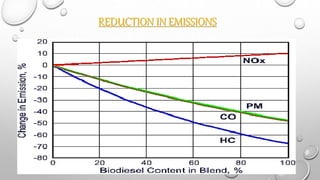
REDUCTION IN EMISSIONS
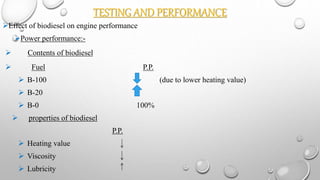
TESTING AND PERFORMANCE
Effect of biodiesel on engine performance
Power performance:-
 Contents of biodiesel
 Fuel P.P.
 B-100 (due to lower heating value)
 B-20
 B-0 100%
 properties of biodiesel
P.P.
 Heating value
 Viscosity
 Lubricity
Durability performance:-
 Fuel durability
B-100 (it is reactive in nature)
B-20
B-0 100%
Economy performance:-
In order to compensate loss of heating value more amount of biodiesel fuel
consumption takes place.
The difference in fuel consumption of diesel & pure bd was 18.5% in mass & was
reduced to 13.5% by volume because of higher density of BD.
B100
B100 refers 100% biodiesel and 0% diesel fuel.
Biodiesel is a very good solvent.
B100 freezes at much higher temperature than conventional diesel.
Biodiesel is not compatible with certain hoses and gaskets.
Biodiesel is not compatible with certain metals and plastics.
SELECTED PROPERTIES OF BIODIESEL AND DIESEL
ECONOMIC BENEFITS
Biodiesel is least-cost-strategy to comply with state and federal regulations.
Use of biodiesel does not require major engine modifications. The only thing
that changes is air quality.
Biodiesel has positive attributes such as increased cetane, high fuel lubricity &
high oxygen content.
ENVIRONMENTAL BENEFITS
Biodiesel contains fewer aromatic hydrocarbon: benzofluoranthene: 56 %
reduction; benzopyrenes: 71 % reduction .
Biodiesel reduces emissions of carbon monoxide (CO) by approximately 50 %
and carbon dioxide by 78 % on a net lifecycle basis.
Biodiesel is biodegradable and non-toxic posing no threat to human health.
Biodiesel reduces by as much as 65 % the emission of small particles of solid
combustion products.
Biodiesel has higher cetane rating than petro diesel .
EMISSIONS
The use of biodiesel in a conventional diesel engine results in substantial
reduction of unburned hydrocarbons, carbon monoxide, and particulate matter
compared to emissions from diesel fuel.
The ozone (smog) forming potentials of hydrocarbons is less than diesel fuel.
Sulfur emissions are essentially eliminated with pure biodiesel .
BIODIESEL : FIRST TRIAL RUN ON TRAIN
First successful trial run of a superfast passenger train was conducted
on Dec 31, 2009
Delhi - Amritsar shatabdi express used 5% of biodiesel fuel.
Railway annual fuel bill = Rs 3400 crores (for diesel)
10% mixture with diesel = reduced
(rs.300-400 crores / annum)
5% substitution is accepted.
INDIAN INITIATIVES
National mission on biodiesel has been launched by GOI
State governments designated special authorities/bodies to manage
Ministry of petroleum and natural gas notified biodiesel purchase policy
Government institutes are working on technology and promotion
Public and private sectors are working on processing and end use
SOME MORE PRACTICALITIES
The former president of India, Dr. Abdul Kalam, is one of the strong
advocators of jatropha cultivation for production of bio-diesel.
The state bank of India provided a boost to the cultivation of jatropha in
India by signing a MOU with d1 Mohan, a joint venture of d1 oils plc, to
give loans to the tune of 1.3 billion rupees to local farmers in India.
OLDER DIESEL MERCEDES ARE POPULAR FOR RUNNING
ON BIODIESEL
ADVANTAGES
Bio diesel is environmental friendly.
It can help reduce dependency on foreign oil.
It helps to lubricate the engine itself, decreasing engine wear.
It offers similar power to diesel fuel.
It is safer than conventional diesel.
It can be made from waste products.
It can be made at home easily.
DISADVANTAGES
Its storage for long period is not suitable for engine operation.
It becomes gel in cold weather.
It has water content. (Hygroscopic)
It degrades rubber.
It has higher (10%) nox emissions.
It decreases horsepower. (25%)
CONCLUSION
Biodiesel is eco-friendly.
Biodiesel is clean burning alternative fuel.
Biodiesel contain no petroleum, but can be blended with conventional diesel
fuel.
These fuel can be used in any diesel engine without any modification.
Biodiesel is degradable , non toxic and free from sulphur and lead.
Bio diesel deekshith

Bio diesel deekshith

  • 1.
    BIO DIESEL VASAGIRI SAIDEEXIT M.TECH AUTOMOBILE A7626215004
  • 2.
    INTRODUCTION Fossil fuels willsoon be exhausted. If we had replenish fuel sources, what direction should we go in? Electric cars Solar power Wind power OR
  • 3.
  • 4.
    WHAT ARE BIOFUELS? Anyhydrocarbon fuel that is produced from organic matter (living or once living material) in a short period of time (days, weeks, or even months) is considered a biofuel.
  • 5.
    WHY BIO FUELS? BIOFUELS VERSUS FOSSIL FUELS Fossil fuels are not renewable, which means they will run out at some point. As our ability to pump fossil fuels from the ground diminishes, the available supply will decrease, which will inevitably lead to an increase in price. Biofuels can be looked upon as a way of energy security which stands as an alternative of fossil fuels that are limited in availability. Today, the use of biofuels has expanded throughout the globe.
  • 6.
    TYPES OF BIOFUELS biofuelsare often broken into two generations. 1st generation biofuels are also called conventional biofuels. they are made from things like sugar, starch, or vegetable oil. note that these are all food products. any biofuel made from a feedstock that can also be consumed as a human food is considered a first generation biofuel. 2nd generation biofuels are produced from sustainable feedstock. no second generation biofuel is also a food crop, though certain food products can become second generation fuels when they are no longer useful for consumption. second generation biofuels are often called “advanced biofuels.”
  • 7.
    BIO FUEL  Thereare 4 chief biofuels categories: the 1st generation of biofuels comes from sugar, starch & vegetable fats that are solely dependent on food-crops. It also can be sourced through animal fats.  E.G; biofuels are bio-diesel, bioethanol
  • 8.
    WHAT IS BIODIESEL? BIODIESEL: Anlow-emissions, high lubricating alternative diesel fuel produced from veg.Oil / animal fats Non-toxic, biodegradable Can be combined at any level with petroleum diesel to fuel diesel engines.
  • 9.
    WHY BIODIESEL? Biodiesel reducescarbon dioxide exhaust emissions up to 80%. Biodiesel produces 100% less sox than petroleum. Biodiesel reduces exhaust smoke (particulates) emissions by up to 75% so the usual black cloud associated with a diesel engine can be eliminated. The smell of the biodiesel exhaust is far more pleasant.
  • 10.
    Biodiesel is mucheasier to handle and does not cause cracking or redness. Biodiesel is much less dangerous to put in vehicle fuel tank as its flash point is ± 150°c (300°f) as opposed to petroleum diesel ± 70°c (150°f).  Biodiesel provides significant lubricity improvement over petroleum diesel fuel so engines last longer, with the right additives engine performance can also be enhanced
  • 11.
    HISTORY OF BIODIESEL Transesterificationof vegetable oil before first engine, in 1853 by E. Duffy and J. Patrick Rudolf diesel 1900 world’s exhibition in paris Engine ran on peanut oil, the world’s first biodiesel Used until the 1920’s when petroleum diesel more common due to superior pricing
  • 12.
    BIO DIESEL PRODUCTION Fourmain production methods Direct use and blending Micro emulsions Thermal cracking Transesterification Most common production method Uses vegetable oils and animal fats as feed stocks The reaction of a fat or oil with an alcohol to form esters (biodiesel) and glycerol
  • 13.
    TRANSESTERIFICATION Transesterification is achemical reaction where triglyceride is reacted with alcohol in the presence of catalyst to produce alkyl esters. Biodiesel is produced by the transesterification process. Every 100 gallons of oil produces about 100 gallons of biodiesel and 10 gallons of glycerol
  • 14.
  • 16.
    BIODIESEL ATTRIBUTES High cetaneno. (Avg. Over 50) High lubricity, even in blends as low at 1-2% High energy balance (3.2 to 1) Low agriculture inputs: soybeans 78% life cycle co2 reduction Renewable, sustainable Domestically produced Reduces hc, pm, co in existing diesel engines Reduces nox in boilers and home heating
  • 17.
    BIO DIESEL INI.C ENGINES
  • 18.
    BIODIESEL BLENDS 0 50100 B2 B5 B10 B20 B1… Biodiesel Petroleum diesel B100 = 100% biodiesel B20 = 20% biodiesel + 80% petroleum diesel B10 = 10% biodiesel + 90% petroleum diesel B5 = 5% biodiesel + 95% petroleum diesel B2 = 2% biodiesel + 98% petroleum diesel
  • 19.
  • 20.
    TESTING AND PERFORMANCE Effectof biodiesel on engine performance Power performance:-  Contents of biodiesel  Fuel P.P.  B-100 (due to lower heating value)  B-20  B-0 100%  properties of biodiesel P.P.  Heating value  Viscosity  Lubricity
  • 21.
    Durability performance:-  Fueldurability B-100 (it is reactive in nature) B-20 B-0 100% Economy performance:- In order to compensate loss of heating value more amount of biodiesel fuel consumption takes place. The difference in fuel consumption of diesel & pure bd was 18.5% in mass & was reduced to 13.5% by volume because of higher density of BD.
  • 22.
    B100 B100 refers 100%biodiesel and 0% diesel fuel. Biodiesel is a very good solvent. B100 freezes at much higher temperature than conventional diesel. Biodiesel is not compatible with certain hoses and gaskets. Biodiesel is not compatible with certain metals and plastics.
  • 23.
    SELECTED PROPERTIES OFBIODIESEL AND DIESEL
  • 25.
    ECONOMIC BENEFITS Biodiesel isleast-cost-strategy to comply with state and federal regulations. Use of biodiesel does not require major engine modifications. The only thing that changes is air quality. Biodiesel has positive attributes such as increased cetane, high fuel lubricity & high oxygen content.
  • 26.
    ENVIRONMENTAL BENEFITS Biodiesel containsfewer aromatic hydrocarbon: benzofluoranthene: 56 % reduction; benzopyrenes: 71 % reduction . Biodiesel reduces emissions of carbon monoxide (CO) by approximately 50 % and carbon dioxide by 78 % on a net lifecycle basis. Biodiesel is biodegradable and non-toxic posing no threat to human health. Biodiesel reduces by as much as 65 % the emission of small particles of solid combustion products. Biodiesel has higher cetane rating than petro diesel .
  • 27.
    EMISSIONS The use ofbiodiesel in a conventional diesel engine results in substantial reduction of unburned hydrocarbons, carbon monoxide, and particulate matter compared to emissions from diesel fuel. The ozone (smog) forming potentials of hydrocarbons is less than diesel fuel. Sulfur emissions are essentially eliminated with pure biodiesel .
  • 28.
    BIODIESEL : FIRSTTRIAL RUN ON TRAIN First successful trial run of a superfast passenger train was conducted on Dec 31, 2009 Delhi - Amritsar shatabdi express used 5% of biodiesel fuel. Railway annual fuel bill = Rs 3400 crores (for diesel) 10% mixture with diesel = reduced (rs.300-400 crores / annum) 5% substitution is accepted.
  • 29.
    INDIAN INITIATIVES National missionon biodiesel has been launched by GOI State governments designated special authorities/bodies to manage Ministry of petroleum and natural gas notified biodiesel purchase policy Government institutes are working on technology and promotion Public and private sectors are working on processing and end use
  • 30.
    SOME MORE PRACTICALITIES Theformer president of India, Dr. Abdul Kalam, is one of the strong advocators of jatropha cultivation for production of bio-diesel. The state bank of India provided a boost to the cultivation of jatropha in India by signing a MOU with d1 Mohan, a joint venture of d1 oils plc, to give loans to the tune of 1.3 billion rupees to local farmers in India.
  • 31.
    OLDER DIESEL MERCEDESARE POPULAR FOR RUNNING ON BIODIESEL
  • 32.
    ADVANTAGES Bio diesel isenvironmental friendly. It can help reduce dependency on foreign oil. It helps to lubricate the engine itself, decreasing engine wear. It offers similar power to diesel fuel. It is safer than conventional diesel. It can be made from waste products. It can be made at home easily.
  • 33.
    DISADVANTAGES Its storage forlong period is not suitable for engine operation. It becomes gel in cold weather. It has water content. (Hygroscopic) It degrades rubber. It has higher (10%) nox emissions. It decreases horsepower. (25%)
  • 34.
    CONCLUSION Biodiesel is eco-friendly. Biodieselis clean burning alternative fuel. Biodiesel contain no petroleum, but can be blended with conventional diesel fuel. These fuel can be used in any diesel engine without any modification. Biodiesel is degradable , non toxic and free from sulphur and lead.