WASTE TO FUEL
What is fuel?
What is Waste to fuel?
Incineration
Alternatives to incineration
Pyrolysis of plastic
Innovative Minds
WHAT IS FUEL?
• Fuels are any materials that store potential
energy in forms that can be practicably released
and used for work or as heat energy . The
concept originally applied solely to those
materials storing energy in the form of chemical
energy that could be released
through combustion, but the concept has since
been also applied to other sources of heat energy
such as nuclear energy .
WhatIsWasteToFuel?
Waste-to-energy or
energy-from-waste is
the process of generating
energy in the form of
electricity and/or heat
from the incineration of
waste. WtE is a form of
energy recovery. Most
WtE processes produce
electricity and/or heat
directly through
combustion, or produce
a combustible fuel
commodity, such as
methane, methanol,
ethanol or synthetic
fuels.
A New Vision - Incineration
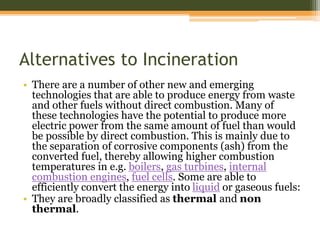
• Incineration, the combustion of
organic material such as waste with
energy recovery, is the most
common WtE implementation. The
method of using incineration to
convert municipal solid
waste (MSW) to energy is a
relatively old method of WtE
production. Incineration generally
entails burning waste (residual
MSW, commercial, industrial and
RDF) to boil water which powers
steam generators that make electric
energy and heat to be used in
homes, businesses, institutions and
industries. One problem associated
with incinerating MSW to make
electrical energy, is the potential for
pollutants to enter the atmosphere
with the flue gases from the boiler.
The Problem
Alternatives to Incineration
• There are a number of other new and emerging
technologies that are able to produce energy from waste
and other fuels without direct combustion. Many of
these technologies have the potential to produce more
electric power from the same amount of fuel than would
be possible by direct combustion. This is mainly due to
the separation of corrosive components (ash) from the
converted fuel, thereby allowing higher combustion
temperatures in e.g. boilers, gas turbines, internal
combustion engines, fuel cells. Some are able to
efficiently convert the energy into liquid or gaseous fuels:
• They are broadly classified as thermal and non
thermal.
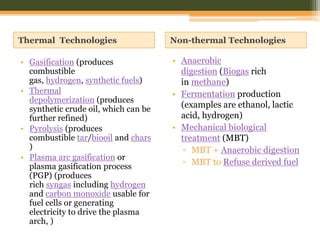
Thermal Technologies Non-thermal Technologies
• Gasification (produces
combustible
gas, hydrogen, synthetic fuels)
• Thermal
depolymerization (produces
synthetic crude oil, which can be
further refined)
• Pyrolysis (produces
combustible tar/biooil and chars
)
• Plasma arc gasification or
plasma gasification process
(PGP) (produces
rich syngas including hydrogen
and carbon monoxide usable for
fuel cells or generating
electricity to drive the plasma
arch, )
• Anaerobic
digestion (Biogas rich
in methane)
• Fermentation production
(examples are ethanol, lactic
acid, hydrogen)
• Mechanical biological
treatment (MBT)
▫ MBT + Anaerobic digestion
▫ MBT to Refuse derived fuel
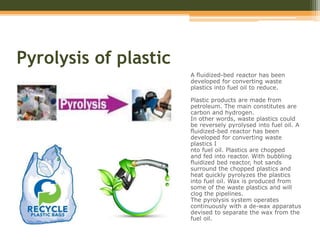
Pyrolysis of plastic
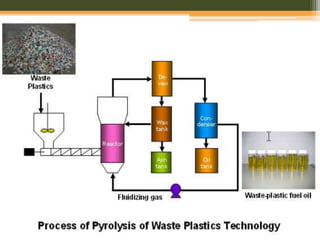
A fluidized-bed reactor has been
developed for converting waste
plastics into fuel oil to reduce.
Plastic products are made from
petroleum. The main constitutes are
carbon and hydrogen.
In other words, waste plastics could
be reversely pyrolysed into fuel oil. A
fluidized-bed reactor has been
developed for converting waste
plastics I
nto fuel oil. Plastics are chopped
and fed into reactor. With bubbling
fluidized bed reactor, hot sands
surround the chopped plastics and
heat quickly pyrolyzes the plastics
into fuel oil. Wax is produced from
some of the waste plastics and will
clog the pipelines.
The pyrolysis system operates
continuously with a de-wax apparatus
devised to separate the wax from the
fuel oil.
Applied Objects
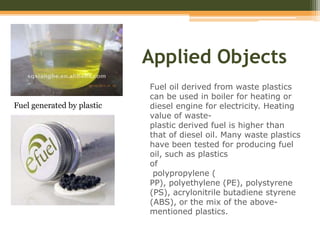
Fuel oil derived from waste plastics
can be used in boiler for heating or
diesel engine for electricity. Heating
value of waste-
plastic derived fuel is higher than
that of diesel oil. Many waste plastics
have been tested for producing fuel
oil, such as plastics
of
polypropylene (
PP), polyethylene (PE), polystyrene
(PS), acrylonitrile butadiene styrene
(ABS), or the mix of the above-
mentioned plastics.
Fuel generated by plastic
Benefits of Pyrolysis
of plastic
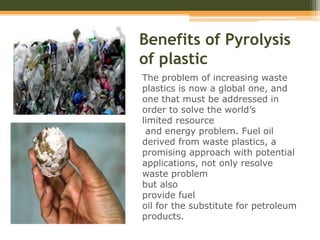
The problem of increasing waste
plastics is now a global one, and
one that must be addressed in
order to solve the world’s
limited resource
and energy problem. Fuel oil
derived from waste plastics, a
promising approach with potential
applications, not only resolve
waste problem
but also
provide fuel
oil for the substitute for petroleum
products.
The Future
• The future way of economical
production of high quality synthetic
Diesel fuel:
•
• • After years of intensive
catalyst and process research the
breakthrough of reproducing the
natural way of fossil oil production
within a process duration turned down
from hundreds of millions of years to
now only seconds and up to 3 (three)
minutes has finally become reality!
• • This causes the synthetic
Diesel fuel "NanoDiesel™" produced
by this method to be fully competitive.
• • With most of the input
materials the quality of the synthetic
fuel produced by this new ground
breaking method is even higher than
that of regular Diesel fuel available at
gas stations.
• • Cost per Gallon of Diesel produced is
anywhere in the World only between 0,52 &
0,85 US$ without Government subsidies.
• • Elimination of almost all
environmental pollution through inorganic
transformation of harmful substances into salts
and crystals, based on the ion changing
characteristics of the GP-Cat, our proprietary
Catalyst.
• • For the first time this method now
allows active environmental protection as well
as optimized energy production from industrial
residuals, waste and biologically regenerating
raw materials in perfect combination and free
of any conflicts.
• • Environmental protection as future
leading sources of energy and job production
• • Elimination of the needs for new and
existing Landfill's and its Toxic Emissions
through this process
• • Higher National Independence and
Higher National Security
• • Existing Resource "Garbage" used to
fulfill our Fuel and Energy demands.
WtE Plants around the world
• Lee County Solid Waste Resource
Recovery Facility, Fort Myers, Florida,
USA (1994)[29]
• Montgomery County Resource
Recovery Facility in Dickerson,
Maryland, USA (1995)
• Spittelau (1971), and Flötzersteig
(1963), Vienna, Austria (Wien
Energie)
• SYSAV in Malmö (2003 and 2008),
Sweden (Flash presentation)
• Algonquin Power, Brampton, Ontario,
Canada[30]
• Teesside EfW
plant near Middlesbrough, North East
England (1998)
• Edmonton Incinerator in Greater
London, England (1974)
• Burnaby Waste-to-Energy
Facility, Metro
Vancouver, Canada (1988).
Innovative Minds
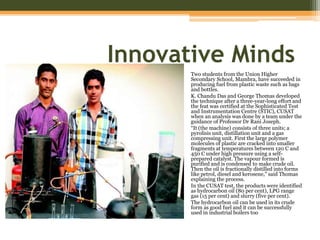
Two students from the Union Higher
Secondary School, Mambra, have succeeded in
producing fuel from plastic waste such as bags
and bottles.
K. Chandu Das and George Thomas developed
the technique after a three-year-long effort and
the feat was certified at the Sophisticated Test
and Instrumentation Centre (STIC), CUSAT
when an analysis was done by a team under the
guidance of Professor Dr Rani Joseph.
“It (the machine) consists of three units; a
pyrolisis unit, distillation unit and a gas
compressing unit. First the large polymer
molecules of plastic are cracked into smaller
fragments at temperatures between 120 C and
450 C under high pressure using a self-
prepared catalyst. The vapour formed is
purified and is condensed to make crude oil.
Then the oil is fractionally distilled into forms
like petrol, diesel and kerosene,” said Thomas
explaining the process.
In the CUSAT test, the products were identified
as hydrocarbon oil (80 per cent), LPG range
gas (15 per cent) and slurry (five per cent).
The hydrocarbon oil can be used in its crude
form as good fuel and it can be successfully
used in industrial boilers too
Thank you

Waste to fuel

  • 1.
    WASTE TO FUEL Whatis fuel? What is Waste to fuel? Incineration Alternatives to incineration Pyrolysis of plastic Innovative Minds
  • 2.
    WHAT IS FUEL? •Fuels are any materials that store potential energy in forms that can be practicably released and used for work or as heat energy . The concept originally applied solely to those materials storing energy in the form of chemical energy that could be released through combustion, but the concept has since been also applied to other sources of heat energy such as nuclear energy .
  • 3.
    WhatIsWasteToFuel? Waste-to-energy or energy-from-waste is theprocess of generating energy in the form of electricity and/or heat from the incineration of waste. WtE is a form of energy recovery. Most WtE processes produce electricity and/or heat directly through combustion, or produce a combustible fuel commodity, such as methane, methanol, ethanol or synthetic fuels.
  • 4.
    A New Vision- Incineration • Incineration, the combustion of organic material such as waste with energy recovery, is the most common WtE implementation. The method of using incineration to convert municipal solid waste (MSW) to energy is a relatively old method of WtE production. Incineration generally entails burning waste (residual MSW, commercial, industrial and RDF) to boil water which powers steam generators that make electric energy and heat to be used in homes, businesses, institutions and industries. One problem associated with incinerating MSW to make electrical energy, is the potential for pollutants to enter the atmosphere with the flue gases from the boiler.
  • 5.
  • 6.
    Alternatives to Incineration •There are a number of other new and emerging technologies that are able to produce energy from waste and other fuels without direct combustion. Many of these technologies have the potential to produce more electric power from the same amount of fuel than would be possible by direct combustion. This is mainly due to the separation of corrosive components (ash) from the converted fuel, thereby allowing higher combustion temperatures in e.g. boilers, gas turbines, internal combustion engines, fuel cells. Some are able to efficiently convert the energy into liquid or gaseous fuels: • They are broadly classified as thermal and non thermal.
  • 7.
    Thermal Technologies Non-thermalTechnologies • Gasification (produces combustible gas, hydrogen, synthetic fuels) • Thermal depolymerization (produces synthetic crude oil, which can be further refined) • Pyrolysis (produces combustible tar/biooil and chars ) • Plasma arc gasification or plasma gasification process (PGP) (produces rich syngas including hydrogen and carbon monoxide usable for fuel cells or generating electricity to drive the plasma arch, ) • Anaerobic digestion (Biogas rich in methane) • Fermentation production (examples are ethanol, lactic acid, hydrogen) • Mechanical biological treatment (MBT) ▫ MBT + Anaerobic digestion ▫ MBT to Refuse derived fuel
  • 8.
    Pyrolysis of plastic Afluidized-bed reactor has been developed for converting waste plastics into fuel oil to reduce. Plastic products are made from petroleum. The main constitutes are carbon and hydrogen. In other words, waste plastics could be reversely pyrolysed into fuel oil. A fluidized-bed reactor has been developed for converting waste plastics I nto fuel oil. Plastics are chopped and fed into reactor. With bubbling fluidized bed reactor, hot sands surround the chopped plastics and heat quickly pyrolyzes the plastics into fuel oil. Wax is produced from some of the waste plastics and will clog the pipelines. The pyrolysis system operates continuously with a de-wax apparatus devised to separate the wax from the fuel oil.
  • 10.
    Applied Objects Fuel oilderived from waste plastics can be used in boiler for heating or diesel engine for electricity. Heating value of waste- plastic derived fuel is higher than that of diesel oil. Many waste plastics have been tested for producing fuel oil, such as plastics of polypropylene ( PP), polyethylene (PE), polystyrene (PS), acrylonitrile butadiene styrene (ABS), or the mix of the above- mentioned plastics. Fuel generated by plastic
  • 11.
    Benefits of Pyrolysis ofplastic The problem of increasing waste plastics is now a global one, and one that must be addressed in order to solve the world’s limited resource and energy problem. Fuel oil derived from waste plastics, a promising approach with potential applications, not only resolve waste problem but also provide fuel oil for the substitute for petroleum products.
  • 12.
    The Future • Thefuture way of economical production of high quality synthetic Diesel fuel: • • • After years of intensive catalyst and process research the breakthrough of reproducing the natural way of fossil oil production within a process duration turned down from hundreds of millions of years to now only seconds and up to 3 (three) minutes has finally become reality! • • This causes the synthetic Diesel fuel "NanoDiesel™" produced by this method to be fully competitive. • • With most of the input materials the quality of the synthetic fuel produced by this new ground breaking method is even higher than that of regular Diesel fuel available at gas stations. • • Cost per Gallon of Diesel produced is anywhere in the World only between 0,52 & 0,85 US$ without Government subsidies. • • Elimination of almost all environmental pollution through inorganic transformation of harmful substances into salts and crystals, based on the ion changing characteristics of the GP-Cat, our proprietary Catalyst. • • For the first time this method now allows active environmental protection as well as optimized energy production from industrial residuals, waste and biologically regenerating raw materials in perfect combination and free of any conflicts. • • Environmental protection as future leading sources of energy and job production • • Elimination of the needs for new and existing Landfill's and its Toxic Emissions through this process • • Higher National Independence and Higher National Security • • Existing Resource "Garbage" used to fulfill our Fuel and Energy demands.
  • 13.
    WtE Plants aroundthe world • Lee County Solid Waste Resource Recovery Facility, Fort Myers, Florida, USA (1994)[29] • Montgomery County Resource Recovery Facility in Dickerson, Maryland, USA (1995) • Spittelau (1971), and Flötzersteig (1963), Vienna, Austria (Wien Energie) • SYSAV in Malmö (2003 and 2008), Sweden (Flash presentation) • Algonquin Power, Brampton, Ontario, Canada[30] • Teesside EfW plant near Middlesbrough, North East England (1998) • Edmonton Incinerator in Greater London, England (1974) • Burnaby Waste-to-Energy Facility, Metro Vancouver, Canada (1988).
  • 14.
    Innovative Minds Two studentsfrom the Union Higher Secondary School, Mambra, have succeeded in producing fuel from plastic waste such as bags and bottles. K. Chandu Das and George Thomas developed the technique after a three-year-long effort and the feat was certified at the Sophisticated Test and Instrumentation Centre (STIC), CUSAT when an analysis was done by a team under the guidance of Professor Dr Rani Joseph. “It (the machine) consists of three units; a pyrolisis unit, distillation unit and a gas compressing unit. First the large polymer molecules of plastic are cracked into smaller fragments at temperatures between 120 C and 450 C under high pressure using a self- prepared catalyst. The vapour formed is purified and is condensed to make crude oil. Then the oil is fractionally distilled into forms like petrol, diesel and kerosene,” said Thomas explaining the process. In the CUSAT test, the products were identified as hydrocarbon oil (80 per cent), LPG range gas (15 per cent) and slurry (five per cent). The hydrocarbon oil can be used in its crude form as good fuel and it can be successfully used in industrial boilers too
  • 15.