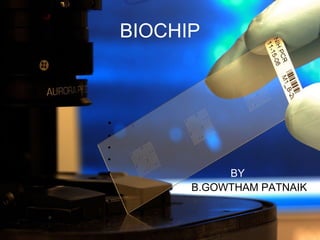
BIOCHIP 
• 
• 
• 
• 
• BY 
• B.GOWTHAM PATNAIK 
•
OVERVIEW 
INTRODUCTION 
HISTORY 
DEFINITION 
STRUCTURE AND BASIC WORKING 
BIOCHIP IMPLANT 
APPLICATION 
ADVANTAGE & DISADVANTAGE 
CONCLUSION 
FUTURE
INTRODUCTION 
Collection of miniaturized test sites(micro arrays) 
arranged on a solid substrate. 
permits many test to be performes at the same time. 
surface area is no longer than a fingurenail. 
perform thousands of biological reactions in a few 
seconds. 
used to analyze organic molecules associated with 
living organisms.
HISTORY 
•Developed in 1983 for monitoring fisheries. 
•Large scale development of biochips in the 1990s. 
•Today, a large variety of biochip technologies are 
either in development or being commercialized. 
•Invented in 4G generation & the development is 
stillcontinued.
YEAR SCIENTIST CONTRIBUTION 
1980 Fredsanger& 
Walter Gilbert DNA sequencing approach 
1983 Kary Mullis PCR which amplify minute 
amounts of DNA to quantities 
1986 Leroy Hood 
Flourescence based DNA 
sequency facilitating 
automation of reading DNA 
sequence
DEFINITION 
• Collection of micro array 
arranged on a substrate. 
• Can perform millions of 
operations 
• Can also performs 
thousands of biological 
operations. 
• Increase speed of 
identification of genes.
COMPONENTS 
Biochip implant system of 
two components: 
1. Transponder 
2. Reader or Scanner
TRANSPONDER 
• It is the actual biochip implant. 
• There are two types of transponders-active & passive. 
• Using a passive transponder. 
• Biochip and reader via low frequency radio waves.
Transponder consists of four parts: 
1. Computer microchip 
2. Antenna coil 
3. Tuning capacitor 
4. Glass Capsule
Fig:Biochip Components
• Computer Microchip: Microchip stores a unique 
identification number from 10 to 15 digits long. 
• Antenna Coil: this tiny primitve,radio 
antenna"receives & sends" signal from reader or 
scanner. 
• Tuning Capacitor: this capacitor is charged by the 
small signal sent by the reader. 
• Glass Capsule: "Houses" the microchip,antenna 
coil,capacitor.it is made of biocompatible material 
such as soda lime glass.
Reader or Scanner: 
• Consists of an "exciter"coil which creates 
electromagnetic signal. 
• Provides energy to "activate" the implemented 
biochip. 
• Also carries a receiving coil to receive ID number. 
• Contain the software and components to decode the 
receive code & display the result in LCD display. 
• All do in milliseconds.
WORKING 
• Reader transmits a Low-power radio signal and 
activate the implanted biochip. 
• ID number is transmitted by the transponder and 
received by the reader. 
• Reader display the ID number on the reader's LCD 
display.
BIOCHIP IMPLANT 
• Injected by a hypodermic syringe beneath the skin. 
• Injection is safe and simple. 
• Anesthesia is not required. 
• Usually injected behind the Neck.
Fig:Perspective of actual size
BIOCHIPS CURRENTLY UNDER 
DEVOLPMENT 
• Chips that follows footsteps 
• Glucose level Detectors 
• Oxy sensors 
• Brain surgery with an ON-OFF switch 
• Experiments with lost sight.
GLUCOSE DETECTOR 
• Chip can be integrated 
with Glucose detector. 
• Chip allows to easily 
moniter Diabetes.
OXYGEN SENSOR 
• The biochip can also be integrated with an oxygen 
sensor . 
• The oxygen sensor will be useful to monitor 
breathing rate. 
• The oxygen sensor chips sends light pulses out into 
the body. 
• The light absorbed to varying extent, depending on 
how much oxygen is being carried in the blood,and 
the chip detect the light
APPLICATION 
With a biochip,tracing of a person/animal anywhere in 
the world. 
A biochip can store and update FINANCIAL, medical 
and demographic data, basically everything about a 
person. 
 Biochip leads to a secured E-commerce system. 
Biochip really have potential in replacing passport, 
ATM, medical records etc.
ADVANTAGES 
Small in size. 
 Faster & powerful. 
 Perform thousand of biological reactions in a few 
seconds. 
 Increase speed of diagnosis of unknown pathogens. 
 Ability to detect multiple viral agent in parallel. 
 Ease of use.
DISADVANTAGES 
• They raise critical issue of personal privacy. 
• They can be emplanted into ones body with out their 
knowledge.
SCOPE 
A chip implanted some where in human body might 
serve as a combination of 
1. Credit card 
2. Driving license 
3. Passport 
4. Personal identification etc. 
 No longer would it be needed to worry about losing 
all above thing. 
 Can also widely established in veterinary field.
CONCLUSION 
BIOCHIPS are: 
Fast 
 Accurate 
 Miniaturized 
 Advantages upon conventional Analyzer 
 Expected to become economically advantageous 
attributes that make them analogous to computer 
chip.

Biochip 28

  • 1.
    BIOCHIP • • • • • BY • B.GOWTHAM PATNAIK •
  • 2.
    OVERVIEW INTRODUCTION HISTORY DEFINITION STRUCTURE AND BASIC WORKING BIOCHIP IMPLANT APPLICATION ADVANTAGE & DISADVANTAGE CONCLUSION FUTURE
  • 3.
    INTRODUCTION Collection ofminiaturized test sites(micro arrays) arranged on a solid substrate. permits many test to be performes at the same time. surface area is no longer than a fingurenail. perform thousands of biological reactions in a few seconds. used to analyze organic molecules associated with living organisms.
  • 4.
    HISTORY •Developed in1983 for monitoring fisheries. •Large scale development of biochips in the 1990s. •Today, a large variety of biochip technologies are either in development or being commercialized. •Invented in 4G generation & the development is stillcontinued.
  • 5.
    YEAR SCIENTIST CONTRIBUTION 1980 Fredsanger& Walter Gilbert DNA sequencing approach 1983 Kary Mullis PCR which amplify minute amounts of DNA to quantities 1986 Leroy Hood Flourescence based DNA sequency facilitating automation of reading DNA sequence
  • 6.
    DEFINITION • Collectionof micro array arranged on a substrate. • Can perform millions of operations • Can also performs thousands of biological operations. • Increase speed of identification of genes.
  • 7.
    COMPONENTS Biochip implantsystem of two components: 1. Transponder 2. Reader or Scanner
  • 8.
    TRANSPONDER • Itis the actual biochip implant. • There are two types of transponders-active & passive. • Using a passive transponder. • Biochip and reader via low frequency radio waves.
  • 9.
    Transponder consists offour parts: 1. Computer microchip 2. Antenna coil 3. Tuning capacitor 4. Glass Capsule
  • 10.
  • 11.
    • Computer Microchip:Microchip stores a unique identification number from 10 to 15 digits long. • Antenna Coil: this tiny primitve,radio antenna"receives & sends" signal from reader or scanner. • Tuning Capacitor: this capacitor is charged by the small signal sent by the reader. • Glass Capsule: "Houses" the microchip,antenna coil,capacitor.it is made of biocompatible material such as soda lime glass.
  • 12.
    Reader or Scanner: • Consists of an "exciter"coil which creates electromagnetic signal. • Provides energy to "activate" the implemented biochip. • Also carries a receiving coil to receive ID number. • Contain the software and components to decode the receive code & display the result in LCD display. • All do in milliseconds.
  • 13.
    WORKING • Readertransmits a Low-power radio signal and activate the implanted biochip. • ID number is transmitted by the transponder and received by the reader. • Reader display the ID number on the reader's LCD display.
  • 15.
    BIOCHIP IMPLANT •Injected by a hypodermic syringe beneath the skin. • Injection is safe and simple. • Anesthesia is not required. • Usually injected behind the Neck.
  • 17.
  • 18.
    BIOCHIPS CURRENTLY UNDER DEVOLPMENT • Chips that follows footsteps • Glucose level Detectors • Oxy sensors • Brain surgery with an ON-OFF switch • Experiments with lost sight.
  • 19.
    GLUCOSE DETECTOR •Chip can be integrated with Glucose detector. • Chip allows to easily moniter Diabetes.
  • 20.
    OXYGEN SENSOR •The biochip can also be integrated with an oxygen sensor . • The oxygen sensor will be useful to monitor breathing rate. • The oxygen sensor chips sends light pulses out into the body. • The light absorbed to varying extent, depending on how much oxygen is being carried in the blood,and the chip detect the light
  • 22.
    APPLICATION With abiochip,tracing of a person/animal anywhere in the world. A biochip can store and update FINANCIAL, medical and demographic data, basically everything about a person.  Biochip leads to a secured E-commerce system. Biochip really have potential in replacing passport, ATM, medical records etc.
  • 23.
    ADVANTAGES Small insize.  Faster & powerful.  Perform thousand of biological reactions in a few seconds.  Increase speed of diagnosis of unknown pathogens.  Ability to detect multiple viral agent in parallel.  Ease of use.
  • 24.
    DISADVANTAGES • Theyraise critical issue of personal privacy. • They can be emplanted into ones body with out their knowledge.
  • 25.
    SCOPE A chipimplanted some where in human body might serve as a combination of 1. Credit card 2. Driving license 3. Passport 4. Personal identification etc.  No longer would it be needed to worry about losing all above thing.  Can also widely established in veterinary field.
  • 26.
    CONCLUSION BIOCHIPS are: Fast  Accurate  Miniaturized  Advantages upon conventional Analyzer  Expected to become economically advantageous attributes that make them analogous to computer chip.