PRESENTED BY :-
AVINASH SAHU
B.TECH - BIOTECHNOLOGY
BIOCHIP(THE FUTURE OF MEDICINE)
OVERVIEW
INTRODUCTION
BIOCHIP
TECHNOLOGY AND ITS COMPONENT
TYPES OF BIOCHIP
CONCLUSION
IMPLANATATION AND ADVANTAGES
APPLICATIONS OF BIOCHIP
REFERENCE
Introduction
● Biochips are essentially miniaturized laboratories that can perform hundreds or
thousands of biochemical reactions simultaneously .
● Typically, a biochip's surface area is no larger than a fingernail (2-12 Inches).
● Biochip used to record the simultaneous activity of thousands of genes in a cell,
and is important for many areas of biology and medicine.
● Biochip is a device that is capable to analyse a wide range of physiological tasks
when placed into the human body.
● The development started with early work on the underlying sensor technology.
One of the first portable, chemistry-based sensors was the glass pH electrode,
invented in 1922 by Hughes .
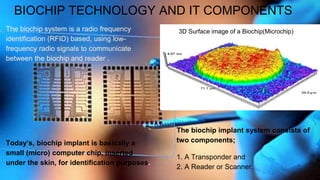
The biochip system is a radio frequency
identification (RFID) based, using low-
frequency radio signals to communicate
between the biochip and reader .
Today’s, biochip implant is basically a
small (micro) computer chip, inserted
under the skin, for identification purposes.
The biochip implant system consists of
two components;
1. A Transponder and
2. A Reader or Scanner.
BIOCHIP TECHNOLOGY AND IT COMPONENTS
3D Surface image of a Biochip(Microchip)
IMPLANTING A BIO-CHIP
THE TRANSPONDER
● The transponder is the actual biochip implant.
● It is a passive transponder it contains no battery
or energy of it's own.
● Being passive, it's inactive until the reader
activates it by sending it a low-power electrical
charge.
● Components of Biochip
The biochip-transponder consists of four parts;
1.Computer microchip,
2.Antenna coil,
3.Capacitor And
4.Glass capsule.
THE READER or SCANNER
● The reader consists of an "exciter" coil which
creates an electromagnetic field that, via radio
signals, provides the necessary energy to
"excite" or "activate" the implanted biochip.
● The reader also carries a receiving coil that
receives the transmitted code or ID number
sent back from the "activated" implanted
biochip. This all takes place very fast, in
milliseconds.
● The reader also contains the software and
components to decode the received code and
display the result in an LCD display.
THE BIOCHIP IMPLANT SYSTEM
TYPES OF BIOCHIP
On the basis of target molecules in the sample, biochips are classified as
● Protein biochips
● DNA biochip
● Enzyme biochips &
● Lab-on-a-chip
APPLICATION
HUMAN GENOME
PROJECT
GENETIC VARIATION
FORENSIC
MEDICAL PURPOSE
MOLECULAR LEVEL
PHARMACOGENOMICS
CANCER DIAGNOSIS
POLLUTIONTRANSPORT
COMPANIES
IMPLANTATION OF RETINA BIOCHIP
• Physicians are able to analyze blood results and
recognize sepsis within 20 minutes using a biochip ,
• Sepsis, commonly known as 'blood poisoning,' is a
life threatening illness, caused by patients’ own
immune system going into overdrive.
• Sepsis immune response causes small blood clots to
form, blocking blood flow to vital organs, resulting in
organ failure. In the United States about 750,000
people get severe sepsis each year, and more than
200,000 die from it.
• These bind to the proteins – meaning antibodies,
protein and marked antibodies are all firmly linked to
each other and to the chip's surface. When the chip is
illuminated, the dye lights up." The apparatus sees
lots of little illuminated dots that show the protein was
in the blood. But if the patient is healthy, however, the
chip remains dark.
Biochip Can Recognize Sepsis Quickly
❖More sensitive than bioassay tests currently in use.
❖Faster analysis than traditional methods.
For example, a biochip, also known as a “lab-on-chip” can be used to detect food pathogens
like E . Coli , salmonella, listeria and others all at the same time.
❖Able to provide results in a matter of minutes, opening up the possibility of a rapid, point-of-
care diagnostic tool for patients.
❖The potential of these devices is huge because multiple tests can be performed simultaneously.
❖ Biochip can recognize sepsis quickly.
❖ New biochip will test for HIV with just a drop of blood.
ADVANTAGES
CONCLUSION
➢ Biochips can be employed for multiple applications in various spheres of
technology such as diagnosis of cancer, blood clots, analysis of biomarkers,
biomolecules, etc,.
➢ The landscape study provides various other insights regarding principal assignees
and their focus area. The analysis also reveals that USA and China are the leading
countries for biochip development.
➢ Some mobile device manufacturers have even experimented with integrating
biochips onto mobile phone cases so that mobile operators could potentially begin
to offer health related services .
➢ It can be used in transport companies such as FedEx and Purolator in order to track
where their trucks and drivers are. They already use this technology (RFID tags) to
locate packages and track them around the world. Because they do not have to
contact every drivers to know if they are on schedule, it saves time and money.
➢ The presence of such giants making big leaps in this technology is a clear
indication that this industry has a bright future and it will mark a revolution in
medicine .
➢ “The ultimate goal is to lessen dependence on animal test subjects and decrease
time and cost for developing drugs”.
REFERENCES
1.LexInnova “Bio-chips: The Future Of Medicine - Patent Landscape Analysis” 13-Nov-2013
2.Prof. T.Venkat Narayana Rao, Sai Sukruthi.G, Gloria Raj . “ Biochip Technology –A Gigantic Innovation ”
International Journal of Emerging Technology and Advanced Engineering. Website: www.ijetae.com (ISSN 2250-
2459, Volume 2, Issue 3, March 2012)
3. Images Via Google , Pinterest, and Videos via youtube
4.Best emerging tech from gartners hype cycle . “ TECH INSIDER ” (2015-8)
5.TODD LEWAN . “Chip Implants Linked to Animal Tumors - The Washington Post ” wp-
dyn/content/article/2007/09/08/AR2007090800997 .

BIOCHIP 3

  • 1.
    PRESENTED BY :- AVINASHSAHU B.TECH - BIOTECHNOLOGY BIOCHIP(THE FUTURE OF MEDICINE)
  • 2.
    OVERVIEW INTRODUCTION BIOCHIP TECHNOLOGY AND ITSCOMPONENT TYPES OF BIOCHIP CONCLUSION IMPLANATATION AND ADVANTAGES APPLICATIONS OF BIOCHIP REFERENCE
  • 3.
    Introduction ● Biochips areessentially miniaturized laboratories that can perform hundreds or thousands of biochemical reactions simultaneously . ● Typically, a biochip's surface area is no larger than a fingernail (2-12 Inches). ● Biochip used to record the simultaneous activity of thousands of genes in a cell, and is important for many areas of biology and medicine. ● Biochip is a device that is capable to analyse a wide range of physiological tasks when placed into the human body. ● The development started with early work on the underlying sensor technology. One of the first portable, chemistry-based sensors was the glass pH electrode, invented in 1922 by Hughes .
  • 4.
    The biochip systemis a radio frequency identification (RFID) based, using low- frequency radio signals to communicate between the biochip and reader . Today’s, biochip implant is basically a small (micro) computer chip, inserted under the skin, for identification purposes. The biochip implant system consists of two components; 1. A Transponder and 2. A Reader or Scanner. BIOCHIP TECHNOLOGY AND IT COMPONENTS 3D Surface image of a Biochip(Microchip)
  • 5.
  • 6.
    THE TRANSPONDER ● Thetransponder is the actual biochip implant. ● It is a passive transponder it contains no battery or energy of it's own. ● Being passive, it's inactive until the reader activates it by sending it a low-power electrical charge. ● Components of Biochip The biochip-transponder consists of four parts; 1.Computer microchip, 2.Antenna coil, 3.Capacitor And 4.Glass capsule. THE READER or SCANNER ● The reader consists of an "exciter" coil which creates an electromagnetic field that, via radio signals, provides the necessary energy to "excite" or "activate" the implanted biochip. ● The reader also carries a receiving coil that receives the transmitted code or ID number sent back from the "activated" implanted biochip. This all takes place very fast, in milliseconds. ● The reader also contains the software and components to decode the received code and display the result in an LCD display. THE BIOCHIP IMPLANT SYSTEM
  • 7.
    TYPES OF BIOCHIP Onthe basis of target molecules in the sample, biochips are classified as ● Protein biochips ● DNA biochip ● Enzyme biochips & ● Lab-on-a-chip
  • 8.
    APPLICATION HUMAN GENOME PROJECT GENETIC VARIATION FORENSIC MEDICALPURPOSE MOLECULAR LEVEL PHARMACOGENOMICS CANCER DIAGNOSIS POLLUTIONTRANSPORT COMPANIES
  • 9.
  • 10.
    • Physicians areable to analyze blood results and recognize sepsis within 20 minutes using a biochip , • Sepsis, commonly known as 'blood poisoning,' is a life threatening illness, caused by patients’ own immune system going into overdrive. • Sepsis immune response causes small blood clots to form, blocking blood flow to vital organs, resulting in organ failure. In the United States about 750,000 people get severe sepsis each year, and more than 200,000 die from it. • These bind to the proteins – meaning antibodies, protein and marked antibodies are all firmly linked to each other and to the chip's surface. When the chip is illuminated, the dye lights up." The apparatus sees lots of little illuminated dots that show the protein was in the blood. But if the patient is healthy, however, the chip remains dark. Biochip Can Recognize Sepsis Quickly
  • 11.
    ❖More sensitive thanbioassay tests currently in use. ❖Faster analysis than traditional methods. For example, a biochip, also known as a “lab-on-chip” can be used to detect food pathogens like E . Coli , salmonella, listeria and others all at the same time. ❖Able to provide results in a matter of minutes, opening up the possibility of a rapid, point-of- care diagnostic tool for patients. ❖The potential of these devices is huge because multiple tests can be performed simultaneously. ❖ Biochip can recognize sepsis quickly. ❖ New biochip will test for HIV with just a drop of blood. ADVANTAGES
  • 12.
    CONCLUSION ➢ Biochips canbe employed for multiple applications in various spheres of technology such as diagnosis of cancer, blood clots, analysis of biomarkers, biomolecules, etc,. ➢ The landscape study provides various other insights regarding principal assignees and their focus area. The analysis also reveals that USA and China are the leading countries for biochip development. ➢ Some mobile device manufacturers have even experimented with integrating biochips onto mobile phone cases so that mobile operators could potentially begin to offer health related services . ➢ It can be used in transport companies such as FedEx and Purolator in order to track where their trucks and drivers are. They already use this technology (RFID tags) to locate packages and track them around the world. Because they do not have to contact every drivers to know if they are on schedule, it saves time and money. ➢ The presence of such giants making big leaps in this technology is a clear indication that this industry has a bright future and it will mark a revolution in medicine . ➢ “The ultimate goal is to lessen dependence on animal test subjects and decrease time and cost for developing drugs”.
  • 13.
    REFERENCES 1.LexInnova “Bio-chips: TheFuture Of Medicine - Patent Landscape Analysis” 13-Nov-2013 2.Prof. T.Venkat Narayana Rao, Sai Sukruthi.G, Gloria Raj . “ Biochip Technology –A Gigantic Innovation ” International Journal of Emerging Technology and Advanced Engineering. Website: www.ijetae.com (ISSN 2250- 2459, Volume 2, Issue 3, March 2012) 3. Images Via Google , Pinterest, and Videos via youtube 4.Best emerging tech from gartners hype cycle . “ TECH INSIDER ” (2015-8) 5.TODD LEWAN . “Chip Implants Linked to Animal Tumors - The Washington Post ” wp- dyn/content/article/2007/09/08/AR2007090800997 .