Submitted By:
Sneha S Mena
BIOCHIP
1
2
 Biochips are microscopic electronic devices
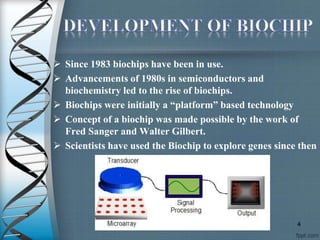
 Biochip requires microarray technology, transduction
and signal processing technology.
 Made in a glass or Silicon wafer
 Biochips are capable to execute many hundred
operations simultaneously on a solid surface.
 It combines genetics, molecular biology and
biochemistry
 Biochip Technology is the most significant technology
in biotechnology
 High throughput, mini size, automated and cost
effective
 Biochip is an important potential tool in life science 3
 Since 1983 biochips have been in use.
 Advancements of 1980s in semiconductors and
biochemistry led to the rise of biochips.
 Biochips were initially a “platform” based technology
 Concept of a biochip was made possible by the work of
Fred Sanger and Walter Gilbert.
 Scientists have used the Biochip to explore genes since then
4
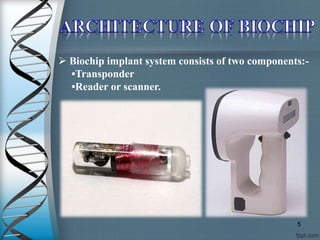
 Biochip implant system consists of two components:-
•Transponder
•Reader or scanner.
5
 The transponder is the actual biochip implant
 The biochip system is a Radio frequency
identification system (RFID), using low-frequency
radio signals to communicate between the reader
and biochip.
 The reading range or activation range ,between
reader and biochip is small, normally between 2 and
12inches.
1. Size: The size of a biochip is the size of an
uncooked rice grain. It ranges from 2 mm to 3 mm
and about 1 mm in diameter
6
PERSPECTIVE OF ACTUAL SIZE
7
2. TRANSPONDER:
Actual biochip implant.
Two types of transponder – passive or active.
Communication between biochip and reader is via
low-frequency radio waves.
Transponder consists of four parts:-
Computer microchip
Antenna coil
Tuning capacitor
Glass capsule
8
9
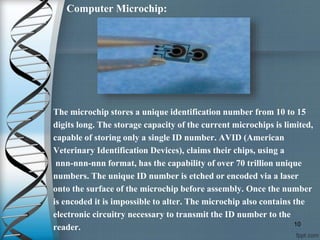
Computer Microchip:
The microchip stores a unique identification number from 10 to 15
digits long. The storage capacity of the current microchips is limited,
capable of storing only a single ID number. AVID (American
Veterinary Identification Devices), claims their chips, using a
nnn-nnn-nnn format, has the capability of over 70 trillion unique
numbers. The unique ID number is etched or encoded via a laser
onto the surface of the microchip before assembly. Once the number
is encoded it is impossible to alter. The microchip also contains the
electronic circuitry necessary to transmit the ID number to the
reader. 10
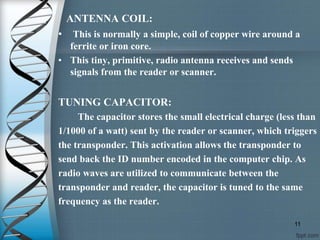
ANTENNA COIL:
• This is normally a simple, coil of copper wire around a
ferrite or iron core.
• This tiny, primitive, radio antenna receives and sends
signals from the reader or scanner.
TUNING CAPACITOR:
The capacitor stores the small electrical charge (less than
1/1000 of a watt) sent by the reader or scanner, which triggers
the transponder. This activation allows the transponder to
send back the ID number encoded in the computer chip. As
radio waves are utilized to communicate between the
transponder and reader, the capacitor is tuned to the same
frequency as the reader.
11
GLASS CAPSULE:
The glass capsule holds the microchip, antenna coil and
capacitor. It is a small capsule, the smallest measuring 11 mm in
length and 2 mm in diameter, about the size of an uncooked
grain of rice as shown in previous figure. The capsule is made of
biocompatible material such as soda lime glass. After assembly,
the capsule is hermetically (air tight) sealed, so no bodily fluids
can touch the electronics inside.
12
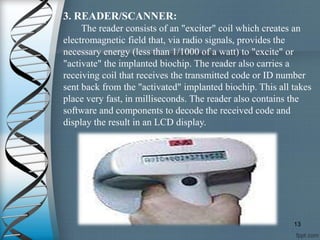
3. READER/SCANNER:
The reader consists of an "exciter" coil which creates an
electromagnetic field that, via radio signals, provides the
necessary energy (less than 1/1000 of a watt) to "excite" or
"activate" the implanted biochip. The reader also carries a
receiving coil that receives the transmitted code or ID number
sent back from the "activated" implanted biochip. This all takes
place very fast, in milliseconds. The reader also contains the
software and components to decode the received code and
display the result in an LCD display.
13
4. COST :
BIOCHIPS are not cheap, though the price is falling rapidly.
A year ago, human biochips cost $2,000 per unit. Currently
human biochips cost $1,000, while chips for mice, yeast, and
fruit flies cost around $400 to $500. The price for human
biochips will probably drop to $500 this year. Once all the
human genes are well characterised and all the functional
human SNPs are known, manufacture of the chips could
conceivably be standardized. Then, prices for biochips, like
the price for computer memory chips, would fall through the
floor.
14
15
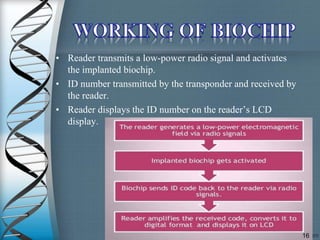
• Reader transmits a low-power radio signal and activates
the implanted biochip.
• ID number transmitted by the transponder and received by
the reader.
• Reader displays the ID number on the reader’s LCD
display.
16
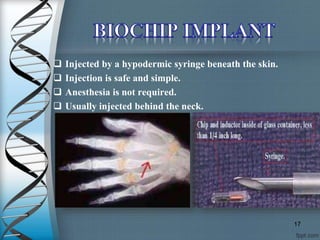
 Injected by a hypodermic syringe beneath the skin.
 Injection is safe and simple.
 Anesthesia is not required.
 Usually injected behind the neck.
17
 With a biochip tracing of a person/animal, anywhere
in the world is possible.
 A biochip can store and update financial, medical,
demographic data, basically everything about a
person.
 A biochip leads to a secured E-commerce systems.
 Biochips are really potent in replacing passports, cash,
medical records.
 Medicinal implementation of biochips-as glucose
detector; as oxygen sensor; as blood pressure sensor.
 Applied in genomics, proteomics, cellomics, bio-
diagnostics. 18
 To rescue the sick.
 To find the lost people.
 To identify person uniquely.
 In monitoring health condition of individuals in which
they are specially employed.
 They can perform thousands of biological reactions in
a few seconds.
 Increase speed of diagnosis of unknown pathogens.
 Ability to detect multiple viral agents in parallel.
19
 They raise critical issues of personal privacy.
 They mark the end of human freedom and dignity.
 There is a danger of turning every man, women and
child into a controlled slave.
 They can be implanted into ones body without their
knowledge.
 “Black market” for chips would thrive.
 Criminals would cut off hands and heads, stealing
"rich-folks" chips.
20
 A chip implanted somewhere in human bodies might
serve as a combination of credit card, passport,
driver's license, personal diary.
 No longer would it be needed to worry about losing
the credit cards while travelling.
 A chip inserted into human bodies might also give us
extra mental power.
21
Biochips are :-
 Fast
 Accurate
 Miniaturized
 Advantages upon conventional Analyzer
 Expected to become economically advantageous
attributes that make them analogous to computer
chip.
22
23

Biochip

  • 1.
    Submitted By: Sneha SMena BIOCHIP 1
  • 2.
  • 3.
     Biochips aremicroscopic electronic devices  Biochip requires microarray technology, transduction and signal processing technology.  Made in a glass or Silicon wafer  Biochips are capable to execute many hundred operations simultaneously on a solid surface.  It combines genetics, molecular biology and biochemistry  Biochip Technology is the most significant technology in biotechnology  High throughput, mini size, automated and cost effective  Biochip is an important potential tool in life science 3
  • 4.
     Since 1983biochips have been in use.  Advancements of 1980s in semiconductors and biochemistry led to the rise of biochips.  Biochips were initially a “platform” based technology  Concept of a biochip was made possible by the work of Fred Sanger and Walter Gilbert.  Scientists have used the Biochip to explore genes since then 4
  • 5.
     Biochip implantsystem consists of two components:- •Transponder •Reader or scanner. 5
  • 6.
     The transponderis the actual biochip implant  The biochip system is a Radio frequency identification system (RFID), using low-frequency radio signals to communicate between the reader and biochip.  The reading range or activation range ,between reader and biochip is small, normally between 2 and 12inches. 1. Size: The size of a biochip is the size of an uncooked rice grain. It ranges from 2 mm to 3 mm and about 1 mm in diameter 6
  • 7.
  • 8.
    2. TRANSPONDER: Actual biochipimplant. Two types of transponder – passive or active. Communication between biochip and reader is via low-frequency radio waves. Transponder consists of four parts:- Computer microchip Antenna coil Tuning capacitor Glass capsule 8
  • 9.
  • 10.
    Computer Microchip: The microchipstores a unique identification number from 10 to 15 digits long. The storage capacity of the current microchips is limited, capable of storing only a single ID number. AVID (American Veterinary Identification Devices), claims their chips, using a nnn-nnn-nnn format, has the capability of over 70 trillion unique numbers. The unique ID number is etched or encoded via a laser onto the surface of the microchip before assembly. Once the number is encoded it is impossible to alter. The microchip also contains the electronic circuitry necessary to transmit the ID number to the reader. 10
  • 11.
    ANTENNA COIL: • Thisis normally a simple, coil of copper wire around a ferrite or iron core. • This tiny, primitive, radio antenna receives and sends signals from the reader or scanner. TUNING CAPACITOR: The capacitor stores the small electrical charge (less than 1/1000 of a watt) sent by the reader or scanner, which triggers the transponder. This activation allows the transponder to send back the ID number encoded in the computer chip. As radio waves are utilized to communicate between the transponder and reader, the capacitor is tuned to the same frequency as the reader. 11
  • 12.
    GLASS CAPSULE: The glasscapsule holds the microchip, antenna coil and capacitor. It is a small capsule, the smallest measuring 11 mm in length and 2 mm in diameter, about the size of an uncooked grain of rice as shown in previous figure. The capsule is made of biocompatible material such as soda lime glass. After assembly, the capsule is hermetically (air tight) sealed, so no bodily fluids can touch the electronics inside. 12
  • 13.
    3. READER/SCANNER: The readerconsists of an "exciter" coil which creates an electromagnetic field that, via radio signals, provides the necessary energy (less than 1/1000 of a watt) to "excite" or "activate" the implanted biochip. The reader also carries a receiving coil that receives the transmitted code or ID number sent back from the "activated" implanted biochip. This all takes place very fast, in milliseconds. The reader also contains the software and components to decode the received code and display the result in an LCD display. 13
  • 14.
    4. COST : BIOCHIPSare not cheap, though the price is falling rapidly. A year ago, human biochips cost $2,000 per unit. Currently human biochips cost $1,000, while chips for mice, yeast, and fruit flies cost around $400 to $500. The price for human biochips will probably drop to $500 this year. Once all the human genes are well characterised and all the functional human SNPs are known, manufacture of the chips could conceivably be standardized. Then, prices for biochips, like the price for computer memory chips, would fall through the floor. 14
  • 15.
  • 16.
    • Reader transmitsa low-power radio signal and activates the implanted biochip. • ID number transmitted by the transponder and received by the reader. • Reader displays the ID number on the reader’s LCD display. 16
  • 17.
     Injected bya hypodermic syringe beneath the skin.  Injection is safe and simple.  Anesthesia is not required.  Usually injected behind the neck. 17
  • 18.
     With abiochip tracing of a person/animal, anywhere in the world is possible.  A biochip can store and update financial, medical, demographic data, basically everything about a person.  A biochip leads to a secured E-commerce systems.  Biochips are really potent in replacing passports, cash, medical records.  Medicinal implementation of biochips-as glucose detector; as oxygen sensor; as blood pressure sensor.  Applied in genomics, proteomics, cellomics, bio- diagnostics. 18
  • 19.
     To rescuethe sick.  To find the lost people.  To identify person uniquely.  In monitoring health condition of individuals in which they are specially employed.  They can perform thousands of biological reactions in a few seconds.  Increase speed of diagnosis of unknown pathogens.  Ability to detect multiple viral agents in parallel. 19
  • 20.
     They raisecritical issues of personal privacy.  They mark the end of human freedom and dignity.  There is a danger of turning every man, women and child into a controlled slave.  They can be implanted into ones body without their knowledge.  “Black market” for chips would thrive.  Criminals would cut off hands and heads, stealing "rich-folks" chips. 20
  • 21.
     A chipimplanted somewhere in human bodies might serve as a combination of credit card, passport, driver's license, personal diary.  No longer would it be needed to worry about losing the credit cards while travelling.  A chip inserted into human bodies might also give us extra mental power. 21
  • 22.
    Biochips are :- Fast  Accurate  Miniaturized  Advantages upon conventional Analyzer  Expected to become economically advantageous attributes that make them analogous to computer chip. 22
  • 23.