BIOCHIPS
(Life On It)
Seminar
on
Topic Name
BIOCHIPS(Life On It)
By
Student’s Name SONAL SINGH
Session: 2018-2019
Submitted
to
Department of Electrical and Electronics Engineering
G.L. BAJAJ INSTITUTE OF TECHNOLOGY AND MANAGEMENT
[Approved by AICTE, Govt. Of India & Affiliated to Dr. APJ A.K. Technical
University, Lucknow, U.P. India]
INSIDE THIS
• INTRODUCTION
• HISTORY
• THE BIOCHIP TECHNOLOGY
• COMPONENTS OF BIOCHIPS
• WORKING
• DIFFERENT TYPES OF BIOCHIPS
• BIOCHIPS IMPLANT
• APPLICATIONS
• MERITS & DMERITS
• FUTURE
• CONCLUSION
• REFRENCES
INTRODUCTION
• A single electronic card may replace everything in your wallet including. . Your cash ,
passport ,financial details etc.
• It is new type of bio-security device to accurately track information regarding
everything about a person.
• Surface area is no longer than a finger nail.
• Biochips are used to analyze organic molecules associated with living organisms.
• A biochip is a collection of miniaturized test sites (micro arrays) arranged on a solid
substrate that permits many tests to be performed at the same time in order to get higher
throughput and speed.
• Like a computer chip that can perform millions of mathematical operation in one
second, a biochip can perform thousands of biological operations, such as decoding
genes, in a few seconds.
HISTROY
• The Biochip technology was originally developed in 1983 .
• For instance, at least 6 million medical devices, such as artificial body parts (prosthetic
devices), breast implants, chin implants, etc., are implanted in people each year.
• In 1993, the Food and Drug Administration passed the Safe Medical Devices
Registration Act of 1993, requiring all artificial body implants to have "implanted"
identification — the biochip.
• The major biochip companies are A.V.I.D. (American Veterinary Identification
Devices), Trovan Identification Systems, and Destron-Fearing Corporation.
THE BIOCHIP TECHNOLOGY
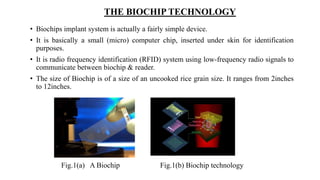
• Biochips implant system is actually a fairly simple device.
• It is basically a small (micro) computer chip, inserted under skin for identification
purposes.
• It is radio frequency identification (RFID) system using low-frequency radio signals to
communicate between biochip & reader.
• The size of Biochip is of a size of an uncooked rice grain size. It ranges from 2inches
to 12inches.
Fig.1(a) A Biochip Fig.1(b) Biochip technology
COMPONENTS OF BIOCHIPS
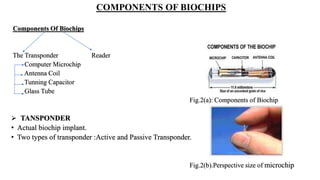
Components Of Biochips
The Transponder Reader
Computer Microchip
Antenna Coil
Tunning Capacitor
Glass Tube
Fig.2(a): Components of Biochip
 TANSPONDER
• Actual biochip implant.
• Two types of transponder :Active and Passive Transponder.
Fig.2(b).Perspective size of microchip
BIOCHIPS IMPLANT
• The transponder is the actual biochip implant. It is a passive transponder, meaning it contains no
battery or energy of its own.
• Biochips has a very long life, up to 99 years, and no maintenance. Being passive, it's inactive
until the reader activates it by sending it a low-power electrical charge.
• The reader "reads" or "scans" the implanted biochip and receives back data (in this case an
identification number) from the biochip.
• The communication between biochip and reader is via low-frequency radio waves.
• The biochip transponder consists of four parts:
• i) Computer microchip:The microchip stores a unique identification number of 10 to15 digits.
• ii) Antenna coil:This tiny, radio antenna “receives & sends” radio signals from receiver
• iii) Tunning capacitor:This capacitor is charged by small signal sent by the reader.
• iv) Glass capsule: “houses” the microchip, antenna coil and capacitor. Made up of
biocompatible material such as soda lime glass.
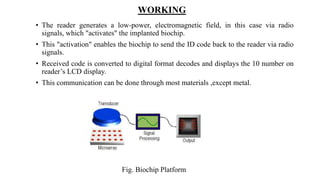
WORKING
• The reader generates a low-power, electromagnetic field, in this case via radio
signals, which "activates" the implanted biochip.
• This "activation" enables the biochip to send the ID code back to the reader via radio
signals.
• Received code is converted to digital format decodes and displays the 10 number on
reader’s LCD display.
• This communication can be done through most materials ,except metal.
Fig. Biochip Platform
APPLICATIONS
• A biochip can store and update financial, medical, demographic data, basically
everything about a person.
• A biochip leads to a secured E-Commerce systems.
• Biochips really are potent in replacing passports, cash, medical records.
• Tracing of a person /animal ,anywhere in the world is possible with the implanted
Biochips.
Medicinal implementation
• 1. Biochips as Glucose detector
• 2.Biochips as an Blood Pressure sensor
DIFFERENT TYPES OF BIOCHIP
• 1.DNA chip 2. Protein chip 3. Enzyme chip 4. Lab-on-a chip
TYPICAL PROBLEM OF BIOCHIPS: A SOLUTION PROPOSED
 The Lock: Problem before the world
• A chip implant would contain a person’s financial world, medical history, health care — it
would contain his electronic life".
• Kidnappers will skin people to find them.
 Our key: The solution
• A existing model of Biochips consists of only ROM component.
• The induction of RAM component in addition to ROM component.
• RAM needs to be continuously charged inorder to retain the data. Current can be supplied
to the chip either from the electrical energy produced in the cells. By converting the heat
energy in our body to electrical energy.
• Once if the chip is taken out from the human body RAM immediately loses the Power
supply from the human body; thus information in the RAM is lost.
MERITS & DEMERITS
MERITS
• Fast reaction times
• Low-cost, portable and disposable
• Compactness
• High-throughput
• To find lost people, and to identify person uniquely.
• In monitoring health conditions.
DEMERITS
• They raise critical issues of personal privacy.
• They may not be supported by large percentage of people.
FUTURE OF BIOCHIPS
• In science biochips will play a substantial role in the analysis of the genetic basis of
common diseases. If these diseases are understood once, the clinical use of biochips
will open an enormous potential for a predictive medicine.
• DNA chips will facilitate the integration of diagnosis and therapeutics, as well as the
introduction of personalized medicines.
CONCLUSION
• A chip might serve as a combination of credit cards, passport etc.
• No longer would it be needed to worry about losing the credit cards while traveling.
• A chip inserted in human body might also give us extra mental power.
REFERENCES
• Bruce, H., Robinson, Nadrian, Seeman, C., 1987, The design of a biochip: a self-
assembling molecular-scale memory device. Protein Eng 1:295-300.
• Jain, K.K., 2004, Applications of biochips: from diagnostics to personalized medicine.
Curr Opin
• Drug Discov Devel 7:285-289.
• Kallioniemi, O.P., 2001, Biochip technologies in cancer research. Ann Med 33:142-
147.
• Electronics for you and information technology magazines.
BIOCHIPS(Life On It)

BIOCHIPS(Life On It)

  • 1.
  • 2.
    Seminar on Topic Name BIOCHIPS(Life OnIt) By Student’s Name SONAL SINGH Session: 2018-2019 Submitted to Department of Electrical and Electronics Engineering G.L. BAJAJ INSTITUTE OF TECHNOLOGY AND MANAGEMENT [Approved by AICTE, Govt. Of India & Affiliated to Dr. APJ A.K. Technical University, Lucknow, U.P. India]
  • 3.
    INSIDE THIS • INTRODUCTION •HISTORY • THE BIOCHIP TECHNOLOGY • COMPONENTS OF BIOCHIPS • WORKING • DIFFERENT TYPES OF BIOCHIPS • BIOCHIPS IMPLANT • APPLICATIONS • MERITS & DMERITS • FUTURE • CONCLUSION • REFRENCES
  • 4.
    INTRODUCTION • A singleelectronic card may replace everything in your wallet including. . Your cash , passport ,financial details etc. • It is new type of bio-security device to accurately track information regarding everything about a person. • Surface area is no longer than a finger nail. • Biochips are used to analyze organic molecules associated with living organisms. • A biochip is a collection of miniaturized test sites (micro arrays) arranged on a solid substrate that permits many tests to be performed at the same time in order to get higher throughput and speed. • Like a computer chip that can perform millions of mathematical operation in one second, a biochip can perform thousands of biological operations, such as decoding genes, in a few seconds.
  • 5.
    HISTROY • The Biochiptechnology was originally developed in 1983 . • For instance, at least 6 million medical devices, such as artificial body parts (prosthetic devices), breast implants, chin implants, etc., are implanted in people each year. • In 1993, the Food and Drug Administration passed the Safe Medical Devices Registration Act of 1993, requiring all artificial body implants to have "implanted" identification — the biochip. • The major biochip companies are A.V.I.D. (American Veterinary Identification Devices), Trovan Identification Systems, and Destron-Fearing Corporation.
  • 6.
    THE BIOCHIP TECHNOLOGY •Biochips implant system is actually a fairly simple device. • It is basically a small (micro) computer chip, inserted under skin for identification purposes. • It is radio frequency identification (RFID) system using low-frequency radio signals to communicate between biochip & reader. • The size of Biochip is of a size of an uncooked rice grain size. It ranges from 2inches to 12inches. Fig.1(a) A Biochip Fig.1(b) Biochip technology
  • 7.
    COMPONENTS OF BIOCHIPS ComponentsOf Biochips The Transponder Reader Computer Microchip Antenna Coil Tunning Capacitor Glass Tube Fig.2(a): Components of Biochip  TANSPONDER • Actual biochip implant. • Two types of transponder :Active and Passive Transponder. Fig.2(b).Perspective size of microchip
  • 8.
    BIOCHIPS IMPLANT • Thetransponder is the actual biochip implant. It is a passive transponder, meaning it contains no battery or energy of its own. • Biochips has a very long life, up to 99 years, and no maintenance. Being passive, it's inactive until the reader activates it by sending it a low-power electrical charge. • The reader "reads" or "scans" the implanted biochip and receives back data (in this case an identification number) from the biochip. • The communication between biochip and reader is via low-frequency radio waves. • The biochip transponder consists of four parts: • i) Computer microchip:The microchip stores a unique identification number of 10 to15 digits. • ii) Antenna coil:This tiny, radio antenna “receives & sends” radio signals from receiver • iii) Tunning capacitor:This capacitor is charged by small signal sent by the reader. • iv) Glass capsule: “houses” the microchip, antenna coil and capacitor. Made up of biocompatible material such as soda lime glass.
  • 9.
    WORKING • The readergenerates a low-power, electromagnetic field, in this case via radio signals, which "activates" the implanted biochip. • This "activation" enables the biochip to send the ID code back to the reader via radio signals. • Received code is converted to digital format decodes and displays the 10 number on reader’s LCD display. • This communication can be done through most materials ,except metal. Fig. Biochip Platform
  • 10.
    APPLICATIONS • A biochipcan store and update financial, medical, demographic data, basically everything about a person. • A biochip leads to a secured E-Commerce systems. • Biochips really are potent in replacing passports, cash, medical records. • Tracing of a person /animal ,anywhere in the world is possible with the implanted Biochips. Medicinal implementation • 1. Biochips as Glucose detector • 2.Biochips as an Blood Pressure sensor DIFFERENT TYPES OF BIOCHIP • 1.DNA chip 2. Protein chip 3. Enzyme chip 4. Lab-on-a chip
  • 11.
    TYPICAL PROBLEM OFBIOCHIPS: A SOLUTION PROPOSED  The Lock: Problem before the world • A chip implant would contain a person’s financial world, medical history, health care — it would contain his electronic life". • Kidnappers will skin people to find them.  Our key: The solution • A existing model of Biochips consists of only ROM component. • The induction of RAM component in addition to ROM component. • RAM needs to be continuously charged inorder to retain the data. Current can be supplied to the chip either from the electrical energy produced in the cells. By converting the heat energy in our body to electrical energy. • Once if the chip is taken out from the human body RAM immediately loses the Power supply from the human body; thus information in the RAM is lost.
  • 12.
    MERITS & DEMERITS MERITS •Fast reaction times • Low-cost, portable and disposable • Compactness • High-throughput • To find lost people, and to identify person uniquely. • In monitoring health conditions. DEMERITS • They raise critical issues of personal privacy. • They may not be supported by large percentage of people.
  • 13.
    FUTURE OF BIOCHIPS •In science biochips will play a substantial role in the analysis of the genetic basis of common diseases. If these diseases are understood once, the clinical use of biochips will open an enormous potential for a predictive medicine. • DNA chips will facilitate the integration of diagnosis and therapeutics, as well as the introduction of personalized medicines. CONCLUSION • A chip might serve as a combination of credit cards, passport etc. • No longer would it be needed to worry about losing the credit cards while traveling. • A chip inserted in human body might also give us extra mental power.
  • 14.
    REFERENCES • Bruce, H.,Robinson, Nadrian, Seeman, C., 1987, The design of a biochip: a self- assembling molecular-scale memory device. Protein Eng 1:295-300. • Jain, K.K., 2004, Applications of biochips: from diagnostics to personalized medicine. Curr Opin • Drug Discov Devel 7:285-289. • Kallioniemi, O.P., 2001, Biochip technologies in cancer research. Ann Med 33:142- 147. • Electronics for you and information technology magazines.