SUBMITTED BY :
PANKAJ AGARWAL
OVERVIE
 W
 INTRODUCTION
DEFINETION
STRUCTURE AND BASIC WORKING
BIOCHIP IMPLANT
APPLICATION
ADVANTAGES
CONCLUSION
FUTURE
INTRODUCTION :-

   Collection of miniaturized test sites(microarrays)
    arranged on a solid substrate.
   Permits many tests to be performed at the same time.
   Surface area is no longer than a fingernail.
   Perform thousands of biological reactions in a few
    seconds.
   Used to analyze organic molecules associated with
    living organisms.
   Help in identifying gene sequences, environmental
    pollutants, airborne toxins, or other biochemical
    constituents.
DEFINETION :-

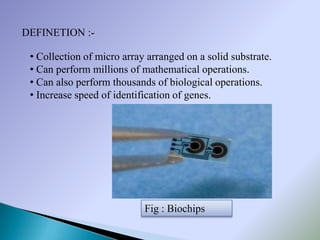
 • Collection of micro array arranged on a solid substrate.
 • Can perform millions of mathematical operations.
 • Can also perform thousands of biological operations.
 • Increase speed of identification of genes.


                            Fig : Biochips
COMPONENTS :-
Biochip implant system consist of two component...

• Transponder

• Reader or scanner
TRANSPONDER :-

• It is the Actual Biochip Implant.
• Two Types of Transponder- Passive & Active.
• Using a Passive Transponder.
• Biochip & Reader Communicate Via low Frequency Radio Waves.
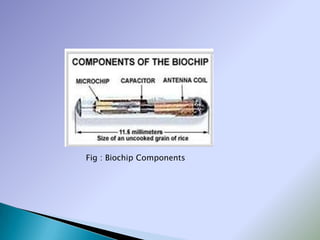
• Transponder Consist of Four Parts :-
1. Computer Microchip
2. Antenna Coil
3. Tuning Capacitor
4. Glass Capsule
Fig : Biochip Components
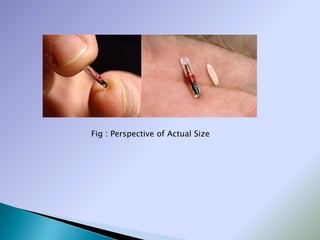
Fig : Perspective of Actual Size
• Computer Microchip :-
      The microchip stores a unique identification number
from 10 to 15 digits long.
• Antenna Coil :-
     This tiny, primitive, radio antenna “ receives & sends ”
signal from the reader or scanner.
• Tuning Capacitor :-
        This capacitor is charged by the small signal sent by the
reader.
• Glass Capsule :-
         “Houses” the microchip, antenna coil, capacitor. It is
made of biocompatible material such as soda lime glass.
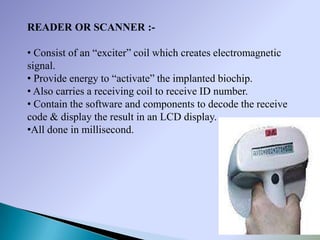
READER OR SCANNER :-

• Consist of an “exciter” coil which creates electromagnetic
signal.
• Provide energy to “activate” the implanted biochip.
• Also carries a receiving coil to receive ID number.
• Contain the software and components to decode the receive
code & display the result in an LCD display.
•All done in millisecond.
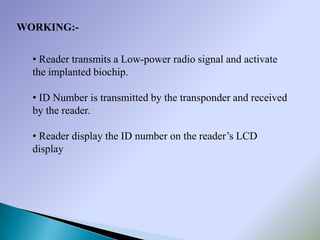
WORKING:-

  • Reader transmits a Low-power radio signal and activate
  the implanted biochip.

  • ID Number is transmitted by the transponder and received
  by the reader.

  • Reader display the ID number on the reader’s LCD
  display
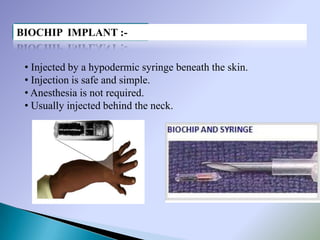
BIOCHIP IMPLANT :-


 • Injected by a hypodermic syringe beneath the skin.
 • Injection is safe and simple.
 • Anesthesia is not required.
 • Usually injected behind the neck.
APPLICATION :-

  With a biochip , tracing of a person/animal anywhere in
 the world.
 A biochip can store and update financial, medical and
 demographic data, basically everything about a person.
  Biochip leads to a secured E-commerce system.
 Biochip really have potential in replacing
 passport, ATM, medical records etc.
 Medicinal implementation of biochips- as glucose
 detector, as oxygen sensor, as a blood pressure sensor etc.
ADVANTAGES :-


   Small in size.
   Faster & powerful.
   Perform thousand of biological reactions in a few seconds.
   Increase speed of diagnosis of unknown pathogens.
   Ability to detect multiple viral agent in parallel.
   Ease of use.
FUTURE :-

  A chip implanted some where in human body might
 serve as a combination of
 1. Credit card
 2. Driving license
 3. Passport
 4. Personal identification etc.
  No longer would it be needed to worry about losing all
    above thing.
  Can also widely established in veterinary field.
CONCLUSION:-
Biochips are :-
 Fast
 Accurate
 Miniaturized
 Advantages upon conventional Analyzer
 Expected to become economically advantageous attributes
that make them analogous to computer chip.
THANK YOU
Biochips seminar

Biochips seminar

  • 1.
  • 2.
    OVERVIE W  INTRODUCTION DEFINETION STRUCTUREAND BASIC WORKING BIOCHIP IMPLANT APPLICATION ADVANTAGES CONCLUSION FUTURE
  • 3.
    INTRODUCTION :-  Collection of miniaturized test sites(microarrays) arranged on a solid substrate.  Permits many tests to be performed at the same time.  Surface area is no longer than a fingernail.  Perform thousands of biological reactions in a few seconds.  Used to analyze organic molecules associated with living organisms.  Help in identifying gene sequences, environmental pollutants, airborne toxins, or other biochemical constituents.
  • 4.
    DEFINETION :- •Collection of micro array arranged on a solid substrate. • Can perform millions of mathematical operations. • Can also perform thousands of biological operations. • Increase speed of identification of genes. Fig : Biochips
  • 5.
    COMPONENTS :- Biochip implantsystem consist of two component... • Transponder • Reader or scanner
  • 6.
    TRANSPONDER :- • Itis the Actual Biochip Implant. • Two Types of Transponder- Passive & Active. • Using a Passive Transponder. • Biochip & Reader Communicate Via low Frequency Radio Waves. • Transponder Consist of Four Parts :- 1. Computer Microchip 2. Antenna Coil 3. Tuning Capacitor 4. Glass Capsule
  • 7.
    Fig : BiochipComponents
  • 8.
    Fig : Perspectiveof Actual Size
  • 9.
    • Computer Microchip:- The microchip stores a unique identification number from 10 to 15 digits long. • Antenna Coil :- This tiny, primitive, radio antenna “ receives & sends ” signal from the reader or scanner. • Tuning Capacitor :- This capacitor is charged by the small signal sent by the reader. • Glass Capsule :- “Houses” the microchip, antenna coil, capacitor. It is made of biocompatible material such as soda lime glass.
  • 10.
    READER OR SCANNER:- • Consist of an “exciter” coil which creates electromagnetic signal. • Provide energy to “activate” the implanted biochip. • Also carries a receiving coil to receive ID number. • Contain the software and components to decode the receive code & display the result in an LCD display. •All done in millisecond.
  • 11.
    WORKING:- •Reader transmits a Low-power radio signal and activate the implanted biochip. • ID Number is transmitted by the transponder and received by the reader. • Reader display the ID number on the reader’s LCD display
  • 12.
    BIOCHIP IMPLANT :- • Injected by a hypodermic syringe beneath the skin. • Injection is safe and simple. • Anesthesia is not required. • Usually injected behind the neck.
  • 14.
    APPLICATION :- With a biochip , tracing of a person/animal anywhere in the world. A biochip can store and update financial, medical and demographic data, basically everything about a person.  Biochip leads to a secured E-commerce system. Biochip really have potential in replacing passport, ATM, medical records etc. Medicinal implementation of biochips- as glucose detector, as oxygen sensor, as a blood pressure sensor etc.
  • 15.
    ADVANTAGES :-  Small in size.  Faster & powerful.  Perform thousand of biological reactions in a few seconds.  Increase speed of diagnosis of unknown pathogens.  Ability to detect multiple viral agent in parallel.  Ease of use.
  • 16.
    FUTURE :- A chip implanted some where in human body might serve as a combination of 1. Credit card 2. Driving license 3. Passport 4. Personal identification etc.  No longer would it be needed to worry about losing all above thing.  Can also widely established in veterinary field.
  • 17.
    CONCLUSION:- Biochips are :- Fast  Accurate  Miniaturized  Advantages upon conventional Analyzer  Expected to become economically advantageous attributes that make them analogous to computer chip.
  • 18.