“BIOCHIPS”
FRONTIERS IN MEDICAL
DIAGNOSTICS
HARSHA JACOB
S8 BIOTECHNOLOGY
ROLL NO:12
SCET
GUIDE : Mrs.SALINI P. J
Contents
• Introduction
• History
• Components
• Working
• Application
• Advantages& Disadvantages
• Future prospects
• Conclusion
INTRODUCTION
• Collection of miniaturized test sites(microarrays)
arranged on a solid substrate.
• Permits many tests to be performed at the same time.
• Surface area is no longer than a fingernail.
• Perform thousands of biological reactions in a few
seconds.
• Used to analyze organic molecules associated with
living organisms.
• Helps in identifying gene sequence, environmental
pollutants, airborne toxins, or other biochemical
constituents.
• The major bio chip company is AVID.
(American veterinary identification devices)
• It can also be used as a bio security device to
accurately track information regarding what a
person is doing and who is actually doing it .
• A single electronic card may replace
everything in your ATM cards ,your credit
cards ,your id cards, your medical records
• Bio implant is basically a small micro
computer chip inserted under the skin for
identification purposes
• Employ radio frequency identification system
(RFTD) – uses low frequency radio signals to
communicate between the bio chip and
reader
DEFINiTION
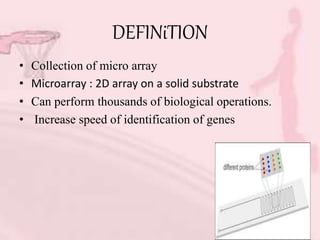
• Collection of micro array
• Microarray : 2D array on a solid substrate
• Can perform thousands of biological operations.
• Increase speed of identification of genes
IN BRIEF
• Bio + Chip = Biochip
– Bio: stands for any biological entity
eg: protein, DNA
– Chip: a computer chip
– Biochip: a mate between biological entity and a
computer
HISTORY
• Developed in 1983 for monitoring fisheries.
• Large scale development of biochips in the
1990s.
• Today, a large variety of biochip technologies are
either in development or being commercialized
COMPONENTS
Biochip implant system consist of two
components
 Transponder
 Reader or scanner
Transponder
Actual biochip implant.
Two types of transponder – passive or active.
Communication between biochip and reader is via
low-frequency radio waves.
Transponder consists of four parts:-
a. Computer microchip
b. Antenna coil
c. Tuning capacitor
d. Glass capsule
COMPONENTS
 Computer Microchip
– The microchip stores a unique identification number from
10 to 15 digits long. The unique ID number is etched or
encoded via a laser onto the surface of the microchip before
assembly. Once the number is encoded it is impossible to
alter. The microchip also contains the electronic circuitry
necessary to transmit the ID number to the reader
 Antenna Coil
– This is normally a simple, coil of copper wire around a ferrite
or iron core. This tiny, primitive, radio antenna receives and
sends signals from the reader or scanner.
 Tuning Capacitor
– The capacitor stores the small electrical charge sent by the
reader or scanner, which triggers the transponder. This
activation allows the transponder to send back the ID number
encoded in the computer chip. As radio waves are utilized to
communicate between the transponder and reader, the
capacitor is tuned to the same frequency as the reader.
 Glass Capsule
– The glass capsule holds the microchip, antenna coil and
capacitor. It is a small capsule, the smallest measuring 11
mm in length and 2 mm in diameter, about the size of an
uncooked grain of rice. The capsule is made of
biocompatible material such as soda lime glass. After
assembly, the capsule is hermetically (air-tight) sealed, so
no body fluids can touch the electronics inside.
READER / SCANNER
• Consists of an “exciter” coil which creates
electromagnetic field.
• Provide energy to “activate” the implanted biochip.
• Also carries a receiving coil to receive ID number.
• Contains the software and components to decode
the receive code and display the result in an LCD
display.
• All done in millisecond.
WORKING
• Reader transmits a low-power radio signal and
activates the implanted biochip.
• ID number transmitted by the transponder
and received by the reader.
• Reader displays the ID number on the
reader’s LCD display.
BIOCHIP IMPLANT
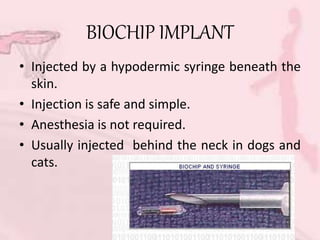
• Injected by a hypodermic syringe beneath the
skin.
• Injection is safe and simple.
• Anesthesia is not required.
• Usually injected behind the neck in dogs and
cats.
APPLICATIONS
• With a biochip tracing of a person/animal, anywhere
in the world is possible.
• Biochips are really potent in replacing passports,cash,
medical records.
• Medicinal implementation of biochips-as glucose
detector; as oxygen sensor; as an blood pressure
sensor.
Biochip as a Glucose detector
• Biochip integrated with a glucose detector.
• Monitor the level of glucose in blood
Principle:
• LED –emits light.
• Glucose concentration inversely proportional
to amount of light detected.
• S4MS chip
ADVANTAGES
• To find the lost people.
• To identify person uniquely.
• In monitoring health condition of individuals .
• They can perform thousands of biological
reactions in a few seconds.
• Increase speed of diagnosis of unknown
pathogens.
• Ability to detect multiple viral agents in parallel.
DISADVANTAGES
• They raise critical issues of personal privacy.
• They mark the end of human freedom and
dignity.
• There is a danger of turning every man,
women and child into a controlled slave.
• They can be implanted into ones body without
their knowledge.
IN FUTURE....
A chip implanted some where in human body
might serve as a combination of
i. Credit card
ii. Driving license
iii. Passport
iv. Personal identification etc.
No longer would it be needed to worry about
losing all above thing.
Can also widely established in veterinary field.
CONCLUSION
Biochips are :-
 Fast
 Accurate
 Miniaturized
 Expected to become economically advantageous
attributes that make them analogous to computer
chip.
REFERENCES
• Cady, NC (2009). "Microchip-based PCR Amplification Systems".
Lab-on-a-Chip Technology: Bio molecular Separation and Analysis.
Caister Academic Press.
• Fan et al. (2009). "Two-Dimensional Electrophoresis in a Chip".
Lab-on-a-Chip Technology: Bio molecular Separation and Analysis.
Caister Academic Press.
• S. P. Fodor, J. L. Read, M. C. Pirrung, L. Stryer, A. T. Lu, and D.
Solas, ―Light-directed, spatially addressable parallel chemical
analysis,‖ Science 251, pp. 767–773, 1991.
• P. Fortina, D. Graves, C. Stoeckert, Jr., S. McKenzie, and S. Surrey
in Biochip Technology, J. Cheng and L. J. Kricka, eds., ch.
Technology Options and Applications of DNA Microarrays, pp.
185–216, Harwood Academic Publishers, Philadelphia, 2001
Thank you

"Biochips" Frontiers In Medical Diagnosis

  • 1.
    “BIOCHIPS” FRONTIERS IN MEDICAL DIAGNOSTICS HARSHAJACOB S8 BIOTECHNOLOGY ROLL NO:12 SCET GUIDE : Mrs.SALINI P. J
  • 2.
    Contents • Introduction • History •Components • Working • Application • Advantages& Disadvantages • Future prospects • Conclusion
  • 3.
    INTRODUCTION • Collection ofminiaturized test sites(microarrays) arranged on a solid substrate. • Permits many tests to be performed at the same time. • Surface area is no longer than a fingernail. • Perform thousands of biological reactions in a few seconds. • Used to analyze organic molecules associated with living organisms. • Helps in identifying gene sequence, environmental pollutants, airborne toxins, or other biochemical constituents.
  • 4.
    • The majorbio chip company is AVID. (American veterinary identification devices) • It can also be used as a bio security device to accurately track information regarding what a person is doing and who is actually doing it . • A single electronic card may replace everything in your ATM cards ,your credit cards ,your id cards, your medical records
  • 5.
    • Bio implantis basically a small micro computer chip inserted under the skin for identification purposes • Employ radio frequency identification system (RFTD) – uses low frequency radio signals to communicate between the bio chip and reader
  • 6.
    DEFINiTION • Collection ofmicro array • Microarray : 2D array on a solid substrate • Can perform thousands of biological operations. • Increase speed of identification of genes
  • 7.
    IN BRIEF • Bio+ Chip = Biochip – Bio: stands for any biological entity eg: protein, DNA – Chip: a computer chip – Biochip: a mate between biological entity and a computer
  • 8.
    HISTORY • Developed in1983 for monitoring fisheries. • Large scale development of biochips in the 1990s. • Today, a large variety of biochip technologies are either in development or being commercialized
  • 9.
    COMPONENTS Biochip implant systemconsist of two components  Transponder  Reader or scanner
  • 10.
    Transponder Actual biochip implant. Twotypes of transponder – passive or active. Communication between biochip and reader is via low-frequency radio waves. Transponder consists of four parts:- a. Computer microchip b. Antenna coil c. Tuning capacitor d. Glass capsule
  • 12.
    COMPONENTS  Computer Microchip –The microchip stores a unique identification number from 10 to 15 digits long. The unique ID number is etched or encoded via a laser onto the surface of the microchip before assembly. Once the number is encoded it is impossible to alter. The microchip also contains the electronic circuitry necessary to transmit the ID number to the reader
  • 13.
     Antenna Coil –This is normally a simple, coil of copper wire around a ferrite or iron core. This tiny, primitive, radio antenna receives and sends signals from the reader or scanner.  Tuning Capacitor – The capacitor stores the small electrical charge sent by the reader or scanner, which triggers the transponder. This activation allows the transponder to send back the ID number encoded in the computer chip. As radio waves are utilized to communicate between the transponder and reader, the capacitor is tuned to the same frequency as the reader.
  • 14.
     Glass Capsule –The glass capsule holds the microchip, antenna coil and capacitor. It is a small capsule, the smallest measuring 11 mm in length and 2 mm in diameter, about the size of an uncooked grain of rice. The capsule is made of biocompatible material such as soda lime glass. After assembly, the capsule is hermetically (air-tight) sealed, so no body fluids can touch the electronics inside.
  • 15.
    READER / SCANNER •Consists of an “exciter” coil which creates electromagnetic field. • Provide energy to “activate” the implanted biochip. • Also carries a receiving coil to receive ID number. • Contains the software and components to decode the receive code and display the result in an LCD display. • All done in millisecond.
  • 17.
    WORKING • Reader transmitsa low-power radio signal and activates the implanted biochip. • ID number transmitted by the transponder and received by the reader. • Reader displays the ID number on the reader’s LCD display.
  • 18.
    BIOCHIP IMPLANT • Injectedby a hypodermic syringe beneath the skin. • Injection is safe and simple. • Anesthesia is not required. • Usually injected behind the neck in dogs and cats.
  • 19.
    APPLICATIONS • With abiochip tracing of a person/animal, anywhere in the world is possible. • Biochips are really potent in replacing passports,cash, medical records. • Medicinal implementation of biochips-as glucose detector; as oxygen sensor; as an blood pressure sensor.
  • 20.
    Biochip as aGlucose detector • Biochip integrated with a glucose detector. • Monitor the level of glucose in blood Principle: • LED –emits light. • Glucose concentration inversely proportional to amount of light detected. • S4MS chip
  • 21.
    ADVANTAGES • To findthe lost people. • To identify person uniquely. • In monitoring health condition of individuals . • They can perform thousands of biological reactions in a few seconds. • Increase speed of diagnosis of unknown pathogens. • Ability to detect multiple viral agents in parallel.
  • 22.
    DISADVANTAGES • They raisecritical issues of personal privacy. • They mark the end of human freedom and dignity. • There is a danger of turning every man, women and child into a controlled slave. • They can be implanted into ones body without their knowledge.
  • 23.
    IN FUTURE.... A chipimplanted some where in human body might serve as a combination of i. Credit card ii. Driving license iii. Passport iv. Personal identification etc. No longer would it be needed to worry about losing all above thing. Can also widely established in veterinary field.
  • 24.
    CONCLUSION Biochips are :- Fast  Accurate  Miniaturized  Expected to become economically advantageous attributes that make them analogous to computer chip.
  • 25.
    REFERENCES • Cady, NC(2009). "Microchip-based PCR Amplification Systems". Lab-on-a-Chip Technology: Bio molecular Separation and Analysis. Caister Academic Press. • Fan et al. (2009). "Two-Dimensional Electrophoresis in a Chip". Lab-on-a-Chip Technology: Bio molecular Separation and Analysis. Caister Academic Press. • S. P. Fodor, J. L. Read, M. C. Pirrung, L. Stryer, A. T. Lu, and D. Solas, ―Light-directed, spatially addressable parallel chemical analysis,‖ Science 251, pp. 767–773, 1991. • P. Fortina, D. Graves, C. Stoeckert, Jr., S. McKenzie, and S. Surrey in Biochip Technology, J. Cheng and L. J. Kricka, eds., ch. Technology Options and Applications of DNA Microarrays, pp. 185–216, Harwood Academic Publishers, Philadelphia, 2001
  • 26.