Mr. Raghvendra Kushwaha
Mr. Shiv Pratap Yadav
Rajat Jaiswal
Roll no.1712240127
ME-55-56
INTRODUCTION
HISTORY
COMPONENTS OF BIOCHIP
WORKING OF BIOCHIPS
BIOCHIP IMPLANT
APPLICATIONS
ADVANTAGES
DISADVANTAGES
FUTURE
CONCLUSION
REFERENCES
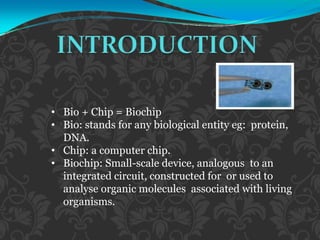
• Bio + Chip = Biochip
• Bio: stands for any biological entity eg: protein,
DNA.
• Chip: a computer chip.
• Biochip: Small-scale device, analogous to an
integrated circuit, constructed for or used to
analyse organic molecules associated with living
organisms.
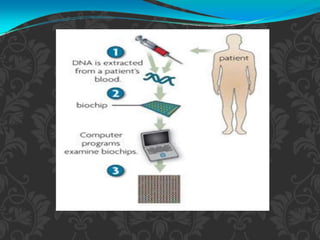
• Collection of miniaturized test sites(microarrays)
arranged on a solid substrate.
• Permits many tests to be performed at the sametime.
• Surface area is no longer than a fingernail.
• Perform thousands of biological reactions in a
few seconds.
• Used to analyse organic molecules associated
with living organisms.
• Help in identifying gene sequences, environmental
pollutants, airborne toxins, or other biochemical
constituents.
•Developed in 1983for monitoring fisheries.
•Large scale development of biochips in the 1990s.
•Today, a large variety of biochip technologies are either
in development or beingcommercialized.
•Invented in 4G generation & the development is still
continued.
•In 1980 Fred Sanger and Walter Gilbert were awarded
Nobel Prize for their pioneering DNA sequencing
approach.
•In 1983, Kary Mullis was awarded Nobel Prize for his
Polymerase Chain Reaction(PCR) which allowed to
amplify minute amounts of DNA to quantities.
•In 1986, Leroy Hood gave fluorescence-based DNA
sequencing which facilitated the automation of reading
DNA sequence.
Types of Bio-Chips
• DNA Microarray- A DNA microarray is set of tiny DNA spots fixed
to a strong surface. A researcher utilizes to calculate expression levels
for a large no of Genes.
• Microfluidic Chip- Microfluidic chip is also known as lab on a chip.
These are choice to usual bio-chemical laboratories and are
transforming several applications like DNA analysis, molecular
biology procedures which is known as the study of proteins and
diagnostic of diseases (clinical pathology).
• Protein Microarray- A protein microarray or a protein chip
method is use to follow the actions as well as connections of proteins
and to find out their function on a large scale.
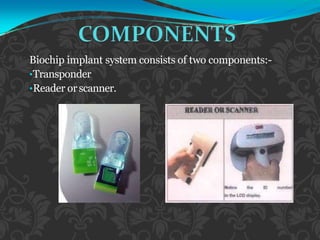
Biochip implant system consists of two components:-
•Transponder
•Reader orscanner.
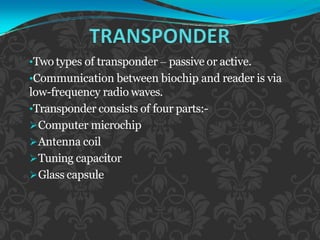
•Two types of transponder – passive or active.
•Communication between biochip and reader is via
low-frequency radio waves.
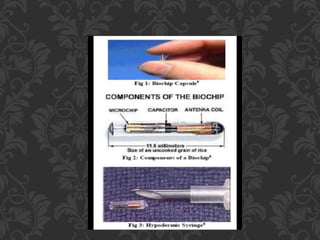
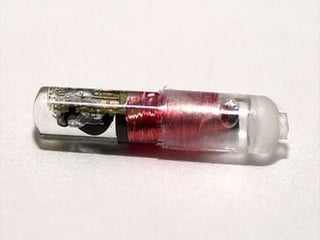
•Transponder consists of four parts:-
Computer microchip
Antenna coil
Tuning capacitor
Glass capsule
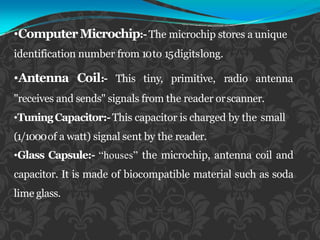
•ComputerMicrochip:-The microchip stores a unique
identification number from 10to 15digitslong.
•Antenna Coil:- This tiny, primitive, radio antenna
"receives and sends" signals from the reader orscanner.
•TuningCapacitor:-This capacitor is charged by the small
(1/1000of a watt) signal sent by the reader.
•Glass Capsule:- “houses” the microchip, antenna coil and
capacitor. It is made of biocompatible material such as soda
lime glass.
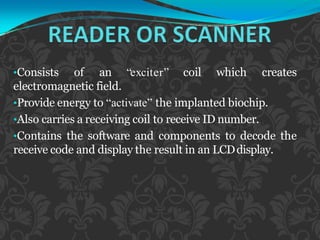
•Consists of an “exciter” coil which creates
electromagnetic field.
•Provide energy to “activate” the implanted biochip.
•Also carries a receiving coil to receive ID number.
•Contains the software and components to decode the
receive code and display the result in an LCDdisplay.
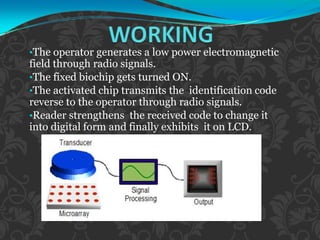
•The operator generates a low power electromagnetic
field through radio signals.
•The fixed biochip gets turned ON.
•The activated chip transmits the identification code
reverse to the operator through radio signals.
•Reader strengthens the received code to change it
into digital form and finally exhibits it on LCD.
•Injected by a hypodermic syringe beneath the skin.
•Injection is safe and simple.
•Anesthesia is not required.
•Usually injected behind the neck in dogs and cats.
•With a biochip tracing of a person/animal, anywhere
in the world is possible.
•A biochip can store and update financial, medical,
demographic data, basically everything about a person.
•A biochip leads to a secured E-commercesystems.
•Biochips are really potent in replacing passports, cash,
medical records.
•Medicinal implementation of biochips-as glucose
detector; as oxygen sensor; as an blood pressure sensor.
•Torescue the sick.
•Tofind the lost people.
•Toidentify person uniquely.
•In monitoring health condition of individuals in which they
are specially employed.
•They can perform thousands of biological reactions in a few
seconds.
•Increase speed of diagnosis of unknown pathogens.
•Ability to detect multiple viral agents inparallel.
•They raise critical issues of personal privacy.
•They mark the end of human freedom and dignity.
•There is a danger of turning every man, women and
child into a controlled slave.
•They can be implanted into ones body without their
knowledge.
•A chip implanted somewhere in human bodies might
serve as a combination of credit card, passport, driver's
license, personal diary.
•No longer would it be needed to worry about losing the
credit cards while traveling.
•A chip inserted into human bodies might also giveus
extra mental power.
Biochips are:-
•Fast
•Accurate
•Miniaturized
•expected to become economically advantageous
attributes that make them analogous to computerchip.
http://en.wikipedia.org/wiki/Biochip
http://www.electronicsforu.com
http://link.springer.com/article/10.1007/s002160051
549#page-1
Google images.
The Biochip Technology

The Biochip Technology

  • 1.
    Mr. Raghvendra Kushwaha Mr.Shiv Pratap Yadav Rajat Jaiswal Roll no.1712240127 ME-55-56
  • 2.
    INTRODUCTION HISTORY COMPONENTS OF BIOCHIP WORKINGOF BIOCHIPS BIOCHIP IMPLANT APPLICATIONS ADVANTAGES DISADVANTAGES FUTURE CONCLUSION REFERENCES
  • 3.
    • Bio +Chip = Biochip • Bio: stands for any biological entity eg: protein, DNA. • Chip: a computer chip. • Biochip: Small-scale device, analogous to an integrated circuit, constructed for or used to analyse organic molecules associated with living organisms.
  • 4.
    • Collection ofminiaturized test sites(microarrays) arranged on a solid substrate. • Permits many tests to be performed at the sametime. • Surface area is no longer than a fingernail. • Perform thousands of biological reactions in a few seconds. • Used to analyse organic molecules associated with living organisms. • Help in identifying gene sequences, environmental pollutants, airborne toxins, or other biochemical constituents.
  • 5.
    •Developed in 1983formonitoring fisheries. •Large scale development of biochips in the 1990s. •Today, a large variety of biochip technologies are either in development or beingcommercialized. •Invented in 4G generation & the development is still continued. •In 1980 Fred Sanger and Walter Gilbert were awarded Nobel Prize for their pioneering DNA sequencing approach. •In 1983, Kary Mullis was awarded Nobel Prize for his Polymerase Chain Reaction(PCR) which allowed to amplify minute amounts of DNA to quantities.
  • 6.
    •In 1986, LeroyHood gave fluorescence-based DNA sequencing which facilitated the automation of reading DNA sequence.
  • 7.
    Types of Bio-Chips •DNA Microarray- A DNA microarray is set of tiny DNA spots fixed to a strong surface. A researcher utilizes to calculate expression levels for a large no of Genes. • Microfluidic Chip- Microfluidic chip is also known as lab on a chip. These are choice to usual bio-chemical laboratories and are transforming several applications like DNA analysis, molecular biology procedures which is known as the study of proteins and diagnostic of diseases (clinical pathology). • Protein Microarray- A protein microarray or a protein chip method is use to follow the actions as well as connections of proteins and to find out their function on a large scale.
  • 8.
    Biochip implant systemconsists of two components:- •Transponder •Reader orscanner.
  • 10.
    •Two types oftransponder – passive or active. •Communication between biochip and reader is via low-frequency radio waves. •Transponder consists of four parts:- Computer microchip Antenna coil Tuning capacitor Glass capsule
  • 12.
    •ComputerMicrochip:-The microchip storesa unique identification number from 10to 15digitslong. •Antenna Coil:- This tiny, primitive, radio antenna "receives and sends" signals from the reader orscanner. •TuningCapacitor:-This capacitor is charged by the small (1/1000of a watt) signal sent by the reader. •Glass Capsule:- “houses” the microchip, antenna coil and capacitor. It is made of biocompatible material such as soda lime glass.
  • 13.
    •Consists of an“exciter” coil which creates electromagnetic field. •Provide energy to “activate” the implanted biochip. •Also carries a receiving coil to receive ID number. •Contains the software and components to decode the receive code and display the result in an LCDdisplay.
  • 14.
    •The operator generatesa low power electromagnetic field through radio signals. •The fixed biochip gets turned ON. •The activated chip transmits the identification code reverse to the operator through radio signals. •Reader strengthens the received code to change it into digital form and finally exhibits it on LCD.
  • 15.
    •Injected by ahypodermic syringe beneath the skin. •Injection is safe and simple. •Anesthesia is not required. •Usually injected behind the neck in dogs and cats.
  • 17.
    •With a biochiptracing of a person/animal, anywhere in the world is possible. •A biochip can store and update financial, medical, demographic data, basically everything about a person. •A biochip leads to a secured E-commercesystems. •Biochips are really potent in replacing passports, cash, medical records. •Medicinal implementation of biochips-as glucose detector; as oxygen sensor; as an blood pressure sensor.
  • 18.
    •Torescue the sick. •Tofindthe lost people. •Toidentify person uniquely. •In monitoring health condition of individuals in which they are specially employed. •They can perform thousands of biological reactions in a few seconds. •Increase speed of diagnosis of unknown pathogens. •Ability to detect multiple viral agents inparallel.
  • 19.
    •They raise criticalissues of personal privacy. •They mark the end of human freedom and dignity. •There is a danger of turning every man, women and child into a controlled slave. •They can be implanted into ones body without their knowledge.
  • 20.
    •A chip implantedsomewhere in human bodies might serve as a combination of credit card, passport, driver's license, personal diary. •No longer would it be needed to worry about losing the credit cards while traveling. •A chip inserted into human bodies might also giveus extra mental power.
  • 21.
    Biochips are:- •Fast •Accurate •Miniaturized •expected tobecome economically advantageous attributes that make them analogous to computerchip.
  • 23.