Submitted by:
Mustahid Ali
OVERVIEW
DEFINITION
HISTORY
BIOCHIP TECHNOLOGY
BIOCHIP ARCHITECTURE
IMPLANT
WORKING
APPLICATION
ADVANTAGES
DISADVANTAGES
FUTURE OF BIOCHIPS
CONCLUSION
DEFINITION
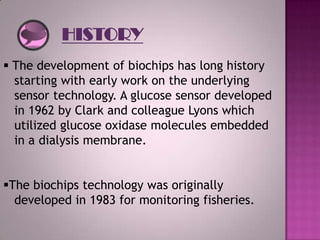
Bio + Chip = Biochip
Bio: stands for any biological entity eg:
protein,DNA.
Chip: a computer chip.
Biochip: Small-scale device, analogous
to an integrated circuit, constructed of
or used to analyze organic molecules
associated with living organisms.
HISTORY
 The development of biochips has long history
starting with early work on the underlying
sensor technology. A glucose sensor developed
in 1962 by Clark and colleague Lyons which
utilized glucose oxidase molecules embedded
in a dialysis membrane.
The biochips technology was originally
developed in 1983 for monitoring fisheries.
THE BIOCHIP TECHNOLOGY
 The biochip system is Radio Frequency
Identification (RFID) system.
 The multiple technologies needed to make a
successful biochip —
 Sensing chemistry: to sense the biologial
processes.
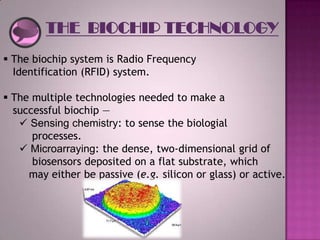
 Microarraying: the dense, two-dimensional grid of
biosensors deposited on a flat substrate, which
may either be passive (e.g. silicon or glass) or active.
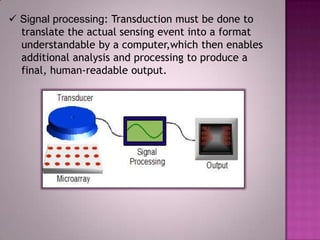
 Signal processing: Transduction must be done to
translate the actual sensing event into a format
understandable by a computer,which then enables
additional analysis and processing to produce a
final, human-readable output.
BIOCHIP ARCHITECTURE
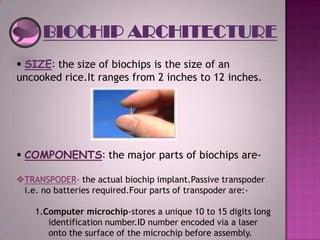
 SIZE: the size of biochips is the size of an
uncooked rice.It ranges from 2 inches to 12 inches.

 COMPONENTS: the major parts of biochips areTRANSPODER- the actual biochip implant.Passive transpoder
i.e. no batteries required.Four parts of transpoder are:1.Computer microchip-stores a unique 10 to 15 digits long
identification number.ID number encoded via a laser
onto the surface of the microchip before assembly.
2.Antenna coil-simple, coil of copper wire around a
ferrite or iron core.Receives and sends signals from
the reader.
3.Tuning Capacitor- stores the small electrical charge
sent by the reader which activates the transponder to send
back the ID number encoded.Capacitor is tuned to the
same radio frequency as the reader to establish
communication between the two.
4. Glass Capsule- houses the microchip, antenna coil and
capacitor. A small capsule measuring 11 mm in length and
2 mm in diameter.Made soda lime glass.After assembly,
the capsule is air tight sealed.
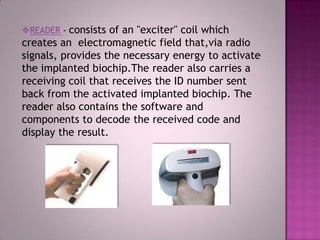
READER - consists of an "exciter" coil which

creates an electromagnetic field that,via radio
signals, provides the necessary energy to activate
the implanted biochip.The reader also carries a
receiving coil that receives the ID number sent
back from the activated implanted biochip. The
reader also contains the software and
components to decode the received code and
display the result.
IMPLANT

The biochip is inserted into the subject with a
hypodermic syringe. Injection is safe and
simple,comparable to common vaccines. Anesthesia is
not required nor recommended.
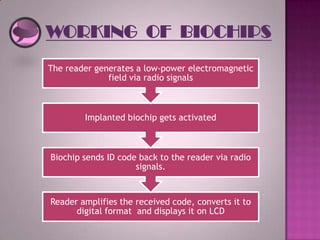
WORKING OF BIOCHIPS
The reader generates a low-power electromagnetic
field via radio signals

Implanted biochip gets activated

Biochip sends ID code back to the reader via radio
signals.

Reader amplifies the received code, converts it to
digital format and displays it on LCD
APPLICATIONS
With a biochip tracing of a person/animal
anywhere in the world is possible
A biochip can store and update financial,
medical,demographic data, basically everything
about a person
Biochips really are potent in replacing passports,
cash and medical records.
A biochip leads to a secured Ecommerce Systems
They can perform thousands of biological reactions
and operations in few seconds.
MEDICAL IMPLEMENTATION
OF BIOCHIPS
Biochip as Glucose Detector
Biochip as an Blood Pressure sensor
Biochip as Oxygen sensor
ADVANTAGES
TO RESCUE THE SICK.
TO IDENTIFY PERSON UNIQUELY.
IN MONITORING HEALTH CONDITIONOFINDIVIDUALS
IN WHICH THEY ARE SPECIFICALLY EMPLOYED.
THEY CAN PERFORM THOUSANDS OF BIOLOGICAL
REACTIONS,OPERATIONS IN FEW SECONDS.
DISADVANTAGES
THEY RAISE CRITICAL ISSUESOF
PERSONAL PRIVACY.
THEY MARK THE END OF HUMAN FREEDOM AND
DIGNITY.
THEY MAY NOT BE SUPPORTED BY LARGE % OF
PEOPLE.
THERE IS A DANGER OF TURNING EVERY
MAN,WOMEN AND CHILD INTO A CONTROLLED
SLAVE.
THEY CAN BE IMPLANTED INTO ONES BODY
WITHOUT THEIR KNOWLEDGE.
FUTURE OF BIOCHIPS
If people feel that they loose their privacy because
of Biochips, they may resist use of it.
But if they feel that it could help in a lot of ways
like detecting , monitoring and curing of diseases
they can use them intensively.

So it is users of chip who determine its future .
CONCLUSION
Biochips are fast, accurate, miniaturized and can be
expected to become economically advantageous
attributes that make them analogous to a computer
chip. One expects to see an accelerated trend of
ultra miniaturization and eventual harmonization of
technologies ,so that dominant fabrication strategies
will emerge. Since the potential applications are
vast, both for research and clinical use, the potential
markets for biochips will be huge, a powerful driving
force for their continued development.
REFERENCES
http://www.scribd.com
http://www.authorstream.com
http://www.slideshare.net
www.wikipedia.org
Biochips
Biochips

Biochips

  • 1.
  • 2.
  • 3.
    DEFINITION Bio + Chip= Biochip Bio: stands for any biological entity eg: protein,DNA. Chip: a computer chip. Biochip: Small-scale device, analogous to an integrated circuit, constructed of or used to analyze organic molecules associated with living organisms.
  • 4.
    HISTORY  The developmentof biochips has long history starting with early work on the underlying sensor technology. A glucose sensor developed in 1962 by Clark and colleague Lyons which utilized glucose oxidase molecules embedded in a dialysis membrane. The biochips technology was originally developed in 1983 for monitoring fisheries.
  • 5.
    THE BIOCHIP TECHNOLOGY The biochip system is Radio Frequency Identification (RFID) system.  The multiple technologies needed to make a successful biochip —  Sensing chemistry: to sense the biologial processes.  Microarraying: the dense, two-dimensional grid of biosensors deposited on a flat substrate, which may either be passive (e.g. silicon or glass) or active.
  • 6.
     Signal processing:Transduction must be done to translate the actual sensing event into a format understandable by a computer,which then enables additional analysis and processing to produce a final, human-readable output.
  • 7.
    BIOCHIP ARCHITECTURE  SIZE:the size of biochips is the size of an uncooked rice.It ranges from 2 inches to 12 inches.  COMPONENTS: the major parts of biochips areTRANSPODER- the actual biochip implant.Passive transpoder i.e. no batteries required.Four parts of transpoder are:1.Computer microchip-stores a unique 10 to 15 digits long identification number.ID number encoded via a laser onto the surface of the microchip before assembly.
  • 8.
    2.Antenna coil-simple, coilof copper wire around a ferrite or iron core.Receives and sends signals from the reader. 3.Tuning Capacitor- stores the small electrical charge sent by the reader which activates the transponder to send back the ID number encoded.Capacitor is tuned to the same radio frequency as the reader to establish communication between the two. 4. Glass Capsule- houses the microchip, antenna coil and capacitor. A small capsule measuring 11 mm in length and 2 mm in diameter.Made soda lime glass.After assembly, the capsule is air tight sealed.
  • 9.
    READER - consistsof an "exciter" coil which creates an electromagnetic field that,via radio signals, provides the necessary energy to activate the implanted biochip.The reader also carries a receiving coil that receives the ID number sent back from the activated implanted biochip. The reader also contains the software and components to decode the received code and display the result.
  • 10.
    IMPLANT The biochip isinserted into the subject with a hypodermic syringe. Injection is safe and simple,comparable to common vaccines. Anesthesia is not required nor recommended.
  • 11.
    WORKING OF BIOCHIPS Thereader generates a low-power electromagnetic field via radio signals Implanted biochip gets activated Biochip sends ID code back to the reader via radio signals. Reader amplifies the received code, converts it to digital format and displays it on LCD
  • 12.
    APPLICATIONS With a biochiptracing of a person/animal anywhere in the world is possible A biochip can store and update financial, medical,demographic data, basically everything about a person Biochips really are potent in replacing passports, cash and medical records. A biochip leads to a secured Ecommerce Systems They can perform thousands of biological reactions and operations in few seconds.
  • 13.
    MEDICAL IMPLEMENTATION OF BIOCHIPS Biochipas Glucose Detector Biochip as an Blood Pressure sensor Biochip as Oxygen sensor
  • 14.
    ADVANTAGES TO RESCUE THESICK. TO IDENTIFY PERSON UNIQUELY. IN MONITORING HEALTH CONDITIONOFINDIVIDUALS IN WHICH THEY ARE SPECIFICALLY EMPLOYED. THEY CAN PERFORM THOUSANDS OF BIOLOGICAL REACTIONS,OPERATIONS IN FEW SECONDS.
  • 15.
    DISADVANTAGES THEY RAISE CRITICALISSUESOF PERSONAL PRIVACY. THEY MARK THE END OF HUMAN FREEDOM AND DIGNITY. THEY MAY NOT BE SUPPORTED BY LARGE % OF PEOPLE. THERE IS A DANGER OF TURNING EVERY MAN,WOMEN AND CHILD INTO A CONTROLLED SLAVE. THEY CAN BE IMPLANTED INTO ONES BODY WITHOUT THEIR KNOWLEDGE.
  • 16.
    FUTURE OF BIOCHIPS Ifpeople feel that they loose their privacy because of Biochips, they may resist use of it. But if they feel that it could help in a lot of ways like detecting , monitoring and curing of diseases they can use them intensively. So it is users of chip who determine its future .
  • 17.
    CONCLUSION Biochips are fast,accurate, miniaturized and can be expected to become economically advantageous attributes that make them analogous to a computer chip. One expects to see an accelerated trend of ultra miniaturization and eventual harmonization of technologies ,so that dominant fabrication strategies will emerge. Since the potential applications are vast, both for research and clinical use, the potential markets for biochips will be huge, a powerful driving force for their continued development.
  • 18.