
LIGHT FIDELITY 
PRESENTED BY 
PRABHU KIRAN(ECE_4A) 
ROLL NO:11621A0407
CONTENTS 
 INTRODUCTION 
 HISTORY 
 CONSTRUCTION OF LI-FI 
 HOW DOE’S IT WORKS? 
 LI-FI VS WIFI 
 APPLICATIONS 
 ADVANTAGES 
 LIMITATIONS 
 CONCLUSION
INTRODUCTION 
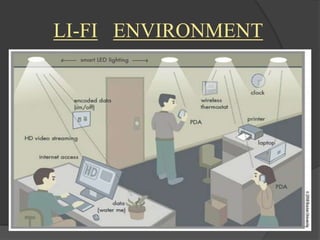
 Li-Fi is technology that uses LED's for 
transmit data wirelessly . 
 Li-Fi means “LIGHT FIDELITY”. 
 Li-Fi is fast and cheap fiber version that 
use Visible Light Communication(VLC) .
Contd…….. 
 VLC is a data communication that uses 
visible light for data transmission. 
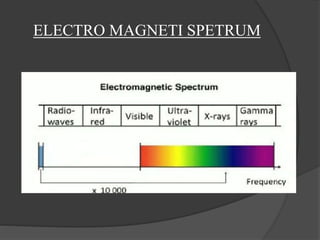
 Visible light ranges from 
400THz(780nm) to 800THz(375nm). 
 Its act as transceiver and also used for 
lighting the room.
LI-FI ENVIRONMENT
HISTORY 
 In 1990’s countries like Germany, Korea 
and Japan found this. 
 They discovered that led’s are retrofitted 
to send information. 
 Porf. Harald Haas worked on it to 
improve this technology.
Contd…. 
 On 12th July 2011 he successfully 
demonstrated his new invention. 
 He used a led table lamp for streaming a 
hd video with a speed of 10mbps. 
 In the middle he blocked the lamp to 
prove that lamp was source of data.
Contd…. 
 At ted global talks he demonstrated with 
10mbps. 
 Which is fairly good than UK broadband 
connection . 
 Later after two months he achieved a 
speed of 123mbps
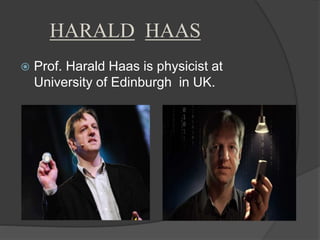
HARALD HAAS 
 Prof. Harald Haas is physicist at 
University of Edinburgh in UK.
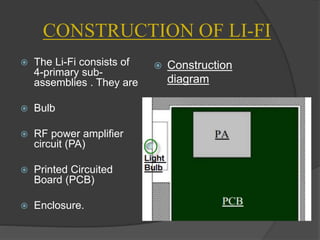
CONSTRUCTION OF LI-FI 
 The Li-Fi consists of 
4-primary sub-assemblies 
. They are 
 Bulb 
 RF power amplifier 
circuit (PA) 
 Printed Circuited 
Board (PCB) 
 Enclosure. 
 Construction 
diagram
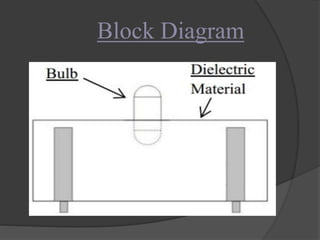
Block Diagram
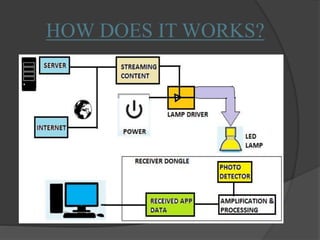
HOW DOES IT WORKS?
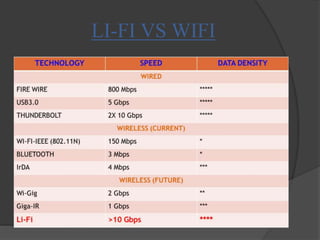
LI-FI VS WIFI
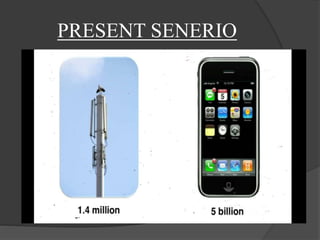
PRESENT SENERIO
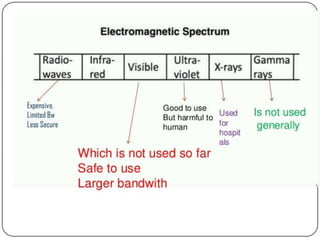
ELECTRO MAGNETI SPETRUM
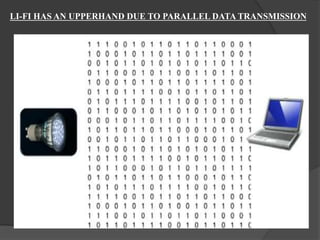
LI-FI HAS AN UPPERHAND DUE TO PARALLEL DATA TRANSMISSION
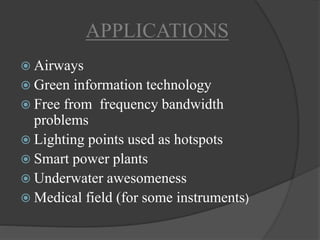
APPLICATIONS 
 Airways 
 Green information technology 
 Free from frequency bandwidth 
problems 
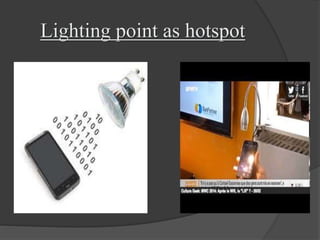
 Lighting points used as hotspots 
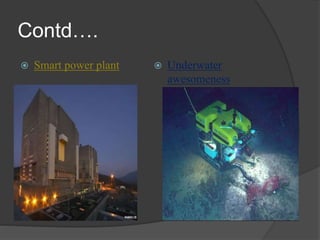
 Smart power plants 
 Underwater awesomeness 
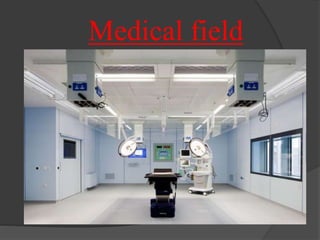
 Medical field (for some instruments)
Contd….. 
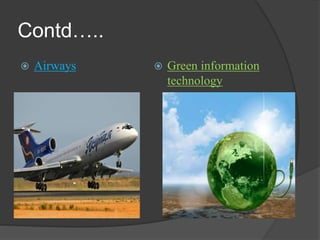
 Airways  Green information 
technology
Lighting point as hotspot
Contd…. 
 Smart power plant  Underwater 
awesomeness
Medical field
Other areas where we can use li-fi 
 Traffic lights 
 Street lights 
 Shopping malls 
 Educational organizations 
 Home 
 Transport systems
Advantages 
 High speed 
 Low cost 
 Easy to use 
 Harmless 
 Fast data transfer
Limitations 
 Can’t pass through wall 
 External interference 
 High installation cost for VLC system 
 Still need wi-fi
Future scope 
 We can transmit data very high speed due to 
parallel transmission. And we can reduce the 
use of power for modems and Wi-Fi routers. 
We are not to worry about high internet 
bills. By 2018 we can use a high speed 
internet of 10gbps with we can download a 
hd movie in 30seconds. We can reduce the 
radiation and global warming
conclusion 
 The possibilities are numerous and can be explored further. If 
his technology can be put into practical use, every bulb can be 
used something like a Wi-Fi hotspot to transmit wireless data 
and we will proceed toward the cleaner, greener, safer and 
brighter future. The concept of Li-Fi is currently attracting a 
great deal of interest, not least because it may offer a genuine 
and very efficient alternative to radio-based wireless. As a 
growing number of people and their many devices access 
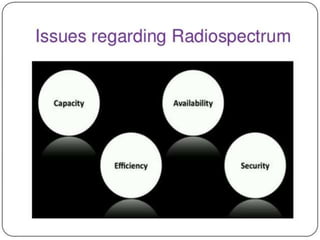
wireless internet, the airwaves are becoming increasingly 
clogged, making it more and more difficult to get a reliable, 
high-speed signal. This may solve issues such as the shortage of 
radio-frequency bandwidth and also allow internet where 
traditional radio based wireless isn’t allowed such as aircraft or 
hospitals. One of the shortcomings however is that it only work 
in direct line of sight.
References 
 Wiki/Li-Fi(http://en.wikipedia.org/wiki/Li- 
Fi) 
 Ted global talks/talks/Harald Haas 
 http://slideshare.com/li-fitech.html 
 seminarprojects.com/s/seminar-report-on-lifi
Thanking you

Light fidelity

  • 1.
    LIGHT FIDELITY PRESENTEDBY PRABHU KIRAN(ECE_4A) ROLL NO:11621A0407
  • 2.
    CONTENTS  INTRODUCTION  HISTORY  CONSTRUCTION OF LI-FI  HOW DOE’S IT WORKS?  LI-FI VS WIFI  APPLICATIONS  ADVANTAGES  LIMITATIONS  CONCLUSION
  • 3.
    INTRODUCTION  Li-Fiis technology that uses LED's for transmit data wirelessly .  Li-Fi means “LIGHT FIDELITY”.  Li-Fi is fast and cheap fiber version that use Visible Light Communication(VLC) .
  • 4.
    Contd……..  VLCis a data communication that uses visible light for data transmission.  Visible light ranges from 400THz(780nm) to 800THz(375nm).  Its act as transceiver and also used for lighting the room.
  • 5.
  • 6.
    HISTORY  In1990’s countries like Germany, Korea and Japan found this.  They discovered that led’s are retrofitted to send information.  Porf. Harald Haas worked on it to improve this technology.
  • 7.
    Contd….  On12th July 2011 he successfully demonstrated his new invention.  He used a led table lamp for streaming a hd video with a speed of 10mbps.  In the middle he blocked the lamp to prove that lamp was source of data.
  • 8.
    Contd….  Atted global talks he demonstrated with 10mbps.  Which is fairly good than UK broadband connection .  Later after two months he achieved a speed of 123mbps
  • 9.
    HARALD HAAS Prof. Harald Haas is physicist at University of Edinburgh in UK.
  • 10.
    CONSTRUCTION OF LI-FI  The Li-Fi consists of 4-primary sub-assemblies . They are  Bulb  RF power amplifier circuit (PA)  Printed Circuited Board (PCB)  Enclosure.  Construction diagram
  • 11.
  • 12.
  • 13.
  • 14.
  • 16.
  • 18.
    LI-FI HAS ANUPPERHAND DUE TO PARALLEL DATA TRANSMISSION
  • 19.
    APPLICATIONS  Airways  Green information technology  Free from frequency bandwidth problems  Lighting points used as hotspots  Smart power plants  Underwater awesomeness  Medical field (for some instruments)
  • 20.
    Contd…..  Airways Green information technology
  • 21.
  • 22.
    Contd….  Smartpower plant  Underwater awesomeness
  • 23.
  • 24.
    Other areas wherewe can use li-fi  Traffic lights  Street lights  Shopping malls  Educational organizations  Home  Transport systems
  • 25.
    Advantages  Highspeed  Low cost  Easy to use  Harmless  Fast data transfer
  • 26.
    Limitations  Can’tpass through wall  External interference  High installation cost for VLC system  Still need wi-fi
  • 27.
    Future scope We can transmit data very high speed due to parallel transmission. And we can reduce the use of power for modems and Wi-Fi routers. We are not to worry about high internet bills. By 2018 we can use a high speed internet of 10gbps with we can download a hd movie in 30seconds. We can reduce the radiation and global warming
  • 28.
    conclusion  Thepossibilities are numerous and can be explored further. If his technology can be put into practical use, every bulb can be used something like a Wi-Fi hotspot to transmit wireless data and we will proceed toward the cleaner, greener, safer and brighter future. The concept of Li-Fi is currently attracting a great deal of interest, not least because it may offer a genuine and very efficient alternative to radio-based wireless. As a growing number of people and their many devices access wireless internet, the airwaves are becoming increasingly clogged, making it more and more difficult to get a reliable, high-speed signal. This may solve issues such as the shortage of radio-frequency bandwidth and also allow internet where traditional radio based wireless isn’t allowed such as aircraft or hospitals. One of the shortcomings however is that it only work in direct line of sight.
  • 29.
    References  Wiki/Li-Fi(http://en.wikipedia.org/wiki/Li- Fi)  Ted global talks/talks/Harald Haas  http://slideshare.com/li-fitech.html  seminarprojects.com/s/seminar-report-on-lifi
  • 30.