Pennington Nutrition Series
Healthier lives through education in nutrition and preventive medicine                                  No. 38


                                          Anthocyanins

                                                           Anthocyanins are members of the flavonoid group of
                                                           phytochemicals, which is a group predominant in teas,
                                                           honey, wines, fruits, vegetables, nuts, olive oil, cocoa and
                                                           cereals.

                                                           The flavonoids are thought to be perhaps the most im-
                                                           portant single group of phenolics in food.

                                                           The primary players in the flavonoid group include:
                                                           Anthocyanins (cyaniding, pelargonidin, petunidin)
                                                           Flavanols (quercetin, Kaempferol)
                                                           Flavones (luteolin, apigenin)
                                                           Flavanones (myricetin, naringin, hesperetin, naringenin)
                                                           Flavan-3-ols (catechin, epicatechin, gallocatechin)
                                                           Isoflavones (genistein, daidzein)

                                                           Phytochemicals in this group (flavonoids) are frequently
                                                           referred to as bioflavonoids due to their multifaceted
         More on Anthocyanins                              roles in human health.

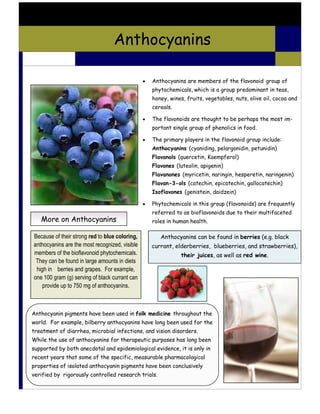
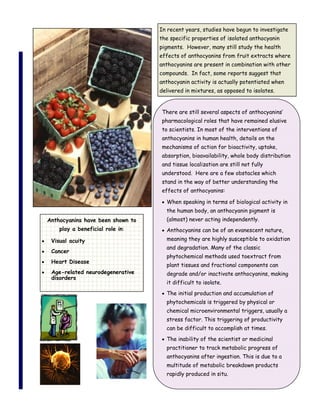
      Because of their strong red to blue coloring,            Anthocyanins can be found in berries (e.g. black
      anthocyanins are the most recognized, visible        currant, elderberries, blueberries, and strawberries),
      members of the bioflavonoid phytochemicals.                        their juices, as well as red wine.
       They can be found in large amounts in diets
       high in berries and grapes. For example,
      one 100 gram (g) serving of black currant can
          provide up to 750 mg of anthocyanins.


     Anthocyanin pigments have been used in folk medicine throughout the
     world. For example, bilberry anthocyanins have long been used for the
     treatment of diarrhea, microbial infections, and vision disorders.
     While the use of anthocyanins for therapeutic purposes has long been
     supported by both anecdotal and epidemiological evidence, it is only in
     recent years that some of the specific, measurable pharmacological
     properties of isolated anthocyanin pigments have been conclusively
     verified by rigorously controlled research trials.
In recent years, studies have begun to investigate
                                  the specific properties of isolated anthocyanin
                                  pigments. However, many still study the health
                                  effects of anthocyanins from fruit extracts where
                                  anthocyanins are present in combination with other
                                  compounds. In fact, some reports suggest that
                                  anthocyanin activity is actually potentiated when
                                  delivered in mixtures, as opposed to isolates.


                                  There are still several aspects of anthocyaninsโ€™
                                  pharmacological roles that have remained elusive
                                  to scientists. In most of the interventions of
                                  anthocyanins in human health, details on the
                                  mechanisms of action for bioactivity, uptake,
                                  absorption, bioavailability, whole body distribution
                                  and tissue localization are still not fully
                                  understood. Here are a few obstacles which
                                  stand in the way of better understanding the
                                  effects of anthocyanins:

                                    When speaking in terms of biological activity in
                                    the human body, an anthocyanin pigment is
Anthocyanins have been shown to     (almost) never acting independently.
    play a beneficial role in:      Anthocyanins can be of an evanescent nature,
 Visual acuity                      meaning they are highly susceptible to oxidation
                                    and degradation. Many of the classic
 Cancer
                                    phytochemical methods used toextract from
 Heart Disease
                                    plant tissues and fractional components can
 Age-related neurodegenerative      degrade and/or inactivate anthocyanins, making
 disorders
                                    it difficult to isolate.
                                    The initial production and accumulation of
                                    phytochemicals is triggered by physical or
                                    chemical microenvironmental triggers, usually a
                                    stress factor. This triggering of productivity
                                    can be difficult to accomplish at times.
                                    The inability of the scientist or medicinal
                                    practitioner to track metabolic progress of
                                    anthocyanins after ingestion. This is due to a
                                    multitude of metabolic breakdown products
                                    rapidly produced in situ.
Proposed Health Effects of Anthocyanins
  Visual Acuity
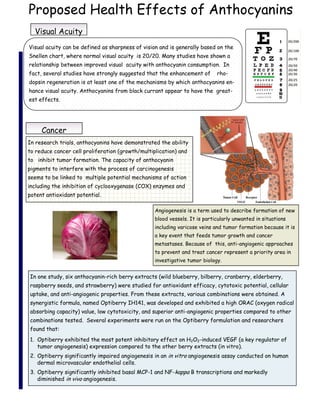
Visual acuity can be defined as sharpness of vision and is generally based on the
Snellen chart, where normal visual acuity is 20/20. Many studies have shown a
relationship between improved visual acuity with anthocyanin consumption. In
fact, several studies have strongly suggested that the enhancement of       rho-
dopsin regeneration is at least one of the mechanisms by which anthocyanins en-
hance visual acuity. Anthocyanins from black currant appear to have the great-
est effects.


     Cancer
In research trials, anthocyanins have demonstrated the ability
to reduce cancer cell proliferation (growth/multiplication) and
to inhibit tumor formation. The capacity of anthocyanin
pigments to interfere with the process of carcinogenesis
seems to be linked to multiple potential mechanisms of action
including the inhibition of cyclooxygenase (COX) enzymes and
potent antioxidant potential.

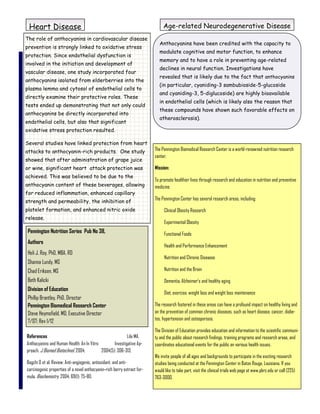
                                                  Angiogenesis is a term used to describe formation of new
                                                  blood vessels. It is particularly unwanted in situations
                                                  including varicose veins and tumor formation because it is
                                                  a key event that feeds tumor growth and cancer
                                                  metastases. Because of this, anti-angiogenic approaches
                                                  to prevent and treat cancer represent a priority area in
                                                  investigative tumor biology.


In one study, six anthocyanin-rich berry extracts (wild blueberry, bilberry, cranberry, elderberry,
raspberry seeds, and strawberry) were studied for antioxidant efficacy, cytotoxic potential, cellular
uptake, and anti-angiogenic properties. From these extracts, various combinations were obtained. A
synergistic formula, named Optiberry IH141, was developed and exhibited a high ORAC (oxygen radical
absorbing capacity) value, low cytotoxicity, and superior anti-angiogenic properties compared to other
combinations tested. Several experiments were run on the Optiberry formulation and researchers
found that:
1. Optiberry exhibited the most potent inhibitory effect on H2O2-induced VEGF (a key regulator of
   tumor angiogenesis) expression compared to the other berry extracts (in vitro).
2. Optiberry significantly impaired angiogenesis in an in vitro angiogenesis assay conducted on human
   dermal microvascular endothelial cells.
3. Optiberry significantly inhibited basal MCP-1 and NF-kappa B transcriptions and markedly
   diminished in vivo angiogenesis.
Heart Disease                                                                Age-related Neurodegenerative Disease
The role of anthocyanins in cardiovascular disease
                                                                           Anthocyanins have been credited with the capacity to
prevention is strongly linked to oxidative stress
                                                                           modulate cognitive and motor function, to enhance
protection. Since endothelial dysfunction is
                                                                           memory and to have a role in preventing age-related
involved in the initiation and development of
                                                                           declines in neural function. Investigations have
vascular disease, one study incorporated four
                                                                           revealed that is likely due to the fact that anthocyanins
anthocyanins isolated from elderberries into the
                                                                           (in particular, cyaniding-3 sambubioside-5-glucoside
plasma lemma and cytosol of endothelial cells to
                                                                           and cyaniding-3, 5-diglucoside) are highly bioavailable
directly examine their protective roles. These
                                                                           in endothelial cells (which is likely also the reason that
tests ended up demonstrating that not only could
                                                                           these compounds have shown such favorable effects on
anthocyanins be directly incorporated into
                                                                           atherosclerosis).
endothelial cells, but also that significant
oxidative stress protection resulted.

Several studies have linked protection from heart
attacks to anthocyanin-rich products. One study                          The Pennington Biomedical Research Center is a world-renowned nutrition research
                                                                         center.
showed that after administration of grape juice
or wine, significant heart attack protection was                         Mission:
achieved. This was believed to be due to the
                                                                         To promote healthier lives through research and education in nutrition and preventive
anthocyanin content of these beverages, allowing                         medicine.
for reduced inflammation, enhanced capillary
                                                                         The Pennington Center has several research areas, including:
strength and permeability, the inhibition of
platelet formation, and enhanced nitric oxide                                 Clinical Obesity Research
release.
                                                                              Experimental Obesity
 Pennington Nutrition Series Pub No 38,                                       Functional Foods
 Authors
                                                                              Health and Performance Enhancement
 Heli J. Roy, PhD, MBA, RD
                                                                              Nutrition and Chronic Diseases
 Shanna Lundy, MS
 Chad Eriksen, MS                                                             Nutrition and the Brain

 Beth Kalicki                                                                 Dementia, Alzheimerโ€™s and healthy aging
 Division of Education
                                                                              Diet, exercise, weight loss and weight loss maintenance
 Phillip Brantley, PhD, Director
 Pennington Biomedical Research Center                                   The research fostered in these areas can have a profound impact on healthy living and
 Steve Heymsfield, MD, Executive Director                                on the prevention of common chronic diseases, such as heart disease, cancer, diabe-
                                                                         tes, hypertension and osteoporosis.
 7/07; Rev 1/12
                                                                         The Division of Education provides education and information to the scientific communi-
References                                                Lila MA.       ty and the public about research findings, training programs and research areas, and
Anthocyanins and Human Health: An In Vitro        Investigative Ap-      coordinates educational events for the public on various health issues.
proach. J Biomed Biotechnol. 2004;         2004(5): 306-313.
                                                                         We invite people of all ages and backgrounds to participate in the exciting research
Bagchi D et al. Review: Anti-angiogenic, antioxidant, and anti-          studies being conducted at the Pennington Center in Baton Rouge, Louisiana. If you
carcinogenic properties of a novel anthocyanin-rich berry extract for-   would like to take part, visit the clinical trials web page at www.pbrc.edu or call (225)
mula. Biochemistry. 2004; 69(1): 75-80.                                  763-3000.

Health benefits of anthocyanins

  • 1.
    Pennington Nutrition Series Healthierlives through education in nutrition and preventive medicine No. 38 Anthocyanins Anthocyanins are members of the flavonoid group of phytochemicals, which is a group predominant in teas, honey, wines, fruits, vegetables, nuts, olive oil, cocoa and cereals. The flavonoids are thought to be perhaps the most im- portant single group of phenolics in food. The primary players in the flavonoid group include: Anthocyanins (cyaniding, pelargonidin, petunidin) Flavanols (quercetin, Kaempferol) Flavones (luteolin, apigenin) Flavanones (myricetin, naringin, hesperetin, naringenin) Flavan-3-ols (catechin, epicatechin, gallocatechin) Isoflavones (genistein, daidzein) Phytochemicals in this group (flavonoids) are frequently referred to as bioflavonoids due to their multifaceted More on Anthocyanins roles in human health. Because of their strong red to blue coloring, Anthocyanins can be found in berries (e.g. black anthocyanins are the most recognized, visible currant, elderberries, blueberries, and strawberries), members of the bioflavonoid phytochemicals. their juices, as well as red wine. They can be found in large amounts in diets high in berries and grapes. For example, one 100 gram (g) serving of black currant can provide up to 750 mg of anthocyanins. Anthocyanin pigments have been used in folk medicine throughout the world. For example, bilberry anthocyanins have long been used for the treatment of diarrhea, microbial infections, and vision disorders. While the use of anthocyanins for therapeutic purposes has long been supported by both anecdotal and epidemiological evidence, it is only in recent years that some of the specific, measurable pharmacological properties of isolated anthocyanin pigments have been conclusively verified by rigorously controlled research trials.
  • 2.
    In recent years,studies have begun to investigate the specific properties of isolated anthocyanin pigments. However, many still study the health effects of anthocyanins from fruit extracts where anthocyanins are present in combination with other compounds. In fact, some reports suggest that anthocyanin activity is actually potentiated when delivered in mixtures, as opposed to isolates. There are still several aspects of anthocyaninsโ€™ pharmacological roles that have remained elusive to scientists. In most of the interventions of anthocyanins in human health, details on the mechanisms of action for bioactivity, uptake, absorption, bioavailability, whole body distribution and tissue localization are still not fully understood. Here are a few obstacles which stand in the way of better understanding the effects of anthocyanins: When speaking in terms of biological activity in the human body, an anthocyanin pigment is Anthocyanins have been shown to (almost) never acting independently. play a beneficial role in: Anthocyanins can be of an evanescent nature, Visual acuity meaning they are highly susceptible to oxidation and degradation. Many of the classic Cancer phytochemical methods used toextract from Heart Disease plant tissues and fractional components can Age-related neurodegenerative degrade and/or inactivate anthocyanins, making disorders it difficult to isolate. The initial production and accumulation of phytochemicals is triggered by physical or chemical microenvironmental triggers, usually a stress factor. This triggering of productivity can be difficult to accomplish at times. The inability of the scientist or medicinal practitioner to track metabolic progress of anthocyanins after ingestion. This is due to a multitude of metabolic breakdown products rapidly produced in situ.
  • 3.
    Proposed Health Effectsof Anthocyanins Visual Acuity Visual acuity can be defined as sharpness of vision and is generally based on the Snellen chart, where normal visual acuity is 20/20. Many studies have shown a relationship between improved visual acuity with anthocyanin consumption. In fact, several studies have strongly suggested that the enhancement of rho- dopsin regeneration is at least one of the mechanisms by which anthocyanins en- hance visual acuity. Anthocyanins from black currant appear to have the great- est effects. Cancer In research trials, anthocyanins have demonstrated the ability to reduce cancer cell proliferation (growth/multiplication) and to inhibit tumor formation. The capacity of anthocyanin pigments to interfere with the process of carcinogenesis seems to be linked to multiple potential mechanisms of action including the inhibition of cyclooxygenase (COX) enzymes and potent antioxidant potential. Angiogenesis is a term used to describe formation of new blood vessels. It is particularly unwanted in situations including varicose veins and tumor formation because it is a key event that feeds tumor growth and cancer metastases. Because of this, anti-angiogenic approaches to prevent and treat cancer represent a priority area in investigative tumor biology. In one study, six anthocyanin-rich berry extracts (wild blueberry, bilberry, cranberry, elderberry, raspberry seeds, and strawberry) were studied for antioxidant efficacy, cytotoxic potential, cellular uptake, and anti-angiogenic properties. From these extracts, various combinations were obtained. A synergistic formula, named Optiberry IH141, was developed and exhibited a high ORAC (oxygen radical absorbing capacity) value, low cytotoxicity, and superior anti-angiogenic properties compared to other combinations tested. Several experiments were run on the Optiberry formulation and researchers found that: 1. Optiberry exhibited the most potent inhibitory effect on H2O2-induced VEGF (a key regulator of tumor angiogenesis) expression compared to the other berry extracts (in vitro). 2. Optiberry significantly impaired angiogenesis in an in vitro angiogenesis assay conducted on human dermal microvascular endothelial cells. 3. Optiberry significantly inhibited basal MCP-1 and NF-kappa B transcriptions and markedly diminished in vivo angiogenesis.
  • 4.
    Heart Disease Age-related Neurodegenerative Disease The role of anthocyanins in cardiovascular disease Anthocyanins have been credited with the capacity to prevention is strongly linked to oxidative stress modulate cognitive and motor function, to enhance protection. Since endothelial dysfunction is memory and to have a role in preventing age-related involved in the initiation and development of declines in neural function. Investigations have vascular disease, one study incorporated four revealed that is likely due to the fact that anthocyanins anthocyanins isolated from elderberries into the (in particular, cyaniding-3 sambubioside-5-glucoside plasma lemma and cytosol of endothelial cells to and cyaniding-3, 5-diglucoside) are highly bioavailable directly examine their protective roles. These in endothelial cells (which is likely also the reason that tests ended up demonstrating that not only could these compounds have shown such favorable effects on anthocyanins be directly incorporated into atherosclerosis). endothelial cells, but also that significant oxidative stress protection resulted. Several studies have linked protection from heart attacks to anthocyanin-rich products. One study The Pennington Biomedical Research Center is a world-renowned nutrition research center. showed that after administration of grape juice or wine, significant heart attack protection was Mission: achieved. This was believed to be due to the To promote healthier lives through research and education in nutrition and preventive anthocyanin content of these beverages, allowing medicine. for reduced inflammation, enhanced capillary The Pennington Center has several research areas, including: strength and permeability, the inhibition of platelet formation, and enhanced nitric oxide Clinical Obesity Research release. Experimental Obesity Pennington Nutrition Series Pub No 38, Functional Foods Authors Health and Performance Enhancement Heli J. Roy, PhD, MBA, RD Nutrition and Chronic Diseases Shanna Lundy, MS Chad Eriksen, MS Nutrition and the Brain Beth Kalicki Dementia, Alzheimerโ€™s and healthy aging Division of Education Diet, exercise, weight loss and weight loss maintenance Phillip Brantley, PhD, Director Pennington Biomedical Research Center The research fostered in these areas can have a profound impact on healthy living and Steve Heymsfield, MD, Executive Director on the prevention of common chronic diseases, such as heart disease, cancer, diabe- tes, hypertension and osteoporosis. 7/07; Rev 1/12 The Division of Education provides education and information to the scientific communi- References Lila MA. ty and the public about research findings, training programs and research areas, and Anthocyanins and Human Health: An In Vitro Investigative Ap- coordinates educational events for the public on various health issues. proach. J Biomed Biotechnol. 2004; 2004(5): 306-313. We invite people of all ages and backgrounds to participate in the exciting research Bagchi D et al. Review: Anti-angiogenic, antioxidant, and anti- studies being conducted at the Pennington Center in Baton Rouge, Louisiana. If you carcinogenic properties of a novel anthocyanin-rich berry extract for- would like to take part, visit the clinical trials web page at www.pbrc.edu or call (225) mula. Biochemistry. 2004; 69(1): 75-80. 763-3000.