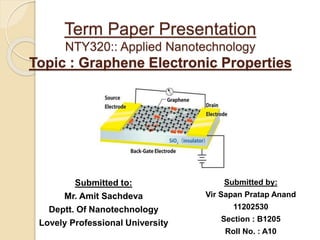
Term Paper Presentation
NTY320:: Applied Nanotechnology
Topic : Graphene Electronic Properties
Submitted to:
Mr. Amit Sachdeva
Deptt. Of Nanotechnology
Lovely Professional University
Submitted by:
Vir Sapan Pratap Anand
11202530
Section : B1205
Roll No. : A10
 Ever thought of a non metal or
semiconductor with zero band Gap?
Ever thought of 2-D Compounds ?
Ever thought of a material with
tensile strength of 130GPa and even
you can pick it like a child’s play..?
Ever thought of a conducting material
that can transmit 97.7% of light ??
 Ever thought of a conducting
material with 20 times stretchable
capacity of its length??
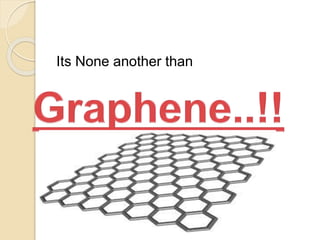
Its None another than
Graphene : Electronic Properties
Topics To be discussed
Introduction to Graphene
Why Graphene is So special?
Properties of Graphene
More about Electronic properties
Hall Effect
Extraordinary Properties,
Extraordinary Applications
Summary
Graphene : A brief
introduction
 It is a 2-D allotrope of Carbon at
atomic scale with hexagonal lattice.
Graphene – a combination of “Graph”
and suffix “-ene” named by Hanns
peter Boehm in 1962.
It has atomic thickness of 0.345nm
and 200 times stronger than steel.
Why So Special ??
 Sp2 Hybridization
 0.345nm thickness.
 Atoms 1.42 A apart.
These properties enable graphene to be
extraordnary in terms of:
1. Strength
2. Electricity
3. Heat Conduction
And many More…
Properties of Graphene:
 Chemical property : Highest ratio of
edge atoms of any allotrope, defects
within a sheet increase its reactivity.
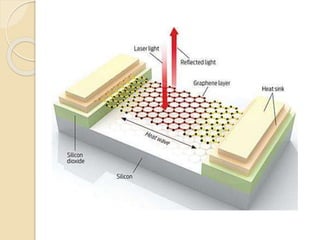
 Optical Property: Able to transmit
97.7% of light; reflectance and
transmittance studied as function of v,
temp. and Carrier density.
 High Conductivity of Graphene :
1500-2500 W/mK
Mechanical Properties of
Graphene
1. Tensile strength = 130
GPa
Young’s Modulus = 1 TPa
Weight of 1 sq. meter
Graphene sheet =
any Guesses ?
Only 0.77 mg
Could 2-D compounds exist ?
 Till 2004, no one believed so.
 Due to their thermal instability when
separated
 Graphene made it POSSIBLE.
 Carbon – Carbon bonds in Graphene
are so small and strong that they
prevent thermal fluctuations from
destroying it.
Electronic Properties of
Graphene:
 Carbon – 6 electrons : 2 in inner shell
and 4 in outer shell which are
available for chemical bonding.
 But in Graphene, each atom
connected to other three C atoms.
 Which leaves one e- freely available in
3rd Dimension for e- conduction (pi
electron)
 They overlap and help in C-C bond
formation in graphene.
Brillouin Zone and Dirac
Points:
 Brillouin Zone: In Solid State
Physics, it is a uniquely defined
primitive cell whose boundaries are
given by planes related to points on
the reciprocal lattice.
 Dirac Points: The electrons and
holes and the six corners of Brillouin
zone are called Dirac Points
Hall effect:
 Production of a voltage difference
(the Hallvoltage) across an electrical
conductor, transverse to an electric
current in the conductor and a
magnetic field perpendicular to the
current.
 It was discovered by Edwin Hall in
1879.
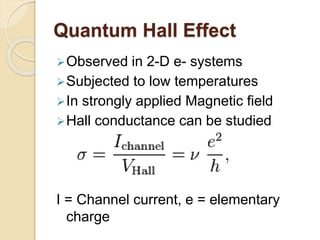
Quantum Hall Effect
Observed in 2-D e- systems
Subjected to low temperatures
In strongly applied Magnetic field
Hall conductance can be studied
I = Channel current, e = elementary
charge
Extra Ordinary Electronic
Applications of Graphene:
 Bioelectric Sensor
Optical Electronic Properties
Photovoltaic cell
Ultra Filtration
Energy Storage
Applications continued…
1. Biological Sensing Devices : due
to large surface area and high
conductivity, it can be used to
monitor Glucose levels, haemoglobin
levels, cholesterol level and even
DNA Sequencing.
2. Optical Electronics: As it Transmits
97.7% of light and has high
conductivity, It can be used in LCDs,
Org. LEDs
Applications Continued…
3. Ultrafiltration: Pore size of 5nm,
graphene can be employed in water
filtration, desalination system and
viable biofuel creation.
4. Photovoltaic cell: absorbs a
photon, generates multiple electrons.
Able to work in all wavelengths, can
be used to power our homes through
curtains and to recharge mobile
phones.
Applications Continued:
Energy Storage:
- Can be used to make super
capacitors.
- Able to charge very quickly.
- Could be used in high energy
applications such as electric vehicles,
laptops, smart phones, tablets, PCs at
significantly low size and weight.
Summary
1. Graphene is single atom thin sheet of
Carbon
2. It has extraordinary mechanical, optical and
electronic properties.
3. C-C bonds are so small and strong and give
it 2-D Structure
4. Electronic Properties dictated by Pi-Orbitals
5. Quantum Hall effect used to study voltage
and conductance
6. It has variety of applications in biosensors,
optical elctronics, energy storage,
photovoltaic cell etc.
Graphene electronic properties (1)

Graphene electronic properties (1)

  • 1.
    Term Paper Presentation NTY320::Applied Nanotechnology Topic : Graphene Electronic Properties Submitted to: Mr. Amit Sachdeva Deptt. Of Nanotechnology Lovely Professional University Submitted by: Vir Sapan Pratap Anand 11202530 Section : B1205 Roll No. : A10
  • 2.
     Ever thoughtof a non metal or semiconductor with zero band Gap? Ever thought of 2-D Compounds ? Ever thought of a material with tensile strength of 130GPa and even you can pick it like a child’s play..? Ever thought of a conducting material that can transmit 97.7% of light ??  Ever thought of a conducting material with 20 times stretchable capacity of its length??
  • 3.
  • 4.
    Graphene : ElectronicProperties Topics To be discussed Introduction to Graphene Why Graphene is So special? Properties of Graphene More about Electronic properties Hall Effect Extraordinary Properties, Extraordinary Applications Summary
  • 5.
    Graphene : Abrief introduction  It is a 2-D allotrope of Carbon at atomic scale with hexagonal lattice. Graphene – a combination of “Graph” and suffix “-ene” named by Hanns peter Boehm in 1962. It has atomic thickness of 0.345nm and 200 times stronger than steel.
  • 6.
    Why So Special??  Sp2 Hybridization  0.345nm thickness.  Atoms 1.42 A apart. These properties enable graphene to be extraordnary in terms of: 1. Strength 2. Electricity 3. Heat Conduction And many More…
  • 7.
    Properties of Graphene: Chemical property : Highest ratio of edge atoms of any allotrope, defects within a sheet increase its reactivity.  Optical Property: Able to transmit 97.7% of light; reflectance and transmittance studied as function of v, temp. and Carrier density.  High Conductivity of Graphene : 1500-2500 W/mK
  • 9.
    Mechanical Properties of Graphene 1.Tensile strength = 130 GPa Young’s Modulus = 1 TPa Weight of 1 sq. meter Graphene sheet = any Guesses ? Only 0.77 mg
  • 10.
    Could 2-D compoundsexist ?  Till 2004, no one believed so.  Due to their thermal instability when separated  Graphene made it POSSIBLE.  Carbon – Carbon bonds in Graphene are so small and strong that they prevent thermal fluctuations from destroying it.
  • 11.
    Electronic Properties of Graphene: Carbon – 6 electrons : 2 in inner shell and 4 in outer shell which are available for chemical bonding.  But in Graphene, each atom connected to other three C atoms.  Which leaves one e- freely available in 3rd Dimension for e- conduction (pi electron)  They overlap and help in C-C bond formation in graphene.
  • 12.
    Brillouin Zone andDirac Points:  Brillouin Zone: In Solid State Physics, it is a uniquely defined primitive cell whose boundaries are given by planes related to points on the reciprocal lattice.  Dirac Points: The electrons and holes and the six corners of Brillouin zone are called Dirac Points
  • 13.
    Hall effect:  Productionof a voltage difference (the Hallvoltage) across an electrical conductor, transverse to an electric current in the conductor and a magnetic field perpendicular to the current.  It was discovered by Edwin Hall in 1879.
  • 14.
    Quantum Hall Effect Observedin 2-D e- systems Subjected to low temperatures In strongly applied Magnetic field Hall conductance can be studied I = Channel current, e = elementary charge
  • 15.
    Extra Ordinary Electronic Applicationsof Graphene:  Bioelectric Sensor Optical Electronic Properties Photovoltaic cell Ultra Filtration Energy Storage
  • 16.
    Applications continued… 1. BiologicalSensing Devices : due to large surface area and high conductivity, it can be used to monitor Glucose levels, haemoglobin levels, cholesterol level and even DNA Sequencing. 2. Optical Electronics: As it Transmits 97.7% of light and has high conductivity, It can be used in LCDs, Org. LEDs
  • 17.
    Applications Continued… 3. Ultrafiltration:Pore size of 5nm, graphene can be employed in water filtration, desalination system and viable biofuel creation. 4. Photovoltaic cell: absorbs a photon, generates multiple electrons. Able to work in all wavelengths, can be used to power our homes through curtains and to recharge mobile phones.
  • 18.
    Applications Continued: Energy Storage: -Can be used to make super capacitors. - Able to charge very quickly. - Could be used in high energy applications such as electric vehicles, laptops, smart phones, tablets, PCs at significantly low size and weight.
  • 19.
    Summary 1. Graphene issingle atom thin sheet of Carbon 2. It has extraordinary mechanical, optical and electronic properties. 3. C-C bonds are so small and strong and give it 2-D Structure 4. Electronic Properties dictated by Pi-Orbitals 5. Quantum Hall effect used to study voltage and conductance 6. It has variety of applications in biosensors, optical elctronics, energy storage, photovoltaic cell etc.