
PLANT GROWTH
REGULATORS
OR
PLANT HORMONES
PLANT GROWTH REGULATORS
(PLANT HORMONES)
• Plant growth regulators (also known as growth regulators or
plant hormones) are chemicals used to alter the growth of a
plant or plant part.
• Hormones are substances naturally produced by plants,
substances that control normal plant functions, such as root
growth, fruit set and drop, growth and other development
processes.
• Plant growth-regulating substances, or hormones (from the
Greek word hormaein, meaning "to excite").
• Plant hormones are differ from animal hormones.
General plant hormones
 Auxins (cell elongation)
 Gibberellins (cell elongation + cell division -
translated into growth)
 Cytokinins (cell division + inhibits
senescence)
 Abscisic acid (abscission of leaves and fruits +
dormancy induction of buds and
seeds)
 Ethylene (promotes senescence, epinasty, and
fruit ripening)
Auxin
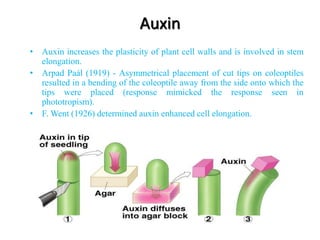
• Auxin increases the plasticity of plant cell walls and is involved in stem
elongation.
• Arpad Paál (1919) - Asymmetrical placement of cut tips on coleoptiles
resulted in a bending of the coleoptile away from the side onto which the
tips were placed (response mimicked the response seen in
phototropism).
• F. Went (1926) determined auxin enhanced cell elongation.
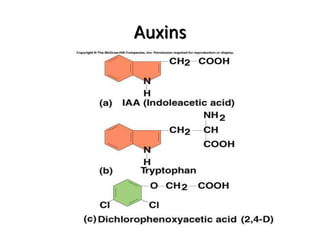
Auxins
Auxin
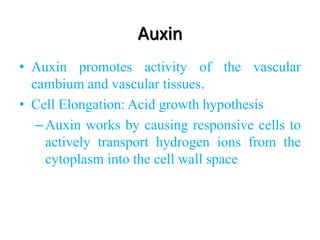
• Auxin promotes activity of the vascular
cambium and vascular tissues.
• Cell Elongation: Acid growth hypothesis
–Auxin works by causing responsive cells to
actively transport hydrogen ions from the
cytoplasm into the cell wall space
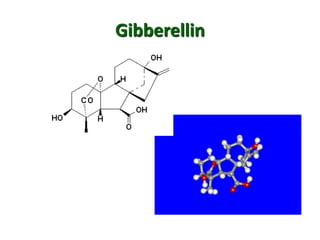
Gibberellin
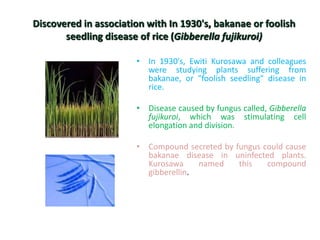
Discovered in association with In 1930's, bakanae or foolish
seedling disease of rice (Gibberella fujikuroi)
• In 1930's, Ewiti Kurosawa and colleagues
were studying plants suffering from
bakanae, or "foolish seedling" disease in
rice.
• Disease caused by fungus called, Gibberella
fujikuroi, which was stimulating cell
elongation and division.
• Compound secreted by fungus could cause
bakanae disease in uninfected plants.
Kurosawa named this compound
gibberellin.
Gibberellins
• Gibberellins are named after the fungus
Gibberella fujikuroi which causes rice plants
to grow abnormally tall.
– Synthesized in apical portions of stems and roots
– Important effects on stem elongation
– In seed germination
Effects of Gibberellins
• Cell elongation.
• GIBBERELLINS induces cellular division
and cellular elongation; auxin induces
cellular elongation alone.
• Breaking of dormancy in buds and seeds.
• Seed Germination.
• Promotion of flowering.
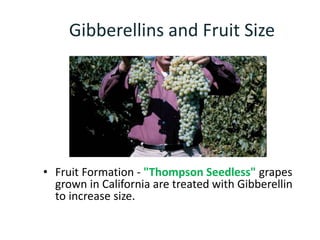
Gibberellins and Fruit Size
• Fruit Formation - "Thompson Seedless" grapes
grown in California are treated with Gibberellin
to increase size.
Discovery of cytokinins
• In the 1950s, Folke Skoog and Carlos Miller studying the influence of auxin
on the growth of tobacco in tissue culture. When auxin was added to
artificial medium, the cells enlarged but did not divide. Miller took herring-
sperm DNA. Miller knew of Overbeek's work, and decided to add this to the
culture medium, the tobacco cells started dividing. He repeated this
experiment with fresh herring-sperm DNA, but the results were not repeated.
Only old DNA seemed to work. Miller later discovered that adding the
purine base of DNA (adenine) would cause the cells to divide.
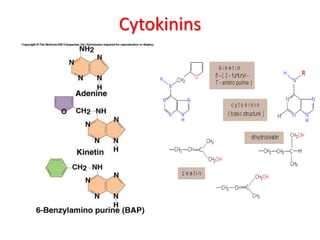
• Adenine or adenine-like compounds induce cell division in plant tissue
culture. Miller, Skoog and their coworkers isolated the growth factor
responsible for cellular division from a DNA preparation calling it
kinetin which belongs to a class of compounds called cytokinins.
• In 1964, the first naturally occurring cytokinin was isolated from corn called
zeatin. Zeatin and zeatin riboside are found in coconut milk. All cytokinins
(artificial or natural) are chemically similar to adenine.
Function of cytokinins
 Promotes cell division.
 Morphogenesis.
 Lateral bud development.
 Delay of senescence.
Cytokinins
• Cytokinins, in combination with auxin,
stimulate cell division and
differentiation.
–Most cytokinin produced in root
apical meristems and transported
throughout plant.
Cytokinins
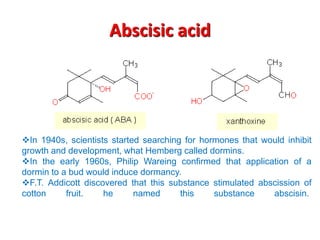
Abscisic acid
In 1940s, scientists started searching for hormones that would inhibit
growth and development, what Hemberg called dormins.
In the early 1960s, Philip Wareing confirmed that application of a
dormin to a bud would induce dormancy.
F.T. Addicott discovered that this substance stimulated abscission of
cotton fruit. he named this substance abscisin.
Abscisic Acid
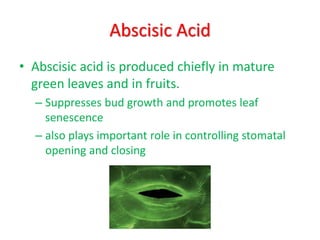
• Abscisic acid is produced chiefly in mature
green leaves and in fruits.
– Suppresses bud growth and promotes leaf
senescence
– also plays important role in controlling stomatal
opening and closing
Discovery of ethylene
 In 1901, D. Neljubow
identified that a byproduct
of gas combustion was
ethylene gas and this gas
could affect plant growth.
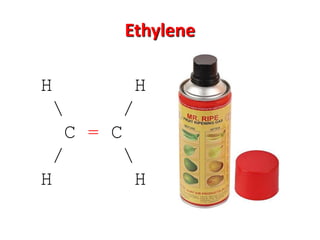
Ethylene
H H
 /
C = C
/ 
H H
Functions of ethylene
 Fruit ripening.
 Epinasty– downward movement of curvature of leaves.
 Encourages senescence and abscission.
 Initiation of stem elongation and bud development.
 Flowering - Ethylene inhibits flowering in most species, but
promotes it in a few plants such as pineapple and mango.
 Sex Expression - Cucumber buds treated with ethylene
become carpellate (female) flowers, whereas those treated
with gibberellins become staminate (male) flowers.
CONCLUSION
• Plant growth regulators play an important role in
the growth and development of the plants.
• From the germination of new plant to till their
death, plant regulators are needed.
• If we have good knowledge about phyto-hormones
then we can produce in large scale of plant products
such as medicines from secondary metabolities,
fruits, vegetables, etc.
Plant hormones

Plant hormones

  • 1.
  • 2.
    PLANT GROWTH REGULATORS (PLANTHORMONES) • Plant growth regulators (also known as growth regulators or plant hormones) are chemicals used to alter the growth of a plant or plant part. • Hormones are substances naturally produced by plants, substances that control normal plant functions, such as root growth, fruit set and drop, growth and other development processes. • Plant growth-regulating substances, or hormones (from the Greek word hormaein, meaning "to excite"). • Plant hormones are differ from animal hormones.
  • 3.
    General plant hormones Auxins (cell elongation)  Gibberellins (cell elongation + cell division - translated into growth)  Cytokinins (cell division + inhibits senescence)  Abscisic acid (abscission of leaves and fruits + dormancy induction of buds and seeds)  Ethylene (promotes senescence, epinasty, and fruit ripening)
  • 4.
    Auxin • Auxin increasesthe plasticity of plant cell walls and is involved in stem elongation. • Arpad Paál (1919) - Asymmetrical placement of cut tips on coleoptiles resulted in a bending of the coleoptile away from the side onto which the tips were placed (response mimicked the response seen in phototropism). • F. Went (1926) determined auxin enhanced cell elongation.
  • 5.
  • 6.
    Auxin • Auxin promotesactivity of the vascular cambium and vascular tissues. • Cell Elongation: Acid growth hypothesis –Auxin works by causing responsive cells to actively transport hydrogen ions from the cytoplasm into the cell wall space
  • 7.
  • 8.
    Discovered in associationwith In 1930's, bakanae or foolish seedling disease of rice (Gibberella fujikuroi) • In 1930's, Ewiti Kurosawa and colleagues were studying plants suffering from bakanae, or "foolish seedling" disease in rice. • Disease caused by fungus called, Gibberella fujikuroi, which was stimulating cell elongation and division. • Compound secreted by fungus could cause bakanae disease in uninfected plants. Kurosawa named this compound gibberellin.
  • 9.
    Gibberellins • Gibberellins arenamed after the fungus Gibberella fujikuroi which causes rice plants to grow abnormally tall. – Synthesized in apical portions of stems and roots – Important effects on stem elongation – In seed germination
  • 10.
    Effects of Gibberellins •Cell elongation. • GIBBERELLINS induces cellular division and cellular elongation; auxin induces cellular elongation alone. • Breaking of dormancy in buds and seeds. • Seed Germination. • Promotion of flowering.
  • 11.
    Gibberellins and FruitSize • Fruit Formation - "Thompson Seedless" grapes grown in California are treated with Gibberellin to increase size.
  • 12.
    Discovery of cytokinins •In the 1950s, Folke Skoog and Carlos Miller studying the influence of auxin on the growth of tobacco in tissue culture. When auxin was added to artificial medium, the cells enlarged but did not divide. Miller took herring- sperm DNA. Miller knew of Overbeek's work, and decided to add this to the culture medium, the tobacco cells started dividing. He repeated this experiment with fresh herring-sperm DNA, but the results were not repeated. Only old DNA seemed to work. Miller later discovered that adding the purine base of DNA (adenine) would cause the cells to divide. • Adenine or adenine-like compounds induce cell division in plant tissue culture. Miller, Skoog and their coworkers isolated the growth factor responsible for cellular division from a DNA preparation calling it kinetin which belongs to a class of compounds called cytokinins. • In 1964, the first naturally occurring cytokinin was isolated from corn called zeatin. Zeatin and zeatin riboside are found in coconut milk. All cytokinins (artificial or natural) are chemically similar to adenine.
  • 13.
    Function of cytokinins Promotes cell division.  Morphogenesis.  Lateral bud development.  Delay of senescence.
  • 14.
    Cytokinins • Cytokinins, incombination with auxin, stimulate cell division and differentiation. –Most cytokinin produced in root apical meristems and transported throughout plant.
  • 15.
  • 16.
    Abscisic acid In 1940s,scientists started searching for hormones that would inhibit growth and development, what Hemberg called dormins. In the early 1960s, Philip Wareing confirmed that application of a dormin to a bud would induce dormancy. F.T. Addicott discovered that this substance stimulated abscission of cotton fruit. he named this substance abscisin.
  • 17.
    Abscisic Acid • Abscisicacid is produced chiefly in mature green leaves and in fruits. – Suppresses bud growth and promotes leaf senescence – also plays important role in controlling stomatal opening and closing
  • 18.
    Discovery of ethylene In 1901, D. Neljubow identified that a byproduct of gas combustion was ethylene gas and this gas could affect plant growth.
  • 19.
  • 20.
    Functions of ethylene Fruit ripening.  Epinasty– downward movement of curvature of leaves.  Encourages senescence and abscission.  Initiation of stem elongation and bud development.  Flowering - Ethylene inhibits flowering in most species, but promotes it in a few plants such as pineapple and mango.  Sex Expression - Cucumber buds treated with ethylene become carpellate (female) flowers, whereas those treated with gibberellins become staminate (male) flowers.
  • 21.
    CONCLUSION • Plant growthregulators play an important role in the growth and development of the plants. • From the germination of new plant to till their death, plant regulators are needed. • If we have good knowledge about phyto-hormones then we can produce in large scale of plant products such as medicines from secondary metabolities, fruits, vegetables, etc.