
Department of biochemistry
Presented by – Rajnish kumar
Semester- 02
Roll no -02/16
Plant growth hormone(Auxin)
• The term auxin includes all those chemical
substances which promote growth of stem or
coleoptile sections
• It come as a first plant growth hormone from
the work of Darwin (1881).
• Naturally occurring auxin is indole-3-acetic
acid.
Types of auxin
• 1) Natural auxin – these are naturally occurring
auxin in plants and therefore regarded as
phytohormones. The best known natural auxin is
indole-3-acetic acid.
• 2) Synthetic auxin – these are many chemicals
synthesized in the laboratories that cause various
physiological response similar to IAA. Synthetic
auxins are not considered as phytohormones
Biosynthesis of Auxin
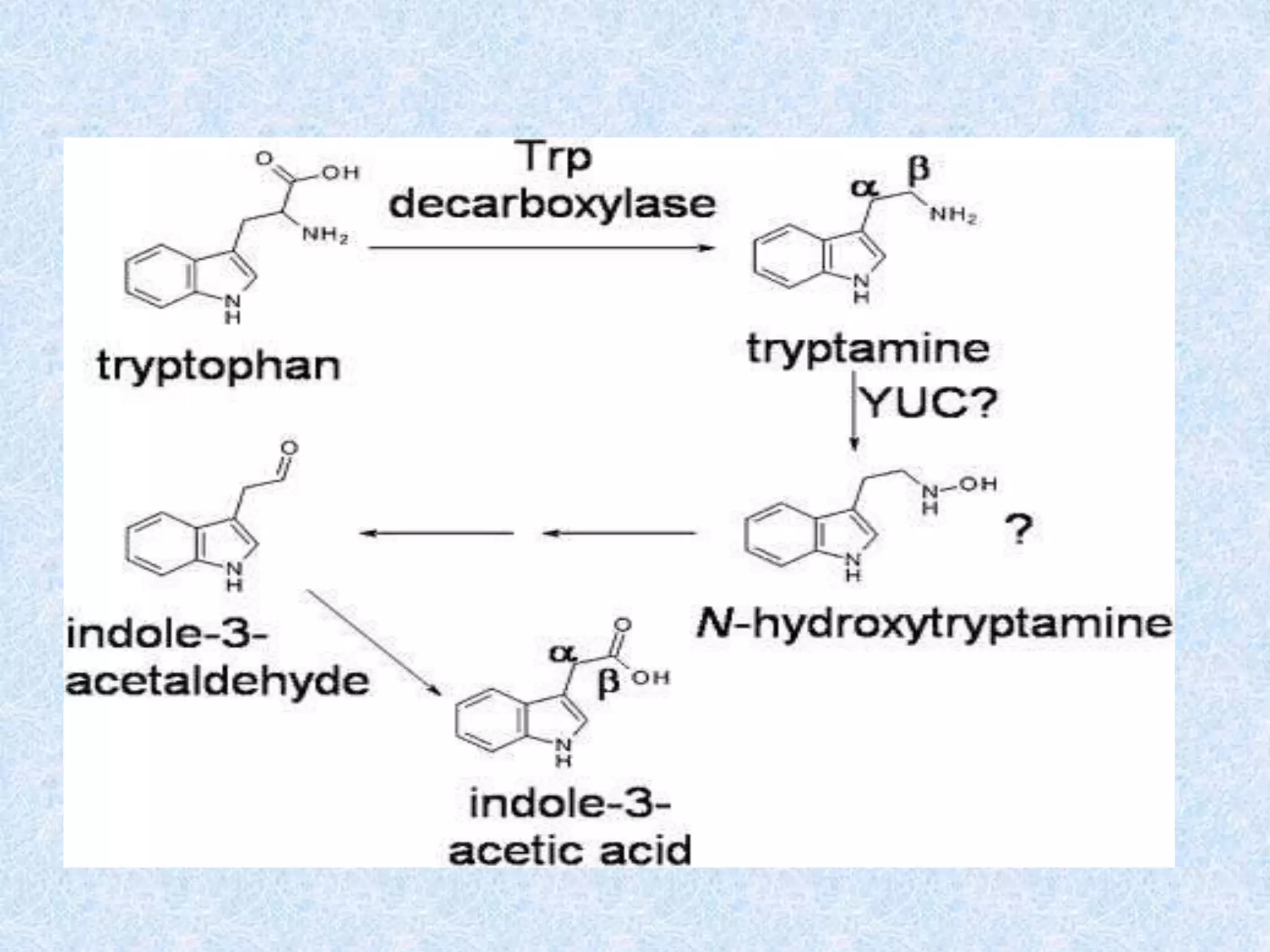
1) first of all the amino acid tryptophan donates
its amino group to another alpha keto acid by
transamination reaction to become indole
pyruvic acid. The reaction is catalysed by
tryptophan transaminase.
2)Then indolepyruvic acid undergoes
decarboxylation in presence of enzyme indole
pyruvate decarboxylase to become indole
acetaldehyde
• 3) finally indole acetaldehyde
oxidizes to become indole-3-acetic
acid. This reaction is catalysed by
enzyme indole acetaldehyde
dehydrogenase
Physiological effects of auxins
• 1) It helps in cell elongation
• 2) It helps in promotion of cell division in
cambium.
• 3) It helps to promote root growth in low
concentration.
• 4) It influence the apical buds and suppress
the growth of lateral buds this is called apical
dominance.
• 5) It helps in prevention of abscission
layer
• 6) It also helps in the formation of
seedless fruits without fertilization
• 7) Auxin also regulate plant growth
movement like phototropism and
geotropism.
Thankyou

Biosynthesis of auxin[1]

  • 1.
    Department of biochemistry Presentedby – Rajnish kumar Semester- 02 Roll no -02/16
  • 2.
    Plant growth hormone(Auxin) •The term auxin includes all those chemical substances which promote growth of stem or coleoptile sections • It come as a first plant growth hormone from the work of Darwin (1881). • Naturally occurring auxin is indole-3-acetic acid.
  • 3.
    Types of auxin •1) Natural auxin – these are naturally occurring auxin in plants and therefore regarded as phytohormones. The best known natural auxin is indole-3-acetic acid. • 2) Synthetic auxin – these are many chemicals synthesized in the laboratories that cause various physiological response similar to IAA. Synthetic auxins are not considered as phytohormones
  • 4.
    Biosynthesis of Auxin 1)first of all the amino acid tryptophan donates its amino group to another alpha keto acid by transamination reaction to become indole pyruvic acid. The reaction is catalysed by tryptophan transaminase. 2)Then indolepyruvic acid undergoes decarboxylation in presence of enzyme indole pyruvate decarboxylase to become indole acetaldehyde
  • 5.
    • 3) finallyindole acetaldehyde oxidizes to become indole-3-acetic acid. This reaction is catalysed by enzyme indole acetaldehyde dehydrogenase
  • 7.
    Physiological effects ofauxins • 1) It helps in cell elongation • 2) It helps in promotion of cell division in cambium. • 3) It helps to promote root growth in low concentration. • 4) It influence the apical buds and suppress the growth of lateral buds this is called apical dominance.
  • 8.
    • 5) Ithelps in prevention of abscission layer • 6) It also helps in the formation of seedless fruits without fertilization • 7) Auxin also regulate plant growth movement like phototropism and geotropism.
  • 9.