ASSIGNMENT ON PLANT
PIGMENTS
SAM HIGGINBOTTOM UNIVERSITY OF AGRICULTURE, TECHNOLOGY
& SCIENCE,
ALLAHABAD (U.P.)-211007, INDIA
Presented to:
Dr. Urfi Fatmi
Asst. Professor
Dept. Of Horticulture
SHUATS
Presented By:
V S K Keerthan Paruchuru
19MSHFC015
M.Sc. Ag. Horti (Floriculture and
Landscaping)
Semester -2
SUBJECT- VALUE ADDITION IN FLOWERS
HOFL-723
PLANT PIGMENT
Pigments or Biological Pigments can be simply defined as the Biochromes or Pigments. These are the
substances which are produced by the living organisms and have a colour which results from the colour
absorption techniques.
Pigments are the set of compounds that have an intense colour and are used in the colouring of other
materials. These are insoluble substances and are sometimes applied as ground particles in solid form
with the liquids. We come across various kinds of Biological pigments in plants as well as animals.
A plant pigment is any type of colored substance produced by a plant. In general, any chemical
compound which absorbs visible radiation between about 380 nm (violet) and 760 nm (ruby-red) is
considered a pigment. There are many different plant pigments, and they are found in different classes of
organic compounds. Plant pigments give color to leaves, flowers, and fruits and are also important in
controlling photosynthesis, growth, and development.
Functions
• Primary function of chlorophyll is photosynthesis.
• Carotenoids Absorb In Wavelengths that Chlorophyll Does Poorly In.
• Carotenoids can Dissipate Excess Energy as Heat.
• Plants Can Regulate the Degree to Which Carotenoids Dissipate Excess
Energy as Heat.
• Carotenoids May Also Protect the Leaf in the Fall.
• Help to capture as much light as possible.
• Anthocyanins play an important role in facilitating plant reproduction as
they attract pollinators and seed dispersers by imparting bright colors.
• Betanin is commercially used as a natural food dye.
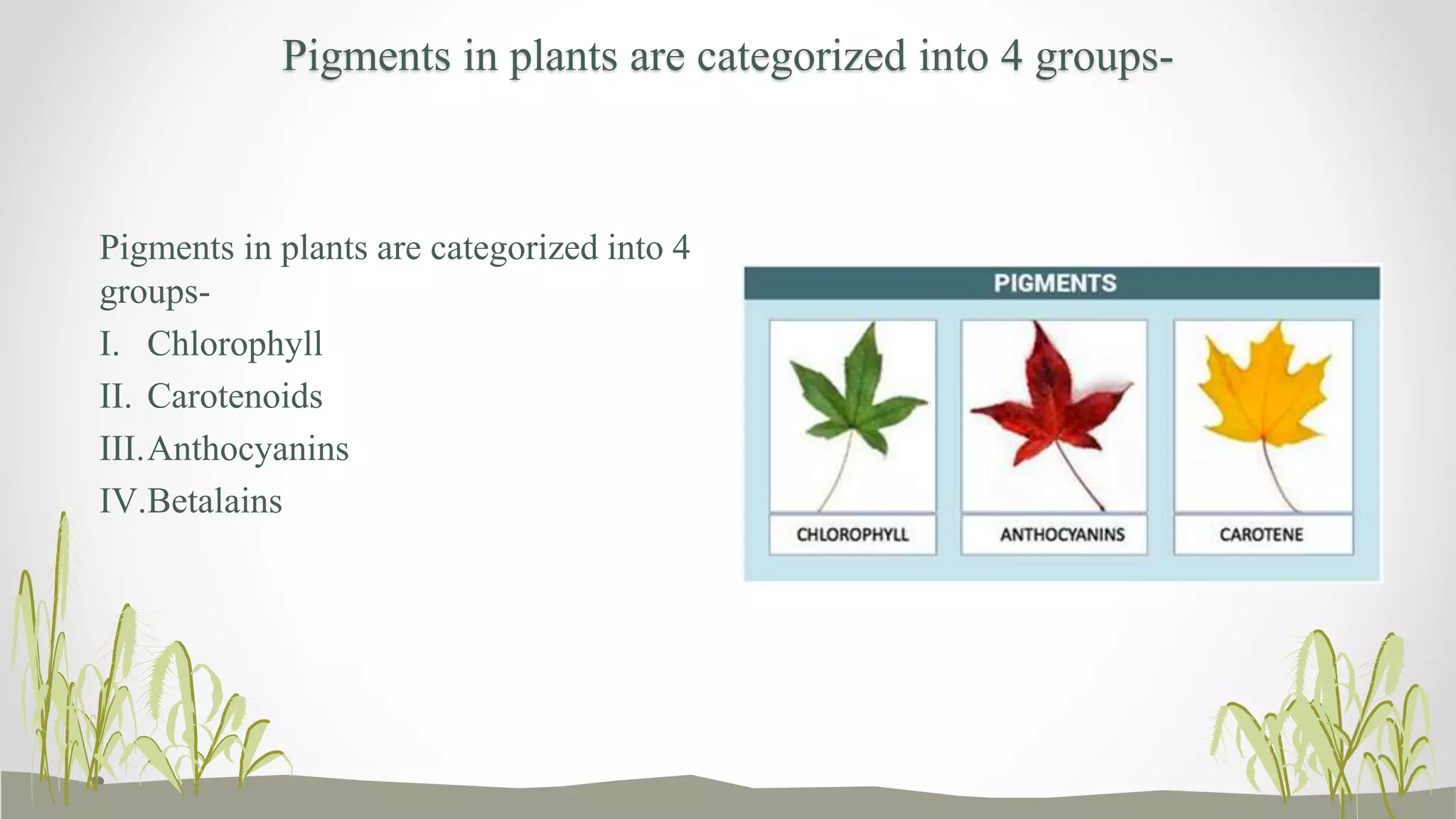
Pigments in plants are categorized into 4 groups-
Pigments in plants are categorized into 4
groups-
I. Chlorophyll
II. Carotenoids
III.Anthocyanins
IV.Betalains
Chlorophyll
Origin-
Chlorophyll was first isolated and named by Joseph Bienaimé Caventou and Pierre Joseph
Pelletier in 1817.The presence of magnesium in chlorophyll was discovered in 1906 and
was the first time that magnesium had been detected in living tissue.
The chlorophylls are used to drive photosynthesis and are the most important plant
pigments. Chlorophylls occur in plants, algae, and photosynthetic bacteria. In plants and
algae, they are located in the inner membranes of chloroplasts, organelles (membrane
enclosed structures) within plant cells which perform photosynthesis. Photosynthesis uses
the light energy absorbed by chlorophylls to synthesize carbohydrates. All organisms on
earth depend upon photosynthesis for food, either directly or indirectly.
Plants are perceived as green because chlorophyll absorbs mainly the blue and
red wavelength and reflects the green.
There are several types of chlorophyll, but all share
the chlorin magnesium ligand which forms the right side of this
diagram.
Types of chlorophyll :
The green colouring of the plant leaves is due to the pigment called chlorophyll. The chlorophyll pigment is
of various kinds such as a, b, c, d, p.
The different types of chlorophylls absorb different wavelengths of light. Most plants use several
photosynthetic pigments with different absorption spectra, allowing use of a greater portion of the solar
spectrum for photosynthesis. Chlorophyll-a is present in higher plants, algae, cyanobacteria, and
chloroxybacteria.
Higher plants and some groups of algae also have chlorophyll-b. Other algae have chlorophyll-c or
chlorophyll-d. There are also numerous types of bacteriochlorophylls found in the photosynthetic bacteria.
Utility-
A 2002 study found that "leaves exposed to strong light contained degraded major antenna proteins, unlike
those kept in the dark, which is consistent with studies on the illumination of isolated proteins". This appeared
to the authors as support for the hypothesis that "active oxygen species play a role in vivo" in the short-term
behavior of plants.
Carotenoids
Origin-
The earliest studies on carotenoids date back to the beginning of the 19th century. Beta-carotene
was first isolated by Wackenroder in 1831, and many other carotenoids were discovered and
named during the 1800s, although their structures were still unknown.
Utility-
Some carotenoids are produced by bacteria to protect themselves from oxidative immune attack.
The golden pigment that gives some strains of Staphylococcus aureus their name (aureus =
golden) is a carotenoid called staphyloxanthin. This carotenoid is a virulence factor with
an antioxidant action that helps the microbe evade death by reactive oxygen species used by the
host immune system.
Carotenoids are yellow, orange, or red pigments synthesized by many plants,
fungi, and bacteria. In plants, carotenoids can occur in roots, stems, leaves,
flowers, and fruits. Within a plant cell, carotenoids are found in the
membranes of plastids, organelles surrounded by characteristic double
membranes. Chloroplasts are the most important type of plastid and they
synthesize and store carotenoids as well as perform photosynthesis. Two of
the best-known carotenoids are Beta-carotene and lycopene. Beta-carotene
gives carrots, sweet potatoes, and other vegetables their orange color.
Lycopene gives tomatoes their red color. When a human eats carrots or other
foods containing carotenoids, the liver splits the carotenoid molecule in half
to create two molecules of vitamin-A, an essential micronutrient.
Types of carotenoids:
There are two general classes of carotenoids
• Carotenoids with molecules containing oxygen, such
as lutein and zeaxanthin, are known as xanthophylls.
• The unoxygenated (oxygen free) carotenoids such as α-carotene, β-
carotene, and lycopene, are known as carotenes. Carotenes typically
contain only carbon and hydrogen (i.e., are hydrocarbons), and are in
the subclass of unsaturated hydrocarbons.
General structure of a carotenoid: polyene tail with double
bonds, possible terminal rings
Anthocyanin
Origin-
Anthocyanins had been observed for centuries as “colored cell sap.” In 1835 the
German botanist Ludwig Marquart gave them their name, deriving anthocyanin from
the Greek anthos, meaning flower, and kyanos, meaning blue. Many long-standing
misconceptions about anthocyanin function date from these early observations, notably
that these pigments arise from the breakdown of chlorophyll during autumn.
Utility-
Anthocyanins may be used as pH indicators because their color changes with pH; they
are red or pink in acidic solutions (pH < 7), purple in neutral solutions (pH ≈ 7),
greenish-yellow in alkaline solutions (pH > 7), and colorless in very alkaline solutions,
where the pigment is completely reduced.
Role of anthocyanin-
Coloration
In flowers, the coloration that is provided by anthocyanin accumulation may
attract a wide variety of animal pollinators, while in fruits, the same coloration
may aid in seed dispersal by attracting herbivorous animals to the potentially-
edible fruits bearing these red, blue, or purple colors.
Plant physiology
Anthocyanins may have a protective role in plants against extreme temperatures.
Tomato plants protect against cold stress with anthocyanins countering reactive
oxygen species, leading to a lower rate of cell death in leaves.
Light absorbance
The absorbance pattern responsible for the red color of anthocyanins may be
complementary to that of green chlorophyll in photosynthetically-active tissues
such as young Quercus coccifera leaves. It may protect the leaves from attacks by
herbivores that may be attracted by green color.
Purple cauliflower contains anthocyanins Anthocyanins give these pansies their dark
purple pigmentation
Betalains
Origin-
The discovery of fluorescence in Betalains was linked to research
on their biosynthetic pathway. The steps of the biosynthesis of
Betalains were preliminarily established in the late 1960s and two
main enzymes were proposed to build the structural units of the
pigments. A 4,5-DOPA-extradiol-dioxygenase (DODA) was
proposed to cleave the aromatic ring of L-dihydroxyphenylalanine
(L-DOPA) to a linear form, able to produce the basic structural unit
of all betalains, betalamic acid
Chemical structure of betanin.
They are a class of red and yellow tyrosine-derived pigments found in plants of the
Caryophyllales, where they replace anthocyanin pigments. They are never co-exist with
anthocyanins, i.e. they are found only when anthocyanins are absent. They are most
often noticeable in the petals of flowers, but may color the fruits, leaves, stems, and
roots of plants that contain them.
There are two categories of Betalains:
i. Betacyanins include the reddish to violet betalain pigments
ii. Betaxanthins are those betalain pigments which appear yellow to orange.
Utility-
Betanin extracted from the red beet was used as starting material for
the semisynthesis of an artificial betalainic coumarin, which was applied as a
fluorescent probe for the live-cell imaging of Plasmodium-infected erythrocytes.
Value Added Products from Plant Pigments-
• Chlorophyll influences green colour in leaves which can used in preparation of green leaf bag which also
helps in encouraging eco-friendly products.
• Chefs use chlorophyll to color a variety of foods and beverages green, such as pasta and spirits.
• Betanin is commercially used as a natural food dye.
• Products of carotenoid degradation such as ionones, damascones and damascenones are also important
fragrance chemicals that are used extensively in the perfumes and fragrance industry.
• Dried carrots have the highest amount of carotene which is used as edible product
• Anthocyanins from various fruits and vegetables used as food additives.
• Anthocyanin influences autumn leaf colour in many plants which they can be used in flower arrangement
and dry flower products.
REFERENCE
• https://www.encyclopedia.com/science/encyclopedias-almanacs-transcripts-and-maps/plant-pigment-0
• https://en.wikipedia.org/wiki/Biological_pigment
• https://en.wikipedia.org/wiki/Chlorophyll
• https://en.wikipedia.org/wiki/Carotenoid#Structure_and_function
• https://en.wikipedia.org/wiki/Anthocyanin
• https://en.wikipedia.org/wiki/Betalain
• https://www.sciencedirect.com/science/article/pii/S1360138519303012
• https://www.slideshare.net/Sapan_Anand/biochemistry-term-paper-presentation
• http://lifeofplant.blogspot.com/2011/02/pigments-in-plants.html

Plant pigments

  • 1.
  • 2.
    SAM HIGGINBOTTOM UNIVERSITYOF AGRICULTURE, TECHNOLOGY & SCIENCE, ALLAHABAD (U.P.)-211007, INDIA Presented to: Dr. Urfi Fatmi Asst. Professor Dept. Of Horticulture SHUATS Presented By: V S K Keerthan Paruchuru 19MSHFC015 M.Sc. Ag. Horti (Floriculture and Landscaping) Semester -2 SUBJECT- VALUE ADDITION IN FLOWERS HOFL-723
  • 3.
    PLANT PIGMENT Pigments orBiological Pigments can be simply defined as the Biochromes or Pigments. These are the substances which are produced by the living organisms and have a colour which results from the colour absorption techniques. Pigments are the set of compounds that have an intense colour and are used in the colouring of other materials. These are insoluble substances and are sometimes applied as ground particles in solid form with the liquids. We come across various kinds of Biological pigments in plants as well as animals. A plant pigment is any type of colored substance produced by a plant. In general, any chemical compound which absorbs visible radiation between about 380 nm (violet) and 760 nm (ruby-red) is considered a pigment. There are many different plant pigments, and they are found in different classes of organic compounds. Plant pigments give color to leaves, flowers, and fruits and are also important in controlling photosynthesis, growth, and development.
  • 4.
    Functions • Primary functionof chlorophyll is photosynthesis. • Carotenoids Absorb In Wavelengths that Chlorophyll Does Poorly In. • Carotenoids can Dissipate Excess Energy as Heat. • Plants Can Regulate the Degree to Which Carotenoids Dissipate Excess Energy as Heat. • Carotenoids May Also Protect the Leaf in the Fall. • Help to capture as much light as possible. • Anthocyanins play an important role in facilitating plant reproduction as they attract pollinators and seed dispersers by imparting bright colors. • Betanin is commercially used as a natural food dye.
  • 5.
    Pigments in plantsare categorized into 4 groups- Pigments in plants are categorized into 4 groups- I. Chlorophyll II. Carotenoids III.Anthocyanins IV.Betalains
  • 6.
    Chlorophyll Origin- Chlorophyll was firstisolated and named by Joseph Bienaimé Caventou and Pierre Joseph Pelletier in 1817.The presence of magnesium in chlorophyll was discovered in 1906 and was the first time that magnesium had been detected in living tissue. The chlorophylls are used to drive photosynthesis and are the most important plant pigments. Chlorophylls occur in plants, algae, and photosynthetic bacteria. In plants and algae, they are located in the inner membranes of chloroplasts, organelles (membrane enclosed structures) within plant cells which perform photosynthesis. Photosynthesis uses the light energy absorbed by chlorophylls to synthesize carbohydrates. All organisms on earth depend upon photosynthesis for food, either directly or indirectly.
  • 7.
    Plants are perceivedas green because chlorophyll absorbs mainly the blue and red wavelength and reflects the green. There are several types of chlorophyll, but all share the chlorin magnesium ligand which forms the right side of this diagram.
  • 8.
    Types of chlorophyll: The green colouring of the plant leaves is due to the pigment called chlorophyll. The chlorophyll pigment is of various kinds such as a, b, c, d, p. The different types of chlorophylls absorb different wavelengths of light. Most plants use several photosynthetic pigments with different absorption spectra, allowing use of a greater portion of the solar spectrum for photosynthesis. Chlorophyll-a is present in higher plants, algae, cyanobacteria, and chloroxybacteria. Higher plants and some groups of algae also have chlorophyll-b. Other algae have chlorophyll-c or chlorophyll-d. There are also numerous types of bacteriochlorophylls found in the photosynthetic bacteria. Utility- A 2002 study found that "leaves exposed to strong light contained degraded major antenna proteins, unlike those kept in the dark, which is consistent with studies on the illumination of isolated proteins". This appeared to the authors as support for the hypothesis that "active oxygen species play a role in vivo" in the short-term behavior of plants.
  • 9.
    Carotenoids Origin- The earliest studieson carotenoids date back to the beginning of the 19th century. Beta-carotene was first isolated by Wackenroder in 1831, and many other carotenoids were discovered and named during the 1800s, although their structures were still unknown. Utility- Some carotenoids are produced by bacteria to protect themselves from oxidative immune attack. The golden pigment that gives some strains of Staphylococcus aureus their name (aureus = golden) is a carotenoid called staphyloxanthin. This carotenoid is a virulence factor with an antioxidant action that helps the microbe evade death by reactive oxygen species used by the host immune system.
  • 10.
    Carotenoids are yellow,orange, or red pigments synthesized by many plants, fungi, and bacteria. In plants, carotenoids can occur in roots, stems, leaves, flowers, and fruits. Within a plant cell, carotenoids are found in the membranes of plastids, organelles surrounded by characteristic double membranes. Chloroplasts are the most important type of plastid and they synthesize and store carotenoids as well as perform photosynthesis. Two of the best-known carotenoids are Beta-carotene and lycopene. Beta-carotene gives carrots, sweet potatoes, and other vegetables their orange color. Lycopene gives tomatoes their red color. When a human eats carrots or other foods containing carotenoids, the liver splits the carotenoid molecule in half to create two molecules of vitamin-A, an essential micronutrient.
  • 11.
    Types of carotenoids: Thereare two general classes of carotenoids • Carotenoids with molecules containing oxygen, such as lutein and zeaxanthin, are known as xanthophylls. • The unoxygenated (oxygen free) carotenoids such as α-carotene, β- carotene, and lycopene, are known as carotenes. Carotenes typically contain only carbon and hydrogen (i.e., are hydrocarbons), and are in the subclass of unsaturated hydrocarbons. General structure of a carotenoid: polyene tail with double bonds, possible terminal rings
  • 12.
    Anthocyanin Origin- Anthocyanins had beenobserved for centuries as “colored cell sap.” In 1835 the German botanist Ludwig Marquart gave them their name, deriving anthocyanin from the Greek anthos, meaning flower, and kyanos, meaning blue. Many long-standing misconceptions about anthocyanin function date from these early observations, notably that these pigments arise from the breakdown of chlorophyll during autumn. Utility- Anthocyanins may be used as pH indicators because their color changes with pH; they are red or pink in acidic solutions (pH < 7), purple in neutral solutions (pH ≈ 7), greenish-yellow in alkaline solutions (pH > 7), and colorless in very alkaline solutions, where the pigment is completely reduced.
  • 13.
    Role of anthocyanin- Coloration Inflowers, the coloration that is provided by anthocyanin accumulation may attract a wide variety of animal pollinators, while in fruits, the same coloration may aid in seed dispersal by attracting herbivorous animals to the potentially- edible fruits bearing these red, blue, or purple colors. Plant physiology Anthocyanins may have a protective role in plants against extreme temperatures. Tomato plants protect against cold stress with anthocyanins countering reactive oxygen species, leading to a lower rate of cell death in leaves. Light absorbance The absorbance pattern responsible for the red color of anthocyanins may be complementary to that of green chlorophyll in photosynthetically-active tissues such as young Quercus coccifera leaves. It may protect the leaves from attacks by herbivores that may be attracted by green color.
  • 14.
    Purple cauliflower containsanthocyanins Anthocyanins give these pansies their dark purple pigmentation
  • 15.
    Betalains Origin- The discovery offluorescence in Betalains was linked to research on their biosynthetic pathway. The steps of the biosynthesis of Betalains were preliminarily established in the late 1960s and two main enzymes were proposed to build the structural units of the pigments. A 4,5-DOPA-extradiol-dioxygenase (DODA) was proposed to cleave the aromatic ring of L-dihydroxyphenylalanine (L-DOPA) to a linear form, able to produce the basic structural unit of all betalains, betalamic acid Chemical structure of betanin.
  • 16.
    They are aclass of red and yellow tyrosine-derived pigments found in plants of the Caryophyllales, where they replace anthocyanin pigments. They are never co-exist with anthocyanins, i.e. they are found only when anthocyanins are absent. They are most often noticeable in the petals of flowers, but may color the fruits, leaves, stems, and roots of plants that contain them. There are two categories of Betalains: i. Betacyanins include the reddish to violet betalain pigments ii. Betaxanthins are those betalain pigments which appear yellow to orange. Utility- Betanin extracted from the red beet was used as starting material for the semisynthesis of an artificial betalainic coumarin, which was applied as a fluorescent probe for the live-cell imaging of Plasmodium-infected erythrocytes.
  • 17.
    Value Added Productsfrom Plant Pigments- • Chlorophyll influences green colour in leaves which can used in preparation of green leaf bag which also helps in encouraging eco-friendly products. • Chefs use chlorophyll to color a variety of foods and beverages green, such as pasta and spirits. • Betanin is commercially used as a natural food dye. • Products of carotenoid degradation such as ionones, damascones and damascenones are also important fragrance chemicals that are used extensively in the perfumes and fragrance industry. • Dried carrots have the highest amount of carotene which is used as edible product • Anthocyanins from various fruits and vegetables used as food additives. • Anthocyanin influences autumn leaf colour in many plants which they can be used in flower arrangement and dry flower products.
  • 18.
    REFERENCE • https://www.encyclopedia.com/science/encyclopedias-almanacs-transcripts-and-maps/plant-pigment-0 • https://en.wikipedia.org/wiki/Biological_pigment •https://en.wikipedia.org/wiki/Chlorophyll • https://en.wikipedia.org/wiki/Carotenoid#Structure_and_function • https://en.wikipedia.org/wiki/Anthocyanin • https://en.wikipedia.org/wiki/Betalain • https://www.sciencedirect.com/science/article/pii/S1360138519303012 • https://www.slideshare.net/Sapan_Anand/biochemistry-term-paper-presentation • http://lifeofplant.blogspot.com/2011/02/pigments-in-plants.html