PHOTOSYNTHESIS
Copyright © 2002 Pearson Education, Inc., publishing as Benjamin Cummings
The Pathways of Photosynthesis
(continued)
This presentation downloaded from the internet on 11-30-
06 from
http://www.mercy.edu/faculty/knizeski/10B2-PathwysOfPhoto
.4. The Calvin cycle uses ATP and NADPH to convert CO2 to sugar: a closer
look
5. Alternative mechanisms of carbon fixation have evolved in hot, arid
climates
6. Photosynthesis is the biosphere’s metabolic foundation: a review
• The Calvin cycle regenerates its starting material
after molecules enter and leave the cycle.
• CO2 enters the cycle and leaves as sugar.
• The cycle spends the energy of ATP and the
reducing power of electrons carried by NADPH to
make the sugar.
• The actual sugar product of the Calvin cycle is not
glucose, but a three-carbon sugar, glyceraldehyde-3-
phosphate (G3P).
4. The Calvin cycle uses ATP and NADPH
to convert CO2 to sugar: a closer look
Copyright © 2002 Pearson Education, Inc., publishing as Benjamin Cummings
• Each turn of the Calvin cycle fixes one carbon.
• For the net synthesis of one G3P molecule, the
cycle must take place three times, fixing three
molecules of CO2.
• To make one glucose molecules would require six
cycles and the fixation of six CO2 molecules.
Copyright © 2002 Pearson Education, Inc., publishing as Benjamin Cummings
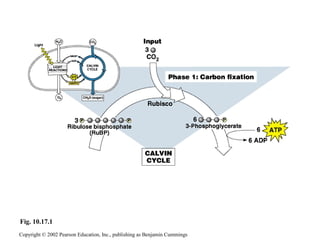
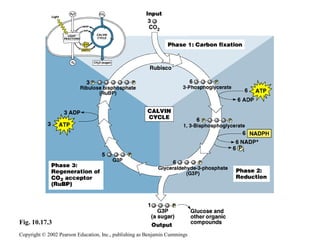
• The Calvin cycle has three phases.
• In the carbon fixation phase, each CO2 molecule is
attached to a five-carbon sugar, ribulose
bisphosphate (RuBP).
• This is catalyzed by RuBP carboxylase or rubisco.
• The six-carbon intermediate splits in half to form two
molecules of 3-phosphoglycerate per CO2.
Copyright © 2002 Pearson Education, Inc., publishing as Benjamin Cummings
Fig. 10.17.1
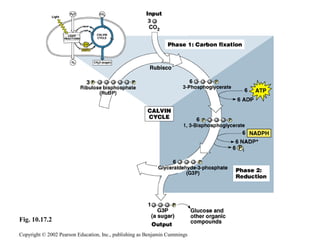
• During reduction, each 3-phosphoglycerate
receives another phosphate group from ATP to
form 1,3 bisphosphoglycerate.
• A pair of electrons from NADPH reduces each 1,3
bisphosphoglycerate to G3P.
• The electrons reduce a carboxyl group to a carbonyl
group.
Copyright © 2002 Pearson Education, Inc., publishing as Benjamin Cummings
Fig. 10.17.2
• If our goal was to produce one G3P net, we would
start with 3 CO2 (3C) and three RuBP (15C).
• After fixation and reduction we would have six
molecules of G3P (18C).
• One of these six G3P (3C) is a net gain of carbohydrate.
• This molecule can exit the cycle to be used by the
plant cell.
• The other five (15C) must remain in the cycle to
regenerate three RuBP.
Copyright © 2002 Pearson Education, Inc., publishing as Benjamin Cummings
• In the last phase, regeneration of the CO2 acceptor
(RuBP), these five G3P molecules are rearranged
to form 3 RuBP molecules.
• To do this, the cycle must spend three more
molecules of ATP (one per RuBP) to complete the
cycle and prepare for the next.
Copyright © 2002 Pearson Education, Inc., publishing as Benjamin Cummings
Fig. 10.17.3
• For the net synthesis of one G3P molecule, the
Calvin recycle consumes nine ATP and six
NAPDH.
• It “costs” three ATP and two NADPH per CO2.
• The G3P from the Calvin cycle is the starting
material for metabolic pathways that synthesize
other organic compounds, including glucose and
other carbohydrates.
Copyright © 2002 Pearson Education, Inc., publishing as Benjamin Cummings
• One of the major problems facing terrestrial plants is
dehydration.
• At times, solutions to this problem conflict with other
metabolic processes, especially photosynthesis.
• The stomata are not only the major route for gas
exchange (CO2 in and O2 out), but also for the
evaporative loss of water.
• On hot, dry days plants close the stomata to conserve
water, but this causes problems for photosynthesis.
5. Alternative mechanisms of carbon
fixation have evolved in hot, arid climates
Copyright © 2002 Pearson Education, Inc., publishing as Benjamin Cummings
• In most plants (C3 plants) initial fixation of CO2
occurs via rubisco and results in a three-carbon
compound, 3-phosphoglycerate.
• These plants include rice, wheat, and soybeans.
• When their stomata are closed on a hot, dry day,
CO2 levels drop as CO2 is consumed in the Calvin
cycle.
• At the same time, O2 levels rise as the light reaction
converts light to chemical energy.
• While rubisco normally accepts CO2, when the
O2/CO2 ratio increases (on a hot, dry day with closed
stomata), rubisco can add O2 to RuBP.
Copyright © 2002 Pearson Education, Inc., publishing as Benjamin Cummings
• When rubisco adds O2 to RuBP, RuBP splits into a
three-carbon piece and a two-carbon piece in a
process called photorespiration.
• The two-carbon fragment is exported from the
chloroplast and degraded to CO2 by mitochondria and
peroxisomes.
• Unlike normal respiration, this process produces no
ATP, nor additional organic molecules.
• Photorespiration decreases photosynthetic output
by siphoning organic material from the Calvin
cycle.
Copyright © 2002 Pearson Education, Inc., publishing as Benjamin Cummings
• A hypothesis for the existence of photorespiraton (a
inexact requirement for CO2 versus O2 by rubisco) is
that it is evolutionary baggage.
• When rubisco first evolved, the atmosphere had far
less O2 and more CO2 than it does today.
• The inability of the active site of rubisco to exclude O2
would have made little difference.
• Today it does make a difference.
• Photorespiration can drain away as much as 50% of the
carbon fixed by the Calvin cycle on a hot, dry day.
• Certain plant species have evolved alternate modes
of carbon fixation to minimize photorespiration.
Copyright © 2002 Pearson Education, Inc., publishing as Benjamin Cummings
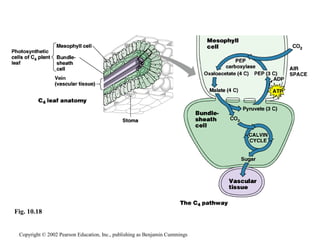
• The C4 plants fix CO2 first in a four-carbon
compound.
• Several thousand plants, including sugercane and corn,
use this pathway.
• In C4 plants, mesophyll cells incorporate CO2 into
organic molecules.
• The key enzyme, phosphoenolpyruvate carboxylase,
adds CO2 to phosphoenolpyruvate (PEP) to form
oxaloacetetate.
• PEP carboxylase has a very high affinity for CO2 and
can fix CO2 efficiently when rubisco cannot - on hot,
dry days with the stomata closed.
Copyright © 2002 Pearson Education, Inc., publishing as Benjamin Cummings
• The mesophyll cells pump these four-carbon
compounds into bundle-sheath cells.
• The bundle sheath cells strip a carbon, as CO2, from the
four-carbon compound and return the three-carbon
remainder to the mesophyll cells.
• The bundle sheath cells then uses rubisco to start the
Calvin cycle with an abundant supply of CO2.
Copyright © 2002 Pearson Education, Inc., publishing as Benjamin Cummings
Fig. 10.18
• In effect, the mesophyll cells pump CO2 into the
bundle sheath cells, keeping CO2 levels high
enough for rubisco to accept CO2 and not O2.
• C4 photosynthesis minimizes photorespiration and
enhances sugar production.
• C4 plants thrive in hot regions with intense
sunlight.
Copyright © 2002 Pearson Education, Inc., publishing as Benjamin Cummings
• A second strategy to minimize photorespiration is
found in succulent plants, cacti, pineapples, and
several other plant families.
• These plants, known as CAM plants for crassulacean
acid metabolism (CAM), open stomata during the
night and close them during the day.
• Temperatures are typically lower at night and
humidity is higher.
• During the night, these plants fix CO2 into a variety of
organic acids in mesophyll cells.
• During the day, the light reactions supply ATP and
NADPH to the Calvin cycle and CO2 is released from
the organic acids.
Copyright © 2002 Pearson Education, Inc., publishing as Benjamin Cummings
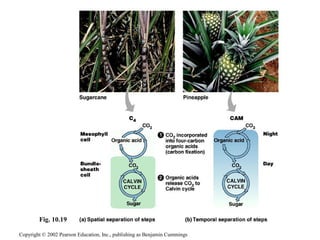
• Both C4 and CAM plants add CO2 into organic
intermediates before it enters the Calvin cycle.
• In C4 plants, carbon fixation and the Calvin cycle are
spatially separated.
• In CAM plants, carbon fixation and the Calvin cycle are
temporally separated.
• Both eventually use the Calvin cycle to incorporate
light energy into the production of sugar.
Copyright © 2002 Pearson Education, Inc., publishing as Benjamin Cummings
Fig. 10.19
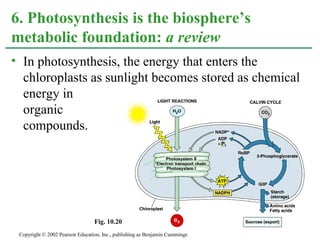
• In photosynthesis, the energy that enters the
chloroplasts as sunlight becomes stored as chemical
energy in
organic
compounds.
6. Photosynthesis is the biosphere’s
metabolic foundation: a review
Copyright © 2002 Pearson Education, Inc., publishing as Benjamin Cummings
Fig. 10.20
• Sugar made in the chloroplasts supplies the entire
plant with chemical energy and carbon skeletons to
synthesize all the major organic molecules of cells.
• About 50% of the organic material is consumed as fuel
for cellular respiration in plant mitochondria.
• Carbohydrate in the form of the disaccharide sucrose
travels via the veins to nonphotosynthetic cells.
• There, it provides fuel for respiration and the raw
materials for anabolic pathways including synthesis of
proteins and lipids and building the extracellular
polysaccharide cellulose.
Copyright © 2002 Pearson Education, Inc., publishing as Benjamin Cummings
• Plants also store excess sugar by synthesizing
starch.
• Some is stored as starch in chloroplasts or in storage cells
in roots, tubers, seeds, and fruits.
• Heterotrophs, including humans, may completely or
partially consume plants for fuel and raw materials.
• On a global scale, photosynthesis is the most
important process to the welfare of life on Earth.
• Each year photosynthesis synthesizes 160 billion metric
tons of carbohydrate per year.
Copyright © 2002 Pearson Education, Inc., publishing as Benjamin Cummings

Photosynthesis carbon fixation

  • 1.
    PHOTOSYNTHESIS Copyright © 2002Pearson Education, Inc., publishing as Benjamin Cummings The Pathways of Photosynthesis (continued) This presentation downloaded from the internet on 11-30- 06 from http://www.mercy.edu/faculty/knizeski/10B2-PathwysOfPhoto .4. The Calvin cycle uses ATP and NADPH to convert CO2 to sugar: a closer look 5. Alternative mechanisms of carbon fixation have evolved in hot, arid climates 6. Photosynthesis is the biosphere’s metabolic foundation: a review
  • 2.
    • The Calvincycle regenerates its starting material after molecules enter and leave the cycle. • CO2 enters the cycle and leaves as sugar. • The cycle spends the energy of ATP and the reducing power of electrons carried by NADPH to make the sugar. • The actual sugar product of the Calvin cycle is not glucose, but a three-carbon sugar, glyceraldehyde-3- phosphate (G3P). 4. The Calvin cycle uses ATP and NADPH to convert CO2 to sugar: a closer look Copyright © 2002 Pearson Education, Inc., publishing as Benjamin Cummings
  • 3.
    • Each turnof the Calvin cycle fixes one carbon. • For the net synthesis of one G3P molecule, the cycle must take place three times, fixing three molecules of CO2. • To make one glucose molecules would require six cycles and the fixation of six CO2 molecules. Copyright © 2002 Pearson Education, Inc., publishing as Benjamin Cummings
  • 4.
    • The Calvincycle has three phases. • In the carbon fixation phase, each CO2 molecule is attached to a five-carbon sugar, ribulose bisphosphate (RuBP). • This is catalyzed by RuBP carboxylase or rubisco. • The six-carbon intermediate splits in half to form two molecules of 3-phosphoglycerate per CO2. Copyright © 2002 Pearson Education, Inc., publishing as Benjamin Cummings
  • 5.
    Copyright © 2002Pearson Education, Inc., publishing as Benjamin Cummings Fig. 10.17.1
  • 6.
    • During reduction,each 3-phosphoglycerate receives another phosphate group from ATP to form 1,3 bisphosphoglycerate. • A pair of electrons from NADPH reduces each 1,3 bisphosphoglycerate to G3P. • The electrons reduce a carboxyl group to a carbonyl group. Copyright © 2002 Pearson Education, Inc., publishing as Benjamin Cummings
  • 7.
    Copyright © 2002Pearson Education, Inc., publishing as Benjamin Cummings Fig. 10.17.2
  • 8.
    • If ourgoal was to produce one G3P net, we would start with 3 CO2 (3C) and three RuBP (15C). • After fixation and reduction we would have six molecules of G3P (18C). • One of these six G3P (3C) is a net gain of carbohydrate. • This molecule can exit the cycle to be used by the plant cell. • The other five (15C) must remain in the cycle to regenerate three RuBP. Copyright © 2002 Pearson Education, Inc., publishing as Benjamin Cummings
  • 9.
    • In thelast phase, regeneration of the CO2 acceptor (RuBP), these five G3P molecules are rearranged to form 3 RuBP molecules. • To do this, the cycle must spend three more molecules of ATP (one per RuBP) to complete the cycle and prepare for the next. Copyright © 2002 Pearson Education, Inc., publishing as Benjamin Cummings
  • 10.
    Copyright © 2002Pearson Education, Inc., publishing as Benjamin Cummings Fig. 10.17.3
  • 11.
    • For thenet synthesis of one G3P molecule, the Calvin recycle consumes nine ATP and six NAPDH. • It “costs” three ATP and two NADPH per CO2. • The G3P from the Calvin cycle is the starting material for metabolic pathways that synthesize other organic compounds, including glucose and other carbohydrates. Copyright © 2002 Pearson Education, Inc., publishing as Benjamin Cummings
  • 12.
    • One ofthe major problems facing terrestrial plants is dehydration. • At times, solutions to this problem conflict with other metabolic processes, especially photosynthesis. • The stomata are not only the major route for gas exchange (CO2 in and O2 out), but also for the evaporative loss of water. • On hot, dry days plants close the stomata to conserve water, but this causes problems for photosynthesis. 5. Alternative mechanisms of carbon fixation have evolved in hot, arid climates Copyright © 2002 Pearson Education, Inc., publishing as Benjamin Cummings
  • 13.
    • In mostplants (C3 plants) initial fixation of CO2 occurs via rubisco and results in a three-carbon compound, 3-phosphoglycerate. • These plants include rice, wheat, and soybeans. • When their stomata are closed on a hot, dry day, CO2 levels drop as CO2 is consumed in the Calvin cycle. • At the same time, O2 levels rise as the light reaction converts light to chemical energy. • While rubisco normally accepts CO2, when the O2/CO2 ratio increases (on a hot, dry day with closed stomata), rubisco can add O2 to RuBP. Copyright © 2002 Pearson Education, Inc., publishing as Benjamin Cummings
  • 14.
    • When rubiscoadds O2 to RuBP, RuBP splits into a three-carbon piece and a two-carbon piece in a process called photorespiration. • The two-carbon fragment is exported from the chloroplast and degraded to CO2 by mitochondria and peroxisomes. • Unlike normal respiration, this process produces no ATP, nor additional organic molecules. • Photorespiration decreases photosynthetic output by siphoning organic material from the Calvin cycle. Copyright © 2002 Pearson Education, Inc., publishing as Benjamin Cummings
  • 15.
    • A hypothesisfor the existence of photorespiraton (a inexact requirement for CO2 versus O2 by rubisco) is that it is evolutionary baggage. • When rubisco first evolved, the atmosphere had far less O2 and more CO2 than it does today. • The inability of the active site of rubisco to exclude O2 would have made little difference. • Today it does make a difference. • Photorespiration can drain away as much as 50% of the carbon fixed by the Calvin cycle on a hot, dry day. • Certain plant species have evolved alternate modes of carbon fixation to minimize photorespiration. Copyright © 2002 Pearson Education, Inc., publishing as Benjamin Cummings
  • 16.
    • The C4plants fix CO2 first in a four-carbon compound. • Several thousand plants, including sugercane and corn, use this pathway. • In C4 plants, mesophyll cells incorporate CO2 into organic molecules. • The key enzyme, phosphoenolpyruvate carboxylase, adds CO2 to phosphoenolpyruvate (PEP) to form oxaloacetetate. • PEP carboxylase has a very high affinity for CO2 and can fix CO2 efficiently when rubisco cannot - on hot, dry days with the stomata closed. Copyright © 2002 Pearson Education, Inc., publishing as Benjamin Cummings
  • 17.
    • The mesophyllcells pump these four-carbon compounds into bundle-sheath cells. • The bundle sheath cells strip a carbon, as CO2, from the four-carbon compound and return the three-carbon remainder to the mesophyll cells. • The bundle sheath cells then uses rubisco to start the Calvin cycle with an abundant supply of CO2. Copyright © 2002 Pearson Education, Inc., publishing as Benjamin Cummings
  • 18.
    Copyright © 2002Pearson Education, Inc., publishing as Benjamin Cummings Fig. 10.18
  • 19.
    • In effect,the mesophyll cells pump CO2 into the bundle sheath cells, keeping CO2 levels high enough for rubisco to accept CO2 and not O2. • C4 photosynthesis minimizes photorespiration and enhances sugar production. • C4 plants thrive in hot regions with intense sunlight. Copyright © 2002 Pearson Education, Inc., publishing as Benjamin Cummings
  • 20.
    • A secondstrategy to minimize photorespiration is found in succulent plants, cacti, pineapples, and several other plant families. • These plants, known as CAM plants for crassulacean acid metabolism (CAM), open stomata during the night and close them during the day. • Temperatures are typically lower at night and humidity is higher. • During the night, these plants fix CO2 into a variety of organic acids in mesophyll cells. • During the day, the light reactions supply ATP and NADPH to the Calvin cycle and CO2 is released from the organic acids. Copyright © 2002 Pearson Education, Inc., publishing as Benjamin Cummings
  • 21.
    • Both C4and CAM plants add CO2 into organic intermediates before it enters the Calvin cycle. • In C4 plants, carbon fixation and the Calvin cycle are spatially separated. • In CAM plants, carbon fixation and the Calvin cycle are temporally separated. • Both eventually use the Calvin cycle to incorporate light energy into the production of sugar. Copyright © 2002 Pearson Education, Inc., publishing as Benjamin Cummings
  • 22.
    Copyright © 2002Pearson Education, Inc., publishing as Benjamin Cummings Fig. 10.19
  • 23.
    • In photosynthesis,the energy that enters the chloroplasts as sunlight becomes stored as chemical energy in organic compounds. 6. Photosynthesis is the biosphere’s metabolic foundation: a review Copyright © 2002 Pearson Education, Inc., publishing as Benjamin Cummings Fig. 10.20
  • 24.
    • Sugar madein the chloroplasts supplies the entire plant with chemical energy and carbon skeletons to synthesize all the major organic molecules of cells. • About 50% of the organic material is consumed as fuel for cellular respiration in plant mitochondria. • Carbohydrate in the form of the disaccharide sucrose travels via the veins to nonphotosynthetic cells. • There, it provides fuel for respiration and the raw materials for anabolic pathways including synthesis of proteins and lipids and building the extracellular polysaccharide cellulose. Copyright © 2002 Pearson Education, Inc., publishing as Benjamin Cummings
  • 25.
    • Plants alsostore excess sugar by synthesizing starch. • Some is stored as starch in chloroplasts or in storage cells in roots, tubers, seeds, and fruits. • Heterotrophs, including humans, may completely or partially consume plants for fuel and raw materials. • On a global scale, photosynthesis is the most important process to the welfare of life on Earth. • Each year photosynthesis synthesizes 160 billion metric tons of carbohydrate per year. Copyright © 2002 Pearson Education, Inc., publishing as Benjamin Cummings