Chemistry of Natural Products
AMINO ACIDS
Presented to: Dr. Syeda Abida Ejaz
Presented by : Aamna Khatoon
M.Phil pharmaceutical Chemistry
1st Semester Spring 2021-2023
.
Amino Acids
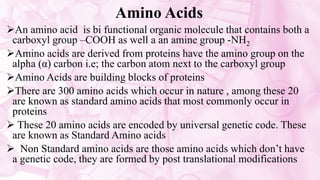
An amino acid is bi functional organic molecule that contains both a
carboxyl group –COOH as well a an amine group -NH2
Amino acids are derived from proteins have the amino group on the
alpha (α) carbon i.e; the carbon atom next to the carboxyl group
Amino Acids are building blocks of proteins
There are 300 amino acids which occur in nature , among these 20
are known as standard amino acids that most commonly occur in
proteins
 These 20 amino acids are encoded by universal genetic code. These
are known as Standard Amino acids
 Non Standard amino acids are those amino acids which don’t have
a genetic code, they are formed by post translational modifications
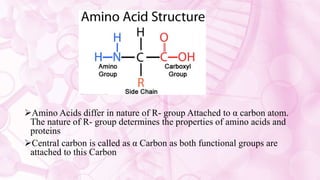
Amino Acids differ in nature of R- group Attached to α carbon atom.
The nature of R- group determines the properties of amino acids and
proteins
Central carbon is called as α Carbon as both functional groups are
attached to this Carbon
Amino Acids
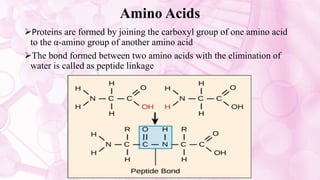
Proteins are formed by joining the carboxyl group of one amino acid
to the α-amino group of another amino acid
The bond formed between two amino acids with the elimination of
water is called as peptide linkage
Sr.
no
Name Abbreviation Structure
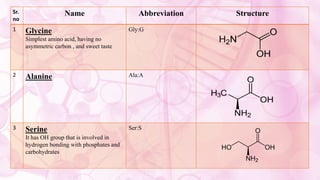
1 Glycine
Simplest amino acid, having no
asymmetric carbon , and sweet taste
Gly:G
2 Alanine Ala:A
3 Serine
It has OH group that is involved in
hydrogen bonding with phosphates and
carbohydrates
Ser:S
Sr.
no
Name Abbreviation Structure
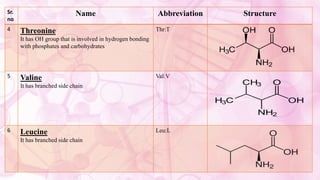
4 Threonine
It has OH group that is involved in hydrogen bonding
with phosphates and carbohydrates
Thr:T
5 Valine
It has branched side chain
Val:V
6 Leucine
It has branched side chain
Leu:L
Sr.
no
Name Abbreviation Structure
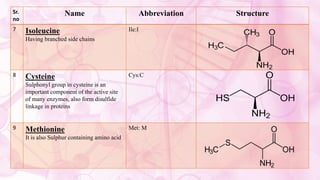
7 Isoleucine
Having branched side chains
Ile:I
8 Cysteine
Sulphonyl group in cysteine is an
important component of the active site
of many enzymes, also form disulfide
linkage in proteins
Cys:C
9 Methionine
It is also Sulphur containing amino acid
Met: M
Sr.
no
Name Abbreviation Structure
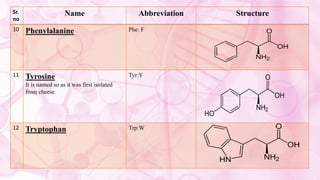
10 Phenylalanine Phe: F
11 Tyrosine
It is named so as it was first isolated
from cheese
Tyr:Y
12 Tryptophan Trp:W
Sr.
no
Name Abbreviation Structure
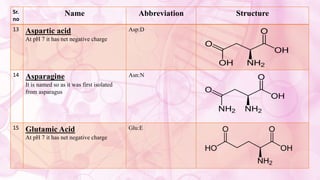
13 Aspartic acid
At pH 7 it has net negative charge
Asp:D
14 Asparagine
It is named so as it was first isolated
from asparagus
Asn:N
15 Glutamic Acid
At pH 7 it has net negative charge
Glu:E
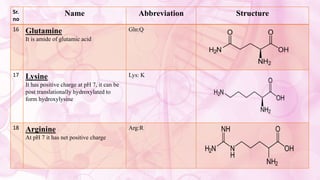
Sr.
no
Name Abbreviation Structure
16 Glutamine
It is amide of glutamic acid
Gln:Q
17 Lysine
It has positive charge at pH 7, it can be
post translationally hydroxylated to
form hydroxylysine
Lys: K
18 Arginine
At pH 7 it has net positive charge
Arg:R
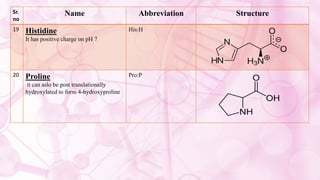
Sr.
no
Name Abbreviation Structure
19 Histidine
It has positive charge on pH 7
His:H
20 Proline
it can aslo be post translationally
hydroxylated to form 4-hydroxyproline
Pro:P
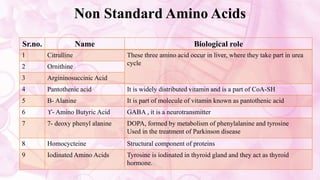
Non Standard Amino Acids
Sr.no. Name Biological role
1 Citrulline These three amino acid occur in liver, where they take part in urea
cycle
2 Ornithine
3 Argininosuccinic Acid
4 Pantothenic acid It is widely distributed vitamin and is a part of CoA-SH
5 Β- Alanine It is part of molecule of vitamin known as pantothenic acid
6 ϒ- Amino Butyric Acid GABA , it is a neurotransmitter
7 7- deoxy phenyl alanine DOPA, formed by metabolism of phenylalanine and tyrosine
Used in the treatment of Parkinson disease
8 Homocycteine Structural component of proteins
9 Iodinated Amino Acids Tyrosine is iodinated in thyroid gland and they act as thyroid
hormone.
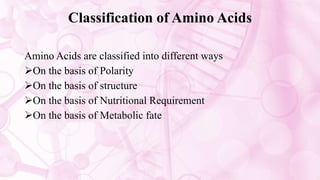
Classification of Amino Acids
Amino Acids are classified into different ways
On the basis of Polarity
On the basis of structure
On the basis of Nutritional Requirement
On the basis of Metabolic fate
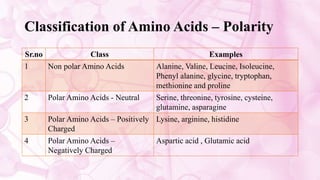
Classification of Amino Acids – Polarity
Sr.no Class Examples
1 Non polar Amino Acids Alanine, Valine, Leucine, Isoleucine,
Phenyl alanine, glycine, tryptophan,
methionine and proline
2 Polar Amino Acids - Neutral Serine, threonine, tyrosine, cysteine,
glutamine, asparagine
3 Polar Amino Acids – Positively
Charged
Lysine, arginine, histidine
4 Polar Amino Acids –
Negatively Charged
Aspartic acid , Glutamic acid
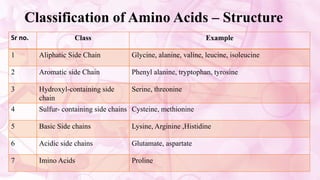
Classification of Amino Acids – Structure
Sr no. Class Example
1 Aliphatic Side Chain Glycine, alanine, valine, leucine, isoleucine
2 Aromatic side Chain Phenyl alanine, tryptophan, tyrosine
3 Hydroxyl-containing side
chain
Serine, threonine
4 Sulfur- containing side chains Cysteine, methionine
5 Basic Side chains Lysine, Arginine ,Histidine
6 Acidic side chains Glutamate, aspartate
7 Imino Acids Proline
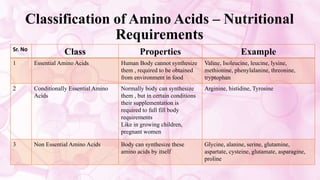
Classification of Amino Acids – Nutritional
Requirements
Sr. No
Class Properties Example
1 Essential Amino Acids Human Body cannot synthesize
them , required to be obtained
from environment in food
Valine, Isoleucine, leucine, lysine,
methionine, phenylalanine, threonine,
tryptophan
2 Conditionally Essential Amino
Acids
Normally body can synthesize
them , but in certain conditions
their supplementation is
required to full fill body
requirements
Like in growing children,
pregnant women
Arginine, histidine, Tyrosine
3 Non Essential Amino Acids Body can synthesize these
amino acids by itself
Glycine, alanine, serine, glutamine,
aspartate, cysteine, glutamate, asparagine,
proline
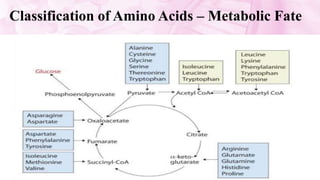
Classification of Amino Acids – Metabolic Fate
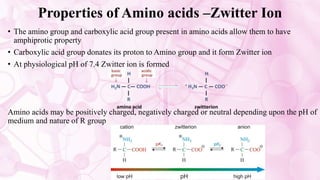
• The amino group and carboxylic acid group present in amino acids allow them to have
amphiprotic property
• Carboxylic acid group donates its proton to Amino group and it form Zwitter ion
• At physiological pH of 7.4 Zwitter ion is formed
Amino acids may be positively charged, negatively charged or neutral depending upon the pH of
medium and nature of R group
Properties of Amino acids –Zwitter Ion
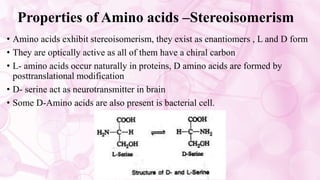
Properties of Amino acids –Stereoisomerism
• Amino acids exhibit stereoisomerism, they exist as enantiomers , L and D form
• They are optically active as all of them have a chiral carbon
• L- amino acids occur naturally in proteins, D amino acids are formed by
posttranslational modification
• D- serine act as neurotransmitter in brain
• Some D-Amino acids are also present is bacterial cell.
Sources of Amino Acids-Protein
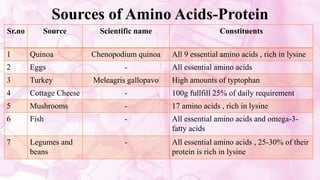
Sr.no Source Scientific name Constituents
1 Quinoa Chenopodium quinoa All 9 essential amino acids , rich in lysine
2 Eggs - All essential amino acids
3 Turkey Meleagris gallopavo High amounts of typtophan
4 Cottage Cheese - 100g fullfill 25% of daily requirement
5 Mushrooms - 17 amino acids , rich in lysine
6 Fish - All essential amino acids and omega-3-
fatty acids
7 Legumes and
beans
- All essential amino acids , 25-30% of their
protein is rich in lysine
Amino Acids-As Drug
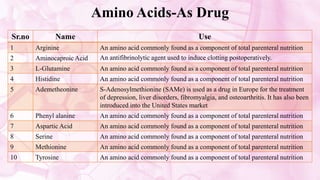
Sr.no Name Use
1 Arginine An amino acid commonly found as a component of total parenteral nutrition
2 Aminocaproic Acid An antifibrinolytic agent used to induce clotting postoperatively.
3 L-Glutamine An amino acid commonly found as a component of total parenteral nutrition
4 Histidine An amino acid commonly found as a component of total parenteral nutrition
5 Ademetheonine S-Adenosylmethionine (SAMe) is used as a drug in Europe for the treatment
of depression, liver disorders, fibromyalgia, and osteoarthritis. It has also been
introduced into the United States market
6 Phenyl alanine An amino acid commonly found as a component of total parenteral nutrition
7 Aspartic Acid An amino acid commonly found as a component of total parenteral nutrition
8 Serine An amino acid commonly found as a component of total parenteral nutrition
9 Methionine An amino acid commonly found as a component of total parenteral nutrition
10 Tyrosine An amino acid commonly found as a component of total parenteral nutrition
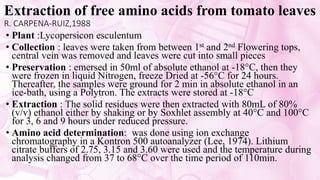
Extraction of free amino acids from tomato leaves
R. CARPENA-RUIZ,1988
• Plant :Lycopersicon esculentum
• Collection : leaves were taken from between 1st and 2nd Flowering tops,
central vein was removed and leaves were cut into small pieces
• Preservation : emersed in 50ml of absolute ethanol at -18°C, then they
were frozen in liquid Nitrogen, freeze Dried at -56°C for 24 hours.
Thereafter, the samples were ground for 2 min in absolute ethanol in an
ice-bath, using a Polytron. The extracts were stored at -18°C
• Extraction : The solid residues were then extracted with 80mL of 80%
(v/v) ethanol either by shaking or by Soxhlet assembly at 40°C and 100°C
for 3, 6 and 9 hours under reduced pressure.
• Amino acid determination: was done using ion exchange
chromatography in a Kontron 500 autoanalyzer (Lee, 1974). Lithium
citrate buffers of 2.75, 3.15 and 3.60 were used and the temperature during
analysis changed from 37 to 68°C over the time period of 110min.
Extraction of free amino acids from tomato leaves
R. CARPENA-RUIZ,1988
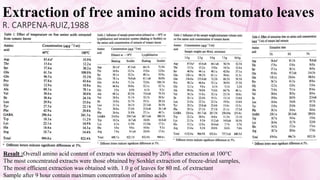
Result :Overall amino acid content of extracts was decreased by 20% after extraction at 100°C
The most concentrated extracts were those obtained by Soxhlet extraction of freeze-dried samples,
The most efficient extraction was obtained with. 1.0 g of leaves for 80 mL of extractant
Sample after 9 hour contain maximum concentration of amino acids
THANK YOU

6. AMINO ACIDS.pptx

  • 1.
    Chemistry of NaturalProducts AMINO ACIDS Presented to: Dr. Syeda Abida Ejaz Presented by : Aamna Khatoon M.Phil pharmaceutical Chemistry 1st Semester Spring 2021-2023 .
  • 2.
    Amino Acids An aminoacid is bi functional organic molecule that contains both a carboxyl group –COOH as well a an amine group -NH2 Amino acids are derived from proteins have the amino group on the alpha (α) carbon i.e; the carbon atom next to the carboxyl group Amino Acids are building blocks of proteins There are 300 amino acids which occur in nature , among these 20 are known as standard amino acids that most commonly occur in proteins  These 20 amino acids are encoded by universal genetic code. These are known as Standard Amino acids  Non Standard amino acids are those amino acids which don’t have a genetic code, they are formed by post translational modifications
  • 3.
    Amino Acids differin nature of R- group Attached to α carbon atom. The nature of R- group determines the properties of amino acids and proteins Central carbon is called as α Carbon as both functional groups are attached to this Carbon
  • 4.
    Amino Acids Proteins areformed by joining the carboxyl group of one amino acid to the α-amino group of another amino acid The bond formed between two amino acids with the elimination of water is called as peptide linkage
  • 5.
    Sr. no Name Abbreviation Structure 1Glycine Simplest amino acid, having no asymmetric carbon , and sweet taste Gly:G 2 Alanine Ala:A 3 Serine It has OH group that is involved in hydrogen bonding with phosphates and carbohydrates Ser:S
  • 6.
    Sr. no Name Abbreviation Structure 4Threonine It has OH group that is involved in hydrogen bonding with phosphates and carbohydrates Thr:T 5 Valine It has branched side chain Val:V 6 Leucine It has branched side chain Leu:L
  • 7.
    Sr. no Name Abbreviation Structure 7Isoleucine Having branched side chains Ile:I 8 Cysteine Sulphonyl group in cysteine is an important component of the active site of many enzymes, also form disulfide linkage in proteins Cys:C 9 Methionine It is also Sulphur containing amino acid Met: M
  • 8.
    Sr. no Name Abbreviation Structure 10Phenylalanine Phe: F 11 Tyrosine It is named so as it was first isolated from cheese Tyr:Y 12 Tryptophan Trp:W
  • 9.
    Sr. no Name Abbreviation Structure 13Aspartic acid At pH 7 it has net negative charge Asp:D 14 Asparagine It is named so as it was first isolated from asparagus Asn:N 15 Glutamic Acid At pH 7 it has net negative charge Glu:E
  • 10.
    Sr. no Name Abbreviation Structure 16Glutamine It is amide of glutamic acid Gln:Q 17 Lysine It has positive charge at pH 7, it can be post translationally hydroxylated to form hydroxylysine Lys: K 18 Arginine At pH 7 it has net positive charge Arg:R
  • 11.
    Sr. no Name Abbreviation Structure 19Histidine It has positive charge on pH 7 His:H 20 Proline it can aslo be post translationally hydroxylated to form 4-hydroxyproline Pro:P
  • 12.
    Non Standard AminoAcids Sr.no. Name Biological role 1 Citrulline These three amino acid occur in liver, where they take part in urea cycle 2 Ornithine 3 Argininosuccinic Acid 4 Pantothenic acid It is widely distributed vitamin and is a part of CoA-SH 5 Β- Alanine It is part of molecule of vitamin known as pantothenic acid 6 ϒ- Amino Butyric Acid GABA , it is a neurotransmitter 7 7- deoxy phenyl alanine DOPA, formed by metabolism of phenylalanine and tyrosine Used in the treatment of Parkinson disease 8 Homocycteine Structural component of proteins 9 Iodinated Amino Acids Tyrosine is iodinated in thyroid gland and they act as thyroid hormone.
  • 13.
    Classification of AminoAcids Amino Acids are classified into different ways On the basis of Polarity On the basis of structure On the basis of Nutritional Requirement On the basis of Metabolic fate
  • 14.
    Classification of AminoAcids – Polarity Sr.no Class Examples 1 Non polar Amino Acids Alanine, Valine, Leucine, Isoleucine, Phenyl alanine, glycine, tryptophan, methionine and proline 2 Polar Amino Acids - Neutral Serine, threonine, tyrosine, cysteine, glutamine, asparagine 3 Polar Amino Acids – Positively Charged Lysine, arginine, histidine 4 Polar Amino Acids – Negatively Charged Aspartic acid , Glutamic acid
  • 15.
    Classification of AminoAcids – Structure Sr no. Class Example 1 Aliphatic Side Chain Glycine, alanine, valine, leucine, isoleucine 2 Aromatic side Chain Phenyl alanine, tryptophan, tyrosine 3 Hydroxyl-containing side chain Serine, threonine 4 Sulfur- containing side chains Cysteine, methionine 5 Basic Side chains Lysine, Arginine ,Histidine 6 Acidic side chains Glutamate, aspartate 7 Imino Acids Proline
  • 16.
    Classification of AminoAcids – Nutritional Requirements Sr. No Class Properties Example 1 Essential Amino Acids Human Body cannot synthesize them , required to be obtained from environment in food Valine, Isoleucine, leucine, lysine, methionine, phenylalanine, threonine, tryptophan 2 Conditionally Essential Amino Acids Normally body can synthesize them , but in certain conditions their supplementation is required to full fill body requirements Like in growing children, pregnant women Arginine, histidine, Tyrosine 3 Non Essential Amino Acids Body can synthesize these amino acids by itself Glycine, alanine, serine, glutamine, aspartate, cysteine, glutamate, asparagine, proline
  • 17.
    Classification of AminoAcids – Metabolic Fate
  • 18.
    • The aminogroup and carboxylic acid group present in amino acids allow them to have amphiprotic property • Carboxylic acid group donates its proton to Amino group and it form Zwitter ion • At physiological pH of 7.4 Zwitter ion is formed Amino acids may be positively charged, negatively charged or neutral depending upon the pH of medium and nature of R group Properties of Amino acids –Zwitter Ion
  • 19.
    Properties of Aminoacids –Stereoisomerism • Amino acids exhibit stereoisomerism, they exist as enantiomers , L and D form • They are optically active as all of them have a chiral carbon • L- amino acids occur naturally in proteins, D amino acids are formed by posttranslational modification • D- serine act as neurotransmitter in brain • Some D-Amino acids are also present is bacterial cell.
  • 20.
    Sources of AminoAcids-Protein Sr.no Source Scientific name Constituents 1 Quinoa Chenopodium quinoa All 9 essential amino acids , rich in lysine 2 Eggs - All essential amino acids 3 Turkey Meleagris gallopavo High amounts of typtophan 4 Cottage Cheese - 100g fullfill 25% of daily requirement 5 Mushrooms - 17 amino acids , rich in lysine 6 Fish - All essential amino acids and omega-3- fatty acids 7 Legumes and beans - All essential amino acids , 25-30% of their protein is rich in lysine
  • 21.
    Amino Acids-As Drug Sr.noName Use 1 Arginine An amino acid commonly found as a component of total parenteral nutrition 2 Aminocaproic Acid An antifibrinolytic agent used to induce clotting postoperatively. 3 L-Glutamine An amino acid commonly found as a component of total parenteral nutrition 4 Histidine An amino acid commonly found as a component of total parenteral nutrition 5 Ademetheonine S-Adenosylmethionine (SAMe) is used as a drug in Europe for the treatment of depression, liver disorders, fibromyalgia, and osteoarthritis. It has also been introduced into the United States market 6 Phenyl alanine An amino acid commonly found as a component of total parenteral nutrition 7 Aspartic Acid An amino acid commonly found as a component of total parenteral nutrition 8 Serine An amino acid commonly found as a component of total parenteral nutrition 9 Methionine An amino acid commonly found as a component of total parenteral nutrition 10 Tyrosine An amino acid commonly found as a component of total parenteral nutrition
  • 22.
    Extraction of freeamino acids from tomato leaves R. CARPENA-RUIZ,1988 • Plant :Lycopersicon esculentum • Collection : leaves were taken from between 1st and 2nd Flowering tops, central vein was removed and leaves were cut into small pieces • Preservation : emersed in 50ml of absolute ethanol at -18°C, then they were frozen in liquid Nitrogen, freeze Dried at -56°C for 24 hours. Thereafter, the samples were ground for 2 min in absolute ethanol in an ice-bath, using a Polytron. The extracts were stored at -18°C • Extraction : The solid residues were then extracted with 80mL of 80% (v/v) ethanol either by shaking or by Soxhlet assembly at 40°C and 100°C for 3, 6 and 9 hours under reduced pressure. • Amino acid determination: was done using ion exchange chromatography in a Kontron 500 autoanalyzer (Lee, 1974). Lithium citrate buffers of 2.75, 3.15 and 3.60 were used and the temperature during analysis changed from 37 to 68°C over the time period of 110min.
  • 23.
    Extraction of freeamino acids from tomato leaves R. CARPENA-RUIZ,1988 Result :Overall amino acid content of extracts was decreased by 20% after extraction at 100°C The most concentrated extracts were those obtained by Soxhlet extraction of freeze-dried samples, The most efficient extraction was obtained with. 1.0 g of leaves for 80 mL of extractant Sample after 9 hour contain maximum concentration of amino acids
  • 24.