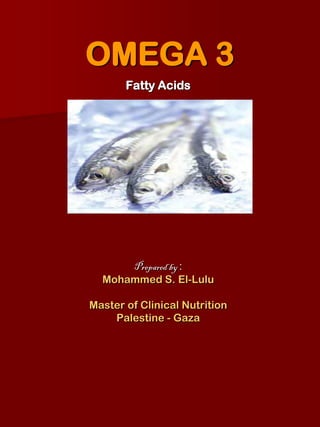
OMEGA 3
       Fatty Acids


      Prepared by :
  Mohammed S. El-Lulu

Master of Clinical Nutrition
    Palestine - Gaza
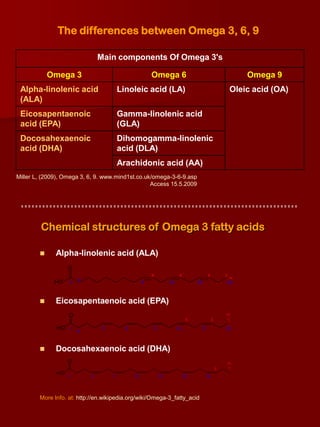
The differences between Omega 3, 6, 9

                              Main components Of Omega 3's

            Omega 3                                Omega 6                   Omega 9
 Alpha-linolenic acid                Linoleic acid (LA)                  Oleic acid (OA)
 (ALA)
 Eicosapentaenoic                    Gamma-linolenic acid
 acid (EPA)                          (GLA)
 Docosahexaenoic                     Dihomogamma-linolenic
 acid (DHA)                          acid (DLA)
                                     Arachidonic acid (AA)
Miller L, (2009), Omega 3, 6, 9. www.mind1st.co.uk/omega-3-6-9.asp
                                                  Access 15.5.2009


         Chemical structures of Omega 3 fatty acids

             Alpha-linolenic acid (ALA)


             Eicosapentaenoic acid (EPA)


             Docosahexaenoic acid (DHA)


        More Info. at: http://en.wikipedia.org/wiki/Omega-3_fatty_acid
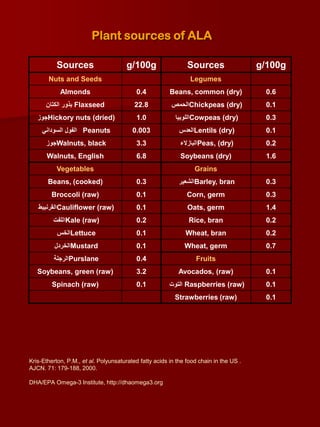
Plant sources of ALA

           Sources                     g/100g                  Sources                  g/100g
       Nuts and Seeds                                           Legumes
            Almonds                        0.4          Beans, common (dry)              0.6
      ‫ بذور الكتان‬Flaxseed                22.8           ‫الحمص‬Chickpeas (dry)            0.1
   ‫جوز‬Hickory nuts (dried)                 1.0            ‫اللوبيا‬Cowpeas (dry)           0.3
     ‫ الفول السوداني‬Peanuts              0.003              ‫العدس‬Lentils (dry)           0.1
      ‫جوز‬Walnuts, black                    3.3              ‫البازالء‬Peas, (dry)          0.2
       Walnuts, English                    6.8              Soybeans (dry)               1.6
           Vegetables                                             Grains
       Beans, (cooked)                     0.3              ‫الشعير‬Barley, bran           0.3
        Broccoli (raw)                     0.1                 Corn, germ                0.3
   ‫القرنبيط‬Cauliflower (raw)               0.1                 Oats, germ                1.4
         ‫اللفت‬Kale (raw)                   0.2                  Rice, bran               0.2
           ‫الخس‬Lettuce                     0.1                Wheat, bran                0.2
          ‫الخردل‬Mustard                    0.1                Wheat, germ                0.7
         ‫الرجلة‬Purslane                    0.4                    Fruits
   Soybeans, green (raw)                   3.2             Avocados, (raw)               0.1
         Spinach (raw)                     0.1          ‫ التوت‬Raspberries (raw)          0.1
                                                          Strawberries (raw)             0.1


Kris-Etherton, P.M., et al. Polyunsaturated fatty acids in the food chain in the US .
AJCN. 71: 179-188, 2000.

DHA/EPA Omega-3 Institute, http://dhaomega3.org
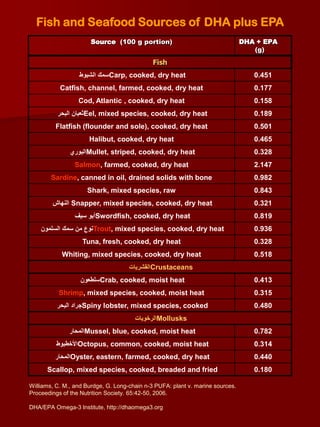
Fish and Seafood Sources of DHA plus EPA
                      Source (100 g portion)                                    DHA + EPA
                                                                                   (g)
                                              Fish
                  ‫سمك الشبوط‬Carp, cooked, dry heat                                 0.451
           Catfish, channel, farmed, cooked, dry heat                              0.177
                  Cod, Atlantic , cooked, dry heat                                 0.158
          ‫ثعبان البحر‬Eel, mixed species, cooked, dry heat                          0.189
         Flatfish (flounder and sole), cooked, dry heat                            0.501
                      Halibut, cooked, dry heat                                    0.465
               ‫البوري‬Mullet, striped, cooked, dry heat                             0.328
                Salmon, farmed, cooked, dry heat                                   2.147
        Sardine, canned in oil, drained solids with bone                           0.982
                     Shark, mixed species, raw                                     0.843
        ‫ النهاش‬Snapper, mixed species, cooked, dry heat                            0.321
                 ‫أبو سيف‬Swordfish, cooked, dry heat                                0.819
    ‫نوع من سمك السلمون‬Trout, mixed species, cooked, dry heat                       0.936
                   Tuna, fresh, cooked, dry heat                                   0.328
            Whiting, mixed species, cooked, dry heat                               0.518
                                     ‫القشريات‬Crustaceans
                   ‫سلطعون‬Crab, cooked, moist heat                                  0.413
           Shrimp, mixed species, cooked, moist heat                               0.315
          ‫جراد البحر‬Spiny lobster, mixed species, cooked                           0.480
                                       ‫الرخويات‬Mollusks
               ‫المحار‬Mussel, blue, cooked, moist heat                              0.782
          ‫األخطبوط‬Octopus, common, cooked, moist heat                              0.314
         ‫المحار‬Oyster, eastern, farmed, cooked, dry heat                           0.440
      Scallop, mixed species, cooked, breaded and fried                            0.180

Williams, C. M., and Burdge, G. Long-chain n-3 PUFA: plant v. marine sources.
Proceedings of the Nutrition Society. 65:42-50, 2006.

DHA/EPA Omega-3 Institute, http://dhaomega3.org
The differences between Plants and
   Seafood sources of Omega 3

Omega-3 fatty acids are the least stable fats in our
diet. Whole grains contain lots of vit-E to keep the
omega 3 fresh and prevent them from turning rancid,
but omega 3 fatty acids in fish are not protected by
vit-E and therefore turn rancid much more quickly
than the omega 3 fatty acids in whole grains.

Omega 3 found in fish oils are mostly long chain
fatty acids. Omega 3 in plants, contain much shorter
chains and are weaker than the omega 3 found in
fish. However, the shorter chain omega 3 (ALA),
are converted to the long chain fatty acids in the
human body. Long- chain fish omega 3 enter blood
and cells more rapidly and produce more rapid
effects than short chain
plant omega-3s.
The differences between Plants and
        Seafood sources of Omega 3 (Cont)


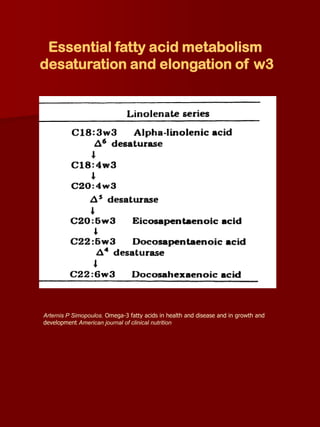
 The conversion of alpha-linolenic acid to EPA and
 DHA involves a series of chemical reactions. One
 of the first reactions in this series is catalyzed by
 the enzyme delta-6 desaturase. Further down the
 line is a reaction that is catalyzed by the enzyme
 delta-5 desaturase.


     To increase the activity of your desaturase
     enzymes, be sure that your diet includes a
     sufficient amount of
     vitamin B6, vitamin B3, vitamin C, magnesium
     and zinc.


Simopoulos AP. Omega-3 fatty acids in wild plants, nuts and seeds. Asia Pacific Journal of Clinical Nutrition,
2002, Vol 11, Suppl. 6, pp S163-S173.

More Info. at: www.DrMirkin.com
Essential fatty acid metabolism
desaturation and elongation of w3


Arternis P Simopoulos. Omega-3 fatty acids in health and disease and in growth and
development American journal of clinical nutrition
How it Functions
 What are the functions of omega 3 fatty acids?


   Every cell in our body is surrounded by a cell
    membrane composed mainly of fatty acids.
    The cell membrane allows the proper amounts
    of necessary nutrients to enter the cell, and
    ensures that waste products are quickly
    removed from the cell.

A- Promoting Healthy Cell Membranes

To perform these functions optimally, however,
the cell membrane must maintain its integrity and
fluidity. Cells without a healthy membrane lose
their ability to hold water and vital nutrients. They
also lose their ability to communicate with other
cells. Researchers believe that loss of cell to cell
communication is one of the physiological events
that leads to growth of cancerous tumors.

(especially Breast cancer via several
mechanisms):
A- Promoting Healthy Cell Membranes
                                                                                            (cont.)


1- inhibiting a pro-inflammatory enzyme called
   cyclooxygenase 2 (COX 2), which promotes
    breast cancer.

2- activating a type of receptor in cell membranes
   called peroxisome proliferator-activated receptor
   (PPAR)-ã, which can shut down proliferative
   activity.
3- increasing the expression of BRCA1 and BRCA2,
   tumor suppressor genes that, when functioning
   normally, help repair damage to DNA, thus helping
   to prevent cancer development.


 Bernard-Gallon DJ, Vissac-Sabatier C, Antoine-Vincent D et al. Differential effects of n-3 and n-6
 polyunsaturated fatty acids on BRCA1 and BRCA2 gene expression in breast cell lines. Br J Nutr 2002
 Apr;87(4):281-9 2002.

 Source: International Journal of Cancer
 More Info. at: http://www.whfoods.com/genpage.php?tname=nutrient&dbid=84
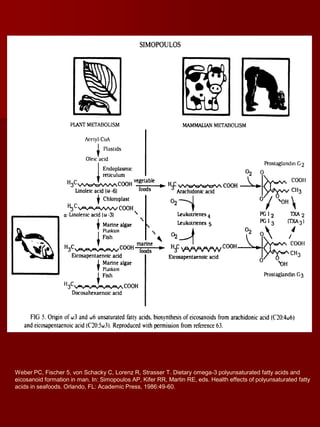
B- Prostaglandin Production


   Omega 3 fats play an important role in
    the production of powerful hormone-
    like substances called prostaglandins.
    Prostaglandins help regulate many
    important physiological functions
    including blood pressure, blood
    clotting, nerve transmission, the
    inflammatory and allergic responses,
    the functions of the kidneys and
    gastrointestinal tract, and the
    production of other hormones.


    Source: The George Mateljan Foundation
    More Info. at: http://www.whfoods.com/genpage.php?tname=nutrient&dbid=84
Weber PC, Fischer 5, von Schacky C, Lorenz R, Strasser T. Dietary omega-3 polyunsaturated fatty acids and
eicosanoid formation in man. In: Simopoulos AP, Kifer RR, Martin RE, eds. Health effects of polyunsaturated fatty
acids in seafoods. Orlando, FL: Academic Press, 1986:49-60.
C- EPA Directly
          Anti-Inflammatory
     A recently identified lipid product, that our
      bodies make from EPA, called resolvins, helps
      explain how this omega-3 fat provides anti-
      inflammatory effects on our joints and
      improves blood flow.

     Resolvins, which have been shown to reduce
      inflammation in animal studies, are made from
      EPA by our cellular enzymes, and work by
      inhibiting the production and regulating the
      migration of inflammatory cells and chemicals
      to sites of inflammation. Unlike anti-
      inflammatory drugs, such as aspirin,
      ibuprofen and the COX-2 inhibitors, the
      resolvins our bodies produce from EPA do not
      have negative side effects on our
      gastrointestinal or cardiovascular systems.


Arita M, Bianchini F, Aliberti J, Sher A, Chiang N, Hong S, Yang R, Petasis NA, Serhan CN. Stereochemical
assignment, antiinflammatory properties, and receptor for the omega-3 lipid mediator resolvin E1. J Exp Med.
2005 Mar 7;201(5):713-22. 2005. PMID:15753205.

Source: The George Mateljan Foundation
More Info. at: http://www.whfoods.com/genpage.php?tname=nutrient&dbid=84
Function of Omega 3
   Reduce inflammation throughout your body

   Keep your blood from clotting excessively

   Maintain the fluidity of your cell membranes

   lower the amount of lipids (fats such as
    cholesterol, vLDL, and triglycerides)
    circulating in the bloodstream

   decrease platelet aggregation, preventing
    excessive blood clotting

   inhibit thickening of the arteries by decreasing
    endothelial cells' production of a platelet-
    derived growth factor (the lining of the arteries
    is composed of endothelial cells)
Function of Omega 3
                                                                                                 (cont.)

          increase the activity of another chemical
           derived from endothelial cells (endothelium-
           derived nitric oxide), which causes arteries to
           relax and dilate

          reduce the production of messenger
           chemicals called cytokines, which are
           involved in the inflammatory response
           associated with atherosclerosis

          reduce the risk of becoming obese and
           improve the body's ability to respond to
           insulin by stimulating the secretion of leptin, a
           hormone that helps regulate food intake, body
           weight and metabolism, and is expressed
           primarily by adipocytes (fat cells)

          help prevent cancer cell growth

1- Osmundsen H, Clouet P. Metabolic effects of omega-3 fatty acids. Biofactors 2000;13(1-4):5-8 2000. PMID:15800.
2- Heller A, Koch T. [Immunonutrition with omega-3-fatty acids. Are new anti-inflammatory strategies in sight?].
   Zentralbl Chir 2000;125(2):123-36 2000. PMID:15830.
3- Popp-Snijders C, Schouten JA, Heine RJ, et al. Dietary supplementation of omega-3 polyunsaturated fatty acids
  improves insulin sensitivity in non-insulin-dependent diabetes. Diabetes Res 1987 Mar;4(3):141-7 1987. PMID:8990.
4- Severus WE, Littman AB, Stoll AL. Omega-3 fatty acids, homocysteine, and the increased risk of cardiovascular
   mortality in major depressive disorder. Harv Rev Psychiatry 2001 Nov-2001 Dec 31;9(6):280-93 2001. PMID:15780.

Source: The George Mateljan Foundation
More Info. at: http://www.whfoods.com/genpage.php?tname=nutrient&dbid=84
Health Conditions
          Omega 3 fatty acids may play a role in the
          prevention and/or treatment of the following health
          conditions:

     Alzheimer's disease
     Asthma
     Attention deficit hyperactivity disorder (ADHD)
     Bipolar disorder
     Cancer
     Cardiovascular disease
     Depression
     Diabetes
     Eczema
     High blood pressure
     Migraine headaches
     Multiple sclerosis
     Obesity
     Osteoarthritis
     Osteoporosis
     Psoriasis
     Rheumatoid arthritis


1- Osmundsen H, Clouet P. Metabolic effects of omega-3 fatty acids. Biofactors 2000;13(1-4):5-8 2000. PMID:15800.
2- Heller A, Koch T. [Immunonutrition with omega-3-fatty acids. Are new anti-inflammatory strategies in sight?].
   Zentralbl Chir 2000;125(2):123-36 2000. PMID:15830.

Source: The George Mateljan Foundation
More Info. at: http://www.whfoods.com/genpage.php?tname=nutrient&dbid=84
Deficiency Symptoms
   What are deficiency symptoms for omega 3
    fatty acids?

   Recent statistics indicate that nearly 99% of
    people in the United States do not eat enough
    omega 3 fatty acids. However, the symptoms
    of omega 3 fatty acid deficiency are very
    vague, and can often be attributed to some
    other health conditions or nutrient
    deficiencies.

   Consequently, few people (or their physicians,
    for that matter) realize that they are not
    consuming enough omega 3 fatty acids. The
    symptoms of omega 3 fatty acid deficiency
    include fatigue, dry and/or itchy skin, brittle
    hair and nails, constipation, frequent colds,
    depression, poor concentration, lack of
    physical endurance, and/or joint pain.


    Source: The George Mateljan Foundation
    More Info. at: http://www.whfoods.com/genpage.php?tname=nutrient&dbid=84
Drug-Nutrient Interactions

Fish oil supplements containing high amounts of
omega 3 fatty acids have been shown to reduce high
blood pressure in people taking cyclosporine, an
immunosuppressive drug used to prevent rejection
of transplanted organs.

In addition, a high dietary intake of omega 3 fats,
especially from fish, may decrease blood pressure
and thin the blood. People taking prescription blood
pressure medications and/or anticoagulants should
consult with their physician before taking fish oil
supplements.


               Nutrient Interactions
Vitamin E, the primary fat-soluble antioxidant, protects
omega 3 fats from oxidation. Oxidation is a chemical
process that produces free radicals.


 Source: The George Mateljan Foundation
 More Info. at: http://www.whfoods.com/genpage.php?tname=nutrient&dbid=84
Omega 3 Side Effects
Omega 3 side effects & precautions depends on the source.
The most popular omega 3 supplements come from either fish oil,
flaxseed oil, & Cod liver oil.

     Fish Oil Side Effects and Precautions:

1- Possible side effects such as belching, nausea, diarrhea,
   bloating, and intestinal gas.

2- Very high doses may cause a fishy body odor and/or "fish breath".

3- In some people, fish oil supplementation has been reported to increase
    cholesterol LDL levels. However, others have reported that taking garlic
    supplements can counteract this effect.

4- Diabetes: taking large amounts of fish oil may make it more difficult to
   control blood sugar levels.

5- Fish oil may have a blood-thinning effect, it is recommended that anyone
   taking anticoagulant medications (blood thinning medications) such as
   Coumadin or taking any over-the-counter blood thinners such as aspirin,
   consult with a physician before taking any supplements.


          Cod liver oil contains both vitamin A and D, and consuming
          excessive amounts of these two vitamins can cause toxicity
          and dangerous side effects.

       Flaxseed oil appears to be safe with very few omega 3 side effects.
       Flaxseed oil may cause mild gastrointestinal symptoms as diarrhea.


    More Info at: www.nutritional-supplement-educational-centre.com/omega-3-side-effects.html
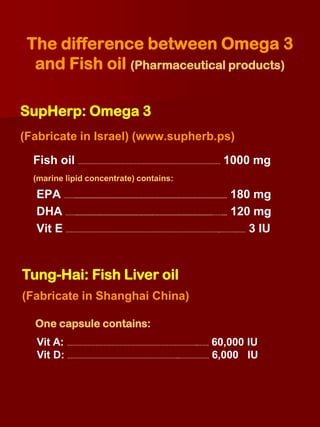
The difference between Omega 3
  and Fish oil (Pharmaceutical products)

SupHerp: Omega 3
(Fabricate in Israel) (www.supherb.ps)

  Fish oil ……………………………………………………………………………… 1000 mg
  (marine lipid concentrate) contains:

  EPA ……................................................................................................................... 180 mg
  DHA …….......................................................................................................…….... 120 mg
  Vit E ……………………………………………………………………………………..……….…… 3 IU


Tung-Hai: Fish Liver oil
(Fabricate in Shanghai China)

  One capsule contains:
  Vit A: ………………………………………………………………………..……. 60,000 IU
  Vit D: ……………………………………………………………..………………. 6,000 IU
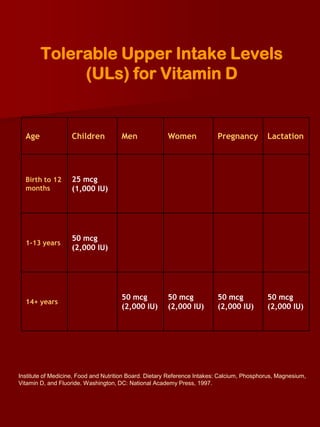
Tolerable Upper Intake Levels
             (ULs) for Vitamin D


  Age              Children           Men              Women              Pregnancy         Lactation


  Birth to 12      25 mcg
  months           (1,000 IU)


                   50 mcg
  1-13 years
                   (2,000 IU)


                                      50 mcg           50 mcg             50 mcg            50 mcg
  14+ years
                                      (2,000 IU)       (2,000 IU)         (2,000 IU)        (2,000 IU)


Institute of Medicine, Food and Nutrition Board. Dietary Reference Intakes: Calcium, Phosphorus, Magnesium,
Vitamin D, and Fluoride. Washington, DC: National Academy Press, 1997.
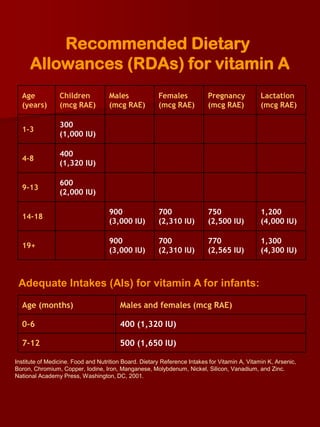
Recommended Dietary
     Allowances (RDAs) for vitamin A
  Age            Children           Males              Females            Pregnancy            Lactation
  (years)        (mcg RAE)          (mcg RAE)          (mcg RAE)          (mcg RAE)            (mcg RAE)

                 300
  1-3
                 (1,000 IU)

                 400
  4-8
                 (1,320 IU)

                 600
  9-13
                 (2,000 IU)

                                    900                700                750                  1,200
  14-18
                                    (3,000 IU)         (2,310 IU)         (2,500 IU)           (4,000 IU)

                                    900                700                770                  1,300
  19+
                                    (3,000 IU)         (2,310 IU)         (2,565 IU)           (4,300 IU)


 Adequate Intakes (AIs) for vitamin A for infants:

  Age (months)                          Males and females (mcg RAE)

  0-6                                   400 (1,320 IU)

  7-12                                  500 (1,650 IU)

Institute of Medicine. Food and Nutrition Board. Dietary Reference Intakes for Vitamin A, Vitamin K, Arsenic,
Boron, Chromium, Copper, Iodine, Iron, Manganese, Molybdenum, Nickel, Silicon, Vanadium, and Zinc.
National Academy Press, Washington, DC, 2001.
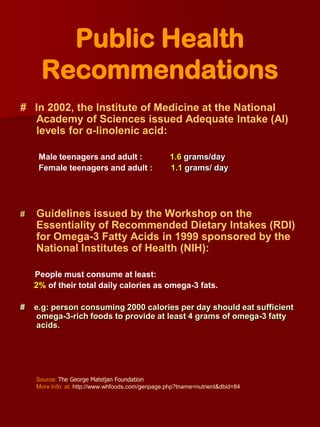
Public Health
     Recommendations
# In 2002, the Institute of Medicine at the National
  Academy of Sciences issued Adequate Intake (AI)
  levels for α-linolenic acid:

     Male teenagers and adult :                    1.6 grams/day
     Female teenagers and adult :                  1.1 grams/ day


#   Guidelines issued by the Workshop on the
    Essentiality of Recommended Dietary Intakes (RDI)
    for Omega-3 Fatty Acids in 1999 sponsored by the
    National Institutes of Health (NIH):

    People must consume at least:
    2% of their total daily calories as omega-3 fats.

#   e.g: person consuming 2000 calories per day should eat sufficient
    omega-3-rich foods to provide at least 4 grams of omega-3 fatty
    acids.


    Source: The George Mateljan Foundation
    More Info. at: http://www.whfoods.com/genpage.php?tname=nutrient&dbid=84
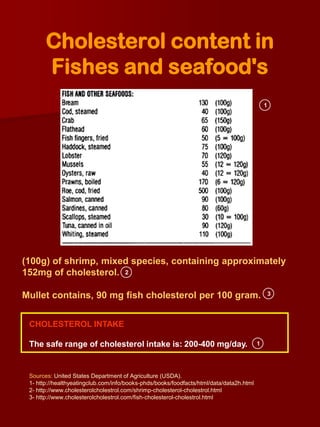
Cholesterol content in
       Fishes and seafood's
                                                                                             1


(100g) of shrimp, mixed species, containing approximately
152mg of cholesterol. 2

Mullet contains, 90 mg fish cholesterol per 100 gram.                                            3


 CHOLESTEROL INTAKE

 The safe range of cholesterol intake is: 200-400 mg/day.                                1


 Sources: United States Department of Agriculture (USDA).
 1- http://healthyeatingclub.com/info/books-phds/books/foodfacts/html/data/data2h.html
 2- http://www.cholesterolcholestrol.com/shrimp-cholesterol-cholestrol.html
 3- http://www.cholesterolcholestrol.com/fish-cholesterol-cholestrol.html
Salmon


Spiny lobster


Oyster


Mullet

Omega 3

  • 1.
    OMEGA 3 Fatty Acids Prepared by : Mohammed S. El-Lulu Master of Clinical Nutrition Palestine - Gaza
  • 2.
    The differences betweenOmega 3, 6, 9 Main components Of Omega 3's Omega 3 Omega 6 Omega 9 Alpha-linolenic acid Linoleic acid (LA) Oleic acid (OA) (ALA) Eicosapentaenoic Gamma-linolenic acid acid (EPA) (GLA) Docosahexaenoic Dihomogamma-linolenic acid (DHA) acid (DLA) Arachidonic acid (AA) Miller L, (2009), Omega 3, 6, 9. www.mind1st.co.uk/omega-3-6-9.asp Access 15.5.2009 Chemical structures of Omega 3 fatty acids  Alpha-linolenic acid (ALA)  Eicosapentaenoic acid (EPA)  Docosahexaenoic acid (DHA) More Info. at: http://en.wikipedia.org/wiki/Omega-3_fatty_acid
  • 3.
    Plant sources ofALA Sources g/100g Sources g/100g Nuts and Seeds Legumes Almonds 0.4 Beans, common (dry) 0.6 ‫ بذور الكتان‬Flaxseed 22.8 ‫الحمص‬Chickpeas (dry) 0.1 ‫جوز‬Hickory nuts (dried) 1.0 ‫اللوبيا‬Cowpeas (dry) 0.3 ‫ الفول السوداني‬Peanuts 0.003 ‫العدس‬Lentils (dry) 0.1 ‫جوز‬Walnuts, black 3.3 ‫البازالء‬Peas, (dry) 0.2 Walnuts, English 6.8 Soybeans (dry) 1.6 Vegetables Grains Beans, (cooked) 0.3 ‫الشعير‬Barley, bran 0.3 Broccoli (raw) 0.1 Corn, germ 0.3 ‫القرنبيط‬Cauliflower (raw) 0.1 Oats, germ 1.4 ‫اللفت‬Kale (raw) 0.2 Rice, bran 0.2 ‫الخس‬Lettuce 0.1 Wheat, bran 0.2 ‫الخردل‬Mustard 0.1 Wheat, germ 0.7 ‫الرجلة‬Purslane 0.4 Fruits Soybeans, green (raw) 3.2 Avocados, (raw) 0.1 Spinach (raw) 0.1 ‫ التوت‬Raspberries (raw) 0.1 Strawberries (raw) 0.1 Kris-Etherton, P.M., et al. Polyunsaturated fatty acids in the food chain in the US . AJCN. 71: 179-188, 2000. DHA/EPA Omega-3 Institute, http://dhaomega3.org
  • 4.
    Fish and SeafoodSources of DHA plus EPA Source (100 g portion) DHA + EPA (g) Fish ‫سمك الشبوط‬Carp, cooked, dry heat 0.451 Catfish, channel, farmed, cooked, dry heat 0.177 Cod, Atlantic , cooked, dry heat 0.158 ‫ثعبان البحر‬Eel, mixed species, cooked, dry heat 0.189 Flatfish (flounder and sole), cooked, dry heat 0.501 Halibut, cooked, dry heat 0.465 ‫البوري‬Mullet, striped, cooked, dry heat 0.328 Salmon, farmed, cooked, dry heat 2.147 Sardine, canned in oil, drained solids with bone 0.982 Shark, mixed species, raw 0.843 ‫ النهاش‬Snapper, mixed species, cooked, dry heat 0.321 ‫أبو سيف‬Swordfish, cooked, dry heat 0.819 ‫نوع من سمك السلمون‬Trout, mixed species, cooked, dry heat 0.936 Tuna, fresh, cooked, dry heat 0.328 Whiting, mixed species, cooked, dry heat 0.518 ‫القشريات‬Crustaceans ‫سلطعون‬Crab, cooked, moist heat 0.413 Shrimp, mixed species, cooked, moist heat 0.315 ‫جراد البحر‬Spiny lobster, mixed species, cooked 0.480 ‫الرخويات‬Mollusks ‫المحار‬Mussel, blue, cooked, moist heat 0.782 ‫األخطبوط‬Octopus, common, cooked, moist heat 0.314 ‫المحار‬Oyster, eastern, farmed, cooked, dry heat 0.440 Scallop, mixed species, cooked, breaded and fried 0.180 Williams, C. M., and Burdge, G. Long-chain n-3 PUFA: plant v. marine sources. Proceedings of the Nutrition Society. 65:42-50, 2006. DHA/EPA Omega-3 Institute, http://dhaomega3.org
  • 5.
    The differences betweenPlants and Seafood sources of Omega 3 Omega-3 fatty acids are the least stable fats in our diet. Whole grains contain lots of vit-E to keep the omega 3 fresh and prevent them from turning rancid, but omega 3 fatty acids in fish are not protected by vit-E and therefore turn rancid much more quickly than the omega 3 fatty acids in whole grains. Omega 3 found in fish oils are mostly long chain fatty acids. Omega 3 in plants, contain much shorter chains and are weaker than the omega 3 found in fish. However, the shorter chain omega 3 (ALA), are converted to the long chain fatty acids in the human body. Long- chain fish omega 3 enter blood and cells more rapidly and produce more rapid effects than short chain plant omega-3s.
  • 6.
    The differences betweenPlants and Seafood sources of Omega 3 (Cont) The conversion of alpha-linolenic acid to EPA and DHA involves a series of chemical reactions. One of the first reactions in this series is catalyzed by the enzyme delta-6 desaturase. Further down the line is a reaction that is catalyzed by the enzyme delta-5 desaturase. To increase the activity of your desaturase enzymes, be sure that your diet includes a sufficient amount of vitamin B6, vitamin B3, vitamin C, magnesium and zinc. Simopoulos AP. Omega-3 fatty acids in wild plants, nuts and seeds. Asia Pacific Journal of Clinical Nutrition, 2002, Vol 11, Suppl. 6, pp S163-S173. More Info. at: www.DrMirkin.com
  • 7.
    Essential fatty acidmetabolism desaturation and elongation of w3 Arternis P Simopoulos. Omega-3 fatty acids in health and disease and in growth and development American journal of clinical nutrition
  • 8.
    How it Functions What are the functions of omega 3 fatty acids?  Every cell in our body is surrounded by a cell membrane composed mainly of fatty acids. The cell membrane allows the proper amounts of necessary nutrients to enter the cell, and ensures that waste products are quickly removed from the cell. A- Promoting Healthy Cell Membranes To perform these functions optimally, however, the cell membrane must maintain its integrity and fluidity. Cells without a healthy membrane lose their ability to hold water and vital nutrients. They also lose their ability to communicate with other cells. Researchers believe that loss of cell to cell communication is one of the physiological events that leads to growth of cancerous tumors. (especially Breast cancer via several mechanisms):
  • 9.
    A- Promoting HealthyCell Membranes (cont.) 1- inhibiting a pro-inflammatory enzyme called cyclooxygenase 2 (COX 2), which promotes breast cancer. 2- activating a type of receptor in cell membranes called peroxisome proliferator-activated receptor (PPAR)-ã, which can shut down proliferative activity. 3- increasing the expression of BRCA1 and BRCA2, tumor suppressor genes that, when functioning normally, help repair damage to DNA, thus helping to prevent cancer development. Bernard-Gallon DJ, Vissac-Sabatier C, Antoine-Vincent D et al. Differential effects of n-3 and n-6 polyunsaturated fatty acids on BRCA1 and BRCA2 gene expression in breast cell lines. Br J Nutr 2002 Apr;87(4):281-9 2002. Source: International Journal of Cancer More Info. at: http://www.whfoods.com/genpage.php?tname=nutrient&dbid=84
  • 10.
    B- Prostaglandin Production  Omega 3 fats play an important role in the production of powerful hormone- like substances called prostaglandins. Prostaglandins help regulate many important physiological functions including blood pressure, blood clotting, nerve transmission, the inflammatory and allergic responses, the functions of the kidneys and gastrointestinal tract, and the production of other hormones. Source: The George Mateljan Foundation More Info. at: http://www.whfoods.com/genpage.php?tname=nutrient&dbid=84
  • 11.
    Weber PC, Fischer5, von Schacky C, Lorenz R, Strasser T. Dietary omega-3 polyunsaturated fatty acids and eicosanoid formation in man. In: Simopoulos AP, Kifer RR, Martin RE, eds. Health effects of polyunsaturated fatty acids in seafoods. Orlando, FL: Academic Press, 1986:49-60.
  • 12.
    C- EPA Directly Anti-Inflammatory  A recently identified lipid product, that our bodies make from EPA, called resolvins, helps explain how this omega-3 fat provides anti- inflammatory effects on our joints and improves blood flow.  Resolvins, which have been shown to reduce inflammation in animal studies, are made from EPA by our cellular enzymes, and work by inhibiting the production and regulating the migration of inflammatory cells and chemicals to sites of inflammation. Unlike anti- inflammatory drugs, such as aspirin, ibuprofen and the COX-2 inhibitors, the resolvins our bodies produce from EPA do not have negative side effects on our gastrointestinal or cardiovascular systems. Arita M, Bianchini F, Aliberti J, Sher A, Chiang N, Hong S, Yang R, Petasis NA, Serhan CN. Stereochemical assignment, antiinflammatory properties, and receptor for the omega-3 lipid mediator resolvin E1. J Exp Med. 2005 Mar 7;201(5):713-22. 2005. PMID:15753205. Source: The George Mateljan Foundation More Info. at: http://www.whfoods.com/genpage.php?tname=nutrient&dbid=84
  • 13.
    Function of Omega3  Reduce inflammation throughout your body  Keep your blood from clotting excessively  Maintain the fluidity of your cell membranes  lower the amount of lipids (fats such as cholesterol, vLDL, and triglycerides) circulating in the bloodstream  decrease platelet aggregation, preventing excessive blood clotting  inhibit thickening of the arteries by decreasing endothelial cells' production of a platelet- derived growth factor (the lining of the arteries is composed of endothelial cells)
  • 14.
    Function of Omega3 (cont.)  increase the activity of another chemical derived from endothelial cells (endothelium- derived nitric oxide), which causes arteries to relax and dilate  reduce the production of messenger chemicals called cytokines, which are involved in the inflammatory response associated with atherosclerosis  reduce the risk of becoming obese and improve the body's ability to respond to insulin by stimulating the secretion of leptin, a hormone that helps regulate food intake, body weight and metabolism, and is expressed primarily by adipocytes (fat cells)  help prevent cancer cell growth 1- Osmundsen H, Clouet P. Metabolic effects of omega-3 fatty acids. Biofactors 2000;13(1-4):5-8 2000. PMID:15800. 2- Heller A, Koch T. [Immunonutrition with omega-3-fatty acids. Are new anti-inflammatory strategies in sight?]. Zentralbl Chir 2000;125(2):123-36 2000. PMID:15830. 3- Popp-Snijders C, Schouten JA, Heine RJ, et al. Dietary supplementation of omega-3 polyunsaturated fatty acids improves insulin sensitivity in non-insulin-dependent diabetes. Diabetes Res 1987 Mar;4(3):141-7 1987. PMID:8990. 4- Severus WE, Littman AB, Stoll AL. Omega-3 fatty acids, homocysteine, and the increased risk of cardiovascular mortality in major depressive disorder. Harv Rev Psychiatry 2001 Nov-2001 Dec 31;9(6):280-93 2001. PMID:15780. Source: The George Mateljan Foundation More Info. at: http://www.whfoods.com/genpage.php?tname=nutrient&dbid=84
  • 15.
    Health Conditions Omega 3 fatty acids may play a role in the prevention and/or treatment of the following health conditions:  Alzheimer's disease  Asthma  Attention deficit hyperactivity disorder (ADHD)  Bipolar disorder  Cancer  Cardiovascular disease  Depression  Diabetes  Eczema  High blood pressure  Migraine headaches  Multiple sclerosis  Obesity  Osteoarthritis  Osteoporosis  Psoriasis  Rheumatoid arthritis 1- Osmundsen H, Clouet P. Metabolic effects of omega-3 fatty acids. Biofactors 2000;13(1-4):5-8 2000. PMID:15800. 2- Heller A, Koch T. [Immunonutrition with omega-3-fatty acids. Are new anti-inflammatory strategies in sight?]. Zentralbl Chir 2000;125(2):123-36 2000. PMID:15830. Source: The George Mateljan Foundation More Info. at: http://www.whfoods.com/genpage.php?tname=nutrient&dbid=84
  • 16.
    Deficiency Symptoms  What are deficiency symptoms for omega 3 fatty acids?  Recent statistics indicate that nearly 99% of people in the United States do not eat enough omega 3 fatty acids. However, the symptoms of omega 3 fatty acid deficiency are very vague, and can often be attributed to some other health conditions or nutrient deficiencies.  Consequently, few people (or their physicians, for that matter) realize that they are not consuming enough omega 3 fatty acids. The symptoms of omega 3 fatty acid deficiency include fatigue, dry and/or itchy skin, brittle hair and nails, constipation, frequent colds, depression, poor concentration, lack of physical endurance, and/or joint pain. Source: The George Mateljan Foundation More Info. at: http://www.whfoods.com/genpage.php?tname=nutrient&dbid=84
  • 17.
    Drug-Nutrient Interactions Fish oilsupplements containing high amounts of omega 3 fatty acids have been shown to reduce high blood pressure in people taking cyclosporine, an immunosuppressive drug used to prevent rejection of transplanted organs. In addition, a high dietary intake of omega 3 fats, especially from fish, may decrease blood pressure and thin the blood. People taking prescription blood pressure medications and/or anticoagulants should consult with their physician before taking fish oil supplements. Nutrient Interactions Vitamin E, the primary fat-soluble antioxidant, protects omega 3 fats from oxidation. Oxidation is a chemical process that produces free radicals. Source: The George Mateljan Foundation More Info. at: http://www.whfoods.com/genpage.php?tname=nutrient&dbid=84
  • 18.
    Omega 3 SideEffects Omega 3 side effects & precautions depends on the source. The most popular omega 3 supplements come from either fish oil, flaxseed oil, & Cod liver oil.  Fish Oil Side Effects and Precautions: 1- Possible side effects such as belching, nausea, diarrhea, bloating, and intestinal gas. 2- Very high doses may cause a fishy body odor and/or "fish breath". 3- In some people, fish oil supplementation has been reported to increase cholesterol LDL levels. However, others have reported that taking garlic supplements can counteract this effect. 4- Diabetes: taking large amounts of fish oil may make it more difficult to control blood sugar levels. 5- Fish oil may have a blood-thinning effect, it is recommended that anyone taking anticoagulant medications (blood thinning medications) such as Coumadin or taking any over-the-counter blood thinners such as aspirin, consult with a physician before taking any supplements. Cod liver oil contains both vitamin A and D, and consuming excessive amounts of these two vitamins can cause toxicity and dangerous side effects. Flaxseed oil appears to be safe with very few omega 3 side effects. Flaxseed oil may cause mild gastrointestinal symptoms as diarrhea. More Info at: www.nutritional-supplement-educational-centre.com/omega-3-side-effects.html
  • 19.
    The difference betweenOmega 3 and Fish oil (Pharmaceutical products) SupHerp: Omega 3 (Fabricate in Israel) (www.supherb.ps) Fish oil ……………………………………………………………………………… 1000 mg (marine lipid concentrate) contains: EPA ……................................................................................................................... 180 mg DHA …….......................................................................................................…….... 120 mg Vit E ……………………………………………………………………………………..……….…… 3 IU Tung-Hai: Fish Liver oil (Fabricate in Shanghai China) One capsule contains: Vit A: ………………………………………………………………………..……. 60,000 IU Vit D: ……………………………………………………………..………………. 6,000 IU
  • 20.
    Tolerable Upper IntakeLevels (ULs) for Vitamin D Age Children Men Women Pregnancy Lactation Birth to 12 25 mcg months (1,000 IU) 50 mcg 1-13 years (2,000 IU) 50 mcg 50 mcg 50 mcg 50 mcg 14+ years (2,000 IU) (2,000 IU) (2,000 IU) (2,000 IU) Institute of Medicine, Food and Nutrition Board. Dietary Reference Intakes: Calcium, Phosphorus, Magnesium, Vitamin D, and Fluoride. Washington, DC: National Academy Press, 1997.
  • 21.
    Recommended Dietary Allowances (RDAs) for vitamin A Age Children Males Females Pregnancy Lactation (years) (mcg RAE) (mcg RAE) (mcg RAE) (mcg RAE) (mcg RAE) 300 1-3 (1,000 IU) 400 4-8 (1,320 IU) 600 9-13 (2,000 IU) 900 700 750 1,200 14-18 (3,000 IU) (2,310 IU) (2,500 IU) (4,000 IU) 900 700 770 1,300 19+ (3,000 IU) (2,310 IU) (2,565 IU) (4,300 IU) Adequate Intakes (AIs) for vitamin A for infants: Age (months) Males and females (mcg RAE) 0-6 400 (1,320 IU) 7-12 500 (1,650 IU) Institute of Medicine. Food and Nutrition Board. Dietary Reference Intakes for Vitamin A, Vitamin K, Arsenic, Boron, Chromium, Copper, Iodine, Iron, Manganese, Molybdenum, Nickel, Silicon, Vanadium, and Zinc. National Academy Press, Washington, DC, 2001.
  • 22.
    Public Health Recommendations # In 2002, the Institute of Medicine at the National Academy of Sciences issued Adequate Intake (AI) levels for α-linolenic acid: Male teenagers and adult : 1.6 grams/day Female teenagers and adult : 1.1 grams/ day # Guidelines issued by the Workshop on the Essentiality of Recommended Dietary Intakes (RDI) for Omega-3 Fatty Acids in 1999 sponsored by the National Institutes of Health (NIH): People must consume at least: 2% of their total daily calories as omega-3 fats. # e.g: person consuming 2000 calories per day should eat sufficient omega-3-rich foods to provide at least 4 grams of omega-3 fatty acids. Source: The George Mateljan Foundation More Info. at: http://www.whfoods.com/genpage.php?tname=nutrient&dbid=84
  • 23.
    Cholesterol content in Fishes and seafood's 1 (100g) of shrimp, mixed species, containing approximately 152mg of cholesterol. 2 Mullet contains, 90 mg fish cholesterol per 100 gram. 3 CHOLESTEROL INTAKE The safe range of cholesterol intake is: 200-400 mg/day. 1 Sources: United States Department of Agriculture (USDA). 1- http://healthyeatingclub.com/info/books-phds/books/foodfacts/html/data/data2h.html 2- http://www.cholesterolcholestrol.com/shrimp-cholesterol-cholestrol.html 3- http://www.cholesterolcholestrol.com/fish-cholesterol-cholestrol.html
  • 24.