Metabolism  of amino acids    Department of Biochemistry (J.D.) 2011
Glucogenic  (13)     pyruvate and/or CAC intermediates  Ketogenic  (2)   =  Leu , Lys    acetyl-CoA + acetoacetate Mixed  (5)   =   Thr, Ile, Phe, Tyr, Trp Intermediates of amino acid catabolism
Asp Ser, Gly, Thr, Ala, Cys, Trp Intermediates of amino acid catabolism pyruvate glucose fumarate succinyl-CoA 2-oxoglutarate oxaloacetate acetoacetate
Transamination of alanine alanine aminotransferase Alanine alanine pyruvate 2-oxoglutarate glutamate
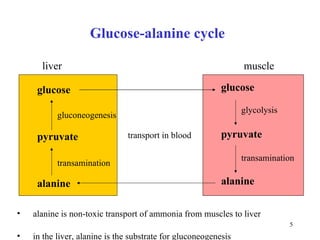
Glu c os e -alanin e  cy cle liver muscle glu c os e pyruv ate alanin e glu cose pyruv ate alanin e transamina tion gly colysis transamina tion glu c oneogene sis transport  in   blood alanine is non-toxic transport of ammonia from muscles to liver  in the liver, alanine is the substrate for gluconeogenesis
Alanine - summary readily made from pyruvate (transamination) ALT is clinically important enzyme, mainly in liver, elevated catalytic concentration in blood serum – liver diseases Ala is released to blood mainly from muscles, together with Gln  (postresorp tion phase) semiessential AA (in metabolic stress) – important substrate for gluconeogenesis
Hydrolysis of arginine    urea Arginine glutamate n o  transamina tion arginine ornithine
NO is signal molecule from arginine BH 4 Exogenous NO sources  glycerol trinitrate isosorbide dinitrate amyl nitrite isobutyl nitrite sodium nitroprusside citrulline N-hydroxyarginine nitric oxide radical
Synthesis of creatine (1. part) glycin arginine ornithine guanidinoacetate from Greek  κρέας  (meat) glycine
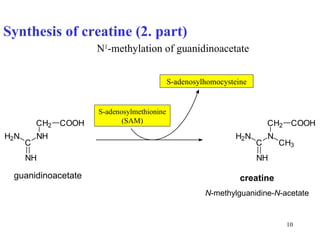
Synthesis of creatine (2. part)   N 1 -methylation of guanidinoacetate S-adenosylmethionine (SAM) S-adenosylhomocysteine creatine N -methylguanidine- N -acetate guanidinoacetate
N 2 -Phosforylation of creatine kreatin kreatinfosfát ATP creatine creatine phosphate
Creatinine is a catabolite of creatine  made in non-enzymatic reaction non-enzymatic cyclization dehydratation kreatin creatinine - H 2 O creatine
Arginine   - summery semiessential AA (childhood) the most basic AA (guanidine, p K B  = 0.5) no transamination ,  Arg releases ornithine + urea Arg + Gly + Met    creatine releases NO (vasodilator) OTC (over-the-counter) preparations in pharmacy
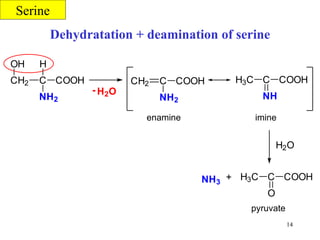
Dehydratation + deamination of serine Serine pyruvate imine enamine
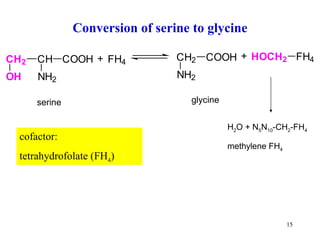
Conversion of serine to glycine H 2 O + N 5 N 10 -CH 2 -FH 4 methylene FH 4   serine glycine cofactor: tetrahydrofolate (FH 4 )
Transamination of serine and glucose formation reverse reaction:  synthesis of serine pathway is different - through   ph os ph oserin e serine hydroxypyruvate glycerate 3-P-glycerate glucose 2-oxoglutarate
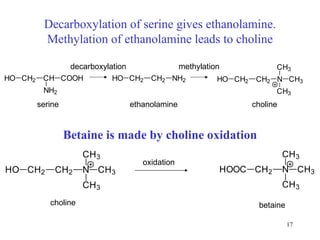
Betain e   is made by  cholin e oxidation oxida tion De c arboxyla tion of  serin e gives  ethanolamin e. Methyla tion of  ethanolamin e   leads to  cholin e de c arboxyla tion methyla tion serin e ethanolamin e cholin e betain e cholin e
Serine - summary non-essential glucogenic AA  source of C1 fragments  ( attached to tetrahydrofolate ) component of glycerophospholipids d e c arboxyla tion gives  ethanolamin e     cholin e carbon skeleton used for  selenocystein e serine side chain in proteins:   the site of phosphorylation the linkage of oligosaccharides ( O -glycoside bond) nucleophilic -OH group in  a c tiv e site of  enzym e   (serine proteases)
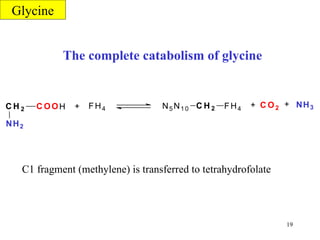
The complete catabolism of glycine C1 fragment (methylene) is transferred to tetrahydrofolate Glycine C O O H C H 2 N H 2 N 5 N 1 0 C H 2 F H 4 + + C O 2 N H 3 F H 4 +
Oxidative deamination of glycine glyoxylate oxalate
Oxal ate in human body 60 %  c atabolism  of  glycin e and  ethanolamin e 30 %  c atabolism  of  vitamin C 10 %  food  ( spinach , r hubarb , mangold,  tea ,  cocoa )
Glycine - summary Catabolism complete oxidation to CO 2  + NH 3 oxidative deamination to oxalate Anabolic conversions donor of C1 fragment serine porphyrines purine bases  creatine glutathione (GSH) conjugation agent  (bile acids, xenobiotics)
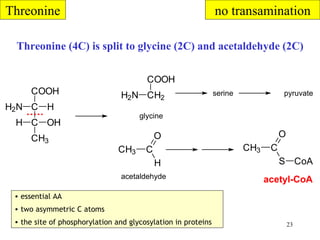
Threonine (4C) is split to glycine (2C) and acetaldehyde (2C) Threonine essential AA two asymmetric C atoms the site of phosphorylation and glycosylation in proteins n o  transamina tion glycine pyruvate serine acetaldehyde
Methionine is  methyl ation agent ( homocystein e side product) B 12 ethanolamin e noradrenalin e guanidinace tate methionine S-adenosylmethionine substrate substrate- CH 3 choline adrenalin e creatine homocysteine remethylation Methionine n o  transamina tion
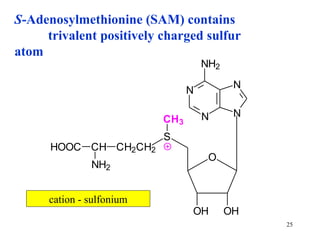
S -Adenosylmethionine (SAM)   contains   tr ivalent positively charged  s ulfur atom c ation -  sulfonium
Cysteine is made from methionine methionine homocysteine cystathionine homoserine cysteine condensation with serine cysteine release pyridoxal-P B 12 succinyl-CoA
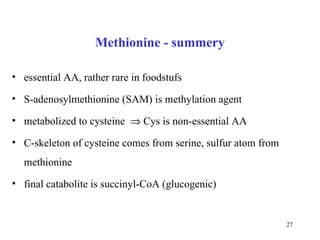
Methionine - summery essential AA, rather rare in foodstufs  S-adenosylmethionine (SAM) is methylation agent metabolized to cysteine    Cys is non-essential AA C-skeleton of cysteine comes from serine, sulfur atom from methio ni ne final catabolite is succinyl-CoA (glucogenic)
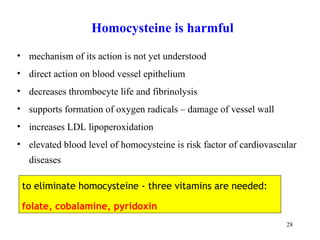
Homocystein e is harmful mechanism  of its action is not yet understood direct action on blood vessel epithelium  decreases  t h rombocyt e life and  fibrinol ysis supports formation of oxygen radicals  –  damage of vessel wall   increases LDL  lipoperoxida tion elevated blood level of homocysteine is risk factor of cardiovascular diseases to eliminate homocysteine - three vitamins are needed:  folate, cobalamine, pyridoxin
C ystein e catabolism: oxygenation of -SH group cysteine oxygenation cysteine sulfinate cysteic acid decarboxylation transamination hypotaurine taurine oxygenation sulfinylpyruvate Cysteine oxygenation
The formation of sulfite under physiol. pH – dissociation only to  HSO 3 -   sulfite sulfinylpyruvate hydrolytic cleavage of sulfite pyruvate
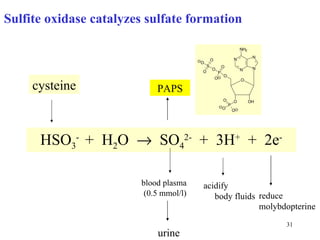
Sulfite oxidase catalyzes sulfate formation  cysteine HSO 3 -  +  H 2 O     SO 4 2-   +  3H +   +  2e - blood  pla s ma  (0 . 5 mmol/l) acidify  body fluids reduce molybdopterine PAPS urine
Distinguish anion S 2-   (e.g.  ZnS  zinc  sulfid e) Sulfid e   in organic anion  SO 4 2- Sulf ate R-S-R dialkylsulfid e Sulfid e   organic anion  SO 3 2- Sulfit e
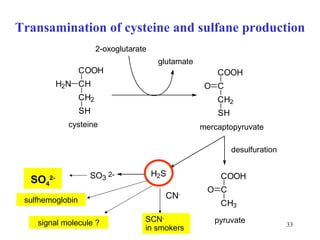
Transamination of cysteine and  sulfan e production CN - SCN -   in smokers SO 4 2- sulfhemoglobin sign al  mole c ul e  ? 2-oxoglutarate cysteine glutamate mercaptopyruvate desulfuration pyruvate
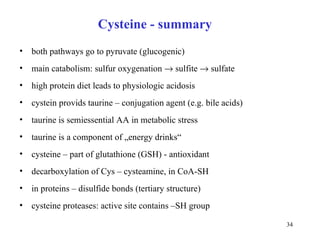
Cysteine - summary both pathways go to pyruvate (glucogenic) main catabolism: sulfur oxygenation    sulfite    sulfate high protein diet leads to physiologic acidosis cystein provids taurine – conjugation agent (e.g. bile acids)   taurine is semi e s sen tial AA in  metabolic   stre s s  taurine is a component of „ energ y drinks“ cysteine – part of glutathione (GSH) - antioxidant d e c arboxyla tion of Cys  – cysteamin e ,  in  CoA-SH in proteins  – disulfid e bonds (tertiary structure) cysteine proteases: active site contains –SH group
Six amino acids provide pyruvate 1. Serine – dehydratation + deamination 2. Glycine –  via  serine 3. Threonine –  via  glycine 4. Alanine – transamination (ALT) 5. Cysteine – both catabolic pathways 6. Tryptophan –  via  alanine  (see later)
Transamination of Asp    oxaloacetate ( C AC) AST (aspartate aminotransferase) – clinically important enzyme in urea cycle, Asp donates one nitrogen into urea and releases fumarate decarboxylation of Asp     β -alanine (part of coenzyme A) donor of nitrogen in purine  synt hesis ( fumar ate released) whole structure given for  pyrimidin e bases synthesis a spartam  (sweetener) condensation with ammonia    asparagine   (for cell utilization, not   as  detoxi c a tion of  am monia) Aspartate
β -Alanine is made by the decarboxylation of aspartate - CO 2 β α in the structure of CoA-SH
Glutamate with oxaloacetate afford aspartate (transamination) AST reaction produces aspartate for urea synthesis aspartate aminotransferase Glutamate oxaloacetate aspartate    urea glutamate 2-oxoglutarate
Dehydrogenative deamination of glutamate  is the main producer of ammonia in tissues g lutamate dehydrogenase  (GD, GDH, GMD) glutamate 2-iminoglutarate 2-oxoglutarate (CAC)
Decarboxylation of glutamate glutamate
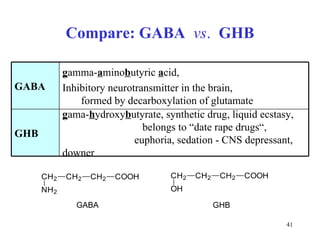
Compare: GABA  vs .   GHB GABA  GHB g ama- h ydroxy b utyrate, synthetic drug, liquid ecstasy,  belongs to “date rape drugs “ ,  euphoria, sedation - CNS depressant, downer GHB g amma- a mino b utyric  a cid, Inhibitory neurotransmitter in the brain,  formed by decarboxylation of glutamate GABA
Chinese restaurant syndrome after ingestion of larger amounts of  monosodium glutamate (MSG, E621) taste enhancer  – e.g. instant soups, soya souce, etc. burning sensations, numbness, tingling, feelings of warmth, facial pressure  or tightness, chest pain, headache, nausea, rapid heartbeat, bronchospasm in people with asthma, drowsiness, weakness ... MSG is not recommended for children
Glutamate - summary produced in the transaminations of most AA glutamate dehydrogenase reaction produces most ammonia in body transaminations are reversible, so glutamate can be converted to  2-oxoglutarate (glucogenic) Glu  +  NH 3      Gln (ammonia detoxification) glutamate is readily made from glutamine, histidine, proline, ornithine pure monosodium glutamate, flavour enhancer, can cause health problems (chinese restaurant syndrome)
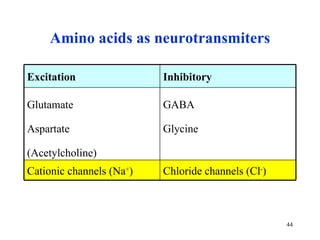
Amino  acids as  neurotransmiter s Chlorid e channels  (Cl - ) C ation ic channels  (Na + ) GABA Glycin e Glutam ate Aspart ate (Acetylcholin e ) Inhibi tory Excita tion
See also the previous lecture (AA-1) glutamine synthesis is the way of ammonia detoxification in tissues including liver in kidneys, glutamine releases ammonia (deamidation) metabolic fuel for some tissues  (enterocyt es , fibroblast s , lym ph ocyt es , ma c ro pha g es ) donor  of nitrogen for syntheses  (glu c osamin e , purin es ) Glutam in e
T hree   amino acids   donate  four  N  atom s in purine bases synthesis fumar ate glutam ate aspartate glycine amide group  of glutamine amide group  of glutamine
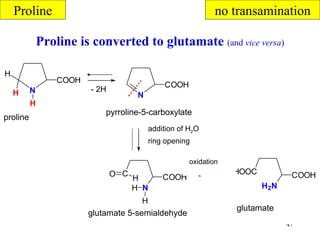
Proline is converted to glutamate  (and  vice versa ) proline   glutamate   5-semialdehyde   glutamate   pyrroline-5-carboxylate   oxidation   addition of H 2 O ring opening   Proline n o  transamina tion
Hydroxylation of proline with 2-oxoglutarate as reductant - CO 2 proline 2-oxoglutarate 4-hydroxyproline succinate Fe 2+ ascorbate
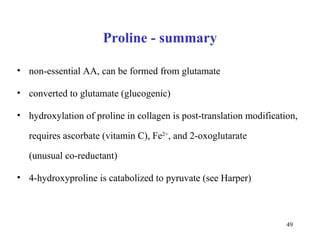
Proline - summary non-essential AA, can be formed from glutamate converted to glutamate (glucogenic)  hydroxylation of proline in collagen is post-translation modification, requires ascorbate (vitamin C), Fe 2+ , and 2-oxoglutarate   (unusual co-reductant) 4-hydroxyproline is catabolized to pyruvate (see Harper)
Ca tabolism  of  histidin e starts with  desatura tion  and deamination urocanic acid (urocanate) Histidine n o  transamin ation
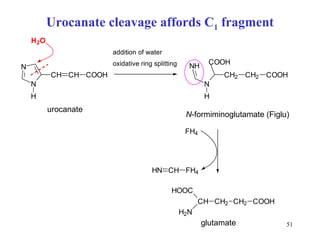
Urocanate cleavage affords C 1  fragment FIGLU urocanate N -formiminoglutamate (Figlu) glutamate addition of water oxidative ring splitting
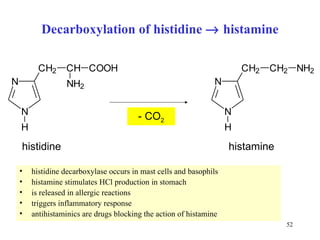
Decarboxylation of histidine    histamine histidine decarboxylase occurs in mast cells and basophils histamine stimulates HCl production in stomach  is released in allergic reactions  triggers inflammatory response antihistaminics are drugs blocking the action of histamine - CO 2 histidine histamine
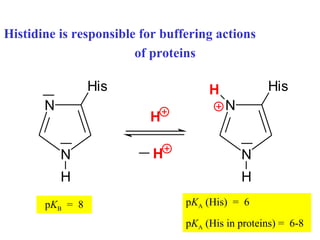
Histidine is responsible for buffering actions  of proteins p K B   =   8 p K A  (His)   =   6 p K A  (His  in proteins ) =  6-8
Histidine - summary semiessential AA  no transamination, catabolism begins with desaturation and deamination the source of 1C groups (formimino) converted to glutamate (glucogenic) histidine is abundant in  hemoglobin –  buffer system post - transla tion modification:  methyla tion of  His  in  a c tin e /myosin e     3-methylhistidin e  –  its urine  ex c re tion is the indicator of muscle  proteol ysis and nutrition status
Leucine (1) - transamination + decarboxylation  Leucine, Isoleucine, Valine (BCAA) branched 2-oxoacid oxidative decarboxylation branched acyl-CoA transamination
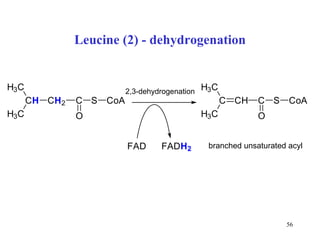
Leucine (2) - dehydrogenation 2,3-dehydrogenation branched unsaturated acyl
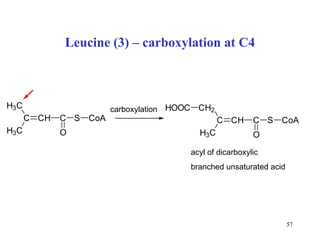
Leucine (3) – carboxylation at C4 carboxylation acyl of dicarboxylic branched unsaturated acid
Leucine (4) – hydratation of double bond
Leucine (5) – splitting the C-C bond in HMG-CoA HMG-CoA lyase acetoacetate
Compare the final products of BCAA B 12 B 12 glucogenic succinyl-CoA Valine  ketogenic glucogenic acetyl-CoA + succinyl-CoA Isoleucine  ketogenic acetyl-CoA + acetoacetate Leucine
BCAA - summery all BCAA are essential  the first three reactions are the same (transamination, oxid. decarboxylation, dehydrogenation), final products are different  leucine – ketogenic, valine – glucogenic, isoleucine – mixed after meal, BCAA make about 70 % of AA in blood, because the liver does not utilize them (lack of aminotransferases) BCAA are most utilized in muscles and brain  BCAA infusion are applied in severe catabolic conditions
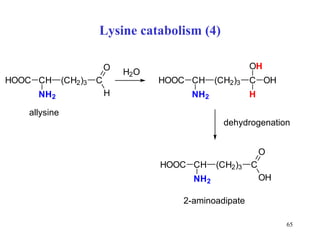
Lysine catabolism (1) Lysine n o  transamina tion lysine 2-oxoglutarate ketimine (Schiff base)
Lysine catabolism (2) ketimine hydrogenation  dehydrogenation  saccharopine aldimine
Lysine catabolism (3) hydrolysis aldimine allysine  glutamate
Lysine catabolism (4) allysine  dehydrogenation  2-aminoadipate
Lysine catabolism (5) 2-aminoadipate 2-oxoglutarate transamination 2-oxoadipate glutamate
Lysine is the substrate for carnitine  (the transfer of FA from cytosol to mitochondria) carnitine  acylcarnitine
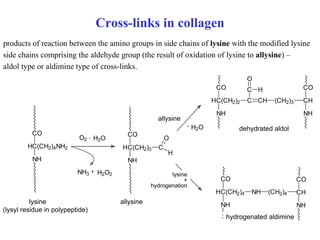
Cross-links in collagen hydrogenated aldimine lysine (lysyl residue in polypeptide)   dehydrated aldol  allysine allysine lysine + hydrogenation products of reaction between the amino groups in side   chains of  lysine  with the modified lysine side chains comprising   the aldehyde group (the result of oxidation of lysine to  allysine ) –  aldol type or aldimine type of cross-links.
Formation of fibrin clot during blood coagulation  (cross-linking of fibrin) lysine glutamine cross-linking
Lysine - summary essential AA, no transamination ε -amino group is removed as glutamate  -amino group is removed from aminoadipate by transamination final product acetyl-CoA (ketogenic) Other conversions:   lysin e in many proteins binds  ubi qu itin ( targeting for  proteasom e ) carnitine (transport system for FA to mitochondria) d e c arboxyla tion    c adaverin e in collagen: cross bridges, hydroxylation     hydroxylysin e in fibrin: cross linking during blood coagulation
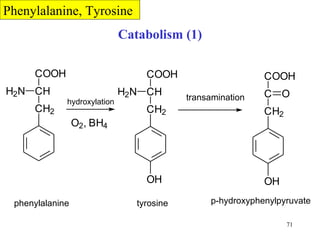
Catabolism (1) Phenylalanine, Tyrosine hydroxylation transamination phenylalanine tyrosine p-hydroxyphenylpyruvate
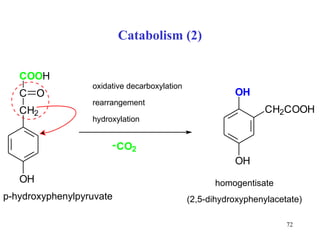
Catabolism (2) p-hydroxy ph enylpyruv ate homogentisate (2,5-dihydroxyphenylacetate) oxidative decarboxylation rearrangement hydroxylation
Catabolism (3) oxidative cleavage  of aromatic ring dioxygenase maleylacetoacetate
Catabolism (4) maleylacetoacetate fumarylacetoacetate isomeration
Catabolism (5) fumarylacetoacetate fumarate  acetoacetate
Hyperphenylalaninemia and Phenylketonuria deficit of hydroxylase or BH 4 elevated blood Phe and its metabolites  excretion of phenylpyruvate  by urine  phenylalanine tyrosine hydroxylase
Metabolites of phenylalanine phenylalanine phenylpyruvate transamination oxid. decarboxylation phenylacetate phenyllactate hydrogenation
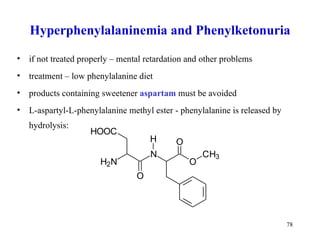
if not treated properly – mental retardation and other problems  treatment – low phenylalanine diet  products containing sweetener  aspartam  must be avoided  L-aspartyl-L-phenylalanine methyl ester - phenylalanine is released by hydrolysis:  Hyperphenylalaninemia and Phenylketonuria
Hydroxylation of phenylalanine gives  tyrosin e phenylalanine tyrosine c o - redu c tant tetrahydrobiopterin e
DOPA  a nd  dopamin e from tyrosine tyrosine dopamine (catecholamine) (3,4-dihydroxyphenylalanine) hydroxylation decarboxylation Tyrosine
Linguistic note abbreviation  DOPA   comes from older English nomenclature  oxo group and hydroxyl group were not distinguished properly: DOPA =  d i o xo p henyl a lanine correct chemical name is:  3-(3,4-dihydroxyphenyl)alanine
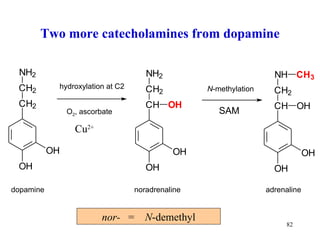
Two more catecholamines from dopamine Cu 2+ nor-   =  N -demethyl hydroxylation at C2 N -methylation dopamine noradrenaline adrenaline O 2 , ascorbate
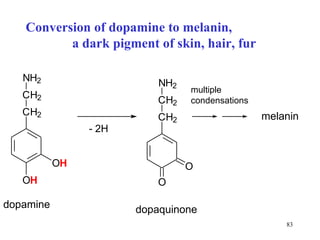
Conversion of dopamine to melanin,  a dark pigment of skin, hair, fur dopamine dopaquinone melanin multiple  condensations
Conversion of  tyrosin e   to  thyroxin e bound to  thyreoglobulin tyrosine 3’,5’-diiododtyrosine thyroxine
Phenylalanine, tyrosine - summary Phe is essential amino acid, Tyr not  Tyr  is made by Phe  hydroxyla tion ( tetrahydrobiopterin e cofactor) catabolism is the same for both AA (mixed AA) provide fumarate for CAC (glucogenic)  acetoacetate (ketone body) tyrosine is converted to hormones (catecholamines, thyronines)  and dark skin pigment melanin
Catabolism (1) O 2 Tryptophan n o  transamina tion tryptophan oxidative cleavage  of aromatic ring N -formylkynurenine
Catabolism (2) hydrolysis of  amide group formamide hydroxylation formate
Catabolism (3) hydrolytic cleavage  of alanine  3-hydroxyanthranilate
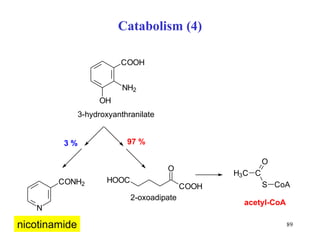
Catabolism (4) 3-hydroxyanthranilate nicotinamide 2-oxoadipate
Decarboxylation of tryptophan tryptophan tryptamine
Conversion of tryptophan to melatonin sleep-wake cycle the hormone of darkness Trp hydroxylation 5-hydroxytryptophan decarboxylation N -acetylation O -methylation
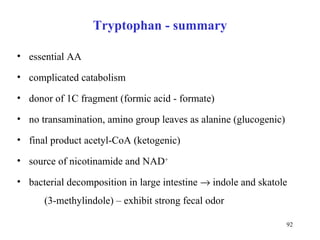
Tryptophan - summary essential AA  complicated catabolism donor  of  1C fragment (form ic acid - formate ) no transamination, amino group leaves as alanine (glucogenic) final product acetyl-CoA (ketogenic)  source of nicotinamide and NAD + bacterial decomposition in large intestine    indole and skatole   (3-methylindol e )  – exhibit strong fecal odor
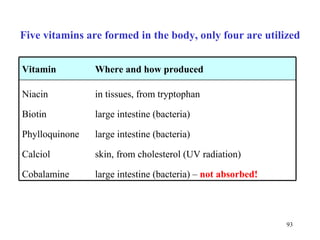
Five vitamins are formed in the body, only four are utilized in tissues, from tryptophan large intestine ( ba cteria)  large intestine ( ba cteria) skin, from  cholesterol (UV  radiation ) large intestine ( ba cteria)  –  n ot absorbed ! Niacin Biotin Ph yl l o quinone C alciol C obalamin e Where and how produced Vitamin
Seven amino acids do not undergo transamination ornithine 2-aminoadipate homoserine glycine alanine glutamate NH 3  (desaturation deamination) Arginine Lysine Methionine Threonine Tryptophan Proline Histidine  -NH 2  group is removed as Amino acid
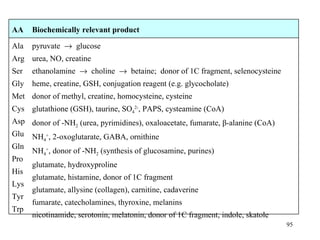
pyruv ate      glu cose urea , NO,  creatine ethanolamin e      cholin e      betain e ;  donor  of  1C fragment , selenocysteine hem e ,  c reatin e , GSH,  c onjuga tion reagent  ( e.g . gly c ochol ate ) donor  of  methyl,  c reatin e , homocystein e, cysteine glutathione ( GSH ) , taurin e , SO 4 2- ,  PAPS,  cysteamin e  (CoA) d onor  of  -NH 2  (urea, pyrimidin es ),  oxaloacetate,  fumar ate ,  β -alanin e  (CoA) NH 4 + ,  2-oxoglutar ate , GABA , ornithine NH 4 + , d onor  of  -NH 2  (synt hesis of  glu c osamin e , purin es ) glutamate,  hydroxyprolin e glutamate,  histamin e , donor  of  1C fragment glutamate,  allysin e  ( collagen ),  c arnitin e ,  c adaverin e fumar ate ,  c atecholamin es , thyroxin e , melanin s ni c otinamid e , serotonin, melatonin,   donor  of  1C fragment , indole, skatole Ala Arg Ser Gly Met Cys Asp Glu Gln Pro His Lys Tyr Trp Biochemic ally relevant  produ c t A A

Aa 2

  • 1.
    Metabolism ofamino acids  Department of Biochemistry (J.D.) 2011
  • 2.
    Glucogenic (13)  pyruvate and/or CAC intermediates Ketogenic (2) = Leu , Lys  acetyl-CoA + acetoacetate Mixed (5) = Thr, Ile, Phe, Tyr, Trp Intermediates of amino acid catabolism
  • 3.
    Asp Ser, Gly,Thr, Ala, Cys, Trp Intermediates of amino acid catabolism pyruvate glucose fumarate succinyl-CoA 2-oxoglutarate oxaloacetate acetoacetate
  • 4.
    Transamination of alaninealanine aminotransferase Alanine alanine pyruvate 2-oxoglutarate glutamate
  • 5.
    Glu c ose -alanin e cy cle liver muscle glu c os e pyruv ate alanin e glu cose pyruv ate alanin e transamina tion gly colysis transamina tion glu c oneogene sis transport in blood alanine is non-toxic transport of ammonia from muscles to liver in the liver, alanine is the substrate for gluconeogenesis
  • 6.
    Alanine - summaryreadily made from pyruvate (transamination) ALT is clinically important enzyme, mainly in liver, elevated catalytic concentration in blood serum – liver diseases Ala is released to blood mainly from muscles, together with Gln (postresorp tion phase) semiessential AA (in metabolic stress) – important substrate for gluconeogenesis
  • 7.
    Hydrolysis of arginine  urea Arginine glutamate n o transamina tion arginine ornithine
  • 8.
    NO is signalmolecule from arginine BH 4 Exogenous NO sources glycerol trinitrate isosorbide dinitrate amyl nitrite isobutyl nitrite sodium nitroprusside citrulline N-hydroxyarginine nitric oxide radical
  • 9.
    Synthesis of creatine(1. part) glycin arginine ornithine guanidinoacetate from Greek κρέας (meat) glycine
  • 10.
    Synthesis of creatine(2. part) N 1 -methylation of guanidinoacetate S-adenosylmethionine (SAM) S-adenosylhomocysteine creatine N -methylguanidine- N -acetate guanidinoacetate
  • 11.
    N 2 -Phosforylationof creatine kreatin kreatinfosfát ATP creatine creatine phosphate
  • 12.
    Creatinine is acatabolite of creatine made in non-enzymatic reaction non-enzymatic cyclization dehydratation kreatin creatinine - H 2 O creatine
  • 13.
    Arginine - summery semiessential AA (childhood) the most basic AA (guanidine, p K B = 0.5) no transamination , Arg releases ornithine + urea Arg + Gly + Met  creatine releases NO (vasodilator) OTC (over-the-counter) preparations in pharmacy
  • 14.
    Dehydratation + deaminationof serine Serine pyruvate imine enamine
  • 15.
    Conversion of serineto glycine H 2 O + N 5 N 10 -CH 2 -FH 4 methylene FH 4 serine glycine cofactor: tetrahydrofolate (FH 4 )
  • 16.
    Transamination of serineand glucose formation reverse reaction: synthesis of serine pathway is different - through ph os ph oserin e serine hydroxypyruvate glycerate 3-P-glycerate glucose 2-oxoglutarate
  • 17.
    Betain e is made by cholin e oxidation oxida tion De c arboxyla tion of serin e gives ethanolamin e. Methyla tion of ethanolamin e leads to cholin e de c arboxyla tion methyla tion serin e ethanolamin e cholin e betain e cholin e
  • 18.
    Serine - summarynon-essential glucogenic AA source of C1 fragments ( attached to tetrahydrofolate ) component of glycerophospholipids d e c arboxyla tion gives ethanolamin e  cholin e carbon skeleton used for selenocystein e serine side chain in proteins: the site of phosphorylation the linkage of oligosaccharides ( O -glycoside bond) nucleophilic -OH group in a c tiv e site of enzym e (serine proteases)
  • 19.
    The complete catabolismof glycine C1 fragment (methylene) is transferred to tetrahydrofolate Glycine C O O H C H 2 N H 2 N 5 N 1 0 C H 2 F H 4 + + C O 2 N H 3 F H 4 +
  • 20.
    Oxidative deamination ofglycine glyoxylate oxalate
  • 21.
    Oxal ate inhuman body 60 % c atabolism of glycin e and ethanolamin e 30 % c atabolism of vitamin C 10 % food ( spinach , r hubarb , mangold, tea , cocoa )
  • 22.
    Glycine - summaryCatabolism complete oxidation to CO 2 + NH 3 oxidative deamination to oxalate Anabolic conversions donor of C1 fragment serine porphyrines purine bases creatine glutathione (GSH) conjugation agent (bile acids, xenobiotics)
  • 23.
    Threonine (4C) issplit to glycine (2C) and acetaldehyde (2C) Threonine essential AA two asymmetric C atoms the site of phosphorylation and glycosylation in proteins n o transamina tion glycine pyruvate serine acetaldehyde
  • 24.
    Methionine is methyl ation agent ( homocystein e side product) B 12 ethanolamin e noradrenalin e guanidinace tate methionine S-adenosylmethionine substrate substrate- CH 3 choline adrenalin e creatine homocysteine remethylation Methionine n o transamina tion
  • 25.
    S -Adenosylmethionine (SAM) contains tr ivalent positively charged s ulfur atom c ation - sulfonium
  • 26.
    Cysteine is madefrom methionine methionine homocysteine cystathionine homoserine cysteine condensation with serine cysteine release pyridoxal-P B 12 succinyl-CoA
  • 27.
    Methionine - summeryessential AA, rather rare in foodstufs S-adenosylmethionine (SAM) is methylation agent metabolized to cysteine  Cys is non-essential AA C-skeleton of cysteine comes from serine, sulfur atom from methio ni ne final catabolite is succinyl-CoA (glucogenic)
  • 28.
    Homocystein e isharmful mechanism of its action is not yet understood direct action on blood vessel epithelium decreases t h rombocyt e life and fibrinol ysis supports formation of oxygen radicals – damage of vessel wall increases LDL lipoperoxida tion elevated blood level of homocysteine is risk factor of cardiovascular diseases to eliminate homocysteine - three vitamins are needed: folate, cobalamine, pyridoxin
  • 29.
    C ystein ecatabolism: oxygenation of -SH group cysteine oxygenation cysteine sulfinate cysteic acid decarboxylation transamination hypotaurine taurine oxygenation sulfinylpyruvate Cysteine oxygenation
  • 30.
    The formation ofsulfite under physiol. pH – dissociation only to HSO 3 - sulfite sulfinylpyruvate hydrolytic cleavage of sulfite pyruvate
  • 31.
    Sulfite oxidase catalyzessulfate formation cysteine HSO 3 - + H 2 O  SO 4 2- + 3H + + 2e - blood pla s ma (0 . 5 mmol/l) acidify body fluids reduce molybdopterine PAPS urine
  • 32.
    Distinguish anion S2- (e.g. ZnS zinc sulfid e) Sulfid e in organic anion SO 4 2- Sulf ate R-S-R dialkylsulfid e Sulfid e organic anion SO 3 2- Sulfit e
  • 33.
    Transamination of cysteineand sulfan e production CN - SCN - in smokers SO 4 2- sulfhemoglobin sign al mole c ul e ? 2-oxoglutarate cysteine glutamate mercaptopyruvate desulfuration pyruvate
  • 34.
    Cysteine - summaryboth pathways go to pyruvate (glucogenic) main catabolism: sulfur oxygenation  sulfite  sulfate high protein diet leads to physiologic acidosis cystein provids taurine – conjugation agent (e.g. bile acids) taurine is semi e s sen tial AA in metabolic stre s s taurine is a component of „ energ y drinks“ cysteine – part of glutathione (GSH) - antioxidant d e c arboxyla tion of Cys – cysteamin e , in CoA-SH in proteins – disulfid e bonds (tertiary structure) cysteine proteases: active site contains –SH group
  • 35.
    Six amino acidsprovide pyruvate 1. Serine – dehydratation + deamination 2. Glycine – via serine 3. Threonine – via glycine 4. Alanine – transamination (ALT) 5. Cysteine – both catabolic pathways 6. Tryptophan – via alanine (see later)
  • 36.
    Transamination of Asp  oxaloacetate ( C AC) AST (aspartate aminotransferase) – clinically important enzyme in urea cycle, Asp donates one nitrogen into urea and releases fumarate decarboxylation of Asp  β -alanine (part of coenzyme A) donor of nitrogen in purine synt hesis ( fumar ate released) whole structure given for pyrimidin e bases synthesis a spartam (sweetener) condensation with ammonia  asparagine (for cell utilization, not as detoxi c a tion of am monia) Aspartate
  • 37.
    β -Alanine ismade by the decarboxylation of aspartate - CO 2 β α in the structure of CoA-SH
  • 38.
    Glutamate with oxaloacetateafford aspartate (transamination) AST reaction produces aspartate for urea synthesis aspartate aminotransferase Glutamate oxaloacetate aspartate  urea glutamate 2-oxoglutarate
  • 39.
    Dehydrogenative deamination ofglutamate is the main producer of ammonia in tissues g lutamate dehydrogenase (GD, GDH, GMD) glutamate 2-iminoglutarate 2-oxoglutarate (CAC)
  • 40.
  • 41.
    Compare: GABA vs . GHB GABA GHB g ama- h ydroxy b utyrate, synthetic drug, liquid ecstasy, belongs to “date rape drugs “ , euphoria, sedation - CNS depressant, downer GHB g amma- a mino b utyric a cid, Inhibitory neurotransmitter in the brain, formed by decarboxylation of glutamate GABA
  • 42.
    Chinese restaurant syndromeafter ingestion of larger amounts of monosodium glutamate (MSG, E621) taste enhancer – e.g. instant soups, soya souce, etc. burning sensations, numbness, tingling, feelings of warmth, facial pressure or tightness, chest pain, headache, nausea, rapid heartbeat, bronchospasm in people with asthma, drowsiness, weakness ... MSG is not recommended for children
  • 43.
    Glutamate - summaryproduced in the transaminations of most AA glutamate dehydrogenase reaction produces most ammonia in body transaminations are reversible, so glutamate can be converted to 2-oxoglutarate (glucogenic) Glu + NH 3  Gln (ammonia detoxification) glutamate is readily made from glutamine, histidine, proline, ornithine pure monosodium glutamate, flavour enhancer, can cause health problems (chinese restaurant syndrome)
  • 44.
    Amino acidsas neurotransmiter s Chlorid e channels (Cl - ) C ation ic channels (Na + ) GABA Glycin e Glutam ate Aspart ate (Acetylcholin e ) Inhibi tory Excita tion
  • 45.
    See also theprevious lecture (AA-1) glutamine synthesis is the way of ammonia detoxification in tissues including liver in kidneys, glutamine releases ammonia (deamidation) metabolic fuel for some tissues (enterocyt es , fibroblast s , lym ph ocyt es , ma c ro pha g es ) donor of nitrogen for syntheses (glu c osamin e , purin es ) Glutam in e
  • 46.
    T hree amino acids donate four N atom s in purine bases synthesis fumar ate glutam ate aspartate glycine amide group of glutamine amide group of glutamine
  • 47.
    Proline is convertedto glutamate (and vice versa ) proline glutamate 5-semialdehyde glutamate pyrroline-5-carboxylate oxidation addition of H 2 O ring opening Proline n o transamina tion
  • 48.
    Hydroxylation of prolinewith 2-oxoglutarate as reductant - CO 2 proline 2-oxoglutarate 4-hydroxyproline succinate Fe 2+ ascorbate
  • 49.
    Proline - summarynon-essential AA, can be formed from glutamate converted to glutamate (glucogenic) hydroxylation of proline in collagen is post-translation modification, requires ascorbate (vitamin C), Fe 2+ , and 2-oxoglutarate (unusual co-reductant) 4-hydroxyproline is catabolized to pyruvate (see Harper)
  • 50.
    Ca tabolism of histidin e starts with desatura tion and deamination urocanic acid (urocanate) Histidine n o transamin ation
  • 51.
    Urocanate cleavage affordsC 1 fragment FIGLU urocanate N -formiminoglutamate (Figlu) glutamate addition of water oxidative ring splitting
  • 52.
    Decarboxylation of histidine  histamine histidine decarboxylase occurs in mast cells and basophils histamine stimulates HCl production in stomach is released in allergic reactions triggers inflammatory response antihistaminics are drugs blocking the action of histamine - CO 2 histidine histamine
  • 53.
    Histidine is responsiblefor buffering actions of proteins p K B = 8 p K A (His) = 6 p K A (His in proteins ) = 6-8
  • 54.
    Histidine - summarysemiessential AA no transamination, catabolism begins with desaturation and deamination the source of 1C groups (formimino) converted to glutamate (glucogenic) histidine is abundant in hemoglobin – buffer system post - transla tion modification: methyla tion of His in a c tin e /myosin e  3-methylhistidin e – its urine ex c re tion is the indicator of muscle proteol ysis and nutrition status
  • 55.
    Leucine (1) -transamination + decarboxylation Leucine, Isoleucine, Valine (BCAA) branched 2-oxoacid oxidative decarboxylation branched acyl-CoA transamination
  • 56.
    Leucine (2) -dehydrogenation 2,3-dehydrogenation branched unsaturated acyl
  • 57.
    Leucine (3) –carboxylation at C4 carboxylation acyl of dicarboxylic branched unsaturated acid
  • 58.
    Leucine (4) –hydratation of double bond
  • 59.
    Leucine (5) –splitting the C-C bond in HMG-CoA HMG-CoA lyase acetoacetate
  • 60.
    Compare the finalproducts of BCAA B 12 B 12 glucogenic succinyl-CoA Valine ketogenic glucogenic acetyl-CoA + succinyl-CoA Isoleucine ketogenic acetyl-CoA + acetoacetate Leucine
  • 61.
    BCAA - summeryall BCAA are essential the first three reactions are the same (transamination, oxid. decarboxylation, dehydrogenation), final products are different leucine – ketogenic, valine – glucogenic, isoleucine – mixed after meal, BCAA make about 70 % of AA in blood, because the liver does not utilize them (lack of aminotransferases) BCAA are most utilized in muscles and brain BCAA infusion are applied in severe catabolic conditions
  • 62.
    Lysine catabolism (1)Lysine n o transamina tion lysine 2-oxoglutarate ketimine (Schiff base)
  • 63.
    Lysine catabolism (2)ketimine hydrogenation dehydrogenation saccharopine aldimine
  • 64.
    Lysine catabolism (3)hydrolysis aldimine allysine glutamate
  • 65.
    Lysine catabolism (4)allysine dehydrogenation 2-aminoadipate
  • 66.
    Lysine catabolism (5)2-aminoadipate 2-oxoglutarate transamination 2-oxoadipate glutamate
  • 67.
    Lysine is thesubstrate for carnitine (the transfer of FA from cytosol to mitochondria) carnitine acylcarnitine
  • 68.
    Cross-links in collagenhydrogenated aldimine lysine (lysyl residue in polypeptide) dehydrated aldol allysine allysine lysine + hydrogenation products of reaction between the amino groups in side chains of lysine with the modified lysine side chains comprising the aldehyde group (the result of oxidation of lysine to allysine ) – aldol type or aldimine type of cross-links.
  • 69.
    Formation of fibrinclot during blood coagulation (cross-linking of fibrin) lysine glutamine cross-linking
  • 70.
    Lysine - summaryessential AA, no transamination ε -amino group is removed as glutamate  -amino group is removed from aminoadipate by transamination final product acetyl-CoA (ketogenic) Other conversions: lysin e in many proteins binds ubi qu itin ( targeting for proteasom e ) carnitine (transport system for FA to mitochondria) d e c arboxyla tion  c adaverin e in collagen: cross bridges, hydroxylation  hydroxylysin e in fibrin: cross linking during blood coagulation
  • 71.
    Catabolism (1) Phenylalanine,Tyrosine hydroxylation transamination phenylalanine tyrosine p-hydroxyphenylpyruvate
  • 72.
    Catabolism (2) p-hydroxyph enylpyruv ate homogentisate (2,5-dihydroxyphenylacetate) oxidative decarboxylation rearrangement hydroxylation
  • 73.
    Catabolism (3) oxidativecleavage of aromatic ring dioxygenase maleylacetoacetate
  • 74.
    Catabolism (4) maleylacetoacetatefumarylacetoacetate isomeration
  • 75.
  • 76.
    Hyperphenylalaninemia and Phenylketonuriadeficit of hydroxylase or BH 4 elevated blood Phe and its metabolites excretion of phenylpyruvate by urine phenylalanine tyrosine hydroxylase
  • 77.
    Metabolites of phenylalaninephenylalanine phenylpyruvate transamination oxid. decarboxylation phenylacetate phenyllactate hydrogenation
  • 78.
    if not treatedproperly – mental retardation and other problems treatment – low phenylalanine diet products containing sweetener aspartam must be avoided L-aspartyl-L-phenylalanine methyl ester - phenylalanine is released by hydrolysis: Hyperphenylalaninemia and Phenylketonuria
  • 79.
    Hydroxylation of phenylalaninegives tyrosin e phenylalanine tyrosine c o - redu c tant tetrahydrobiopterin e
  • 80.
    DOPA and dopamin e from tyrosine tyrosine dopamine (catecholamine) (3,4-dihydroxyphenylalanine) hydroxylation decarboxylation Tyrosine
  • 81.
    Linguistic note abbreviation DOPA comes from older English nomenclature oxo group and hydroxyl group were not distinguished properly: DOPA = d i o xo p henyl a lanine correct chemical name is: 3-(3,4-dihydroxyphenyl)alanine
  • 82.
    Two more catecholaminesfrom dopamine Cu 2+ nor- = N -demethyl hydroxylation at C2 N -methylation dopamine noradrenaline adrenaline O 2 , ascorbate
  • 83.
    Conversion of dopamineto melanin, a dark pigment of skin, hair, fur dopamine dopaquinone melanin multiple condensations
  • 84.
    Conversion of tyrosin e to thyroxin e bound to thyreoglobulin tyrosine 3’,5’-diiododtyrosine thyroxine
  • 85.
    Phenylalanine, tyrosine -summary Phe is essential amino acid, Tyr not Tyr is made by Phe hydroxyla tion ( tetrahydrobiopterin e cofactor) catabolism is the same for both AA (mixed AA) provide fumarate for CAC (glucogenic) acetoacetate (ketone body) tyrosine is converted to hormones (catecholamines, thyronines) and dark skin pigment melanin
  • 86.
    Catabolism (1) O2 Tryptophan n o transamina tion tryptophan oxidative cleavage of aromatic ring N -formylkynurenine
  • 87.
    Catabolism (2) hydrolysisof amide group formamide hydroxylation formate
  • 88.
    Catabolism (3) hydrolyticcleavage of alanine 3-hydroxyanthranilate
  • 89.
    Catabolism (4) 3-hydroxyanthranilatenicotinamide 2-oxoadipate
  • 90.
    Decarboxylation of tryptophantryptophan tryptamine
  • 91.
    Conversion of tryptophanto melatonin sleep-wake cycle the hormone of darkness Trp hydroxylation 5-hydroxytryptophan decarboxylation N -acetylation O -methylation
  • 92.
    Tryptophan - summaryessential AA complicated catabolism donor of 1C fragment (form ic acid - formate ) no transamination, amino group leaves as alanine (glucogenic) final product acetyl-CoA (ketogenic) source of nicotinamide and NAD + bacterial decomposition in large intestine  indole and skatole (3-methylindol e ) – exhibit strong fecal odor
  • 93.
    Five vitamins areformed in the body, only four are utilized in tissues, from tryptophan large intestine ( ba cteria) large intestine ( ba cteria) skin, from cholesterol (UV radiation ) large intestine ( ba cteria) – n ot absorbed ! Niacin Biotin Ph yl l o quinone C alciol C obalamin e Where and how produced Vitamin
  • 94.
    Seven amino acidsdo not undergo transamination ornithine 2-aminoadipate homoserine glycine alanine glutamate NH 3 (desaturation deamination) Arginine Lysine Methionine Threonine Tryptophan Proline Histidine  -NH 2 group is removed as Amino acid
  • 95.
    pyruv ate  glu cose urea , NO, creatine ethanolamin e  cholin e  betain e ; donor of 1C fragment , selenocysteine hem e , c reatin e , GSH, c onjuga tion reagent ( e.g . gly c ochol ate ) donor of methyl, c reatin e , homocystein e, cysteine glutathione ( GSH ) , taurin e , SO 4 2- , PAPS, cysteamin e (CoA) d onor of -NH 2 (urea, pyrimidin es ), oxaloacetate, fumar ate , β -alanin e (CoA) NH 4 + , 2-oxoglutar ate , GABA , ornithine NH 4 + , d onor of -NH 2 (synt hesis of glu c osamin e , purin es ) glutamate, hydroxyprolin e glutamate, histamin e , donor of 1C fragment glutamate, allysin e ( collagen ), c arnitin e , c adaverin e fumar ate , c atecholamin es , thyroxin e , melanin s ni c otinamid e , serotonin, melatonin, donor of 1C fragment , indole, skatole Ala Arg Ser Gly Met Cys Asp Glu Gln Pro His Lys Tyr Trp Biochemic ally relevant produ c t A A