BIOCHEMISTRY
   Note Outline
I. Learning Targets
• I can identify the elements commonly found in living things (C,
  H, O, and N).
• I can describe how atoms bond together to form molecules.
• I can compare the chemical structures of carbohydrates,
  lipids, proteins, and nucleic acids by describing how they form
  and are broken down.
• I can relate the importance of the 4 biomolecules to living
  things.
• I can describe the function of an enzyme and factors that
  influence enzyme activity.
II. Features of Life
 A. What is Biology?
II. Features of Life
 A. What is Biology?

       1. Definition: the study of the
          diversity of life
II. Features of Life
 A. What is Biology?

       1. Definition: the study of the
          diversity of life

       2. More specifically, biologists…
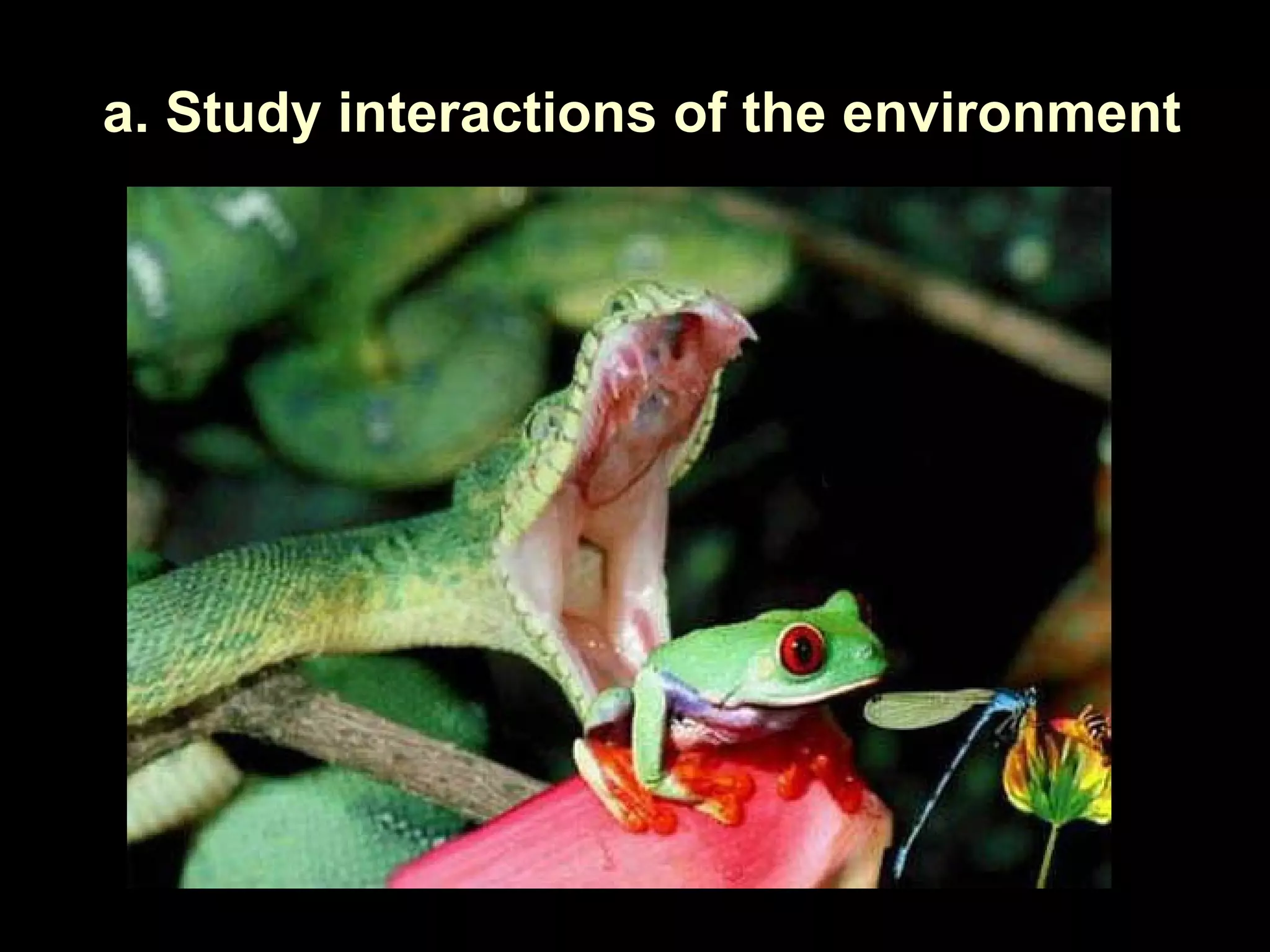
a. Study interactions of the environment
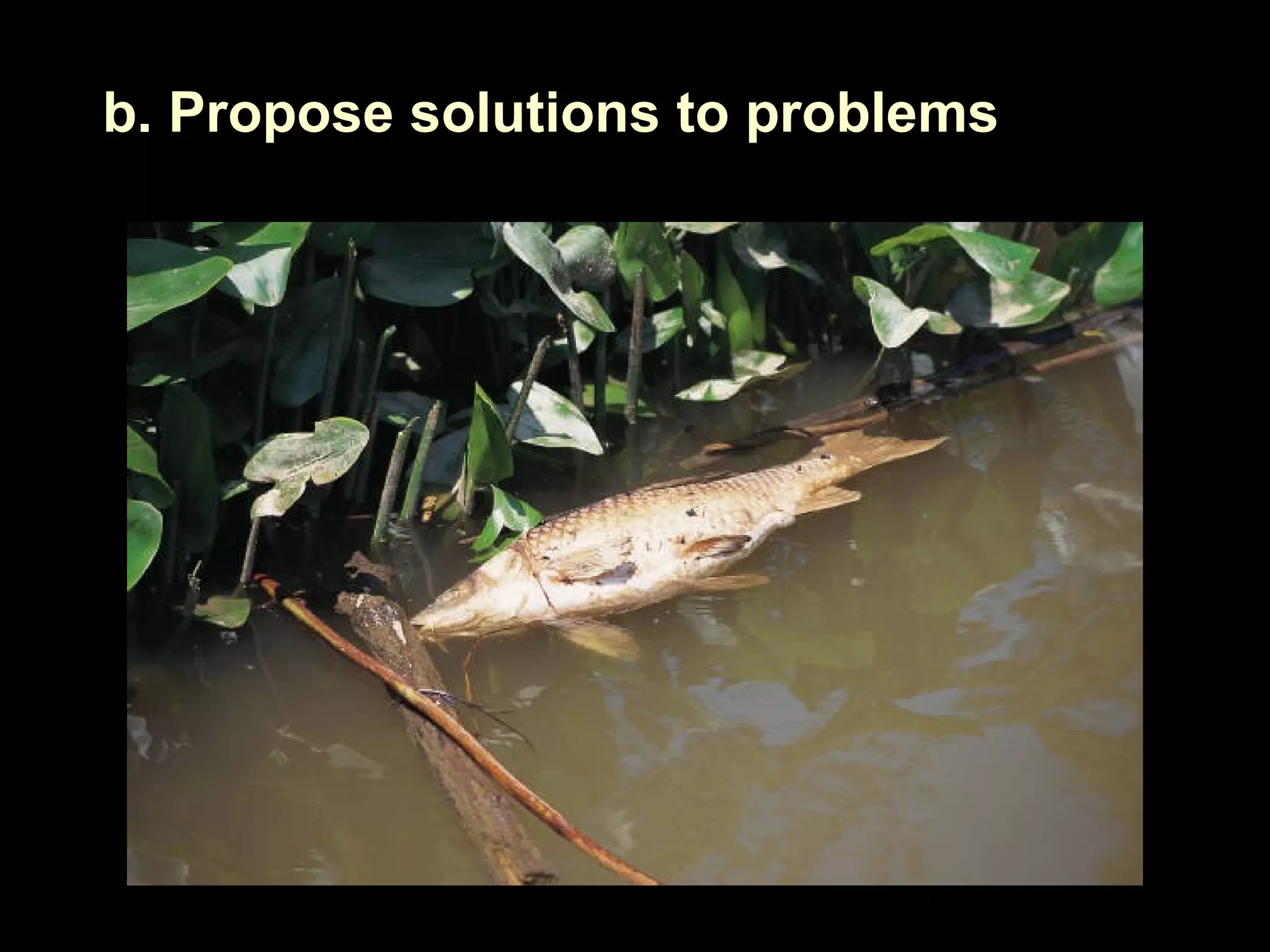
b. Propose solutions to problems
B. What Constitutes Life?

 The term living is not easy to define.

 Living things MUST contain ALL 5 of
 the following to be considered alive.
Living things…
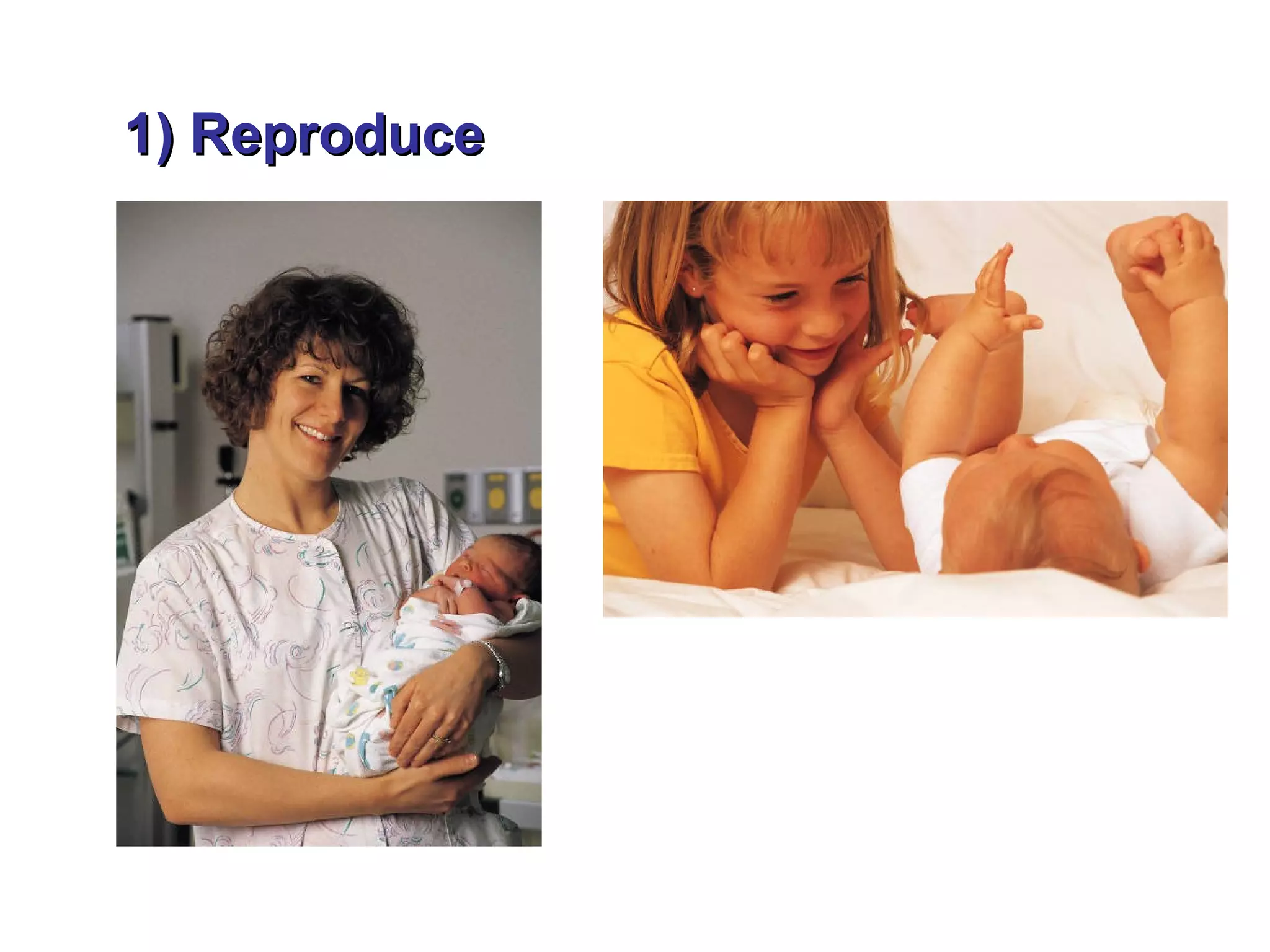
1) Reproduce
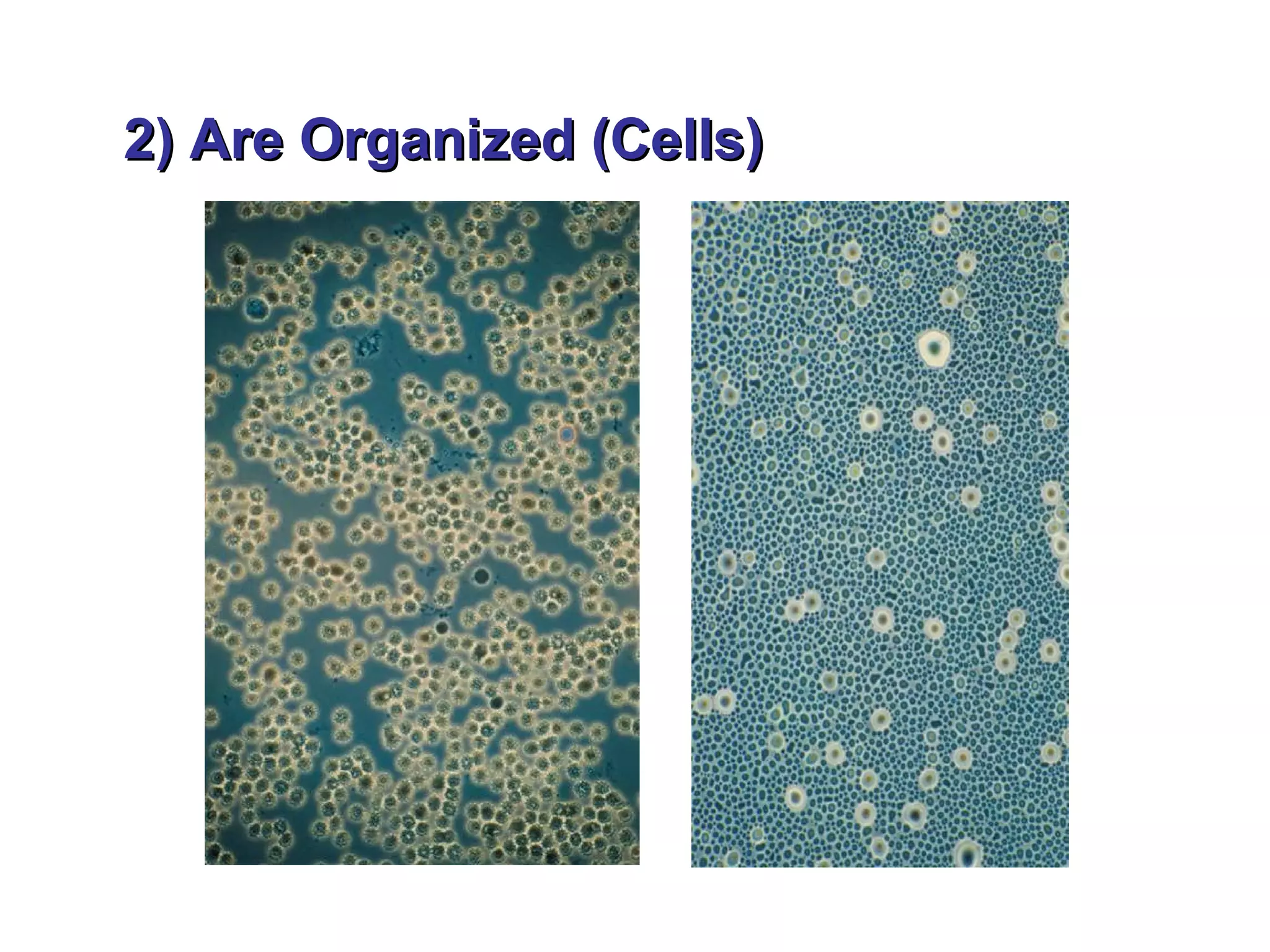
2) Are Organized (Cells)
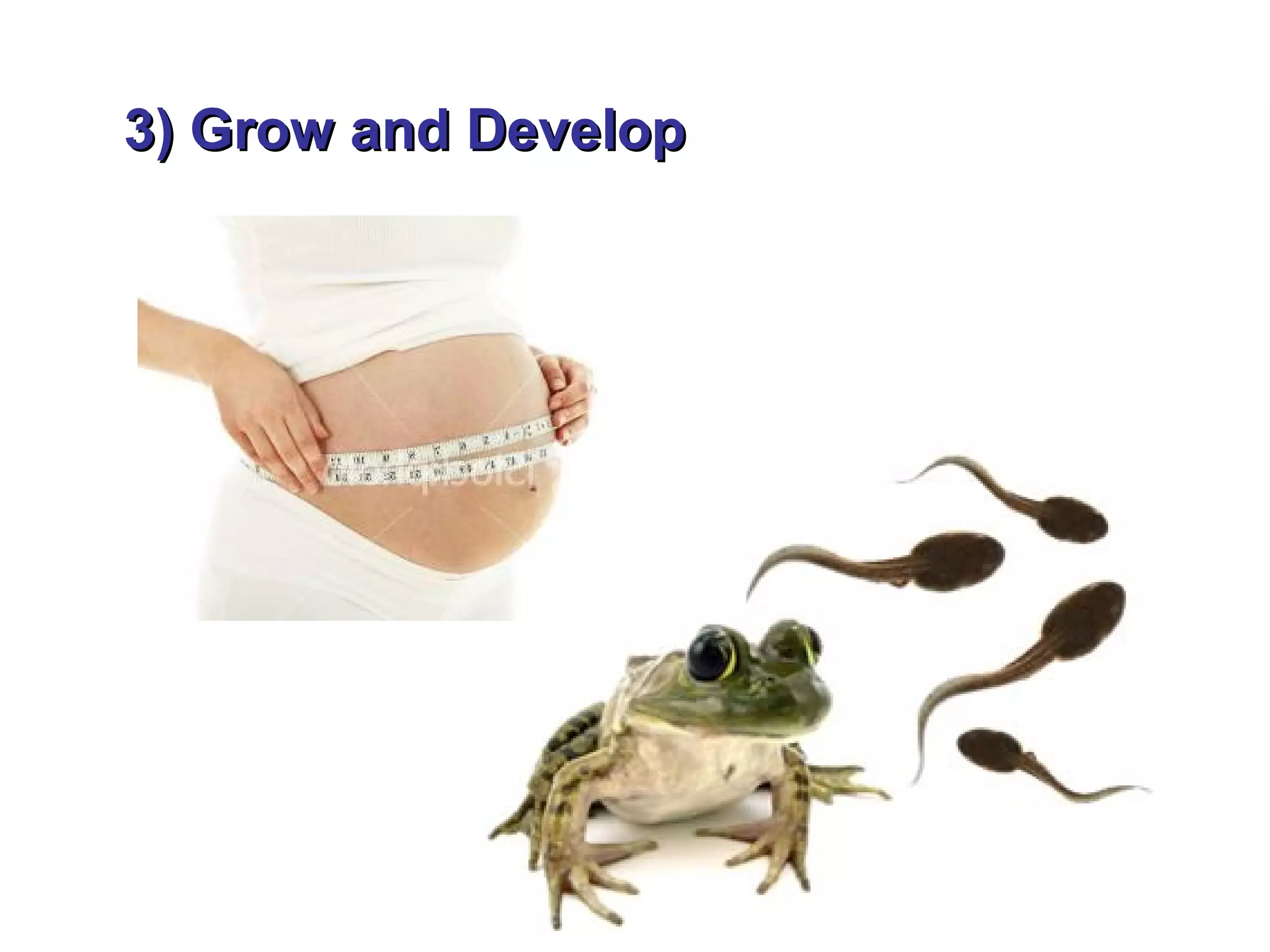
3) Grow and Develop
4) Use Energy / Evolve
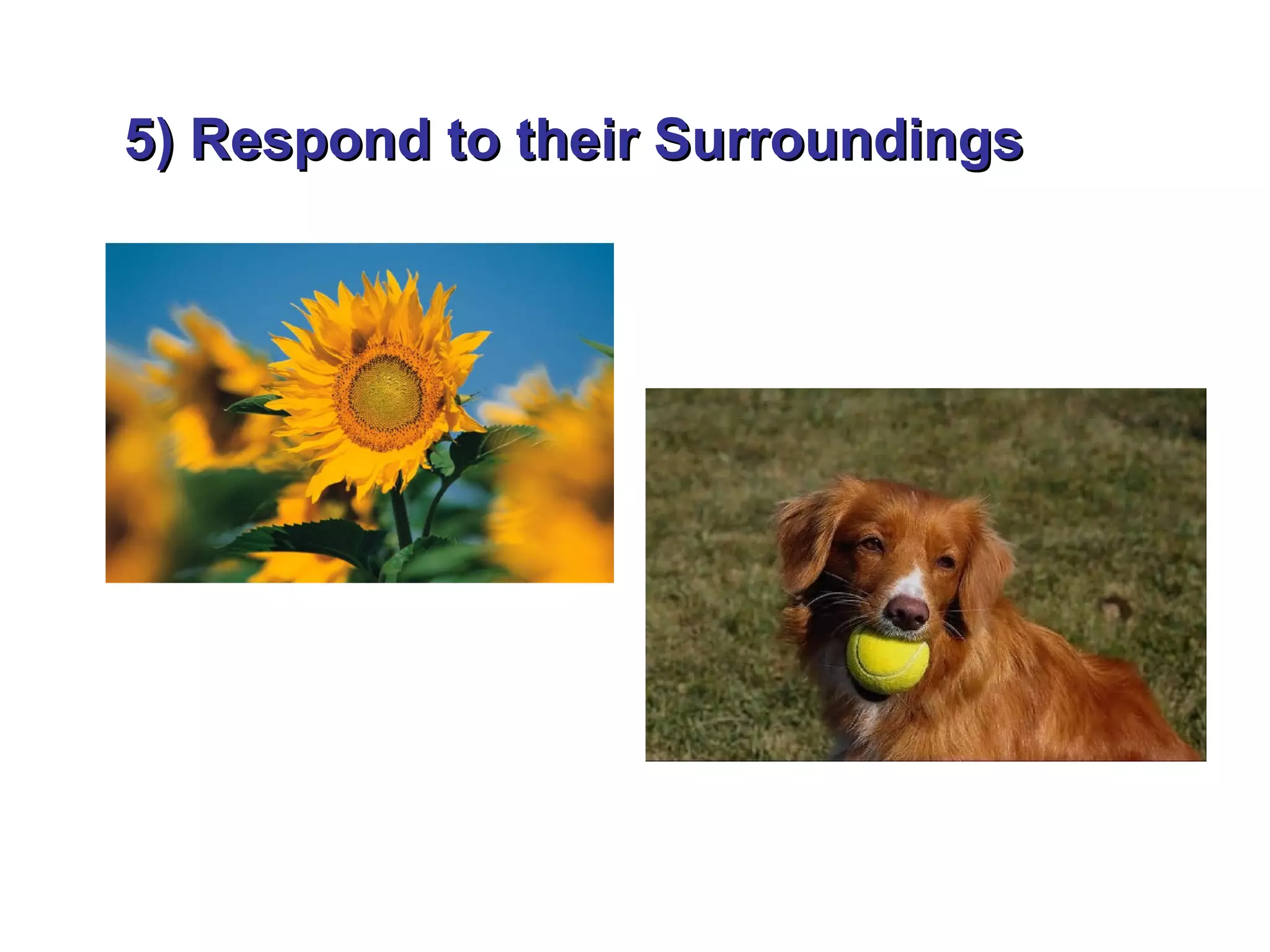
5) Respond to their Surroundings
III. Atoms and their
Interactions
   A. Elements
     1. Everything is made of substances
        called elements.
III. Atoms and their
Interactions
   A. Elements
     1. Everything is made of substances
        called elements.

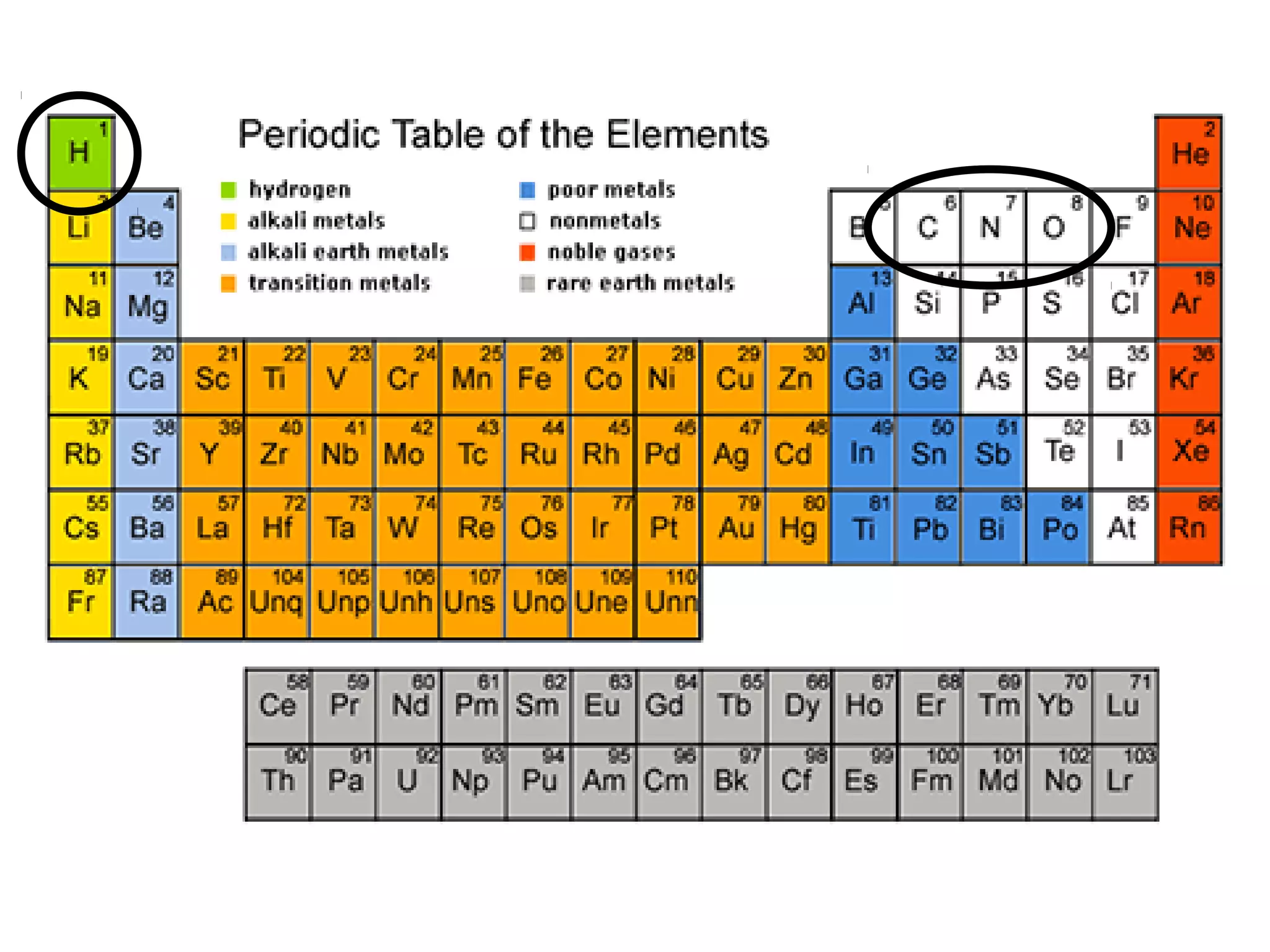
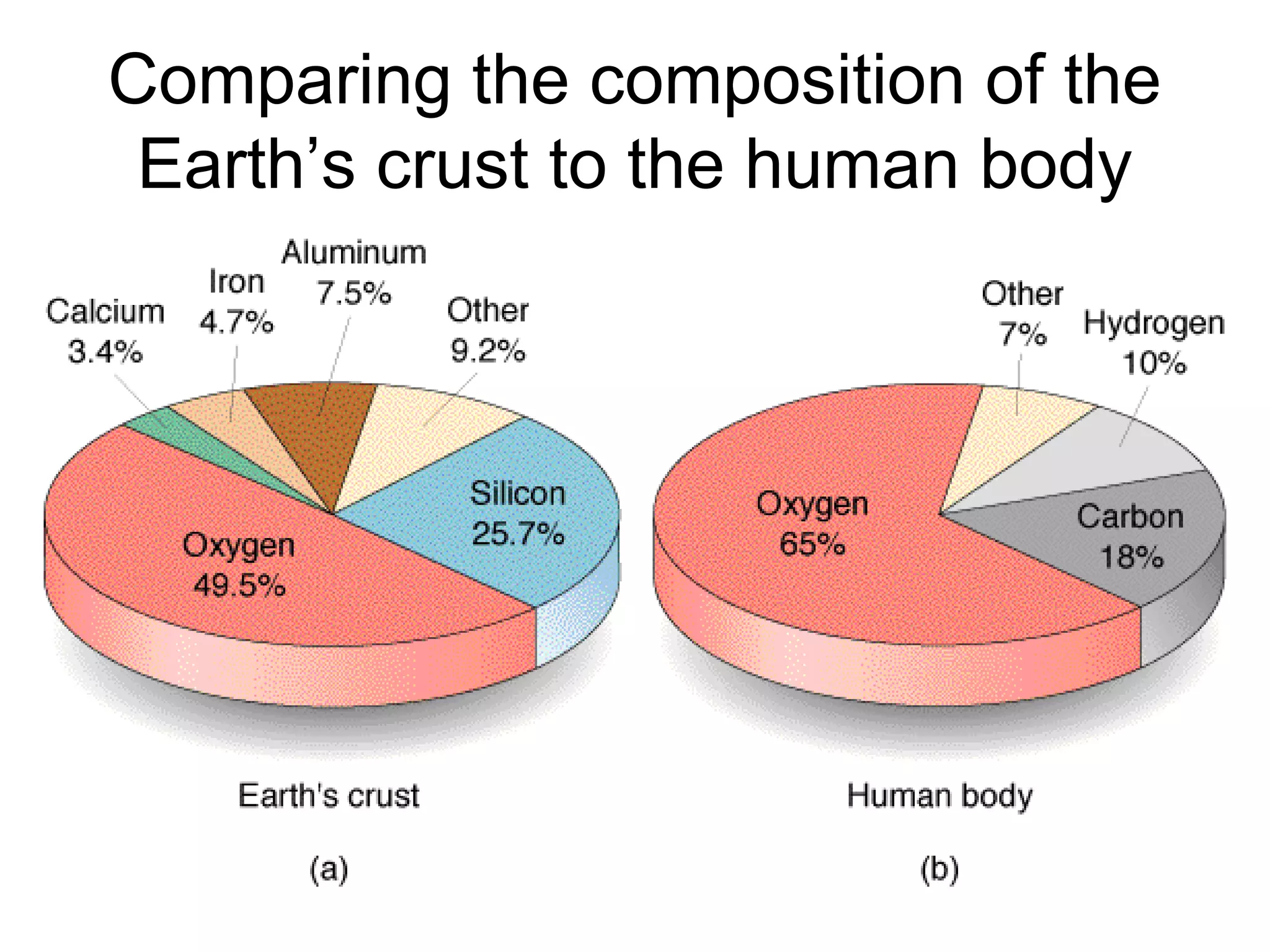
     2. Most common elements are…
         Carbon, Hydrogen, Oxygen,
         and Nitrogen
Comparing the composition of the
 Earth’s crust to the human body
B. Atoms are the basic building block of
  all matter.
     1. Definition: an atom is the
        smallest particle of an element
        that has the same characteristics
        of that element.
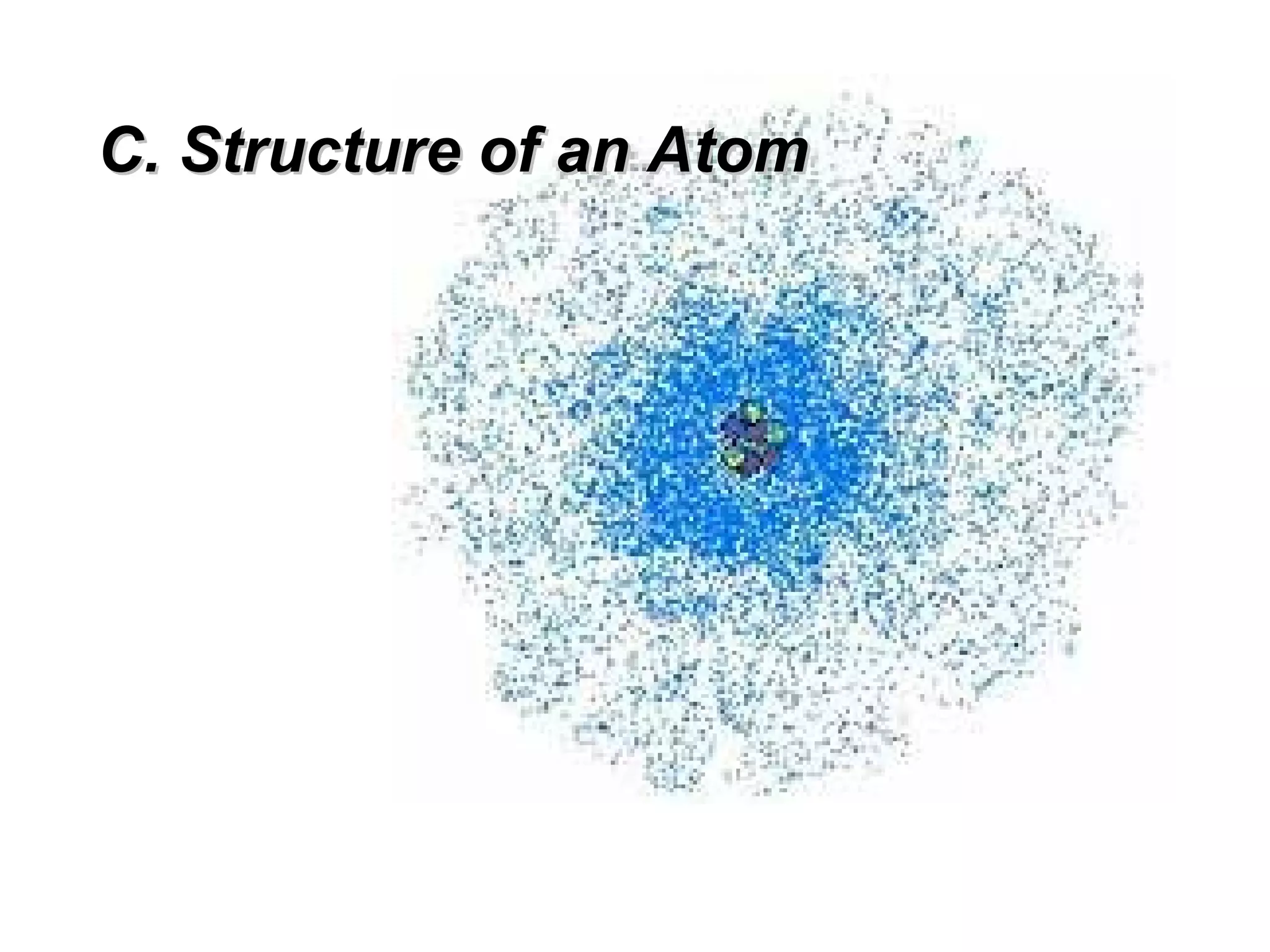
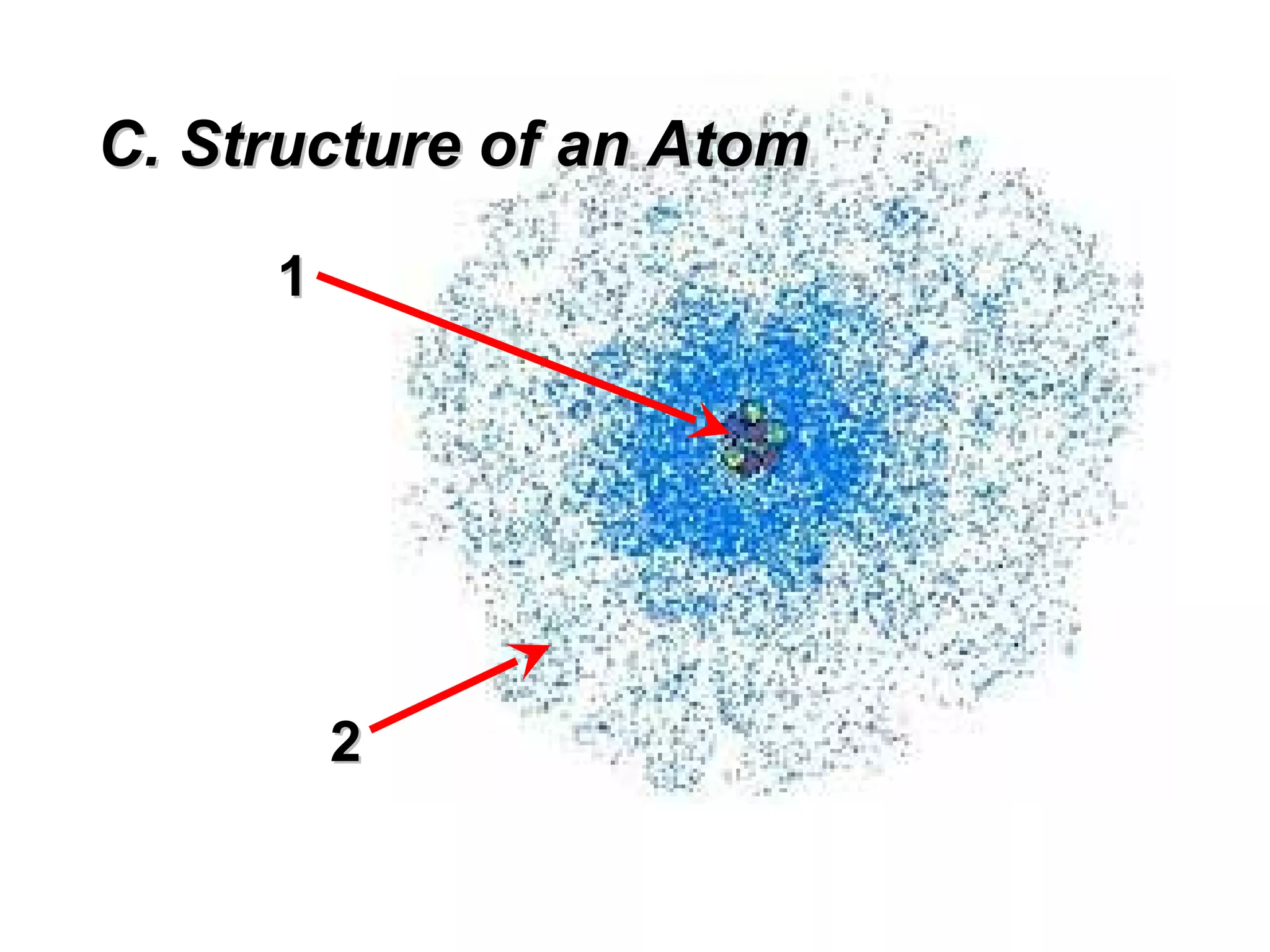
C. Structure of an Atom

     1


         2
C. Structure of an Atom
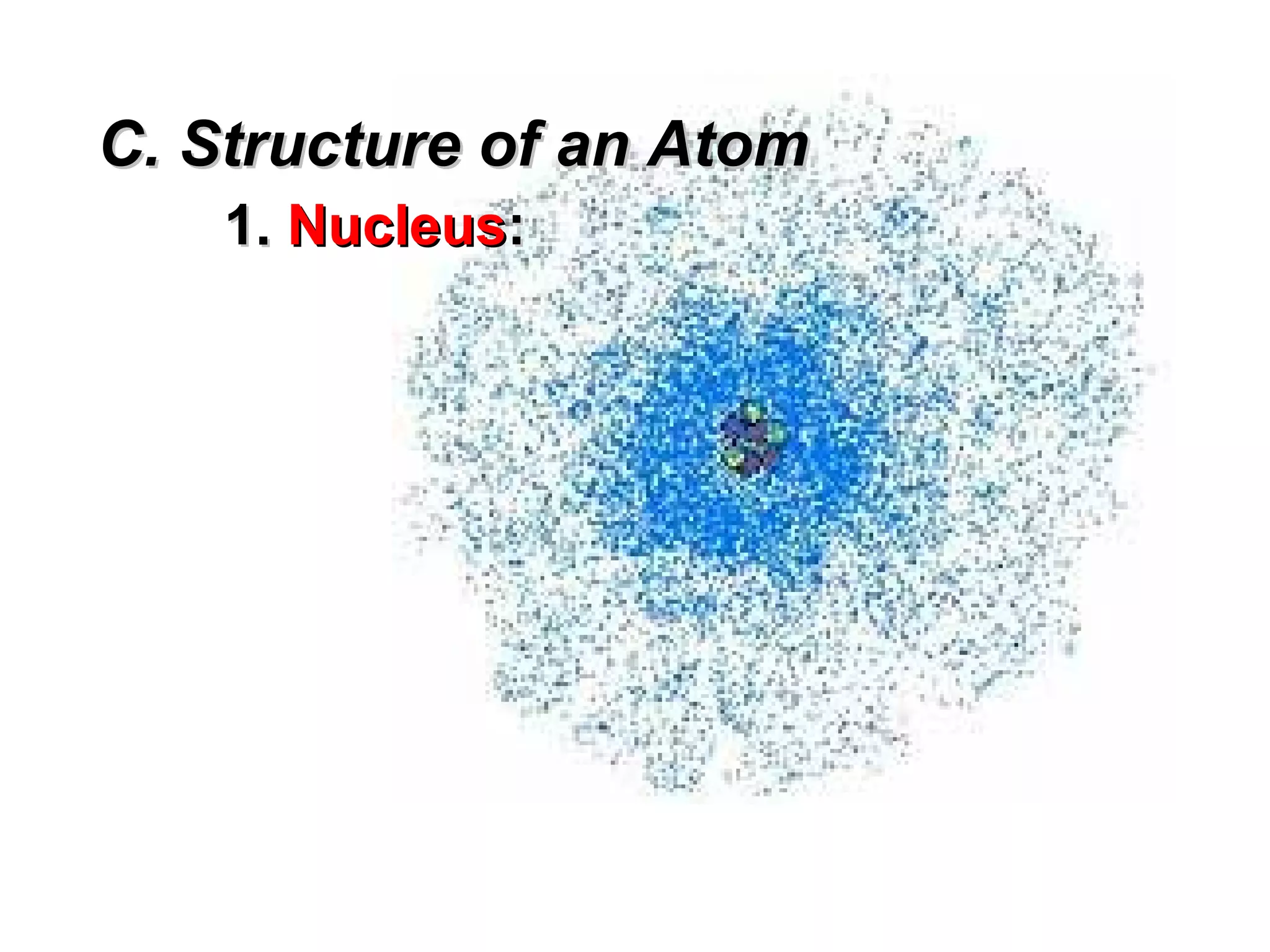
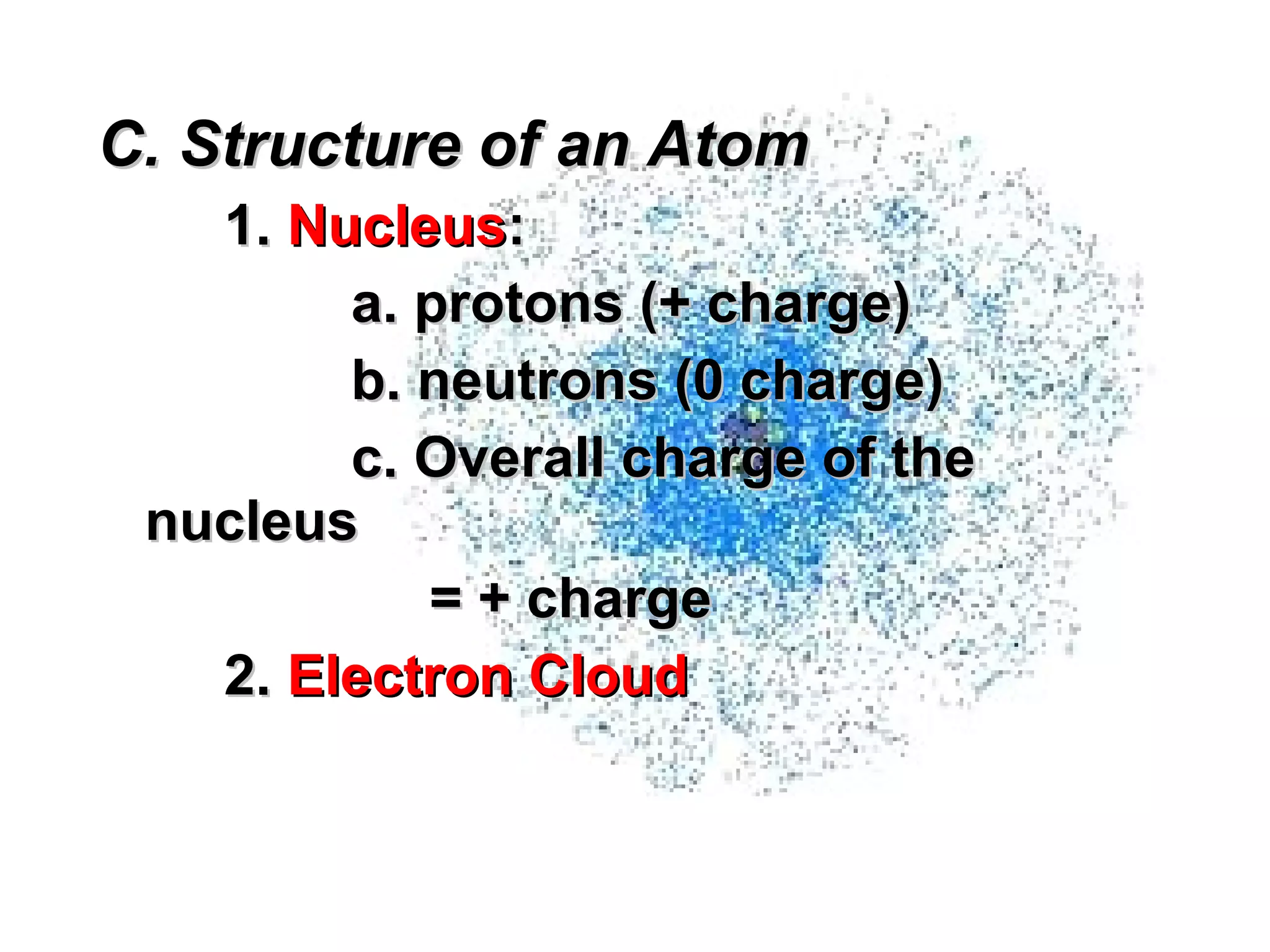
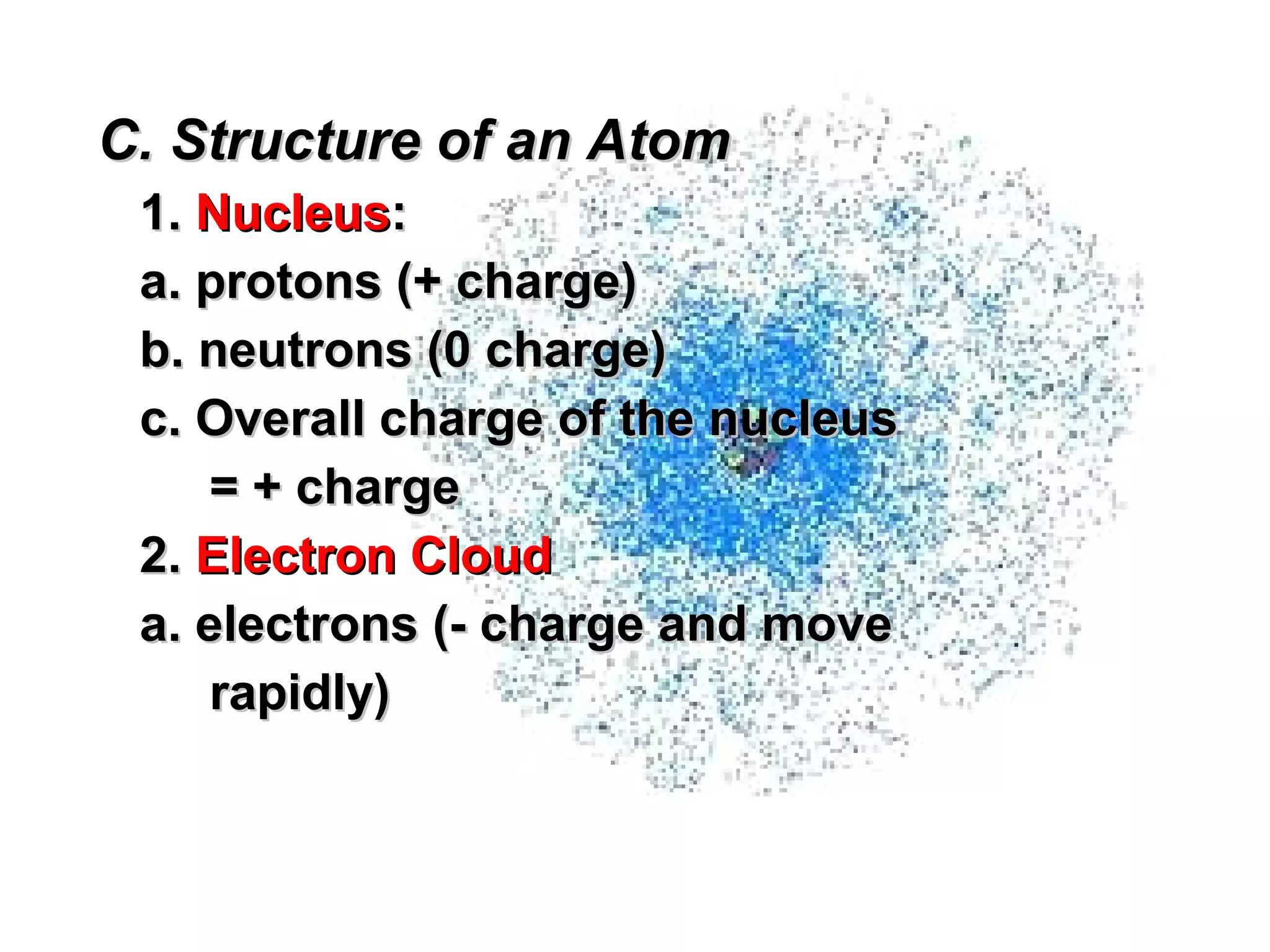
    1. Nucleus:
C. Structure of an Atom
    1. Nucleus:
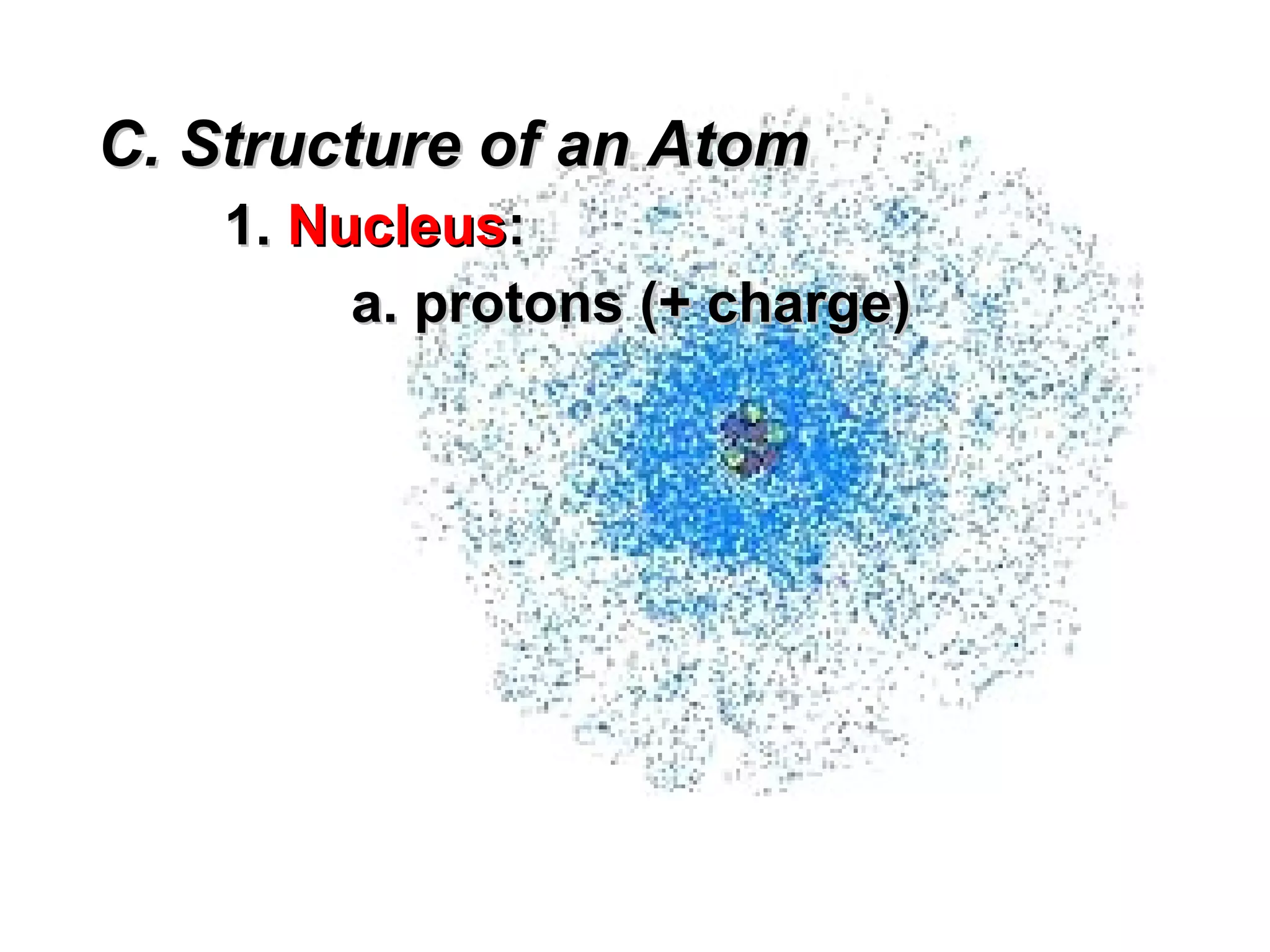
         a. protons (+ charge)
C. Structure of an Atom
    1. Nucleus:
         a. protons (+ charge)
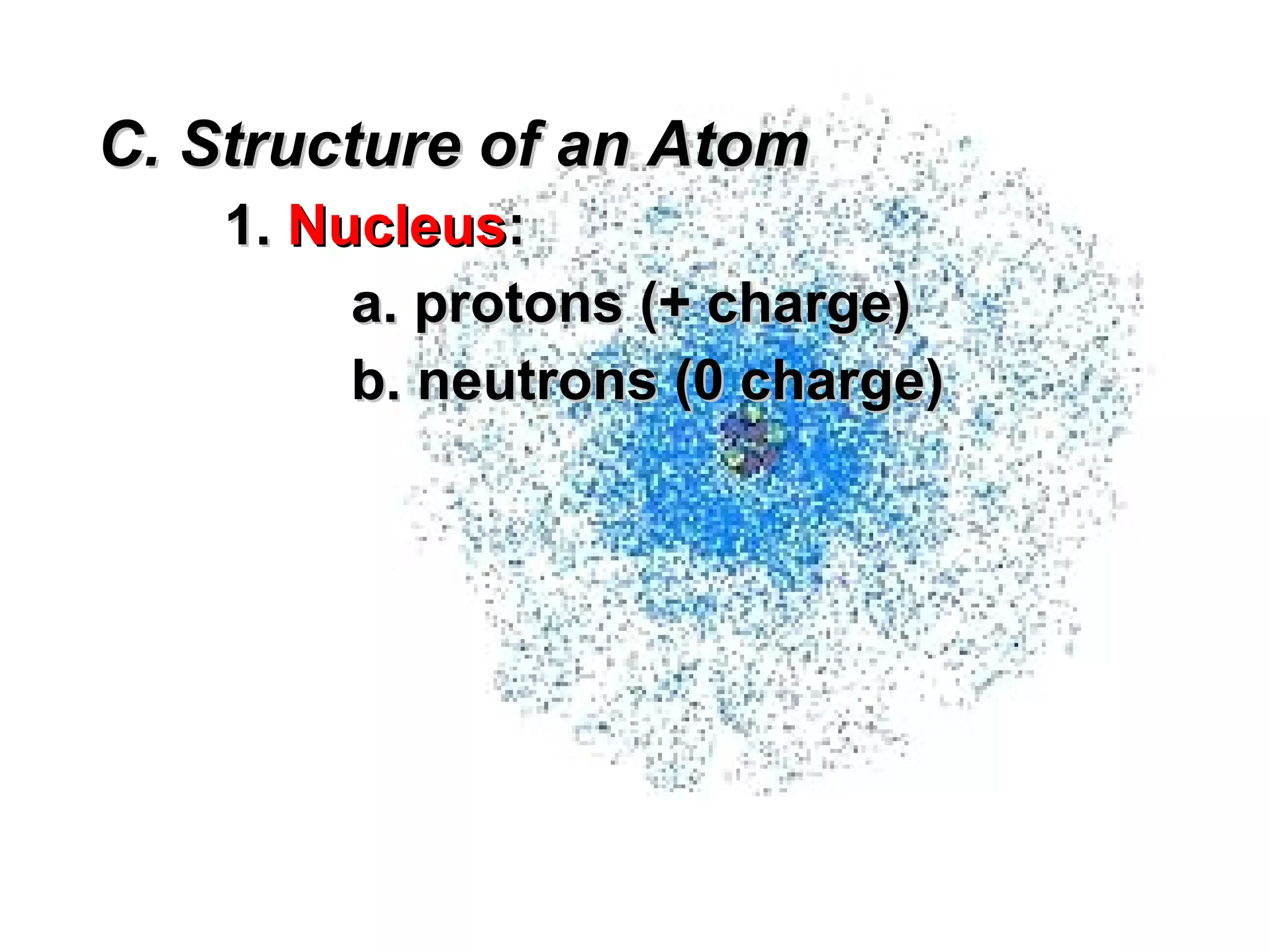
         b. neutrons (0 charge)
C. Structure of an Atom
   1. Nucleus:
        a. protons (+ charge)
        b. neutrons (0 charge)
        c. Overall charge of the
 nucleus
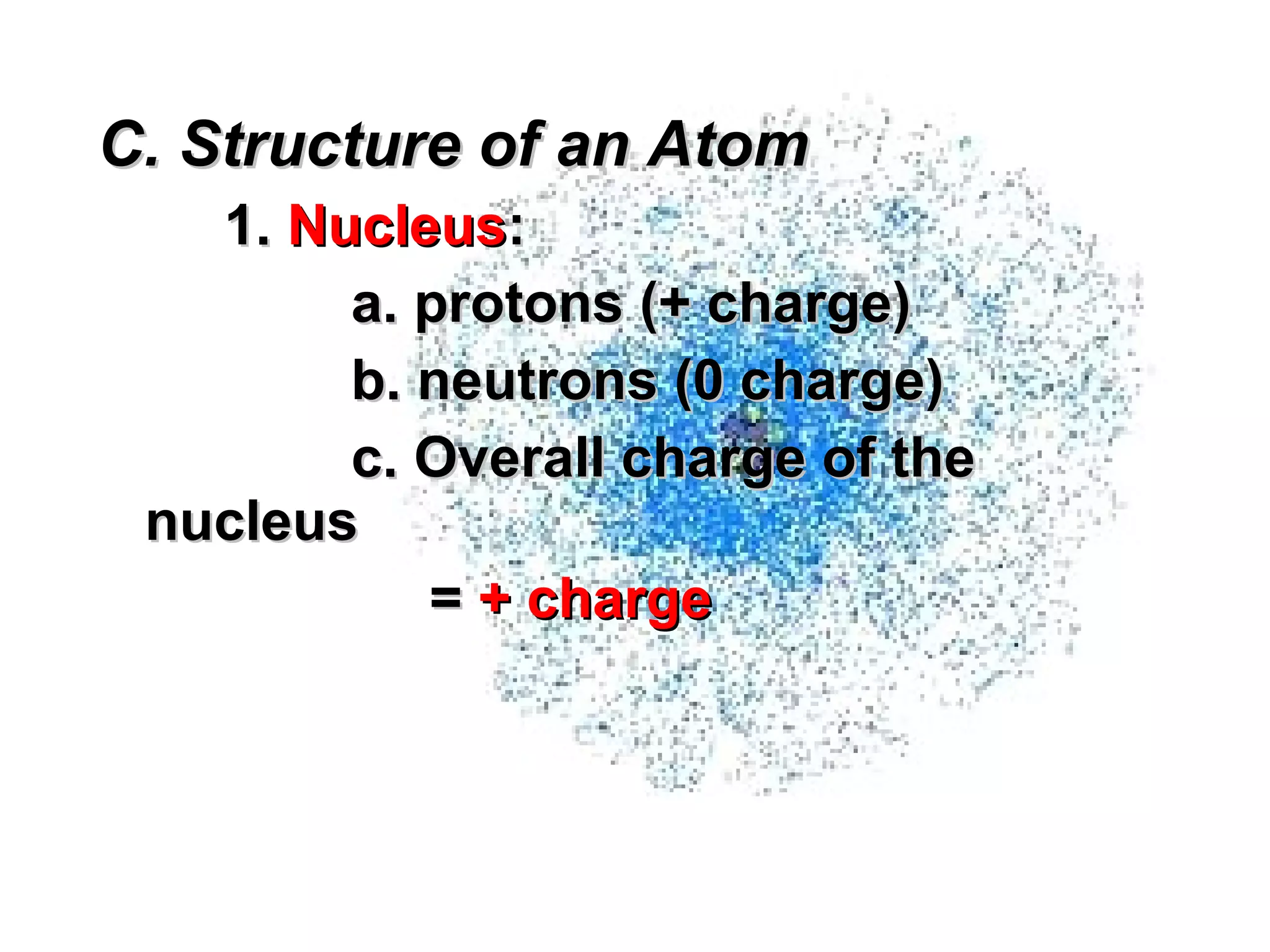
           = + charge
C. Structure of an Atom
   1. Nucleus:
        a. protons (+ charge)
        b. neutrons (0 charge)
        c. Overall charge of the
 nucleus
           = + charge
   2. Electron Cloud
C. Structure of an Atom
 1. Nucleus:
 a. protons (+ charge)
 b. neutrons (0 charge)
 c. Overall charge of the nucleus
     = + charge
 2. Electron Cloud
 a. electrons (- charge and move
     rapidly)
C. Structure of an Atom
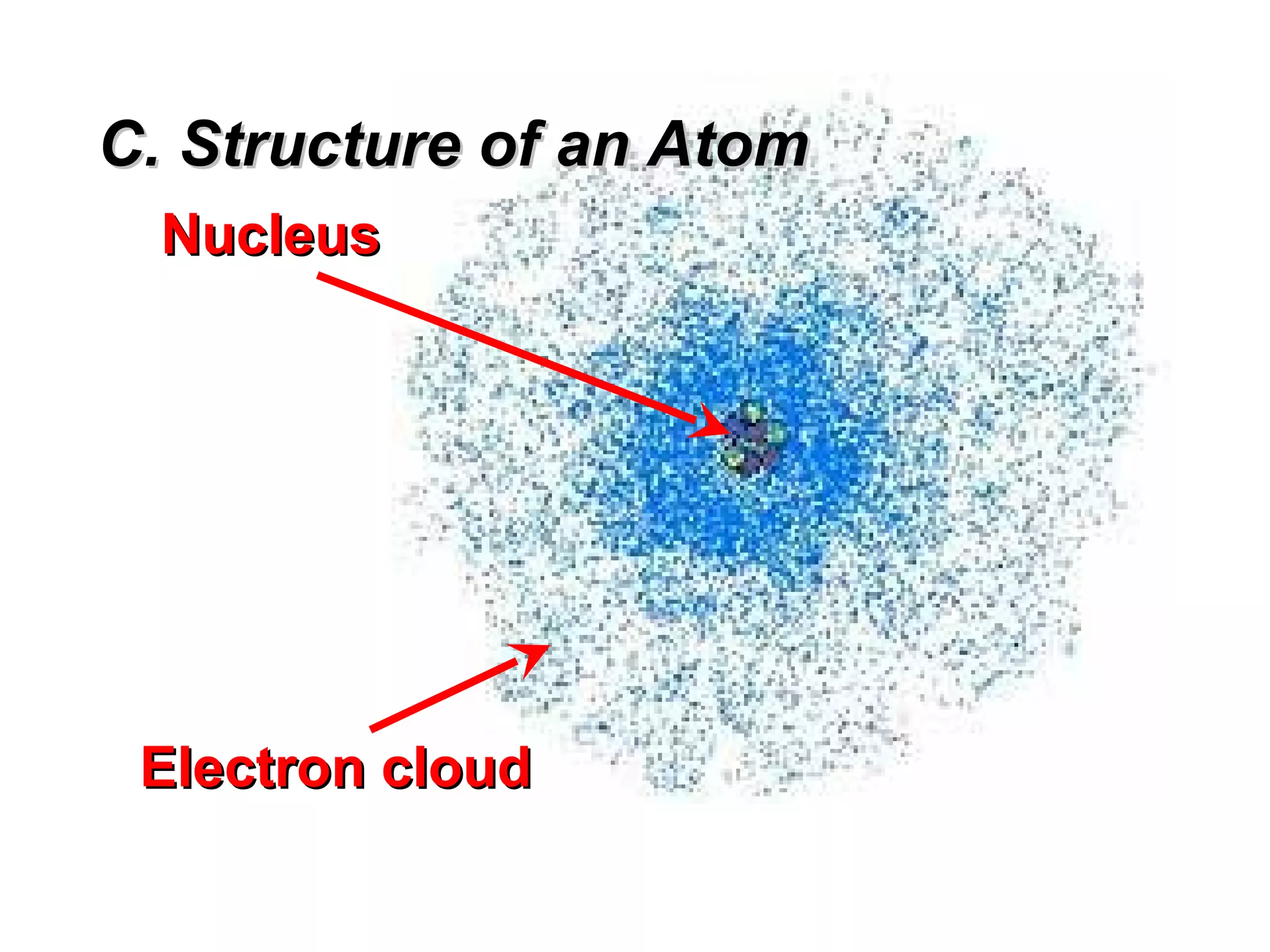
  Nucleus


 Electron cloud
D. Atoms become stable by bonding
   with other atoms.
D. Atoms become stable by bonding
   with other atoms.

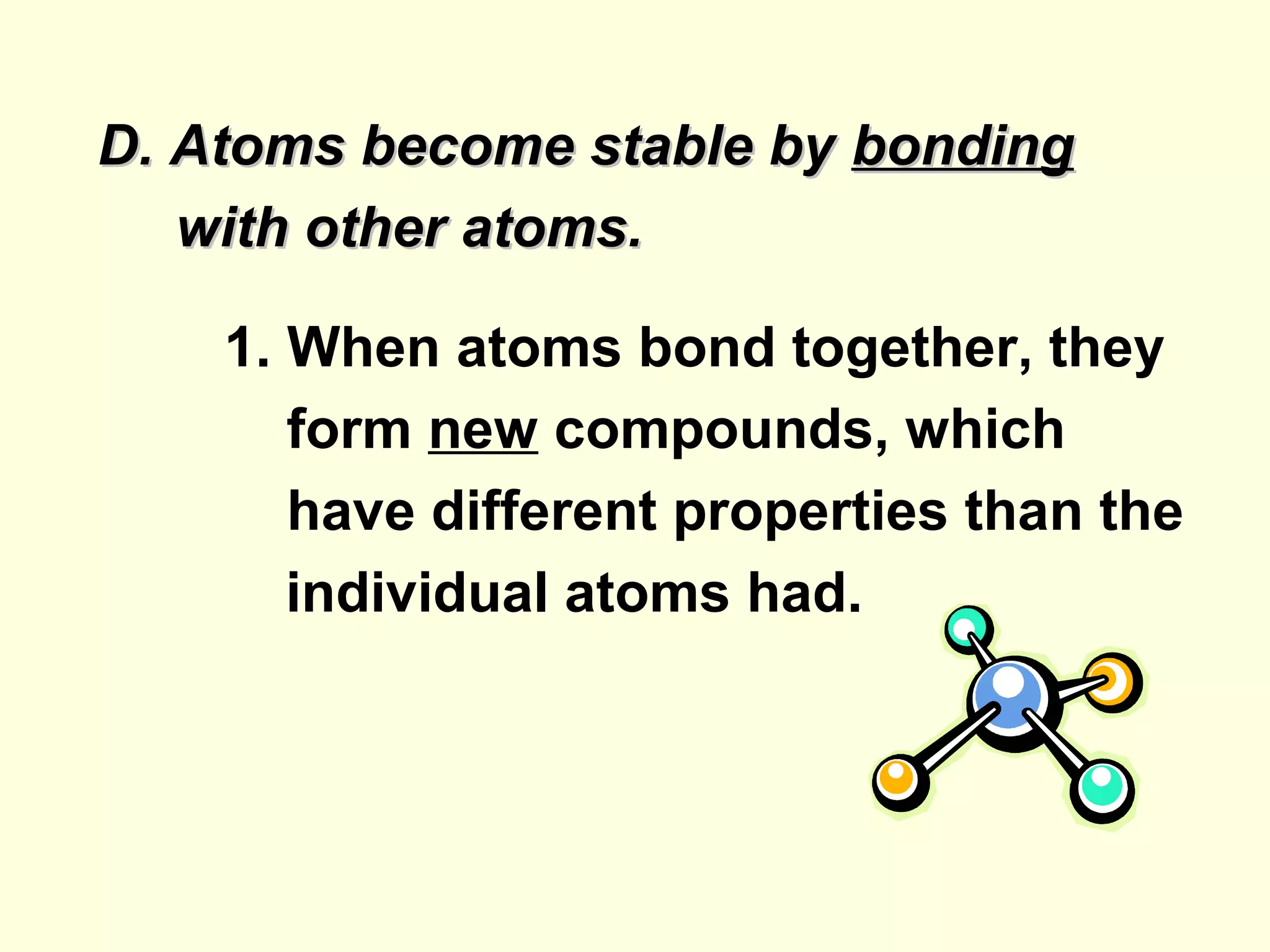
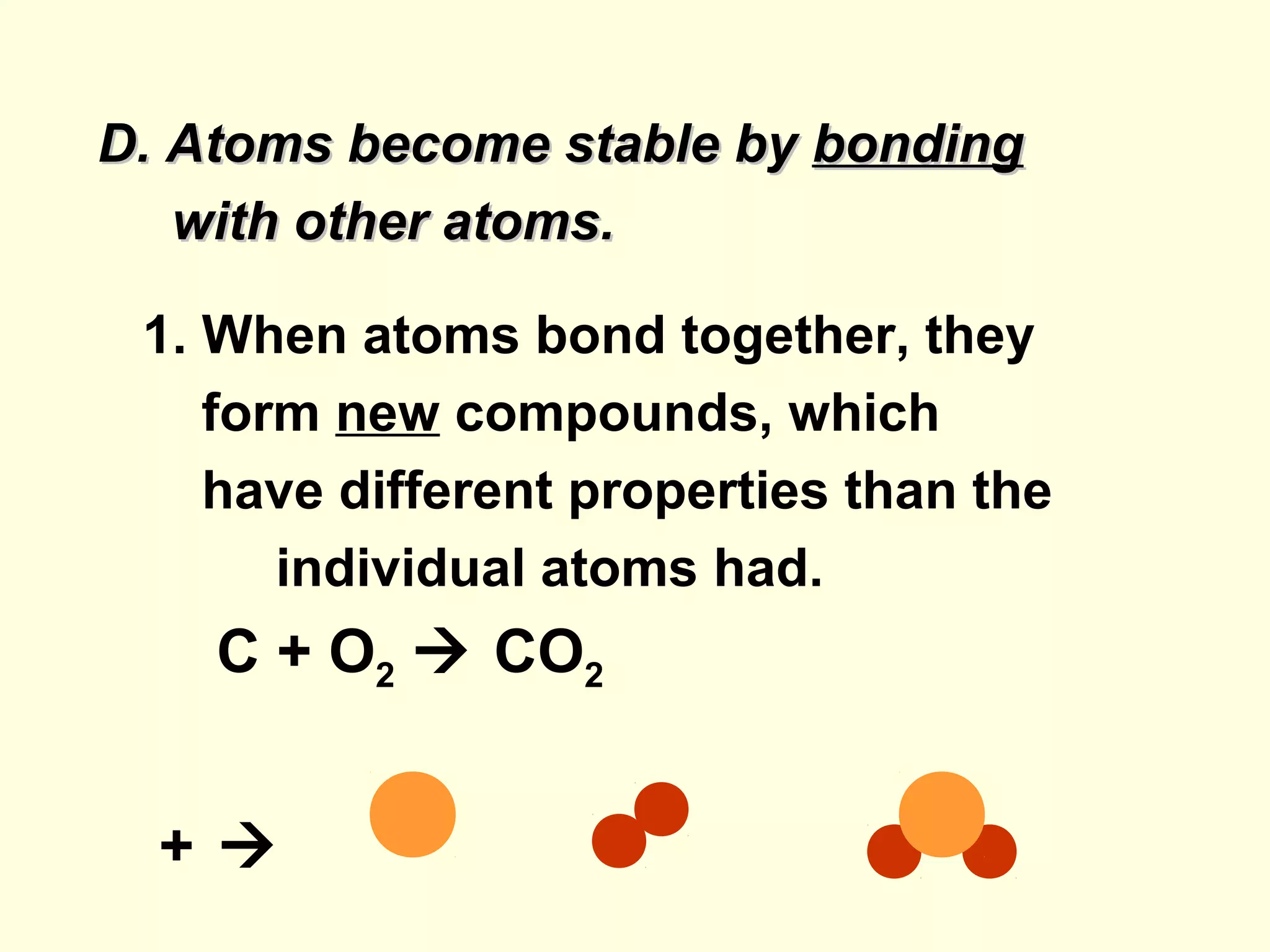
    1. When atoms bond together, they
       form new compounds, which
       have different properties than the
       individual atoms had.
D. Atoms become stable by bonding
   with other atoms.

 1. When atoms bond together, they
    form new compounds, which
    have different properties than the
       individual atoms had.
    C + O2  CO2


  +
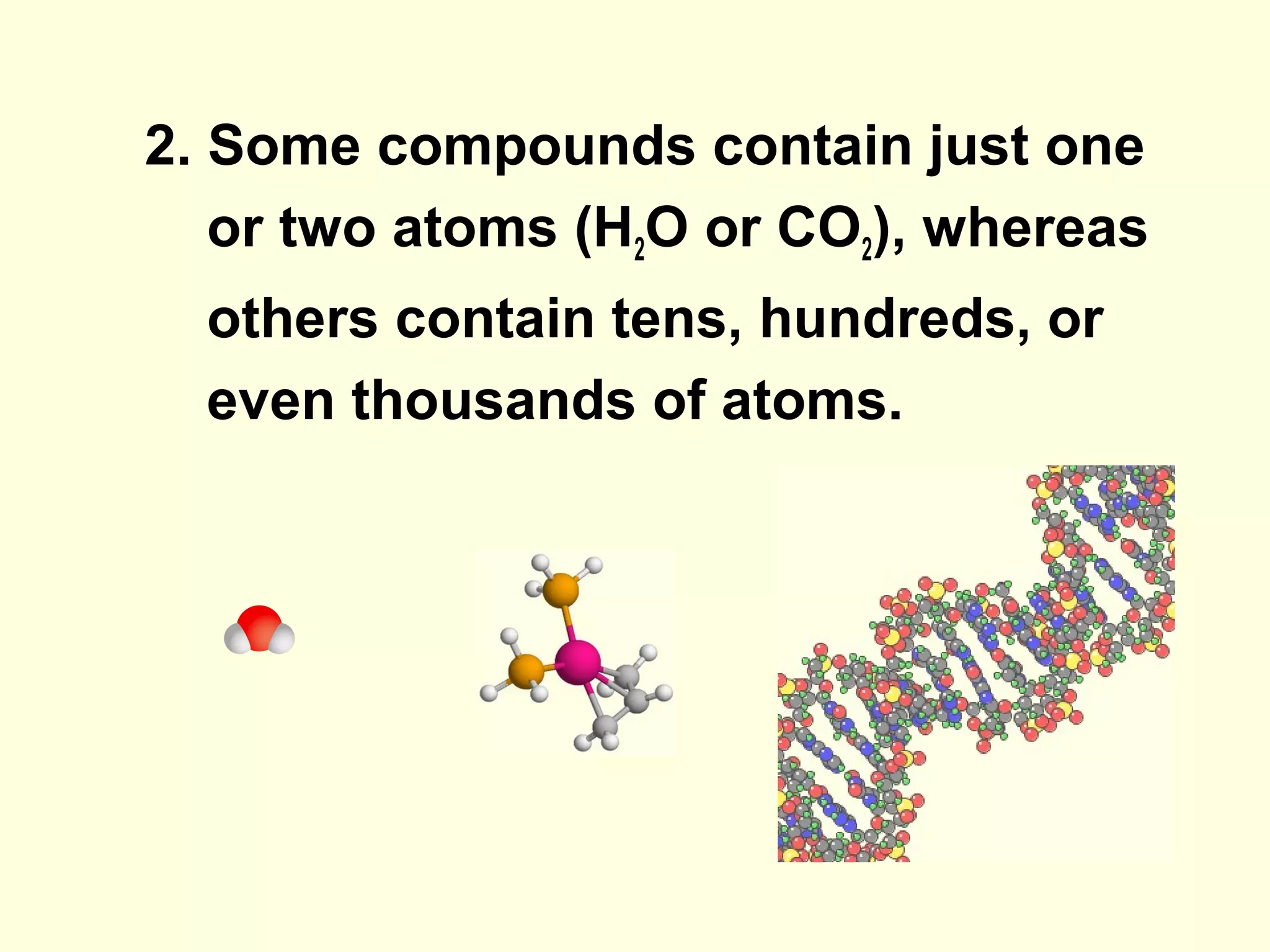
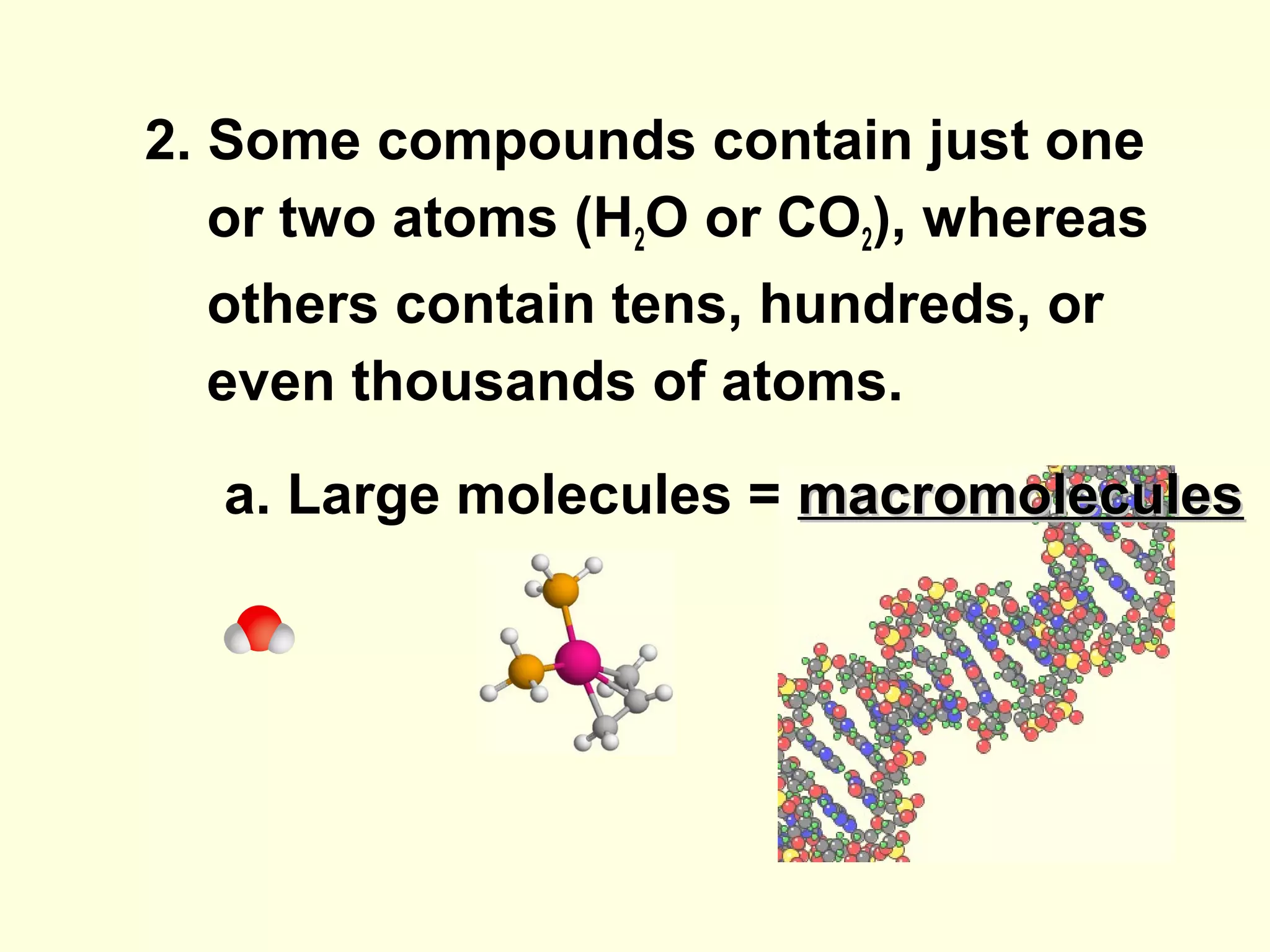
2. Some compounds contain just one
   or two atoms (H2O or CO2), whereas
  others contain tens, hundreds, or
  even thousands of atoms.
2. Some compounds contain just one
   or two atoms (H2O or CO2), whereas
  others contain tens, hundreds, or
  even thousands of atoms.

  a. Large molecules = macromolecules
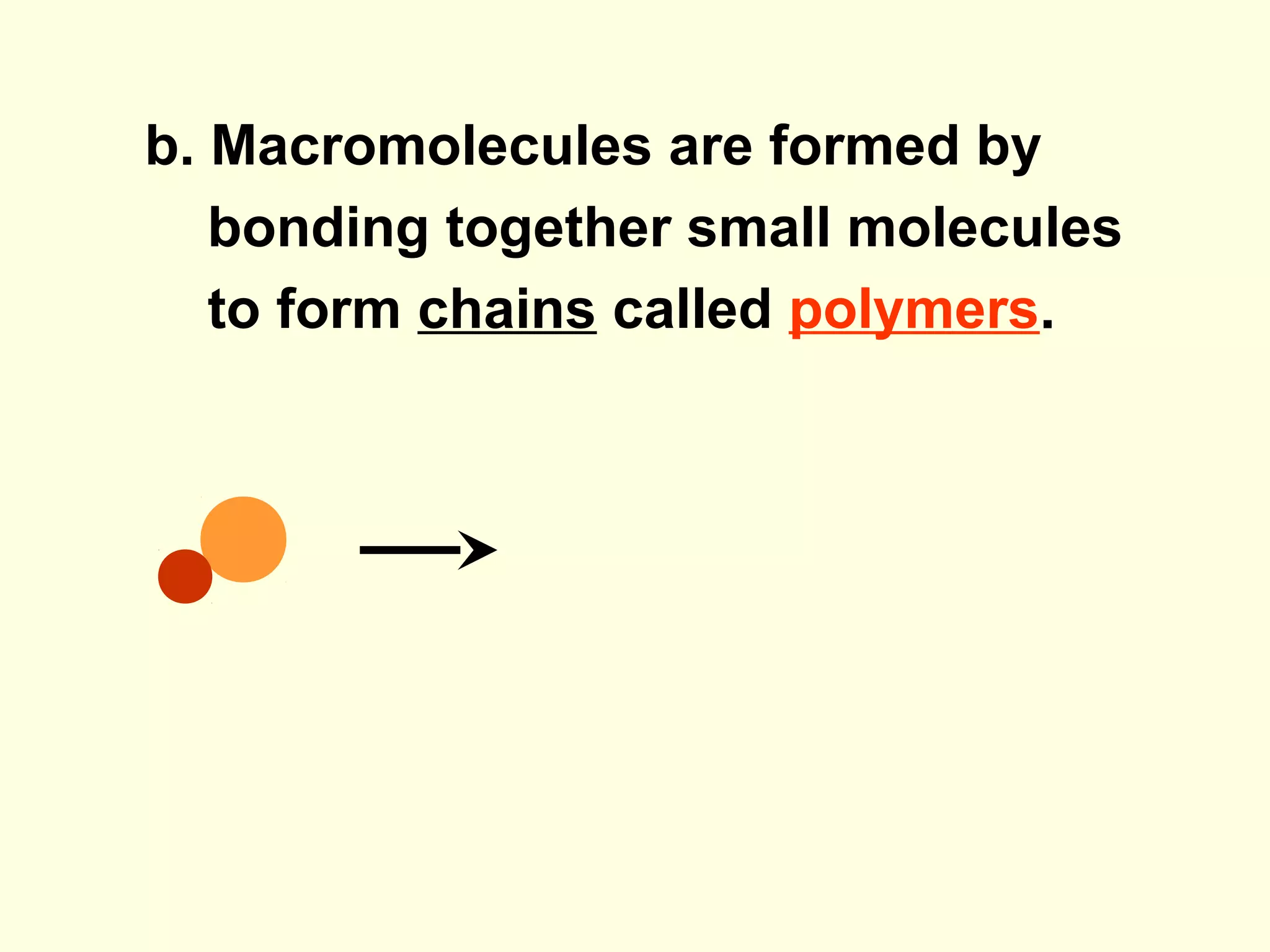
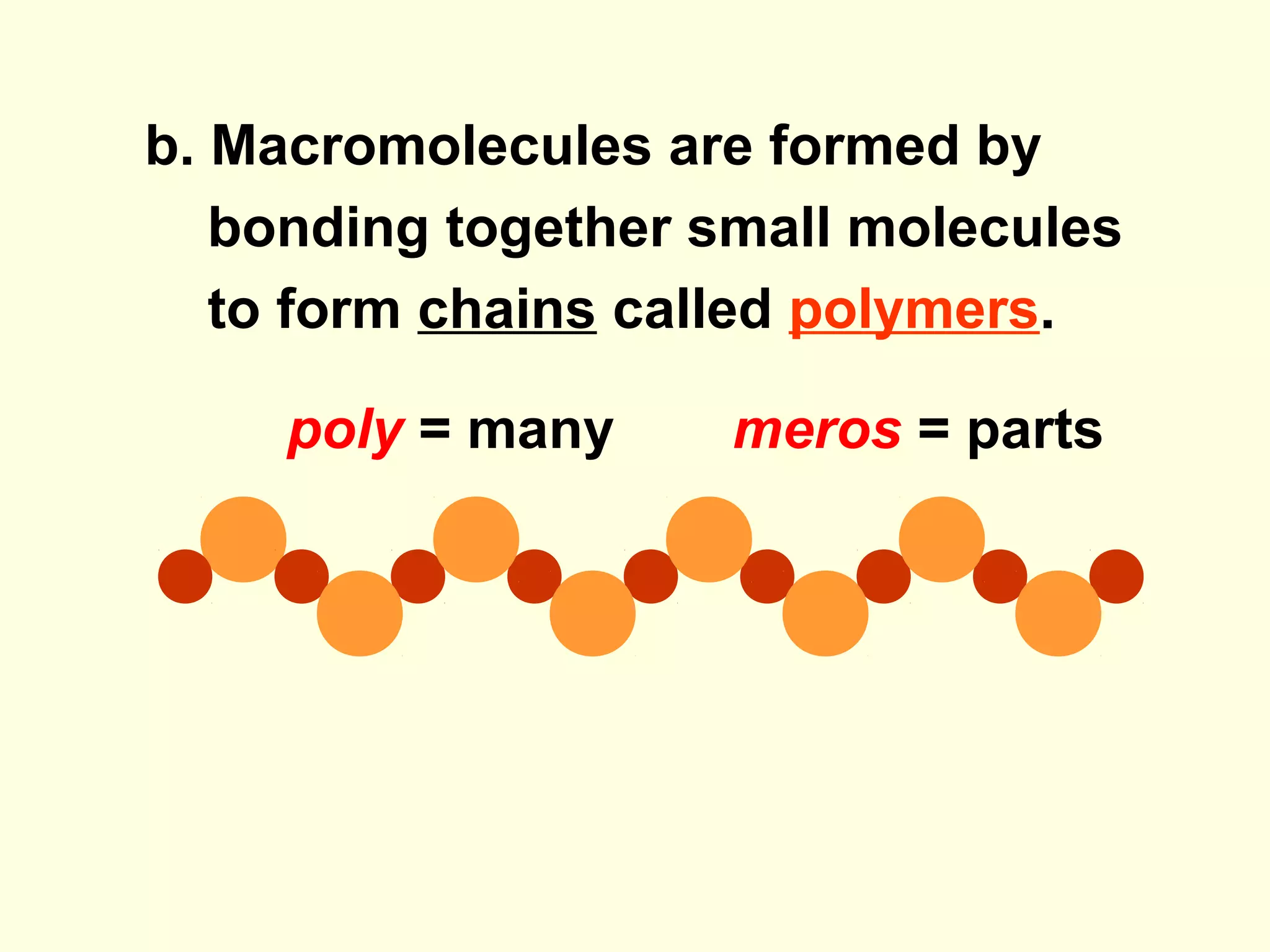
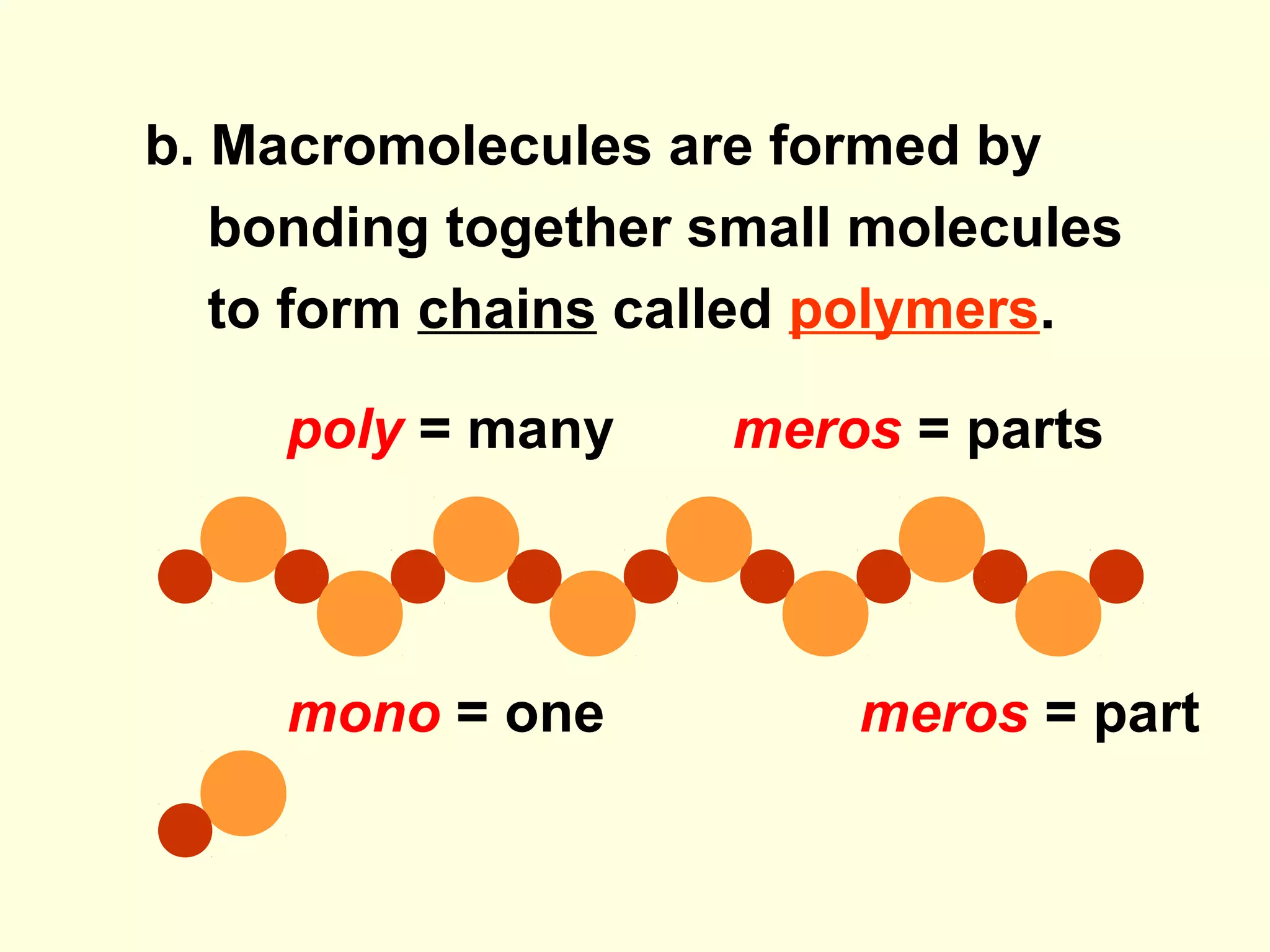
b. Macromolecules are formed by
   bonding together small molecules
   to form chains called polymers.
b. Macromolecules are formed by
   bonding together small molecules
   to form chains called polymers.

     poly = many     meros = parts
b. Macromolecules are formed by
   bonding together small molecules
   to form chains called polymers.

     poly = many     meros = parts


     mono = one          meros = part
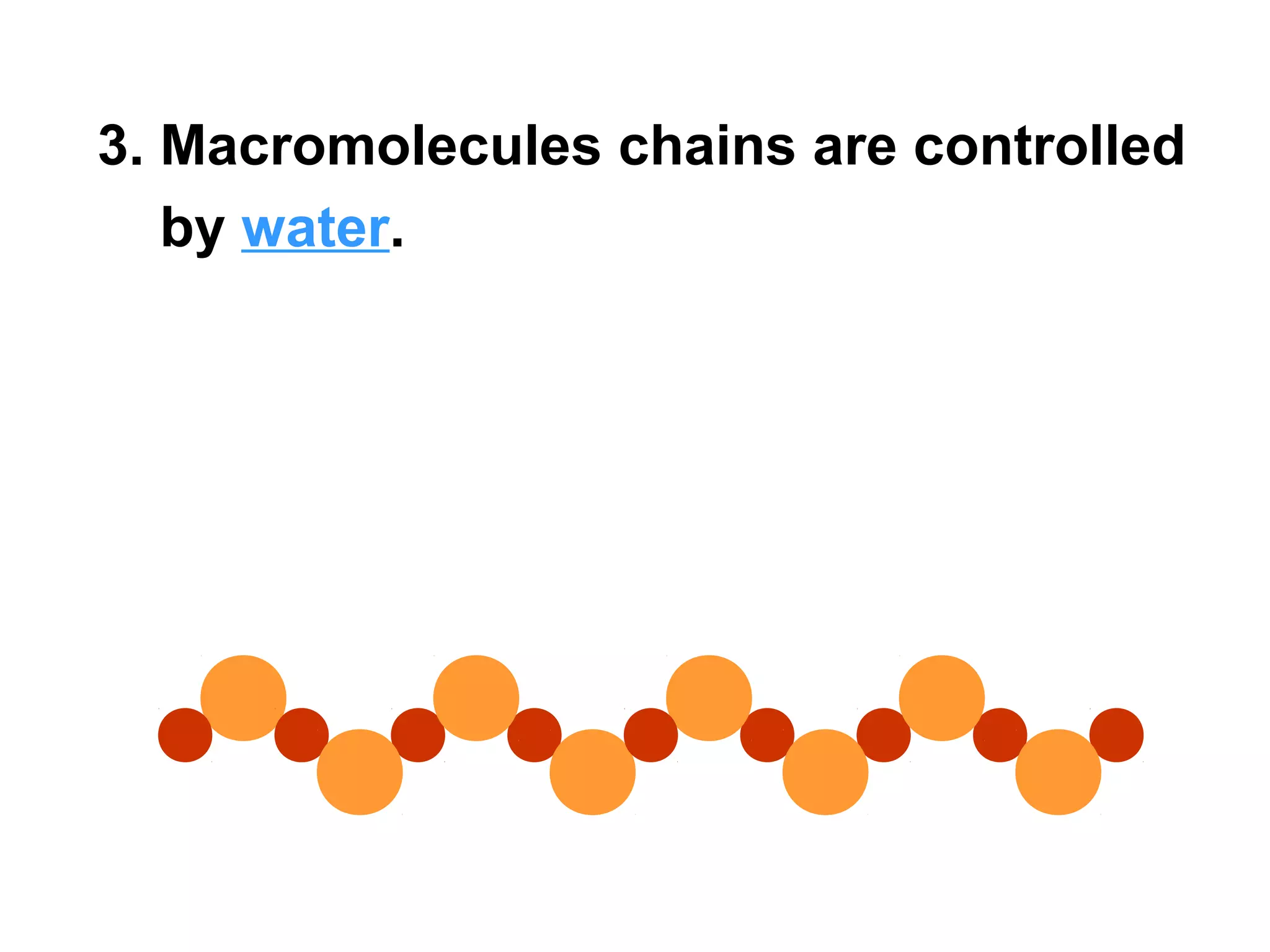
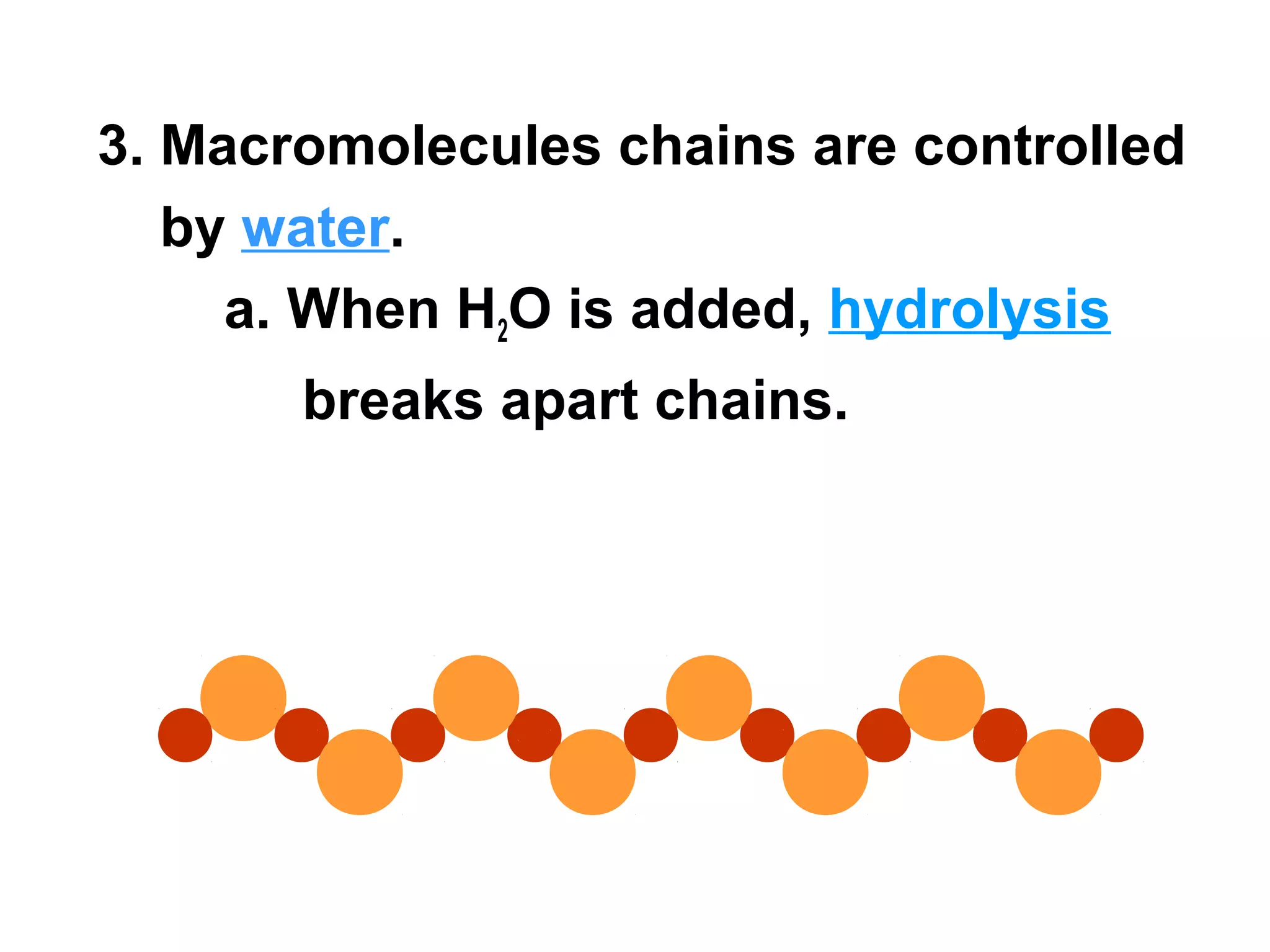
3. Macromolecules chains are controlled
   by water.
3. Macromolecules chains are controlled
   by water.
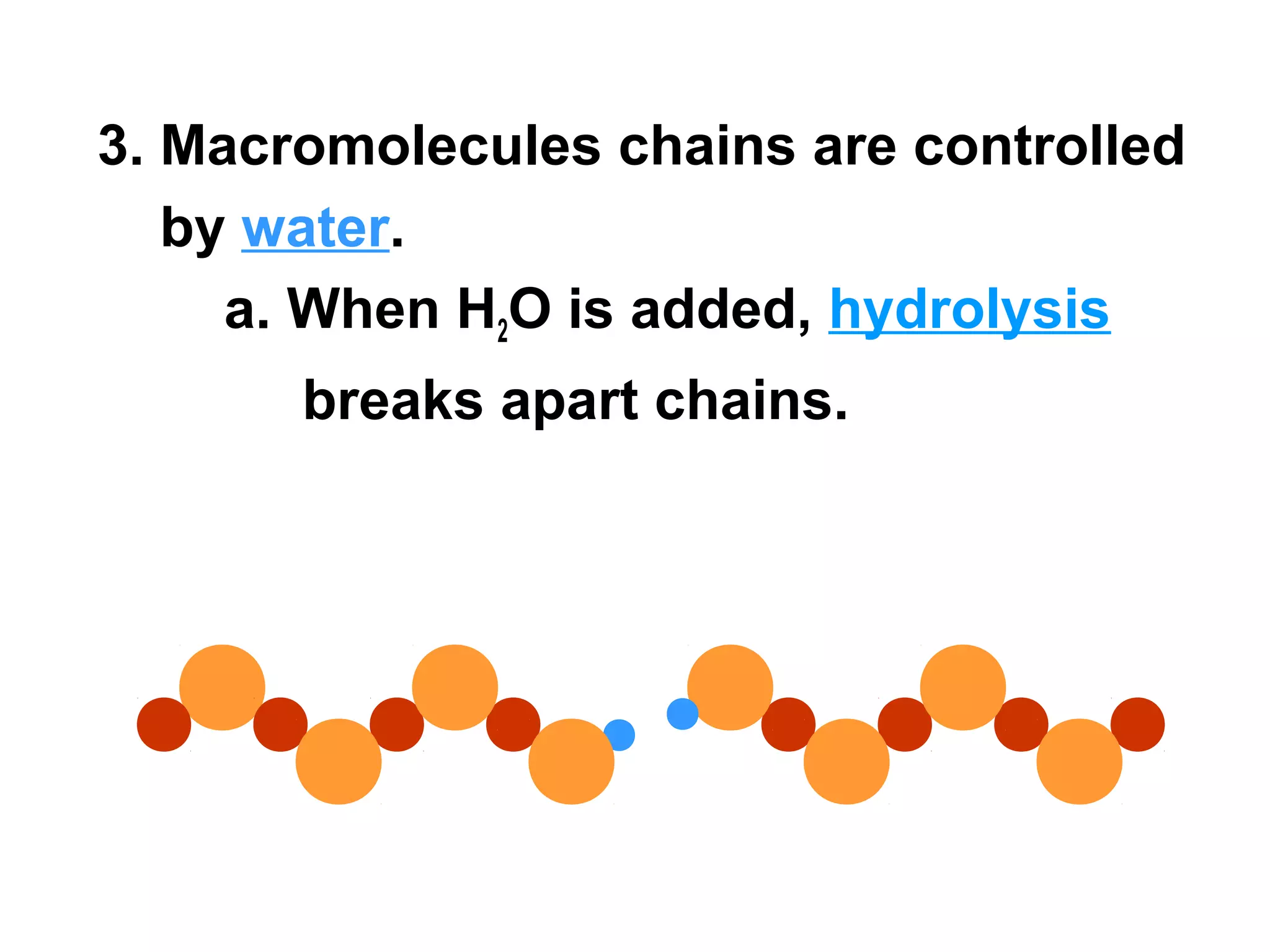
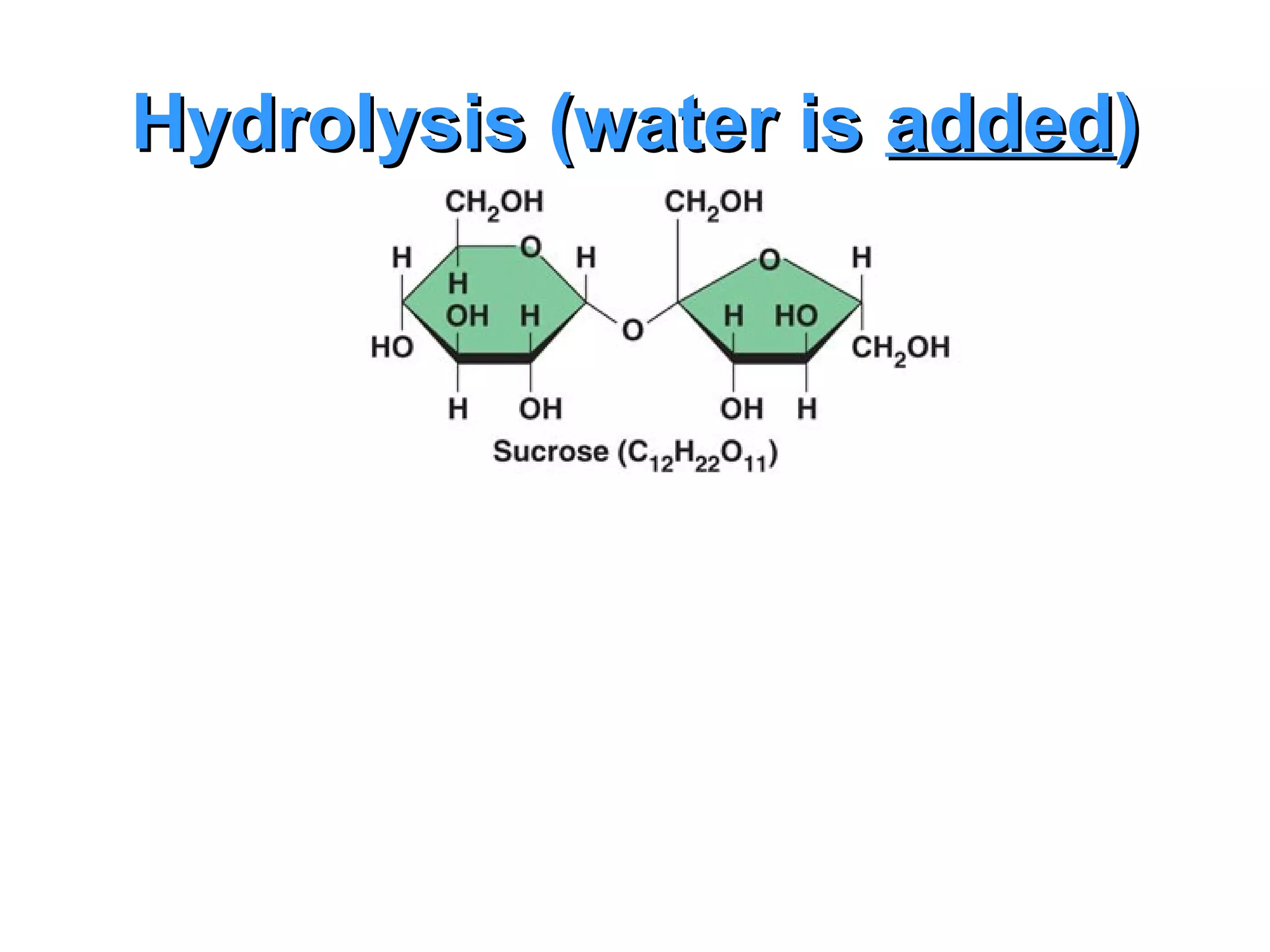
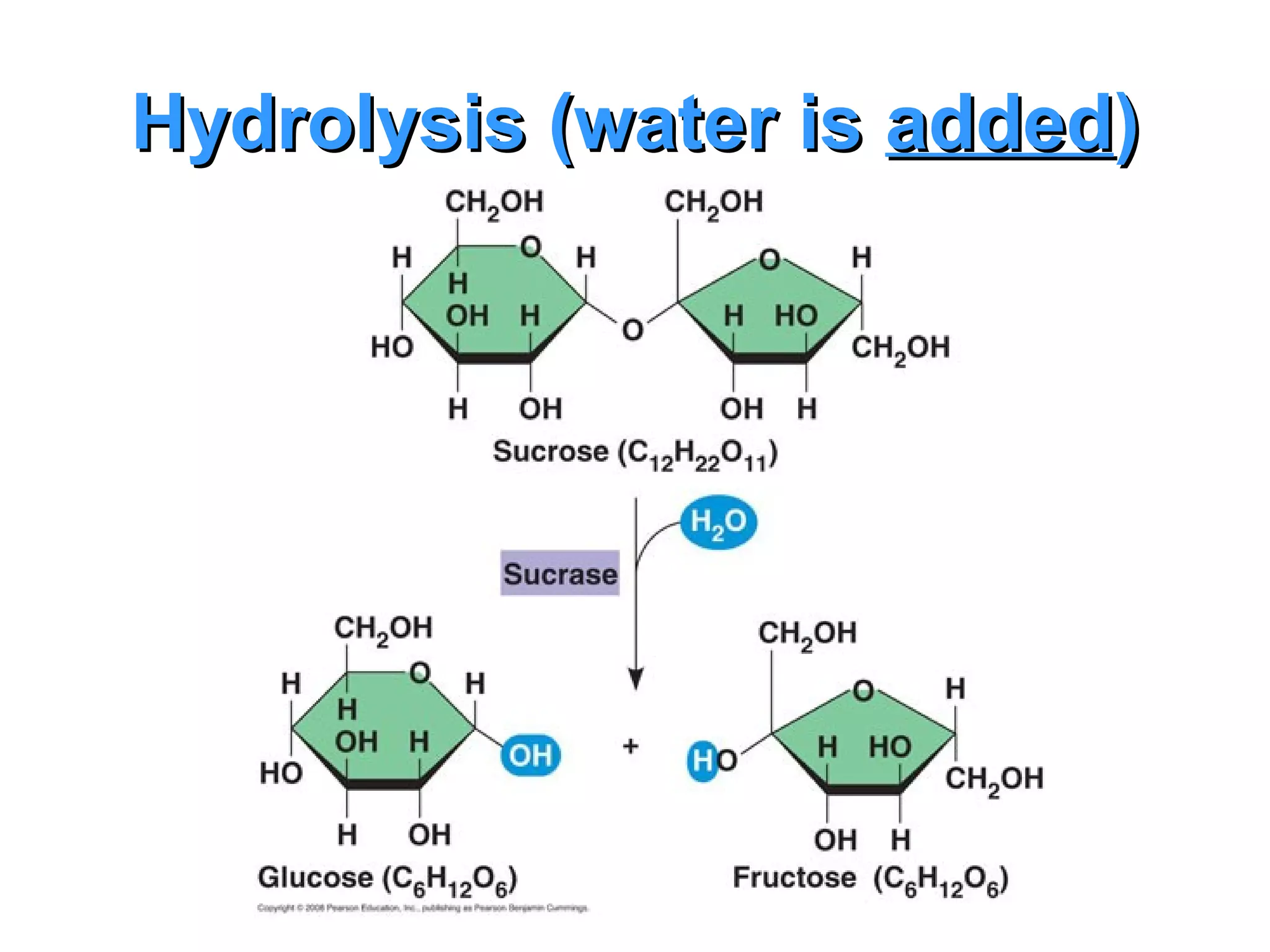
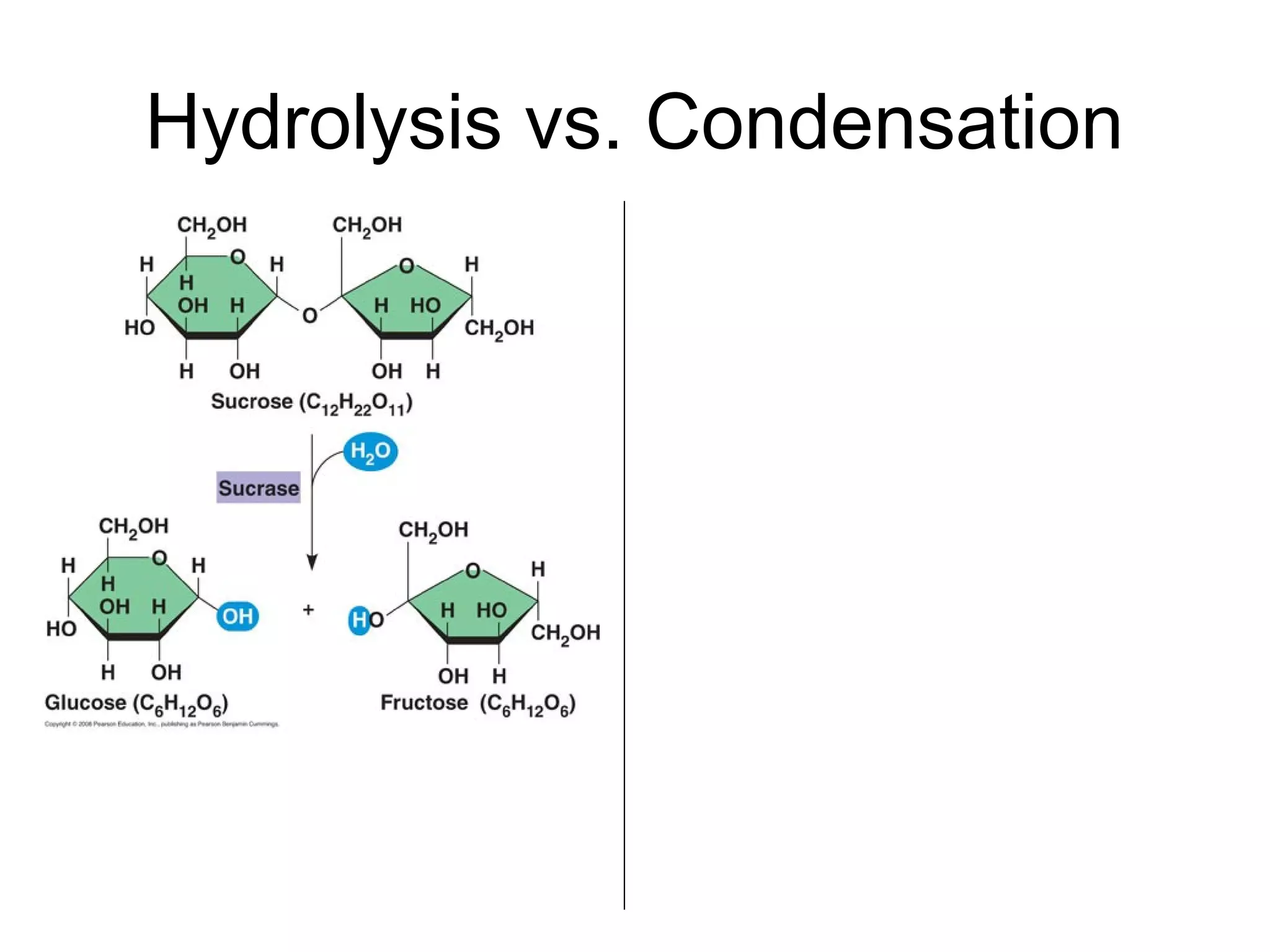
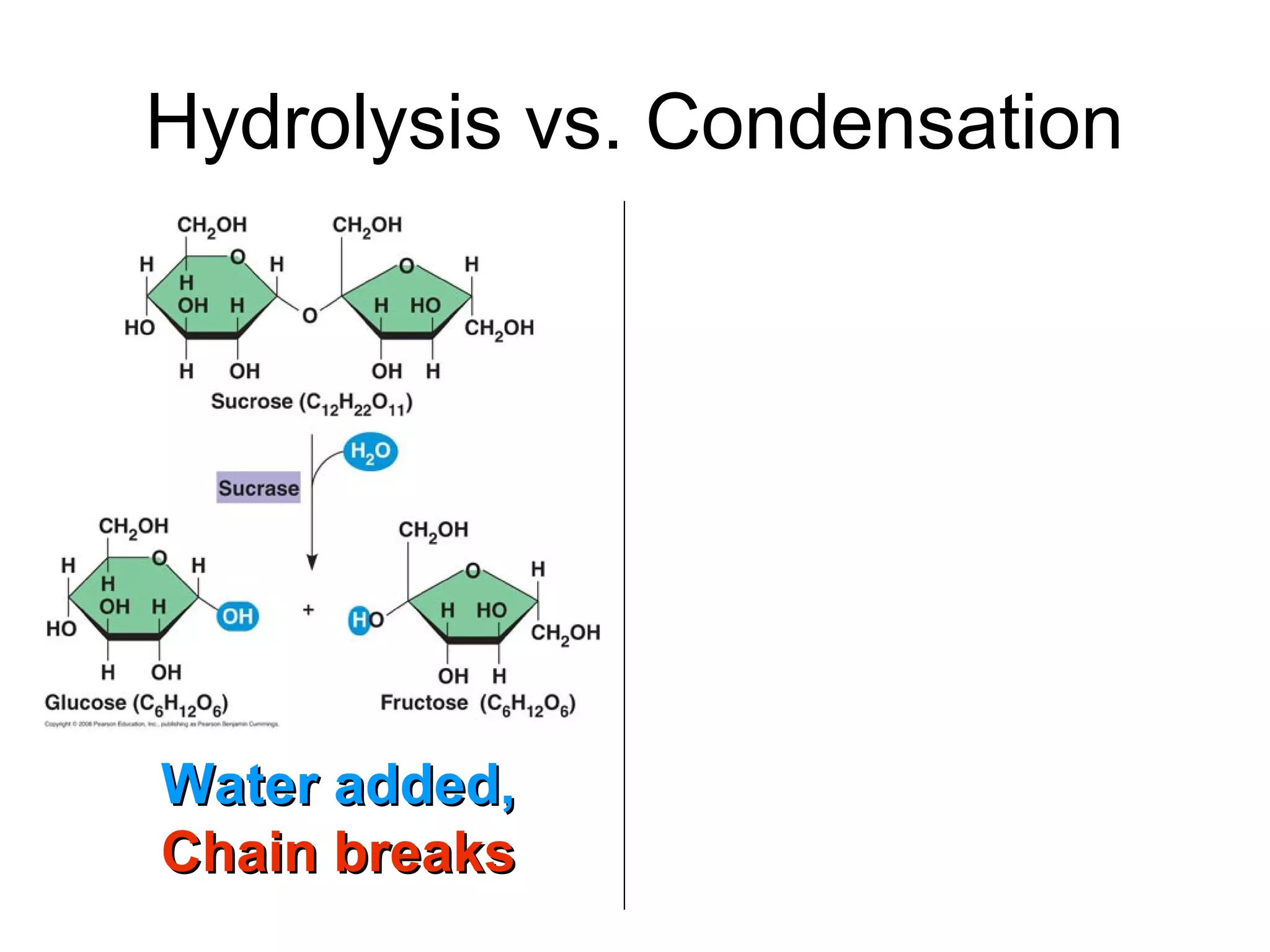
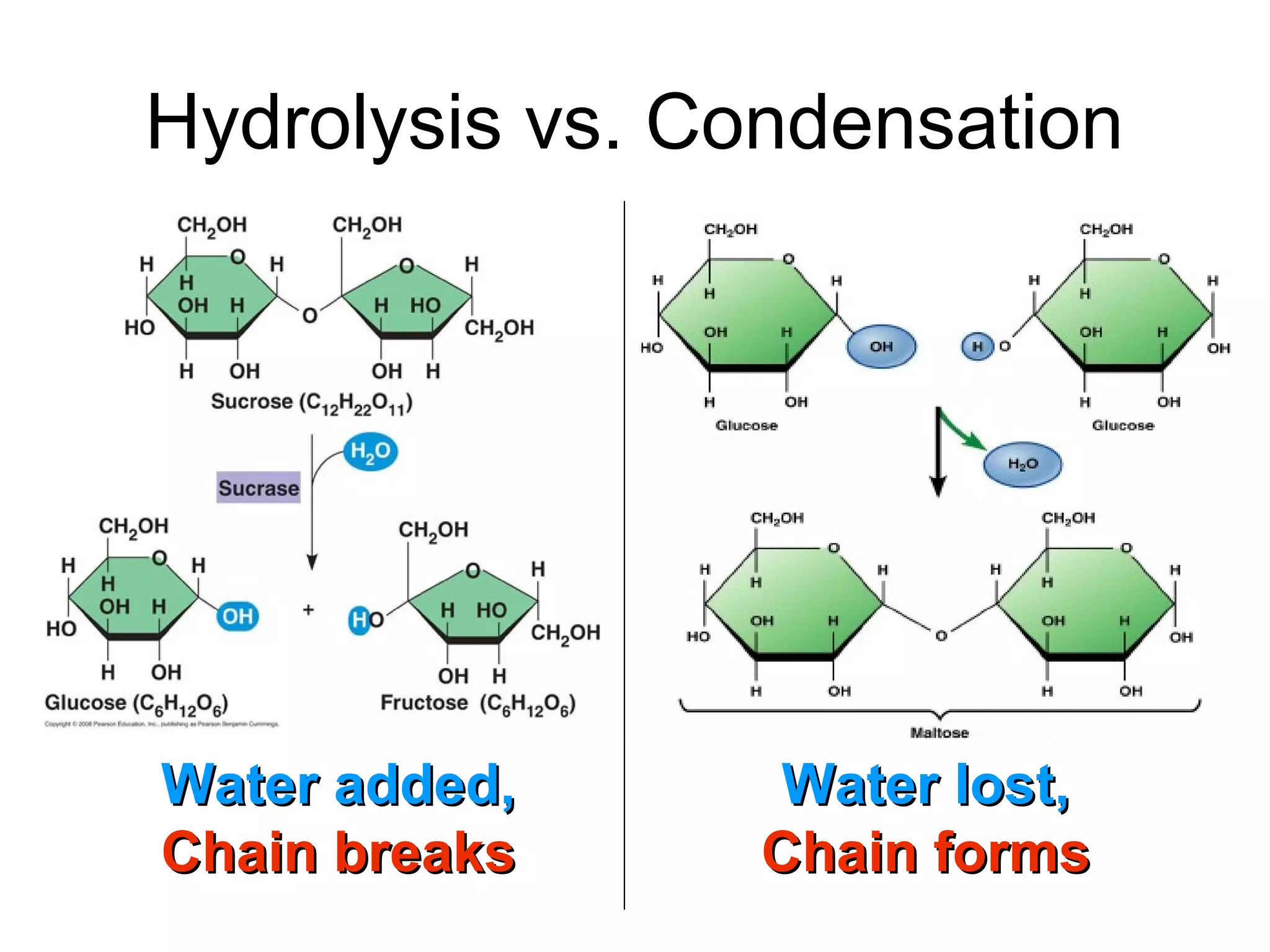
     a. When H2O is added, hydrolysis
       breaks apart chains.
3. Macromolecules chains are controlled
   by water.
     a. When H2O is added, hydrolysis
       breaks apart chains.
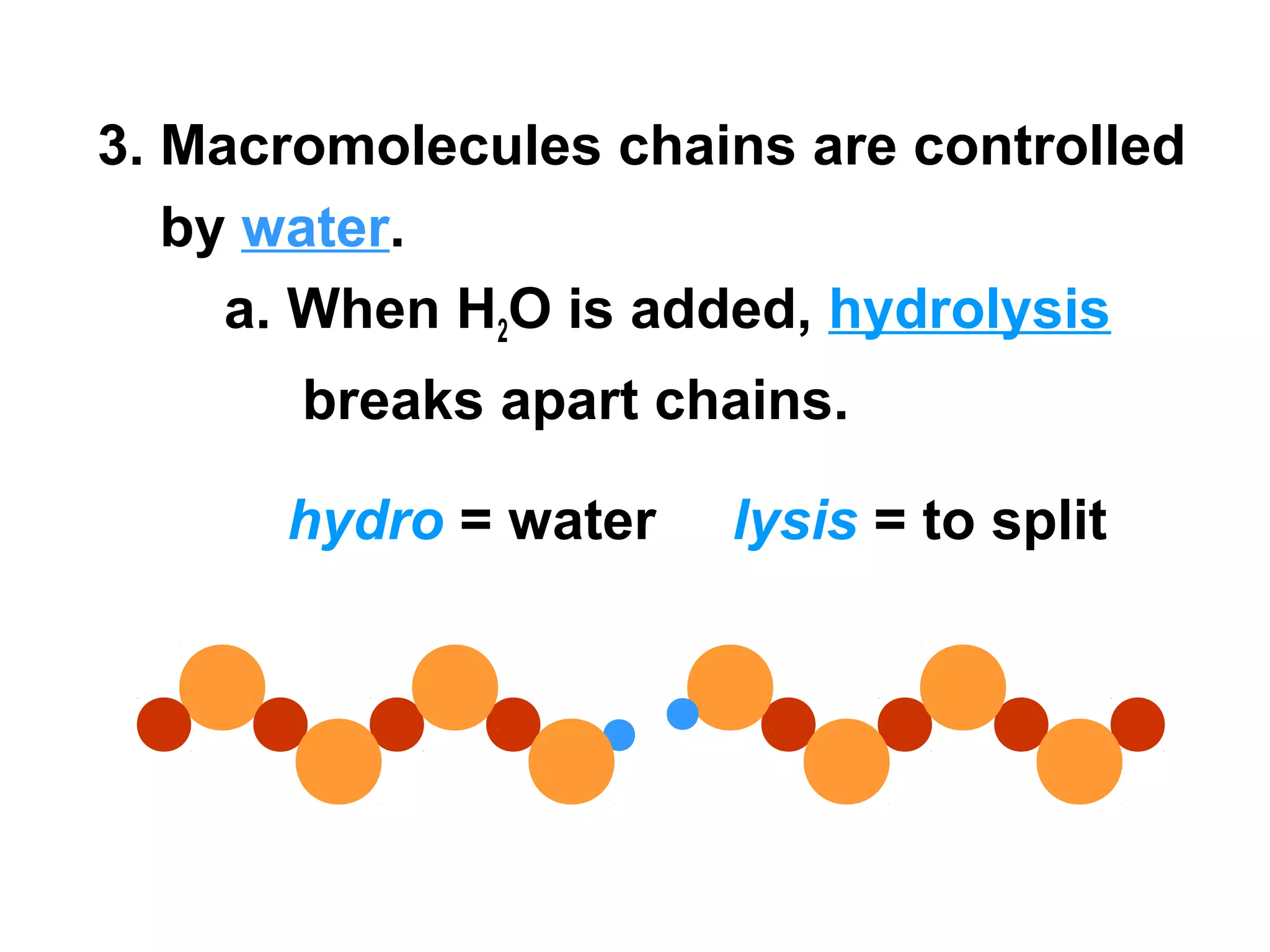
3. Macromolecules chains are controlled
   by water.
     a. When H2O is added, hydrolysis
       breaks apart chains.

      hydro = water   lysis = to split
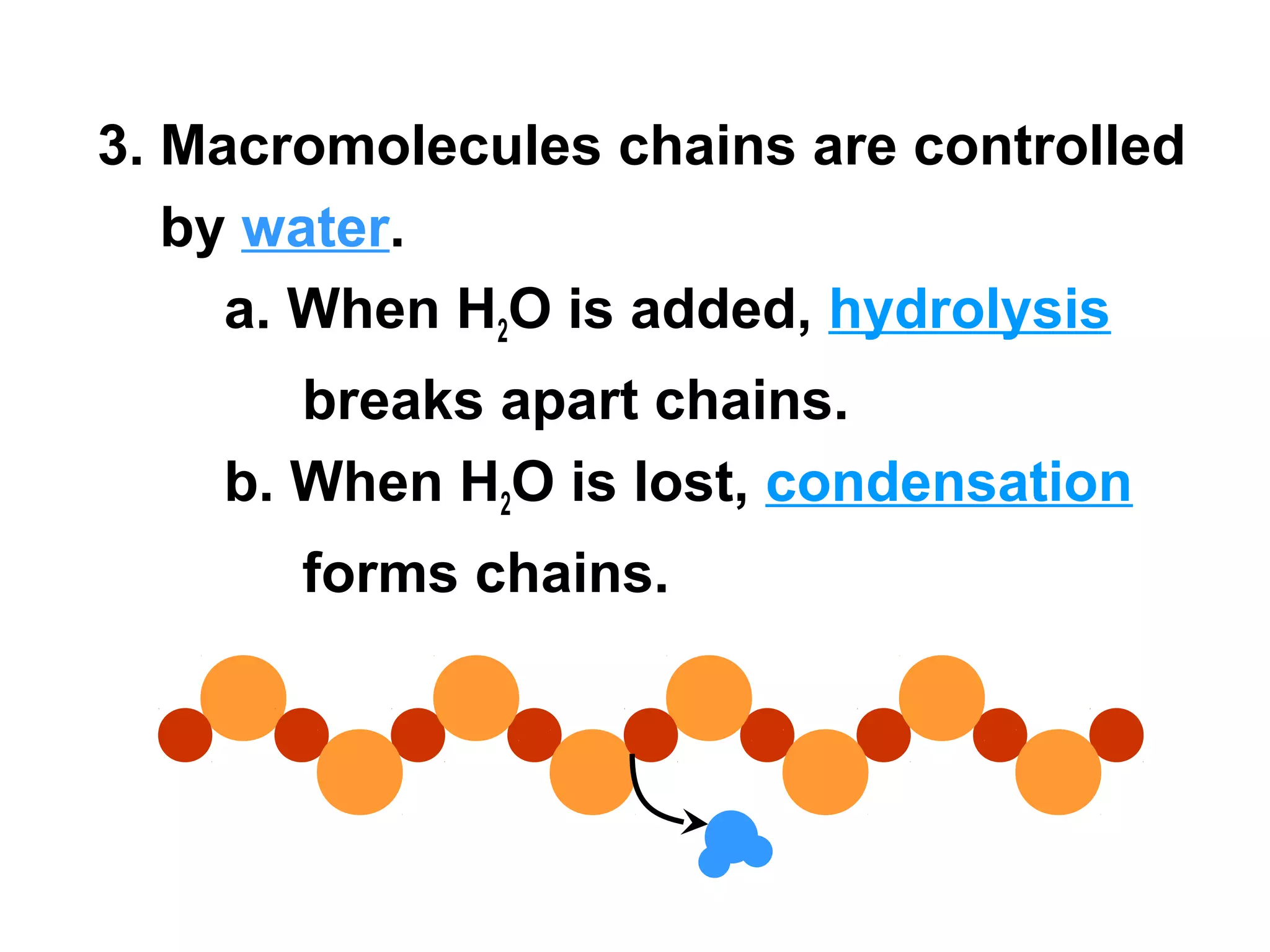
3. Macromolecules chains are controlled
   by water.
     a. When H2O is added, hydrolysis
       breaks apart chains.
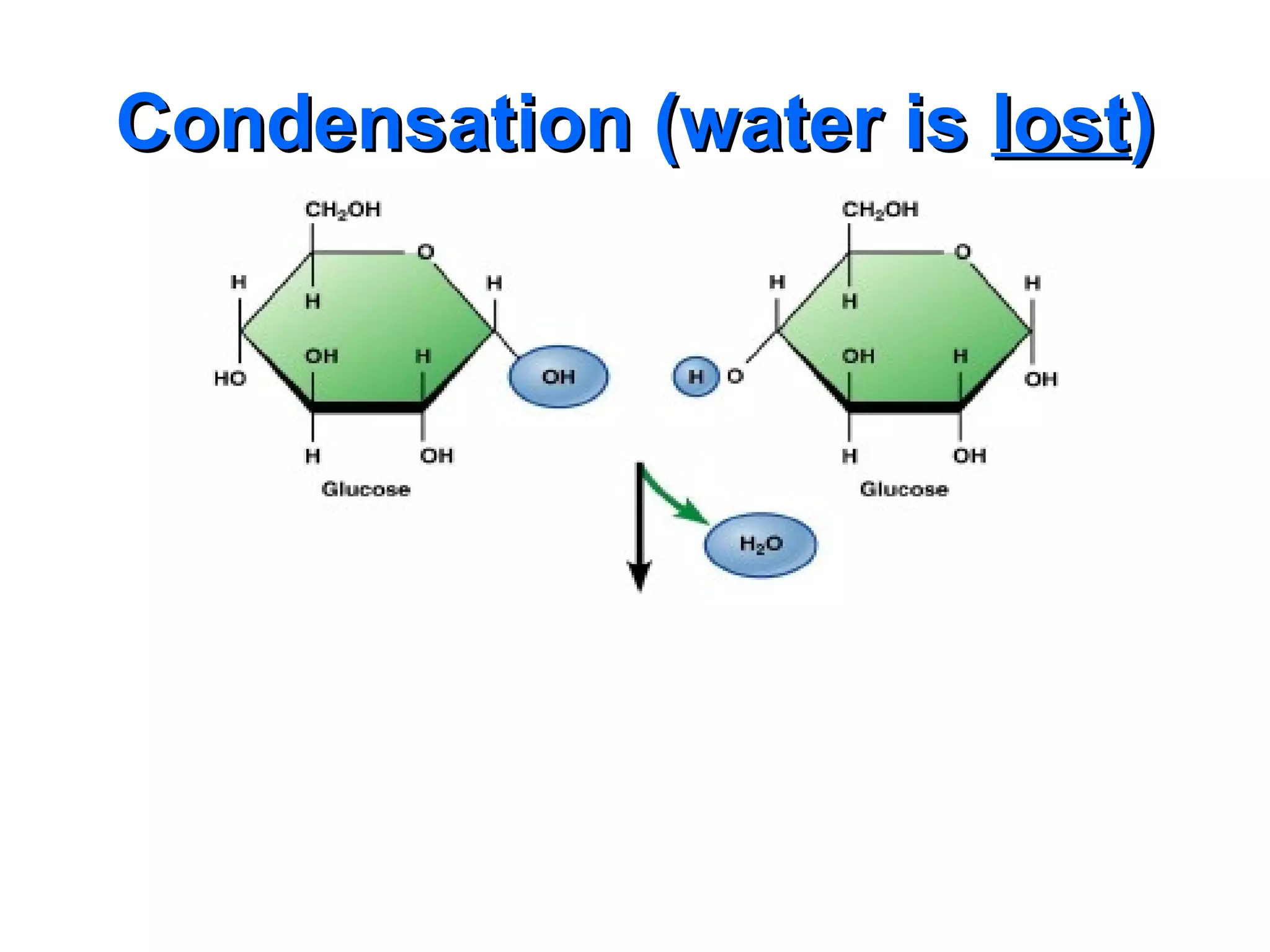
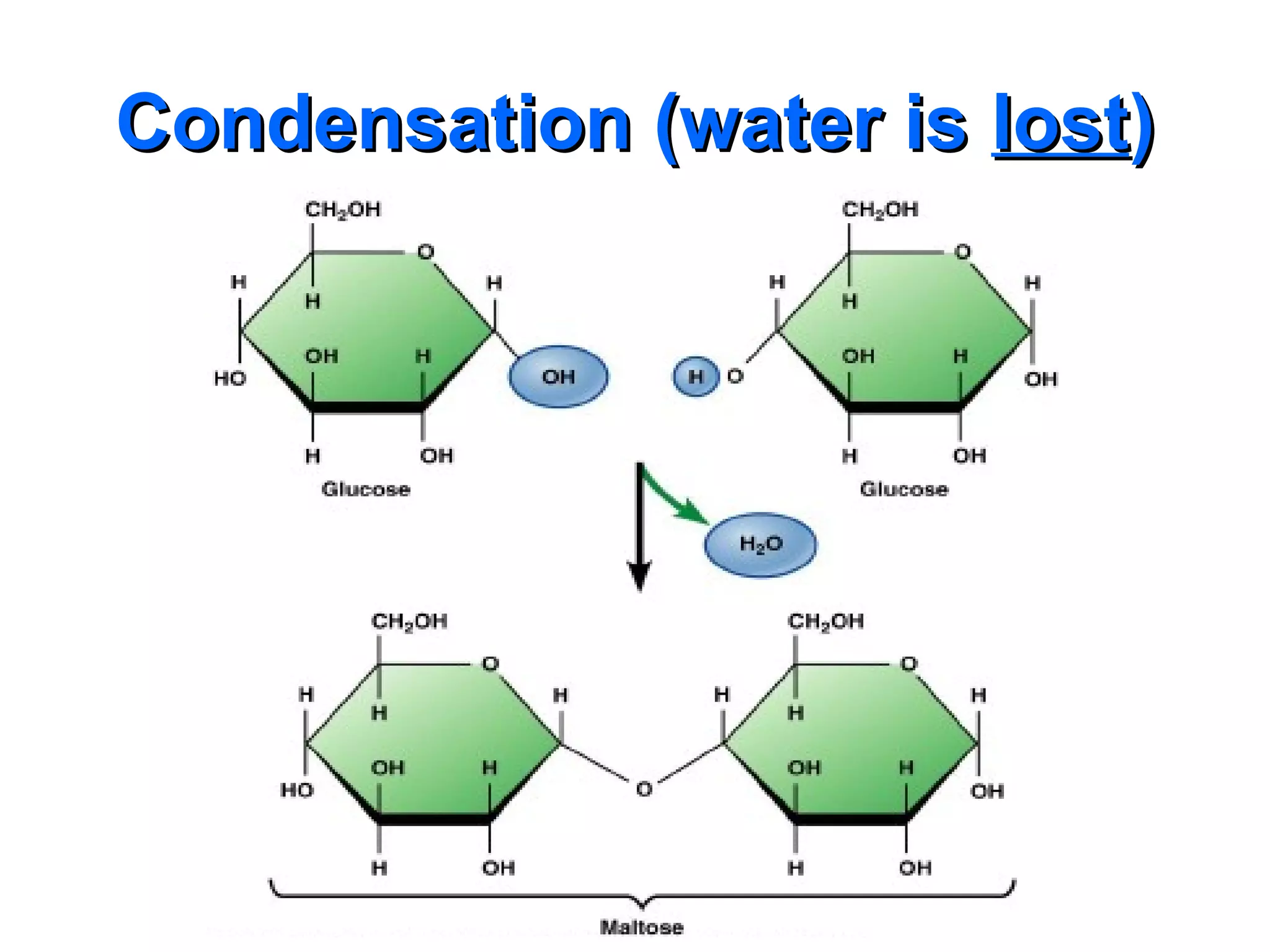
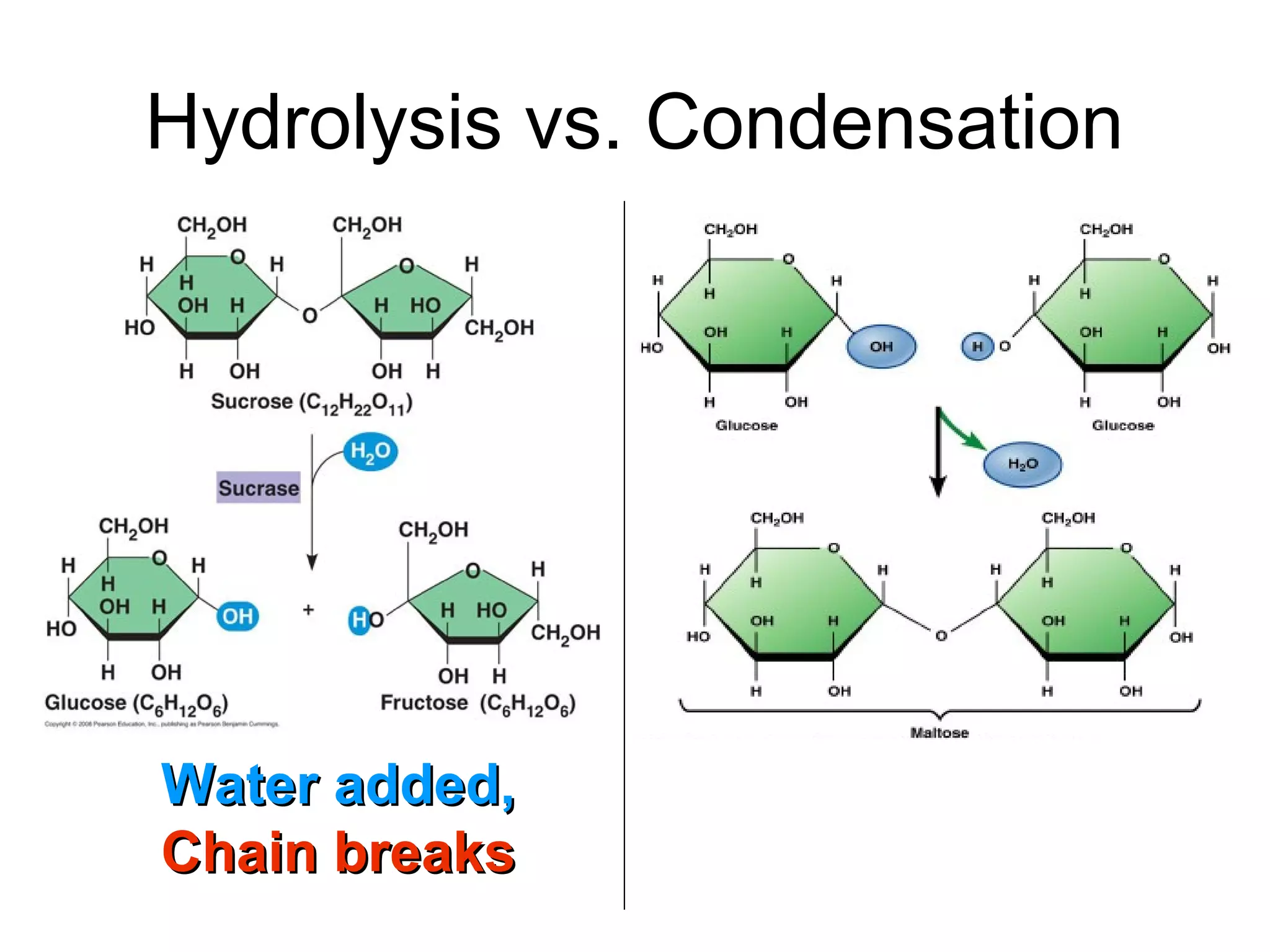
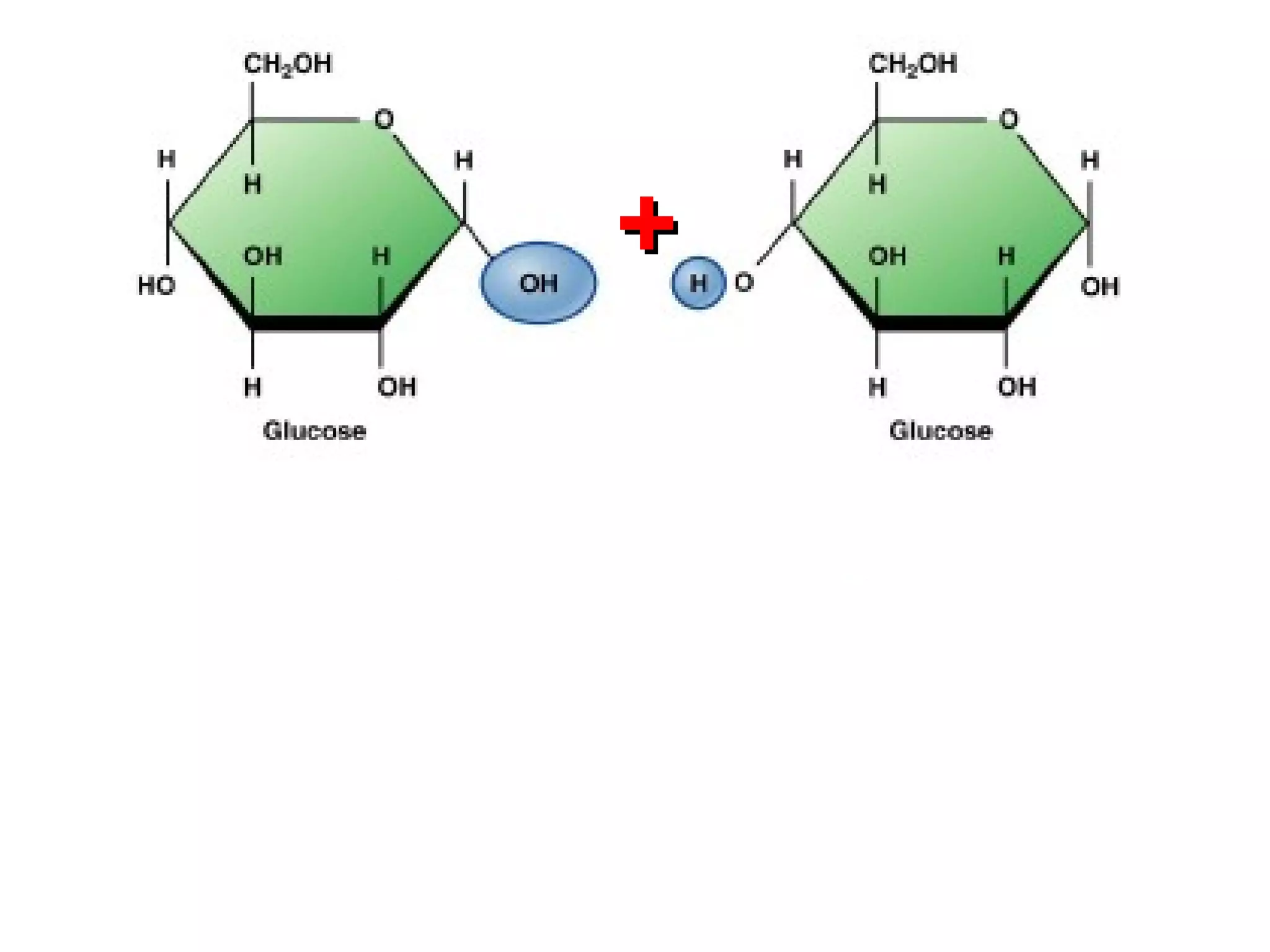
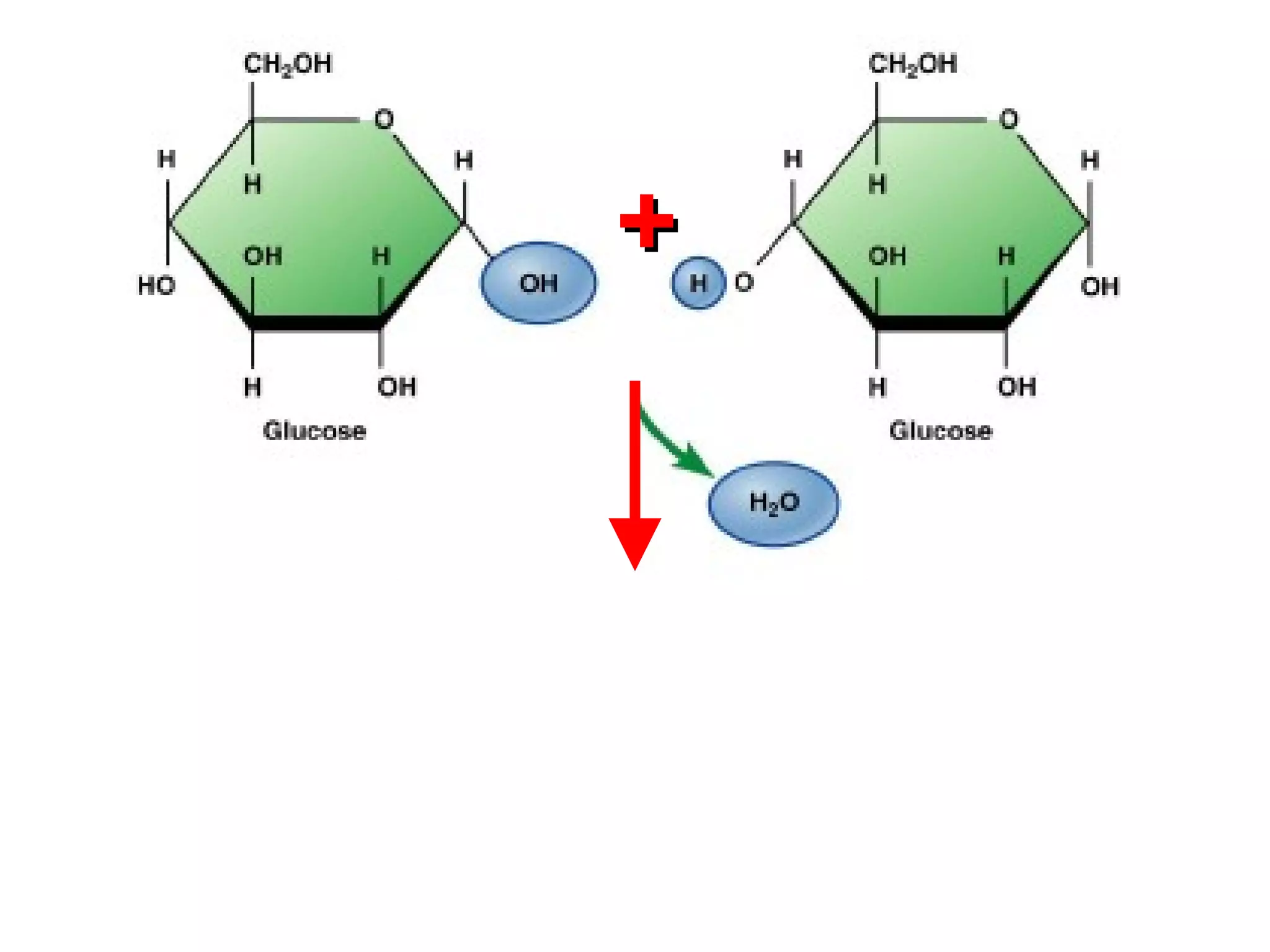
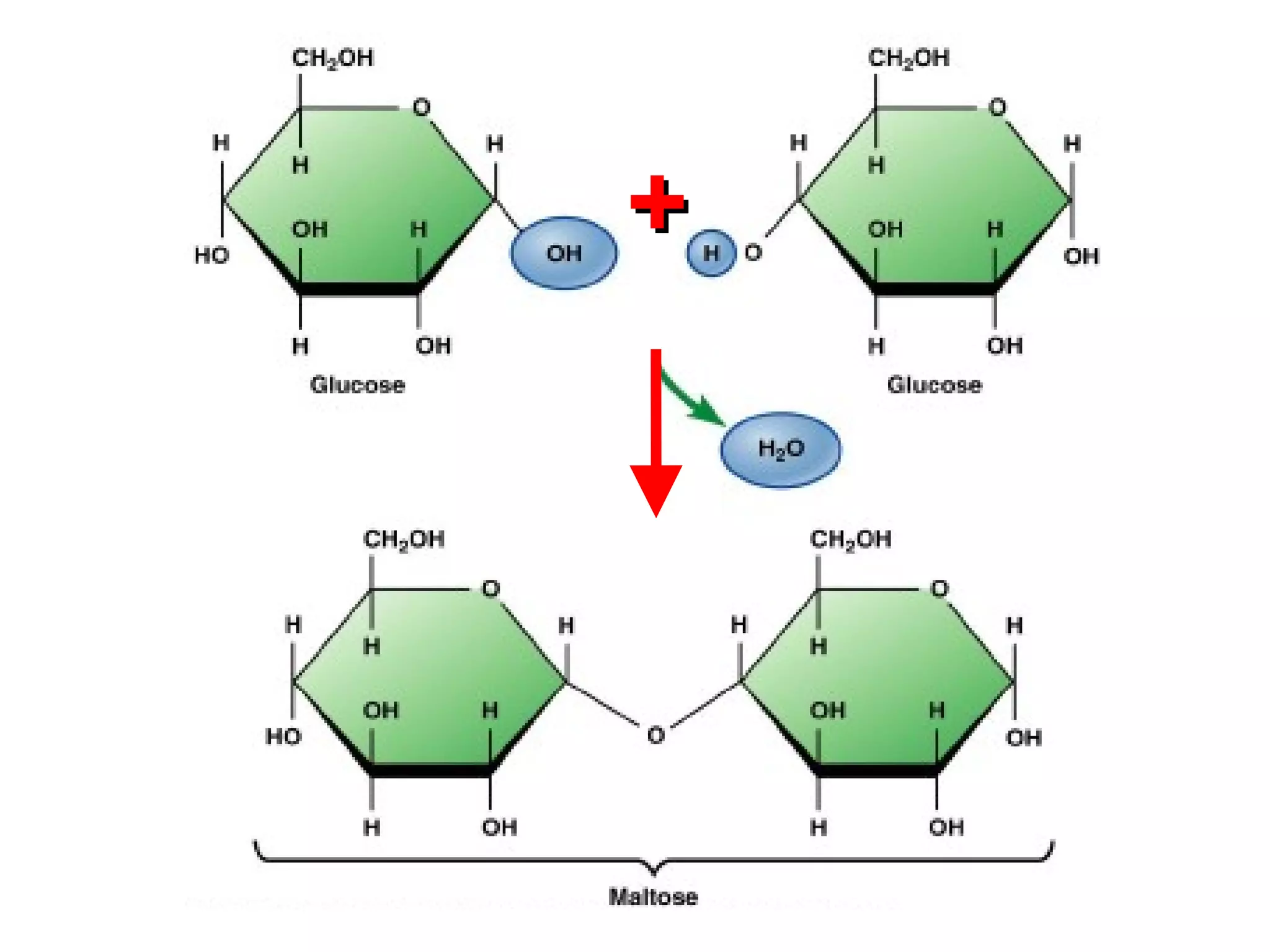
    b. When H2O is lost, condensation
       forms chains.
Hydrolysis (water is added)
Condensation (water is lost)
Hydrolysis vs. Condensation


Water added,
Chain breaks
Hydrolysis vs. Condensation


Water added,
Chain breaks
Hydrolysis vs. Condensation


Water added,     Water lost,
Chain breaks    Chain forms
IV. Organic Biomolecules
   A. You are what you eat!
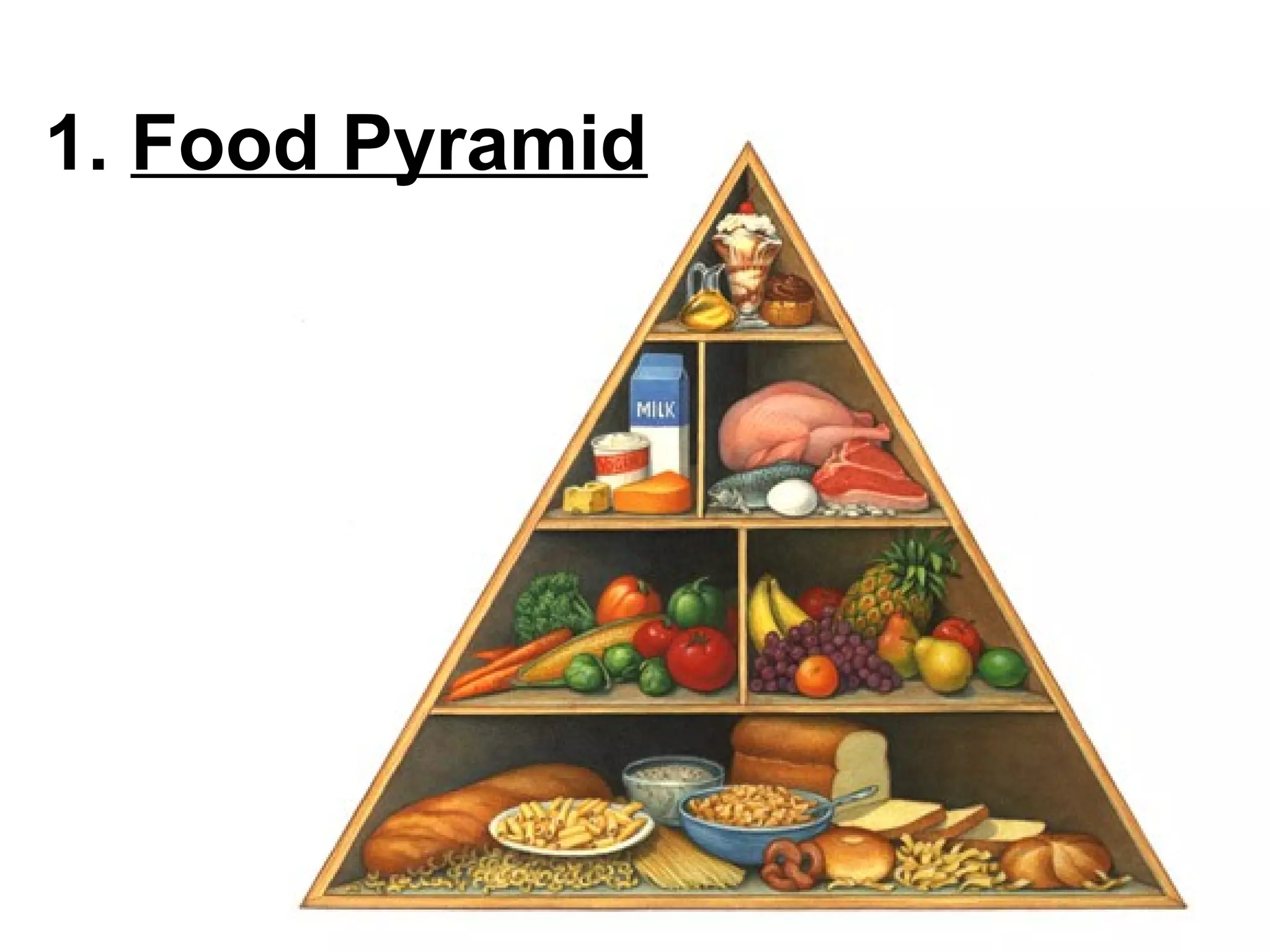
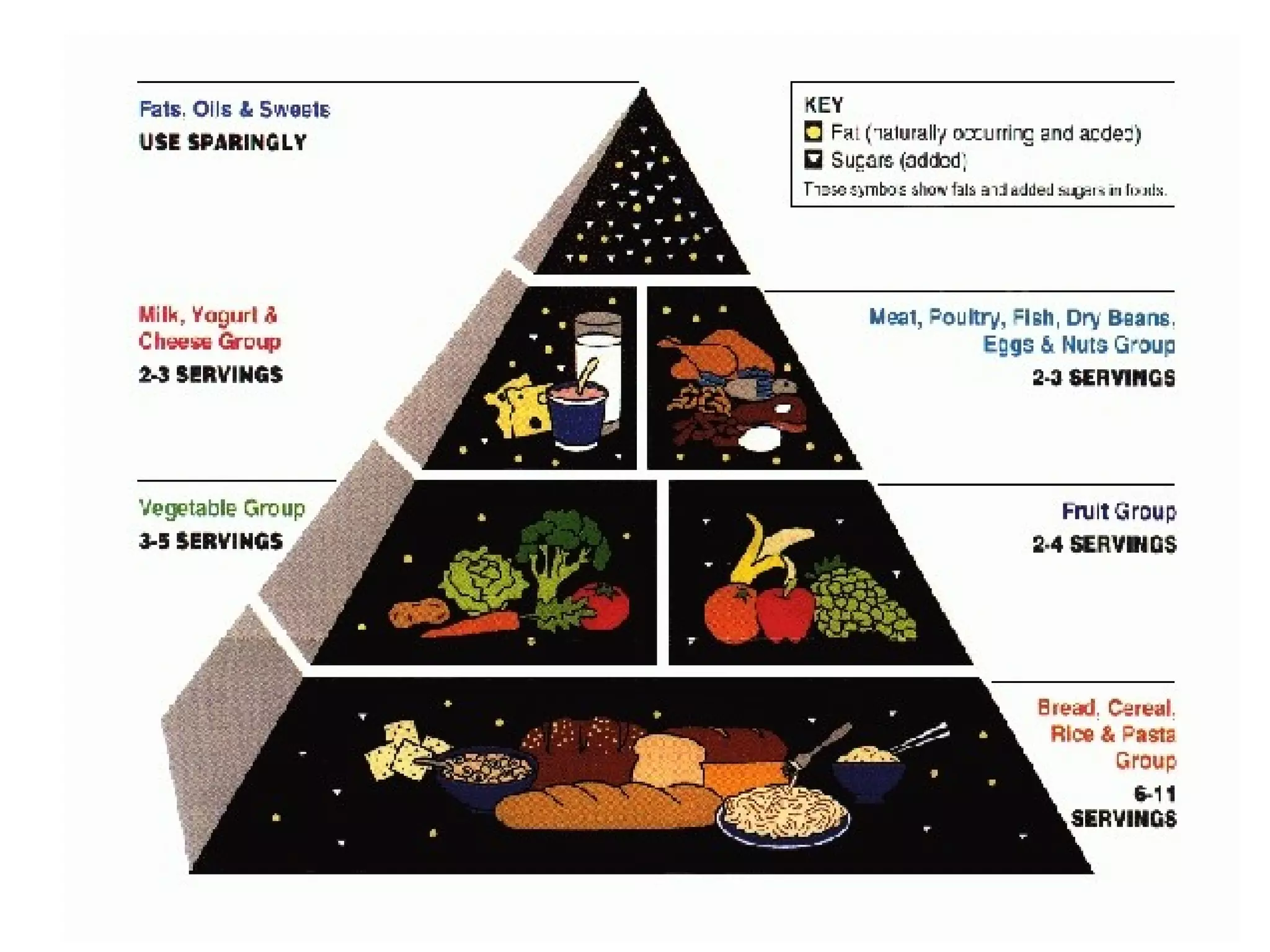
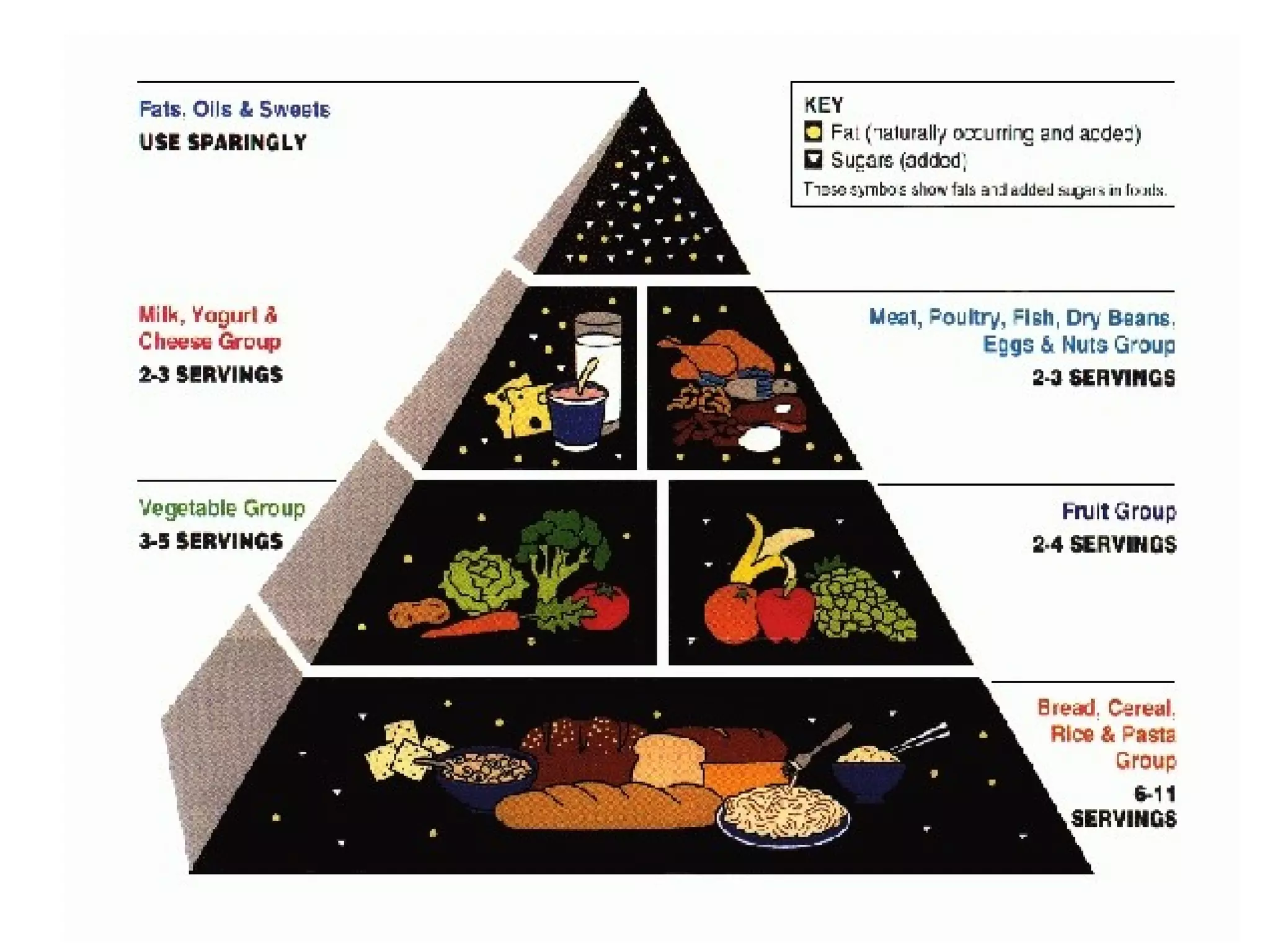
1. Food Pyramid
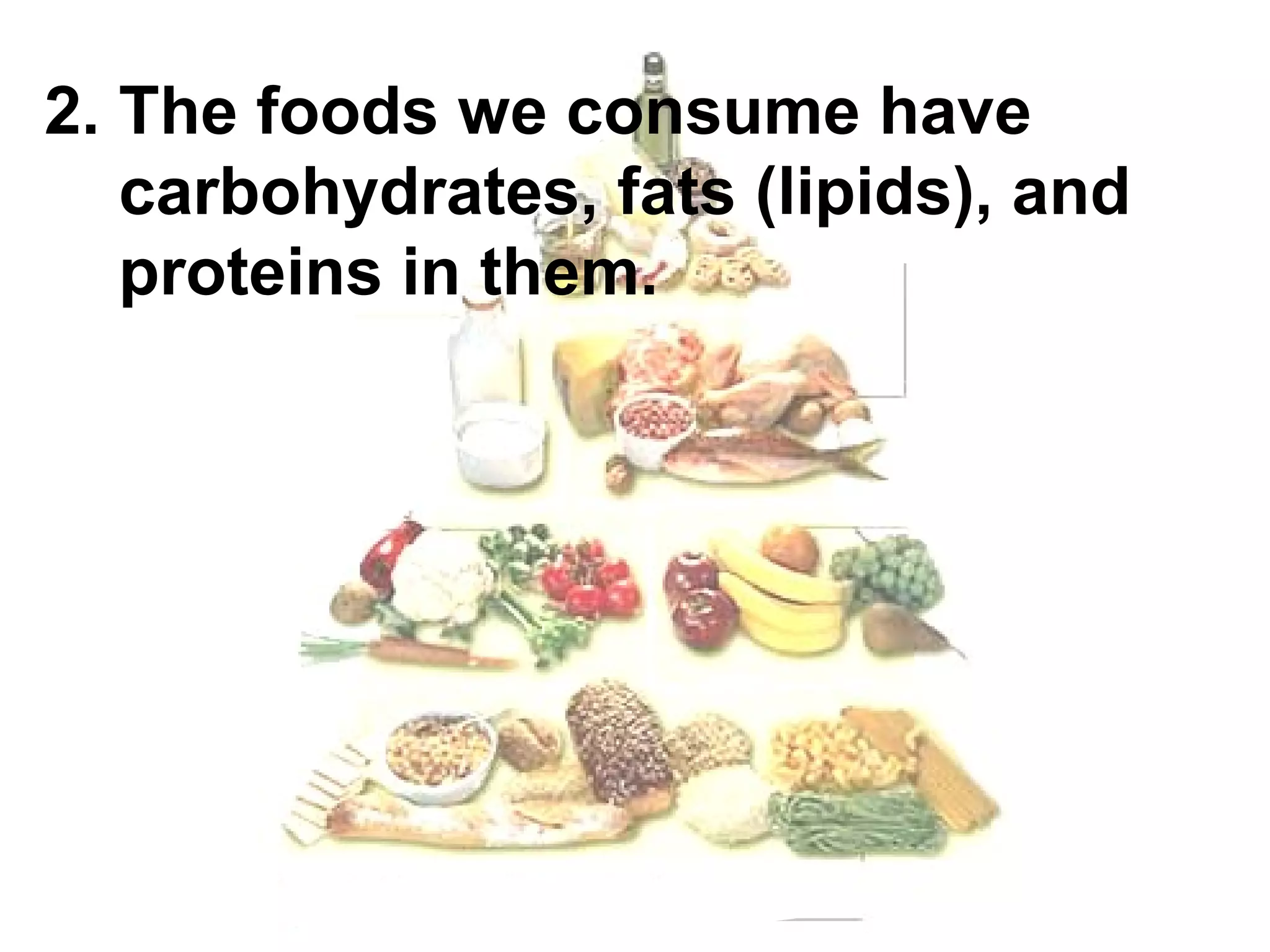
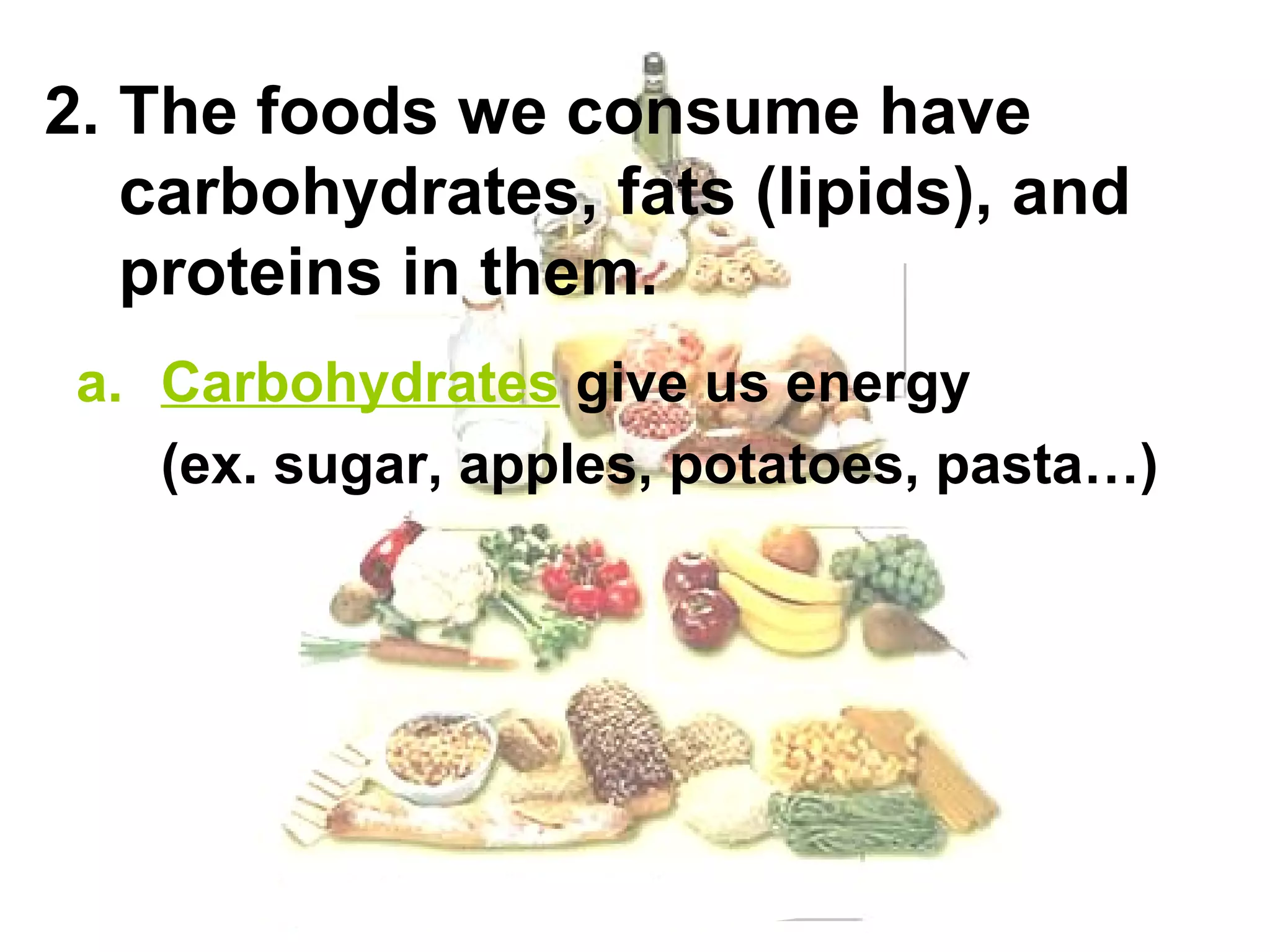
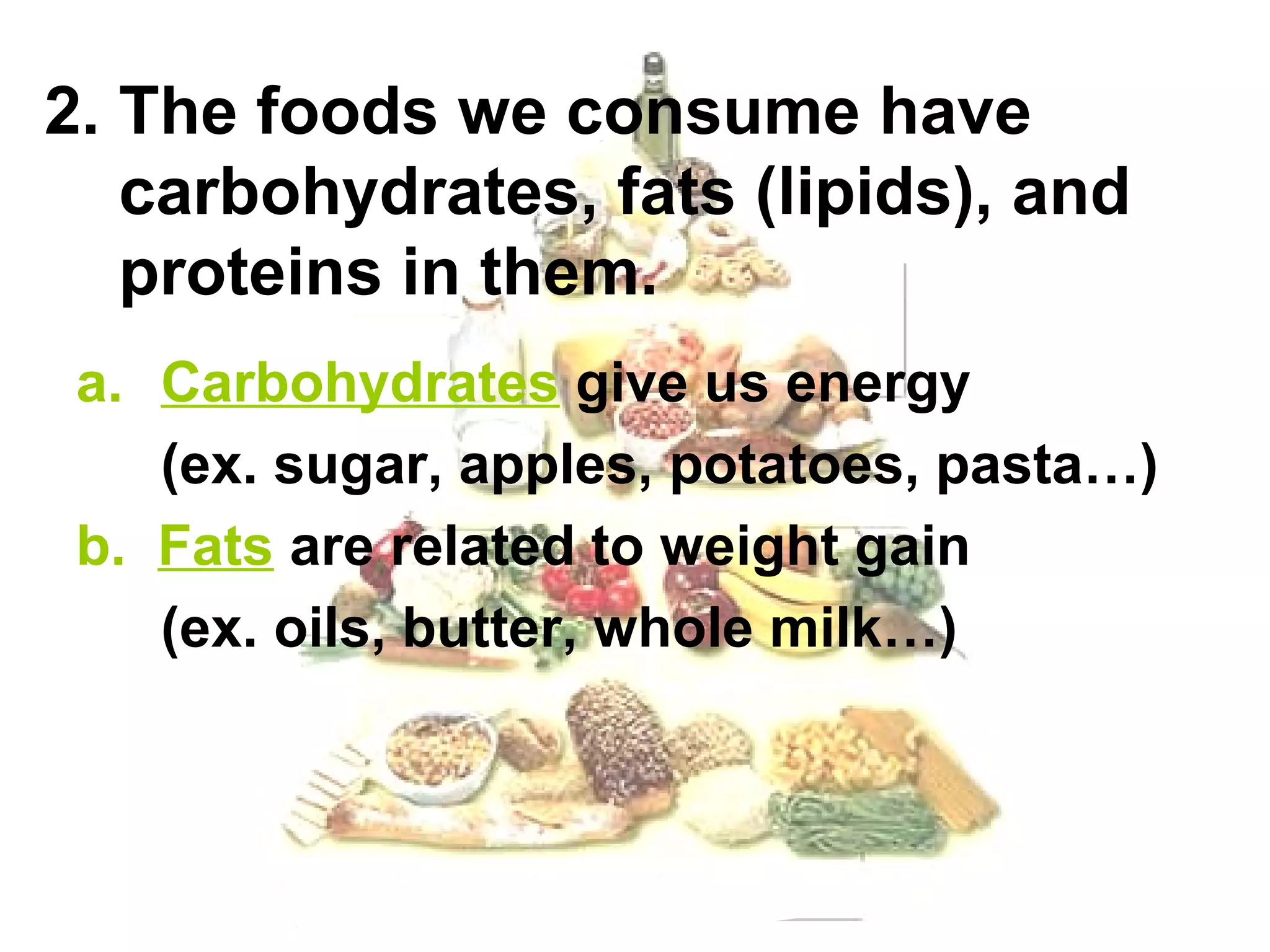
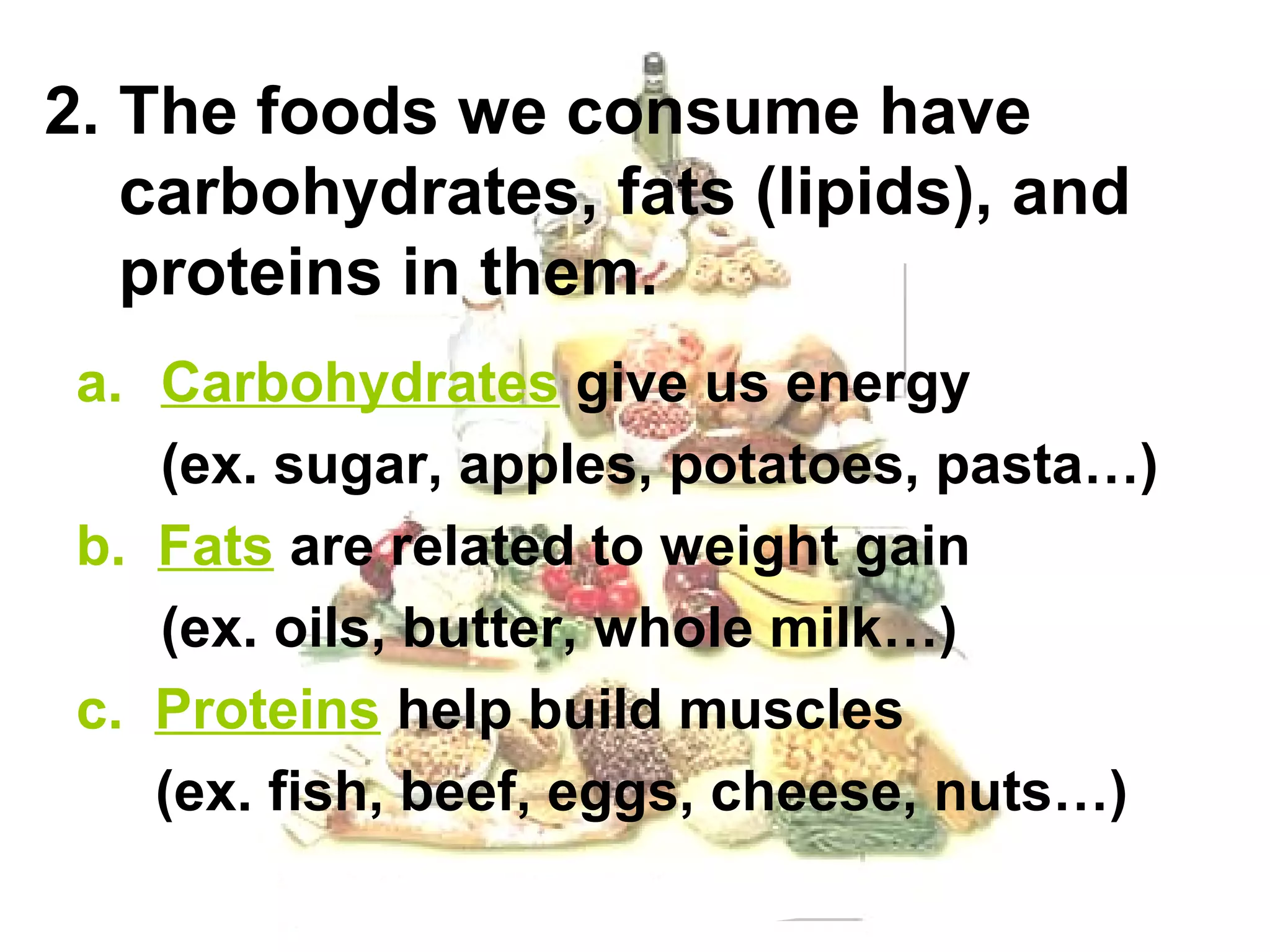
2. The foods we consume have
   carbohydrates, fats (lipids), and
   proteins in them.
2. The foods we consume have
   carbohydrates, fats (lipids), and
   proteins in them.
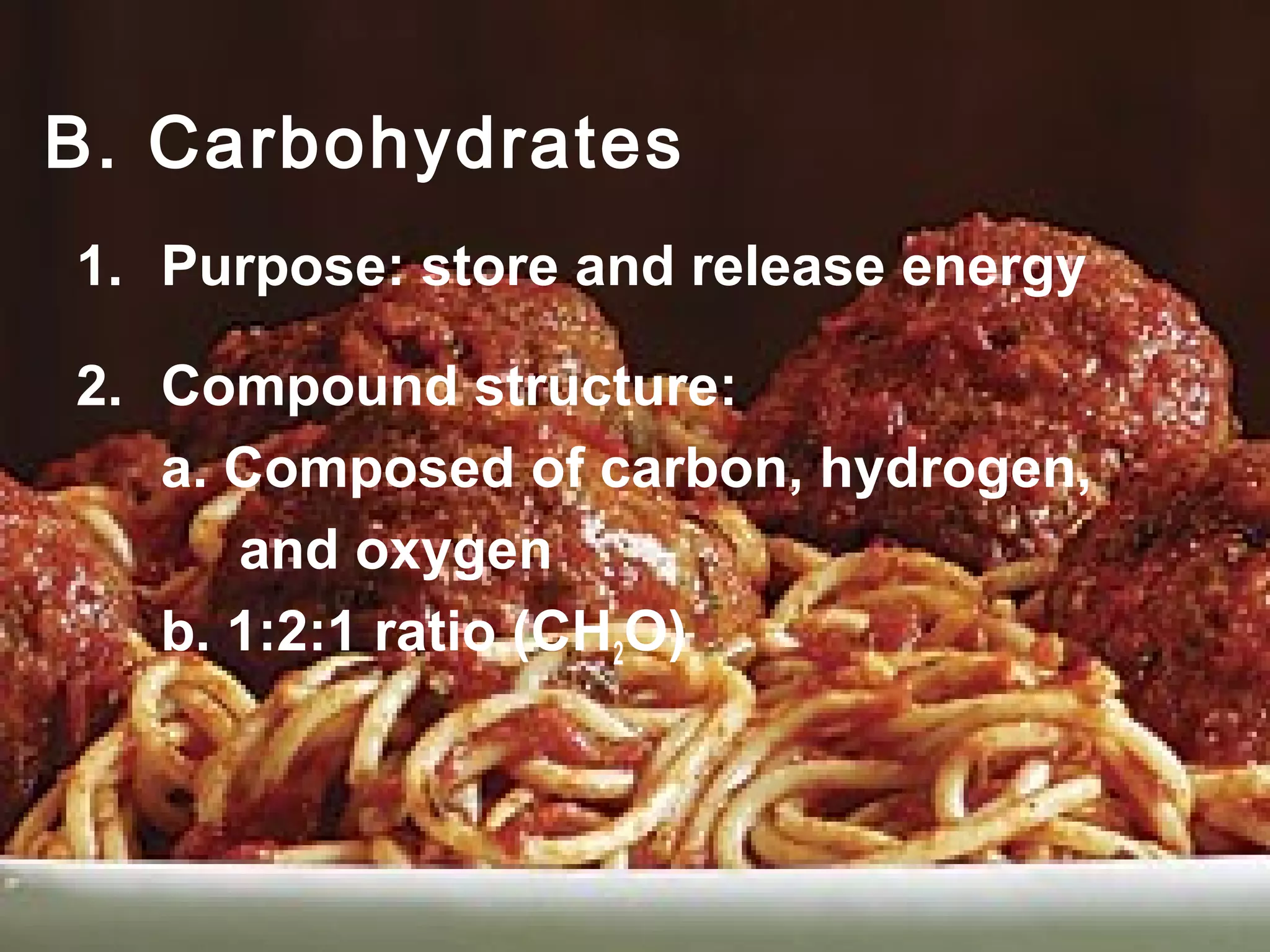
 a. Carbohydrates give us energy
    (ex. sugar, apples, potatoes, pasta…)
2. The foods we consume have
   carbohydrates, fats (lipids), and
   proteins in them.
 a. Carbohydrates give us energy
    (ex. sugar, apples, potatoes, pasta…)
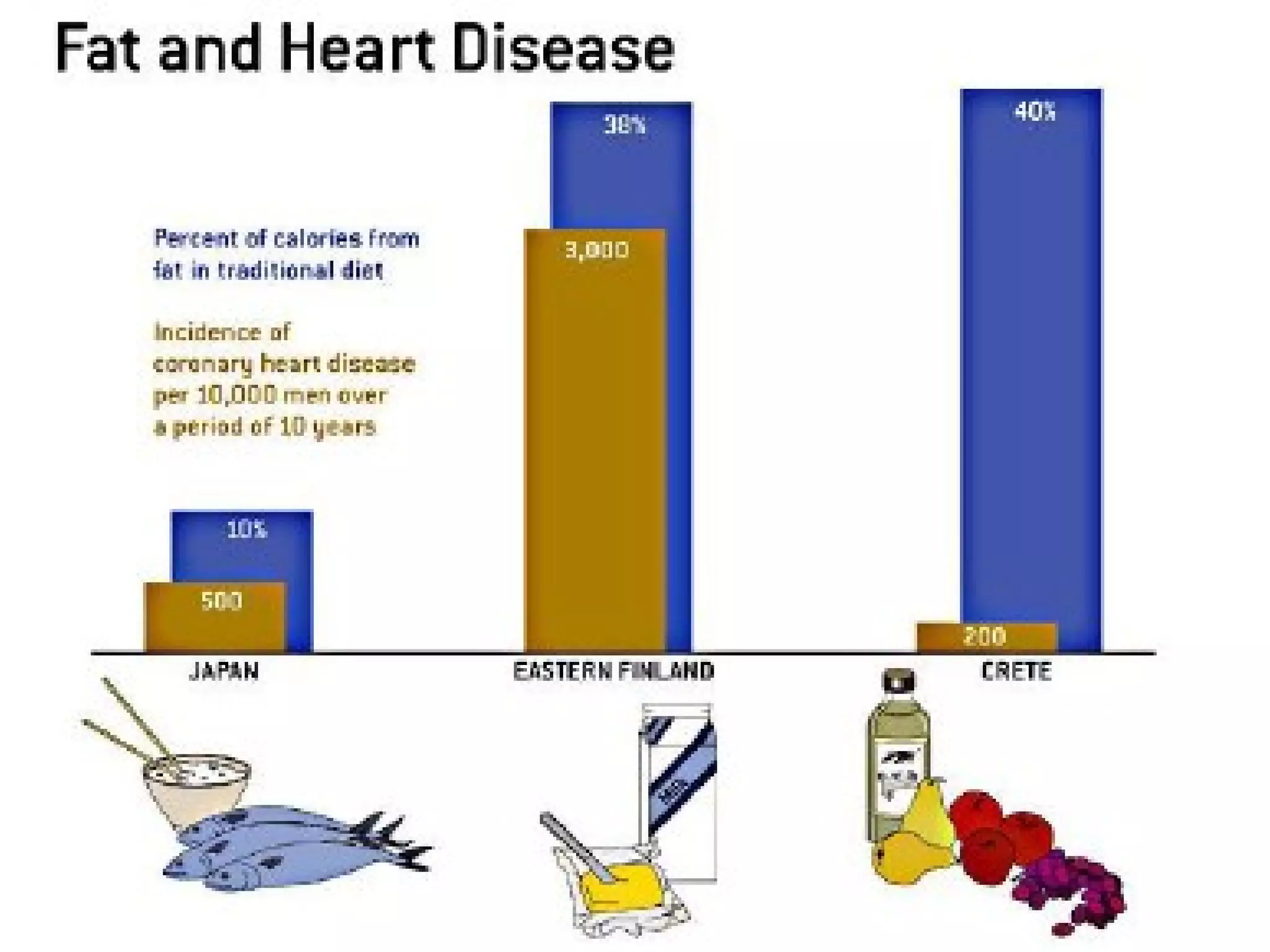
 b. Fats are related to weight gain
    (ex. oils, butter, whole milk…)
2. The foods we consume have
   carbohydrates, fats (lipids), and
   proteins in them.
 a. Carbohydrates give us energy
    (ex. sugar, apples, potatoes, pasta…)
 b. Fats are related to weight gain
    (ex. oils, butter, whole milk…)
 c. Proteins help build muscles
    (ex. fish, beef, eggs, cheese, nuts…)
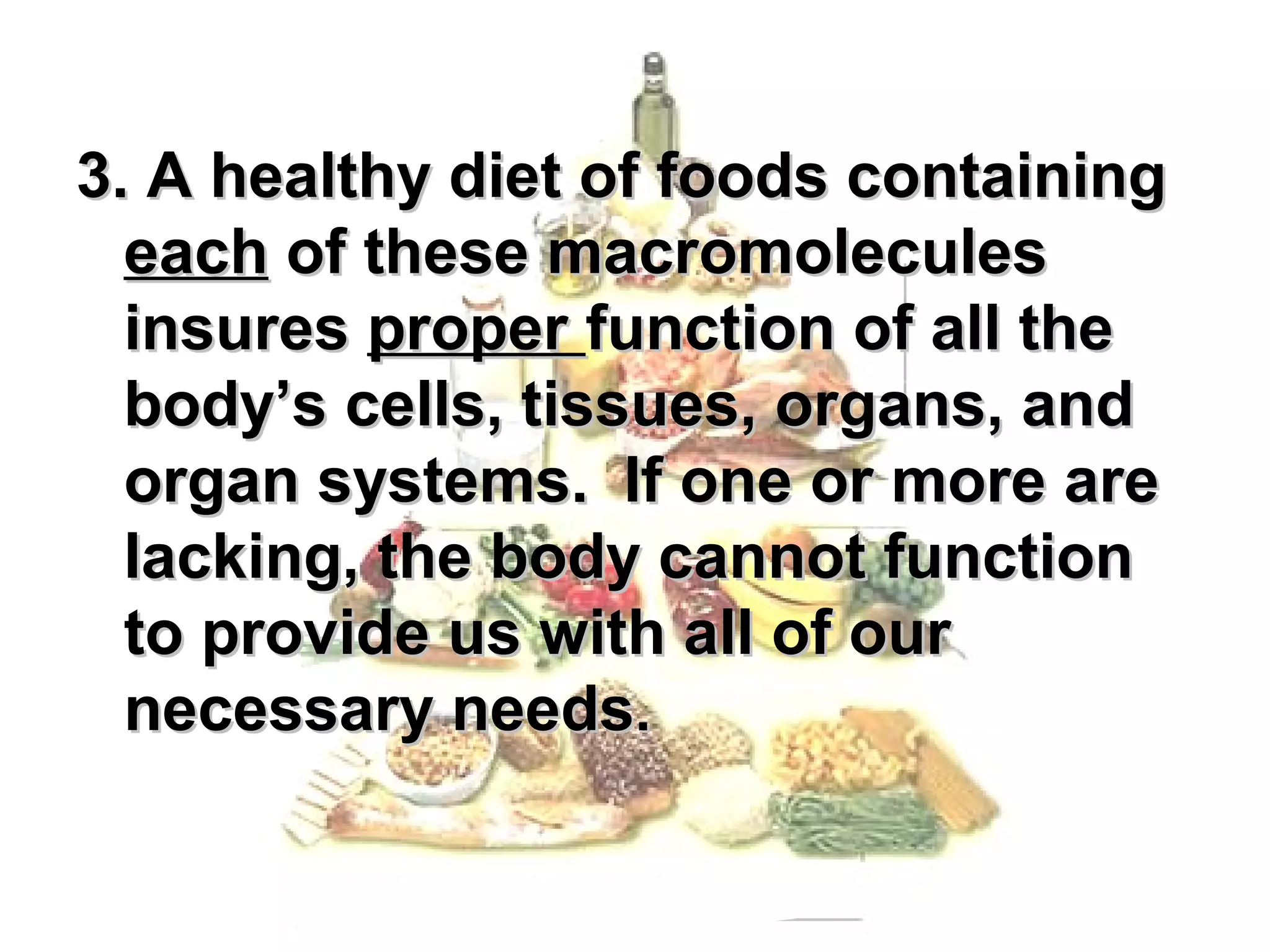
3. A healthy diet of foods containing
  each of these macromolecules
  insures proper function of all the
  body’s cells, tissues, organs, and
  organ systems. If one or more are
  lacking, the body cannot function
  to provide us with all of our
  necessary needs.
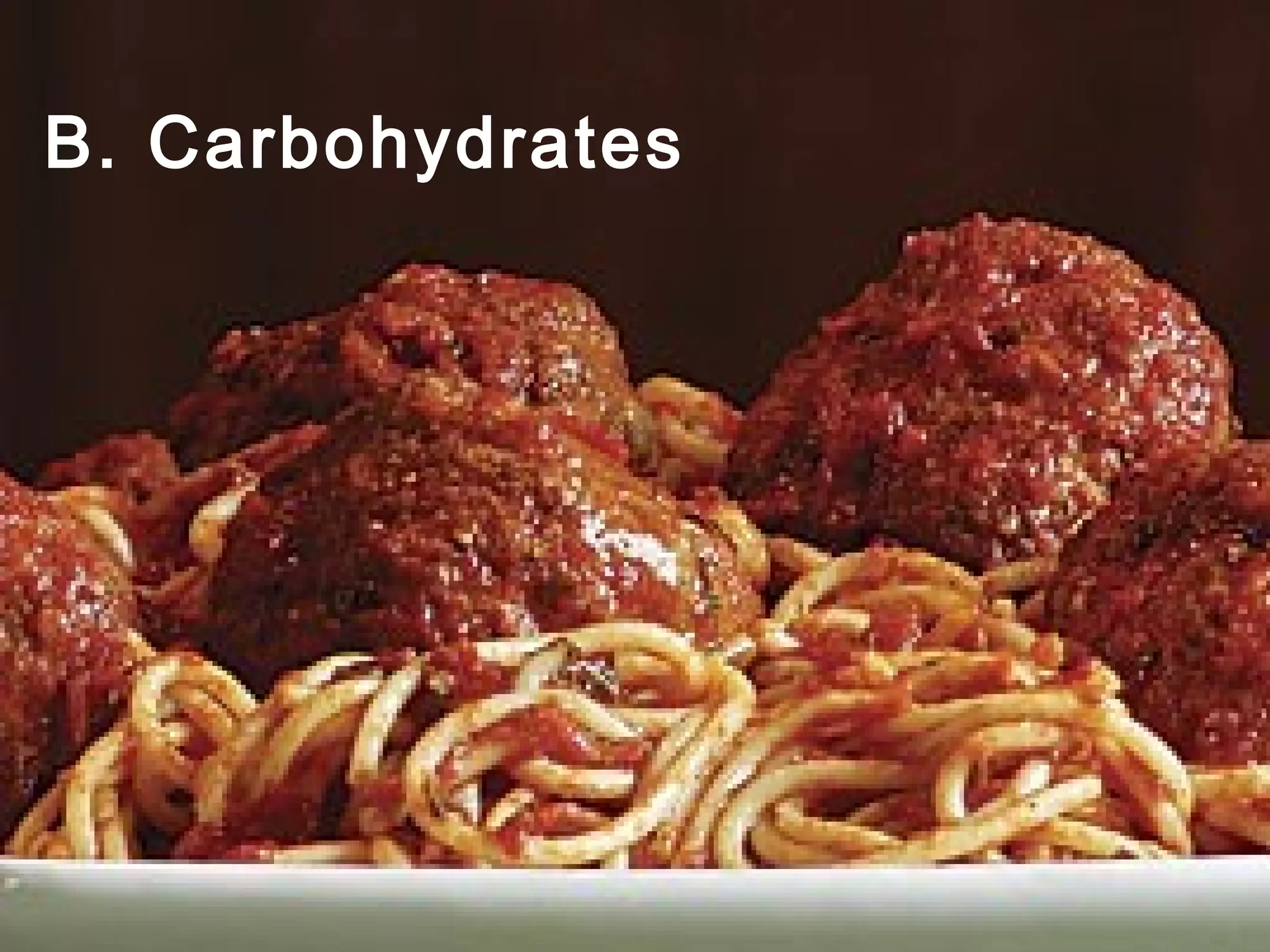
B. Carbohydrates
B. Carbohydrates
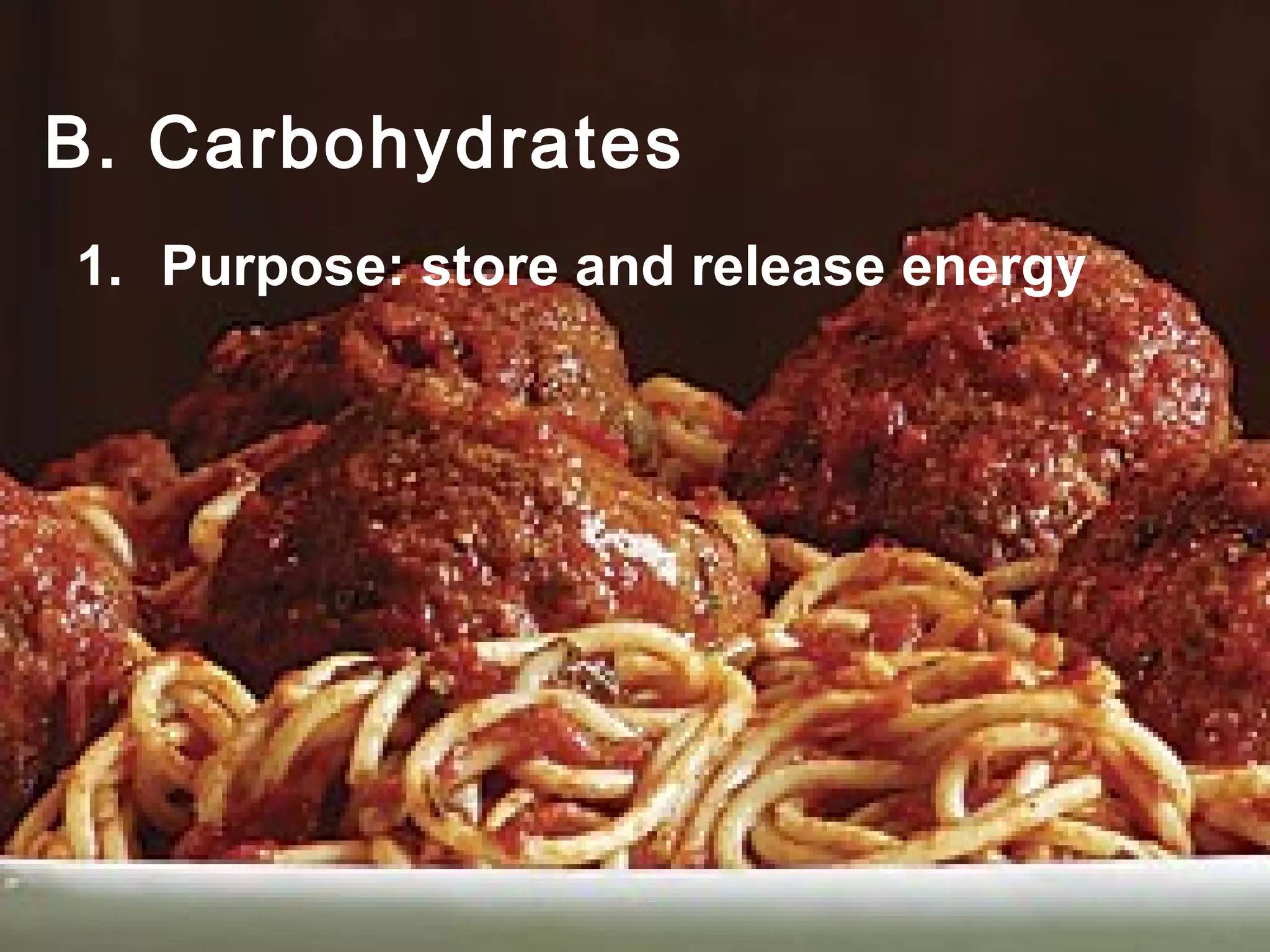
1. Purpose: store and release energy
B. Carbohydrates
1. Purpose: store and release energy

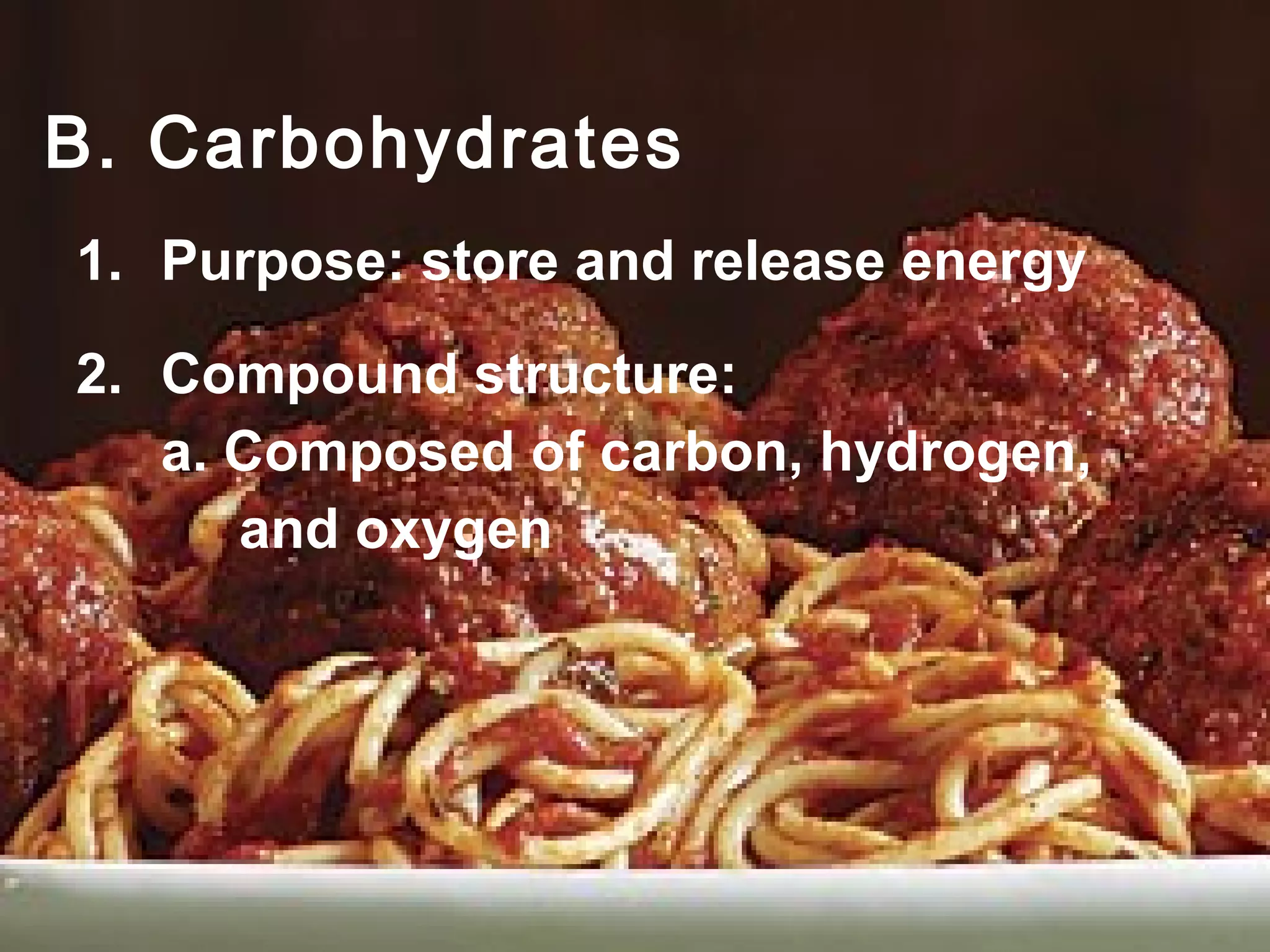
2. Compound structure:
   a. Composed of carbon, hydrogen,
      and oxygen
B. Carbohydrates
1. Purpose: store and release energy

2. Compound structure:
   a. Composed of carbon, hydrogen,
      and oxygen
   b. 1:2:1 ratio (CH2O)
B. Carbohydrates
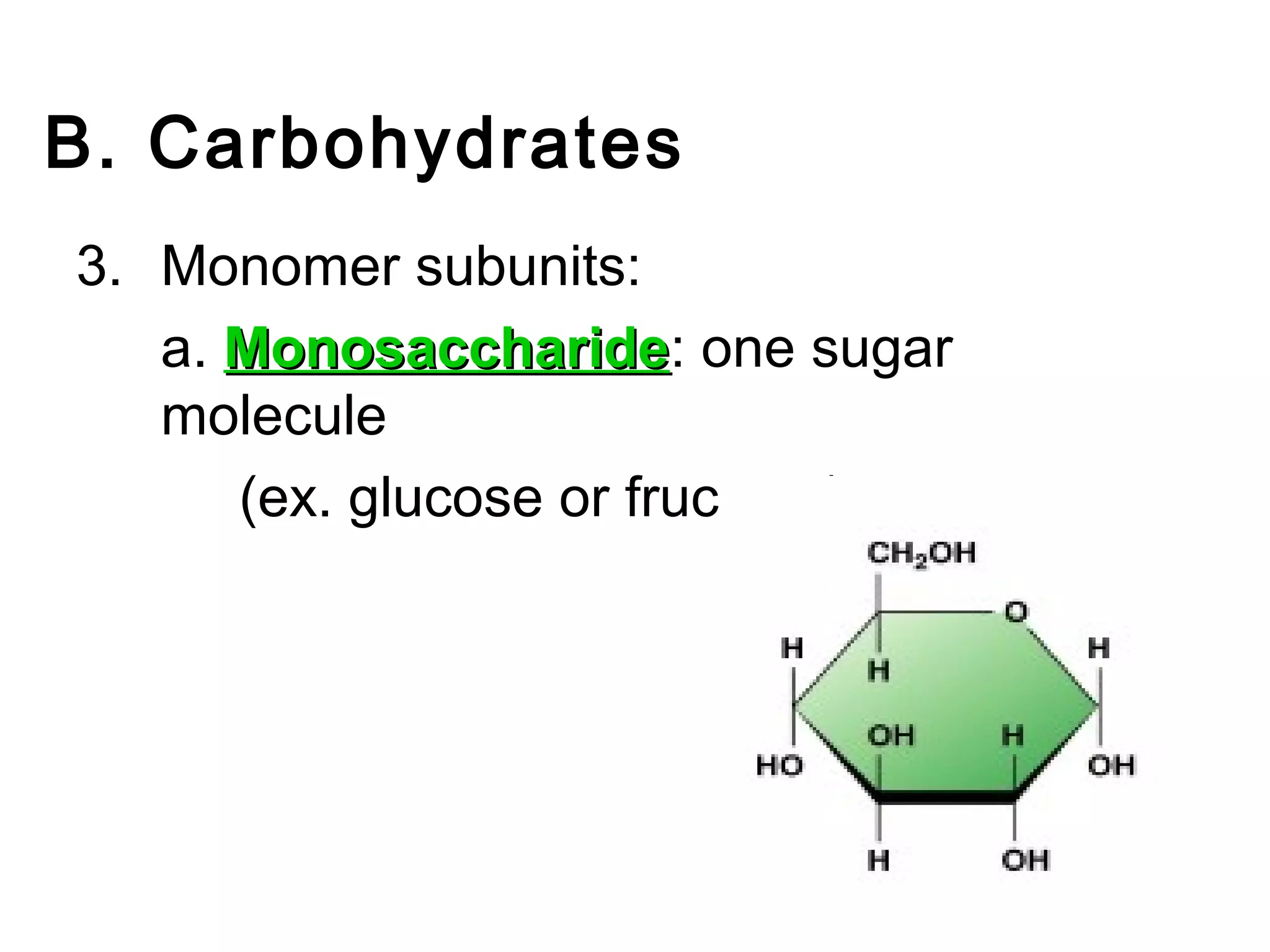
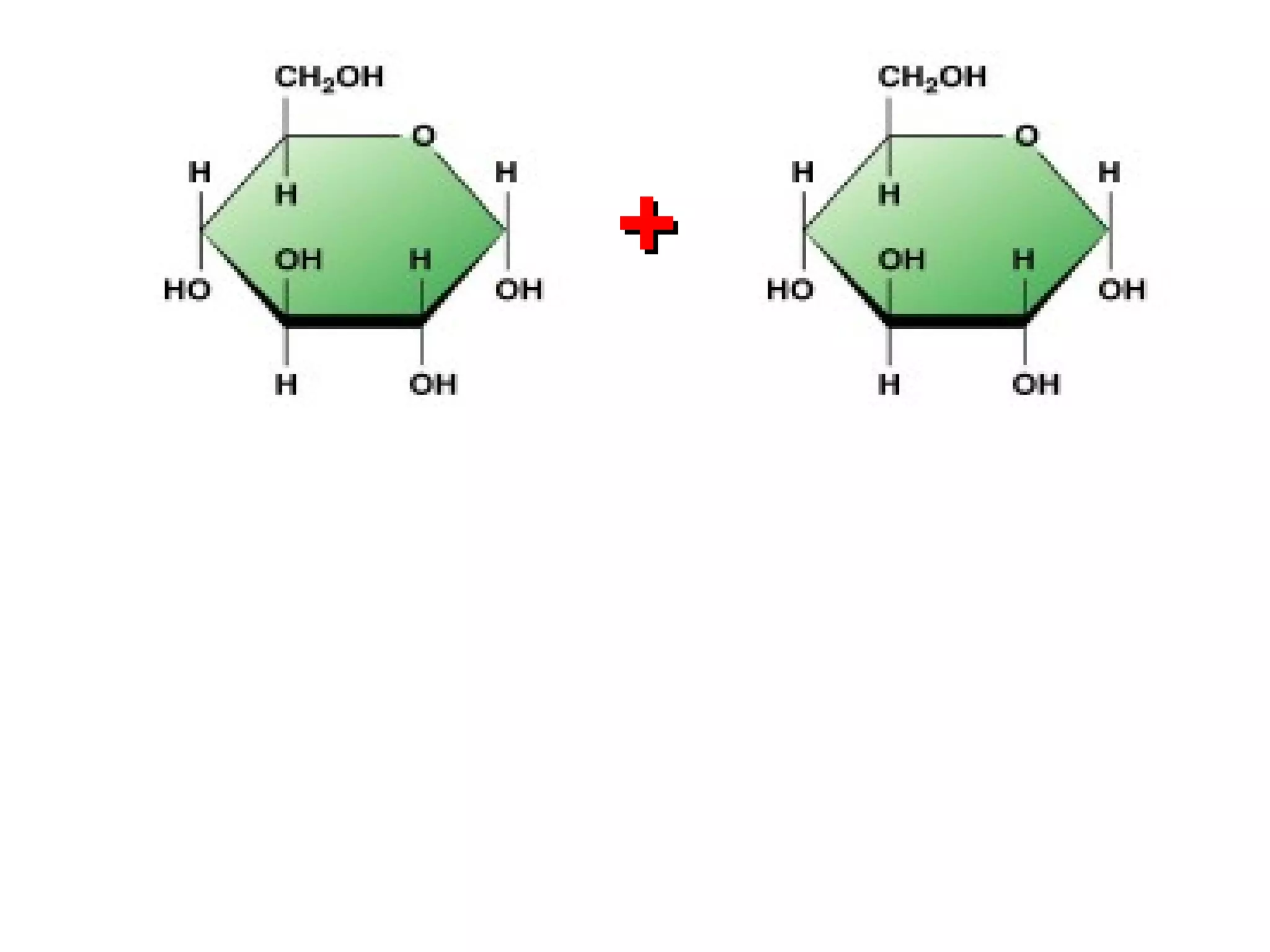
3. Monomer subunits:
   a. Monosaccharide: one sugar
      Monosaccharide
   molecule
      (ex. glucose or fructose)
B. Carbohydrates
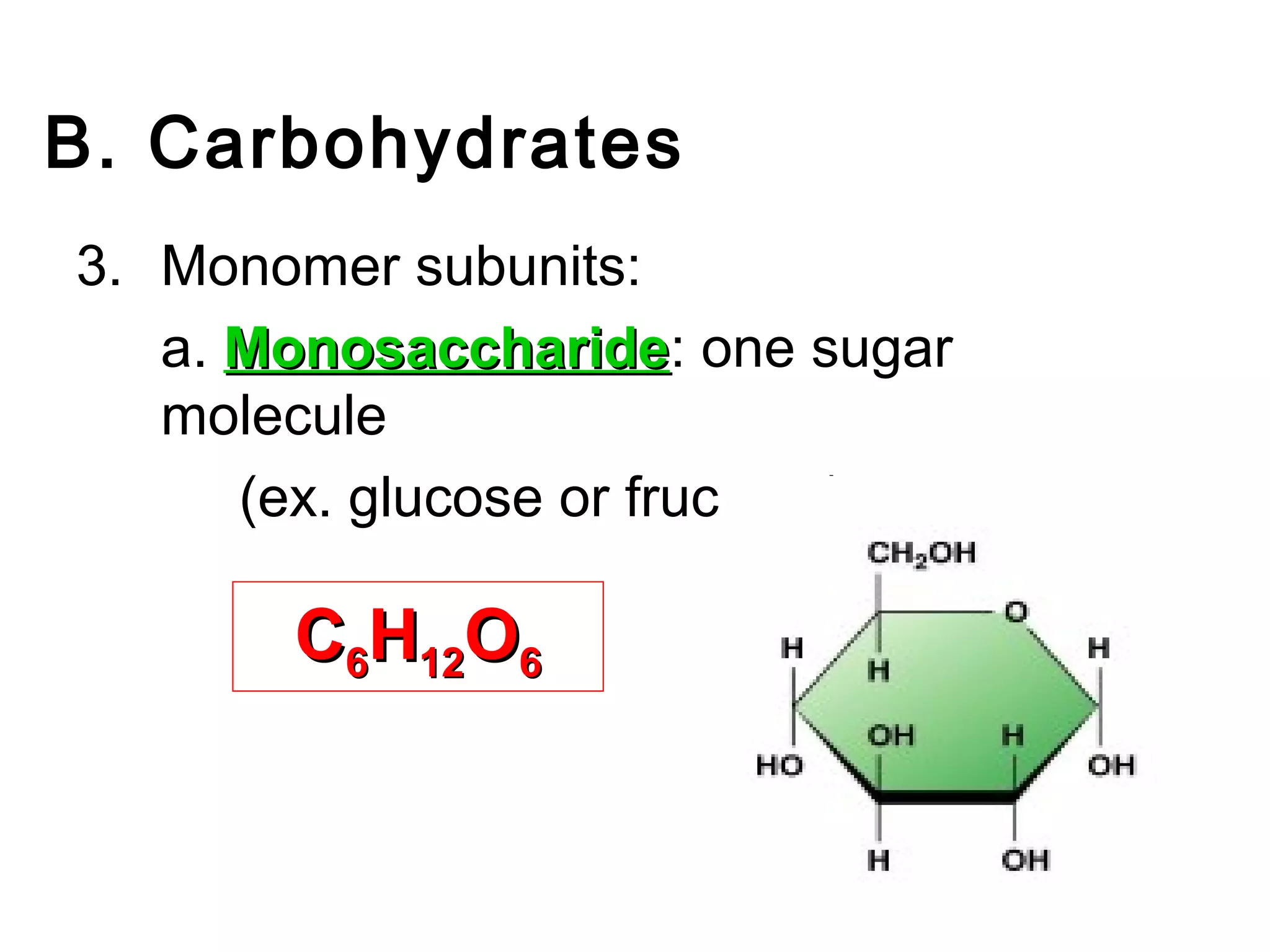
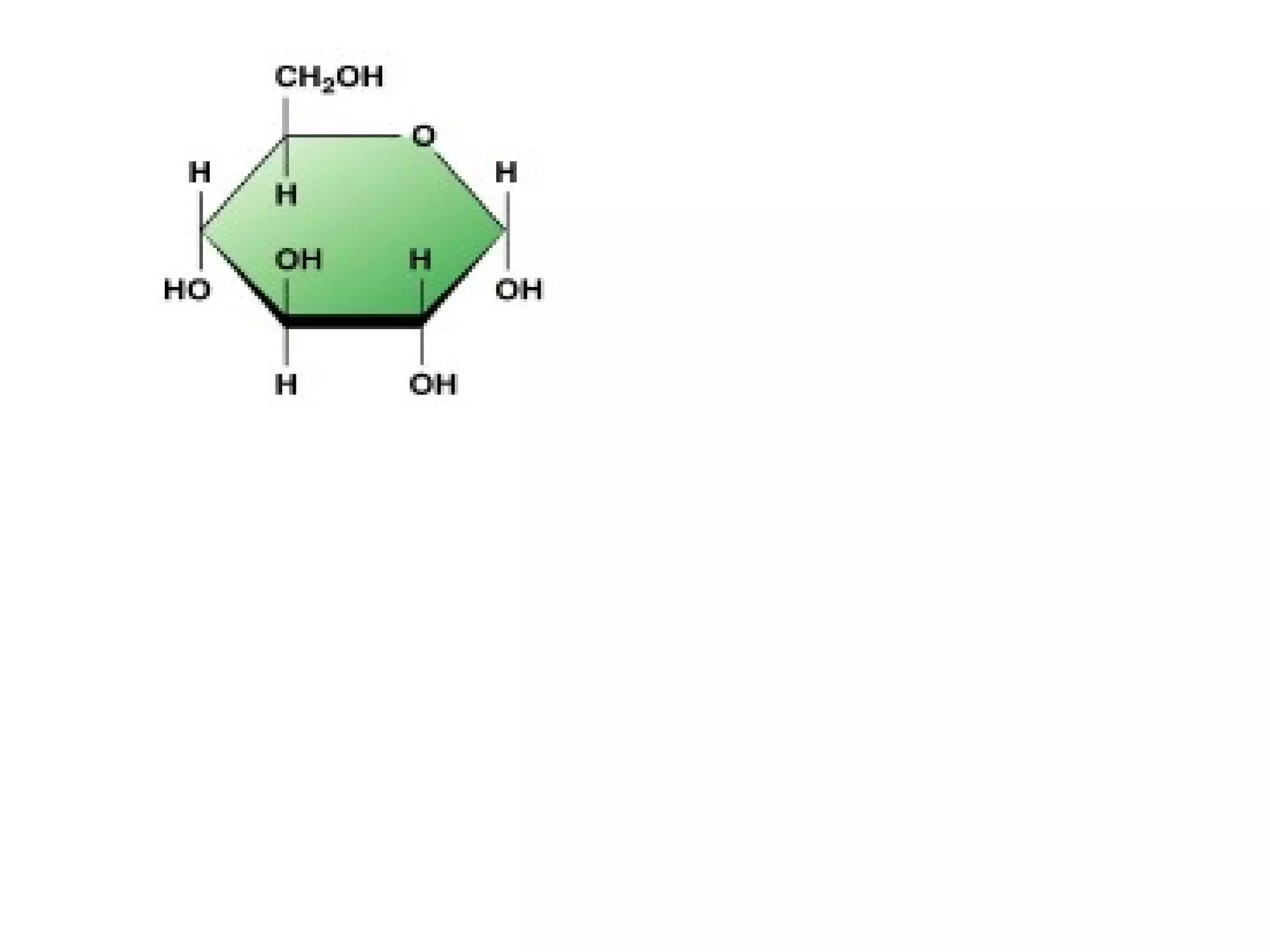
3. Monomer subunits:
   a. Monosaccharide: one sugar
      Monosaccharide
   molecule
      (ex. glucose or fructose)

       C6H12O6
+
+
+
+
B. Carbohydrates
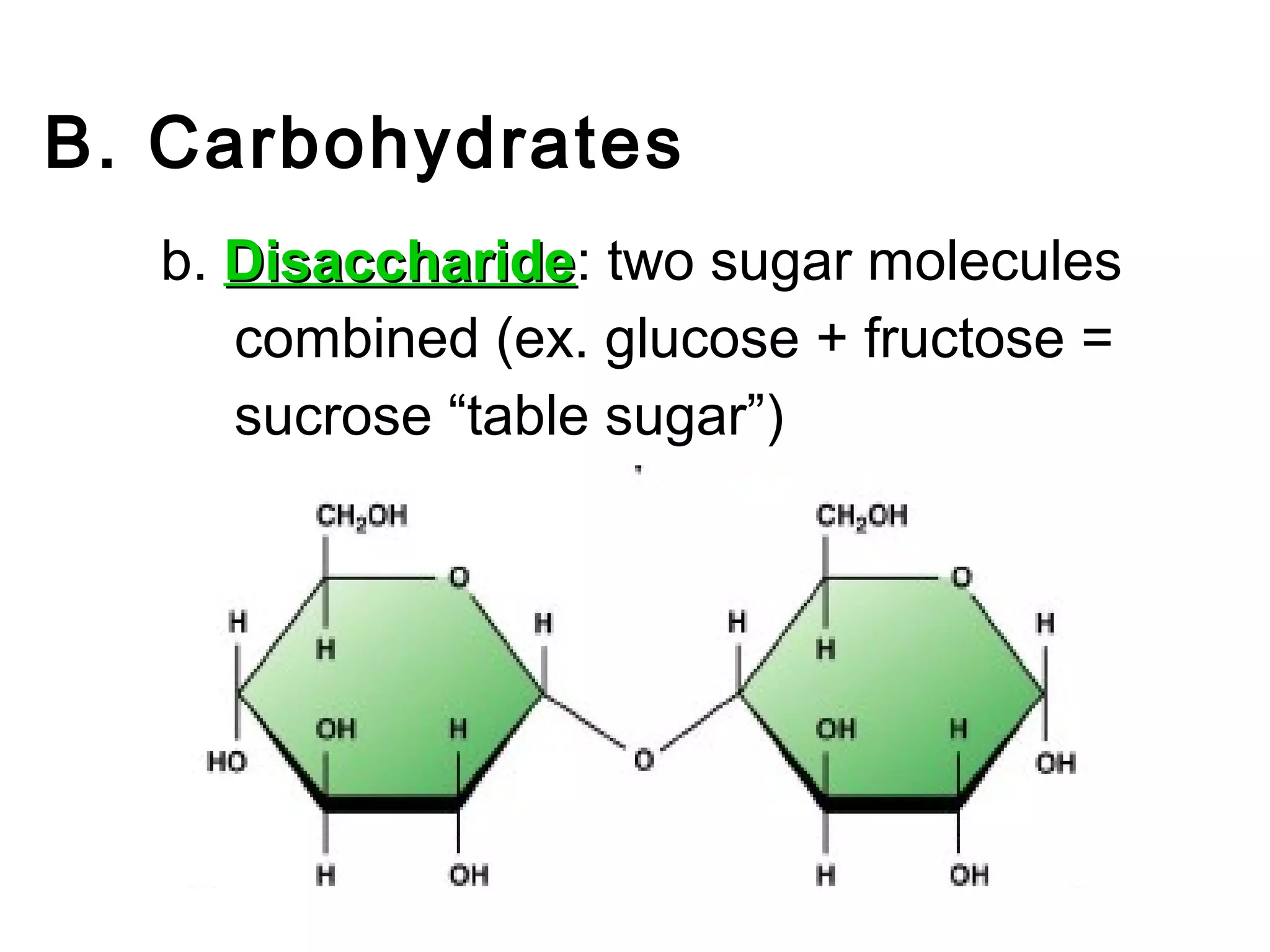
  b. Disaccharide: two sugar molecules
     Disaccharide
     combined (ex. glucose + fructose =
     sucrose “table sugar”)
B. Carbohydrates
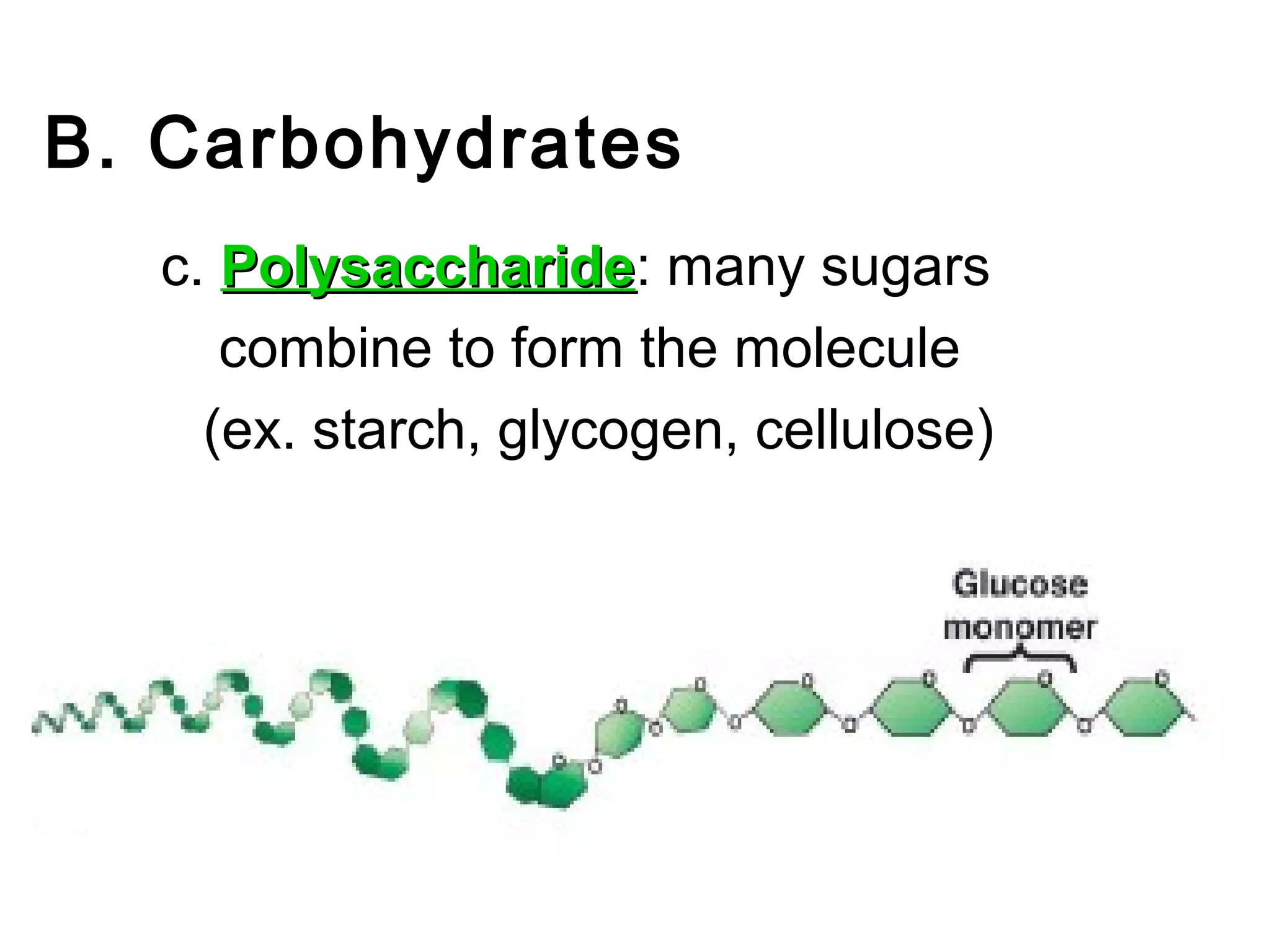
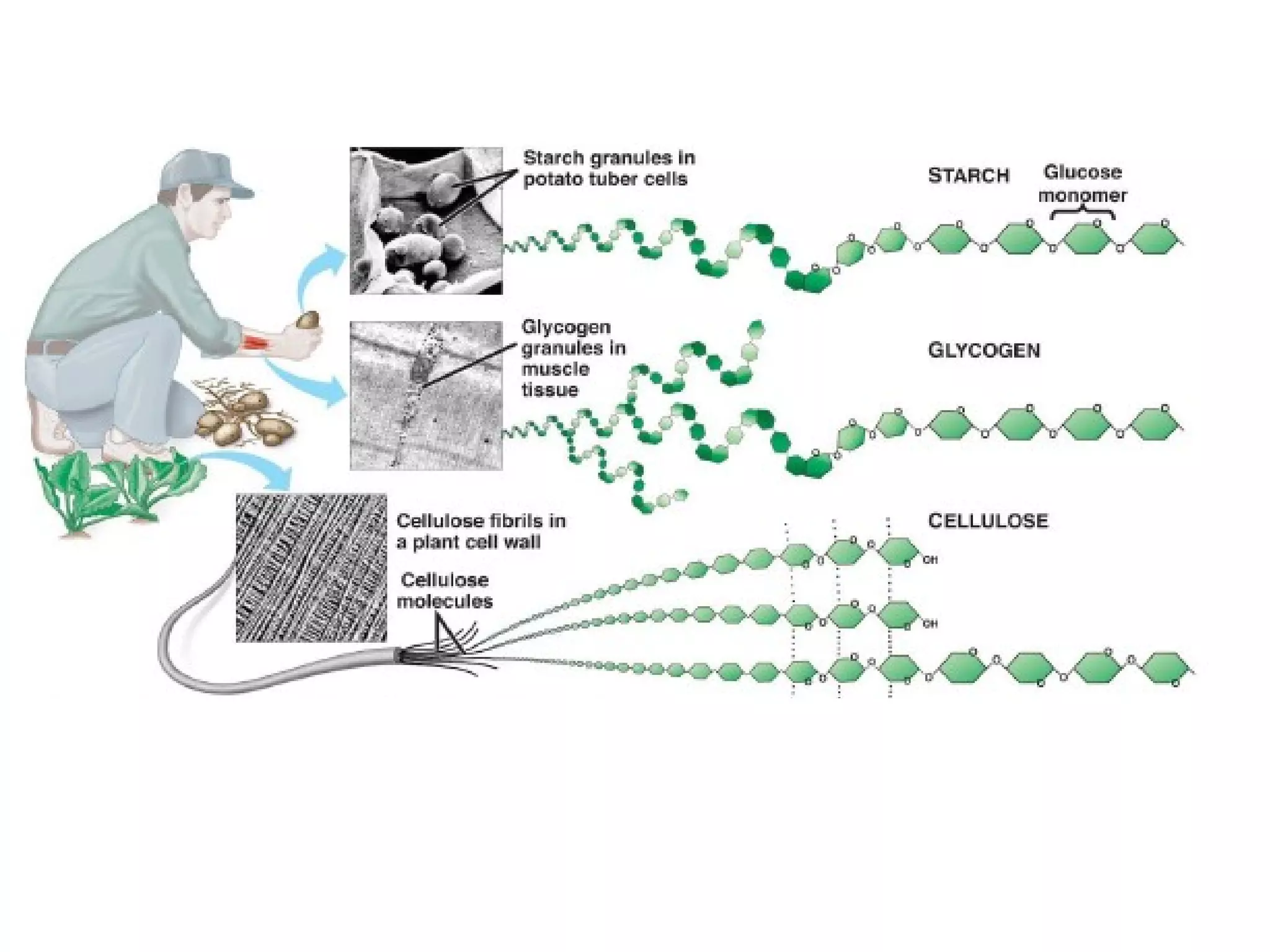
  c. Polysaccharide: many sugars
     Polysaccharide
     combine to form the molecule
    (ex. starch, glycogen, cellulose)
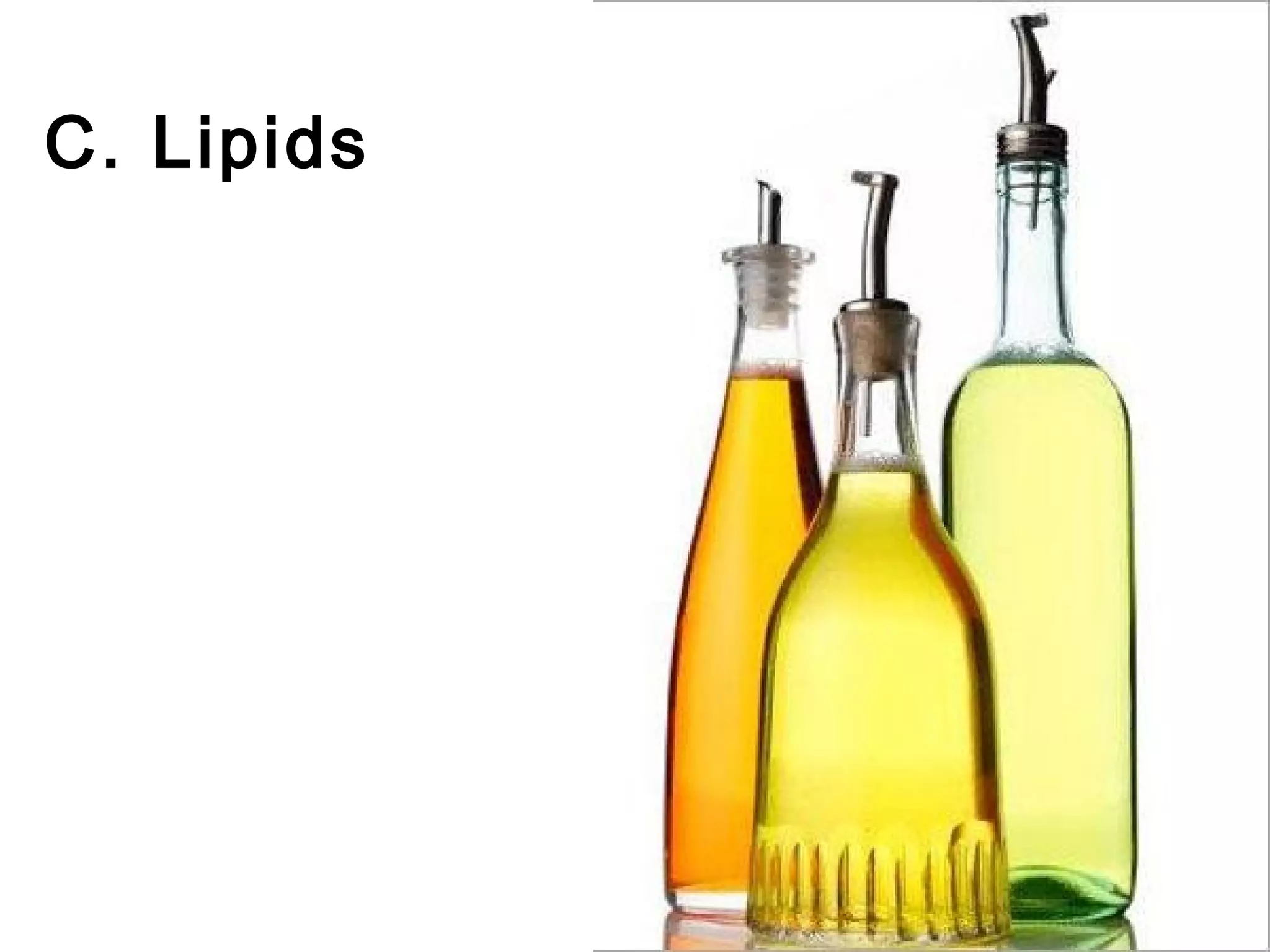
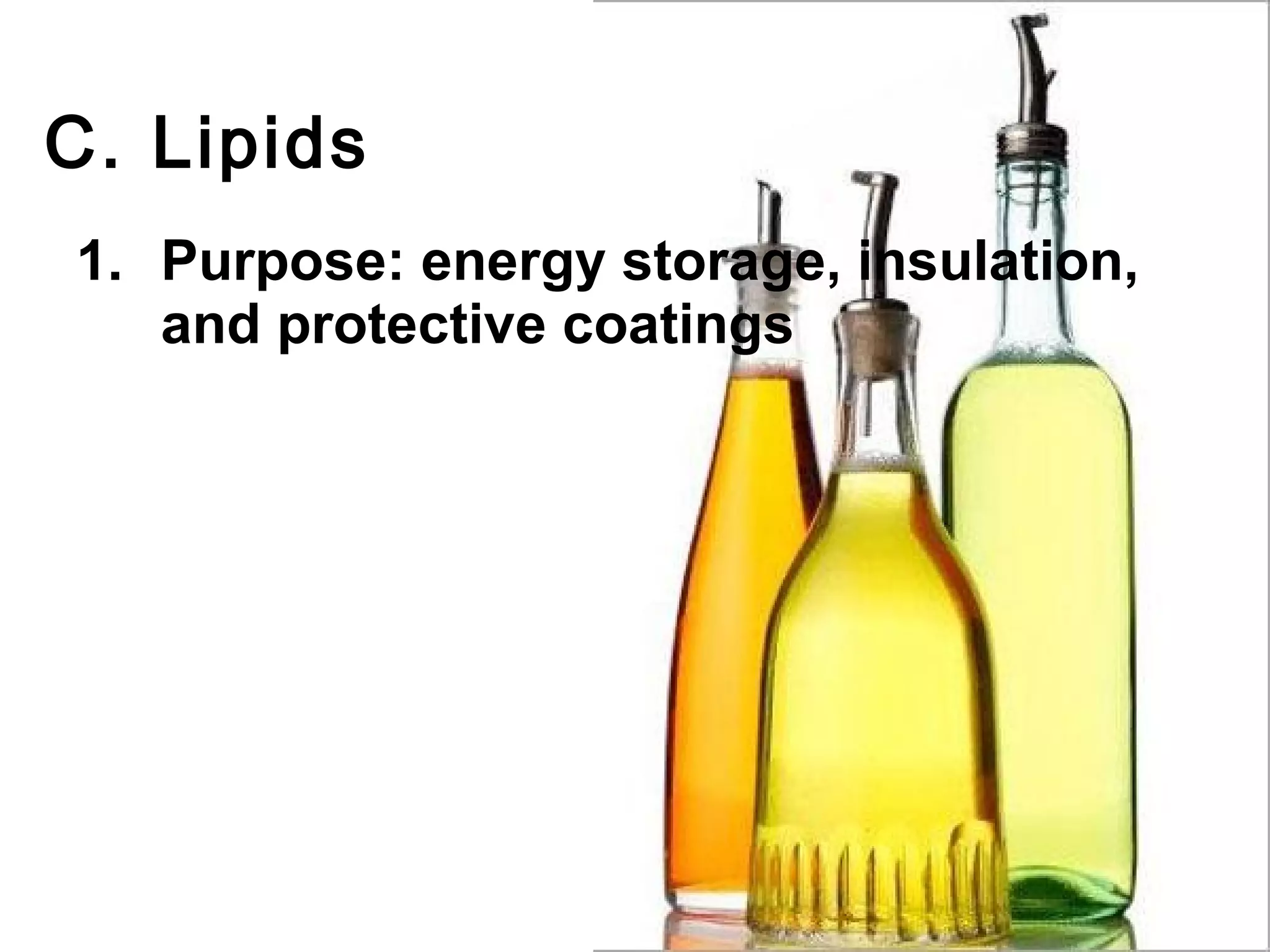
C. Lipids
C. Lipids
1. Purpose: energy storage, insulation,
   and protective coatings
C. Lipids
1. Purpose: energy storage, insulation,
   and protective coatings

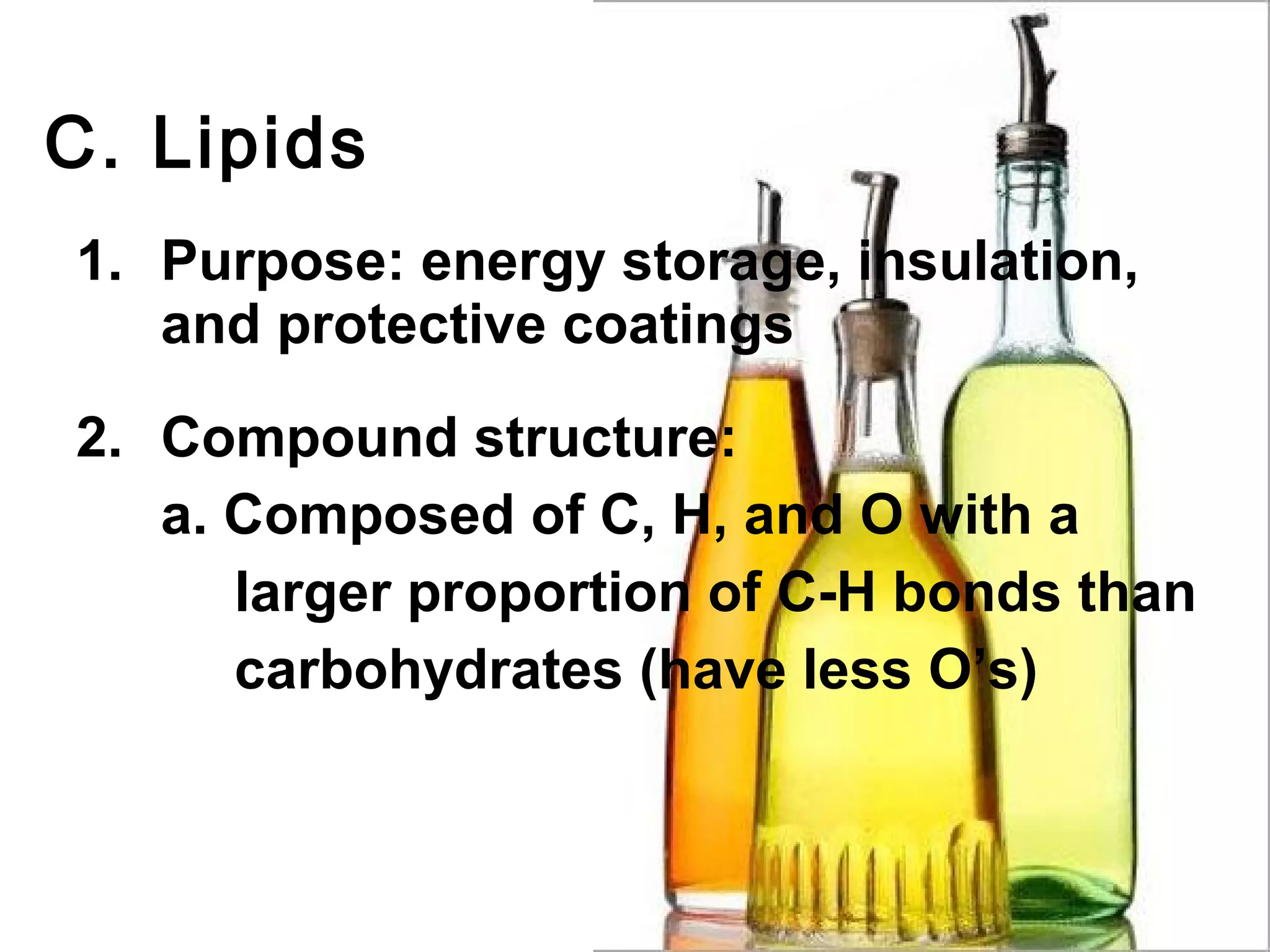
2. Compound structure:
   a. Composed of C, H, and O with a
      larger proportion of C-H bonds than
      carbohydrates (have less O’s)
C. Lipids
1. Purpose: energy storage, insulation,
   and protective coatings

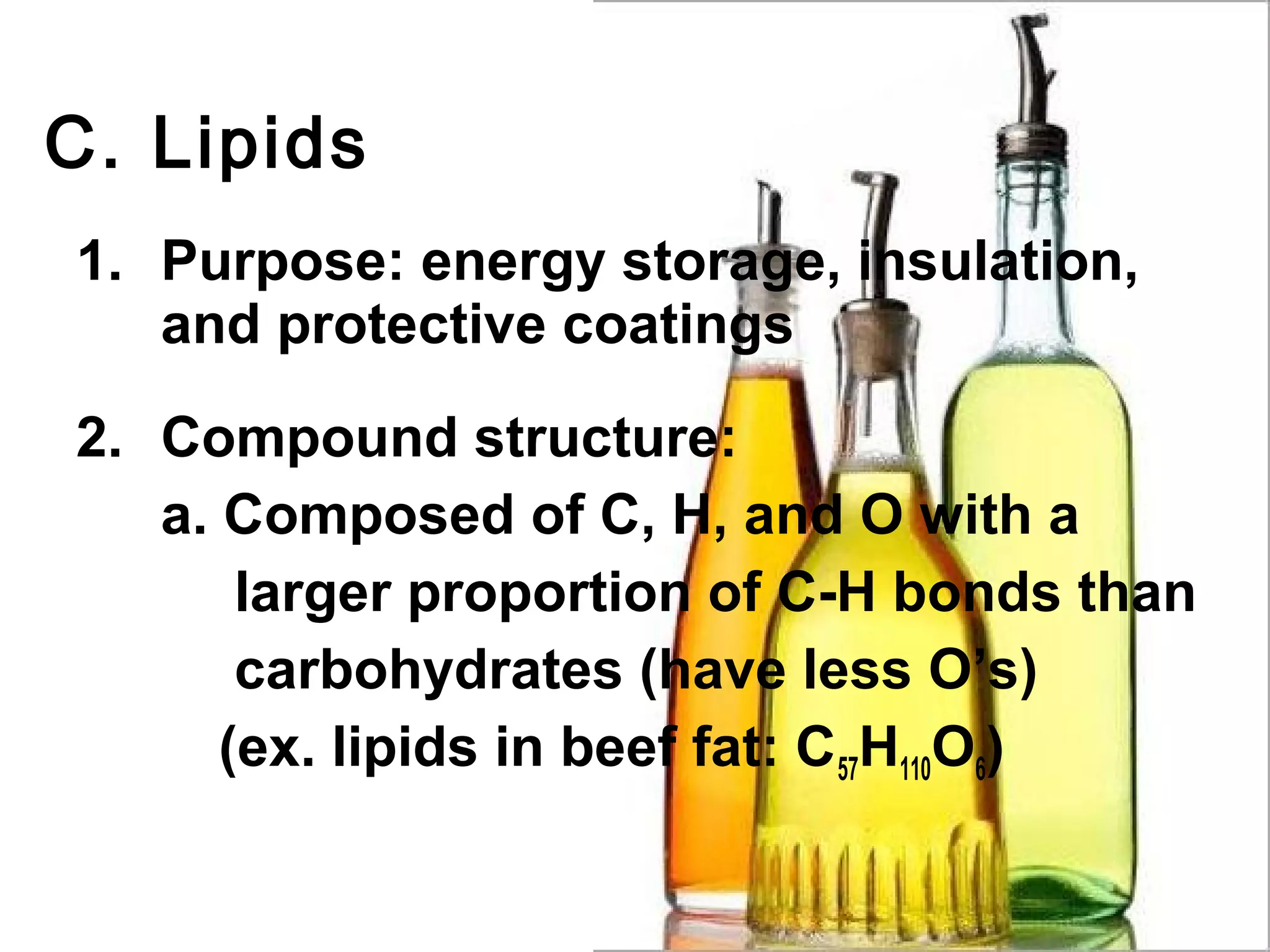
2. Compound structure:
   a. Composed of C, H, and O with a
       larger proportion of C-H bonds than
       carbohydrates (have less O’s)
      (ex. lipids in beef fat: C57H110O6)
C. Lipids
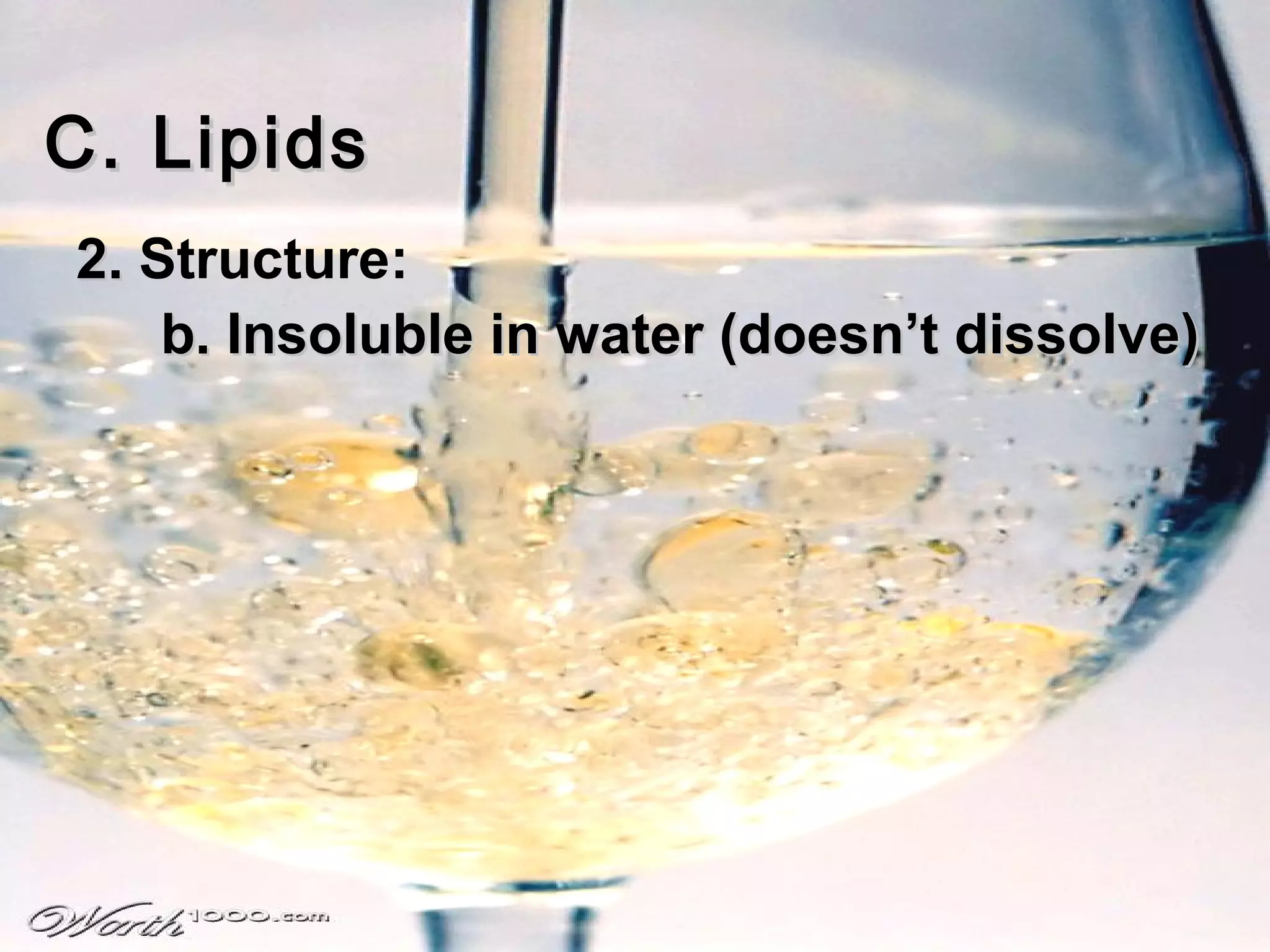
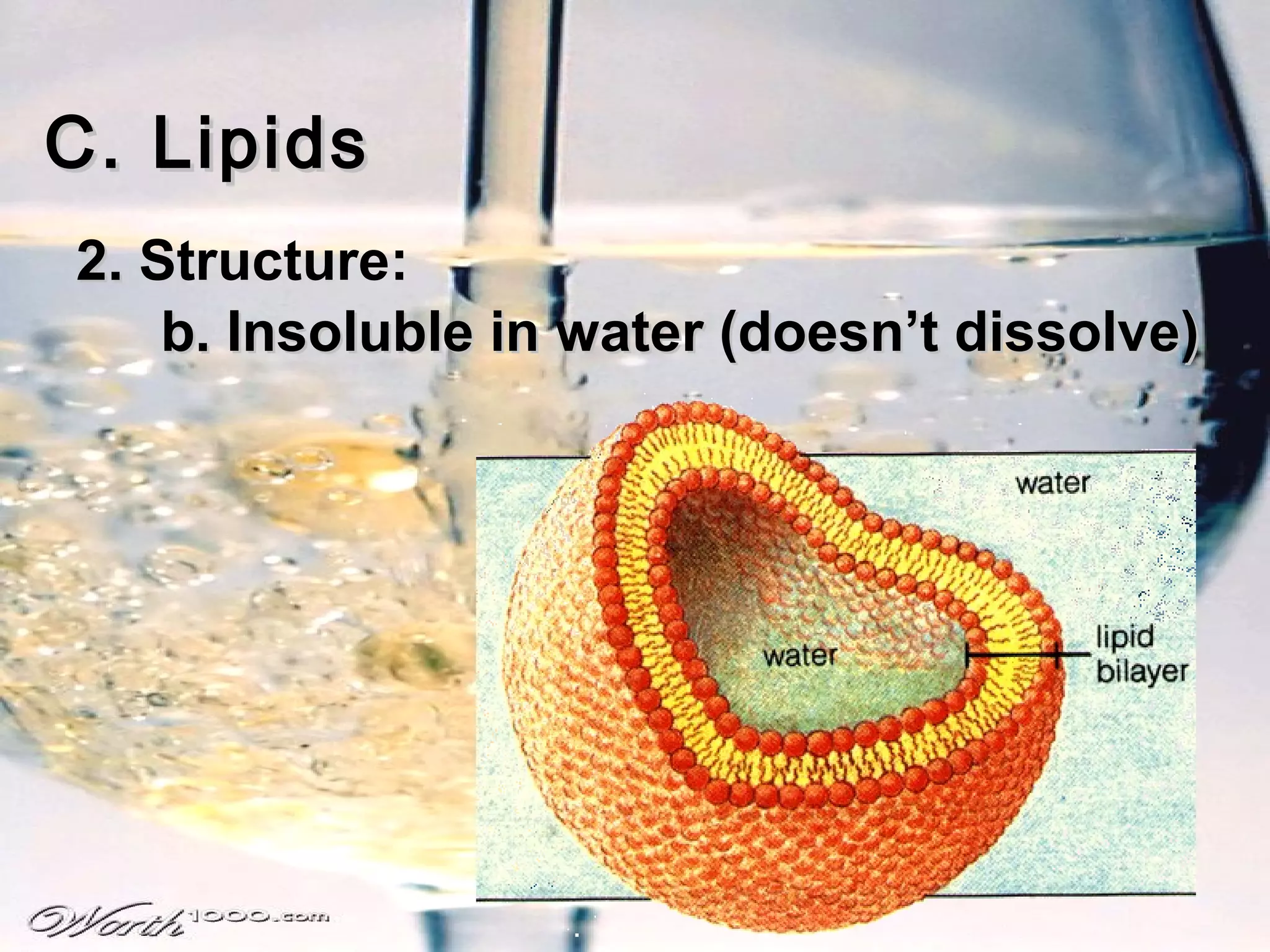
2. Structure:
    b. Insoluble in water (doesn’t dissolve)
C. Lipids
2. Structure:
    b. Insoluble in water (doesn’t dissolve)
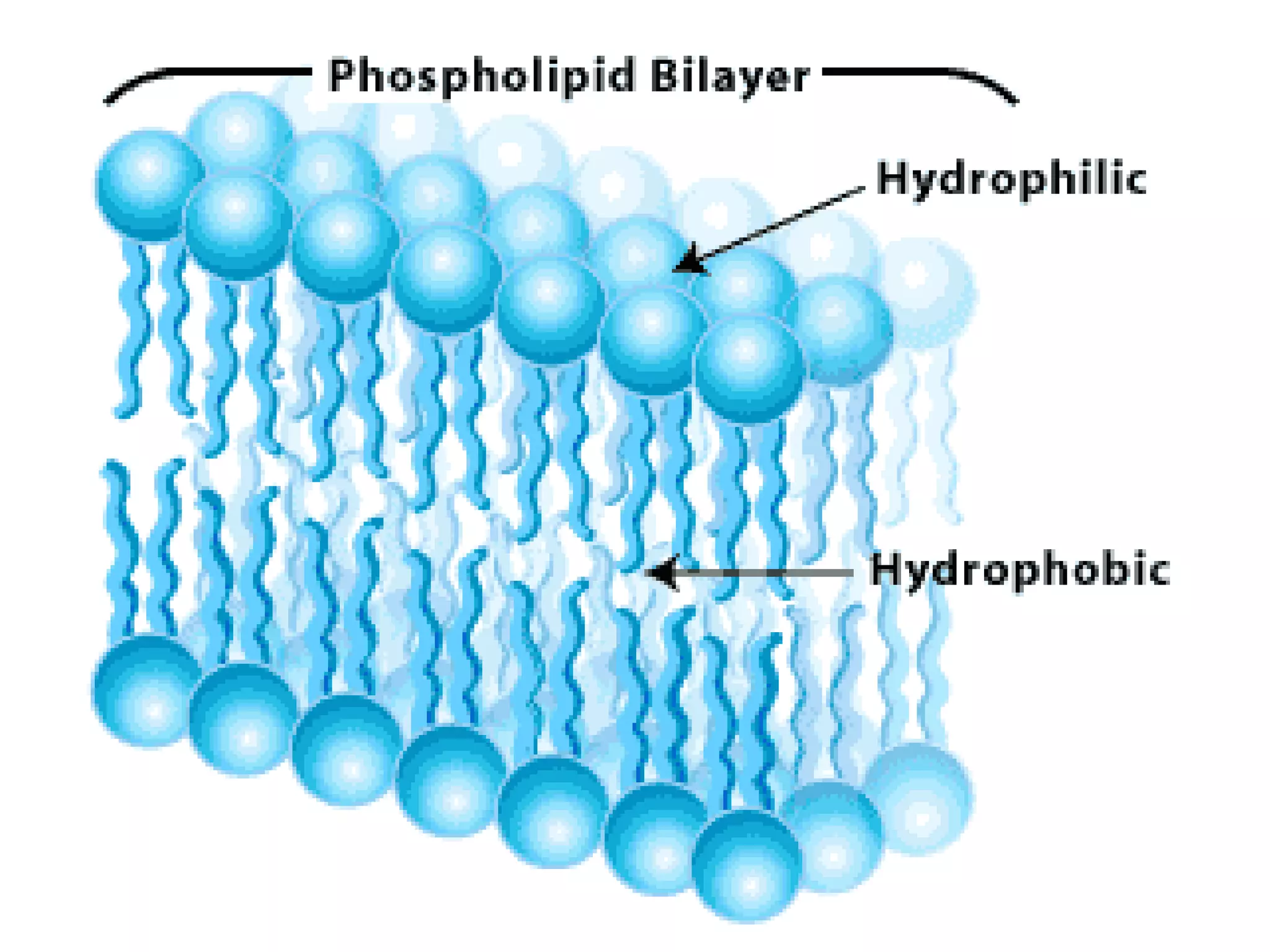
C. Lipids
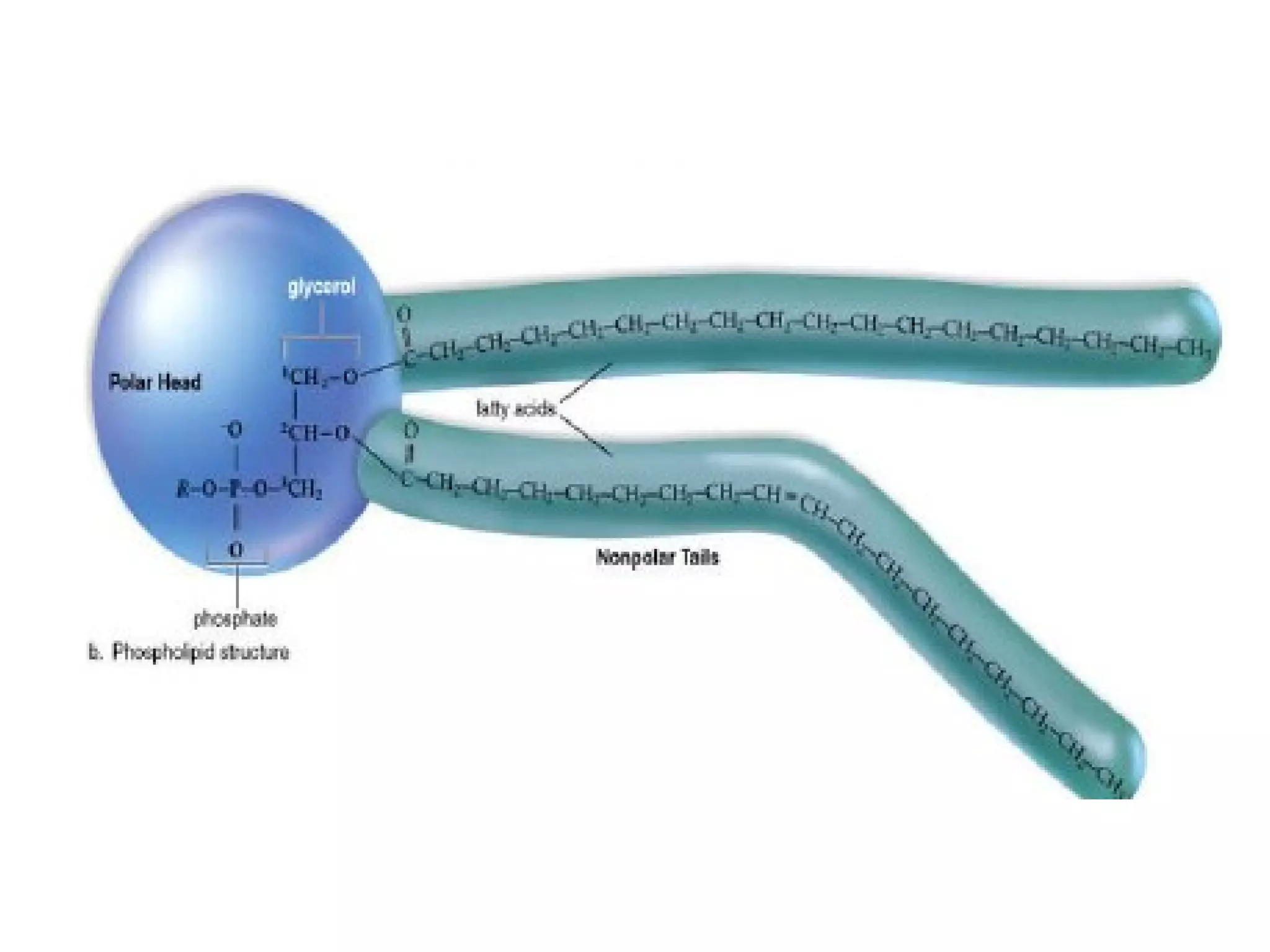
3. Insoluble in
   water
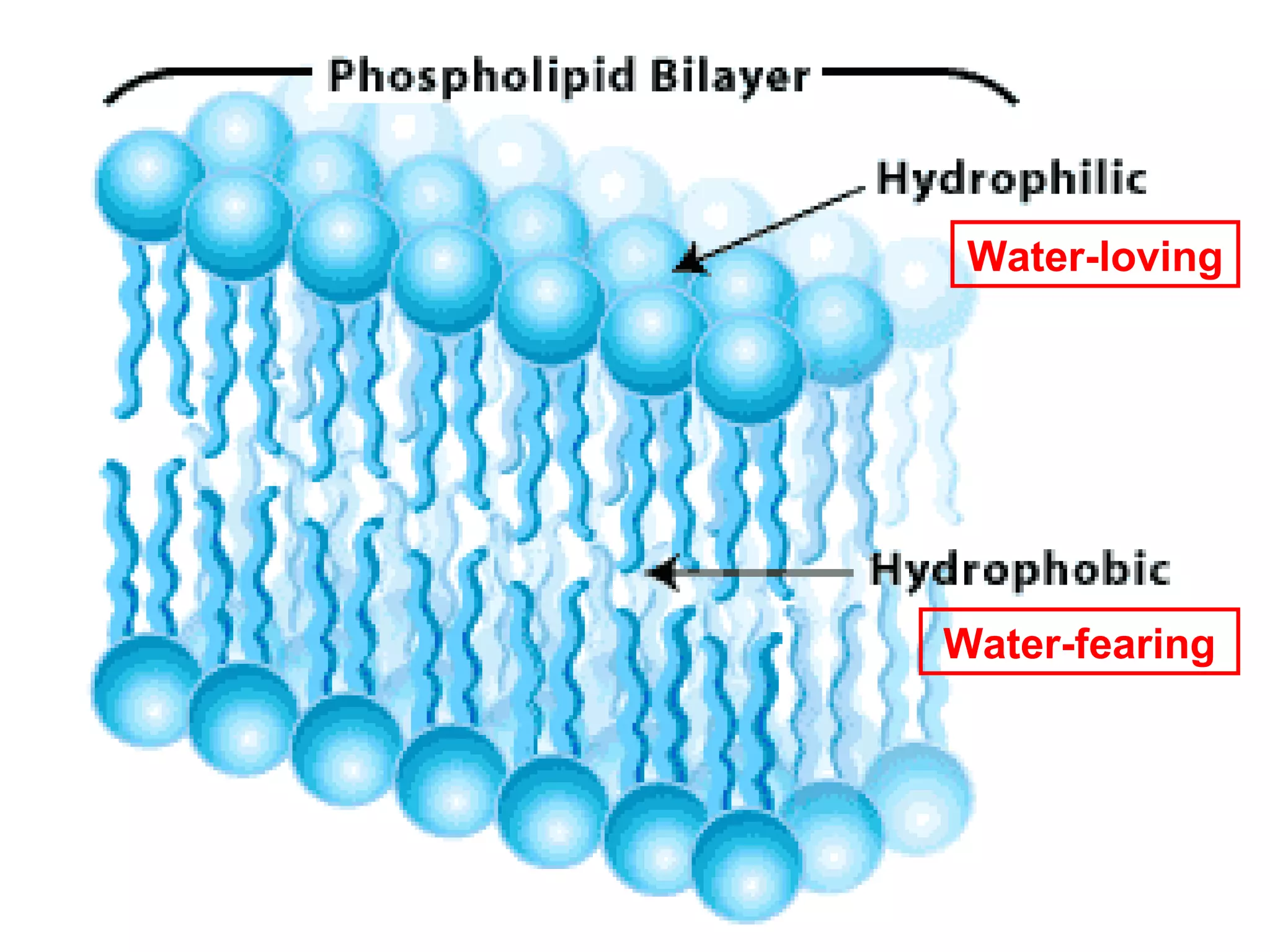
C. Lipids
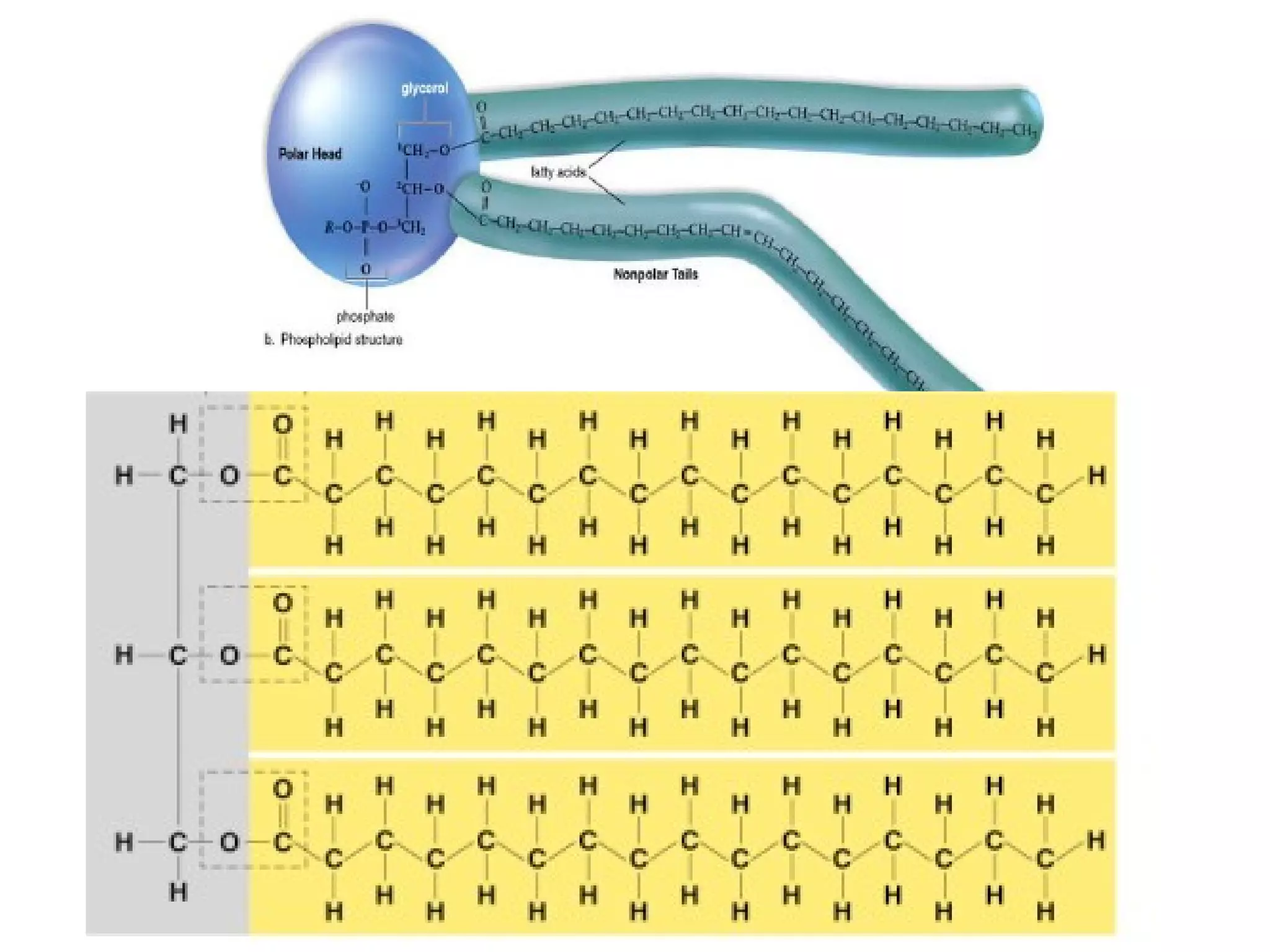
3. Insoluble in    Water-loving
   water


                  Water-fearing
C. Lipids
2. Structure:
    b. Insoluble in water (doesn’t dissolve)

3. Monomer subunit:
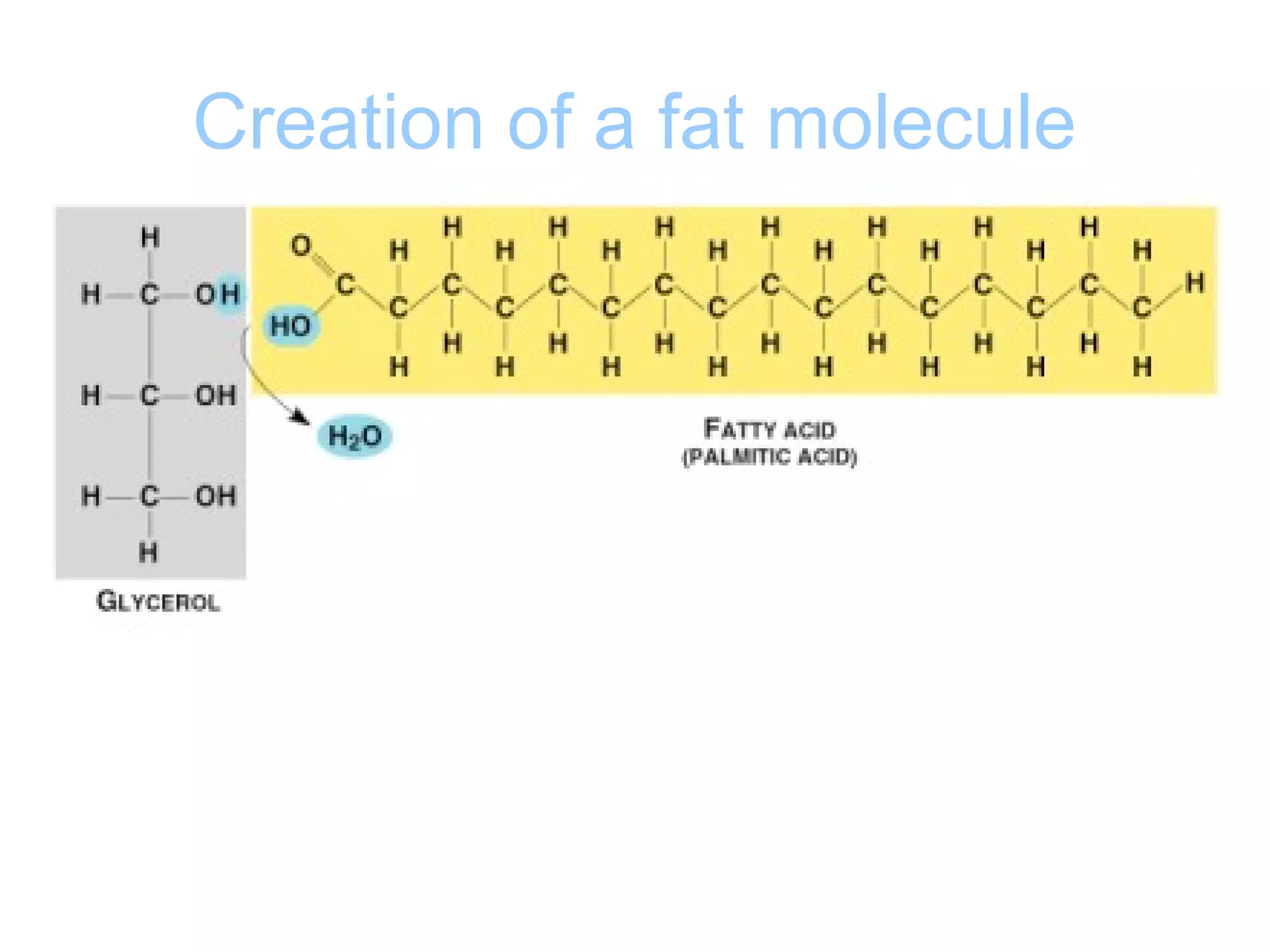
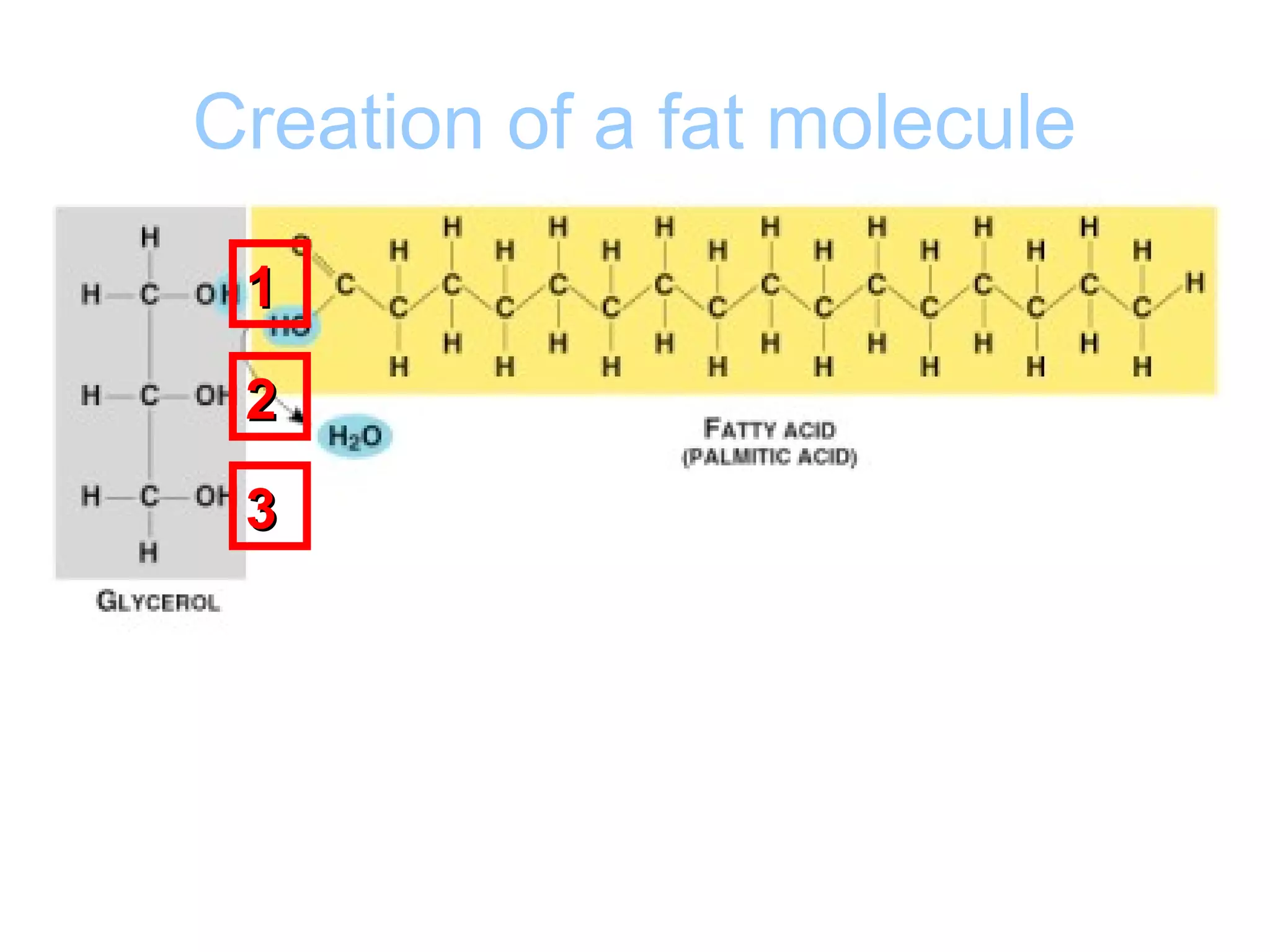
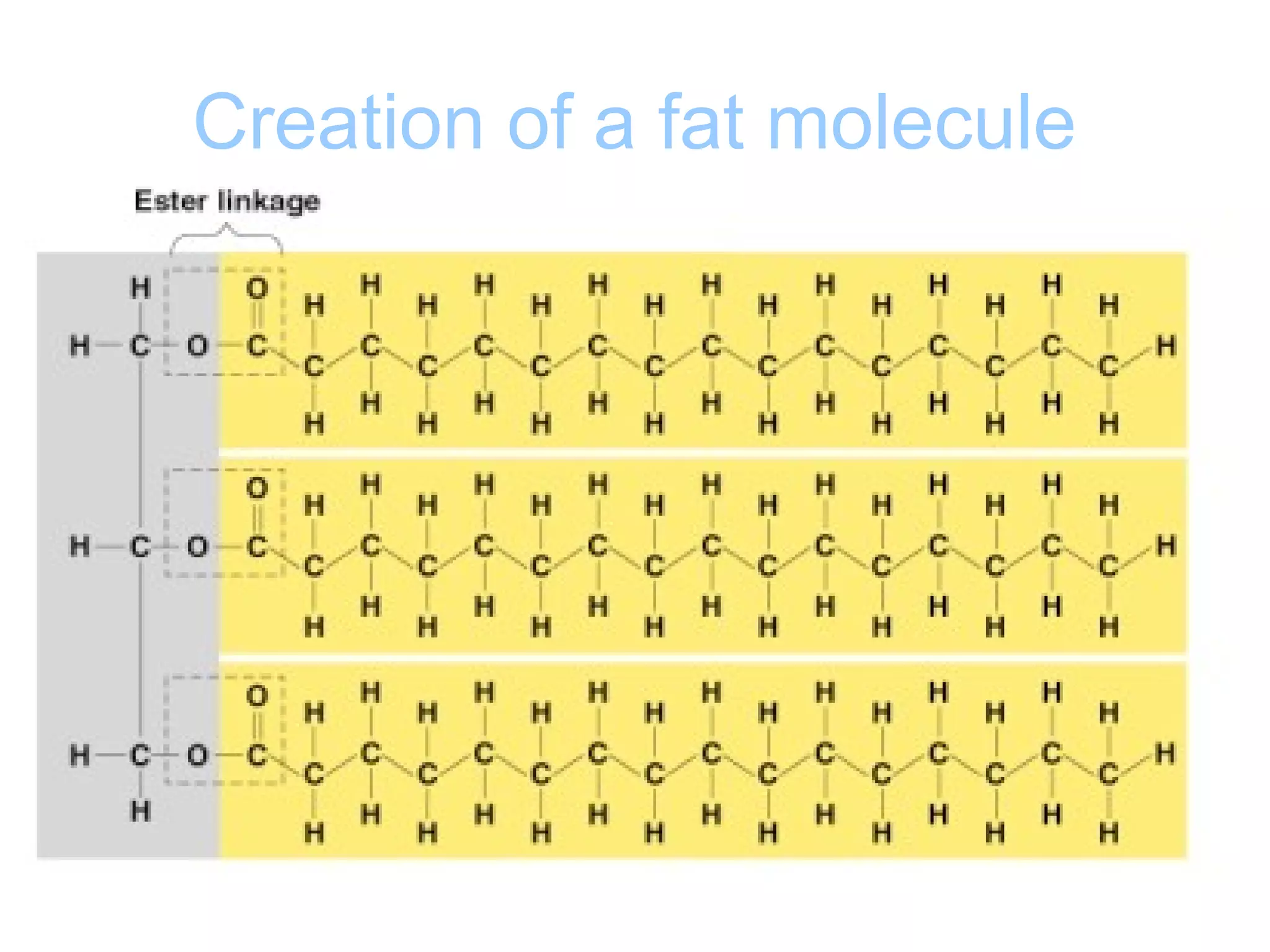
   a. Fatty acids and a glycerol
Creation of a fat molecule

 1
 2
 3
Creation of a fat molecule
C. Lipids
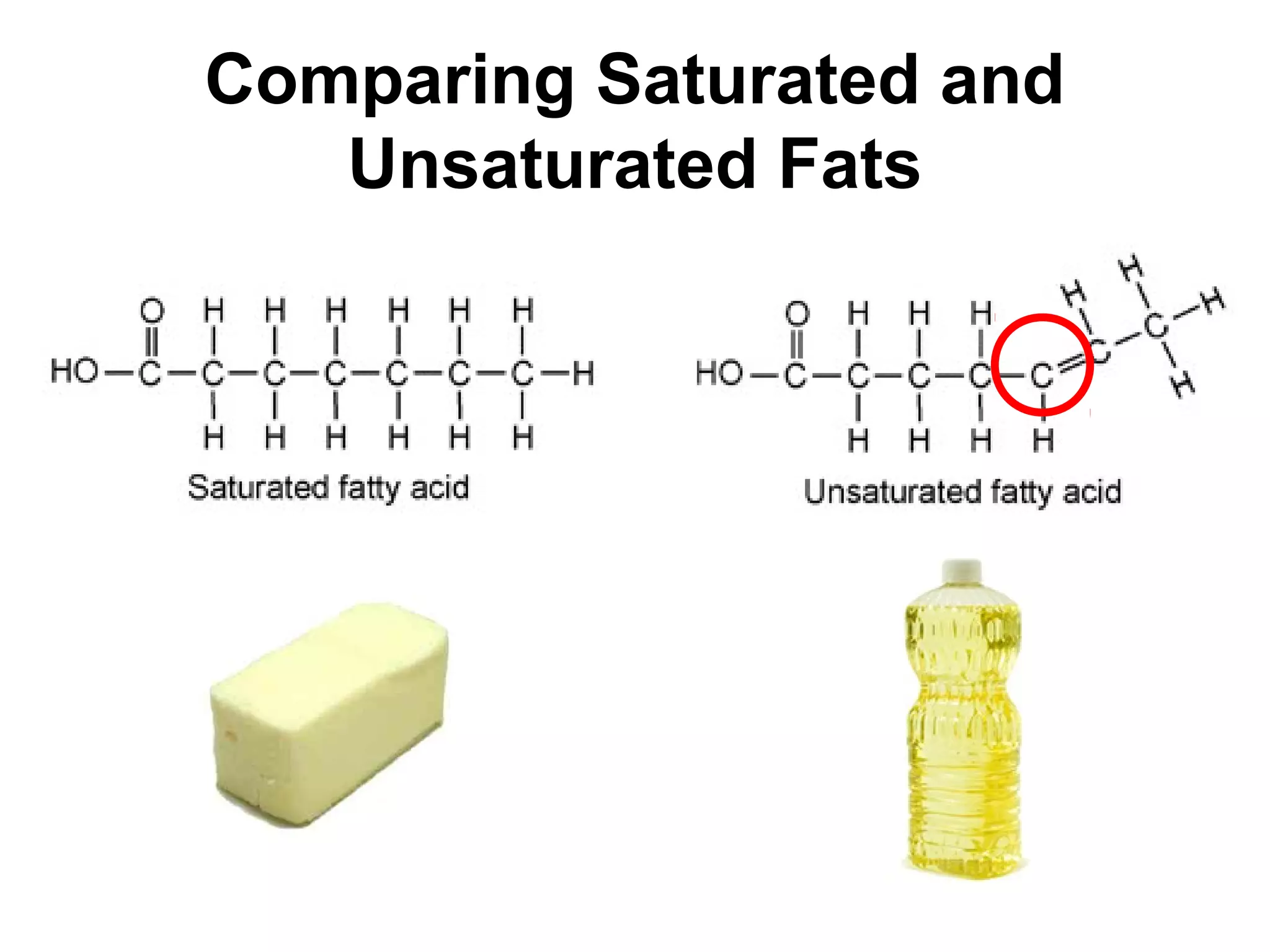
4. Forms:
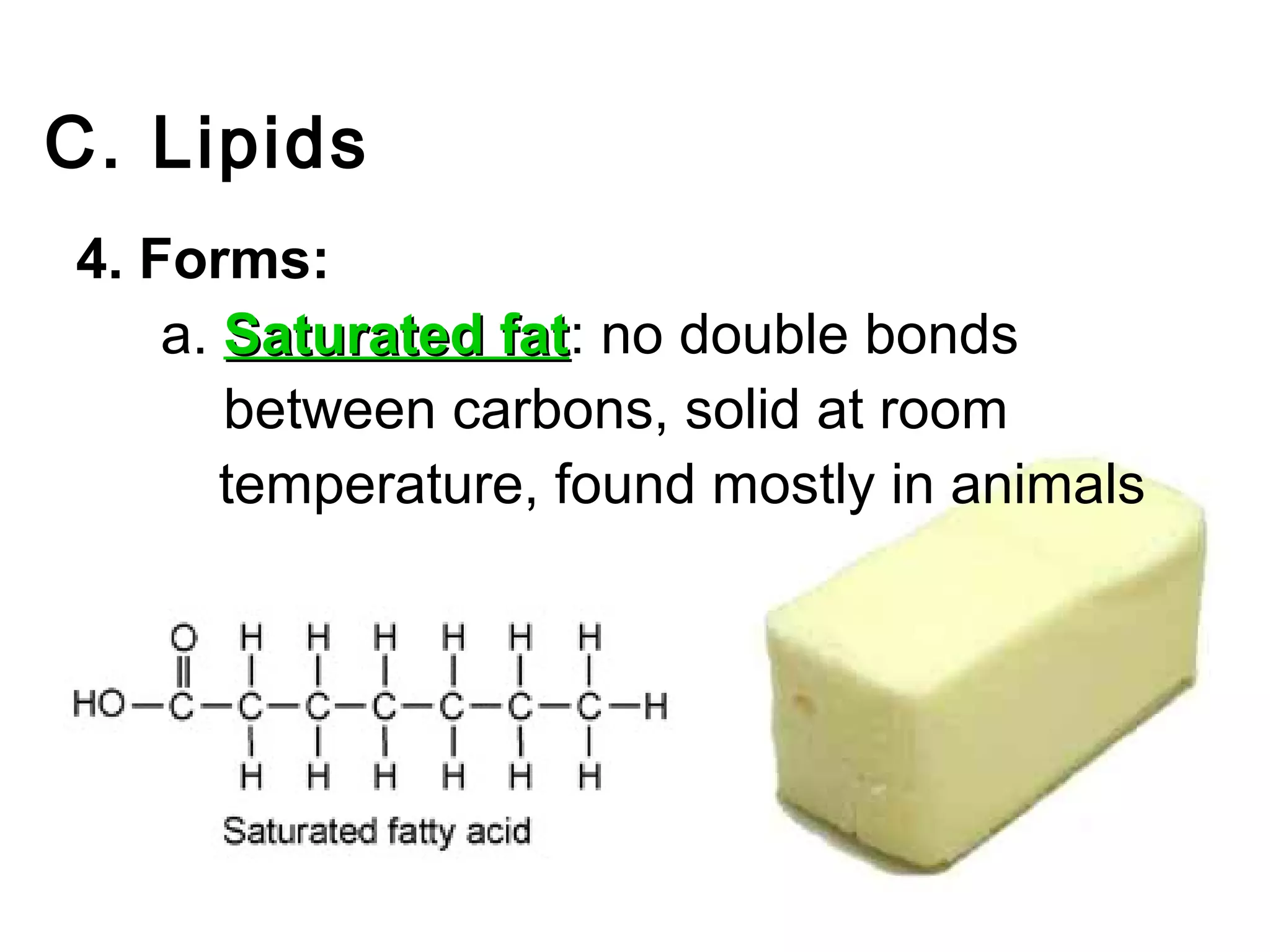
    a. Saturated fat: no double bonds
                 fat
       between carbons, solid at room
       temperature, found mostly in animals
C. Lipids
4. Forms:
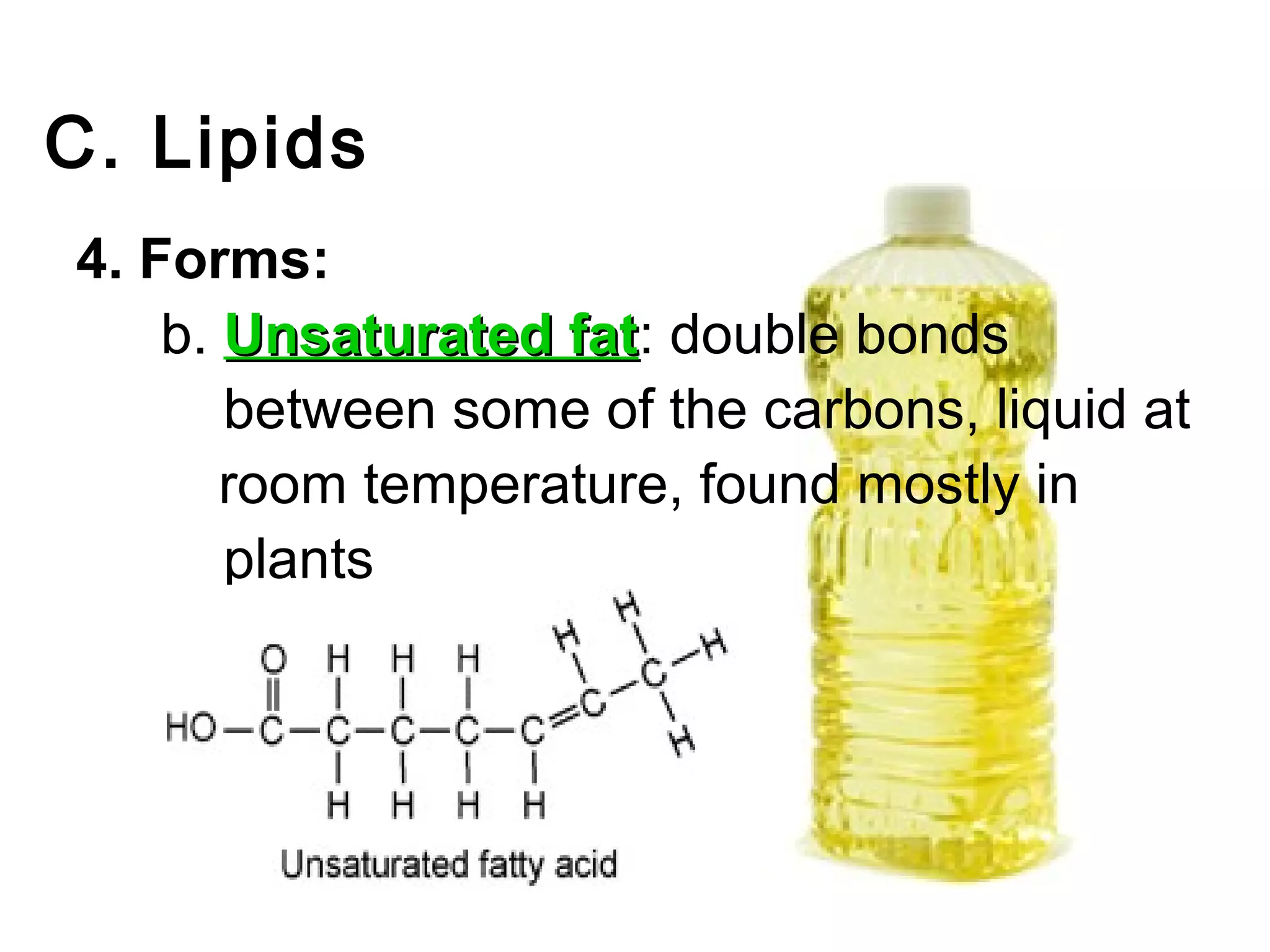
    b. Unsaturated fat: double bonds
                   fat
       between some of the carbons, liquid at
       room temperature, found mostly in
       plants
Comparing Saturated and
   Unsaturated Fats
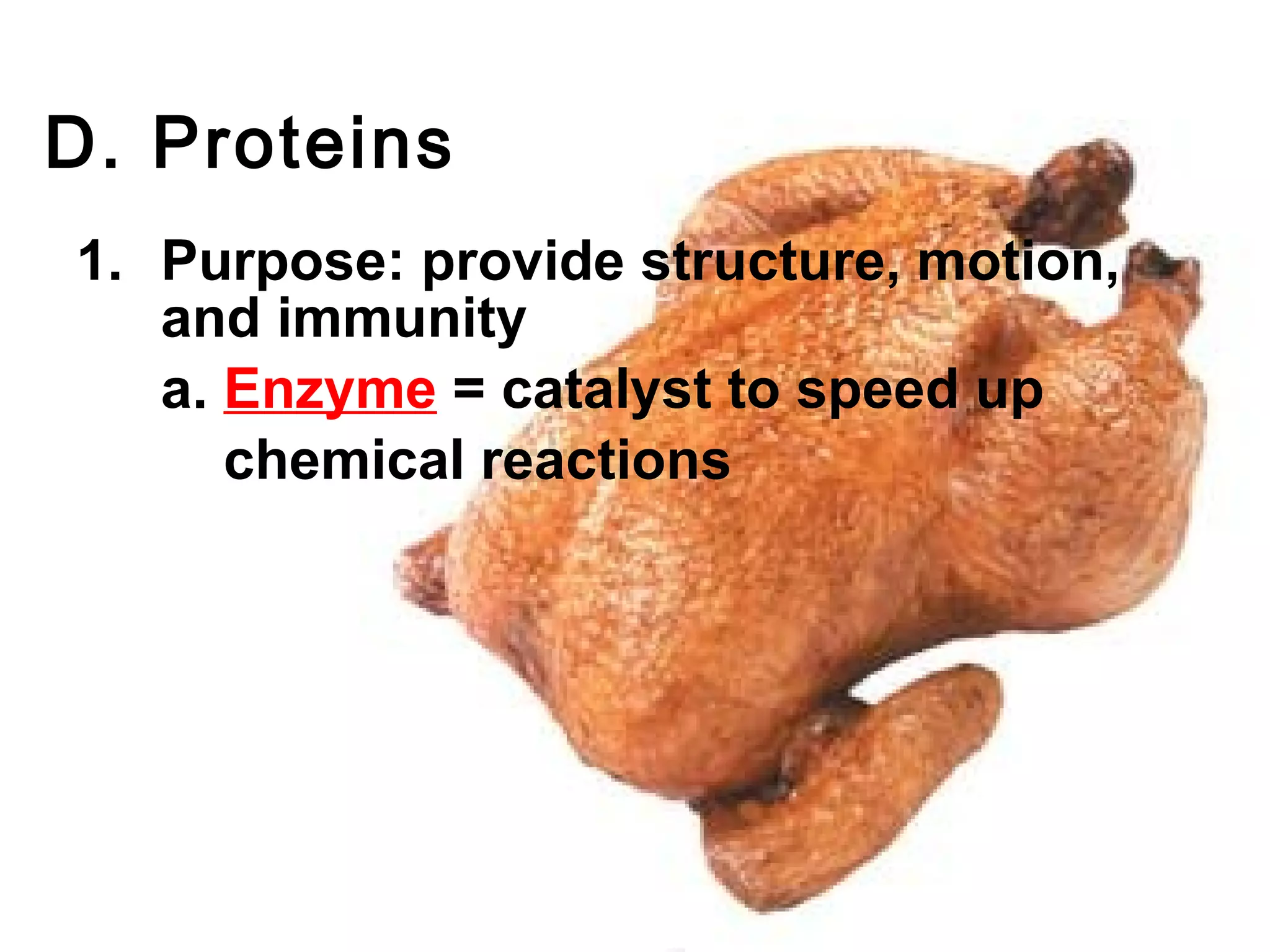
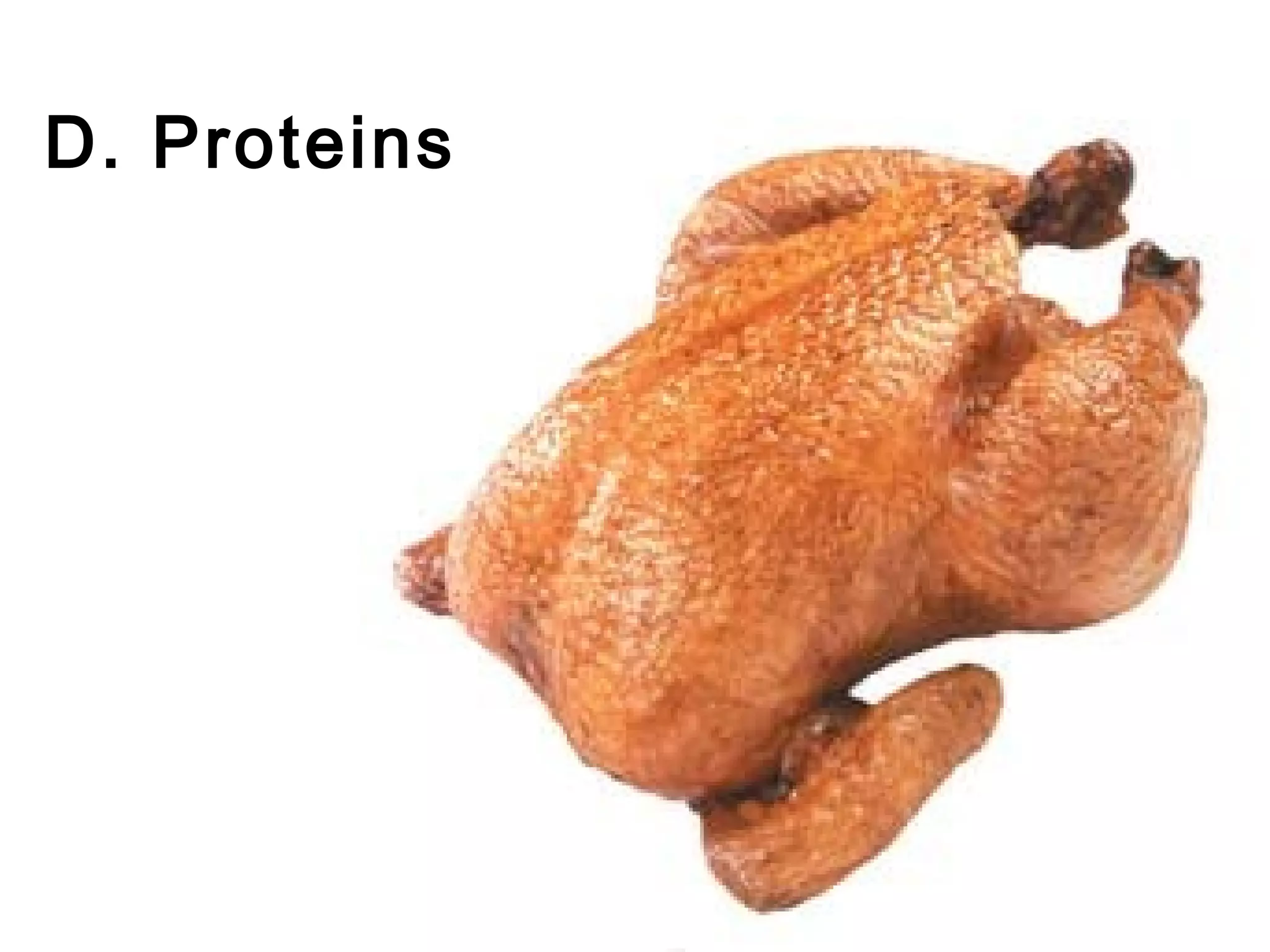
D. Proteins
D. Proteins
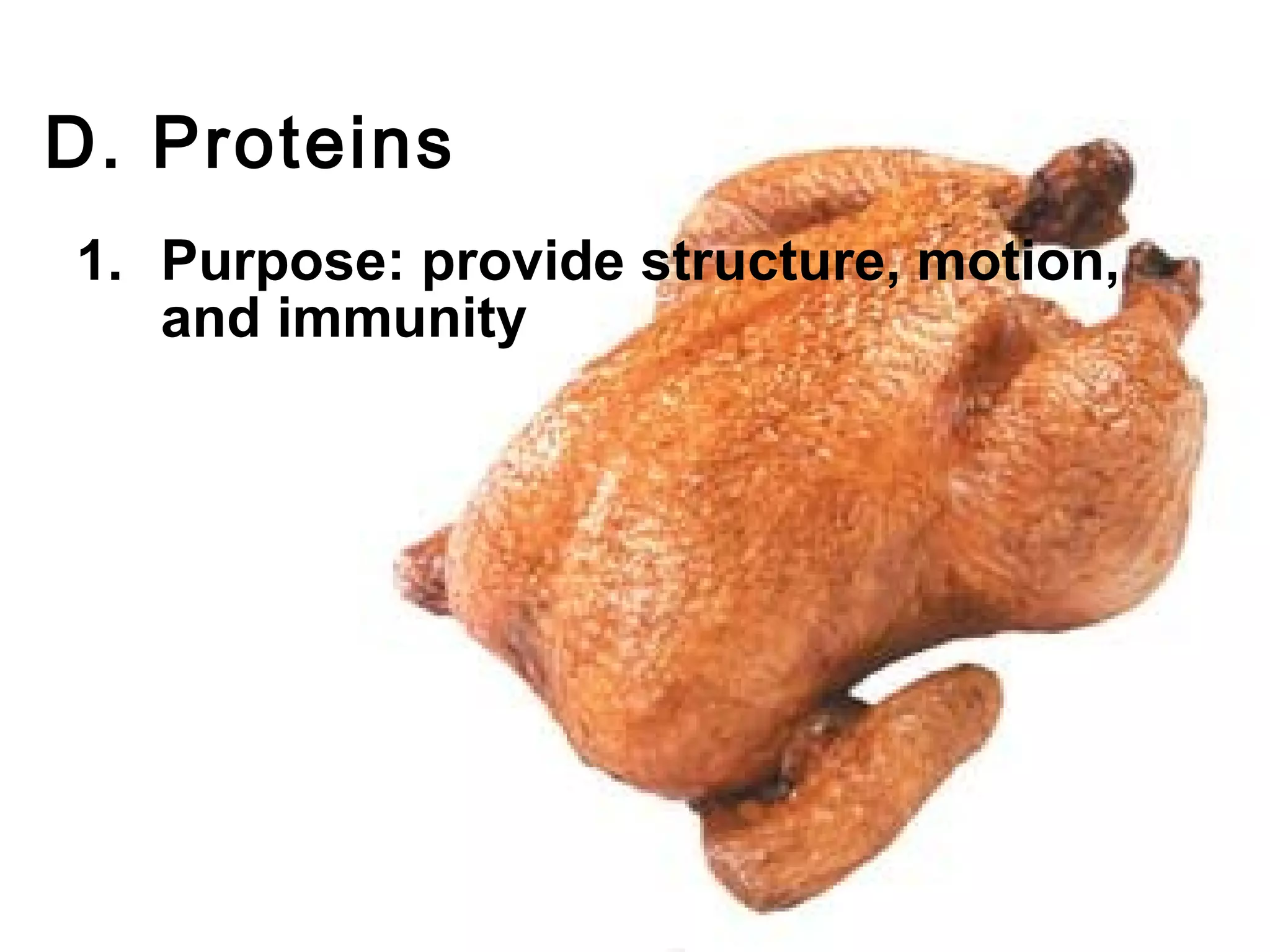
1. Purpose: provide structure, motion,
   and immunity
D. Proteins
1. Purpose: provide structure, motion,
   and immunity
   a. Enzyme = catalyst to speed up
      chemical reactions
D. Proteins
1. Purpose: provide structure, motion,
   and immunity
   a. Enzyme = catalyst to speed up
      chemical reactions
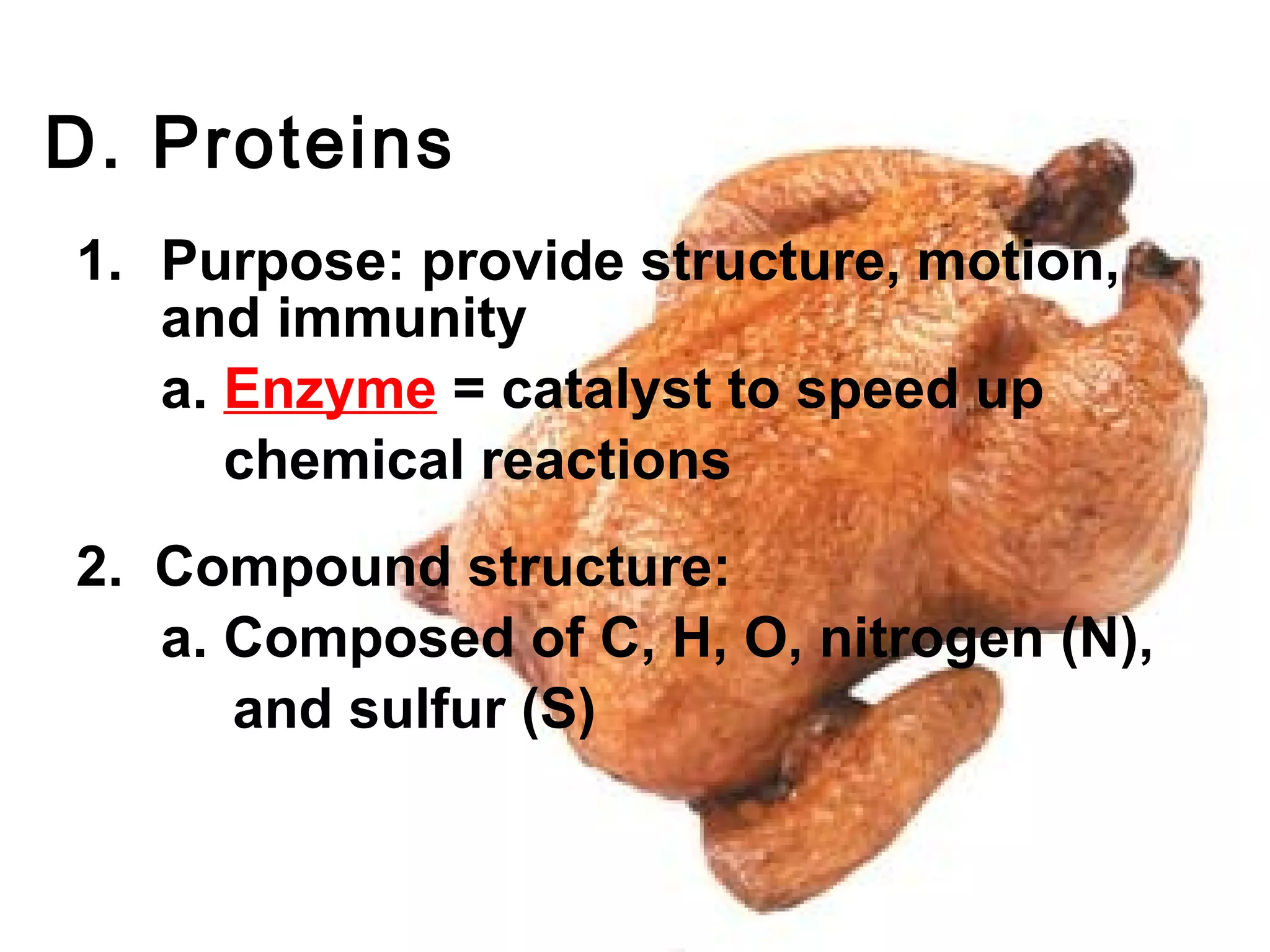
2. Compound structure:
   a. Composed of C, H, O, nitrogen (N),
      and sulfur (S)
D. Proteins
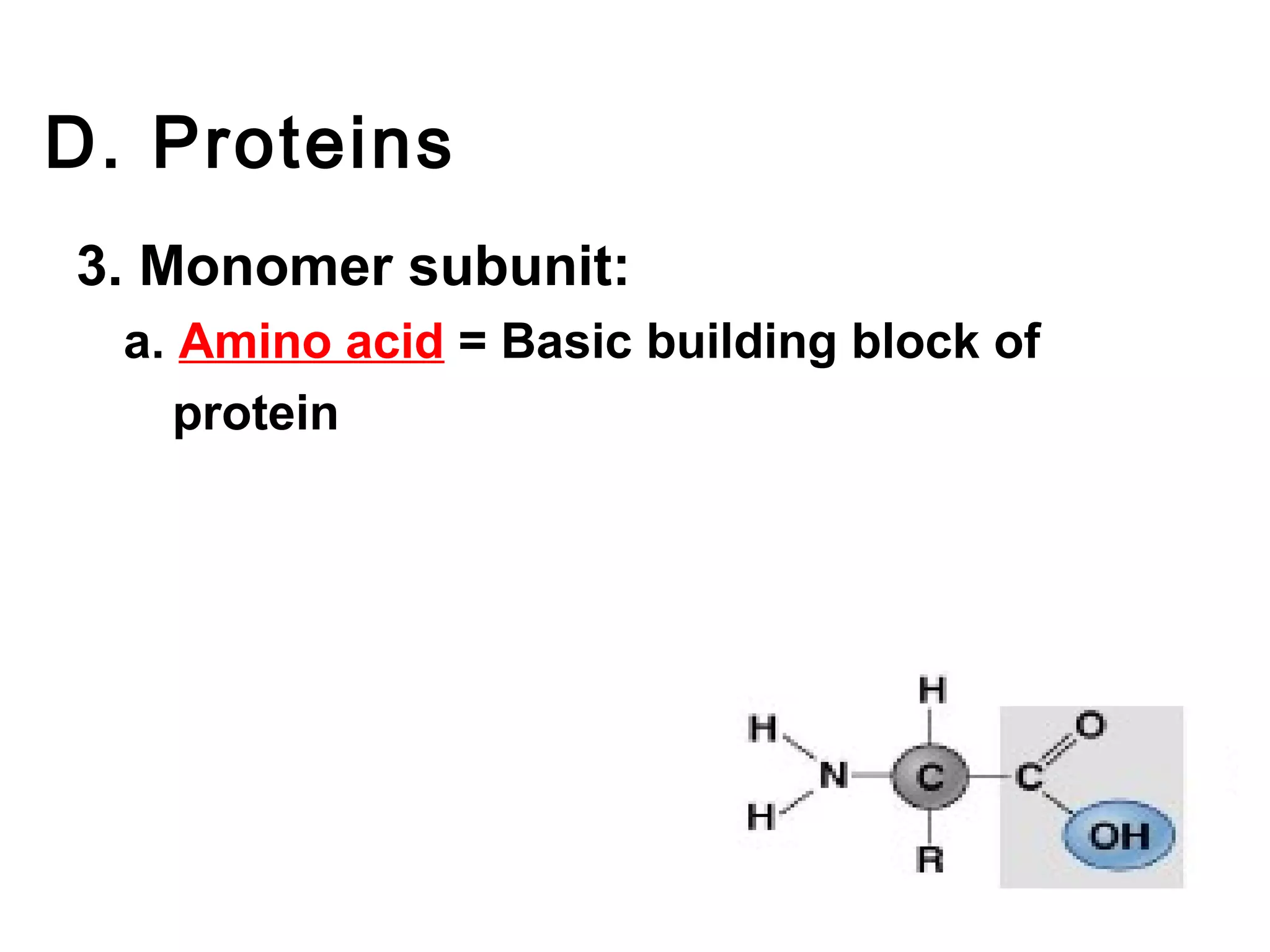
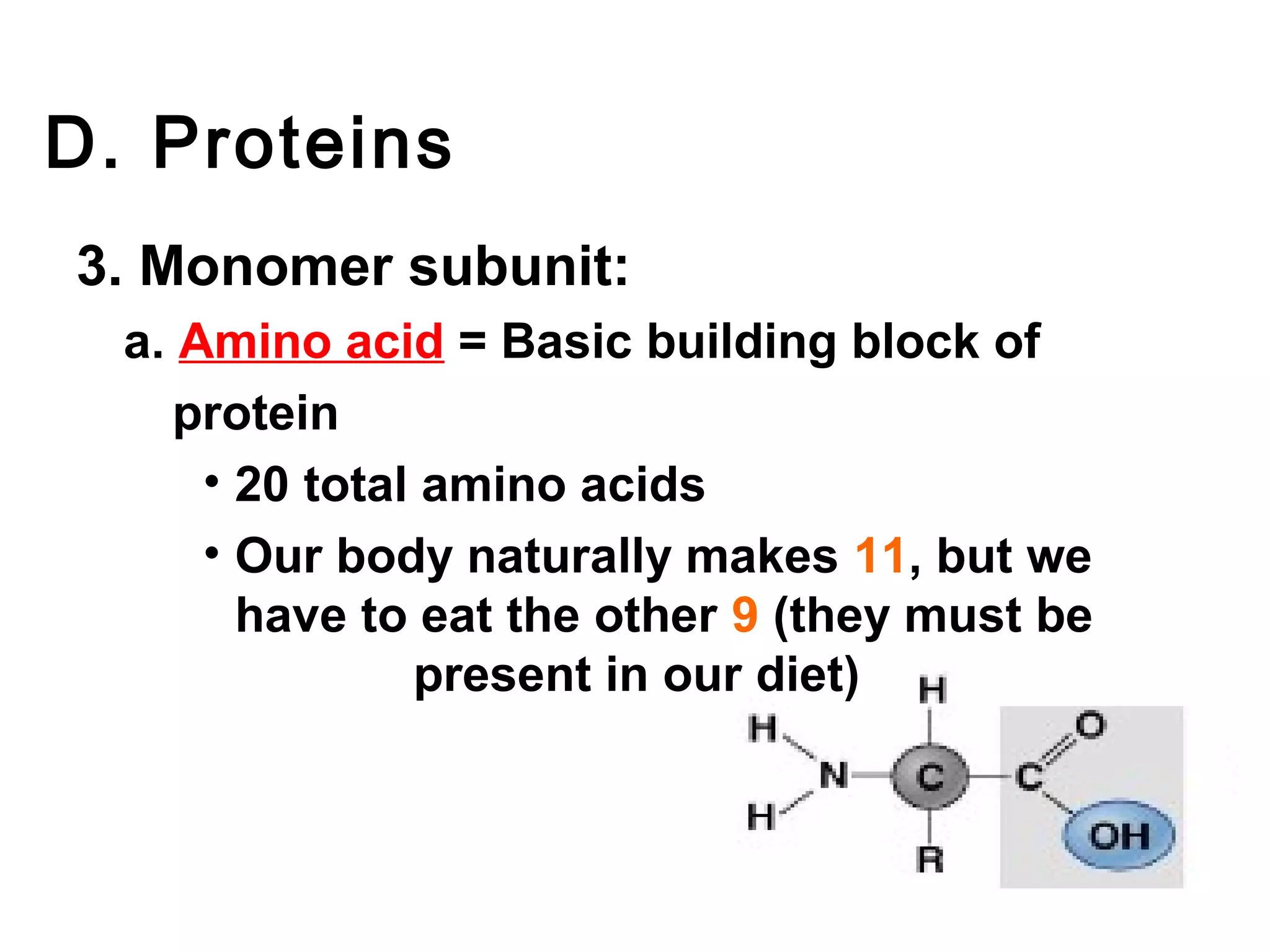
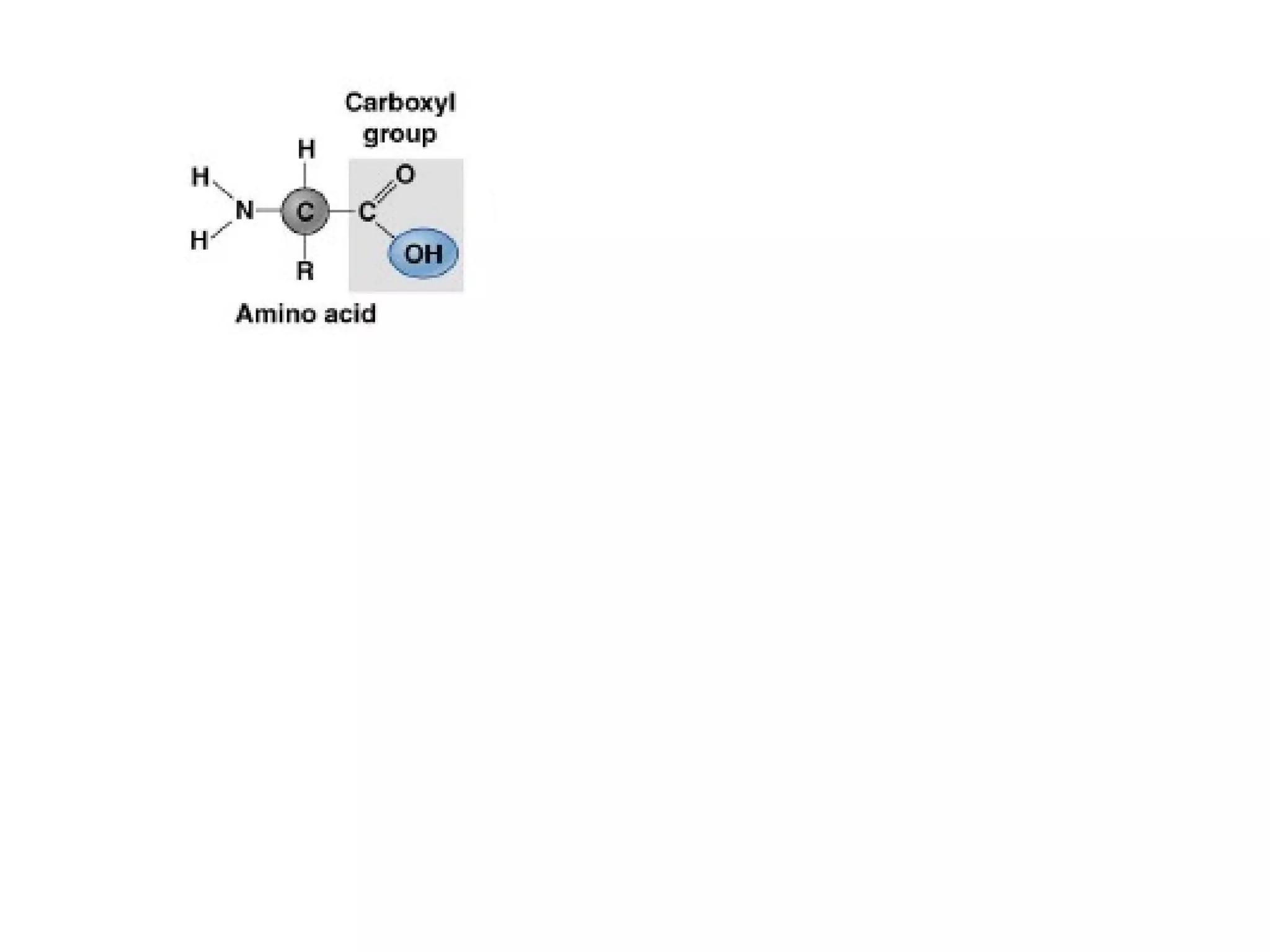
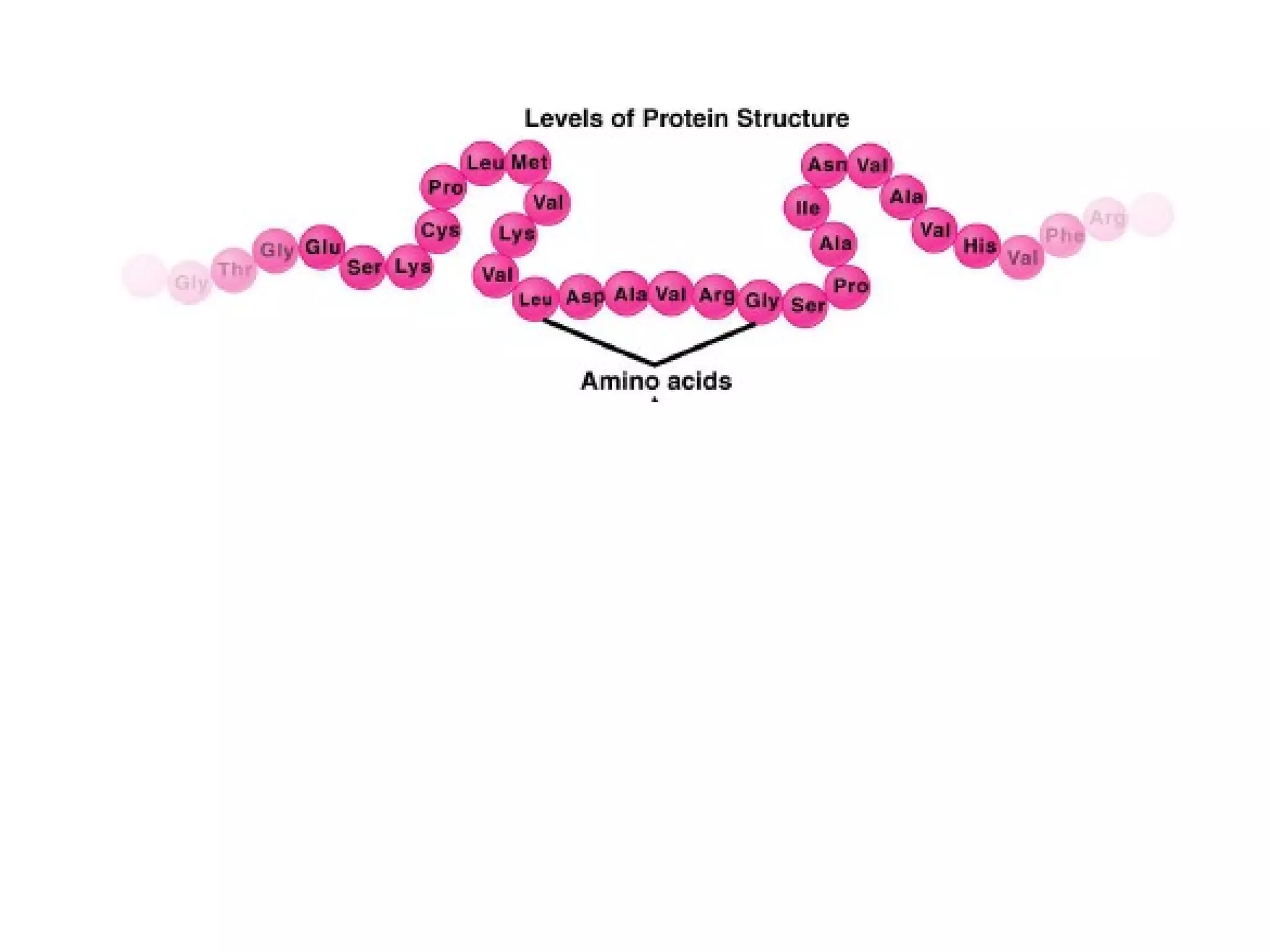
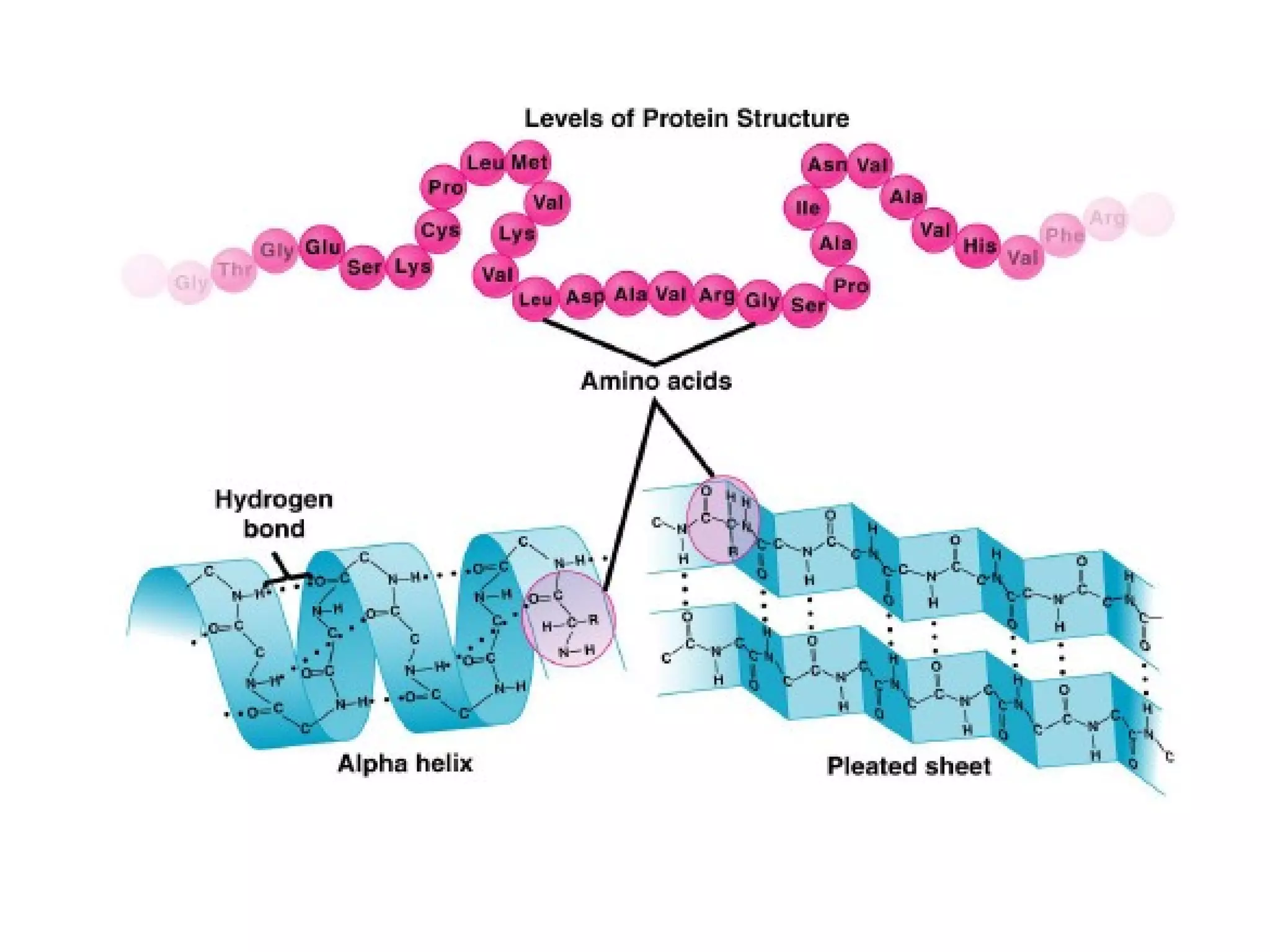
3. Monomer subunit:
  a. Amino acid = Basic building block of
     protein
D. Proteins
3. Monomer subunit:
  a. Amino acid = Basic building block of
     protein
      • 20 total amino acids
      • Our body naturally makes 11, but we
        have to eat the other 9 (they must be
                present in our diet)
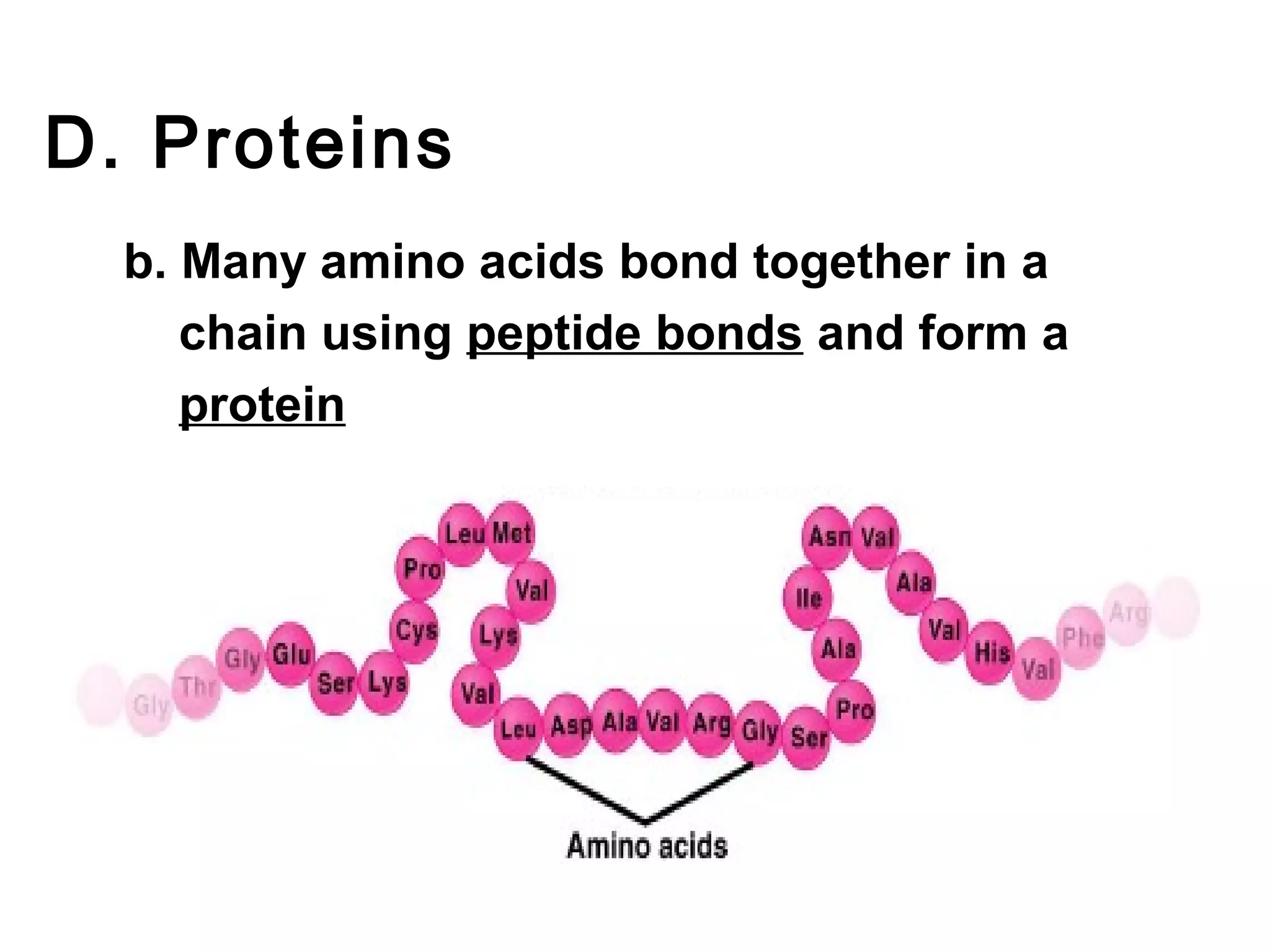
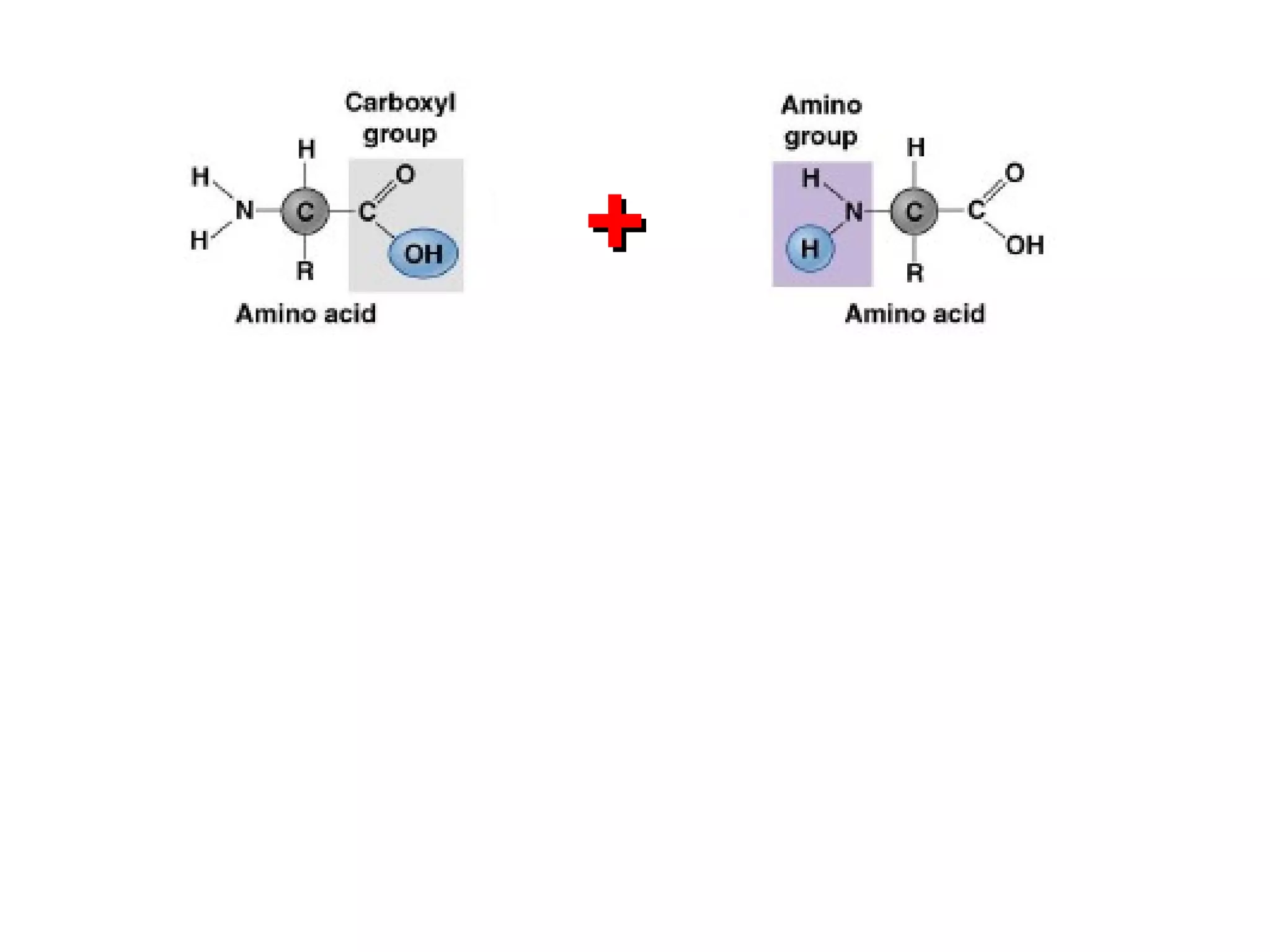
D. Proteins
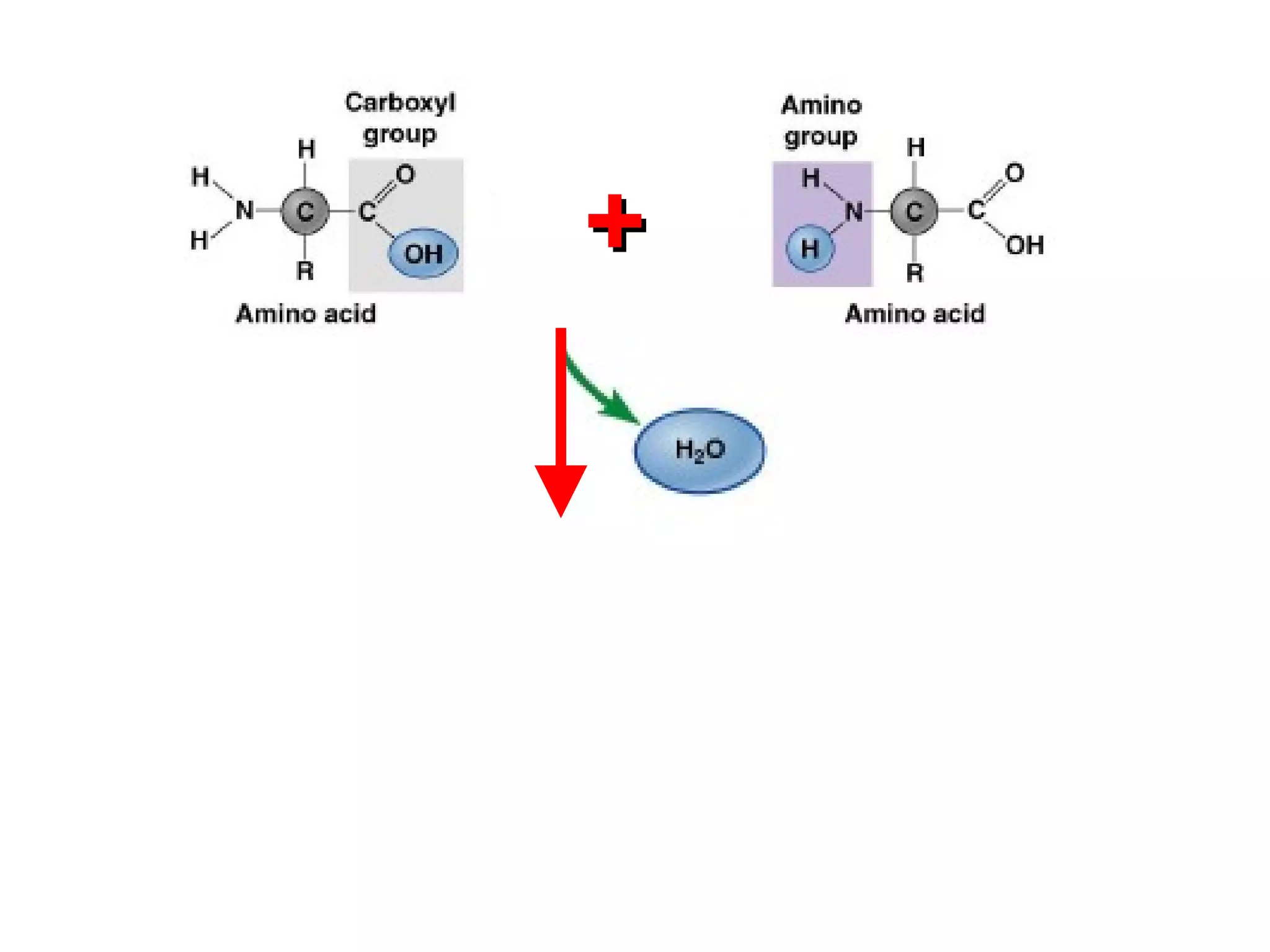
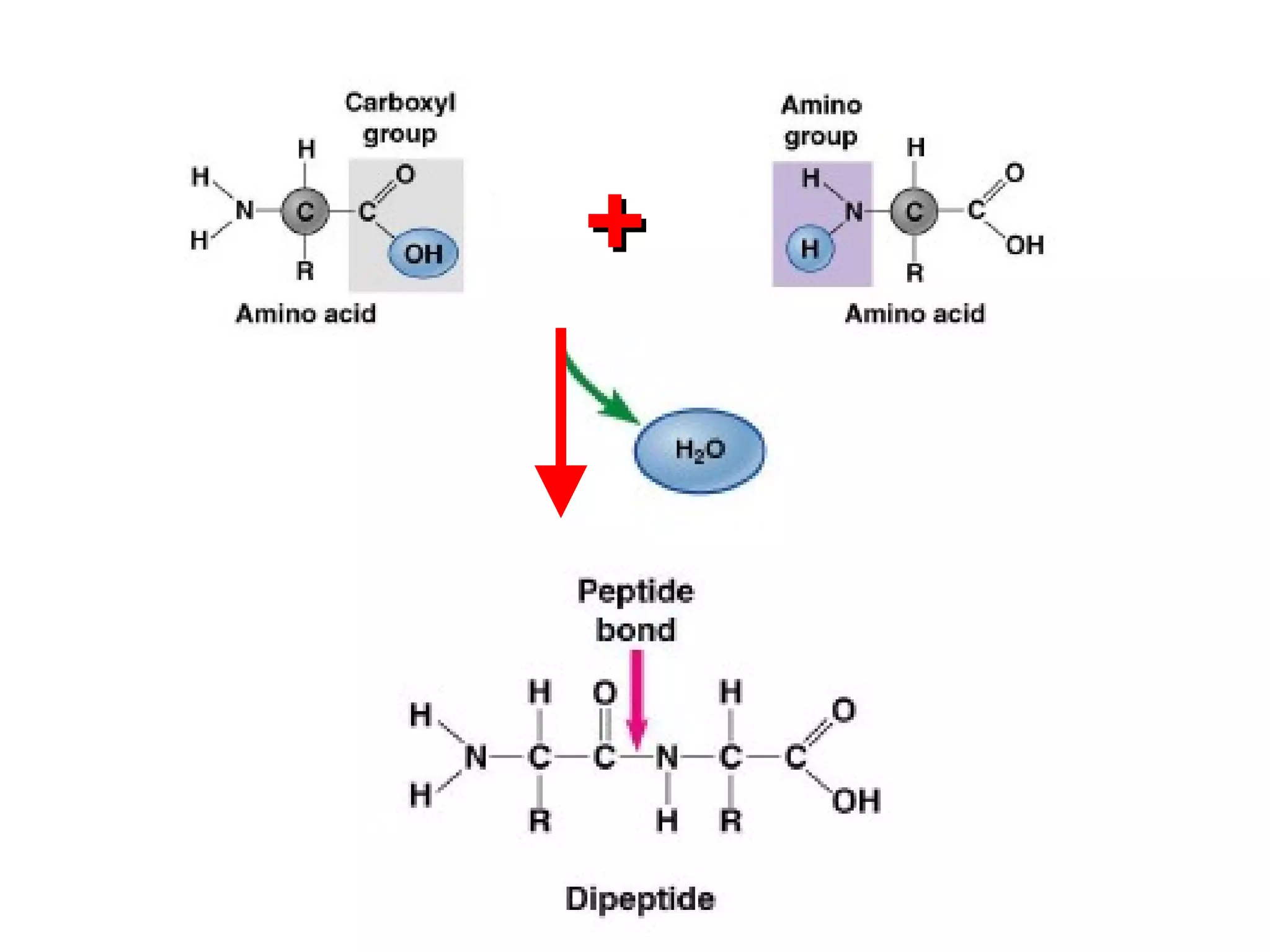
  b. Many amino acids bond together in a
     chain using peptide bonds and form a
     protein
+
+
+
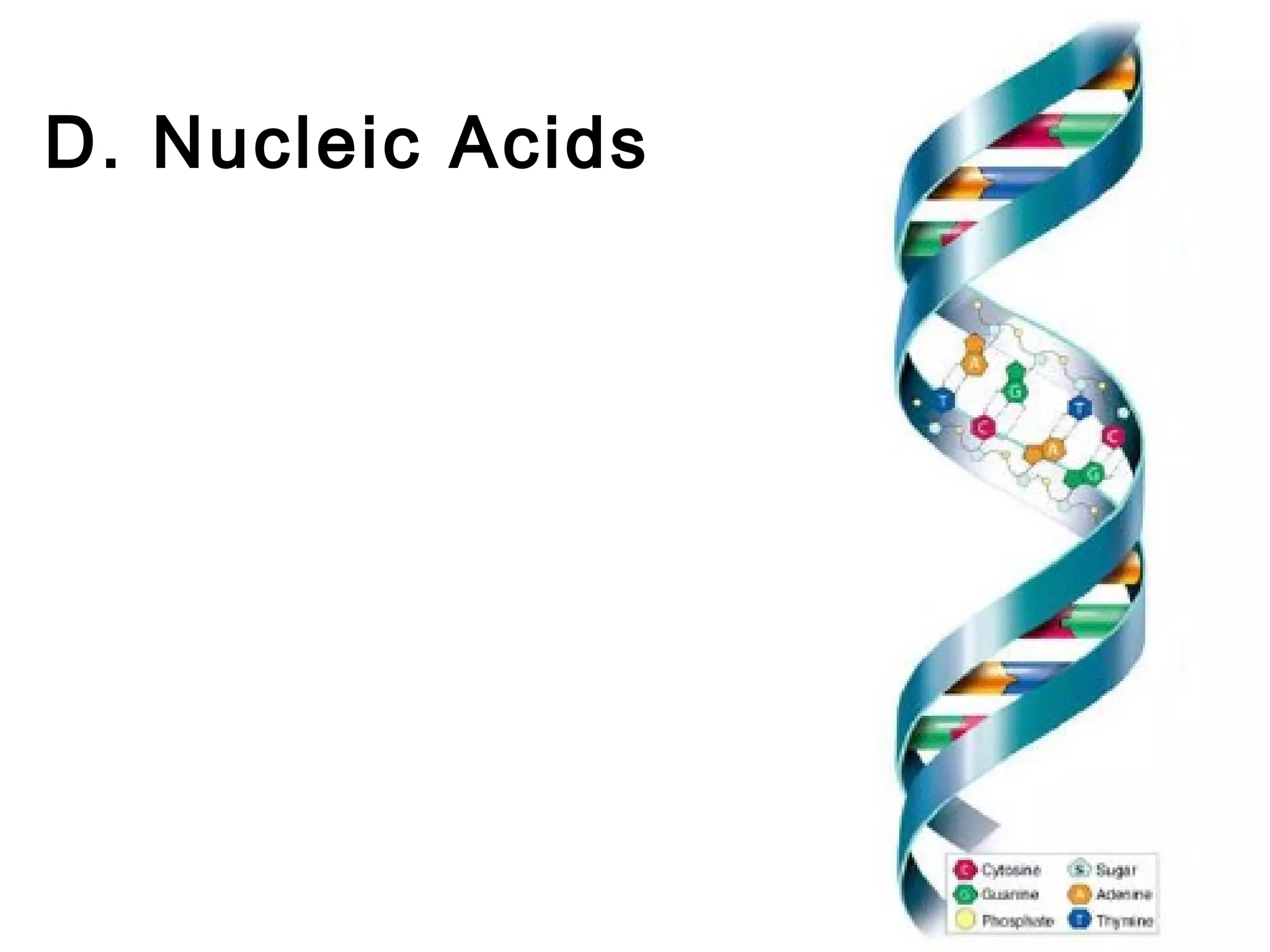
D. Nucleic Acids
D. Nucleic Acids
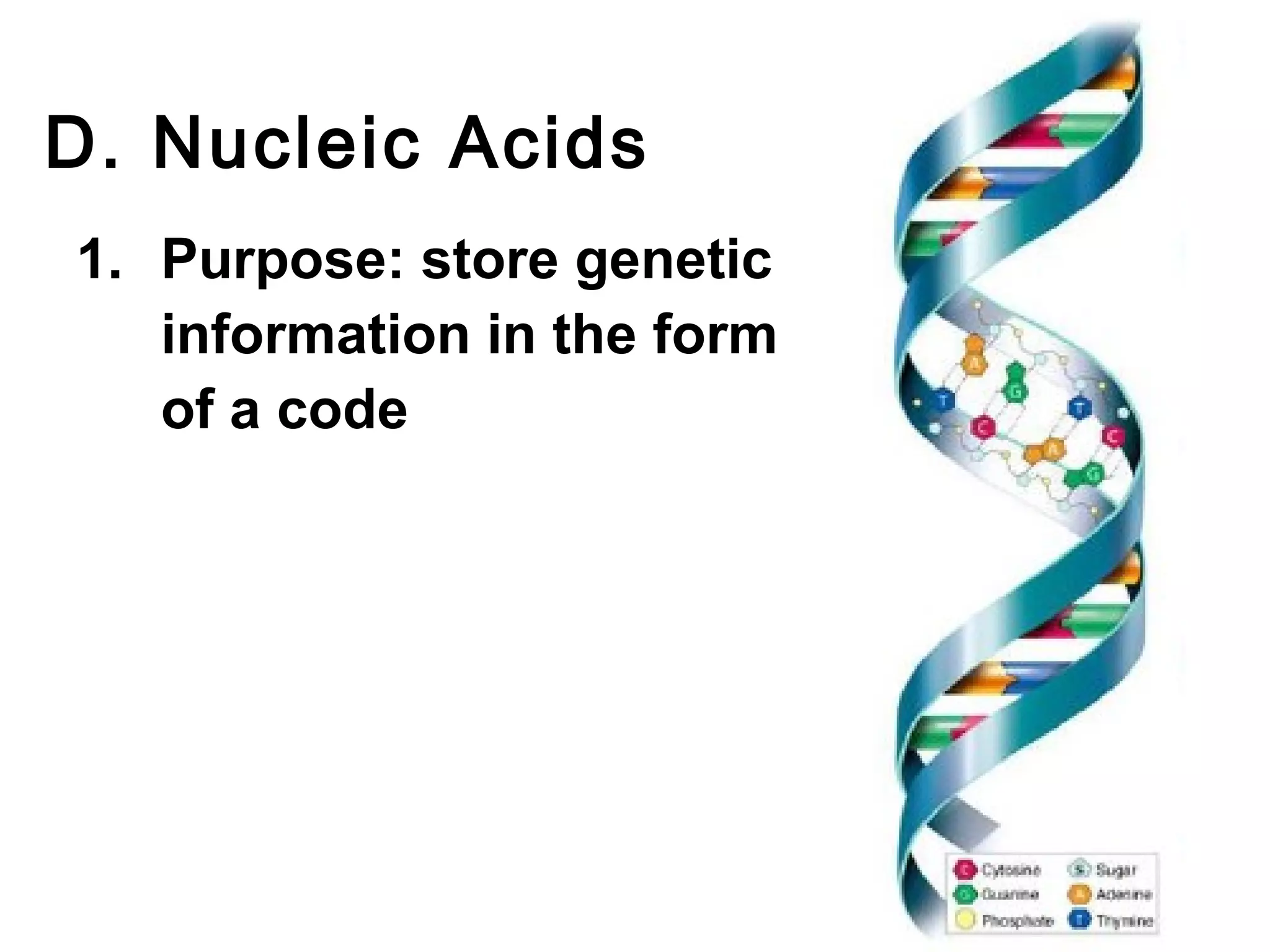
1. Purpose: store genetic
   information in the form
   of a code
D. Nucleic Acids
1. Purpose: store genetic
   information in the form
   of a code
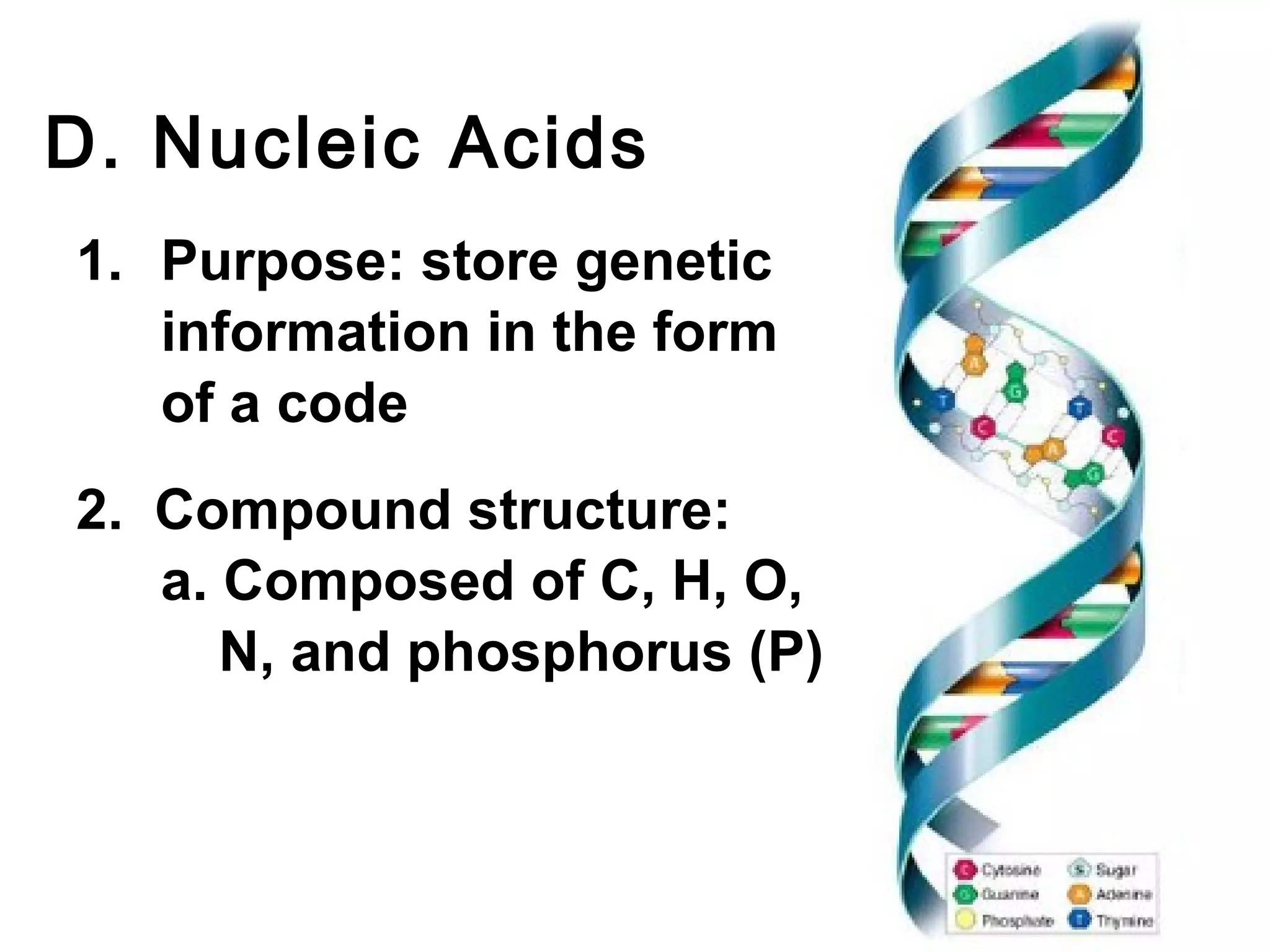
2. Compound structure:
   a. Composed of C, H, O,
      N, and phosphorus (P)
D. Nucleic Acids
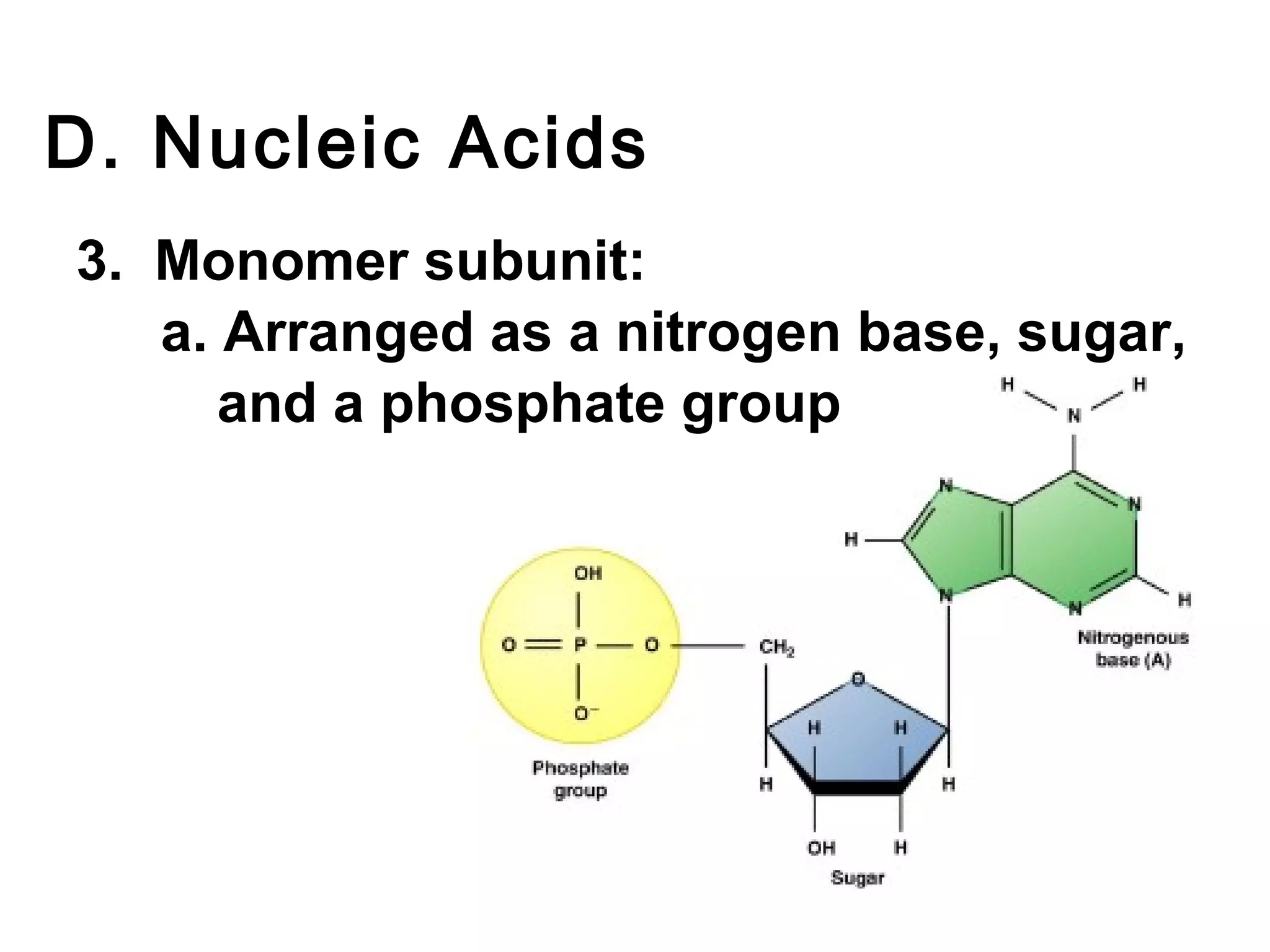
3. Monomer subunit:
   a. Arranged as a nitrogen base, sugar,
      and a phosphate group
D. Nucleic Acids
4. Forms:
   a. DNA: contains instructions to form all
      DNA
      of an organism’s enzymes and
      structural proteins
   b. RNA: copy of DNA used when making
      RNA
      proteins
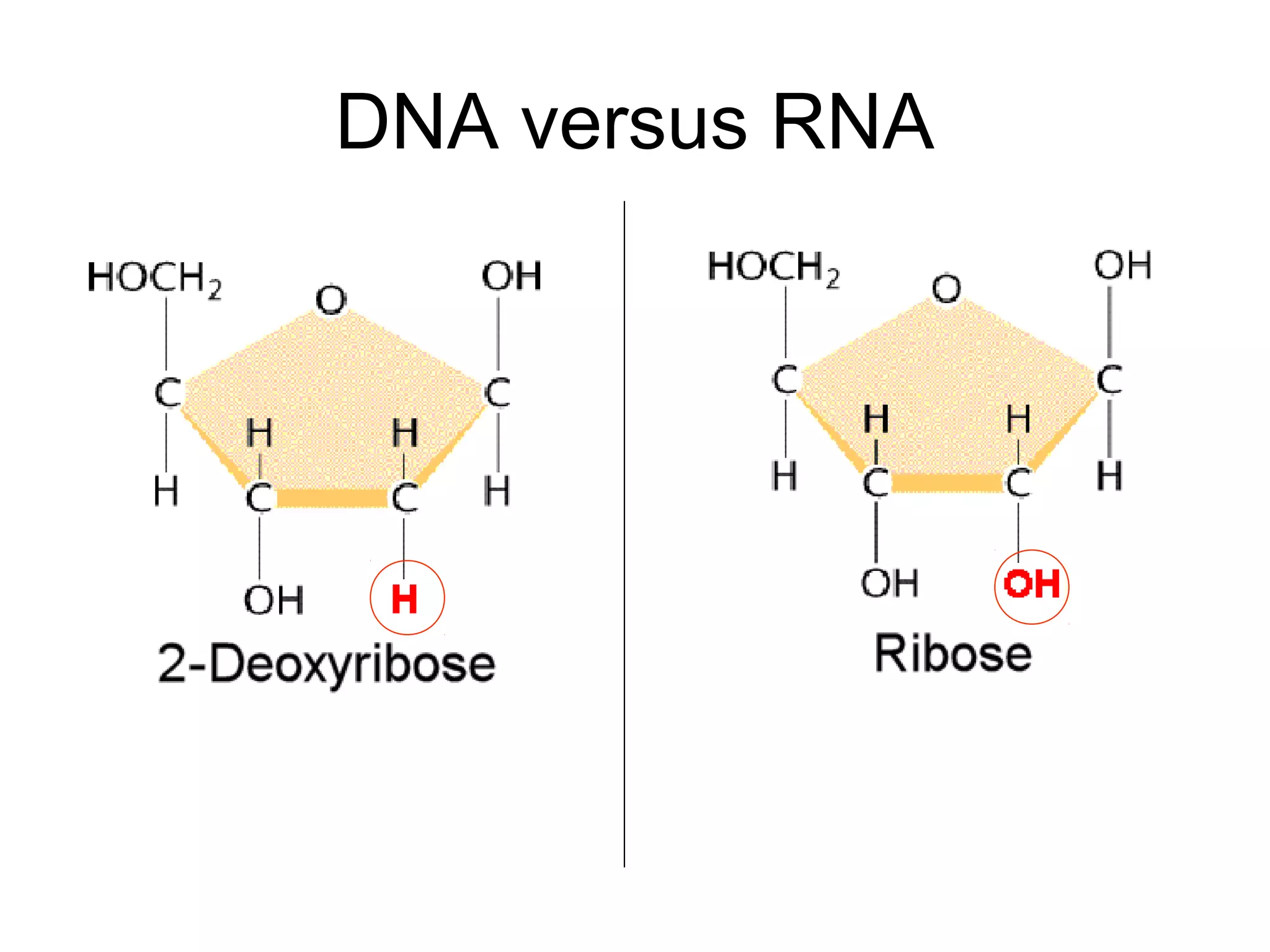
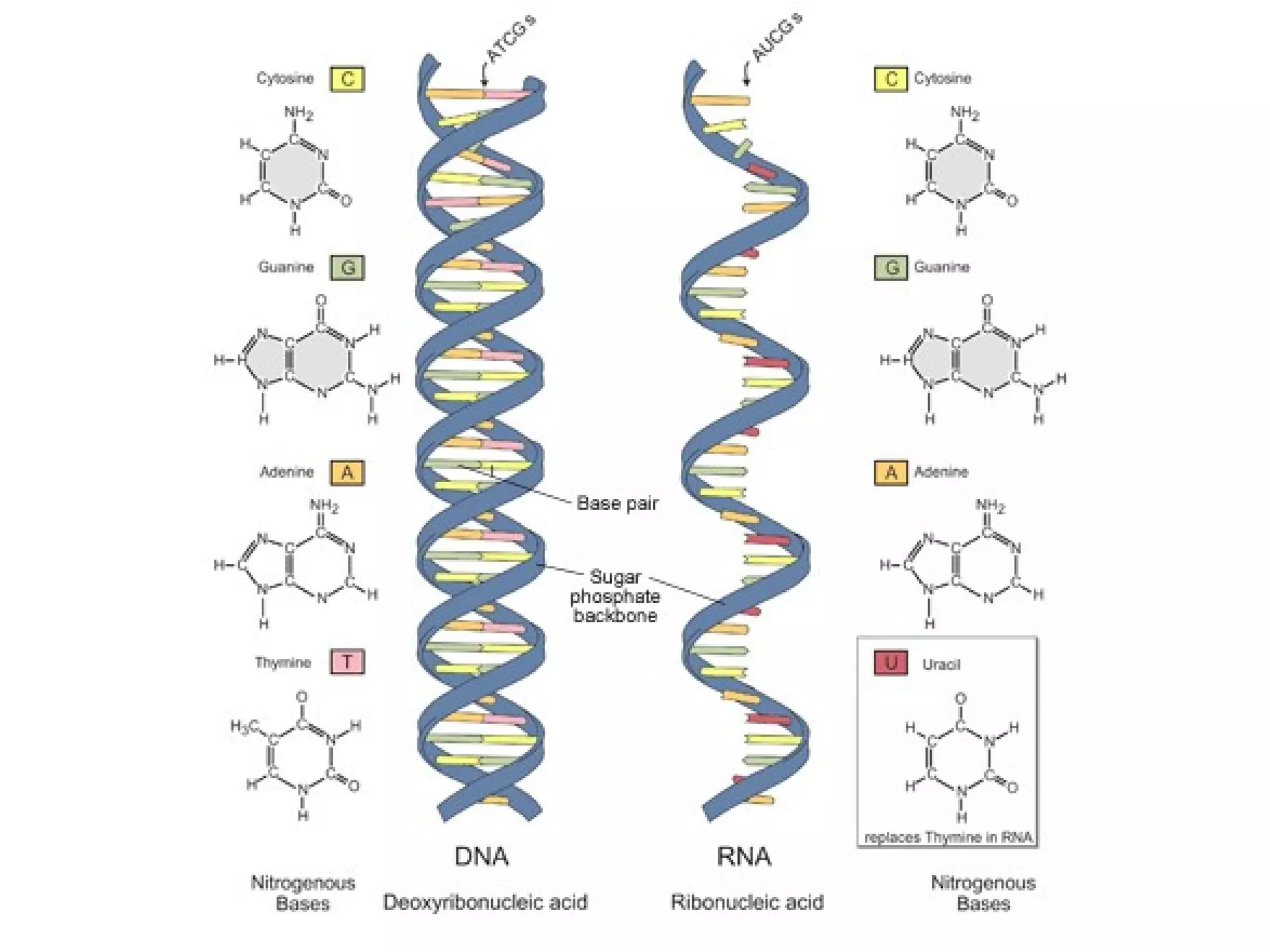
DNA versus RNA
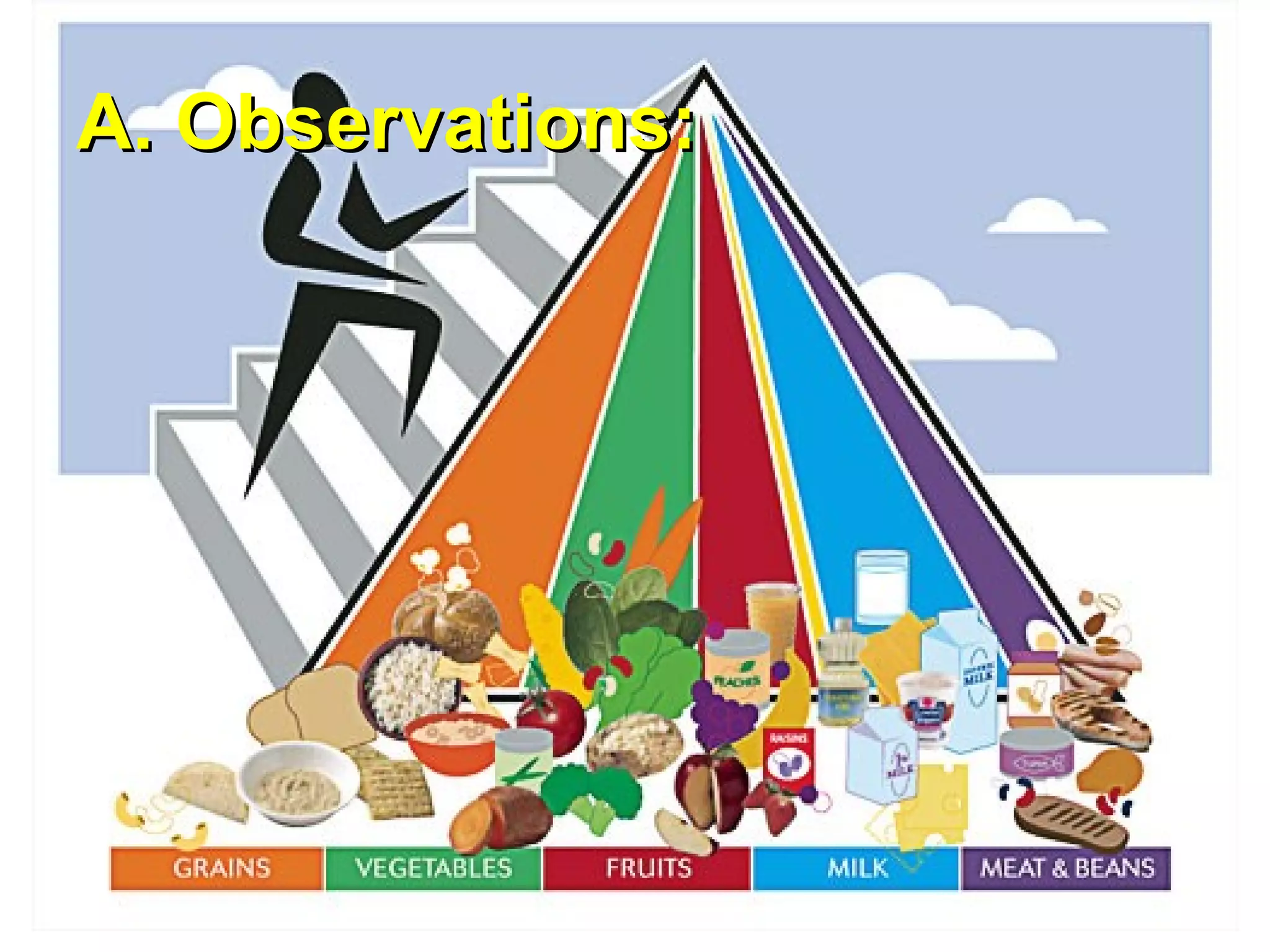
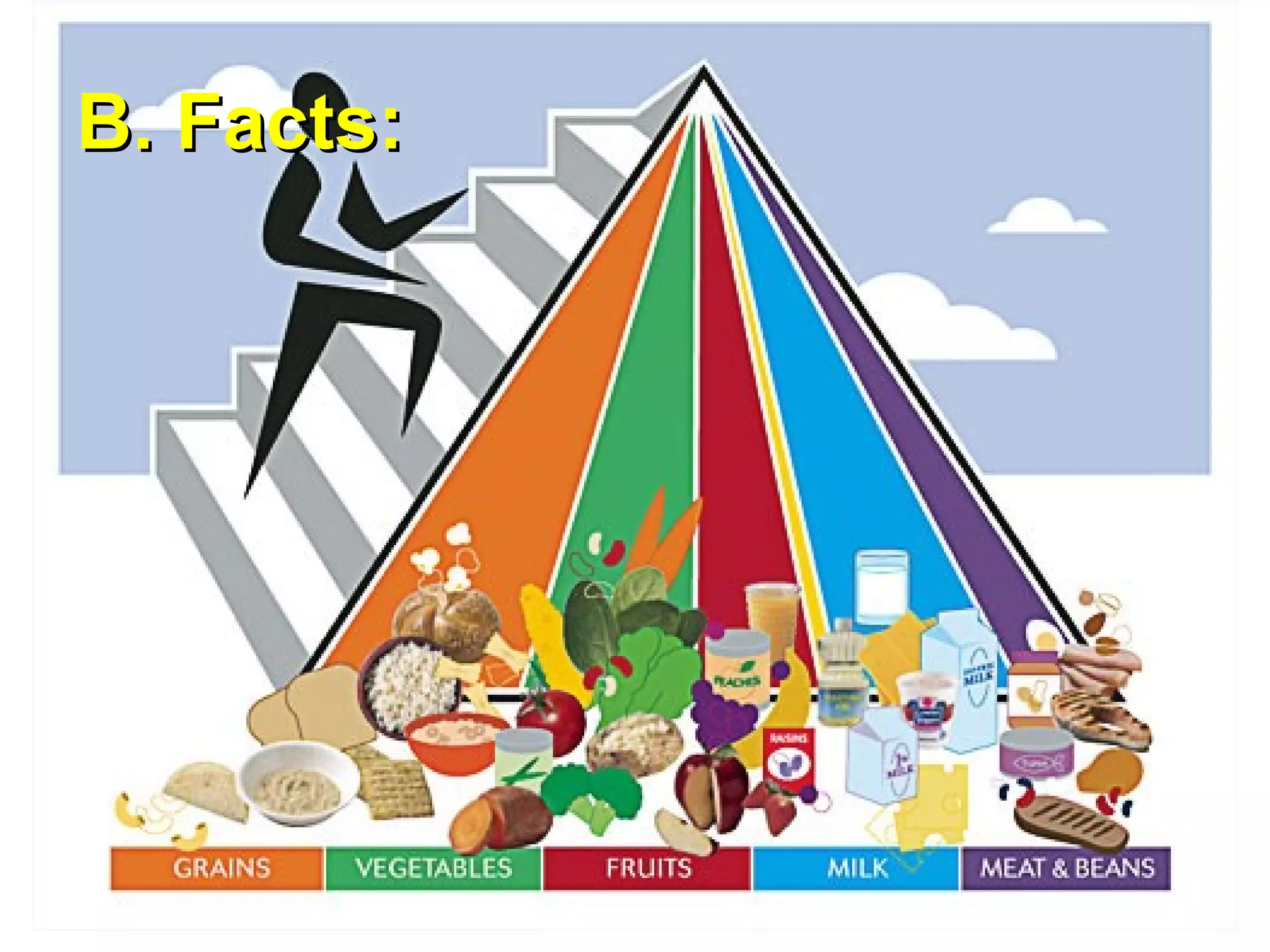
V. Revisions to the Food
Pyramid
A. Observations:
B. Facts:
Biochemistry Introductory Powerpoint

Biochemistry Introductory Powerpoint

  • 2.
    BIOCHEMISTRY Note Outline
  • 3.
    I. Learning Targets •I can identify the elements commonly found in living things (C, H, O, and N). • I can describe how atoms bond together to form molecules. • I can compare the chemical structures of carbohydrates, lipids, proteins, and nucleic acids by describing how they form and are broken down. • I can relate the importance of the 4 biomolecules to living things. • I can describe the function of an enzyme and factors that influence enzyme activity.
  • 4.
    II. Features ofLife A. What is Biology?
  • 5.
    II. Features ofLife A. What is Biology? 1. Definition: the study of the diversity of life
  • 6.
    II. Features ofLife A. What is Biology? 1. Definition: the study of the diversity of life 2. More specifically, biologists…
  • 7.
    a. Study interactionsof the environment
  • 8.
  • 9.
    B. What ConstitutesLife? The term living is not easy to define. Living things MUST contain ALL 5 of the following to be considered alive.
  • 10.
  • 11.
  • 12.
  • 13.
    3) Grow andDevelop
  • 14.
    4) Use Energy/ Evolve
  • 15.
    5) Respond totheir Surroundings
  • 17.
    III. Atoms andtheir Interactions A. Elements 1. Everything is made of substances called elements.
  • 20.
    III. Atoms andtheir Interactions A. Elements 1. Everything is made of substances called elements. 2. Most common elements are… Carbon, Hydrogen, Oxygen, and Nitrogen
  • 21.
    Comparing the compositionof the Earth’s crust to the human body
  • 22.
    B. Atoms arethe basic building block of all matter. 1. Definition: an atom is the smallest particle of an element that has the same characteristics of that element.
  • 23.
  • 24.
    C. Structure ofan Atom 1 2
  • 25.
    C. Structure ofan Atom 1. Nucleus:
  • 26.
    C. Structure ofan Atom 1. Nucleus: a. protons (+ charge)
  • 27.
    C. Structure ofan Atom 1. Nucleus: a. protons (+ charge) b. neutrons (0 charge)
  • 28.
    C. Structure ofan Atom 1. Nucleus: a. protons (+ charge) b. neutrons (0 charge) c. Overall charge of the nucleus = + charge
  • 29.
    C. Structure ofan Atom 1. Nucleus: a. protons (+ charge) b. neutrons (0 charge) c. Overall charge of the nucleus = + charge 2. Electron Cloud
  • 30.
    C. Structure ofan Atom 1. Nucleus: a. protons (+ charge) b. neutrons (0 charge) c. Overall charge of the nucleus = + charge 2. Electron Cloud a. electrons (- charge and move rapidly)
  • 31.
    C. Structure ofan Atom Nucleus Electron cloud
  • 32.
    D. Atoms becomestable by bonding with other atoms.
  • 33.
    D. Atoms becomestable by bonding with other atoms. 1. When atoms bond together, they form new compounds, which have different properties than the individual atoms had.
  • 34.
    D. Atoms becomestable by bonding with other atoms. 1. When atoms bond together, they form new compounds, which have different properties than the individual atoms had. C + O2  CO2 +
  • 35.
    2. Some compoundscontain just one or two atoms (H2O or CO2), whereas others contain tens, hundreds, or even thousands of atoms.
  • 36.
    2. Some compoundscontain just one or two atoms (H2O or CO2), whereas others contain tens, hundreds, or even thousands of atoms. a. Large molecules = macromolecules
  • 37.
    b. Macromolecules areformed by bonding together small molecules to form chains called polymers.
  • 38.
    b. Macromolecules areformed by bonding together small molecules to form chains called polymers. poly = many meros = parts
  • 39.
    b. Macromolecules areformed by bonding together small molecules to form chains called polymers. poly = many meros = parts mono = one meros = part
  • 40.
    3. Macromolecules chainsare controlled by water.
  • 41.
    3. Macromolecules chainsare controlled by water. a. When H2O is added, hydrolysis breaks apart chains.
  • 42.
    3. Macromolecules chainsare controlled by water. a. When H2O is added, hydrolysis breaks apart chains.
  • 43.
    3. Macromolecules chainsare controlled by water. a. When H2O is added, hydrolysis breaks apart chains. hydro = water lysis = to split
  • 44.
    3. Macromolecules chainsare controlled by water. a. When H2O is added, hydrolysis breaks apart chains. b. When H2O is lost, condensation forms chains.
  • 45.
  • 46.
  • 47.
  • 48.
  • 49.
  • 50.
  • 51.
  • 52.
    Hydrolysis vs. Condensation Wateradded, Water lost, Chain breaks Chain forms
  • 54.
    IV. Organic Biomolecules A. You are what you eat!
  • 56.
  • 57.
    2. The foodswe consume have carbohydrates, fats (lipids), and proteins in them.
  • 58.
    2. The foodswe consume have carbohydrates, fats (lipids), and proteins in them. a. Carbohydrates give us energy (ex. sugar, apples, potatoes, pasta…)
  • 59.
    2. The foodswe consume have carbohydrates, fats (lipids), and proteins in them. a. Carbohydrates give us energy (ex. sugar, apples, potatoes, pasta…) b. Fats are related to weight gain (ex. oils, butter, whole milk…)
  • 60.
    2. The foodswe consume have carbohydrates, fats (lipids), and proteins in them. a. Carbohydrates give us energy (ex. sugar, apples, potatoes, pasta…) b. Fats are related to weight gain (ex. oils, butter, whole milk…) c. Proteins help build muscles (ex. fish, beef, eggs, cheese, nuts…)
  • 61.
    3. A healthydiet of foods containing each of these macromolecules insures proper function of all the body’s cells, tissues, organs, and organ systems. If one or more are lacking, the body cannot function to provide us with all of our necessary needs.
  • 64.
  • 65.
    B. Carbohydrates 1. Purpose:store and release energy
  • 66.
    B. Carbohydrates 1. Purpose:store and release energy 2. Compound structure: a. Composed of carbon, hydrogen, and oxygen
  • 67.
    B. Carbohydrates 1. Purpose:store and release energy 2. Compound structure: a. Composed of carbon, hydrogen, and oxygen b. 1:2:1 ratio (CH2O)
  • 68.
    B. Carbohydrates 3. Monomersubunits: a. Monosaccharide: one sugar Monosaccharide molecule (ex. glucose or fructose)
  • 69.
    B. Carbohydrates 3. Monomersubunits: a. Monosaccharide: one sugar Monosaccharide molecule (ex. glucose or fructose) C6H12O6
  • 71.
  • 72.
  • 73.
  • 74.
  • 75.
    B. Carbohydrates b. Disaccharide: two sugar molecules Disaccharide combined (ex. glucose + fructose = sucrose “table sugar”)
  • 76.
    B. Carbohydrates c. Polysaccharide: many sugars Polysaccharide combine to form the molecule (ex. starch, glycogen, cellulose)
  • 79.
  • 80.
    C. Lipids 1. Purpose:energy storage, insulation, and protective coatings
  • 81.
    C. Lipids 1. Purpose:energy storage, insulation, and protective coatings 2. Compound structure: a. Composed of C, H, and O with a larger proportion of C-H bonds than carbohydrates (have less O’s)
  • 82.
    C. Lipids 1. Purpose:energy storage, insulation, and protective coatings 2. Compound structure: a. Composed of C, H, and O with a larger proportion of C-H bonds than carbohydrates (have less O’s) (ex. lipids in beef fat: C57H110O6)
  • 83.
    C. Lipids 2. Structure: b. Insoluble in water (doesn’t dissolve)
  • 84.
    C. Lipids 2. Structure: b. Insoluble in water (doesn’t dissolve)
  • 85.
  • 86.
    C. Lipids 3. Insolublein Water-loving water Water-fearing
  • 89.
    C. Lipids 2. Structure: b. Insoluble in water (doesn’t dissolve) 3. Monomer subunit: a. Fatty acids and a glycerol
  • 90.
    Creation of afat molecule
  • 91.
    Creation of afat molecule 1 2 3
  • 92.
    Creation of afat molecule
  • 94.
    C. Lipids 4. Forms: a. Saturated fat: no double bonds fat between carbons, solid at room temperature, found mostly in animals
  • 95.
    C. Lipids 4. Forms: b. Unsaturated fat: double bonds fat between some of the carbons, liquid at room temperature, found mostly in plants
  • 96.
    Comparing Saturated and Unsaturated Fats
  • 98.
  • 99.
    D. Proteins 1. Purpose:provide structure, motion, and immunity
  • 100.
    D. Proteins 1. Purpose:provide structure, motion, and immunity a. Enzyme = catalyst to speed up chemical reactions
  • 101.
    D. Proteins 1. Purpose:provide structure, motion, and immunity a. Enzyme = catalyst to speed up chemical reactions 2. Compound structure: a. Composed of C, H, O, nitrogen (N), and sulfur (S)
  • 102.
    D. Proteins 3. Monomersubunit: a. Amino acid = Basic building block of protein
  • 103.
    D. Proteins 3. Monomersubunit: a. Amino acid = Basic building block of protein • 20 total amino acids • Our body naturally makes 11, but we have to eat the other 9 (they must be present in our diet)
  • 104.
    D. Proteins b. Many amino acids bond together in a chain using peptide bonds and form a protein
  • 106.
  • 107.
  • 108.
  • 112.
  • 113.
    D. Nucleic Acids 1.Purpose: store genetic information in the form of a code
  • 114.
    D. Nucleic Acids 1.Purpose: store genetic information in the form of a code 2. Compound structure: a. Composed of C, H, O, N, and phosphorus (P)
  • 115.
    D. Nucleic Acids 3.Monomer subunit: a. Arranged as a nitrogen base, sugar, and a phosphate group
  • 116.
    D. Nucleic Acids 4.Forms: a. DNA: contains instructions to form all DNA of an organism’s enzymes and structural proteins b. RNA: copy of DNA used when making RNA proteins
  • 117.
  • 120.
    V. Revisions tothe Food Pyramid
  • 123.
  • 124.