Factors Affecting
Bioavailability of drug
Ashutosh Gupta
M. Pharm (pharmaceutics)
From BIT Mesra Ranchi
Assistant Professor
at
Department of Pharmaceutics
College of Pharmacy
TMU Moradabad
1
CONTENTS
 Introduction of Bioavailability
 Objective of bioavailability studies
 Types of bioavailability
 Factors Affecting Bioavailability
 Pharmaceutical factors
 Pharmacological factors
 Route of administration
 Bibliography
2
Introduction of bioavailability
 The rate and extent at which the active concentration of a drug is available
at the desired site of action.
Bioavailability=
𝑨𝑼𝑪 𝒐𝒇 𝒐𝒓𝒂𝒍
𝑨𝑼𝑪 𝒐𝒇 𝑰𝑽
*
𝑰𝑽 𝒅𝒐𝒔𝒆
𝑶𝒓𝒂𝒍 𝒅𝒐𝒔𝒆
 In such cases, the dose available to the patient, called as bioavailable
dose. It often less than the administered dose.
 The amount of drug that reaches the systemic circulation is called as
systemic availability.
 The term bioavailable fraction F refers to the fraction of administered
dose that enters the systemic circulation.
𝐅 =
𝐁𝐢𝐨𝐚𝐯𝐚𝐢𝐥𝐚𝐛𝐥𝐞
𝐀𝐝𝐦𝐢𝐧𝐢𝐬𝐭𝐞𝐫𝐞𝐝 𝐝𝐨𝐬𝐞
3
 Primary stages of development of a suitable dosage foam for a new drug
entity to obtain evidence of its therapeutic utility.
Objective of bioavailability studies
Bioavailability studies are important in the-
 Determination of influence of excipients, patient-related factors and
possible interaction with other drug on the efficiency of absorption.
 Development of new formulations of the existing drugs.
4
 Control of quality of a drug product during the early stages of factors,
storages and stability on the drug absorption.
 Comparison of availability of a drug substance from different dosage
forms or from the same dosage from produced by different manufactures.
5
Types of bioavailability
There are two types of bioavailability
- Relative bioavailability
- Absolute bioavailability
 Relative bioavailability
The relative bioavailability is the systemic availability of a drug after oral
administration is compared with that of oral standard of the same drug.
𝐅𝐫 =
𝐎𝐫𝐚𝐥 𝐝𝐨𝐬𝐞 (𝐝𝐫𝐮𝐠)
𝐎𝐫𝐚𝐥 𝐝𝐨𝐬𝐞 (𝐬𝐭𝐚𝐧𝐝𝐚𝐫𝐝)
6
 Absolute bioavailability
when the systemic availability of a drug administered orally is comparison
to its intravenous administration, is called as absolute bioavailability .
𝐅 =
𝑶𝒓𝒂𝒍 𝒅𝒐𝒔𝒆
𝐈. 𝐕 𝐝𝐨𝐬𝐞
7
Factors affecting Bioavailability
There are various factors which affect the bioavailability of drug-
 Pharmaceutical factors
 Pharmacological factors
 Route of administration
8
Pharmaceutical Factors:
 It is expected that, bioavailability of drugs to be in this decreasing
order-
Solutions > Suspension > Capsule > Tablet > Coated Tablet
9
The Pharmaceutical factors include:
 Particle Size
 Salt Form
 Crystal Forms
 Nature of Excipients
 Degree of Ionisation
 Partition coefficient
 The method of manufacturing
10
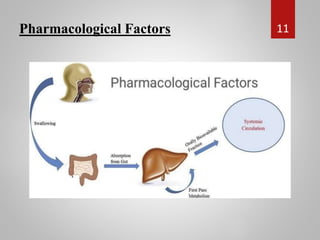
Pharmacological Factors 11
The Pharmacological factors include:
 Gastric Emptying and Gastrointestinal Motility
 Gastrointestinal Diseases
 Food and Other Substances
 First Pass Metabolism
 Drug-Drug Interactions
12
Route of administration
 Parenteral
 Oral
 Topical
 Rectal
 Inhalation
Parenteral > Oral > rectal > Topical
13
Bibliography:
 Brahmankar D.M, biopharmaceutics and pharmacokinetics, New Delhi,
Vallabh Publications, 2012.
 Goodman L. S, Goodman & Gilman’s Pharmacological Basis of
Therapeutics, 13th Edition, New York; New Delhi, TataMcGraw-Hill
Education, 2017.
 Katzung B. G, Basic and Clinical Pharmacology, 14th Edition, New York;
New Delhi, TataMcGraw-Hill Education, 2017.
 Tripathi K.D, Essentials of Medical Pharmacology, 7th Edition, New
Delhi, Jaypee Brothers Publications, 2013.
14
ThankYou!

15