Kailas K Mali
Contents
 Introduction
 Tissue permeability of drugs
 Barrier to distribution of drugs
 Factors affecting drug distribution
 Physico-chemical properties of drugs
 Volume of distribution
 Drug-protein binding
 Factors affecting drug-protein binding
 Significance of drug protein binding
2
Introduction
 Diffusion of drug from capillaries to interstitial spaces
3
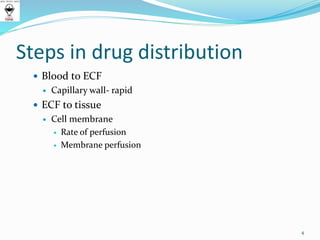
Steps in drug distribution
 Blood to ECF
 Capillary wall- rapid
 ECF to tissue
 Cell membrane
 Rate of perfusion
 Membrane perfusion
4
Factors affecting drug distribution
 Tissue permeability of drug
 Organ/tissue size and perfusion rate
 Binding of drug to tissue components
 Miscellaneous factors
5
Factors affecting drug distribution
 Tissue permeability of drug
 Physicochemical properties of drug
 Physiological barriers
6
Factors affecting drug distribution
 Physicochemical properties of drug
 Capillary membrane
 Molecular weight < 500 – 600 daltons cross
 Cell membrane
 Molecular size < 50 dalton through pores
 Degree of ionisation- pH of ECF & ICF (7.4), pKa of drug
 Unionised and lipophilic drug cross cell membrane barrier
 Phenobarbital and SA
 same Ko/w but former is ionised less at blood pH shows rapid
distribution.
 Thiopental- lipophilic, unionised-
 Fast distribution (BBB/Fat Biphasic distribution)
 Penicillins- polar, water soluble and ionised
 Systemic Acidosis / Alkalosis (altered distribution of drugs)
7
Factors affecting drug distribution
 Physiological barriers
 Simple capillary endothelial barrier
 Simple cell Membrane barrier
 Blood-brain barrier
 Blood – CSF barrier
 Blood-placental barrier
 Blood-tests barrier
8
Factors affecting drug distribution
 Physiological barriers
 Simple capillary endothelial barrier
 Simple cell Membrane barrier
9
Blood ECF ICF
Drug size < 50 dD
D D
D
P
D D
D
D D
Lipophilic Drug
Size 50-500 d
Polar/ ionised
size > 50 d
D
Bulk flow
Passive
Active
D
+ +
-
Capillary barrier Cell membrane barrier
Blood
Brain
Factors affecting drug distribution
 Physiological barriers
 Blood-brain barrier
10
ECF
Glial cells
Basement Memb.
Astrocytes
Pericytes
Capillary endothelium
Tight intercellular
Junctions
Factors affecting drug distribution
 Physiological barriers
 Blood-brain barrier
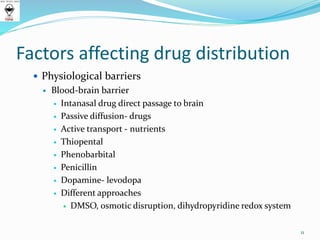
 Intanasal drug direct passage to brain
 Passive diffusion- drugs
 Active transport - nutrients
 Thiopental
 Phenobarbital
 Penicillin
 Dopamine- levodopa
 Different approaches
 DMSO, osmotic disruption, dihydropyridine redox system
11
Factors affecting drug distribution
 Physiological barriers
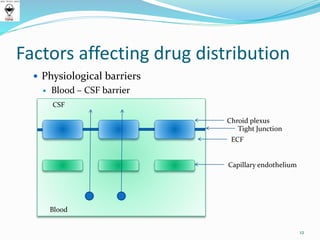
 Blood – CSF barrier
12
Blood
CSF
Tight Junction
Chroid plexus
Capillary endothelium
ECF
Factors affecting drug distribution
 Physiological barriers Blood-placental barrier
13
Mother Fetus
Polar drug
Non-polar drug Non-polar drug
Polar metabolite Polar metabolite
Factors affecting drug distribution
 Blood-placental barrier
 Factors
 Placental blood flow increased delivery of drug
to placental membrane
 Molecular size of drug decreased transfer as size
increases
impermeable to drugs MW>1000
permeable to drugs MW<600
 Lipid solubility of drug increased transfer as lipid
solubility increases
 pKa of drug ion trapping on either side
14
Factors affecting drug distribution
 Permeability rate limited
 Drug is ionic, polar or water soluble
 Physiological barriers
15
Factors affecting drug distribution
 Organ/ Tissue Size and perfusion rate
 Perfusion rate limited
 Drug highly lipophilic
 High permeability
 Rate limited- Blood flow
 Rate limited- Perfusion to tissue
 Perfusion rate
 Volume of blood that flows per unit time per unit volume of
the tissue
 Highly perfused tissue: lung, kidney, liver, heart, brain
 Moderately perfused tissue: muscles, skin
 Poorly perfused tissue: Fat, bone
16
Factors affecting drug distribution
 Organ/ Tissue Size and perfusion rate
 Extent of distribution depend on tissue size
 Example: Thiopental (biphasic distribution)
 Initially- Brain
 Then- fats (adipose tissue)
17
Factors affecting drug distribution
18
Tissue Percent Body
Weight
Percent Car
diac Output
Blood Flow
(ml/100 g tissue/min)
Adrenals 0.02 1 550
Kidneys 0.4 24 450
Thyroid 0.04 2 400
Liver 2.3 27 -
Hepatic 2.0 5 20
Portal 20 75
Portal-drained viscera 2.0 20 75
Heart (basal) 0.4 4 70
Brain 2.0 15 55
Skin 7.0 5 5
Muscle (basal) 40.0 15 3
Connective tissue 7.0 1 1
Fat 15.0 2 1
Factors affecting drug distribution
 Age
 Infants
 TBW and fat is greater
 Skeleton muscles and albumin content are less
 BBB poorly developed
 Elderly
 Fat is greater
 Skeleton muscles and albumin content less
19
Factors affecting drug distribution
 Pregnancy
 Uterus, placenta and foetus increases volume available for
distribution
 Plasma and ECF increased
 Albumin content decreased
 Obesity
 High adipose tissue content- lipophilic drugs distributed well
 High fatty acid contents- altered binding of acidic drugs
 Diet
 Fat increases free fatty acid levels which alters binding of
acidic drugs to albumin
20
Factors affecting drug distribution
 Disease state
 Altered albumin content
 Altered perfusion rate
 Altered tissue pH
 Meningitis increases permeation of polar drugs to brain
 Drug interactions
21
Volume of distribution
 TBW: 42L
 Volume of distribution
 Apparent volume of distribution
22
Protein Binding of Drugs
 Phenomenon of complex formation of drug with protein
 Mechanisms of protein binding
 Hydrogen bonds
 Hydrophobic bonds
 Ionic bonds
 Van der Wall’s forces
23
Protein Binding of Drugs
 Binding of drugs to blood component
 Plasma protein- drug binding
 Blood cell- drug binding
24
Protein Binding of Drugs
 Binding of drugs to blood component
 Plasma protein- drug binding
 Albumin > alpha acid glycoproteins > lipoproteins > globilins
 Binding of drug to HSA
 Molecular Wt – 65000
 Concentration- 3.5 to 5 g%
 Variety of drugs bind to albumin
 Endogenous material like – fatty acids, bilirubin, tryptophans
 Four binding Sites
 Site I (Warfarin)- NSAIDS, Phenytoin, bilirubin, Sodium
valproate
25
Protein Binding of Drugs
 Binding of drugs to blood component
 Plasma protein- drug binding
 Binding of drug to HSA
 Four binding Sites
 Site I (Warfarin)- NSAIDS, Phenytoin, bilirubin, Sodium
valproate, etc
 Site II (diazepam)- ibuprofen, tryptophan, ketoprofen, etc
 Site III (digitoxin)
 Site IV (tamoxifen)
26
Protein Binding of Drugs
 Binding of drugs to blood component
 Plasma protein- drug binding
 Binding of drug to AAG
 Molecular Wt- 44000
 Concentration- 0.44 to 0.1 g%
 Basic drugs: Imipramine, lidocaine, amitriptyline, etc.
27
Protein Binding of Drugs
 Binding of drugs to blood component
 Plasma protein- drug binding
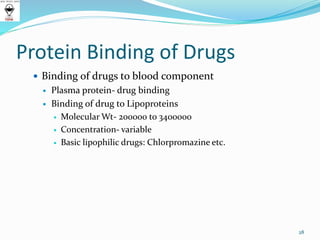
 Binding of drug to Lipoproteins
 Molecular Wt- 200000 to 3400000
 Concentration- variable
 Basic lipophilic drugs: Chlorpromazine etc.
28
Protein Binding of Drugs
 Binding of drugs to blood component
 Plasma protein- drug binding
 Binding of drug to Globulins
 Alpha 1 globulin: transcortin
 Steroids
 Alpha 2 globulin: ceruloplasmin
 Vitamin A, D, E, K and cupric ions
 Beta 1 globulin: transferrin
 Ferrous ions
 Beta 2 globulin
 Carotinoids
 Gamma globulin
 Antigens
29
Protein Binding of Drugs
 Binding of drugs to blood component
 Binding of drug to blood cells
 RBC (95%) components:
 Hemoglobin
 MW- 64500, Concentration 21 to 15 g%
 Phenytoin, pentobarbital, phenothiazines
 Carbonic anhydrase
 Acetazolamide, chlorthalidone
 Cell membrane
 Imipramine, chlorpromazine
33
Protein Binding of Drugs
 Binding of drugs to tissues
 Tissue binding increases apparent Vd
 Tissue binding increases biological half life of drug
 Factors affecting tissue binding
 Lipophilicity
 Structure of drug
 Perfusion rate
 pH difference
34
Protein Binding of Drugs
 Binding of drugs to tissues
 Liver: Paracetamol- hepatotoxicity
 Lungs: imipramine, chlorpromazine
 Kidney: Matallothionin (protein) bind to heavy metals
 Skin: Melanin- chloroquine, phenothiazines
 Eyes: Melanin- chloroquine, phenothiazines- retinopathy
 Hairs: Arsenicals, chloroquine, phenothiazines
 Bones: Tetracyclines
 Fats: Lipophilic drugs
 Nucleic Acids: chloroquine and quinacrine
35
Protein Binding of Drugs
36
Parameter Protein- drug binding Tissue- drug binding
Binding Weak bonds & thus
reversible
Covalent bonds & thus
irreversible
Vd Small Large
Half Life Short Long
Toxicity No Common
DI Displacement No
Binding Competitive Non Competitive
Factors affecting drug -Protein binding
 Drug related
 Physicochemical characters of drug
 Concentration of drug in body
 Drug binding affinity towards binding component
 Protein/ tissue
 Physicochemical characters of protein or binding agent
 Concentration of protein in body
 Number of binding sites on binding agent
 Drug interactions
 Patient
37
Factors affecting drug -Protein binding
 Drug related
 Protein/ tissue
 Drug interactions
 Competition between drugs for the binding sites
 Competition between drugs and normal body constituents
for the binding sites
 Allosteric changes in protein molecules
 Patient
 Age
 Inter-subject variation
 Disease state
38
Factors affecting drug -Protein binding
 Drug related
 Physicochemical characters of drug
 Lipophilicity- localized in tissues
 Thiopental- adipose tissues
 Acidic drugs- HAS
 Penicillins, sulphonamides
 Basic drugs- AAG
 Imipramine
 Neutral, unionised- lipoproteins
39
Factors affecting drug -Protein binding
 Drug related
 Concentration of drug in body
 Therapeutic concentration of lidocaine can saturate AAG
 Drug concentration unable to saturate HSA
 Drug binding affinity towards binding component
 Lidocaine has greater affinity for AAG than for HAS
 Digoxin- protein of cardiac muscles
 Iophenoxic acid- plasma proteins (t1/2 2.5 years)
40
Factors affecting drug -Protein binding
 Protein/ tissue
 Physicochemical characters of protein or binding agent
 Lipoproteins and adipose tissue bind to lipophilic drugs
 Concentration of protein in body
 Albumin high percent
 Number of binding sites on binding agent
 Albumin-Four binding sites
41
Factors affecting drug -Protein binding
 Drug interactions
 Competition between drugs for the binding sites
 Warfarin + Phenylbutazone
 Competition between drugs and normal body constituents
for the binding sites
 Free fatty acids- drugs- HSA
 Bilirubin - HSA
 Allosteric changes in protein molecules
42
Factors affecting drug -Protein binding
 Patient Related factors
 Age
 Neonates: Low albumin content
 Young infants: Greater binding
 Elderly: Low albumin content, High levels of AAG
 Inter-subject variation
 Disease states
 Hypoalbuminaemia: aging, CCF, trauma, burns, inflammatory
states, renal and hepatic disorders, pregnancy, surgery, etc
 Hyperlipoproteinaemia: hypothyroidiosm, obstructive liver
disease, alcoholism etc
43
Factors affecting drug -Protein binding
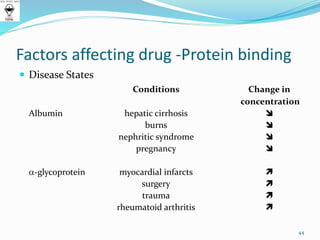
 Disease States
Conditions Change in
concentration
Albumin hepatic cirrhosis 
burns 
nephritic syndrome 
pregnancy 
a-glycoprotein myocardial infarcts 
surgery 
trauma 
rheumatoid arthritis 
44
Significance of Protein binding
 Patient Related Factors
 Absorption
 Systemic solubility of drugs
 Distribution
 Tissue binding
 Elimination
 Displacement interactions and toxicity
 Diagnosis
 Therapy and drug tageting
45
Bibliography
 D. M. Bramhankar and S. B. Jaiswal. Biopharmaceutics and
Pharmacokinetics A Treatise. Delhi;Vallabh Prakashan. 2010
 Jambhekar SS, Breen PJ. Basic Pharmacokinetics. London;
Pharmaceutical Press. 2009.
 Shargel L, Wu-Pong S, Yu ABC. Applied biopharmaceutics and
Pharmacokinetics. McGraw Hill. 2007.
46

Distribution

  • 1.
  • 2.
    Contents  Introduction  Tissuepermeability of drugs  Barrier to distribution of drugs  Factors affecting drug distribution  Physico-chemical properties of drugs  Volume of distribution  Drug-protein binding  Factors affecting drug-protein binding  Significance of drug protein binding 2
  • 3.
    Introduction  Diffusion ofdrug from capillaries to interstitial spaces 3
  • 4.
    Steps in drugdistribution  Blood to ECF  Capillary wall- rapid  ECF to tissue  Cell membrane  Rate of perfusion  Membrane perfusion 4
  • 5.
    Factors affecting drugdistribution  Tissue permeability of drug  Organ/tissue size and perfusion rate  Binding of drug to tissue components  Miscellaneous factors 5
  • 6.
    Factors affecting drugdistribution  Tissue permeability of drug  Physicochemical properties of drug  Physiological barriers 6
  • 7.
    Factors affecting drugdistribution  Physicochemical properties of drug  Capillary membrane  Molecular weight < 500 – 600 daltons cross  Cell membrane  Molecular size < 50 dalton through pores  Degree of ionisation- pH of ECF & ICF (7.4), pKa of drug  Unionised and lipophilic drug cross cell membrane barrier  Phenobarbital and SA  same Ko/w but former is ionised less at blood pH shows rapid distribution.  Thiopental- lipophilic, unionised-  Fast distribution (BBB/Fat Biphasic distribution)  Penicillins- polar, water soluble and ionised  Systemic Acidosis / Alkalosis (altered distribution of drugs) 7
  • 8.
    Factors affecting drugdistribution  Physiological barriers  Simple capillary endothelial barrier  Simple cell Membrane barrier  Blood-brain barrier  Blood – CSF barrier  Blood-placental barrier  Blood-tests barrier 8
  • 9.
    Factors affecting drugdistribution  Physiological barriers  Simple capillary endothelial barrier  Simple cell Membrane barrier 9 Blood ECF ICF Drug size < 50 dD D D D P D D D D D Lipophilic Drug Size 50-500 d Polar/ ionised size > 50 d D Bulk flow Passive Active D + + - Capillary barrier Cell membrane barrier
  • 10.
    Blood Brain Factors affecting drugdistribution  Physiological barriers  Blood-brain barrier 10 ECF Glial cells Basement Memb. Astrocytes Pericytes Capillary endothelium Tight intercellular Junctions
  • 11.
    Factors affecting drugdistribution  Physiological barriers  Blood-brain barrier  Intanasal drug direct passage to brain  Passive diffusion- drugs  Active transport - nutrients  Thiopental  Phenobarbital  Penicillin  Dopamine- levodopa  Different approaches  DMSO, osmotic disruption, dihydropyridine redox system 11
  • 12.
    Factors affecting drugdistribution  Physiological barriers  Blood – CSF barrier 12 Blood CSF Tight Junction Chroid plexus Capillary endothelium ECF
  • 13.
    Factors affecting drugdistribution  Physiological barriers Blood-placental barrier 13 Mother Fetus Polar drug Non-polar drug Non-polar drug Polar metabolite Polar metabolite
  • 14.
    Factors affecting drugdistribution  Blood-placental barrier  Factors  Placental blood flow increased delivery of drug to placental membrane  Molecular size of drug decreased transfer as size increases impermeable to drugs MW>1000 permeable to drugs MW<600  Lipid solubility of drug increased transfer as lipid solubility increases  pKa of drug ion trapping on either side 14
  • 15.
    Factors affecting drugdistribution  Permeability rate limited  Drug is ionic, polar or water soluble  Physiological barriers 15
  • 16.
    Factors affecting drugdistribution  Organ/ Tissue Size and perfusion rate  Perfusion rate limited  Drug highly lipophilic  High permeability  Rate limited- Blood flow  Rate limited- Perfusion to tissue  Perfusion rate  Volume of blood that flows per unit time per unit volume of the tissue  Highly perfused tissue: lung, kidney, liver, heart, brain  Moderately perfused tissue: muscles, skin  Poorly perfused tissue: Fat, bone 16
  • 17.
    Factors affecting drugdistribution  Organ/ Tissue Size and perfusion rate  Extent of distribution depend on tissue size  Example: Thiopental (biphasic distribution)  Initially- Brain  Then- fats (adipose tissue) 17
  • 18.
    Factors affecting drugdistribution 18 Tissue Percent Body Weight Percent Car diac Output Blood Flow (ml/100 g tissue/min) Adrenals 0.02 1 550 Kidneys 0.4 24 450 Thyroid 0.04 2 400 Liver 2.3 27 - Hepatic 2.0 5 20 Portal 20 75 Portal-drained viscera 2.0 20 75 Heart (basal) 0.4 4 70 Brain 2.0 15 55 Skin 7.0 5 5 Muscle (basal) 40.0 15 3 Connective tissue 7.0 1 1 Fat 15.0 2 1
  • 19.
    Factors affecting drugdistribution  Age  Infants  TBW and fat is greater  Skeleton muscles and albumin content are less  BBB poorly developed  Elderly  Fat is greater  Skeleton muscles and albumin content less 19
  • 20.
    Factors affecting drugdistribution  Pregnancy  Uterus, placenta and foetus increases volume available for distribution  Plasma and ECF increased  Albumin content decreased  Obesity  High adipose tissue content- lipophilic drugs distributed well  High fatty acid contents- altered binding of acidic drugs  Diet  Fat increases free fatty acid levels which alters binding of acidic drugs to albumin 20
  • 21.
    Factors affecting drugdistribution  Disease state  Altered albumin content  Altered perfusion rate  Altered tissue pH  Meningitis increases permeation of polar drugs to brain  Drug interactions 21
  • 22.
    Volume of distribution TBW: 42L  Volume of distribution  Apparent volume of distribution 22
  • 23.
    Protein Binding ofDrugs  Phenomenon of complex formation of drug with protein  Mechanisms of protein binding  Hydrogen bonds  Hydrophobic bonds  Ionic bonds  Van der Wall’s forces 23
  • 24.
    Protein Binding ofDrugs  Binding of drugs to blood component  Plasma protein- drug binding  Blood cell- drug binding 24
  • 25.
    Protein Binding ofDrugs  Binding of drugs to blood component  Plasma protein- drug binding  Albumin > alpha acid glycoproteins > lipoproteins > globilins  Binding of drug to HSA  Molecular Wt – 65000  Concentration- 3.5 to 5 g%  Variety of drugs bind to albumin  Endogenous material like – fatty acids, bilirubin, tryptophans  Four binding Sites  Site I (Warfarin)- NSAIDS, Phenytoin, bilirubin, Sodium valproate 25
  • 26.
    Protein Binding ofDrugs  Binding of drugs to blood component  Plasma protein- drug binding  Binding of drug to HSA  Four binding Sites  Site I (Warfarin)- NSAIDS, Phenytoin, bilirubin, Sodium valproate, etc  Site II (diazepam)- ibuprofen, tryptophan, ketoprofen, etc  Site III (digitoxin)  Site IV (tamoxifen) 26
  • 27.
    Protein Binding ofDrugs  Binding of drugs to blood component  Plasma protein- drug binding  Binding of drug to AAG  Molecular Wt- 44000  Concentration- 0.44 to 0.1 g%  Basic drugs: Imipramine, lidocaine, amitriptyline, etc. 27
  • 28.
    Protein Binding ofDrugs  Binding of drugs to blood component  Plasma protein- drug binding  Binding of drug to Lipoproteins  Molecular Wt- 200000 to 3400000  Concentration- variable  Basic lipophilic drugs: Chlorpromazine etc. 28
  • 29.
    Protein Binding ofDrugs  Binding of drugs to blood component  Plasma protein- drug binding  Binding of drug to Globulins  Alpha 1 globulin: transcortin  Steroids  Alpha 2 globulin: ceruloplasmin  Vitamin A, D, E, K and cupric ions  Beta 1 globulin: transferrin  Ferrous ions  Beta 2 globulin  Carotinoids  Gamma globulin  Antigens 29
  • 30.
    Protein Binding ofDrugs  Binding of drugs to blood component  Binding of drug to blood cells  RBC (95%) components:  Hemoglobin  MW- 64500, Concentration 21 to 15 g%  Phenytoin, pentobarbital, phenothiazines  Carbonic anhydrase  Acetazolamide, chlorthalidone  Cell membrane  Imipramine, chlorpromazine 33
  • 31.
    Protein Binding ofDrugs  Binding of drugs to tissues  Tissue binding increases apparent Vd  Tissue binding increases biological half life of drug  Factors affecting tissue binding  Lipophilicity  Structure of drug  Perfusion rate  pH difference 34
  • 32.
    Protein Binding ofDrugs  Binding of drugs to tissues  Liver: Paracetamol- hepatotoxicity  Lungs: imipramine, chlorpromazine  Kidney: Matallothionin (protein) bind to heavy metals  Skin: Melanin- chloroquine, phenothiazines  Eyes: Melanin- chloroquine, phenothiazines- retinopathy  Hairs: Arsenicals, chloroquine, phenothiazines  Bones: Tetracyclines  Fats: Lipophilic drugs  Nucleic Acids: chloroquine and quinacrine 35
  • 33.
    Protein Binding ofDrugs 36 Parameter Protein- drug binding Tissue- drug binding Binding Weak bonds & thus reversible Covalent bonds & thus irreversible Vd Small Large Half Life Short Long Toxicity No Common DI Displacement No Binding Competitive Non Competitive
  • 34.
    Factors affecting drug-Protein binding  Drug related  Physicochemical characters of drug  Concentration of drug in body  Drug binding affinity towards binding component  Protein/ tissue  Physicochemical characters of protein or binding agent  Concentration of protein in body  Number of binding sites on binding agent  Drug interactions  Patient 37
  • 35.
    Factors affecting drug-Protein binding  Drug related  Protein/ tissue  Drug interactions  Competition between drugs for the binding sites  Competition between drugs and normal body constituents for the binding sites  Allosteric changes in protein molecules  Patient  Age  Inter-subject variation  Disease state 38
  • 36.
    Factors affecting drug-Protein binding  Drug related  Physicochemical characters of drug  Lipophilicity- localized in tissues  Thiopental- adipose tissues  Acidic drugs- HAS  Penicillins, sulphonamides  Basic drugs- AAG  Imipramine  Neutral, unionised- lipoproteins 39
  • 37.
    Factors affecting drug-Protein binding  Drug related  Concentration of drug in body  Therapeutic concentration of lidocaine can saturate AAG  Drug concentration unable to saturate HSA  Drug binding affinity towards binding component  Lidocaine has greater affinity for AAG than for HAS  Digoxin- protein of cardiac muscles  Iophenoxic acid- plasma proteins (t1/2 2.5 years) 40
  • 38.
    Factors affecting drug-Protein binding  Protein/ tissue  Physicochemical characters of protein or binding agent  Lipoproteins and adipose tissue bind to lipophilic drugs  Concentration of protein in body  Albumin high percent  Number of binding sites on binding agent  Albumin-Four binding sites 41
  • 39.
    Factors affecting drug-Protein binding  Drug interactions  Competition between drugs for the binding sites  Warfarin + Phenylbutazone  Competition between drugs and normal body constituents for the binding sites  Free fatty acids- drugs- HSA  Bilirubin - HSA  Allosteric changes in protein molecules 42
  • 40.
    Factors affecting drug-Protein binding  Patient Related factors  Age  Neonates: Low albumin content  Young infants: Greater binding  Elderly: Low albumin content, High levels of AAG  Inter-subject variation  Disease states  Hypoalbuminaemia: aging, CCF, trauma, burns, inflammatory states, renal and hepatic disorders, pregnancy, surgery, etc  Hyperlipoproteinaemia: hypothyroidiosm, obstructive liver disease, alcoholism etc 43
  • 41.
    Factors affecting drug-Protein binding  Disease States Conditions Change in concentration Albumin hepatic cirrhosis  burns  nephritic syndrome  pregnancy  a-glycoprotein myocardial infarcts  surgery  trauma  rheumatoid arthritis  44
  • 42.
    Significance of Proteinbinding  Patient Related Factors  Absorption  Systemic solubility of drugs  Distribution  Tissue binding  Elimination  Displacement interactions and toxicity  Diagnosis  Therapy and drug tageting 45
  • 43.
    Bibliography  D. M.Bramhankar and S. B. Jaiswal. Biopharmaceutics and Pharmacokinetics A Treatise. Delhi;Vallabh Prakashan. 2010  Jambhekar SS, Breen PJ. Basic Pharmacokinetics. London; Pharmaceutical Press. 2009.  Shargel L, Wu-Pong S, Yu ABC. Applied biopharmaceutics and Pharmacokinetics. McGraw Hill. 2007. 46