Introduction
1) Drug discovery – New drugs (Natural & Synthetic)
 Intrinsic dissolution, Bioavailability
2) Pharmaceutical Product Development or Dosage form
design
 Solids, Semi Solids, Liquids (convenient forms)
 Preformulation studies (ii) Lab scale manufacturing (iii)
QC tests (analytical method developments, in-vitro
studies) (iv) stability study (v) Bioequivalence study (vi)
Approval (pre-qualification)
Introduction
 In-vitro and In-vivo characterizations
 In-vitro: Disintegration, Dissolution (MDT, t50, t90) etc.
 In-vivo: Ka, Co, Vd, Cmax, Tmax, AUC, CL, Ke, t1/2, BA,
RBA, AUMC, MRT
 IVIVC
 Regulatory requirements (Dossiers) (Pre-qualification)
Disintegration and Dissolution
 In-vitro studies: To find a relationship between an in vitro
characteristic of a dosage form, and its in vivo performance.
Disintegration:
 The USP introduced its disintegration test in 1950.
 With advances in methodology, the disintegration test was
found to be too insensitive, and dissolution test methods
were introduced in the USP in 1968.
Disintegration and Dissolution
 ICH Q6 A: Disintegration may be substituted for
dissolution when:
 rapidly dissolving FPP’s (dissolution >80% in 15 minutes
at pH 1.2, 4.0 and 6.8) and API’s which are highly soluble
throughout the physiological range (dose/solubility volume
< 250 mL from pH 1.2 to 6.8)
 Most appropriate when:
 relationship between DT and dissolution is established, or
 DT shown to be more discriminating than dissolution.
Dissolution
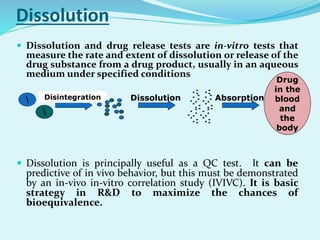
 Dissolution and drug release tests are in-vitro tests that
measure the rate and extent of dissolution or release of the
drug substance from a drug product, usually in an aqueous
medium under specified conditions
 Dissolution is principally useful as a QC test. It can be
predictive of in vivo behavior, but this must be demonstrated
by an in-vivo in-vitro correlation study (IVIVC). It is basic
strategy in R&D to maximize the chances of
bioequivalence.
Disintegration Dissolution Absorption
Drug
in the
blood
and
the
body
Factors of dissolution
 Solubility and Sink conditions: Solubility of
the API in 37◦C in water, other media (ie HCl) or
buffers of different pH should meet “sink
condition” (volume of medium at least three times
that required in order to form a saturated solution
of API). C(sink manint. conce.) = Cs X 1/3
 In the absence of sink conditions, investigate
methods to enhance solubility, eg use of a
surfactant. If a surfactant is used, its
concentration should be properly justified (e.g.
typically <2% Sodium Lauryl Sulfate (SLS).
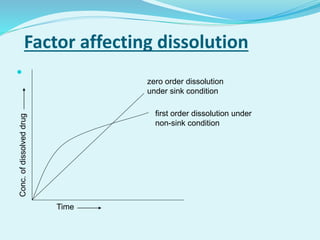
Factor affecting dissolution

first order dissolution under
non-sink condition
Conc.ofdissolveddrug
Time
zero order dissolution
under sink condition
Factor affecting dissolution

Immediate release typically means that 75% of the API is
dissolved within 45 minutes
– Rapidly dissolving: ≥ 85% in ≤ 30 minutes
– Very rapidly dissolving: ≥ 85% in ≤ 15 minutes
Factor affecting dissolution
 pH: water may be used as medium, however the effect
of the formulation on the pH of water must be
investigated and if it changes, the use of buffers or HCl
should be considered.
 pH should have in-vivo relevance if possible;
 Stability and solubility of API should be considered,
for example some APIs are unstable in acidic medium
 Hydrodynamics
 Agitation rate
 Shape of dissolution vessel
 Placement of formulation in vessel
 Sinkers (for floating products and products that stick to
side of vessel)
Factor affecting dissolution
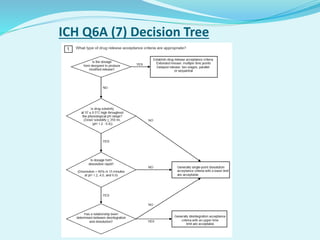
ICH Q6A (7) Decision Tree
Pre-qualification requirements for dissolution:
 A discriminating dissolution method should be
developed for the final composition of the FPP,
when applicable. This is a general requirement for
solid orals.
 The procedure should be capable of distinguishing
significant changes in composition or
manufacturing process that might be expected
to affect in vivo performance.
 The dissolution method should be incorporated
into the stability and quality control programs
(release and shelf-life specifications). Release
limits = Shelf-life limits.
Pre-qualification requirements for dissolution:
 Multipoint dissolution profiles of both the test and the
reference FPPs should be compared.
 A tabulated summary of the compositions of the FPP
batches (batch number, batch size, manufacturing date
and certificate of analysis at batch release) used in clinical
trials and in bioequivalence studies and a presentation of
dissolution profiles must be provided.
 Results from comparative in vitro studies (e.g.,
dissolution) or comparative in vivo studies (e.g.,
bioequivalence) should be discussed when appropriate.
Drug to Drug products (Types)
 Solid – Tablets, capsules, Powders etc.
 Semi-solids – Ointments, Paste, Gels etc.
 Liquids – Suspensions, Syrups etc.
Disintegration Dissolution Absorption
Drug
in the
blood
and
the
body
Comparative dissolution
Multiple points Single point
Suggested media for comparative dissolution studies:
 pH 6.8 buffer
 pH 4.5 buffer
 pH 1.2 buffer or 0.1 N HCl
Water may be used as an additional medium, especially when the
API is unstable in buffered media to the extent that data is
unusable.
 Calculation of similarity factor (f2):
 If both test and reference products show >85% dissolution in 15
minutes, profiles are considered similar and f2 calculation is
unnecessary.
 Otherwise, calculate f2 (calculation next page). If f2>50, the
profiles are considered similar.
 The dissolution conditions are similar, e.g.
 Apparatus, medium, volume, rotation speed & temp.
 Minimize possible experimental differences in conditions
Comparative dissolution studies:
f2 is the similarity factor, n is the number of time points,
 R(t) is the mean %drug dissolved (reference product), and
 T(t) is the mean %drug dissolved (test product).
The evaluation of similarity is based on the conditions of:
 A minimum of three time points (zero excluded); time
points for comparator and test products should be the
same.
 12 dosage units of each formulation;
Intrinsic dissolution
 For intrinsic dissolution-limited absorption (i.e., the
disintegration of the dosage form is rapid, but dissolution
of drug is slow)
 reduce the particle size of the API
 Enhance the transient solubility of the API
 different salt forms of the API
 surfactants in the formulation
 solubilized liquid formulations in hard or soft gelatin
capsules
 non-crystalline materials
Dissolution Apparatus
Apparatusa Name Drug Product
Apparatus 1 Rotating basket Tablets
Apparatus 2 Paddle Tablets, capsules, modified drug products, suspensions
Apparatus 3 Reciprocating cylinder Extended-release drug products
Apparatus 4 Flow cell Drug products containing low-water-soluble drugs
Apparatus 5 Paddle over disk Transdermal drug products
Apparatus 6 Cylinder Transdermal drug products
Apparatus 7 Reciprocating disk Transdermal drug products
Rotating bottle (Non-USP-NF) Extended-release drug products (beads)
Diffusion cell (Franz) (Non-USP-NF) Ointments, creams, transdermal drug products
aApparatus 1–7 refer to dissolution apparatus in USP-NF (United States Pharmacopeia)
Rotating basket (Apparatus 2)
 In case of non-disintegrating dosage forms this apparatus is
superior to apparatus 2 since it constraints the dosage form
in a steady state fluid flow
 It is inferior for testing dosage forms which contains gums
due to clogging of screen matrix
 In the case of floating dosage forms this method performs
well, but care should be taken that excipients do not clog
the basket mesh
Rotating Paddle (Apparatus 2)
 This apparatus is identical to apparatus 1 except that the
paddle is substituted for the rotating basket
 Frequently used for both disintegrating and non-
disintegrating dosage forms
Reciprocating cylinder
(Apparatus 3)
 One advantage of the reciprocating cylinder is that the
gastrointestinal tract conditions can be easily simulated, as
it is easy to make time dependent pH changes
 This apparatus is most suitable for non-disintegrating
(extended release) or delayed release (enteric coated)
dosage forms
Flow cell (Apparatus 4)
 The advantage of flow through cell apparatus is the ability
to test drugs of very low aqueous solubility and the ability
to change the pH conveniently during the test
Paddle over the disk (Apparatus 5)
Cylinder (Apparatus 6)
 The cylinder method (Apparatus 6) for testing transdermal
preparation is modified from the basket method
(Apparatus 1). In place of the basket, a stainless steel
cylinder is used to hold the sample.
Reciprocating disk method
(Apparatus 7)
 In the reciprocating disk method for testing transdermal
products, a motor drive assembly (Apparatus 7) is used to
reciprocate the system vertically, and the samples are
placed on disk-shaped holders.
IN VITRO IN VIVO
CORRELATION
(IVIVC)
DEFINITION
 USP definition
“The establishment of rational relationship b/w a biological
property or a parameter derived from a biological property
produced by a dosage form and physicochemical property
of same dosage form”
 FDA definition
“It is predictive mathematical model describing the
relationship b/w in vitro property of dosage form and a
relevant in vivo response”
29
Purpose of IVIVC
 Reduction of regulatory burden (less in-vivo)
 Optimization of formulations
 Justifications for product quality (therapeutic)
 Useful in scale-up or post approval changes
 IVIVC model – in-vitro release profile – substitute
in vivo bioequivalent
 (In-vivo – in-vitro correlated – linear or nonlinear)
19 November 2010 30KLECOP, Nipani
LEVELS OF CORRELATION
 Level A correlation
 Level B correlation
 Level C correlation
 Multiple level C correlation
 Level D correlation (qualitative - ranking)
19 November 2010 31KLECOP, Nipani
Level A correlation
 Highest category
correlation
 Represents point to
point relationship
 Developed by two
stage procedure
Deconvulation
Comparison
 Purpose – define direct
relationship
0
20
40
60
80
100
120
0 20 40 60 80 100 120
%Drug Dissolved
%Drug
Absorbed
19 November 2010 32KLECOP, Nipani
In vivo data analysis
 The Wagner–Nelson method was used to calculate the
percentage of the dose absorbed:
 where F(t) is the amount absorbed. The percent absorbed is
determined by dividing the amount absorbed at any time
by the plateau value, keAUC(0–∞) and multiplying this ratio
by 100:
In-vitro–in-vivo correlation
Level B correlation
 Utilizes the principle of statistical moment
analysis
MDTvitro is compared with MRTvivo
 No point to point correlation
 Does not reflect the actual in vivo plasma level
curves
 Thus we can not rely to justify the formulation
modification, mfg site change and excipient source
change.
35
Level C correlation
 Dissolution time point (t 50%,t 90% ) is compared to one
mean pharmacokinetic parameter ( Cmax ,tmax ,AUC)
 Single point correlation
 Weakest level of correlation as partial relationship b/w
absorption and dissolution is established
 Useful in the early stages of formulation development
36
Multiple level C correlation
 It reflects the relationship b/w one or several
pharmacokinetic parameter of interest and amount of
drug dissolved at several time point of dissolution
profile (minimum 3 points). It justify biowaivers.
 Base on
 Early
 Middle
 Late stage
37
IVIVC models
LEVELS OF CORRELATION
Convolution model
Deconvolution model
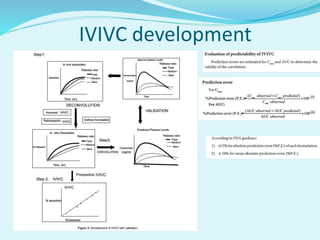
IVIVC development
 Deconvolution
 The observed fraction of the drug absorbed is based
on the Wagner-Nelson method
observed drug
plasma concentration
(conc.obs)
estimated fraction of
the drug absorbed
(Fab)
43
 the predicted fraction of the drug absorbed is then
convolved to the predicted drug plasma concentrations
Convolution
predicted fraction of
the drug absorbed
(PredFab)
predicted drug
plasma concentration
(conc.pred)
44
Convolution
Dissolution data
predicted drug
plasma concentration
(conc.pred)

DRUG DISSOLUTION, BIO-AVAILABILITY AND IVIVC DEVELOPMENT

  • 2.
    Introduction 1) Drug discovery– New drugs (Natural & Synthetic)  Intrinsic dissolution, Bioavailability 2) Pharmaceutical Product Development or Dosage form design  Solids, Semi Solids, Liquids (convenient forms)  Preformulation studies (ii) Lab scale manufacturing (iii) QC tests (analytical method developments, in-vitro studies) (iv) stability study (v) Bioequivalence study (vi) Approval (pre-qualification)
  • 3.
    Introduction  In-vitro andIn-vivo characterizations  In-vitro: Disintegration, Dissolution (MDT, t50, t90) etc.  In-vivo: Ka, Co, Vd, Cmax, Tmax, AUC, CL, Ke, t1/2, BA, RBA, AUMC, MRT  IVIVC  Regulatory requirements (Dossiers) (Pre-qualification)
  • 4.
    Disintegration and Dissolution In-vitro studies: To find a relationship between an in vitro characteristic of a dosage form, and its in vivo performance. Disintegration:  The USP introduced its disintegration test in 1950.  With advances in methodology, the disintegration test was found to be too insensitive, and dissolution test methods were introduced in the USP in 1968.
  • 5.
    Disintegration and Dissolution ICH Q6 A: Disintegration may be substituted for dissolution when:  rapidly dissolving FPP’s (dissolution >80% in 15 minutes at pH 1.2, 4.0 and 6.8) and API’s which are highly soluble throughout the physiological range (dose/solubility volume < 250 mL from pH 1.2 to 6.8)  Most appropriate when:  relationship between DT and dissolution is established, or  DT shown to be more discriminating than dissolution.
  • 6.
    Dissolution  Dissolution anddrug release tests are in-vitro tests that measure the rate and extent of dissolution or release of the drug substance from a drug product, usually in an aqueous medium under specified conditions  Dissolution is principally useful as a QC test. It can be predictive of in vivo behavior, but this must be demonstrated by an in-vivo in-vitro correlation study (IVIVC). It is basic strategy in R&D to maximize the chances of bioequivalence. Disintegration Dissolution Absorption Drug in the blood and the body
  • 7.
    Factors of dissolution Solubility and Sink conditions: Solubility of the API in 37◦C in water, other media (ie HCl) or buffers of different pH should meet “sink condition” (volume of medium at least three times that required in order to form a saturated solution of API). C(sink manint. conce.) = Cs X 1/3  In the absence of sink conditions, investigate methods to enhance solubility, eg use of a surfactant. If a surfactant is used, its concentration should be properly justified (e.g. typically <2% Sodium Lauryl Sulfate (SLS).
  • 8.
    Factor affecting dissolution  firstorder dissolution under non-sink condition Conc.ofdissolveddrug Time zero order dissolution under sink condition
  • 9.
    Factor affecting dissolution  Immediaterelease typically means that 75% of the API is dissolved within 45 minutes – Rapidly dissolving: ≥ 85% in ≤ 30 minutes – Very rapidly dissolving: ≥ 85% in ≤ 15 minutes
  • 10.
    Factor affecting dissolution pH: water may be used as medium, however the effect of the formulation on the pH of water must be investigated and if it changes, the use of buffers or HCl should be considered.  pH should have in-vivo relevance if possible;  Stability and solubility of API should be considered, for example some APIs are unstable in acidic medium  Hydrodynamics  Agitation rate  Shape of dissolution vessel  Placement of formulation in vessel  Sinkers (for floating products and products that stick to side of vessel)
  • 11.
  • 12.
    ICH Q6A (7)Decision Tree
  • 13.
    Pre-qualification requirements fordissolution:  A discriminating dissolution method should be developed for the final composition of the FPP, when applicable. This is a general requirement for solid orals.  The procedure should be capable of distinguishing significant changes in composition or manufacturing process that might be expected to affect in vivo performance.  The dissolution method should be incorporated into the stability and quality control programs (release and shelf-life specifications). Release limits = Shelf-life limits.
  • 14.
    Pre-qualification requirements fordissolution:  Multipoint dissolution profiles of both the test and the reference FPPs should be compared.  A tabulated summary of the compositions of the FPP batches (batch number, batch size, manufacturing date and certificate of analysis at batch release) used in clinical trials and in bioequivalence studies and a presentation of dissolution profiles must be provided.  Results from comparative in vitro studies (e.g., dissolution) or comparative in vivo studies (e.g., bioequivalence) should be discussed when appropriate.
  • 15.
    Drug to Drugproducts (Types)  Solid – Tablets, capsules, Powders etc.  Semi-solids – Ointments, Paste, Gels etc.  Liquids – Suspensions, Syrups etc. Disintegration Dissolution Absorption Drug in the blood and the body
  • 16.
  • 17.
    Suggested media forcomparative dissolution studies:  pH 6.8 buffer  pH 4.5 buffer  pH 1.2 buffer or 0.1 N HCl Water may be used as an additional medium, especially when the API is unstable in buffered media to the extent that data is unusable.  Calculation of similarity factor (f2):  If both test and reference products show >85% dissolution in 15 minutes, profiles are considered similar and f2 calculation is unnecessary.  Otherwise, calculate f2 (calculation next page). If f2>50, the profiles are considered similar.  The dissolution conditions are similar, e.g.  Apparatus, medium, volume, rotation speed & temp.  Minimize possible experimental differences in conditions
  • 18.
    Comparative dissolution studies: f2is the similarity factor, n is the number of time points,  R(t) is the mean %drug dissolved (reference product), and  T(t) is the mean %drug dissolved (test product). The evaluation of similarity is based on the conditions of:  A minimum of three time points (zero excluded); time points for comparator and test products should be the same.  12 dosage units of each formulation;
  • 19.
    Intrinsic dissolution  Forintrinsic dissolution-limited absorption (i.e., the disintegration of the dosage form is rapid, but dissolution of drug is slow)  reduce the particle size of the API  Enhance the transient solubility of the API  different salt forms of the API  surfactants in the formulation  solubilized liquid formulations in hard or soft gelatin capsules  non-crystalline materials
  • 20.
    Dissolution Apparatus Apparatusa NameDrug Product Apparatus 1 Rotating basket Tablets Apparatus 2 Paddle Tablets, capsules, modified drug products, suspensions Apparatus 3 Reciprocating cylinder Extended-release drug products Apparatus 4 Flow cell Drug products containing low-water-soluble drugs Apparatus 5 Paddle over disk Transdermal drug products Apparatus 6 Cylinder Transdermal drug products Apparatus 7 Reciprocating disk Transdermal drug products Rotating bottle (Non-USP-NF) Extended-release drug products (beads) Diffusion cell (Franz) (Non-USP-NF) Ointments, creams, transdermal drug products aApparatus 1–7 refer to dissolution apparatus in USP-NF (United States Pharmacopeia)
  • 21.
    Rotating basket (Apparatus2)  In case of non-disintegrating dosage forms this apparatus is superior to apparatus 2 since it constraints the dosage form in a steady state fluid flow  It is inferior for testing dosage forms which contains gums due to clogging of screen matrix  In the case of floating dosage forms this method performs well, but care should be taken that excipients do not clog the basket mesh
  • 22.
    Rotating Paddle (Apparatus2)  This apparatus is identical to apparatus 1 except that the paddle is substituted for the rotating basket  Frequently used for both disintegrating and non- disintegrating dosage forms
  • 23.
    Reciprocating cylinder (Apparatus 3) One advantage of the reciprocating cylinder is that the gastrointestinal tract conditions can be easily simulated, as it is easy to make time dependent pH changes  This apparatus is most suitable for non-disintegrating (extended release) or delayed release (enteric coated) dosage forms
  • 24.
    Flow cell (Apparatus4)  The advantage of flow through cell apparatus is the ability to test drugs of very low aqueous solubility and the ability to change the pH conveniently during the test
  • 25.
    Paddle over thedisk (Apparatus 5)
  • 26.
    Cylinder (Apparatus 6) The cylinder method (Apparatus 6) for testing transdermal preparation is modified from the basket method (Apparatus 1). In place of the basket, a stainless steel cylinder is used to hold the sample.
  • 27.
    Reciprocating disk method (Apparatus7)  In the reciprocating disk method for testing transdermal products, a motor drive assembly (Apparatus 7) is used to reciprocate the system vertically, and the samples are placed on disk-shaped holders.
  • 28.
    IN VITRO INVIVO CORRELATION (IVIVC)
  • 29.
    DEFINITION  USP definition “Theestablishment of rational relationship b/w a biological property or a parameter derived from a biological property produced by a dosage form and physicochemical property of same dosage form”  FDA definition “It is predictive mathematical model describing the relationship b/w in vitro property of dosage form and a relevant in vivo response” 29
  • 30.
    Purpose of IVIVC Reduction of regulatory burden (less in-vivo)  Optimization of formulations  Justifications for product quality (therapeutic)  Useful in scale-up or post approval changes  IVIVC model – in-vitro release profile – substitute in vivo bioequivalent  (In-vivo – in-vitro correlated – linear or nonlinear) 19 November 2010 30KLECOP, Nipani
  • 31.
    LEVELS OF CORRELATION Level A correlation  Level B correlation  Level C correlation  Multiple level C correlation  Level D correlation (qualitative - ranking) 19 November 2010 31KLECOP, Nipani
  • 32.
    Level A correlation Highest category correlation  Represents point to point relationship  Developed by two stage procedure Deconvulation Comparison  Purpose – define direct relationship 0 20 40 60 80 100 120 0 20 40 60 80 100 120 %Drug Dissolved %Drug Absorbed 19 November 2010 32KLECOP, Nipani
  • 33.
    In vivo dataanalysis  The Wagner–Nelson method was used to calculate the percentage of the dose absorbed:  where F(t) is the amount absorbed. The percent absorbed is determined by dividing the amount absorbed at any time by the plateau value, keAUC(0–∞) and multiplying this ratio by 100:
  • 34.
  • 35.
    Level B correlation Utilizes the principle of statistical moment analysis MDTvitro is compared with MRTvivo  No point to point correlation  Does not reflect the actual in vivo plasma level curves  Thus we can not rely to justify the formulation modification, mfg site change and excipient source change. 35
  • 36.
    Level C correlation Dissolution time point (t 50%,t 90% ) is compared to one mean pharmacokinetic parameter ( Cmax ,tmax ,AUC)  Single point correlation  Weakest level of correlation as partial relationship b/w absorption and dissolution is established  Useful in the early stages of formulation development 36
  • 37.
    Multiple level Ccorrelation  It reflects the relationship b/w one or several pharmacokinetic parameter of interest and amount of drug dissolved at several time point of dissolution profile (minimum 3 points). It justify biowaivers.  Base on  Early  Middle  Late stage 37
  • 38.
    IVIVC models LEVELS OFCORRELATION Convolution model Deconvolution model
  • 39.
  • 42.
     Deconvolution  Theobserved fraction of the drug absorbed is based on the Wagner-Nelson method observed drug plasma concentration (conc.obs) estimated fraction of the drug absorbed (Fab)
  • 43.
    43  the predictedfraction of the drug absorbed is then convolved to the predicted drug plasma concentrations Convolution predicted fraction of the drug absorbed (PredFab) predicted drug plasma concentration (conc.pred)
  • 44.