Pharmacon 2007 European Congress on Future of Pharmacy New Technologies and Trends in Pharmacy, Pharmaceutical Industry and Education  Dubrovnik – 26 May 2007 Trigger Point – Self-medication: Patients in white coats  Dr Hubertus Cranz Director General Association of the European Self-Medication Industry (AESGP) 7, avenue de Tervuren – B-1040 Brussels – Belgium  Tel: +32 2 735 51 30    Fax: +32 2 735 52 22    info@aesgp.be     www.aesgp.be
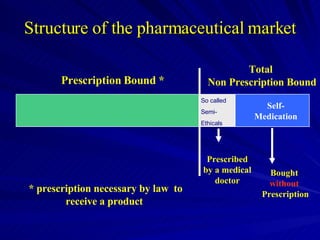
Total  Non Prescription Bound Prescription Bound * * prescription necessary by law  to receive a product  Prescribed by a medical doctor Bought  without   Prescription Structure of the pharmaceutical market So called Semi- Ethicals Self-Medication
STUDY ON EUROPEAN CONSUMER ATTITUDES ON SELF MEDICATION PRODUCTS PURCHASED AT PHARMACIES
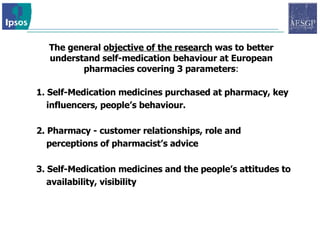
The general  objective of the research  was to better understand self-medication behaviour at European pharmacies covering 3 parameters : 1. Self-Medication medicines purchased at pharmacy, key influencers, people’s behaviour.  2.  Pharmacy - customer relationships, role and perceptions of pharmacist’s advice  3. Self-Medication medicines and the people’s attitudes to availability, visibility
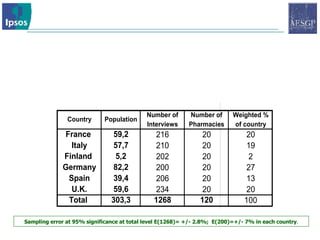
20 pharmacies (urban/suburb) in each of 6 European countries were selected for the study. IPSOS staff interviewed, by pen and paper questionnaires, 1,268 people who  purchased  a self medication product as they exited those pharmacies:  Sampling error at 9 5 % significance  at total  level E(1268)= +/- 2.8%;  E( 2 00)=+/-  7 % in each country .
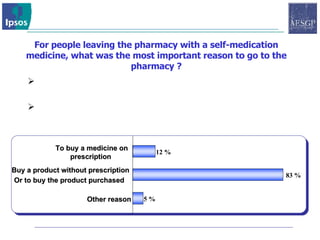
12 % 83 % 5  % To buy a medicine on prescription Buy a product without prescription Or to buy the product purchased Other reason For people leaving the pharmacy with a self-medication medicine, what was the most important reason to go to the pharmacy ? 83% of people went to the pharmacy with the specific intention to buy a self-medication product. 12% went to the pharmacy to buy a prescription product and also bought a self-medication product.
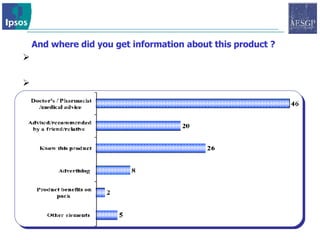
And where did you get information about this product ? 46 % of people said that they were influenced through the advice of a Health care professional 8% said that advertising played a role.
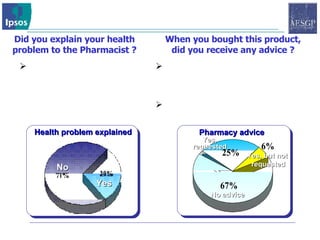
Pharmacy advice   No Yes Yes, requested No advice Yes, but n ot  requested Did you explain your health problem to the Pharmacist ? 71% of people did not explain their problem to the pharmacist when purchasing a self-medication product.  When you bought this product, did you receive any advice ? 67% of people who bought a self-med. product did not receive advice.  6% received advice without asking for it.  Health problem explained
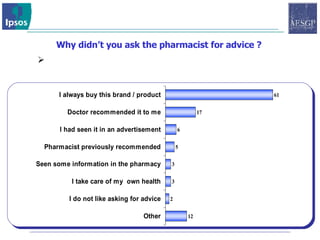
Why didn’t you ask the pharmacist for advice ? 61% of those people who had not requested / received advice had always bought this brand / product.
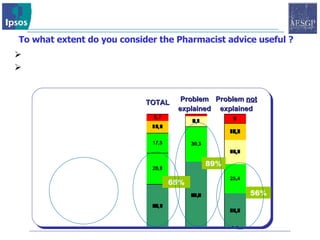
Of no use Of little use Somewhat useful Quite useful Very useful TOTAL To what extent do you consider the Pharmacist advice useful ? 65% of people consider Pharmacist advice very / quite useful. Even when they do  not  explain their problem, 56% consider Pharmacist advice very / quite useful. Problem explained Problem  not explained 89% 65% 56%
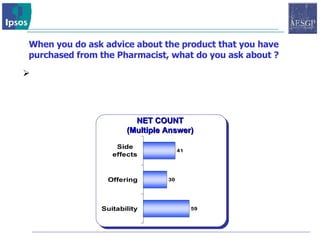
NET COUNT  (Multiple Answer)  When you do ask advice about the product that you have purchased from the Pharmacist, what do you ask about ? 59 % of those who asked advice would like to understand whether the product is suitable for them while 41% are concerned about side effects.
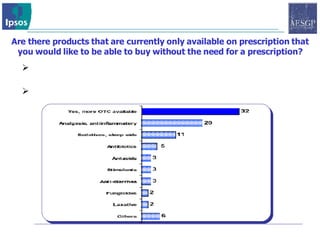
Are there products that are currently only available on prescription that you would like to be able to buy without the need for a prescription? 32% of self-medication purchasers would like to see more self-medication products available Analgesics / anti-inflammatory products score highest
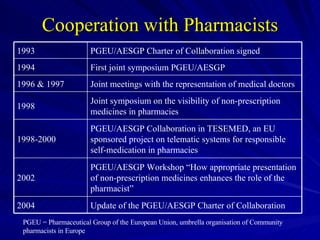
Cooperation with Pharmacists PGEU = Pharmaceutical Group of the European Union, umbrella organisation of Community  pharmacists in Europe  Update of the PGEU/AESGP Charter of Collaboration 2004 PGEU/AESGP Workshop “How appropriate presentation of non-prescription medicines enhances the role of the pharmacist” 2002 PGEU/AESGP Collaboration in TESEMED, an EU sponsored project on telematic systems for responsible self-medication in pharmacies 1998-2000 Joint symposium on the visibility of non-prescription medicines in pharmacies 1998 Joint meetings with the representation of medical doctors 1996 & 1997 First joint symposium PGEU/AESGP 1994 PGEU/AESGP Charter of Collaboration signed 1993
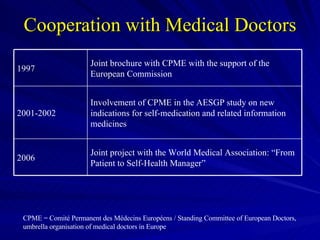
Cooperation with Medical Doctors CPME = Comité Permanent des Médecins Européens / Standing Committee of European Doctors,  umbrella organisation of medical doctors in Europe  Joint project with the World Medical Association: “From Patient to Self-Health Manager” 2006 Involvement of CPME in the AESGP study on new indications for self-medication and related information medicines  2001-2002 Joint brochure with CPME with the support of the European Commission  1997
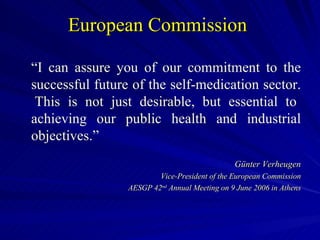
European Commission  “ I can assure you of our commitment to the successful future of the self-medication sector.  This is not just desirable, but essential to achieving our public health and industrial objectives.” Günter Verheugen Vice-President of the European Commission AESGP 42 nd  Annual Meeting on 9 June 2006 in Athens
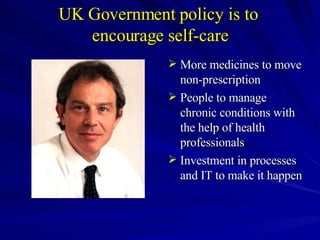
UK Government policy is to  encourage self-care More medicines to move non-prescription  People to manage chronic conditions with the help of health professionals Investment in processes and IT to make it happen
Switches in the spotlight Simvastatin Orlistat  Chloramphenicol Triptans “ Plan B”
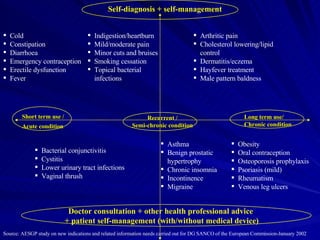
Self-diagnosis + self-management Cold Constipation Diarrhoea Emergency contraception Erectile dysfunction Fever Arthritic pain Cholesterol lowering/lipid control Dermatitis/eczema Hayfever treatment Male pattern baldness Doctor consultation + other health professional advice  + patient self-management (with/without medical device) Recurrent / Semi-chronic condition Short term use /  Acute condition Indigestion/heartburn Mild/moderate pain Minor cuts and bruises Smoking cessation Topical bacterial infections Bacterial conjunctivitis Cystitis Lower urinary tract infections Vaginal thrush Obesity Oral contraception Osteoporosis prophylaxis Psoriasis (mild) Rheumatism Venous leg ulcers Asthma Benign prostatic hypertrophy Chronic insomnia Incontinence Migraine Long term use/  Chronic condition Source: AESGP study on new indications and related information needs carried out for DG SANCO of the European Commission-January 2002
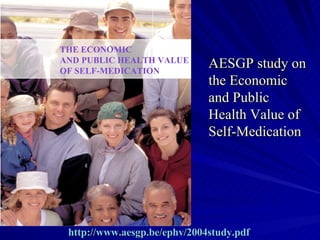
THE ECONOMIC AND PUBLIC HEALTH VALUE OF SELF-MEDICATION   AESGP study on the Economic and Public Health Value of Self-Medication http://www.aesgp.be/ephv/2004study.pdf
The future of self-medication  is closely related to the future of pharmacists
Role of the pharmacist in self-care Guide customers Recognised point of reference for all health issues Assist citizens by providing basic information at the time of dispensing
Education and Training Universities should cover non-prescription medicines as a priority. This should include training on communication and counselling. Through continuing professional development, pharmacists should update their scientific knowledge but also improve their communication skills
Pharmacy design The pharmacy needs to gain competitiveness through: Improvement of the pharmacy lay-out  Good visibility and presentation of medicines with the objective of stimulating debate on available treatment options Making use of category management (manage shelf space effectively)
For the future let’s continue to work together to provide high quality services and products

Trigger Point – Self-medication: Patients in white coats

  • 1.
    Pharmacon 2007 EuropeanCongress on Future of Pharmacy New Technologies and Trends in Pharmacy, Pharmaceutical Industry and Education Dubrovnik – 26 May 2007 Trigger Point – Self-medication: Patients in white coats Dr Hubertus Cranz Director General Association of the European Self-Medication Industry (AESGP) 7, avenue de Tervuren – B-1040 Brussels – Belgium Tel: +32 2 735 51 30  Fax: +32 2 735 52 22  info@aesgp.be  www.aesgp.be
  • 2.
    Total NonPrescription Bound Prescription Bound * * prescription necessary by law to receive a product Prescribed by a medical doctor Bought without Prescription Structure of the pharmaceutical market So called Semi- Ethicals Self-Medication
  • 3.
    STUDY ON EUROPEANCONSUMER ATTITUDES ON SELF MEDICATION PRODUCTS PURCHASED AT PHARMACIES
  • 4.
    The general objective of the research was to better understand self-medication behaviour at European pharmacies covering 3 parameters : 1. Self-Medication medicines purchased at pharmacy, key influencers, people’s behaviour. 2. Pharmacy - customer relationships, role and perceptions of pharmacist’s advice 3. Self-Medication medicines and the people’s attitudes to availability, visibility
  • 5.
    20 pharmacies (urban/suburb)in each of 6 European countries were selected for the study. IPSOS staff interviewed, by pen and paper questionnaires, 1,268 people who purchased a self medication product as they exited those pharmacies: Sampling error at 9 5 % significance at total level E(1268)= +/- 2.8%; E( 2 00)=+/- 7 % in each country .
  • 6.
    12 % 83% 5 % To buy a medicine on prescription Buy a product without prescription Or to buy the product purchased Other reason For people leaving the pharmacy with a self-medication medicine, what was the most important reason to go to the pharmacy ? 83% of people went to the pharmacy with the specific intention to buy a self-medication product. 12% went to the pharmacy to buy a prescription product and also bought a self-medication product.
  • 7.
    And where didyou get information about this product ? 46 % of people said that they were influenced through the advice of a Health care professional 8% said that advertising played a role.
  • 8.
    Pharmacy advice No Yes Yes, requested No advice Yes, but n ot requested Did you explain your health problem to the Pharmacist ? 71% of people did not explain their problem to the pharmacist when purchasing a self-medication product. When you bought this product, did you receive any advice ? 67% of people who bought a self-med. product did not receive advice. 6% received advice without asking for it. Health problem explained
  • 9.
    Why didn’t youask the pharmacist for advice ? 61% of those people who had not requested / received advice had always bought this brand / product.
  • 10.
    Of no useOf little use Somewhat useful Quite useful Very useful TOTAL To what extent do you consider the Pharmacist advice useful ? 65% of people consider Pharmacist advice very / quite useful. Even when they do not explain their problem, 56% consider Pharmacist advice very / quite useful. Problem explained Problem not explained 89% 65% 56%
  • 11.
    NET COUNT (Multiple Answer) When you do ask advice about the product that you have purchased from the Pharmacist, what do you ask about ? 59 % of those who asked advice would like to understand whether the product is suitable for them while 41% are concerned about side effects.
  • 12.
    Are there productsthat are currently only available on prescription that you would like to be able to buy without the need for a prescription? 32% of self-medication purchasers would like to see more self-medication products available Analgesics / anti-inflammatory products score highest
  • 13.
    Cooperation with PharmacistsPGEU = Pharmaceutical Group of the European Union, umbrella organisation of Community pharmacists in Europe Update of the PGEU/AESGP Charter of Collaboration 2004 PGEU/AESGP Workshop “How appropriate presentation of non-prescription medicines enhances the role of the pharmacist” 2002 PGEU/AESGP Collaboration in TESEMED, an EU sponsored project on telematic systems for responsible self-medication in pharmacies 1998-2000 Joint symposium on the visibility of non-prescription medicines in pharmacies 1998 Joint meetings with the representation of medical doctors 1996 & 1997 First joint symposium PGEU/AESGP 1994 PGEU/AESGP Charter of Collaboration signed 1993
  • 14.
    Cooperation with MedicalDoctors CPME = Comité Permanent des Médecins Européens / Standing Committee of European Doctors, umbrella organisation of medical doctors in Europe Joint project with the World Medical Association: “From Patient to Self-Health Manager” 2006 Involvement of CPME in the AESGP study on new indications for self-medication and related information medicines 2001-2002 Joint brochure with CPME with the support of the European Commission 1997
  • 15.
    European Commission “ I can assure you of our commitment to the successful future of the self-medication sector. This is not just desirable, but essential to achieving our public health and industrial objectives.” Günter Verheugen Vice-President of the European Commission AESGP 42 nd Annual Meeting on 9 June 2006 in Athens
  • 16.
    UK Government policyis to encourage self-care More medicines to move non-prescription People to manage chronic conditions with the help of health professionals Investment in processes and IT to make it happen
  • 17.
    Switches in thespotlight Simvastatin Orlistat Chloramphenicol Triptans “ Plan B”
  • 18.
    Self-diagnosis + self-managementCold Constipation Diarrhoea Emergency contraception Erectile dysfunction Fever Arthritic pain Cholesterol lowering/lipid control Dermatitis/eczema Hayfever treatment Male pattern baldness Doctor consultation + other health professional advice + patient self-management (with/without medical device) Recurrent / Semi-chronic condition Short term use / Acute condition Indigestion/heartburn Mild/moderate pain Minor cuts and bruises Smoking cessation Topical bacterial infections Bacterial conjunctivitis Cystitis Lower urinary tract infections Vaginal thrush Obesity Oral contraception Osteoporosis prophylaxis Psoriasis (mild) Rheumatism Venous leg ulcers Asthma Benign prostatic hypertrophy Chronic insomnia Incontinence Migraine Long term use/ Chronic condition Source: AESGP study on new indications and related information needs carried out for DG SANCO of the European Commission-January 2002
  • 19.
    THE ECONOMIC ANDPUBLIC HEALTH VALUE OF SELF-MEDICATION AESGP study on the Economic and Public Health Value of Self-Medication http://www.aesgp.be/ephv/2004study.pdf
  • 20.
    The future ofself-medication is closely related to the future of pharmacists
  • 21.
    Role of thepharmacist in self-care Guide customers Recognised point of reference for all health issues Assist citizens by providing basic information at the time of dispensing
  • 22.
    Education and TrainingUniversities should cover non-prescription medicines as a priority. This should include training on communication and counselling. Through continuing professional development, pharmacists should update their scientific knowledge but also improve their communication skills
  • 23.
    Pharmacy design Thepharmacy needs to gain competitiveness through: Improvement of the pharmacy lay-out Good visibility and presentation of medicines with the objective of stimulating debate on available treatment options Making use of category management (manage shelf space effectively)
  • 24.
    For the futurelet’s continue to work together to provide high quality services and products