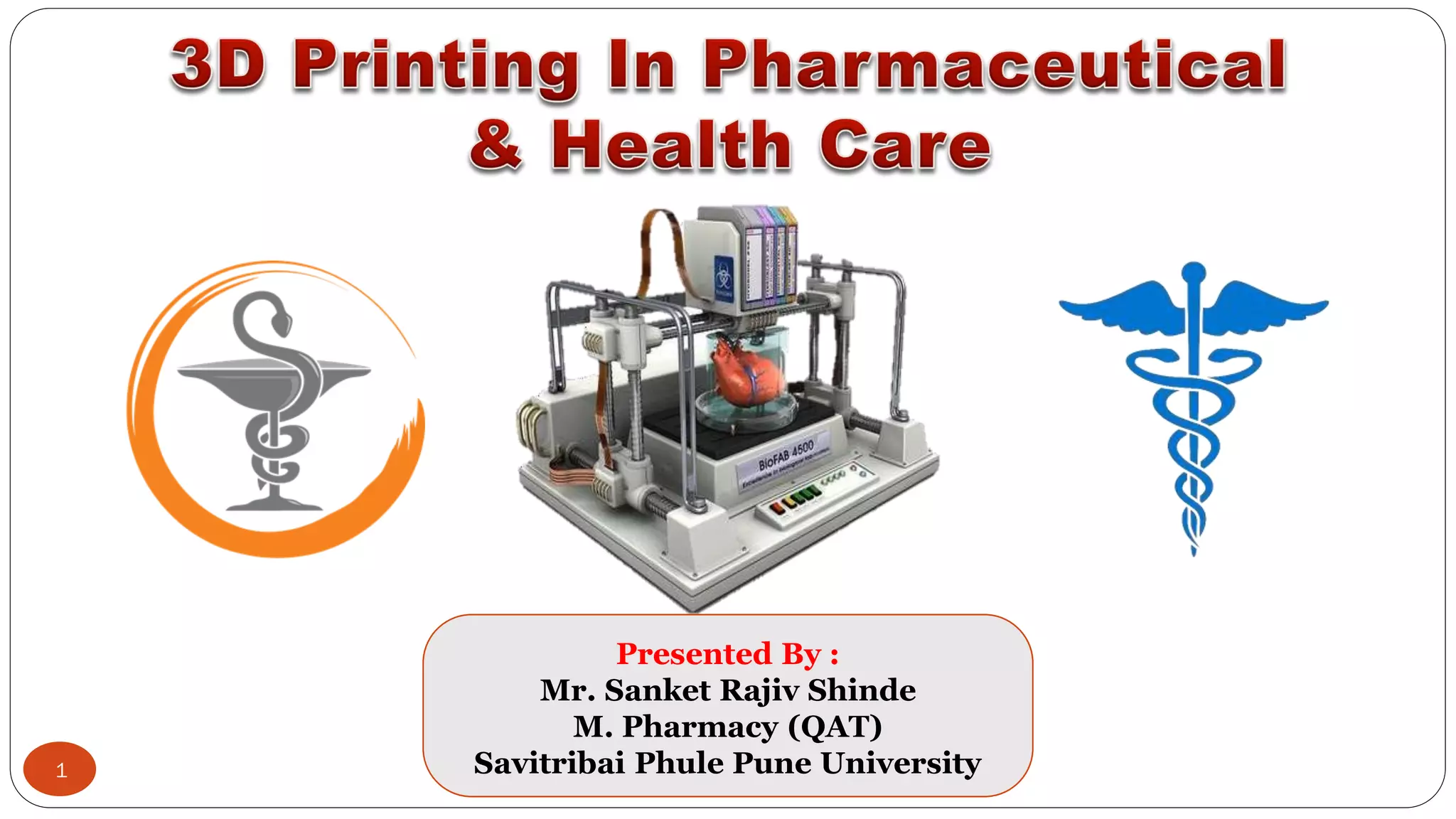
Presented By :
Mr. Sanket Rajiv Shinde
M. Pharmacy (QAT)
Savitribai Phule Pune University1
The basics of the technology
1. What is 3D Printing ?
3D Printing is a process of making a physical object from a three dimensional
digital model typically by layering down many thin layers of a material in
succession.
Introduction
Processes
Additive
Manufacturing (AM)
Rapid Prototyping (RP)
Solid Free-form
fabrication (SFF)
3
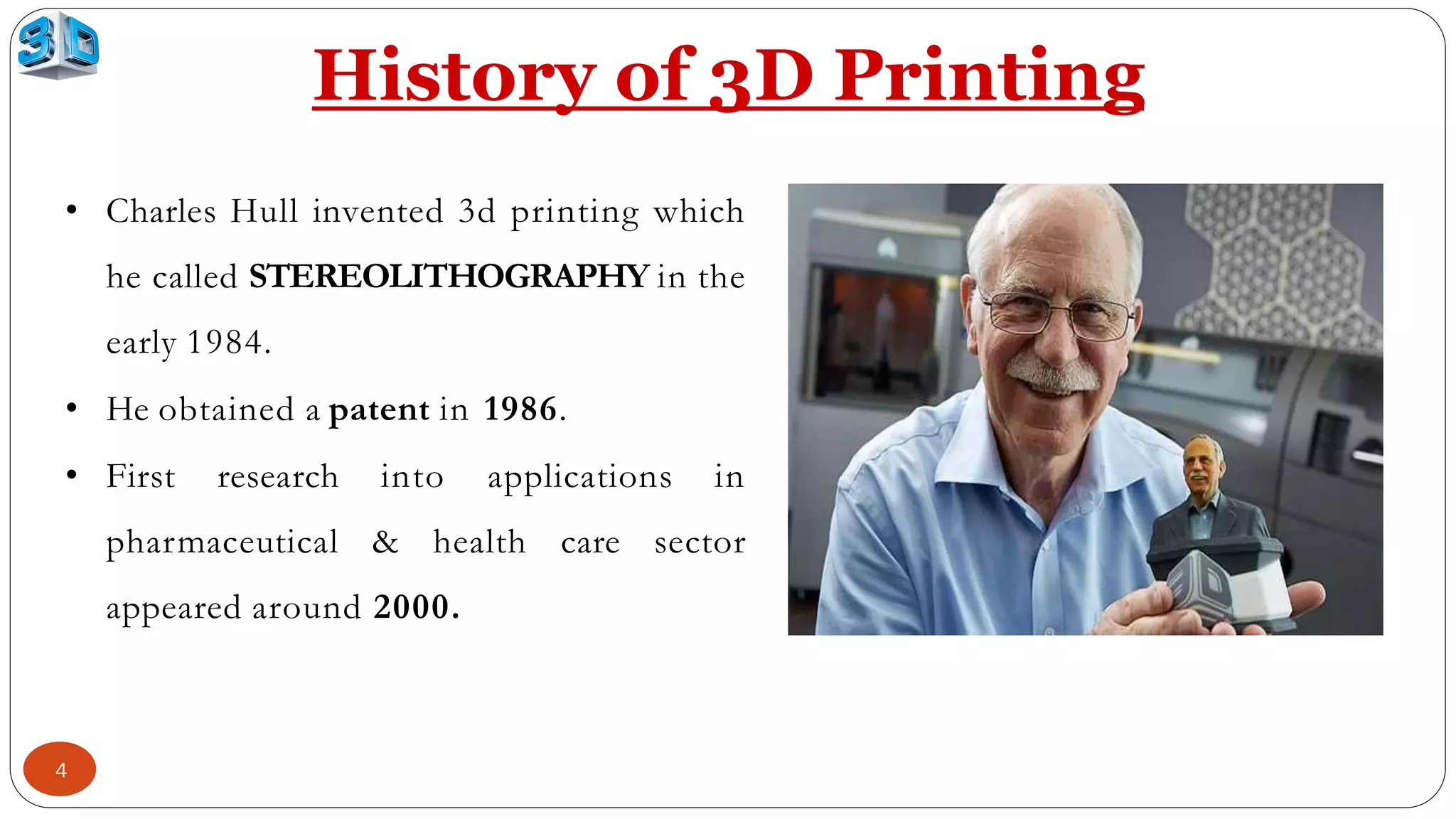
• Charles Hull invented 3d printing which
he called STEREOLITHOGRAPHY in the
early 1984.
• He obtained a patent in 1986.
• First research into applications in
pharmaceutical & health care sector
appeared around 2000.
History of 3D Printing
4
1984 Charles Hull invented Stereolithography
1996
Dr. Gabor Forgacs observed that cells stick together during embryonic
development
2000
Urinary bladder augmentation using a synthetic scaffold seeded with the
patients' own cells
2003
Thomas Boland's lab modified an inkjet printer to accommodate and
dispense cells in scaffolds
2009
Organovo, creates the NovoGen MMX Bioprinter using Forgacs technology
2010
Organovo prints the first human blood vessel without the use of scaffolds
2011
Organavo develops 3D bioprinted disease models made from human cells.
5
A step by step process
2. How 3D Printing works ?
• There are about two dozen 3D printing processes, which use varying printer technologies,
speeds, and resolutions, and hundreds of materials.
• These technologies can build a 3D object in almost any shape imaginable as defined in a
computer-aided design (CAD) file.
• In a basic setup, the 3D printer first follows the instructions in the CAD file to build the
foundation for the object, moving the print head along the x–y plane.
• The printer then continues to follow the instructions, moving the print head along the z-axis
to build the object vertically layer by layer.
7
3D Printing Process
8
• The type of 3D printer chosen for an application often depends on the materials to be
used and how the layers in the finished product are bonded.
• The three most commonly used 3D printer technologies in medical applications are :
• Selective Laser Sintering (SLS)
• Thermal Inkjet (TIJ) Printing
• Fused Deposition Modeling (FDM).
9
Types of 3D Printers
The latest innovations
3. 3D Printing in Pharmaceuticals
• ZipDose is a 3D printer that creates pills by printing out thin layers of
medicine in powder form, with layers of a water based binder spread
between each of the powder layers.
• The result is a tablet that can dissolve with a sip of water in less than 5
seconds.
11 Source- www.aprecia.com/Zipdose
Development of Drug using 3D Printer
12 Source- www.aprecia.com/Zipdose
13
How does it works ?
• A 3D printing process also allows layers of medications to be
packaged in better porous medium in precise dosages.
• The possibility to 3D print drugs on affordable devices could eventually
lead to cheaper medication.
The latest trend
4. 3D Printing in Healthcare
3D Bioprinting
15
• The most latest technology in biofabrication of
living structures using tissue engineering is
“Bioprinting”.
• Bioprinting is defined as the construction of tissue
constructs using a set of techniques that transfer
biologically important materials onto a substrate with
computer-aided, specialized 3D printers.
Bioprinter
16
3D Printed Bionic Heart Model
(Bioink) (Biopaper)
Components Needed For Bioprinting
17
Pre- Processing
Processing
Post Processing
3 Phases
Cells Hydrogel Bioprinter
Bioprinted
tissue or
organ
PRINTING PROCESS
18
Maturation
Current Progress
19
Ear: 250 µm cells and collagen from rat tail make human ear in
15 min. Post-processing 3 months. To serve children with
hearing loss due to malformed outer ear.
Kidneys: Layer-by-layer building of scaffold and deposition of
kidney cells. Assembly to be transplanted into patient.
Degradation of scaffold to follow in-vivo.
Blood Vessels: Rigid but non-toxic sugar filaments form core.
Cells deposited around filaments. Subsequent blood flow
dissolves sugar.
Skin grafts: Laser scan wound to determine depth and area.
One inkjet ejects enzymes and second, cells. Layer is finally
sealed by human skin cells. Useful in war and disaster zones.
20
Bones: Print scaffold with ceramic or Titanium powder,
incubation of 1 day in culture of human stem cells. Repair of
complex fractures in accident survivors.
Researchers at the National Library
of Medicine generate digital files
from clinical data, such as CT scans,
that are used to make custom 3D-
printed surgical and medical
models.21
A 3D model used for surgical
planning by neurosurgeons at the
Walter Reed National Military
Medical Center.
Surgical Models
Harvard team 3D prints blood vessel-
lined tissue that could one day be used
to test drugs
22
3D Printing Creates Low-Cost Prosthetic
Fingers
3D Bone implant
23 Medical devices
Ear cartilage
Synthetic skin
• Printing new Skin
• Printing cartilage&
bones
• Printing replacement
tissues
• Printing replacement
organs
• Specific organ
tissue replacement
for important organs
like heart and
kidney.
• Personalized
replacement for
3D printed joints
with custom fit.
• Life saving 3D
printed organ
replacement.
Research (today)
Technology Adoption
( after 5- 8 years)
Commercialization
(after 10- 15 years)
Bioprinting - Forecast
24
• The Global 3D Bio printing Market was valued at approximately $570
million in 2015 and is expected to grow at a CAGR (Compound Annual
Growth rate) of around 25-27% during the forecast period that is from
2016 to 2022.
• Such high growth is majorly attributed to factors such as; growing demand
for tissues and organs for transplantation and the growing technological
advancements in 3D Bio printing technology.
25
Demand of Bioprinting
• Study shows that making Medical equipment is 1 of the 3 Major sector
along with Automobile and Aerospace.
Bio printing(Medical/dental ) has the Fast growth rate of 50%/year
increasing.
Aerospace &
Defence
15%
Source- www.statia.com/worldwide-3d-printing
26
Market Share
28%
4%
20%15%
12%
16%
5%
3D Printing Market Share (2015)
Education & Research
Architecture
Automotive
Aerospace & Defence
Pharmaceutical
Medical & Dental
Other
• Value chain of 3D printing includes various stakeholders, namely:
• Research and Development
• 3D printer and material manufacturers
• Retailers
• Final consumers
Primary
Activity Secondary
Activity
Source- www.ey.com/publication/vwLUAssets
27
Value Chain Analysis of 3D Printing
Various activities in Value chain analysis
Primary Activities :
28
• Research and development - responsible for changing the conventional techniques
of manufacturing and introducing new technology into the market
• Manufacturers - construct components and accomplish higher precision and
advanced resolution while providing faster manufacturing process
• Consumers - automobile, defense, aerospace, industrial, healthcare, education and
research, arts, architecture and others.
Manufacturers
Suppliers
CustomersR&D
Support Activities :These activities indirectly influence the 3D
printing market size.
29
Technology adoption
High-end technologies used in development of new techniques
Capital investment
Influence the role of stakeholders, such as manufacturers and
consumer
Economies of scale
Achieve the return on investment
Patent protection
Help Inventors Turn Ideas Into Success
Source- www.amtz.in/think3d -announce-6m-3d-print-facility-india
30
Future of 3D Printing in India
• According to a research conducted by 6W research, India’s 3D printing market is
projected to grow at around 20 percent during 2014-19.
• India 3D printer market is projected to cross $79 million by 2021.
• Indian 3D printing platform think 3D has announced it will be establishing a $6
million 3D printing facility in Andhra Pradesh, India (Andhra Pradesh MedTech Zone-
AMTZ).
• The $6 million facility is expected to enable India’s medical device market to become
more independent reducing total foreign import from 75% to 10%
31
High cost of
Manufacturing
Lack of Awareness
Still very
nascent Industry
Lack of raw
Material
Challenges in 3D Printing Industry
32
Conclusion
• 3D printing has become a useful and potentially transformative tool in a number of
different fields, including medicine.
• As printer performance, resolution, and available materials have increased, so have the
applications.
• Researchers continue to improve existing medical applications that use 3D printing
technology and to explore new ones.
• The medical advances that have been made using 3D printing are already significant
and exciting, but some of the more revolutionary applications, such as organ printing,
will need time to evolve.
33

3D printing in pharmaceuticals

  • 1.
    Presented By : Mr.Sanket Rajiv Shinde M. Pharmacy (QAT) Savitribai Phule Pune University1
  • 2.
    The basics ofthe technology 1. What is 3D Printing ?
  • 3.
    3D Printing isa process of making a physical object from a three dimensional digital model typically by layering down many thin layers of a material in succession. Introduction Processes Additive Manufacturing (AM) Rapid Prototyping (RP) Solid Free-form fabrication (SFF) 3
  • 4.
    • Charles Hullinvented 3d printing which he called STEREOLITHOGRAPHY in the early 1984. • He obtained a patent in 1986. • First research into applications in pharmaceutical & health care sector appeared around 2000. History of 3D Printing 4
  • 5.
    1984 Charles Hullinvented Stereolithography 1996 Dr. Gabor Forgacs observed that cells stick together during embryonic development 2000 Urinary bladder augmentation using a synthetic scaffold seeded with the patients' own cells 2003 Thomas Boland's lab modified an inkjet printer to accommodate and dispense cells in scaffolds 2009 Organovo, creates the NovoGen MMX Bioprinter using Forgacs technology 2010 Organovo prints the first human blood vessel without the use of scaffolds 2011 Organavo develops 3D bioprinted disease models made from human cells. 5
  • 6.
    A step bystep process 2. How 3D Printing works ?
  • 7.
    • There areabout two dozen 3D printing processes, which use varying printer technologies, speeds, and resolutions, and hundreds of materials. • These technologies can build a 3D object in almost any shape imaginable as defined in a computer-aided design (CAD) file. • In a basic setup, the 3D printer first follows the instructions in the CAD file to build the foundation for the object, moving the print head along the x–y plane. • The printer then continues to follow the instructions, moving the print head along the z-axis to build the object vertically layer by layer. 7 3D Printing Process
  • 8.
  • 9.
    • The typeof 3D printer chosen for an application often depends on the materials to be used and how the layers in the finished product are bonded. • The three most commonly used 3D printer technologies in medical applications are : • Selective Laser Sintering (SLS) • Thermal Inkjet (TIJ) Printing • Fused Deposition Modeling (FDM). 9 Types of 3D Printers
  • 10.
    The latest innovations 3.3D Printing in Pharmaceuticals
  • 11.
    • ZipDose isa 3D printer that creates pills by printing out thin layers of medicine in powder form, with layers of a water based binder spread between each of the powder layers. • The result is a tablet that can dissolve with a sip of water in less than 5 seconds. 11 Source- www.aprecia.com/Zipdose Development of Drug using 3D Printer
  • 12.
  • 13.
    13 How does itworks ? • A 3D printing process also allows layers of medications to be packaged in better porous medium in precise dosages. • The possibility to 3D print drugs on affordable devices could eventually lead to cheaper medication.
  • 14.
    The latest trend 4.3D Printing in Healthcare
  • 15.
    3D Bioprinting 15 • Themost latest technology in biofabrication of living structures using tissue engineering is “Bioprinting”. • Bioprinting is defined as the construction of tissue constructs using a set of techniques that transfer biologically important materials onto a substrate with computer-aided, specialized 3D printers. Bioprinter
  • 16.
  • 17.
    (Bioink) (Biopaper) Components NeededFor Bioprinting 17 Pre- Processing Processing Post Processing 3 Phases Cells Hydrogel Bioprinter Bioprinted tissue or organ
  • 18.
  • 19.
    Current Progress 19 Ear: 250µm cells and collagen from rat tail make human ear in 15 min. Post-processing 3 months. To serve children with hearing loss due to malformed outer ear. Kidneys: Layer-by-layer building of scaffold and deposition of kidney cells. Assembly to be transplanted into patient. Degradation of scaffold to follow in-vivo. Blood Vessels: Rigid but non-toxic sugar filaments form core. Cells deposited around filaments. Subsequent blood flow dissolves sugar.
  • 20.
    Skin grafts: Laserscan wound to determine depth and area. One inkjet ejects enzymes and second, cells. Layer is finally sealed by human skin cells. Useful in war and disaster zones. 20 Bones: Print scaffold with ceramic or Titanium powder, incubation of 1 day in culture of human stem cells. Repair of complex fractures in accident survivors.
  • 21.
    Researchers at theNational Library of Medicine generate digital files from clinical data, such as CT scans, that are used to make custom 3D- printed surgical and medical models.21 A 3D model used for surgical planning by neurosurgeons at the Walter Reed National Military Medical Center. Surgical Models
  • 22.
    Harvard team 3Dprints blood vessel- lined tissue that could one day be used to test drugs 22 3D Printing Creates Low-Cost Prosthetic Fingers
  • 23.
    3D Bone implant 23Medical devices Ear cartilage Synthetic skin
  • 24.
    • Printing newSkin • Printing cartilage& bones • Printing replacement tissues • Printing replacement organs • Specific organ tissue replacement for important organs like heart and kidney. • Personalized replacement for 3D printed joints with custom fit. • Life saving 3D printed organ replacement. Research (today) Technology Adoption ( after 5- 8 years) Commercialization (after 10- 15 years) Bioprinting - Forecast 24
  • 25.
    • The Global3D Bio printing Market was valued at approximately $570 million in 2015 and is expected to grow at a CAGR (Compound Annual Growth rate) of around 25-27% during the forecast period that is from 2016 to 2022. • Such high growth is majorly attributed to factors such as; growing demand for tissues and organs for transplantation and the growing technological advancements in 3D Bio printing technology. 25 Demand of Bioprinting
  • 26.
    • Study showsthat making Medical equipment is 1 of the 3 Major sector along with Automobile and Aerospace. Bio printing(Medical/dental ) has the Fast growth rate of 50%/year increasing. Aerospace & Defence 15% Source- www.statia.com/worldwide-3d-printing 26 Market Share 28% 4% 20%15% 12% 16% 5% 3D Printing Market Share (2015) Education & Research Architecture Automotive Aerospace & Defence Pharmaceutical Medical & Dental Other
  • 27.
    • Value chainof 3D printing includes various stakeholders, namely: • Research and Development • 3D printer and material manufacturers • Retailers • Final consumers Primary Activity Secondary Activity Source- www.ey.com/publication/vwLUAssets 27 Value Chain Analysis of 3D Printing Various activities in Value chain analysis
  • 28.
    Primary Activities : 28 •Research and development - responsible for changing the conventional techniques of manufacturing and introducing new technology into the market • Manufacturers - construct components and accomplish higher precision and advanced resolution while providing faster manufacturing process • Consumers - automobile, defense, aerospace, industrial, healthcare, education and research, arts, architecture and others. Manufacturers Suppliers CustomersR&D
  • 29.
    Support Activities :Theseactivities indirectly influence the 3D printing market size. 29 Technology adoption High-end technologies used in development of new techniques Capital investment Influence the role of stakeholders, such as manufacturers and consumer Economies of scale Achieve the return on investment Patent protection Help Inventors Turn Ideas Into Success
  • 30.
    Source- www.amtz.in/think3d -announce-6m-3d-print-facility-india 30 Futureof 3D Printing in India • According to a research conducted by 6W research, India’s 3D printing market is projected to grow at around 20 percent during 2014-19. • India 3D printer market is projected to cross $79 million by 2021. • Indian 3D printing platform think 3D has announced it will be establishing a $6 million 3D printing facility in Andhra Pradesh, India (Andhra Pradesh MedTech Zone- AMTZ). • The $6 million facility is expected to enable India’s medical device market to become more independent reducing total foreign import from 75% to 10%
  • 31.
    31 High cost of Manufacturing Lackof Awareness Still very nascent Industry Lack of raw Material Challenges in 3D Printing Industry
  • 32.
    32 Conclusion • 3D printinghas become a useful and potentially transformative tool in a number of different fields, including medicine. • As printer performance, resolution, and available materials have increased, so have the applications. • Researchers continue to improve existing medical applications that use 3D printing technology and to explore new ones. • The medical advances that have been made using 3D printing are already significant and exciting, but some of the more revolutionary applications, such as organ printing, will need time to evolve.
  • 33.