The document provides an overview of mass spectrometry, detailing its principles, ionization methods, and applications. It emphasizes the direct analysis in real time (DART) technique, which allows for the analysis of various substances with minimal preparation and under ambient conditions. Additionally, it outlines various mass spectrometry instruments, applications, and fields that utilize this technique.
Contents:
• Introduction
• Basicprinciple of Mass spectrometry
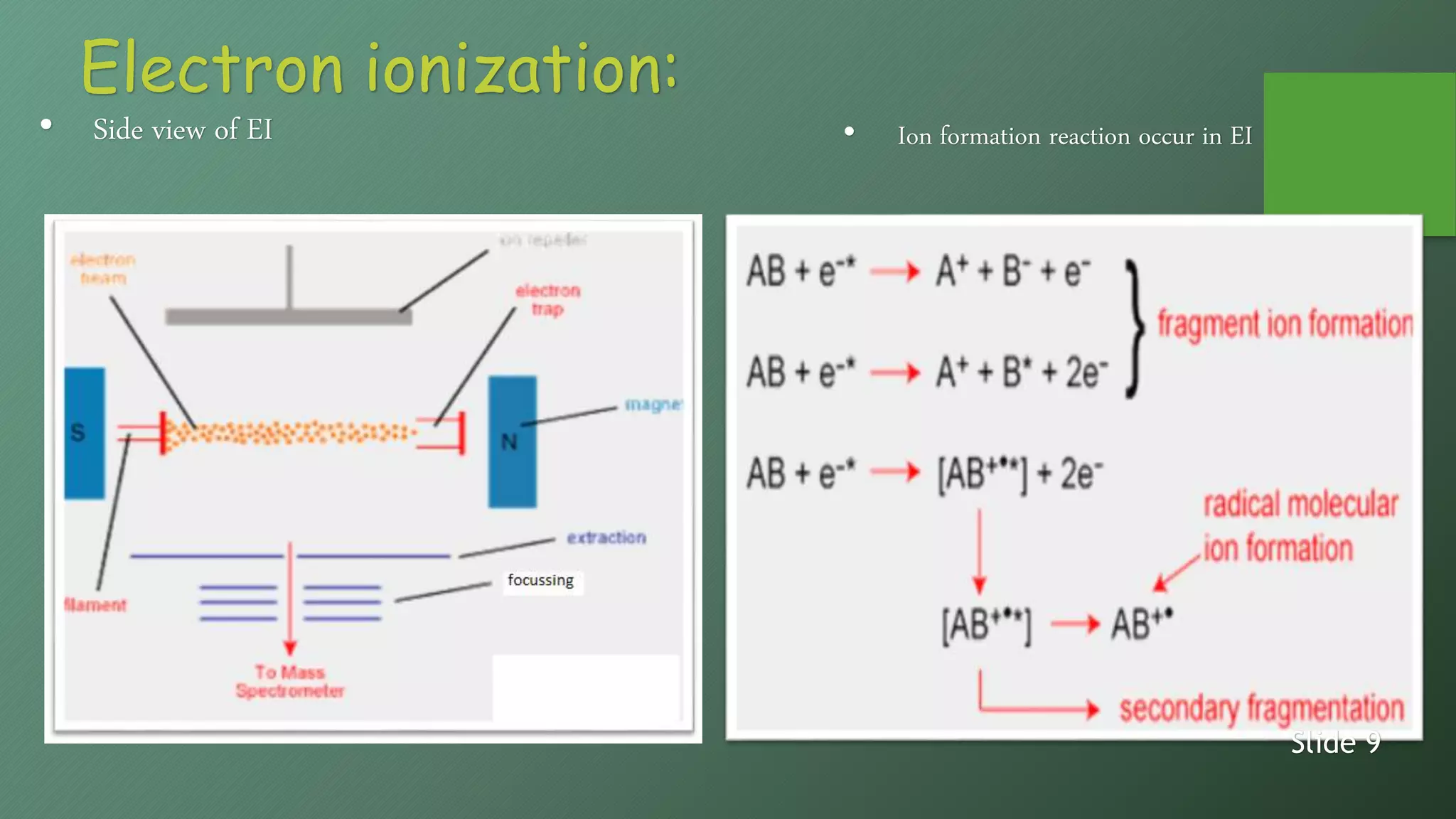
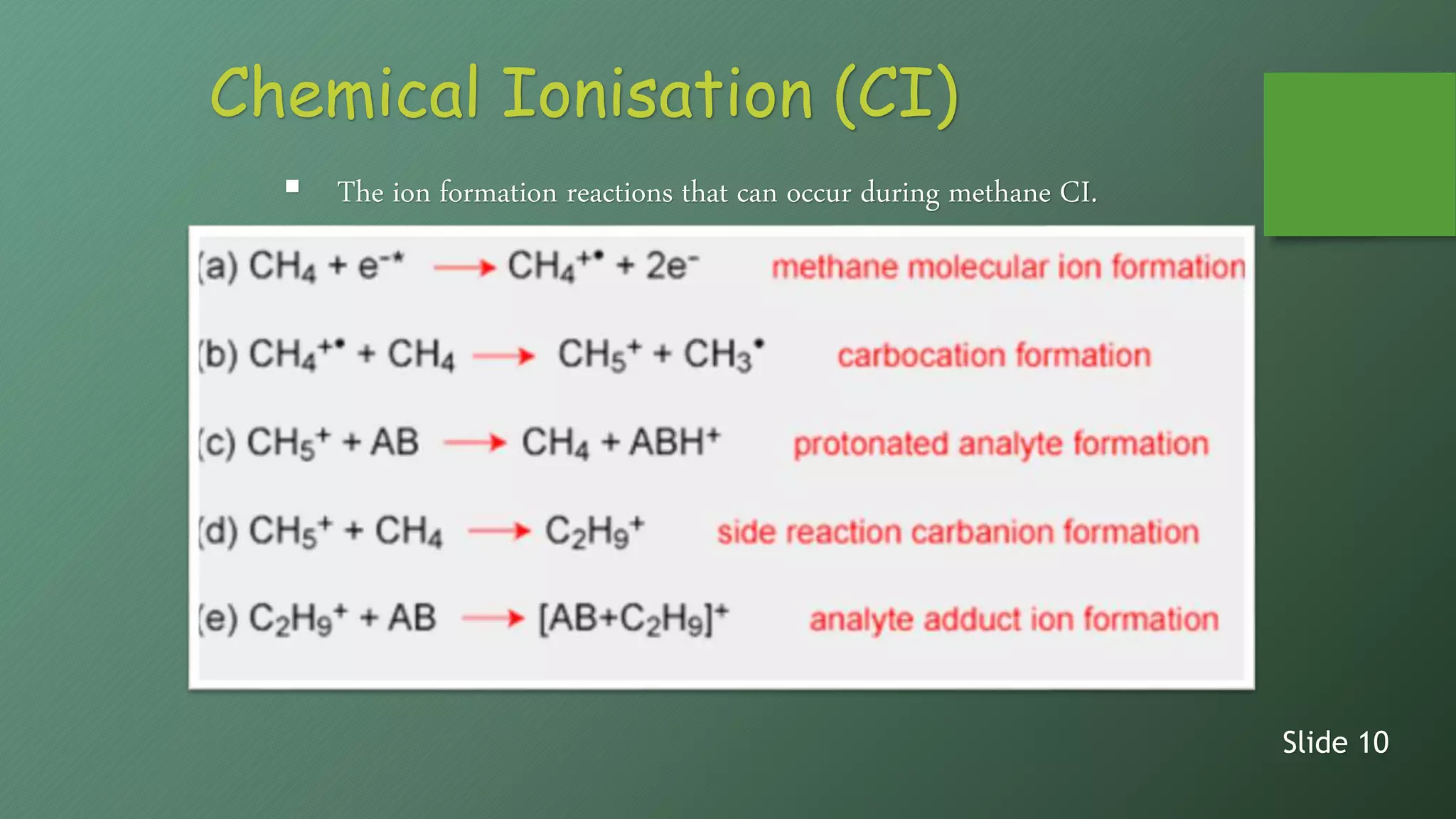
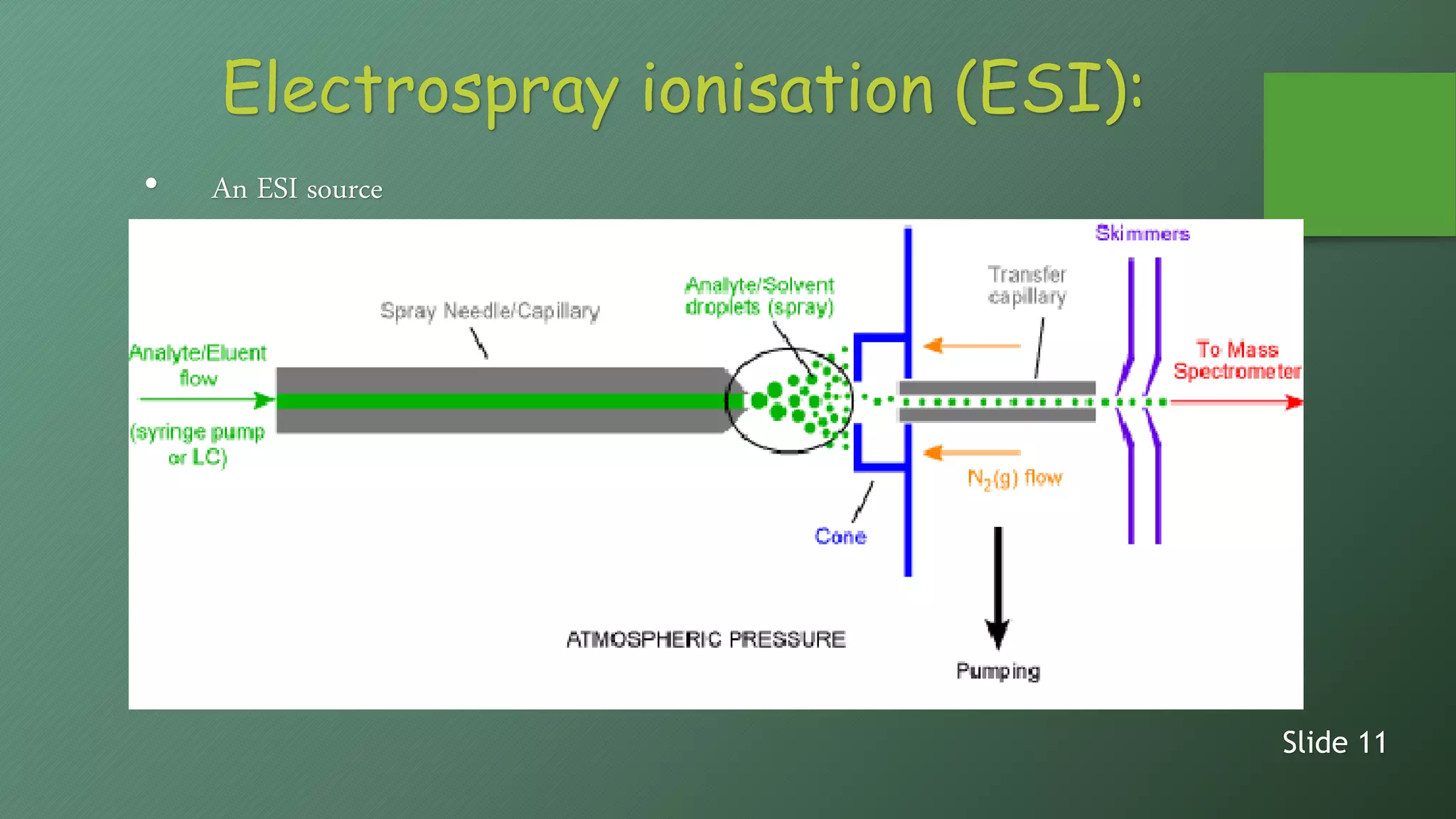
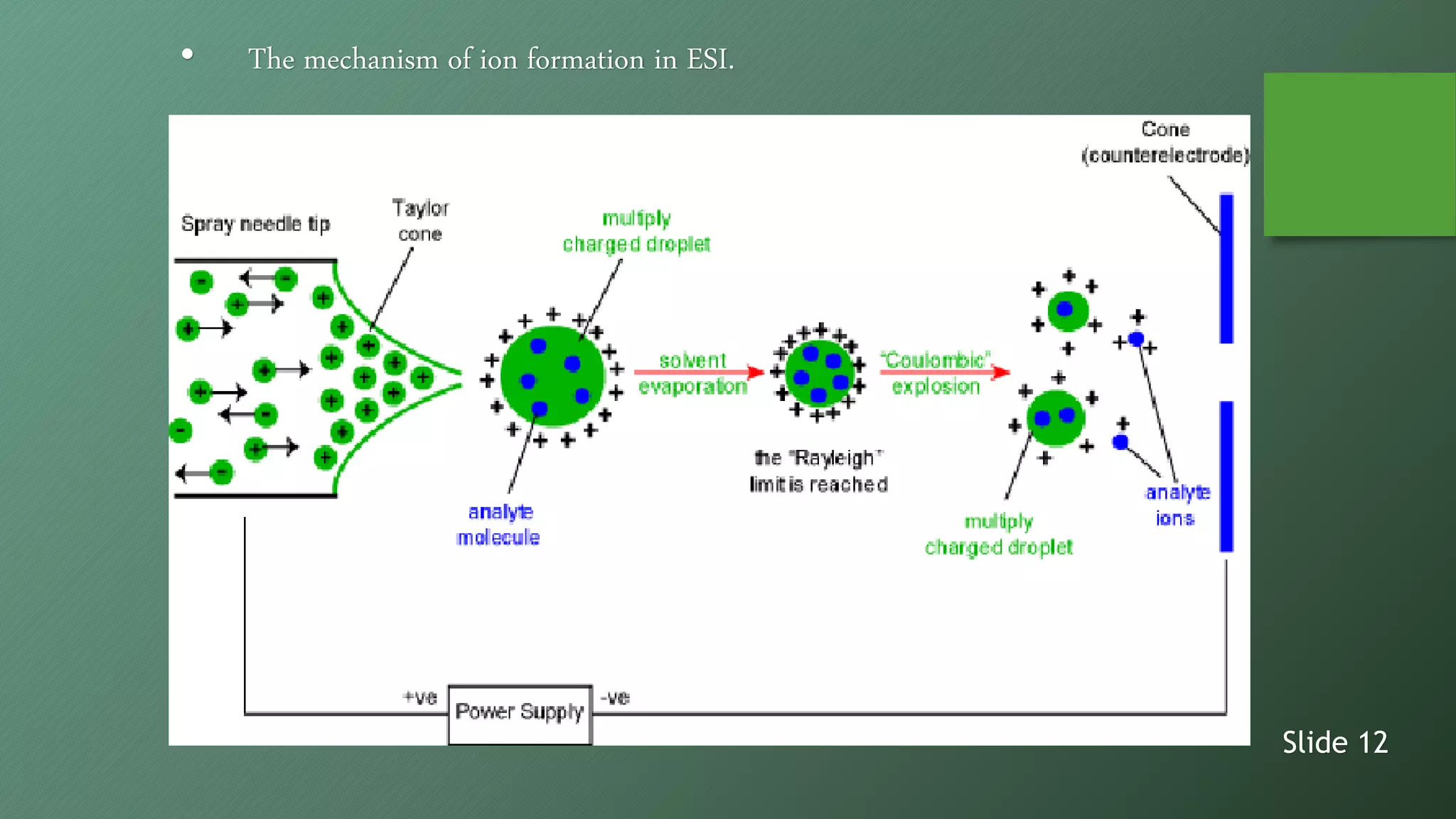
• Ionization
• Ion sources
• DART ion source
• DART ion application
• Mass spectrometry analyzers and detectors
Slide 2
3.
Introduction of Mass
spectrometry
•MASS SPECTROMETRY:
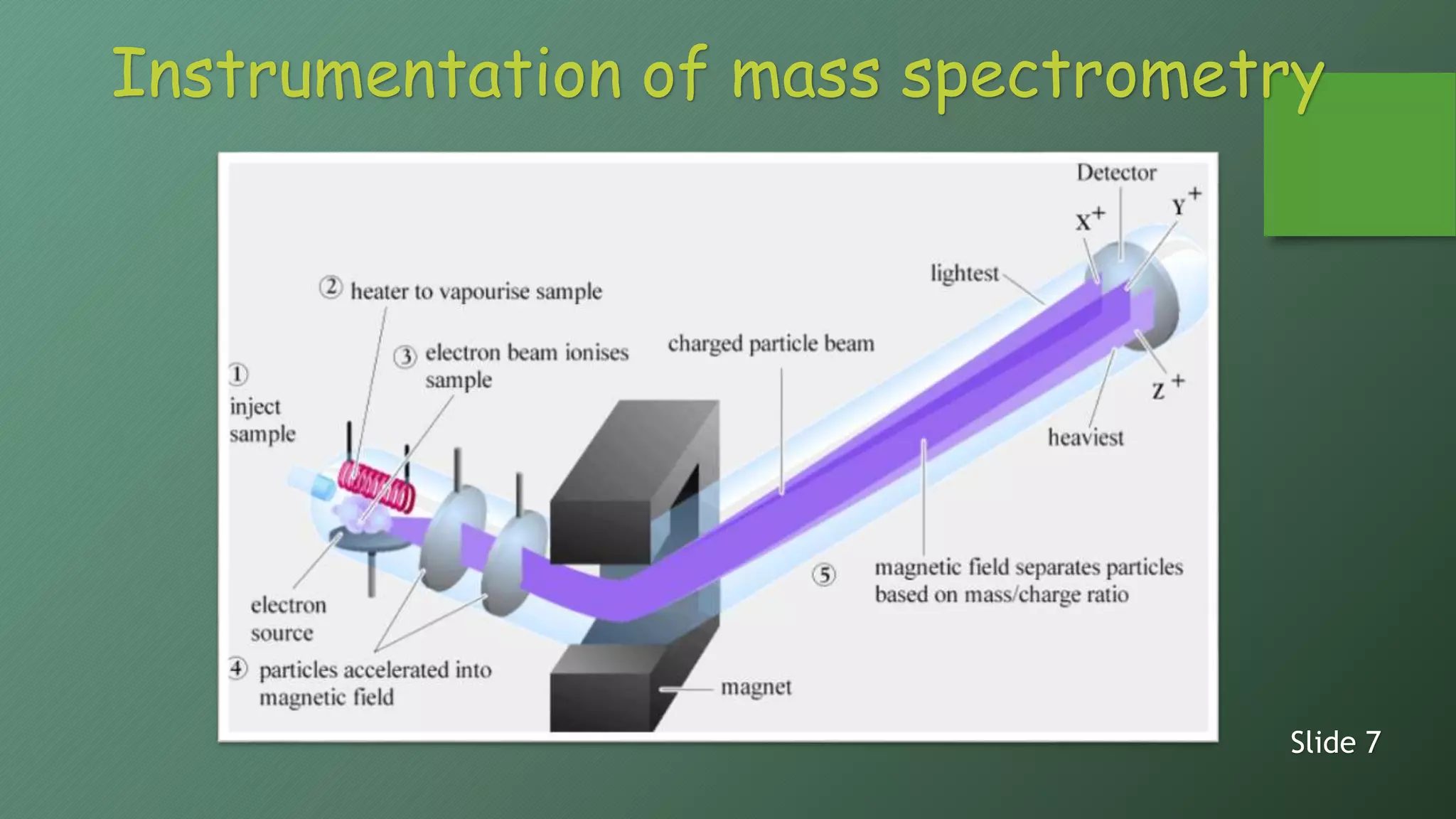
Mass spectrometry is an instrumental technique in which
sample is converted to rapidly moving positive ions by
electron bombardment and charged particles are separated
according to their masses.
• MASS SPECTRUM:
Mass spectrum is a plot relative abundance against the ratio of
mass/charge(m/e).
Slide 3
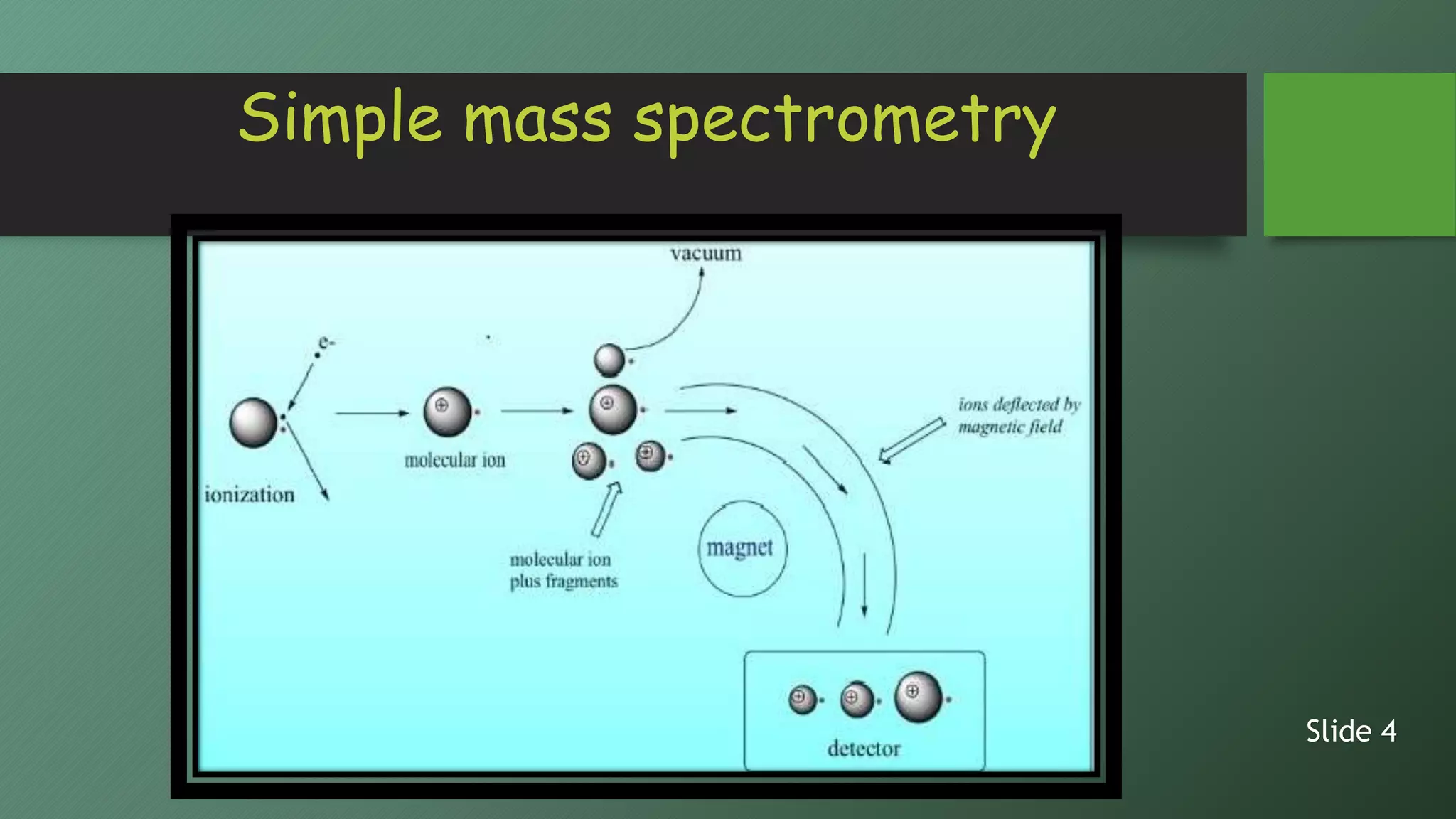
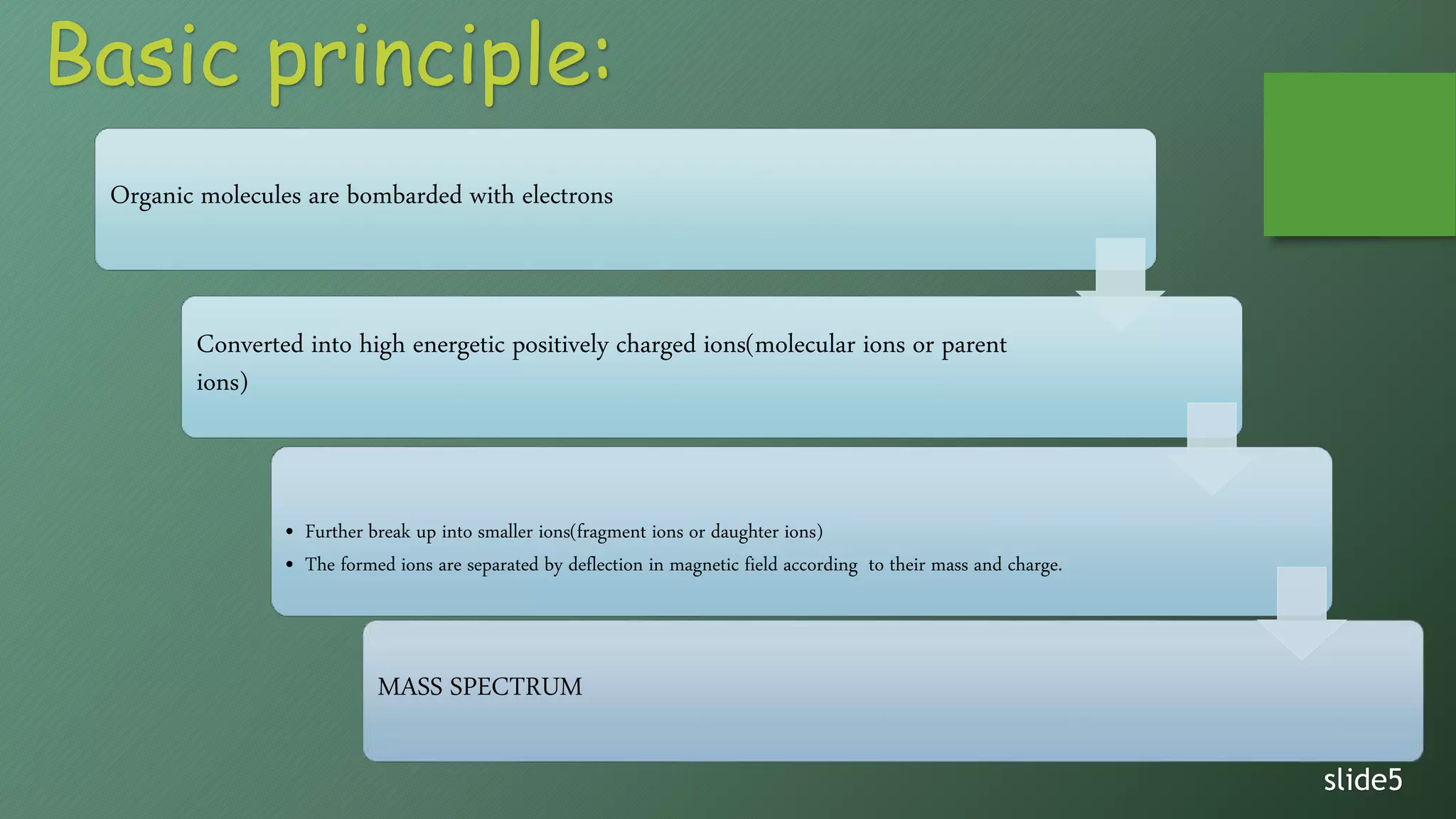
Organic molecules arebombarded with electrons
Converted into high energetic positively charged ions(molecular ions or parent
ions)
• Further break up into smaller ions(fragment ions or daughter ions)
• The formed ions are separated by deflection in magnetic field according to their mass and charge.
MASS SPECTRUM
slide5
Basic principle:
6.
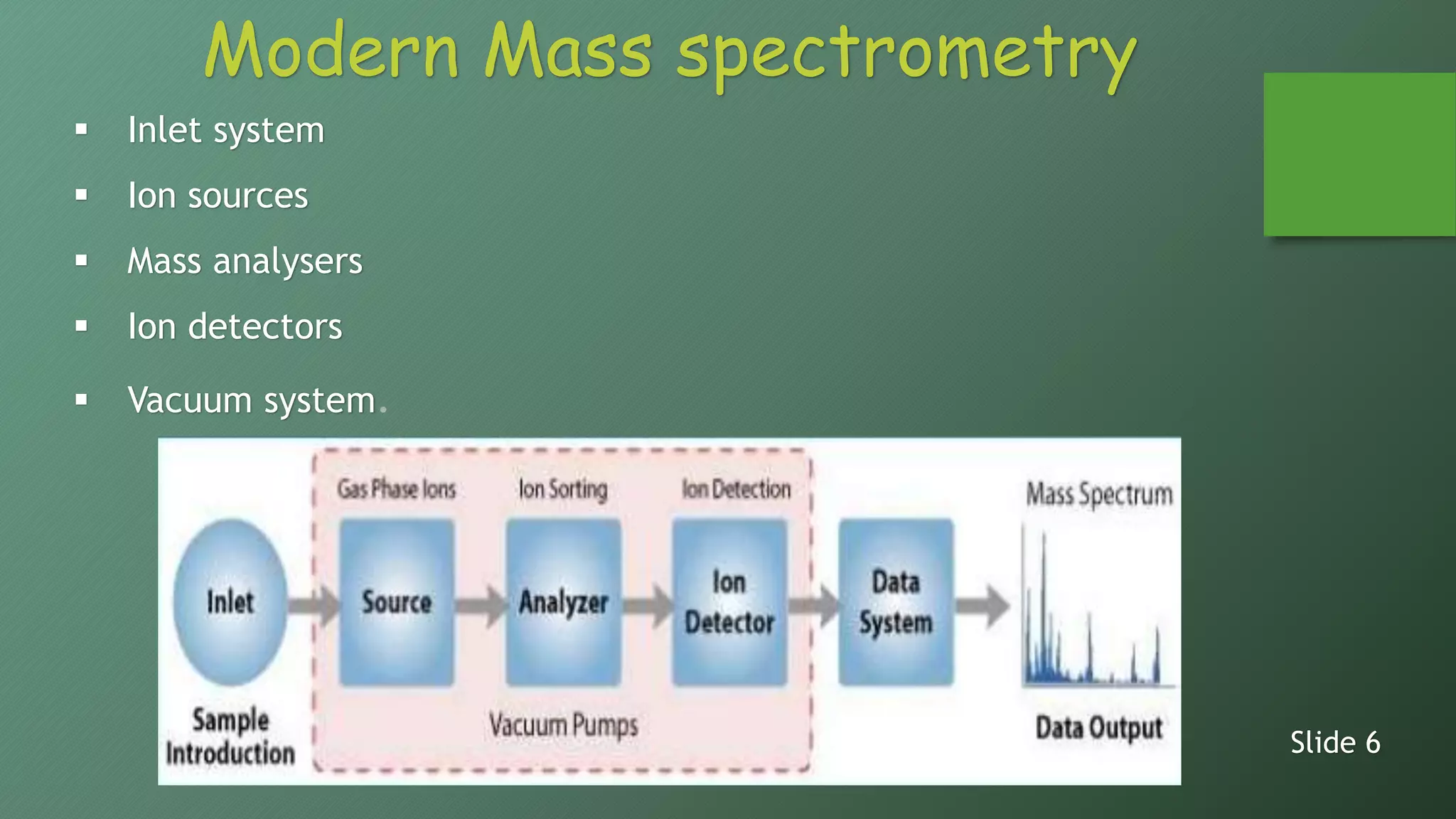
Modern Mass spectrometry
Inlet system
Ion sources
Mass analysers
Ion detectors
Vacuum system
Slide 6
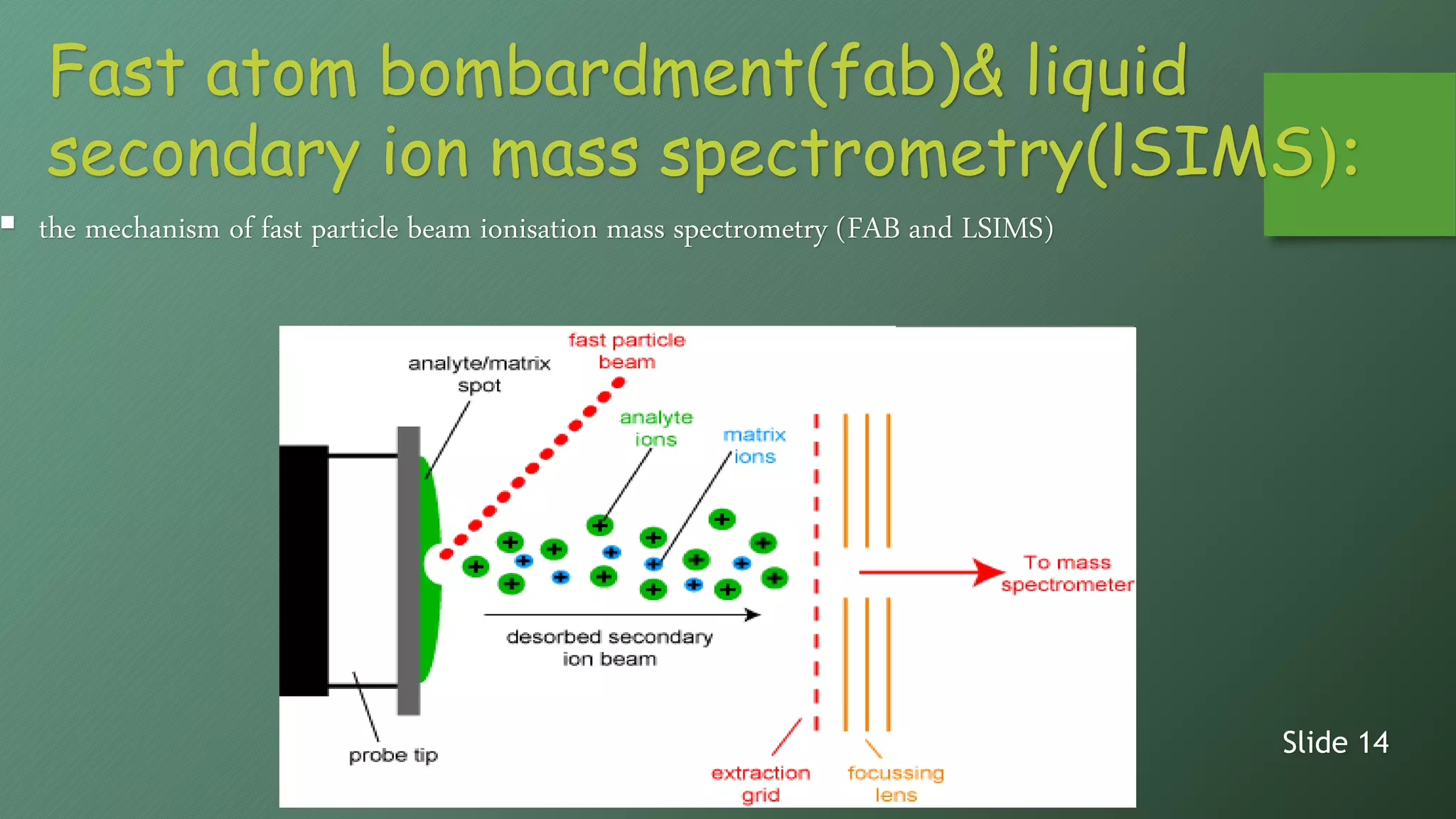
Fast atom bombardment(fab)&liquid
secondary ion mass spectrometry(lSIMS):
the mechanism of fast particle beam ionisation mass spectrometry (FAB and LSIMS)
Slide 14
Introduction:
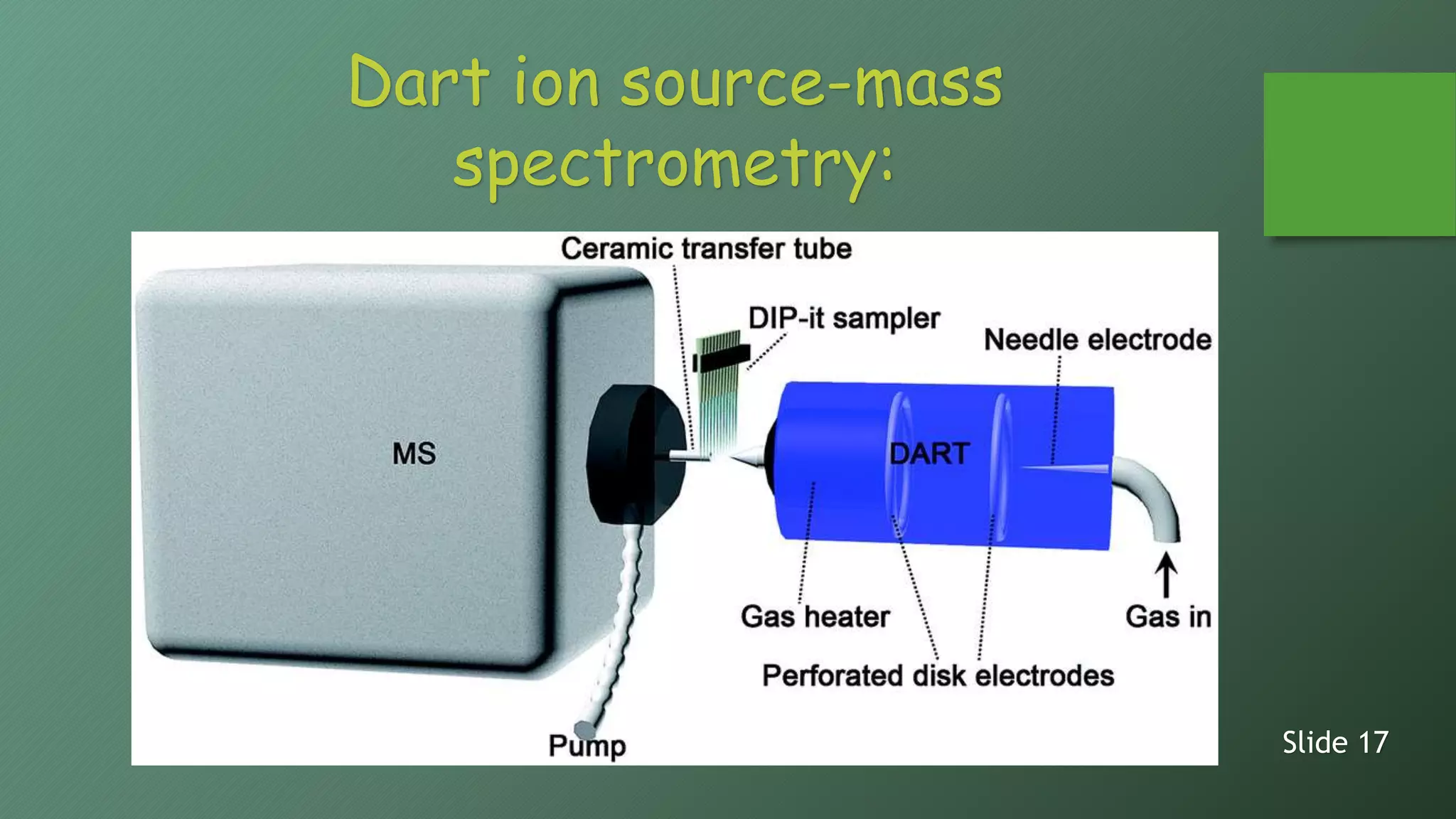
The new ionsource reported herein over-comes these limitations.
The new technique, referred to as Direct Analysis in Real Time (DART tm), has been coupled to the AccuTOFLCtm
atmospheric pressure ionization mass spectrometer to permit high-resolution, exact mass measurements of gases, liquids,
and solids.
DART successfully sampled hundreds of chemicals, including chemical agents and their signatures, pharmaceutics,
metabolites, pesticides and environmentally significant compounds etc.,
The composition of drug capsules and tablets was directly analyzed.
Slide 16
DART IONSOURCE ( DIRECT ANALYSIS IN
REAL TIME ) :
Background and Principleof Operation:
The discovery that DART could be used for positive-ion and negative-ion non-contact detection of materials on surfaces, as
well as for detection of gases and liquids.
DART is based on the atmospheric pressure interactions of long-lived electronic excited-state atoms or vibronic excited-state
molecules with the sample and atmospheric gases.
o The DART ion source is shown. A gas (typically helium or nitrogen) flows through a chamber where an electrical discharge
produces ions, electrons, and excited-state (metastable) atoms and molecules.
Slide 18
19.
Principle of DARTIonization:
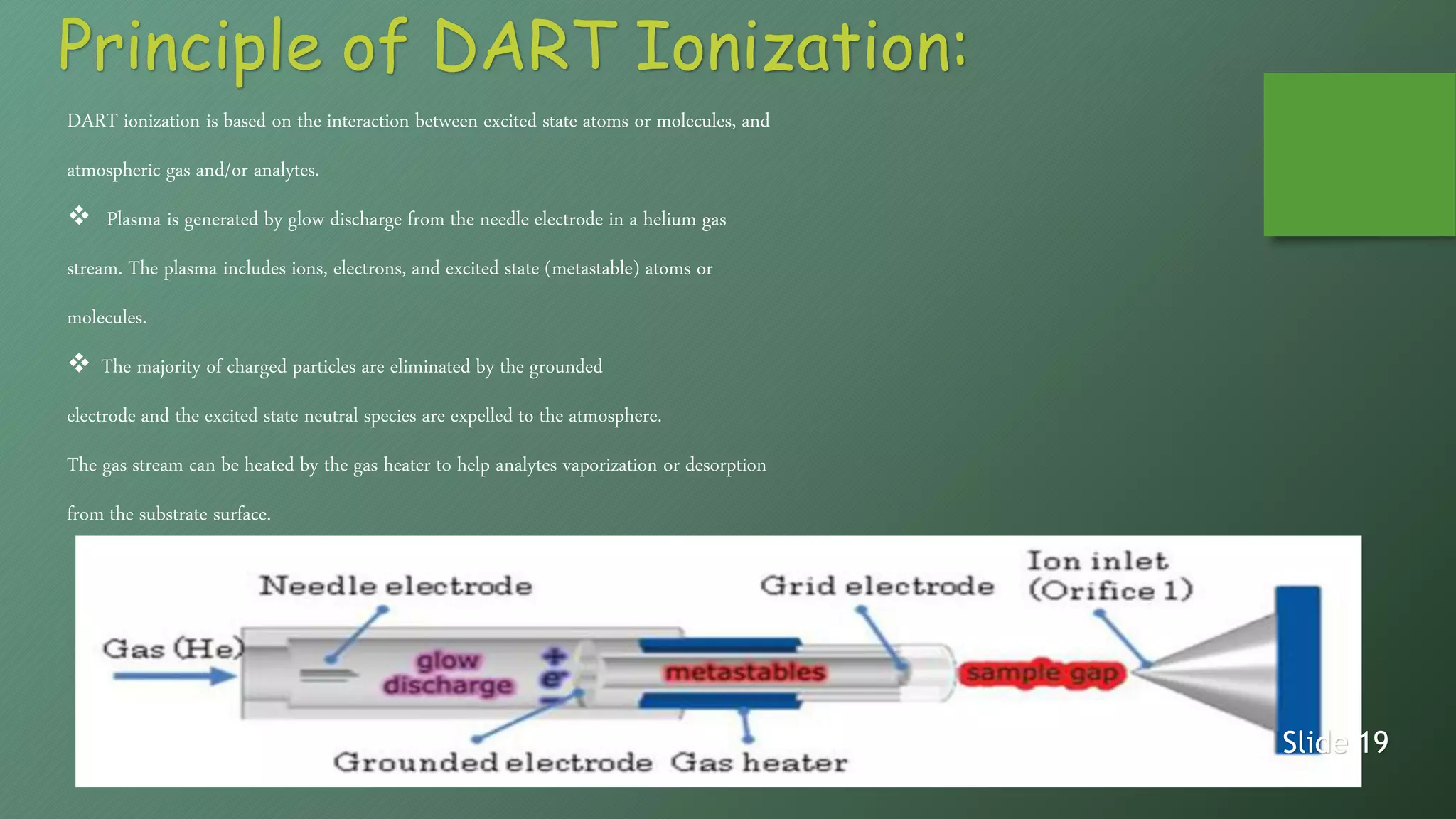
DART ionization is based on the interaction between excited state atoms or molecules, and
atmospheric gas and/or analytes.
Plasma is generated by glow discharge from the needle electrode in a helium gas
stream. The plasma includes ions, electrons, and excited state (metastable) atoms or
molecules.
The majority of charged particles are eliminated by the grounded
electrode and the excited state neutral species are expelled to the atmosphere.
The gas stream can be heated by the gas heater to help analytes vaporization or desorption
from the substrate surface.
Slide 19
20.
Minimal samplepreparation;
Sample maintenance under ambient conditions
Outside the vacuum system;
Rapid
Sensitive
High‐throughput analysis;
The ability for in‐situ detection.
Gentle ionization methods.
Used for both organic and biological.
Compounds, polar and non‐polar molecules Slide 20
21.
Dart applications:
Forensics
Pharmaceutics
food chemistry
biological samples
chemical analysis
fragrance industry
DART has been used for analysis of explosives ,drugs , inks , sexual assault evidence , and of synthetic
cannabinoids in herbal samples.
Slide 21
22.
Mass Analyzers:
quadrupoles
Time-of-Flight (TOF)
magnetic sectors
Fourier transform and
quadrupole ion traps.
Mass detectors:
Electron multiplier
Faraday cup
Scintillator ('Daly' detector). Slide 22
23.
fields that usemass spectrometry:
Pharmaceutical sciences
Proteomics
Drug discovery
Clinical testing
Genomics
Environmental sciences
Geology etc.,
Slide 23
Applications of mass spectrometer:
24.
[1]. https://masspec.scripps.edu/.
[2].Merriam-Webster dictionary,Medical dictionary by FARLAX, https://en.Wikipedia.org/.
[3]. Modern Mass Spectroscopy, pp. 1-302, 225. Springer-Verlag, Berlin, 2003.
[4]. MacMillan Group Meeting 2005 Sandra Lee.
[5]. http://simons.com/.
[6].RAPID COMM MASS SPECTROM,vol-II,2-16(1997),
[7].JEOL USA,Inc. EAI Corporation, GEO Centers Inc. Edgewood chemical
Biological center.
[8].https://www.jeolusa.com/ms/ms prodsaccutof_dart.html.
[9].Eid Alsbou (2010), MEMORIAL UNIVERSITY.
[10]. Witt & Bowers: JACS 2000,122, 3458.
[11]. J.L. Jimenez – Fall 2007 University of Colorado-Boulder.
Slide 24
References:
![[1]. https://masspec.scripps.edu/.
[2].Merriam-Webster dictionary, Medical dictionary by FARLAX, https://en.Wikipedia.org/.
[3]. Modern Mass Spectroscopy, pp. 1-302, 225. Springer-Verlag, Berlin, 2003.
[4]. MacMillan Group Meeting 2005 Sandra Lee.
[5]. http://simons.com/.
[6].RAPID COMM MASS SPECTROM,vol-II,2-16(1997),
[7].JEOL USA,Inc. EAI Corporation, GEO Centers Inc. Edgewood chemical
Biological center.
[8].https://www.jeolusa.com/ms/ms prodsaccutof_dart.html.
[9].Eid Alsbou (2010), MEMORIAL UNIVERSITY.
[10]. Witt & Bowers: JACS 2000,122, 3458.
[11]. J.L. Jimenez – Fall 2007 University of Colorado-Boulder.
Slide 24
References:](https://image.slidesharecdn.com/dartion-massspectrometry-151130181211-lva1-app6891/75/Dart-ion-source-mass-spectrometry-24-2048.jpg)