Presented By :
Mr. Sanket Rajiv Shinde
M. Pharmacy (QAT)
1
1. Introduction
2. History
3. Regulatory Program
4. Organization/Governance
5. Guidelines
6. Conclusion
7. References
2
1. INTRODUCTION
CONTENTS
 The Therapeutic Goods Administration or TGA is the regulatory
body for therapeutic goods in Australia.
 The TGA is responsible for conducting assessment and monitoring
activities to ensure that therapeutic goods available in Australia are
of an acceptable standard.
3
1. Therapeutics Goods Administration :
1. INTRODUCTION
 What are Therapeutic Goods? : 1,4
 A ‘therapeutic goods’ is broadly defined as a good which is
represented in any way to be or is likely to be taken to be, for
therapeutic use , unless specifically excluded or included under
section 7 of the Therapeutic Good Act 1989.
 Therapeutic goods is a product and connection with:
• Preventing , diagnosing , curing or alleviating a disease , defect or
injury.
• Effecting inhibition or modifying a physiological process .
• Testing the susceptibility of person to a disease .
• Controlling or preventing conception.
• Testing for pregnancy.
4
TGA contd….
 The objective of the Therapeutic Goods Act 1989, which came into effect on
15 February 1991, is to provide a national framework for the regulation of
therapeutic goods in Australia to ensure the quality, safety and efficacy of
medicines and ensure the quality, safety and performance of medical devices.
 Essentially therapeutic goods must be entered on the Australian Register of
Therapeutic Goods (ARTG) before they can be supplied in Australia.
 The ARTG is a computer database of information about therapeutic goods for
human use approved for supply in, or exported from, Australia.
5
Regulatory Program :1,4
TGA contd….
 Australian manufacturers of all medicines must be licensed under
Part 4 of the Therapeutic Goods Act 1989 and their manufacturing
processes must comply with the principles of GMP (Good
Manufacturing Practice).
 Once approved for marketing in Australia, medicines are included in
the ARTG and can be identified by the AUST R number (for
registered medicines) or an AUST L number (listed medicines) that
appears on the packaging of the medicine.
6
TGA contd….
 Regulatory Framework for medicine :4,6
 The TGA maintains the Australian Register of Therapeutic Goods
(ARTG), a database that includes details of all therapeutic goods that
are imported into, supplied in, or exported from Australia.
 In consultation with industry, the TGA has developed the Australian
Regulatory Guidelines For The Complementary Medicine
(ARGCM) to assist sponsors of complementary medicines to meet
their legislative obligations.
7
TGA contd….
 Purpose of ARGCM :5
 Provide information to help sponsors of complementary medicines to
meet their obligations under therapeutic goods legislation.
 Help ensure that applications to the TGA relating to complementary
medicines uniformly meet all essential regulatory requirements so that
applications may be processed successfully within minimum
timeframes.
 Enhance clarity and transparency of processes leading to the
Registration and Listing of complementary medicines in the Australian
Register of Therapeutic Goods (ARTG).
8
TGA contd….
 ARGCM Structure and Content :5
 Part I- Provides guidance on the Registration of complementary
medicines.
 Part II- Provides guidance on Listed complementary medicines.
 Part III- Provides guidance on the evaluation of complementary
medicine substances for use in Listed medicines.
 Part IV- Provides general guidance in relation to complementary
medicine modalities such as homoeopathy, traditional herbal
medicine and aromatherapy.
 Part V- Provides details of TGA policy guidelines relevant to
complementary medicines.
9
TGA contd….
 These products are evaluated by the TGA for quality, safety and efficacy
under the provisions of Section 25 of the Therapeutic Goods Act 1989.
 Products in this category include:
 Products that are to be included in the Schedule of Pharmaceutical
Benefits.
 Products that contain a sunscreen active ingredient that is not included
in the list of Sunscreening agents permitted as active ingredients in listed
products;
 Products that make therapeutic claims other than sunscreening.
 Products that are not otherwise exempt or listable.
10
TGA contd….
Regulatory Guidelines for OTC medicines :6
 Element To Regulate Therapeutic Goods :1,4
 Licensing and Audit of Manufactures
 Pre-Market Assessment
 Post-Market Regulatory Authority
11
 Licensing and Audit of Manufacturers -
 The Act requires each Australian manufacturer of medicinal products
for human use to hold a manufacturing license.
 License holders are required to comply with the manufacturing
principles of the Act, including compliance with Good Manufacturing
Practice (GMP).
TGA contd….
 Pre-market Assessment :1,4
 These include:
 The toxicity of the ingredients (itself a complex of factors);
 The dosage form of the medicine.
 Medicines that are assessed to be of higher risk are individually
evaluated for quality, safety and efficacy. Higher risk products approved
by the TGA are included on the ARTG as Registered medicines.
 Listed medicines are low risk medicines and are included on the ARTG
via a low-cost and streamlined electronic application and validation
process.
12
TGA contd….
• How is Risk Assessed? :4
 A product risk is determine by a number of factors:-
 Side effect
 Life threatening or very serious illness
 Inappropriate self medication
 Adverse effect for prolonged use.
13
TGA contd….
 Post-market Regulatory Activity :1,4
 The essential elements of this systematic risk-based approach
include:-
 Targeted and random desk-based audits of Listed products.
 Monitoring of adverse reactions to complementary medicines.
 Targeted and random laboratory testing of products and ingredients.
 Targeted and random surveillance in the market place.
 An effective, responsive and timely recalls procedure.
 Audit of GMP.
 Effective controls for the advertising of therapeutic goods.
14
TGA contd….
• Fees and Charges :4
 From 1 July 1998, the TGA has been required by the government to
fully recover its operating costs for all activities that falls within the
scope of the act, including regulation of industry and TGA’s public
health responsibility.
 A list of fees is included in Schedule 9 of the Therapeutic Goods
Regulation 1990.
15
TGA contd….
 Business Management Group
 Executive Support Unit
 Office of Complementary Medicine
 Office of Devices, Blood and Tissues
 Office of Laboratory and Scientific Services
 Office of Manufacturing Quality
 Office of Medicine Safety Monitoring
 Office of Non-Prescription Medicine
16
TGA contd….
TGA Organizations :4
2. The Medicines and Healthcare products
Regulatory Agency :
 The Medicines and Healthcare products Regulatory Agency (MHRA)
is the government agency which is responsible for ensuring that
medicines and medical devices work, and are acceptably safe.
 The MHRA now also looks after blood and blood products, working
with UK blood services, healthcare providers, and other relevant
organizations to improve blood quality and safety.
 The MHRA regulates a wide range of materials from medicines and
medical devices to blood and therapeutic products/services that are
derived from tissue engineering.
17
 The agency was formed on 1 April2003 with the merger of the
Medicines Control Agency (MCA) and the Medical Devices Agency
(MDA). It is an Executive Agency of the Department of Health.
18
 Operate post-marketing surveillance for reporting investigating and
monitoring of adverse drug reactions to medicines and incidents
with medical devices.
 Assessment and authorization of medicinal products for sale and
supply in UK.
 Roles of the MHRA:-
MHRA contd….
History :8
 Investigate internet sales and potential counterfeiting of medicines,
and prosecute where necessary.
 Regulate clinical trials of medicines and medical devices.
 Monitor and ensure compliance with statutory obligations relating to
medicines and medical devices.
 Promote safe use of medicines and devices.
 Manage the General Practice Research database and the British
Pharmacopeia.
19
MHRA contd….
 Assess application for authorization to market products for human
use and either grant authorizations to market each product or reject
such applications.
 Assess applications to undertaken clinical trials and grant, or refuse,
permission.
 Inspect the manufacturers and wholesalers of medicines for human
use and either grant manufacturing and wholesale licenses or refuse
such licenses.
 Undertaken post marketing surveillance including;
 Pharmacovigilance
 Quality defect monitoring
 Sampling and testing
 Product recalls
20
MHRA contd….
Regulatory Program :1,8
 Monitoring of Safety and Quality Standards :7
 The MHRA monitors safety and quality standards by:-
 Regular inspections of good and safe practice, including
 Medicines manufacture and supply
 Medicines distribution and storage
 Clinical trials
 Auditing of clinical inspecting system for devices
 Laboratories testing medicines
 Auditing Notified Bodies
21
MHRA contd….
22
 Dealing with faulty Medicines :7
 The MHRA’s Defective Medicines Report Centre (DMRC) issues alerts to
healthcare professionals, hospitals, GP surgeries, and wholesalers to tell
them when a medicine is being recalled or when there are concerns about
the quality that will affect its safety or effectiveness.
 Class 1 requires immediate recall, because the product poses a serious or
life threatening risk to health .
 Class 2 specifies a recall within 48 hours, because the defect could harm
the patient but is not life threatening.
 Class 3 requires action to be taken within 5 days because the defect is
unlikely to harm patients and is being carried out for reasons other than
patient safety.
 Class 4 alerts advise caution to be exercised when using the product, but
indicate that the product poses no threat to patient safety.
MHRA contd….
23
 The Agency Board is made up of a non-executive Chairman, six
non-executive members and the Agency's Chief Executive Officer.
 The Agency's Chief Executive is responsible for service delivery
and resources.
 The Executive Board, consisting of the Agency's directors.
MHRA contd….
MHRA Governance :7
 Membership :7
 The Agency Board is chaired by the MHRA Chairman, and consists of
six non-executive directors and the Chief Executive Officer.
 The Executive Board’s primary responsibility are to ensure the
strategic direction set by the Agency Board is implemented and
reflected in the day to day operations of the Agency.
 Principles of good governance are followed.
 The Agency is well managed financially.
 Appropriate human resources (HR) policies are followed.
 Reporting to the Agency Board on the operations of the Agency.
24
MHRA contd….
3. Medicines Control Council :
 South Africa has developed a medicines regulatory authority with
internationally recognized standing.
 The Medicines Control Council (MCC) is a statutory body that was
established in terms of the Medicines and Related Substances
Control Act, 101 of 1965, to oversee the regulation of medicines in
South Africa.
25
 More than 20 000 medicines have been approved.
 More than 220 meetings have been held to decide on the registration
of medicines.
 The South African Pharmacy Council has licensed 300 wholesalers
and distributors.
 The Medicines Control Council approves more than 280 clinical
trials annually.
26
MCC contd….
History :8
27
 The Medicines Control Council applies standards laid down by the
Medicines and Related Substances Control Act, (Act 101 of 1965) which
governs the manufacture, distribution, sale, and marketing of medicines.
 The prescribing and dispensing of medicines is controlled.
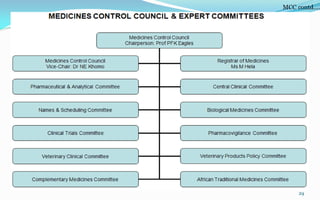
 The Council has eleven technical committees, with 146 members from
various institutions in the country.
 The MCC operates through external experts who are members of Council
Committee structures. Most experts evaluate data sets submitted by the
pharmaceutical industry for purposes of registration.
MCC contd….
Regulatory Program :3,8
 The office of the Registrar provides administrative and technical support
to Council and its activities. The Registrar is also an executive secretary
to council.
 The staff complement of Medicines Regulatory Affairs includes doctors,
pharmacists, veterinarians, other scientists and administrative staff.
 The skills of Council and its committees are written into law and include
expertise in toxicology and medicine safety, clinical pharmacology,
biotechnology, pharmaceutics, internal medicine, virology,
pharmaceutical chemistry, neonatology, pediatrics, immunology,
veterinary science, complementary medicines and law.
28
MCC contd….
29
MCC contd….
30
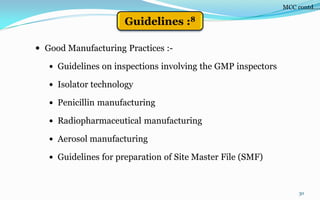
 Good Manufacturing Practices :-
 Guidelines on inspections involving the GMP inspectors
 Isolator technology
 Penicillin manufacturing
 Radiopharmaceutical manufacturing
 Aerosol manufacturing
 Guidelines for preparation of Site Master File (SMF)
MCC contd….
Guidelines :8
31
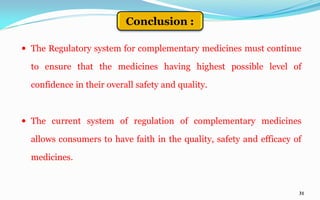
 The Regulatory system for complementary medicines must continue
to ensure that the medicines having highest possible level of
confidence in their overall safety and quality.
 The current system of regulation of complementary medicines
allows consumers to have faith in the quality, safety and efficacy of
medicines.
Conclusion :
32
REFERENCES
1. Kuchekar BS, Itkar SC, Forensic Pharmacy, fourth ed. Pune: Nirali Prakashan, 2004,P.
306-332.
2. Jain NK, Pharmaceutical Product Development, Second ed. New Delhi: CBS Publishers and
distributor, 2005,P.457:489.
3. Savant DA, The Pharmaceutical Sciences Pharma Pathway, Eighth ed. Pune: Nirali
Prakashan, 2010, P.2.103
4. http://www.tga.gov.au
5. Australian regulatory guidelines for complementary medicines
<http://www.tga.gov.au/docs/html/argcm.htm
6. Australian regulatory guidelines for OTC medicines -
<http://www.tga.gov.au/docs/html/argom.htm
7. http://www.aboutus.org/Mhra
8. http://www.health.gov.za
33

Regulatory Authorities for Pharmaceuticals - TGA,MHRA,MCC

  • 1.
    Presented By : Mr.Sanket Rajiv Shinde M. Pharmacy (QAT) 1
  • 2.
    1. Introduction 2. History 3.Regulatory Program 4. Organization/Governance 5. Guidelines 6. Conclusion 7. References 2 1. INTRODUCTION CONTENTS
  • 3.
     The TherapeuticGoods Administration or TGA is the regulatory body for therapeutic goods in Australia.  The TGA is responsible for conducting assessment and monitoring activities to ensure that therapeutic goods available in Australia are of an acceptable standard. 3 1. Therapeutics Goods Administration : 1. INTRODUCTION
  • 4.
     What areTherapeutic Goods? : 1,4  A ‘therapeutic goods’ is broadly defined as a good which is represented in any way to be or is likely to be taken to be, for therapeutic use , unless specifically excluded or included under section 7 of the Therapeutic Good Act 1989.  Therapeutic goods is a product and connection with: • Preventing , diagnosing , curing or alleviating a disease , defect or injury. • Effecting inhibition or modifying a physiological process . • Testing the susceptibility of person to a disease . • Controlling or preventing conception. • Testing for pregnancy. 4 TGA contd….
  • 5.
     The objectiveof the Therapeutic Goods Act 1989, which came into effect on 15 February 1991, is to provide a national framework for the regulation of therapeutic goods in Australia to ensure the quality, safety and efficacy of medicines and ensure the quality, safety and performance of medical devices.  Essentially therapeutic goods must be entered on the Australian Register of Therapeutic Goods (ARTG) before they can be supplied in Australia.  The ARTG is a computer database of information about therapeutic goods for human use approved for supply in, or exported from, Australia. 5 Regulatory Program :1,4 TGA contd….
  • 6.
     Australian manufacturersof all medicines must be licensed under Part 4 of the Therapeutic Goods Act 1989 and their manufacturing processes must comply with the principles of GMP (Good Manufacturing Practice).  Once approved for marketing in Australia, medicines are included in the ARTG and can be identified by the AUST R number (for registered medicines) or an AUST L number (listed medicines) that appears on the packaging of the medicine. 6 TGA contd….
  • 7.
     Regulatory Frameworkfor medicine :4,6  The TGA maintains the Australian Register of Therapeutic Goods (ARTG), a database that includes details of all therapeutic goods that are imported into, supplied in, or exported from Australia.  In consultation with industry, the TGA has developed the Australian Regulatory Guidelines For The Complementary Medicine (ARGCM) to assist sponsors of complementary medicines to meet their legislative obligations. 7 TGA contd….
  • 8.
     Purpose ofARGCM :5  Provide information to help sponsors of complementary medicines to meet their obligations under therapeutic goods legislation.  Help ensure that applications to the TGA relating to complementary medicines uniformly meet all essential regulatory requirements so that applications may be processed successfully within minimum timeframes.  Enhance clarity and transparency of processes leading to the Registration and Listing of complementary medicines in the Australian Register of Therapeutic Goods (ARTG). 8 TGA contd….
  • 9.
     ARGCM Structureand Content :5  Part I- Provides guidance on the Registration of complementary medicines.  Part II- Provides guidance on Listed complementary medicines.  Part III- Provides guidance on the evaluation of complementary medicine substances for use in Listed medicines.  Part IV- Provides general guidance in relation to complementary medicine modalities such as homoeopathy, traditional herbal medicine and aromatherapy.  Part V- Provides details of TGA policy guidelines relevant to complementary medicines. 9 TGA contd….
  • 10.
     These productsare evaluated by the TGA for quality, safety and efficacy under the provisions of Section 25 of the Therapeutic Goods Act 1989.  Products in this category include:  Products that are to be included in the Schedule of Pharmaceutical Benefits.  Products that contain a sunscreen active ingredient that is not included in the list of Sunscreening agents permitted as active ingredients in listed products;  Products that make therapeutic claims other than sunscreening.  Products that are not otherwise exempt or listable. 10 TGA contd…. Regulatory Guidelines for OTC medicines :6
  • 11.
     Element ToRegulate Therapeutic Goods :1,4  Licensing and Audit of Manufactures  Pre-Market Assessment  Post-Market Regulatory Authority 11  Licensing and Audit of Manufacturers -  The Act requires each Australian manufacturer of medicinal products for human use to hold a manufacturing license.  License holders are required to comply with the manufacturing principles of the Act, including compliance with Good Manufacturing Practice (GMP). TGA contd….
  • 12.
     Pre-market Assessment:1,4  These include:  The toxicity of the ingredients (itself a complex of factors);  The dosage form of the medicine.  Medicines that are assessed to be of higher risk are individually evaluated for quality, safety and efficacy. Higher risk products approved by the TGA are included on the ARTG as Registered medicines.  Listed medicines are low risk medicines and are included on the ARTG via a low-cost and streamlined electronic application and validation process. 12 TGA contd….
  • 13.
    • How isRisk Assessed? :4  A product risk is determine by a number of factors:-  Side effect  Life threatening or very serious illness  Inappropriate self medication  Adverse effect for prolonged use. 13 TGA contd….
  • 14.
     Post-market RegulatoryActivity :1,4  The essential elements of this systematic risk-based approach include:-  Targeted and random desk-based audits of Listed products.  Monitoring of adverse reactions to complementary medicines.  Targeted and random laboratory testing of products and ingredients.  Targeted and random surveillance in the market place.  An effective, responsive and timely recalls procedure.  Audit of GMP.  Effective controls for the advertising of therapeutic goods. 14 TGA contd….
  • 15.
    • Fees andCharges :4  From 1 July 1998, the TGA has been required by the government to fully recover its operating costs for all activities that falls within the scope of the act, including regulation of industry and TGA’s public health responsibility.  A list of fees is included in Schedule 9 of the Therapeutic Goods Regulation 1990. 15 TGA contd….
  • 16.
     Business ManagementGroup  Executive Support Unit  Office of Complementary Medicine  Office of Devices, Blood and Tissues  Office of Laboratory and Scientific Services  Office of Manufacturing Quality  Office of Medicine Safety Monitoring  Office of Non-Prescription Medicine 16 TGA contd…. TGA Organizations :4
  • 17.
    2. The Medicinesand Healthcare products Regulatory Agency :  The Medicines and Healthcare products Regulatory Agency (MHRA) is the government agency which is responsible for ensuring that medicines and medical devices work, and are acceptably safe.  The MHRA now also looks after blood and blood products, working with UK blood services, healthcare providers, and other relevant organizations to improve blood quality and safety.  The MHRA regulates a wide range of materials from medicines and medical devices to blood and therapeutic products/services that are derived from tissue engineering. 17
  • 18.
     The agencywas formed on 1 April2003 with the merger of the Medicines Control Agency (MCA) and the Medical Devices Agency (MDA). It is an Executive Agency of the Department of Health. 18  Operate post-marketing surveillance for reporting investigating and monitoring of adverse drug reactions to medicines and incidents with medical devices.  Assessment and authorization of medicinal products for sale and supply in UK.  Roles of the MHRA:- MHRA contd…. History :8
  • 19.
     Investigate internetsales and potential counterfeiting of medicines, and prosecute where necessary.  Regulate clinical trials of medicines and medical devices.  Monitor and ensure compliance with statutory obligations relating to medicines and medical devices.  Promote safe use of medicines and devices.  Manage the General Practice Research database and the British Pharmacopeia. 19 MHRA contd….
  • 20.
     Assess applicationfor authorization to market products for human use and either grant authorizations to market each product or reject such applications.  Assess applications to undertaken clinical trials and grant, or refuse, permission.  Inspect the manufacturers and wholesalers of medicines for human use and either grant manufacturing and wholesale licenses or refuse such licenses.  Undertaken post marketing surveillance including;  Pharmacovigilance  Quality defect monitoring  Sampling and testing  Product recalls 20 MHRA contd…. Regulatory Program :1,8
  • 21.
     Monitoring ofSafety and Quality Standards :7  The MHRA monitors safety and quality standards by:-  Regular inspections of good and safe practice, including  Medicines manufacture and supply  Medicines distribution and storage  Clinical trials  Auditing of clinical inspecting system for devices  Laboratories testing medicines  Auditing Notified Bodies 21 MHRA contd….
  • 22.
    22  Dealing withfaulty Medicines :7  The MHRA’s Defective Medicines Report Centre (DMRC) issues alerts to healthcare professionals, hospitals, GP surgeries, and wholesalers to tell them when a medicine is being recalled or when there are concerns about the quality that will affect its safety or effectiveness.  Class 1 requires immediate recall, because the product poses a serious or life threatening risk to health .  Class 2 specifies a recall within 48 hours, because the defect could harm the patient but is not life threatening.  Class 3 requires action to be taken within 5 days because the defect is unlikely to harm patients and is being carried out for reasons other than patient safety.  Class 4 alerts advise caution to be exercised when using the product, but indicate that the product poses no threat to patient safety. MHRA contd….
  • 23.
    23  The AgencyBoard is made up of a non-executive Chairman, six non-executive members and the Agency's Chief Executive Officer.  The Agency's Chief Executive is responsible for service delivery and resources.  The Executive Board, consisting of the Agency's directors. MHRA contd…. MHRA Governance :7
  • 24.
     Membership :7 The Agency Board is chaired by the MHRA Chairman, and consists of six non-executive directors and the Chief Executive Officer.  The Executive Board’s primary responsibility are to ensure the strategic direction set by the Agency Board is implemented and reflected in the day to day operations of the Agency.  Principles of good governance are followed.  The Agency is well managed financially.  Appropriate human resources (HR) policies are followed.  Reporting to the Agency Board on the operations of the Agency. 24 MHRA contd….
  • 25.
    3. Medicines ControlCouncil :  South Africa has developed a medicines regulatory authority with internationally recognized standing.  The Medicines Control Council (MCC) is a statutory body that was established in terms of the Medicines and Related Substances Control Act, 101 of 1965, to oversee the regulation of medicines in South Africa. 25
  • 26.
     More than20 000 medicines have been approved.  More than 220 meetings have been held to decide on the registration of medicines.  The South African Pharmacy Council has licensed 300 wholesalers and distributors.  The Medicines Control Council approves more than 280 clinical trials annually. 26 MCC contd…. History :8
  • 27.
    27  The MedicinesControl Council applies standards laid down by the Medicines and Related Substances Control Act, (Act 101 of 1965) which governs the manufacture, distribution, sale, and marketing of medicines.  The prescribing and dispensing of medicines is controlled.  The Council has eleven technical committees, with 146 members from various institutions in the country.  The MCC operates through external experts who are members of Council Committee structures. Most experts evaluate data sets submitted by the pharmaceutical industry for purposes of registration. MCC contd…. Regulatory Program :3,8
  • 28.
     The officeof the Registrar provides administrative and technical support to Council and its activities. The Registrar is also an executive secretary to council.  The staff complement of Medicines Regulatory Affairs includes doctors, pharmacists, veterinarians, other scientists and administrative staff.  The skills of Council and its committees are written into law and include expertise in toxicology and medicine safety, clinical pharmacology, biotechnology, pharmaceutics, internal medicine, virology, pharmaceutical chemistry, neonatology, pediatrics, immunology, veterinary science, complementary medicines and law. 28 MCC contd….
  • 29.
  • 30.
    30  Good ManufacturingPractices :-  Guidelines on inspections involving the GMP inspectors  Isolator technology  Penicillin manufacturing  Radiopharmaceutical manufacturing  Aerosol manufacturing  Guidelines for preparation of Site Master File (SMF) MCC contd…. Guidelines :8
  • 31.
    31  The Regulatorysystem for complementary medicines must continue to ensure that the medicines having highest possible level of confidence in their overall safety and quality.  The current system of regulation of complementary medicines allows consumers to have faith in the quality, safety and efficacy of medicines. Conclusion :
  • 32.
    32 REFERENCES 1. Kuchekar BS,Itkar SC, Forensic Pharmacy, fourth ed. Pune: Nirali Prakashan, 2004,P. 306-332. 2. Jain NK, Pharmaceutical Product Development, Second ed. New Delhi: CBS Publishers and distributor, 2005,P.457:489. 3. Savant DA, The Pharmaceutical Sciences Pharma Pathway, Eighth ed. Pune: Nirali Prakashan, 2010, P.2.103 4. http://www.tga.gov.au 5. Australian regulatory guidelines for complementary medicines <http://www.tga.gov.au/docs/html/argcm.htm 6. Australian regulatory guidelines for OTC medicines - <http://www.tga.gov.au/docs/html/argom.htm 7. http://www.aboutus.org/Mhra 8. http://www.health.gov.za
  • 33.