16-1 Genes and Variation 16-1 Genes and Variation
How Common Is Genetic Variation? Many genes have at least two forms, or alleles. All organisms have genetic variation that is “invisible” because it involves small differences in biochemical processes. An individual organism is heterozygous for many genes.
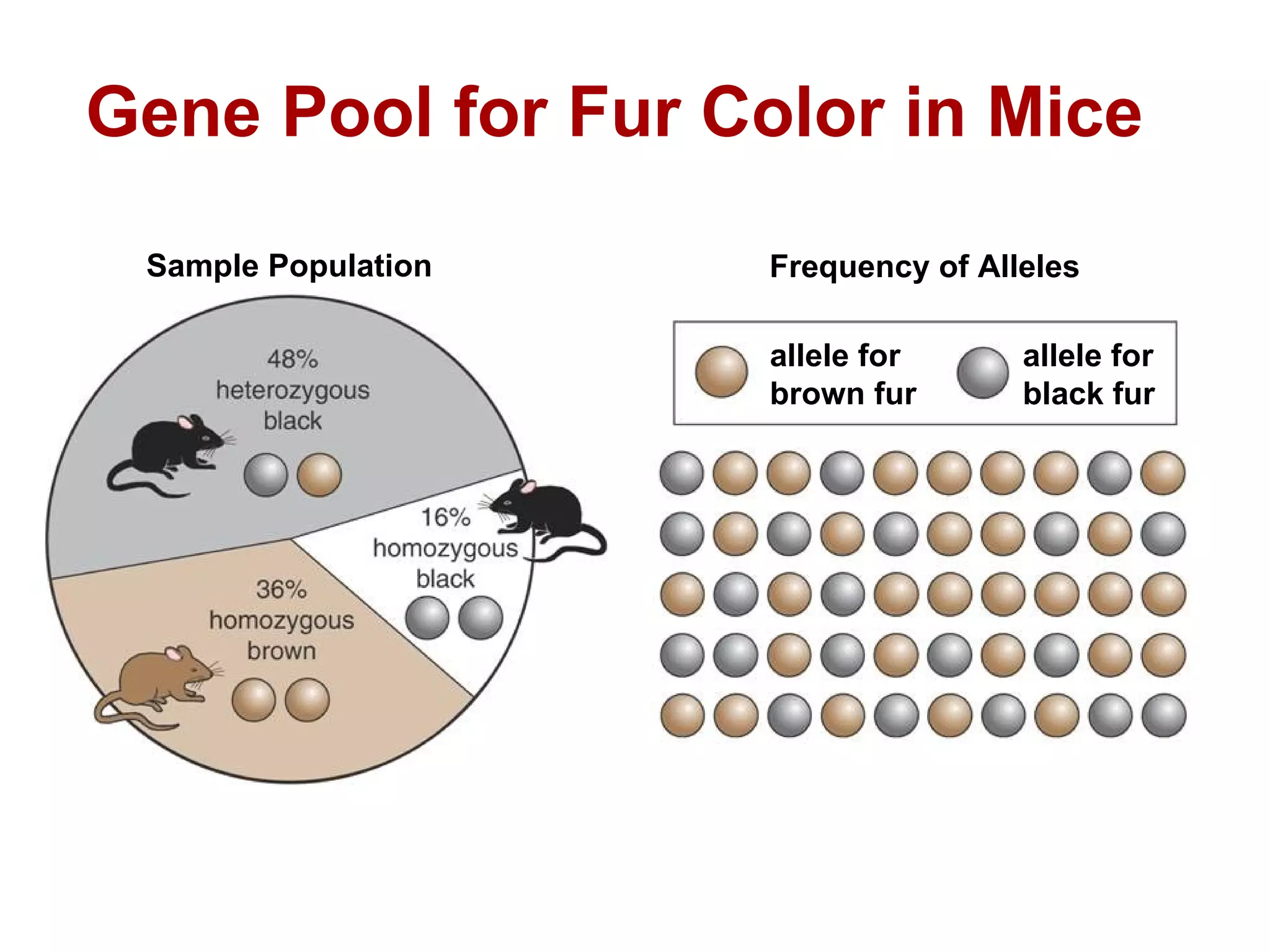
Genetic variation is studied in populations.   A  population  is a group of individuals of the same species that interbreed.   A  gene pool  consists of all genes, including all the different alleles, that are present in a population.
The  relative frequency  of an allele is the number of times the allele occurs in a gene pool, compared with the number of times other alleles for the same gene occur.   Relative frequency is often expressed as a percentage.
Gene Pool for Fur Color in Mice Sample Population Frequency of Alleles allele for brown fur allele for black fur
Evolution is any change in the relative frequency of alleles in a population.
The two main sources of genetic variation are mutations and the genetic shuffling that results from sexual reproduction.
A mutation is any change in a sequence of DNA. Mutations occur because of mistakes in DNA replication or as a result of radiation or chemicals in the environment. Mutations do not always affect an organism’s phenotype.
Most heritable differences are due to gene shuffling. Crossing-over increases the number of genotypes that can appear in offspring. Sexual reproduction produces different phenotypes, but it does not change the relative frequency of alleles in a population.
Single-Gene and Polygenic Traits The number of phenotypes produced for a given trait depends on how many genes control the trait.
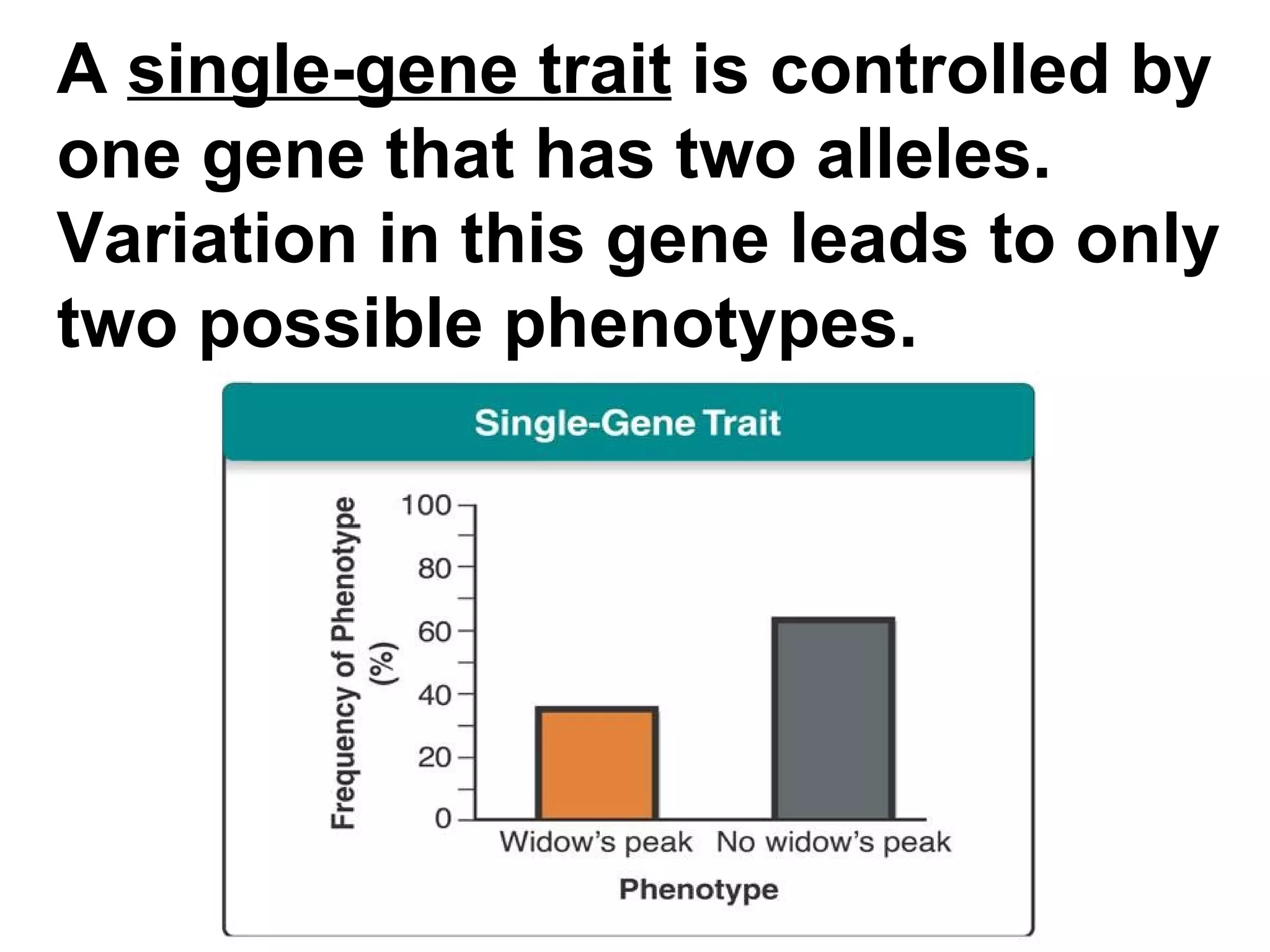
A  single-gene trait  is controlled by one gene that has two alleles. Variation in this gene leads to only two possible phenotypes.
The allele for a widow’s peak is dominant over the allele for a hairline with no peak. However, the presence of a widow’s peak may be less common in a population. In real populations,  phenotypic ratios are determined by the frequency of alleles as well as by whether the alleles are dominant or recessive.
Many traits are controlled by two or more genes and are called  polygenic traits .   One polygenic trait can have many possible genotypes and phenotypes. Height in humans is a polygenic trait.
A bell-shaped curve is typical of polygenic traits. A bell-shaped curve is also called normal distribution.
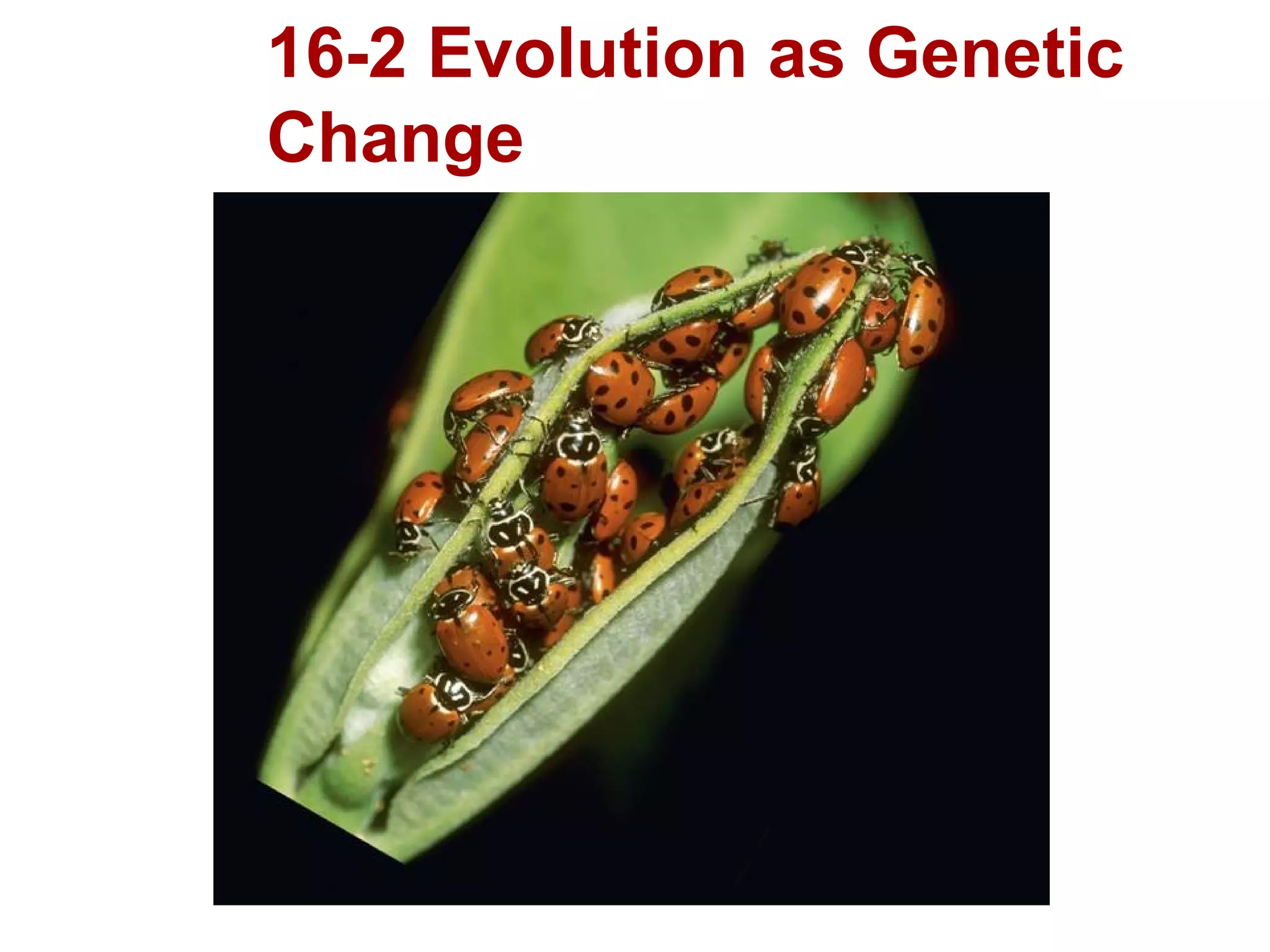
16-2 Evolution as Genetic Change 16-2 Evolution as Genetic Change
16-2 Evolution as Genetic Change Natural selection affects which individuals survive and reproduce and which do not.  If an individual dies without reproducing, its alleles are removed from the population’s gene pool.  If an individual produces many offspring, its alleles may increase in frequency.
16-2 Evolution as Genetic Change Evolution is any change over time in the relative frequencies of alleles in a population.  Populations, not individual organisms, can evolve over time. 16-2 Evolution as Genetic Change
Natural selection on single-gene traits can lead to changes in allele frequencies and thus to evolution.
Organisms of one color may produce fewer offspring than organisms of other colors.  For example, a lizard population is normally brown, but has mutations that produce red and black forms. Red lizards are more visible to predators, so they will be less likely to survive and reproduce. Therefore, the allele for red color will become rare.
Black lizards may warm up faster on cold days. This may give them energy to avoid predators. In turn, they may produce more offspring.  The allele for black color will increase in relative frequency.
 
Natural selection can affect the distributions of phenotypes in any of three ways: directional selection stabilizing selection disruptive selection
Directional Selection  When individuals at one end of the curve have higher fitness than individuals in the middle or at the other end,  directional selection  takes place.   The range of phenotypes shifts as some individuals survive and reproduce while others do not.
In this case, birds with larger beaks have higher fitness. Therefore, the average beak size increases.
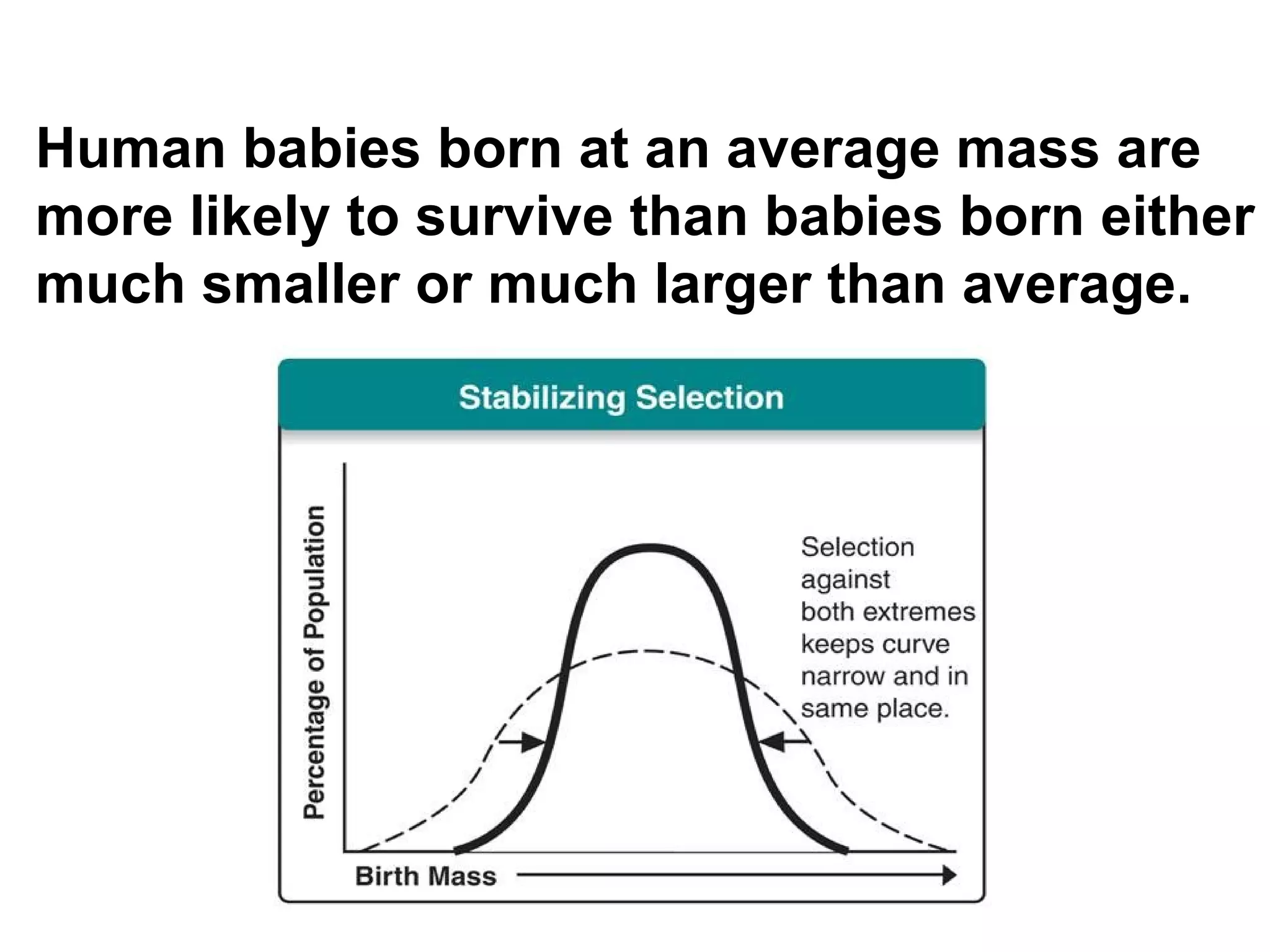
Stabilizing Selection  When individuals near the center of the curve have higher fitness than individuals at either end of the curve,  stabilizing selection  takes place. This keeps the center of the curve at its current position, but it narrows the overall graph.
Human babies born at an average mass are more likely to survive than babies born either much smaller or much larger than average.
Disruptive Selection  When individuals at the upper and lower ends of the curve have higher fitness than individuals near the middle,  disruptive selection  takes place. If the pressure of natural selection is strong enough and long enough, the curve will split, creating two distinct phenotypes.
If average-sized seeds become scarce, a bird population will split into two groups: one that eats small seeds and one that eats large seeds.
A random change in allele frequency is called  genetic drift .
In small populations , individuals that carry a particular allele may leave more descendants than other individuals do, just by chance.  Over time, a series of chance occurrences of this type can cause an allele to become common in a population.
Genetic drift may occur when a small group of individuals colonizes a new habitat.  Individuals may carry alleles in different relative frequencies than did the larger population from which they came.  The new population will be genetically different from the parent population.
Genetic Drift
 
 
Descendants Population A Population B
When allele frequencies change due to migration of a small subgroup of a population it is known as the  founder effect.
Evolution Versus Genetic Equilibrium The  Hardy-Weinberg principle  states that allele frequencies in a population will remain constant unless one or more factors cause those frequencies to change.  When allele frequencies remain constant it is called  genetic equilibrium .
Evolution Versus Genetic Equilibrium   What five conditions are needed to maintain genetic equilibrium?
Five conditions are required to maintain genetic equilibrium from generation to generation: there must be random mating, the population must be very large, there can be no movement into or out of the population, there can be no mutations, and  there can be no natural selection.
Evolution Versus Genetic Equilibrium Random Mating Random mating ensures that each individual has an equal chance of passing on its alleles to offspring. In natural populations, mating is rarely completely random. Many species select mates based on particular heritable traits.
Evolution Versus Genetic Equilibrium Large Population Genetic drift has less effect on large populations than on small ones.  Allele frequencies of large populations are less likely to be changed through the process of genetic drift.
Evolution Versus Genetic Equilibrium No Movement Into or Out of the Population  Because individuals may bring new alleles into a population, there must be no movement of individuals into or out of a population.  The population's gene pool must be kept together and kept separate from the gene pools of other populations.
Evolution Versus Genetic Equilibrium No Mutations If genes mutate, new alleles may be introduced into the population, and allele frequencies will change.
Evolution Versus Genetic Equilibrium No Natural Selection All genotypes in the population must have equal probabilities of survival and reproduction.  No phenotype can have a selective advantage over another.  There can be no natural selection operating on the population.
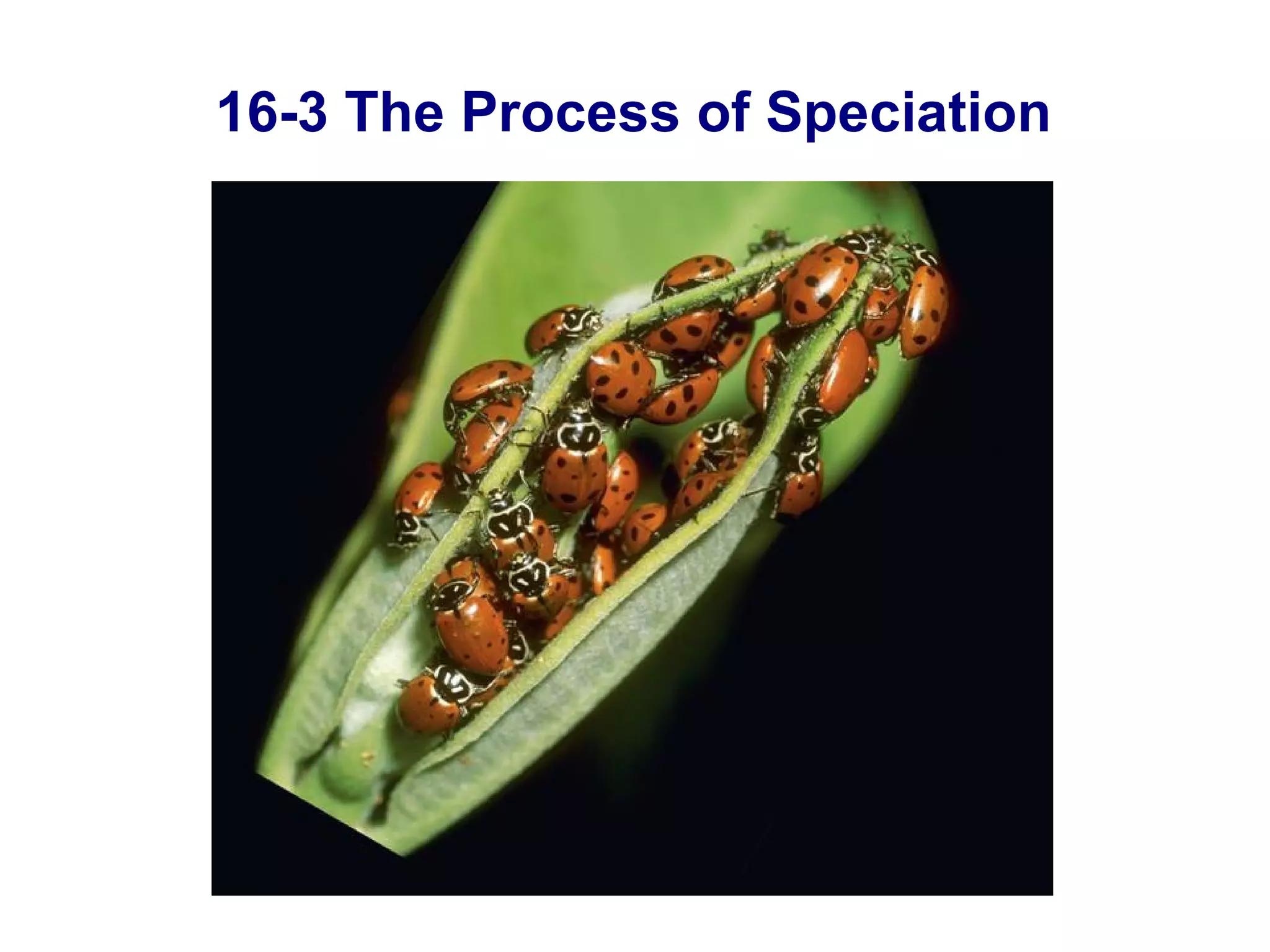
16-3 The Process of Speciation 16-3 The Process of Speciation
16-3 The Process of Speciation Natural selection and chance events can change the relative frequencies of alleles in a population and lead to speciation. Speciation  is the formation of new species. A species is a group of organisms that breed with one another and produce fertile offspring.
Isolating Mechanisms What factors are involved in the formation of new species? The gene pools of two populations must become separated for them to become new species.
Isolating Mechanisms Isolating Mechanisms As new species evolve, populations become reproductively isolated from each other. When the members of two populations cannot interbreed and produce fertile offspring,  reproductive isolation  has occurred.
Isolating Mechanisms Reproductive isolation can develop in a variety of ways, including: behavioral isolation geographic isolation temporal isolation
Isolating Mechanisms Behavioral Isolation  Behavioral isolation  occurs when two populations are capable of interbreeding but have differences in courtship rituals or other reproductive strategies that involve behavior.
Isolating Mechanisms Geographic Isolation  Geographic isolation  occurs when two populations are separated by geographic barriers such as rivers or mountains.
Isolating Mechanisms Geographic barriers do not guarantee the formation of new species.  If two formerly separated populations can still interbreed, they remain a single species.  Potential geographic barriers may separate certain types of organisms but not others.
Isolating Mechanisms Temporal Isolation   Temporal isolation  occurs when two or more species reproduce at different times.
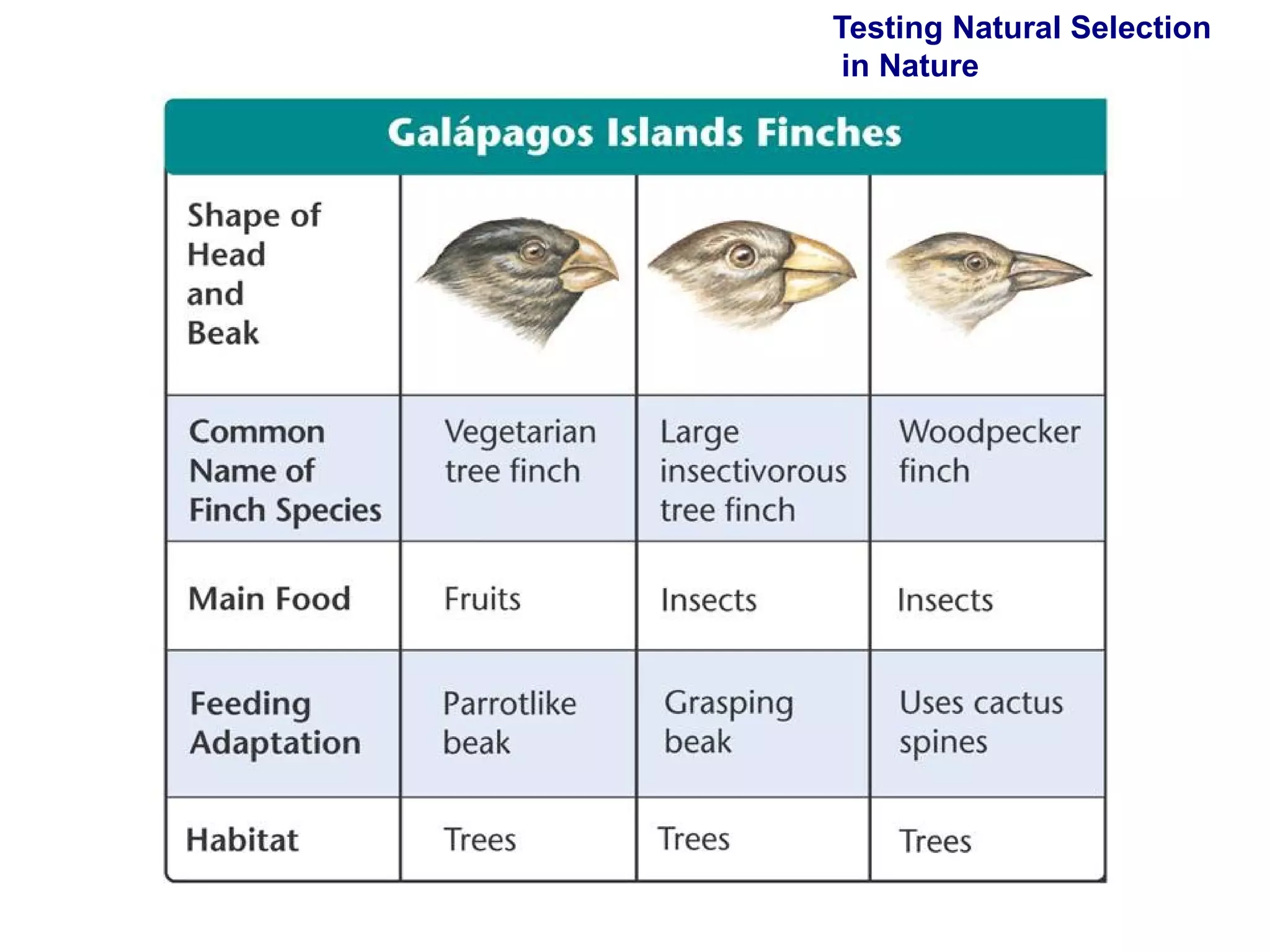
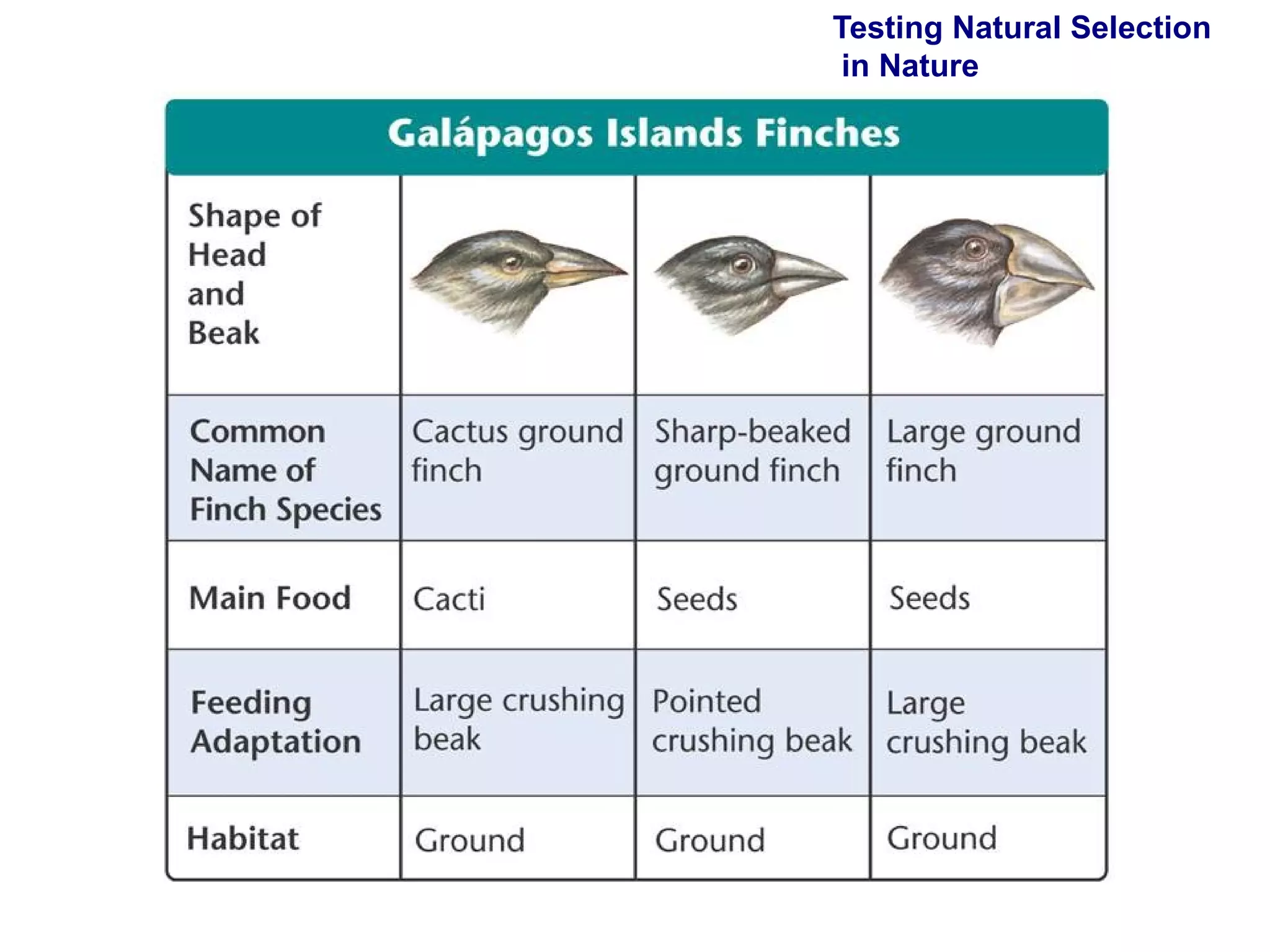
Testing Natural Selection  in Nature Testing Natural Selection in Nature Studies showing natural selection in action involve descendants of the finches that Darwin observed in the Galápagos Islands. The finches Darwin saw were different, but he hypothesized that they had descended from a common ancestor.
Testing Natural Selection  in Nature
Testing Natural Selection  in Nature Peter and Rosemary Grant tested Darwin’s hypothesis, which relied on two testable assumptions: For beak size and shape to evolve, there must be enough heritable variation in those traits to provide raw material for natural selection. Differences in beak size and shape must produce differences in fitness, causing natural selection to occur.
Testing Natural Selection  in Nature The Grants tested these hypotheses on the medium ground finch on Daphne Major, one of the Galápagos Islands.  During the rainy season, there is plenty of food.
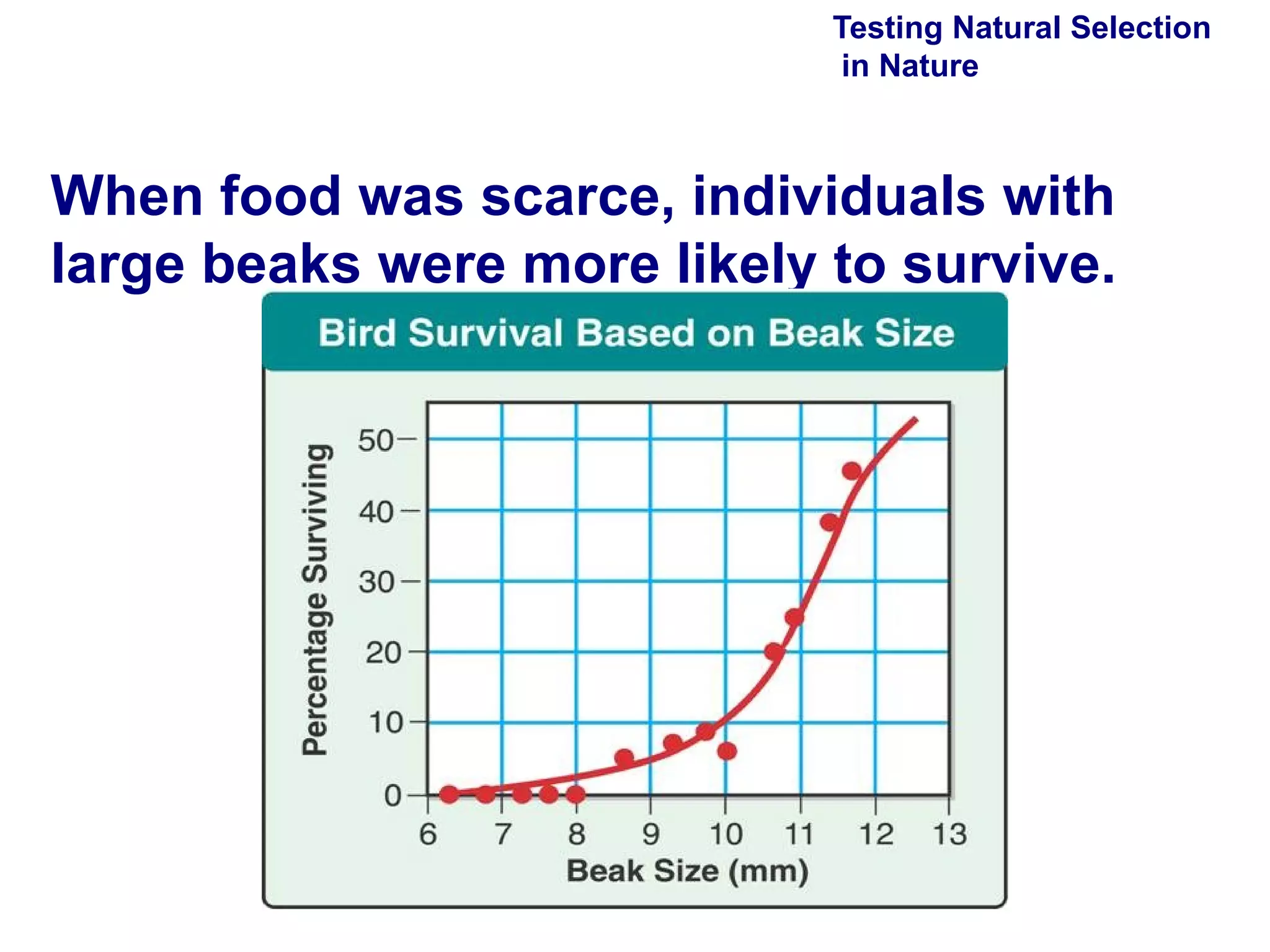
Testing Natural Selection  in Nature During droughts, food becomes scarce.  Individual birds with different-sized beaks had different chances of survival during a drought.
Testing Natural Selection  in Nature When food was scarce, individuals with large beaks were more likely to survive.
Testing Natural Selection  in Nature The Grants provided evidence of the process of evolution.  Beak size can be changed by natural selection.
Speciation in Darwin’s Finches Describe the process of speciation in the Galápagos finches.
Speciation in Darwin's Finches Speciation in Darwin's Finches Speciation in the Galápagos finches occurred by: founding of a new population geographic isolation changes in new population's gene pool reproductive isolation ecological competition
Speciation in Darwin's Finches Founders Arrive  A few finches —species A —travel from South America to one of the Gal á pagos Islands.  There, they survive and reproduce.
Speciation in Darwin's Finches Geographic Isolation Some birds from species A cross to a second island. The two populations no longer share a gene pool.
Speciation in Darwin's Finches Changes in the Gene Pool Seed sizes on the second island favor birds with large beaks. The population on the second island evolves into population B, with larger beaks.
Speciation in Darwin's Finches Reproductive Isolation If population B birds cross back to the first island, they will not mate with birds from population A. Populations A and B are separate species.
Speciation in Darwin's Finches Ecological Competition As species A and B compete for available seeds on the first island, they continue to evolve in a way that increases the differences between them.  A new species —C—may evolve.
Speciation in Darwin's Finches Continued Evolution This process of isolation, genetic change, and reproductive isolation probably repeated itself often across the entire Galápagos island chain.
Studying Evolution Since  Darwin Studying Evolution Since Darwin Scientific evidence supports the theory that living species descended with modification from common ancestors that lived in the ancient past. Scientists predict that as new fossils are found, they will continue to expand our understanding of how species evolved.
16-1 Which of the following statements is TRUE?  The relative frequency of an allele is not related to whether the allele is dominant or recessive. Mutations always affect an organism's phenotype. Crossing over decreases the number of different genotypes that appear in an offspring. Evolution does not affect the frequency of genes in a gene pool.
16-1 Most inheritable differences are a result of  gene shuffling. frequency of alleles. mutations. DNA replication.
16-1 The main sources of inherited variation are gene shuffling and mutations. gene pools and frequencies. single-gene and polygenic traits. genotypes and phenotypes.
16-1 A widow's peak in humans is an example of a(an)  invariable trait. single-gene trait. polygenic trait. mutation.
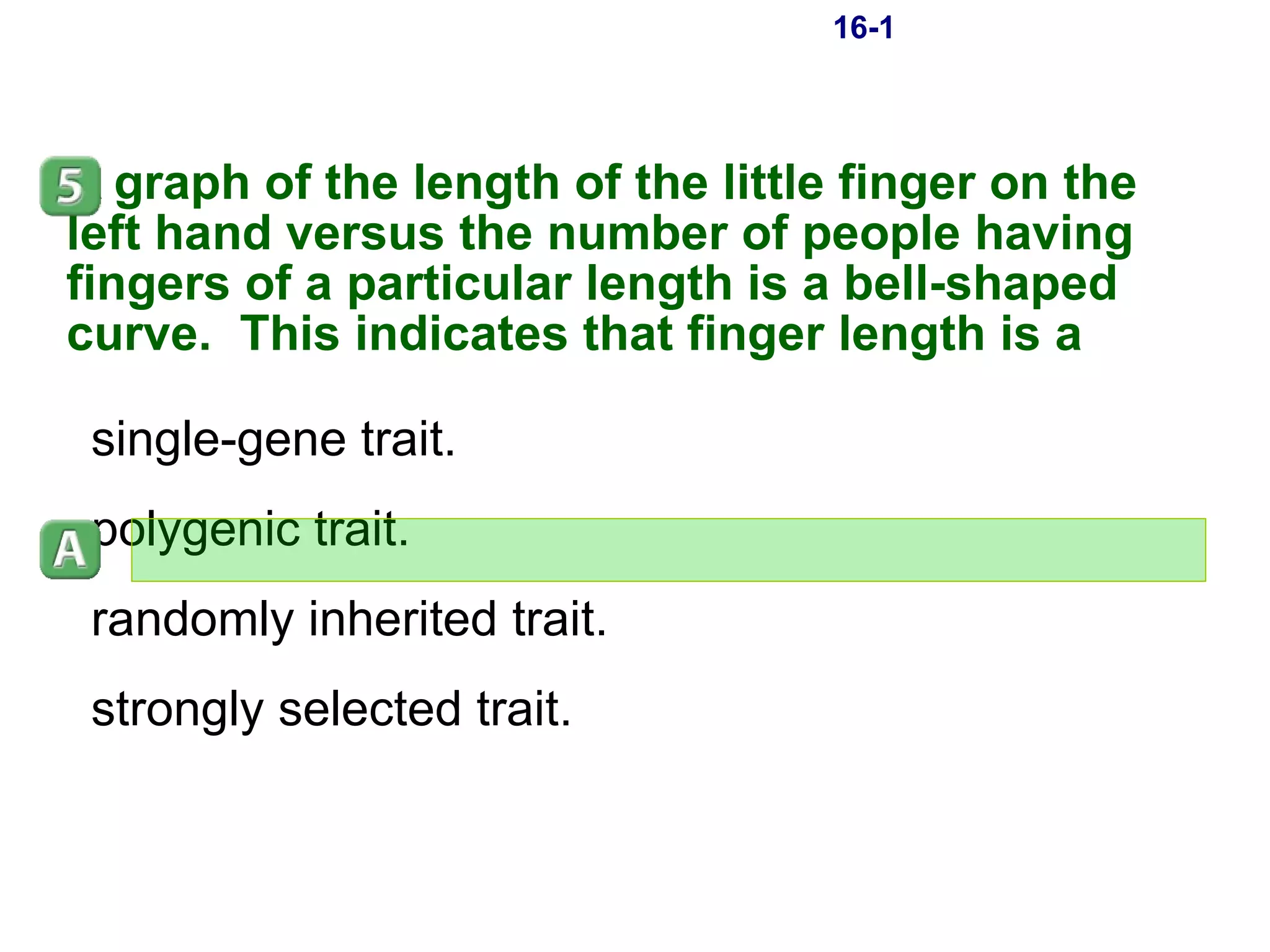
16-1 A graph of the length of the little finger on the left hand versus the number of people having fingers of a particular length is a bell-shaped curve.  This indicates that finger length is a single-gene trait. polygenic trait. randomly inherited trait. strongly selected trait.
16- 2
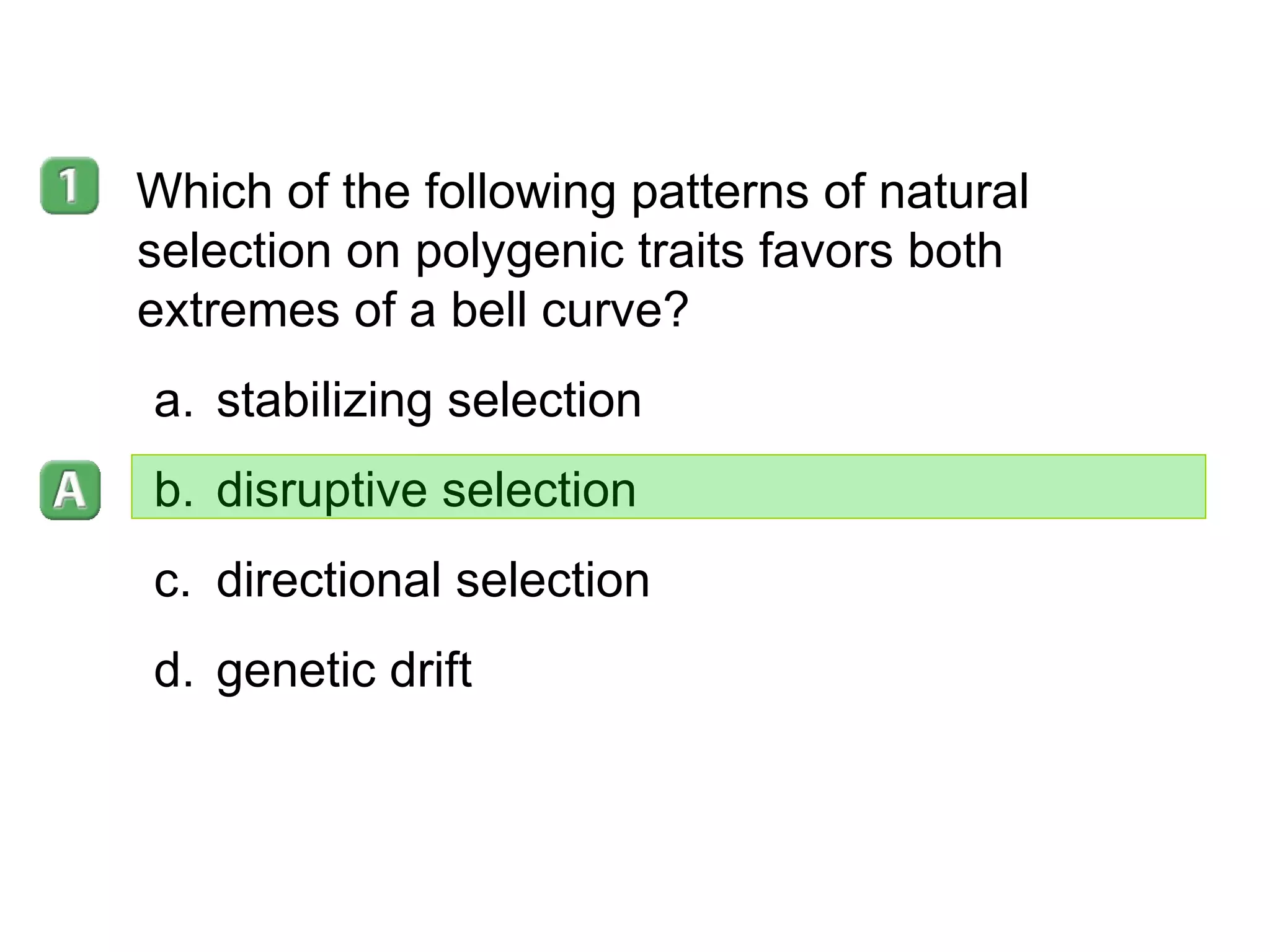
16- 2 Which of the following patterns of natural selection on polygenic traits favors both extremes of a bell curve?  stabilizing selection disruptive selection directional selection genetic drift
16- 2 Which of the following events could lead to genetic drift? A few new individuals move into a large, diverse population. A few individuals from a large, diverse population leave and establish a new population. Two large populations come back together after a few years of separation. The mutation rate in a large population increases due to pollution.
16- 2 The situation in which allele frequencies remain constant in a population is known as  genetic drift. the founder effect. genetic equilibrium. natural selection.
16- 2 Which of the following conditions is required to maintain genetic equilibrium in a population? movement in or out of the population random mating natural selection small population
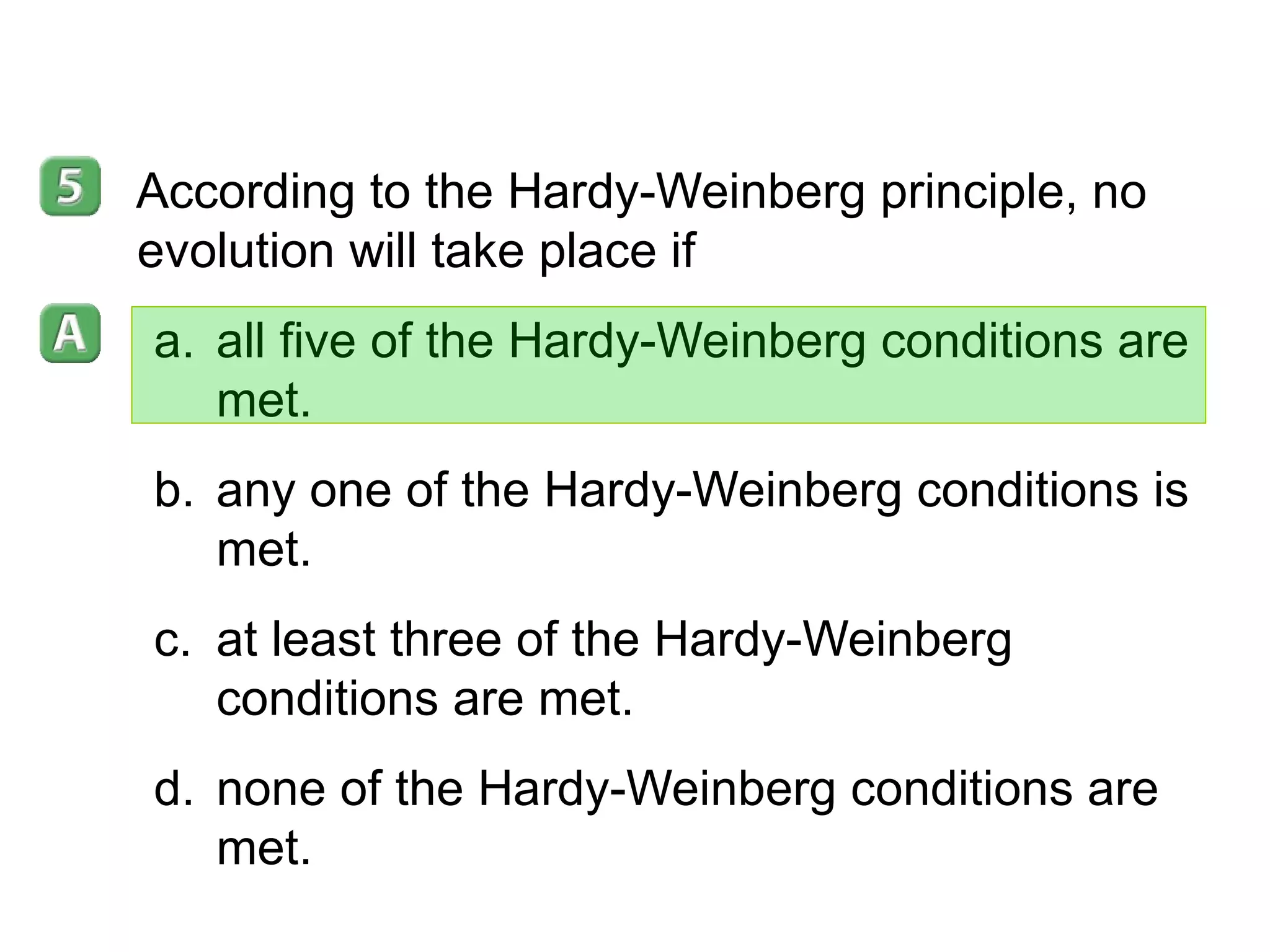
16- 2 According to the Hardy-Weinberg principle, no evolution will take place if all five of the Hardy-Weinberg conditions are met. any one of the Hardy-Weinberg conditions is met. at least three of the Hardy-Weinberg conditions are met. none of the Hardy-Weinberg conditions are met.
16- 3 When two species do not reproduce because of differences in mating rituals, the situation is referred to as  temporal isolation. geographic isolation. behavioral isolation. reproductive isolation.
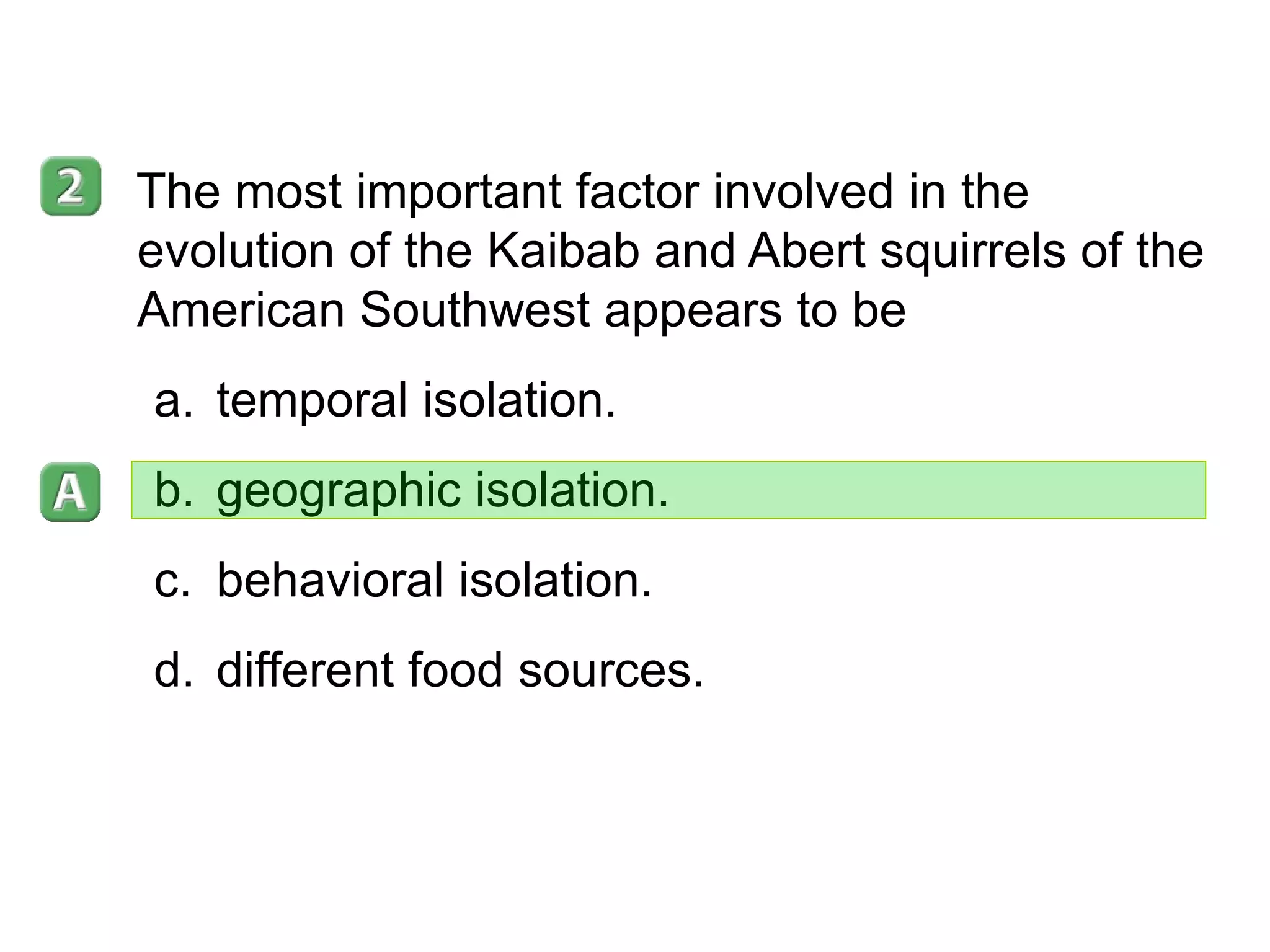
16- 3 The most important factor involved in the evolution of the Kaibab and Abert squirrels of the American Southwest appears to be temporal isolation. geographic isolation. behavioral isolation. different food sources.
16- 3 One finding of the Grants' research on generations of Galápagos finches was that  natural selection did not occur in the finches natural selection can take place often and very rapidly. beak size had no effect on survival rate of the finches. natural selection was slow and permanent.
16- 3 All of the following played a role in speciation of Galápagos finches EXCEPT  no changes in the gene pool. separation of populations. reproductive isolation. natural selection.
16- 3 Beak size in the various groups of Galápagos finches changed primarily in response to climate. mating preference. food source. availability of water.
END OF SECTION

Bio16 speciation

  • 1.
    16-1 Genes andVariation 16-1 Genes and Variation
  • 2.
    How Common IsGenetic Variation? Many genes have at least two forms, or alleles. All organisms have genetic variation that is “invisible” because it involves small differences in biochemical processes. An individual organism is heterozygous for many genes.
  • 3.
    Genetic variation isstudied in populations. A population is a group of individuals of the same species that interbreed. A gene pool consists of all genes, including all the different alleles, that are present in a population.
  • 4.
    The relativefrequency of an allele is the number of times the allele occurs in a gene pool, compared with the number of times other alleles for the same gene occur. Relative frequency is often expressed as a percentage.
  • 5.
    Gene Pool forFur Color in Mice Sample Population Frequency of Alleles allele for brown fur allele for black fur
  • 6.
    Evolution is anychange in the relative frequency of alleles in a population.
  • 7.
    The two mainsources of genetic variation are mutations and the genetic shuffling that results from sexual reproduction.
  • 8.
    A mutation isany change in a sequence of DNA. Mutations occur because of mistakes in DNA replication or as a result of radiation or chemicals in the environment. Mutations do not always affect an organism’s phenotype.
  • 9.
    Most heritable differencesare due to gene shuffling. Crossing-over increases the number of genotypes that can appear in offspring. Sexual reproduction produces different phenotypes, but it does not change the relative frequency of alleles in a population.
  • 10.
    Single-Gene and PolygenicTraits The number of phenotypes produced for a given trait depends on how many genes control the trait.
  • 11.
    A single-genetrait is controlled by one gene that has two alleles. Variation in this gene leads to only two possible phenotypes.
  • 12.
    The allele fora widow’s peak is dominant over the allele for a hairline with no peak. However, the presence of a widow’s peak may be less common in a population. In real populations, phenotypic ratios are determined by the frequency of alleles as well as by whether the alleles are dominant or recessive.
  • 13.
    Many traits arecontrolled by two or more genes and are called polygenic traits . One polygenic trait can have many possible genotypes and phenotypes. Height in humans is a polygenic trait.
  • 14.
    A bell-shaped curveis typical of polygenic traits. A bell-shaped curve is also called normal distribution.
  • 15.
    16-2 Evolution as GeneticChange 16-2 Evolution as Genetic Change
  • 16.
    16-2 Evolution as GeneticChange Natural selection affects which individuals survive and reproduce and which do not. If an individual dies without reproducing, its alleles are removed from the population’s gene pool. If an individual produces many offspring, its alleles may increase in frequency.
  • 17.
    16-2 Evolution as GeneticChange Evolution is any change over time in the relative frequencies of alleles in a population. Populations, not individual organisms, can evolve over time. 16-2 Evolution as Genetic Change
  • 18.
    Natural selection onsingle-gene traits can lead to changes in allele frequencies and thus to evolution.
  • 19.
    Organisms of onecolor may produce fewer offspring than organisms of other colors. For example, a lizard population is normally brown, but has mutations that produce red and black forms. Red lizards are more visible to predators, so they will be less likely to survive and reproduce. Therefore, the allele for red color will become rare.
  • 20.
    Black lizards maywarm up faster on cold days. This may give them energy to avoid predators. In turn, they may produce more offspring. The allele for black color will increase in relative frequency.
  • 21.
  • 22.
    Natural selection canaffect the distributions of phenotypes in any of three ways: directional selection stabilizing selection disruptive selection
  • 23.
    Directional Selection  Whenindividuals at one end of the curve have higher fitness than individuals in the middle or at the other end, directional selection takes place. The range of phenotypes shifts as some individuals survive and reproduce while others do not.
  • 24.
    In this case,birds with larger beaks have higher fitness. Therefore, the average beak size increases.
  • 25.
    Stabilizing Selection  Whenindividuals near the center of the curve have higher fitness than individuals at either end of the curve, stabilizing selection takes place. This keeps the center of the curve at its current position, but it narrows the overall graph.
  • 26.
    Human babies bornat an average mass are more likely to survive than babies born either much smaller or much larger than average.
  • 27.
    Disruptive Selection  Whenindividuals at the upper and lower ends of the curve have higher fitness than individuals near the middle, disruptive selection takes place. If the pressure of natural selection is strong enough and long enough, the curve will split, creating two distinct phenotypes.
  • 28.
    If average-sized seedsbecome scarce, a bird population will split into two groups: one that eats small seeds and one that eats large seeds.
  • 29.
    A random changein allele frequency is called genetic drift .
  • 30.
    In small populations, individuals that carry a particular allele may leave more descendants than other individuals do, just by chance. Over time, a series of chance occurrences of this type can cause an allele to become common in a population.
  • 31.
    Genetic drift mayoccur when a small group of individuals colonizes a new habitat. Individuals may carry alleles in different relative frequencies than did the larger population from which they came. The new population will be genetically different from the parent population.
  • 32.
  • 33.
  • 34.
  • 35.
  • 36.
    When allele frequencieschange due to migration of a small subgroup of a population it is known as the founder effect.
  • 37.
    Evolution Versus GeneticEquilibrium The Hardy-Weinberg principle states that allele frequencies in a population will remain constant unless one or more factors cause those frequencies to change. When allele frequencies remain constant it is called genetic equilibrium .
  • 38.
    Evolution Versus GeneticEquilibrium What five conditions are needed to maintain genetic equilibrium?
  • 39.
    Five conditions arerequired to maintain genetic equilibrium from generation to generation: there must be random mating, the population must be very large, there can be no movement into or out of the population, there can be no mutations, and there can be no natural selection.
  • 40.
    Evolution Versus GeneticEquilibrium Random Mating Random mating ensures that each individual has an equal chance of passing on its alleles to offspring. In natural populations, mating is rarely completely random. Many species select mates based on particular heritable traits.
  • 41.
    Evolution Versus GeneticEquilibrium Large Population Genetic drift has less effect on large populations than on small ones. Allele frequencies of large populations are less likely to be changed through the process of genetic drift.
  • 42.
    Evolution Versus GeneticEquilibrium No Movement Into or Out of the Population  Because individuals may bring new alleles into a population, there must be no movement of individuals into or out of a population. The population's gene pool must be kept together and kept separate from the gene pools of other populations.
  • 43.
    Evolution Versus GeneticEquilibrium No Mutations If genes mutate, new alleles may be introduced into the population, and allele frequencies will change.
  • 44.
    Evolution Versus GeneticEquilibrium No Natural Selection All genotypes in the population must have equal probabilities of survival and reproduction. No phenotype can have a selective advantage over another. There can be no natural selection operating on the population.
  • 45.
    16-3 The Process ofSpeciation 16-3 The Process of Speciation
  • 46.
    16-3 The Process ofSpeciation Natural selection and chance events can change the relative frequencies of alleles in a population and lead to speciation. Speciation is the formation of new species. A species is a group of organisms that breed with one another and produce fertile offspring.
  • 47.
    Isolating Mechanisms Whatfactors are involved in the formation of new species? The gene pools of two populations must become separated for them to become new species.
  • 48.
    Isolating Mechanisms IsolatingMechanisms As new species evolve, populations become reproductively isolated from each other. When the members of two populations cannot interbreed and produce fertile offspring, reproductive isolation has occurred.
  • 49.
    Isolating Mechanisms Reproductiveisolation can develop in a variety of ways, including: behavioral isolation geographic isolation temporal isolation
  • 50.
    Isolating Mechanisms BehavioralIsolation  Behavioral isolation occurs when two populations are capable of interbreeding but have differences in courtship rituals or other reproductive strategies that involve behavior.
  • 51.
    Isolating Mechanisms GeographicIsolation  Geographic isolation occurs when two populations are separated by geographic barriers such as rivers or mountains.
  • 52.
    Isolating Mechanisms Geographicbarriers do not guarantee the formation of new species. If two formerly separated populations can still interbreed, they remain a single species. Potential geographic barriers may separate certain types of organisms but not others.
  • 53.
    Isolating Mechanisms TemporalIsolation   Temporal isolation occurs when two or more species reproduce at different times.
  • 54.
    Testing Natural Selection in Nature Testing Natural Selection in Nature Studies showing natural selection in action involve descendants of the finches that Darwin observed in the Galápagos Islands. The finches Darwin saw were different, but he hypothesized that they had descended from a common ancestor.
  • 55.
  • 56.
  • 57.
    Testing Natural Selection in Nature Peter and Rosemary Grant tested Darwin’s hypothesis, which relied on two testable assumptions: For beak size and shape to evolve, there must be enough heritable variation in those traits to provide raw material for natural selection. Differences in beak size and shape must produce differences in fitness, causing natural selection to occur.
  • 58.
    Testing Natural Selection in Nature The Grants tested these hypotheses on the medium ground finch on Daphne Major, one of the Galápagos Islands. During the rainy season, there is plenty of food.
  • 59.
    Testing Natural Selection in Nature During droughts, food becomes scarce. Individual birds with different-sized beaks had different chances of survival during a drought.
  • 60.
    Testing Natural Selection in Nature When food was scarce, individuals with large beaks were more likely to survive.
  • 61.
    Testing Natural Selection in Nature The Grants provided evidence of the process of evolution. Beak size can be changed by natural selection.
  • 62.
    Speciation in Darwin’sFinches Describe the process of speciation in the Galápagos finches.
  • 63.
    Speciation in Darwin'sFinches Speciation in Darwin's Finches Speciation in the Galápagos finches occurred by: founding of a new population geographic isolation changes in new population's gene pool reproductive isolation ecological competition
  • 64.
    Speciation in Darwin'sFinches Founders Arrive  A few finches —species A —travel from South America to one of the Gal á pagos Islands. There, they survive and reproduce.
  • 65.
    Speciation in Darwin'sFinches Geographic Isolation Some birds from species A cross to a second island. The two populations no longer share a gene pool.
  • 66.
    Speciation in Darwin'sFinches Changes in the Gene Pool Seed sizes on the second island favor birds with large beaks. The population on the second island evolves into population B, with larger beaks.
  • 67.
    Speciation in Darwin'sFinches Reproductive Isolation If population B birds cross back to the first island, they will not mate with birds from population A. Populations A and B are separate species.
  • 68.
    Speciation in Darwin'sFinches Ecological Competition As species A and B compete for available seeds on the first island, they continue to evolve in a way that increases the differences between them. A new species —C—may evolve.
  • 69.
    Speciation in Darwin'sFinches Continued Evolution This process of isolation, genetic change, and reproductive isolation probably repeated itself often across the entire Galápagos island chain.
  • 70.
    Studying Evolution Since Darwin Studying Evolution Since Darwin Scientific evidence supports the theory that living species descended with modification from common ancestors that lived in the ancient past. Scientists predict that as new fossils are found, they will continue to expand our understanding of how species evolved.
  • 71.
    16-1 Which ofthe following statements is TRUE? The relative frequency of an allele is not related to whether the allele is dominant or recessive. Mutations always affect an organism's phenotype. Crossing over decreases the number of different genotypes that appear in an offspring. Evolution does not affect the frequency of genes in a gene pool.
  • 72.
    16-1 Most inheritabledifferences are a result of gene shuffling. frequency of alleles. mutations. DNA replication.
  • 73.
    16-1 The mainsources of inherited variation are gene shuffling and mutations. gene pools and frequencies. single-gene and polygenic traits. genotypes and phenotypes.
  • 74.
    16-1 A widow'speak in humans is an example of a(an) invariable trait. single-gene trait. polygenic trait. mutation.
  • 75.
    16-1 A graphof the length of the little finger on the left hand versus the number of people having fingers of a particular length is a bell-shaped curve. This indicates that finger length is a single-gene trait. polygenic trait. randomly inherited trait. strongly selected trait.
  • 76.
  • 77.
    16- 2 Whichof the following patterns of natural selection on polygenic traits favors both extremes of a bell curve? stabilizing selection disruptive selection directional selection genetic drift
  • 78.
    16- 2 Whichof the following events could lead to genetic drift? A few new individuals move into a large, diverse population. A few individuals from a large, diverse population leave and establish a new population. Two large populations come back together after a few years of separation. The mutation rate in a large population increases due to pollution.
  • 79.
    16- 2 Thesituation in which allele frequencies remain constant in a population is known as genetic drift. the founder effect. genetic equilibrium. natural selection.
  • 80.
    16- 2 Whichof the following conditions is required to maintain genetic equilibrium in a population? movement in or out of the population random mating natural selection small population
  • 81.
    16- 2 Accordingto the Hardy-Weinberg principle, no evolution will take place if all five of the Hardy-Weinberg conditions are met. any one of the Hardy-Weinberg conditions is met. at least three of the Hardy-Weinberg conditions are met. none of the Hardy-Weinberg conditions are met.
  • 82.
    16- 3 Whentwo species do not reproduce because of differences in mating rituals, the situation is referred to as temporal isolation. geographic isolation. behavioral isolation. reproductive isolation.
  • 83.
    16- 3 Themost important factor involved in the evolution of the Kaibab and Abert squirrels of the American Southwest appears to be temporal isolation. geographic isolation. behavioral isolation. different food sources.
  • 84.
    16- 3 Onefinding of the Grants' research on generations of Galápagos finches was that natural selection did not occur in the finches natural selection can take place often and very rapidly. beak size had no effect on survival rate of the finches. natural selection was slow and permanent.
  • 85.
    16- 3 Allof the following played a role in speciation of Galápagos finches EXCEPT no changes in the gene pool. separation of populations. reproductive isolation. natural selection.
  • 86.
    16- 3 Beaksize in the various groups of Galápagos finches changed primarily in response to climate. mating preference. food source. availability of water.
  • 87.

Editor's Notes

  • #2 Photo credit: ©MURRAY, PATTI/Animals Animals Enterprises